




Abstract
Amid ongoing debates over integration failures in Europe, this article examines an important yet understudied area: public perceptions of integration. Previous studies have largely focused on isolated aspects of public opinion, especially cultural elements, offering limited insights into how citizens define successful integration and perceive policy shortcomings. This article expands the scope with a data-driven, two-step approach that enables an open exploration of integration attitudes, unconstrained by predefined categories. Using open-ended responses, it captures citizens’ views on what they deem essential for successful integration, while latent class analysis is applied to identify distinct groups with shared perspectives. Substantively, the analysis provides insights into the diverse nature of public opinion on integration, challenging oversimplified measures and bringing to light previously overlooked patterns. Methodologically, it offers a flexible framework for examining public opinion, forming a basis for future cross-country comparisons seeking to enhance our understanding of public sentiment on integration.
Keywords
Over the past three decades, immigrant integration has become a deeply politicized issue in European politics, with heightened debates about its failure (Aleksynska and Algan, 2010; Hutter and Kriesi, 2022). Once confined to radical right-wing rhetoric, this belief has gradually entered mainstream discourse (Lesińska, 2014; Mikelatou and Arvanitis, 2019) and public opinion (Dražanová et al., 2020). While pessimism about immigrant integration is evident in public opinion, research in this area remains limited, focusing predominantly on cultural aspects, such as preferences for multicultural policies versus assimilation (e.g. Breugelmans and Van De Vijver, 2004; Stogianni et al., 2021). Given the complex nature of integration, existing studies thus provide only a limited view of public preferences (Sobolewska et al., 2017: 59), leaving much to be understood about how people envision successful integration and what they perceive as lacking in past and present policies. Addressing these gaps, this article adopts a data-driven approach to openly explore public attitudes, moving beyond predefined and isolated measures.
More sophisticated methods for measuring public perceptions of integration are essential not only to advance scientific knowledge (Sobolewska et al., 2017) but also due to their societal and democratic implications. Perceived policy failures can erode political trust and civic engagement (Cheng and Liu, 2018), both critical components of a healthy democracy (Hetherington and Rudolph, 2018). In the context of immigration, poorly perceived policies can also foster hostility toward immigrant groups (Saxton and Benson, 2003), further marginalizing these communities and fueling social unrest (Schierup and Ålund, 2011). In addition, negative perceptions may increase support for authoritarian and xenophobic parties (Norris and Inglehart, 2019), deepen political polarization, and undermine democratic processes (McCoy et al., 2018). Conflicts over cultural values, such as immigration and national identity, have become central drivers of polarization in Europe and beyond (Hutter and Kriesi, 2022; Norris and Inglehart, 2019). While some degree of polarization is inherent to democracy, offering voters meaningful choices, excessive polarization can impede policy dialogue, cooperation, and effective governance (McCoy et al., 2018), undermine trust in political institutions (Hetherington and Rudolph, 2018), and foster an “us versus them” mentality marked by group loyalty and hostility toward opponents (Iyengar and Westwood, 2015; McCoy et al., 2018). These risks, coupled with heightened immigration-related tensions in European politics, underscore the need for further understanding of public opinion and its drivers, for policymakers and scientists alike.
To gain a comprehensive measure of public attitudes, this article employs a two-step, data-driven approach. First, it explores what individuals deem essential for successful integration through open-ended questions, capturing public perspectives unbounded by predefined categories. Second, it applies latent class analysis (LCA) to identify groups with shared views on integration based on observable patterns in their responses (Sinha et al., 2021).
The study draws on survey data from Sweden, a country once viewed as a liberal outlier in European immigration politics but now considered more aligned with broader European practices (Dahlstedt and Neergaard, 2019; Demker and Odmalm, 2022; Rydgren and Van der Meiden, 2019). The rise of a right-wing populist party in 2010, coupled with the 2015 migration crisis, intensified political and media attention on immigration in Sweden (Oscarsson and Strömbäck, 2019), and led to the adoption of more restrictive policies (Demker and Odmalm, 2022). As in much of Western Europe, Sweden’s political discourse also increasingly addresses the cultural dimensions of integration, with concerns about the erosion of liberal values and Swedish identity featuring prominently (Dahlstedt and Eliassi, 2018). Given these developments, this study may offer insights into broader trends in European public attitudes. Its primary goal, however, is to establish a framework for future cross-country research seeking a more inclusive understanding of public opinion.
In brief, the study affirms some recent findings that public opinion on integration is multidimensional; it contributes to these by showing that different dimensions are articulated by distinct groups. In addition, the study uncovers previously overlooked components and patterns in citizens’ attitudes, illustrating the value of an inductive approach for identifying emerging or underexplored aspects of public opinion. The article concludes with a discussion on how these insights can guide future research.
Integration as a Multidimensional Concept
Building on previous research, this article adopts a multidimensional definition of integration, categorized into three broad dimensions: structural, cultural, and social (e.g. Bosswick and Heckmann, 2006; Heckmann and Schnapper, 2003). The structural dimension refers to immigrants’ participation in and access to key institutions within the host society, such as the labor market, housing, and welfare system. Immigrants are considered structurally integrated when they attain positions comparable to those of native citizens.
Cultural integration involves the transformation of norms, values, and behaviors through interactions among individuals from diverse cultural backgrounds. Unlike structural integration, which is unidirectional—where greater participation in societal institutions reflects higher integration—cultural integration is bidirectional, spanning from cultural assimilation to multiculturalism (Bosswick and Heckmann, 2006). Assimilation is primarily a one-sided process in which immigrants replace their original culture with that of the host country, aiming for cultural homogeneity. In contrast, multiculturalism allows immigrants to maintain their cultural identities within a shared national framework (Bosswick and Heckmann, 2006). At the opposite end of assimilation (sometimes considered an extreme version of multiculturalism) is “differentialism,” where immigrants either self-segregate or are excluded from the host culture, forming distinct ethnic sub-societies with their own norms and values (Bosswick and Heckmann, 2006; Brubaker, 2001; Joppke, 2007). In the literature, France is frequently cited as an example of the assimilation model, the Netherlands and Sweden represent the multicultural model, while Germany, by contrast, has exemplified the differential approach (Brubaker, 2001; Joppke, 2007; Scholten et al., 2015).
The concept of social integration encompasses what Bosswick and Heckmann (2006) call “interactional” and “identificational” integration. This dimension includes participation in personal relationships and social networks, such as friendships, marriages, and membership in voluntary organizations (interactional integration), and the individual’s sense of belonging to the host society (identificational integration).
Language acquisition, finally, is considered critical for integration in all three dimensions (Bosswick and Heckmann, 2006). It appears as a key component in studies examining public perceptions of integration (Dražanová et al., 2020; Sanhueza Petrarca and Demker, 2019; Sobolewska et al., 2017) and in related studies on what it means to be a “true citizen” (Oscarsson, 2019; Stokes, 2017).
Integration in European Politics
As a response to World War II, when cultural assimilation became synonymous with the coercive oppression of minority cultures, many European welfare states adopted a human-rights-based model of integration, prioritizing immigrants’ access to essential institutions like the labor market and welfare system, while safeguarding their right to maintain their cultural heritage (Bosswick and Heckmann, 2006; Mouritsen et al., 2019; Soysal, 2012).
Lately, however, Europe’s embrace of cultural diversity and tolerance has come under increasing criticism. Multicultural policies are often blamed for alleged integration failures (Lesińska, 2014; Meer et al., 2015; Mikelatou and Arvanitis, 2019), prompting a shift toward a stricter “civic integration” model. This model repositions integration responsibilities from the state to individuals, emphasizing duties over rights, and ties societal membership to employability, economic self-sufficiency, and adoption of “liberal values” (Joppke, 2007; Meer et al., 2015; Mouritsen et al., 2019; Soysal, 2012). In practice, this approach manifests in mandatory civic integration courses and tests on the host country’s culture, traditions, and values, along with language proficiency and employment requirements for residency, citizenship, and entry (Joppke, 2007; Meer et al., 2015; Mouritsen et al., 2019; Soysal, 2012).
These developments should be viewed not only in the light of changing nation-states and migration flows but also against a shifting political discourse around “immigrant culture.” Economic concerns, such as welfare dependency, unemployment, and financial pressures on host societies are recurring themes in European political and media discussions on immigration (Eberl et al., 2018; Lesińska, 2014; McKeever, 2020; Strömbäck et al., 2017). Recently, however, social and cultural issues have become more prominent in these debates (Lesińska, 2014; McKeever, 2020; Mikelatou and Arvanitis, 2019). This shift is particularly evident in discussions on immigrant integration, where cultural concerns dominate, while economic factors remain central in broader immigration discourse (Helbling, 2014).
At times, cultural and economic concerns intersect. In early twenty-first-century Sweden, for example, terms like “welfare dependency” and “distrust” were depicted as “cultural expressions” underlying socioeconomic marginalization in ethnically segregated suburbs (Dahlstedt and Neergaard, 2019: 128). Increasingly, however, cultural debates on integration have shifted toward concerns about the effects of diversity on national cohesion, with shared values taking a central place (Dahlstedt and Eliassi, 2018; Lesińska, 2014; McKeever, 2020; Mikelatou and Arvanitis, 2019).
Between 2010 and 2011, prominent European conservative leaders such as Angela Merkel (Germany), David Cameron (UK), and Nicolas Sarkozy (France) publicly declared multiculturalism a failure. They equated it with cultural relativism and linked it to the rise of religious fundamentalism, especially within Muslim communities, which they viewed as a threat to core liberal values foundational to the European welfare states, such as autonomy and gender equality (e.g. Lesińska, 2014; McKeever, 2020). Similar debates have unfolded across Europe regarding religious symbols, like the full-face veil in Switzerland, Belgium, and France (Aleksynska and Algan, 2010; McKeever, 2020; Mikelatou and Arvanitis, 2019), and discussions on “Leitkultur” in Germany (Loch, 2014; Scholten et al., 2015).
Concerns about the cultural impact of immigration on interethnic conflict, violence, and criminality have furthermore grown in Europe (Brubaker, 2001; Dahlstedt and Neergaard, 2019; Lesińska, 2014; Scholten et al., 2015). In Sweden, for instance, discussions around ethnic enclaves and gangs in segregated suburbs, perceived as fostering criminality and a “culture of violence,” have become prominent (Dahlstedt and Neergaard, 2019). Similar concerns appear in discussions about a “ghettoization” of immigrant-dense areas in, for example, the United Kingdom, Denmark, and France (e.g. Loch, 2014; Scholten et al., 2015). These fears have intensified during periods of heightened conflict, such as the violent riots in ethnically segregated areas of France (2005) and Britain (2011), and in the wake of events like 9/11 and subsequent terrorist attacks in Europe, where political and media narratives frequently cite the radicalization of Islamic migrants as a contributing factor (McKeever, 2020; Mikelatou and Arvanitis, 2019; Scholten et al., 2015).
Public Views of What Is Central to a Successful Integration of Immigrants
When it comes to the public views on integration, existing research has predominantly focused on the cultural dimension. Findings from this field largely support the political narrative that multiculturalism has failed, with most studies indicating a general preference for cultural assimilation among native Europeans (e.g. Callens et al., 2014; Stogianni et al., 2021). However, Sobolewska et al. (2017) argue that this apparent consensus may stem from the use of overly simplistic measures in prior research, where respondents are often given binary options, such as choosing between multiculturalism and cultural assimilation (Sobolewska et al., 2017). These binary measures may fail to capture the full complexity of public attitudes, thus providing an incomplete view of public opinion.
To provide a more nuanced perspective, Sobolewska et al. (2017) examined public perceptions of successful integration without using politically charged terms like “multiculturalism” or “assimilation.” Their study used survey experiments in which participants evaluated fictitious individuals with immigrant backgrounds, each randomly assigned different combinations of integration characteristics (e.g. interethnic friendships, education, religiosity). Respondents then assessed how integrated they believed these individuals to be. Findings showed that participants held a multidimensional view of integration, extending beyond the cultural one. Although cultural assimilation appeared as central to being perceived as integrated, other aspects—such as interethnic friendships and language acquisition—also mattered (Sobolewska et al., 2017).
Another example of a study that explored a wider range of integration factors is Sanhueza Petrarca and Demker (2019), who investigated public support for integration policies related to the structural and social dimensions in Sweden. They found high support for policies such as language courses, social orientation classes, and anti-discrimination measures, while support for labor market policies, mother tongue teaching, and housing policies was relatively lower. Dražanová et al. (2020), furthermore, examined public views on nine integration factors across cultural, social, and structural dimensions, using data from a 2017 Special Eurobarometer survey. They found that respondents across most EU countries held similar views on what is central to successful integration, prioritizing factors like speaking the host country’s language, contributing to the welfare system, and adhering to the host society’s values (Dražanová et al., 2020).
While some studies thus have adopted a broader approach to examining public views on integration, these remain limited and still rely on researcher-selected criteria. To gain a more comprehensive assessment, the current study first asks open questions, allowing respondents to freely express the factors they consider essential for integration, unbound by predefined categories. It further explores whether there are groups that share similar views, by exploring patterns in those responses:
RQ1: What components do people consider essential for successful integration?
RQ2: Are there distinct groups who share views on the essential components of successful integration?
Factors Shaping Perceptions of the Key Components for Successful Integration
To gain a deeper understanding of public perceptions of successful integration and the factors shaping different views, the role of socioeconomic and political background is considered.
Education and employment status, first, may play a role in how people prioritize all three dimensions of integration. First, numerous studies indicate that individuals with lower education levels and labor market skills are more likely to oppose immigration (e.g. Card et al., 2012; Dustmann and Preston, 2007). This opposition is often attributed to economic concerns, where individuals with lower economic status and security may be more likely to perceive immigrants as a threat to their economic well-being, as they are more vulnerable to competition for jobs and welfare resources (e.g. Bloom et al., 2015; Heizmann and Huth, 2021). Similar findings are observed in the context of integration attitudes. Sanhueza Petrarca and Demker (2019) found that individuals with lower education and income levels were more critical of policies designed to support immigrants in the housing and labor markets. Other studies suggest that those with lower educational backgrounds are more likely to oppose welfare support for immigrants (Van der Waal et al., 2010) and to view immigrants’ contributions to the welfare system as critical for successful integration (Dražanová et al., 2020). Collectively, these findings suggest that individuals with lower socioeconomic status—such as the less educated or unemployed—will be more inclined to place weight on stricter demands on immigrants’ structural integration.
In addition, education may matter for how people prioritize the social and cultural dimensions. Potentially reflecting a broader role of education in fostering tolerance and acceptance of diversity (Hainmueller and Hiscox, 2007) and reducing perceptions of immigrants as cultural threats (Bloom et al., 2015), higher levels of education have been found to be associated with a stronger emphasis on social participation, and a weaker emphasis on cultural adjustments, as factors for successful integration (Dražanová et al., 2020).
Ethnic background may furthermore play a role in what people consider important. First, native-born individuals tend to find cultural assimilation important for integration, while foreign-born are more supportive of multicultural policies (Callens et al., 2014; Stogianni et al., 2021). Second, native-born tend to be more skeptical of welfare redistribution and more concerned about welfare abuse than foreign-born (Goossen et al., 2021; Reeskens and Van Oorschot, 2015)—concerns that are frequently invoked as a political justification for imposing stricter demands on immigrants than on their native-born counterparts (Van Oorschot et al., 2017). These findings suggest that native-born citizens will place stronger emphasis on immigrants’ structural integration as well as their adjustments to the host country’s culture, compared to those with a foreign background.
Sex may shape attitudes on the economic and cultural dimensions. First, men tend to be more negative about welfare spending and more suspicious of welfare abuse than women (Goossen et al., 2021; Reeskens and Van Oorschot, 2015), suggesting they will place greater emphasis on immigrants’ structural integration and self-sufficiency. Second, men have been shown to perceive cultural assimilation as more important for integration than women (Dražanová et al., 2020; Stogianni et al., 2021).
Age, instead, has been found to influence priorities of the cultural and social dimensions of integration: Older individuals tend to emphasize cultural homogeneity (Card et al., 2012; Demker, 2019), while younger individuals are more likely to view societal participation as central for successful integration (Dražanová et al., 2020).
Priorities of the social and cultural dimensions may, furthermore, be shaped by interpersonal trust. Low interpersonal trust is associated with heightened perceptions of outgroup threats and limited social interactions beyond one’s in-group (Herreros and Criado, 2009; Ziller, 2015). In immigration contexts, this has been shown to correspond with concerns that factors like cultural and linguistic diversity may erode national unity (e.g. Card et al., 2012) while, conversely, high trust seems to reduce perceptions of immigrants as social or cultural threats (Bloom et al., 2015). Against this backdrop, individuals with lower trust may be inclined to emphasize immigrants’ adaptation to the host society’s values (cultural dimension), as well as their identification with the host society (social dimension).
Ideological orientation, finally, may influence priorities on all dimensions. First, right-wing orientation is associated with lower perceived deservingness of welfare benefits for immigrants (Van der Waal et al., 2010) suggesting that right-leaning individuals may emphasize harder demands on immigrants’ structural integration and economic self-sufficiency. Second, right-leaning individuals tend to be more likely to consider cultural assimilation essential for successful integration and to view cultural diversity negatively (e.g. Demker, 2019; Dražanová et al., 2020; Wike et al., 2016), suggesting that they will be more likely to emphasize cultural adaption for successful integration than people on the left. Third, ideological orientation seems to affect the priorities of social integration: left-leaning individuals have been found to be more likely to regard societal participation as important to successful integration (Dražanová et al., 2020), whereas right-leaning individuals seem to be less likely to endorse a common sense of belonging to society (Verkuyten et al., 2016).
Against the above background, the following research question is asked:
RQ3: What roles do sociodemographic factors—education, employment, sex, age, ethnicity, interpersonal trust, and ideology—play in people’s perceptions of the key components for successful integration?
Public Perceptions of the Success of Past and Present Integration Policies, and the Factors Shaping These Views
Based on recent data from the European Social Survey, Dražanová et al. (2020) found that public perceptions of the success of existing integration policies largely align with the political narrative of integration failures in Europe. However, the reasons behind this perceived failure—and how people’s beliefs about what constitutes successful integration factor into this perception—remain unexplored.
Research on public attitudes toward immigration suggests that individual background as well as political and media discourse often influence citizens’ evaluations of immigration policies more than actual policy outcomes (e.g. Eberl et al., 2018; Schmidt-Catran and Czymara, 2023). In addition, studies on political accountability indicate that citizens often assess government performance by comparing policy outcomes to their expectations and preferences rather than to stated policy objectives (Burlacu et al., 2018; Seyd, 2016). Together, these findings imply that public views on integration policies may be less about policy alignment with governmental aims and more about alignment with what citizens consider desirable.
Moreover, while integration was traditionally seen as a linear process—where progress in one area leads to progress in others—recent research suggests that integration may unfold in non-linear ways (Aleksynska and Algan, 2010; Kislev, 2019). For instance, immigrants may achieve structural integration, such as in education or employment, yet feel an increasing social distance from the native population (Aleksynska and Algan, 2010; Kislev, 2019). Consequently, if certain aspects of integration perform better than others, which aspects people prioritize can shape their conclusions about policy effectiveness.
To explore these possibilities, the following research question is asked:
RQ4: Do people’s perceptions of the components for successful integration shape perceptions of the effectiveness of past and present integration policies?
When investigating people’s perceptions of the effectiveness of current integration policies, finally, sociodemographic factors will be included as covariates. Dražanová et al. (2020) found, for example, that women, younger individuals, and those with left-leaning political orientation and foreign backgrounds were more likely to view integration as successful. Higher levels of education and employment were similarly linked to more positive perceptions of integration success. Conversely, men, older people, right-leaning individuals, native-born, and lower educated were more inclined to hold negative views (Dražanová et al., 2020). Finally, given the strong correlation between interpersonal and political trust, with low-trusting individuals being more skeptical of political institutions (e.g. Putnam, 2000), those with lower interpersonal trust may be more prone to view integration policies—as any policies—negatively compared to their higher-trusting counterparts.
Method and Design
Public attitudes toward integration are explored using survey data collected in 2018 with members of the Swedish public. Before presenting further details of the data and design, therefore, a brief overview of Sweden’s immigration context within the broader European framework is presented.
The Swedish Case in a European Context
While many European countries adopted stricter immigration policies and assimilation-focused integration strategies in the late 1990s and early 2000s, Sweden stood out as an outlier by maintaining liberal entry policies and supporting cultural diversity (Andersson et al., 2018; Demker and Odmalm, 2022). However, over the past 15 years, Sweden has shifted its immigration policies, marking what some have called “the end of Swedish exceptionalism” (e.g. Dahlstedt and Neergaard, 2019; Rydgren and Van der Meiden, 2019; Schierup and Ålund, 2011). By 2019, Swedish policies had, in many respects, aligned with broader European practices (Demker and Odmalm, 2022). Several factors contribute to why experts now view Sweden as more representative of European immigration politics.
Stricter Entry Regime Policies
Sweden’s shift toward stricter immigration policies became evident during the 2015 migration crisis, which placed immense pressure on European borders. Initially generous, Sweden soon introduced restrictive measures, including border controls and the suspension of permanent residency permits, to align with EU standards (Andersson et al., 2018; Demker and Odmalm, 2022). Consequently, asylum approvals in Sweden dropped sharply. During the peak of the 2015 crisis, Sweden received one of the EU’s highest per capita rates of asylum applications (12.4%), surpassed only by Germany (35.2%) and Hungary (13.9%) (Eurostat, 2016a). However, that same year, Sweden accounted for just around 10% of the EU’s total positive asylum decisions—a figure comparable to Italy and France, but significantly lower than Germany’s 41% (Eurostat, 2016b). By 2018, Sweden continued to receive a high volume of asylum applications but granted a modest share of the EU’s total approvals (5.9%) (Eurostat, 2019a, 2019b).
Public Opinion and Support for Radical-Right Parties
Paralleling the political shifts, Sweden’s public opinion on immigration—once more positive than that of most EU nations—has grown significantly more restrictive since 2015 (Demker, 2019). While Sweden still scored relatively high in areas such as the perceived positive impact of immigrants on society, by 2017, public attitudes had shifted to levels comparable with those in for example Luxembourg, the Netherlands, and the United Kingdom (Dražanová et al., 2020). In that same year, Swedes rated relatively low regarding the perceived success of immigrant integration (Dražanová et al., 2020). The rise of the anti-immigration party Sverigedemokraterna (Sweden Democrats) and its continued electoral success since entering parliament in 2010 (Rydgren and Van der Meiden, 2019) further reflects broader European trends, where xenophobic and populist parties have gained significant ground in the past decades (Silver, 2022).
Skepticism of Cultural Diversity
Sweden’s political discourse on integration has furthermore shifted toward a more critical stance on multiculturalism, increasingly adopting the assimilationist rhetoric seen across Europe. Notably, the rhetoric of the Sweden Democrats has gained mainstream traction, with growing concerns that non-Western—particularly Muslim—immigration threatens “core Swedish values” like gender equality and solidarity. Prominent mainstream right-wing politicians have echoed these views, advocating that immigrants must adapt to these values (Dahlstedt and Eliassi, 2018; Dahlstedt and Neergaard, 2019).
Alongside the discussion over Swedish values, concerns about multi-ethnic suburban areas developing into “parallel societies” marked by violence and crime have intensified, with youth uprisings, involving car fires and clashes with police, igniting this narrative (Schierup and Ålund, 2011). Initially, the Swedish debate on parallel societies centered on socioeconomic issues like poverty and welfare cuts, but it has increasingly pivoted to focus on ethnicity and immigration (Dahlstedt and Neergaard, 2019). A recent rise in deadly violence and shootings linked to criminal gangs and drug markets in segregated areas—where foreign-born individuals are often overrepresented (Gerell et al., 2021)—has further fueled claims that immigrant-dense neighborhoods are breeding grounds for “cultures of violence” (Dahlstedt and Eliassi, 2018; Dahlstedt and Neergaard, 2019). These discussions are akin to those about the “ghettoization” of multi-ethnic communities in for example Denmark, France, and the United Kingdom (Loch, 2014; Scholten et al., 2015).
Structural and Social Integration
Sweden’s performance in observable indicators of integration, finally, does not stand out significantly within Europe. According to statistics from Eurostat, 1 in 2018, 66.5% of non-EU-born individuals aged 20–64 were in the labor force in Sweden, compared to 86.3% of native-born Swedes, resulting in a 19.8% employment gap. This gap exceeds the EU average of 9.8% but is on par with that of the Netherlands (18.8%), Germany (16.1%), and France (15.5%). In education, non-EU-born individuals aged 30–34 in Sweden had a tertiary education rate 2.9% lower than that of native-born Swedes. This figure is better than the EU average gap of -9% and only slightly below Germany’s gap of -3.4%. In addition, 40.4% of non-EU-born individuals in Sweden were at risk of poverty and social exclusion in 2018—a gap of 27.9% compared to 12.5% of native-born Swedes. This disparity is also higher than the EU average gap of 18.7% but is comparable to levels in for example France (24.7%) and the Netherlands (21.5%).
Survey Design and Data
The survey was conducted between 12 September and 7 October 2018, as part of a Swedish citizen panel, administered by the SOM Institute, a survey research infrastructure at the University of Gothenburg, Sweden. The study was performed under ethical approval by the Gothenburg Regional Ethics Review Board [ID: 189-14]. A random sub-sample of 13,386 panel members was invited, of which 8795 participated, resulting in a 66% net participation rate (AAPOR RR5 = 62%). After removing missing data, the final sample size amounted to 7706. The citizen panel includes both probability- and non-probability-recruited members of the Swedish public, and the present sub-sample was drawn without regard to recruitment procedure. As a result, the participants do not reflect a random representation of the Swedish population, and descriptive analyses show an over-representation of highly educated individuals (79% university-educated), males (63%), older (42.4% 59 + years), and with a native background (83.7%). For detailed demographic information, see Online Appendix A.
To control for sample skewness, all analyses were replicated on two randomized sub-samples, post-stratified by respective educational level and sex. The results were also replicated under control for political interest, given a high proportion of politically interested individuals in the sample. All results were robust for the class analysis (see Online Appendix D). For the predictive analyses, the results were generally weaker in statistical significance in the two stratified sub-samples, although they remained robust in substantive terms; all results were robust to political interest (see Online Appendix E and F for details).
Outcome Variables
Perceptions of how Swedish integration policies have functioned, first, were measured by the question: “How do you believe Swedish integration policies have functioned in recent years?” Respondents answered on a 5-point scale ranging from 1 (Very badly) to 5 (Very well).
Views on key factors for successful integration, second, was measured by an open-ended question:
In the Swedish debate on immigration, it is often said that people with an immigrant background must integrate into Swedish society. What is meant by being integrated into society can however vary between political parties and individuals. According to you, what is most important for a person to be considered integrated into Swedish society?
Responses were manually coded into seven dichotomous variables through an iterative process. Categories were first created by the author based on the three dimensions of integration: structural, cultural, and social. The structural dimension was divided into three categories: “Employment/education,” “Housing,” and “Economic self-sufficiency.” The other two dimensions each had one category: “Cultural assimilation” (adjustment to Swedish values, norms, culture) and “Societal participation” (socializing outside one’s ethnic group, participating in societal activities, wanting to be part of Sweden). “Language learning,” considered a key component in most integration processes and included in prior surveys on integration (Dražanová et al., 2020; Sobolewska et al., 2017), was also included as its own category. After an initial inspection of the data, “Compliance with Swedish laws” was further added to the coding scheme, as it appeared frequently in the respondents’ answers. While not typically being part of theoretical conceptualizations of integration (e.g. Bosswick and Heckmann, 2006), nor of studies on public opinion on integration, law compliance has appeared in related surveys on what it means to be a “true citizen” (e.g. Oscarsson, 2019).
The coding scheme was refined through repeated coding of smaller sub-samples of responses. Once the scheme was finalized, the author and two independent coders employed at the University of Gothenburg coded the same 300 responses. A reliability test showed high inter-coder reliability, with Krippendorff’s alpha exceeding .8 across all categories. 2 After these assessments, the remaining responses were coded by the author. A variable was created for each category, with responses receiving either 1 (In the category) or 0 (Not in the category). Since responses could fall into multiple categories, the categories were not mutually exclusive. Responses that did not fit any category were coded as “other” (n = 688), and non-responses were coded as missing (n = 266).
Predictors/covariates
The following variables were included as covariates: Age was categorized as follows: 1 (18–29 years, 5%), 2 (30–39 years, 15.9%), 3 (40–59 years, 36.7%), and 4 (60 or older, 42.4%). Educational level was measured by asking respondents their highest level of education, resulting in a dichotomous variable: 1 (Studied at University, 79%) and 0 (Not studied at university, 21%). Employment status was based on a categorical question about labor market participation, coded as 1 (Employed, 62.2%) and 0 (Not employed, 37.8% (including retirees and students)). Ethnic background was constructed using three questions about the birth countries of the respondent, their mother, and their father. Respondents born in Sweden along with both parents were coded as 1 (Native background, 83.7%), while those born outside Sweden or with at least one parent born outside Sweden were coded as 0 (Foreign background, 16.3%). Left-right political orientation was measured using an 11-point scale, with values normalized from 0 (Far left) to 1 (Far right) (M = 0.49, SD = 0.24), and Interpersonal trust was assessed by asking respondents how much they trust others in general, using an 11-point scale normalized from 0 (Low trust) to 1 (High trust) (M = 0.71, SD = 0.19). Attitudes toward immigration was included as an additional covariate, measured by the question: “To what extent do you think Sweden should accept asylum seekers?” Responses were given on a 7-point scale, normalized to range from 0 (To a low extent) to 1 (To a high extent) (M = 0.46, SD = 0.34).
Analytical Strategies
To explore whether there are groups that share similar views on what is central to successful integration, a latent class analysis (LCA) was conducted. LCA is a statistical method used to identify subgroups, or “latent classes,” within a population based on response patterns across categorical variables (Sinha et al., 2021). Unlike traditional methods for identifying latent groups through patterns in observable indicators—such as k-means clustering, which assigns individuals a discrete class membership—LCA models the probability of an individual belonging to a particular class.
LCA follows an iterative process to determine the optimal number of profiles, considering both the interpretability of the classes and formal fit statistics. The fit indicators used include log-likelihood, sample-size-adjusted Bayesian information criteria (aBIC), Bayesian information criteria (BIC), and entropy. Lower log-likelihood, aBIC, and BIC values, along with entropy values close to 1, suggest better-fitting models (Sinha et al., 2021). Since aBIC and BIC tend to decrease with each additional class, the fit indices were plotted to visually identify where the decrease slowed. The Vuong-Lo-Mendell-Rubin Adjusted LR-test (VLMR) was then applied to assess whether a model with k classes fit the data significantly better than one with k–1 classes. The final solution was selected based on the fit statistics, interpretability, and size of the derived classes.
The models were estimated using a maximum likelihood estimator to account for measurement error. 3 After determining the optimal number of latent classes, a Three-Step-Approach suggested by Asparouhov and Muthén (2014) was employed to (1) predict membership in the latent classes and (2) predict perceptions of the functioning of recent integration policies, using multinomial logistic regressions. The Three-Step-Approach is preferred over conventional models as it accounts for the uncertainty in latent class assignment. To predict class membership, the “auxiliary=R3STEP” automation in Mplus was used (Asparouhov and Muthén, 2014), while a manual three-step approach (Nylund-Gibson et al., 2019) was employed to predict perceptions of current integration policies by class membership. 4
Results
What Components Do People Consider Essential for Successful Integration (RQ1)?
The results from the open answers are summarized in Table 1. The open-ended responses revealed that 52.4% of participants considered learning Swedish as the most important factor for integration. This finding aligns with Dražanová et al. (2020), where ‘speaking the country’s language’ ranked first or second in 22 out of 25 European countries. Similarly, 52.2% of respondents mentioned structural integration components, with employment being the most common (36.2%), followed by economic self-sufficiency (10.7%) and housing (5.3%). In addition, 25.6% of respondents emphasized adherence to Swedish values and culture, while 25.7% highlighted societal participation. Together, these findings suggest that when allowed to freely express their views, people consider both structural, cultural, and social elements as central to a well-functioning integration. These findings align with those from previous cross-country studies in Europe suggesting that public opinion on integration is multidimensional (Dražanová et al., 2020; Sobolewska et al., 2017).
Percent of Sample Mentioning Each Component of Integration.
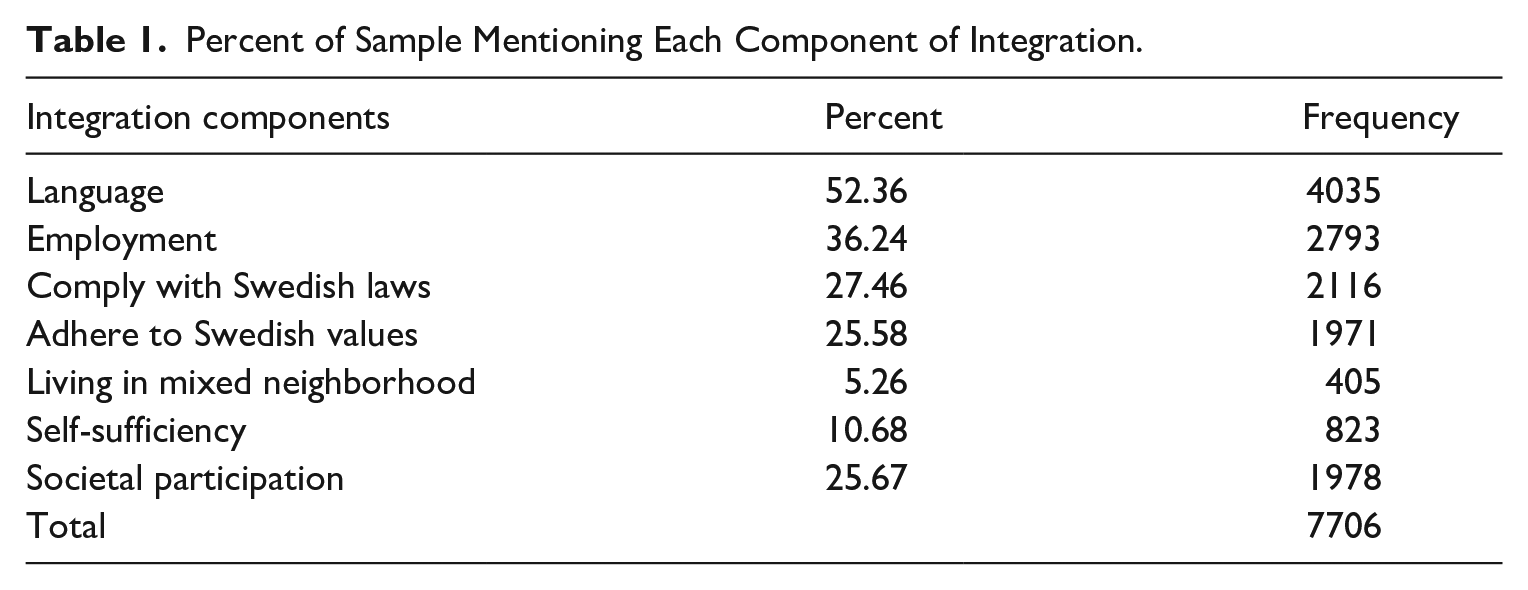
The results, however, also revealed a potentially overlooked aspect in previous research. Specifically, and unanticipated, the analysis showed that more than a quarter (27.5%) of respondents identified compliance with Swedish laws as crucial for integration—a previously ignored factor in integration studies.
Are There Distinct Groups of People Who Share Views on the Key Components of Successful Integration? (RQ2)
To address RQ2, eight rounds of latent class analyses 5 were conducted on the seven integration indicators derived from the respondents’ open-ended answers. After increasing the number of classes k by 1, a four-class solution was selected based on fit statistics, size, and interpretability. First, all solutions with more than four classes included one or more classes comprising less than 10% of the sample, which is indicative of an overfitted model (Sinha et al., 2021). Second, while the log-likelihood, BIC, and aBIC values improved from the one-class to the eight-class model, the rate of improvement slowed after the fourth class. The entropy value for the four-class solution was 0.71, indicating that participants were assigned to latent classes with sufficient precision (Asparouhov and Muthén, 2014). Although the VLMR test suggested a better fit for the five-class solution, considering overall assessments and class interpretability, the four-class model was deemed most appropriate. For detailed fit statistics, see Online Appendix C. The results were successfully replicated with LCA’s on two post-stratified random sub-samples (see Online Appendix D).
Table 2 presents the probability of a respondent mentioning each integration category based on their class membership. The first class, Societal Participation (n = 1350), is the smallest group, characterized by a high probability of mentioning societal participation (70.8%) but a low probability of mentioning other factors. The second smallest class, Language (n = 1408), consists entirely of members who view language as essential for integration (100%), with low probabilities for other factors, whereas the second-largest class, Employment (n = 2212), exhibits a high probability of mentioning employment (87.1%) and language (44.4%), but lower mentions of other factors.
Probabilities of Mentioning Factor When Assigned Membership in Respective Class.
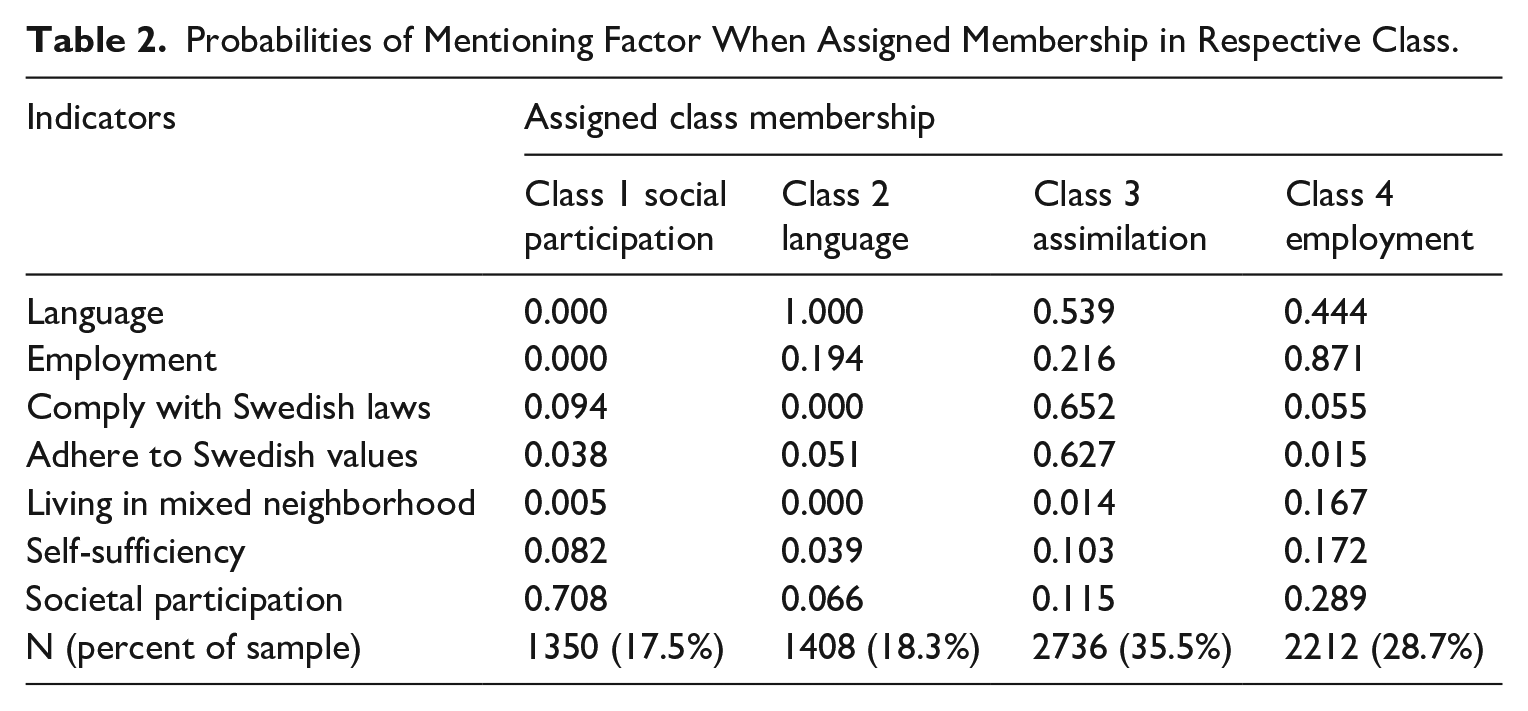
Finally, members of the largest class, Assimilation (n = 2736), had a high probability of mentioning adaptation to Swedish values (62.7%), compliance with laws (65.2%), and language acquisition (53.9%), with lower mentions of other factors. The relatively large size of this class reflects findings by Dražanová et al. (2020), who found that immigrants’ commitment to the host country’s values ranked highly in a majority of 25 surveyed European countries.
In summary, the LCA identified four, clearly distinguishable, groups with distinct ideas about what constitutes successful integration, delineating against respectively the structural, social, and cultural dimensions, as well as language acquisition. While language formed its own class, it also played an important role in two other classes (Assimilation and Employment), reinforcing its significance across different dimensions of integration (Bosswick and Heckmann, 2006; Dražanová et al., 2020).
Although the multidimensional nature of public opinion thus aligns with previous research (e.g. Sobolewska et al., 2017), these findings suggest that, on the group level, people tend to be more one-dimensional. The two groups that exhibit a slightly more multidimensional view of integration are the classes labeled Assimilation and Employment. Members of the Assimilation class were foremost defined by a high likelihood of mentioning the cultural dimension—along with law compliance and language—but also, to a lesser extent, they referenced employment (21.6%), a key component of structural integration. Conversely, members of the Employment class primarily focused on employment and language but also, to some lesser extent, invoked components related to the social dimension (28.9%).
Sociodemographic Characteristics of Groups With Distinct Views on the Key Components of Successful Integration (RQ3)
To explore the individual characteristics of members in the different classes, a multivariate logistic regression model was estimated, predicting class membership by sociodemographic factors. Odds ratios with related confidence intervals from the regressions are illustrated in Figure 1, with the Language class serving as the reference category (see Online Appendix E for a table with all estimates).
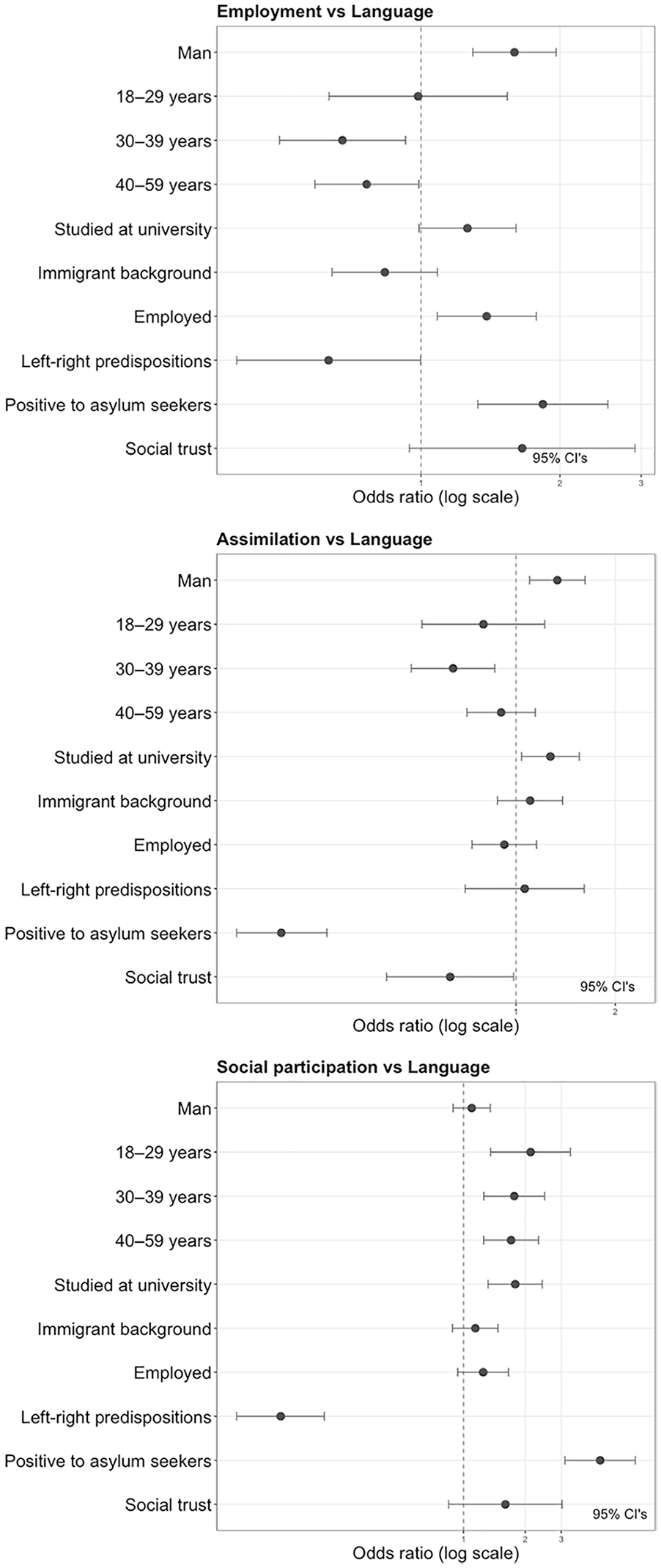
Predictors of Class Membership.
Employment Class
Men (OR = 1.60, CI (1.30, 1.96)), employed (OR = 1.39, CI (1.08, 1.78)), and individuals with positive attitudes toward asylum seekers (OR = 1.84, CI (1.33, 2.54)) are more likely to belong to the group that sees employment and language as key to integration compared to the group focusing solely on language. Conversely, individuals in their mid-ages are less likely to belong to this group than those aged 60 and older (30–39 years: OR = 0.68, CI (0.49, 0.93); 40–59 years: OR = 0.76, CI (0.59, 0.99)).
When re-running the analysis on smaller sub-samples, and when controlling for political interest, the results were substantively the same but remained statistically significant across all tests only in the case of sex and immigration attitudes (see Online Appendix E). Hence, the findings provide robust support for the prediction that men place greater emphasis on economic self-sufficiency for immigrants than women (e.g. Goossen et al., 2021), but weaker support for the idea that those with lower labor market status and education are more likely to view immigrants as economic threats, thus emphasizing immigrant self-reliance (e.g. Sanhueza Petrarca and Demker, 2019).
Assimilation Class
Men (OR = 1.33, CI (1.10, 1.62)) and university-educated individuals (OR = 1.27, CI (1.04, 1.56)) are more likely to belong to this group compared to the Language class, whereas individuals in their thirties (OR = 0.64, CI (0.48, 0.86)), with positive attitudes toward asylum seekers (OR = 0.19, CI (0.14, 0.27)), and with higher social trust (OR = 0.63, CI (0.41, 0.98)) are less likely to belong to this class. However, also in this case, only being male and having positive attitudes toward asylum seekers remained statistically significant across all robustness tests, thus yielding strong support only for these variables.
Societal Participation
University education (OR = 1.79, CI (1.32, 2.42)), being younger than 60 (18–29 years: OR = 2.12, CI (1.36, 3.32); 30–39 years: OR = 1.77, CI (1.26, 2.49); 40–59 years: OR = 1.71, CI (1.25, 2.32)), and positive toward asylum seekers (OR = 4.65, CI (3.13, 6.91)) significantly predict membership in the group that values social participation and belonging, compared to the Language class. In contrast, leaning politically left (OR = 0.13, CI (0.08, 0.21)) decreases the likelihood of membership in this group. In this case, all predictors remained robust to all tests.
In summary, few sociodemographic factors consistently predicted membership in the classes defined by emphasizing respectively cultural assimilation (Assimilation) and labor market participation (Employment); aside from gender and immigration attitudes, no factors remained significant across all robustness tests. In contrast, several factors robustly predicted membership in the Societal Participation class, including being younger, university-educated, right-leaning, and positive toward asylum seekers.
Interestingly, ethnic background did not predict class membership, diverging from previous studies where ethnicity has been influential (e.g. Callens et al., 2014; Dražanová et al., 2020). This divergence could potentially stem from this study’s broad measure of ethnic background, which only distinguishes between individuals with and without a foreign background. Since non-EU-born individuals, for example, tend to be underrepresented in opinion surveys (Theorin and Lundmark, 2024), respondents with foreign backgrounds in this sample might largely originate from nearby EU countries, who typically face fewer integration challenges (Lichter et al., 2020).
Finally, the weak role of left-right ideology in predicting integration preferences contrasts with prior research, which suggests a significant role of ideology.
Do Different Groups Hold Different Perceptions of Past and Present Integration Policies (RQ4)?
Along with a general tendency in the European public (Dražanová et al., 2020), the respondents in this sample tended to view Swedish integration policies rather negatively (M = 2.06, SD = 0.93 on a 5-point scale). However, further analyses reveal that these perceptions are influenced by both individual views on what constitutes successful integration and sociodemographic factors.
Results from a multivariate linear regression model, estimating the impact of class membership and covariates, are visualized in Figure 2 (see Online Appendix F for a table with all estimates).
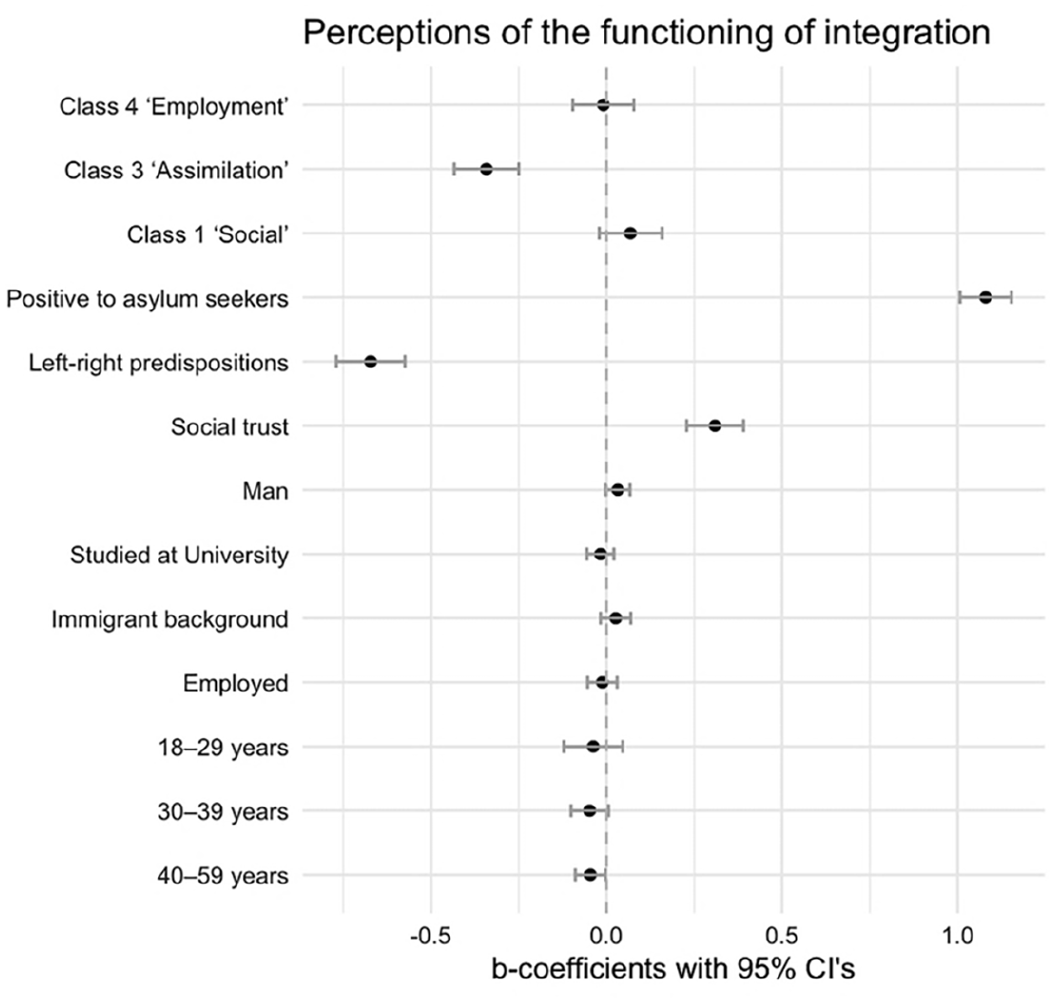
Predictors of Perceptions of Past and Present Integration Policies.
Using the Language group as the reference, the analysis showed that members of the Assimilation group (B = –0.34, SE = 0.05, p < 0.001) held more negative views of immigrant integration in Sweden, possibly reflecting dissatisfaction with Sweden’s multicultural model. No significant associations were found for the Employment (B = –0.01, SE = 0.04, p > 0.05) or Social Participation (B = 0.07, SE = 0.05, p > 0.05) groups. These findings align with broader European discourse, where the multicultural model, in particular, is associated with alleged integration failures (e.g. Dahlstedt and Neergaard, 2019; Lesińska, 2014).
Sociopolitical factors also predicted perceptions. Right-wing individuals were more likely to view integration policies as unsuccessful (B = –0.67, SE = 0.05, p < 0.001), while higher interpersonal trust (B = 0.31, SE = 0.04, p < 0.001) and positive attitudes toward asylum seekers (B = 1.08, SE = 0.04, p < 0.001) predicted more positive views. These findings align with Dražanová et al. (2020) who found that people on the left were less critical of past and present integration policies in Europe. It adds to their findings by highlighting the role of interpersonal trust and immigration attitudes.
All results were robust when tested on a sub-sample stratified by sex and when controlling for political interest 6 (see Online Appendix F).
Summary: Four Groups With Distinct Integration Attitudes
In summary, the analyses identified four distinct attitudinal groups, each characterized by a unique combination of integration preferences, sociodemographic background, and views on past and present integration policies. Collectively, these groups encompass the established dimensions of integration: structural (employment), social, and cultural (assimilation), with language serving a central role, forming both its own class and a part of other classes. These findings provide an initial categorization of integration attitudes that can form the ground for future cross-country comparisons:
Employment Group
Perceives employment and language as key integration factors. Members are more likely to be male and supportive of asylum seekers compared to those who prioritize language as a single component. They do not significantly differ from the Language group in their perceptions of existing integration policies.
Social Participation Group
Focuses on societal participation as key to integration. Members tend to be younger, right-leaning, university-educated, and supportive of asylum immigration. Their views on existing integration policies do not significantly differ from the Language group.
Language Group
Considers language to be key to successful integration, with little to no emphasis on other elements. Members are more likely to be female and positive toward asylum seekers compared to the Assimilation group, and more likely to be female and negative toward asylum seekers compared to the Employment group. Compared to the Social Participation group, they are less likely to be young, right-leaning, university-educated, and supportive of asylum seekers.
Assimilation Group
Members of this group stand out from the others by emphasizing multiple factors, including cultural adaptation, law compliance, language, and to some extent employment, reflecting a more multidimensional understanding of integration. Members of this group are more likely to be male, negative toward asylum seekers, and view existing integration policies negatively compared to the Language group.
Concluding Discussion and Framework for Future Studies
With a backdrop against ongoing debates about integration challenges in Europe, this article explores an important yet underexamined topic: public perceptions of integration. It adopts a data-driven approach for an open exploration of these perceptions, addressing limitations in previous research that have often been confined to pre-defined and isolated factors. The study begins by identifying, through open-ended responses, the key components that people consider essential for successful integration. Subsequently, a latent class analysis is employed to identify groups with shared views.
The study offers four key findings, related to respectively the public opinion at the aggregate level, and at the group level. It also reveals hitherto unexplored patterns and components in public view.
Public Opinion at the Aggregate Level
When participants freely expressed what they considered essential for successful integration, their responses spanned all three dimensions of integration: structural, cultural, and social. These findings align with previous studies (Dražanová et al., 2020; Sobolewska et al., 2017), suggesting that public opinion on integration is multidimensional. Furthermore, the relative importance of these components reflects broader European trends, with cultural and structural dimensions, along with language proficiency, being perceived as central, whereas the social dimension, while significant, is relatively less emphasized (Dražanová et al., 2020). These findings underscore the limitations of focusing solely on the cultural dimension and highlight the need for researchers to consider all dimensions to fully capture the complexity of public perceptions.
Public Opinion at the Group Level
While public opinion collectively encompasses all dimensions of integration, a different picture emerged at the group level. When looking at patterns in people’s responses, four distinct groups were identified, each characterized by a high likelihood of emphasizing one specific dimension and a lower likelihood of mentioning others. Language attainment was the only component with substantial overlap across groups, underscoring its critical role in integration processes (Bosswick and Heckmann, 2006; Dražanová et al., 2020). These findings add to previous research, suggesting that while public opinion on integration is multidimensional at the aggregate level, at the group level, it tends to be more one-dimensional.
Moreover, the shift to a group-level analysis enabled an in-depth assessment of what characterizes groups with specific views on integration. For example, individuals who prioritize both language and cultural dimensions are more likely to be male, hold negative views toward asylum seekers, and critically assess existing integration policies, compared to those who prioritize language alone. Attempting to predict isolated components, such as language attainment, independently of other components (i.e. without considering latent group patterns) would fail to capture those nuances, risking oversimplifying the characteristics of (different) individuals who prioritize language.
Overlooked Components
The open-ended part of this study confirmed that the public considers the traditional dimensions of integration, but it also revealed a previously unexplored factor—law compliance—with more than a quarter of the sample mentioning this aspect. While political actors often cite crime and violence as indicators of poor integration, especially within the cultural dimension (e.g. Lesińska, 2014; Mikelatou and Arvanitis, 2019), law compliance is not considered a core component of integration (Bosswick and Schnapper, 2006), and has been absent from prior public opinion surveys on integration. However, it has been included in a previous population-based survey on Swedish identity (Oscarsson, 2019), which similarly found that adhering to the Swedish laws ranked high for being perceived as “really swedish.” This unanticipated finding underscores the value of open-ended questions in uncovering emerging and underexplored elements of public opinion on integration. It also suggests directions for future research seeking a more comprehensive understanding of public opinion: to determine whether law compliance has become an integral part of the public’s comprehension of integration, beyond Sweden, future cross-country studies should include this component as a potential factor.
Overlooked Patterns
The fourth key finding from this study concerns a previously unrecognized pattern in how different groups perceive integration. The LCA revealed that members of the group prioritizing law compliance also emphasized cultural adjustments and were the most critical of past and present integration efforts. This finding warrants further exploration: why do certain citizens associate cultural aspects of integration with unlawfulness and failed integration? To reiterate, political and media discourse—in Sweden and beyond—often link crime in segregated neighborhoods to ethnicity, attributing weak integration and rising violence to multicultural policies. Future research should investigate whether and to what extent these, and other, elite narratives, shape public opinion on integration (cf. Eberl et al., 2018; Schmidt-Catran and Czymara, 2023).
Limitations and Future Research
While the study provides a framework for future research aimed at improving assessments of public opinion on integration, several limitations must be noted.
First, the study relies on data from a single country (Sweden), collected at a specific point in time, and from a non-representative sample. These factors significantly limit the generalizability of the findings; they cannot be considered representative of the Swedish population at the time nor can they be readily extrapolated to other contexts. Further empirical research is thus essential to determine their broader applicability.
On one hand, previous studies have shown a relatively consensual view on integration across European publics. Sobolewska et al. (2017), who compared integration preferences in the United Kingdom and the Netherlands, and Dražanová et al. (2020), who analyzed preferences across 25 European countries, found considerable consistency in how people prioritize different dimensions, where contribution to the welfare system, adjusting to national values, and language appeared as central. These findings imply that the results of this study may translate to broader European contexts. On the other hand, this study, which uses different analytical methods, revealed more complex findings. For example, the association between cultural aspects of integration, law compliance, and negative views of current integration outcomes may be context-dependent, highlighting the need for further comparative studies.
Fortunately, the methodological approach presented here provides a foundation for such future cross-country comparisons. Latent class analysis can be applied in different contexts, enabling researchers to explore how contextual factors—such as migration inflow, policies, and elite discourse—shape integration attitudes. Future studies should leverage this potential by examining whether similar or distinct “attitudinal groups” emerge in other countries.
For instance, comparing countries with different types of immigration might reveal contextual determinants of public opinion. Previous research indicates that public and media concerns often vary depending on the nature of immigration: refugee migration often raises cultural and security concerns, while labor migration tends to invoke economic considerations (Eberl et al., 2018; Lesińska, 2014; Scholten et al., 2015). In addition, when immigrants come from culturally distant regions, the public and media alike tend to focus more on cultural issues (Bloom et al., 2015; Dustmann and Preston, 2007; Eberl et al., 2018). From this light, the prominence of cultural and security concerns may resonate especially with countries that have a similar high intake of refugees as Sweden, such as Germany (Andersson et al., 2018). Conversely, in countries that primarily receive labor migrants, such as Italy (Ambrosetti and Paparusso, 2018), economic and structural concerns may be more prominent.
Other valuable comparisons could include countries with different media or political systems, or different integration policies. While this study confirmed some previous findings about the backgrounds of individuals with particular views, it also yielded a weaker role for certain factors, such as left-right orientation and ethnicity. Determining whether these findings are due to the sample composition or factors specific to Sweden—such as its political or media environment—requires further comparative research.
Another limitation of this study is its cross-sectional nature, which restricts the ability to establish causality. For example, although a correlation was identified between negative perceptions of current policies and a preference for cultural assimilation, it might be these negative perceptions that drive preferences for assimilation rather than the reverse. Moreover, negative perceptions of integration could foster adverse immigration attitudes rather than being the result of such attitudes. A third factor, such as political or media narratives, might furthermore shape both what people consider important for integration and how they view existing policies (Eberl et al., 2018). To clarify causality, future research should utilize panel surveys or experimental designs, while accounting for external factors like media exposure.
Finally, the approach outlined in this study—starting with open-ended responses, followed by manual coding and LCA—is resource-intensive and may appear unfeasible. However, while demonstrating the value of this multi-step, data-driven method, the goal was also to establish a framework to facilitate for future research. The findings from the open-ended responses largely align with closed-ended multi-item surveys in Europe (Dražanová et al., 2020), indicating that such surveys quite effectively capture public opinion—although adding an item related to law compliance could add valuable information. A potential compromise might also involve conducting smaller open-ended pilot surveys or focus group interviews, which could then guide the design of larger, closed-ended surveys. LCA, in turn, can help streamline the analysis, allowing for comparisons of broader attitudinal groups without isolating individual components of integration.
In conclusion, this study demonstrates the value of examining patterns across multiple response items, capturing different dimensions of integration, to create a more comprehensive measure of integration attitudes. Future research should build on these findings, exploring their applicability and potential variations across different contexts.
Supplemental Material
sj-docx-1-psw-10.1177_14789299241297801 – Supplemental material for Beyond Cultural Narratives: A Data-Driven Analysis of How Citizens Define Successful Integration
Supplemental material, sj-docx-1-psw-10.1177_14789299241297801 for Beyond Cultural Narratives: A Data-Driven Analysis of How Citizens Define Successful Integration by Elina Lindgren in Political Studies Review
Footnotes
Acknowledgements
The author is grateful to the SOM Institute for their assistance with data collection and input on the questionnaire. The author is also grateful to the anonymous reviewers of Political Studies Review, for their valuable feedback and suggestions on earlier versions of this manuscript.
Data availability statement
Data used for the analyses can be shared by the author upon request.
Declaration of conflicting interests
The author(s) declared no potential conflicts of interest with respect to the research, authorship, and/or publication of this article.
Funding
The author(s) disclosed receipt of the following financial support for the research, authorship, and/or publication of this article: This research was funded by the SOM Institute at the University of Gothenburg, Sweden.

Supplementary information
Additional supplementary information may be found with the online version of this article.
Appendix A. Sample Descriptive. Table A.1. Breakdown of Sample on Demographics and Covariates. Appendix B. Instructions for Coding of Open-Ended Questions. Original Survey Question. Table B.1. Coding Scheme. Coding Principles. Appendix C. Fit Statistics for One to Eight LCA Solutions. Table C.1. Summary of Model Fit Statistics. Figure C.1. Elbow Plots for aBIC, BIC, and Loglikelihood for One to Eight Class Solutions. Appendix D. Robustness Analyses: Fit Statistics for One to Eight LCA Solutions Using Post-Stratified Subsamples. Table D.1. Summary of Model Fit Statistics. Figure D.1. Elbow Plots for aBIC, BIC, and Loglikelihood for One to Eight Class Solutions. Table D.2. Probabilities Mentioning Factor When Assigned Membership in Class. Table D.3. Summary of Model Fit Statistics. Figure D.2. Elbow Plots for aBIC, BIC, and Loglikelihood for One to Eight Class Solutions. Table D.4. Probabilities Mentioning Factor When Assigned Membership in Class. Appendix E. Predictors of Class Membership. Table E.1. Predictors of Class Membership: Results from Full Sample and Robustness Analyses. Appendix F. Predictors of Perceptions of the Functioning of Integration. Table F.1. Predictors of Perceptions of the Functioning of Integration: Results from Full Sample and Robustness Analyses.
Notes
Author Biography
References
Supplementary Material
Please find the following supplemental material available below.
For Open Access articles published under a Creative Commons License, all supplemental material carries the same license as the article it is associated with.
For non-Open Access articles published, all supplemental material carries a non-exclusive license, and permission requests for re-use of supplemental material or any part of supplemental material shall be sent directly to the copyright owner as specified in the copyright notice associated with the article.
