




Abstract
This article undertakes a critique of the attitudes approach to populism, predicated on survey-based operationalisations of populism as a set of attitudes. Our critique is threefold: first, the move of reducing ‘the elite’ to ‘the politicians’ in survey items – beginning with the foundational Akkerman scale – is at odds with the constructivist underpinnings of Mudde’s ideational definition that this literature largely draws on, where ‘the people’ and ‘the elite’ are understood as contingent constructions that can take on a wide range of meanings depending on the ideological permutation. Second, our corpus linguistics-based overview of empirical patterns within the ‘populist attitudes’ literature indicates a skewed focus on the far right within this literature, contrary to the ideological variability of populism following the ideational definition. Third, the reliance on public opinion surveys points to the danger of reifying public opinion and attributing objective qualities to ‘the people’ as such. In assuming categories such as ‘the elite’ to stand for determinate referents such as ‘the politicians’ in survey-based operationalisations, the positivist bias of the attitudes approach paradoxically mirrors the objectivist bias (following Sartori) of early populism research that reduced the identity of ‘the people’ in populism to determinate socio-structural categories such as the peasantry.
Introduction
Recent years have seen an exponential growth in the literature on populism, and with it the emergence of recognisable paradigms within the field of populism research. One strand of scholarship that has gained in prominence is the ‘populist attitudes’ literature, centred on survey-based approaches to measuring populism as a set of attitudes on the level of individual respondents. This literature has emerged from within the ideational approach based on Cas Mudde’s (2004) influential definition and has increasingly come to (re-)define the ideational paradigm, as exemplified by the centrality accorded to the notion of populist attitudes in publications such as The Ideational Approach to Populism (Hawkins and Rovira Kaltwasser, 2019). While Mudde conceptualises populism as a thin-centred ideology whose core is the invocation of the will of a pure ‘people’ against a corrupt ‘elite’, the ‘populist attitudes’ line of inquiry carries this understanding over from the level of organised political actors to that of individual voters by operationalising populism as a set of survey-measured attitudes centred on the belief that politics should be about the will of ‘the people’ rather than ‘the politicians’ (e.g. following the influential Akkerman scale). This particular reading of the ideational approach – which we will refer to shorthand as the attitudes approach to populism – has become increasingly prominent within populism research and in the publication landscape, as even a cursory look at recent titles carried in international peer-reviewed journals today attests.
In this article, we undertake a systematic critique of the attitudes approach, whose assumptions about the operationalisability of populism as a set of survey items are ultimately inconsistent with the constructivist underpinnings of Mudde’s ideational definition and point to a positivist bias that overlooks the wide range of constructions that categories such as ‘the elite’ can take on. We ground this argument in a wider arc in the development of populism research from early approaches based on modernisation theory in the 1960s, which were characterised by an objectivist bias following Sartori (1990 [1968]) – namely, the assumption that ‘the people’ invoked by populism is definitionally reducible to determinate socio-structural categories such as the peasantry – to the constructivist turn in populism research marked by the influential ideational and discursive approaches of Mudde (2004) and Ernesto Laclau (2005a), respectively, which are predicated on an understanding of ‘the people’ and ‘the elite’ in populism as contingent constructions that can take on a wide range of contents (see also Kim, 2022a; 2022b). The attitudes approach becomes problematic in this light insofar as the meaning of ‘the elite’ is reduced to ‘the politicians’ in survey designs and the variability of populism thus becomes circumscribed – paradoxically mirroring the objectivist bias of early populism research whereby the meaning of ‘the people’ tends to be reduced to determinate socio-structural categories such as the peasantry.
In the following, we first provide a targeted account of the objectivist roots of early populism research – drawing here on Sartori’s (1990 [1968]) incisive critique of the ‘objectivist bias’ in the study of politics more generally – and the constructivist turn of the mid-2000s as a break with this earlier paradigm. We then examine three interrelated aspects – conceptual, empirical, epistemological – in our critical discussion of the attitudes approach to populism. First, we present a conceptual critique of survey-based operationalisations of ‘the people’ and ‘the elite’, beginning with the foundational contribution by Akkerman et al. (2014), as inconsistent with the ideational paradigm’s own constructivist premises. Second, we conduct a corpus linguistics-based survey of the titles and abstracts of Web of Science-indexed articles on ‘populist attitudes’, which finds a skewed empirical focus on the far right within this literature – pointing to the problem of ‘populist hype’ observable in the field of populism research as a whole (Glynos and Mondon, 2019) – in contrast to the ideational approach’s professed emphasis on the ideological variability of populism. Finally, we discuss the danger of reifying public opinion and of conflating the results of survey results with ‘the people’ as such – as indicated by article titles such as ‘How Populist Are the People? Measuring Populist Attitudes in Voters’ (Akkerman et al., 2014) – without taking into account the socially constructed and mediated nature of such categories. While it is beyond the scope and methodological purview of this article to propose alternative measurements or prescriptive solutions, our constructivist critique highlights existing issues as well as potential pitfalls of the attitudes approach and underscores the need for more reflexivity in populism research more generally.
The Objectivist Roots of Populism Research and the Constructivist Turn
The beginnings of populism research as an international field of social-science scholarship in the 1960s were dominated by a search for the ‘social bases’ of populism, to paraphrase the subtitle of Lipset’s (1960) book Political Man. In the Ionescu and Gellner (1969) volume Populism: Its Meaning and National Characteristics – based on an international conference held at the London School of Economics, a key moment in the development of modern populism research – the various contributions ultimately converged in ‘ascribing to populism some particular social content’ (Laclau, 2005a: 8) and reducing populism to an epiphenomenal expression of objectively underlying socio-structural processes such as ‘modernisation’ (see also Kim 2022a; 2022b). Take, for example, Stewart’s (1969: 180) argument that, faced with the decision between conceptualising populism as ‘(1) a system of ideas; or (2) as a number of discrete social phenomena; or (3) as the product of a certain type or types of social situation [. . .] it is the third which is the most illuminating’. He proceeds to argue that ‘[p]opulism emerges as a response to the problems posed by modernization and its consequences’, especially ‘the tension between backward countries and more advanced ones, and [. . .] between developed and backward parts of the same country’ (Stewart, 1969: 180–181). Even McRae (1969: 163–164), whose contribution is titled ‘Populism as an Ideology’, ends up reducing populism to the ‘a-political’ reaction of ‘a predominantly agricultural segment of society’ that, ‘under the threat of some kind of modernization, industrialism, call it what you will’, emerges around the affirmation of some primitive ‘virtue’ in reaction against the ills of modernity. Wiles (1969: 166–167), who similarly defines populism as the belief that ‘virtue resides in the simple people, who are the overwhelming majority, and in their collective traditions’, maintains that populism results from some form of ‘alienation’ within the socio-structural fabric of modern societies, whether this be ‘racial’, ‘geographical’, or ‘urban’. The editors of the volume summarise the overall consensus among the contributors in noting that populism worshipped the people. But the people the populists worshipped were the meek and the miserable, and the populists worshipped them because they were miserable and because they were persecuted by the conspirators. The fact is that the people were more often than not identified in the peasants who were and are, in underdeveloped societies especially, the most miserable of the lot – and the more miserable they were the more worshipped they should be (Ionescu and Gellner, 1969: 4).
All this serves to suggest that early populism research was prone to what Sartori (1990 [1968]) criticised during this same period in the late 1960s as an ‘objectivist bias’ in the ‘sociology of politics’. Referring in particular to the class voting and class representation literature – including Lipset’s (1960) earlier work – Sartori (1990 [1968]: 171) identifies an ‘objectivist bias’ that assumes political identities to be ‘artifacts’ merely reflecting objective socio-structural ‘facts’, such that socio-structurally determinate groups such as ‘class’ find their objective expression in political parties. Going against this view, Sartori argues that class identity is itself a political construct produced by organised actors such as parties (‘Rather, and before, it is the class that receives its identity from the party’; Sartori, 1990 [1968]: 169). The key point here is that categories of collective identity such as ‘the working class’ in class politics or ‘the people’ in populism can be constructed with different meanings and are not reducible to a mere reflection of an objectively given set of ‘social bases’. What Sartori thus criticises as an objectivist bias can be seen to be at work in the Ionescu-Gellner volume as well: namely, the move of conceptually reducing the evidently central category of ‘the people’ in populism to a reflection of determinate locations in the social structure such as the peasantry.
The constructivist turn in populism research in the early 2000s breaks with this objectivist paradigm by understanding ‘the people’ in populism as a contingent construction, rather than an objective expression of an underlying socio-structural group (Kim, 2022a; 2022b). Foundational contributions to this turn (broadly understood) include the ideational and discursive approaches of Mudde (2004) and Laclau (2005a), respectively, which take on a paradigmatic character insofar as they explicitly and systematically ground the concept of populism (in their own ways) in constructivist theoretical foundations: Freeden’s (1996) morphological conception of ideology and a ‘post-foundational’ (Marchart, 2007) theory of discourse and hegemony, respectively. For Mudde, all ideologies following Freeden constitute conceptual maps of social reality held together by meaningful relations between core ‘concepts’ (e.g. ‘freedom’ in relation to individuals and markets in liberalism, etc.). In this context, Mudde (2004) understands populism as a ‘thin-centred ideology’ with a limited conceptual core consisting of ‘the people’ whose ‘general will’ is held to be the subject of politics in demarcation against ‘the elite’. Mudde’s definition, while emphasising that ‘the people’ in populism is necessarily constructed as homogeneous and pure and ‘the elite’ as corrupt and evil, allows for considerable variation in how such categories are constructed in different ideological permutations of populism (in combination with ‘thick ideologies’ from socialism to liberalism to nativism), as the author’s discussions of examples ranging from Evo Morales and Occupy Wall Street to countless cases on the far right illustrate (Mudde, 2007, 2016; Mudde and Rovira Kaltwasser, 2013, 2017). Fundamentally, Mudde’s adoption of Freeden’s theory of ideology entails a key constructivist premise: namely, that concepts such as ‘the people’ and ‘the elite’ in populism are not objectively given entities traceable to a determinate set of socio-structural categories, but rather political constructs that vary in their contents depending on the ideological sign. The key research question, in other words, becomes how ‘the people’ is constructed and given meaning, not what underlying socio-structural groups it expresses. This is arguably an important commonality of Mudde’s ideational definition and Laclau’s (2005a) discursive approach, with the latter conceptualising populism as a political logic of constructing a ‘people’ in antagonistic demarcation against a power bloc. Indeed, Laclau (2005b: 48; emphasis in original) goes farther than Mudde in making his constructivism explicit; as he emphasises, the category of ‘the people’ in populism precisely ‘does not simply express some kind of original popular identity; it actually constitutes the latter’; populism makes visible in exemplary fashion the contingent nature of political identities by turning ‘the people’ as a universal, symbolically privileged category of democratic order into a political construct in opposition to constituted forms of power (such as ‘the elite’, ‘the top 1%’ and ‘the established parties’). It is in this sense that Laclau (2005a: 67) famously referred to populism as ‘the royal road to understanding something about the ontological constitution of the political as such’.
If the ideational approach popularised by Mudde is part and parcel of a broader constructivist shift in populism research, a separate question is to what extent this orientation is borne out in subsequent developments within the ideational literature. In the first decade following Mudde’s (2004) article that introduced the ideational definition of populism into academic discourse, prominent applications of this approach included the analysis of populist ideology in its different variations on the ‘supply side’ of organised political actors, from the radical left to the far right (e.g. Mudde, 2007; Mudde and Rovira Kaltwasser, 2012, 2013) coupled with theoretical reflections on (thin-centred) populist ideology in relation to democracy (e.g. Rovira Kaltwasser, 2012). The 2014 article of Akkerman, Mudde and Zaslove – 10 years after Mudde’s earlier contribution – arguably marks a turning point with the introduction of the so-called Akkerman scale, inaugurating a rapid proliferation of research on measuring ‘populist attitudes’ based on an attitudes-centred interpretation of the ideational definition. It is this attitudes approach – and the specific reading of the ideational approach it entails – to which we now turn.
Pitfalls in the Attitudes Approach to Populism: A Critique
From Ideology to Attitudes: The Positivist Bias of the Attitudes Approach
The key move entailed by the attitudes approach is to situate ‘ideational theory at the individual level with the concept of populist attitudes’ (Hawkins and Rovira Kaltwasser, 2019: 6). The idea here is that if populism is understood as a thin-centred ideology pitting a ‘pure people’ against a ‘corrupt elite’, this ideology is measurable not only in the public communication or discourse of organised actors, but also in the attitudinal orientations of individuals as gauged in surveys. A foundational work in this literature is that of Akkerman et al. (2014) which has subsequently taken on a pioneering function for a large body of scholarship on populist attitudes. The ‘Akkerman scale’ features eight survey items designed to operationalise the ideational definition as a set of attitudes, encompassing the three core dimensions of ‘sovereignty of the people, opposition to the elite, and the Manichean division between “good” and “evil”’: POP1 The politicians in the Dutch parliament need to follow the will of the people. POP2 The people, and not politicians, should make our most important policy decisions. POP3 The political differences between the elite and the people are larger than the differences among the people. POP4 I would rather be represented by a citizen than by a specialized politician. POP5 Elected officials talk too much and take too little action. POP6 Politics is ultimately a struggle between good and evil. POP7 What people call ‘compromise’ in politics is really just selling out on one’s principles. POP8 Interest groups have too much influence over political decisions (Akkerman et al., 2014: 1331).
The survey items were designed for the Dutch context but conceived as broadly applicable (with the reference to ‘the Dutch parliament’ being interchangeable with any other national parliament). As Akkerman et al. note, the items POP5, POP6, and POP7 refer to the specifically Manichean dimension of the ideational definition of populism. Leaving aside for now this dimension – which has also been a matter of conceptual debate within the broader field of populism research (Katsambekis, 2022; Kim, 2022a) – the question here is whether the central opposition between ‘people’ and ‘elite’, which has arguably been a point of definitional convergence between different approaches to populism (see also Hawkins and Rovira Kaltwasser, 2019; Mudde and Rovira Kaltwasser, 2017), is borne out in this survey-based operationalisation.
What is immediately notable in these survey items is the attempt to pin the meaning of ‘people’ and ‘elite’ onto the opposition between ‘people’ and ‘politicians’ (POP1, POP2, POP4). In effect, the ‘corrupt elite’ of the ideational definition becomes reduced to ‘the politicians in the Dutch [or any other national] parliament’ who pose an obstacle to the ‘will of the people’ in the survey-based operationalisation of populism. As such, other possible constructions of ‘the elite’, such as big business, politico-economic ‘oligarchs’, or cultural and media elites (to name but a few possibilities) are thus foreclosed from the beginning. While POP3 features a broader (and vaguer) reference to ‘the elite’ against ‘the people’, the specific references to ‘the politicians’ in POP1 and POP2 pull in a different direction: that of restricting the possible meanings of ‘the elite’ onto one particular construction thereof, namely ‘politicians’. Numerous other studies and foundational attempts at operationalisation are similarly characterised by this move of reducing ‘the elite’ in populism to ‘the politicians’. This can already be seen in the earlier work of Hawkins et al. (2012), which proposed similar survey items referring to ‘the people’ against ‘the politicians’ in the US context: ‘POP2 The politicians in Congress need to follow the will of the people’; ‘POP4 The people, not the politicians, should make the most important policy decisions’ (Hawkins et al., 2012: 8). Hobolt et al. (2016), in a report for the influential Comparative Study of Electoral Systems (CSES) network, operationalise ‘attitudes towards political elites’ exclusively in terms of ‘politicians’: ‘b. Most politicians do not care about the people. c. Most politicians are trustworthy[.] d. Politicians are the main problem in [COUNTRY]’ (Hobolt et al., 2016: 7–8). In yet another methodological publication titled ‘Measuring Populist Attitudes on Three Dimensions’, Schulz et al. (2018: 5) operationalise what they refer to as ‘anti-elitism attitudes’ in terms of opposition to ‘the entity of “the politicians” or “the government”’.
Why this fixation with ‘politicians’ as the only possible form (or the only methodologically relevant one) that ‘the elite’ can take in populism? One possible justification might be that the survey items are designed to operationalise populism in the concrete institutional setting of representative democracies; however, such a move is at odds with the ideational definition’s fundamental openness to how, by which actors, and in what setting ‘the people’ and ‘the elite’ are constructed, as prominent examples from the protest arena such as Occupy Wall Street indicate (Mudde and Rovira Kaltwasser, 2017). Indeed, it is perfectly conceivable from an ideational perspective that ‘the elite’ of populism might not be politicians, but rather business elites or oligarchs who are accused of holding the real power, rather than politicians or parliaments. This kind of populism – such as that of Bernie Sanders in the US – might even argue that it is precisely the elected politicians in Congress who ought to be the ones exercising real power in the name of ‘the people’, as opposed to other, purportedly illegitimate ‘elites’ such as ‘the billionaire class’ or ‘Wall Street’. The fact that a survey-based operationalisation of the ideational definition would reduce the meaning of ‘the elite’ to the category of ‘the politicians’ is, therefore, rather puzzling and in need of justification, which is curiously glossed over in all these publications by oft-cited and renowned scholars in the field.
The move from populist ideology to populist attitudes is characterised here by what might be called a positivist bias: in the quest for survey measurements of populism at the individual level, the attitudes approach constricts the range of meanings that categories such as ‘the elite’ can take on and, indeed, creates a serious validity problem insofar as the survey items end up measuring only one specific possible form of populism (namely, one directed against the ‘politicians’ rather than other possible forms of ‘elite’). It is unclear why the elite cannot simply be left as ‘the elite’ in the survey items, rather than being specified as ‘the politicians’; if the move of reducing the elite as ‘the politicians’ is deemed necessary for lending the survey items a certain concreteness for the respondent, this, in turn, undermines the construct validity of the operationalisation by constricting the range of meanings ‘the elite’ can take relative to the ideational definition that the attitudes approach claims to base itself on. Here, the antinomies of positivism come into view: the move of rendering ‘the elite’ more concrete means that it ends up referring to a smaller subset of what it is actually intended to measure. What gets lost in the process are the constructivist underpinnings of the ideational approach to populism – namely, the understanding of ‘people’ and ‘elite’ as contingent and variable constructions, rather than objectively pinpointable categories whose meaning can be assumed to correspond to determinate referents such as ‘the politicians’ for ‘the elite’ or ‘the peasantry’ for ‘the people’.
The Problem of Populist Hype: Empirical Patterns of Focus in the Populist Attitudes Literature
Against the backdrop of this conceptual critique, we now turn to the question of empirical patterns of focus and framing within the populist attitudes literature. Numerous studies have identified a problem of far-right bias in the field of populism research as a whole – from Hunger and Paxton (2022: 627), who note a widespread ‘conflation of populism with nativism’, to Glynos and Mondon (2019) and Mondon (2022a), who use the term ‘populist hype’ to describe what they identify as an inflationary conflation of populism with other -isms, especially those associated with far-right politics. To what extent is this problem also visible in the populist attitudes literature more specifically? If so, to what extent (if at all) is this related to the conceptual issues highlighted in the previous section?
In this vein, we have undertaken a broader quantitative survey of the populist attitudes literature to identify what empirical patterns emerge in terms of the thematic foci and trends within this body of scholarship. Methodologically, we draw here on Mondon’s (2022a)’s research on the subfield of far-right studies, itself building on Brown’s (2019, 2023) mixed methods approach that combines insights from the quantitative corpus linguistics and critical approaches to discourse studies. To this end, the titles and abstracts of articles containing the terms ‘populist attitude*’ were collected from the Web of Science database on 21 December 2022 and cover a 10-year period from the beginning of 2012 to the end of 2022 when these data were collected. As Mondon (2022a: 6) notes, focusing on abstracts and titles can yield insights that can help us to understand the framing of research in the field; that is, to highlight what is considered to be worthy of inclusion in the most public-facing elements of our research. This is particularly relevant as priming and framing (McCombs, 2014) in titles and abstracts have become increasingly important in contemporary academia as dissemination and citations are widely considered core to ‘performance’ in this neoliberal setting.
While it is possible that some articles are missing from our data as collection can be delayed, the Web of Science database gives us one of the most comprehensive ways to access the state of the art within the academic publishing landscape. 1 In total, 194 articles with the terms ‘populist attitude*’ in the title and/or abstract were collected. 2 Once a manual cleaning process was conducted, we were left with 187 articles and abstracts and an overall word count of 34,314. The corpus was then cleaned further using appropriate stop-word lists (limited to three-letter words) and combining lemmas and analysed with Wordsmith and NVivo to first discover word frequencies and then collocations for the most prevalent terms in the sample, excluding irrelevant terms which had not been picked up by the stop-word list (e.g. however, besides) and proper nouns such as countries (see Table 1).
Word Frequency After Cleaning Process Undertaken (Top 50 Keywords).
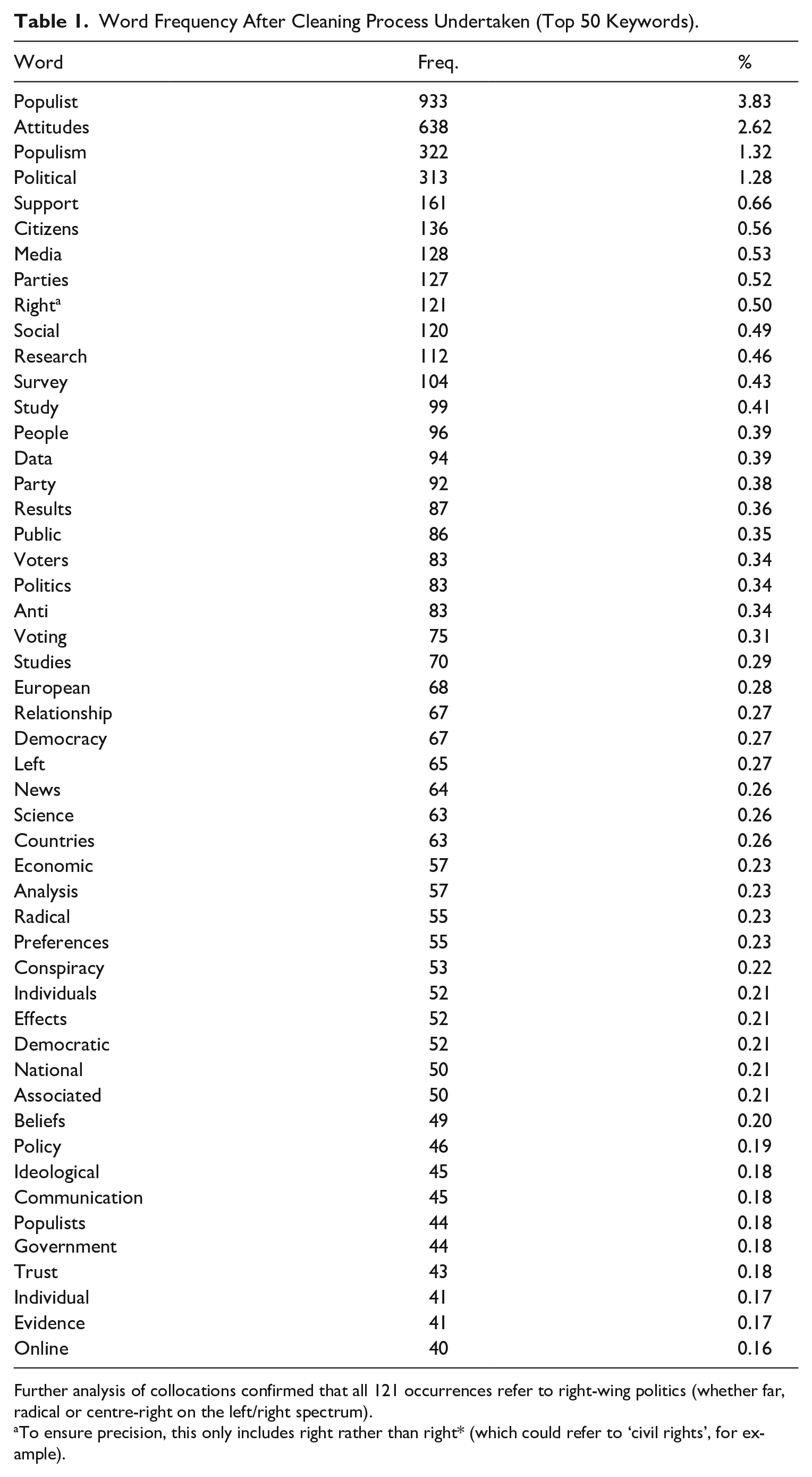
Further analysis of collocations confirmed that all 121 occurrences refer to right-wing politics (whether far, radical or centre-right on the left/right spectrum).
To ensure precision, this only includes right rather than right* (which could refer to ‘civil rights’, for example).
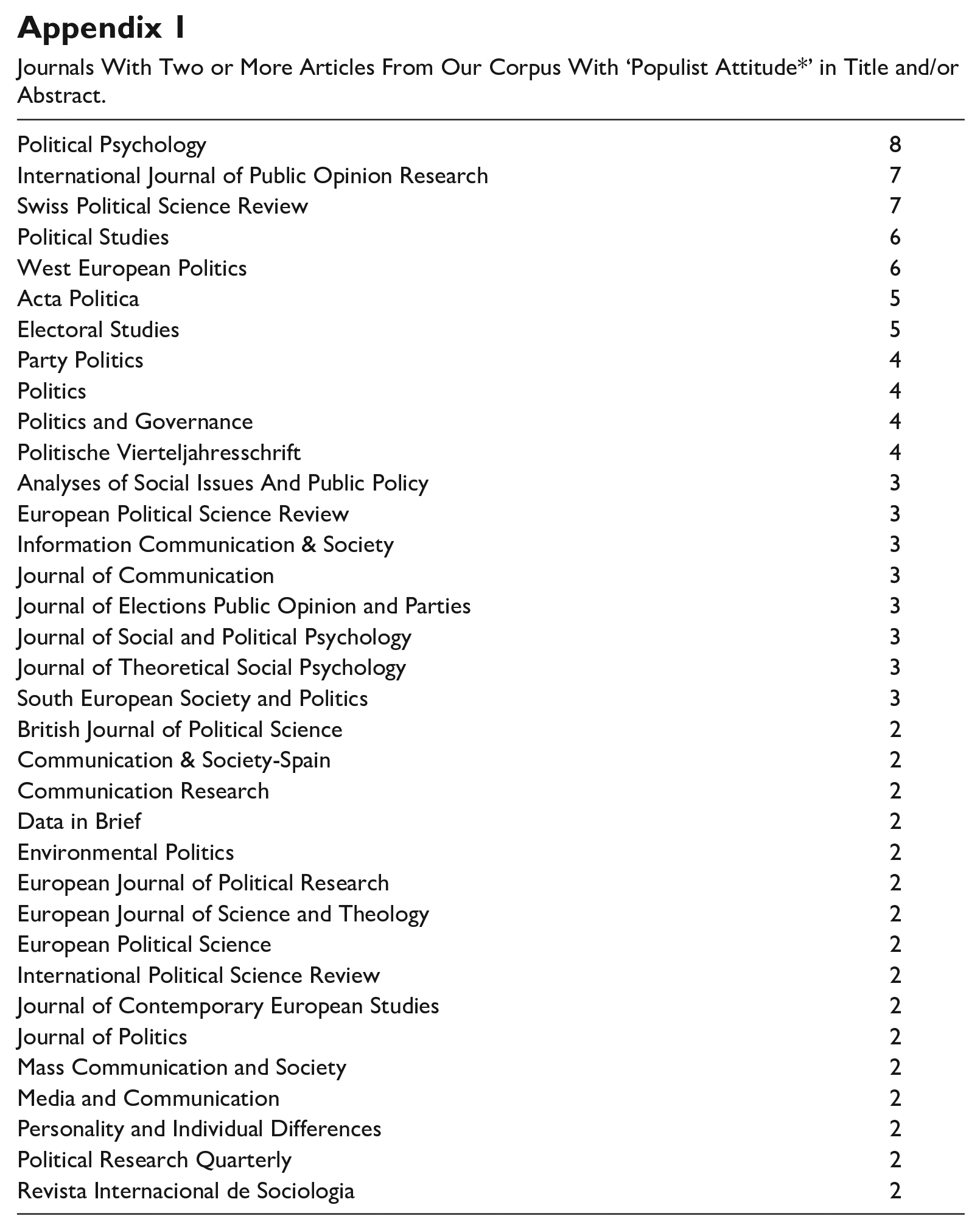
Our analysis first indicates that research on ‘populist attitudes’ is indeed very recent. Only one article containing the terms in their abstract and/or title appears in the database for 2012, 2014 and 2016, while none appear for 2013 and 2015. The growing trend starts in 2017 with 12 articles and has increased every year since, with 63 publications in 2021. When our data collection was conducted, 46 articles had been published and recorded in the Web of Science database containing the terms in 2022; these results must be taken with caution as it is likely that not all articles from that year appeared immediately in the database. It is also possible that the downwards trend in the number of articles on populism more generally, which we witness in the Web of Science database from 2020 onwards, also took hold in this subfield. 3 Furthermore, we can see a concentration of articles on populist attitudes in quantitatively oriented political science journals (see Appendix 1), in addition to a considerable number of articles published in journals with a focus on psychology and communication studies.
When it comes to the extent of ‘far-right bias’ in this literature, a striking but perhaps unsurprising result of our analysis is the prevalence of the term ‘right’ in the corpus (121 following a manual cleaning process to limit this count to right-wing/far-right politics and not civil rights, for instance). This term is used almost twice as often as ‘left’, thus confirming other research on the field of populism studies as a whole that has identified either a skewed focus on right-wing/far-right forms of populism or, worse, the euphemisation and normalisation of far-right ideologies as populist (Mondon, 2022b; Hunger and Paxton, 2022). Indeed, as Mudde (2016: 23) notes for research on political parties as a whole, ‘at least since the early 1990s, there have been more academic studies of populist radical right parties than of all other party families combined’.
As such, the populist attitudes literature is not immune to the tendency to focus on or indeed ‘hype’ far-right forms of populism or politics more generally, which is not least problematic in light of the ideational approach’s professed openness to the ideological versatility of populism across the left/right spectrum (e.g. Mudde and Rovira Kaltwasser, 2013, 2017). To be sure, this is a problem of empirical focus and framing in the literature, which in some ways displays an even more aprioristically limited understanding of populism than the survey-based operationalisations that we have criticised. Take, for instance, the oft-cited research note by Schulz et al. (2018). The first line of their introduction to an article titled ‘Measuring populist attitudes’ only provides far-right examples, pointing to ‘the proportion of voters who sympathised with the Swedish Democrats (12.9%), the Finns (17.7%), the Law and Justice Party (51.5%), the Danish People’s Party (21.1%), or the Freedom Party of Austria (49.7%)’ in the context of ‘national elections of 2014, 2015, and 2016’ in various European countries (Schulz et al., 2018: 316). Beyond the lack of engagement with the context of said elections (presidential runoffs vs various types of parliamentary ones), what is particularly striking is that in at least some of these examples of ‘populism’ cited by the authors, it is not, in fact, the dichotomy of ‘the people’ versus ‘the politicians’ that characterises the ideology of these parties as the attitudes-based operationalisation would have it. In the case of Law and Justice (PiS), for instance, it is precisely not ‘politicians’ as such that are made out to be the problem – indeed, the party’s claim would be that its (now former) parliamentary majority is governing in the interest of ‘the people’ (against unelected veto players such as judges) – but, rather, illegitimate forms of privilege entrenched in the post-communist era that PiS politicians in government are supposedly working to root out (Kim, 2021). What is equally striking in Schulz et al.’s enumeration is the absence of left-wing populist parties that did campaign on a rhetoric of ‘people’ versus ‘politicians’ and scored major electoral successes on this basis at the time – such as Podemos in Spain (20.7% in the 2015 elections). In short, this example from the populist attitudes literature points to a common problem in the field as a whole: namely, that the ‘populist’ label is thrown around prior to any kind of analysis of the ideology or discourse of these political parties, at times even contrary to one’s own operationalisation of the concept. The problem here is arguably the dominance of an aprioristic framing, with ‘populism’ used as a synonym for far-right politics prior to any kind of analysis and regardless of which definitional or analytical criteria one professedly subscribes to.
The Problem of Populist Hype, Continued: The Danger of Reifying Attitudes
This pitfall of ‘populist hype’ – which, as we have shown, exists in but is certainly not limited to the populist attitudes literature – has an epistemological dimension that arguably deserves particular attention when it comes to the study of populist attitudes. As critical observers in the field of populism research have noted, the problem of populist hype is rooted in the double hermeneutics surrounding the key category of ‘the people’ (Glynos and Mondon, 2019; Stavrakakis et al., 2018; Stavrakakis, 2017; Goyvaerts, 2021): the apparent rise of populist forces laying claim to ‘the people’ has fuelled academics, politicians and media commentators alike to search for how ‘the people’ really think and feel using sophisticated survey techniques (as a kind of objectified, quantified counterpart to ‘the people’ as a political construct invoked by populists). In short, we as academics often take for granted that, using the right measurements, we can know what the otherwise elusive ‘people’ truly and objectively are about. This is what Csigó (2016) refers to as ‘the neopopular bubble’, whereby the category of ‘the people’ becomes something like a speculative object for public opinion researchers who scramble to extract the true kernel of popular opinion beyond the fog of competing political claims to represent it. Yet the problem here is precisely that there is no way to access a pure, unadulterated ‘people’ prior to its political mediation: the view of the analyst and the respondent alike is irreducibly coloured by the presence of such categories in the field of public discourse. To take up our previous example, the meaning of ‘the politicians’ in relation to ‘the people’ will likely be very different for supporters of Bernie Sanders and Donald Trump, insofar as Sanders’ populism is about claiming that ‘the people’ need elected ‘politicians’ to stand up against ‘Wall Street’, whereas Trump’s populism claims precisely that ‘the people’ need to be represented by a ‘businessman’ like him against ‘the politicians’. Following the standard operationalisations in the attitudes literature, Trump supporters who respond ‘yes’ to the survey items on attitudes against ‘politicians’ (in addition to the other items) would qualify as populist whereas Sanders voters who respond ‘no’ might not. To then conclude on this basis that we have determined the answer to the question ‘How Populist Are the People?’ – the title of Akkerman et al.’s (2014) foundational article for the attitudes literature – would be deeply questionable.
The Sanders/Trump example is instructive insofar as it points to how certain terminology that is assumed by researchers to stand for an objective referent (e.g. ‘the politicians’ for ‘the elite’) is, in fact, irreducibly mediated by political constructions that may give it diametrically opposing meanings to different people. It is in this vein that a long tradition in constructivist thought and social research has emphasised that there is no such thing as unmediated public opinion existing prior to social relations or political interventions. Pierre Bourdieu’s (1973) provocative statement that ‘public opinion does not exist’ should be understood precisely in this sense: namely, that public opinion is ultimately a construct that cannot be understood outside of its social and political mediation. This certainly does not mean that public opinion research should not be done or cannot be valuable. Rather, what is needed in the process of conducting such research is thoroughgoing reflection on the use of terminology as well as a certain reflexivity in recognising the constructed and mediated nature of the categories that we as researchers must use (as ‘second-order constructions’ following Bourdieu). Posing the question in terms such as ‘How Populist Are the People?’ points to the risk of reifying the results of public opinion surveys and extrapolating onto the level of an objectively extractable ‘people’ in spite of the very real validity issues that we have raised in relation to the operationalisation of populist attitudes.
When it comes to concrete alternatives for how to operationalise and measure populist attitudes, this is a question that deserves in-depth discussion among specialists of attitudes research themselves – a discussion that we hope to stimulate, but cannot hope to provide the definitive answers to, with this critique. It is precisely the striking lack of reflection and debate on questions such as why ‘the elite’ ought to be operationalised as ‘the politicians’ that we have sought to highlight in our critical discussion. At the very least, it would seem that alternatives such as leaving ‘the elite’ unspecified in survey items and/or offering a range of context-dependent specifications based on various existing populist constructions of ‘the elite’ in a given national setting would merit some kind of consideration. In any case, a consistent application of the ideational approach would, in light of its constructivist underpinnings, entail first examining the different populist constructions of ‘people’ and ‘elite’ in a given context prior to survey-based applications – not least in the interest of reaching an informed decision on the appropriateness of operationalising ‘the people’ as ‘the politicians’, for example – let alone extrapolations of survey results onto the level of ‘the people’ as such.
Conclusion
The aim of this article has been to undertake a systematic critique of the attitudes approach, keying in on three interconnected aspects – conceptual, empirical, epistemological – for our critical discussion of the growing literature on ‘populist attitudes’. First, the operationalisation of ‘the elite’ as ‘the politicians’ in survey-based studies of populist attitudes – beginning with the foundational Akkerman scale – presents problems of validity as well as conceptual and definitional consistency vis-à-vis Mudde’s oft-invoked ideational definition, in which ‘the people’ and ‘the elite’ are understood to take on a wide range of possible meanings (potentially including, but certainly not limited to, ‘the politicians’) depending on the ideological permutation. Here, the attitudes approach is at odds with the constructivist underpinnings of the ideational approach, understood as part and parcel of a wider constructivist shift in populism research away from the objectivist assumptions of the 1960s. Second, our corpus linguistics-based survey of the titles and abstracts of Web of Science articles on ‘populist attitudes’ points to an empirical trend towards a one-sided focus on the far right within this literature, as is the case in populism research more generally. Here, again, there is a notable disconnect with the versatility of the ideational definition or even the more restrictive attitudes-based operationalisation itself, which is ignored when examples of far-right parties that do not in fact pit ‘the people’ against ‘the politicians’ are aprioristically labelled ‘populist’. Finally, the attitudes approach points to the danger of reifying public opinion and attributing objective qualities to ‘the people’ as such – as suggested by article titles such as ‘How Populist Are the People?’ – ignoring the socially produced and mediated nature of survey-based snapshots that we commonly refer to as ‘attitudes’ (whether populist or otherwise).
To be sure, all this does not have to mean that there is no value in measuring populist attitudes or that there is no place for this approach within the growing field of populism research. Rather, the key implication of our critique is that the limitations of an attitudes approach – as with any approach to populism – require, at the very least, deeper reflection and explicit justification: from the move of operationalising ‘the elite’ as ‘the politicians’ in survey items to drawing conclusions from survey results onto the level of the attitudinal orientations of ‘the people’ tout court. The aim of our constructivist critique here is not to offer prescriptions regarding methodological alternatives, but rather to highlight under-examined pitfalls that deserve consideration in future research. This need for scholarly reflexivity becomes all the more pressing as the literature on populism grows all the more rapidly and the danger of ‘populist hype’ and of reifying public opinion surveys becomes more real. Indeed, in light of all the above-discussed issues of conceptual and definitional consistency that studies on populist attitudes exhibit vis-à-vis the ideational approach that they claim to draw from, the readiness with which leading proponents of the ideational approach have embraced the populist attitudes literature in recent years should give us pause. Our hope is that the critique that we have presented contributes towards greater reflexivity both within and across the various paradigms that enrich the study of populism today.
Footnotes
Appendix
Journals With Two or More Articles From Our Corpus With ‘Populist Attitude*’ in Title and/or Abstract.
| Political Psychology | 8 |
| International Journal of Public Opinion Research | 7 |
| Swiss Political Science Review | 7 |
| Political Studies | 6 |
| West European Politics | 6 |
| Acta Politica | 5 |
| Electoral Studies | 5 |
| Party Politics | 4 |
| Politics | 4 |
| Politics and Governance | 4 |
| Politische Vierteljahresschrift | 4 |
| Analyses of Social Issues And Public Policy | 3 |
| European Political Science Review | 3 |
| Information Communication & Society | 3 |
| Journal of Communication | 3 |
| Journal of Elections Public Opinion and Parties | 3 |
| Journal of Social and Political Psychology | 3 |
| Journal of Theoretical Social Psychology | 3 |
| South European Society and Politics | 3 |
| British Journal of Political Science | 2 |
| Communication & Society-Spain | 2 |
| Communication Research | 2 |
| Data in Brief | 2 |
| Environmental Politics | 2 |
| European Journal of Political Research | 2 |
| European Journal of Science and Theology | 2 |
| European Political Science | 2 |
| International Political Science Review | 2 |
| Journal of Contemporary European Studies | 2 |
| Journal of Politics | 2 |
| Mass Communication and Society | 2 |
| Media and Communication | 2 |
| Personality and Individual Differences | 2 |
| Political Research Quarterly | 2 |
| Revista Internacional de Sociologia | 2 |
Acknowledgements
The authors would like to thank Hilde Coffé and Jana Goyvaerts for their comments on earlier draft versions.
Declaration of conflicting interests
The author(s) declared no potential conflicts of interest with respect to the research, authorship, and/or publication of this article.
Funding
The author(s) received no financial support for the research, authorship, and/or publication of this article.
