




Abstract
It is widely feared that the onset of populism poses a threat to democracy, as citizens’ support for democracy is essential for its legitimacy and stability. Yet, the relationship between populism and democratic support at the citizen level remains poorly understood, particularly with respect to support for liberal democracy. Data measuring citizens’ populist attitudes in conjunction with a comprehensive range of measures of democratic support have been lacking. Using unique data from the Netherlands, we study the relationship between individuals’ populist attitudes and their attitudes towards democracy in three studies. We examine the association between populism and support for democracy and satisfaction with democracy (Study 1), populism and support for liberal democracy (Study 2), and populism and support for majoritarian conceptions of democracy (Study 3). We find that while citizens with stronger populist attitudes are dissatisfied with how democracy works, they are no less supportive of the principle of democracy. Contrary to most theorizing, we find that citizens with higher populist attitudes not less supportive of key institutions of liberal democracy, but reject mediated representation through political parties. At the same time, individuals with stronger populist attitudes are highly supportive of forms of unconstrained majoritarian rule. These findings suggest that the relationship between populism and support for (liberal) democracy is more complicated than commonly assumed.
Introduction
The rise of populist parties and movements has spurned debates among political scientists and pundits about citizens’ commitment to democracy (Foa and Mounk, 2016; Voeten, 2016). Citizens’ support for democratic rule is important as the endurance of democracy hinges upon it (Claassen, 2020; Easton and Framework, 1965). Despite reassuring recent findings that citizens are no less supportive of democracy today than in the past (Wuttke et al., 2020b; Zilinsky, 2019), the fear remains that the onset of populism in modern democracies poses a threat to citizens’ allegiance to democracy.
Political theorists have warned that populist politics are at odds with the central underpinnings of democracy (Müller, 2017; Rummens, 2017; Urbinati, 2017, 2019c). Populism rejects political mediation through political parties by advocating a direct relationship between the people and its political leadership. This radical majoritarian vision of representation also clashes with norms of political pluralism in debate and institutions. Empirical research on the relationship between the presence of populist parties and the quality of democracy by and large confirms the detrimental effect of populism on democracy (Houle and Kenny, 2018; Huber and Schimpf, 2017; Juon and Bochsler, 2020; Ruth, 2018).
However, while empirical research on the populism–democracy nexus has flourished on the supply side of politics, the nature of the association between populism and attitudes towards different conceptions of democracy on the citizen level has been understudied. To understand the implications of populism on views among the citizenry for democracy, it is crucial to know whether citizens with stronger populist attitudes are supportive of democracy and, if so, what kind of democracy they support. Previous research suggests that citizens with higher levels of populist attitudes are ‘dissatisfied democrats’: supportive of the idea of democracy in principle, but unhappy with how democracy works in practice (Kaltwasser and Van Hauwaert, 2020). Yet, support for democracy in the abstract obscures what kind of conceptions of democracy individuals with stronger populist attitudes actually support (Ferrín and Kriesi, 2016; König et al., 2022; Wuttke et al., 2020a).
Specifically, whether citizens with stronger populist attitudes reject or support a liberal democratic view of democracy has remained understudied. This is surprising, since the citizens’ support for democracy matters for its ultimate survival (Claassen, 2020). We believe that the same is true for liberal democracy: the endurance of liberal democratic institutions hinges, in part, on public support. Cueing theory posits that parties can affect citizen preferences (Bolsen et al., 2014), and recent research shows that partisanship affects citizens’ perceptions of democracy (Krishnarajan 2022). Studying the relationship between populist beliefs and support for (liberal) democracy at the individual level is therefore particularly relevant in a context of high populist mobilization.
We unpack the relationship between populism and democracy at the citizen-level with three different cross-sectional studies conducted in the Netherlands. Study 1 revisits the relationship between populist attitudes, satisfaction with democracy and support for democracy. In Study 2, we examine whether individuals who hold stronger populist attitudes support key components of liberal democracy. In Study 3, we investigate whether individuals with stronger populist attitudes support a different, populist conception of democracy. With these three empirical studies, we explicitly aim to bridge the gap between political theory on populism and democracy (Laclau, 2005; Mudde and Kaltwasser, 2017; Müller, 2017; Rummens, 2017; Urbinati, 2017, 2019a) and empirical political science.
This article is one of the first studies to examine the relationship between populist attitudes and different conceptions of democracy (but see Van der Brug et al., 2021; Wuttke et al., 2022). Data availability has proven to be an obstacle for testing the relationship between democracy preferences and populist attitudes. Data resources that combine items on populist attitudes as well as a series of indicators measuring different aspects of democratic support are scarce. The study by Wuttke et al. (2022) discusses descriptive evidence on the connection between populist attitudes and democracy, but with a limited number of items to capture different aspects of democratic support. Van der Brug et al. (2021) study the role of populist voting, rather than populist attitudes, on support for liberal democracy, with a limited set of indicators for liberal democracy. Combining individual-level measures of populist attitudes (Akkerman et al., 2014) with new measures of democratic support, we examine the association between citizens’ populism and different forms of democratic support. We do so using newly collected data from multiple waves of the LISS (Longitudinal Internet Studies for the Social Sciences) panel (2015/2016 and 2018/2019) from CentERdata (2019), a high-quality true probability sample from the Netherlands. The Dutch case is suitable for studying the association between populism and democratic preferences in Western Europe, as populist ideas are present at both the citizen and party level across the political spectrum (Akkerman et al., 2014; Otjes and Louwerse, 2015; Werner and Jacobs, 2021).
Our results show that the relationship between populism and democracy at the citizen level is not as straightforward as often assumed. We find that individuals with stronger populist attitudes are generally supportive of democracy, but are dissatisfied with how democracy works in practice. Contrary to most theorizing, we find that citizens with stronger populist attitudes do not necessarily oppose key institutions of liberal democracy, but are wary of mediated representation through political parties. Citizens with stronger populist attitudes also overwhelmingly support majority rule without judicial constraints and decision-making through referendums. These results suggest that individuals with stronger populist attitudes are particularly critical of constraints on ‘the rule of the people’.
Our findings have important implications for research on democratic attitudes and populism. The negative relationship between populism and liberal democracy found at the party level does not squarely correspond with the liberal democratic preferences of populist citizens. Our results also suggest that citizens’ pluralist preferences and support for majoritarian conceptions of democracy are not mutually exclusive. Citizens with stronger populist attitudes both support a highly majoritarian vision of democracy, while also supporting key pluralistic institutions of liberal democracy. This highlights the importance of studying citizens’ democratic preferences in a disaggregated manner by distinguishing different constitutive aspects of democratic governance.
Defining Populism
We define populism as a set of political ideas which sees political contestation as a struggle between the virtuous people and the corrupt elite (Hawkins and Kaltwasser, 2018; Mudde, 2004, 2017). This ‘ideational approach’ stresses the ultimate sovereignty of the people, as the people are the only true and legitimate source of political power (Mudde, 2004). The people are seen as a pure, homogeneous group that shares a single ‘general will’ that should be reflected in political power. The people, often conceived as society’s ‘ordinary people’, stand in contrast to the ‘bad’ or even ‘evil’ elite, who are corrupted by holding political power (Taggart, 2018). By not holding political power, the people are, politically speaking, uncorrupted (Urbinati, 2019a: 57). The juxtaposition between the people and elite is moral in nature: it is seen as a conflict between good and bad (i.e. a ‘Manichean’ worldview). The populist conception of the people as a homogeneous entity amounts to a partial view of society. Only a specific part of society, be it an ethnic, cultural, or class identity, belongs to the people (Urbinati, 2019a: 15). This inherent exclusionary trait of populism highlights its supposed tension with pluralism.
This ideational definition of populism contrasts with conceptions of populism as a political strategy (Weyland, 2017), as a political style (Moffitt and Tormey, 2014) and as an understanding of representation and democracy (Urbinati, 2019a). Strategic and stylistic definitions do not consider populism to be a set of coherent political ideas. Rather, the strategic perspective of populism sees populism as a form of political organization in which highly personalized leadership is used to mobilize voters to obtain political power (Weyland, 2001, 2017). The stylistic approach regards populism as a performance or repertoire in which populists’ style or language and their appeal to emotions are key (Moffitt and Tormey, 2014). While both approaches have their merits for studying populism at the party level, the focus exclusive on the supply-side limits their applicability to individual-level populism research. Political theorists have conceptualized populism as an understanding of democracy and representative government (Rummens, 2017; Urbinati, 2019a). Yet, the theoretical definition of populism as a model of democracy inhibits understanding populism and democracy as analytically distinct concepts, which is crucial for an empirical endeavour that wants to investigate the relationship between populist attitudes and democratic support at the citizen level.
The ideational approach to populism, by contrast, is particularly conducive to empirical analysis; its concise definition permits researchers to measure degrees of populism in individuals (Akkerman et al., 2014) and among political parties (Meijers and Zaslove, 2021) in different political contexts. The ideational approach has been applied to parties and citizens on the left and the right side of the political spectrum in various regions and countries. Measuring populism as a continuous, latent construct, the ideational approach allows us to differentiate between individuals who have a higher or lower degree of populist attitudes (Akkerman et al., 2014; Schulz et al., 2018). To be sure, individuals who are more populist are more likely to support populist parties. Yet, not all individuals with stronger populist attitudes support a populist party, and not all individuals who support populist parties possess stronger populist attitudes (Akkerman et al., 2014, 2017; Van Hauwaert and Van Kessel, 2018).
Populism and Definitions of Democracy
The nature of the relationship between populism and democracy is contentious. While some regard populism to be an essentially democratic ideology (Laclau, 2005), others highlight fundamental contradictions between populism and democracy (Müller, 2014; Urbinati, 2019a). Crucially, scholars’ evaluations of the relationship between populism and democracy depend on the definition of democracy that is applied.
Scholars of democracy have distinguished ‘minimalist’ and ‘maximalist’ definitions of democracy (Dahl, 2008a; Morlino, 2012; Przeworski, 2019). Famously, Schumpeter proposed a ‘minimalist’ view of democracy as electoral democracy, in which democracy primarily denotes popular sovereignty by representation achieved through free and fair elections (Przeworski, 2019; Schumpeter, 1942). By contrast, a ‘maximalist’ view of democracy emphasizes the importance of two pillars: the representative and the constitutional pillars (Diamond, 2003; Mény and Surel, 2002). Whereas the former ensures that representation is possible via free and competitive authorization mechanisms (i.e. elections), the latter ensures necessary constitutional features, such as the separation of powers and the rule of law.
Scholars who argue that populism, in theory, is congruent with democracy accept a more ‘minimalist’, Schumpeterian perspective of electoral democracy (Mudde and Kaltwasser, 2017). By contrast, scholars who hold that populism is inherently at odds with democracy adopt a ‘maximalist’ view of democracy, according to which democracy is impossible without liberalism, pluralism, separation of powers and the rule of law (Müller, 2017; Rummens, 2017; Urbinati, 2017, 2019a). In fact, Urbinati (2019a) argues that liberal democracy is a pleonasm, because democracy cannot exist without pluralistic political debate and the institutions ensuring pluralism that are enshrined in liberalism. In view of this debate, we expect that the relationship between populism and democracy to differ across different approaches to defining, and measuring, citizens’ democratic preferences.
To be sure, most theorizing about the implications of populism for democracy focuses analytically on the country or party level (Mudde and Kaltwasser, 2012; Rummens, 2017; Urbinati, 2019a). Nevertheless, macro-level theory about populism’s relationship with democracy can inform individual-level research (Jacobs et al., 2018; Kaltwasser and Van Hauwaert, 2020). Political theory work about populism’s implications for democracy therefore guides the hypotheses that we formulate, and subsequently test, in our three empirical studies.
Empirical Approach
The empirical analyses of our three studies rely on original nationally representative surveys of the Netherlands. All surveys used in Studies 1–3 are fielded by CentERdata on the LISS (Longitudinal Internet Studies for the Social Sciences) panel, a high-quality panel that is based on a true probability sample of households drawn from the population register by Statistics Netherlands (CBS) (see also Werner and Jacobs, 2021). Table 1 lists the surveys that are used in all three studies. We complement our three unique surveys with data from recurring modules fielded by LISS (see Table 1). Measured at single time periods, our data are of cross-sectional nature. This means we do not aim to make causal claims about the relationship populism and democratic attitudes. All analyses are conducted in R. 1
Overview of Survey Data Used.
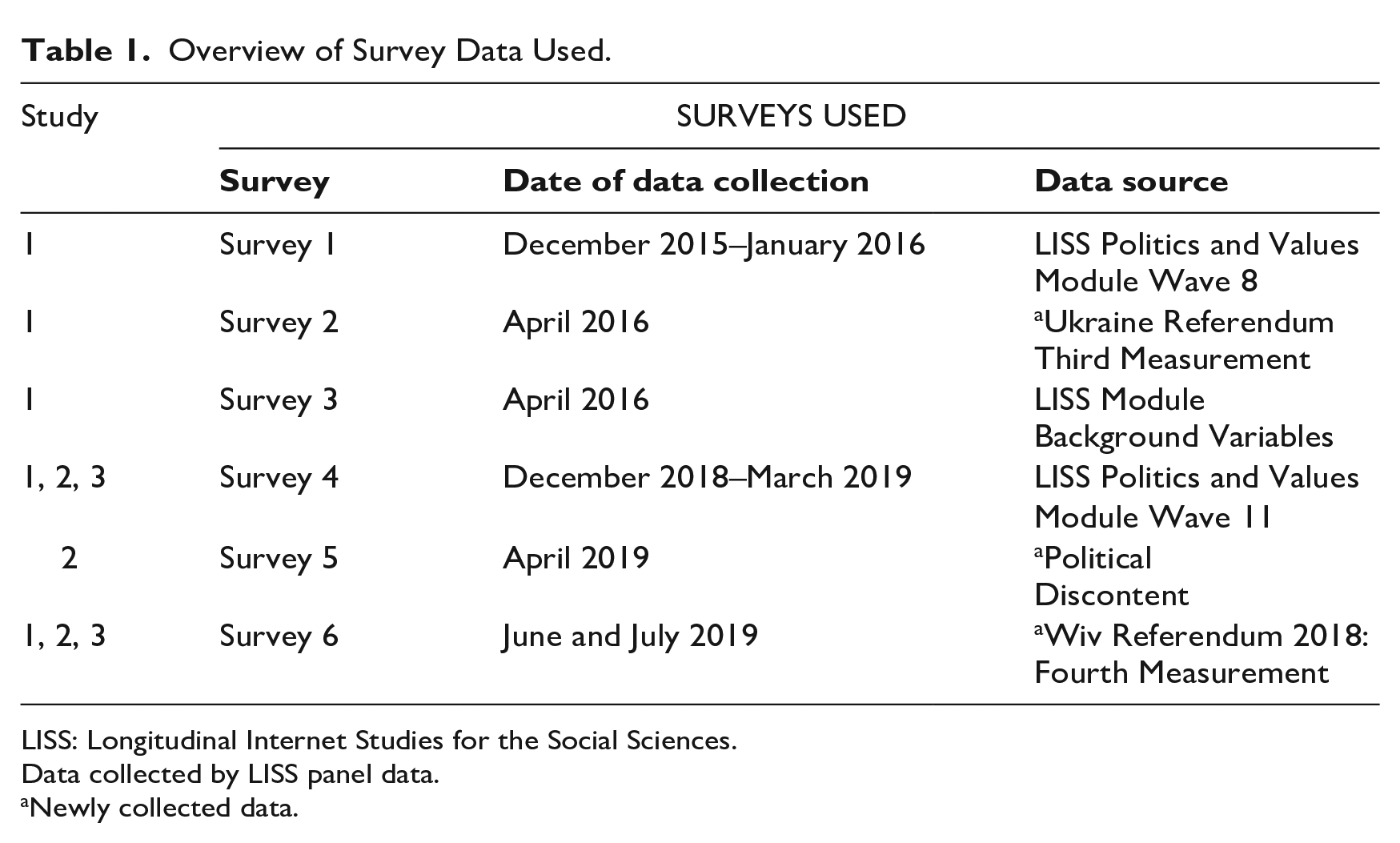
LISS: Longitudinal Internet Studies for the Social Sciences.
Data collected by LISS panel data.
Newly collected data.
The Case: The Netherlands
The Netherlands is a good case to test the relationship between populism and democracy among citizens (cf. Werner and Jacobs, 2021). Populist attitudes have been present in the Netherlands on both the left and the right sides of the political spectrum for some time (Akkerman et al., 2014), and the Netherlands also boasts both left- and right-wing populist parties in opposition (Otjes and Louwerse, 2015). According to the V-Dem Liberal Democracy Index, the quality of democracy in the Netherlands is comparable with other Western European democracies (Coppedge et al., 2021). Our data were collected prior to the Covid-19 pandemic. As such, the Netherlands did not experience severe economic or political crises at the time of study. We are confident therefore that our findings have bearing on the relationship between democratic preferences and populist attitudes for other parliamentary democracies in which the populist right and/or populist left were not in government. It is possible, however, that the relationship between populism and democratic attitudes at the individual level is different when a populist party is in office. As Krishnarajan (2022) found, democratic ideals are likely evaluated through a perceptual screen of current politics and partisan preferences. Jungkunz et al. (2021) show that voters’ populist attitudes hinge on whether a populist party is in power, or not. Hence, while our study provides an important first step into the relationship between populism and democratic attitudes at the individual level, future research should examine the relationship between populism and liberal democracy in contexts in which populist parties are in power.
Measuring Populist Attitudes
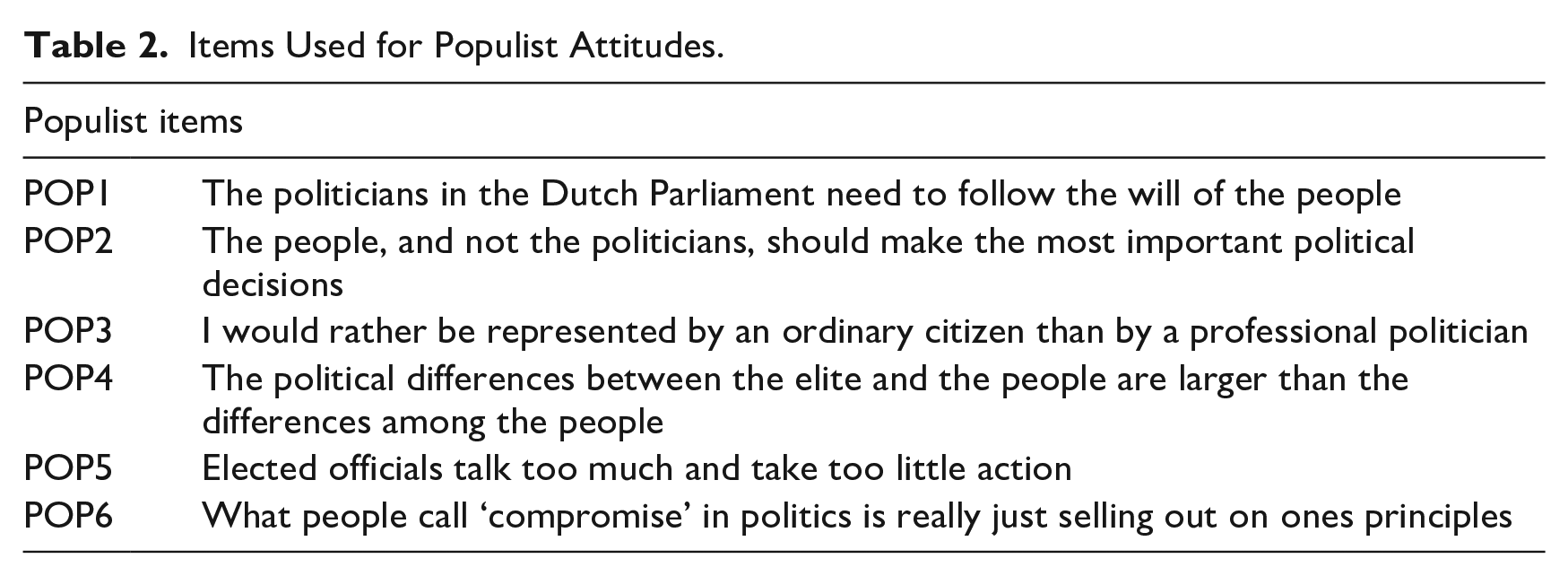
Our key independent variable in all three studies is respondents’ populist attitudes. Populist attitudes are measured with the scale developed by Akkerman et al. (2014). Six survey items measured on a Likert-type scale (1, disagree completely to 5, agree completely) are used to address the three core dimensions of populism, tapping into the anti-elite, people-centrist and antagonistic nature of populism (see Table 2). Given that populism is considered to be a latent construct, we conduct a confirmatory factor analysis (CFA). We do so both for the 2016 and for the 2019 data from Original Surveys 2 and 6. The CFA produces a one-factor structure for both samples. In line with previous research (Geurkink et al., 2020), we covary the error terms for POP1–POP2 and POP2–POP3 (see Tables A18 and A19 in the Online Appendix). Not only does this produce a better model fit, covarying these three items is also theoretically relevant as all three items tap into the people-centrist notion of populism. We use the regression scores from the CFA to construct our populist attitudes variable.
Items Used for Populist Attitudes.
Measuring Democratic Attitudes
Support for democracy has been measured in many different ways. We argue that one’s approach to measuring citizens’ democratic attitudes depends on the theoretical objective at hand. For this reason, we rely on different measures of democratic support in our three studies. Study 1 revisits the relationship between populist attitudes and both satisfaction with democracy and support for democracy. Doing so, we follow a long tradition of measuring regime performance, as satisfaction with democracy, and regime preferences, as overall democratic support (see Mattes, 2018 for an overview). In Study 2, we study the association between populist attitudes and support for liberal democracy. As liberal democracy compromises an array of different norms and institutions, we argue liberal democratic preferences cannot be captured with a single indicator (see König et al., 2022 for a discussion). As such, we are inspired by Ferrín and Kriesi (2016) who operationalize support for liberal democracy in a multi-dimensional way (see also König et al., 2022; Wuttke et al., 2020b). To do so, we measure support for the constitutive institutions of liberal democracy with nine separate items. Previous research has found that the aggregation of dimensions of liberal democracy into a single latent construct is fraught with problems (see König et al., 2022). In Study 3, we turn to a populist conception of democracy – measuring support for two forms of majoritarian rule. The exact operationalization of the democracy measures are discussed in each study.
Study 1: Populist Citizens as Dissatisfied Democrats
The centrality of popular sovereignty and majority rule in populism leads some scholars to conclude that populism is inherently a democratic ideology (Canovan, 1999; Laclau, 2005; Mudde and Kaltwasser, 2012). After all, its stated aim is to give voice to the people by some form of representation. This sets populism apart from anti-democratic extremist ideologies, such as fascism. Employing a minimalist definition of electoral democracy, scholars argue that populist movements can increase the quality of democracy by giving a voice to under-represented political concerns and by increasing political participation (Mudde and Kaltwasser, 2012). Indeed, populism can serve as a ‘corrective’ to democracy (Mudde and Kaltwasser, 2017). Empirical research shows some support for this positive rendering of populism’s impact on democracy. Huber and Ruth (2017) show that the presence of populist parties can indeed improve the equality of democracy by reducing the unequal participation of poorer and less educated citizens. Leininger and Meijers (2021) show that the parliamentary representation of populist parties has positively affected voter turnout in Central and Eastern Europe.
Populism can also be seen as a response to the functioning of democratic decision-making. Populist parties rally against the political establishment, because the establishment fails to sufficiently serve the people’s interests. From this perspective, populists are democrats who are dissatisfied with the state of democracy in their country (Canovan, 1999; Mudde and Kaltwasser, 2012; Kaltwasser and Van Hauwaert, 2020). This suggests that it is important to distinguish citizens’ evaluations of democracy from their normative views on democracy (Ferrín and Kriesi, 2016; Kaltwasser and Van Hauwaert, 2020; Wuttke et al., 2020a). Indeed, Stoker and Hay (2017) argue that populism is not a cry against democracy, but dissatisfaction with the current practice of politics. The ‘stealth democracy’ thesis by Hibbing and Theiss-Morse (2002) argues that citizens are dissatisfied by politics, because they see too much of the decision-making processes of a representative system that ultimately does not deliver on its promises (cf. Stoker and Hay 2017; Webb, 2013).
In Study 1, we examine the relationship between populist attitudes and individuals’ satisfaction with democracy and their support for the principle of democracy. Previous studies have found that individuals who hold stronger populist attitudes are more supportive of democracy than less populist respondents (Zaslove et al., 2021; Kaltwasser and Van Hauwaert, 2020). Citizens who support populist parties are not indifferent about politics, but are rather inclined to be more politically interested (Van Hauwaert and Van Kessel, 2018). Hence, discontent from individuals with stronger populist attitudes is likely rooted in genuine concern and dissatisfaction about the way democracy works (Kaltwasser and Van Hauwaert, 2020). Study 1’s hypotheses are therefore:
Hypothesis 1.1. The higher the respondent’s level of populist attitudes, the lower the respondent’s satisfaction with democracy.
Hypothesis 1.2. The higher the respondent’s level of populist attitudes, the higher the respondent’s support for democracy.
Study 1: Empirical Analysis
Respondents’ satisfaction with democracy is measured in Surveys 1 and 6 with items that ask individuals how satisfied they are with democracy (see Table 1). We estimate the effect of populist attitudes on individuals’ satisfaction with democracy using ordinary least squares (OLS) regression models. To adjust for possible heteroskedasticity, we use robust standard errors. 2
Support for democracy, in Survey 2, is measured by taking the mean of the sum of two Likert-type items about how people value democracy: ‘Democracy is the best political system’ and ‘It is important that a country is governed on the basis of democratic principles’. The correlation between the items is 0.73. In Survey 6, support for democracy is measured with the so-called ‘Churchill-democracy’ item: ‘Democracy may have its problems but it is better than any other form of government’. To avoid that skewed variable distributions affect our results, we also estimate logistic regression models as a robustness check (see the Online Appendix). The statistical significance and substantive findings are the same across these different model specifications.
The regression models control for respondents’ gender, level of educational, age and income (log). To make sure we estimate the effect of populism pur sang, we control for respondents’ left–right position and their degree of political trust. The models examining support for democracy also include satisfaction with democracy as a control. 3 The exact operationalization of the control variables is described in Section A.1 in the Online Appendix.
Figure 1 shows a coefficient plot for the OLS regression of the effect of populist attitudes on satisfaction and support for democracy in 2016 and 2019. 4 As hypothesized in Hypothesis 1.1, we find a statistically negative effect of populist attitudes on respondents’ satisfaction with democracy in both models, corroborating evidence proffered by Kaltwasser and Van Hauwaert (2020).
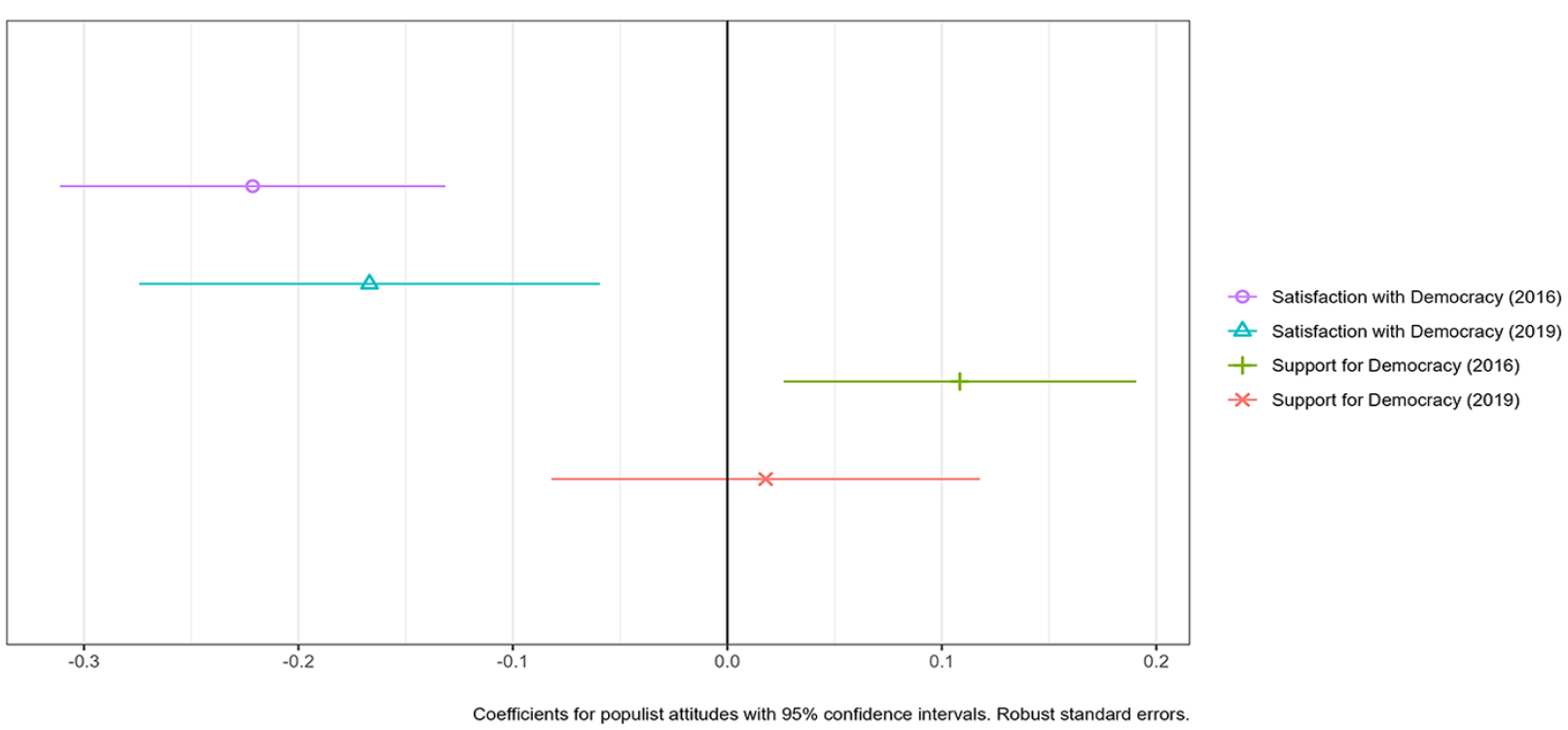
Populism, Satisfaction and Support for Democracy (OLS Regression).
Turning to the effect of populist attitudes on support for democracy, the evidence is mixed. In line with previous research (Kaltwasser and Van Hauwaert, 2020), the 2016 data display a positive effect of populism on support for democracy – indicating that respondents with stronger populist attitudes are more likely to support democracy than respondents with weaker populist attitudes. By contrast, the 2019 analysis finds no statistically significant effect of populist attitudes on support for democracy. It is possible that the different operationalization of the ‘support for democracy’ variable in the two surveys underlies these different findings. Given this mixed evidence, we do not find support for Hypothesis 1.2, which states that populist respondents are more supportive of the principle of democracy.
All in all, our findings indicate that while individuals with stronger populist attitudes are clearly dissatisfied with how democracy currently works, these same individuals are by no means less supportive of the principle of democracy. Yet, commitment to the abstract principle of democracy begs the question how citizens with stronger populist attitudes evaluate the constitutive dimensions of liberal democracy. We will address this question in Study 2.
Study 2: Populist Citizens as Reluctant Liberal Democrats?
Scholars who posit that populism is at odds with democracy, argue that populists defy political norms related to political pluralism, checks and balances, and the rule of law. In other words, populism is deemed incompatible with liberal democracy. From a maximalist understanding of democracy, political theorists argue that populism is antithetical to the core features and institutions of liberal democracy (Müller, 2017; Rummens, 2017; Urbinati, 2017, 2019a). Populists’ narrow conception of the people is deemed incompatible with political pluralism and with competing notions of the common good (Herman, 2017; Müller, 2014). The idea that the ‘true people’ are a homogeneous group negates the presence of political diversity in society and in public debate. Urbinati (2019a: 15), therefore, argues that populism constitutes a ‘radical and programmatic partiality’. The idea that only a part of society is sovereign as ‘the people’, can amount to a rejection of minority rights and legal egalitarianism. What is more, theorists fear that populism is antithetical to political opposition, as there is no space for legitimate opposition from its anti-pluralist perspective of politics (Moffitt, 2020: 97).
It has been argued that a corollary of populists’ rejection of political pluralism is its rejection of political mediation by political parties. In this sense, populism can be seen as a continuation of a long history of anti-party sentiment (Herman, 2017; Muirhead, 2006; Rosenblum, 2010). Populists reject the idea that political parties play an important intermediate role between citizens’ preferences and government policy, as mediation distorts the ‘pure’ will of the people. Moreover, the diversity of political parties necessitates compromise which distorts the general will of the sovereign people. Yet, party politics is precisely about contested notions of the common good (Urbinati, 2017; Van Biezen 2012; Viviani, 2019).
Populists’ radical majoritarian view of political sovereignty also relates to its supposed incompatibility with institutional checks and balances, such as the separation of powers and the rule of law. Pluralism is institutionalized in liberal democracies through the separation of powers and the rule of law through which the rule of the majority is purposely constrained (Bellamy, 1996; Diamond, 2003; Plattner, 2010; Urbinati, 2019c). In theory, this is incompatible with the populist idea that the will of the people should be unbridled (Urbinati, 2019a, 2017).
These considerations motivate Urbinati (2019a: 15) to conclude that populism disfigures the fundamental institutions of representative democracy, especially when in power. Empirical research on the country and party levels by, and large supports these concerns. Studies show that populist parties and leaders have eroded checks and constraints on the executive (Houle and Kenny, 2018; Huber and Schimpf, 2017; Juon and Bochsler, 2020; Ruth, 2018), have hampered media freedom (Juon and Bochsler, 2020; Kenny, 2020) and have attacked minority rights (Huber and Schimpf, 2017). It remains unclear, however, whether populism’s incompatibility with political pluralism also applies to the citizen level.
Below, we present our hypotheses on the relationship between individuals with stronger populist attitudes and support for constitutive components of liberal democracy. To test the extent to which expectations about the relationship between populism and liberal democracy in political theory research hold true for the individual level, we base our hypotheses explicitly on this literature.
Operationalizing Preferences for Liberal Democracy
To measure support for liberal democracy among citizens, we follow Ferrín and Kriesi (2016) and measure support for liberal democracy in a multi-dimensional, disaggregated fashion (see also König et al., 2022; Wuttke et al., 2020b). Despite widespread agreement on the theoretical consistency of liberal democracy as a multi-faceted concept (i.e. Dahl, 2008b), previous research has shown that a valid aggregation of items measuring constitutive aspects of liberal democracy into a latent construct is fraught with problems (König et al., 2022). More importantly, the aim of our endeavour is to uncover the relationship between populist attitudes and support for the various underlying aspects of liberal democracy. Therefore, we have explicitly chosen to measure support for liberal democracy with separate items that cover the constitutive aspects of liberal democracy, as theorized by Urbinati (2019a).
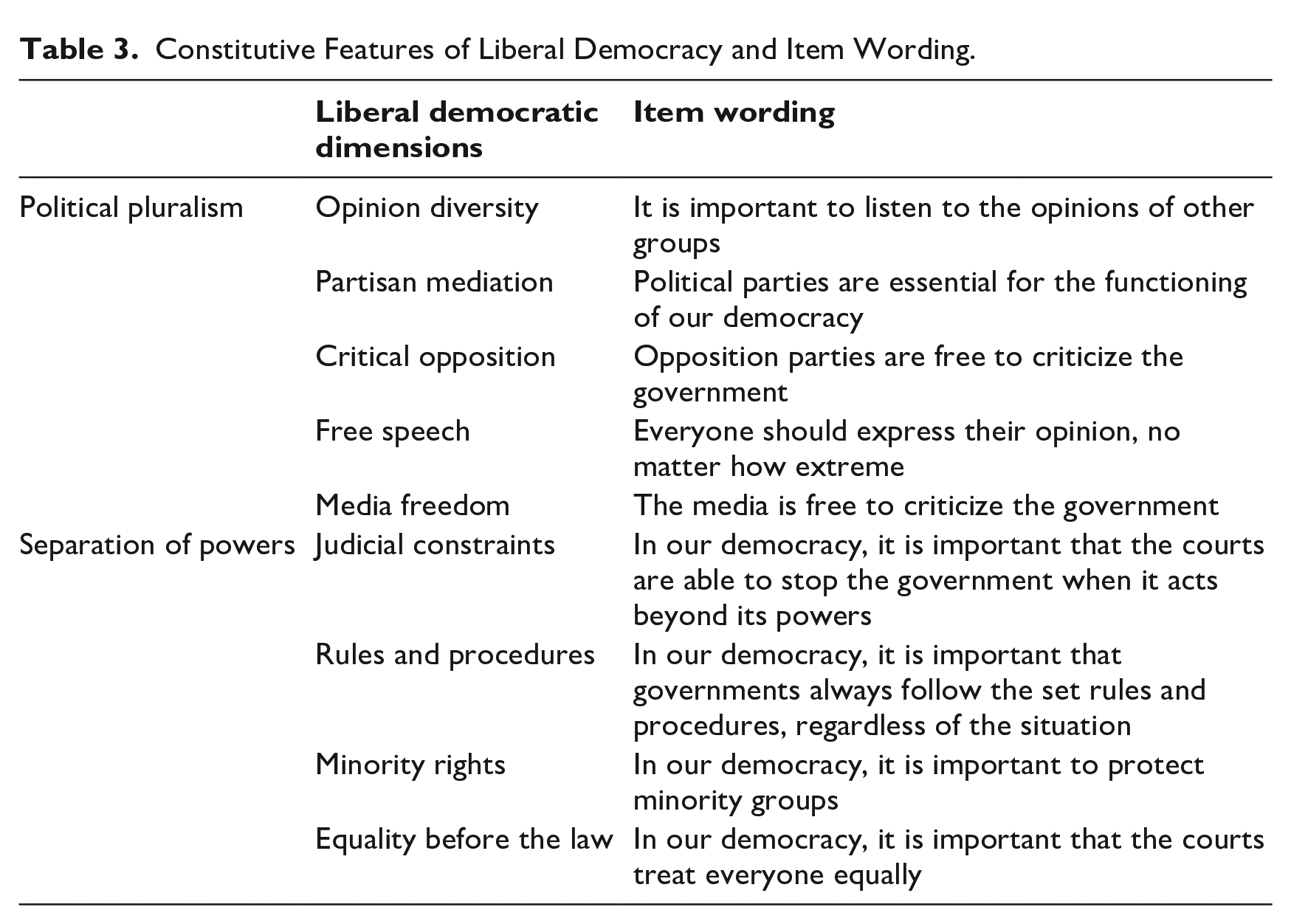
Our operationalization of citizen preferences for liberal democracy follows the theoretical distinction between two dimensions of liberal democracy: political pluralism and mediation and separation of powers and the rule of law Urbinati (2019a). Both dimensions are key to dominant definitions of liberal democracy or polyarchy (Dahl, 2008a; Diamond, 2003). 5 Given that, we are interested in the association between populist attitudes and the specific underlying components of both dimensions, we do not aggregate support in these dimensions. Rather, we use the dimensions of political pluralism and mediation and separation of powers and the rule of law as a theoretical lens for our empirical analysis. Table 3 lists the different components of liberal democracy as well as their operationalization.
Constitutive Features of Liberal Democracy and Item Wording.
Political Pluralism and Mediation
Political theorists like Urbinati (2019a) and Müller (2017) have argued that populism is at odds with political pluralism. We test the theoretical expectation that citizens with stronger populist attitudes reject political pluralism for the five components of political pluralism listed in Table 3.
First, populists adhere to a monistic conception of the public good, which does not permit open contestation (Herman, 2017: 740). This suggests that populists consider dissenting views to be a threat. As such, populists’ rejection of political pluralism at the citizen level can be apparent from a rejection of opinion diversity. We therefore hypothesize:
Hypothesis 2.1. The higher the respondent’s level of populist attitudes, the less likely the respondent is to believe that it is important to listen to the opinion of other groups.
Populists’ anti-pluralism also leads them to reject party politics and partisan mediation. Given that the ‘true people’ are a homogeneous group with a single general will, there is no need for political parties. Party politics requires deliberation and debate, finding common ground between contrasting views and striking compromises (Gutmann and Thompson, 2010). Instead, populist leaders insist on more direct forms of representation, that is, through the populist leader herself or himself. From this perspective, it is expected that populist citizens reject partisan mediation:
Hypothesis 2.2. The higher the respondent’s level of populist attitudes, the less likely the respondent is to believe that political parties are essential for the functioning of democracy.
A consequence of this rejection of partisan mediation is that should have no business in criticizing those in power. The idea that multiple parties in opposition should criticize the government in not in line with a monistic view of politics that is ascribed to populists. As such, one could expect populist attitudes to be associated with a rejection of critical opposition parties:
Hypothesis 2.3. The higher the respondent’s level of populist attitudes, the less likely the respondent is to believe that opposition parties are free to criticize the government.
Populists’ homogeneous view of the people should also lead to rejection of free public debate – as only a ‘part’ of the society can speak for the people’s singular views. This leads to the theoretical expectation that populists reject free speech.
Hypothesis 2.4. The higher the respondent’s level of populist attitudes, the less likely the respondent is to believe that everyone should be able to voice their opinion.
Populists’ monistic view of legitimate political opinions can also extend to the public sphere (Herman, 2017: 748). Media freedom is arguably a cornerstone of free political contestation in liberal democracies. The media disseminates a diversity of political opinions and, crucially, serves as an important check on government’s power. Supply-side research has shown that populist parties in power regularly attack media freedom (Juon and Bochsler, 2020; Kenny, 2020). From a monist perspective of politics, populist citizens are likely to believe that the media should not be able to criticize the government. From this perspective, we can postulate the following hypothesis:
Hypothesis 2.5. The higher the respondent’s level of populist attitudes, the less likely the respondent is to believe that the media are free to criticize the government.
Separation of Powers and the Rule of Law
Populists’ rejection of political pluralism also relates to its frustration with the separation of powers and the rule of law. Arguably, the separation of powers and the rule of law institutionalize pluralist norms by constraining majority rule (Diamond, 2003; Plattner, 2010). This should frustrate citizens with strong populist attitudes given populism’s belief in unconstrained majoritarianism.
Separation of powers denotes the idea that the elected executive, representing a political majority, cannot interfere with or obstruct the legislative branch and the judicial branch. The clearest example of separation of powers is when the courts rule that government policy is at odds with the law. Therefore, populists likely believe that courts should not be able to constrain the government. In addition, a radical majoritarian view on democracy is likely to be impatient with procedures that ensure governments act in line with the rule of law. We therefore test whether citizens believe that the government should always act according to set rules and procedures. In theory, populists should reject such proceduralism as it can stand in the way of popular sovereignty. In light of these considerations, we posit the following hypotheses:
Hypothesis 2.6. The higher the respondent’s level of populist attitudes, the less likely the respondent is to believe that is important that the courts can constrain the government’s actions.
Hypothesis 2.7. The higher the respondent’s level of populist attitudes, the less likely the respondent is to believe that is important that governments, regardless of the situation, adhere to set rules and procedures.
Populists’ singular view of the people can also translate to a partial view of the law. As such, populism can be at odds with the idea of minority rights and equality before the law. Indeed, empirical research on the party level has shown that populists have a deteriorating impact on minority rights (Huber and Schimpf, 2017). We therefore test the following two hypotheses:
Hypothesis 2.8. The higher the respondent’s level of populist attitudes, the less likely the respondent is to believe that is important that minority groups are protected.
Hypothesis 2.9. The higher the respondent’s level of populist attitudes, the less likely the respondent is to believe that is important that the courts treat everyone equally.
An Alternative View: Dissatisfied Liberal Democrats and Laclauian Populism
The hypotheses above are rooted in the pessimistic view of political theorists like Müller (2017), Rummens (2017) and Urbinati (2019a) on the relationship between populism and liberal democracy. Yet, not all scholars paint such a dark picture of the association between populist ideation and liberal democracy.
First, Stoker and Hay (2017) argue that populists’ dissatisfaction does not stem from a rejection of liberal representative democracy. Rather, discontent stems from the belief that political elites do not deliver on the promises of representative democracy. From this perspective, citizens with high levels of populist attitudes do not necessarily reject principles like the rule of law, but believe these principles are wielded selectively. This would lead to different expectations between populist thought and support for liberal democratic institutions at the individual level. For instance, populist citizens might be more, or equally, likely to believe that governments should follow strict rules and procedures (cf. Hypothesis 2.7), precisely because (mainstream) governments are perceived not to do so. In a similar vein, highly populist citizens are likely to be more, or equally, supportive of principle of equality before the law (see Hypothesis 2.9), because they believe elites are currently unencumbered by laws and regulations.
Second, with respect to the relationship between populism and pluralist principles, political theorists like Ernesto Laclau and Chantal Mouffe put forward a positive, even emancipatory view of populism. Laclau (2005) and Mouffe (2005) see populism, in its left-wing form, as a vehicle to achieve ‘radical democracy’: a form of democracy that revolves around political difference rather than compromise and consensus. In this view, representative democracy has become an increasingly closed political system with power in the hands of the few (Moffitt, 2020: 100). What is necessary, therefore, is an emancipatory (left-wing) form of populism that brings power back to ‘the people’. While ‘the people’ in the ideational approach to populism is considered to be a homogeneous entity, the Laclauian discursive approach emphasizes the openness and indeterminacy of ‘the people’ (Moffitt, 2020: 101).
Although this discursive conception of populism is not entirely congruent with the ideational approach to populism, its relationship with liberal democracy is worth noting nonetheless. Whereas populism in the ideational definition is distinctly anti-pluralist, this is not so clear-cut in the Laclauian discursive approach to populism. For Laclau and Mouffe, populism revolves around bringing adversarialism and conflict back into mainstream politics, emancipating a diverse group of citizens as ‘the people’ to shake up the establishment (cf. Stavrakakis et al., 2018). When we theorize about the relationship between pluralist components and populism from this perspective, different expectations come to fore. Rather than opposing political opposition (see Hypothesis 2.3), highly populist citizens could embrace opposition to the government as a way to change the political status quo and hope for political renewal. Similarly, the antagonistic character of Laclauian populism could lead to a view that free speech cannot be curbed (cf. Hypothesis 2.4). Those who argue that populism can have a corrective effect also argue that populist movements can address previously ignored issues (Mudde and Kaltwasser, 2012). An antagonistic, anti-establishment view of populism could, moreover, lead to the expectation that highly populist citizens welcome the media’s critique on the government (cf. Hypothesis 2.5). Indeed, although highly populist citizens are less keen on so-called traditional media outlets, recent research shows that they are more likely to engage with alternative media (Müller and Schulz, 2021). From this perspective, highly populist citizens might be particularly likely to support a media that is perceived as free and critical.
Ultimately, however, also Laclau’s theory of populism can also be regarded to be at odds with pluralism as power is concentrated in a leading figure, who will unite ‘the people’ (Moffitt, 2020: 109–110). Therefore, it remains unclear how the pluralist aspects of Laclauian populism relate to its anti-pluralist tendencies, and how these translate to the individual level.
Study 2: Empirical Analysis
We test all nine hypotheses from Study 2 with newly collected data from two surveys in 2019 from the LISS panel (Surveys 5 and 6). We leverage the panel structure of the LISS panel and the close temporal proximity of the surveys to combine these in a single data set, complemented with data from Survey 4 (see Table 1). We operationalize populist attitudes in the same way as in Study 1. We estimate OLS regression models for the nine dependent variables. All models rely on the same control variables as the models estimating support for democracy (see Sections A.1 and A.3 in the Online Appendix). The OLS models include robust standard errors to control for heteroskedasticity. As a robustness check, we also estimate logistic regression models for all nine models. The statistical significance and substantive findings are the same across model specifications (see the Online Appendix for a more extensive discussion regarding the specification of these models.)
Figure 2 displays the coefficients of our independent variable of interest, populist attitudes, on the various dependent variables representing different components of liberal democracy (full models can be found in Tables A7–A12 in the Online Appendix).
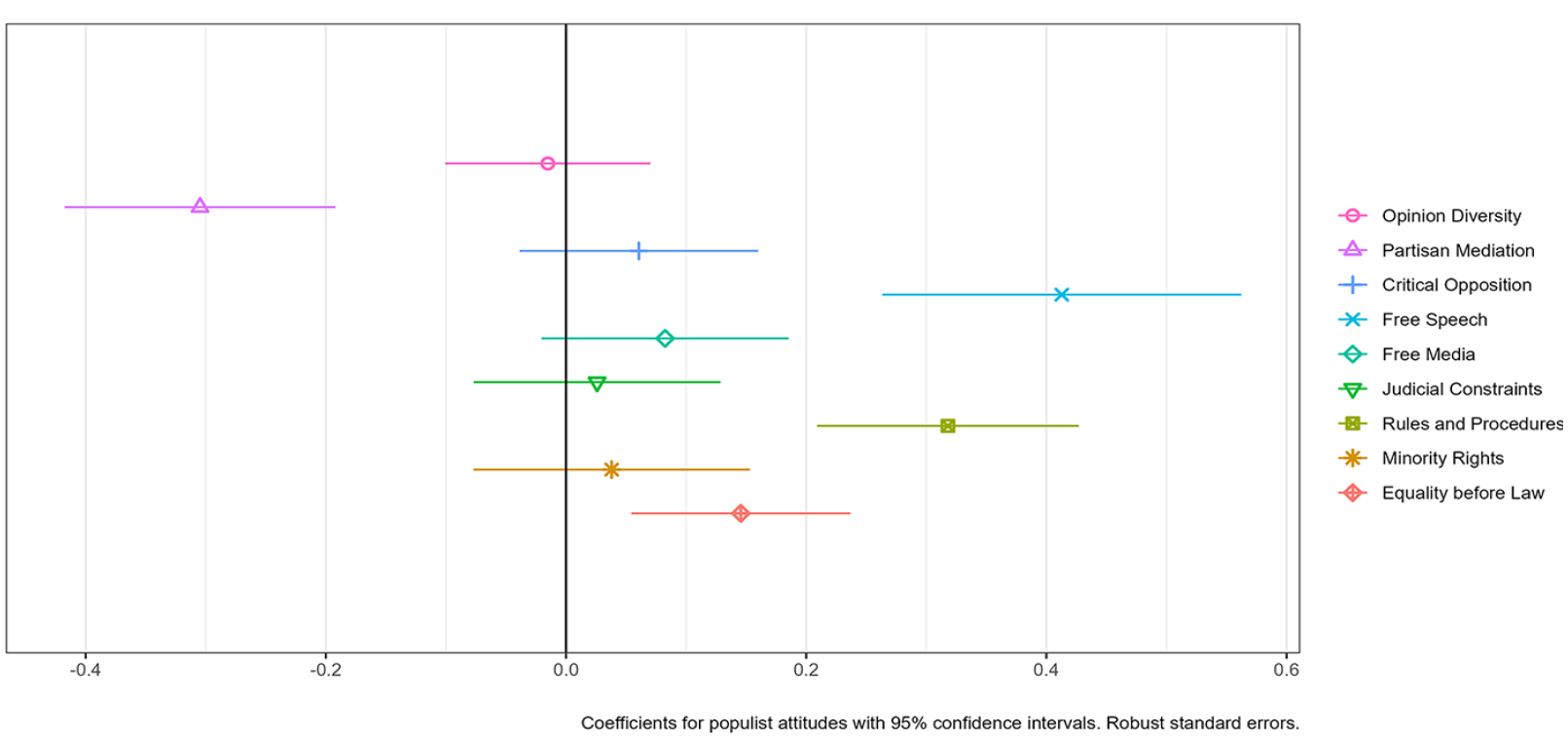
Populism and Liberal Representative Democracy (OLS Regression).
Starting with the relationship between populist attitudes and opinion diversity, the coefficient plot shows a negative, but statistically insignificant effect of a respondent’s degree of populism on opinion diversity. Thus, we find no support for Hypothesis 2.1, which posited that populists’ monistic view of the public good should reduce preferences for opinion diversity. We see no evidence that individuals with strong populist attitudes are more likely to oppose opinion diversity than citizens with weaker populist attitudes.
Hypothesis 2.2 posited that individuals with stronger populist attitudes reject mediated political representation by parties. The coefficient plot shows that respondents’ populist attitudes have a sizable negative and statistically significant effect on their propensity to reject parties as necessary for democracy. Turning to the relationship between populist attitudes and the idea that opposition parties should be free to criticize the government (Hypothesis 2.3), Figure 2 demonstrates that there is no significant effect of populist attitudes on support for a critical opposition. This might suggest that populists’ anti-pluralist and anti-establishment preferences might cancel each other out.
With respect to free speech, Hypothesis 2.4 posited that populists’ anti-pluralism leads to a rejection of free speech. Figure 2 shows that there is a clear positive and statistically significant effect of populist attitudes on support for free speech, in contrast to Hypothesis 2.4. Hypothesis 2.5 posited that highly populist individuals are less likely to support the idea that the media is free to criticize the government. Again, Figure 2 shows that there is no statistically significant effect of respondents’ populist attitudes on media freedom, which – again – might suggest that anti-pluralist and anti-establishment sentiments offset one another.
Turning to the question of separation of power and the rule of law, Hypothesis 2.6 posited that populists likely find it less important that courts can constrain the government’s actions when its policy is at odds with the law. Contrary to what was hypothesized, the coefficient in Figure 2 shows a statistically insignificant effect of populist attitudes on this variable. Regarding populists’ views on procedural governance, Hypothesis 2.7 stipulated that individuals with stronger populist attitudes are less likely to think that governments should always adhere to existing rules and procedures. Yet, contrary to what we hypothesized individuals with stronger populist attitudes, in fact, are more likely to think that governments should adhere to set rules and procedures.
Hypotheses 2.8 and 2.9 expressed the expectation that citizens with stronger populist attitudes are less likely to support the idea of minority group protection as well as the idea that everyone should be equal before the law. Interestingly, however, we find a statistically insignificant effect of stronger populist attitudes on minority rights, leading us to reject Hypothesis 2.8. Moreover, we reject Hypothesis 2.9 as we find a significant, positive effect of stronger populist attitudes on support for equality before the law.
In sum, Study 2 finds that while individuals with stronger populist attitudes reject partisan mediation, they are not less supportive of liberal democracy’s core pluralist institutions. This suggests that supply-level conclusions about the relationship between populism and (liberal) democracy (Urbinati, 2019c) do not hold at the individual level. Interestingly, individuals with stronger populist attitudes are more supportive of free speech, that governments follow the rules and that all citizens are treated equally before the law than citizens with lower populist attitudes. We return to these findings in the conclusion.
Study 3: Populist Democracy as Majoritarian Popular Rule
Our findings so far have shown that Dutch citizens with stronger populist attitudes are no less supportive of democracy and no less supportive of most dimensions of liberal democracy. Yet, their frustration regarding the functioning of democracy, and with the role of political parties in particular, stands out. This is in line with the argument that individuals with stronger populist attitudes reject mediated representation (Urbinati, 2019c). Instead, populist support a vision of majoritarianism in which the wishes of the majority of the people are decisive. Study 3 tests whether citizens with stronger populist attitudes are more prone to support a form of majoritarian popular sovereignty.
In theory, populism can be seen as a claim about political representation as it advocates a radical majoritarian vision of representation. Central to a populist vision of political representation is the idea that the people, and only the people, are sovereign. As a consequence, the demands and wishes of the people should never be curtailed (Kaltwasser, 2014; Urbinati, 2019c). Populist conceptions of democracy stipulate that majority rule cannot be constrained by elites and non-elected bodies, such as the judiciary.
Unbridled majoritarian rule should also hold when the demands of the people are incompatible with legal provisions enshrined in the country’s constitution. Citizens with stronger populist attitudes are therefore likely to reject any adjudication of the majority’s will by the judiciary, as this would amount to an encroachment of popular sovereignty. We therefore hypothesize that citizens with stronger populist views believe that the will of the majority should never be constrained by the courts:
Hypothesis 3.1. The higher the respondent’s level of populist attitudes, the more likely the respondent is to believe that in our democracy the will of the majority should never be constrained by the judiciary.
Plebiscites are another form of unbridled majoritarian rule. Referendums are a commonly proposed form of democratic reform to improve the participatory character of political decision-making (Scarrow, 2003). Referendums put complex policy questions directly to the people, after which the majority (or plurality) prevails. In case of legally binding referendums, referendums provide the people a direct, unmediated form of influence on government policy.
Populism’s emphasis on unmediated representation also explains its affinity with direct forms of representation. Referendums can be seen as a way to return political power to the people (Mudde, 2007: 151). Referendums, especially those originating from grass-roots citizen initiatives, escape the power of elites (Jacobs et al., 2018; Mudde, 2007: 151). What is more, referendums speak to populism’s homogeneous conception of the people as they enable representation of the people in its entirety with little differentiation (Canovan, 2005). As such, referendums are a form of unconstrained majoritarianism par excellence. Indeed, previous research has found that populists tend to support referendums (Jacobs et al., 2018), and that populist citizens are more likely to accept the outcome of a referendum when ‘their’ side loses (Werner and Jacobs, 2021). We therefore test the following hypothesis:
Hypothesis 3.2. The higher the respondent’s level of populist attitudes, the more likely the respondent is to support a referendum on important issues.
Study 3: Empirical Analysis
We test both hypotheses using data from original survey data (Survey 6, see Table 1). We adopt the same approach as in Studies 1 and 2, and estimate the effect of populist attitudes on the dependent variables of interest, while controlling for possible confounders. We use the same populist attitudes variable and control variables as in Study 2 (Section A.3 in the Online Appendix). We estimate the two models examining populist democracy by way of OLS regression models, with robust standard errors. 6
We measure support for majority rule without judicial constraints with the Likert-type item ‘In our democracy the majority should be decisive, and judges should, for example, not be able to constrain it’. Support for a referendum vote on important decisions is measured using the item ‘On some decisions that are important for our country, voters should vote via a referendum’ (see also Jacobs et al., 2018). Figure 2 shows a coefficient plot with the effect of respondents’ populist attitudes on two dependent variables: support for majority rule without judicial constraints and support for a referendum vote on important decisions (See Table A13 in the Online Appendix for full models).
Figure 3 shows a strong, statistically significant and positive effect of populist attitudes on support for unconstrained majority rule. This allows us to accept Hypothesis 3.1. We also see a significant and positive effect of populist attitudes on referendum support – leading us to accepting Hypothesis 3.2. The magnitude of the effects for both variables is quite striking and indicates strong support for the idea that populists support a majoritarian form of political representation.
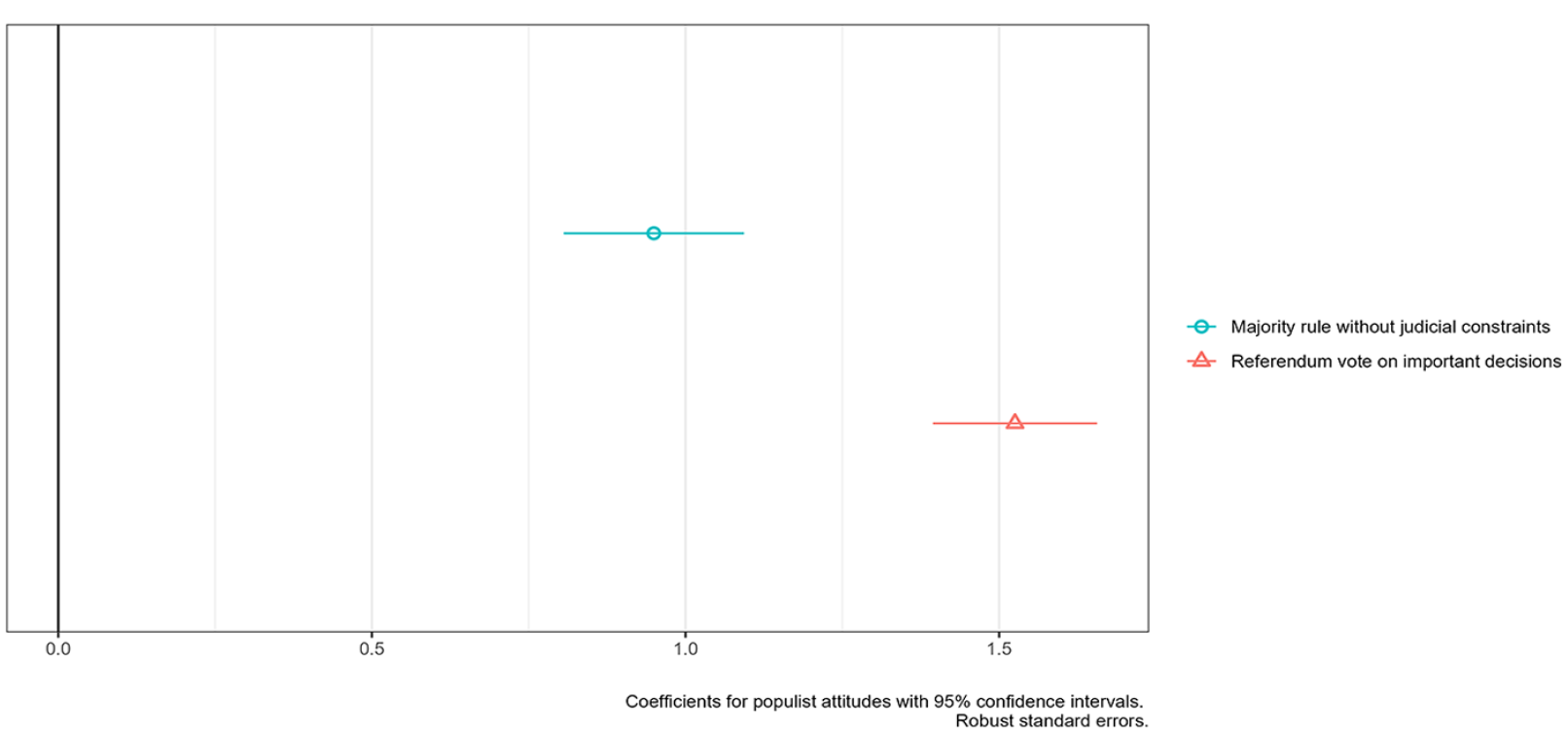
Populist Democracy (OLS Regression).
Conclusion
The relationship between citizens’ populist attitudes and their attitudes towards democracy has been understudied. Using unique data from the Netherlands, we provide new and important insights into the relationship between populism and democracy at the individual level by examining the relationship between populist attitudes and satisfaction with democracy and support for democracy (Study 1), between populist attitudes and dimensions of liberal democracy (Study 2) and between populist attitudes and forms of unconstrained majority rule (Study 3). Corroborating previous findings (Kaltwasser and Van Hauwaert, 2020), we find in Study 1 that populist citizens are less satisfied with the functioning of democracy, but not less supportive of the principle of democracy. In Study 2, we find that while populist citizens reject the idea that political parties are important mediators, they do support key tenets of liberal democracy. Finally, Study 3 shows that highly populist citizens are more likely to support majoritarian popular rule and unequivocally support referendums.
The findings that citizens with stronger populist attitudes do not, in fact, exhibit less support for key institutions of liberal democracy as citizens with lower populist attitudes ran contrary to the expectations formulated on the basis of political theory work by Müller (2017), Rummens (2017) and Urbinati (2019c). These findings highlight that the association between populism and pluralist political preferences is more complicated than often assumed. At least in our sample of Dutch citizens, individuals with stronger populist attitudes are not more likely to oppose minority rights or the separation of powers. These findings are commensurate with recent research by (Ellenbroek et al., 2023) who find that populist voters are equally supportive of political pluralism in parliament and government. In addition, our findings are in line with the recent descriptive study by Wuttke et al. (2022), who show that populist citizens in France Germany, Switzerland and the United Kingdom are not more likely to reject the rule of law than non-populists. In a similar vein, studies have shown that citizens who vote for populist parties do not consistently oppose liberal democratic principles (Van der Brug et al., 2021), and that populist attitudes are not a good predictor of voting for a far right candidate with authoritarian credentials (Silva et al., 2022).
This gives credence to the argument put forward by Stoker and Hay (2017) that individuals with stronger populist attitudes do not necessarily reject liberal representative democracy per se. Rather, we can speculate that these individuals believe the system does not live up to its promises, as the high levels of dissatisfaction with the functioning of democracy also indicate (Study 1). Neblo et al. (2010: 580) sum this up nicely: ‘There is no contradiction between passionate support for democratic ideals and despair about the way status quo practices subvert them’. Harteveld et al. (2021) find that populist radical right voters and nativist voters become much more satisfied with democracy when radical right parties are included in government. While the study focuses on nativist voters of the radical right, this also suggests that political discontent is strongly linked to a lack of inclusion – as opposed to fundamental opposition to representative democracy. 7
What is more, our findings also lend support to a Laclauian take on the relationship between populism and democracy (Laclau, 2005; Mouffe, 2005). For Mouffe and Laclau, populism can be a healthy corrective to democracy by bringing back conflict and political difference into political debate and by challenging a ‘closed political system’ (cf. Mudde and Kaltwasser, 2012). This echoes our findings that individuals with stronger populist attitudes tend to support checks and balances on the executive. One could even posit that our findings suggest that, in certain respects, citizens with higher populist attitudes are better democrats than those with lower populist attitudes, given the positive effect of populist attitudes on support for free speech, procedural governance and equality before the law. 8
Individuals with stronger populist attitude’s support for democracy in principle and their acceptance of most pluralistic institutions enshrined in liberal democracy notwithstanding, we find that these individuals strongly favour majoritarian and unmediated forms of political representation. Citizens with stronger populist attitudes are strongly in favour of referendums and believe majority rule should not be curtailed by actors, such as judges. Moreover, they reject the idea that parties are important for the functioning of democracy. This mirrors the supposition that party politics conflicts with the populist notion of a single common good (Herman, 2017; Mair, 2002; Müller, 2014), and dovetails with the populist view that political parties stand in the way of the common sense of the people (Caramani, 2017). From the theoretical angle of thinkers like Rummens (2017) and Urbinati (2019c), a rejection of political parties can be considered as the repudiation of a crucial component of liberal democracy.
Yet, while our theoretical argument is inspired by a view that sees political parties as a central component of liberal representative democracy (Muirhead, 2006; Urbinati, 2019b), others have argued that liberal democracy is possible without, or at least with less, party involvement. Studies of deliberative democracy show the promise of deliberative citizen assemblies and mini-publics for representative democracy (Dryzek et al., 2019; Neblo et al., 2010). Moreover, one’s rejection of political parties could also stem from the belief that parties do not live up to their democratic task (Stoker and Hay, 2017), and hence from a desire for more genuine deliberation – among citizens and also among politicians who are not burdened with partisan polarization. What is more, one could argue that a rejection of parties is not necessarily a rejection of all political mediation as such. It is possible some citizens are wary of political parties as oligopolistic forces and prefer mediated representation by independent MPs or experts instead.
This study into the relationship between citizens’ populist attitudes and democratic preferences was conducted in the Netherlands. The presence of populism among both citizens and opposition parties makes the Netherlands a good starting point for this new research agenda on democratic preferences and populism (see also Akkerman et al., 2014; Werner and Jacobs, 2021). As such, it is likely that our findings travel to similar West European contexts.
Yet, to further our understanding of the relationship between populism and democracy among citizens, it is important to assess this association in different political contexts. Previous democracy research has indeed found that support for dimensions of democracy depends on the political context (Easton, 1975; Spierings, 2014). It is therefore possible that the incumbency in government of a populist party affects the relationship between populism and democratic attitudes at the individual level. Jungkunz et al. (2021) find that the level of populist attitudes among voters for populist parties is lower when the populist party in question is in power. Moreover, recent research has found that what citizens evaluate as ‘democratic’ strongly depend on motivated reasoning and the ideology of the politician proposing a certain policy (Krishnarajan, 2022). This suggests that democratic ideals are gauged through a perceptual screen of current politics and partisan preferences. This suggests that populists’ appraisals of democracy likely depend on their national experience with democracy.
Thus, while our study provides an important first step into the relationship between populism and democracy at the individual level, future research should study whether the relationship between populism and liberal democracy holds in cross-national comparative fashion. Examining the contingency of this relationship by also studying the perceived importance of key institutions of liberal democracy in contexts in which populist leaders are in power is a promising avenue for future investigation.
Our finding that citizens with strong populist attitudes are more supportive of free speech, procedural governance and legal egalitarianism could therefore well stem from feelings of political exclusion (Taggart, 2002), rather than democratic commitment alone. To test this empirically, more research is needed on why highly populist citizens are more likely to support free speech, rule-based governance and equality before the law. Is this rooted in the principled belief that free speech, legal egalitarianism and rule-based governance are necessary for a healthy democracy? Or, alternatively, is it rooted in a partisan belief that these principles are currently applied selectively (i.e. free speech, legal equality and rule of law do not apply to everyone)? Finally, it is worth exploring measures of democratic support without reference to the executive. Despite the inclusion of control variables like satisfaction with democracy and political trust in our models, it is possible that these measures of institutionalized pluralism pick up on anti-establishment sentiments. Using factorial experiments, future research could attempt to separate preferences for pluralism and the separation of powers from anti-elite evaluations.
All in all, we believe that this study is a significant step forward in understanding the implications of populist thought for citizens’ democratic commitment. While populist actors in power often distort liberal democracy (Houle and Kenny, 2018; Juon and Bochsler, 2020; Ruth, 2018), we find that the same is not true for citizens. This suggests that we should be cautious of applying meta- and meso-level theories about populism and democracy to individual-level dynamics.
Supplemental Material
sj-pdf-1-psx-10.1177_00323217231173800 – Supplemental material for Populist Democrats? Unpacking the Relationship Between Populist and Democratic Attitudes at the Citizen Level
Supplemental material, sj-pdf-1-psx-10.1177_00323217231173800 for Populist Democrats? Unpacking the Relationship Between Populist and Democratic Attitudes at the Citizen Level by Andrej Zaslove and Maurits Meijers in Political Studies
Footnotes
Acknowledgements
The authors would like to thank the anonymous reviewers for their very helpful and constructive comments on the paper. A previous version of this paper was presented at the ECPR General Conference, 20–28 August 2020 at the panel entitled: Mapping the Complex Relationship Between Voters and Parties to Explain Differences in Radical Party Performance Based on New Theorizing, New Data and New Methods. They would also like to thank the discussant Robert Huber for his very good comments and suggestions. The paper was also presented at the ECPR Joint Sessions workshop New Frontiers in Democracy Research: Tackling a Conceptual and Methodological Impasse, 26–28 May 2021. They would like to thank the discussant Lea Kaftan for her very helpful comments and suggestions. They would also like to thank the workshop chairs Reinhard Heinisch and Annika Werner as well as all other workshop participants. In addition, they would like to thank Fabian Habersack, Alex Lehr, Alberto Stefanelli and Yaël van Drunen for their advice and comments on earlier versions of the paper.
Declaration of Conflicting Interests
The author(s) declared no potential conflicts of interest with respect to the research, authorship and/or publication of this article.
Funding
The author(s) disclosed receipt of the following financial support for the research, authorship, and/or publication of this article: Maurits Meijers gratefully acknowledges financial support from the Dutch Organisation for Sciences (NWO Veni Grant VI. Veni.191R.018, ‘The Reputational Cost of Party Policy Change’).
Supplementary Information
Additional Supplementary Information may be found with the online version of this article. A.1 Study 1 A.2 Logistic Regression Models Table A1: Descriptives Data 2016 A.3 Study 2 A.4 Logistic Regression A.5 Study 3 Table A2: Descriptives Data 2019 A.6 Histograms for Dependent Variables Figure A1: Histogram Plots for Dependent Variables Figure A2: Histogram Plots for Dependent Variables Table A3: Descriptives Dichotomized Variables A.7 Regression Models Table A4: Populism, Satisfaction and Support for Democracy (OLS) Table A5: Populism and Support for Democracy (Logistic Regression with Log-odds) Table A6: Populism and Support for Democracy (Logistic Regression with Odds ratios) Table A7: Populism and Liberal Representative Democracy: Political Pluralism and Mediation (OLS) Table A8: Populism and Liberal Representative Democracy: Separation of Powers and the Rule of Law (OLS) Table A9: Populism and Liberal Representative Democracy: Political Pluralism and Mediation (Logistic Regression with Log-odds) Table A10: Populism and Liberal Representative Democracy: Separation of Powers and the Rule of Law (Logistic Regression with Log-odds) Table A11: Populism and Liberal Representative Democracy: Political Pluralism and Mediation (Logistic Regression with Odds Ratios) Table A12: Populism and Liberal Representative Democracy: Separation of Powers and the Rule of Law (Logistic Regression with Odds Ratios) Table A13: Populist Democracy (OLS) A.8 Regression Models (Standardized) Table A14: Standardized Predictors for Democracy (OLS) Models with Significant Effects Table A15: Standardized Predictors for Liberal Representative Democracy (OLS) Models with Significant Effects Table A16: Standardized Predictors for Populist Democracy (OLS) Models with Significant Effects A.9 Conditional Predictions for the Regression Models with Significant Results Figure A3: Conditional Predictions for Models with Significant Effects Figure A4: Conditional Predictions for Models with Significant Effects (with Mean of the Sum) A.10 Fit Statistics for Confirmatory Factor Analysis Table A17: Fit Statistics Table A18: Factor Loadings Table A19: Factor Loadings A.11 Survey Questions Table A20: Study 1 Table A21: Study 1 Table A22: Study 2 Table A23: Study 3
Notes
Author Biographies
References
Supplementary Material
Please find the following supplemental material available below.
For Open Access articles published under a Creative Commons License, all supplemental material carries the same license as the article it is associated with.
For non-Open Access articles published, all supplemental material carries a non-exclusive license, and permission requests for re-use of supplemental material or any part of supplemental material shall be sent directly to the copyright owner as specified in the copyright notice associated with the article.
