



Abstract
Voters across Europe have become increasingly polarised on both ends of the political spectrum in the last decade. While radical right parties were able to mobilise voters on their salient topics, radical left parties were only sporadically successful. In this article, we analyse why radical left parties fail to benefit from increasing polarisation by examining their potential voter base. Radical left individuals should have a lower incentive to participate in elections to change the status quo because of their suspicion towards authorities in general and the government more specifically. Instead, they should engage in status quo -busting grassroots activities to enforce revolutionary, rather than evolutionary, change. Our hypotheses are put to an empirical test by relying on data from the European Social Survey. We include respondents from 17 Western European countries from five rounds of the European Social Survey. The results have important implications for our understanding of the demand side of the political extremism wave.
Introduction
We have seen the support for radicalism of both the right and left rise in Western democracies in the past two decades (Rooduijn et al., 2017). While far right parties have been gaining in electoral vote shares simultaneously, we have yet to see the same levels of enthusiasm for radical left parties (RLPs). 1 RLPs are often not popular or are at times even considered mainstream by radical left individuals (Ramiro and Gomez, 2017). According to a widely read socialist opinion website ‘the main work ahead is not voting or getting out the vote: it is building the foundations for a future mass Marxist tendency’ (Socialist-Revolution, 2020). Do people on the radical left spectrum tend to take their political action to the streets instead of the ballot box? This is the question we are going to answer in this article.
The literature refers to political participation most commonly through an ‘action by ordinary citizens directed toward influencing some political outcomes’ (Brady, 1999: 737). 2 The interest on the influence of ideology on the preferred type of political participation has been extensive in the literature. Van der Meer et al. (2009), for instance, have focused on the extremes on both ends of the spectrum and find support for the notion that extremists are more likely to be politically active, especially those on the radical left side of the spectrum. Yet more studies have shown that especially those who lean towards authoritarianism on the radical left are dissatisfied with democracy. Contrary to Van der Meer et al.’s (2009) finding, Steiner and Hillen (2019) show that those radical leftists avoid voting. Our study disaggregates political participation, and we hypothesise that radical left individuals are more likely to take part in non-institutionalised forms of political participation than in institutionalised ones. As there are significant differences within the radical left (Gomez et al., 2016), we further expect to see these differences magnified between the authoritarian radical left and the libertarian radical left; here, we expect that those on the authoritarian end will be less likely to participate in non-institutionalised forms of political participation and also less likely to make use of the institutionalised forms, such as voting.
By drawing on data from five rounds of the European Social Survey (ESS) (NSD, 2018a, 2018b, 2018c, 2020, 2021), we find that radical left individuals, in general, are not significantly less likely to turn out to vote than other individuals. While radical left citizens are the least likely group to only choose to participate in politics through the means of the ballot box, they are the most likely group to choose to participate in non-institutionalised and institutionalised forms of participation at the same time. This means that while radical left individuals do not just rely on voting, they tend to be the most politically engaged group of citizens. However, a unidimensional framing of those on the radical left leaves out the increasingly salient non-economic dimension. Through analysing radical left individuals on a non-economic dimension, we find that those on the authoritarian end have a higher probability to participate in only voting, while those on the libertarian end are more likely to make use of institutional and non-institutional forms of participation. This shows that while radical left individuals tend to be the most engaged group of individuals compared with other ideologies, there are significant differences in this behaviour among the radical left itself.
Hence, this article contributes to the study of political participation by theorising what sets radical left individuals apart from other groups. More importantly, this research expands previous literature by focusing on a two-dimensional understanding of those on the radical left and differentiating between those on the authoritarian and those on the libertarian side of the spectrum. In addition, this article adds to the existing literature by creating an index of participation that allows us to draw conclusions with regard to participation combination choices of radical left individuals.
Theory
In recent decades, polarisation and support for radical parties have increased (see, for example, Casal Bértoa and Rama, 2021). Accordingly, interest in the potential voter bases of parties on the extremes of the ideological spectrum has risen as well. Yet, only very sporadically have we seen this polarisation being successfully used by those on the radical left. 3 Since the number of RLPs has been comparable to the amount of radical right parties present in Western European party systems (Rooduijn et al., 2023), we can feasibly assume that the substantial variation between the success at the ballot box for the radical left and radical right success in Western Europe is based on more intricate differences between the two groups in question. While there are multiple reasons associated with the increases of vote shares of the radical right in Western Europe, we are exclusively examining the demand side perspective. Therefore, while other factors such as issue ownership and salience of the radical right on immigration are important in understanding their success, especially in comparison to the radical left, a so far overlooked dynamic is of the participation strategies more generally within the radical left. This means that while salience is an important determinant in whether people vote for a certain party, these factors are traditionally country-level and depend on elections. In this study, we are interested in studying more general dynamics of radical left voters that exist outside of fluctuating patterns like party competition and most important issues in an election.
According to Bakker et al. (2015), people on the socio-culturally right-wing side of the political spectrum ‘value order, tradition, and stability, and believe that the government should be a firm moral authority on social and cultural issues’. Radical right parties are strongly associated with traditional, authoritarian and nationalist positions. Yet, we also find some RLPs on the TAN side of the socio-cultural GAL-TAN dimension (Bakker et al., 2015). However, this does not necessarily mean that voters of the radical right and the radical left are alike even when both groups have low trust in democratic institutions. While radical right and radical left voters are both associated with scepticism towards the elite, this is translated into opposition to law and order more strongly for the radical left voting individuals than for voters of their radical right counterpart (Spierings and Zaslove, 2017). This means that while the level of authoritarianism differs between individuals supporting the radical right and the radical left, an opposition to law and order within the radical left is likely to translate into a general disdain for hierarchical structures and authority. Consequently, it is less surprising that ‘positional deprivation generally [...] is associated with respondents’ retreat from mainstream parties and with support for both radical right and, particularly, radical left parties’ (Burgoon et al., 2019). An example of this dynamic can be clearly seen in the Spanish left, where Ramiro and Gomez (2017: 115) argue that ‘some citizens might have been so alienated by mainstream politics that they might even perceive the established radical left as part of mainstream’. On the supply side in France, it has even been argued that the revolutionary approach to politics hinders their willingness to enter government, as their participation in government would not lead to ‘real change’ (referring to a post-capitalist society) but rather legitimise the current status quo (Bell, 2010).
Though the lack of political trust does not differentiate radical left from radical right supporters (Rydgren, 2007) and the supply in parties is overall very similar between radical left and radical right parties, Lefkofridi et al. (2014) show that there is indeed a supply gap more specifically for supporters of left authoritarianism. This is not a factor we see in the radical right, as we have a great diversity of party representation for those supporting the radical right ideology. According to Hillen and Steiner (2020), the lack of representation of those on the authoritarian left has caused general dissatisfaction. Though Lefkofridi et al. (2014) show that the authoritarian left opts to vote for liberal left parties over liberal right parties, this article examines to what extent those on the radical left actively take part in any form of political participation.
The finding of Hillen and Steiner (2020) of some radical left supporters being less satisfied with their representation and therefore less likely to participate in government directly contradicts Van der Meer et al.’s (2009) findings showing that radical left supporters are among the most politically active group. Therefore, this research examines when and how radical left supporters are active politically. Though Van der Meer et al. (2009) show that radical left supporters are engaging in political participation, the findings of Lefkofridi et al. (2014) demonstrate that the authoritarian radical left actually votes less due to their dissatisfaction. Are radical left supporters more likely to participate in non-institutional forms of political participation? The next section will elaborate on the differences between institutionalised and non-institutionalised forms of political participation in the context of radical left supporters and provide our hypotheses.
Institutionalised Forms of Participation
As non-partisanship has become more common, the way political participation is used to express individuals’ opinions has changed. In the past, forms of political participation have been distinguished as non-conventional and conventional forms of participation (Marien et al., 2010). Though, recently it has become fairly common to participate in such non-conventional forms, like protests. Therefore, this classification does not seem as appropriate. This article follows Marien et al. (2010) in their approach of classifying forms of participation through their institutionalisation. The distinction through institutionalisation (Barnes et al., 1979) means that instead of concentrating on the temporal aspect of participation, the focus is on the level at which the form of political participation is ‘part of the political system’ (Marien et al., 2010: 188). There is an array of different forms of political participation in current democratic countries, famously examined through Hirschman’s ‘Exit, Voice and Loyalty’ (1970). For instance, voice could be understood as participating in a demonstration (voicing an opinion) while exit, in the most extreme cases, could be the choice to leave the country due to unfavourable policies. While some forms of political participation are more institutionalised, like voting, others are non-institutionalised. Boycotts, protests and Internet activism have become prominent non-institutionalised forms of political participation (Norris et al., 2005).
Institutionalised forms of political participation are most easily identified with the electoral process (Marien et al., 2010). For example, institutionalised forms of political participation include party membership and contacting politicians, but the most common form of political participation around the world is voting. High turnout has been considered as a signal of motivation from the electorate to participate in politics (Vella, 2018). Understanding the potential voters of RLPs is important to grasp political participation of the extreme groups in the electorates. The circumstance that brings people to voting for RLPs can be attributed to a lot of socio-economic factors, which RLPs stand in opposition to. Voters of the radical left can be understood as very ideological and often times younger voters (Ramiro, 2016). March (2008) argues that radical left supporters think of themselves as the ‘left behind’. This makes sense as unemployment is an important variable in influencing the support for RLPs (March and Rommerskirchen, 2015).
The opposite of voting, choosing not to vote or abstention, can also be considered political participation and has been seen as a common form of political protest, especially in comparison to frequency of citizen participation in demonstrations and/or party activism (Van Deth et al., 2007). However, it is difficult to determine whether non-voting is an active form of non-participation rather than apathy. In the seminal article, Brennan and Hamlin (1998) explore two different understandings of voting, the instrumental and the expressive voting. The former predicts that ‘voters will be drawn disproportionately from the extremes of the political distribution’ (Brennan and Hamlin, 1998: 154) due to the idea that ‘non-voting results from indifference’ (Brennan and Hamlin, 1998: 159). This is strongly contrasted with the idea of expressive voting in which ‘non-voters will be those whose ideal points are most distant from the candidate positions’ and thus, non-voters are most frequently alienated rather than apathetic.
Voting abstention may take place when individuals are distrusting of the electoral procedure (Alvarez et al., 2008) as there is a positive correlation between political trust and voter turnout (Gronlund and Setala, 2007). Consequentially, low turnout might well cause even lower satisfaction and legitimacy of democracy (Li and Marsh, 2008). There is reason to believe that radical left supporters might choose not to make use of their right to vote. Political trust is a key factor that is associated negatively with those who are potential supporters of RLPs (Charalambous and Lamprianou, 2017). This finding is important as it provides further evidence that distrust is linked to ideology (Barnea and Schwartz, 1998). Although radical right-wing supporters show greater political distrust in the political system (Knigge, 1998; Lubbers et al., 2002), research has found that lower political trust is also a common feature of the radical left (Krouwel et al., 2017; Kutiyski et al., 2021). Furthermore, as radical left ideology lends itself more to a general suspicion towards government and authorities, as one of the long-term goals is to enforce revolutionary change. Hence, this article argues that a reluctance to participate in elections, and thus legitimising status quo power structures, is likely to exist for the whole radical left group identity.
Non-Institutionalised Forms of Participation
There are also other ways of expressing one’s opinion aside from voting. Typically, these are non-institutionalised forms of political participation such as taking part in a demonstration or a boycott. In this article, we argue that the political orientation of individuals also matters with regard to non-institutionalised forms of political participation. More specifically, we postulate that radical left individuals are more likely to partake in other forms of political participation such as demonstrations or boycotts. Research in the past has often assumed that left-wing groups are more likely to be involved in protests than other ideological groups (see, for example, Barnes et al., 1979; Marsh, 1977; Van der Meer et al., 2009). However, a lot of the research on this topic is largely outdated given today’s political circumstances. Especially when examining recent radical right protest, for example, surrounding the ‘refugee crisis’ or yellow vest movement in France, right-wing people are no longer foreign to protests as a form of political participation (Wondreys, 2021). Still, Kostelka and Rovny (2019) find that in Western Europe (contrary to Eastern Europe), the likelihood of a protest being left wing is significantly higher than it being right wing. 4 While we see a general trend towards lower levels of voting turnout across most countries (see, for example, Blais et al., 2004; Dassonneville and Hooghe, 2017; Gallego, 2009), the opposite is happening for non-institutionalised types of political participation (Marien et al., 2010). Boycotts are also understood as exit based political participation (as a consumer is exiting the market) while protests are usually framed within the ‘voice’ framework Hirschman (1970: 86). These non-institutionalised forms such as demonstrating or boycotting certain products have become increasingly important in the last few decades (see, for example, Norris et al., 2005).
In the seminal work by Barnes et al. (1979), a relationship between ideology and differences in the patters of protesting was found. Classic ideological distinctions can form differences in the types of demonstrations (Norris et al., 2005). Therefore, protests organised by trade unions will have higher participation from people who are left wing. The protests during the financial crisis were also mainly associated with left-wing people, for instance (Kriesi et al., 2012). More recently, though, some evidence has suggested that this picture has become more diverse with anti-immigration feelings mobilising people on the radical right (Rucht, 2007). Research by Norris et al. (2005) about the ‘disaffection explanation’ failed to find evidence to suggest that protest activists have lower levels of political trust and that therefore, demonstrations will be highly visited because of dissatisfaction and frustration. They further argue that the mechanism would extend to demonstrators being disproportionally radical right or radical left individuals, who are alienated from politics. They also test this in addition with the socio-economic and demographic profile of protesters.
Though Norris et al. (2005) failed to find an extensive relationship between dissatisfaction in democracy and turning out to demonstrate, they do find that protesters are disproportionally from the left. In general, they find that protesters are most likely to be labour organisers and party members, which has been supported by other research in the past (Barnes et al., 1979; Inglehart, 1990). Some research even went so far as to argue that at an individual level, protests were more normatively in line with people who identify with the left (Finkel and Opp, 1991). Furthermore, citizens who identify themselves as incongruent to the government are more likely to engage in protest as a form of political participation (Van der Meer et al., 2009). While for centre right-wing individuals, voting is a more feasible method to express their political discontent, for centre left-wing individuals protest is a preferable form of political participation (Hutter and Kriesi, 2013). Yet, there is no evidence to suggest that protest has been more frequently used by supporters or the radical right than the radical left (Torcal et al., 2016).
Institutionalised forms of participation, like voting, are usually advocated by those who are more dominantly represented. This article argues that radical left individuals may be less inclined to vote in comparison to other individuals, as their party representation is often either considered mainstream, or outside of their own policy preferences. Furthermore, individuals who are more likely to distrust state organisations, such as the police, may feel less convinced that participating in institutionalised forms will result in substantial change. In contrast to this, non-institutional forms of participation, like boycott and demonstrations, are often a good way to participate in politics, and an easier way to cause disruption leading to system change, without promoting state organisations. According to this, we should find an increased participation in protest from individuals who identify with a left-wing political ideology. In this article we argue that this should be found even stronger in those who identify themselves with a radical left ideology. We therefore hypothesise the following:
The Authoritarian-Libertarian Divide
While the unidimensional understanding of left-right is an important way to capture the range of ideological preferences of voters and parties, a new dimension has become salient in recent years. As more issues like immigration, the environment and LGBTQIA* have become prominent in political discourse, scholars have started to conceptualise a non-economic dimension that is based on socio-cultural preferences (Green-Pedersen and Otjes, 2019; Kriesi et al., 2008; Van der Brug and Van Spanje, 2009). We typically find two types of voters at the ends of the socio-cultural dimension: those with libertarian and those with authoritarian preferences.
RLPs and their voters have been understood as incredibly diverse in the literature (e.g. Gomez et al., 2016; March, 2012). Gomez et al. (2016) shows that parties and voters of RLPs differ significantly based on whether they identify with New Politics or traditional radical left politics. While a more traditional RLP does not necessarily support more authoritarian policies like anti-immigration, they are still associated with communist ideals. However, New Politics RLPs are understood as identifying with green and postmaterialist issues and are therefore more liberal. These distinctions are important to consider when analysing the participation behaviour of radical left individuals. Gomez et al. (2016) show that traditional RLP voters are more likely to hold negative views of the EU, are more left wing and are more likely to be less educated. The presence of authoritarian left-wingers is not necessarily a new phenomenon. Lipset (1959) already suggested that working-class authoritarians make up a good portion of the general electorate. Later, Kriesi et al. (2008) and Oesch and Rennwald (2018) make reference to this particular subgroup of left-wingers.
Lack of party supply affects turnout (Brockington, 2009; Schafer and Debus, 2018) and political participation more generally (Curini et al., 2012; Mayne and Hakhverdian, 2017). This makes sense as voters whose parties win in elections are more satisfied (Blais et al., 2017). This seems to be the case when it comes to polarised voters and the lack of left authoritarian parties (Lefkofridi et al., 2014; Steiner and Hillen, 2019). Steiner and Hillen (2019) argue that such a supply gap may be the reason why left-authoritarians show lower levels of voting participation and political support. This representation lack could even apply to systems where technically there is a radical left party present.
While both the radical right and radical left supporters show low trust attitudes, some radical left supporters do not have an outlet for their vote, as they are either faced with a low supply in authoritarian left parties or see existing RLPs as part of the mainstream establishment as argued by Ramiro and Gomez (2017) in the case of Spain. Lefkofridi et al. (2014) show that left authoritarians are also willing to choose between left libertarian and right authoritarian parties and typically prefer to vote for the former rather than the latter. This finding shows that although a left-authoritarian supply gap may be harmful to representation of left authoritarians, they may still choose to vote nonetheless. In contrast, Hillen and Steiner (2020: 331) show that in the presence of a left-authoritarian supply gap, ‘left-authoritarians are less likely to vote and exhibit lower levels of satisfaction with democracy and political trust’. In their analysis, a key factor to explain why left-authoritarians in Finland are less likely to turn out to vote was the lack in parties matching their preference profile. While they can find left-wing parties and authoritarian parties, they are rarely convinced that parties equally emphasise their authoritarian position while also maintaining their left-wing economic ownership. This left-authoritarian supply gap might cause dissatisfaction in voters.
Though Van der Meer et al. (2009) show that radical left supporters are engaging in political participation, most Western European party systems have a supply gap in authoritarian left parties as described by Lefkofridi et al. (2014). Therefore, although Van der Meer et al. (2009) find that radical left-wingers are engaged in politics, one needs to carefully distinguish between those on the authoritarian radical left and those on the libertarian radical left. While the libertarian radical left individuals have had been generally congruent with parties available to them, this is not usually the case for those on the authoritarian left. Due to this, research has shown more dissatisfaction with democracy from these voters (Hillen and Steiner, 2020), which has an effect on their overall willingness to participate in politics. Within the framework of Hirschman (1970), we argue that for authoritarian radical left individuals, the willingness and opportunity to voice an opinion through voting is far lower due to lack of supply and dissatisfaction as a consequence of such. Thus, we argue that,
We argue in H1b that the radical left-wing electorates will be more likely to participate in non-institutional forms of political participation in comparison to the rest of the electorate. Above we argue that radical left-wing individuals will be more likely to participate in protests and boycotts as they can avoid choosing a party that will be unlikely to represent their full views and also as boycotts and protests are a more straightforward way to make a radical disruption in political life. While this is true for those on the libertarian and authoritarian side alike, and according to Hirschman (1970) non-institutional forms of political participation may be a likely pathway to express their ‘voice’ in protests and boycotts, the more libertarian the socio-cultural preferences of the radical left, the more likely it is that they are willing to engage with overall politics.
As shown by Kostelka and Rovny (2019: 1678), ‘cultural liberalism, with its refusal of traditional social hierarchy, is ideologically much more congruent with disruptive political actions’. Similar to their voting preferences, more authoritarian radical left individuals will be more likely to be rather disconnected from the political spectrum, not just due to the lack of authoritarian RLPs. When voters see that there is higher ideological or issue congruence with the government (Curini et al., 2012) or the party system, this contributes to democracy satisfaction (Brandenburg and Johns, 2014; Mayne and Hakhverdian, 2017). As Van der Meer et al. (2009) argue, radical left-wingers are likely to participate and engage with non-institutional forms of participation. When analysing those on the radical left using a multidimensional spatial understanding, we argue,
Research Design
In the following part, we present our research design. We will start with describing the logic of our case selection, before we discuss the operationalisation of our dependent and independent variables.
Case Selection
To test our hypotheses on the (political) participation of radical left voters, we rely on data from the ESS. More specifically, we use rounds 5–9 of the ESS which covers the years between 2010 and 2018. Since previous research has shown that the relationship between the two most important dimensions (left vs right and libertarian vs authoritarian) is different in Eastern and Western Europe (see, for example, Marks et al., 2006), we decided to only include Western European countries (see, for example, Lefkofridi et al., 2014). Accordingly, we include the following 17 countries in our analysis: Austria, Belgium, Cyprus, Denmark, Finland, France, Germany, Iceland, Ireland, Italy, the Netherlands, Norway, Portugal, Spain, Sweden, Switzerland and the United Kingdom.
Dependent Variables
Our focus in this article is the participation behaviour of radical left individuals. To analyse their behaviour, we have chosen three different types of political participation: voting, 5 taking part in a lawful demonstration 6 and boycotting certain products. 7 All three variables are dichotomous, meaning that the answer is either yes or no. We have decided to include two different forms of non-institutionalised participation since demonstrations and boycotts are inherently different from each other. While the decision to take part in a demonstration is usually made by the individual itself, demonstrations as such are mass events. In contrast to that, boycotts are highly individual and aim at preventing large corporations from earning money. This is much more in line with a left-wing ideology than a right-wing one.
Figure 5 in the Appendix shows the distribution of our three dependent variables. While a large majority of the respondents in our dataset reported that they took part in the last election (81.04%), the non-institutionalised ways of political participation are not as popular as voting. Only 8.57% of the respondents were part of a demonstration during the last 12 months whereas 22.46% of the respondents boycotted at least one product in the last 12 months.
In the theory section, we made a distinction between institutionalised and non-institutionalised forms of participation. In this analysis, voting in an election is considered to be an institutionalised form of participation, whereas taking part in a demonstration or in a boycott are non-institutionalised ways of participating politically. We have hypothesised that radical left individuals are more likely to use non-institutionalised forms of participation rather than institutionalised forms. However, people do not have to make a choice between voting in an election and taking part in a demonstration or a boycott. They can also do both or neither. Accordingly, we have created a dependent variable with four different categories: no participation at all, institutionalised forms of participation only, non-institutionalised forms of participation only and taking part in both forms.
Figure 6 in the Appendix displays the distribution of this categorical variable. Most people (57.00%) only participate politically by voting in elections. Still, a considerable amount of people (24.04%) do not only vote but have also been taking part in a demonstration or a boycott in the last 12 months. With regard to the other two categories, Figure 6 shows that not participating at all (15.46%) is more popular among the respondents in our sample compared with only relying on boycotts or demonstrations to participate politically (3.48%).
Explanatory and Control Variables
Our main explanatory variable is a categorical variable that is based on the left right self-placement that is available in the ESS dataset. 8 The original variable is a continuous variable that ranges between 0 (radical left) and 10 (radical right). While our hypotheses postulate that radical left voters are less likely to vote but more likely to take part in demonstrations and boycotts, there is also an inherent comparison to other groups on the political spectrum. We decided to classify those respondents as radical left that placed themselves between 0 and 1, while we classified respondents between 9 and 10 as radical right. Respondents that placed themselves between 2 and 3 and between 7 and 8 respectively are coded as centre left and centre right, whereas respondents between 4 and 6 have been allocated to the middle of the spectrum.
Figure 7 in the Appendix shows the distribution of our main explanatory variable. Not surprisingly, most respondents fall into the middle category (51.91%), followed by the centre right (19.75%) and the centre left (16.75%) category. Looking towards the extremes, we can see that they are equally distributed: 5.76% consider themselves to be radical left, whereas 5.82% allocate themselves on the radical right.
Using the left right self-placement to identify radical left (or right) people is somewhat contested in the literature. Bauer et al. (2017), for instance, argue that people have different conceptions about what right and left means and show that these different conceptions vary systematically depending on, for instance, education. Lachat (2018) further postulates that it can be misleading to derive specific issue preferences from the general right left ideology because the relationship between the right left placements and issue dimensions such as economy or socio-cultural. More specifically, he shows that ‘the issues which explain the degree of extremity of their ideological self-placement are not the same’ (Lachat, 2018: 431) for people on the left and on the right. However, in both cases, we do not think that this poses a real problem for our analysis. With regard to the former point, we argue that it does not necessarily matter for us if respondents have different conceptions about what left and right means because what matters is that the respondents think of themselves as being on the extremes of the spectrum. Recent research has shown that the distinction into left and right can also be understood as a group identity for the voters and that these labels are used to identify themselves with these groups (Devine, 2015; Mason, 2018).
Regarding the latter point, we agree that radical right and radical left come with differences with regard to extremity in issue positions. In the previous section, we have even theorised that there will be important differences within the group of radical left individuals, especially in terms of authoritarian versus libertarian. Accordingly, and to test Hypotheses 2a and 2b, we include an additional explanatory variable as a proxy for the distinction between authoritarians and libertarians. We decided to rely on a question about migration, which has traditionally been used as an indicator for the authoritarian/libertarian divide. 9
We further include a number of control variables that are common in participation research. Accordingly, we control for the socio-economic characteristics of the respondents such as gender, age, 10 the household income as well as education and political interest In addition, Gronlund and Setala (2007) have shown that trust in institutions of the state increase voting turnout. To make sure that our results are not driven by underlying, low levels of political trust, we also include a trust index that comprises the levels of trust in parliament, politicians as well as parties. Finally, we also include a dummy variable that indicates whether there is a viable radical left party present in the country since this might have important consequences for the voting behaviour of people on the radical left. We follow the classification by PopuList Rooduijn et al. (2023) to operationalise this variable. As PopuList defines relevant RLP as parties having had one seat or over 2% in an election since 1989, we further limit our requirements to only including RLPs as relevant if they have met these requirements since 2008 to not include parties that are no longer relevant within the time frame studied.
Analysis
In the following section we present the results of our analyses. The observations in our dataset, respondents of the ESS, are not independent of each other but are clustered into 17 countries. In addition, respondents and countries are also nested within the five different rounds of the ESS. This means that our data is hierarchically structured and this has to be taken into account to avoid overrating the significance of the estimated effects (Steenbergen and Jones, 2002). Accordingly, we run multilevel logit and multilevel multinomial models to account for the hierarchical structure of our data. 11
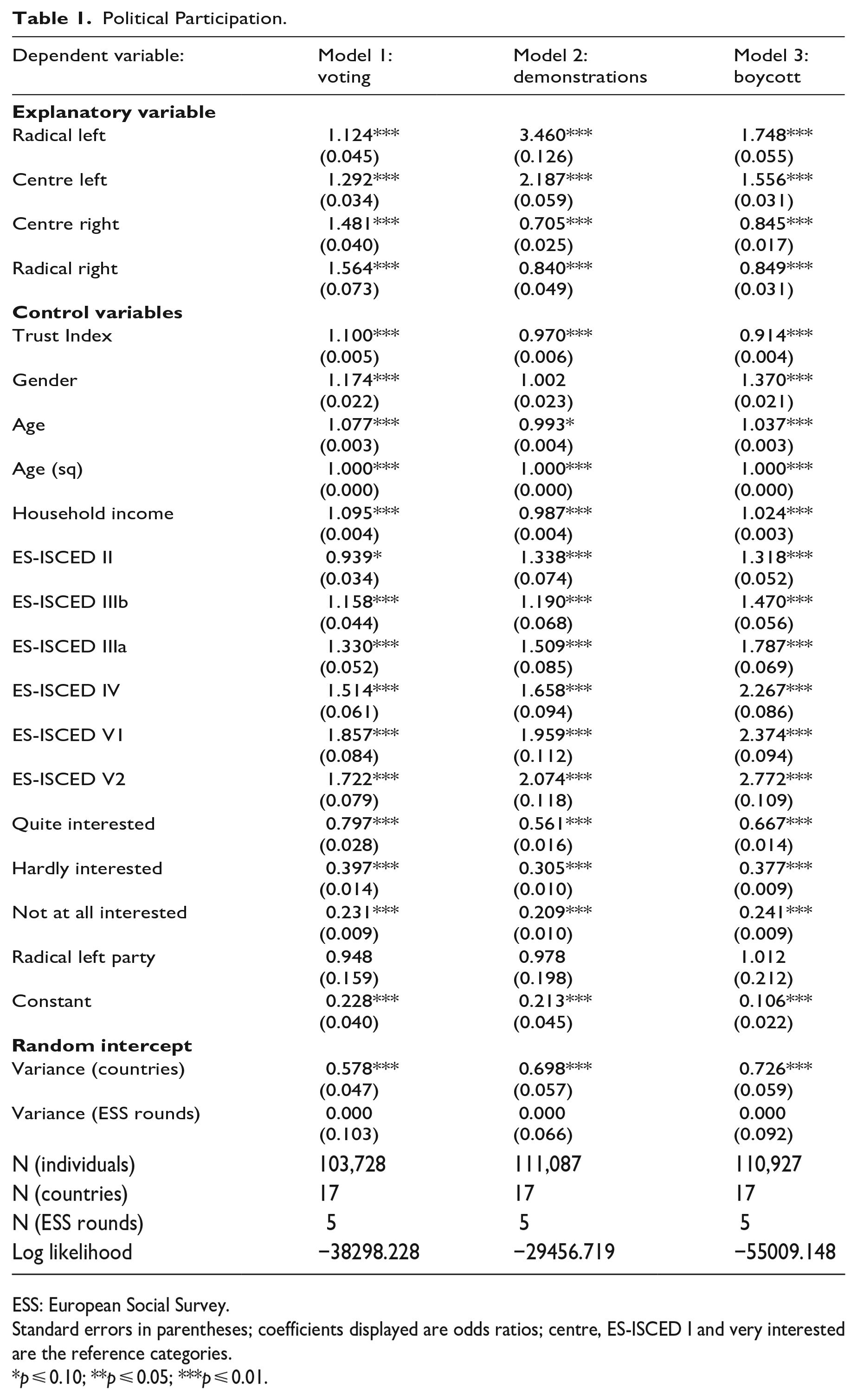
The results of our first analysis can be found in Table 1. The coefficients displayed are odds ratios. An odds ratio above 1 indicates a positive influence on the probability of, for instance, taking part in an election, whereas a value between 0 and 1 signals a decreasing effect on the probability. Since we have three dependent variables, we also have three models: Model 1 looks at whether or not respondents took part in an election, Model 2 analyses the participation in a demonstration and Model 3 includes the results for boycotting certain products.
Political Participation.
ESS: European Social Survey.
Standard errors in parentheses; coefficients displayed are odds ratios; centre, ES-ISCED I and very interested are the reference categories.
p ⩽ 0.10; **p ⩽ 0.05; ***p ⩽ 0.01.
Our main explanatory variable has five categories: radical left, centre left, centre, centre right and radical right. We have chosen the individuals in the centre of the ideological spectrum as the reference category. Hence, all coefficients have to be interpreted in comparison to this reference category. In Model 1, we analyse the probability of taking part in an election. We have hypothesised that radical left voters should be less likely to vote because of their opposition to the governmental institutions. Contrary to our theoretical expectations, however, the results do not support our theoretical argument that radical left individuals do not see taking part in an election as a meaningful way to induce change. They are more likely to vote than people in the centre of the political spectrum and do not seem to be substantially different from the other categories. In contrast to voting in elections, we do see differences between the different ideological groups with regard to non-institutionalised forms of participation. Model 2 analyses the probability to take part in a demonstration whereas Model 3 includes the results for participating in a boycott. In both cases, the radical left is not only more likely to make use of these forms of participation compared with the centre of the spectrum but also differs substantially from the centre and radical right.
To ease the interpretation of our results, we have calculated predicted probabilities for taking part in an election, a demonstration and a boycott (King et al., 2000). The results can be found in Figure 1. While we can clearly see that radical left individuals tend to make use of non-institutionalised forms of participation more often, we do not find any substantial differences regarding voting in elections. When comparing the result of radical left supporters to those of the radical right, we cannot see differences in terms of taking part in institutionalised forms of political participation, however when looking closer at the difference between the two groups in terms of their participation in non-institutionalised forms of political participation, we can see some trends. In the past, the literature has looked at groups like radical left and radical right as one group, defined by their extreme ideological commitment (see, for example, Van der Meer et al., 2009). From Figure 1, their behaviour towards institutionalised forms of political participation seems to follow this assumption. Yet, when it comes to the non-institutionalised participation behaviour, this assumption no longer holds. Though past research has indicated that radical right voters are equally as politically active as other party voters (Allen, 2017), radical right supporters seem to be less willing to participate in non-institutionalised forms than radical-left individuals. This supports the argument that, based on ideological differences, some individuals will be more or less willing to use these forms of action to express their desire for structural change. Although it has been argued that radical right non-institutional activism has increased in the last few decades (Castle et al., 2020; Mudde, 2019), this increase is still significantly different from the participation of radical left individuals. As argued above, the radical left has a desire to implement systemic change, accompanied with less trust in the system. While the radical right also shows tendencies to distrust institutions, the radical right does not translate these through non-institutionalised forms of participation. Though we do not necessarily find that the distrust of the radical left towards institutions (such as political parties) translates to abstention, we do find that there is a higher tendency to make use of non-institutionalised methods in comparison to supporters with difference ideological leanings.
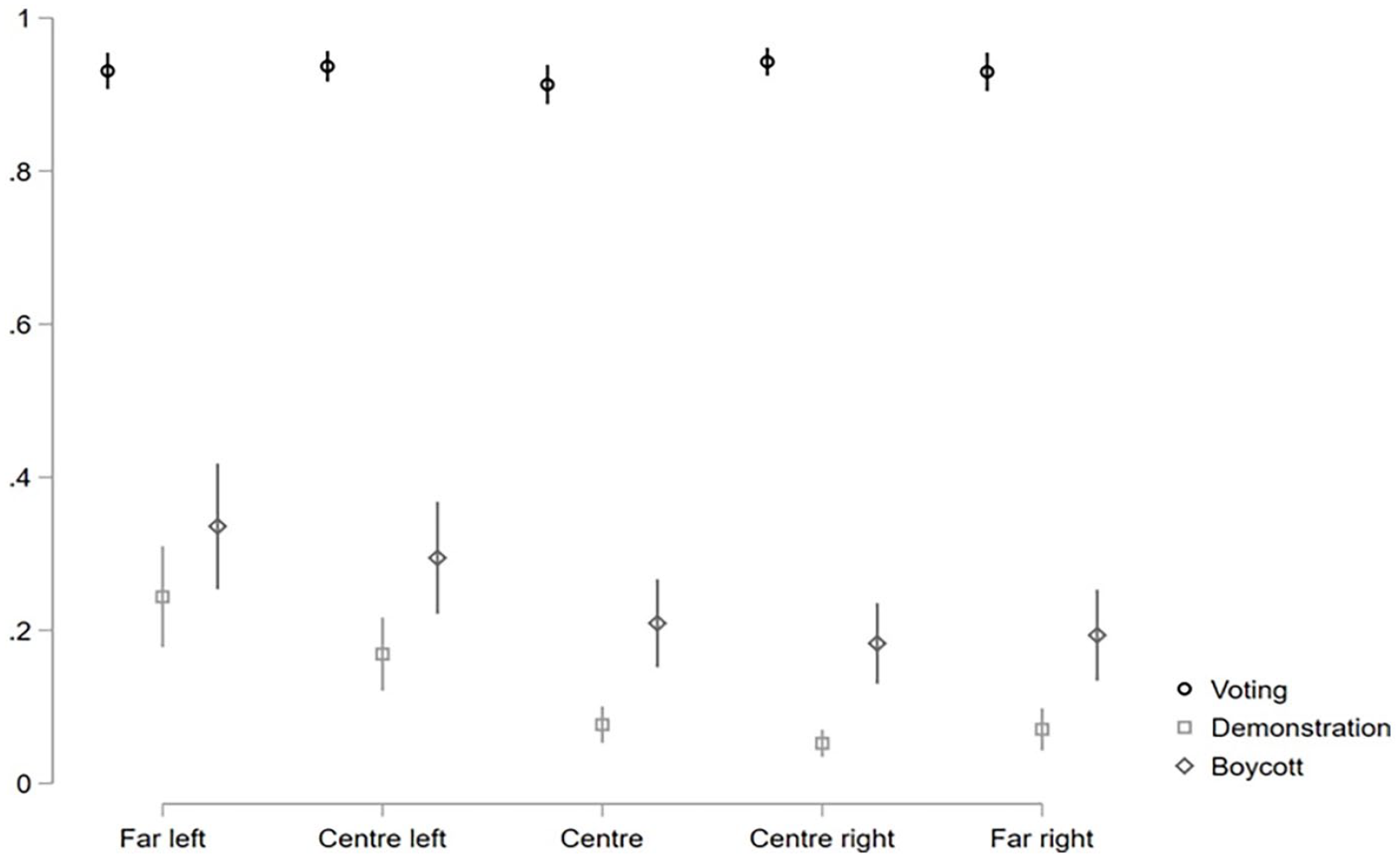
Predicted Probabilities.
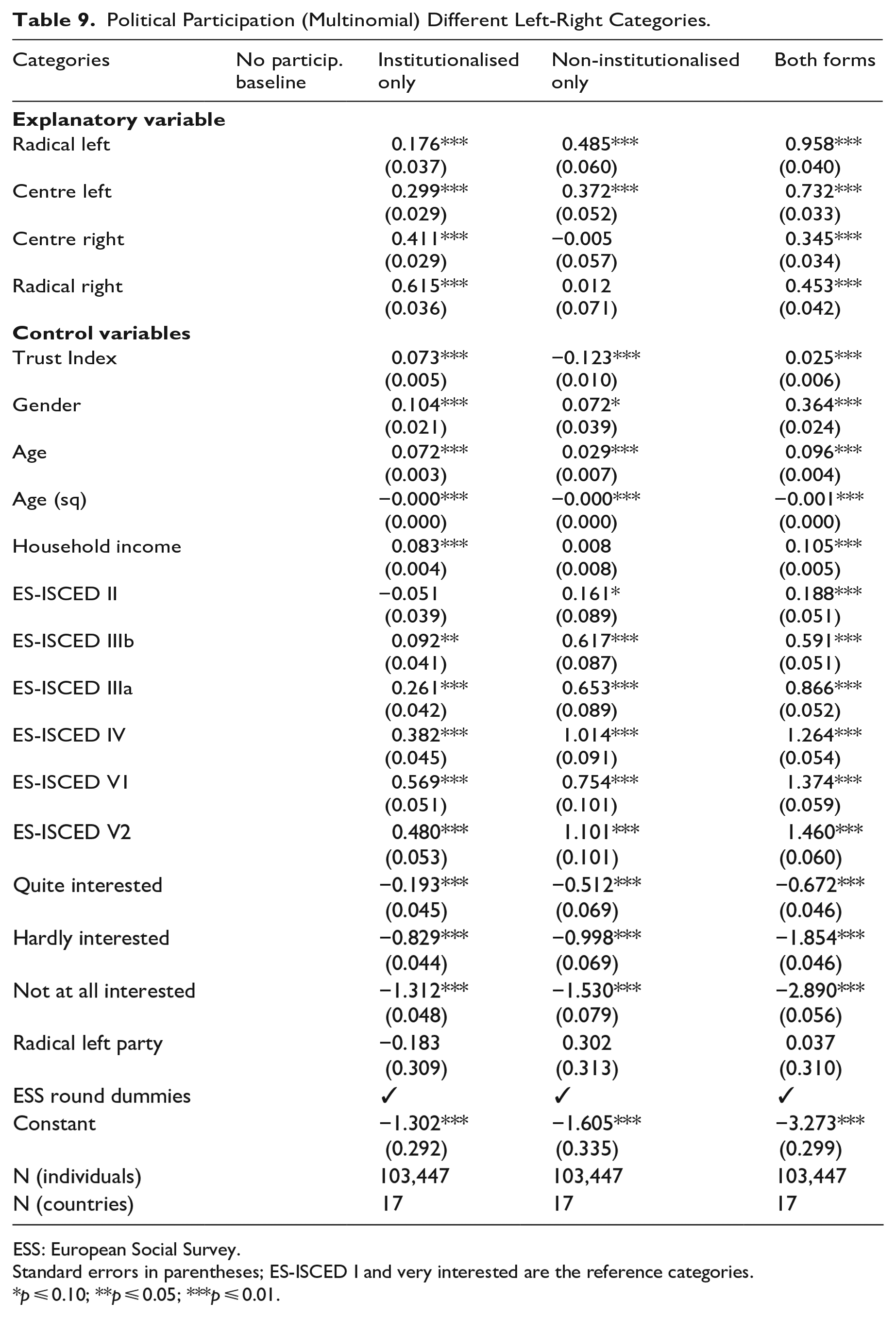
Looking at the results from Figure 1 we might be inclined to say that radical left individuals are more politically active in general compared with the other categories. The previous analysis, however, does not allow for such conclusions to be drawn since we do not know if the same people in the radical left category take part in elections and also engage in non-institutionalised forms of participation. To overcome this problem, we rely on our categorical dependent variable and run a multilevel multinomial model. Since the interpretation of these models is not intuitive, we only present the predicted probabilities here. The full model can be found in Table 5 in the Appendix. Figure 2 shows the predicted probabilities for our categorical dependent variable. There are several important findings to note in this graph. First, and partially contrary to our theoretical expectations, if we compare radical left individuals to other groups of the political spectrum, they are not more likely to only rely on non-institutionalised forms of political participation such as boycotts and demonstrations. Second, partially in line with our theoretical expectations, the radical left group is the least likely to only take part in the institutionalised form of political participation (i.e. voting). Third, and most importantly, taking part in both, institutionalised and non-institutionalised forms of political participation is most common among those on the radical left. 12 While these results do only partially support our hypotheses, it allows is to conclude that radical left individuals, especially compared with the other groups on the political spectrum, are more politically active.
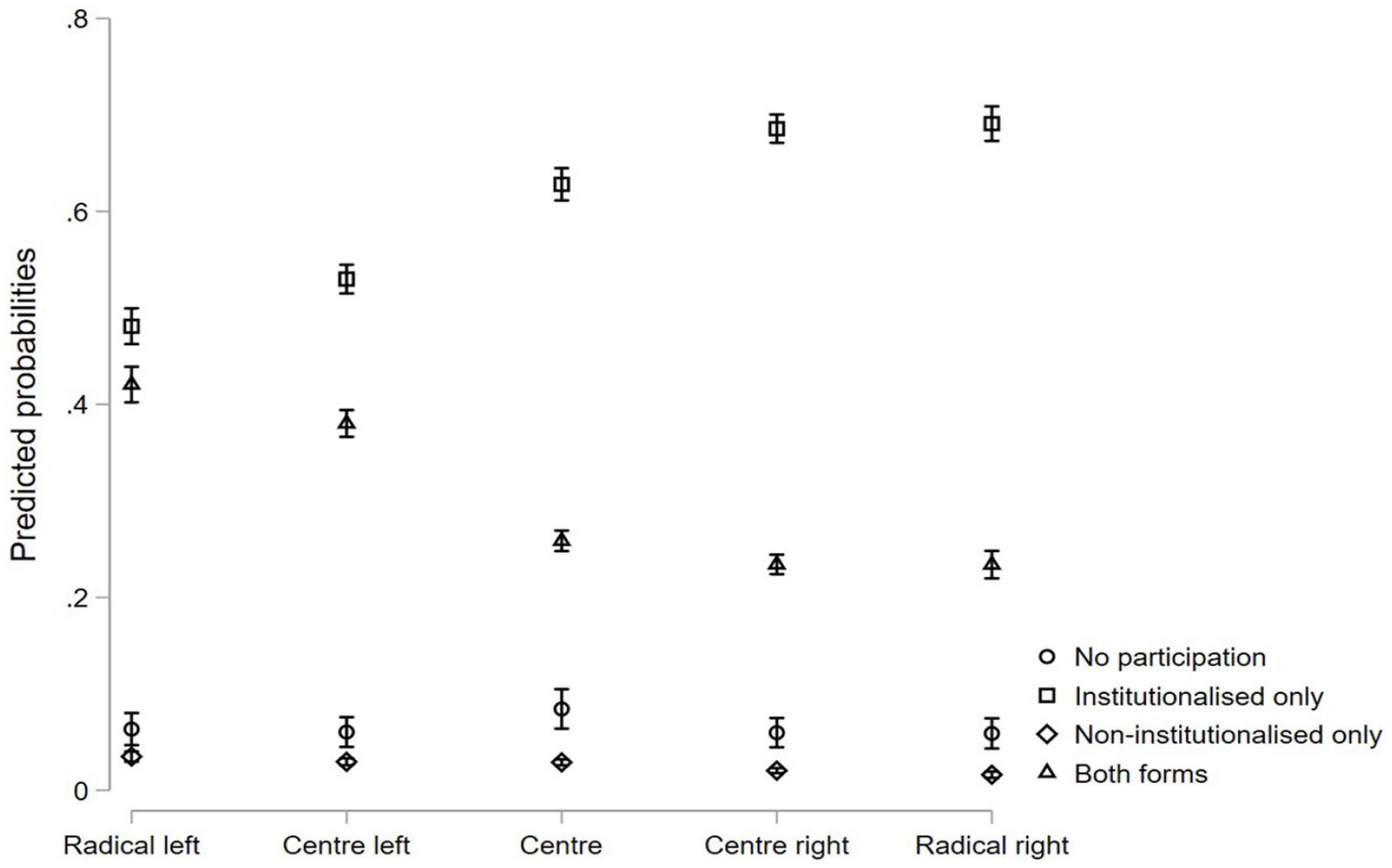
Predicted Probabilities (Multinomial).
In a last step, we test our hypotheses about the differences within the group of radical left individuals. 13 Figure 3 includes the predicted probabilities for the three different types of political participation. While we do not find any differences between left-authoritarians and left-libertarians regarding voting, there are substantial differences with regard to non-institutionalised forms of political participation. While individuals that are leaning more towards the left-authoritarian side (i.e. think that immigration makes the country a worse place to live) are less likely to rely on demonstrations or boycotts, left-libertarians (i.e. people that think that immigration makes the country a better place to live) are more likely to take part in demonstrations or boycotts. These findings lend support to Hypothesis 2b but not to Hypothesis 2a.
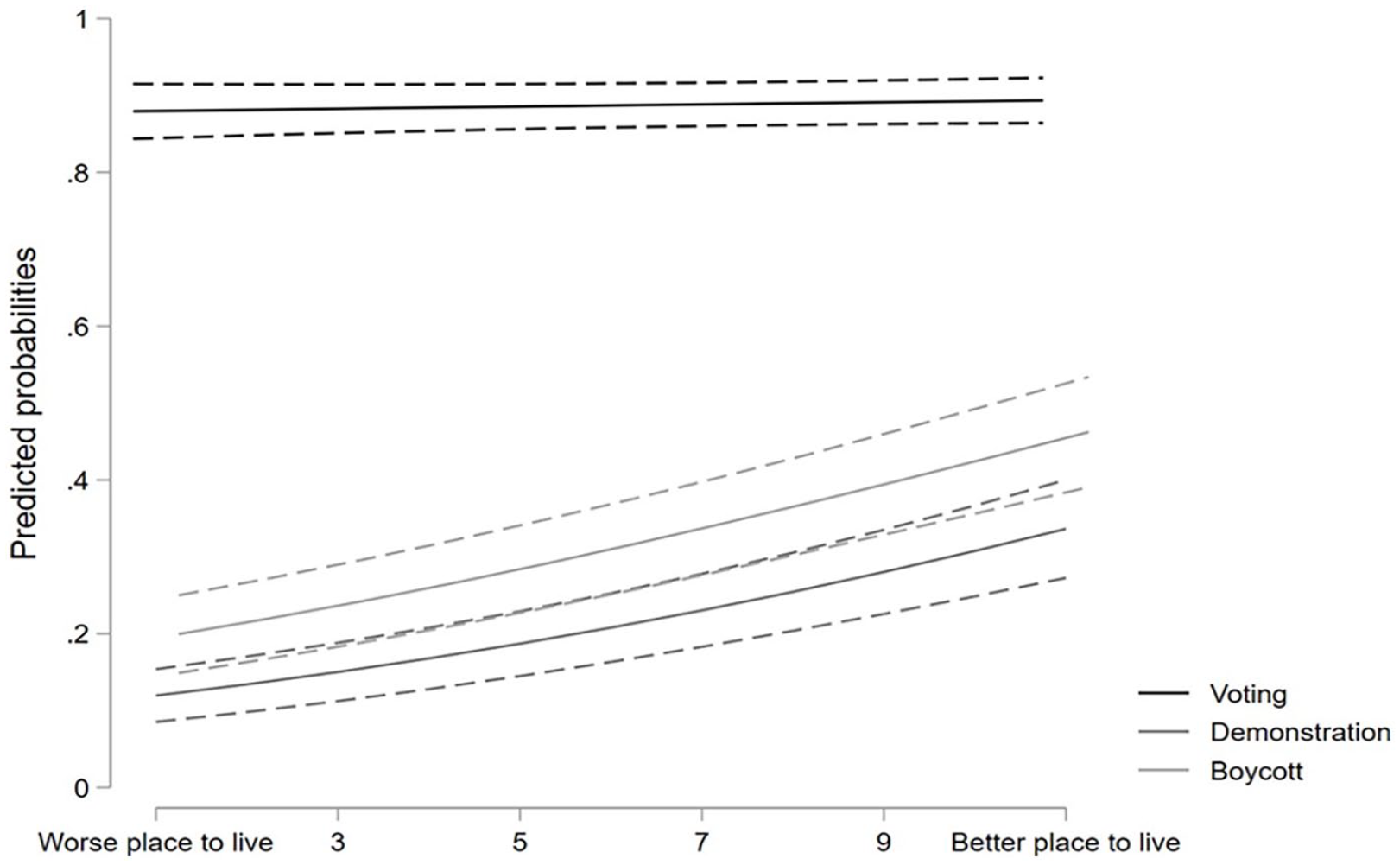
Predicted Probabilities (Radical Lefts Only).
Figure 4 includes the results for the multinomial model. The predicted probabilities demonstrate that there are important commonalities but also important differences between left-authoritarian and left-libertarians. We find small differences between authoritarians and libertarians with regard to not participating at all (with authoritarians being more likely to not participate at all) and non-institutional participation only (with libertarians being more likely to do so). For the categories both forms of political participation and institutionalised participation only, however, we find that the development is exactly opposite. People on the authoritarian end of the spectrum are substantially less likely to take part in both forms of political participation but considerably more likely to only vote. The more libertarian the people become, the more likely participation in both forms and the less likely they are to solely go to the ballot box. Hence, there are important differences within the group of radical left people, especially with regard to non-institutionalised forms of participation.
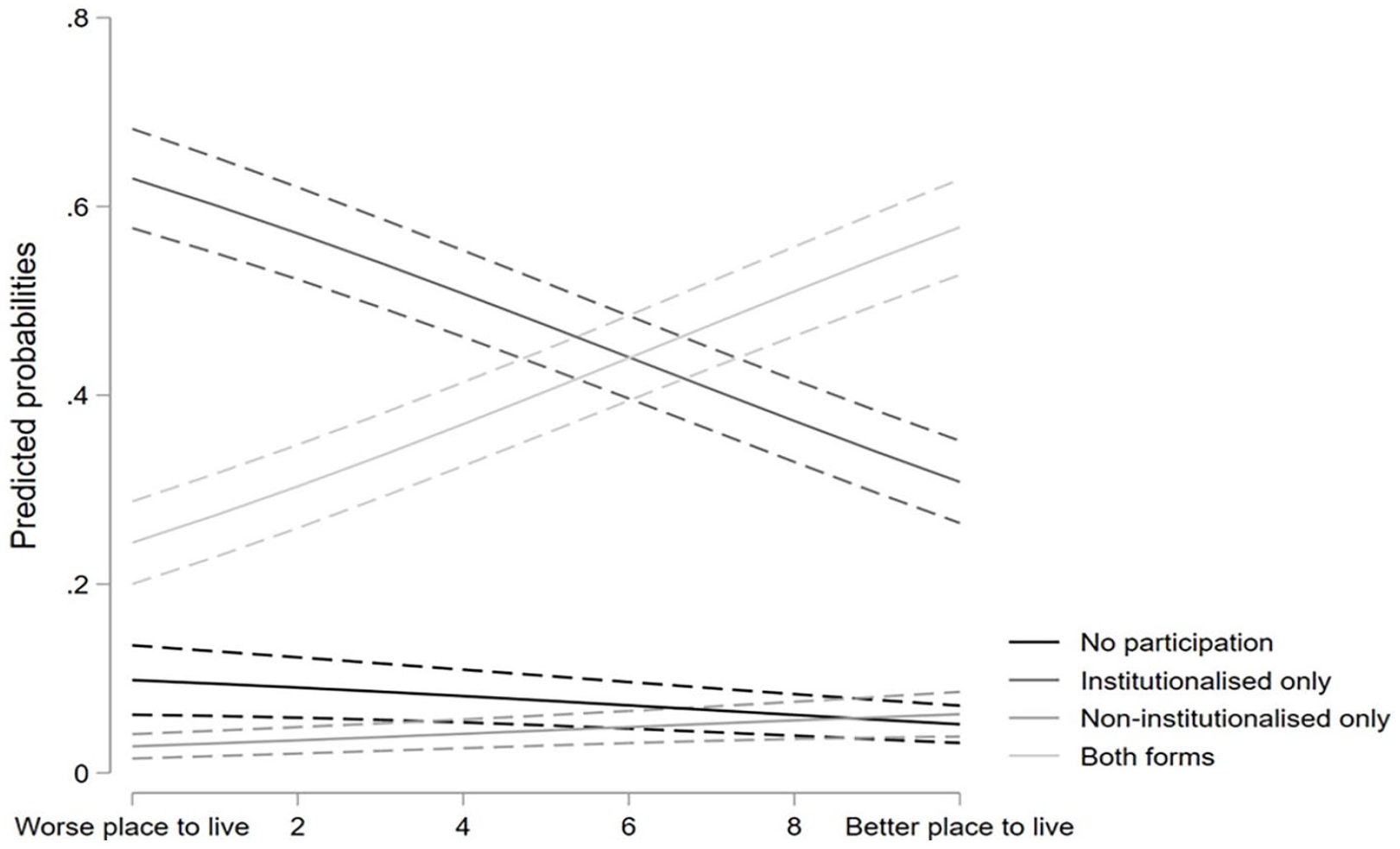
Predicted Probabilities (Multinomial; Radical Lefts Only).
We further include a number of robustness checks. First, we did a step-wise introduction of our control variables to make sure that the findings for our main explanatory variable cannot be attributed to, for instance, the trust index. The results can be found in Tables 2,3 and 4 in the Appendix. Second, we use a different operationalisation of our main independent variable. We follow Visser et al. (2014) and classify radical left individuals that place themselves between 0 and 2 on the left-right scale instead of 0 and 1 (and do that for the radical right accordingly). The results for our analyses can be found in Tables 8 and 9. 14 The results remain substantially the same.
Conclusion
While the rise of political polarisation has led to an increased support for radical right parties, we have not seen a similar development for RLPs. This is surprising insofar as that they should theoretically be able to benefit from increased polarisation in a similar vein as radical right parties. In this article, we therefore sought to answer the question if radical left individuals rather take the streets instead of the parliament.
Since radical left individuals are characterised by a general suspicion towards status quo power structures in the political system and because even RLPs might be seen as too established in this system, we hypothesised that they should be less likely to vote but should be more likely to take part in non-institutionalised forms of political participation such as boycotting or demonstrations. The results of our analysis of the data provided by the ESS only partially support our hypotheses. While the first part of our empirical analysis suggested that radical left individuals are substantially more likely to partake in demonstrations and boycotts, it also shows that they are more likely to take part in elections compared with voters in the centre of the political spectrum. The second part of our analysis has given us a more nuanced picture of political participation of the radical left: they are the least likely group to only take part in elections and they are not substantially more likely to only demonstrate or boycott. Most interestingly, though, the probability to take part in both, institutionalised and non-institutionalised forms of political participation is highest among radical left individuals. Accordingly, then, the title of the article could be rephrased: radical left individuals want to take both, the streets and the parliament.
Yet, analysing those on the radical left more carefully by distinguishing on a socio-cultural dimension, we found further interesting dynamics. Against our hypothesis, libertarian and authoritarian radical leftists do not distinguish on their participation in elections. Yet, in accordance with H2b, we find clear and significant difference for non-institutionalised forms of participation. The more liberal the radical leftists are, the more likely they are to not only participate in demonstrations and protests, but they are also significantly more likely to use all forms of participation. In comparison, the more authoritarian the radical leftist is, the more likely they are to only use institutionalised forms of political participation. This is an important finding, as previously the literature has assumed that authoritarian leftists are unsatisfied and thus, less likely to participate in elections due to the supply gap (Hillen and Steiner, 2020; Lefkofridi et al., 2014; Steiner and Hillen, 2019). This article shows that all those on the radical left spectrum are likely to participate in elections, independent of their socio-cultural preferences. However, we could still see the effects of the dissatisfaction among the authoritarian left, as they are less likely to believe in the effects of demonstrations and boycotts than their libertarian counterparts.
Our research therefore shows that the ideology of being radical left does not hinder institutional but additionally encourages non-institutional political participation. We thus follow up on Lefkofridi et al.’s (2014) finding showing that the ideology of being radical left is not the cause of dissatisfaction, leading to abstentions, but rather the lack in sufficiently authoritarian left options is the cause of such dynamic among this group. These results are surprising since RLPs, in general, perform rather poorly in elections and have not seen an increased level of support in the last 10 years compared with radical right parties. 15 There are two possible explanations for this discrepancy. First, radical left individuals could be more likely to over-report their participation in elections. This does, however, not seem very likely as there is no reason why the social desirability bias should be more relevant for those on the left side of the political spectrum. Second, radical left individuals are more likely to vote for other leftist parties that have a higher chance of getting into office. In Germany, for instance, it seems like a substantial share of radical left individuals vote for the social democratic party or the green party instead of the radical left party even though this party is established and has been around for quite some time. However, since this party has largely been excluded from coalition considerations (by the other parties but at least partly also on its own will), it might not seem as a viable option to some of those on the radical left that want to see their preferences being represented not only in parliament but also in government. This implies that contrary to our theoretical expectations, radical left individuals are keen on influencing the status quo, even if this might not automatically lead to systemic change.
Future research should have a closer look at which parties radical left individuals tend to vote for. Furthermore, future research should also investigate further the relationship between our findings and the salience of relevant issues in voting for the radical left. As Steiner and Hillen (2021) show, misconceived congruence can take a big part in voting for or against a party by those on the left-authoritarian spectrum. They show that when this happens, issue salience is not important. They also show that ‘when voters are aware that parties match their position on only one dimension, vote choices are shaped by whether they care most about the economy or immigration’ (Steiner and Hillen, 2021: 1). Thus, the specific voting behaviour of especially left-authoritarians, who we show are more likely to only vote as their form of political participation, is increasingly important to understand the findings of Steiner and Hillen (2019) and the direction of the vote choice in more depth.
Footnotes
Appendix
Political Participation (Multinomial) Different Left-Right Categories.
| Categories | No particip. baseline | Institutionalised only | Non-institutionalised only | Both forms |
|---|---|---|---|---|
|
|
||||
| Radical left | 0.176***
|
0.485***
|
0.958***
|
|
| Centre left | 0.299***
|
0.372***
|
0.732***
|
|
| Centre right | 0.411***
|
−0.005 |
0.345***
|
|
| Radical right | 0.615***
|
0.012 |
0.453***
|
|
|
|
||||
| Trust Index | 0.073***
|
−0.123***
|
0.025***
|
|
| Gender | 0.104***
|
0.072*
|
0.364***
|
|
| Age | 0.072***
|
0.029***
|
0.096***
|
|
| Age (sq) | −0.000***
|
−0.000***
|
−0.001***
|
|
| Household income | 0.083***
|
0.008 |
0.105***
|
|
| ES-ISCED II | −0.051 |
0.161*
|
0.188***
|
|
| ES-ISCED IIIb | 0.092** |
0.617***
|
0.591***
|
|
| ES-ISCED IIIa | 0.261***
|
0.653***
|
0.866***
|
|
| ES-ISCED IV | 0.382***
|
1.014***
|
1.264***
|
|
| ES-ISCED V1 | 0.569***
|
0.754***
|
1.374***
|
|
| ES-ISCED V2 | 0.480***
|
1.101***
|
1.460***
|
|
| Quite interested | −0.193***
|
−0.512***
|
−0.672***
|
|
| Hardly interested | −0.829***
|
−0.998***
|
−1.854***
|
|
| Not at all interested | −1.312***
|
−1.530***
|
−2.890***
|
|
| Radical left party | −0.183 |
0.302 |
0.037 |
|
| ESS round dummies | ✓ | ✓ | ✓ | |
| Constant | −1.302***
|
−1.605***
|
−3.273***
|
|
| N (individuals) | 103,447 | 103,447 | 103,447 | |
| N (countries) | 17 | 17 | 17 | |
ESS: European Social Survey.
Standard errors in parentheses; ES-ISCED I and very interested are the reference categories.
p ⩽ 0.10; **p ⩽ 0.05; ***p ⩽ 0.01.
Declaration of conflicting interests
The author(s) declared no potential conflicts of interest with respect to the research, authorship and/or publication of this article.
Funding
The author(s) received no financial support for the research, authorship and/or publication of this article.
