



Abstract
While much research has been devoted to the effects of inequality on political participation, little attention has been paid to how different kinds of subjective perceptions of social inequality affect citizens’ political behaviour. This is important since these perceptions shape the message that reaches political decision-makers when addressing concerns over social inequalities. This article differentiates between sociotropic and egocentric perceptions of social inequality and explores to what extent individuals’ perceptions of such inequality affect engagement in institutionalized and non-institutionalized political participation between elections. Engagement was evaluated with a survey among a segment of the Finnish population (n = 1673). Our results indicate that citizens with sociotropic concerns are more likely to get involved in both institutionalized and non-institutionalized forms of political participation, whereas egocentric perceptions have less of an impact. Furthermore, the associations are moderated by left–right ideology: sociotropic concerns are more strongly expressed among left-wing voters, whereas right-wingers are more likely to be propelled to action by egocentric concerns.
Introduction
Citizens increasingly believe that social rights and efforts to combat social inequalities constitute a central element of democratic citizenship (Oser and Hooghe, 2018). For decision-makers to be able to enact the appropriate social policies with which to address worries over social inequality, citizens need to channel their concerns into the formal political decision-making process. The most common mechanism for establishing a link between citizens and decision-makers is political participation, in various forms (Esaiasson and Narud, 2013). It is therefore important to appreciate how worries over social inequality are associated with the different forms of political participation.
Despite decades of research on the link between inequality and political participation, there is still no agreement on how inequalities affect participation.
First, there are different forms of inequality such as economic, political and social inequality. We here focus on the latter, which we conceive as unequal distribution of opportunities in society (Hurst et al., 2016; Neckerman, 2004). It is therefore a broader concept than economic inequality, which focuses on inequalities in economic resources. Social inequality is more about ‘unequal access to valued resources, services, and positions in the society’ (Kerbo, 2003: 11) and implies lack of equality of outcome. Economic inequality may affect social inequality, but the two should not be equated since other factors may also affect the level of social inequality, such as ethnicity and cultural resources.
Most previous studies have examined the link between participation and more objective measures on different types of inequality, such as the Gini coefficient at the societal level (Beramendi and Anderson, 2008; Mahler, 2002; Schäfer and Schwander, 2019; Solt, 2004; Stockemer and Scruggs, 2012; Wichowsky, 2012) or individual income or educational attainment at the individual level (Dalton, 2017; Marien et al., 2010). While these studies provide important insights, they do not establish whether individuals perceive these differences or see them as problematic. While we are unable to establish whether objective or subjective measures are more important, we focus on subjective measures since this is arguably an important element for assessing the impact of how social inequality affects political behaviour since perceptions of inequality do not always match objective realities (Chambers et al., 2014; Cruces et al., 2013; Gimpelson and Treisman, 2018; Kuhn, 2019).
Furthermore, perceptions of social inequality may take different forms. Research on voter behaviour has long distinguished between sociotropic and egocentric voting when it comes to financial concerns (Kinder and Kiewiet, 1981), where the former involves concerns over the situation of society at large, whereas the latter concerns worries over one’s own economic situation. A similar distinction can be made when it comes to worries over inequalities. A person may be worried over social inequalities because of the societal impact (sociotropic), for example, a general worry that the number of poor people in society is growing, while others may worry about social inequality because of the implications on oneself (egocentric), for example, because they may be experiencing financial problems. While these differences are likely to have important implications on political participation, previous research has not examined the implications of these different conceptualizations of social inequality.
Another important element to consider is the range of political activities that are at the disposal of citizens who want to voice their concerns. Many studies focus on the impact of inequalities on voter turnout and voting behaviour (Beramendi and Anderson, 2008; Mahler, 2002; Schäfer and Schwander, 2019; Solt, 2004; Stockemer and Scruggs, 2012; Wichowsky, 2012), but few studies examine the link to participation between elections. While perceptions of social inequality may obviously also be important for determining turnout, it is important to understand the link to participation between elections. These activities include more issue-specific forms of participation, for instance signing petitions or getting involved into protests over a particular topic (Verba et al., 1995). We in this study therefore focus on participation between elections rather than turnout, which has been examined extensively by previous scholarship.
Finally, the association between perceptions of social inequalities may depend on other individual characteristics (Loveless, 2013; Martorano, 2018). Left–right ideology is particularly likely to affect how pertinent worries over social inequality are since this ideological dimension is closely connected to preferences for redistribution in society.
Our intention is to contribute to this research agenda by examining how sociotropic and egocentric perceptions of social inequality are associated with institutionalized participation (IP) and non-institutionalized participation (NIP), including how they are moderated by ideological predispositions. We do so with the help of a survey distributed to a sample of Finnish citizens (n = 1673), in which we asked respondents about their perceptions of inequalities and their specific political actions taken to address problems with inequalities.
The results show that, across all respondents, people with sociotropic concerns over inequalities engage in both more institutionalized and non-institutionalized activities, while egocentric concerns do not lead to a greater propensity for participation. However, considering ideological predispositions, it is clear that the mobilizing impact of sociotropic concerns mainly pertains to people on the left of the ideological scale. Similarly, egocentric concerns can mobilize people on the right of the ideological scale. This shows that different concerns are channelled through different acts of participation, which has the potential to determine what worries influence formal political decision-making.
The Link Between Inequality and Participation
From a democratic perspective, it is important that all citizens have an equal opportunity to influence political decision-making (Dahl, 1989). While few dispute this basic principle, there is little doubt that equality is rarely, if ever, achieved in practice (Dalton, 2017; Schattschneider, 1960). An important aspect of this conundrum concerns how social inequalities affect the propensity for political participation. Social inequality concerns the extent to which different groups in society are consistently marginalized in society (Hurst et al., 2016; Kerbo, 2003; Neckerman, 2004). While this includes economic inequalities, it also comprises inequalities that arise out of belonging to a particular social class, ethnic or sexual minority. While much of the research has focused on economic inequalities, other forms of marginalization may have similar effects. We here draw on the insights drawn from research on economic inequalities but focus on a broader concept of social inequality when examining the link to political participation.
Several studies have examined the links between inequality and different forms of political participation (Armingeon and Schädel, 2015; Jensen and Jespersen, 2017; Offe, 2013; Schäfer and Schwander, 2019; Solt, 2008; Stolle and Hooghe, 2011; Verba et al., 1995), but there is still no agreement on the nature of these connections. According to one school of thought, inequalities depress participation among deprived citizens. As Goodin and Dryzek (1980) argued, it is rational for the less well-off to not participate when then game is rigged in favour of the privileged. Since money can buy influence, wealthier individuals are considered more powerful (Offe, 2013; Pateman, 1971), and the poor might conclude that there is little point in engaging in politics at all. This is supported by Boix (2003) and Solt (2008), who found that economic inequality had negative effects on subnational turnout rates in the United States and in Italy. An earlier study of 23 democracies revealed that a higher level of income inequality decreases political interest, the frequency of political discussion and participation in elections among all but the most affluent citizens (Meltzer and Richard, 1981). A slightly different line of reasoning comes to similar conclusions: individuals with more resources, such as the required time and civic skills, are more likely to participate (Verba et al., 1995). Since these factors are usually prevalent among the affluent, the wealthiest socio-economic groups are more likely to be politically active, whereas the masses remain less active, which suppresses overall levels of participation.
A contrary perspective maintains that inequality can increase participation in politics. This might occur when higher levels of inequality cause greater divergences in preferences among the public – especially with regard to redistributive policies, which fuel debates and lead to increased political mobilization (Brady, 2004; Oliver, 2001). Lower levels of inequality in society should, correspondingly, lead to fewer demands on government, a greater consensus about policies and, thus, less engaging politics. For instance, Oliver’s (2001) study found a positive relationship between municipal-level income inequality and local political engagement. Moreover, the vast majority of demonstrations during the recent global financial crisis were motivated by the indignation of individuals over ever-increasing inequalities between ordinary citizens and the richest groups (Ortiz et al., 2013). However, other scholars show that inequality does not sufficiently explain these phenomena since, for instance, in Latin American countries the number of protests has increased even though inequality has decreased (Justino and Martorano, 2016).
Hence, there is no agreement on the link between inequality and participation. A possible reason for this is that scholars have looked at different countries at different periods and used a variety of methods (Schäfer and Schwander, 2019). However, for the present purposes, three features are particularly noteworthy: (1) a focus on objective measures at the societal level rather than perceived inequalities at the individual level, (2) rarely distinguishing between different forms of political participation when analysing the linkages and (3) no regard for how ideological differences may affect the linkages at the individual level. In the following, we outline how we address each of these challenges in our study. Since we conceive our study as exploratory, we make no firm hypotheses, but instead state more general expectations for the linkages.
Concerning the first point, several studies have focused on objective measures of inequality at the societal level, such as the Gini coefficient and voter turnout (Beramendi and Anderson, 2008; Mahler, 2002; Schäfer and Schwander, 2019; Solt, 2004; Stockemer and Scruggs, 2012; Wichowsky, 2012). These studies provide important insights into the associations between economic inequalities at the societal level and political participation. However, they do not make it possible to establish how individuals perceive inequalities or if different individuals tend to focus on different aspects of inequality.
Previous studies show that there are systematic differences in how people perceive inequality as well as the implications of preferences on economic redistribution. These are further linked to socio-demographic characteristics (Bobzien, 2020). Emphasizing the significance of perceptions, Gimpelson and Treisman (2018: 27) note that ‘most theories about political effects of inequality need to be reframed as theories about effects of perceived inequality’. This is important since perceptions do not always match realities. As large cross-national surveys show, ordinary people have little idea about how high inequality is, how it has been changing and where they fit in the income distribution (Gimpelson and Treisman, 2018). Furthermore, several previous studies have observed inconsistencies in perceptions of inequality, concluding that people’s understanding of inequality is driven by misperceptions of reality (Chambers et al., 2014; Cruces et al., 2013; Kuhn, 2019). For instance, people tend to see themselves as being situated ‘near the middle’ irrespective of their objective position (Irwin, 2018). Similarly, individuals in the United States underestimated how much wealth was owned by the richest 20% of the population and overestimated how much was owned by the poorest 40% of the population, indicating a large divergence between perceived and actual economic inequality (Brown-Iannuzzi et al., 2017). Simultaneously, people might feel that disparities have increased even if the level of inequality has decreased or remained stable (Martorano, 2018). All of this underlines that, to understand the implications of inequalities, it may be wise to focus on subjective perceptions rather than objective realities since these are more likely to shape behaviour. Perceptions of inequality – whether accurate or not – correlate strongly with political preferences and outcomes (Alesina and Angeletos, 2005; Gimpelson and Treisman, 2018; Ianchovichina et al., 2015). The perception of inequality has been found to affect the propensity to participate in various political activities (Castillo et al., 2015; Jo and Choi, 2019; Krauss, 2015).
In connection with this, it is also important to distinguish between different perceptions of inequalities. Here, it is possible to distinguish between sociotropic and egocentric perceptions of inequalities. This distinction builds on the work of Kinder and Kiewiet (1981), who identify sociotropic voters as those who care more about the economic situation of the nation and juxtapose them with egocentric voters, who base their vote on their personal situation. Lockerbie (2006) also concludes that both sociotropic and egocentric evaluations matter since people are strongly concerned with both their own well-being and the well-being of others. A similar logic is likely to apply to the perception of inequalities since these can either be based on ideas about the general state of inequality in society or on how oneself and one’s immediate social circle are doing. This is important in connection to this issue since it seems likely that sociotropic and egocentric perceptions have entirely different implications for political participation.
Our first expectation is therefore that it is possible to distinguish between sociotropic and egocentric perceptions of inequality
The second point is related to the distinction between different kinds of political participation and their relationship to perceptions of inequalities. As mentioned, several studies focus on turnout, but few studies acknowledge the existence of different kinds of political participation, and that the association may differ depending on what activity is considered (see Stolle and Hooghe (2011) for an exception). This is problematic since there are important differences between various acts of political participation. It is particularly important to examine differences in participation between elections since this is how citizens bring their specific concerns about ongoing events to the attention of elected decision-makers.
At least since the 1970s, the literature on political participation has recognized that participation is not unidimensional (Barnes and Kaase, 1979), although the proper dimensionality remains disputed (Theocharis and van Deth, 2018). However, a distinction is commonly made between institutionalized activities that are structurally embedded in the political system and regulated by the authorities, and NIP, that is, bottom-up activities that citizens use to challenge the status quo, such as demonstrations and political consumerism (Bäck and Christensen, 2016; Malmberg and Christensen, 2021; Marien et al., 2010; Stolle and Hooghe, 2011).
While there are valid reasons to expect the associations between perceptions of inequalities and political participation to hinge on the activity under scrutiny, different expectations may exist for how they materialize. It may be that sociotropic concerns lead to greater mobilization in all forms of participation as people perceive the problems to be imminent. On the contrary, the link may be stronger to NIP, since these concerns challenge the existing order, which often leads to NIP (Malmberg and Christensen, 2021; Marien et al., 2010). Egocentric concerns, however, may be more tied to IP due to the traditional ties between economic concerns and voting (Kinder and Kiewiet, 1981), but it also may be that private natured concerns do not find an expression in political participation. All of this shows that very different expectations may exist, and we therefore formulate two rather broad expectations:
Sociotropic perceptions of inequality have different links to IP and NIP (
and
Egocentric perceptions of inequality have different links to IP and NIP
Finally, we examine how left–right ideology moderates the associations between the perceptions of inequality and political participation. It is important to bear in mind that the relationship between perceptions of inequality and political participation can be moderated by several factors (Loveless, 2013; Martorano, 2018). We here focus on left–right ideology since it has a straightforward connection to perceptions of inequality, and previous studies have shown that the impact of central political attitudes may differ substantially depending on ideology (Christensen and von Schoultz, 2019). Previous studies have also shown that ideology may moderate how inequality affects political behaviour (Armingeon and Weisstanner, 2021; Jurado and Navarrete, 2021). The left–right ideological dimension is usually seen as the ideological dimension structuring most political conflicts (Downs, 1957), which in Europe has divided politics into the liberal–conservative right and the social-democratic or socialist left. For the present purposes, it is noticeable that the left–right dimension has revolved around issues of redistribution, which connects to the current theme of perceptions of inequalities. It seems fair to assume that perceived problems with inequalities constitute more of a problem for people on the left, which has traditionally worked to ensure a high degree of economic and social equality in society. For people on the right, on the other hand, inequalities in society may be considered natural and even desirable from a conservative point of view, while market liberals are likely to attribute inequalities to individual efforts rather than a flaw in society that needs to be corrected.
For these reasons, it seems entirely likely that left/right ideology moderates the associations between perceptions of inequality and forms of political participation
In the following, we explain how we examine these propositions empirically.
Research Design
We first present the survey data used for our study before explaining how we operationalized our variables and the methods used.
Data
To measure the perceptions of inequality, we collected data from a Finnish online panel. The panel (Kansalaismielipide) is administered by the Social Science Research Institute at Åbo Akademi University, and is part of the newly established Finnish Research Infrastructure for Public Opinion (FIRIPO). At the time of the survey, the panel consisted of 2285 Finnish citizens. Approximately 60% of the pool of respondents consisted of respondents recruited using a random sample and mail invitations. The rest of the respondents were recruited through advertising on various online and social media channels.
The survey was fielded on 23 September 2021, using the online survey platform Qualtrics. A week later, on 30 September, a reminder was sent to all respondents who had not completed the survey. During the first week, 1350 responses were collected, and an additional 323 responses were collected after the reminder was sent out. The survey was closed on 7 October with a total of 1673 responses. Out of these 1673 responses, 1563 or 93% were complete responses, that is, all survey items were filled out. Some respondents were excluded from the analyses due to missing data. 1
Variables
We measured the perceptions of social inequalities with a series of presented statements (shown in Table 1) on social inequality in the Finnish society (First, we would like to present some statements on inequality in Finland. For each of these, please indicate the extent to which you agree or disagree). Answers were given on a 5-point Likert-type scale (strongly agree to strongly disagree). The ordering of the statements was randomized in the presentation to respondents, so it would not affect answers.
Statements on Inequality in Finland and Responses (%).
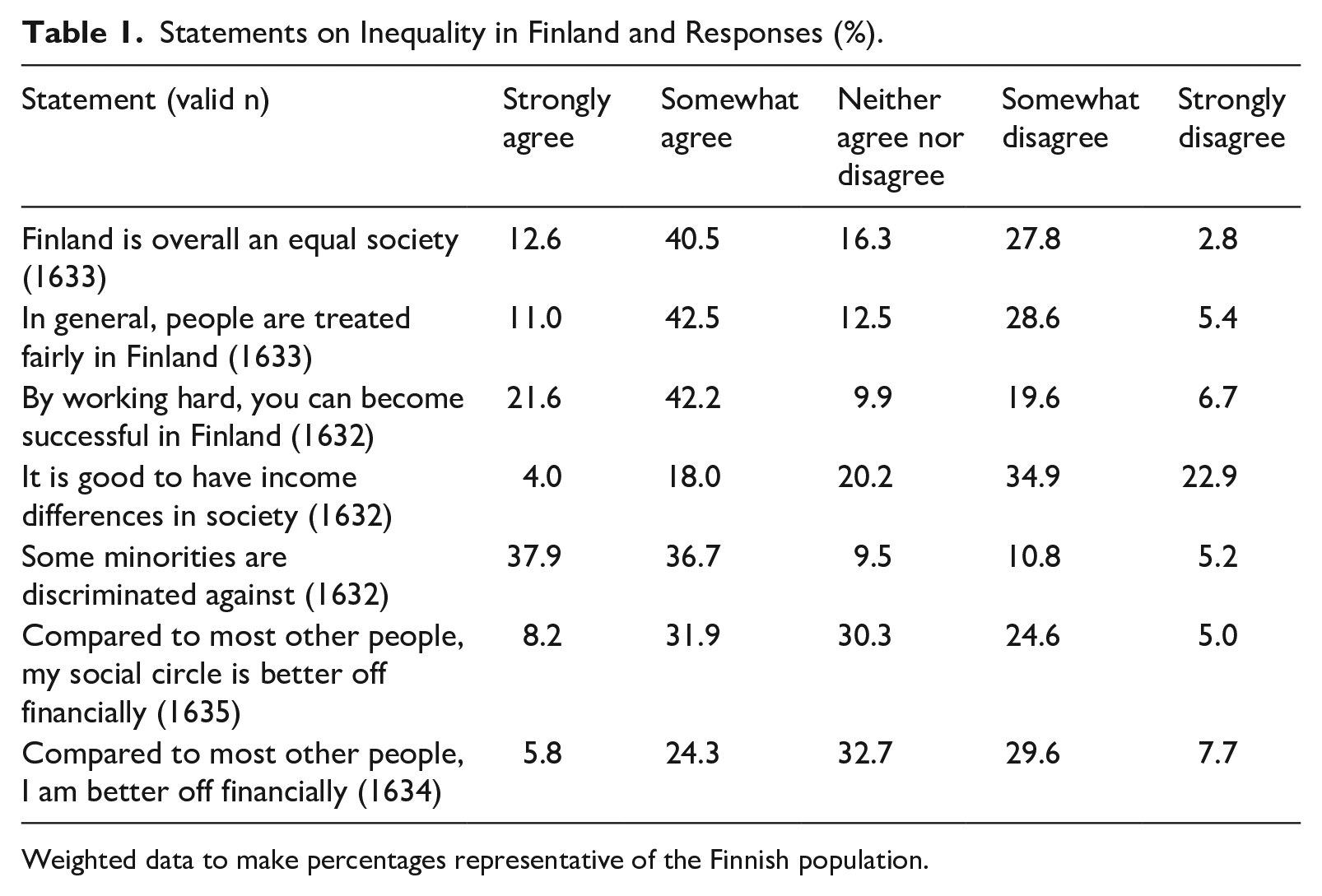
Weighted data to make percentages representative of the Finnish population.
We subsequently recoded the statement on minorities being discriminated against so that higher scores for all statements would entail a higher degree of worry about social inequalities (indicated with an R in subsequent tables where appropriate).
The examination of the dimensionality of these responses forms part of the empirical analyses to address our first expectation E1.
The dependent variable in our study is political participation aimed at addressing social inequalities in society. As noted, we believe that participation between elections is more likely to be driven by specific concerns over social inequality since they are more issue-specific forms of participation (Verba et al., 1995). Consequently, while politicians may take a general position on addressing social inequalities during election campaigns, it is between elections that specific decisions are made and citizens can exert influence through political participation (Esaiasson and Narud, 2013). Therefore, our focus is on participation between elections rather than on voter turnout, which has been the focus of most previous studies (Beramendi and Anderson, 2008; Mahler, 2002; Schäfer and Schwander, 2019; Solt, 2004; Stockemer and Scruggs, 2012; Wichowsky, 2012).
It is important to note that, contrary to previous efforts that have examined the link between inequalities and political participation (Bäck and Christensen, 2020; Hooghe and Marien, 2013; Malmberg and Christensen, 2021; Marien et al., 2010), we explicitly focus on participation aimed at addressing social inequalities rather than general political participation, which may have other goals. To be able to do this, we first asked respondents whether they had performed a series of political activities without specifying the goal (We now present different ways people can influence what is going on in society. Which of these have you done in the past 12 months or, if you felt an issue was important, which of these might you do?). The respondents could pick between 13 predefined activities that covered a wide range of political activities, which according to a Finnish national election survey, are among the most common political activities in Finland (Bäck and Christensen, 2020). 2 Afterwards, we asked a follow-up question of respondents who had performed at least one of the activities (And which of these did you do to address problems with social inequality in Finland), for which they could only select the activities they indicated having performed in the previous question. While the cross-sectional data entails that the direction of causality may still be disputed, this makes it possible to assess whether perceptions of social inequalities are also associated with participation to address these concerns.
To examine the dimensionality of political participation addressing social inequality, we performed an exploratory factor analysis, shown in Table 2. Since the items were dichotomous, we used a polychoric variant where we extracted all dimensions with an eigenvalue >13 and rotated the extracted dimensions using promax. We excluded violence beforehand since no respondents indicated using this to address social inequality, and, afterwards, also excluded wearing a badge and online activities since they had unclear loadings on the two extracted dimensions (the results still indicated two factors were suitable and the interpretations were similar).
Exploratory Factor Analysis of Performing Political Activities to Address Problems With Social Inequality.
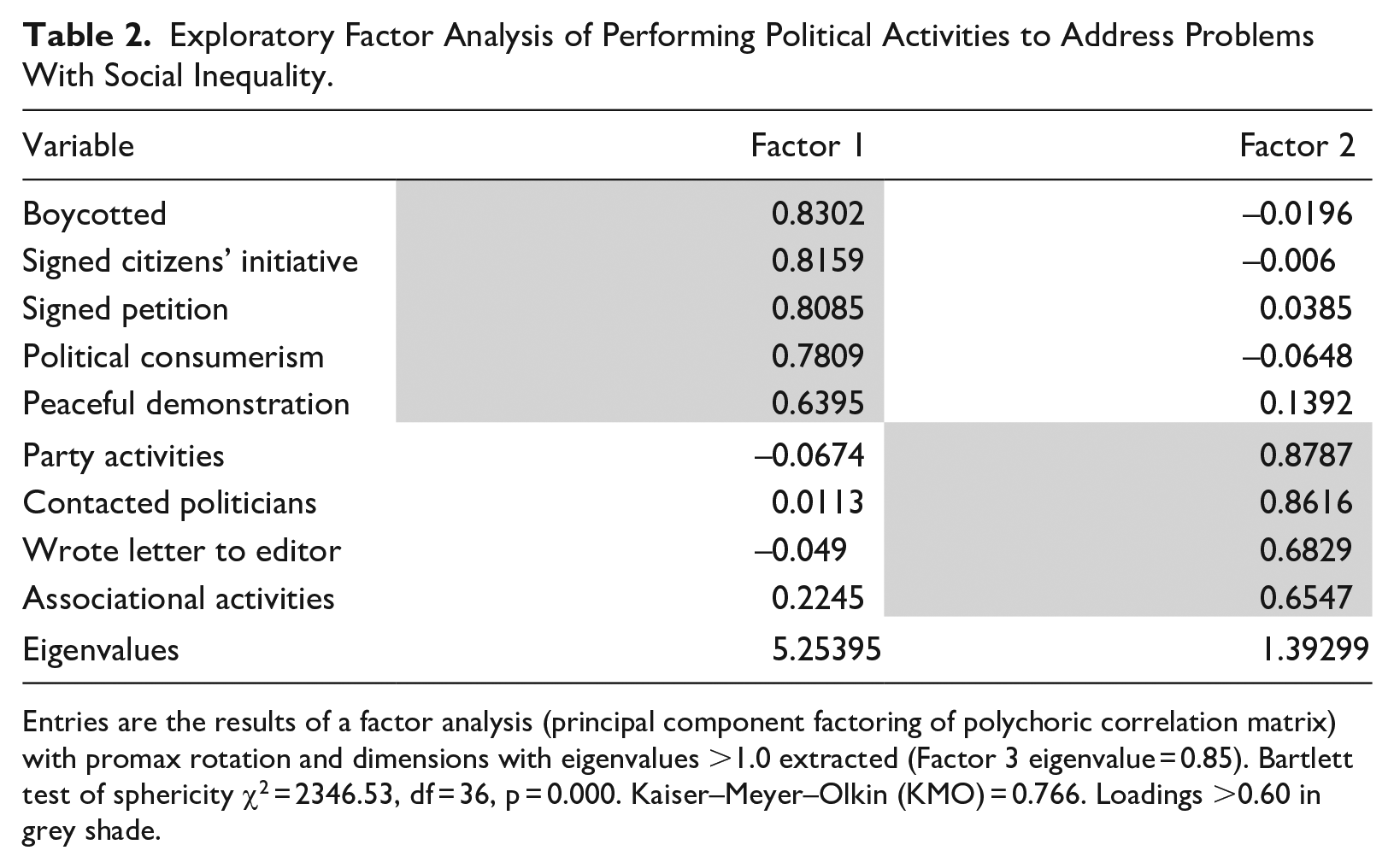
Entries are the results of a factor analysis (principal component factoring of polychoric correlation matrix) with promax rotation and dimensions with eigenvalues >1.0 extracted (Factor 3 eigenvalue = 0.85). Bartlett test of sphericity χ2 = 2346.53, df = 36, p = 0.000. Kaiser–Meyer–Olkin (KMO) = 0.766. Loadings >0.60 in grey shade.
The results correspond to several previous studies, although this could not be taken for granted, considering the specific goal of the activities (Bäck and Christensen, 2016; Hooghe and Marien, 2013; Malmberg and Christensen, 2021). We find that two dimensions adequately captured the dimensionality, and these corresponded to a non-institutionalized dimension of political participation, where citizens take part on their own terms, and another dimension corresponding to IP, where the formal political system is the locus of participation.
We used these results to construct two sum-indexes that formed the dependent variables in the analyses of links between perceptions of social inequality and political participation. The non-institutionalized variables (NIP) included boycotting, signing citizens’ initiatives, signing petitions, political consumerism and peaceful demonstrations (varies 0–5, mean = 1.63, SD = 1.46, alpha = 0.68), while the institutionalized sub-scale (IP) included party activities, contacting politicians, writing letters to the editor and associational activities (varies 0–4, mean = 0.66, SD = 1.00, alpha = 0.61). 4
The moderator variable was left–right ideology, which was measured with a question asking people to indicate their position on a scale 0–10 (In political matters people talk of ‘left’ and ‘right’. Here, we use a scale from 0–10 where ‘0’ means furthest to the left and ‘10’ means furthest to the right. Please indicate what number best describes how you would place yourself on this scale). This was subsequently recoded to vary between 0 and 1, with 0 being furthest to the left and 1 being furthest to the right, but all 11 categories were preserved.
To ascertain that no associations between perceptions of social inequalities and participation were spurious, we included a number of control variables that have been argued to affect the propensity for political participation (Bäck and Christensen, 2016; Hooghe and Marien, 2013; Verba et al., 1995). These include the basic socio-demographics of age (in the regression models we also include ‘Age 2 ’ to allow for non-linear relationships), gender (24 respondents who indicated other were recoded as missing), education (highest level of education completed, recoded to indicate primary, secondary or tertiary education), income (monthly household income after taxes, seven categories below €1000 to above €6000), and marital status (recoded so 1 = married/cohabiting and 0 = single). We also included political interest (four categories: not at all interested–very interested). As recommended by Cinelli and Hazlett (2020), we did not give these controls a causal interpretation, but focused exclusively on our focal independent variables. Full formulations of all questions and answer categories are found in Appendix 1.
Table 3 shows descriptive statistics for all variables.
Descriptive Statistics.
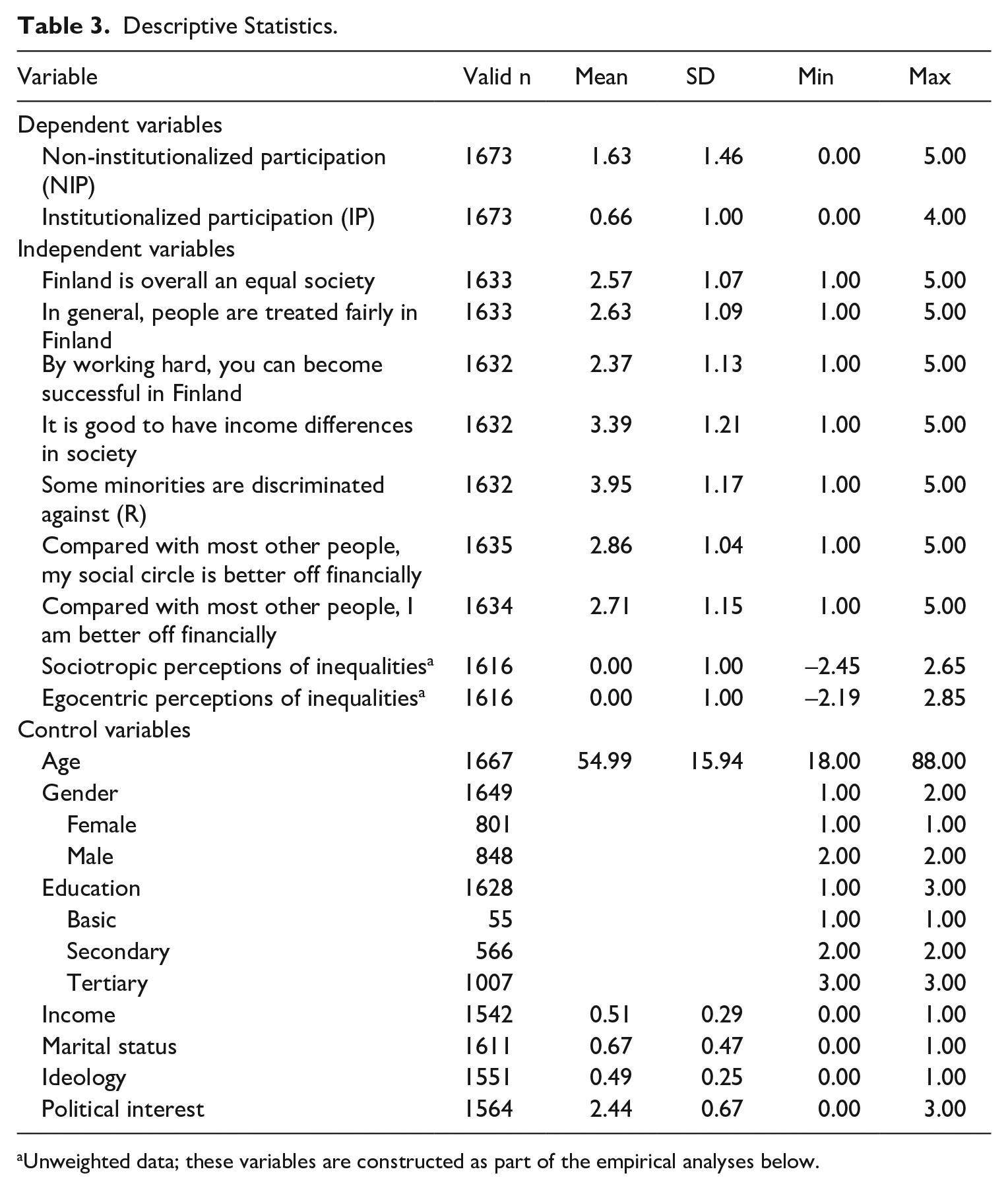
Unweighted data; these variables are constructed as part of the empirical analyses below.
Method
For our first expectation, we used exploratory factor analysis to examine the dimensionality of perceptions of social inequality (Preacher and MacCallum, 2003). We used principal component factoring with promax rotation, which did not assume that the extracted factors were uncorrelated. All dimensions with an eigenvalue larger than 1 were extracted, but since this Kaiser criterion can be misleading (Van Der Eijk and Rose, 2015), we double-checked with a scree-plot and parallel analysis, both of which suggested a similar solution in this case.
For our second and third expectations, we estimated the regression models using linear regression analysis (OLS) with robust standard errors. However, since the dependent variables were, strictly speaking, ordinal and skewed, as few perform all activities, we also estimated the results using negative binomial regression, Poisson regression and ordinal logistic regression (all results are shown in Appendix 2). Regardless of the method used, we reached similar conclusions, but only the linear regression results are reported in the main text since they are intuitively easier to understand.
For the interaction analyses, we included interaction terms between ideology and the perceptions of social inequalities to see whether their associations with participation were interdependent. We used both marginal effects and predicted means to evaluate the effects as recommended by Brambor et al. (2006).
Empirical Analysis
Our first expectation concerned the dimensionality of perceptions of social inequalities. The results of an exploratory factor analysis (principal component factoring with promax rotation) are shown in Table 4.
Exploratory Factor Analysis of Attitudes to Social Inequality (Principal Component Factoring With Promax Rotation).
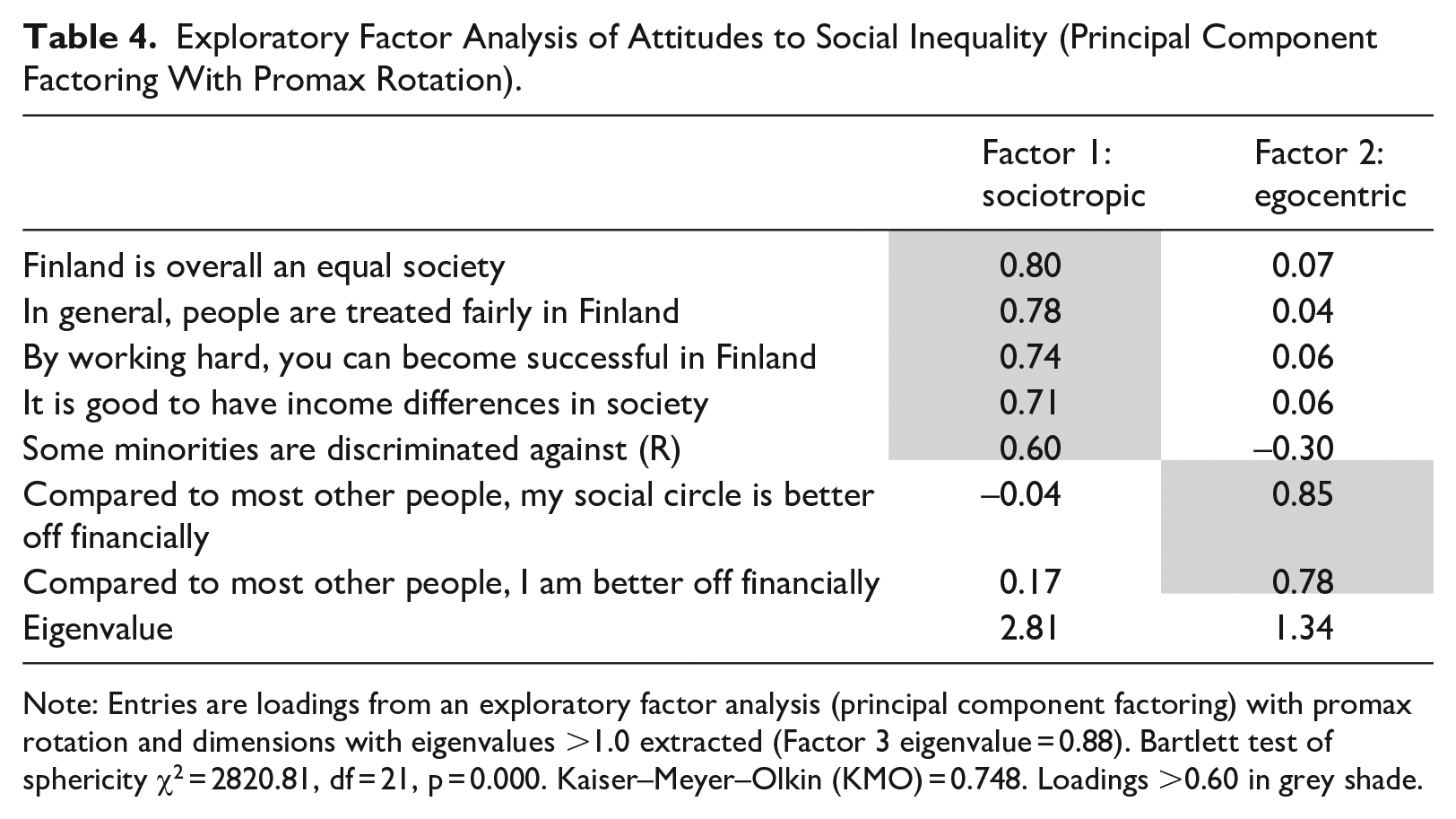
Note: Entries are loadings from an exploratory factor analysis (principal component factoring) with promax rotation and dimensions with eigenvalues >1.0 extracted (Factor 3 eigenvalue = 0.88). Bartlett test of sphericity χ2 = 2820.81, df = 21, p = 0.000. Kaiser–Meyer–Olkin (KMO) = 0.748. Loadings >0.60 in grey shade.
The results generally align with our expectations since the first dimension involved attitudes about inequalities in society in general and the rights of other groups in society. We interpret this as a dimension concerning sociotropic perceptions of social inequalities. The second dimension concerns the financial situation of oneself and one’s close social circle, and we interpret this as egocentric perceptions of social inequality. For both dimensions, higher scores entail that this type of inequality is considered to be more problematic. In the following, we use these dimensions as our central independent variables. 5
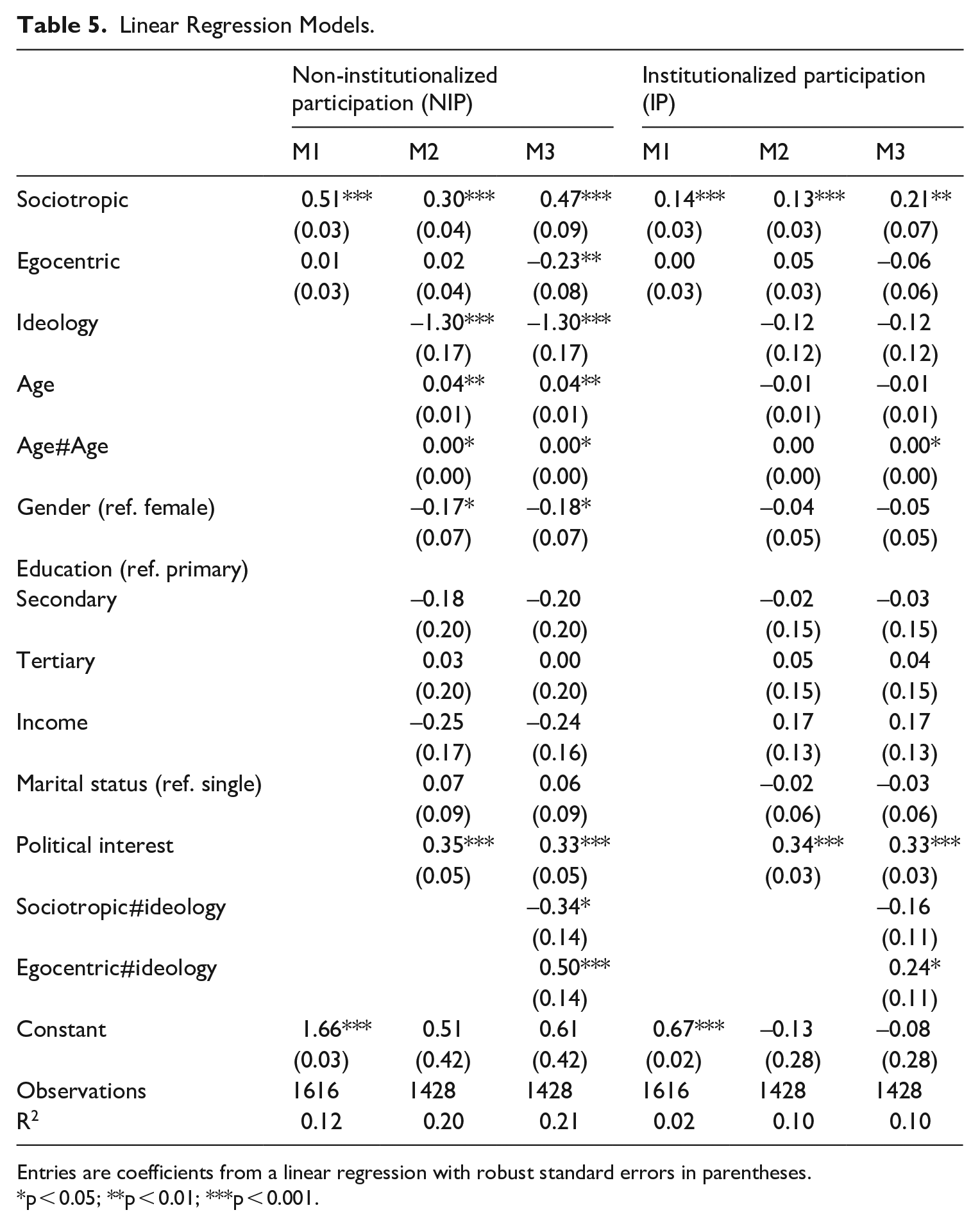
Our second and third expectations concerns the links between these worries over social inequalities and their links to NIP and IP. To examine this, we show results from several regression analyses in Table 5. There are three models for both forms of participation: The first includes both perceptions of inequality simultaneously, the second includes all control variables, while the third includes interaction terms.
Linear Regression Models.
Entries are coefficients from a linear regression with robust standard errors in parentheses.
p < 0.05; **p < 0.01; ***p < 0.001.
The results for Models 1 and 2 show that there are significant positive estimates for sociotropic perceptions of social inequalities for both NIP (B = 0.30 in Model 2, p < 0.001) and IP (B = 0.13 in Model 2, p < 0.001). The links with egocentric perceptions are insignificant in Model 1 for both NIP and IP. It is worth noting that this association remains significant even when controlling for individual-level factors such as income and education, which suggests that the perceptions of social inequality operate independent of the socio-economic status of individuals.
Figure 1 shows what the significant coefficient entails for the expected developments in political participation.
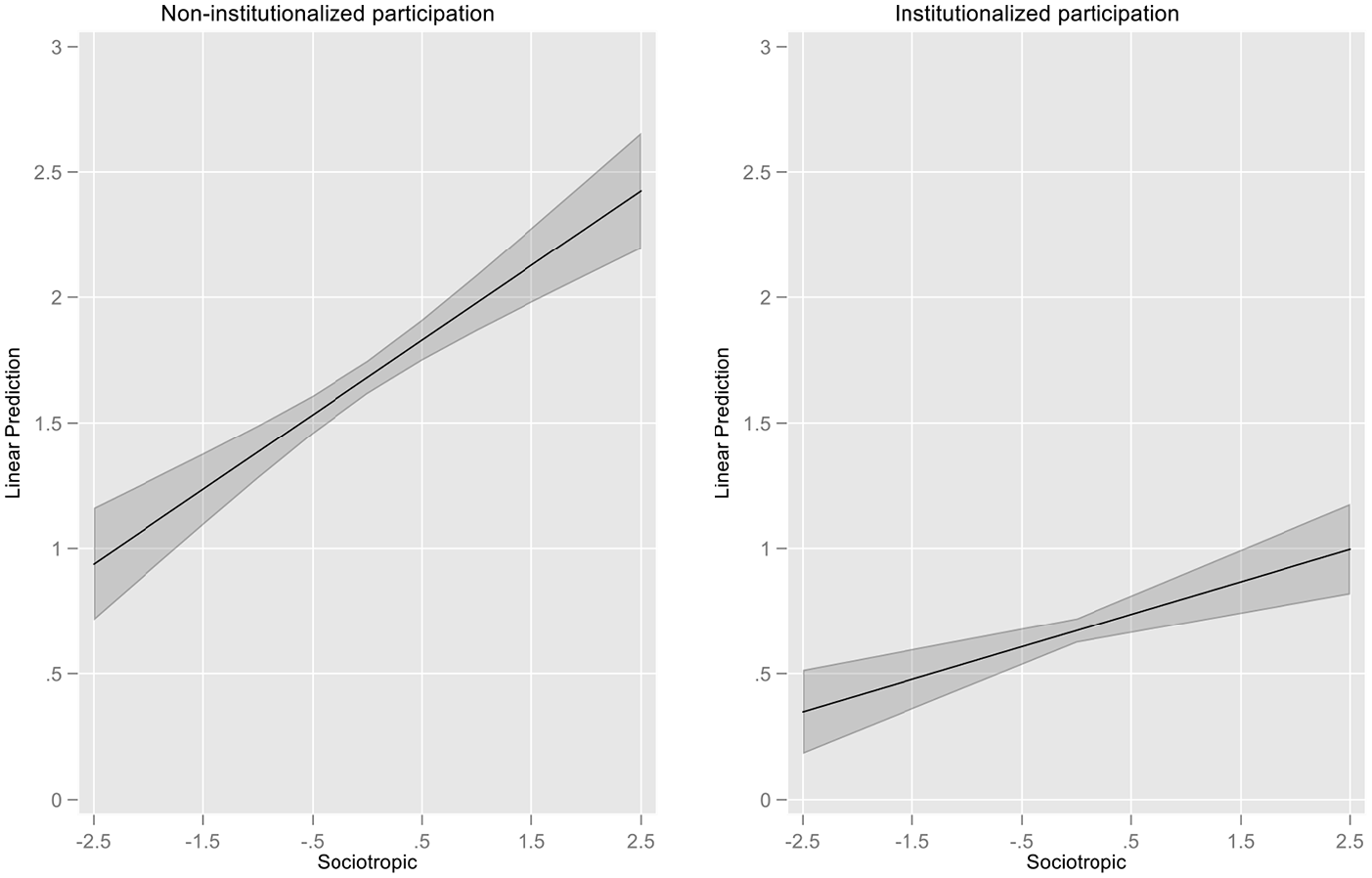
Predicted Developments in Political Participation as a Function of Sociotropic Perceptions of Inequality (95% CI).
As sociotropic concerns increase, people become much more likely to perform NIP, as the least worried are expected to perform about 1 activity, whereas it increases to 2–3 activities for the most worried. The pattern is similar for IP, but the differences are less pronounced, since the least worried are expected to be inactive, while the most worried are likely to perform one institutionalized activity.
The third and final expectation concerns the potential interaction with ideology, which is examined in Model 3. Here we see that the coefficients for three of the four interaction terms are significant; when it comes to IP, only the interaction term for sociotropic and ideology is not significant at a conventional p < 0.05. However, since traditional significance tests are unreliable when it comes to interaction terms (Brambor et al., 2006; Kam and Franzese, 2009), we explore the implications for all four terms. We start by showing marginal effects of the perceptions of social inequalities as a function of ideology in Figure 2.
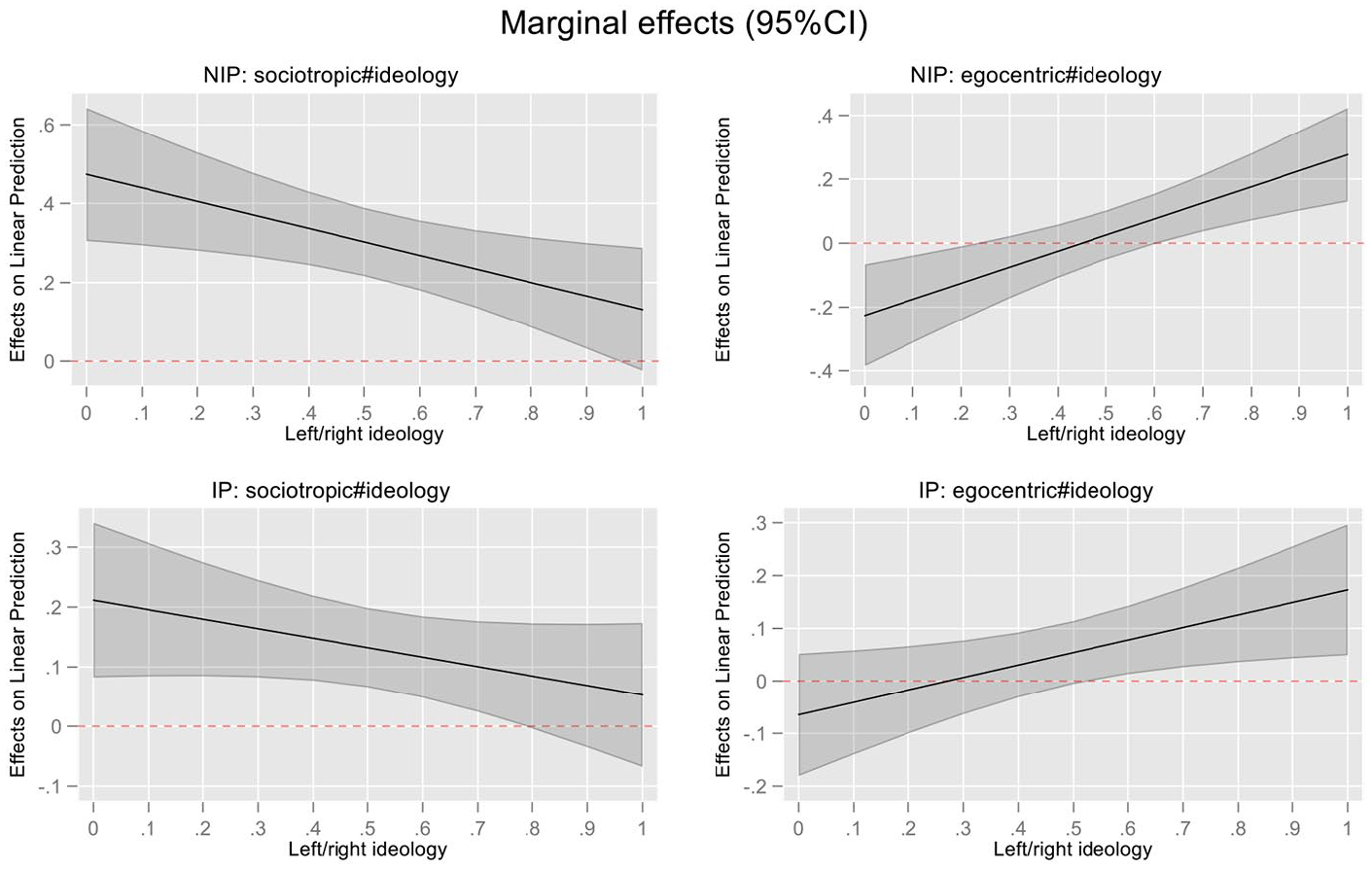
Implications of Interaction Effects: Marginal Effects.
The plots show that sociotropic perceptions are much more strongly associated with participation for people to the left, whereas the association is weak and even insignificant for people to the right. Conversely, egocentric perceptions can mobilize people to the right, but the implications are non-significant or even negative for NIP for those the furthest to the left.
To further illustrate what these differences entail, in Figure 3, we show predicated mean scores of participation for people at the ideological extremes.
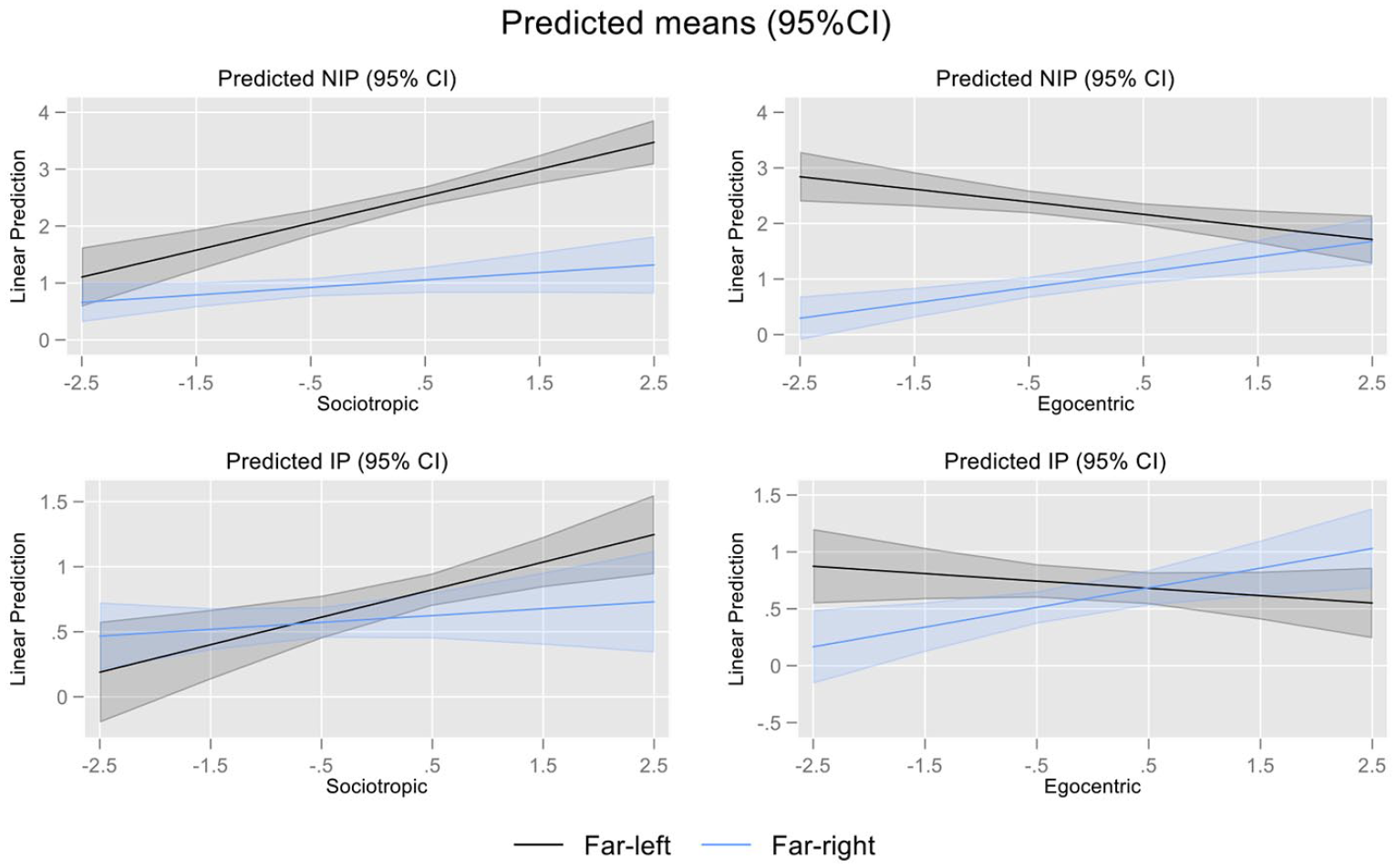
Implications of Interaction Effects: Predicted Means.
These results show that those to the far left (ideology = 0) who are worried about sociotropic inequality (Sociotropic score = 2.5) can be expected to perform 3–4 NIP activities and 1 IP activity, while those to the right (Ideology = 1) are much less likely to take action, even when they worry over sociotropic inequalities. Those to the right do, however, become active when worried about egocentric inequalities since they are predicted to engage in nearly 2 NIP activities and 1 IP activity. Those to the left are less likely to become mobilized and their predicted activity level decreases when they worry over their own perceived financial problems or those of their social circle.
Conclusion
Political participation is a central mechanism through which citizens can convey their worries over social inequalities to decision-makers. Although an extensive body of research has examined the link between social inequality and political participation, there is still no consensus in the field about how perceptions of social inequality are associated with political participation. Instead, a multitude of studies have arrived at contradictory findings, reaffirming the complex and multidimensional nature of the issue at hand.
With this study, we contribute to the literature by asking how subjective perceptions of inequality affect one’s propensity to take an action to explicitly address the inequalities in society and what role ideology plays.
The results of the study make at least three important contributions to existing knowledge. First, we show that subjective perceptions of social inequality form two distinct dimensions, which we label sociotropic and egocentric perceptions of social inequalities. The former relates to general social inequality in society, while the latter is about worries over the implications of social inequalities for oneself. Previous studies that have examined subjective perceptions of social inequality (Bobzien, 2020; Gimpelson and Treisman, 2018; Kuhn, 2019) have not examined differences in the dimensionality of these perceptions. This may help explain why some studies cast doubt on the importance of perception compared objective measures of inequality (Weisstanner and Armingeon, 2021). The notion that worrying about social inequality can take different forms indicates that general questions about the importance of social inequality may be misleading since these fail to capture the underlying motivations behind the worries.
Second, this distinction has important implications for the propensity to become politically active in addressing these worries between elections. Several previous studies have examined the link between both objective and subjective measures of inequality and political participation (Alesina and Angeletos, 2005; Castillo et al., 2015; Gimpelson and Treisman, 2018; Ianchovichina et al., 2015; Jo and Choi, 2019; Krauss, 2015). Our study differs from these endeavours by focusing explicitly on acts of political participation aimed at addressing concerns over social inequalities and examining the association with two forms of political participation between elections: IP and NIP activities. Our results demonstrate that citizens with sociotropic concerns are more likely to be involved in both IP and NIP, whereas political participation among those who have egocentric perceptions is affected less. This indicates that sociotropic concerns about social inequalities are more likely to reach the attention of political decision-makers, whereas personal grievances are less likely to reach the political agenda. In the midst of the discourse about citizens’ alienation from politics, this indicates that many do care about the societal developments in their country and how their fellow citizens are doing. Also, they are ready to take action to address the perceived social inequalities, which could potentially break the vicious circle of social inequality leading to unequal involvement in politics and influence on the political agenda.
Our final important finding to some extent dampens this optimistic note and adds a word of caution. We demonstrate that political predispositions matter as the associations are moderated by left–right ideology. This entails that people to the left are mobilized by perceived overall societal inequalities whereas those to the right become active when worried about their own perceived financial problems or those of their own social circle. This confirms to some degree the conclusions made by Lockerbie (2006) stating that both sociotropic and egocentric evaluations matter since different issues/perceptions activate different people. Furthermore, this finding corroborates previous results that indicate that the relationship between perceptions of social inequality and political participation is moderated by predispositions and characteristics (Loveless, 2013; Martorano, 2018). In this case, we interpret this result as an indication of cognitive dissonance inhibiting action (Festinger, 1957). It is mainly when ideological worldviews and subjective perceptions of social inequalities align that we find a mobilizing effect. When there is a conflict, for example, a right-wing individual worried about the situation of the poor in society, this is less likely to lead to political action. Hence, our findings reiterate that left–right ideological predispositions still play a role in affecting political behaviour and subsequently political change (Oscarsson and Holmberg, 2016).
Despite these contributions, some limitations need to be acknowledged. The analysis is not based on a fully representative sample of the Finnish population, which weakens the explanatory power of our findings to some degree, even if weighting does not appear to change the results. More importantly, we focus exclusively on the situation in Finland, which is an egalitarian country without stark social differences that exist elsewhere. More studies therefore need to examine similar issues in other contexts, and preferably in a comparative manner, to substantiate the findings. Finally, some potential endogeneity problems have to be acknowledged since it comes as no surprise that, for instance, people with left-leaning ideology are more propelled to action when sociotropic concerns are high. This raises a question whether it is because people have a left-wing ideology that they see inequality as a relevant social problem or it is because they find social inequalities problematic or are even affected by it that they place themselves on the left of the political spectrum. On the contrary, the fact that our measures of sociotropic and egocentric perceptions of social inequality function as expected in light of ideological differences lends further credence to the viability of this distinction.
Despite these uncertainties, our findings clearly indicate that it is important to appreciate that the message conveyed to political decision-makers through acts of political participation is shaped by both the perceptions of social inequality and the ideological characteristics of the messengers.
Footnotes
Appendix 1
Appendix 2
Declaration of conflicting interests
The author(s) declared no potential conflicts of interest with respect to the research, authorship and/or publication of this article.
Funding
The author(s) received no financial support for the research, authorship and/or publication of this article.
