



Abstract
Recent years have seen a rapid growth of interest in the inclusion of citizen participation in the work of public institutions, advancing a well-established literature in public administration, which aims to reconcile the goals of public bureaucracies with those of democracy. Consequently, a rich body of literature and empirical work has emerged, which explores the extent to which the aspirations of the literature are reflected in practical experiences of participatory initiatives. In this article, we argue that this literature would benefit from a deeper connection with democratic theory. In particular, we suggest that our ability to make assessments over the functioning of citizen participation initiatives would be strengthened by a closer engagement with the contributions made by social choice theorists. We aim to promote a constructive dialogue, suggesting that considering social choice perspectives in analyses of participation might allow the claims made by proponents of citizen involvement in public administration to be strengthened considerably.
Introduction
The last 30 years have seen a growing interest in citizen participation in the work of public institutions (Brandsen et al., 2018). While this might seem most immediately to be the preserve of democratic theory, work on participation is also well established in the public administration literature, which suggests that it might provide a number of benefits, including more effective, locally focused services and a more engaged and tolerant citizenry, as well as enhancing organisational performance (Neshkova and Guo, 2012) and harnessing instrumental benefits for both policy outcomes and the public at large (Moynihan, 2003; Nabatchi, 2010). Consequently, public administration scholars have developed a rich body of literature and empirical work, which examines recent reforms in detail and raises questions about the prospects for their success. Much of this material, while welcoming attempts to increase participation in public institutions, takes a nuanced tone, suggesting that, in practice, attempts at reform offer broadly encouraging results (see Ebdon and Franklin, 2004; Kathlene and Martin, 1991; Neshkova and Guo, 2012
In this article we argue that there is value in connecting democratic theory more closely with public administration scholars’ work on citizen participation. We aim to promote a constructive dialogue, suggesting that including perspectives from democratic theory can add new insight to public administration analyses of citizen participation while also testing established concepts in new settings. In the article, we suggest that public administration scholars’ ability to make assessments over the functioning of citizen participation initiatives would be strengthened by a closer engagement with social choice theory. Considering social choice perspectives might highlight where citizen participation initiatives are not functioning as intended, for example, by leading to paradoxical results or involving nuanced forms of manipulation. We also suggest that social choice theory can provide an important complement to the public administration literature by demonstrating how important aggregation procedures are for the achievement of the benefits of the citizen participation.
The article begins with a brief account of the position of participation in public administration scholarship, highlighting some of the prominent themes in the literature, and identifying some of the ways the existing literature already draws on democratic theory, as well as the limitations of current work. The article moves on to introduce social choice theory before examining its implications for work on citizen participation, concluding by highlighting its potential to strengthen claims over the functioning of participation initiatives.
Participation in Public Administration
The potential for democratic theory to speak to public administration scholarship in this area is already clear from the existing work. Follett (1951 [1924]) set the tone for subsequent thought with her suggestion that the proper role of public managers should not be to act as insular ‘experts’, working with the consent of the public but to engage them directly in the affairs of government. This, in her view, was a question of democracy, presenting a choice between popular, democratic control and expert bureaucracies. Her answer was based less on the normative desirability of participation than on the utility of a system of public bureaucracy where citizens and officials worked in harmony: ‘To divide society on the one side into the expert and the governors basing their governing on his reports, and on the other the people consenting, is, I believe, a disaster-courting procedure’ (Follett, 1924: 5).
Instead, it was the role of public officials to work together with citizens to direct the machinery of the state. H. George Frederickson (1982: 502) agreed, suggesting that public administration should be ‘intimately tied to citizenship, the citizenry generally, and to the effectiveness of public managers who work directly with the citizenry’. Numerous scholars have tackled participation from this starting point, and there is a broad acceptance that the direct involvement of citizens in the mechanics of modern public governance is desirable and produces a wide range of benefits (Fung and Wright, 2001; Ianiello et al., 2019; Pateman, 2012).
Recent years have witnessed the development of a strong normative foundation for these benefits (see Bovaird, 2007; Fung, 2006; Jakobsen et al., 2019; Vigoda, 2002). The value of participation, in this view, is rooted in a theoretical justification for including the public in the development of the outputs of public administration, one which has a democratic core. For instance, Fagence (1977) argued that restrictions on citizen participation in public administration are anti-democratic, and contrary to the organising principles of modern society, which were to be controlled by democratic, rather than bureaucratic, means. Tina Nabatchi (2010: 377) suggests that a ‘democratic ethos’ encourages both scholars and practitioners of public administration to value citizen participation. Probably the most comprehensive assessment of these issues was presented in Beierle and Cayford’s (2002) meta-analysis of 239 cases of public participation. Focused on environmental policy, their work suggests that participation results in not simply more effective policy, but that it has an important educative effect on citizens, providing an appreciation of the practicalities of public administration and also greater knowledge of the issues at hand, resulting in a more informed pool of participants, suggesting, in short, that participation should be valued in part because it can result in tangible democratic benefits.
Beyond normative assertions, scholars of public administration also draw on democratic theory to trace extrinsic benefits from citizen participation affecting the quality of public administration, rather than the individuals taking part. Tina Nabatchi (2010) describes this as an instrumental, rather than normative perspective, where the benefits for public participation are felt where they assist the clarity and effectiveness of the decision-making process. Here, the critical factor in determining citizen participation is the prevailing view held by public administrators over its costs and benefits. Neshkova and Guo’s (2012: 269) work on state transportation agencies in the US found that ‘citizen input is positively and significantly associated with better service in terms of both efficiency and effectiveness’. Gianpaulo Baiocchi (2005: 67) famously outlined the benefits of participatory budgeting in Porto Allegre, Brazil, suggesting that it can result in ‘efficient, redistributive and fair decision-making’. Elsewhere, numerous case studies attest to the potential for citizen participation to improve policy outcomes and encourage greater realisation of the goals of public administration (Heller and Isaac, 2005; Kathlene and Martin, 1991; Moynihan, 2003). However even here, much of the existing work still draws on democracy to make its case, for instance, by connecting gains in the quality of public decision-making and service delivery with features such as ‘the democratic ideals of self-organisation, civic responsibility, and public deliberation’ (Olivo, 1998: 267).
Beyond this, recent work assigns citizens a central role in participatory initiatives, with a focus on collaborative forms of engagement such as co-production and co-creation to harness participation’s value (Brandsen et al., 2018; Dean, 2018). These are distinct from ‘classical’ forms of citizen participation in a number of important ways (Voorberg et al., 2015). Osborne (2018) distinguishes between co-production and co-creation and previous ways of understanding citizen participation, highlighting a focus on the wider value of participation for citizens, rather than the production of public services. Voorberg et al. (2015) suggest citizens might variously be involved as co-implementors, co-designers and as initiators, in each case taking on a role which far exceeds previously-held views based on the primacy of public managers. The centrality of citizens here is significant, and is the source of a number of claims of democratic value. Ansell and Torfing (2021) suggest that engaging citizens in co-creation can help build a greater degree of democratic ownership. Pestoff (2006, 2009) argues that co-production, broadly conceived, can be a means of addressing the ‘democratic deficit’ in liberal democratic systems. Verschuere et al. (2018) agree but suggest that a greater degree of theoretical sophistication is needed if these claims over democratic gains are to be fully verified.
The corollary of all this is that citizen participation in public administration is considered to bring a greater degree of both legitimacy and effectiveness, and although this is not the only justification for participation, this is frequently articulated in terms of democratic theory. However, despite the prominence of this literature, as others have noted, connections between public administration and democratic theory are rarely made explicit, and the precise origins of the claims being made by the proponents of public participation can be hard to determine (Moynihan, 2003; Olivo, 1998; Verschuere et al., 2018).
Examples are not hard to find in the literature. King et al. (1998: 319) claim that ‘there is theoretical and practical recognition that the public must be involved in more public decisions’, but provide no explicit articulation of the democratic benefits that they believe might result from increased involvement. Elsewhere, Nabatchi (2010: 382) makes a valuable and convincing case for the importance of deliberative democracy to the work of public officials but nonetheless appeals broadly to ‘classical political thinkers from Aristotle to Jefferson’ in support of her argument for the importance of democracy in public administration. Time and again, a recurrent theme of the literature is the presence of only a limited engagement with democratic theory of the kind most political theorists would recognise.
Loose appeals to democracy like this do proponents of participation few favours and are problematic for two reasons. First, mainstream democratic theory, at least as understood within political science, has for some time been rather more nuanced over the prospects and value of participation than some of the public administration literature would suggest, 1 and has developed sophisticated means of understanding both the potential as well as the pitfalls of citizen participation (see Dacombe, 2018; Fung, 2004 for reviews). Second, and critically, a closer connection with democratic thought might provide important correctives to some of the more perplexing problems faced by researchers and practitioners interested in opening up the work of public agencies to greater degrees of citizen involvement.
Connecting Democratic Theory and Citizen Participation
While we should be clear that an array of views exist over the benefits associated with citizen participation, many accounts still take its value for granted (Ianiello et al., 2019). However, without a clear theoretical foundation, claims of democratic justification for citizen participation are necessarily incomplete. A number of dissenting voices in the public administration literature support this concern. Archon Fung (2006: 67) is concerned with existing scholarship’s ‘naïve and untempered enthusiasm for public participation’. Kweit and Kweit (1980) are sceptical of the ability of citizens to properly engage in the technical aspects of modern bureaucracies. Hibbing and Theiss-Morse (2002) identify a distinct lack of enthusiasm for participation among citizens themselves, despite its popularity in the literature. Bryson et al. (2013) suggest that a lack of understanding over how to design participation processes can hinder success. Williams et al. (2016) go further, exploring ways in which co-production might negatively impact public agencies’ work. Similarly, Yang and Pandey (2011) acknowledge the importance of participation for democratic governance but note that uncertainties over institutional design leave citizen participation as a ‘black box’. As Burton (2009: 264) puts it for something that is held to be so important and to deliver a myriad of benefits, we know little of the extent to which the benefits of public participation are in fact delivered or of the balance of these benefits with any costs.
Of course, public administration scholarship has long recognised that the outcomes of participatory initiatives are not guaranteed and a number of analytic tools have been developed to understand the dynamics of participation that take place. In one of the classic treatments of citizen participation in public administration, Sherry Arnstein (1969) imagines participation as a ‘ladder’ of eight ‘rungs’: manipulation, therapy, informing, consultation, placation, partnership, delegated power, and at its most advanced level, citizen control. The value of participation associated with citizen control is contrasted with that of manipulation and therapy (considered forms of ‘non-participation’), and with tokenistic methods such as consultation and placation. Arnstein’s model is at once practical and normative, indicating a progressive scale of citizen empowerment and highlighting that participation should not be seen as a simple dichotomy between the involvement or exclusion of citizens.
More recently, Fung (2006, 2016) has developed these ideas into a ‘Democracy Cube’. This builds on the Ladder of Participation – Fung explicitly cites Arnstein’s model as the basis for his approach – aiming to address what he sees as some of its shortcomings. Consequently, Arnstein’s approach is developed in two main ways. First, by addressing its normativity, on the basis that there may be times where citizen participation is not desirable. Second, the varying forms of participation are updated, particularly to include deliberative initiatives. Fung focuses on degrees of participant selection, communication and decision mechanisms, and authority and power to reach a three-dimensional account of participation – a ‘cube’, in contrast to Arnstein’s linear model.
Identifying where on these frameworks a participatory initiative might be situated is no simple task. As Fung (2016) suggests, there are numerous ways in which seemingly open participatory processes might be compromised and rendered trivial by, for instance, limiting participants’ control over decision-making procedures, or over the agenda of issues that may be considered. In response, we argue that, given the focus of much of the literature on the democratic value of participation, analyses of participatory initiatives would benefit from a closer engagement with democratic theory, and in particular with the literature on social choice theory. We suggest that such a connection would allow a greater degree of sophistication in analyses of citizen participation, and has the potential to reveal otherwise hidden problems by demonstrating the influence of the aggregation procedure employed on the results of the decision-making process in situations where this would otherwise be undetected.
Social Choice Theory
Social choice theory is a branch of democratic theory concerned with the possibilities (and problems) of the aggregation of individual inputs into collective outputs and the implications of the empirical analysis of varying systems of aggregation. It deals with questions over the aggregation of votes, preferences, welfare functions, and opinions as well as the translation of individual views to constitute a collective judgement (e.g. in panels of subject matter experts).
At their most extreme, democratic theorists who draw on social choice theory can suggest that democracy is a mechanism which cannot feasibly produce outcomes which are meaningful and coherent (see Riker, 1982). It is understandable that, for proponents of democratic participation, this apparent critique of democracy might be marginalised or ignored. However, the insights provided by social choice theory have proven valuable in correcting uncritical assumptions over democratic value, and can contribute to our understanding of the functioning of attempts at promoting citizen participation. In recent years, social choice theory has been applied to provide justification of deliberative practices (Dryzek and List, 2003), to a create a logical map of democratic models (List, 2011), and to debates on epistemic value of democracy (Estlund, 2008; Goodin and Spiekermann, 2018), among many other contributions.
The starting point for much of this literature is Kenneth Arrow’s work on collective decision-making. A Nobel Prize-winning economist, early in his career Arrow demonstrated the impossibility of any system of aggregation of preferences over three or more alternatives meeting a number of specific fairness conditions. The first of Arrow’s conditions is non-dictatorship, suggesting that outcomes cannot be decided any individual alone, a point which makes intuitive sense in any democratic context. The second is unanimity; that if everyone agrees on a preference, then this preference must form the collective decision. Third, that the aggregation of preferences must be transitive. That is to say if A > B, and B > C then A must be preferred to C. Fourth is that there should be no reasonable restriction on the preferences permitted to be held by participants (known as universal domain). Finally, Arrow specifies that any aggregation must be compatible with the independence of irrelevant alternatives. This means that, of the myriad preferences which might exist, the preference of, say, A > B should not be affected by the presence of an entirely unrelated choice, X. Consequently, any attempt to enshrine the common (or public) will in decision-making cannot be taken for granted as, depending on the mechanism of aggregation employed, different results will occur. Arrow’s (2012) work, first published as ‘Social Choice and Individual Values’, targets all systems of aggregation, rather than democracy alone.
Riker (1982) extends this argument to suggest that, as Arrow has demonstrated no system of aggregation can satisfy all fairness conditions, we must question whether democratic decisions are true reflections of the preferences of those involved, or whether have been subjected to manipulation or strategic action by unscrupulous politicians and bureaucrats. Perhaps the easiest way of understanding how this might work is through the Condorcet Paradox. Let us imagine three voters, 1, 2 and 3, who can each choose between three alternatives, A, B and C, and that these preferences are ordered as shown in Table 1.
Example of Cyclical Preferences.
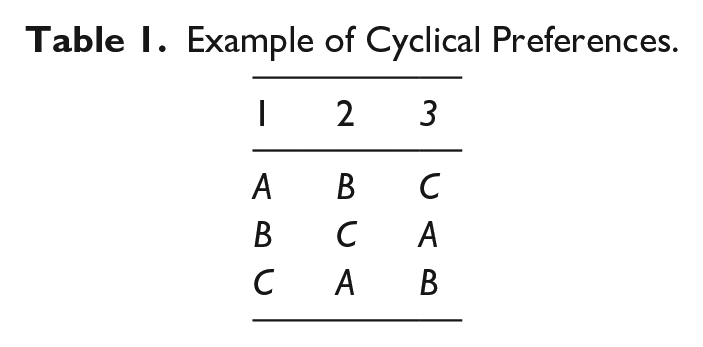
Here, no preference can win out in pairwise comparison: A > B and B > C, but C > A, and so the aggregation of preferences cycles infinitely and meaninglessly, violating the Arrovian condition of transitivity. In the social choice literature, a system in which the winner is identified by the highest number of votes is called a plurality rule (as opposed to a majority rule). As Gerry Mackie (2003) points out, any democratic system which allows more than two preferences is subject to problems like this, and plurality rules are a regular occurrence in public life, even if they are concealed (such as in elections with only two likely winners). Aggregation problems can be even starker when considered in the context of group, rather than individual, preferences. Here, intransitivity, alongside the vagaries of large-scale aggregation systems can lead to paradoxical results or decision-making paralysis (van Deemen, 2014). This is a familiar scenario in representative politics, and examples can be readily found in national elections (such as the UK General Elections of 1982 and 2004).
Most recent work in social choice theory is concerned with judgement aggregations, as opposed to votes or individual preferences (List, 2012). Issues over the aggregation of logically-connected propositions to form collective judgement are present in, for example, expert panels or citizens’ juries. Work on judgement aggregation identifies more general problems leading from inconsistencies in the structure of judgements. For instance, Kornhauser and Sager (1993) identify that majority voting on the propositions underpinning a judgement decision might differ from the outcome of a vote on the final outcome. Dietrich and List (2007) highlight the ‘discursive dilemma’ where irrational collective judgements can result from the aggregation of logically consistent propositions. These insights have been extended and applied in a wide range of contexts and form part of mainstream work on social choice (List and Puppe, 2009; Pettit, 2001).
Findings like these have decisively shaped the study of democracy in recent decades, and have provided influential results in fields as diverse as legal studies, sociology and computer science, as well as political theory (List, 2012). Considering the application of social choice theory in this way has clear implications for work on public administration by clarifying the basis of citizen participation in any situation where the views of individuals need to be collected into some form of collective output.
However, interest in citizen involvement in public administration also yields benefits for the social choice literature by bringing a new focus. Much of its early development was concerned with binding decision-making by professionals: whether in legislative contexts, courts or by public officials. For example, Ordeshook and Schwartz (1987) outline the influence of common parliamentary procedures on legislative outcomes. Bendor and Moe (1986) model the influence of the wider political environment on agenda control. Riker (1982) famously outlines Pliny the Younger’s attempts to manipulate the agenda of the Roman Senate to secure his favoured outcome in determining the punishment for an alleged crime. In the administrative context, Hammond (1986) analyses how the organisational structures of bureaucratic policy have an influence on its results. Citizens’ involvement in decision-making differs from these examples. As opposed to the decision-making in legislative contexts, it is less formally structured (see Oleszak, 1984). As opposed to the decision-making by public officials, it involves lay citizens, often purposely recruited to participate in a singular process. Last but not least, involvement of the citizens in public administration does not always result in binding decisions.
All of these elements have consequences for the application of social choice theory. Less formalised structures of decision-making can make blunt instances of manipulation, for example, strategic voting, less probable, although entirely out of the question. However, the involvement of lay participants makes the process sensitive to procedural forms of manipulation, for example, agenda control or the sequencing of decision-making procedures. Clearly, the variety of forms of citizen participation extends far beyond a focus on these kinds of decision-making procedure. But a focus on this context does provide the clearest indication of both the potential contribution and the limits of social choice theory in this context.
Social Choice and Participation in Public Administration
To illustrate how social choice paradoxes can affect both the organisation and outcomes of participatory processes within public administration settings, we introduce two stylised examples exploring the decision-making process during a focus group, and in a citizens’ jury. While these hypothetical examples are intended to highlight the contribution of a dialogue between social choice theory and public administration at an abstract level, in each case they are rooted in similar, real-world cases (see Fung, 2006; Jo and Nabatchi, 2021).
First, let us consider a focus group. Our example concerns a scenario where a hypothetical City Council aims to gauge inhabitants’ views on raising additional local budget revenue. This stylised example mirrors the setting of a focus group on budget priorities that took place in 2020 in the city of Edinburgh, UK. In this case, The City of Edinburgh Council (2022) employed a game-based approach to citizen participation, combining focus group discussions with an aggregative mechanism to identify a collective decision at the end of the events.
Let us imagine that the 25 members of the focus group banded around three broad groups of preference on raising local revenue: the introduction of a congestion charge on driving in the city centre, an increase in the council tax for local students, and the introduction of a tourist tax on visitors to the city. Some opted for the introduction of the congestion charge since it affected their income the least. They considered an increase in council tax as the next preferable option but held a strong negative preference for the tourist tax. Another group of inhabitants held a strong preference for an increase in the council tax for students. They did not mind so much introduction of the tourist tax but argued that the congestion charge would negatively influence their family or business budgets. Finally, the third group of participants had a strong preference for tourist tax because they wanted to keep local property prices low. They did not mind the introduction of a congestion charge but disagreed with the increase in the council tax for students on moral grounds.
To summarise, the preferences of this focus group can be illustrated in Table 2.
Preferences of Focus Group Participants.
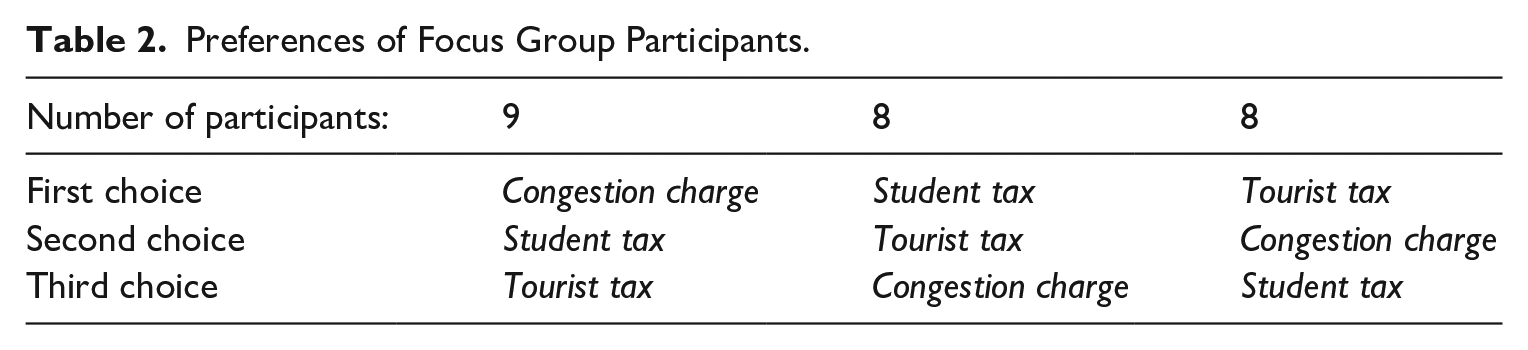
To identify the collective decision, the group facilitator suggested participants hold a process of deliberation, and if no agreement could be reached, a vote should be held. During the round of deliberation, none of the participants changed their mind, hence the group decided to vote, with each casting their vote for their particular strongest preference. This voting identified a congestion charge as the dominant preference for raising tax revenue. However, some participants had concerns about this result, suggesting that it is not fair to choose a congestion charge since this option did not have majoritarian support (nine people choose congestion charge, whereas 16 did not). As a result, the group decided to hold another vote, this time including second and third preferences. They used pairwise voting to identify if they collectively prefer a congestion charge over a student council tax, a student council tax over a tourist tax, or a tourist tax over a student council tax. The group’s voting is illustrated in Table 3.
Results of the Pairwise Voting.

Unfortunately, this round of voting did not bring up a clear preference for any one option. The facilitator suggested choosing between the most preferred two options (i.e. the congestion charge vs the student council tax) and then voting on the choice between the winner and the third option (a ‘run-off’). More people preferred congestion charge over student council tax (17) than those who preferred student council tax over congestion charge (8). Participants voted then on if they prefer congestion charge over tourist tax (supported by 9) or tourist tax over congestion charge (supported by 16). As a result, the group opted for the tourist tax.
The example above illustrates how, depending on the decision-making procedure employed, the result can look entirely different. Considering such paradoxes highlights more general problems with vague assumptions over the conduct of citizen participation: without considering the dynamics of aggregation, the process can be frustrating and obscure for the participants, and consequently challenge the popular legitimacy of any chosen solution.
Our second example concerns a citizens’ jury. Here, a group of citizens, usually selected at random, are charged with making recommendations on specific policy problems. Participants are given information on a variety of policy options, and trained facilitators help participants deliberate over their merits, before reaching a collective judgement over the most appropriate action to take. For our example, let’s imagine that a city council has organised a citizens’ jury to investigate the possible ways it might respond to the climate change emergency. This case, while hypothetical, follows a similar design to the Citizens’ Jury on Climate Change held in 2021 by one of the boroughs in London, UK (Southwark Council and Shared Future, 2022).
In contrast to the focus group, the preferences held by the participants are limited in two distinct ways. First the citizens involved are presented with information on the topics addressed, including feasibility constraints of the developed proposals. 2 Second, the process of deliberation which participants go through can have a distinctive role to play in sharpening the preference rankings held by participants (see List (2019) for a discussion of the effects of deliberation on preferences). The structured forms of discussion which take place serve a number of purposes. Participants can share ideas, bringing others around to their point of view while also listening to the opinions of others and revising their own accordingly. This also requires a process of self-reflection, with participants considering the basis for their own preferences on the merits of various options available. However, an important distinction is that procedurally, the account of the views of those participating on a number of preliminary issues can be as important as the final recommendation.
Let us assume that at the first stage of the process, the citizens needed to provide a reasoned recommendation (a judgement) on whether the council should promote electric car usage, for example, by introducing public charging points. As List and Polak (2010) suggest, the aggregation of judgements requires that the set of value judgements held by each participant over several preceding propositions is logically consistent. For example, if the citizens’ jury agrees that (1) electric cars are beneficial for the environment, and (2) the City council should promote electric cars if and only if they are beneficial for the environment, it should also recommend to the City council (3) to promote electric car usage. However, individual participants can have different beliefs regarding these propositions. For example, some participants may disagree with the benefit of electric cars for the environment but support the promotion of electric cars due to other reasons (perhaps a reduction of noise).
Consequently, public officials particularly interested in drawing on the collective judgements of participants to gain insights about public priorities over transport will find the above example can yield results which closely resemble those of plurality rule in other contexts (Table 4).
Individual and Majority Judgements of Citizens’ Jury Participants.
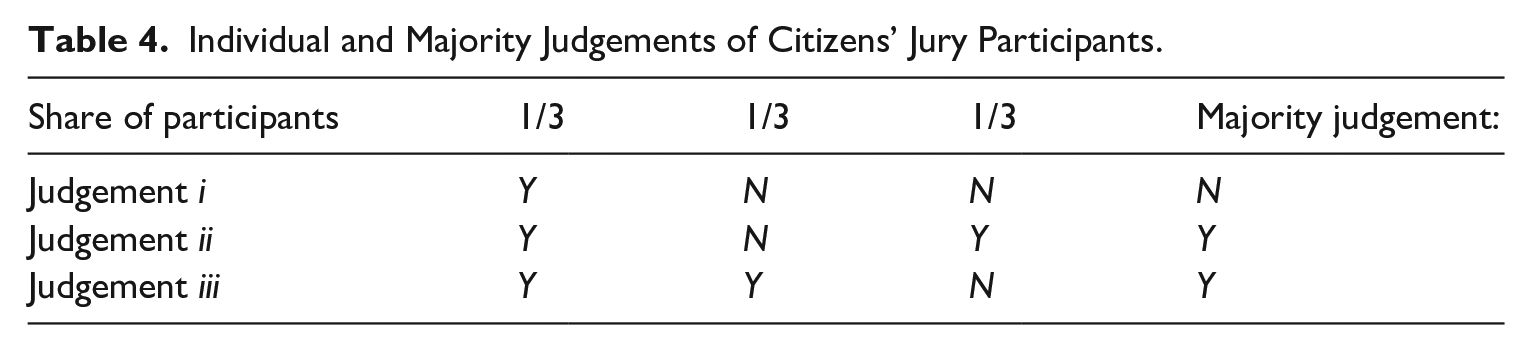
In this situation, despite each of the participants holding perfectly consistent preferences, the collective judgement is logically inconsistent (Dietrich and List, 2007). Furthermore, such preferences suffer from intransitivity (see List, 2011: 278). 3 In the citizens’ jury outlined above, Arrovian conditions are therefore violated in general terms, as well as in numerous others, such as the limiting of preferences through the presentation of information to the participants (violating the condition of universal domain), deliberation before the making the decision (violating the condition of independence) or the shaping of the jury’s agenda to favour particular points of view. Violation of Arrovian condition in general terms is not necessarily problematic. However, as we argue in the next section, an awareness among participants of such violations are important both from the perspective of potential manipulation and transparency of the process.
The two examples sketched above suggest that the dialogue between social choice theory and public administration has much to contribute to the existing literature and has the potential to add significantly to our understanding of the functioning of citizen participation in public administration. The focus on citizen preferences and their aggregation demonstrates problems with arriving at fair and logically coherent collective preferences and asks important questions of the ways in which citizens might be engaged in public participation. Processes of aggregation necessarily limit the plurality of voices that the participatory processes aim to gather. Consequently, the difficulties with coherent aggregation of judgements might undermine the normative and instrumental value that participatory processes can bring to the public administration. Despite this, as the next section illustrates, social choice theory can also provide evidence of the potential of participatory processes.
Reconciling Citizen Participation and Social Choice
We suggest a greater connection with social choice theory might be beneficial to claims of democratic value in citizen participation. For instance, its focus on the ways in which aggregation works has much to say about the functioning of participation initiatives by, for instance, exposing the unanticipated consequences of different aggregation rules. Social choice theory also has much to tell us about the ways in which participants approach the choices they face by casting light on the structure of their preferences over public issues. Social choice theory, in this context, becomes a powerful tool for understanding the ways in citizen participation can play out in practice. Below, we outline two ways in which social choice theory might enhance the public administration literature’s understanding of the value of citizen participation; through its potential for identifying instances of manipulation of citizen involvement in policy decisions, and its ability to clarify the preference structures of those involved.
Exposing Manipulation of Policy Decisions
The most obvious implication of the examples outlined above would be to question the efficacy of citizen participation. In part, this is because of the potential for manipulation of decision-making processes to distort the aggregation of the preferences held by those to participate, as we have seen, a point long shared in the public administration literature (see Arnstein, 1969). From the social choice perspective, one position is that the potential for manipulation may be enough to compromise participation from the outset, that aggregation problems can mean that ‘manipulated outcomes are meaningless, and unmanipulated outcomes are meaningless because they cannot be distinguished from manipulated ones’ (Riker, 1982: 237). Clearly, when it comes to the allocation of public funds, directing the efforts of public officials, making judgements on the merits of various laws or constitutional procedures, or any of the other tasks which citizens are asked to perform when engaging in democracy, the insights of social choice theory ask serious questions of much of the existing work in public administration.
However, if we move beyond the negative orientation to participation which accompanies such positions, social choice theory can, conversely, be of benefit in situations where concerns exist over the potential for citizen involvement in determining policy outcomes to be compromised. In particular, its application can highlight cases of manipulation when choosing the means of aggregation and demonstrating cases of agenda control.
Let’s look first at a case of manipulation through compromising the means of aggregation. In the citizen’s jury example outlined above, the collective judgement might be very different depending on the method of aggregation. For example, in contrast to the aggregation rule outlined above, the organisers of the citizens’ jury could decide to treat Judgement iii as a conclusion and aggregate judgements derived in this way (see Table 5). 4
Conclusion-Based Result of Citizens’ Jury.
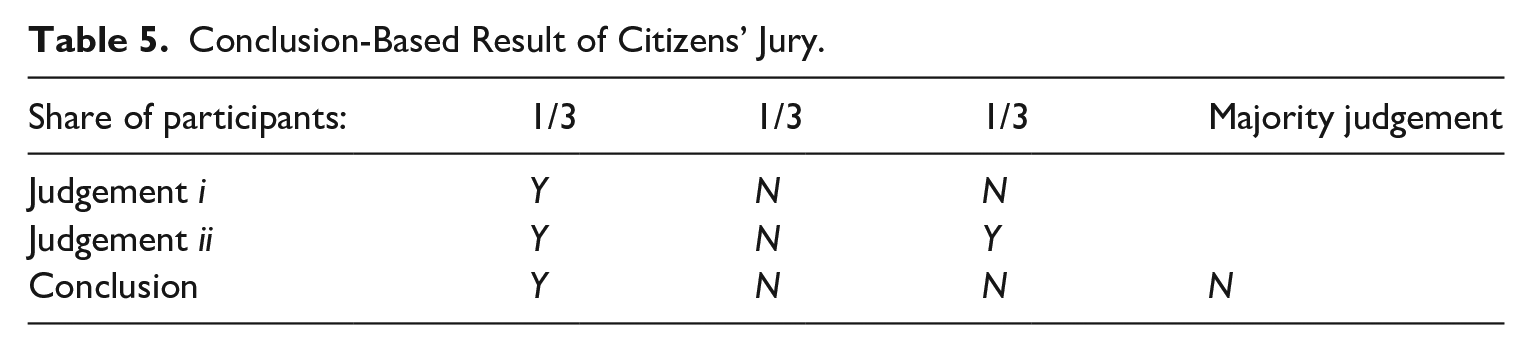
In such a scenario, the recommendation would be to not promote electric car use, the opposite of the recommendation derived from aggregation of particular judgements. Following the social choice literature, adopting such a method of arriving at the collective judgement can be an example of manipulation and might be employed to arrive at a result most favoured by powerful interest groups. At the same time, such manipulation does not need to result from ill motives but, for example, from a willingness to structure the decision-making process in a logical and coherent way.
In this context, social choice theory highlights instances of manipulation which otherwise would not be easily visible to participants. Awareness of the possibility of nuanced forms of manipulation is beneficial for both participants and public administrators, consequently supporting the instrumental effects of participatory process identified by the literature. Such awareness can be empowering for the participants, and be a source of greater understanding of (and confidence in) the processes of participation. For public administrators, it provides a rationale for engaging participants in the design of participatory procedures and, consequently, helps in arriving at more reflective results.
A second form of manipulation, control over the agenda, can also result from procedures that affect the collective preferences of those who take part. Riker suggests that this might take two forms. First, those exercised by actors with the ability to directly control the agenda (perhaps committee chairs, interlocutors in debates, and so on). Second, the variety of means in which actors without a formal role in can shape the procedures at hand – for instance, where the terms of debate, or the alternatives that are considered, might be altered to favour particular outcomes. Each of these examples are plainly evident throughout the public administration literature – indeed, a focus on interest groups, influence and public opinion has been a staple of the literature in both public administration and political science.
Agenda control can manifest itself in numerous ways. Examples might include the ability of committee chairs to determine what is to be discussed, and for how long; decisions over the wording of questions asked; the role of public officials in deciding the terms of reference for a public enquiry – all familiar concerns which reflect social choice theory’s focus on the roles played by empowered actors. However, agenda control can also work in more subtle ways. The location of a public meeting, norms over correct speech, dress and behaviour, and myriad other factors can serve to shape and constrain the agenda for many public participation schemes. Really, agenda control is a reflection of the differing manifestations of power within a particular setting. The distribution of power in this way has a profound effect on the conduct of public administration: as Riker (1993: 1) himself put it, ‘agendas foreshadow outcomes: the shape of an agenda influences the choices made from it’.
In contrast to manipulation through control over method of aggregation, agenda control will, in many cases, be obvious and easy to detect – Riker suggests that ‘the consequences of agenda control are apparent in some degree in the content of almost all social choice’ (Riker, 1982: 169). Nonetheless, the social choice literature has taken agenda control as one of its primary concerns (Bendor and Moe, 1986; Hammond, 1986; Ordeshook and Schwartz, 1987). However, the insights of social choice theory enable both public administrators and citizens to identify also those cases of agenda control that are more nuanced and more difficult to detect. A good example here would be the ways in which the structure and order of elements of the agenda can affect logically-connected judgements: in the example of the citizens’ jury discussed above, altering the sequence of judgement aggregation can clearly lead to different results.
Each of these examples might be more, or less, harmful depending on the institutional context to participation, the aggregation rule in place, and the issue at hand. Indeed, some writers suggest that, far from being a harmful procedure, manipulation might not be nearly so concerning as we might think (Dowding and Van Hees, 2008). Furthermore, the democratic consequences of manipulation and agenda control would differ depending on who influenced the process. Hence, there is a difference between instances of manipulation by organisers or powerful interests groups and when it is a result of power sharing among stakeholders. For example, in a process of regulatory negotiation when all the affected stakeholders reach a decision on the language of the proposed regulation, all those involved will also have influence over the agenda and the order of propositions analysed (Fiorino, 1988).
Preference Clarification and Single-Peakedness
Beyond the exploration of manipulation sketched above, a further way in which social choice theory might significantly contribute to work on public administration is by elucidating the functioning of deliberative democratic innovations, such as citizens’ juries of the kind sketched in the example above. Drawing on the logic of deliberative forms of democracy, participatory initiatives of this kind have been subject to significant scrutiny in the literature. Public administration scholars are optimistic about its potential: Tina Nabatchi (2010: 392) suggests that ‘deliberative democracy offers institutional designs that may help the field rediscover the role of the public in shaping societal affairs and, in doing so, abate the inherent tensions between bureaucratic and democratic ethos’. Archon Fung (2004) proposes a form of ‘empowered deliberation’, where citizens are able to shape policy outcomes through deliberative encounters with both public officials and each other. Fishkin’s deliberative polling project harnesses the ability of deliberative democracy to engender informed judgements over complex public issues (see Fishkin (2018) for an overview).
Social choice theory can help advance aims like these by laying bare the preference structures of participants in deliberations on policy, and by specifying conditions where the chances of incoherent results are reduced through deliberative processes, for example, by achieving single-peakedness of preferences. It is well established in the literature that where collective preferences are single-peaked (that is to say, that it is possible to organise the alternatives according some dimensions so that there is one most preferred alternative, with the other options are decreasingly less preferable) and there is no strategic voting, then cycling cannot occur (Black, 1948). For instance, McKelvey and Schofield (1987) have demonstrated that, if we assume that all rank orderings are equally likely to be held, then the potential for cycling increases with both the number of options available and the number of participants. If, however, some orderings are more likely than others, then not only is the cycling of preferences far less likely but there might be a far greater degree of certainty over the likelihood of manipulation, and the overall quality of the outcomes of public participation. Consequently, the ability to identify situations where preferences move towards single-peakedness is highly beneficial to the success of democracy. In the social choice literature, the exploration of preference ordering has become a preoccupation with the literature, with numerous writers exploring both the likelihood of it occurring and the conditions which prompt it (see Mackie, 2003).
Recent application of social choice theory to deliberative democracy suggest that, far from driving diversity in opinion, the act of reason-giving argumentation can in fact serve to sharpen preferences (Dryzek and List, 2003; List, 2019). Dryzek (2001) suggests that deliberation can extend the dynamics of collective decision-making beyond a single point of aggregation by fostering open, public communication of preferences, and holds that this is invulnerable to some of the trenchant critiques drawn from social choice theory. Miller (1992) made a similar point, arguing that deliberative democracy is less vulnerable than other forms of democratic decision-making to the challenges highlighted by social choice theory, due to deliberation’s ability to produce single-peaked preferences. Dryzek and List (2003) argue that deliberation can facilitate single-peakedness of participants’ preferences, by producing a meta-agreement. This agreement, not on the substantive question at hand, but on the nature of the disagreement enables participants to organise their opinions in way that escapes cyclical results. List et al. (2013) empirically demonstrate that deliberation can increase proximity to single-peakedness.
Deliberative processes in public administration might also work in other ways which are beneficial to the clarity of the outcomes produced by citizen participation. For instance, involving citizens in a deliberative process over public decisions might (at least theoretically) mean that those involved gravitate behind a particular option as they are persuaded by the ‘forceless force of the better argument’ (Habermas, 1999: 140). A more likely outcome might be that, rather than being persuaded to support some obviously correct option, citizens find that as part of the process of deliberation they are able to both encounter new information on the issues at hand (which might reinforce or alter their preferences structures over the available options) and to weigh carefully the rank ordering of preferences which they hold.
Of course, much of this rests on the particular iteration of deliberative democracy which is considered, as well as the setting, participants and subjects for discussion which are in question. However, while the public administration literature treats deliberation as a potentially valuable avenue for citizen participation, much debate exists over the functioning and efficacy of deliberation in practice – as Simone Chambers (2003: 307) suggests, deliberative democracy has moved from a ‘theoretical statement’ to a ‘working theory’, where its core premises and assumptions are subject to experiment and empirical testing. It is perhaps here that the literature on social choice can be of most value, and there are obvious benefits to its potential for enhancing existing accounts of deliberative democracy in public administration.
Conclusion
The aim of this article was to begin to suggest ways in which both public administration scholarship and democratic theory might benefit from a closer connection to each other. The tendency of the existing literature to make broad claims over the democratic value of participation which are to some extent disconnected from democratic theory is a weakness in much of the work in this area (Verschuere et al., 2018). As we have seen, democratic theory, as conventionally understood, is a diverse body of work and many iterations take a far more nuanced view over the prospects of democracy than many public administration scholars would have us believe. A closer engagement especially between social choice and public administration is, as outlined above, of critical importance given the central place of citizen participation in many accounts of the work of public managers.
The application of social choice theory to participatory processes in public administration demonstrates the importance of the theory to less-formalised decision-making processes involving non-professional decision-makers. It also demonstrates broader relevance of this body of literature and opens up new avenues for further research. For the public administration literature, engagement with social choice theory highlights that participatory processes may not always deal with diverse inputs in a way that would be fair and logically consistent. Consequently, it challenges that part of the literature which connects the benefits of participation strictly to the fairness or achieved diversity of such processes. Social choice theory also provides new arguments for the benefits of public participation in administrative settings. In particular, social choice theory highlights cases of manipulation and provides basis for more transparent processes. Furthermore, it provides a rationale as to why deliberative processes are of a particular value in this setting.
Furthermore, knowledge and understanding of social choice theory has more than theoretical consequences for the field of public administration. It offers practical implications for the daily work of public administration practitioners. Social choice theory indicates that the very method of aggregation is not value-neutral, and different methods can lead to different results. To avoid manipulation and to raise awareness among participants about such consequences, practitioners can further delegate the choice of aggregation procedure to the participants themselves. To avoid paradoxes resulting from ordering the judgements, practitioners might explain how and why certain propositions have been ordered in a particular way, offer a possibility of changing such order, and introduce power-sharing during the process. Above all, social choice theory offers a powerful reason why participation in the public administration practice might take a deliberative form.
There are many applications of social choice theory, and indeed there exists a vast range of different forms of participatory processes: the brief sketch here can only provide an indication of the potential of its insights for public administration scholarship. But it is clear that a closer engagement with this literature can add much to the ways in which public administration scholars go about their work. This article provides some initial insights into the ways in which this might be done. Thinking about the relationship between participatory processes and the normative expectations of democracy in the light of social choice theory, and indeed, democratic theory more broadly, can pay clear dividends; experience from elsewhere in the social sciences suggests that public administration scholars should consider turning their attention to this field.
Footnotes
Declaration of conflicting interests
The author(s) declared no potential conflicts of interest with respect to the research, authorship and/or publication of this article.
Funding
The author(s) received no financial support for the research, authorship and/or publication of this article.
