



Abstract
Constituents in the United States have used local public meetings in recent years to shape policy on some of the most high-profile race-related issues. However, public meeting participation remains less studied relative to other modes of participation. This study investigates the extent to which race shapes the way a message is heard and evaluated by the public audience and the degree to which its impact depends on the issue of the message. To carry out the study, I set up a 2 × 3 experiment containing six short treatment videos in which I manipulated the race of the actor/speaker (Black or White) and the message issue (innocuous service request, race-related policy, and race-neutral policy). Subjects were randomly assigned to watch one of the six videos and then asked to evaluate the message in the video. The early results of this study show that unlike previous studies revealing racial bias in a range of political contexts in the United States, race exerts neither independent nor conditional effects on the evaluation of the message as reasonable. I discuss the limitations and implications of these findings and useful considerations to think about in expanding this study.
Introduction
Constituents use local public meetings to influence policy-making in a variety of important areas, such as zoning, redevelopment, and the budget. However, what remains understudied, despite an increasing interest in listening as a practice essential to a well-functioning democracy (Calder, 2015; Dobson, 2014; Scudder, 2020), is how government officials and members of the public actually listen to the constituent messages that are expressed in these meetings. Even less studied is how race/ethnicity shapes the auditory listening of individuals exposed to or attending these meetings.
While the importance of racial demographic representativeness has been emphasized in public meeting participation (Collins, 2021; Hoang, 2021), insufficient attention has been paid to how racial minorities are treated in these meetings when they do participate. Do public officials and other citizens actually listen to what they say and when they do, how do they perceive these messages? The extent to which public officials acknowledge and understand the perspectives of historically underrepresented groups is relevant because to the degree that citizen input shapes the policy outcomes of public meetings and racial minorities are continuously ignored or misunderstood, such outcomes will be biased toward already privileged groups. While research has investigated the extent to which public officials adopt constituent policy preferences expressed in public meetings (Adams, 2004; Cole and Caputo, 1984), no research (to the best of the author’s knowledge) has been undertaken to study the degree to which race/ethnicity potentially affects how these messages are perceived by the public.
This oversight is relevant because investigating how the public listens to messages in local government meetings has implications for research on the role of listening in other kinds of public meetings. Some of the messages that are expressed in local council meetings center on topics (e.g., development and public safety) that also constitute the focus of single-issue, deliberative public meetings. If scholars consistently find that citizens ignore or misunderstand particular racial/ethnic groups when they express messages about certain issues in local council meetings, then perhaps these groups may also be ignored in community meetings that revolve around similar issues. These findings would then have implications for how public officials should design deliberative meetings such that marginalized constituents would not be dismissed during discussions. This study therefore considers, via an experimental design, how racial identities impact citizens’ evaluation of messages they hear from other constituents in American city council meetings.
Background Information
Message interpretation, the meaning assigned to a message, is an important component in the listening process because it affects how individuals comprehend a message and ultimately respond to it. Studies in linguistics have demonstrated that the propensity to infer undesirable traits about a speaker based partly on race negatively affects the way the message is interpreted and subsequently understood (Kang and Rubin, 2009; Rubin, 2002). Political scientists have also shown how racial identities can shape the way written statements are interpreted (Kuklinski and Hurley, 1994). Furthermore, research in psychology has found that prejudice is associated with a greater predisposition among Whites to perceive anger in Black faces than in similar White faces (Hugenberg and Bodenhausen, 2003) and to categorize racially ambiguous faces displaying relatively hostile expressions as Black (Hugenberg and Bodenhausen, 2004). On the other hand, using computational modeling, another study revealed that objectively neutral expressions on White faces resemble anger more than those on comparable Black faces do, with the implication that individuals will more quickly recognize the onset of anger in Whites than in Blacks (Zebrowitz et al., 2010), which complicates the prevailing notion that cultural stereotypes induce individuals to more readily perceive Blacks as angry. Nonetheless, the tendency to readily attribute certain emotions to particular racial/ethnic groups can distort the interpretation of messages.
How might these potential biases play out in local-level political participation? Research has shown that race matters significantly at the local level. Hajnal and Trounstine’s (2014) study not only identified in large cities significant racial gaps in the preference for the winning mayoral candidate but also high vote cohesion along racial/ethnic lines. Furthermore, studies have documented the strength of coethnic voting among racial minorities at the local level (Barreto, 2007; Philpot and Walton, 2007). However, voting for the coethnic candidate is also shaped by the racial composition of the geographical region of interest (Barreto, 2007).
Thus, the racial context of location matters for urban politics. Research has shown how the representation of African Americans in local government and the racial composition of the city shape the political attitudes and behavior of Blacks (Bobo and Gilliam, 1990; Spence and McClerking, 2010). Moreover, the city’s racial composition influences racial attitudes as well. Some evidence supports (or partially supports) the racial threat hypothesis (Hajnal and Trounstine, 2014; Shah, 2019), which posits that a larger population of outgroup members within a given geographic region increases hostile attitudes among dominant group members toward outgroup members, and hence the dominant group will attempt to limit the power of the outgroup (Blalock, 1967). On the other hand, evidence also supports the contact hypothesis (or variations of it), which contends that, under certain conditions, increased proximity to and contact among different groups can reduce racial prejudice (Allport, 1954; Oliver and Wong, 2003).
In general, research on urban politics reveals not only intra-racial/ethnic group cohesion, outgroup opposition, but also possibilities for racial cooperation, and in many circumstances, these attitudes are shaped by the racial context of the city. While race-related effects might emerge in participatory forums like public meetings, what remains ambiguous, however, is how these attitudes might take shape in public meetings, where participation is qualitatively different from voting. Specifically, unclear is the extent to which message content might moderate race-related effects in message evaluation. There may be insignificant differences in the evaluation of similar messages spoken by individuals of different races if the message is uncontroversial. On the other hand, race-related differences in assessments might emerge for similar messages if the messages center on contentious or complex issues with higher stakes.
Given the considerations above, the questions I ask in this study are as follows: To what extent does the speaker’s racial identity impact the way a message is heard and evaluated in public meetings? To what extent does this impact depend on the type of message conveyed (uncontroversial issue, race-related policy, and race-neutral policy)?
To simplify the experiment, I do not account for racial context, which admittedly limits what the experiment can reveal. However, the results of such an experiment can still provide some useful information. It is perhaps reasonable to assume here that the respondents are rating messages with a mind-set that is largely shaped by the context of the city they live in. 1 Thus, if the results are statistically significant, then perhaps race matters across many or various contexts. If the results are statistically insignificant, then we can conjecture that, at least in some contexts, race may not be as relevant.
Experimental Design
To investigate these questions, I conducted a survey experiment during the summer of 2022 on a convenience sample of subjects across the United States. 2 The survey was created on the QuestionPro software and hosted on CloudResearch, 3 a crowdsourcing platform where researchers can field surveys to high-quality respondents recruited from Amazon Mechanical Turk, another crowdsourcing platform where the quality of respondents varies dramatically. Six hundred and fourteen respondents took the survey out of the 689 respondents who started to answer questions but, for some reason, did not finish the survey. Thus, the retention rate was about 90%. I paid each respondent $2.50 for completing the survey. The average time respondents took to complete the survey was 18 minutes.
Each respondent was asked to answer background questions, such as race, gender, and political ideology, view a series of three short videos approximately 1–1.5 minutes and featuring actors expressing messages that are variations of those that were conveyed in public meetings, and then answer a few questions after watching each video. Each video, produced by the author, features the actor speaking their messages behind a podium as someone normally would during a city council meeting. The questions instructed the respondents to briefly summarize the message of each actor, indicate all applicable emotional dispositions of the actor, and rate on a Likert-type scale from 1 to 5 how reasonable the message was. Respondents were also given the option of providing a justification for their ratings of reasonableness. The experiment given to respondents incorporated a 2 × 3 design with the following conditions: Rowdy Party Group (control group) 1 and 2: white female complaining about Uber, Race-related Policy Group 3 and 4: white female complaining about Uber, Race-neutral Policy Group 5 and 6: white female complaining about Uber,
The first and third videos in each condition primarily serve the purposes of preventing subjects from deducing the study’s purpose and to simulate as much as possible the environment of city council meetings. Thus, the study’s main interest is the interpretation of the speaker’s message in the second video. The request for city officials to help deal with a neighbor’s ongoing disruptive parties that has been inadequately addressed by police intervention is a request that would normally be perceived as uncontroversial. The request for city officials to direct the police department to implement de-escalation training to address racial bias in police encounters with civilians is intended as a race-related policy message. The request for the city to deny a change in a zoning ordinance is intended as a race-neutral but somewhat complex policy because it may be slightly more difficult to understand due to some technical jargon. 4
Method of Analysis
The main variable of interest is the perceived reasonableness of the constituent message. This measure is captured by asking respondents to rate on a scale from 1 to 5 how reasonable the constituent’s message was. One of the study’s primary emphases is whether, within each control or treatment group, differences in the tendency to evaluate a message as reasonable are influenced by the race of the constituent expressing the message. The other focus is whether the Black–White differences in the control and treatment groups differ significantly from one another. This first and second difference approach not only enables an investigation into whether race-related differences emerge within each control/treatment group but also whether racially driven differences depend on the types of messages expressed. The secondary variables of interest are whether the speaker’s race shapes the perception of his emotions and how these attributions of emotions predict the message’s evaluation.
A simple ordinary least squares regression (which provides the same results as a t-test) was used to estimate race-related differences in the evaluation of messages. I employed a series of logit models to assess whether race was associated with the tendency to attribute certain emotions to the speaker. I also incorporated the perceptions of emotional states as independent variables to determine their effects on message evaluation. The supplemental file contains other analyses and a discussion of how I addressed the uneven distribution of respondent age across treatment groups. These alternative models yielded findings that were similar to the results reported here.
Results
Overall, there is no evidence to suggest that the speaker’s race generally affects the way respondents perceive the reasonableness of the message. In Table 1, the general difference in means between the White and Black speakers is neither substantively nor statistically significant (4.495 vs 4.502). When the racial differences are disaggregated by message issue, it appears that respondents are predisposed to assign a higher rating to the Black speaker than to his White counterpart in the de-escalation training conditions (0.124) but inclined to give a lower rating to the Black speaker than to his White counterpart in the zoning conditions (−0.149). However, these differences fail to reach the conventional levels of statistical significance (p < 0.05).
Mean Ratings of Reasonableness.
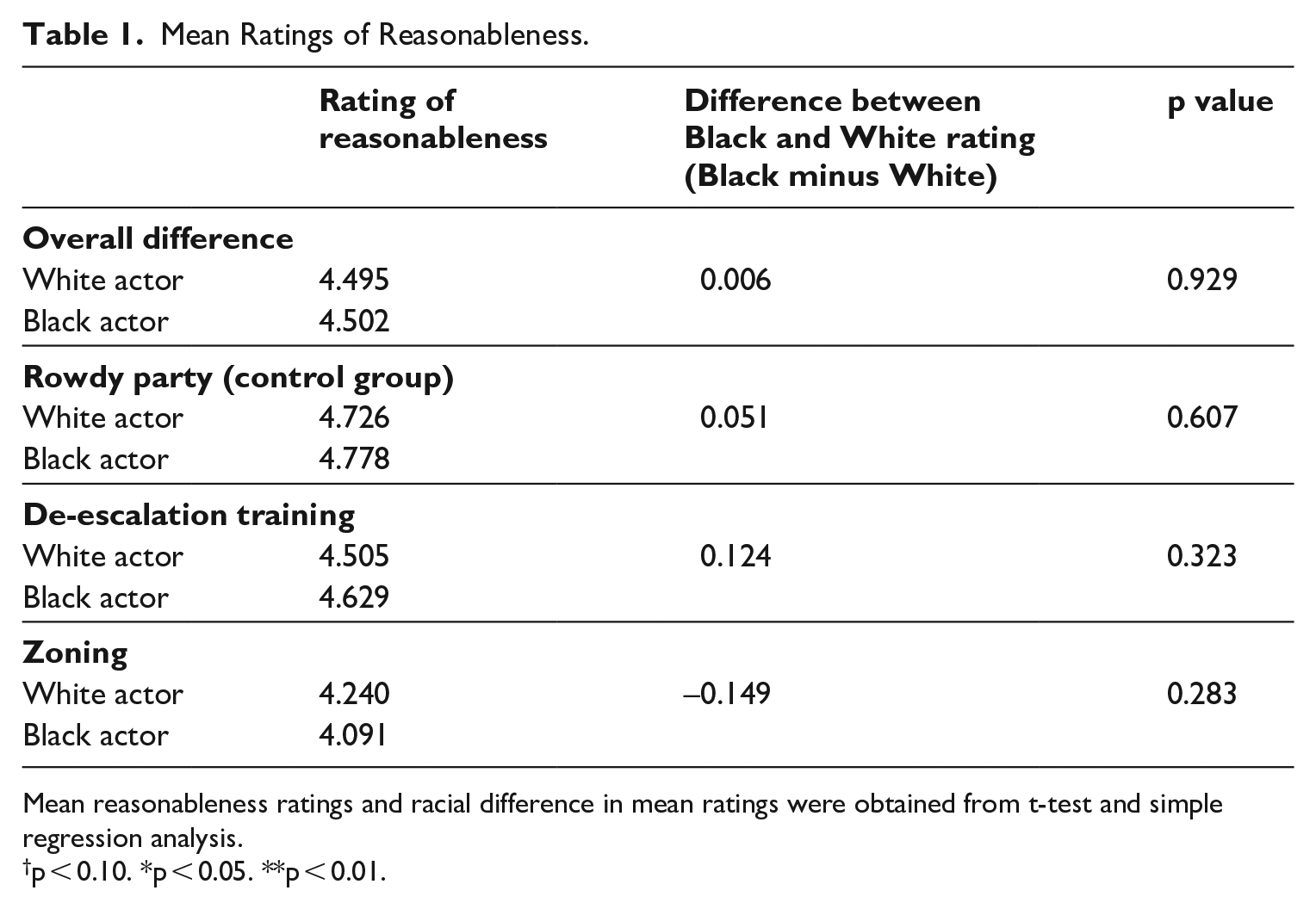
Mean reasonableness ratings and racial difference in mean ratings were obtained from t-test and simple regression analysis.
p < 0.10. *p < 0.05. **p < 0.01.
There is also insufficient evidence to conclude that racial differences depend on the type of message expressed. Not surprisingly, the Black–White difference in the evaluation of the message in the rowdy party conditions is the smallest. Admittedly, the racial differences in the respondents’ evaluation of the de-escalation training and zoning messages appear larger than the difference for the rowdy party conditions. However, as shown in the substantially overlapping confidence intervals in Figure 1, the Black–White gap in the de-escalation training and zoning conditions neither differ significantly from one another nor from the racial difference in the rowdy party conditions. Thus, due to these insignificant second differences, we cannot also conclude that the effect of race depends on the issue of the message.
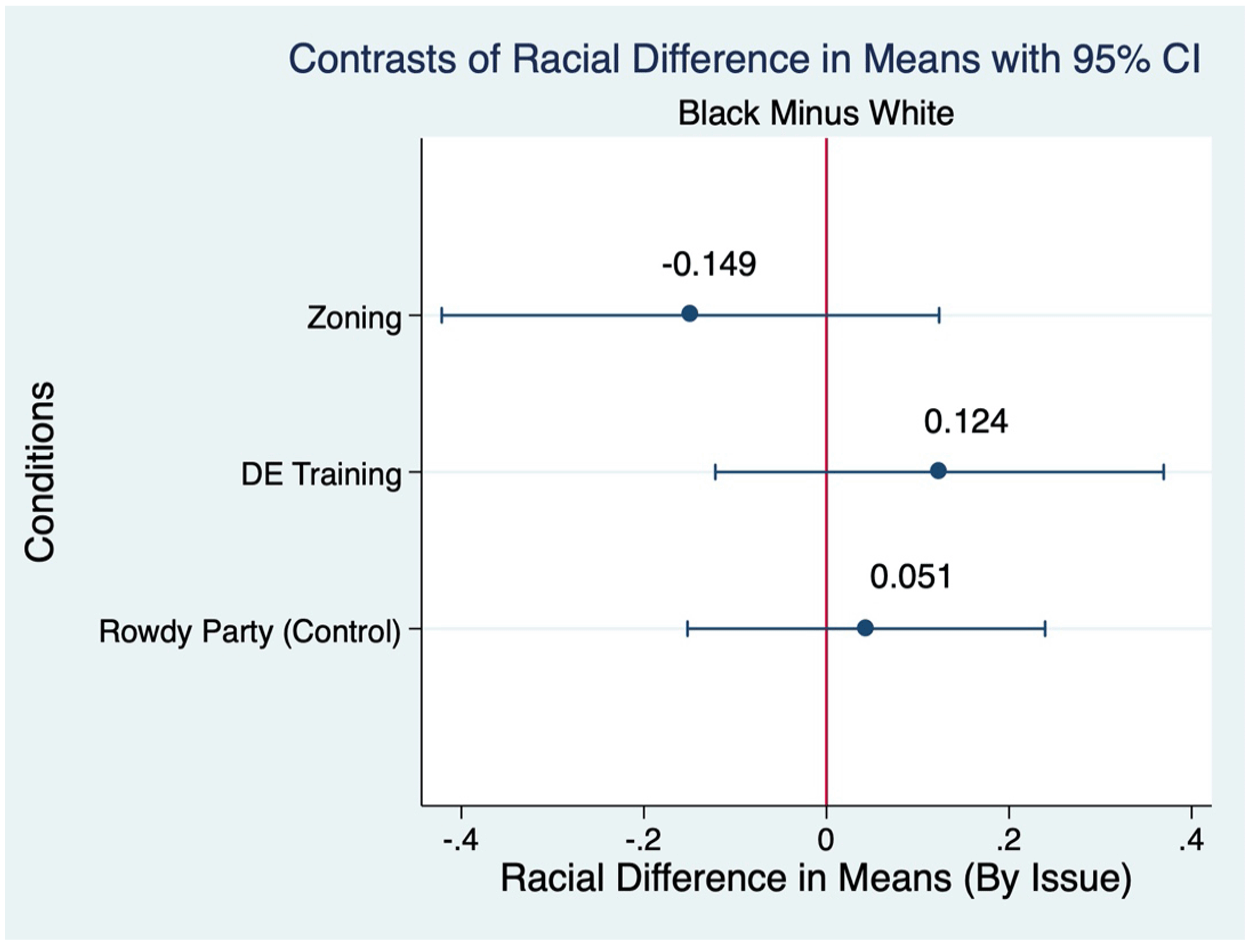
Difference in Means (By Issue).
While evidence was lacking for race-related differences in the evaluation of messages, the speaker’s race was associated with the tendency to attribute certain emotions to the speakers. Subjects were more likely to perceive the Black speaker than his White counterpart as calm in the control condition (0.715 vs 0.588; see Table 2). And, racial differences in perceptions of anger were not statistically significant. Furthermore, respondents were less likely to rate the Black speaker as frustrated compared to his White counterpart in the de-escalation training and zoning policy conditions (0.417 vs 0.565 and 0.326 vs 0.467, respectively).
Probability of Being Perceived as Expressing Various Emotions.
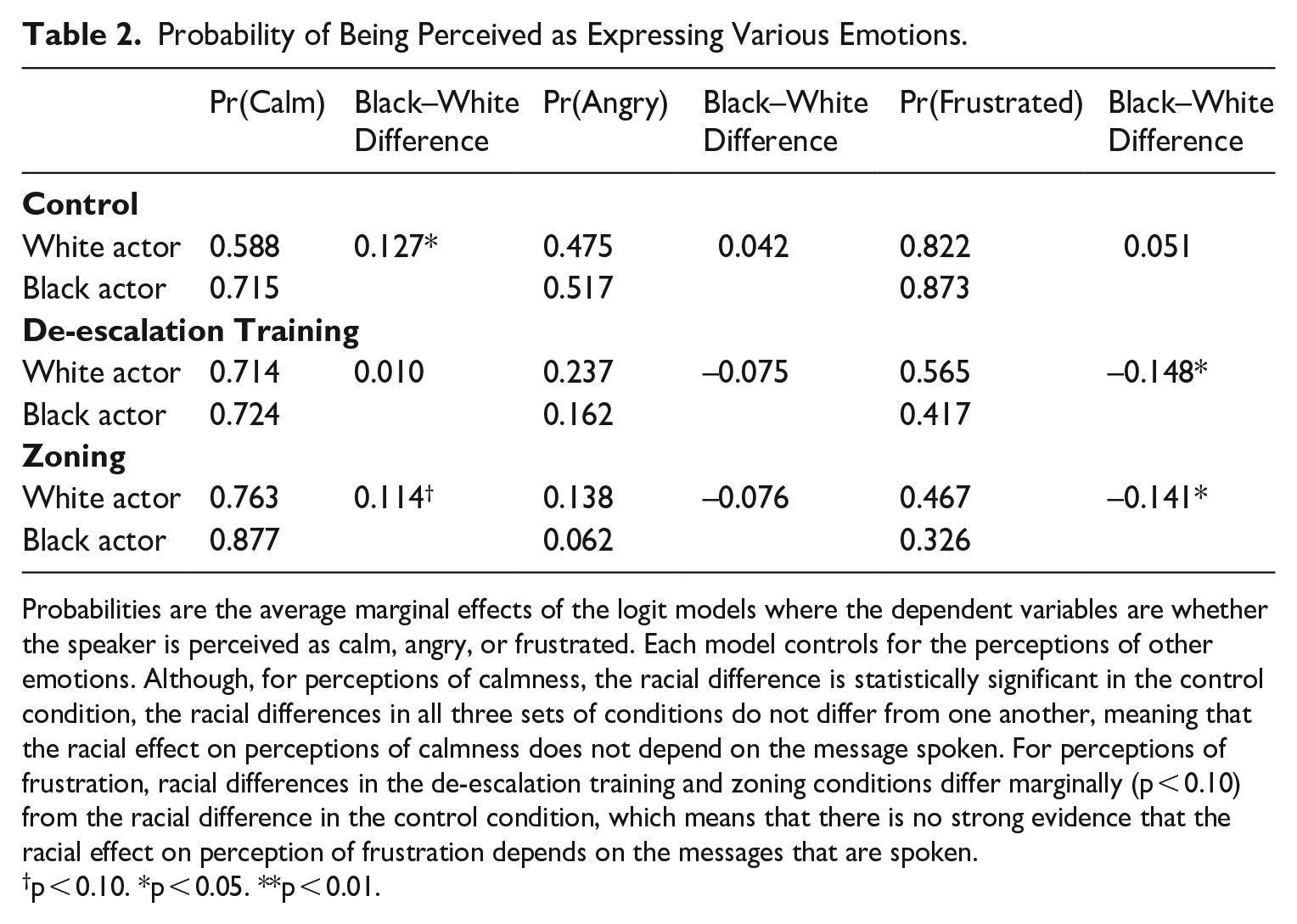
Probabilities are the average marginal effects of the logit models where the dependent variables are whether the speaker is perceived as calm, angry, or frustrated. Each model controls for the perceptions of other emotions. Although, for perceptions of calmness, the racial difference is statistically significant in the control condition, the racial differences in all three sets of conditions do not differ from one another, meaning that the racial effect on perceptions of calmness does not depend on the message spoken. For perceptions of frustration, racial differences in the de-escalation training and zoning conditions differ marginally (p < 0.10) from the racial difference in the control condition, which means that there is no strong evidence that the racial effect on perception of frustration depends on the messages that are spoken.
p < 0.10. *p < 0.05. **p < 0.01.
Equally important, do racial differences emerge in message evaluations when both speakers are perceived as having the same emotions? For the most part, as shown in Table 3, the racial differences are not statistically significant. The only exception is the racial difference in the zoning policy condition when both White and Black speakers are perceived as angry. Importantly, conditional upon being perceived as angry, the White speaker is evaluated as less reasonable than his Black counterpart (3.608 vs 4.652), and this racial effect differs significantly from the racial difference in the de-escalation training and the rowdy party conditions when both speakers are perceived as angry.
Mean Rating and Racial Differences (By Emotion and Condition).
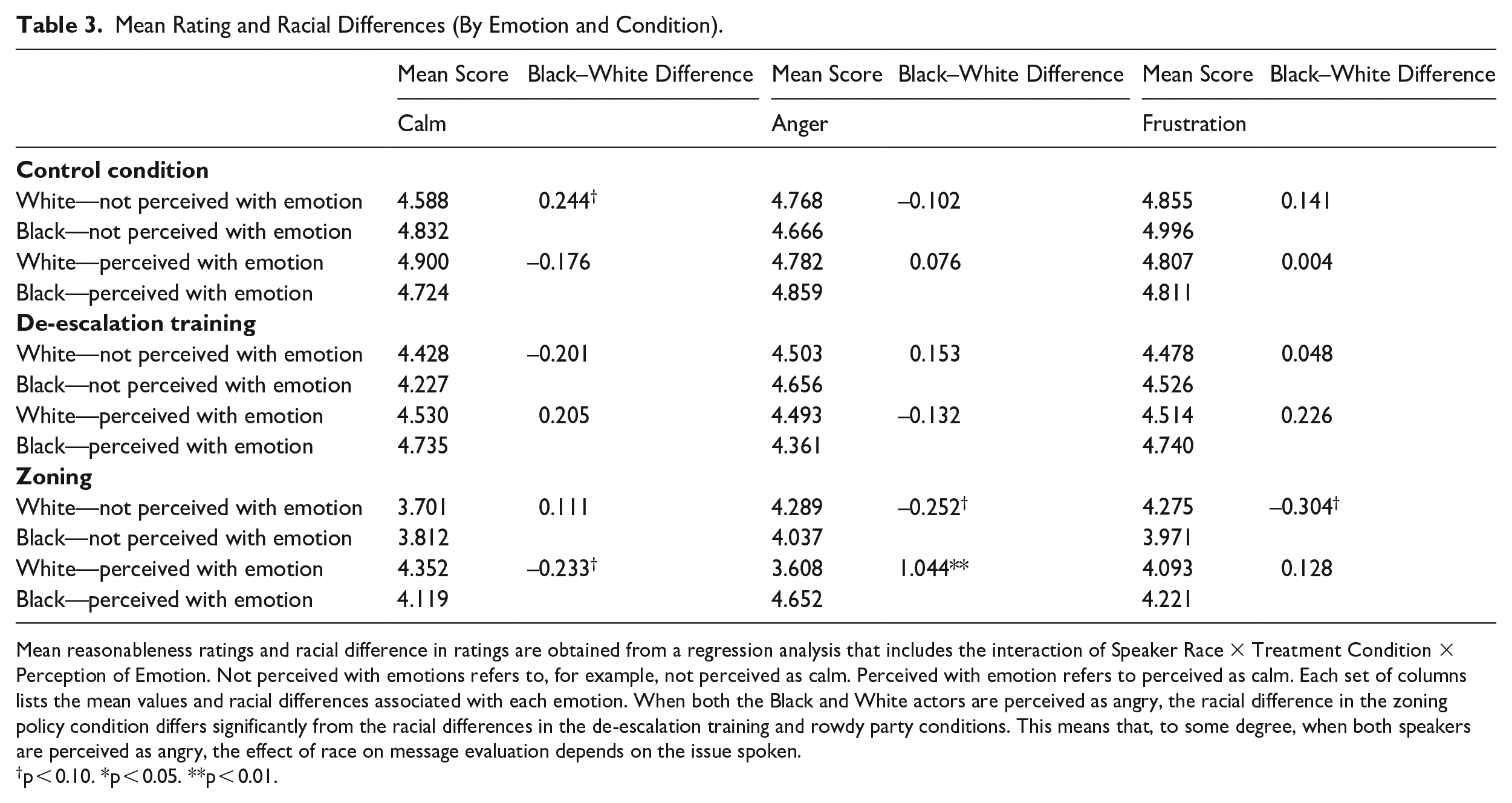
Mean reasonableness ratings and racial difference in ratings are obtained from a regression analysis that includes the interaction of Speaker Race × Treatment Condition × Perception of Emotion. Not perceived with emotions refers to, for example, not perceived as calm. Perceived with emotion refers to perceived as calm. Each set of columns lists the mean values and racial differences associated with each emotion. When both the Black and White actors are perceived as angry, the racial difference in the zoning policy condition differs significantly from the racial differences in the de-escalation training and rowdy party conditions. This means that, to some degree, when both speakers are perceived as angry, the effect of race on message evaluation depends on the issue spoken.
p < 0.10. *p < 0.05. **p < 0.01.
Discussion
The results of this study deviate from previous findings of racial bias in various political contexts in the United States (Lewis-Beck et al., 2010; Block et al., 2021; DeSante and Smith, 2019). While the racial differences in message ratings were statistically insignificant, these findings may have resulted from the lack of power in this experiment. It is possible that race-related effects may have not been detected by the experiment because the actual effect may only be modest, and the number of subjects recruited to the experiment may have been insufficient to yield statistically significant results. 5
However, even if null results persist after adjusting for sample size, this does not preclude the possibility of a race effect. Because local context may shape racial attitudes that affect how people evaluate the messages of different racial groups, a limitation of this experiment is the lack of racial context for the city the speaker is supposedly addressing and the absence of information on the city the respondent lives in. While my study does not account for local racial context, its results suggest the possibility that at least race might not be significant in some contexts.
A future study could utilize various methods to uncover where it does and does not matter. For example, the survey can ask respondents about the characteristics of their city. In addition, the respondents’ knowledge of the racial context of the city the speaker is allegedly from might be relevant to the race-related rating of a message. Perhaps respondents, depending on their race, may evaluate a message differently if the Black speaker was depicted as being from a racially plural city rather than a majority Black city. Thus, a future experiment might include a description of the demographic characteristics of the city the speaker is allegedly speaking in and vary the city’s racial composition to determine whether this variation would produce different race-related effects on message ratings.
Aside from the lack of context, another reason for the null effects could be the absence of racialization in the de-escalation training conditions. Other than speaking about a race-related issue, the Black speaker is not racialized in any other way. Former president Barack Obama was a racialized figure despite his attempts to avoid race-related issues, but Obama was racialized because of his position as the first Black president (Tesler and Sears, 2010). Thus, his race primed racial attitudes that influenced the evaluation of his policies (Tesler and Sears, 2010). In this experiment, the Black speaker’s race may not be as salient in the minds of the survey respondents. Thus, a future study could investigate how activating the salience of the Black speaker’s racial identity might affect the evaluation of his message—for example associating the Black speaker with a well-known group that advocates for Blacks. Another interesting dimension of this consideration is how different ways of racializing the Black speaker might affect the perception of his message. Would association of the Black speaker with the Black Lives Matter movement produce different evaluations of his message than his affiliation with the NAACP (National Association for the Advancement of Colored People)?
This study also produced the unexpected finding that respondents tended to perceive, in some respects, the White actor as more emotional than the Black actor, and perceptions of emotions negatively affected, to a limited degree, the evaluation of the White speaker relative to the Black speaker. However, these results should be interpreted cautiously. First, no two speakers, even when they speak as similarly as possible, are going to speak in the exact same way and with identical voices. Thus, racial differences in perceptions of emotions could be attributed to something else, like voice pitch/tone. Second, the probabilities of being perceived as angry for the Black and White actors in the zoning policy conditions are low. Thus, the racial difference in message evaluation when both speakers are perceived as angry in this condition is based on a small number of respondents.
Nonetheless, Zebrowitz et al.’s (2010) study may provide context to the some of the results here. Both actors were instructed to maintain calm facial expressions, which might be characterized as “neutral.” The neutral facial expression may have suppressed negative generalizations about Blacks that would have otherwise surfaced in the evaluation of messages. This would be consistent with one of Zebrowitz’s (2010) conclusions suggesting that lesser resemblance to anger on neutral expressions of Black faces may suppress negative stereotypes about Blacks. However, additional experiments would need to confirm this conjecture.
Finally, future studies should also examine how the respondent’s race and racial attitudes may affect message evaluation. The composition and size of the sample, of which Whites constituted 75%, precluded me from undertaking an analysis based on the respondent’s race. In addition, without a racial resentment scale or similar measure, I was unable to gauge the respondents’ racial attitudes. Thus, a future experiment would benefit not only from a larger sample but also from the inclusion of some racial bias measure.
Conclusion
In summary, this article elucidates the importance of listening in public meetings. Citizens’ responses to messages expressed by one another depend on how they interpret messages. The results call for further exploration of the possibility that public perception of messages might advantage Black speakers over White speakers in certain issue areas but might disadvantage Black speakers relative to their White counterparts in other areas. While some may reason that it is entirely appropriate for listeners to adopt a more receptive attitude toward messages spoken by groups who have legitimate stakes in the issue, others might argue that any assessment of messages driven by race does not bode well for fair representation. Thus, additional scholarship should not only explore the various conditions under which racial identities shape social interactions in public meetings but also the normative implications resulting from the impact of race on such communicative exchanges in these meetings.
Supplemental Material
sj-docx-1-psw-10.1177_14789299231187225 – Supplemental material for Does Race Affect Public Evaluations of Constituent Messages in Local Government Meetings? Results from an Experiment
Supplemental material, sj-docx-1-psw-10.1177_14789299231187225 for Does Race Affect Public Evaluations of Constituent Messages in Local Government Meetings? Results from an Experiment by Bai Linh Hoang in Political Studies Review
Footnotes
Declaration of conflicting interests
The author(s) declared no potential conflicts of interest with respect to the research, authorship, and/or publication of this article.
Funding
The author(s) received no financial support for the research, authorship, and/or publication of this article.

Supplemental material
Additional supplementary information may be found with the online version of this article. Appendix A: Survey Instrument Appendix B: Summary of Respondent Characteristics Table B1: Frequency and Distribution of Categories Table B2: Multinomial Logistic Regression with Treatment Condition as Dependent Variable Appendix C: Linear Regression Analyses Table C1: Simple Linear Regression (Without Controls) Table C2: Linear Regression (Controlling for Age) Table C3: Regression Models (Controlling for Emotional Dispositions and Age) Appendix D: Ordered Logistic Regression Table D1: Ordered Logistic Regression Table D2: Probabilities Associated with Message Ratings
Notes
Author biography
References
Supplementary Material
Please find the following supplemental material available below.
For Open Access articles published under a Creative Commons License, all supplemental material carries the same license as the article it is associated with.
For non-Open Access articles published, all supplemental material carries a non-exclusive license, and permission requests for re-use of supplemental material or any part of supplemental material shall be sent directly to the copyright owner as specified in the copyright notice associated with the article.
