




Abstract
When can we expect multiple racial groups to find common ground in the face of potentially unequal distributive urban policies? While we understand a great deal about the role of elites in inter-ethnic coalition building, we know less about the conditions under which cooperative behavior among their co-ethnic voters is more likely. Research has found that multiracial coalitions are critical to the political incorporation of racial/ethnic minority group interests at the local level but conflict between minority groups persists due to both real and perceived competition for resources. In this paper, we argue that elite co-ethnic endorsements can increase co-ethnic voters' support for urban distributive policies that disproportionately benefit outgroups over one’s own ingroup. We test our theory using a survey experiment from a representative sample of more than 1800 Los Angeles County voters. We find that respondents are less likely to support policy proposals that exclusively target benefits toward ethnic outgroups compared to when their ethnic ingroup exclusively benefits from an identical proposal. But we also find that the presence of co-ethnic endorsements can increase support for proposals that benefit an ethnic outgroup. We find this effect among Black, Latino, and Asian Americans in our sample.
Introduction
At the start of McKinley Elementary’s 1994–95 school year in Compton C.A., one-quarter of students did not show up for class. Latino organizers had asked parents to keep their children out of class to protest what Latino community leaders perceived as the primarily African American school administration’s inattention to the linguistic barriers Latino children faced in their educational instruction (Straus, 2009). One organizer went as far as to compare Compton Unified School District to school districts in 1950s Mississippi which refused outright to educate Black children. What followed was a protracted and heated debate among community leaders regarding the role of Latinos in Compton’s governing institutions. This scenario was not unique to Compton. Throughout the 1980s and 90s, many cities went through a period of demographic transformation with the arrival of new Latino and Asian American ethnic groups. As these new groups began to make their own demands for political representation and power, questions arose as to whether ethnic elites would be able to overcome both real and perceived competition for limited resources among their co-ethnics in order to maintain old alliances and/or build new ones.
Intergroup conflict between urban ethnic groups and the threat it presents to multiracial coalitions in cities matters because scholars and political activists have long argued that multiracial coalitions are key to the incorporation of ethnic minorities' interests in city politics. Beginning in the 1960s, biracial coalitions of African Americans and their liberal white allies ushered in an era of Black political leadership in some of America’s largest cities (Browning, Marshall, and Tabb, 1990). Atlanta, Detroit, Chicago, and Los Angeles served as examples of how disempowered ethnic groups could leverage alliances to attain political power and more equitably distribute municipal resources (Sonenshein, 1990; Starks and Preston, 1990; Stone, 1989). However, the viability of these early biracial coalitions was soon strained as the 1970s brought about two major changes to the setting of urban politics.
First, the beginning of an era of fiscal austerity in Congress resulted in the significant contraction of municipal budgets across the country (Eisinger, 1998; Jones-Correa, 2001) 1 . With smaller budgets, municipal jobs, and funds for public housing, the resources that urban elites once used as spoils to build inter-ethnic alliances gradually diminished. Second, the sudden and rapid influx of immigrants from Latin America and Asia greatly diversified city populations, creating opportunities for reimagined multi-ethnic coalitions, yet simultaneously generating new political cleavages as the number and size of potential coalition partners increased (Meier and Stewart, 1991). 2 These emerging minority populations soon began to challenge the status quo with their own demands for political power and increasing share of municipal resources.
Prior research has found evidence of substantial group-centric conflict over municipal resources, primarily between Black and Latino populations (Falcon, 1988; Gay, 2006; Kaufmann, 2003; Kerr et al., 2013; Mcclain and Karnig, 1990). Yet, we know little about how these conflicts may hinder political cooperation and how such intergroup conflicts can be overcome. Research examining the effect of elite messaging on mass preferences finds that endorsements (Kuklinksi and Hurly 1994; Lupia, 1994)—statements or signals that provide voters with cheap information they can use to make informed political decisions—can serve as a mechanism by which intergroup conflict may be overcome and coalitions forged in urban spaces. Previous work has emphasized the role of co-ethnic endorsements on voters' evaluations of candidates in local elections where the latter’s preferences have not yet crystallized (Benjamin, 2017b).
It is unclear, however, whether co-ethnic endorsements can move the preferences of co-ethnics on issues where their preferences are more crystalized such as in the distribution of municipal resources. Although ethnic minority leaders continue to facilitate interracial political cooperation to incorporate minority group interests in urban politics, it is not clear if and when their co-ethnic constituents are willing to support the policy agreements forged by their political leaders. Our research highlights the role of these endorsements on voters' evaluations of potential urban policies and how these policies relate to the maintenance of multiracial coalitions.
In this paper, we argue that ethnic minority leaders' use of endorsements can increase co-ethnics’ support for distributive policies that favor ethnic outgroups. Generally, in urban politics, ethnic minorities have been argued to join with other minority groups in coalitions because it allows them to achieve electoral success, beneficial policy outcomes, and government resources that they could not obtain without partners (Browning, Marshall, and Tabb, 1984; Carmichael and Hamilton, 1992). However, even though these groups may support one another during elections (Benjamin, 2017b), individuals within these groups will still prefer resource allocations where benefits to their own ingroup are maximized which might threaten the stability of these coalitions. We argue that while co-ethnic endorsements do not provide any new information that might alter their co-ethnics’ crystallized preferences on distributive policies, co-ethnic voters' trust in their elites (i.e., the messenger) allows the elite to use endorsements to increase co-ethnic support for distributive policies that benefit ethnic outgroups over their own.
We test our theory of cooperative behavior with a 2 × 2 experiment embedded in a representative survey of 1800 Black, Latino, and Asian American Los Angeles County voters. Los Angeles County is a large, multiracial community that has had extensive experience with shifting, multiracial coalitions. Our experiment randomly assigns survey respondents to one of four possible treatments wherein we ask respondents to imagine that their local city council is proposing to set up a scholarship fund for graduating high school seniors. In our vignette we manipulate whether 1) the scholarship fund exclusively targets students from the respondent’s ethnic ingroup or an ethnic outgroup and 2) whether a hypothetical community organization belonging to the respondent’s ethnic ingroup endorses the proposal or not.
In line with our expectations, we find that respondents are less likely to support proposals that disproportionally benefit an ethnic outgroup compared to when their ethnic ingroup disproportionally benefits from an identical proposal. We also find that when a proposal exclusively targets benefits toward an ethnic outgroup, the presence of a co-ethnic endorsement increases the respondent's support for that proposal, as opposed to when such an endorsement is absent. Ethnic minorities do indeed display group-centric behavior in the allocation of local resources, being less likely to support policy outcomes that benefit ethnic outgroups. Yet in line with the current literature (Benjamin, 2017b), we also find that such group-centric behavior gives way to cooperative behavior when proposals are endorsed by a co-ethnic elite. This effect holds among Black, Latino, and Asian American respondents in our experiment. We conclude that the words and actions of ethnic elites continue to be important tools in facilitating co-ethnic political cooperation in an urban landscape of diverse populations and limited municipal resources.
We make several contributions to the literature with this paper. First, our work directly addresses the new challenges ethnic leaders faced as the white-Black racial divide in urban politics was supplanted in some places by the growth of other racial and ethnic minorities in cities. While some scholars theorized that the growth of these new ethnic groups would naturally lead to the formation of new alliances, others argued that racial cleavages can often be the source of conflict rather than unity. In particular, the power of ethnic elites to forge new coalitions came into question given the strong sense of competition documented by scholars among urban racial and ethnic minorities.
This is a significant issue for two reasons: 1) disempowered ethnic minority groups rely heavily on coalitions to incorporate their interests in urban politics and 2) the ability of a governing coalition to meet its policy objectives is largely reliant on three elements: the composition of the electoral coalition, the relationship among members of that coalition, and the resources they bring to a governing coalition (Stone, 1993). Our work finds that while the emergence of new racial and ethnic minority groups can pose a challenge to co-ethnic elites, they are more than capable of managing co-ethnic resource demands through their use of endorsements. This might help explain how multiracial coalitions continue to thrive in the context of shrinking available resources and perceptions of resource competition among urban racial and ethnic minority groups. Relatedly, we broaden the application of theories of urban electoral behavior (Benjamin, 2017b; Kaufmann, 2004) to non-electoral settings. Our study finds that elite co-ethnic endorsements can significantly increase co-ethnic support for distributional policy proposals that disproportionally benefit an ethnic outgroup over one’s ingroup. Moreover, we find that this effect manifests not only among Black and Latino voters but also Asian American voters in our experiment.
The paper proceeds by providing an overview of the literature on urban inter-ethnic coalitions and racial minorities' sense of competition over scarce resources. We then present our theoretical framework and derived hypotheses. We procced to describe our research design and the Los Angeles County survey we use to test our hypotheses. In the last two sections, we analyze our results and discuss the feasibility of multiracial coalitions in cities situating our findings to a growing literature on urban elites, resource management, and multiracial coalitions.
Literature Review and Theory
Coalitions and Intergroup Competition
At its core, the study of ethnic minority groups in urban politics is the study of how racial and ethnic groups cooperate with one another to achieve shared political goals (Browning, Marshall, and Tabb, 1984; Carmichael and Hamilton, 1992). These goals can vary widely, from electing preferred candidates to office, to changing policies that discriminate against ethnic groups, or influencing the passage of policies that benefit coalitional partners. Early work on inter-ethnic coalitions primarily focused on the biracial Black-white coalitions that brought a wave of Black elected leaders to local offices in the wake of the Civil Rights Movement (Browning, Marshall, and Tabb, 1984; Munoz and Henry, 1986; Sonenshein, 1990; Starks and Preston, 1990; Stone, 1989). These coalitions, scholars argued, were driven by ideological motivations, as insurgent African American community groups and their racially liberal white allies worked toward overthrowing conservative local regimes that dominated many city governments (R.P. Browning, Marshall, and Tabb, 1984). Other scholars argued that the limited authority of municipal governments necessitated the creation of informal governing coalitions of elected leaders and private interests to manage resources and adapt to social changes (Stone, 1993). Within these theories, ethnic elites play a critical role in negotiating governing coalitions and mobilizing co-ethnic constituents into taking political action.
As cities became more racially and ethnically diverse, some scholars assumed that multiracial coalitions of Blacks, Latinos, Asian Americans, and others, would come to dominate urban politics. Ethnic minorities' marginalized and racialized status would form the basis for new multiracial coalitions (Kaufmann, 2003; Munoz and Henry, 1986).
Yet, one of the main points of contention within the literature revolves around the driving mechanism behind multiracial coalitions. In particular, scholars debate the role of political ideology and material interest in the formation of multiracial coalitions and intergroup relations in general (Carmichael and Hamilton, 1992; Kaufmann, 2007; McClain and Tauber, 2001; Sonenshein, 2001). Some scholars doubted that a shared liberal ideology or shared marginalized status among racial and ethnic minority groups could provide a long-term basis for multiracial alliances. Writing on biracial white-Black coalitions at the time, Carmichael and Hamilton argue that coalitions based on shared political ideology are untenable as conflicts would arise over group-centric interests (1992, 75). They lay out four preconditions for the establishment of inter-ethnic coalitions: (a) the recognition by the parties involved of their respective self-interests; (b) the mutual belief that each party stands to benefit in terms of that self-interest from allying with the other or others; (c) the acceptance of the fact that each party has its own independent base of power and does not depend for ultimate decision-making on a force outside itself, and (d) the realization that the coalition deals with specific and identifiable-as opposed to general and vague goals (1992, 78–90).
According to this view of urban politics, inter-ethnic coalitions serve as a vehicle for disempowered groups to access resources previously unavailable to them.
Several scholars built on Carmichael and Hamilton’s insights to predict that the diversification of cities would lead to competition rather than cooperation among racial and ethnic minority groups. For instance, Meier and Stewart (1991), argue that given the lower social class and economic status of African Americans, the natural coalition partner of growing Latino populations should be whites, not African Americans. Using a different rationale Kaufmann argues that the inelasticity 3 of minority-specific rewards, such as government jobs, political appointments, municipal contracts, and distributive monies, means that racial and ethnic minority groups may often find themselves in competition for these limited resources, hampering the construction of coalitions (2007, 85–87; McClain and Tauber, 2001). Limited local budgets mean that cities will typically have to make trade-offs between competing demands over resources.
Further, many local public goods are intrinsically tied to place. This, in conjunction with the highly-segregated nature of American cities (Trounstine 2018) means that public goods may disproportionally benefit some ethnic groups more than others. For example, a park, which is usually thought of as a public good, placed in a predominately African American neighborhood may be less accessible to members of ethnic groups who do not live nearby. While we do not assert that multiracial coalitions intentionally craft resource allocations to exclusively benefit one ethnic group while being closed off to other groups, both elites and their co-ethnics may perceive certain resource allocations as favoring one ethnic group over others, potentially sparking dissent and conflict. 4
In addition, urban politics' lack of partisan elections and the distributional character of many local policies means that the political behavior of individuals can be strongly motivated by racial and ethnic group identities rather than the traditional partisan identities that operate in national-level politics (Kaufmann, 2004). The growth of new urban ethnic groups and their desire to attain their own political power has heightened the prominence of race in local politics. Racial group identities continue to be one of the primary cleavages on which urban political competition is centered. 5
This inter-ethnic competition is not just hypothetical. Work by McClain (2006), McClain and Karnig (1990), and Meier and Stewart (1991) has found evidence that urban Latino population growth strongly correlates with a decrease in Black political representation at the city council and school board level. Other research has also shown that African Americans and Latinos compete over municipal jobs (Alozie and Ramirez, 1999; Kerr et al., 2013, 2016; Kerr, Miller, and Reid, 2000; Mcclain, 1993).
Another strand of literature has found that both real and perceived competition over resources can negatively affect ethnic minorities' attitudes toward other ethnic groups. Gay's (2006) study of Black attitudes toward Latinos in Los Angeles finds that African Americans who live in neighborhoods that are economically distressed and have a Latino population that is more socio-economically advantaged than them (vis-à-vis higher levels of education/lower poverty) are more likely to hold negative stereotypical views of Latinos. In addition, these individuals are more likely to perceive themselves as competing with their Latino neighbors for jobs, resources, and political power. A similar set of results is found by Carey Jr. et al. (2016) among Latinos.
These feelings of inter-ethnic competition over resources and negative racial attitudes among ethnic minorities could pose a significant threat to the formation of multiracial political alliances as ethnic elites may struggle to garner popular support for the coalition and its policies among co-ethnic constituents. As Kaufmann states, “Elite organizations and elite coalitions alone, however, cannot sustain broader minority political and social movements. Durable political coalitions must be founded on mass belief systems that both accept and promote these elite agendas” (2003, 200). Theoretically, for multiracial coalitions to be successful there must exist some level of voter support for elite decisions about the allocation of resources. If elected officials institute policies that suffer from support amongst voters, they face the threat of losing reelection, thereby jeopardizing the viability of these coalitions.
As a result, it is impossible to understand the nature of urban interracial alliances without understanding the competing group-centric concerns that racial and ethnic groups may develop under the zero-sum context of urban politics, and how this context affects the possibility of cooperative behavior. We build on existing work to argue that racial and ethnic minorities will be less supportive of resource distributions that favor outgroups compared to those that favor their ingroup. Our argument is centered on racial and ethnic minorities (not whites) given the salience of race in local politics and the significant diversification of cities' racial and ethnic populations.
Thus, we derive our first hypothesis:
Racial and ethnic minorities will be less supportive of resource allocations that disproportionally benefit their ethnic outgroup(s) compared to when resource allocations disproportionally benefit their ethnic ingroup.
Elite Messaging and Mass Preferences
But while ethnic voters may be averse to multiracial alliances in light of intergroup competition for resources, scholars point out that ethnic leaders still hold significant influence over the coalition-making process. According to Sonenshein, “Leaders and organizers have an impact on how group interests are perceived. Interracial coalition’s prospects for success depend heavily on the willingness and ability of leaders to create and sustain such coalitions” (2001, 214). Indeed, research has shown that the behavior of co-ethnic elites can have a significant effect on co-ethnic political behavior and preferences through their use of endorsements.
Co-ethnic endorsements are theorized to function as cues, or signals, that provide co-ethnic voters with cheap information they can use to make informed political decisions or evaluations (Boudreau, 2020; Lupia, 1994; Mondak, 1993). These cues are particularly useful for voters because research shows that most Americans are not well informed about national-level politics (Campbell, 1960) and are even less informed about local politics (Fischel, 2005). Scholars have shown that endorsements are prevalent in local politics, that candidates and policy groups seek them, and that voters are aware of them (Benjamin, 2017b; Benjamin and Miller, 2019; Boudreau, Elmendorf, and MacKenzie, 2019; Gerber and Phillips, 2003; Paul and Brown, 2006). Elites' use of endorsementsallows uninformed voters to make political choices that align with their preferences just as well as informed voters. Extensive work in this field has identified multiple conditions under which cues are most likely to influence voters' preferences and behaviors. Cues are most useful to individuals when 1) they are asked to make decisions on candidates or policies for which they hold limited information or on which their preferences are uncrystallized and 2) the individual perceives the cue-giver to be trustworthy or knowledgeable about the issue at hand.
Within the local election literature, scholars have argued that weaker information environments, lack of partisan cues, and the saliency of race make co-ethnic endorsements critical to the choices and preferences their co-ethnics make and can form the basis for multiracial coalitions. Benjamin (Benjamin, 2017a) argues that co-ethnic endorsements allow minority voters to make choices between candidates when partisan information is unavailable, co-ethnic candidates are not on the ballot, and voters lack information on how much an outgroup candidate will prioritize their group’s policy concerns post-election. In short, co-ethnic endorsements signal, “Although this candidate is not a co-ethnic, this candidate will represent us well in the political arena (Benjamin, 2017a, 634)” She shows that under such conditions, co-ethnic endorsements can increase co-ethnic support for racial outgroup candidates in mayoral elections. Boudreau, Elmendorf, and MacKenzie (2019) goes further and shows that the use of endorsements by ethnic community organizations in a San Franciso mayoral and supervisorial election moved co-ethnic voters to select endorsed candidates over candidates who were more ideologically similar to them. Yet, it is unclear whether co-ethnic endorsements can overcome minority voters' crystallized, group-centered preferences on local policy issues such as the distribution of municipal resources.
There is evidence that in instances where local voters have already formed crystallized preferences on policy issues, elites' use of endorsements can sway voters' behavior and preferences. Paul and Brown (2006) find evidence of this in the case of local referendums on the use of public funds to build professional sports facilities. They show that while most local voters oppose the use of local dollars to build stadiums, elite endorsements in support of these ballot measures, including ethnic elites, increase a ballot measure’s likelihood of passage. Similarly, Gerber and Phillips (2003) use the case of development policies in San Diego, an issue on which voters are known to have stable policy preferences, to show that community interest groups (planning boards and environmental groups) endorsement of a pro-development ballot measure increases voters' willingness to vote in favor of that ballot measure. Gerber and Phillips argue that the expertise of planning boards and the shared interests they have with environmental groups is enough to alter voters' preferences on development policies.
When it comes to distributive policy in urban politics, it can be the case that ethnic elites' endorsement of policies that benefit outgroups over their own group can increase co-ethnic voters' support of those policies. Work by Kuklinksi and Hurly (1994) shows that ethnic minorities' affective attachment to co-ethnic elite messengers may obscure the content of an elite’s message. They use an experiment to show that Black Americans are more likely to positively evaluate potentially divisive racial statements if they believe those statements were made by Black political elites. Ethnic minorities often hold high levels of trust in their co-ethnic elites due to perceptions of shared experiences of discrimination and shared culture (Barreto, 2010; Bobo and Gilliam, 1990). We reason that even if co-ethnic endorsements do not provide any meaningful information that can sway co-ethnics preferences on divisive distributive policies, the affective attachment and trust between ethnic minorities and co-ethnic elites is enough to increase the former’s support for divisive distributive policy proposals—specifically proposals that divert resources to ethnic outgroups—when those proposals are endorsed by an elite.
Co-ethnic endorsements will have a positive effect on co-ethnic support for resource allocations that disproportionally favor an ethnic outgroup, compared to when such proposals are missing a co-ethnic endorsement.
In the next section, we present the research design we use to test how co-ethnic support of resource allocations is affected by the presence of elite co-ethnic endorsements. We then describe the survey and experiment we use to test our hypotheses. Next, we analyze the results of our experiment and find support for both hypotheses. We find that co-ethnic endorsements indeed seem to influence co-ethnic support for resource allocations which benefit an ethnic outgroup. In our conclusion, we discuss the broader implications of our work and how it fits into the growing literature on multiracial coalitions and the issues cities and urban leaders face in the provision of public goods.
Research Design
The two hypotheses derived from our theory naturally lend themselves to a 2 × 2 randomized experiment as outlined in Figure 1. The cells in the second column represent a test of H1 where we compare an individual’s support for a policy that disproportionally benefits an individual’s ethnic outgroup compared to a policy that disproportionally benefits the individual’s ingroup, with no co-ethnic endorsements in either case. As indicated by the signs in Figure 1, we expect respondents to be less supportive of policies that benefit an ethnic outgroup and be more supportive of policies that benefit their ingroup. Policy coalition experiment 2 × 2 design.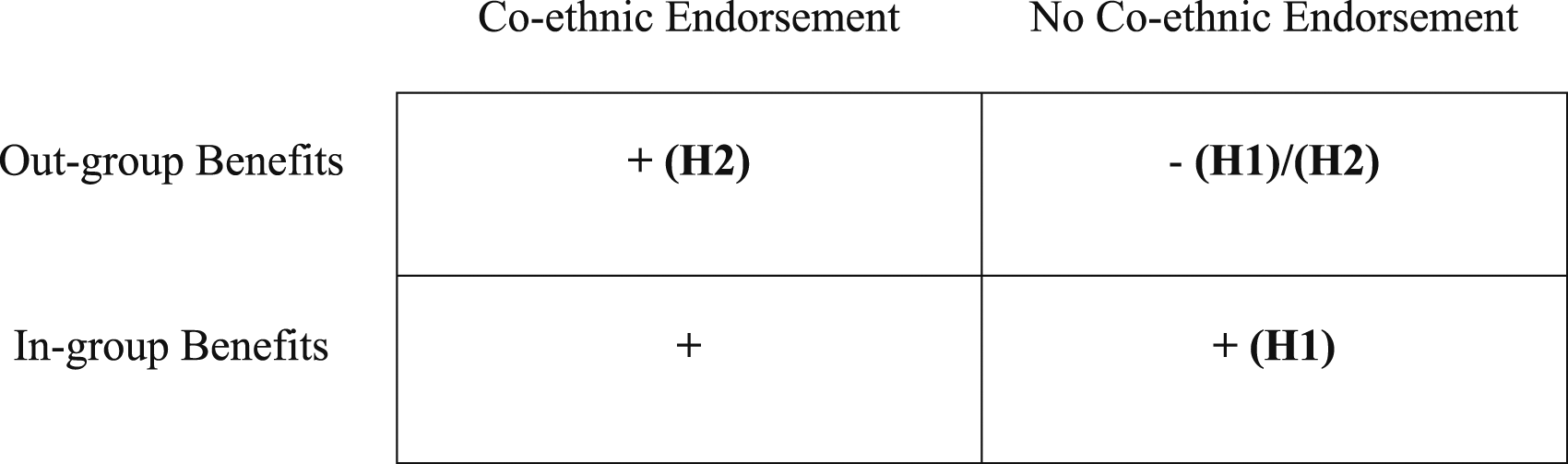
The cells in the first row represent a test of H2 where conditional on an agreement disproportionally benefiting an individual’s ethnic outgroup, we compare individual support for that proposal if it is endorsed by a co-ethnic elite compared to if that proposal is not endorsed by a co-ethnic elite. Our second hypothesis predicts that proposals which benefit an individual’s outgroup are more likely to be supported if that proposal is endorsed by a co-ethnic elite, compared to when such an endorsement is absent.
We chose to test our hypotheses using an experiment for a couple of reasons. First, there is little available survey data that measures public opinion on local issues. This lack of real-world data requires us to collect original data on the attitudes of urban residents toward local issues. Second, an experiment allows us to isolate the effect of our causal mechanisms—how a policy may allocate resources and the presence of a co-ethnic endorsement—on individual cooperative behavior. As we explain in more detail below, constructing our own experimental vignette offered us the opportunity to select a resource allocation issue that could be plausibly construed by the respondents as disproportionally benefiting some ethnic group over others. However, the use of an experiment limits our ability to generalize our findings to the real world, particularly given how inter-ethnic relations and salient political issues may vary from place to place.
We embed our experiment in a representative survey of Los Angeles County residents fielded shortly after the 2020 general election in late November through early December. We run our experiment in Los Angeles County because it is an excellent setting to explore multiracial coalitions. First, L.A. County has a large population of ethnic and racial minorities. According to the 2019 American Community Survey (1-year estimates), 48.6% of L.A. County residents identify as Latino, 25.9% identify as white (non-Hispanic), 14.5% identify as Asian, and 7.7% identify as Black with the remainder identifying as Native American, other, Pacific Islander, or as two or more races. We hoped that the racially diverse demographics of Los Angeles County would provide a rich sample for our experiment.
The second reason we chose L.A. County for our experiment is that due to its diverse demographics, many of its cities have witnessed the creation and recreation of multi-ethnic coalitions. The seat of the county, Los Angeles City, has elected two mayors of color, both supported by racially diverse coalitions that have included African Americans, Latinos, Asian Americans, and white Americans. At the same time, many cities in L.A. County have witnessed violent racial riots where racial and ethnic minority groups have sometimes found themselves on opposing sides. Racial and ethnic minority groups have often come into conflict with one another over limited resources in the form of parks, the implementation of after-school programs and bilingual classes, and access to affordable housing. This environment, with a long history of inter-ethnic cooperation and competition, lends itself to a study of how competition for resources affects minority cooperative behavior and the strategies their co-ethnic elites may use to facilitate such cooperative behavior.
Data Collection
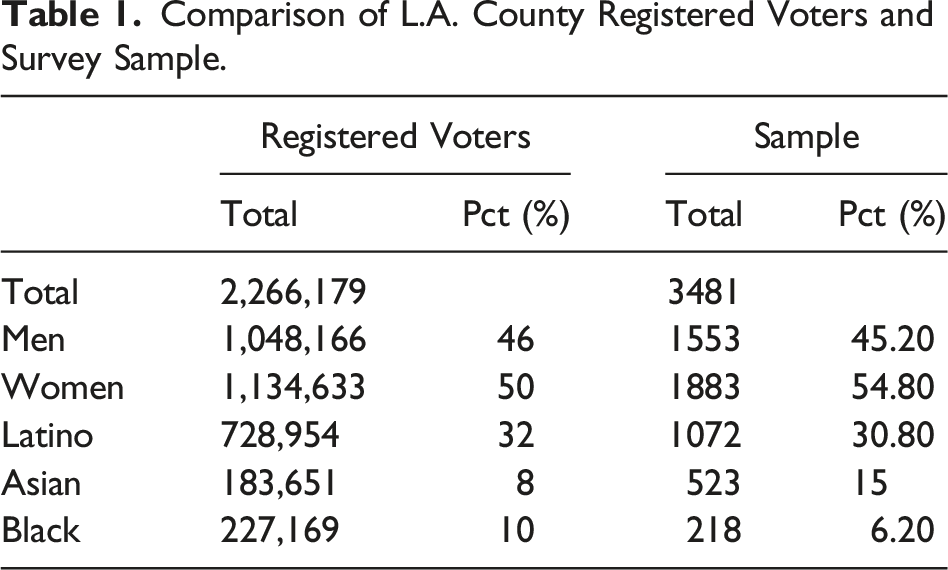
FM3 Research, a California-based public opinion polling company, was contracted to collect a sample of respondents and field the survey. The survey firm generated a stratified sample of 3481 Los Angeles County residents drawn from the county voter file. Survey respondents were contacted via email with a link to participate in our survey. The survey and our embedded experiment were hosted entirely online. Upon entering the survey, respondents were provided with a consent form. Only respondents who consented to participate in our survey were allowed to continue. Our survey was constructed around six blocs of questions. In the first bloc, respondents were asked a series of preliminary demographic questions that included: gender identification, racial/ethnic identification, level of education, and city of residence. In a second bloc, participants were asked several questions regarding their turnout in their cities' 2020 elections and turnout in previous city elections. Our experiment was embedded in the fourth bloc of questions. The fifth bloc of questions asked respondents questions regarding their school board. The sixth bloc asked some final demographic questions including partisan identification, political ideology, religion, income, whether the respondent was a homeowner, and whether the respondent had children living at home with them. Respondents who completed the survey were entered into a raffle for a chance to win an Amazon gift card.
Experimental Setup
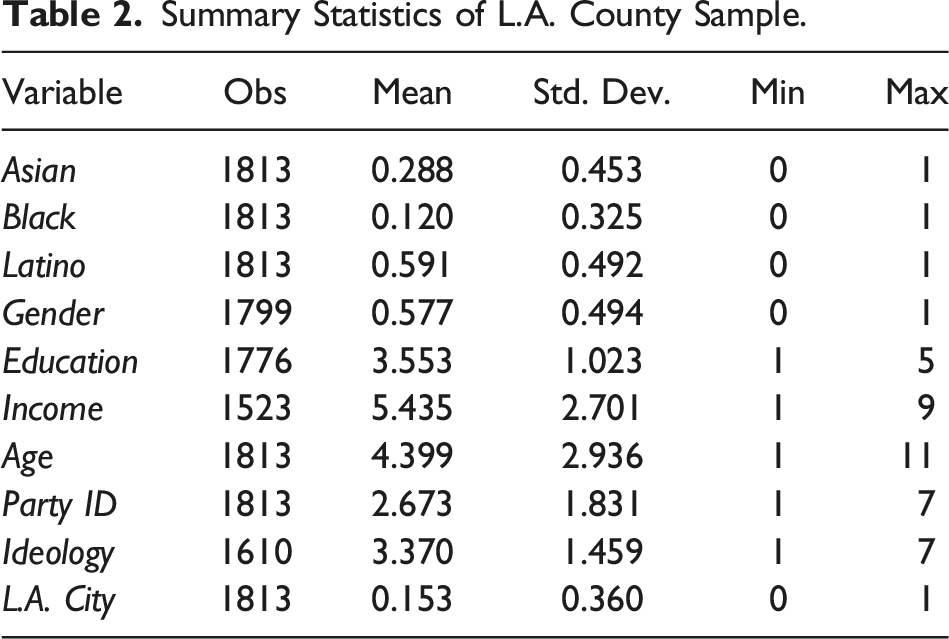
Because of our focus on the cooperative behavior of racial and ethnic minorities in distributional politics, only respondents who identified as Black, Latino, or Asian American were allowed to participate in our experiment. 6 Respondents indicated their racial/ethnic identification with the following question, “What racial or ethnic group best describes you?” The response options were “Black/African American,” “Asian/Asian American,” “Native American/American Indian,” 7 “Hispanic/Latino,” “white/Caucasian,” “multiracial,” “other race,” or “prefer not to answer.” 8 Respondents who identified as “white/Caucasian,” 9 “Native American/American Indian,” “multiracial,” 10 “other race,” or “prefer not to answer” were excluded from the experiment. This brings the total number of respondents who participated in our experiment to 1,813. 11
In our experiment bloc, respondents were randomized into four possible treatment conditions that correspond to cells in Figure 1 and presented with the following text: Imagine that your local government will be partnering with community organizations to establish a scholarship for graduating seniors who have enrolled in a community college or a 4-year university. One of the community partners, United
Response options included: very likely, somewhat likely, somewhat unlikely, and very unlikely. Two fields in the vignette were randomized to create the four possible treatment conditions outlined in Figure 1. The racial/ethnic background of the community partner (elite co-ethnic endorsement dimension) and the racial/ethnic background of the high school seniors who would be eligible for the scholarship (beneficiary of agreement dimension). The first field could take on two possible values. In the first condition, the community partner reflected the racial/ethnic background of the respondent (i.e., African American, Asian American, or Latino) while in the second condition, the field was left blank such that the racial/ethnic background of the community partner was not revealed. For example, an African American respondent in the first condition would observe the text, “United African American Parents for Better Schools” while a respondent in the second condition would simply see “United Parents for Better Schools” regardless of the respondent’s racial/ethnic background. What we are manipulating here is the presence or absence of an elite co-ethnic endorsement. 13
In the second field, we randomized the racial/ethnic background of the recipients of the resource allocation to manipulate whether the respondent’s ethnic ingroup disproportionally benefits from the hypothetical resource allocation or whether an ethnic outgroup disproportionally benefits. In one condition, the racial/ethnic background of the recipients matched that of the respondent while in the second condition, the racial/ethnic background of the recipients did not match the respondent’s racial/ethnic background. For example, a Latino respondent in the first condition would have observed the text, “Latino high school seniors” while a Latino respondent in the second condition would have observed the text “African American high school seniors” or “Asian American high school seniors.” 14
In writing our prompt, we made sure to construct our hypothetical resource allocation proposal around an issue that was likely to be meaningful to the ethnic minority groups in our survey, and for which a hypothetical local government could plausibly provide resources. 15 The manipulation of which ethnic group disproportionally benefits from the hypothetical resource allocation (respondent’s ingroup versus outgroup) allows us to test whether ethnic minorities are actually motivated by group-centric concerns when it comes to the distribution of municipal resources. This, in combination with the second manipulation—the presence or absence of an elite co-ethnic endorsement—allows us to test whether ethnic minorities' group-centric tendencies can be tempered by elite endorsements.
Analysis and Results
Comparison of L.A. County Registered Voters and Survey Sample.
Summary Statistics of L.A. County Sample.
Experimental Results
Effect of Policy Exclusiveness on Support.
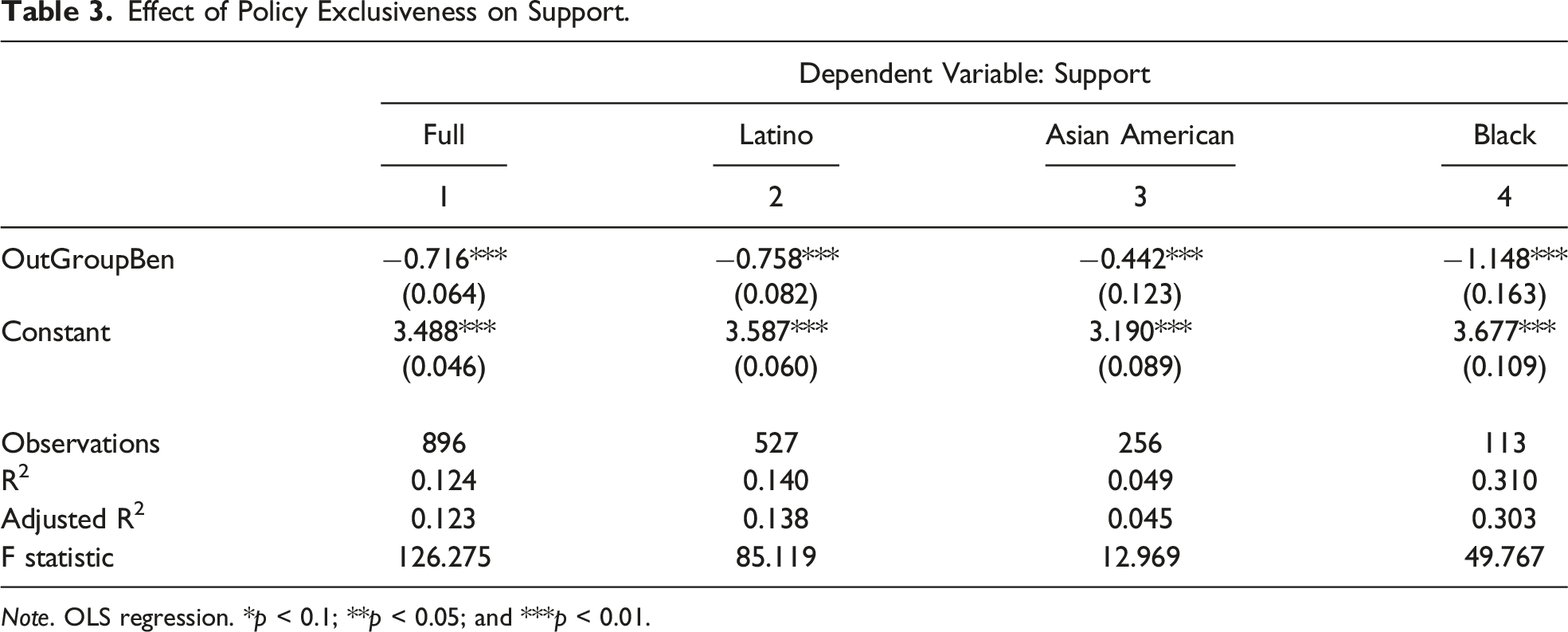
Note. OLS regression. *p < 0.1; **p < 0.05; and ***p < 0.01.
Table 3 indicates strong support for H1. Model 1, containing the full sample of respondents, indicates that individuals who were treated with a policy that benefited an ethnic outgroup were about 0.72 points less likely—on our dependent variable scale—to say they supported such a policy compared to individuals who were treated with a policy that benefited their ethnic ingroup. Substantively, the average level of support for respondents who were treated with a policy that benefited their ethnic ingroup was 3.4 (somewhat likely). In contrast, the comparison group’s average support for a policy that benefits an ethnic outgroup drops to 2.78 (somewhat unlikely). These results are significant at p < .001 level. Looking at Models 2 through 4, we can see that this effect is consistent across our samples of Latino, Asian American, and Black respondents. While the direction on the coefficients is the same across the four models, the size of the effect changes ranging from −1.14 in Model 4 (based on the African American sample) to −0.44 in Model 3 (based on the Asian American sample). However, we are unable to say that these coefficients are statistically different from one another.
Conditional Effect of Policy Exclusiveness on Support.
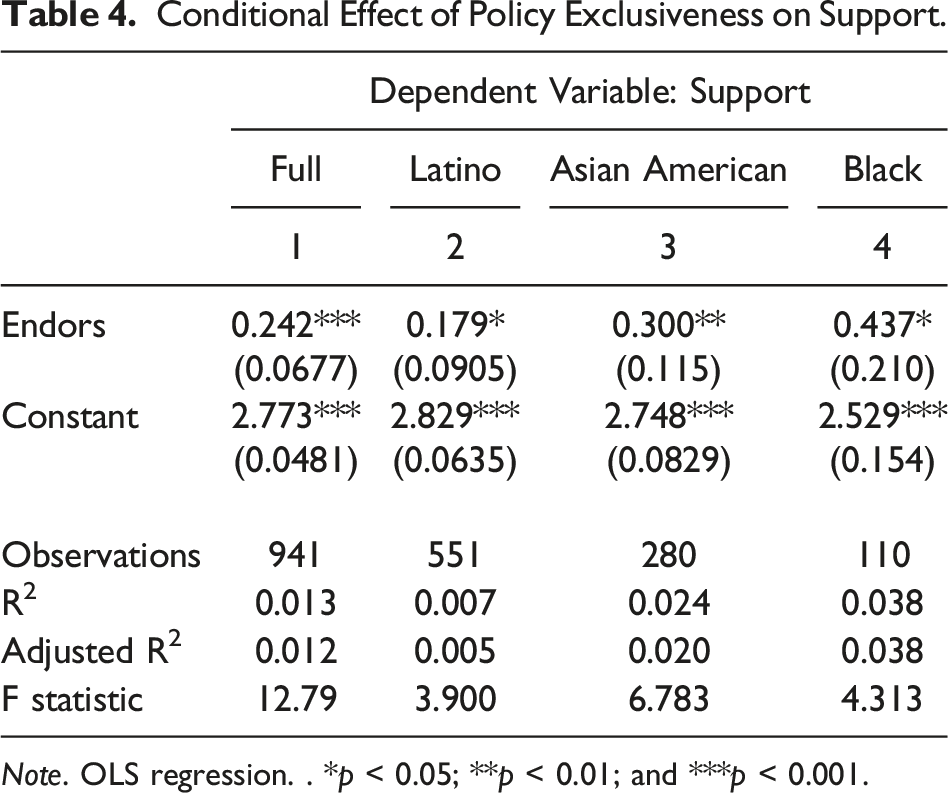
Note. OLS regression. . *p < 0.05; **p < 0.01; and ***p < 0.001.
Table 4 shows that our independent variable Endors is positive and statistically significant in all four models, providing support for H2. Respondents who are presented with a policy that disproportionally allocates resources to an ethnic outgroup are more likely to support that policy when accompanied by a co-ethnic endorsement, compared to when such an endorsement is absent. The average level of support among participants who observed a policy disproportionally benefiting an ethnic outgroup with no endorsement present is about 2.77 (somewhat unlikely) on our dependent variable scale. The average response for participants who observe the same policy with a co-ethnic endorsement is 3.01 (somewhat likely). It appears that endorsements in the policy arena may work similarly to endorsements in the electoral arena. 18
In addition, we can see that the effect of co-ethnic endorsements is also consistent across all subsamples. Among Latino respondents, we see that the effect is also positive and statistically significant. This is in contrast with Benjamin’s (2017b) findings that Latino voters are less likely, relative to African Americans, to have their voting behavior in local elections influenced by co-ethnic endorsements. We take this as novel evidence that Latino political attitudes can also be influenced by elite co-ethnic endorsements.
A novel finding from our experiment is that Asian American participants' attitudes toward distributional policies are significantly affected by the presence of co-ethnic endorsements. Table 3 shows that Asian Americans are more supportive of policies that distribute benefits to ethnic outgroups when a co-ethnic elite endorses that policy compared to when that endorsement is absent. This suggests that a pan-ethnic appeal to Asian American voters could facilitate political cooperation even amongst an ethnic group with high levels of heterogeneity in their national origin.
Discussion
Our experiment reveals several novel findings. First, we provide empirical evidence that shows that racial and ethnic minorities are group-centric and, when it comes to resource allocations, prefer to receive a bigger slice of the pie relative to other racial and ethnic groups. However, we also find that racial and ethnic minorities' support for resource allocations that disproportionally benefit ethnic outgroups can be increased when such resource allocations are coupled with an endorsement from an elite co-ethnic. We interpret this as evidence of the continued importance urban ethnic elites have in not only creating multiracial alliances but also maintaining them through their endorsement of their local government’s policies even if they prove to be less popular with their co-ethnics.
Our results also fit into the broader literature on the challenges ethnically diverse cities and their leaders face in providing goods and services to their residents. A wide range of literature has found that as cities become more ethnically diverse, levels of city funding for public goods tend to decrease (Alesina, Baqir, and Easterly, 1999; An, Levy, and Hero, 2018; Habyarimana et al., 2007; Lee, Lee, and Borcherding, 2016; Rugh and Trounstine, 2011). Scholars have attributed this to the role racial group identities have in shaping Americans' perceptions of (re)distributive policy and how these policies benefit groups they identify with or dislike. Negative racial stereotypes and perceived inter-ethnic competition for resources can lead to voters decreasing their support for distributive policies as we have shown here. Yet, new research shows that city leaders have ways to overcome these challenges.
Rugh and Trounstine (2011) find that ethnic leaders are strategic in their construction of municipal bonds that are put up for a popular vote. They find that while more racially diverse cities tend to pass fewer bonds than less diverse cities, the bonds they do pass tend to pass at higher rates, tend to be larger in size, have more spending categories, and take advantage of larger and more racially diverse turnout in referenda timed with the general election. In short, ethnic leaders aim to deliver public goods in a racially competitive environment by building support for policies that ensure everyone benefits from the resource distribution.
Similarly, Lee, Lee, and E Borcherding (2016) find that cities are strategic in what types of public goods they fund when faced with diverging policy preferences from an ethnically diverse population. They argue that city expenditures on public goods within the context of an ethnically diversifying population are determined by the price-elasticity of a specific good, whether there are more viable private substitutes for a public good or whether there are fewer substitutes. As cities become more heterogeneous, citizens' preferences on ideal spending for public goods also diverge. As a result, Lee et al. find that municipal governments and school boards shift their city expenditures from public goods that have viable private options (i.e., trash pickup) to public goods that have fewer or no viable private options and are thus less politically costly to fund (i.e., firefighting and policing services and education spending per pupil). In short, city leaders employ clever strategies to provide public goods and services to their constituents that overcome the diverging preferences of different groups. Our work shows that endorsements are another viable tool that ethnic leaders can use to support distributive policy projects and maintain multiracial coalitions.
We also extend the research on the use and effectiveness of elite co-ethnic endorsements to motivate co-ethnic political behavior and attitudes. We show that endorsements can be effective in altering co-ethnic attitudes outside of the electoral context. Our argument that ethnic minorities are group-centric is supported by the evidence. We find that such group-centric tendencies can be overcome when a co-ethnic endorsement is made in support of the policy. While we cannot directly test how endorsements function here among co-ethnics, we speculate that rather than acting as sources of cheap information, elite co-ethnic endorsements may instead function as a legitimizing signal to co-ethnics. The inclusion of members from one’s own ethnic group in the resource allocation process might legitimize the outcome, increasing support among groups even when they are not the primary beneficiaries of the policy. This underscores the importance of racial and ethnic diversity of local governments and the continued importance of the role of ethnic elites in urban politics.
Another important finding from our analysis is the fact that we find evidence for the impact of endorsements on co-ethnic attitudes among Latinos and Asian Americans. While the importance of co-ethnic endorsements among African Americans had been previously documented, previous research had found a lack of an effect of elite co-ethnic endorsements on Latino political behavior. In addition, the fact that co-ethnic endorsements also affect Asian Americans is a new contribution. Given Asian Americans' significant linguistic and national origin diversity, one might expect Asian Americans to be less responsive to elite co-ethnic endorsements than Latinos, who share more demographic similarities such as language and religion. It may be the case that Los Angeles Asian Americans are unique in this regard. Due to our lack of a survey item on respondents' national origin, we are unable to break down our Asian American sample by national origin group to test whether the effect holds across national origin subsets. We leave it to future scholars to continue to investigate the role of co-ethnic endorsements in the Asian American and Latino communities.
Conclusion
What are the conditions under which multiracial political cooperation can be sustained? The goal of this study is to understand how urban ethnic elites can overcome the group-centric interests of their co-ethnics over distributive policies in order to maintain multiracial coalitions. Our paper highlights the importance of co-ethnic endorsements in urban distributional politics.
We theorize that the saliency of race in local politics and ethnic minorities' perception of intense inter-ethnic competition for urban resources drives group members to prefer distributive policies that benefit their ethnic ingroup over outgroups, potentially threatening multiracial coalitions. Yet, we reason that the strong link between ethnic minorities and their co-ethnic elites allows the latter to use endorsements as a tool to increase their group members' support for policy outcomes that disproportionally benefit ethnic outgroups. In an experiment of Los Angeles County Asian American, Black, and Latino voters we found that subjects were unlikely to indicate support for hypothetical local policy proposals that directed resources toward an ethnic outgroup. However, when introduced to a policy condition in which there was a co-ethnic endorsement present, Asian American, Black, and Latino respondents were more likely to indicate support for these same proposals. We observe that cooperation between different ethnic groups can be facilitated even on proposals where one group gains at the expense of another. The influence of ethnic cleavages which are prevalent in urban politics might be mitigated through the action of local ethnic community organizations and other elites. Though the generalizability of our results is limited given our focus on one county in the United States, they provide preliminary evidence in support of the propensity for cooperative behavior between ethnic minorities and the feasibility of urban inter-ethnic cooperation.
Our findings speak to the growing literature focused on ethnic group relations, as our findings paint a brighter picture for minority relations in urban politics. Given our findings that the effect of co-ethnic endorsements holds across Blacks, Latinos, and Asian Americans in our survey, we want to emphasize the potential for progress that can reach across historical divides. Given the prevalence of co-ethnic endorsements in local contexts, we believe in the long-term potential for multi-ethnic political cooperation in the contemporary urban city.
Supplemental Material
Supplemental Material - Overcoming Resource Competition Among Co-Ethnics: Elites, Endorsements, and Multiracial Support for Urban Distributive Policies
Supplemental Material for Overcoming Resource Competition Among Co-Ethnics: Elites, Endorsements, and Multiracial Support for Urban Distributive Policies by Eddie Lucero and Ricardo Robles in Political Research Quarterly
Footnotes
Acknowledgments
We would like to thank our peer reviewers, Jessica Trounstine, Andrea Benjamin, and the graduate students at UC Merced for their feedback on this project.
Declaration of Conflicting Interests
The author(s) declared no potential conflicts of interest with respect to the research, authorship, and/or publication of this article.
Funding
The author(s) received no financial support for the research, authorship, and/or publication of this article.

Supplemental Material
Supplemental material for this article is available online.
Notes
References
Supplementary Material
Please find the following supplemental material available below.
For Open Access articles published under a Creative Commons License, all supplemental material carries the same license as the article it is associated with.
For non-Open Access articles published, all supplemental material carries a non-exclusive license, and permission requests for re-use of supplemental material or any part of supplemental material shall be sent directly to the copyright owner as specified in the copyright notice associated with the article.
