



Abstract
Country presidents and their political parties have strong connections along partisan lines. However, it remains unclear how this relationship unfolds when country presidents have to be non-partisans and formal ties are not permitted. This article seeks to address this gap in the literature and analyzes how country presidents use informal powers to maintain an influence in the life of their (former) political parties. We use Romania as the most likely case where we would expect such powers to occur and matter, because the country’s constitution bans the country’s president from being a party member once they are elected to public office. We compare the behaviour of the two Romanian country presidents who have each served two complete consecutive terms in office in the post-communist period. Our analysis covers the 2004–2022 period and focuses on the following four dimensions: electing successors, prime ministerial appointments, inclusion in coalition agreements and parties’ electoral performance.
Introduction
Contemporary elections in many liberal democracies revolve around key individuals, who are usually party leaders or prominent candidates for high public office such as parliamentarian, prime minister or country president. This process is considered in general to reflect the personalisation of politics (Cross et al., 2018; Karvonen, 2010) or its presidentialisation in specific circumstances (Elgie and Passarelli, 2020; Poguntke and Webb, 2005; Samuels and Shugart, 2010). The literature devoted to these developments has revealed the connection between political parties and country presidents along three main lines of enquiry: how political parties influence presidents’ performance in office (Kellam, 2015), how party leaders become country presidents (Gherghina, 2020), and how country presidents influence the activity of political parties (Samuels and Shugart, 2010; Wiesehomeier and Benoit, 2009). The latter strand of research focuses extensively on the formal connection between country presidents and political parties – mainly along partisanship lines – but pays limited attention to informal ties. As such, what happens between country presidents who are obliged to be non-partisan and their former parties remains unclear. Such details are important because they allow understanding of the complete spectrum of relationships and what happens in contexts in which formal ties are not permitted.
This article seeks to address this gap in the literature by analysing how country presidents use informal powers to maintain an influence in the life of their former political parties. We use Romania as a crucial case for analysis – as the most likely case where we would expect informal powers to matter – because its national constitution bans the country president from being a political party member. Once elected by popular vote (Romania is a semi-presidential system in which both the Parliament and the president are elected by citizens), the country president becomes a supra-partisan authority and is not allowed to be associated with any political party. Any interference in the party’s activity can be considered unconstitutional. In practice, the double impeachment of president Traian Băsescu for crossing non-partisan lines in 2007 and 2012 illustrates that the provision is enforced. We compare the behaviour of the only two Romanian country presidents who have served two complete consecutive terms in office in the post-communist period: Traian Băsescu (2004–2014) and Klaus Iohannis (2014–2024); our analysis of Iohannis covers events up until December 2022. The analysis is conducted along four dimensions derived from the literature: electing successors, prime ministerial appointments, inclusion in coalition agreements and parties’ electoral performance. For reasons of space and to maintain the coherence of the analysis, the text does not cover the potential day-to-day links that the president has with his former party. The findings illustrate that both presidents interfered with politics in similar dimensions. The main difference lies in how they did so, which is the main reason why one of them was impeached for crossing non-partisan lines while the other was not.
The next section reviews the literature on the relationship between country presidents and political parties. It also outlines the analytical dimensions of the study. The third section presents the research design with an emphasis on the case selection, methods of data collection and method of data analysis. The fourth section provides an overview of country presidents’ activity in Romania in general, and of the two selected presidents in particular. Next, we analyse the ties between country presidents and their parties along the analytical dimensions. The conclusions summarise the key findings and discuss the implications of this article for the broader field of study.
Theoretical Framework
This section reviews the literature related to presidents’ involvement in their parties. A presidential system favours the existence of a two-dimensional presidential office, where the president is, on one hand, the representative of his electorate, and on the other hand, the representative of the political party that brought him to power (Linz, 1994). However, the partisan nature of presidency can differ across political systems. A president in a semi-presidential system might not have the same opportunities to get involved in his party’s affairs as, for example, a president in a semi-presidential system. In several countries, the role of the president is broadly that of mediator between state institutions. Some constitutional provisions significantly restrain the president’s involvement in party politics (Raunio and Sedelius, 2020a). Despite the latter, previous research shows two possible avenues for a country president once elected in office: to leave their party and become a supra-partisan authority, or to stay involved along partisan lines. The first avenue is straightforward and means cutting party ties, which is of little interest here. Instead, we seek to study the second avenue, in which the connection between the country president and their party persists.
Presidential Partisanship
Presidential partisanship can include ‘a president’s feelings of loyalty to his party, to his policy choices, to his style of rhetoric, to his party organizational leadership, to a range of other activities’ (Galvin, 2013). Since 1981, France has been an illustrative case of the presidentialisation of parties around presidential leaders, where presidents or presidential candidates: set the tone of party platforms; pursuit of the presidency, not of legislative seats, dominates electoral campaigns; presidential elections heavily influence outcomes in the legislative race; presidents frequently remove and replace prime ministers despite lacking the constitutional authority to do so; and presidents have come to dominate the policy- making process (Samuels and Shugart, 2010: 179).
In countries where presidential power is not clearly specified, the power remains a matter of ‘where is it written?’ and ‘where is it forbidden?’ (Raunio and Sedelius, 2019, 2020b).
Previous literature suggests that presidential activism is greater in contexts of high-political dissent (e.g. cohabitation), or in cases of minority governments (Köker, 2017). Partisan strength in parliament (e.g. a large parliamentary majority) can increase a president’s power, mostly in times of cohabitation, where the president’s party is absent from government (Moestrup, 2011). Thus, presidential parties are preferred by presidents because they make the bargaining process less complex due to the overlapping of policy preferences. Accordingly, the incentive is greater for presidents to have their parties in the governing coalition (Savage, 2018). For example, partisan presidents might intervene for their parties by replacing the government (either electorally or non-electorally) in order to preserve and increase their parties’ presence in parliament. Ukraine is a good example of presidents who have relied on their formal power to dissolve parliament, leading to a new governing coalition, and also a case of replacing the prime minister with a co-partisan (Kudelia, 2018a). In Lithuania, after 2 years of cohabitation, President Adamkus attempted to build a new coalition (‘new politics’) in the context of legislative elections, with his former party, Center Union, in order to gain a parliamentary majority (Krupavičius, 2013). Moreover, presidents can act in a partisan manner to support their parties in ministerial appointments, particularly in cases of cohabitation, by favouring their co-partisan ministers (Neto and Lobo, 2009).
In countries where the presidential office is constitutionally non-partisan, the president might still engage with their parties through public statements; however, not every public statement is a partisan statement. Partisan statements are recognised when the president addresses a topic that exceeds his prerogatives. Partisan reactions from the opposition were observed in the case of the Turkish president, Recep Tayyip Erdoğan, when his statements crossed the border of his presidential domain (Aytaç and Çarkoğlu, 2018). In different situations, cohabitation might reduce a president’s influence in party politics, since the president’s party is not represented in the government (Elgie and McMenamin, 2011; Lazardeux, 2011; Neto and Lobo, 2009; Sedelius and Mashtaler, 2013), thus lowering his capacity to benefit from informal party channels.
Poland is a relevant example where the president, although formally ‘above parties’, maintained his partisan ties after being elected. President Aleksander Kwaśniewski, who was considered the ‘informal leader’ of his former party, Alliance of Democratic Left (SLD), was uninterested in partnerships with other political parties and instead maintained his support for his own, making several interventions in the internal affairs of the party. For instance, in 2005, he supported Wojciech Olejniczak for the SLD leadership, Marek Borowski (SLD member) for his presidential candidacy, and the SLD in the legislative elections. Later, President Lech Kaczyński remained a representative of his former party, Law and Justice (PiS), publicly acknowledging his subordination to his brother, Jarosław Kaczyński, the party leader of PiS. Bronisław Komorowski was another Polish president who maintained his support of (and subordination to) his party, Civic Platform (PO). Despite their partisan activism, Poland’s presidents were not strengthened by their parties, but rather controlled by them, and in some cases, they were weakened by these actions (Brunclík and Kubát, 2019).
In Romania, presidents have found other ways to side with their parties, such as through public speeches. For example, Iliescu and Băsescu participated in several party congresses and publicly campaigned for their parties during elections (Raunio and Sedelius, 2020a). When granted a high level of popular support, presidents sometimes might try to ‘go public’ and criticise the government in order to obtain concessions on specific policies, or promote their own party’s initiatives (Raunio and Sedelius, 2020b; Sedelius and Ekman, 2010; Suteu, 2020). The media can also be instrumentalised by presidents to actively campaign for their parties; a notable example is Bush’s public addresses through partisan channels, such as Fox News, which were mainly aimed at the republican, Christian US audience (Skinner, 2008).
Support for Their Parties
The literature on presidential activism refers to the ‘presidential party’, which is ‘the party of the candidate who in a presidential or semi-presidential system runs under its label and is directly elected’ or ‘the party the candidate declares an affiliation with in the case of a coalition of parties supporting the candidate’s presidential race’ (Passarelli, 2020: 92). One possible type of relationship between the president and his party could be seen as close to an imperial presidency. In it, the presidential party is the central, majority party and the president is also the president of the majority party. The level of presidential involvement in the party’s affairs is high, and their political programme and activity are aligned (Passarelli, 2020). Presidents might reveal their indirect support for their own parties by scheduling legislative elections for after the presidential elections. This mechanism is often referred to in the literature as ‘honeymoon elections’ (Passarelli, 2020; Shugart and Carey, 1992). The elected president can secure a majority for his party or a partisan coalition. For example, in 2002, Lionel Jospin (a candidate for France’s presidency) decided to postpone the legislative elections to follow the presidential competition by 4 weeks. This strategy was intended to prevent cohabitation and ensure a majority for the Socialists. However, the outcome of the presidential election was unfavourable, since Jacques Chirac was elected president. Nonetheless, evidence shows that honeymoon elections favour the just-elected president’s coalition party (Dupoirier and Sauger, 2010).
Presidents can also directly influence the electoral fate of their parties. The notion of presidential coattail effects posits that popularly elected presidents who enjoy strong support among the electorate may encourage voters to support their party (Samuels and Shugart, 2010). This effect is favoured in cases where the electoral base of the party branch in the legislative and the executive overlaps. For example, in the 2004 US presidential election, there was high degree of overlap between the supporters of the Republican legislative candidates and those of the candidate George W. Bush. Extended to the global level, evidence supports the coattail effect of the presidential candidate over his co-partisan candidates, as the difference between the constituency base for the executive and legislative is only about 10% (Samuels and Shugart, 2010). However, there are some instances in which presidents have few incentives to align with their party’s policy position. For example, in countries with bicameral legislatures, when the elections are separate, and when there are diverging views on the importance of a policy issue, presidents might maintain independence from their party. One possible explanation is that presidents have to address a national constituency, and thus, it is more electorally and strategically beneficial for them to position themselves closer to the median voter (Wiesehomeier and Benoit, 2009).
Earlier research indicates that the constitutional powers can benefit the president in attempts to engage in partisan activity. Empirical evidence from 21 countries shows that a president who is directly elected and has the power to nominate the prime minister tends to nominate a co-partisan. If given the opportunity to interfere for his party’s benefit, the president is more likely to choose a prime minister from his own party (Bucur and Cheibub, 2017). Moreover, presidents can work for their parties by using their veto powers, mainly in cases of intra-governmental conflicts. Evidence from a recent study indicates that when their parties are in government, presidents wield a veto in defence of their party’s political agenda. A notable example is the Slovak president, Ivan Gašparovič, who used his veto power and the government coalition’s divisions to block environmental legislation that his party (Movement for Democracy) in the junior coalition opposed. In a similar way, Polish president Aleksander Kwaśniewski vetoed an initiative on family planning that his party opposed, and Arnold Rüütel, a former Estonian president, vetoed the European Parliament Election Act, which his party opposed (Köker, 2017).
In addition, presidents can even engage in partisan activities through government overthrow. Following the 2010 Ukrainian presidential election, Viktor Yanukovych prevented cohabitation with his former rival Yulia Tymoshenko, by threatening the dissolution of parliament if a new government was not formed. Similarly, Petro Poroshenko asked the prime minister, Arseniy Yatsenyuk, to resign, and his bloc (BPP) secured a majority of seats in the new government majority coalition (Kudelia, 2018b). Similarly, following his election as president of France in 1981, François Mitterrand dissolved the National Assembly, and his words remain notable (‘give me the means to govern’). The honeymoon elections served Mitterrand and increased his power over his legislative majority, because the outcome of the legislative election was dependent on the outcome of the presidential elections (Cole, 1993).
A president with maximal influence in the government formation process, where a parliament’s vote of confidence is not required, can create ‘presidential cabinets’ based on personal political preferences. These situations usually occur in presidential regimes, or when the president is the leader of the parliamentary majority (e.g. the French presidents in the Fifth Republic; Kopeček and Brunclík, 2019). Partisan presidents may try to influence their parties by controlling internal party activity. Accordingly, French president Pompidou opposed the creation of a president position in his presidential party (UDR), due to concerns that a party president might potentially rival his power and influence over the party. In this sense, a special political cell was created to supervise and keep control over the party. Thus, the party’s discipline was strengthened, and the president almost became ‘supreme party leader’. This also happened under de Gaulle’s presidency, when he ‘indirectly controlled the levers of party power’ (Cole, 1993).
This literature review indicates that country presidents can play a role in the life of their (former) political parties in several ways. We thus pick four analytical dimensions that characterise this relationship, which form the basis for our empirical analysis in this article. One of these dimensions refers to the intention of country presidents to nominate or get involved in the election of their successor within the party, if they were the party leaders. A second dimension refers to the appointment of high public officials (e.g. prime ministers, speakers of parliament) from the ranks of their own parties. The third element of this relationship is the push to include the president’s party in coalition agreements. The fourth dimension relates to the electoral performance of the party and gauges a direct (or maybe indirect due to the informal ties) coattail effect of presidential popularity.
Research Design
Since the 1990s, an expansion of semi-presidentialism can be observed in several countries (Elgie et al., 2011). The literature provides several definitions of semi-presidentialism since its conceptualisation has been part of an ongoing debate among scholars (Brunclík and Kubát, 2019). One approach refers to three elements that must be present in a semi-presidential regime: (1) the president of the republic is elected by universal suffrage; (2) he possesses quite considerable powers; (3) he has opposite him, however, a prime minister and ministers who possess executive and governmental power and can stay in office only if the parliament does not show its opposition to them (Duverger, 1980: 166).
Another approach uses a minimalist understanding of semi-presidentialism by ruling out the power elements for a more consistent sorting of countries as semi-presidential. Accordingly, a semi-presidential country includes ‘popularly elected fixed-term president exists alongside a prime minis- ter and cabinet who are responsible to parliament’ (Elgie, 1999: 13). Shugart and Carey (1992: 23–24) distinguish between two sub-types of sempresidentialism: one is the premier-presidentialism with: (1) the president is elected by popular vote for a fixed term in office, and (2) the president selects the prime minister who is to head the cabinet, but (3) the authority to dismiss the cabinet rests exclusively with parliament
and the second is the president-parliamentary in which apart from being elected by popular vote for a fixed term in office, the president can appoint and dismiss the prime minister and other cabinet ministers. We base our analysis on Shugart and Carey’s conceptualisation of semi-presidentialism since it accommodates the executive power elements. In line with this, Romania is a semi-presidential country that belongs to the premier-presidential sub-type (Sedelius and Ekman, 2010: 4).
This country is the most likely case in which we would expect informal powers to occur, as the president is constitutionally required (Art. 80, par. 2) to be neutral and act as a mediator between the state authorities, as well as between the state and society, a requirement which makes Romania a unique case. There are many other European countries in which presidents are non-partisans, but that usually happens because they ran as independent candidates or had bipartisan support when elected (especially in parliamentary regimes). However, to our knowledge, there is no other country in which the president is formally asked to renounce party affiliation once elected to public office. In Romania, these provisions are enforced to a large extent. President Băsescu was subjected to impeachment twice, and the main allegations were the abandonment of his mediating role, active involvement in government and legislative issues, and taking the side of his former political party (Gherghina and Miscoiu, 2013). We selected Traian Băsescu (2004–2014) and Klaus Iohannis (2014–2024) because they are the only presidents in post-communist Romania who have served two consecutive terms in office. 1 This criterion is important, because it allows the continuity of their behaviour to be traced, including instances in which they successfully ran for re-election.
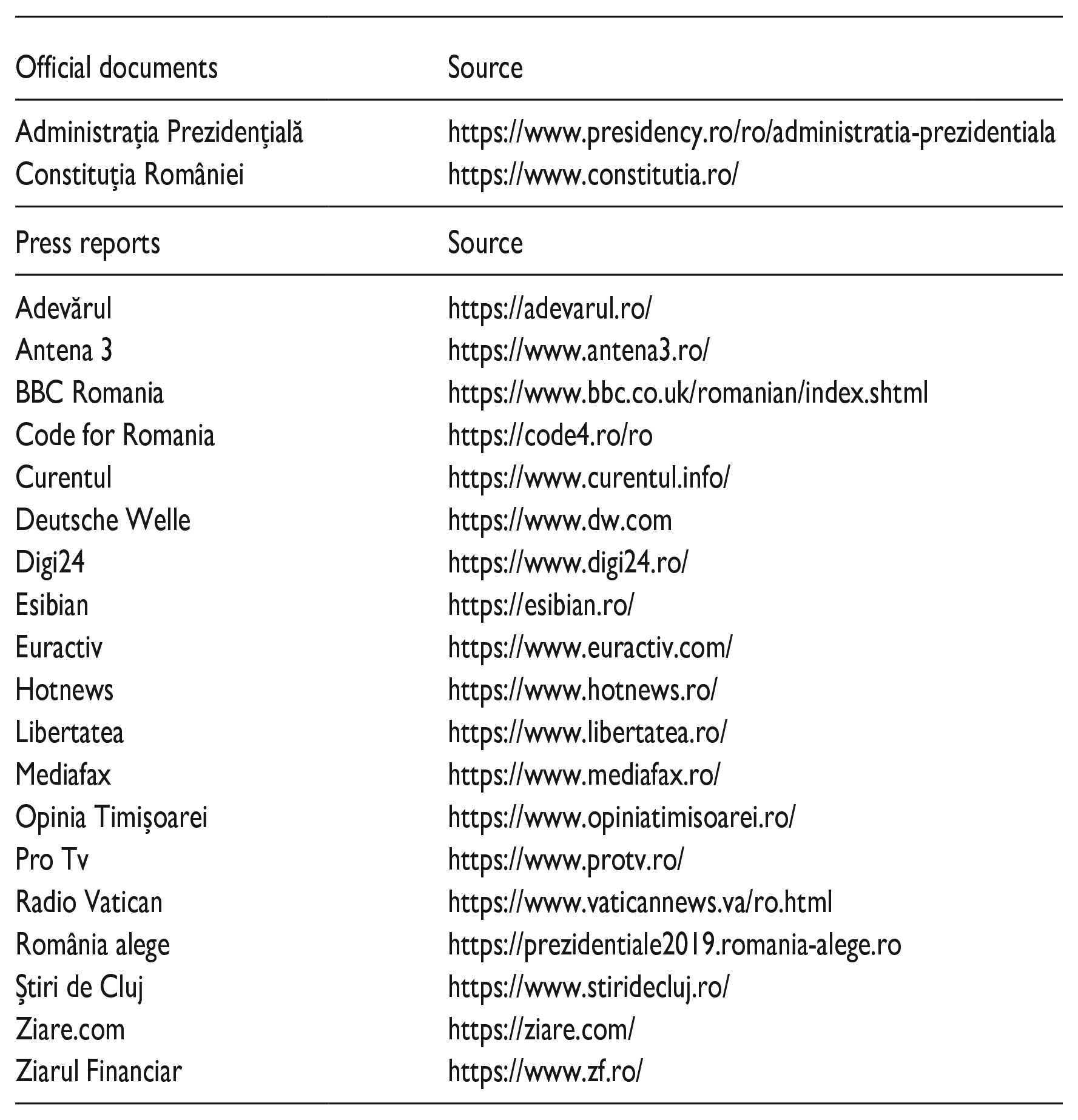
The analysis uses secondary data from official documents (e.g. from the Romanian Constitution and the Presidential Administration) 2 and press reports. Because the presidents’ involvement with their former parties is prohibited by law, we had to use press reports extensively since official documents do not reflect the involvement. The collection of official documents was straightforward because there is a limited number of items related to the presidential powers. The collection of data for press reports took place in two phases. First, the authors individually collected data about the involvement of presidents in their former parties’ affairs. The sources were identified mostly by keywords searching through online media sources. This search resulted in three individual lists of potential press reports to be used in the analysis. Second, the authors included in the analysis the sources that were present in at least two individual lists. The final list included 44 press reports.
These press reports cover a period of 18 years (2004–2022) and were collected systematically from three of the most-read newspapers at national level (Adevărul, Libertatea and Ziarul Financiar), the websites of the three largest national TV stations (Antena 3, Digi24 and Pro TV), the national press agency (Mediafax.ro), three international media outlets with special sections on Romania (BBC Romania, Deutsche Welle and Radio Vatican), three large news portals (Euractiv, Hotnews and Ziare.com), three local media outlets based in large Romanian cities (Esibian, Opinia Timișoarei and Știri de Cluj), and three websites with high political information content (Code for Romania, Curentul and România alege). 3
The coding took place as follows: every author read separately the press reports from the final list and identified the themes presented in Table 1. We agreed on a scheme based on the meaning of the content. The three individual list of themes compiled by each author were compared and the analysis includes only the themes identified by all three coders. We use comparative case studies as the method for analysis. In a broad sense, the comparative case study refers to ‘the systematic comparison of two or more data points (“cases”) obtained through use of the case study method’, where the cases are obtained through an empirical examination of various phenomena (Kaarbo and Beasley, 1999). The functioning mechanism of the comparative case study method is to identify the units of analysis, which are then compared and contrasted across the chosen cases. In line with this logic, the analysis is able to ‘trace across individuals, groups, sites, and time periods’ (Bartlett and Vavrus, 2017).
An Overview of Similarities and Differences of Presidential Approaches.
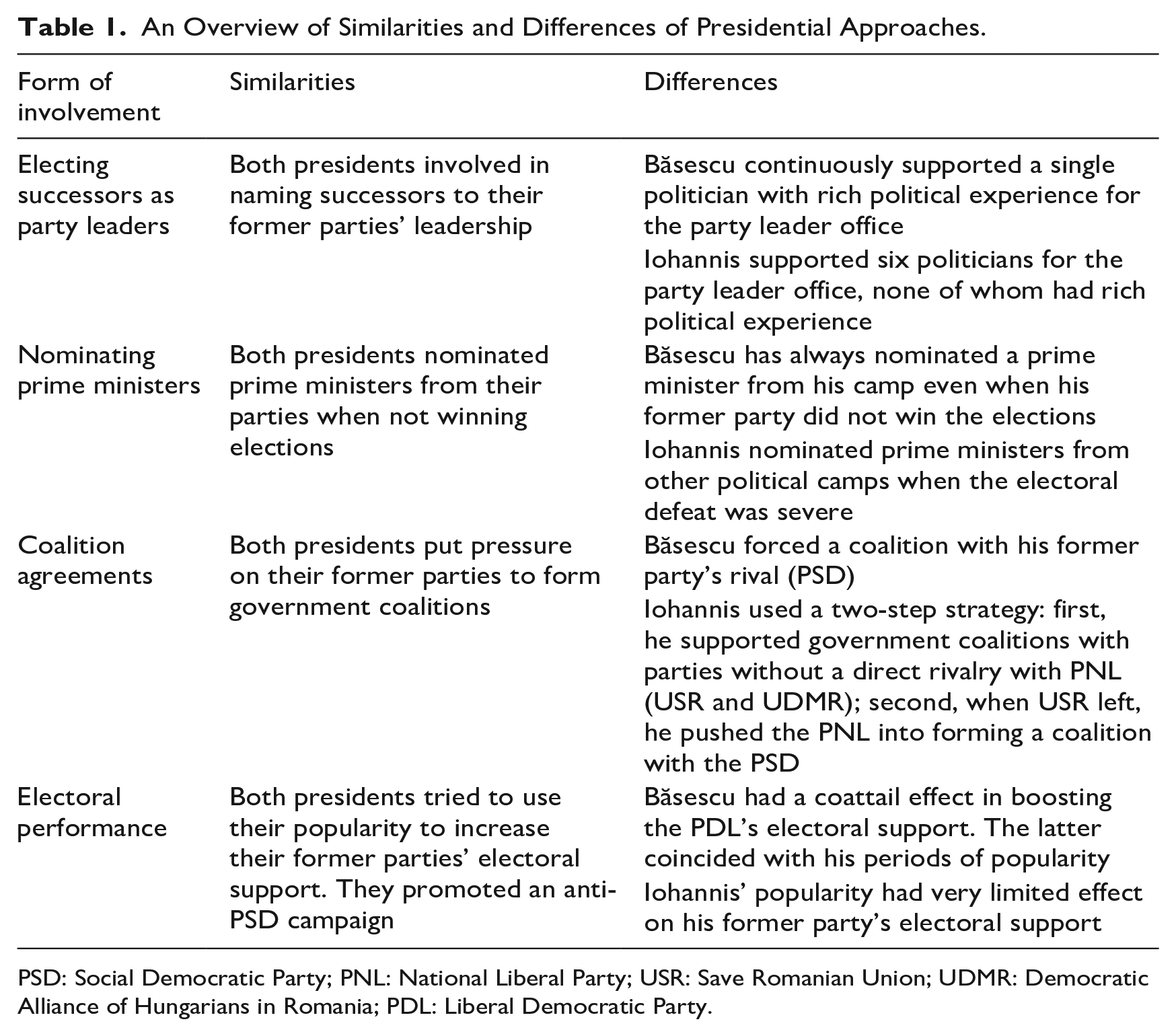
PSD: Social Democratic Party; PNL: National Liberal Party; USR: Save Romanian Union; UDMR: Democratic Alliance of Hungarians in Romania; PDL: Liberal Democratic Party.
From Party Leaders to Country Presidents: Băsescu and Iohannis
The president in Romania is informally considered to be the head of the state, the guarantor of national independence and the political mediator between the state’s powers. These attributions are regulated by the Constitution and concern both domestic and external matters (Administrația Prezidențială, 2022). At the domestic level, the president enacts laws, calls referendums and dissolves the parliament if the latter has not received a confidence vote to form a government. At the external level, the president fulfils mostly diplomatic functions: he or she appoints diplomatic representatives (Romanian or foreign), changes the rank of diplomatic missions and frames and concludes international treaties (Administrația Prezidențială, 2022). The Romanian president cannot serve more than two presidential terms of 5 years each, and cannot be a member of any political party during the presidential term or hold other public offices. He or she cannot benefit from presidential immunity for high treason, is not allowed to nominate a PM from candidates who lack parliamentary confidence, and cannot take part in government meetings without the PM’s consent. Also, the president cannot conclude international treaties on behalf of Romania if they were not negotiated by the government and submitted for ratification to parliament (România Alege, 2019). If the president violates these legislative obligations, he or she can be suspended if one quarter of the Romanian deputies and senators agree during a common session of the two chambers of the parliament, and after consulting the Constitutional Court (Constituția României, 2022).
Background Information on the Two Presidents
Traian Băsescu was the fourth Romanian president and the third to have held the office after the regime change in 1989. He has been one of the most prominent and influential politicians in Romania. He is the founder and a member of the People’s Party Movement (PMP), which gained seats in the national parliament in the 2016 elections and in the European Parliament in the 2019 elections. Before 1989, Băsescu was a member of the Romanian Communist Party (PCR) and after the regime change claimed he had joined to advance his career as a naval officer. He was appointed in the first post-communist government led by Petre Roman as an Under-Secretary of State in the Ministry of Transport. Between 1991 and 1992, he was a Minister of Transport in the Roman and Theodor Stolojan governments (Mediafax, 2009a). After the 1992 legislative elections, Băsescu won a deputy mandate from the National Salvation Front (FSN), and between 1996 and 2000, he again fulfilled the function of Minister of Transport in all three cabinets during that period. In 2000, after his party FSN was relabeled the Democratic Party (PD), he became Bucharest’s mayor as a PD candidate (Dan, 2014).
Băsescu became the leader of PD in 2001. He won the internal elections with a 64% vote share, defeating Roman, who was one of the party founders. His victory was possible because Roman’s credibility decreased over time, the party had poor results in the 2000 legislative elections and Roman failed to ensure internal party cohesion. In the 1996 elections, PD won roughly 14% of votes in an alliance with a smaller party, while in 2000, it got only 7%. Băsescu was perceived by most party members as able to restore or even increase PD’s influence on the political scene (Ziarul Financiar, 2001). As party leader, Băsescu was highly involved in PD’s internal and external matters. He dismissed most of Roman’s allies, and stated that his intention was to get rid of corrupt politicians and to replace them with competent and trustworthy ones (Marian, 2001). He increased the pragmatism of PD’s policies and played an important role in forming electoral alliances with the National Liberal Party (PNL) and strong ties with the Democratic Alliance of Hungarians in Romania (UDMR). Băsescu had 12 party vice presidents in all (compared to Roman’s six) and promoted a nationalist discourse. He underlined that PD should only accept politicians willing to represent Romanian interests (Ziarul Financiar, 2001). He won a second mayoral term in 2004, but resigned to take up presidential office later that year. He was re-elected in 2009 for a second term in office. Băsescu left the PDL in 2013, just 1 year before its merger with the PNL.
The other case study in this article, Klaus Iohannis, is the current president of Romania, gaining his first term in office in 2014 and securing re-election in 2014. Iohannis’ political career started in 1990 when he became a member (and subsequently the leader) of the Democratic Forum of Germans in Romania (FDGR). In 2000, he won the Sibiu mayoral office as a candidate from the same party, with a vote share of over 70%. The city’s inhabitants appreciated him, granting him four successive terms in this office (between 2000 and 2012). Iohannis was a very active local politician and was deeply involved in the city’s concerns. In 2007, during his second mayoral term, Sibiu won the title of European Cultural Capital and Iohannis was praised for his interest in modernising the infrastructure and increasing the economic and tourism potential of the city (DW, 2022). In 2009, Iohannis was proposed as Romania’s PM, and although he did not win this office, he became a popular political figure who was seen as a new possibility for those who wanted a better country (Mediafax, 2014).
In 2013 he joined PNL, and after 3 days the party’s congress granted him the vice-presidency. In 2014, he became the leader of PNL (Administrația Prezidențială, 2022). Even though he was not involved in as many reforms and internal intrigues as Băsescu (since he led the party for only 5 months before winning the presidential office), Iohannis strived to make PNL the biggest right-centre political party in Romania after the 1989 revolution. He formed an alliance with PDL and laid the foundation for the upcoming fusion of these parties. He was proposed as a presidential candidate by the newly formed alliance (Christian Liberal Alliance – ACL) and won presidential office in a second ballot with a share of 54.43% votes (DW, 2022).
Influence Over Former Parties
This section shows how Băsescu and Iohannis each continued to play important roles in the life of their former parties even though this involvement is formally prohibited by law. The section is divided into four sub-sections, each presenting the similarities and differences between the presidents in the four analytical dimensions outlined at the end of the theory section. Table 1 presents an overview of the similarities and differences between the two presidents’ involvement in the life of their former parties. Appendix 1 shows the complete list of sources that were used to code these themes.
Electing Successors as Party Leaders
After winning their respective presidential offices, Băsescu and Iohannis both became involved in electing leaders of their former parties: Băsescu for PDL (relabeled after a merger in 2007) and Iohannis for PNL. Băsescu was the most important actor in the process of deciding who would take over the party’s presidency after his formal resignation as party leader. Between 2004 and 2011, he continuously supported Emil Boc to be the new party leader. Băsescu’s support was emphasised through multiple statements about Boc’s quality, professionalism and efficiency. For example, he repeatedly stated between 2004 and 2011 that Boc is an honest and trustworthy politician who strives to improve the welfare of Romanians and who was not involved in corruption scandals. He portrayed Boc as a very capable politician who had won mayoral offices in Cluj, occupied a prime minister position, and was experienced in leading a political party (he was the executive president of the PD until 2004) with no electoral defeats (Antena 3, 2011; Carbune, 2011; Dobre, 2003; Ruse, 2011; Ultimele Știri, 2011).
Roughly 1 year before his resignation form the party, Băsescu argued explicitly that he had prepared Boc to become the new leader of the party irrespective of its members’ opinions, although formal internal elections were organised (Adevărul, 2003). In 2011, Băsescu continued to support Boc as the president of PDL even though he faced a counter-candidate, Vasile Blaga. Băsescu alleged that Blaga had cheated in the internal elections by beginning the collection of signatures before the official term. He urged the party members to vote for Boc for this position (Dobrescu, 2011; Opinia Timișoarei, 2011; Ruse, 2011).
Iohannis was also involved in the process of electing successors for PNL after he began his presidential term. He appointed Alina Gorghiu as his successor and manifested his support for her by shedding unfavourable light on her counter-candidate, Ludovic Orban. Iohannis’ direct support for Gorghiu was reflected in the PNL members’ votes: in 2014, Gorghiu won the party presidency with 48 votes to 27 received by Orban (Rosca, 2014). Iohannis emphasised that he trusted Gorghiu because they had worked together efficiently during his presidential campaign and she was a capable politician who could implement his programme (Digi24, 2014a, 2014b; Hotnews, 2014). Gorghiu resigned in 2016 due to poor results in the 2016 parliamentary elections; Iohannis then supported Raluca Turcan as an interim president of PNL. Until then, Turcan had a limited political profile, and lacked major political achievements; she was the leader of the PNL branch in Sibiu, the city where Iohannis won four mayoral offices in a row (Candea, 2016; Digi24, 2016).
In 2017, Iohannis indirectly appointed a new party president, Ludovic Orban. Although in this case, Iohannis’ support for Orban was not as obvious as in the previous cases, Orban’s statements and behaviour showed his desire to follow the presidents’ guidelines. He stated explicitly that he would be a loyal partner who follows all directions, and would transform the PNL into an influential party (Digi24, 2017a; Mănoiu, 2017). Orban’s presidency ended in 2021 when Iohannis appointed a new party leader, Florin Cîțu, who had no prior political experience or charisma. Instead, Cîțu was obedient, loyal, unpopular among the public and easily influenced by the president who wished to influence PNL through him. In 2022, he was replaced for 8 days by Gheorghe Flutur (as an interim president) and the current leader of PNL is Nicolae Ciucă, who also lacks prior political experience having been a career soldier rising to army general (Fati, 2022). Orban, Cîțu and Ciucă were prime ministers, the first two for brief periods of time, which partly coincided with their term as party leaders, while Ciucă has been the prime minister since November 2021 and became party leader in April 2022.
These cases reveal one similarity and two important differences between the presidents’ behaviours. Both presidents similarly supported and (in most cases directly) appointed successors who were loyal to them and who could be guided to implement their plans. The differences lie in the type of successors they selected as party leaders, and the stability of the party leader office. Băsescu continuously promoted a single politician to be the new president of his former party. Despite being politically inexperienced, his choice filled a variety of public offices ranging from mayor to prime minister. PDL had only one party leader until Băsescu left the PDL in 2013 following the results of internal elections (Gherghina and Grad, 2021). Iohannis was involved in the election of six party leaders in 8 years. Very few were well-known in the political arena or had prior political experience. All this indicates very high instability for the highest position in the party, which is directly linked to his involvement.
Nominating the Prime Minister
Băsescu and Iohannis both tried to boost the visibility and policy implementation of their former parties by nominating prime ministers from their ranks. For instance, in the 2004 parliamentary elections, the electoral alliance between the Social Democratic Party (PSD) and the Humanist Party of Romania (PUR) won slightly more than 37% of votes, while the Justice and Truth Alliance (DA) that included the PD and PNL got 31.77%. However, Băsescu maintained his control over the formation of a government that would favour him and his former party by appointing Călin Popescu Tăriceanu as prime minister. The latter was the PNL president and the co-president of the DA alliance alongside Boc (Rezultate vot, 2022).
This was a strategic move by Băsescu. By appointing a prime minister from his camp, he retained control over the entire executive branch, which is shared by the country’s president and prime minister. He justified his decision by stating that Tăriceanu is an honourable and trustworthy politician who would fight for Romanians, a very similar view to that used when he supported Boc for party leadership. Băsescu created a government that would favour his interests (BBC Romanian, 2004a). In the 2008 parliamentary elections, the PSD won 34.16% of the popular vote, while the PDL won 33.57% (Rezultate vot, 2022). Băsescu again appointed a prime minister from his camp who was also the party leader. He claimed that Boc would be the most suitable person for the job due to his extensive political experience (DW, 2008). Iohannis acted similarly in 2020 when the PSD won 29.32% of the votes, while PNL got 25.58%. He nominated Orban, the PNL party leader at the time, as prime minister. Like Băsescu, he wanted to minimise the PSD’s influence on the political scene by appointing loyal politicians who would follow his directions (Niță, 2020).
However, when it comes to prime ministerial appointments, a major difference between the presidents is observed. While Băsescu only appointed prime ministers from his own political camp, Iohannis sometimes nominated politicians from other parties. For instance, in 2016, PSD won 45.68% of votes while PNL got 20.42%. Iohannis did not risk nominating a liberal prime minister and opted for cohabitation by nominating the PSD representative. Although he tried to limit the influence of PSD by blocking many of its policies between 2016 and 2019, Iohannis appointed four prime ministers from the PSD: Sorin Grindeanu, Mihai Tudose, Mihai FIfor (interim) and Viorica Dăncilă (Digi24, 2017b; Pro TV, 2017). However, he changed his approach after the 2020 legislative elections and nominated a prime minister from PNL even though the party was ranked second after the PSD.
Government Coalition Agreements
Involvement in government coalition agreements is another dimension where the presidents’ presence was felt. There are two notable examples of situations when Băsescu and Iohannis each put pressure on their former parties to form government coalitions: the 2008 PSD–PDL coalition and the 2020 PNL-Save Romanian Union (USR)-Freedom, Unity and Solidarity Party (PLUS)-UDMR coalition.
First, the 2008 parliamentary elections outcomes (i.e. 34.16% for PSD and 33.57% for PDL) made it difficult for Băsescu to exclude the PSD from government. Accordingly, he laid the foundation of a coalition between the two parties and put pressure on PDL to accept it. Although until 2008 a coalition between the two rival parties appeared to be difficult, Băsescu justified his support for this agreement by explaining that old rivalries must be left behind and that the parties should join forces to create a better country for Romanians (Mediafax, 2009b, 2012). However, the real reason for this agreement was that PDL won insufficient votes to govern on its own, and a coalition with the PNL (which came third in the elections) was not possible due to the relative disintegration of the DA alliance. The government coalition lasted until 2009 when PSD withdrew from the government. The party stated that it would not continue with the agreement since Băsescu had tried to extend PDL’s power and adopted courses of action that went against the PSD’s will (Mediafax, 2012; Stan and Vancea, 2009).
Second, Iohannis forced a government coalition agreement in 2020 by pushing PNL towards USR PLUs (which became USR in 2021 after the two parties merged) and UDMR. This coalition was strong enough to reduce the PSD’s influence and to create a government that would be close in policy to the president (Digi24, 2020). However, 1 year later, the PSD joined the coalition government after USR left the coalition. Iohannis agreed to the move, and his explanation resembled the discourse used by Băsescu in 2008: that the government must represent the majority of Romanians (Mihăescu, 2022).
Therefore, when it comes to coalition agreements, Băsescu and Iohannis acted similarly in promoting their parties as formateurs from a non-winner position. Both presidents pushed their former parties to form government coalitions in order to maintain their power in the government and to reduce the influence of their rival party. However, one important difference is that Băsescu promoted an agreement with the rival party because there were no other possibilities. Iohannis followed a two-step process: first, the PNL formed a government coalition with smaller parties, but when one of these left the coalition, the second step was to invite the PSD to join the government coalition.
Electoral Performance
Băsescu and Iohannis were both proactive in augmenting electoral support for their former parties. They did this either by trying to create a spillover effect of their popularity onto their former parties, or by promoting specific agendas that would indirectly help PDL and PNL. To start with Băsescu, he was a popular politician for a large period of his terms in office. He gained popularity with his anti-corruption rhetoric and call for action. He thus valued his popularity and promoted positive messages about PDL to boost its performance. For example, in 2004, Băsescu mentioned that the DA Alliance was the only way to curb the corruption of the political class and the widening gap between rich and poor, and to accelerate European integration (BBC Romanian, 2004b). Băsescu underlined that PDL is a party for the youth, and for those who want a competent political class comprising enthusiastic politicians who strive for the welfare of the next generations (Digi24, 2013). At the same time, he emphasised that the precarious condition of the political class in Romania was due to the corruption of PSD, and added that Romanians deserve a better country (Hotnews, 2005). He accused the PSD of hindering Romania’s European Union (EU) accession and he did not trust its politicians. Băsescu declared PSD incapable of governing the country, and PDL as the only reliable solution (Dobrescu, 2017; Hotnews, 2005; Stan and Vancea, 2009). Overall, he enhanced PDL’s electoral performance through a negative campaign against PSD and partially against the PNL-led government in the aftermath of the DA disintegration (2006–2008).
Băsescu enhanced PDL’s popularity through specific political initiatives. For instance, in 2007, he organised a referendum to change the electoral system in Romania. He said that the introduction of the two rounds majority voting system was the only solution to obliterate the corrupt political class and to erase parties’ clientelistic relations. He organised the referendum together with the European Parliament elections (Pepine, 2007). This was a strategic move to increase the PDL’s popularity in the 2008 elections. PDL supported this initiative and managed to increase their popularity by backing Băsescu (BBC Romania, 2007).
Iohannis acted similarly; when he won presidential office in 2014, he was known mostly as a very efficient mayor who was not involved in corruption scandals. For this reason, people trusted him, and for many, Iohannis’ presidential term represented a new beginning. Although Iohannis did not manifest such a high level of involvement in politics and undisguised support for his former party as Băsescu, he tried to increase PNL’s popularity by continuously delivering the idea that it was the best political choice for Romanians (Știrile ProTV, 2014). However, Iohannis’ strategy to exert his influence on PNL did not work, as the party’s poor performance in the 2016 parliamentary elections illustrated. Possible explanations for that result could be the poor mobilisation for the elections in a year in which the country was run by a technocratic government (2015–2016), and the PNL’s inability to capitalise on their breakout from the electoral alliance forged with PSD between 2011 and 2014. In 2020, after a year in government, PNL got more votes than in 2016 but considerably fewer than could have been expected given Iohannis’ popularity in the 2019 presidential elections. Overall, there is very limited evidence that Iohannis’ popularity influenced PNL’s electoral performance.
Despite these visible differences, there is one similarity between Băsescu and Iohannis. They both engaged in a negative campaign against PSD, their common target that served as an electoral ally or government coalition partner for both PDL and PNL. Both presidents accused PSD politicians of incompetence and blamed the party for the evils in society. Iohannis accused the PSD of being responsible for Romanian citizens’ loss of trust in the EU (Ziarecom, 2018). In addition, he organised two referendums in 2019 to block some of PSD’s legislative initiatives in justice that he considered to act only in favour of PSD’s corrupt politicians (Euractiv, 2019; Iancu, 2019). These initiatives helped Iohannis to win another presidential term in 2019 and led to the PNL victory in the 2019 European elections.
Conclusion
This article has analysed how two country presidents in Romania have used informal powers to maintain an influence in the life of their former political parties (Elgie and Passarelli, 2020; Galvin, 2013; Passarelli, 2020; Raunio and Sedelius, 2020a). There are three major findings. First, both country presidents had an impact in all four dimensions covered in the article, and neither has remained neutral as stipulated by law (Elgie and Passarelli, 2020). They nominated successors as party leaders, and when those were not successful, the presidents continued to meddle in intra-party leadership selection. They nominated prime ministers from their former parties even when these did not win the popular vote, and thus pushed the parties to be the formateurs of government coalitions. Both presidents also sought to augment the electoral performance of their former parties by actively engaging in campaigning and deploying negative rhetoric against the largest party in the country (Samuels and Shugart, 2010).
Second, the two presidents have used their informal powers differently. Their approaches varied for several reasons, ranging from experience in politics to the strength of their own party, to the size of the opposition in parliament or its popularity with the electorate. Băsescu acted more directly and confrontationally than Iohannis, resulting in two impeachments. Nevertheless, in both impeachments, there was a broad alliance against him and his former party, which was isolated in opposition (2007) or in government (2012). Third, most of these effects were short term because they were linked to the country presidents’ actions and popularity; long-term effects are not visible. For example, we could not identify an effect on party-system institutionalisation because the political environment has constantly changed over the last two decades. The only constant political parties have been PSD and PNL, Băsescu’s former parties merging with the latter. In this specific case, the country president’s actions could not even secure the survival of his party in the electoral arena once his term in office had ended. From among the other parties, only UDMR continued to exist throughout the investigated time frame, with the other parties either episodic in existence or recently formed, that is, before the 2016 or the 2020 legislative elections.
Our findings are important for two main reasons. On one hand, they illustrate that formal separation between parties and public office holders does not work in practice. It is artificial and difficult to maintain since politicians are drawn to the parties that helped them to reach public office. This is also observable in the case of politicians with a limited history in the party like Iohannis. He joined PNL roughly 1 year before becoming the party leader, a position he occupied for around 6 months before becoming party president. His ties with the party were thus quite limited and yet he still extensively used informal powers to influence the fortunes of his party. On the other hand, we show that the actions of country presidents have many consequences after they formally resign from the party. This means that in some cases, the party leaders who succeed them have lower authority or a higher decorative role in the party. These conclusions have important implications for the broader field of political institutions beyond the case study analysed here. The power relations between the two institutions – country president and political parties – can be more complex than is prescribed by the law, with a lot going on behind the scenes. This collaboration influences the trajectory of specific political parties and partially alters political representation in the short term. For example, even when the presidential party does not get plurality support, it still ends up forming the government. It is important to note that these effects are short term, since such an arrangement can be detrimental in the long-run to the quality of democracy.
Our exploratory study lacked sufficient space to explain why the two presidents used their informal powers differently. We touched upon several potential explanations, but further research could focus on exploring and understanding their respective approaches and providing insights into the causal paths leading to such behaviours. Another worthwhile direction would be to investigate the ways in which the use of informal powers by presidents is perceived by politicians from the presidential party, from those in competitor parties, and by the public. This could help to build a bigger picture of the process and add the specific component of attitudes and subjective understandings of presidential actions. In addition, starting from this study, further research could conduct comparisons between countries in which country presidents are de facto non-partisan. This would allow scholars to establish whether the processes and dynamics identified in Romania are strictly case specific, or have broader applicability. Such approaches would deepen our knowledge about country presidents’ compliance with constitutional provisions with respect to their relations with political parties.
Footnotes
Appendix 1
| Official documents | Source |
|---|---|
| Administraţia Prezidenţială | https://www.presidency.ro/ro/administratia-prezidentiala |
| Constituția României | https://www.constitutia.ro/ |
| Press reports | Source |
| Adevărul | https://adevarul.ro/ |
| Antena 3 | https://www.antena3.ro/ |
| BBC Romania | https://www.bbc.co.uk/romanian/index.shtml |
| Code for Romania | https://code4.ro/ro |
| Curentul | https://www.curentul.info/ |
| Deutsche Welle | https://www.dw.com |
| Digi24 | https://www.digi24.ro/ |
| Esibian | https://esibian.ro/ |
| Euractiv | https://www.euractiv.com/ |
| Hotnews | https://www.hotnews.ro/ |
| Libertatea | https://www.libertatea.ro/ |
| Mediafax | https://www.mediafax.ro/ |
| Opinia Timișoarei | https://www.opiniatimisoarei.ro/ |
| Pro Tv | https://www.protv.ro/ |
| Radio Vatican | https://www.vaticannews.va/ro.html |
| România alege | https://prezidentiale2019.romania-alege.ro |
| Știri de Cluj | https://www.stiridecluj.ro/ |
| Ziare.com | https://ziare.com/ |
| Ziarul Financiar | https://www.zf.ro/ |
Declaration of conflicting interests
The author(s) declared no potential conflicts of interest with respect to the research, authorship and/or publication of this article.
Funding
The author(s) received no financial support for the research, authorship and/or publication of this article.
