



Abstract
In the last four decades, the Strategic Triangle concept has established itself as an eclectic theoretical framework in the research domain of triangular analysis. As international politics has evolved, the literature on Strategic Triangle has followed suit. Specifically, it appears that scholars have succeeded in transcending beyond the ‘traditional’ regional setting and conceptualisation by testing existing theoretical assumptions, developing new models and offering new insights into the dynamics of triangular relationships. Against this background, this contribution primarily aims to provide a state-of-the-art, comprehensive overview of the scholarly literature on Strategic Triangles. This article also seeks to illustrate the existing room for further engagement and analysis of triangular relationships by offering concrete recommendations on how researchers could further develop the Strategic Triangle concept.
Introduction
Within International Relations (IR) scholarship, a variety of theories, models, and concepts have been developed to better comprehend the interaction between weak(er) and strong(er) actors in the international arena and understand the motivation behind choosing between conflict and cooperation. Yet, to truly understand how an actor’s foreign policy, bargaining power and strategy are directly influenced by its relations with other actors, a systematic framework is still needed. But what kind of framework is appropriate?
Our point of departure would be theories of IR, specifically balance of power theories (Walt, 1987; Waltz, 1979). The initial assumption of the balance of power school of thought is that states, when facing a rising power, will use a ‘balancing’ strategy against a potential hegemon. Whereas internal balancing usually refers to the increase in defence spending and military buildup, external balancing involves the formation of alliances with other states against the hegemon. Alternatively, secondary powers (also framed in the literature as small/lesser powers) could also employ the strategy of ‘bandwagoning’ in their relations with greater powers. In this case, secondary powers do not challenge but rather align themselves with the rising power with the objective of neutralising the threat and/or benefitting from the great power’s dominance (see also Schweller, 1994).
Nevertheless, balancing or bandwagoning strategies are not without problems. Accordingly, another strategy available for secondary powers is ‘hedging’. Rather than a particular policy, hedging is a broad term for a set of strategies that are located somewhere on the spectrum between balancing and bandwagoning. Specifically, while employing hedging strategies, secondary powers simultaneously bandwagon and balance vis-à-vis the great power(s) (Fiori and Passeri, 2015; Goh, 2007; Lee, 2017; Lim and Cooper, 2015).
Under the umbrella of hedging, analysts have identified a wide range of strategies that secondary powers can use. In the context of positive relations (bandwagon-oriented approach) with the target country, secondary powers attempt to promote political, economic and institutional cooperation with the dominant power through strategies such as engagement, accommodation, enmeshment and binding. At the same time, secondary powers try to protect themselves (balance-oriented approach) against the hegemon through strategies like indirect balancing, complex balancing and soft balancing (Goh, 2008; Kuik, 2008, 2016; Lee, 2012; Lee, 2017; Salman and Geeraets, 2014).
Indeed, the concept of hedging has improved our understanding of the broad spectrum of policy options available to secondary powers, especially in the context of the Asia-Pacific and China’s rise. Nonetheless, beyond the criticism concerning the lack of analytical clarity (see, for example, Ciorciari and Haacke, 2019; Koga, 2018; Lim and Cooper, 2015), there is one key problem when attempting to apply insights from the scholarship on balancing, bandwagoning and hedging. That is, the majority of contributions that employ these concepts have a strong bilateral focus (Wu, 2017: 199) and, thus, may be too narrow and present an oversimplistic view of reality. Yet, a multilateral-oriented approach may increase the complexity of analysis to a level where it is no longer operational. As such, triangular analysis is one possible path of enquiry that represents a middle ground.
In this context, Young and Birchfield (2018: 2) argue that ‘[a]s a heuristic device the concept of triangular diplomacy probes the parameters and consequences of foreign policy behaviour and reactions in ways that would be missed by analyses of only bilateral and multilateral engagements’. Similarly, Li (2020) notes that numerous contributions studying third-party influence patterns have moved beyond triangulation and towards the study of multilateral interactions, yet the inclusion of additional actors is likely to result in the operationalisation of too many invalid variables.
Essentially, the rationale behind focusing specifically on three actors is that, on one hand, ‘[t]he relations – existing, potential, and desired – between any pair of countries influence and are influenced by the relations between each of those countries and a third actor’ (Jervis, 1997: 177). On the other hand, ‘while there are always more than three states in the system, in many cases three are most central’ (Jervis, 1997: 177). Correspondingly, Woo (2001: 1) maintains that ‘triangular diplomacy is quite common in IR due to the linkage of rivals and allies and the involvement of great powers in regional politics’, while de Stange (2015: 48) suggests treating triangular interactions as ‘the new level of analysis in IR’.
The origin of the triangular analysis can be traced to the ever-changing relationship between the United States (US), the Soviet Union (USSR) and the People’s Republic of China (hereafter China). Examining the literature on triangular relations, we find that analysts employ several ways to explore the interaction between these three actors. For instance, this triangular relationship was widely discussed in the works of Kissinger (1979), Barnett (1977), and Yahuda (1978), to name a few, and could be characterised as the ‘power politics approach’ where the interaction between the three actors is the outcome of mutual interest and fear (Lin, 1986: 628–629). Alternatively, the ‘Beijinology’ approach (e.g. Gottlieb (1977) and Garver (1980)) centres on the relationship between China’s domestic politics and its foreign policy and examines how the power struggle between different factions within China influences its foreign policy output in the context of the US–USSR–China triangle (Lin, 1986: 633–634; for an overview on triangular analysis see de Stange, 2015; Jervis, 1997; Lin, 1986; Woo, 2003).
Notwithstanding, the analytical model of the ‘Strategic Triangle’ is the focal point of this article. Principally, the Strategic Triangle can be considered the most widely used and theoretically developed concept for the study of triangular relationships. As such, it is rather efficacious in offering important insights into the interaction and behaviour of three actors within a triangular system.
Against this background, the overarching objective of this article is to provide a state-of-the-art literature review on the Strategic Triangle as a theoretical concept by examining the development of the Strategic Triangle approach over the years. Since the concept was often discussed and refined in the context of cross-Strait relations, the review also includes sources in both English and Mandarin Chinese. Moreover, as triangular interactions is a field of enquiry that remains underdeveloped in both empirical and theoretical terms (de Stange, 2015; Woo, 2003), the article aspires to offer some concrete recommendations on how researchers could further develop the concept.
Finally, we posit that this contribution is especially relevant. With growing geopolitical tensions following the return of the Great Power Rivalry between the US and China, the war between Ukraine and Russia and the recent escalation in cross-Strait relations, the Strategic Triangle could prove to be rather useful in analysing the current geopolitical competition for the hegemony of the international order, as well as the strategies of secondary powers that are caught in between.
The article will proceed as follows. The next section introduces the basic characteristics of the Strategic Triangle model and reviews the development of the concept from its inception in the 1980s. Then, the third part offers several recommendations as to how researchers could further advance the study and application of the Strategic Triangle as a theoretical concept, while the last part provides some concluding remarks.
Strategic Triangle: The Development of a Concept
The Strategic Triangle concept is based on Lowell Dittmer’s (1981) seminal World Politics article on the relations between three great powers, namely, the US, the USSR and China. Importantly, this concept is not confined to the study of these three powers but could also apply to other triangular relations as long as ‘all participants must recognise the strategic salience of the three principals’, and ‘the relationship between any two participants will be influenced by each player’s relationship to the third’ (Dittmer, 1981: 490–491).
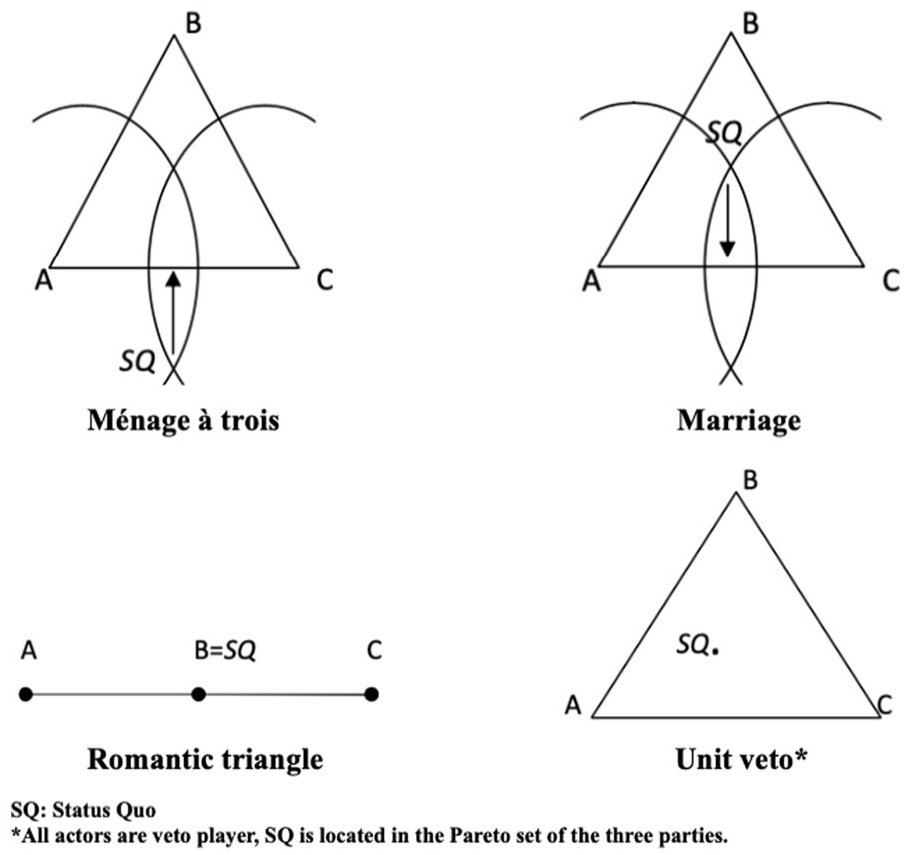
Essentially, Dittmer (1981: 489) identifies three basic types of triangular relations: (a) ‘ménage à trois’ – three amities; (b) ‘romantic triangle’ – amity between one ‘pivot’ player and two ‘wing’ players, but enmity between each of the latter and (c) ‘stable marriage’ – two ‘partner’ amities and one ‘outsider’ enmity (Figure 1).
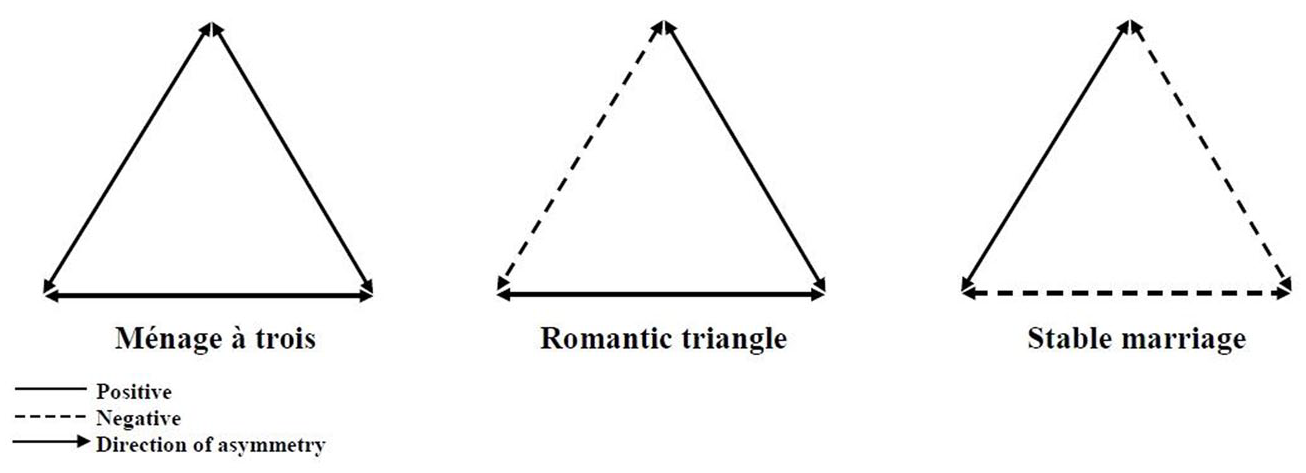
Dittmer’s Patterns of the Strategic Triangle.
Notably, in the evolving landscape of international politics, the scholarship on Strategic Triangles has followed suit and developed in terms of its geographical scope and analytical complexity.
The geographical scope of the theoretical framework encompasses other cases apart from the Great Powers triangle of US–USSR–China including triangles such as, inter alia, China–Japan–Russia (Dittmer, 2005b), China–US–Russia (Dittmer, 2018; Shin, 2015), North Korea–US–China (Chang, 2019), US–China–Japan (Cohen, 2005; Ho et al., 2016), US–China–India (Chatterjee, 2011; Dittmer, 2018), US–India–Russia (Zakharov, 2019), US–Russia–Iran (Chao, 2009), Vietnam–China–US (Womack, 2016b) and US–Australia–China (Dittmer, 2012). Notably, Womack (2010: 374, see also Womack, 2016a) maintains that, given their longevity and clarity, relations between Washington, Beijing and Taipei could be considered as an archetype case for Strategic Triangle analysis. And indeed, the framework has proven to be exceptionally fruitful in the analysis of the US–China–Taiwan triangle (e.g. Bau, 1999, 2009; Dittmer, 2005a, 2011, 2018; Li, 2015; Lin, 2004, 2009; Womack, 2010, 2016a; Womack and Hao, 2016; Wu, 1996, 2001, 2017; Yang, 2017; Yuan and Shen, 2012; to name a few). The remarkably rich and diverse geographical scope of Strategic Triangle scholarship could be seen as a testament to its added value in transcending beyond other approaches that focus on regions as a level of analysis as ‘[i]n area studies, many have researched regional triangles without paying much attention to the generalizability of their arguments’ (Woo, 2003: 35).
When examining the analytical development of the model, scholars have continued to further broaden the scope of Dittmer’s (1981) initial conceptualisation.
For instance, Dittmer (2012) redefines the criteria for triangular relations to be considered as a Strategic Triangle, namely: (a) all three participants are sovereign and rational actors; (b) bilateral interaction between two actors depends on their relationship with the third actor and (c) ‘each must be deemed essential to the game insofar as its defection from one side to the other would critically shift the strategic balance’ (Figure 2) (Dittmer, 2012: 664). Accordingly, following Dittmer’s first two conditions, (Wu, 1996: 27) adds another condition, that is, that ‘national security is at stake’.
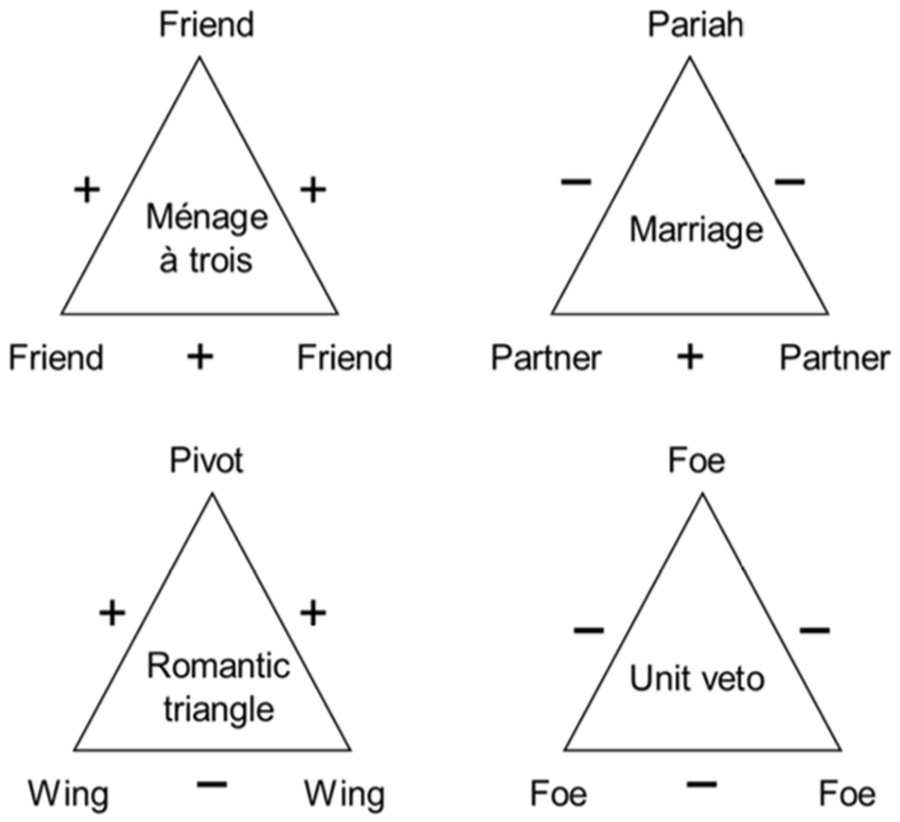
Type of Strategic Triangles.
Along similar lines, Womack (2010: 373) differentiates between ‘soft’ and ‘hard’ triangles. While the former delineates ‘bilateral relationships [that] are influenced by third-party interactions but not determined by them’, the latter includes ‘the simultaneous effect of the relationship of the third party’. In addition, beyond the three ideal settings (namely, ‘ménage à trois’, ‘romantic triangle’ and ‘stable marriage’), a fourth possibility, ‘unit-veto’, exists where all actors oppose each other (Wu, 2000: 420).
Accordingly, Wu (2000: 421) identifies six roles actors can take in these four triangle settings: ‘friend’ in a ménage à trois, ‘partner’ or ‘outcast’ in a stable marriage, ‘pivot’ or ‘wing’ in a romantic triangle and ‘foe’ in a unit-veto. Wu ranked these roles according to the number of positive relations an actor has with the other two actors as well as the type of relationship between the two actors. Thus, he identifies the pivot role as the most beneficial, followed by friend, partner, wing, foe, and outcast (Wu, 2000; see also Dittmer, 1981, 2014; Jervis, 1997; Wu, 2017). Indeed, the pivot position is considered the most beneficial since it allows the pivot to ‘maintain amicable relations with the other two players while preventing them from collaborating against it’ (Wu, 2017: 200–201). Furthermore, not only that a pivot ‘can tilt in different directions to gain concessions from both “wings”’ (Wu, 2017: 201), but a pivot position enables an actor to ‘punch above its weight’ as it can ‘make gains that are out of proportion to its economic and military resources’ (Jervis, 1997: 182).
Wu (2005) further builds on the six roles an actor could assume in a Strategic Triangle. For instance, he differentiates between ‘willing’ and ‘unwilling’ pivots in a romantic triangle. Specifically, while the willing pivot aims to benefit from its superior position, the unwilling pivot ‘happens to be sandwiched between two rivals and seeks to maintain good relations with both’ (Wu, 2005: 153).
Adding More Factors to the ‘Mix’
Further developments in the conceptualisation of Strategic Triangles originated from the need for analysts to incorporate additional factors into their analysis.
For example, one key factor is the balance of power within Strategic Triangles given the fact that oftentimes stronger and weaker actors exist within each triangle setting. As such, in comparison to Strategic Triangles between great powers, differentiating between symmetrical and asymmetrical triangles is essential. Principally, Womack (2010: 379) identifies four types of triangular relationships: (a) Symmetrical Triangle: X = Y = Z; (b) Single-Head Dual Asymmetrical Triangle: X > Y = Z; (c) Twin-Head Dual Asymmetrical Triangle: X = Y > Z and (d) Triple Asymmetrical Triangle: X > Y > Z. Furthermore, analysts seek to examine the problems and possible strategies of each of the actors in asymmetrical triangles in general (Womack, 2010, 2016a); and in the case of the weakest actor (i.e. secondary powers) in particular (Wu, 2017). For instance, while a weak state (as a partner) could be double-crossed by a senior partner, playing the pivot role could prompt a negative response from both powers. Therefore, the ‘hedging partner’ role might prove the most beneficial position (given the risks) as it ‘entails reasonable security through alliance with one giant, while providing some flexibility of movement to elicit courting by the other giant, and possibly some counter counting by its ally, who cannot take the hedging partner for granted’ (Wu, 2017: 201–202).
Another path of research enquiry integrates domestic factors (and constraints) in triangular analysis. In this context, (Wu, 2001) reexamines US–China–Taiwan relations while combining the Strategic Triangle framework (i.e. international level) and power-maximising calculations of ruling elites (i.e. domestic level). He notes that domestic factors (e.g. democratic elections and party congresses) within the three countries pressure the national leaders to take certain actions/policies to preserve their leadership position. Another example is Ho et al. (2016) who incorporate aspects such as history, territory, values, and political differences into the analysis of the US–Japan–China triangle. The study reveals that all actors have been constrained by divergent values and nationalist sentiments, preventing them from improving their relations. Along similar lines, Chu and Chang’s (2010) model incorporates culture in the study of strategy and policy. The analysis focusses on the interaction between the three states/kingdoms (i.e. Wei, Qi and Chu) while challenging Dittmer’s model on the grounds of its exclusive applicability to a specific time and context (i.e. Great Power Rivalry during the Cold War). Thus, to understand contemporary IR, they argue, the existing theories could be complemented by introducing new theoretical approaches (such as social constructivism) and connotations that address national and cultural specificities.
Finally, in the context of external factors, Wu (1996: 35) states ‘it is virtually impossible in today’s world for two nations to have no direct connections whatsoever, and leave their bilateral relations defined completely by their dealings with a third party’. Note that when determining a bilateral relationship, external factors are always added to the existing internal factors. Wu’s (1996) ‘dual triangle’ model could explain how the structure of the great US–USSR–China triangle shapes the arrangement of the US–China–Taiwan mini-triangle (Figure 3).
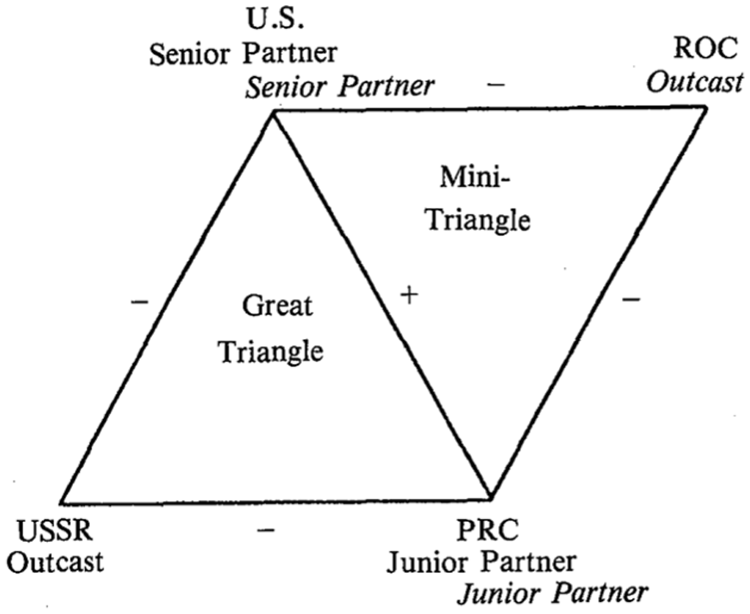
Dual Triangles in the Late 1970s.
Evidently, the Sino-American rapprochement aimed at countering the USSR predetermined US policy towards Taiwan. By shifting diplomatic recognition from Taiwan to China, the US established a stable marriage with China and alienated Taiwan as an outcast. Consequently, as long as the US maintains a positive relationship with China, external factors (the Great Triangle) prevent the US and Taiwan from being close to each other.
Methodological Considerations
Regarding research methodology, various scholars recognise the opportunity for developing the concept into a more complete theory by quantifying the relations between the three actors.
For example, Bau (1999; see also Wu, 2011b) calculates the benefits gained by each role an actor can assume in a triangular setting. Based on the four types of triangular relationships (i.e. ‘ménage à trois’, ‘romantic triangle’, ‘stable marriage’ and ‘unit-veto’), the calculation is as follows: for a friendly relationship, both parties receive + 1 point. By contrast, both parties lose − 1 point for a hostile relationship. Bau’s (1999: 342–345) results show that the role benefits in the Strategic Triangle are: pivot (+ 3) > friend, partner (+ 1) > wing, foe (− 1) > outcast/pariah (− 3).
Ranking the six Strategic Triangle roles enables the evaluation of payoffs of different actors within a triangle. Notwithstanding, (Wu, 2011b) argues that the calculation of national capabilities should be more accurate. As such, in Wu’s (2011b: 9–10) refined triangle, each relationship is weighted according to the relative power of the actors involved. Specifically, Wu includes economic (measured by gross domestic product) and military (measured by military expenditure) dimensions in the equation. His analysis concludes that among all the roles an actor could assume, a pivot receives the best payoff, while an outcast receives the worst.
Alternatively, to address the problem of triangular power asymmetries, Shen (2006) proposes a linear function that quantifies actors’ level of friendliness towards one another, which is determined by mutual security and economic interests. Considering security interests, the ‘most friendly’ scenario would be the formation of a military alliance, while the ‘least friendly’ scenario would be a declaration of war. Regarding economic interests, the ‘most friendly’ case would be the opening of the domestic market, whereas the ‘least friendly’ would be economic blockades and sanctions. Accordingly, the US–China–Taiwan triangle is converted into six sets of relationships (US vs China/Taiwan, China vs US/Taiwan, Taiwan vs US/China) as depicted in Figure 4.
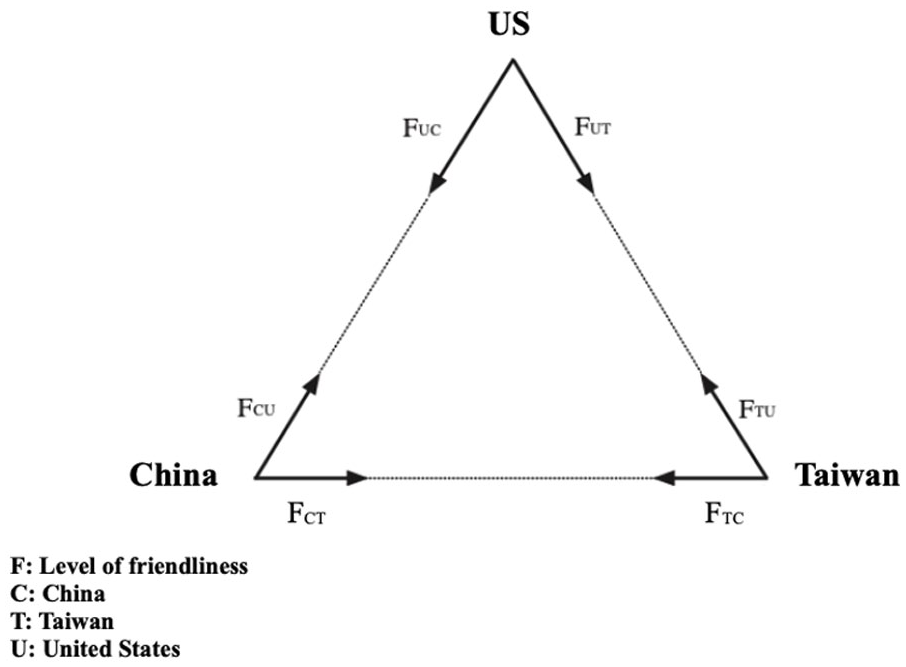
The Level of Friendliness Between the US, China and Taiwan.
In another study, Lin (2009) constructs a ‘Two-Layered Strategic Triangle’ model to examine the impact of domestic politics on the US–China–Taiwan triangle. Derived from Rational Choice and Veto Player Theory, this model assumes that: (a) each country’s attitude towards other countries within the Strategic Triangle is determined by domestic politics (i.e. the collective preferences of the ruling elites); (b) the portrayal of triangular relations extends from the traditional dichotomy (i.e. the ‘positive/negative’ relationship) of the Strategic Triangle to a continuous space where the distance between the countries involved reflects the difference of their interests and (c) changes in domestic leadership and the capabilities of countries to change their status quo are the main variables affecting the Strategic Triangle (Lin, 2009: 278) (Figure 5). Lin concludes that, theoretically, this revised model enables analysts to explain how individual preferences aggregate into collective choices.
An Example of the Two-Layered Strategic Triangle.
Cohen (2005) slightly modifies Dittmer’s (1981) model, proposing that Strategic ‘Triangles are not always equilateral’ (Cohen, 2005: 9), but can be scalene. Put differently, Cohen posits that Dittmer’s conceptualisation might be too simplified to accurately describe the characteristic of some Strategic Triangles. For instance, the China–US–Japan triangle is likely to be scalene. Specifically, whereas the US–Japan relationship has always been positive, US–China relations have fluctuated several times. Cohen derives the length of each side of the triangle from the closeness of the two countries involved. Hence, the US and Japan would be nearer to each other, while both countries would be farther from China (see Figure 6). In following this approach, Cohen (2005: 9–10) suggests that analysts could be more effective in assessing ‘the degree of “positiveness” of each bilateral relationship’.
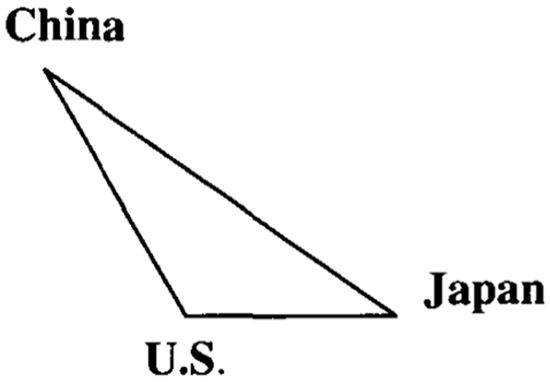
Cohen’s Example of a Scalene Strategic Triangle.
Strategic Triangle: The Way Forward
The prolific development of the theoretical Strategic Triangle concept departs from the traditional settings of triangular interactions. As such, analysts have taken the challenge of adding, revising, and broadening the scope of analysis at various levels. This section of the article explores this line of thought by offering possible paths for further enquiry by providing empirical, conceptual and methodological recommendations.
The US, China and Asia are not the only Game in Town
In 2003, Woo (2003: 45) argued that ‘the end of the Cold War did not mean the end of triangular politics’. While academics have indeed moved beyond Dittmer’s (1981) initial focus on the US–USSR–China Great Power triangle, it seems the existing scholarship remains largely unable to avoid including (at least) one of the three powers featured in Dittmer’s original triangle. Furthermore, it appears that the majority of case studies share a new regional focus that represents the new post-Cold War geopolitical competition. In other words, the analysis is often linked to Asia in general and the theme of China’s rise in particular.
Against this backdrop, we follow Woo’s (2003) line of argument and maintain that as triangular politics perpetuate even after the Cold War, they also exist beyond the Asian context. Moreover, we posit that scholars could diversify their case selection to include more countries as well as a different regional focus.
For instance, (Wu, 2005) conducts a comparative analysis between the US–China–Taiwan triangle and the Germany-Russia-Austria Hungary triangle. Specifically, he examines the process of transformation from a ‘romantic triangle’ to a ‘stable marriage’ due to the inability of the unwilling pivot to manoeuvre between two wings. In so doing, (Wu, 2005: 116) contends that ‘through the application of theories and analogies with historical cases, we can gain deeper understanding of the triangular logic’. In another study, (Wu, 2017) studies the strategies of secondary powers (or ‘lesser powers’ in his terminology) in Strategic Triangles that are caught in great-power competition. Wu also compares the US–China–Taiwan triangle with the European Union (EU)–Ukraine–Russia triangle. As such, his contribution ‘advances IR theories in areas they overlook: small countries, asymmetrical relations, triangular interaction, and geostrategic analysis’ (Wu, 2017: 215), and provides us with the opportunity to apply the Strategic Triangle framework in a European (rather than Asian) regional context.
Similarly, Stulberg (2018) focusses on the interaction between the EU, Ukraine and Russia amid the 2013–2015 Ukraine crisis and Russia’s annexation of Crimea. Specifically, Stulberg seeks to explain the puzzle of strategic restraint among the three actors in the context of energy politics and gas relations. Alternatively, Chao (2009) studies the US–Russia–Iran triangle. He discusses how Iran’s renunciation of nuclear weapons has led to intense competition and limited cooperation between the US and Russia. Whereas the US needs Russia’s support on the nuclear issue, Iran needs to use Russia as a bulwark against US pressure, which ultimately places Russia in the most beneficial position in this Strategic Triangle.
Essentially, the above contributions broaden the geographical scope of Strategic Triangle analysis and effectively demonstrate how the multifaceted study of the Strategic Triangle concept can be developed. For example, the vast majority of contributions on Strategic Triangles focus on individual case studies. However, studies that conduct comparative analyses contribute to the generalisation of the concept by testing the applicability of various hypotheses across space and time (see also Woo, 2001, 2003). In this context, Wu’s (2005) study excellently illustrates a comparative analysis that includes a more historical (rather than contemporary) case study (see also Chu and Chang, 2010). Finally, Chao (2009) and Stulberg (2018) offer important examples of how the study of Strategic Triangles can depart from macro-level analyses scrutinising decades-long relationships, and instead focus on limited time frames (e.g. a few years) and specific policy areas of interest (e.g. energy or nuclear negotiations).
Thinking Outside of the Box and Triangle
Wu (2011a: 8) maintains that ‘other things being equal, any country that finds itself in an ST [i.e. Strategic Triangle] game would aspire to “elevate” its role in that game, thus raising its payoff’. Moreover, out of the three roles available to secondary powers (i.e. partner, hedging partner and pivot), it might be the most beneficial for a secondary power to take the role of a hedging partner (Wu, 2017: 201–202). Previous work on triangular hedging by Goh (2016) supports that countries may employ a set of strategies to avoid making immediate decisions such as balancing, bandwagoning, or neutrality. This approach is widely used in Southeast Asian countries to foster a middle ground between choosing one side at the expense of the other. Wu (2018) also notes that hedging strategies have been adopted by the Taiwanese government in the context of the US–China–Taiwan triangle.
This notwithstanding, one key drawback in the Strategic Triangle framework that (Wu, 2000: 422) identifies is ‘its concentration on the triangular relations without giving sufficient attention to the general international system’. Similarly, Ellis (2012: 3) points out that ‘while the triangle does not exclude . . . actors per se, the focus on the interaction among [them] tends to conceal how other states, as well as non-state actors, play a key role in that dynamics’. Shin (2015: 113) adds that strategic triangularity limits ‘the level of analysis to only that of the superpowers, thereby severely underestimating the potential exertion of influence of small-to-medium level players in the region’.
Essentially, we propose that despite asymmetric power relations between secondary and great powers, secondary powers are strategic actors in their own right and not merely passive pawns in a geopolitical game. That said, when examining the Strategic Triangle scholarship, it seems that the scope of available options is rather limited. We argue, however, that facing the challenge of external influence, secondary powers have the ability to choose among alternative courses of action beyond the specific options that are available within the triangle or ‘moving to triangles that are more benign or more secure’ (Womack, 2010: 392). After all, the relationship between secondary and great powers rarely exists in a vacuum. Quite the opposite, the environment in which asymmetric Strategic Triangles (e.g. the US–China–Taiwan triangle) operate is brimming with other (mostly secondary) powers. While coping with this triangular setting could be an arduous undertaking for a secondary power (as the weakest actor within the triangle), it might prove advantageous in expanding the scope of strategic choices available in its interaction with actors situated outside of the Strategic Triangle.
In this context, Womack’s (2016b) study of the Vietnam–China–US triangle might provide us with a starting point for further enquiry. Womack demonstrates how Vietnam, the weakest actor in this asymmetric triangle, should not only rely on its options within the triangle but also seek options ‘above the triangle’. Specifically, Womack (2016b: 9–10) suggests that to reduce/manage uncertainties, Vietnam could use its association with regional organisations (e.g. ASEAN) or precommitments to transnational rules and regulations (e.g. WTO).
Similarly, Chang (2019) demonstrates how North Korea navigated its ‘intending’ outcast position in the Washington-Beijing-Pyongyang triangle. Specifically, since 2017, North Korea has been improving its ties with Russia and South Korea (i.e. external actors) while taking the Denuclearisation Talks as a bargaining chip to open dialogue with the US and China. Accordingly, North Korea has transformed itself from an ‘outcast’ to a ‘partner’ in the Strategic Triangle.
Against this background, we posit that in some cases (particularly in the context of asymmetrical triangles and secondary powers), it is beneficial to think both outside the box and the triangle. In so doing, several intriguing questions arise once we add another actor to the equation: Can the secondary power utilise its relations with the fourth actor to strengthen its current position or try to compensate for its weak position within the triangle? Which roles should the fourth actor assume in their relations with the secondary power? And do we have another Strategic Triangle (à la Wu’s dual triangle model) that needs to be considered in our analysis?
Strategic Triangle: Qualifying Instead of Quantifying
As previously discussed, part of the development of the Strategic Triangle as a theoretical concept was linked to the process of quantification. Scholars such as Bau (1999), Shen (2006) and Lin (2009) developed various quantitative methods of measurement to expand the understanding of interactions between three actors within a triangle and the value of options and roles they might assume. Contrastingly, most studies on Strategic Triangles not following the quantitative path of enquiry tend to remain at a rather descriptive level while mostly utilising secondary (e.g. existing literature) and, to a lesser extent, primary sources (e.g. official state documents). In this context, we agree with Woo’s (2003: 34) statement that ‘[we] have either historical, descriptive narratives of a single triangle or longitudinal quantitative analyses identifying the presence of triangles without any explanation as to why three members act the way they do’.
Noteworthy, Li (2015, 2020) suggests using online databases (e.g. Global Database of Events, Language, and Tone) to identify keywords (i.e. threat/urge/state to maintain the status quo) from media reports within certain periods, which helps clarify the simultaneous effect of the third party. Still, Li emphasises that ‘there is still a gap in using event databases for analysing the leverage of the US in cross-Strait relations’ (Li, 2015: 218). Specifically, many behind-the-scenes operations and unofficial contacts that precede and follow major events often cannot be revealed in the official press. Accordingly, Li (2015) believes that this approach necessitates complementary qualitative research built on interview records, memoirs and official archives.
Along similar lines, Kuan (2009) highlights the importance of conducting interviews with government officials. His study adopts a mixed-approach method whereby data collection is undertaken using an event database while data is analysed using statistical software. However, Kuan (2009: 233–234) notices that while statistical analysis is based on the State as a unitary actor, other domestic-level factors, such as public opinion, cannot be calculated. It is difficult to verify (even using public opinion polling) whether the process of foreign policy-making accurately reflects public opinion. Thus, elite interviews could be employed to bridge this gap.
Against this backdrop, we maintain more attention be given to the incorporation of qualitative research methods in Strategic Triangle studies. An example of this would be integrating process tracing in the research design of triangular analysis to ‘isolate the impact of interaction on the behaviour of the protagonists’ (Young and Birchfield, 2018: 9). Furthermore, the added value is that, in comparison to historical research, process tracing can extend beyond in-depth storytelling since it ‘converts a historical narrative into an analytical causal explanation couched in explicit theoretical forms’ (George and Bennet, 2005: 211, see also Checkel, 2005; Vennesson, 2008). In addition, since process tracing is often used as a research strategy that centres on a within-case analysis (Bennet and Elman, 2006; Ruback, 2010), it would allow analysts to disaggregate the number of possible observations and thus overcome the n = 1 problem (King et al., 1994: 227, see also Lijphart, 1971).
Regarding qualitative data collection methods, scholars could rely more on archive research and elite interviews. In the context of interviews, one could highlight the importance of linking interviews to a research strategy such as process tracing as ‘the usage that is arguably most relevant to process tracing entails conducting elite interviews to establish the decisions and actions that lay behind an event or series of events’ (Tansey, 2007: 766). In addition, we suggest that analysts not only conduct interviews with government officials but also with former officials and other experts who could provide insights into the case under scrutiny. Alternatively, concerning qualitative data analysis methods, more attention could be given to the use of methods such as content and discourse analyses.
At any rate, be it qualitative or quantitative-oriented analysis, we strongly recommend that scholars offer a more comprehensive description of the way they operationalise their research.
Conclusion
In recent decades, the Strategic Triangle framework has been extensively applied to a wide range of triangular relationships, across regions and time periods.
One of the key virtues of the Strategic Triangle is its applicability as an analytical tool that enables the simplification of complex international settings. Simultaneously, the Strategic Triangle remains eclectic in maintaining conceptual and methodological flexibility. Furthermore, applying the Strategic Triangle concept to a specific triangular relationship allows us to better understand the impact of each actor’s behaviour on the triangular relationship and the strategies employed based on the role they assume within the triangle.
Importantly, the literature on Strategic Triangles continues to evolve, expanding Dittmer’s (1981) original model in a variety of ways, and offering new insights. While the initial regional focus of the Strategic Triangle was on the US–USSR–PRC triangle, analysts now apply the concept to different sets of countries. Similarly, scholars seek to construct more complex models by factoring more variables into the equation and incorporating new methodological approaches to examine triangular relationships.
Notwithstanding, the analysis of Strategic Triangles is still far from reaching its full potential. In this contribution, we maintain that analysts should continue looking beyond ‘traditional’ regional, conceptual and methodological settings. Specifically, by (a) carefully choosing case studies that offer more (or new) opportunities to study, compare and expand the scope of analysis in terms of geographical reach and time period under scrutiny; (b) looking at actors and strategies beyond the triangle and (c) integrating more qualitative research methods into the analysis; scholars could further advance this research domain.
Footnotes
Declaration of conflicting interests
The author(s) declared no potential conflicts of interest with respect to the research, authorship and/or publication of this article.
Funding
The author(s) disclosed receipt of the following financial support for the research, authorship, and/or publication of this article: This work was supported by Taiwan’s National Science and Technology Council [110-2410-H-032 −001 -MY2].
