



Abstract
Linking society and politics has been one of political parties’ key functions in democracies around the world. Groups within political parties, like factions, auxiliary organisations and territorial party branches, have been important for parties to build such linkages because they help incorporate voters’, members’ and elites’ interests. However, although intra-party groups have figured prominently in many studies, scholars often encountered difficulties when seeking to distinguish between them. Missing conceptual clarity is consequential because it has made communicating results across studies difficult and thus posed an obstacle to accumulating knowledge. This review brings together the literature on factionalism and party organisation to enhance conceptual clarity. Groups’ organisational pervasiveness and flexibility allow distinguishing between factions, camps, auxiliary organisations and party branches. The article ends with suggestions for how to put the typology to work.
Introduction
Representing or, in more neutral terms, linking individuals to politics has been one of the core functions of political parties in democracies around the world (Chandra, 2004; Eldersveld, 1964; Kitschelt and Wilkinson, 2007; Morgan, 2011; Rohrschneider and Whitefield, 2012). Incorporating individuals within their organisation, often through formal membership and placing specific people among the party’s candidates and office holders, has been a prominent tool for parties to build such linkages (Chandra, 2004: 102–104; Morgan, 2011: 39–41; Rohrschneider and Whitefield, 2012: Chapters 6 and 7). Groups within political parties matter for parties’ interest incorporation. Although many parties have responded to their declining membership by empowering their members in candidate and leadership selections (Rahat and Kenig, 2018; Scarrow, 2014), the individuals coming together in the same party often form, join or are classified into groups within their party, for example, because they live in the same part of the country, share particular socio-demographic characteristics or uphold similar political views. Factions are one example of such groups, along with cliques, tendencies, and parties’ territorial and administrative branches and special organisations for women, young people or particular professions. They help parties build local roots and infiltrate society, communicate decisions up and down the party hierarchy, recruit members and give a platform to elites (e.g. Allern and Verge, 2017; Bentancur et al., 2019; Blum, 2020; Ellinas, 2020).
While political scientists have long found it useful to differentiate between various kinds of groups because misclassifying a group ‘can blind us to both its strategy and its capacity for influence’ (Blum, 2020: 18), doing so has posed conceptual challenges. The literature on party factions has defined factions and other groups associated with particular policies or leaders within a party (Blum, 2020; Boucek, 2012; Ceron, 2019; DiSalvo, 2012; Hine, 1982; Key, 1949; Rose, 1964). The party organisation literature has focused on how parties’ territorial or administrative branches and associations for particular socio-demographic groups integrate party members and constitute the party as a whole (Allern and Verge, 2017; Ellinas, 2020; Poguntke et al., 2016). However, how these groups differ from each other and relate to the overarching concept of intra-party groups has remained under-explored. As a result, scholars have classified the same empirical referents differently across studies and continued to add new labels, like ‘non-factional intra-party organisations’, ‘circles’ and ‘wings’, to highlight case-specific particularities without clarifying how these terms relate to existing labels (e.g. Ceron, 2019: 36–38, 55–57; Merkl, 1978). Such missing conceptual clarity is consequential because it has made communicating results and accumulating knowledge across studies difficult, underlining the importance of rigorous conceptualisation for comparative research (Passarelli, 2020).
This review argues that bringing together the literature on factionalism and party organisations helps build a matrix that distinguishes between four main types of intra-party groups. Following classical categorisation, it identifies the dimensions along which intra-party groups differ and creates categories for classifying cases (Collier et al., 2012; Sartori, 1984: 41–44). In doing so, the article addresses a gap in the study of party-society linkages since conceptual work in this field has traditionally focused on parties’ programmatic and materialist offers (e.g. Kitschelt, 2000; Kitschelt and Wilkinson, 2007). Moreover, by drawing on 50 studies of factionalism and party organisations in different parts of the world, including contemporary and historical cases, the review aims to bring together an often geographically fragmented field of research and describe interest incorporation in formally and informally organised parties. While the proposed typology has been developed with democracies in mind, groups within political parties also shape politics in many non-democracies (e.g. Geddes, 1999). The costs of transferring the typology to a non-democratic context primarily relate to data availability and quality. As far as data on intra-party groups has been available for non-democracies (e.g. Brownlee, 2007; Chen and Hong, 2021), I hope this article’s conceptual contribution will also be useful for this research tradition.
Following this introduction, the second section shows that focusing on groups’ motivation, purpose, internal coherence, institutionalisation and longevity does not allow differentiating between the main types of intra-party groups in the literature. The third section draws on the party organisation and factionalism literature to develop a new typology. The fourth section provides suggestions for how to apply the typology, and the fifth section concludes. Researching how different intra-party groups help parties to incorporate particular interests requires us in a first step to identify these groups (Janda, 1980: 120). It is on this research stage that this article focuses.
Distinguishing between Intra-Party Groups
Sartori (1976: 63) famously defined political parties as ‘any political group identified by an official label that presents at elections, and is capable of placing through elections [. . .], candidates for public office’. When studying parties’ internal divisions or ideological composition, scholars have often been content to simply speak of ‘factions’ when referring to groups that seek to realise their goals within a party (Bendix and MacKay, 2017; Boucek, 2009, 2012; Ceron, 2019; Janda, 1980). In contrast, scholars of parties’ linkages with society often preferred more fine-grained classifications.
Recently, the Political Party Database (PPDB) project has collected information on parties’ subnational membership organisations and representation in public office, which I subsume under the label party branches (Poguntke et al., 2016, 2020). The PPDB demarcates party branches from parties’ ‘sub-organisations’ for women, young people, seniors, different professions, and ethnic groups (Allern and Verge, 2017: 115; Poguntke et al., 2020: 25). These groups have been known under different labels in the literature, 1 and I use Zariski’s (1965: 5) initial label of auxiliary organisations for brevity. Finally, the PPDB has used the label factions for groups ‘associated with a policy direction and/or with a particular leader within the party’ (Poguntke et al., 2020: 30). When referring to such groups, scholars have also used terms like cliques, wings and tendencies (e.g. Belloni and Beller, 1976; DiSalvo, 2012; Kuhonta, 2015; Passarelli, 2020; Rose, 1964; Zariski, 1960).
Table 1 summarises the characteristics commonly associated with these labels. When assessing whether they allow distinguishing between group types, we need to avoid missing characteristics that are necessary to distinguish between types and including characteristics that are irrelevant to separate neighbouring types (Sartori, 1984: 34).
Prominent Conceptual Dimensions.
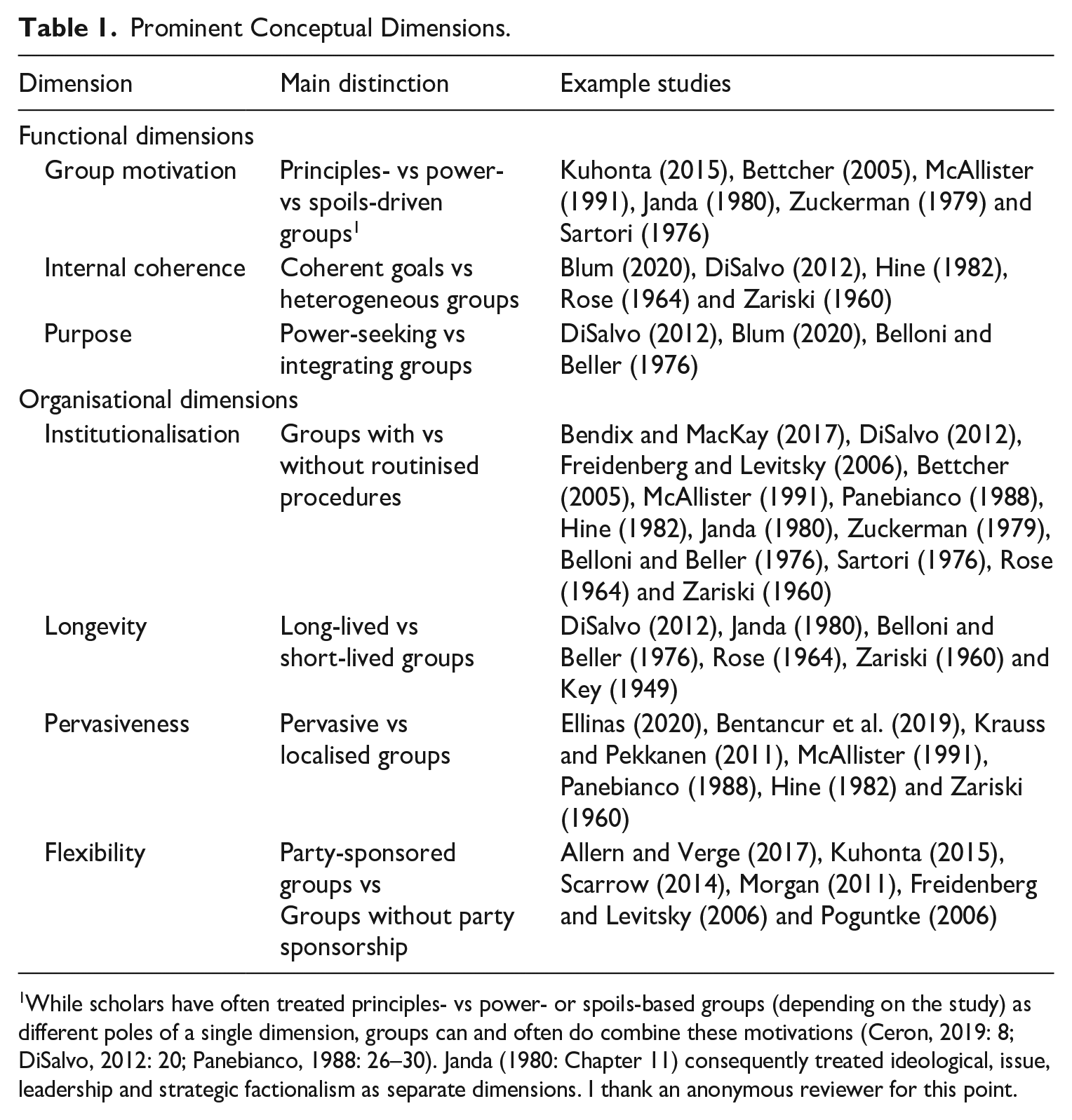
While scholars have often treated principles- vs power- or spoils-based groups (depending on the study) as different poles of a single dimension, groups can and often do combine these motivations (Ceron, 2019: 8; DiSalvo, 2012: 20; Panebianco, 1988: 26–30). Janda (1980: Chapter 11) consequently treated ideological, issue, leadership and strategic factionalism as separate dimensions. I thank an anonymous reviewer for this point.
The factionalism literature has often distinguished between groups motivated by ideological principles or policies and those seeking spoils 2 or positions of power (Bettcher, 2005: 342; Kuhonta, 2015: 286; Sartori, 1976: 76–79; Zuckerman, 1979: 15–16). However, motivational categories are unsuitable for demarcating group types. Similar to factions, party branches and auxiliary organisations can be as much carriers of new policy ideas as they can seek to collect spoils or place ‘their’ candidates among the party’s office holders (Filippov et al., 2004: Chapter 6; Müller and Steininger, 1994). Cliques, tendencies or wings can also be associated with policy or ideological positions and/or specific leadership candidates (Beller and Belloni, 1978: 419–420, 422–423; Zariski, 1960: 36, 44–45). Arguments that tendencies or wings do not engage in collective action usually focus on their (lack of) organisation rather than their motivation (DiSalvo, 2012: 5; Hine, 1982: 38). Similarly, the fact that factions, once stripped off any ideological baggage, have been observed to fragment into numerous groups (e.g. Boucek, 2012), whereas the number of party branches and auxiliary organisations tends to be stable, is linked to constraints around how factions form rather than their motivation – a point further developed below.
Scholars suggested that factions would pursue coherent goals, like getting particular candidates elected or achieving a specific policy agenda, whereas wings or tendencies would advocate only loosely connected attitudes (Blum, 2020: 20–21; DiSalvo, 2012: 6; Hine, 1982: 39; Rose, 1964: 37–38). Cliques would primarily focus on local matters, and auxiliary organisations and party branches would be internally divided on the same conflicts as the entire party (Poguntke, 2002: 59; Zariski, 1960, 1965). However, finding an indicator for internal coherence is difficult. Having a manifesto or submitting motions or candidate slates at party conferences could be used to demarcate factions from wings, tendencies, and cliques. Yet, many party branches and auxiliary organisations also put forward motions or candidates at party conferences, and some auxiliary organisations and party branches in federal systems even have their own manifesto.
DiSalvo (2012: 6) has defined factions as primarily seeking the power ‘to change (or prevent the change)’ of a party’s policies, priorities or office holders, while party branches and auxiliary organisations seem to mainly integrate specific constituencies within the party. However, many party branches and auxiliary organisations also have their own agenda with regard to selecting candidates and formulating the party’s platform (Poguntke, 2002: 49–51, 2006: 402). In turn, factions have also helped integrate groups (Boucek, 2012: 36; Chandra, 2004: 107; McAllister, 1991: 209), and even loose groupings of likeminded party members can stimulate joint policy initiatives and provide a sense of identity (Bendix and MacKay, 2017). Intra-party groups can thus fulfil several purposes (Belloni and Beller, 1976: 545–547; Beller and Belloni, 1978: 437–442).
Institutionalisation refers to factions, unlike loosely connected wings or tendencies, typically possessing a name and leader(s) recognised within the party, holding formalised meetings, and having its own resources and procedures to choose positions and candidates (e.g. Belloni and Beller, 1976: 544–545; DiSalvo, 2012: 5; Hine, 1982: 38; Rose, 1964: 37). Yet, all this also applies to party branches, auxiliary organisations and even cliques, which often rely on ‘a local machine’ (Zariski, 1960: 36).
Finally, scholars highlighting factions’ high institutionalisation also usually highlight their longevity compared with short-lived cliques (DiSalvo, 2012; Key, 1949; Zariski, 1960). However, party branches and auxiliary organisations are also usually long-lived (Allern and Verge, 2017; Poguntke, 2002), while the longevity of wings and tendencies has remained contested (DiSalvo, 2012: 5; Rose, 1964).
Thus, the dimensions discussed so far are not necessary and together sufficient to differentiate between intra-party groups (Table 2).
Intra-party groups along functional and organisational dimensions.
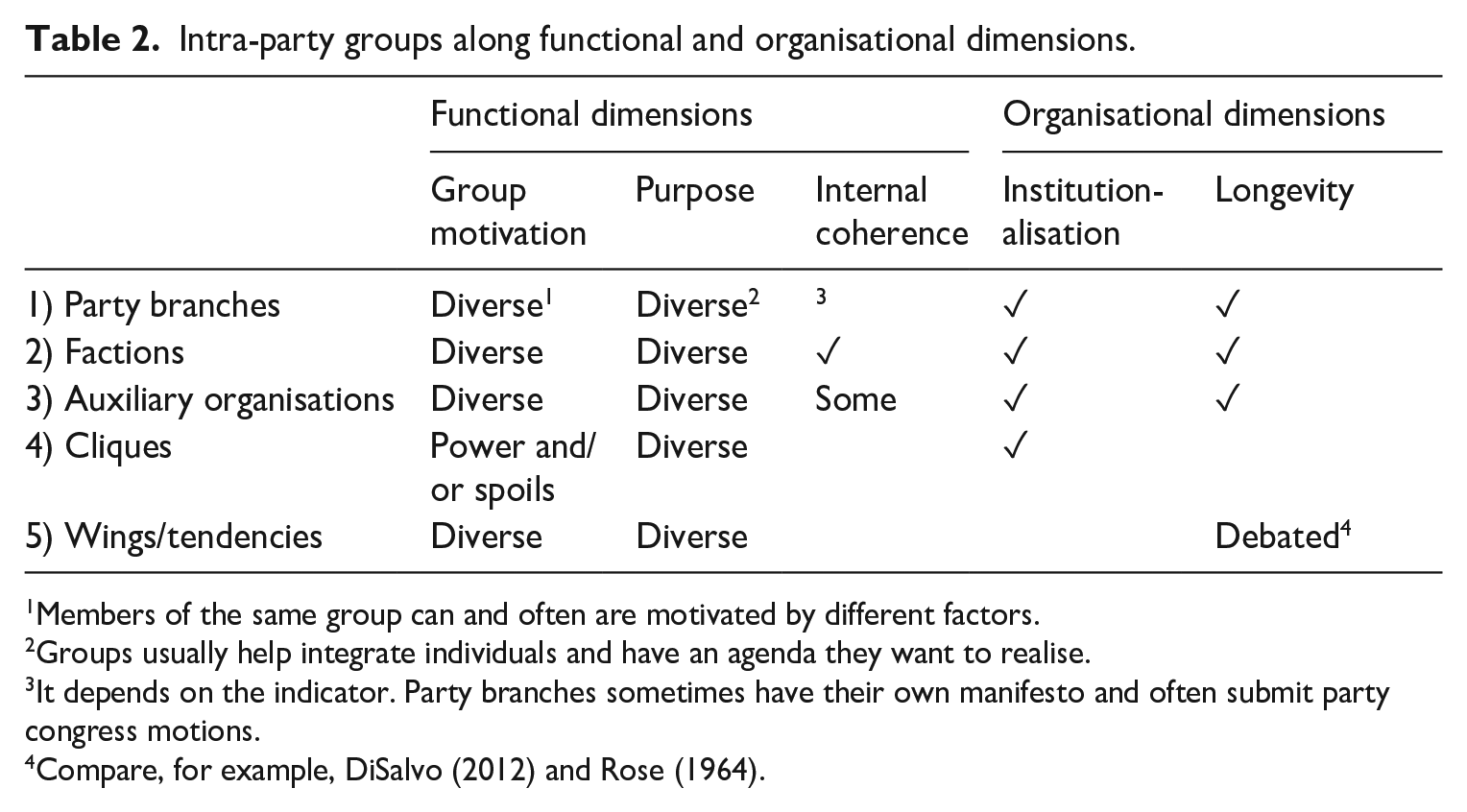
Members of the same group can and often are motivated by different factors.
Groups usually help integrate individuals and have an agenda they want to realise.
It depends on the indicator. Party branches sometimes have their own manifesto and often submit party congress motions.
Compare, for example, DiSalvo (2012) and Rose (1964).
Building a New Typology of Intra-Party Groups
Bringing together the literature on factionalism and party organisations helps distinguish between different types of intra-party groups and enhances our understanding of how parties organisationally incorporate different interests. The factionalism literature has studied intra-party groups’ properties (as reviewed above), whereas the party organisation literature has investigated how different parts of the party constitute the party as a whole. Taken together, they suggest two dimensions that distinguish between four types of intra-party groups based on their links with the host party (Table 3).
Typology of Intra-Party Groups.
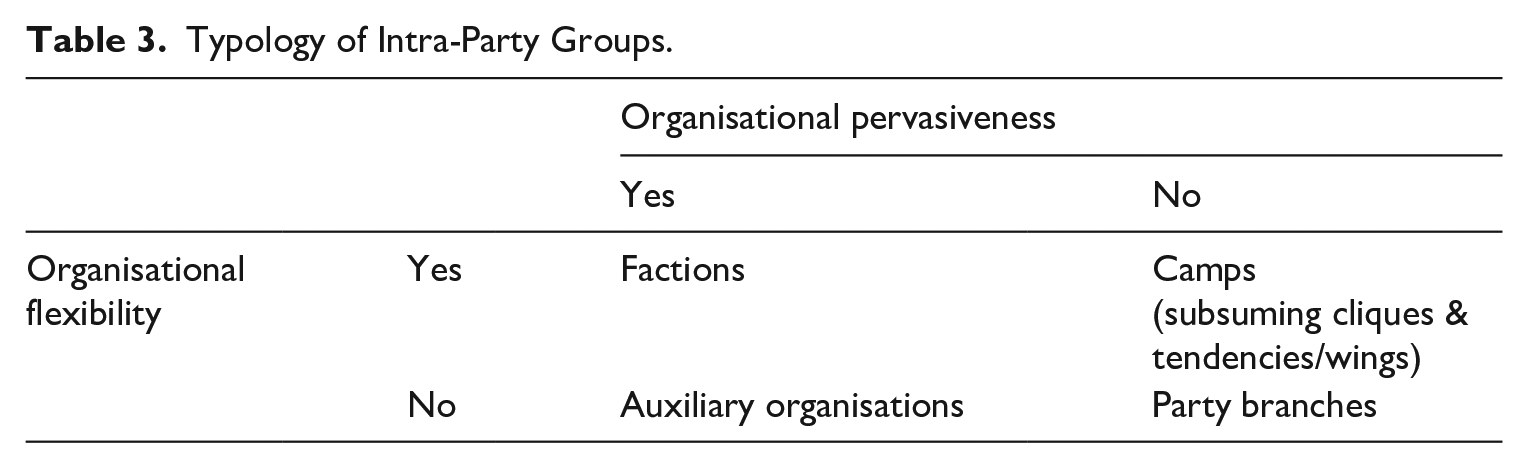
Organisational pervasiveness refers to the extent to which a group penetrates the different levels and layers of a party (Ceron, 2019: 7; Close and Gherghina, 2019: 6). Political parties are composed of vertical and horizontal layers or levels, running from the local to the national membership level and public office (Eldersveld, 1964). Intra-party groups differ in the extent to which their organisation penetrates these levels. Party branches are, by definition, restricted to the country’s administrative unit for which they have been created (Katz and Mair, 1993). While we find candidates from a party’s subnational branches among its office holders at the national level, the membership of a specific regional party branch does not diffuse to a branch of the same party in another region. Cliques have usually been conceived as geographically concentrated groups, often centring around a local leader or machine (DiSalvo, 2012: 5; Zariski, 1960: 36), whereas wings/tendencies lack any notable organisation that could be diffused across party levels (Hine, 1982). In contrast, auxiliary organisations are usually set up as functionally rather than territorially devised units alongside local and intermediary party branches to facilitate ties with society across all party levels (Poguntke, 2002: 49–53; Allern and Verge, 2017: 121–122). In turn, many scholars have highlighted that factions are active and often exist to build networks across these territorial and functional units (Greene, 2007; Krauss and Pekkanen, 2011; McAllister, 1991).
The organisational flexibility dimension emerges from research distinguishing between the central party, characterised by the party leader and meetings of the party congress or executive committee, and groups that compete for influence within the central party. The central party can incorporate intra-party groups in different ways (Morgan, 2011: Chapter 2; Poguntke, 2002, 2006; Scarrow, 2014: Chapter 3). Morgan (2011: 55) has mapped interest incorporation onto a dimension between corporatism, whereby intra-party groups are guaranteed access to posts and central meetings, and pluralism, under which groups compete more openly for influence. The PPDB has operationalised this by looking at whether and how groups are mentioned in the party statutes (Poguntke et al., 2020). In turn, many parties, particularly outside of Europe, are informally organised (e.g. Freidenberg and Levitsky, 2006; Kuhonta, 2015). In formally organised parties, grassroots activities like recruitment and campaigning are carried out by ‘official subunits’ that are created by and have formal ties with the central party. In informally organised parties, subunits often emerge ‘without the permission (or even knowledge) of higher-level authorities’ and frequently take forms not recognised by party statutes (Freidenberg and Levitsky, 2006: 183). Intra-party groups thus differ in whether they have formal ties with the central party.
Knowing that factions are intra-party groups that are organisationally ‘woven’ into virtually all party levels while being free to form helps clarify what attributes other group types are missing (McAllister, 1991: 209). Party branches lack factions’ organisational flexibility and pervasiveness. Auxiliary organisations’ members and meetings can typically be found across party levels, but their formation depends on the party’s approval. Party camps include the flexible and relatively unorganised connections between people with similar views or identities (e.g. based on ethnicity or religion) that previous studies have called tendencies or wings. They do not necessarily have a formal organisation with clearly recognised leaders but may sometimes develop procedures to coordinate activities at a certain time and place in the party hierarchy, like the party’s legislative caucus (e.g. Blum, 2020: 80). Party camps thus subsume tendencies/wings and cliques into a single group type. As their procedures and coordinated activities spread across party levels, camps gradually transform into factions whose organisational pervasiveness encouraged scholars to describe factions as ‘political parties in miniature’ (McAllister, 1991: 209).
Putting the Typology to Work
Figure 1 summarises the criteria and kinds of evidence to put the typology to work. This section will outline these steps, make suggestions for how to deal with borderline cases and suggest strategies to move from a focus on intra-party groups towards drawing conclusions about the party at large.
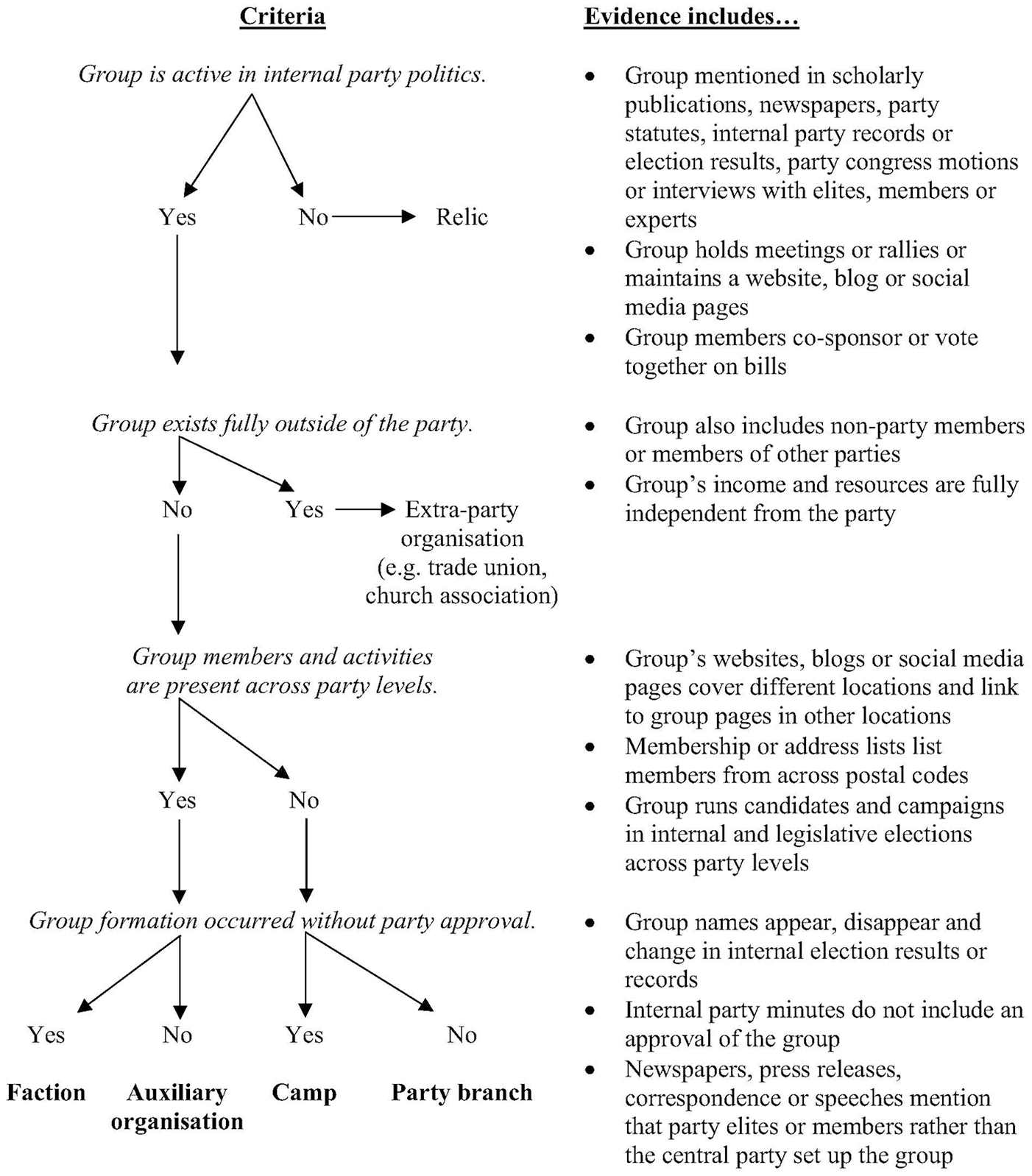
Summary of Criteria and Types of Evidence.
Step 1
Putting the typology to work requires establishing the population of groups for each party and period of interest. Party statutes tend to list party branches and auxiliary organisations as the groups set up by the host party (Poguntke et al., 2016, 2020). To identify groups not listed in the party statutes, we can review how scholars, politicians, party members or journalists described the party’s internal politics (Blum, 2020: 14–15; DiSalvo, 2012: Appendix; Greene, 2007: 190). Internal election results, speeches and (party) newspapers also often mention groups active within the party (Bentancur et al., 2019: 72; Boucek, 2012: 148–149; DiSalvo, 2012: Appendix), and some groups also maintain their own website or social media presence (Blum, 2020: Chapter 4; Skocpol and Williamson, 2012: 90–91). To ensure that these groups are not empty shells, scholars have often looked at activities like organising meetings and rallies (Bentancur et al., 2019: 54–55; Ellinas, 2020: 80–93; Krauss and Pekkanen, 2011: 101–102, 115). This focus on collective action, finally, has been at the heart of studies identifying intra-party groups by looking at party congress motions, roll-call votes or the co-sponsorship of bills (Bendix and MacKay, 2017; Blum, 2020: Chapter 6; Ceron, 2019: Chapter 2).
It is important to demarcate intra-party groups from the autonomous organisations that political parties often interact with, like trade unions, peasant organisations or church organisations (Allern and Verge, 2017: 108–109; Blum, 2020: 20; Ellinas, 2020: 48). These groups exist fully outside of the party, with both having separate organisations, focus areas and identities (Rahat and Kenig, 2018: 51; also Yadav, 2021: 177; Poguntke, 2006: 397–398). By contrast, intra-party groups exclusively ‘use the machinery of the host party to effect change’ and ‘mobilis[e] within’ that host party (Blum, 2020: 18–19).
Step 2
To investigate each groups’ organisational pervasiveness within their host party, we can search for the presence of group members and collective action across party levels. Blum’s (2020: Chapter 4) approach of studying the Tea Party as a network within the GOP is a useful illustration. She used local Tea Party groups’ websites, blogs and social media pages to geocode the groups based on their zip codes and then used the hyperlinks on the groups’ websites to reveal the connections between localities (and with external organisations). Membership and address lists, published by newspapers or the group itself, also provide information on their organisational pervasiveness (Krauss and Pekkanen, 2011: 101–102).
We can also look at the spread of the group’s candidates and campaigns in internal and legislative elections. Bentancur et al. (2019: 71) explained that factions in Uruguay’s Broad Front party (FA) often presented candidates and campaigned for votes in districts across the country. They contrasted factions’ nation-wide reach with the very limited geographical scope of the party’s base committees, which have been the FA’s other main type of internal group, by presenting survey data on the distance between members’ home and their base committee (Bentancur et al., 2019: 50–51). While the base committees delegate members to intermediary and national party meetings, the motions, statements and votes at these meetings alongside interviews with participants evidence that these delegates were not co-opted by the factions but represented their localities (Bentancur et al., 2019: 75–79, 128–131).
Step 3
To investigate groups’ organisational flexibility, looking at their origins is insightful. The party politics literature usually regards party branches and auxiliary organisations as the central party’s official representation at the subnational level and in public office. Their formation typically requires some sort of party approval, and this approval usually comes in the form of a vote at central party meetings or the leader’s agreement, which is typically recorded in the party’s internal minutes or announced via its press releases or internal publications (e.g. Bentancur et al., 2019: 59; Ellinas, 2020: 72, 78; Poguntke, 2006: 398).
In turn, the appearance, disappearance and change of group names in parties’ internal election results, publications, and members’ and journalists’ accounts of party meetings often indicate organisational flexibility (e.g. Bentancur et al., 2019: 71–72). Figure 2 illustrates this flexibility for the early years of Italy’s seminally factionalised Christian Democratic Party (DC), based on Boucek’s (2012: Chapter 7) study of internal election results and my analysis of party minutes and newspaper articles reporting on party meetings. For each group, finding party leaders stating that the group is not a formal part of the party or threatening to expel the group for violating party discipline would constitute evidence that it did not depend on party approval, as would finding that activists formed the group without involving the central party (e.g. Skocpol and Williamson, 2012: 89; Leonardi and Wertman, 1989: 98).
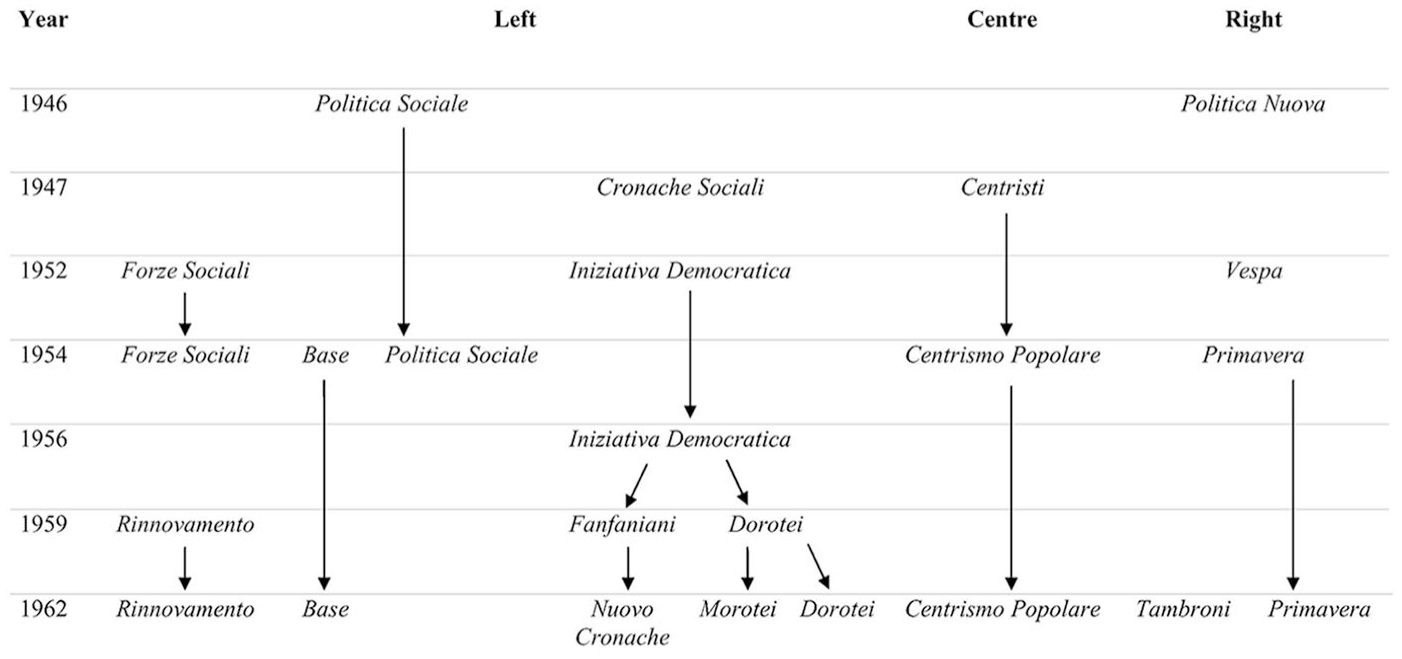
The Organisational Flexibility of the Italian DC’s Correnti, 1946 - 1962.
Step 4
To locate a party’s groups within the typology, we can follow two approaches. With the typology’s constituting dimensions being continuous in nature, its categories can serve as ideal types that anchor a continuous scale. This can be helpful since many groups may fall in-between factions and camps as they are not fully organisationally pervasive. 3 Scholars looked at the size of groups’ membership across different parts of the country, the geographical spread of candidates and legislators affiliated with the group, and the number of activities organised across different districts to measure groups’ level of organisational pervasiveness (Greene, 2007: 190, 205–206; Krauss and Pekkanen, 2011: 115–123; Zuckerman, 1979: 123–127).
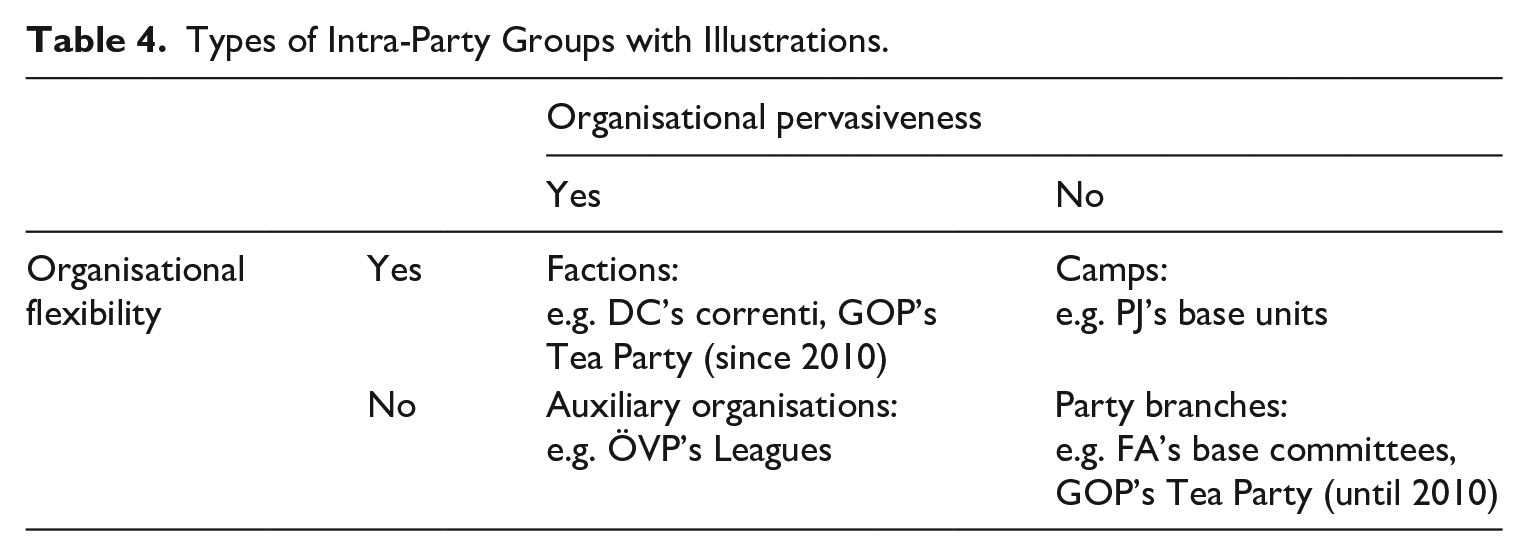
Doing so also helps trace changes in group type over time. The US Tea Party was little more than a ‘mood’ among Republicans before Rick Santelli’s ‘tea party’ rant in February 2009 served as the catalyst for the formation of locally organised groups (Blum, 2020: 7). These groups often emerged explicitly without allowing the GOP establishment to get involved. Supported by national interest groups and media elites, they transformed from camps into a party faction when they started holding meetings and building contact lists to coordinate collective action across localities in the run-up to the 2010 midterms (Skocpol and Williamson, 2012: Chapters 3, 6–8).
Some scholars might prefer leaving out such detail and focus on categorisation to identify the same unit of comparison across contexts. When doing so, the typology helps avoid confusion that might arise as a result of groups’ names. Many base committees in Uruguay’s FA are named after famous activists associated with the political left (e.g. Che Guevara, union leader José Pepe D’Elía) (Bentancur et al., 2019: 60). Their association with a political figure or tradition might erroneously suggest classifying them as factions or camps, whereas their (lack of) organisational pervasiveness and flexibility reveal them to be local party branches.
The typology also helps avoid drawing erroneous conclusions from looking at parties’ statutes. The party statutes name the base committees (Comité de Base in Spanish) in Uruguay’s FA and the base units (unidades basicas) in Argentina’s Justice Party (PJ) as the parties’ official representation at the local level. However, unlike the FA’s base committees, the PJ’s unidades basicas often emerge, operate and disappear independently from the central party (Freidenberg and Levitsky, 2006: 190). Consequently, they are more accurately classified as party camps, underlining the PJ’s informal organisation (Freidenberg and Levitsky, 2006).
Finally, the typology helps clarify the classification of groups associated with class, ethnic or religious identities (see, for example, Arriola, 2012: Chapters 6 and 7; Ceron, 2019: 55–57; Chandra, 2004: Chapter 5; Valenta and Ramet, 2016). For example, Austria’s Christian Democratic Party (ÖVP) has often been considered similarly or even more factionalised than Italy’s DC because its special organisations (called Leagues) for farmers, business and labour professions have been classified as factions (Van Kersbergen, 1995: 28–29). However, the Leagues lack factions’ freedom to form, merge and split, as the host party decided over the formation of new Leagues and the dissolution of existing ones (Müller and Steininger, 1994: 17–20). This difference might explain why both parties experienced very different internal challenges. While the DC struggled to incorporate a proliferation of continuously re-arranging factions (Boucek, 2012: 165), Austria’s Christian Democrats lamented that their Leagues were too static to keep up with the changing composition of society (Müller and Steininger, 1994: 17). Table 4 locates the discussed examples within the typology.
Types of Intra-Party Groups with Illustrations.
Step 5
We usually study intra-party groups to make statements about their host party. Finding out which intra-party groups dominate within different parties in a given period helps describe differences in these parties’ interest incorporation. It helps identify the same unit of comparison across parties and over time and provides the conceptual ground for quantitative measurements. For example, Figure 3 uses Rae’s (1967) fractionalisation index and factions’ internal election results to measure the extent to which a growing number of factions controlled an increasingly similar seat share on the Italian DC’s party council. Obtaining this measurement required, in a first step, identifying the party’s factions and demarcating them from other types of intra-party groups.
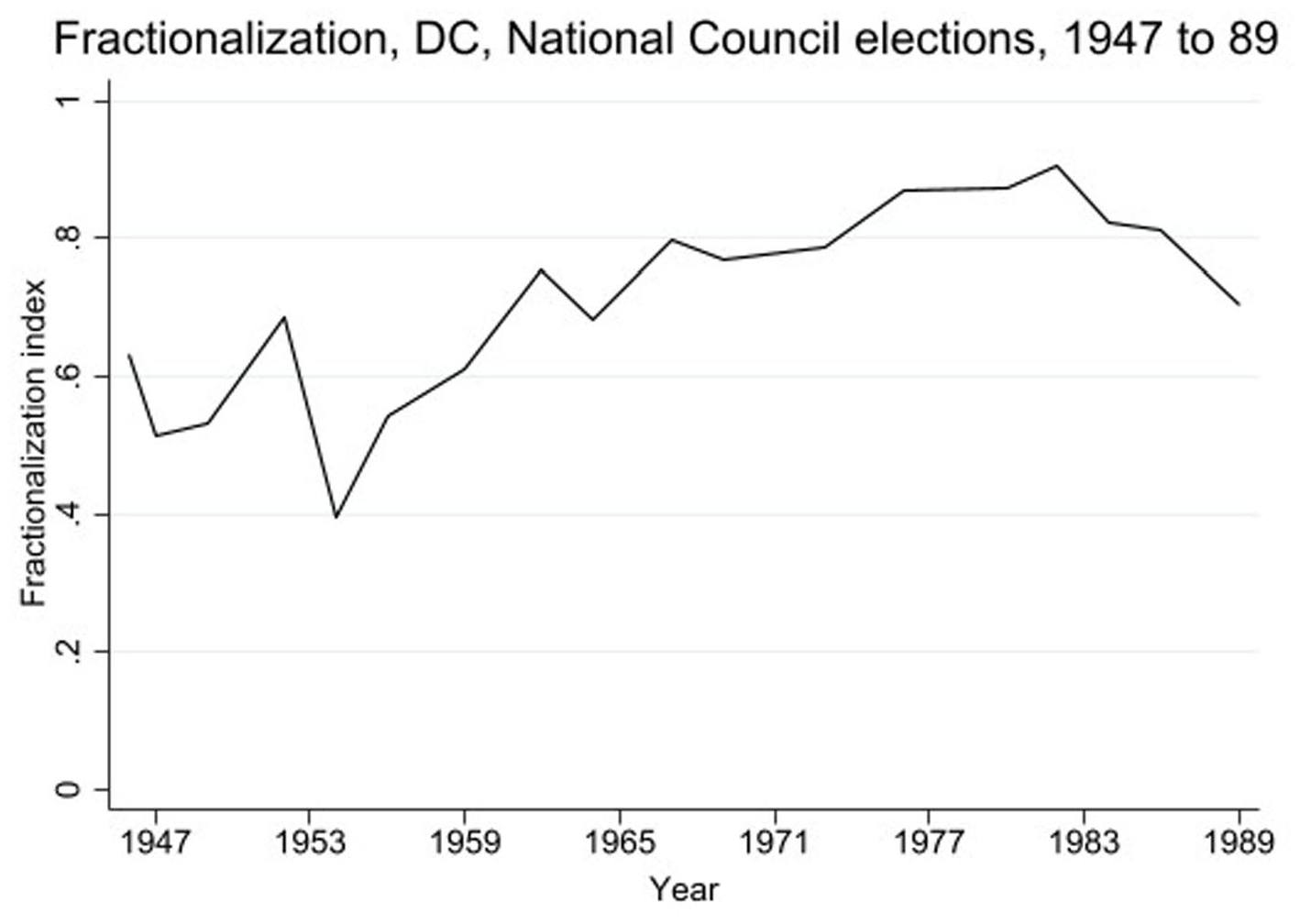
Fractionalisation of DC Party Council among Party Factions.
Conclusion
While scholars have often found it useful to distinguish between different kinds of intra-party groups when studying how political parties link society and politics, a plethora of definitions and labels made it difficult to do so systematically and thus posed an obstacle to accumulating knowledge across studies. Bringing together the literature on factionalism and party organisation, this review addressed this gap. I reviewed the characteristics ascribed to the prominent types of intra-party groups in the literature and showed that most characteristics do not produce a matrix that differentiates between groups. The article proposed such a matrix by building on two dimensions. Organisational pervasiveness across party levels and organisational flexibility vis-à-vis the central party clarify the differences between party factions, branches, auxiliary organisations and camps. The article ended with suggestions for how to put the new typology to work. By reviewing studies on parties in very different contexts and countries, the article suggested the typology’s broad applicability as a step towards integrating the rich scholarship on party politics in different parts of the world and systematising our understanding of the diversity of intra-party groups.
Footnotes
Acknowledgements
The author thanks Agnès Alexandre-Collier, Georgia Kernell, Karina Kosiara-Pedersen, Robert Thomson, Audrey Vandeleene, the participants at the ECPR 2021 Joint Session, and two anonymous reviewers for their very helpful comments and suggestions.
Declaration of conflicting interests
The author(s) declared no potential conflicts of interest with respect to the research, authorship and/or publication of this article.
Funding
The author(s) received no financial support for the research, authorship and/or publication of this article.
