



Abstract
This study maps the interactions of the Hindutva brand of political populism, which is in rise in India, with the feminist politics and concerns. To study this interaction, the article qualitatively studies the phenomenon of Hindutva-populism and feminist politics and uses the Bhartiya Janata Party, the Hindu-rightist political party, as the site to explore the gendered political culture and the complex relationship that populism and feminism share on the women question in their quest for political and social transformation in India. For this purpose, the article focuses on the broad themes, highlighting the differential visions of both projects, of: the lens through which the problems are diagnosed, the solutions proposed to these problems and the role of the related variables such as power, state and leadership, which puts them in a fundamental clash with each other.
Introduction
‘Feminism’, ‘MeToo’, ‘Equal Rights’ we cry,
And then straight go serving plates for the ‘kings’ with a happy sigh.
They allow us. We are modern now. We allow.
Some tears go into making of the dough;
But at least this much can be said without a doubt,
That we all are certainly feminists now.
The Hindutva politics in the Indian political scene and the corollary populist attitudes it espouses have been witnessed as a politico-cultural ideology, a handy political tool, an electoral strategy – all combining to form quintessential elements of rightist politics. This article explores the interplay of Hindutva-populist attitudes and feminist politics through a case study of the Bhartiya Janata Party (BJP), the current ruling party in India that showcases itself on the gender front as a progressive ally for ‘female empowerment’ despite its support to deeply patriarchal cultural ramifications of the core Hindutva-logic. We analyse the discourse being set by the party leaders, observing participants and in-depth interviews with grassroots members, activists and voters in the recently concluded 2022 state assembly elections in Uttar Pradesh (U.P.). Our study reveals fundamental incongruities between feminist and Hindutva-populist projects of political ideals and the trajectories to achieve them. These conflicts include the reductive logic based on cultural patterns based on Hindutva ideology which frames certain ex-cathedra ideals for Indian womanhood, inconsistent with demands of the feminist movement, and a faulty diagnosis of progress based on the women question. This spans positions like: What are/should be the roles of men and women in the society? Where do each belong? Is/should there be a socially constructed functionality to each of these categories? This analysis of the ruling dispensation and its populist strategies of working gives a unique site to understand the inherent tensions between the two projects of political transformation seen in India – which has a societal fabric of the rigid-traditional along with the ‘woke’ strands. One of the central findings of the study deals with the co-opting of the feminist ideals by BJP and the other Hindu-rightist groups within the Sangh Parivaar (the Sangh-family, which includes the Rashtriya Swayamsevak Sangh (RSS), BJP, Akhil Bhartiya Vidyarthi Parishad (ABVP), Vishwa Hindu Parishad (VHP) and other associated organization based on Hindutva ideals), which has resulted in broadly two competing notions of what constitutes the ‘women’s question’. The article explores the idea of ‘female empowerment’ inhabiting these different worlds and finds how the dominance of one of these notions plays out in an electoral democracy of a developing nation with a rightist party at power, which spells out the resonance that the mass voter base has with the conservative values of Hindutva-rightist forces.
The Hindutva-Populism and Feminist Politics
The article explores myriad dimensions in which Hindutva-populism and feminist politics intersect and contradict, preparing a conceptual ground for an analysis of the political discourses set by BJP and what comes out in practice, as seen in the perception of the voter base. These dimensions include the different lenses used in the diagnosis of the political problem, proposed solutions concerning type of leadership and its role, an assessment of representative democracy, role of the state and the nation and conceptualization of political change that the two projects envision.
The Hindutva-Populism
Populism, in all its forms and varieties, has been subject to intense debates on issues of democracy, legitimacy, majoritarianism and identity politics. The analysis in this article draws upon Mudde’s (2004) distinction between the masses and the ‘elite’, where the populist leaders assert in themselves a volonté générale, the ‘general will’ (Kriesi and Pappas, 2015; Mudde, 2004; Mudde and Kaltwasser, 2017), a framing of a special, imaginary bond between the voters and the populist leaders (Mudde and Kaltwasser, 2017). The other characteristic traits often identified with populism are: persuasive, charismatic style of leadership, assertion of a sense of nostalgia about a glorious, distant (alleged) past, an emotional longing and an ‘emotional governance’ (Richards, 2013) for bringing forth that past into the future for the native land (Abts and Rummens, 2007; Kampwirth, 2010; Kriesi, 2014). This longing for the homeland and the nostalgia for the ‘heartland’ are elemental tools of pitting the masses against the ‘others’ and the elites – the establishments which were neutral (Caravantes, 2021; Elchardus and Spruyt, 2016; Rydgren, 2012; Wodak, 2015).
Hindutva provides a political dimension to Hinduism, which many followers see as more of a cultural civilization and a ‘way of life’ than simply being a religion. A popular and culturally lasting definition of the Hindu-homeland and a clear demarcation of who is not a Hindu was made by the Hindutva ideologue Savarkar in the 1920s, who says, ‘A Hindu means a person who regards this land . . . from the Indus to the seas as his fatherland (pitribhumi) as well as his holy-land (punyabhumi)’ (Savarkar, 1923). The definition makes being a Hindu, and as a corollary, being given the full, true citizenship, to an individual incumbent on the geographical-nativist, genealogical and religious factors, unequivocally ousting the Muslims and the Christians from this claim, and thus making them liable to be questioned on where their loyalties lie. This line of thought continues in Golwalkar, who gave more concreteness to the concept of Hindu Rashtra by essentializing the nationhood to ‘kultur’-civilization based on one’s birth and race (Jaffrelot, 1996: 53), and framing the Muslims as foreigners undermining this nationhood (Jaffrelot, 1996: 55).
Ignazi (2003) gives certain characteristics of populist politics: obsession with nationalism and nativism, a form of racism, an atmosphere of xenophobia, calls for reinvigoration of democracy, and need for strong, centralized state, directed by a strong leader, which fit the Hindutva brand of populism. This rightist populism builds a case for an exclusionary and essentialist conception of the masses, making the Hindus the subjects of their appeals, and elements of anti-elitism, popular sovereignty, and the ‘people’ as being wise and virtue-holding – have a strong interplay in its functioning (Schulz et al., 2018).
This variety of politics adopts various strategies to ascend to political rule: a sense of wrongful usurpation of the rights of the masses by the elites is invoked, and there is a construction of images of these ‘powerless masses’, in the case of Hindutva-populist politics, the Hindus, thus making an appeal to ethnicity, religion and nationality as the basis for excluding the usurping elite and the ‘others’ who do not belong (Mudde and Kaltwasser, 2013). This is based on the idea that states should be inhabited exclusively by members of the native group ( ‘the nation’) and that non-native elements are fundamentally threatening to the nation-state’ (Mudde, 2007: 22).
The main goal of populist leaders seems to aim for electoral wins, posited as a mechanism for bringing about political changes. In rhetorical discourses, the nuances and complexities of issues like secularism, pluralism, multiculturalism are set aside by framing the ‘anti-nationals’, and the ‘others’ are construed as aiming for the destruction of the ‘pure nation’ (Pelinka, 2013). In the case of Hindutva nationalism, the debates often tread on the thin line of giving way to either secularism or communalism, often dividing along the either/or lines as the perceived threats to one’s sense of identity or one’s social group trigger feelings of anger, alienation or disenfranchisement (Belmi and Laurin, 2016). These discourses identify the undeserving others to bring about ‘rectificatory’ measures. In this milieu, feminist politics and its critical approach to looking at things often end up at the ‘other’ end of this cultural-biological continuum in the construction of the nation (Butler, 2004; Kinnvall, 2017; Norocel, 2013; Yuval-Davis, 1997).
Feminist Politics
Feminist politics and feminist movements take various forms, but for the purposes of this article, the focus has been on scrutinizing the replication of gendered and hierarchical traditional norms within political parties and political institutions; it is taken as the tool which dismantles and questions the structural inequalities enabling hierarchies that bar inclusive political representation. It is this tool which seeks to enhance the formal as well as substantial women’s representation, focuses on mainstreaming the marginalized, and thus strikes a discordant ripple in structuralized patterns of traditional, dominant gender roles in parties, political institutions and organizations. Here, inclusivity becomes a core concern – as a yearning to become an active participant in the system that rules them, while construction of a collective Hindu identity is at the core of Hindutva-populist politics. While the political movements following essentialist perspectives seek a unifying political ideal, which excludes many groups which are non-represented, their struggles unvoiced, thus reproducing the same tilted structure that works with the exclusion of the oppressed and the marginalized, to create a unanimous ‘ideal’ to aspire towards (Young, 2000). The intersectional examination, however, throws light on how the interactive dynamics of gender, class, caste, race and other systems of categorization duplicate subordination and discrimination in differential degrees, thus rejecting the idea of a single political subject in the universalist formulations, as against taking into account the particularist and local contours (Singh and Parihar, 2022).
Feminist movement and politics also focus on realizing the idea of equal humanization of all sexes, in pursuit of which it rallies behind the ideas of empowering the downtrodden, facilitating non-dependent agency for them and granting recognition to them as independent subjects by all, leading to their equitable participation, moving towards an idea of collective empowerment of all. To bring forth political change in this direction, it promotes a revolutionary transformation of political institutions, accompanied by interventions to make substantial changes. There are debates and various stances of feminist advocates on questions of power and the state and what role they would play in bringing about these changes – whether there should be re-modelling of the concept of power to pattern it in a horizontal, shared, heterogeneous, inclusive fashion to displace the attributes of the traditional notion of it as being exclusionary, vertical, assuming objectivist-rationality; or whether to take an instrumentalist position on power to see it as a ‘resource’ to make interventions (Celis and Lovenduski, 2018).
Hindutva-Populist Politics and the Feminist Discourse
The emergence of right-wing populism across the globe and the simultaneous augmentation of feminist movements and discourses along with, has inspired scholarly interest in studying the relationship between the two (Kantola and Lombardo, 2019). Many research studies identify how the populist leaders and the discourses espoused by them come into an interaction of contradiction with gender politics by the incessant use of masculinist imagery in speeches and glorification of male attributes (Köttig et al., 2017; Mudde and Kaltwasser, 2015; Norocel, 2010), by use of language weaponizing the new ‘people’s man’ as the one mitigating all the ails created by the previous ruling elites. The populist parties, in their very structure, model a charismatic, male leader. The populist appeals to a majoritarian ethnic group brushes over the diversities and the differential gendered and caste dynamics. Much of this research identifies populist politics as having little to no interest in the question of women’s emancipation, instead using it as a strategic manoeuvre to target the backwardness of the ‘other’ cultures (Sauer et al., 2017). Many members of the BJP have been seen brandishing themselves as faces of female empowerment by calling out measures such as legislation on the Muslim practise of triple talaaq 1 as being motivated by concerns for gender equality.
Communal politics features as one of the major keywords used in election campaigning, in speeches made by prominent party leaders, and even flagrantly in the legislation passed in BJP-ruled state assemblies and the national parliament. This polarization has a gendered impact as it sets a split into the very category of the female based on religious affiliations. Specifically, Hindutva-populism does this by making a distinction between Hindu-nationalist women and the ‘other’. This ‘other’ can be the women belonging to the non-Hindu group, who should assimilate culturally, as seen in the hijab row, showcasing increasing hate-crimes against minorities, which embroil within it questions of female bodily autonomy, secularism, and patriarchy (Rahman, 2022), or in the form of the need for protection of these Hindu women from the other evil men of the non-Hindu group, who are constructed as the conspirators of the love-jihad programme.
This process of ‘othering’ has gained a new currency in present times; however, it finds roots in the subcontinent’s tumultuous past. Butalia (1995) identifies the partition as the marker of the drastic changes in communal relations shaped in the Hindu-imagination, which crystallized the Muslim male as predatory, and hence, the violence against them gets justified as a defence, not an offence. This community memory serves hostility even today, as debates about Pakistan, Muslims and victimized Hindus, particularly Hindu females, become inevitably entangled in news debates, from which they percolate into middle-class Hindu family discussions.
Both these assertions take away the agency of women and derive authority from the cultural lineage of the Manusmriti, wherein women are always in need of protection by the patriarch-within the household, or have to be managed outside politically, since they cannot be trusted to take decisions on their own. This lineage is in no way covert, as Ajay Singh Bisht, popularly known as Yogi Adityanath, a prominent member of the BJP and the current Chief Minister of Uttar Pradesh (the state with the largest number of constituencies in national elections), wrote on his personal website in 2014, being the Chief Minister: Considering the importance and honour of women . . . our scriptures have always spoken about giving her protection . . . As energy can go waste and cause damage if left free and uncontrolled, women power also does not require freedom, but protection . . . it is these protected women that give birth to mahapurushas (great men) (Krishnan, 2017).
He went on to say that women who acquire male traits turn into ‘rakshasas’ (demons) (Krishnan, 2017). This ‘hyper-patriarchy’ as Andrea Tara-Chand calls it, leaves women, individually as well as collectively, to engage in counter-hegemonic resistance (Tara-Chand, 2019), but this too comes to those who have privilege. This voice, which speaks of modern feminism and voices the concerns of the female, is an independent agency and what Yogi calls ‘rakshasas’—the free, powerful feminine, and is found on what we call ‘islets of feminism’ in India. These are the small islands of the voices of modernity, which float in the vast oceans of the traditional feminine, which finds representation in the religious scriptures, customary precepts, the ideal mother, the ideal ‘grahini’ (house-wife), a very essentialized version of what womanhood means. Chatterjee (1989) argued that in the nineteenth century, nationalism neatly demarcated between domestic and feminine, and masculine and private. However, this debate continued to wobble, developed fractures during the 1980s, when Hindutva groups recruited women in large numbers to come out in public spaces, and continues to be negotiated even now.
The ‘authentic voice’ embedded in the general will of the ordinary masses (Inglehart, 2016) takes it upon itself to set things right by cementing and providing legal backing to the as-yet communally fractured society through policy initiative or direct law-making. This social reality is further augmented by setting up a virtual social reality, contributing to cementing this ‘collective identity’ and sense of ‘community’ (Caiani and Parenti, 2009; McCauley and Moskalenko, 2008).
Feminists have been critical of the resultant essentializing of women, compartmentalizing them in traditional roles of being a ‘mother’ – bearing, caring, and functioning within the private sphere, therefore making no way for positive policy changes or interventionist measures. In this context, critical research questions on the relationship between the Hindutva brand of populist politics and its impact on gender politics becomes a site to explore questions like the incompatibility between the two projects, their differing visions, and an examination of gender politics within the BJP itself, a party which came upon the national political stage in the 2014 general elections of India with an overwhelming majority, riding on the so-called ‘Modi-wave’ built upon the popular discontent with the erstwhile Congress party which was riddled in the mire of corruption allegations, economic crisis, and a wide perception of it being apathetic to the masses and their concerns.
These competing visions have led to two competing notions of what ‘women empowerment’ means. While one is the modern feminist version, in alignment with the #MeToo ideals, which targets patriarchy as the cause of inequality, the other is rooted in cultural notions and affirms the ‘natural differences’ between men and women, and would target the ‘social deviants’ for protecting women and this natural hierarchy, to ‘allow’ females to become the role-models that the Indian culture ordains for them. This is considered empowerment for women, society and the nation. The stark differences in these linguistics are often differences because of the privilege 2 -positionalities, and the starkness often makes one of these languages unintelligible to the speakers of the other. The latter is the language of empowerment adopted by the Hindu-rightist groups, which resonates with the masses, seeing the ‘islets of feminism’ as western, alien notions, which would not only not work for Indian society, but would work for its disintegration.
Methodology
The article adopts a qualitative study of political discourses of the populist variety as well as the issue of gender politics and a comparative analysis of both as they interact. The sources used for the purposes of this research are: 30 in-depth semi-structured interviews as the primary data, gathering secondary data from news media, and participant observation. The aim was to study the compounded situation of the co-existence of Hindutva-populist politics and feminist politics, as observed in the public speeches and statements of political leaders of the BJP and the members of the RSS – a Hindu-nationalist organization which serves as the ideologue of the party, and the day-to-day operations of the party and the Sangh. The focus is specifically on the BJP-RSS political culture based on their base orientations: their stated political goals and the prescribed methods to achieve them. The data were collected from student union leaders of ABVP- the student wing of BJP, from party leaders, and the ground-level activists affiliated with the party, their statements and interviews featured in mainstream media, and the voters in Uttar Pradesh 2022 assembly elections. The discourse analysis aims at identifying the BJP’s reading of problems in Indian politics, and the prescriptions for their eradication, and its implications for feminist politics. It was done by studying the writings and interviews of popular BJP leaders after 2014 (when the BJP came to power centrally with Modi as the PM), especially on the topics of female empowerment, Hindu culture, and the development policies of the government. The interviewees were also asked questions to give their views on these issues, and whether they agreed or disagreed with the leaders’ views on these. Semi-structured interviews were conducted with the grass-root members and the student union members of the party in the state of Uttar Pradesh 3 (a politically significant state with major political representation at the national level) between July 2021 and March 2022. The participants were chosen through purposive homogeneous sampling. Twenty were selected from the BJP support rallies from the cities of Mathura, Agra and Varanasi – all three being BJP strongholds, which included the grassroots members and local leaders. The other 10 were the student leaders of the ABVP in some of the central universities of Uttar Pradesh (see Table 1). Contact with the participants in this research was made online as well as at rallies in the run up to the elections in the state. The sample included 15 men and 15 women, with 5 participants belonging to the Muslim community, 1 being Christian, and 24 being Hindus, with ages ranging from 18 to 75 years. The interviews were held for purposes of academic research only, and hence the participants are referenced in this paper by random assignment of values (such as P1, P2, P3). Open-ended questions in a semi-structured format were asked on the broad themes of the party’s political culture, the discourses on feminist politics within the party – at the level of leadership and individuals participating, and the ideal role of men and women in society.
Demographic Profile of the Research Participants.
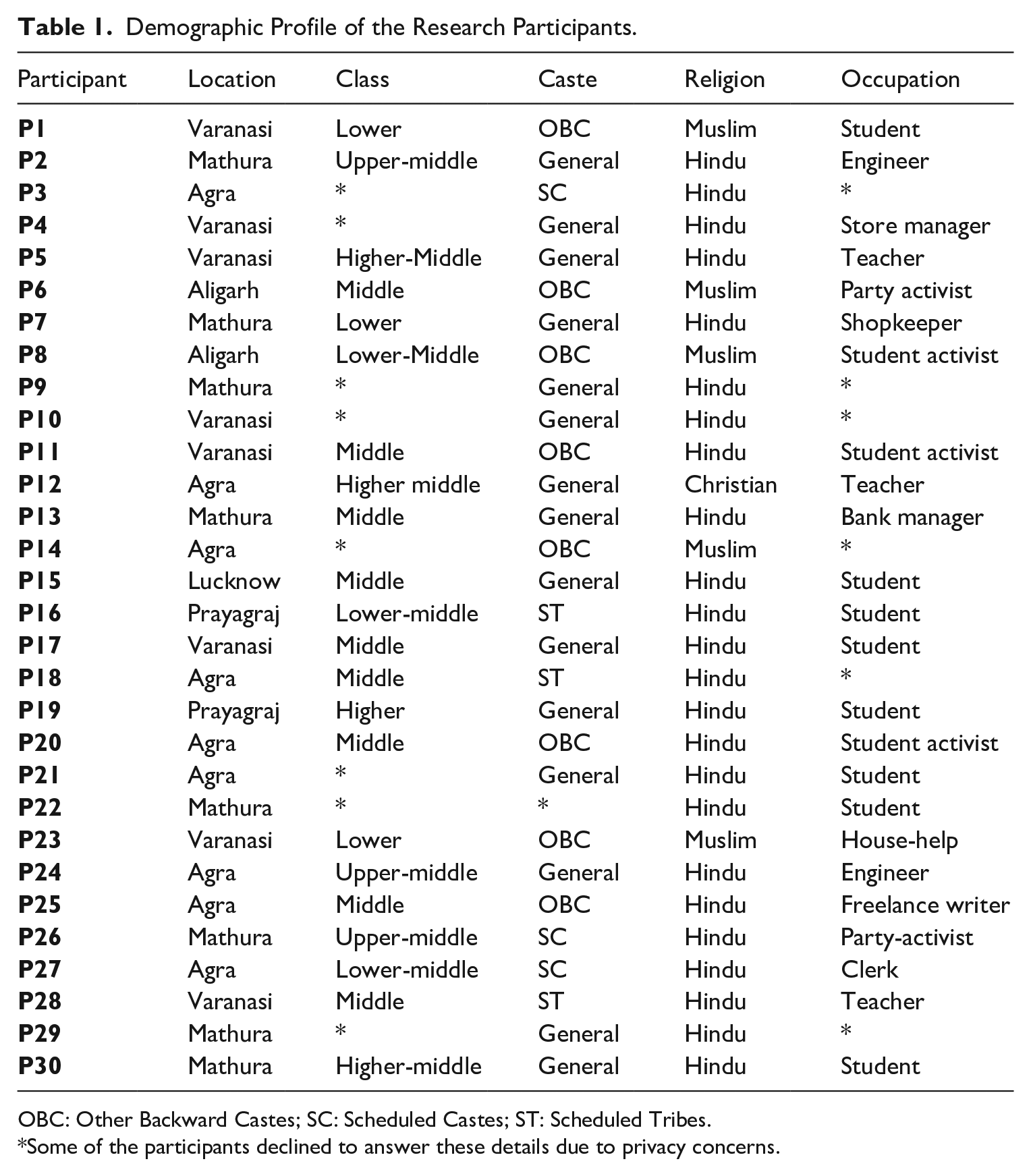
OBC: Other Backward Castes; SC: Scheduled Castes; ST: Scheduled Tribes.
Some of the participants declined to answer these details due to privacy concerns.
For the purposes of this study, we have borrowed the method used by Escobar-Lemmon and Taylor-Robinson (2014) and have formulated the following propositions (PR), which are not necessarily directly testable, but they have corresponding observable implications which are discussed in the course of this article:
PR1: The use of populist tactics, combined with clear objectives in alignment with the Hindutva-ideology, makes the BJP a popular choice among voters in northern India.
PR2: The essentialists are more prone to be co-opted by rightist groups, while non-essentialists often come into direct confrontation with them.
PR3: Largely, the ‘women-question’ gets co-opted within other ideological frameworks, unless the individual in question identifies as a feminist first, and then as any other ideologue.
PR4: In popular imagination, the BJP has become a party that works for real, visible development, is free of corruption, and is linked to the nation’s cultural tools.
PR4a: The import of ‘Indian culture’ takes the form of identity politics and community rights, which further dilute a women’s-rights-based approach.
PR5: For most voters, the ‘women question’ from a feminist perspective dissolves because they see it as a fair trade-off for development and a corruption-free regime rooted in ‘Indian culture’.
PR6: University students (18–25 years) are more perceptive and critical of the party policies with regard to ‘women empowerment’ and the misogyny of leaders than other voters or supporters of the BJP.
BJP: Populist Politics and Feminist Politics Within the Party
The BJP mingles antagonistic strands – rallying on ideas like ‘inclusion of all, development of all’, as well as exclusionary logic exhibited in the daily discourses, which extends to the stances and contradictions with feminist politics. The party frames a structure headed by a charismatic, masculine leadership (the Prime Minister styling himself and his party men as ones with ‘56-inch chest’), with party promising a politics with a difference – aiming to empower women. This demonstrates a clear demarcation between modern feminist sensibilities and the concrete construction of a different definition of ‘woman empowerment’. This is not only a co-opting of feminist ideals, but a projection of a competing strand of the traditional-ideal feminine.
The party posits itself in juxtaposition to the erstwhile ruling party, the Indian National Congress (INC) – branding it as a party built on dynasty-politics and nepotism. Indian National Congress was one of the major associations involved in the independence movement of the country, with leaders like Gandhi, J.L. Nehru and Patel associated with it. After independence, the INC rose to power at both the national and state levels, and it remained an almost unopposed ruling party for decades. It was in the 1980s that right-wing groups gained momentum, and it was in 1998 that the first National Democratic Alliance (NDA) government led by the BJP was formed at the centre. Then, in 2014 and in 2019, the BJP gained majority seats to form a government by itself, which radically changed the coalition-government dynamics that had been at the helm for so long. The BJP brands itself as one built on a democratic-participatory model, targeting the INC, which after independence has been led by the Nehru-Gandhi family and has turned into a ‘family-party’.
People’s Man: Democracy, the Fight Against the ‘Elites’ and Gender Politics
The party leaders frame the socio-political, geo-political, economic crises in India as the deficits to be covered by their new style of politics, confronting the old Nehruvian-Congress styled politics, equating the former with being synonymous with the masses and the latter with the ‘elite’, dynasty-politics, not in consonance with the demands of the masses. The BJP leaders, who serve as faces of the party, like Prime Minister Narendra Modi, or Uttar Pradesh’s Chief Minister Yogi Adityanath, claim their legitimacy as people’s leaders, as outsiders, the ones who challenged the elitist-establishment – the former donning the image of a ‘chai-waala’ (tea-seller) becoming a Prime Minister, and the latter being a priest in a temple; both successfully presenting the right-wing Hindutva politics as a politics of praxis and becoming the faces of cultural far-right populism (Varshney, 2017). The leaders also claim to be invested in measures for women’s empowerment through initiatives and schemes such as the Ujjwala Yojana, launched in 2016, promising free cooking gas connections to rural women in below-poverty-line households, the tag line being ‘Mahilaon Ko Mila Samman’ (Women get dignity), or the ‘Beti Bachao, Beti Padhao’ (Save girls, teach girls), and the rhetoric around their safety and security. The party reproduces the rightist political rhetoric of the construction of patriotic Hindus of the nativist narrative. For the BJP, the core appeal is to these true citizens, those who are accepting of the Hindu way of life, which they claim has been subjected to oppression from foreign rule. The party’s foreign rule began not with imperial European rule, but with the Mughal invasion in the eighth century.
Women feature in party discourse as the half populace which has to be protected from their precarious position in society, but not simply because they have to be treated as individuals in themselves, deserving human rights and dignity as such, but because of the added role they have to play in socially ordained reproductive roles, as the Prime Minister stated in 2014 during a public-speech: Those who see the girl child as a liability should think as to how will mankind survive if we are left in a world with no women . . . If we kill the girl child in the mother’s womb, then what will happen to the world? If only 800 girls are born per 1,000 boys, then 200 boys will remain unmarried (BJP, 2014).
Sikata Banerjee (2012) observes how the themes of masculine imaginations permeate the idea of nation and nationalism, extending to making of a masculine Hindutva. This ideal has traits of martial prowess, muscular strength, moral fortitude, and a readiness to go to battle . . . rooted in a rigid ‘us versus them’ view of nation that becomes implicated in violence and intolerance. Masculine Hinduism also has important connotations for women, whose roles in this environment consist of the heroic mother, chaste wife, and celibate, masculinized warrior. All of these roles shore up the ‘us versus them’ dichotomy and constrict women’s lives by imposing particular norms and encouraging limits on women’s freedom. (Banerjee, 2005)
These notions of essentialized womanhood, deeply entangled with the politics of ‘respectability’ (social constructs defining an ‘honourable’ woman), are fed into the popular awareness of an already orthodox society: A respectable woman is one who avoids eye contact with unrelated men, is modest in her attire, and does not flaunt her ‘dangerous’ sexuality. Her honour, prestige, and reputation (izzat and sharam) are closely tied to the representation of her body and to the male protection that she finds. Women, without the defence of men, can be left extremely vulnerable and easy sexual targets (Guru, 2009).
However, the party members and activists and those affiliated with the RSS do not view the party as a ‘populist’ one, due to the word’s pejorative undertones, but as a party which is aligned with the interests of the people (P4, P5, P8, P10, P26), the leaders of which represent the likes of a common citizen, a participant stating, ‘Could you imagine a tea-seller becoming a PM earlier? It is the common man who is patriotic enough to work for all of us rather than for his family’s corrupt gain. The construction of the image of the Prime Minister as a tea-seller or as a chowkidaar (Watchman) takes over the popular imagination to construct all leaders of BJP as essentially nation-serving, anti-corrupt, hard-working individuals, joining forces to rid India of the lurch it had been left in by previous governments (P8, P11, P14, P18, P20, P24, P26, P29). These statements illustrate the implications of PR1 and PR4, and the ideas persist across the divides of class, caste, religion, occupation, and even the locations of studied areas (see table). This resonance is what propels the party to portray itself as the one serving participatory democracy, in which the non-elite have equal access, focusing on the interests and concerns of the common people and a foray into a politics free from self-indulgence and political corruption. The BJP also promises to be a party providing a platform for strong female representation. The party enjoys an unprecedented popularity across divides, with 37.36% of popular vote in the 2019 national elections (Srimani 2019) and getting 41.3% of the vote share in the recent U.P. legislative elections, an increase from 39.65% in 2017 (Nair 2022). The leaders convey their relatability to common masses by means of their ideology, which provides a clear vision for people to look up to, bringing forth the ideological angle as a tangible element to be used in electoral contestation. This ideology showcases a complete package, writing a whole new grammar of politics, which harkens less on caste identities and seeks to unfreeze caste-identities as decisive elements of political decision-making and makes them more fluid, all the while making religious identities more prominent. The ideological factor resonance seems negligible with the main rival, the Congress party, and other political parties in the fray, which electorally benefits the BJP. The BJP further consolidates its base within the masses by adopting their aesthetics, speaking their lingo, and through performative public appearances within them. This strong identification has helped the party in espousing the language of anti-intellectualism, which it frames as being anti-establishment and as the people’s authentic voice. The conceptualization of discourses on ‘urban Naxals’ and the accompanying violence against this ‘intelligentsia’ is seen as the power of people against the ‘gang’ which enjoyed the luxuries of leftist domination at best, and which hollowed the country from within at worst. However, this positioning of the party leaders and their strategic use of the language also distances them from the common people they claim to be part of, because of a strict hierarchization that is as robust as in the family-dominated structure of the Congress party (P1, P3, P19, P21, P25, P30). ABVP Student members express reservations about certain leaders’ statements and styles, which they consider to be on the fringes and not what the Prime Minister would support. Some of them express hope that the ‘extreme communalization of politics’ and ‘certain members of the party rousing these fires’ (P15) will be reduced once ‘young student leaders and grass-root members are inducted into positions of power within the party’. The party would benefit by asking for votes on the basis of development politics and projects under it to be realized on ground, rather than using the plank of the old vote-bank politics along the lines of religion (P6, P9, P12, P20, P23). However, although the young, university students may be critical, they in no way see any other party at centre other than the BJP, with many participants saying, ‘Modi nahin toh aur kaun?’ (If not Modi, then whom?), which showcases the deep dissatisfaction with the other parties and leaders. So, even if they recognize the deficits on the gender front, they see no other option for the true development of the nation other than the BJP. Two students and five middle-aged voters (urban, middle class) from BJP talked about the communal politics of the Congress, and one of them said, ‘Congress deployed policies of Muslim appeasement for vote bank politics, and when finally someone is talking about Hindus, suddenly secularism is in danger. What is in danger is the Hindu culture and civilization’ (P1). Similar statements were given by other participants as well (P3, P4, P5, P19, P29).
Some of the grassroots members and student leaders are also wary of the gendered implications of a ‘hyper-masculinized style of singular leadership, which has no female leader in line of succession as the party face’ (P6) and the severe consequences for feminist politics because of unpenalized misogynistic remarks by some of the party leaders (P8, P11, P24). Despite the party claims of being inclusionary and striving for the development of all, the party discourses are largely shrouded in the dominantly masculine imageries and attributes that permeate even the ways of addressal to the masses, as Srivastava (2015) observes how the politics of ‘Indian traditions’ and gender are leading to the re-fashioning of masculine identities under this rightist regime, and quotes Vrinda Gopinath saying: Modi’s Empire line is most flattering to himself – of opulent turbans adorned with pearls and feathers, rath chariots of gold and chrome, a machismo swagger with his self-proclaimed ‘chappan chati’ (56-inch chest); flashy showmanship and stage craft at public meetings; it’s an intoxicating cocktail of hyper masculinity, virility and potency. Good Grief, Narendrabhai does sound like a Mughul Emperor of Modern India.
These instances have been severely criticized by feminist activists, identifying them as a party being institutionalized by rigid cultural norms that relegate women to a subordinated position in society and hence being highly patriarchal and even misogynistic. BJP leaders claim advocacy of the interests of women by making interventionist measures like: promoting women’s participation in economic scene by means of, for example, the MUDRA loans to small businesses, the maternity benefit scheme; the Swachh Bharat Abhiyan (Clean India Mission) focusing on toilet-building and raising awareness on sanitation, the Sukanya Samriddhi Yojana – aimed at the girl child, encouraging parents to save money in a tax-free account for her education and marriage, and the Deen Dayal Antyodaya loan programme; claims of providing social security to women through legislation in several BJP-ruled states on love-jihad, 4 criminalizing the practise of talaaq-e-biddat, and emphasizing the reduction of crime against women. These measures, according to party activists, attest to the party’s credentials as one that is strongly supportive of feminist aspirations (P10, P22). A particular pointer was the abolition of the practise of Triple Talaaq by the BJP government. The celebration of the ban among the middle-class households, and from BJP local leaders, took to visual displays and the distribution of sweets, especially so by constructing it with the withholding of ‘privilege’ from the Muslim men, which was not available to Hindus. The celebration was not in favour of empowering Muslim women, but the snatching of ‘unfair privileges’ from Muslim men. This understanding of ‘privilege’, and the absence of rights-based approach for women in popular imaginations itself puts a deep dent in the ‘women-empowering’ credentials of its supporters. This issue was raised by several feminists who saw Muslim women becoming instruments in populist communist politics, which confirms how the ‘women’s question’ gets co-opted and instrumentalized in the Hindutva-populist framework, unless the critique is coming from primarily feminist considerations.
The women-empowering credentials of Hindutva forces have been built over time, as the Sangh groups actively recruited and mobilized women groups through Hindu organizations like Vishwa Hindu Parishad (VHP), RSS’s women wing, Rashtriya Swayamsevika Sangh, and BJP-affiliated Mahila Morcha, into public spaces for the Hindutva-cause. This gained acceptance and active participation from middle-class women. The party supporters reiterate these measures as successful initiatives to give public space to women and hence for the emancipation of women. Sarkar (1999), however, says that though this visibility of women in public spaces did manifest in the promotion of women’s education, safer public spaces, and active participation in political and economic spaces, it did so through aggressive communalization and inegalitarian and hierarchical perspectives. This also did not change their domestic roles in the private sphere, for which they were taught to be ideal wives and mothers, who are always ready to make sacrifices for their family. Hence, the ideology is a ‘form of surrender to patriarchy’ (Bedi, 2006), where women are brought into the public sphere to be made fit for their private roles as Hindu women. The support for the BJP among women, however, could be understood in terms of how this brief escape from the domestic clutches provided them with a sense of agency and autonomy, even if in restricted terms, in the public space for the first time, but this activism was, as Hasan (2010) remarks, not to further women’s interests but in service of Hindutva.
The front which holds the firmest plank for the feminization of politics by the party members is the issue of the security of women and their protection against violent crimes (P5, P7, P16, P19, P20). Many young student party activists emphasized the importance of sensitizing party culture to gendered dynamics in a changing society, as well as increasing women’s political participation and representation, to move towards an equitable and egalitarian developmental politics (P6, P8, P11, P12, P20). Some of them also found issues with the party’s strategic use of feminist agenda and underlined how the party’s routine functioning comes into conflict with the feminist aspirations (P6, P8, P11, P20). They identify a rigid style of leadership and organizational structure that contradicts the principles of feminization of politics, such as many inner circles within the organization barring women’s membership and voices from the female subjectivities (P6, P8, P11, P24). The grassroots activists also give importance to grounded realities of changing dynamics to orient politics. However, notably, on questions on the use of terms: ‘feminism’ and ‘women empowerment’, the party affiliates preferred the use of the latter term, and at least six participants denounced the former term, branding it as a concept of a western import which cannot sustain with the Indian value system (P2, P7, P13, P17, P27, P28). This import on a particular language was not en passant but deliberate, a clear demarcation with the idea of ‘feminism’, which was deemed to be ‘too much’, and unnecessary, and even ‘evil’ (P17), which has a direct aetiological correlation to the rhetoric set by the party leadership on the women’s question, based on the cultural ideals of womanhood. Unsurprisingly, these participants subscribed to essentialist notions of what a woman should be: ‘a good mother, a good wife, bestowed with the power to procreate, and hence her energies should be channelled towards fulfilling this divine destiny: therein lies her empowerment’. This shows how the essentialist views on masculinity and femininity find resonance with the ideals created by the Hindutva-right, and hence, they are more prone to being co-opted by the latter.
Discussion: The Hindutva-Populist Politics and the Women’s Question
The inferences drawn from the author(s)’ research point to an inconsistency in the understanding of what feminism and women’s empowerment truly stand for, particularly among the young research participants who are leading the charges of university politics. These incongruities are borne out of the fundamental gaps between how feminism, or even women’s subjectivities, and women as subjects are seen in distinctive terms in populist and feminist imaginations. The populists’ idealization and construction of ‘womanhood’ stands in stark contrast to many feminisms, primarily of the non-essentialist variety. These incongruities and fault lines are drawn in the very cartography of the lens through which the problems are seen and the resultant diagnosis; the solutions proposed; the methodology as well as the leadership questions in implementing the solution, and the role the state plays in this transformatory process. This has resulted not only in the co-option of feminist aspirations but also in the creation of a competing brand of ‘women’s empowerment’ rooted in traditional and cultural edifices. There is even a difference in the branding of what the ‘women questions’ should be: for the populists, it is in their idea of empowering women by allowing them to develop into what an ideal Hindu-woman essentially should be; they are strong Indian women, who come out in public spaces to assert themselves; they become the ‘devis’ (goddesses), and the ‘Maa’ (Mother), yet never infringe on the traditional sexual hierarchies in domesticity. This essentialism in voters finds resonance in this shared view of the cultural terrain of Indian traditional mores, and hence these populist tactics work in luring in the voters.
Populist politics confounds the alleged attitude of the ‘elite’ group with antagonistic rhetoric, reducing them to absurd propositionalities that conveniently add a layer of obscurity to the multi-factorial and convoluted forms of power hierarchies that might be visible through the non-essentialist and intersectional lens. The consequent coalescing of particularities (Singh and Parihar, 2021) for the construction of an ambiguous volonté générale, into a unitary political subject whose aspirations are fed and fulfilled by the people’s leaders, meta-morphoses into a masculine, charismatic leader. This obfuscates the diversity of the populace and the multiple dimensions of their phenomenologies. These fractures are coated over by appeals to something larger than individuals and their subjectivities: nationalism and patriotism, under which all (should) subsume. This dilutes any aspirations of women’s empowerment and agency beyond what the culture prescribes, and nationalism and development of the nation make these assertions marginalized enough to be deliberated and fought upon only on the ‘woke shores of the islets of feminism’.
The party’s efforts to work for the empowerment of women emphasizes strongly on rescuing and protecting them (P5, P7, P15, P16, P19, P20). In a society that suffers from deep gender inequality with strong social mores giving these inequalities validation, the rhetoric of emphasis on the protection of women from violent crimes, attracts a large voter-base, in pursuit of cultural security. Other demands of feminist concerns, which go beyond the basic-existential security concerns, get lost in the political climate as being ideas of western import which would corrupt the traditional social structures. The non-essentialist concerns from a gendered perspective, therefore, remain largely a domain for the privileged (see Note 2) sections of society, and are not a major concern for the large swathes of masses, especially in Northern India, and states like Uttar Pradesh, which play a pivotal role in the electoral grammar of the country. We hypothesize this reason as the reason behind the large number of ‘silent votes’ of women that the BJP claims to have won in the recent U.P. Assembly elections. This demonstrates the difference in the lens used for the diagnosis of the problem by the populists in contrast to the feminist logic.
The solutions to the differently conceived problems are also in contradiction. Where feminist politics focuses on breaking the moulds of overarching cultural structures led by patriarchal authorities and hierarchical configurations, the populist projects are characteristically imbued with homogenized, centralized leadership, as seen in BJP as well, which subverts feminist commitments to equal deliberative participation and dialogue-exchanges to bring about radical changes in political and social institutions. The pervasive use of masculinist imagery, models of thought, and linguistics, which gives a larger-than-life potency to the male Hindu ideal, also gives further legitimacy to the frictions between the Hindutva-populist political aspirations and the feminist vision. The hierarchization created by such tactics alienates it from the values shared by feminist and critical theories and movements. Some of the grassroot activists and members, especially those belonging to the youth demographic, are critical of this hierarchization with excessive religious undertones, which are endorsed by the top party functionaries. The instrumentalist use of social support through populist calls for purposes of election campaigning also creates strains with the feminist hetero-horizontal participatory models that emphasize enabling agency and autonomy for the participants. Despite BJP’s emphasis on working for gender issues and proclamation of having a large support base among women, commitment to issues which are deeply entrenched in Indian society, like child marriage, sanitation, nutritional-deficiency in women, female infanticide, gaps in literacy rates of males and females, the party’s core emphasis on appeals for nationalism and patriotic fervour, and the dividing language of ‘us’ and ‘them’ for projection of an enemy for gaining communal vote-bank base, places the party squarely as one driving an exclusionary agenda that polarizes the country for purposes of electoral gains. Making electoral victory a good in itself and a failure to work on a substantially inclusive vision for the process of nation-building, BJP’s Hindutva brand of populism creates tensions with feminist commitments to participatory politics grounded in social realities, which are endorsed by some of the ground-root activists as well (P6, P8, P11, P23, P24).
The visions for bringing about social and political change also differ, where populist leaders focus on gaining electoral gains, announcing these wins as the real and ‘authentic’ representation of the people, and heralding themselves as entrants into a new style of inclusive politics. This narrative further proceeds by highlighting the failures of the previous regime, extending to calling out Nehru, India’s first Prime Minister, and subsequent Congress leaders, for crises currently facing India. This attitude of domination and aggressive style of politics reiterates a patriarchal understanding of political power, run through masculine contestation, clashing with feminist critiques on power and authority.
The analysis presented in the paper must be seen in the light of the following limitations: the sampling for the interviews was done in the state of Uttar Pradesh, and hence, it is not a representative sample to make generalizations about Indian politics. However, this opens up further avenues for future research to explore the interplay between populism and feminism in other states. Also, the widespread perception of a simple, contrarian relationship between populist politics and feminist viewpoints needs to be further studied to see the complex and subtle relations that rise in societies that simultaneously contain traditionalities and modernities. This article endeavoured to examine the political cultures exhibited at the very ground level in UP and their interaction with feminist praxis.
This study of the Hindutva brand of populist politics, with BJP as a source and as an instrument for this analysis, makes it clear that there are major clashes between Hindutva-populist politics and feminist trajectories of political and social transformation. These are inherent in the very ideological basis, the central tenets of which fall out of line with feminist goals, and therefore cannot be done away with an act of balancing. This makes reconciliation between both to be seemingly impossible, without a major compromise to the core values on either side. This has resulted in two brands of what the ‘women question’ should be, and how it should be answered. The results also correspond to the theory of there being ‘islets of feminism’ submerged in the traditional sexual hierarchies. The populist party, in this scenario, caters to and works with the large swathes, to whom these ‘islets of feminism’ remain alien, and even toxic to the very structures of society, culture, marriage, and family. Everyone, it seems, is a feminist now (Singh, 2022), with the populists keeping the culturally ordained hierarchical structures the same and positing them as the grand ideal of the ideal society, where Indian (Hindu) women step out in service to this nation and for the cause of securing their religion. This view, however, sees the liberation of women in their instrumentalization for these causes, not beyond them, a complete effacement of an independent self. The view that the Hindu women participate in the cause because of a sense of autonomy they feel outside, however, constrained (Sarkar and Butalia, 1995) holds true, but this study results show how the issue of security of women takes precedence over this need to feel autonomous. The blinding violence and imagery of bloodshed used by the Hindutva groups for ‘security’ and ‘protection’ of Hindus, especially the Hindu females, against the ‘other’, which includes not only the popular imagination of the marauding Muslim but also of those who are responsible for crimes against women, is what provides a cathartic relief in the violence that they will face. The dynamics of izzat are crucial in this, which goes beyond the need for autonomy. The construction of the female as the ‘shakti’ (cosmic divine-feminine power, further cushions this comfort. This angle to looking at the participation of women in the Hindutva movement may be looked at in further research exploring the populist-feminist dynamics in India. The modern feminists and women’s movement critique the legitimacy of these structural patterns of violence against women. Majoritarian communal politics, however, recedes the latter into the background, and the women’s question gets constructed and answered by the majority of voters who believe in a very essentially situated position championed by the right-wing populists. In this dialectic, women become active agents on both sides rather than merely ‘sites of contestation’. The young students do see through some of the problems in the rhetoric set by the populists, but the concerns for development and the image of an efficient government trump other concerns in a society where traditional roles for the female and the male still hold dominance.
Footnotes
Declaration of conflicting interests
The author(s) declared no potential conflicts of interest with respect to the research, authorship and/or publication of this article.
Funding
The author(s) received no financial support for the research, authorship and/or publication of this article.
