




Abstract
This article looks at how six states that adopted feminist foreign policies (FFPs) – Sweden, Canada, France, Luxembourg, Mexico and Spain – relate to each other, using an analysis of semi-structured interviews conducted with diplomats and public officials from the six states. It connects the literature on social hierarchies in world politics with scholarship on identities in foreign policy and on masculinities in global politics, concluding that FFPs do not create solidarity but instead lead adopting states to engage in competition with each other. The article develops a concept of hegemonic feminisation to argue that competition between FFP states becomes possible because these states symbolically rank and evaluate each other based on their perceived performance on gender equality. More specifically, it is demonstrated that ranking and evaluation takes place through references to each state’s progress on gender equality before and after the adoption of FFP and to geographies of progress at home and abroad. The article argues that while this stratification of states leads to the emergence of multiple versions of hegemonic feminisation, these versions reproduce the civilisational distinctions between the Global North and the Global South. It concludes with the implications of hegemonic feminisation for the possibility of states becoming feminist.
Introduction
Feminist foreign policy (FFP) is a phenomenon that has been evolving for almost a decade now. Four EU countries have adopted FFPs (Sweden in 2014, France in 2018, Luxembourg in 2018 and Spain in 2020), along with two countries in the Americas (Canada in 2017 and Mexico in 2020). Other states have also expressed interest in adopting FFPs, including Germany, Chile and Libya. Policymakers’ growing interest in FFP has led to increasing academic curiosity about this phenomenon: what it is and what it does. As Singh Rathore explains, FFP is an approach to foreign policy thought and practice committed to gender justice and equality and is rooted in humanitarian principles, consistently working towards dismantling all oppressive structures that dictate world politics. It is an approach that does not merely talk about ‘adding women’; instead, it works towards ensuring substantive changes in the hierarchical world of international relations at the most fundamental level.
1
Inspired by this definition, this article interrogates whether FFPs do, in fact, challenge the hierarchical world order consisting of patriarchal, racist, capitalist and colonial structures. For an FFP to challenge the hierarchical world order, at a minimum it should encourage solidarity between FFP states themselves through mutual recognition of and respect for the difference that exists between them. The article, however, shows that the opposite is currently true: FFPs, rather than encouraging cross-border solidarity, instead create competition between FFP states rooted in a lack of mutual respect for difference. Such competition among states does not challenge but rather reproduces existing hierarchies in international relations (IR).
This argument draws on three strands of the IR literature: (i) social hierarchies in world politics; (ii) identities in foreign policy and (iii) masculinities in global politics. The scholarship on social hierarchies in world politics argues that states use international norms to compete with each other, rather than collaborate. 2 In the case of FFP, this implies that states may use gender equality norms to differentiate and rank each other’s performance on this dimension rather than work towards collective improvement. Poststructuralist scholarship on identities in foreign policy argues that states’ foreign policies create difference among them through the articulation of temporal and spatial identities. 3 In this case, competition between FFP states over performance on gender equality is constituted by reference to progress on this issue in particular geographical regions. Accordingly, FFP states’ continual reference to progress and geography does not necessarily challenge the hierarchical world order but rather reproduces it. Finally, Feminist IR on masculinities in global politics questions the role of the masculine state as a feminist agent of change in world politics arguing that the state can both guarantee rights and perpetrate violence. 4 This approach suggests that states compete rather than collaborate with each other through their FFPs because these policies are already embedded in states’ self-understanding as gendered protectors at home and abroad. For states to challenge the hierarchies in world politics, they and their institutions have to change.
Combining these three strands of the IR literature offers contributions to the scholarship on social hierarchies in world politics by furthering our understanding of the relationship between gender and hierarchies in world politics. 5 It develops a concept of hegemonic feminisation to show how hierarchies in world politics are produced and sustained by states that rank each other on their perceived achievements on gender equality and how this ranking differs depending on whether the state represents the Global North or the Global South. The article argues that the reproduction of the North–South temporal and spatial differences in FFPs is what sustains the hierarchy in IR. This allows us talking about hierarchies as layered and seeing hierarchies within hierarchies in world politics.
In addition to contributing to the scholarship on social hierarchies in IR, this article also makes contributions to the bourgeoning scholarship on FFP by offering (i) a comparative analysis of six FFPs, (ii) an empirical analysis of interviews conducted with FFP actors from each state and (iii) an understanding of FFP through a lens of hierarchies in world politics. Up until now, scholars have most intensively examined FFP in Sweden 6 and Canada. 7 However, almost no academic attention has been paid to FFPs in other states. Comparative studies of FFP states are just now starting to emerge. 8 Existing FFP scholarship has also prioritised empirical analyses of secondary data drawn from publicly available documents, media reports and social media posts. 9 Little attempt has been made to collect primary data in the form of interviews, and existing interview-based FFP research consists of single case studies of either Sweden or Canada. 10 In terms of theoretical approaches, FFP has been studied through the lenses of nation-branding, gender cosmopolitanism, ethics of care, external perceptions, intersectionality, strategic narratives and gender norms, among others. 11
This article furthers this body of scholarship by offering a comparative analysis of 14 semi-structured interviews with FFP representatives from six states, using the theoretical lenses of hierarchies in world politics, identities in foreign policy and masculinities in global politics. This analysis demonstrates that FFP states create hierarchies among each other in different ways: Sweden and Spain, for example, draw on their progress in gender equality in domestic politics; Canada and Luxembourg stress their progress in international development assistance; and France and Mexico emphasise their global and regional leadership in gender equality. The article argues that these multiple hierarchies between FFP states become possible within the larger global hierarchy of North–South divide.
In what follows, the article first provides a contextual background of the emergence of FFPs, and then discusses the theoretical framework it uses for understanding hierarchies in world politics. It then offers a thematic analysis of 14 semi-structured interviews conducted with official representatives from six FFP states. Finally, the article discusses some of the implications of the identified hierarchies in world politics for the possibility of states becoming feminist.
Feminist Foreign Policy
A foreign policy is a set of principles for how a state can behave in relation to other states. 12 The gender component of foreign policy means that an increase in women’s representation and participation in Ministries of Foreign Affairs and the diplomatic corps can potentially change the impact of a given state’s foreign policy. 13 FFPs may not only seek to increase the number of women serving as ambassadors and other foreign relations officials and staff (gender equality at home) but may also incorporate gender-based analyses of how foreign policy concerning development, trade, defense and security and diplomacy can influence women’s lives abroad (gender equality abroad). 14
Currently, there are six countries with established FFPs: Sweden, Canada, France, Luxembourg, Mexico and Spain. In addition, Germany, Chile and Libya are in the process of formulating FFPs. The adoption of these policies has in all cases been connected to the election of left-leaning and progressive state leaders and the respective governments they have formed. 15 Sweden’s FFP was developed as an extension of the gender equality policies contained within the welfare state model it has been guided by since the 1960s, as well as Sweden’s active international advocacy on soft issues such as human rights, democracy, gender equality and climate change. 16 Sweden’s advocacy on gender issues is reflected in the three pillars of its FFP: women’s rights (sexual health and reproductive rights and freedom from violence), women’s representation (in public office and in peace agreements) and women’s resources (economic empowerment). Sweden’s FFP has been characterised as a combination of idealism (Sweden as a promoter of human rights) and pragmatism (Sweden as a seller of weapons). 17
Canada’s FFP shares commonalities with Sweden’s FFP in that it also combines idealism with pragmatism. 18 Canada’s FFP has evolved from a focus on human security since the 1990s. 19 Due to Canada’s membership in the Group of Seven (G7), economic considerations are even more visible in its FFP than they are in Sweden’s. 20 Because Canada has not yet announced a formal FFP, its current vision is called the Feminist International Assistance Policy (FIAP) and is limited to the promotion of gender equality through development policy. 21
Like Canada, France is a member of G7, and women’s economic empowerment and employment play a correspondingly significant role in its FFP. France’s colonial past has influenced how its FFP incorporates development issues such as female education, sexual health and reproductive rights in the Sahel region of Africa. 22 Gender equality means parity (parité) in France’s FFP, implying a need to incorporate more women into foreign policy institutions, and is reflected in the title of France’s FFP: Feminist Diplomacy.
Luxembourg’s interest in FFP derives from its self-perception as a European state and as a co-founder of Benelux, as well as its significance as a human rights defender in international fora. Luxembourg has adopted a modest approach to FFP that is focused primarily on development issues such as sexual health and reproductive rights, female education and economic empowerment through microfinance. 23
Mexico prides itself in being the first country in the Global South to adopt an FFP and its policy is aimed at Mexican nationals abroad (in the United States in particular) and to the use of international standards to influence politics at home. 24 However, there remains a gap between how Mexico pursues gender equality abroad and how it is doing so at home.
Compared to Mexico’s, Spain’s work on the international stage is more aligned with its domestic efforts. However, Spain’s FFP is less focused on development assistance than FFPs in other countries in the Global North. 25 Instead, it focuses on internal contestation between the rising political Right and the diminishing political Left.
Among the FFPs still in the early stages, Germany is interested in pursuing an FFP that addresses the areas of foreign security and development policies. It is keen on expanding on Sweden’s initial ‘three Rs’ approach (rights, representation, resources) to include a ‘D’ (diversity). 26
Libya is the first conflict-affected state to express interest in adopting an FFP, as well as the first state from the African continent to do so. 27 Due to its history, Libya is more interested in prioritising Women, Peace and Security and implementing associated policies at home than are other FFP states. At the same time, Libya faces internal divisions regarding the appropriateness of FFP for the country, as certain political actors argue that an FFP would be inconsistent with Sharia law.
Chile’s interest in FFP is motivated by efforts to address sexual and gender-based violence; discrimination against women at work, in housing and in care work; and women’s participation and leadership in foreign policy institutions. Similar to Mexico and Spain, Chile’s discussions on adopting an FFP follow an intersectional lens, focusing on marginalised sectors such as indigenous women, migrants and sex workers. 28
Scholars have understood interest in FFP and its adoption by countries in the Global South as a case of direct knowledge transfer from the Global North: ‘After Sweden, Canada, France and Germany, the countries of the “Global South” are also beginning to embrace the principles of social justice and gender equality policies’. 29 This hierarchy between the Global North and the Global South reproduces the colonial mentality of the international system and deprives actors in the Global South of agency, autonomy and independent knowledge. 30 This hierarchy of states and regions undermines the very foundations of FFP, which aims to dismantle international structures of inequality and injustice. 31 Examining FFPs through the lens of hierarchies in world politics therefore offers a tool for critique of this phenomenon.
Identities and Hierarchies in World Politics
For Lake, ‘[a]ll hierarchies are orderings ranked according to some principle, whether it be social norms, status or authority. As such, all hierarchies are socially constructed, dependent on their members – both superordinate and subordinate – understanding their positions and attendant rights and responsibilities’. 32 Norms can be defined as ‘standards of behavior for actors of a given identity’. 33 These standards create criteria for evaluating how states fulfill their obligations and duties domestically and internationally in a particular sociopolitical area, whether it be gender equality, human rights, democracy, sustainability or others. 34 The evaluation criteria inherent to norms generate hierarchies between states and make it possible to differentiate and stratify those who perform better or worse.
Using this reasoning, an FFP can be defined as a norm that sets standards for individual states’ performance on gender equality. These standards include respect for women’s rights as human rights, women’s economic independence and opportunities for women to participate in the public life of their communities. Since different states perform differently on these standards, FFPs produce a system for stratifying and differentiating states based on their performance on gender equality. In this system, some states do better and others do worse, and this ranking shapes power relations between them. 35
Since it is difficult for states to perform perfectly in all areas of gender equality, one particular state may be ranked higher in one or more areas (e.g. women’s participation in public office) but lower on other areas (e.g. respect for women’s rights). In this situation, states become keen to highlight the areas where they perform better and downplay the areas where they perform worse, as well as to do the opposite with their competitors – highlighting areas where other states underperform and ignoring the areas where others do well. 36 Thus, normative hierarchies create inequalities among states within the international society.
This aligns with ideas about the ontology of duality in relational theory, where the Other is always viewed in opposition to the Self due to its difference. This ontology is at the heart of Western liberal thinking that ranks competition, rationality and individualism above engagement, relationality and collectivism. 37 This ontology fits the ‘foreign policy’ part of the FFP concept that understands states to ‘function as self-enclosed, self-interested units of power . . . [in] world politics’. 38 In foreign policy, each state tries to differentiate itself from other states by constructing identities of Selves and Others defined through differences in time and space. 39 Temporal identities hint at the possibility of change, transformation, progress and development. 40 They can create differences such as past versus present, progressive versus conservative, modern versus traditional, developed versus developing and so on. Temporal identities are closely intertwined with spatial identities, since progress and the history of one’s own space only gains meaning in relation to the progress and history of the space of others. 41 Spatial identities can create differences such as the Global North versus the Global South, global versus local, international versus national, centre versus periphery and so on. Combined together, spatial and temporal identities can create binaries such as the developed Global North versus the developing Global South, the modern centre versus the traditional periphery or the progressive global versus the conservative local, among others.
Applying this to FFP, one can argue that hierarchies in foreign policy can emerge through the articulation of identities by setting up temporal (more/less progress) and spatial (at home/abroad) criteria for what it means to be a state that is ‘good’ at FFP. In other words, standards for gender equality such as respect for women’s rights as human rights, women’s economic independence and opportunities for women to participate in the public life of their communities can be evaluated in temporal and spatial terms: that is, how much the Other state has progressed on each standard both at home and abroad from before to after the introduction of FFP, compared to how the Self state has progressed.
Gender and Hierarchies in World Politics
The notions of progress and geography are closely connected to the gendered nature of world politics. Sjoberg suggests three ways of looking at the relationship between gender and hierarchy in world politics: gender hierarchies, gendered hierarchies and hierarchies as gendered institutions. 42 Gender hierarchies order people and states according to ‘masculine’ traits associated with ‘aggression, achievement, control, competition, and power’ 43 and ‘feminine’ traits associated with meekness, passivity, servility, cooperation and weakness.
In comparison to gender hierarchies, gendered hierarchies organise people and states along factors other than gender that nevertheless operate through a gendered lens via strategies of feminising or masculinising states. 44 Feminisation devalues the Other by ‘push[ing] people and/or other actors down in interstate, interrace, interreligion, interclass, internationality, or other relations structured hierarchically’, 45 while masculinisation valorises the Self. Countries that are thus viewed as backward, weak or poor may be feminised, while countries that are seen as progressive, powerful and rich may be masculinised. 46 Hence, feminisation and masculinisation are closely connected to the temporal and spatial identities of states, 47 as femininity may be associated with the stagnation of a particular space and conversely masculinity may be associated with progress. Finally, viewing hierarchies as gendered institutions means that ‘hierarchies are institutionalised in the international arena in gendered ways’. 48 Here, hierarchies produce some actors who follow institutional rules and some who do not as well as some who perform well on assigned indicators and some that lag behind.
Feminine and masculine do not always work in opposition to each other; however, they can constitute each other and co-exist. Ling talks about global hypermasculinity, which is part and parcel of the global market economy (‘bull market’) married to the manly nation-state. 49 Here both men and women can acquire the masculine traits of being ‘upwardly mobile, well educated, well-traveled, and well paid’ and the feminine traits of being ‘stagnant, ignorant, parochial, and scrounging for spare change’. 50 Based on that, one can extrapolate to states and argue that both Western liberal and postcolonial states can display masculine and feminine features because the Other ‘is not outside, alien, or policeable but inside, familiar, and all too unmanageable’. 51 This resonates with the ‘multiple Others’ thesis of poststructuralist IR, where the Self and the Other can constitute each other. 52 For example, the same state can be feminised in one area of gender equality (e.g. having a high presence of women in public institutions) but masculinised in another (e.g. having high levels of gender-based violence).
Shih goes further to suggest that not only can feminisation and masculinisation co-exist; 53 indeed, feminisation can acquire positive traits and be used to valorise the Self and the Other. Compared to Sjoberg, who views feminisation as a strategy for devaluing, Shih understands feminising as a strategy for empowerment. For example, a state with a male leader who claims to be feminist can be viewed as progressive (feminising as valorisation), but a state with a male leader who claims to be a ‘tough guy’ can be viewed as regressive (masculinising as devaluing).
This logic of valorisation/devaluing helps us better understand the possibilities of extending the treatment of gendered hierarchy in world politics from one-dimensional and one-directional to a more multidimensional and multidirectional terrain. This logic also demonstrates that what/who can be feminised and what/who can be masculinised can change over time. 54 Individuals, groups, states and regions that have been devalued (feminised) in the past can be more valued today (e.g. feminine Asian men representing modernity rather than effeminate orientalism), and people or political formations that have been valued (masculinised) in the past can be devalued now (e.g. fathers on a parental leave over Victorian patriarchs). At the same time, the new and the old can co-exist: While feminine Asian men can represent modernity, they can also be subject to racism; while fathers on a parental leave can represent egalitarian relationship, they can still earn more than their female partners. 55
Building further on this work, one can argue that states can both feminise and masculinise Selves and Others in positive or negative ways. In FFP, feminisation can take place when states claim good performance in gender equality, with a simultaneous masculinisation when they aim for a higher rank in the hierarchies of world politics. Similarly, masculinisation may operate when states perform poorly on gender equality, with a simultaneous feminisation when they cannot claim a higher rank in the international hierarchy of states. The same state may Self/Other-feminise in one area of performance but Self/Other-masculinise in another area.
The next question is whether in addition to co-existence of feminisation and masculinisation there can be differences within feminisation and masculinisation. Connell 56 introduced a concept of hegemonic masculinity which has become popular in Feminist IR. 57 Connell argues that hegemonic masculinity stands in a hierarchical relationship not just to femininity but also to other masculinities. In the words of Buschmeyer and Lengersdorf, we can understand hegemonic masculinity ‘not as a fixed, natural essence but rather as a social phenomenon that encapsulates a temporal, spatial and context-specific assemblage of various versions of masculinity. Different masculinities do not circulate freely within this framework, but rather exist in hierarchical relations; they comprise a political order’. 58
Connell distinguishes between subordinate and complicit masculinities. The subordinate masculinity (e.g. being a homosexual) ‘involves both direct interactions and ideological warfare’ with hegemonic masculinity. 59 It is an alternative masculinity, which lacks material and symbolic resources to challenge the hegemony. The complicit masculinity (e.g. emphasised femininity) has to do with embracement of hegemonic masculinity values by the majority in either a bystander mode, passive participation or active involvement. 60 Hooper, however, argues that these masculinities do not necessarily stand in opposition to each other, but can co-exist and complement each other: ‘most men find themselves in composite, contradictory, and shifting positions with regard to the finer nuances of differentiated masculinities, aligned with hegemonic masculinities in some respects, subordinated in others’. 61
Hegemonic Feminisation and Hierarchies in World Politics
If there is hegemonic masculinity, should there not be hegemonic femininity? Connell rejects this possibility: ‘there is no femininity that holds among women the position held by hegemonic masculinity among men’. 62 This article interrogates this argument by suggesting a concept of hegemonic feminisation to capture a process of gendering and becoming a feminist state in IR by establishing a normative order, which prescribes how other states should perform gender equality by ranking each other. Hegemonic feminisation builds on the ideals of liberal feminism (embedded in the ideals of a liberal state and International Liberal Order – ILO). 63 Hegemonic feminisation does not operate outside hegemonic masculinity, but rather within it and because of it. What hegemonic feminisation tries to do is to negotiate the boundaries of hegemonic masculinity and to respond to broader social and political changes worldwide. In this way, hegemonic feminisation alternates between subordinate and complicit masculinities. 64 That is because the colonial, racist, capitalist and ‘patriarchal logics of ordering are becoming more diffuse, but at the same time are not losing their structural strength’. 65
We can see this structural strength in how change from hegemonic masculinity to feminisation occurs in the Global North. While the Global North engages with multiple forms of masculinities and femininities, which can co-exist and compete with each other, it still uses the Global South as a yardstick of its own progress. 66 As Hooper argues, the ‘projection of currently unwanted characteristics onto subordinate groups, branded as pathological or aberrant varieties of masculinity, appears to be ascendant over the earlier projection of effeminacy, as hegemonic masculinities increasingly soften’. 67
In FFP, we can exemplify this process through the concepts of subordinate feminisation and complicit feminisation. 68 Subordinate feminisation is a non-conformist process by FFP states from the Global South to suggest a different set of criteria for hegemonic feminisation to that of the Global North. These criteria can be based on intersectional, postcolonial, decolonial and other non-hegemonic feminisms 69 which address the limitations of liberal feminism (and hence limitations of the liberal state and ILO). When the FFP states in the Global South perform subordinate feminisation, they can challenge the hegemony of feminisation performed by the Global North. Yet, the Global South states lack symbolic and material resources to challenge this hegemony on equal terms. Since the Global South states cannot perform subordinate feminisation outside of hegemonic feminisation, but only within it, subordinate feminisation becomes a form of postcolonial hybridity, 70 where the colonial and indigenous co-exists as one.
Complicit feminisation, on the contrary, presents a conformist process by the FFP states from the Global South, which subscribe to the set of criteria from hegemonic feminisation of the Global North and reproduce them actively or passively. This complicit reproduction of feminisation works as a ‘copy’, which is never as ‘good enough’ as the hegemonic ‘original’. When the FFP states in the Global South perform complicit feminisation, they can amplify the power and strength of hegemonic feminisation of the Global North states. Compared to the postcolonial hybridity of subordinate feminisation, complicit feminisation becomes a form of postcolonial mimicry, 71 where the Global South mimics the politics of the Global North.
As Analysis will show, while the FFP states from the Global North compete for their preferred version of hegemonic feminisation (and thus create multiple versions of hegemonic feminisation and multiple hierarchies it is based upon), the FFP states in the Global South either subordinate to or are complicit with the hegemonic feminisation of their counterparts in the Global North (and thus reproduce the temporal and spatial hierarchies between the North and the South). The next section presents a methodology to study this argument.
Methodology
To understand how FFP states compete for their version of hegemonic feminisation in world politics, I conducted interviews between April and September of 2021 with representatives of six states that have officially adopted FFPs. Since some FFP countries launched their policies earlier (Sweden and Canada), the amount of publicly available documents related to FFPs remains comparatively uneven. Using interviews as a method of data collection allowed me to achieve a more balanced representation of voices. 72
I identified 5–10 potential interviewees from each country and contacted each individual by email. Emails were also sent to the embassies of FFP states in other FFP states, to the UN diplomatic missions of the FFP states in both Geneva and New York, and to the Ministries of Foreign Affairs of each FFP state. This wide net allowed me to capture voices from both bilateral and multilateral arenas.
The interviews were arranged with those who responded positively to these email invitations or who had been recommended by their colleagues. The interviewees included two Gender Equality ambassadors, five officials from Ministries of Foreign Affairs, four ambassadors from FFP states to other FFP states, two ambassadors from FFP states to non-FFP states and one official from a country’s UN mission. I conducted 14 interviews in total: two for Luxembourg, three for Spain, two for France, two for Canada, two for Mexico and three for Sweden. I do not provide details about the interviewees’ roles and omit the interview dates to safeguard data anonymisation in the publication. Instead, I refer to them in the text through numbers: 1, 2 and 3 for Sweden; 4 and 5 for Canada; 6 and 7 for France; 8 and 9 for Luxembourg; 10 and 11 for Mexico; 12, 13 and 14 for Spain.
The interviews were semi-structured and consisted of 13–20 questions tailored to each FFP country. The interview questions of particular relevance to this article are (a) What role have existing FFPs played in your country’s launching an FFP? (b) Did your country consult or collaborate with other FFP states before launching its FFP? In what way? (c) Is your country collaborating now with other FFP states (including those that have introduced an FFP after you)? In what way?
In general, each interview lasted about 1 hour and was conducted digitally. I analysed the interviews abductively using thematic analysis, 73 paying close attention to how the interviewees brought in topics related to temporality and spatiality in their FFPs and the FFPs of other states 74 to create a hierarchy among states. 75 I identified two major themes during this analysis: (i) an FFP state is one that either has a feminist domestic policy in place (Sweden, Spain), or at the very least has an established international development assistance policy (Canada, Luxembourg); (ii) an FFP state is a global or regional leader on gender equality (France, Mexico). The analysis below is structured according to these two major themes and their subthemes (Table 1).
Norm criteria to rank FFP states.
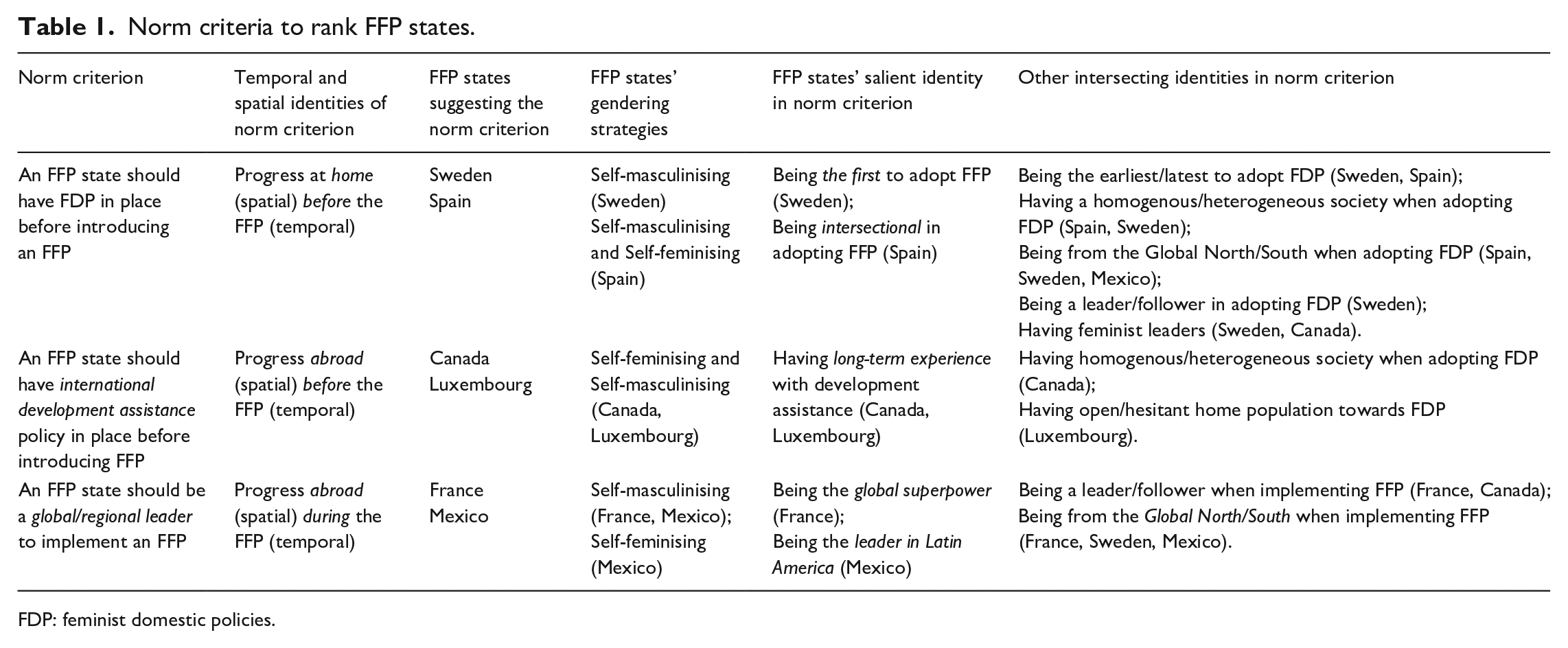
FDP: feminist domestic policies.
It is important to note that the aim of the analysis is not to explain state behaviour but rather to demonstrate the multiplicity of hierarchies within FFP countries of the Global North and South and between them using poststructuralist and feminist lenses. In this way, the analysis responds to the call made by researchers working on social hierarchy in world politics to widen the existing critical perspectives on this phenomenon and further explore the relations between norms and hierarchies. 76 Provided that the only studied Global South country with an FFP in this article is Mexico, the analysis offers a starting point for future scholarship to explore the extent to which the same argument holds for other FFP states in the Global South not addressed here.
Analysis
An FFP State Has Feminist Domestic Policy in Place (Sweden, Spain), or If Not, At the Very Least It Has an Established International Development Assistance Policy (Canada, Luxembourg)
One of the criteria for joining the ‘FFP club’ and becoming an FFP state is having a good record of accomplishment in implementing domestic gender equality policies before introducing an FFP. This criterion was proposed by both Sweden and Spain, who claim to have achieved it, but it was treated with caution by Canada and Luxembourg, who claim to not have progressed far enough along this line. Instead, Canada and Luxembourg limit themselves to an alternative criterion for membership in the FFP club – having a good record of accomplishment in international development assistance policies focused on gender equality. Together, these FFP states created several hierarchies that form the normative criterion for making progress in feminist domestic policies or international development assistance policies: (i) being the earliest or latest to adopt feminist domestic policies; (ii) having a homogenous or heterogeneous society when adopting feminist domestic policies; (iii) being open or hesitant towards the implementation of feminist domestic policies for the state’s own population; (iv) states in either the Global North or the Global South that adopt feminist domestic policies and (v) being a leader or a follower in adopting an FFP.
Earliest/Latest Adoption of Feminist Domestic Policies
Sweden claims to be the country that has the longest track record with domestic gender equality policies: ‘We started to see gender equality in Sweden when men and women shared household and professional work’ (3). Similarly, one of Spain’s interviewees stressed the importance of domestic policies as a catalyst for their FFP: ‘In Spain, domestic policies have played a very, very important role to arrive to this point’ (14). This allows both Sweden and Spain to move their countries up in the temporal hierarchy of states. Being at the top of the hierarchy provides both countries with an opportunity to set the standards for performance for other countries to follow – those who have just introduced or are going to introduce an FFP.
While they are at the top of the temporal hierarchy of states, Sweden and Spain also rank each other in terms of progress made in domestic gender equality policies. While Sweden acknowledges Spain’s progress in this realm, it stresses that Spain developed them later, implying that Spain is behind Sweden: ‘There has been a rapid development in Spain. It started a little later, but it is progressing fast’ (1). This means that even though Sweden and Spain are norm-promoting states that have pioneered criteria for other countries to follow, they also rank each other using these same criteria. 77 These criteria set up standards of hegemonic feminisation for other states to follow. However, these standards are based on masculine ideals of linear progress originating from Enlightenment, 78 which put Sweden and Spain higher in the state ranking compared to other FFP states. These standards do not acknowledge that modernity has not been linear and that in many parts of the world socio-economic decline has followed the period of initial improvement. 79 Hence, while using feminism to promote gender equality, FFP states practice masculinity by prioritising linear progress and competing with each other, which contributes to creating differences between states.
Homogenous Versus Heterogeneous Societies and the Adoption of Feminist Domestic Policies
Spain also acknowledges Sweden’s temporal primacy in its domestic gender equality policies, but it emphasises that the homogeneity of the Swedish society facilitated the implementation of these policies: ‘Swedish society has been working, pushing feminist and gender equality policies and measures from the very beginning in the 1970s. We started later, and our society is more diverse than Sweden in the 1970s’ (14). This means that the heterogeneity of a society – its racial, ethnic, religious, economic, social, cultural and other intersectional inequalities – represents an obstacle for becoming an FFP state and for fulfilling the normative criterion of having successful gender equality policies at home.
This is the case with Canada and Luxembourg, which prioritise their achievements in gender equality in development assistance abroad instead of their domestic policies at home. Canada remains cautious in using its FFP to place it on the top of the temporal hierarchies of states and limits it to FIAP 80 : ‘FIAP was very specifically focused on our international assistance.. . . And then more broadly, what evolved was thinking around Canada’s FFP, but to date there has not been a concrete policy released, the way that we had for our FIAP’ (2). Sweden links Canada’s caution in using its FFP to raise its temporal ranking among FFP states to its domestic controversies: ‘There is greater criticism in Canada; it is less controversial in Sweden. It’s more complicated in Canada, intersectionality and the indigenous issue and racism make it difficult to come up with a clear policy’ (2). Hence, while Spain points to Sweden’s homogeneous society at home as facilitating the latter’s domestic gender equality policies, Sweden stresses the heterogeneity of Canada’s society as a hindrance to its domestic gender equality policies and hence to introducing an FFP.
To offset a lack of progress in feminist domestic policy, Canada sets standards for hegemonic feminisation based on progress in international development assistance. These standards, however, are embedded into the masculine history of colonialism. 81 The very heterogeneity of Canada’s (and today Sweden’s) population stems from the present day deteriorating living conditions of formerly colonised people who migrated to Canada from the Global South or were internally colonised by Canada. Thus, outsourcing feminism abroad does not make masculinity at home disappear (Canada); focusing on past feminist achievements does not prevent masculinity from flourishing in the present (Sweden).
Openness or Hesitation Towards Feminist Domestic Policies Among the Domestic Population
Similar to Canada, Luxembourg’s interviewees hesitated to use their FFP as a way to raise their standing in the temporal hierarchy of states: ‘Our FFP is still in the process of evolving, developing.. . . It might be a little bit too early to evaluate’ (8). Compared to Canada, however, this does not have to do with the ethnic and racial heterogeneity of Luxembourg’s population but rather with overall hesitance to accept gender equality norms at home: ‘In my society, “feminist” is a bad word. Women who would call themselves “feminists” – it’s an insult for some people, not only for men, but including some other women. So it is truly a challenge for my country with an openly announced FFP. It needs constant explanation and implementation, so that it will slowly sink in people’s minds’ (8). That is why, as with Canada, Luxembourg’s FFP is limited to international development assistance: ‘In the pursuit of a feminist foreign policy, Luxembourg will promote gender equality in international and European forums and support women in a more targeted way’ (9). In this way, Luxembourg ranks itself lower in relation to other FFP states and their feminist domestic policies, but higher in relation to its development assistance to the Global South. 82 Ranking itself lower in relation to other FFP states destabilises the homogeneity of linear progress in gender equality within the Global North, but ranking itself higher in relation to the Global South reproduces civilisational distinctions between the Global North and the Global South.
Global North Versus Global South Adopting Feminist Domestic Policies
The state that Sweden and Spain rank lowest among all existing FFP states in terms of progress on feminist domestic policies is Mexico. One of Spain’s interviewees remarked, ‘Mexico, as a country, does not have a feminist domestic policy. Because in our case, an FFP is a completion of feminist policy in general, not only in foreign policy. So it’s a last part of the governmental or country project’ (13). Another Swedish interviewee commented, ‘They [Mexico] are behind, there is no statutory provision on parental leave, these discussions we had in the 1970s’ (3). While Sweden ranks itself higher than Spain in terms of how long it has had feminist domestic policies, it ranks Spain higher than Mexico in terms of progress in feminist domestic policies, due to Spain’s European (rather than Latin American/Global South) identity: ‘In Brussels, Spain is our “like-minded” country.. . . Mexico has a completely different gender equality policy compared to Spain’ (1). This signals that the more different a country is from Europe and North America in its approach to gender equality, the more Othering they receive from existing FFP states. 83 This Othering sustains a hierarchical approach to world politics and undermines solidarity across borders through the valorisation of FFP states from the Global North but devaluing against FFP states that are from the Global South. 84 Here, the Global North states set up standards of hegemonic feminisation for the Global South countries to follow. In its follower role, the Global South is not supposed to reach the hegemonic feminisation patented by the Global North, but rather practice complicit feminisation. 85
Compared to Mexico, Canada still ranks high in the temporal hierarchy of states, despite having issues with racism towards its indigenous population. One Swedish interviewee commented, ‘Canada has an FFP in general, although it is not called this way yet . . . They have gender equality as a high priority’ (2). Thus, countries that have a spatial/temporal identity as being in the Global North would be perceived by others as exhibiting stronger performance in domestic feminist policy – even if they have shortcomings – than countries spacio-temporally identified as the Global South. 86 This means that while FFPs claim to fight for gender equality worldwide, they at the same time amplify differences between the Global North and the Global South. These differences deprive the Global South of the complexity and fluidity of its postcolonial condition and instead sustain colonial essentialism. 87
Being a Leader or Follower in Adopting an FFP
By recognising Canada’s FFP and downplaying Canada’s (as well as Sweden’s) intersectional issues at home, Sweden makes a claim that it is because of Sweden that Canada and other states have introduced FFPs: ‘Sweden has been a reference country in the development of Canada’s FFP’, remarked one Swedish interviewee (2), while another claimed, ‘The policies Mexico wants to pursue are very much inspired by what we do’ (3). These claims are based on Sweden having the longest history of feminist domestic policies and hence being the first to introduce an FFP compared to other states. 88 Through this, Sweden claims it stands at the top of the temporal hierarchy in world politics: ‘We were the first. . . We were pioneers’, one Swedish interviewee pointed out (1). This ‘firstness’ allows Sweden to designate other FFP states as occupying lower positions in the temporal hierarchy of states: ‘There is a difference between being the first and being the seventh, carrying the honor of being the founder’ (2). Hence, Sweden – as a country with a spatial identity of being a ‘smaller state’ – cares more about its place in a temporal hierarchy of world politics than those countries with a spatial identity of being ‘bigger states’, such as Canada. 89 Being ‘the first’ allows Sweden to claim authority in hegemonic feminisation by relying on the masculine ideals of linear progress and ignoring the more circular process of human development. 90
Other FFP states, however, hesitate to see Sweden as a leader of the ‘FFP club’ and an authority that presides over them, pointing to Sweden’s FFP as just one of the many reasons that they introduced their own FFPs. For example, a Mexican interviewee remarked, ‘It was the timing. Many things were happening and conditions had been met’ (10). A Spanish interviewee positioned Sweden as merely one of the actors in whom they found inspiration: ‘We work very well with Sweden, we work very well with Norway, we work collectively with Finland’ (13). Instead, other FFP countries emphasise the contribution of Sweden’s former Foreign Minister Margot Wallström, rather than Sweden per se, in their campaigns to introduce their own FFP. This emphasis pins Sweden’s ranking in terms of its achievements in FFP on a personalisation of politics 91 and introduces feminist leadership as a normative sub-criterion for having a successful feminist domestic policy. It was ‘[t]hanks to Margot Wallström, because basically she came up with that name 92 and she was for many years the face in the world of a feminist policy’, notes a Luxembourg interviewee (8). We see a similar situation in the case of Canada, where Prime Minister Justin Trudeau is seen as one face of the country’s FFP. As one of France’s interviewees remarked, ‘PM Trudeau said famously “I am a feminist”; he was the first male leader to say that’ (7). 93 Compared to Sweden’s quest for hegemonic feminisation through ‘firstness’, other FFP states see the hegemonic feminisation of Sweden and Canada through their political leaders.
Hence, those FFP states that claim a high rank in temporal identities in gender equality set up criteria for hegemonic feminisation by emphasising their progress in domestic gender equality (e.g. Sweden and Spain), while those states that cannot claim a high rank in achieving domestic gender equality suggest an alternative normative criteria of performance by emphasising their progress abroad in development assistance (e.g. Canada and Luxembourg). This reinforces competition among the FFP states and reproduces global inequalities between the Global North and the Global South.
An FFP State Is a Global or Regional Leader on Gender Equality (France, Mexico)
Another criterion for being a member of the ‘FFP club’ is that a state must demonstrate its achievements in gender equality on the international stage by being either a global or at least a regional leader in the implementation of its FFP. France and Mexico advocate for this criterion of hegemonic feminisation, claiming to have achieved it themselves; however, all other FFP states are more cautious about this criterion. Instead, they call for different hierarchies based on normative criteria to measure progress in international gender equality policies: (i) being a leader (vs. follower) in implementing FFP and (ii) whether the implementing state is a member of the Global South or the Global North.
Being a Leader or Follower in Implementing FFP
While Sweden claims leadership in the temporal hierarchy of states (having the earliest feminist domestic policies and being the first to introduce an FFP), France claims leadership in the spatial hierarchy of states by claiming primacy in its progress on gender equality on the international stage since adopting an FFP: When the G7 took place, it was important for us to show that France wanted to be a leader in gender equality, at the international scene, that it was taking this new initiative. Two years later, at the Generation Equality Forum, it was quite established that France was a leader already in gender equality abroad, and it was quite natural and legitimate that it was hosting the Forum.. . . Because two years later we have done a lot, including G7, to show what we meant by the FFP. (7)
France claims global leadership in gender equality by referring to the scale and scope of events it has organised during the implementation of its FFP, as well as its diplomatic omnipresence in different countries and organisations. This allows France to position itself at the top of the spatial hierarchy of states in bilateral and multilateral comparisons. Here, France does not claim progress in gender equality policies per se, but in its country’s geopolitical power and symbolic and material capacity to launch and implement these policies. This makes France set up criteria for hegemonic feminisation in FFP from a masculine superpower perspective. In bilateral terms, when France positions itself at the top of the spatial hierarchy of states it moves other FFP states down in rank: ‘We have the biggest diplomatic network in the world, after the USA, which means we are present pretty much in every member state, even the smallest one, which is not true, I think, of Sweden and Canada’ (7). In multilateral terms, placing itself at the top of the spatial hierarchies of states allows France to present itself as one of the most important countries in the world and more of a leader than other FFP countries: ‘We know that our voice is being heard because we are France and respected, and at least listened to. This is one of the differences maybe with Sweden and Canada, because we are a part of every single organisation and especially the UNSC’ (7).
While Sweden and Spain set up accomplishment in domestic feminist policies as a criterion that every country can work on, France treats achievement in international gender equality policies not as a norm criterion that other countries can share and follow but as an attribute of a superpower that other countries cannot acquire. Hence, in addition to creating gender equality, France’s FFP contributes to inequality between FFP states and encourages competition.
This exclusivity of France’s approach to FFP success provoked different reactions from other FFP states, depending on the proximity or distance each FFP state has from being among the ‘select few’ together with France. Some states recognised France’s contribution to gender equality, raising France’s profile in the temporal hierarchies of states. One Swedish interviewee said: ‘But things have happened in France. The policy has become clearer and a number of initiatives have been undertaken. Gender equality has become more present because France has adopted the FFP and has been promoting it’ (1). Sweden is among the countries that recognises France’s contribution to FFP on the global scene, because Sweden views itself as the creator of FFP and feels that acknowledging the successes of this follower contributes to its own status as an innovator. Here, Sweden focuses on France’s gender equality policies per se rather than on this country’s geopolitical superpower capacity to implement them. Sweden even downplayed imperfections in other FFP states, provided they contribute to Sweden’s understanding of itself as being first and therefore at the top.
Other interviewees stated that French contribution to gender equality was minimal and moved France to the bottom of their temporal hierarchies of the states. In doing so, they referred to what happened before the FFP and what happened at the domestic (rather than international) level in France. One of Spain’s interviewees remarked, ‘France has huge shortcomings when it comes to gender equality, huge. They are late comers, they are non-believers, it is a very-very masculine superpower. There is some kind of commitment to increase the number of women ambassadors, that’s not a feminist foreign policy! . . .There is nothing, it is just a nominalist policy, they are not there’ (13). Since Spain felt that an FFP should be born out of domestic feminist policies, it questioned France’s self-imposed feminist leadership abroad due to its gender equality shortcomings at home. By putting an emphasis on intersectionality in its FFP, Spain presented itself as a soft power abroad. The same interviewee also observed, ‘We are not a hard power; they [France] are a hard power. We are a soft power country. Our main assets are not [being] a hard power. Of course, we have a very interesting geopolitical – geostrategic position. Yes, we are unique geostrategically, but our foreign policy has not played into that’ (13). Here, Spain points out that France’s existing geopolitical capacity to implement gender equality policies is not synonymous with the quality of these policies. Rather, the geopolitical capacity as a trait of a masculine superpower undermines feminist policies at home and abroad. In doing so, Spain questions France’s normative criterion of being a global power to practice hegemonic feminisation in FFP. While for Sweden, a masculine superpower like France can become feminist, for Spain it cannot.
While comparing France to themselves, FFP states recognise Canada’s contribution to gender equality internationally. The interviewees mention Canada’s presence in the G7, the G20 and the United States–Mexico–Canada Agreement, placing Canada on top of spatial hierarchies among the FFP states. One French interviewee noted, ‘There was a close relationship to Canada in the context of the G7, because Canada was the first chairmanship for the Gender Equality Advisory Council with Justin Trudeau at the time; it was a Canadian invention’ (7). One of the Mexican interviewees also commented, ‘Canada’s policy principles were certainly present during recent USMCA negotiations, where the three members shared our perspective on gender equality for the chapter discussions’ (10). Hence, while FFP states do not recognise Canada in fulfilling the normative criterion of having feminist domestic policies in place (temporal identity), they do so in relation to the normative criterion of global leadership (spatial identity).
Global South Versus Global North
Mexico ranks itself in a hierarchy of states as a regional leader and the first country in Latin America to adopt an FFP and by being a country from the Global South. 94 One interviewee from Mexico emphasised its spatial identity as the regional leader in the following way: ‘As the first country in Latin America and the Caribbean to adopt a Feminist Foreign Policy, we are eager to share the opportunities it brings for social change and to share our experience with other countries, especially in the region’ (10). By ranking itself higher up, Mexico mimics Sweden in its masculine ‘firstness’ and France in its masculine globalism. This mimicking contributes to complicit feminisation of the Global South 95 where hierarchy is sustained by supporting and strengthening the hegemonic feminisation of the Global North. One Mexican interviewee also spatially extended this complicit feminisation to the global level: ‘The UN Security Council, where Mexico is non-permanent member [in] 2021–2022, in July 28th, by initiative of Mexico, together with Norway, the United Kingdom, the United States, and Estonia, conducted an Arria formula meeting to analyze the way in which gender stereotypes, toxic masculinities and gender inequality fuel violent radicalisation and terrorism’ (10).
Sweden, which Mexico mimics, supports this complicit feminisation. While Sweden acknowledges its collaboration with Mexico (saying, at one point, ‘Mexico has always had a high profile in multilateral issues. Sweden and Mexico are allies, they always have the same view’ (3)), it does so by Othering all other states in Latin America: ‘Traditionally in Latin America, Mexico has played a leading role. It differs from others, as it has not had a right-wing dictatorship, it has not been ideological. Even if you have had similar challenges, you have a different identity. . . . It has a progressive, liberal, international political orientation’ (3). Since Sweden considers itself the first country to adopt an FFP, it treats Mexico with interest as its follower outside of the Global North.
While mimicking the countries of the Global North in their hegemonic feminisation, Mexico also lifts up its unique identity as a country from the Global South.
96
This allows Mexico to propose alternative criteria to hegemonic feminisation by practicing subordinate feminisation.
97
For example, Mexico used the Generation Equality Forum to raise issues of gender justice relevant for the Global South: The Generation Equality Forum happened in the middle of the COVID-19 pandemic, which affected women and girls disproportionately and in multiple ways and exacerbated gender inequality. Generation Equality was important for our FFP, because within that framework Mexico proposed the creation of the Global Alliance for Care Work, a multi actor initiative to exchange experiences and good practices to advance the Care Work agenda worldwide. (10)
Mexico’s subordinate feminisation as a set of standards for other states in the Global South to follow resembles postcolonial hybridity, which allows mimicry of complicit feminisation to acquire elements of an anticolonial strategy. 98
In contrast to Mexico, France used the Generation Equality Forum to advance its spatial identity to every corner of the world and strategically mobilised Mexico’s identity as a member of the Global South to reach its geopolitical goals: It was very important to have a partner from the Global South for the legitimacy of the Generation Equality Forum, and the only country in the Global South that has an FFP.. . . It was very important that even in a narrative of the Forum that we had these two countries – one from the Global North and one from the Global South – working hand-in-hand. And through Mexico we could also mobilise Latin America, civil society, and Latin American governments. . .. It was very important, and it was better this way than, say, [if] Sweden and France [had] co-hosted. It would not have been the same narrative, and the same impact. (7)
Here France sees Mexico through the lens of complicit feminisation to promote Global North hegemony. Even though the relationship between France and Mexico is presented as a partnership, this partnership is unequal. France is a representative from the Global North which dominates (by requesting access to Latin American countries through Mexico), and Mexico is a representative from the Global South which is subordinated (by providing access to Latin American countries for France).
Hence, those FFP states that claim a high rank through their spatial identities set up the criteria for hegemonic feminisation (France influencing gender equality through it presence abroad), and those states that cannot claim a high rank through their spatial identities either engage in complicit feminisation (Mexico in its postcolonial condition in gender equality) or follow subordinate feminisation (Mexico influencing gender equality according to the needs of the Global South). This contributes to the reproduction of global inequality between the Global North and the Global South during the facilitation of gender equality.
Discussion
We can draw the following conclusions from these findings. First, all six FFP states Self-masculinise in competing for hegemonic feminisation by claiming a higher rank in the hierarchies of world politics (regardless of their actual performance on gender equality). In other words, these states care a lot about their rank – whether they are the best actual performers in gender equality or the worst. Sweden and France are the most active in this gendering strategy. Sweden tries to offset its lack of spatial power as ‘a small state’ by stressing its temporal strength as a ‘gender equality superpower’. 99 In doing so, Sweden ignores the fact that its homogenous ‘gender equality superpower’ of the 1970s is not the same as its ‘multicultural bubble’ of the 2020s. Sweden’s view of itself reproduces the masculine belief in linear progress rather than acknowledges cyclical development. France, on the other hand, aims to balance its lack of temporal progress in gender equality by emphasising its spatial identity of a ‘world superpower’. 100 It stresses its material and symbolic capability to do FFP, rather than the quality of this policy per se. As such, France confuses the means of achieving gender equality with its ends. Overall, five FFP countries from the Global North Self-masculinise in relation to Mexico from the Global South. This Self-masculinisation is based on seeing Mexico as their follower rather than as an equal partner in gender equality policies. Such a hierarchical (White, Western) gaze reproduces civilisational distinctions between states and regions of the world. Self-masculinisation as a gendering strategy of hegemonic feminisation sustains hegemonic masculinity, rather than challenging it, by lacking Self-reflection.
Second, all six FFP states Self-feminise in their quest for hegemonic feminisation by aiming for good performance in gender equality (regardless of their actual rank in the international hierarchy of states). In other words, these states care about improving their actual performance in gender equality regardless of what rank they have or can have. Canada and Luxembourg are the most active in this gendering strategy since both try to offset a lack of gender equality policies at home. Both acknowledge their shortcomings in domestic gender equality policies rather than conceal them (in comparison to Sweden and France). Similarly, Spain and Mexico acknowledge their shortcomings in gender equality at home that they wish to improve. In this way, Spain and Mexico aim to balance their middle power position in terms of temporal and spatial ranking. 101 Hence, Self-feminisation as a gendering strategy of hegemonic feminisation partially challenges hegemonic masculinity, rather than simply reproducing it, by engaging in Self-reflection.
In sum, these findings demonstrate that the old and the new gendered hierarchies in world politics co-exist when hegemonic feminisation tries to engage with hegemonic masculinity. The colonial ideas about the inferior Global South and superior Globalorth are still present, at the same time as the present day ideas about equal cooperation between the Global North and the Global South rather than dependency of the Global South on the Global North take place. While more and more hierarchies and gendering strategies emerge in the Global North, the historical hierarchy between the Global North and the Global South is harder to shake off.
These findings also show that gendered hierarchies do not always correspond to states’ geographical position, power and status within the ‘great-middle-small’ state trichotomy in world politics: that is, that great powers Self-masculinise and small states Self-feminise. 102 Rather, great and middle powers might Self-feminise (e.g. Canada), and small states might Self-masculinise (e.g. Sweden) in the process of creation of gendered hierarchies of states. They can do the same to others – emasculate great and middle powers and masculinise small states. The same state can employ either feminising or masculinising strategies depending on what temporal and spatial identities it perceives itself to possess to offset its shortcomings in relation to the Other.
Finally, the analysis offers a better understanding of where FFP has emerged as a norm or could emerge in the future. Thus far, three categories of states have been identified: (i) those that claim to have made progress in their domestic feminist policies (potentially the Nordic states, the Netherlands, Australia, New Zealand, South Korea and South Africa); (ii) those that claim progress in international development assistance (hence, potentially the United States, the United Kingdom, Japan, Italy, the Netherlands and Switzerland) and (iii) those that claim leadership and global/regional power status in international affairs (potentially the United States, the United Kingdom and Australia). Chile’s and Libya’s expressed interest in developing an FFP might lead to new categories of states that would be more representative of the Global South (e.g. new subordinate and/or complicit feminisations).
Conclusion
The burgeoning scholarship on social hierarchies in world politics argues that the world is organised not according to anarchy, but hierarchy. 103 This scholarship focuses on how, why, when and by whom ‘dominance is preferable to parity for actors in global politics’. 104 This article has looked at the extent to which this is the case for states with FFPs. Using the lens of social hierarchy, 105 it shows that although FFPs aim to fold gender equality into global politics, they also create inequalities among states that adopt them, based on their performance in terms of gender equality both domestically and abroad.
Using a poststructuralist and feminist framework, the article argues that even though FFPs create hierarchy among norm-promoting states, this hierarchy is unstable and not necessarily predictable. Drawing on the theories of ‘multiple Others’ 106 and masculinities in global politics 107 , it has shown that hierarchies can be multiple, and that a high ranking in one hierarchy can offset a lower ranking in another. Moreover, the article has introduced a concept of hegemonic feminisation to capture the multiplicity of gendered hierarchies as well as multidimensionality and multidirectionality of gendering strategies (feminisation and masculinisation) that sustain or challenge old hierarchies in world politics or create new ones. In this way, the article has offered a contribution to the Feminist IR interested in challenges and possibilities of the state becoming feminist. 108 Future studies can explore in more depth the theoretical relationship between the hegemonic feminisation and hegemonic masculinity: To what extent hegemonic feminisation can be a product of the crisis of hegemonic masculinity and to what extent it can constitute a realistic alternative to hegemonic masculinity.
Footnotes
Acknowledgements
I thank three anonymous reviewers for their insightful suggestions and the editorial team of Millennium for their professional support. The earlier versions of the paper were presented at the European Conference on Politics and Gender (ECPG) (6–8 July 2022, University of Ljubljana) and at the SWEPSA 2022 – Annual Conference of the Swedish Political Science Association (28–30 September, Örebro University); I thank everyone for engaging questions and comments. I am also grateful to Markus Holdo and Karin Aggestam for discussing previous paper drafts.
Declaration of Conflicting Interests
The author(s) declared no potential conflicts of interest with respect to the research, authorship, and/or publication of this article.
Funding
The author(s) disclosed receipt of the following financial support for the research, authorship, and/or publication of this article: This work was supported by Riksbankens Jubileumsfond [grant number P19-0712:1].
