



Abstract
This article reports on early results of a research project examining popular support for media freedoms in sub-Saharan Africa. Using data from the Afrobarometer surveys, as well as other sources, we specifically examine cross-national variation in support for media freedoms, seeking to account for the national-level factors that affect that variation. Our findings suggest the importance of two factors in particular. The first is the level of polarization in society. Using a novel measure of this factor, we find that higher levels of polarization are associated with lower levels of support for media freedoms. The second factor is the level of professionalism characterizing the media sector. We find that lower levels of media professionalism drive down support for media freedoms. Further research will explore these through the use of multilevel analysis that incorporates investigation of individual-level factors shaping support for media freedoms.
This report discusses preliminary findings from research exploring popular support for media freedoms in sub-Saharan Africa. The erosion of such support over the past decade has caused concern among press freedom advocates (Conroy-Krutz, 2020). Our study examines the national- and individual-level factors shaping support for media freedoms. Reporting here on our analysis of national-level factors, we highlight the role of two that have remained relatively unexamined in the literature on press and politics. The first is the level of political polarization in society. Using a novel measure of polarization, we find that higher levels of polarization are associated with lower levels of support for media freedoms. The second is the professional integrity exhibited by the media. Corroborating concerns from those who have faulted Africa’s media on these lines, we find that lower levels of media professionalism are associated with less popular support for press freedoms.
Although public support for media freedoms may be crucial in deterring governments from interfering with media independence (Conroy-Krutz, 2020; VonDoepp and Young, 2016), the issue has not been investigated in cross-national research. The Afrobarometer public opinion surveys present a unique opportunity to undertake such research. Since 1999, Afrobarometer has asked citizens of African countries about their support for press freedoms. Although variations in question wording limit our ability to explore data from every iteration of the surveys, data from those conducted between 2011 and 2018 allow for systematic examination of the determinants of support for press freedoms. We focus here on the national-level factors shaping such support.
Theoretical Framework
Drawing from varied bodies of research, but particularly that on public confidence or trust in media, we examine four different types of factors. The first are those associated with the broader cultural environment, specifically the norms, values, and habits that operate within societies. We bring attention to two such factors that might affect support for press freedoms. The first is popular support for democracy. Press freedoms are intimately connected to democracy and thus we might suspect that support for democracy is correlated with support for press freedoms. The second factor is polarization, a current topic of major concern. Recent studies have hypothesized that polarization could negatively impact trust in the press (Hanitzsch et al., 2018; Suiter and Fletcher, 2020). We similarly suspect that more polarized societies will witness more hostility to the media and, by extension, less support for press freedoms. We investigate this issue using a new measure of cross-national polarization.
The next set of factors are political in nature. Here we focus on the extent to which the media faces acts of hostility against it from government. These might take the form of arrests or assaults on journalists, closures of outlets, destruction of property, or passing legislation restricting the activities of media personnel. We suspect that government infringements on media freedoms could actually boost support for media freedoms. As access to information becomes threatened, citizens could increase their support for the freedoms that protect media.
A third set of factors are sociological and pertain to the changing nature of mass communications, particularly, the growth of the Internet and social media. Yet we remain equivocal about the potential impact this might have. On one hand, by increasing access to information, these media might expand support for free and open media, thus driving up support for media freedoms. Yet, on the other, the Internet and social media could undermine support for press freedoms. As Sunstein (2018) argues, Internet and social media use can increase polarization (see also Suiter and Fletcher, 2020). Beyond this, cross-national research by Tsfati and Ariely (2014) indicates that Internet use is negatively associated with trust in the media. This could drive down support for press freedoms.
The final set of factors are those associated with the media itself. Some have linked declining confidence in the media to changes in the content it produces, most notably, shifts to more biased, sensationalistic, and entertainment-focused news (Dautrich and Hartley, 1999; Jones, 2005). In related research, Ariely (2015) analyzes the impact of journalistic professionalism cross-nationally and finds that it has an impact on the relationship between political and press trust. Given that scholars have highlighted weaknesses in professional ethics in African media systems (see Kasoma, 1995; Tettey, 2010), and suggested that problematic output has undermined support for press freedoms (Conroy-Krutz, 2020), we assess whether different levels of journalistic professionalism affect support for media freedoms.
Variables and Data
Rounds 5, 6, and 7 of the Afrobarometer, 1 conducted between 2011 and 2018, asked citizens in 33 African countries about whether they supported the rights of newspapers to publish without government control or supported government preventing media from publishing things it considered harmful to society. Our dependent variable is the percentage of respondents expressing either “support” or “strong support” for media freedoms. This aggregate, country-level measure was captured across the three rounds and thus “country-round” is our unit of analysis. 2 We note that, consistent with the findings mentioned earlier, support declined from Round 5 to Round 7. 3
For our first cultural variable, support for democracy, we also use the results of the Afrobarometer survey, in particular responses to a question that asks citizens about their normative preference for democracy. We use the percentage of citizens who indicated that democracy was preferable to other systems of government.
Our second cultural variable captures the level of polarization in society. There is considerable debate about how to conceptualize and operationalize polarization (see Lelkes, 2016). Although cross-national measures of polarization exist (see Dalton, 2008; Suiter and Fletcher, 2020), few include data on most African countries. On top of this, the existing measures tend to focus on ideological or partisan polarization, and do not capture affective polarization, understood as the extent of loathing or hostility among partisans in society (see Lelkes, 2016; Mason, 2018) that we suspect could undermine popular support for media freedoms. Although the Varieties of Democracy 4 project (V-Dem, discussed below) offers an expert-based assessment of polarization, we relied instead on Afrobarometer surveys to utilize actual sentiments in society to measure polarization levels cross-nationally. The surveys include questions about levels of trust in the president and in the opposition. Using answers to these we were able to discern the percentage of respondents who were highly trusting of the leaders of their own political camp, a rough measure or partisanship, but also highly distrustful of their opponents, a measure of hostility. Our measure of polarization is thus the combination of two raw numbers: those who are highly trustful of the president and also highly distrustful of the opposition, and those who are highly trustful of the opposition and also highly distrustful of the president. This sum was divided by the sample size in each country-round to adjust for different sample sizes.
The political factor we focus on is the level of hostility that media encounter from government. To capture this, we relied on Freedom House’s Freedom of the Press measures, drawing specifically on their assessments of the political environment, 5 which evaluated, among other things, the level of censorship imposed by the government, the level of state interference journalists encountered, and the level of violence and harassment they faced. Scored on a 0–40 scale, with higher scores indicating a worse political environment for the media, we included the measures for the year preceding each Afrobarometer country-round. This allowed us to capture the hostility media had faced prior to the conducting of the surveys. We label this “Political Hostility (FHFOTP).”
Our key sociological variable examines the role of the Internet, and for this we used World Bank data on levels of Internet penetration. Scored on a scale from 0 to 100 (with higher scores indicating greater penetration), we included the level of Internet penetration for the year prior to each Afrobarometer country-round, thus using a lagged measure as we did for political hostility.
Finally, our expectation is that more professionalized media sectors generate higher support for media freedoms. To capture the extent of media professionalism cross-nationally, we relied first and foremost on the V-Dem dataset, which uses country experts to assess various aspects of countries’ political environments annually. This includes a variable labeled “media corrupt,” focused on the extent to which media professionals “accept payments in exchange for altering news coverage.” Scored on a scale of 0–4 (with higher scores indicating
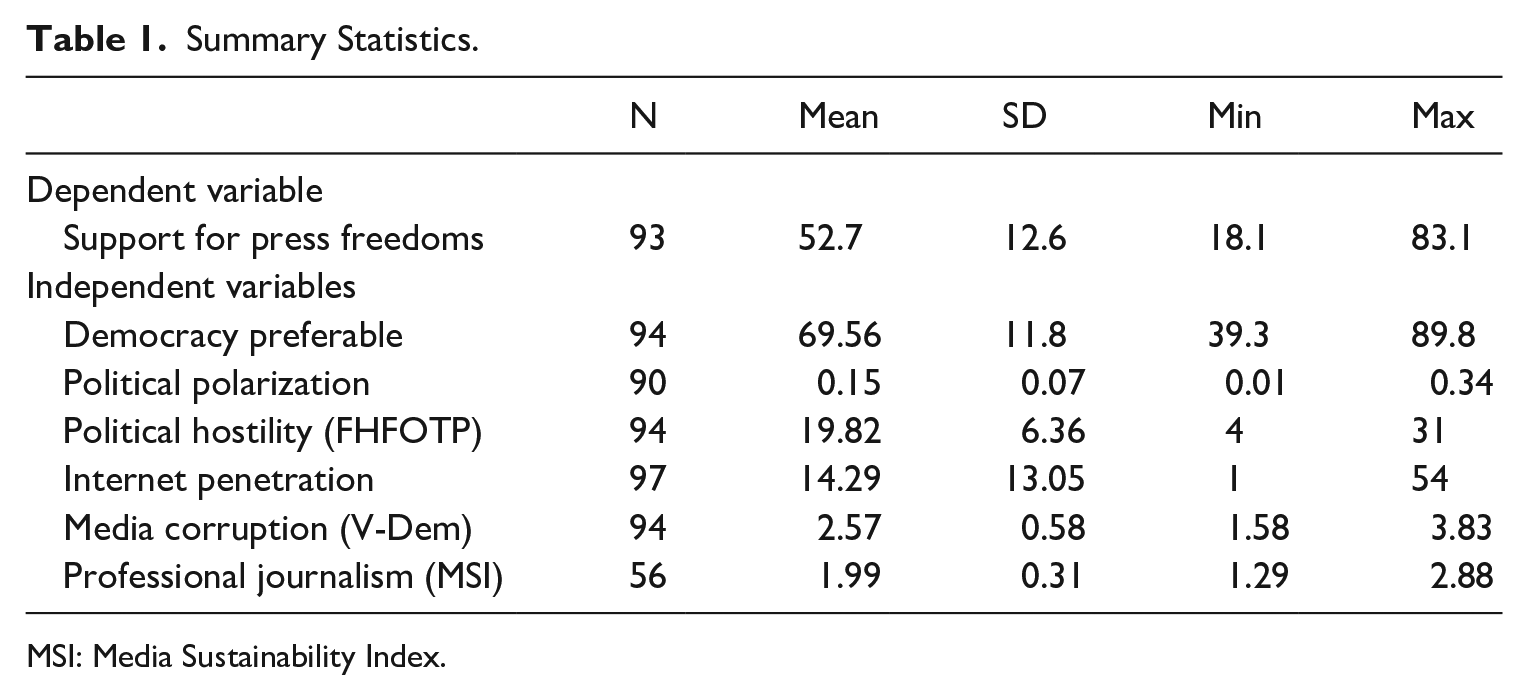
Table 1 displays the summary statistics for each variable.
Summary Statistics.
MSI: Media Sustainability Index.
Results
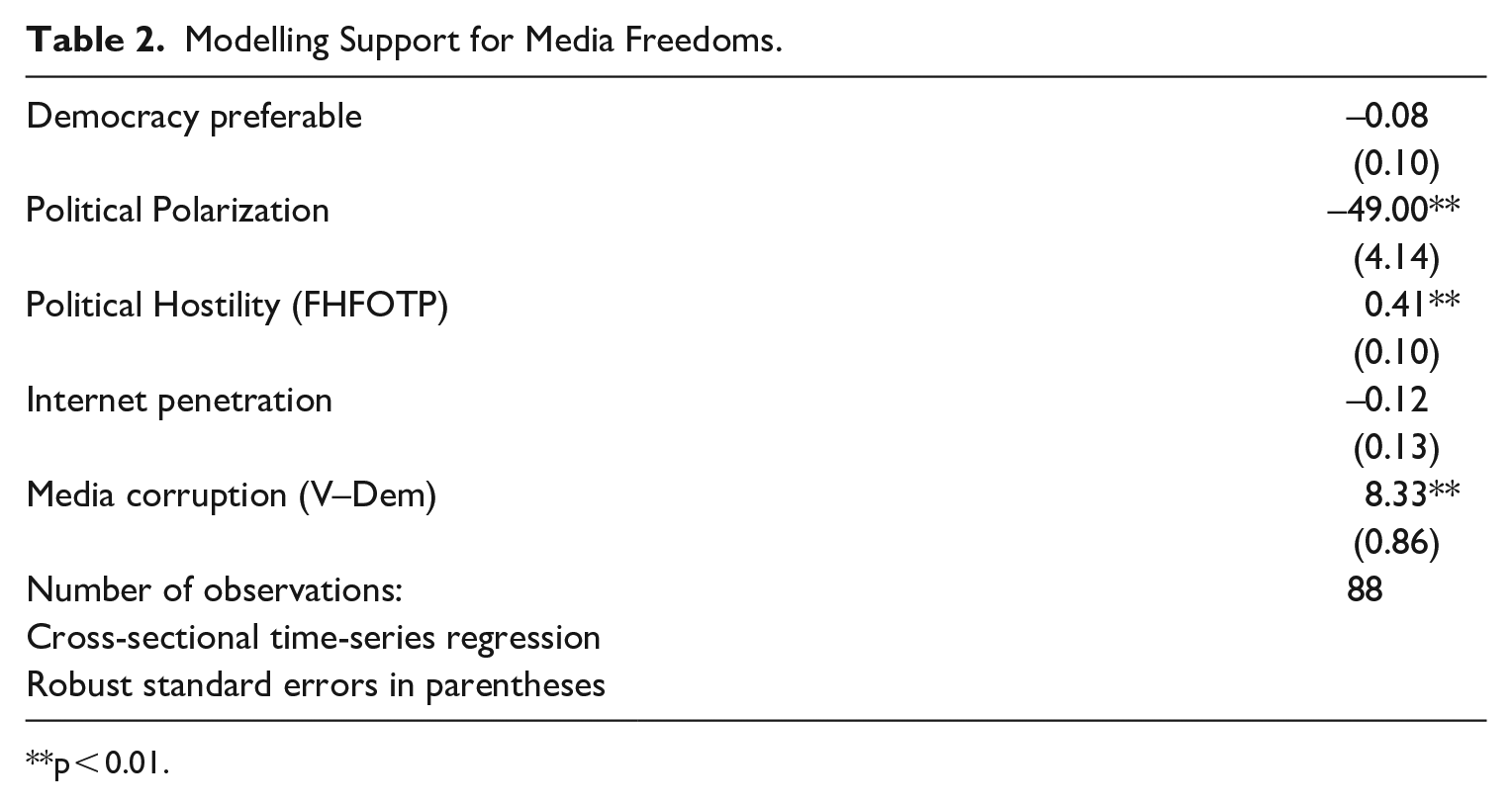
We model support for media freedoms with the predictor variables just discussed, and employ cross-sectional time-series regression given the panel nature of our data. Table 2 shows the results of our main model.
Modelling Support for Media Freedoms.
p < 0.01.
The results are somewhat consistent with our expectations. Political polarization and media corruption (our proxy for media professionalism) are both strongly related to support for media freedoms. Political polarization is negative, such that more polarized countries have lower levels of support for media freedoms, and highly statistically significant. The V-Dem measure of media corruption is positive, and highly statistically significant, indicating that countries with less media corruption see higher levels of support for media freedoms.
Our findings regarding the political environment are also consistent with our hypothesis. We expected that hostility toward the media would increase support for media freedoms. The estimate for the Political Hostility (FHFOTP) is positive and significant, indicating that in countries where the press faces censorship, interference, or harassment, publics show greater support for media freedoms.
Internet penetration shows no association with support for press freedoms. This is perhaps unsurprising. As indicated, Internet penetration could cut both ways vis-a-vis support for media freedoms. More surprising is the null result on preferring democracy. We expected that countries with publics that strongly prefer democracy would also have high levels of support for press freedoms. Our findings show no such relationship
Of note, in models not shown, we ran our analysis with several control variables. These included level of democracy (as measured by Freedom House), colonial heritage, ethno-linguistic fractionalization, and Human Development Index (HDI) levels. Our findings remained robust to the inclusion of these controls. 7
Turning now to substantive effects, Figures 1 and 2 graph the fitted values and 95% confidence intervals for our two substantively largest findings.
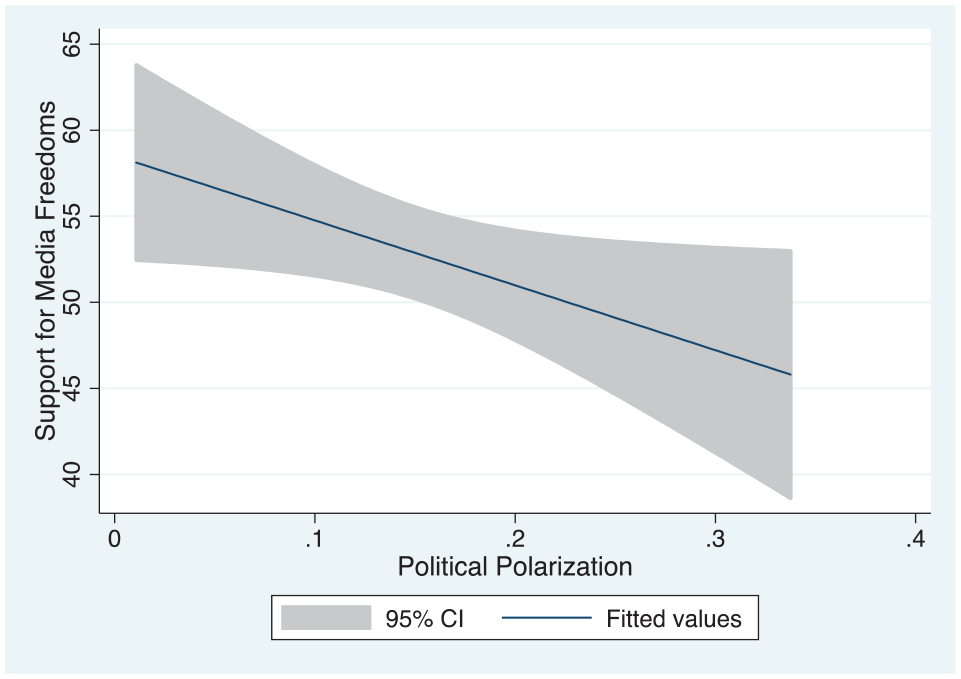
The Effect of Political Polarization on Support for Media Freedoms.
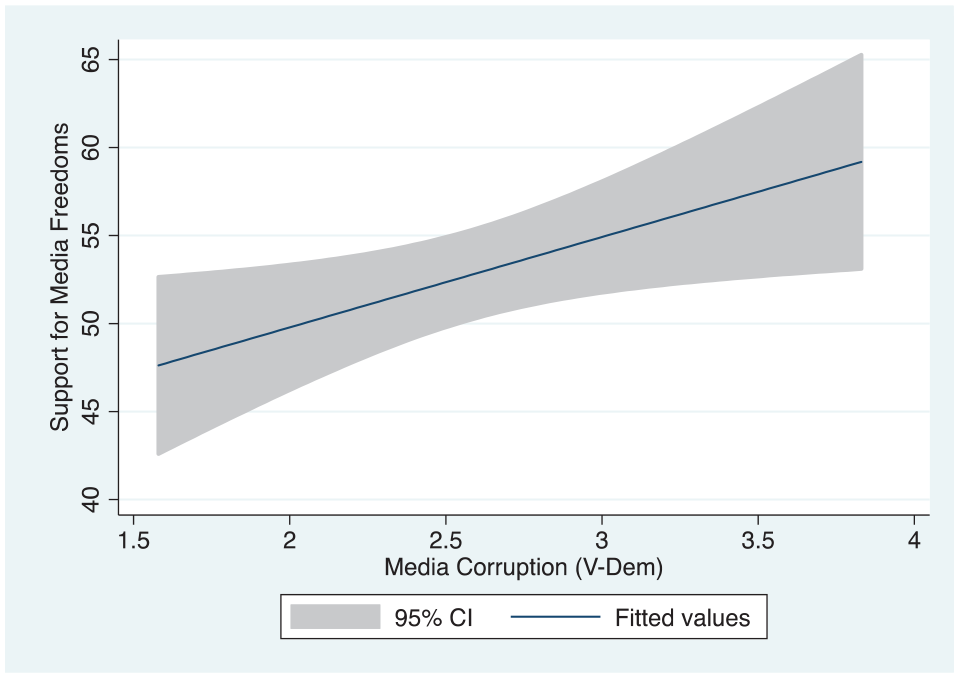
The Effect of Media Corruption on Support for Media Freedoms.
A first major finding is that countries with less political polarization have much greater support for media freedoms than countries with greater polarization. Indeed, going from the least polarized countries to the most leads to slightly more than a 16 percentage point drop in support for media freedoms. A valuable aspect of having three different time periods is that we can not only report on cross-national variation but also track changes over time. Kenya provides an instructive example. In Round 5, polarization in Kenya (with a score of 0.1) was below the African average and support for press freedoms (with a score of 59.4%), was above average. By Round 6, polarization had increased in Kenya (now scoring 0.16) and press freedom support dropped to 54.5%. By Round 7, polarization grew further (now 0.17) and passed the regional average, and support dropped to 50.4%, below the average.
Turning to our findings regarding media corruption, Figure 2 indicates that moving from countries where corruption is highest to those where it is lowest leads to a more than 10 percentage point increase in support for press freedoms. A closer look at the data, however, shows limitations, as the V-Dem index offers identical scores for several countries over the three time periods.
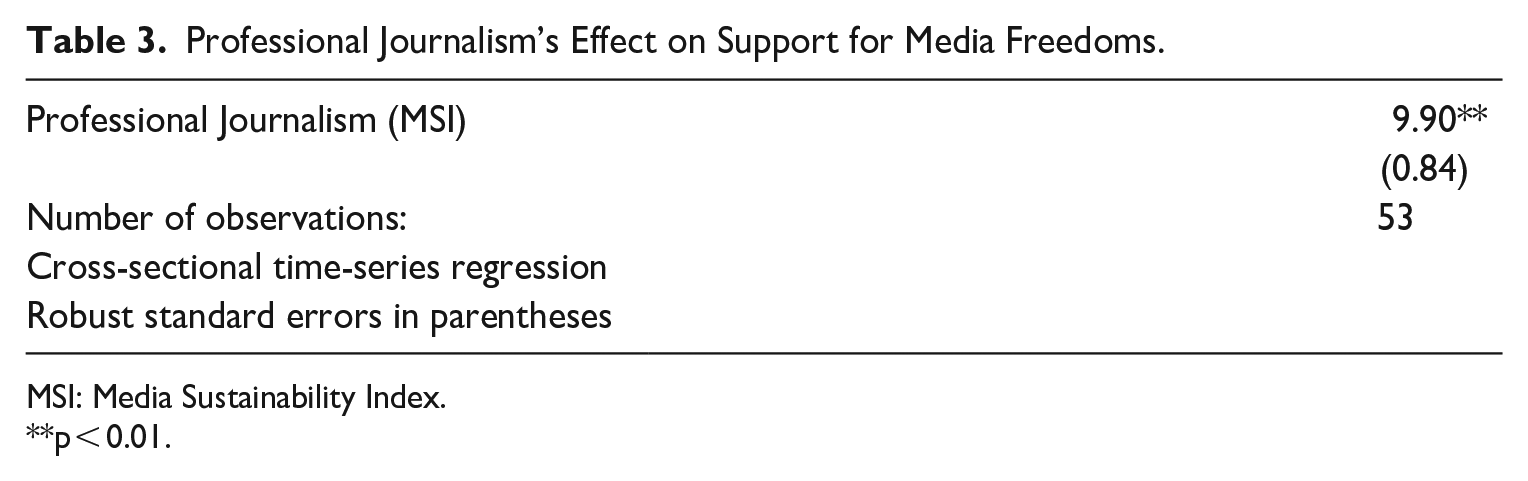
We turned to an alternative measure, MSI’s professional journalism scores mentioned above. The limitation of this measure is that the last set of scores came out in 2012. Thus, while we can reasonably model our dependent variable for Round 5 using MSI’s 2010 scores, and Round 6 with their 2012 scores, we cannot feasibly model Round 7, thus eliminating an entire round for all other variables. For these reasons Table 3 reports on a bivariate regression of MSI’s scores for professional journalism on support for press freedoms, using data from Rounds 5 and 6.
Professional Journalism’s Effect on Support for Media Freedoms.
MSI: Media Sustainability Index.
p < 0.01.
Table 3 shows that MSI’s measure of media professionalism has a positive and highly significant relationship with support for media freedoms. This suggests that in environments where the media operate with high levels of professionalism, publics respond with greater support for press freedoms. Figure 3 indicates that the substantive effect is fairly large. Moving from countries with the least professionalized media to those with the most leads to an almost 16 percentage point increase in support for media freedoms. This is similar in magnitude to the effect of polarization.
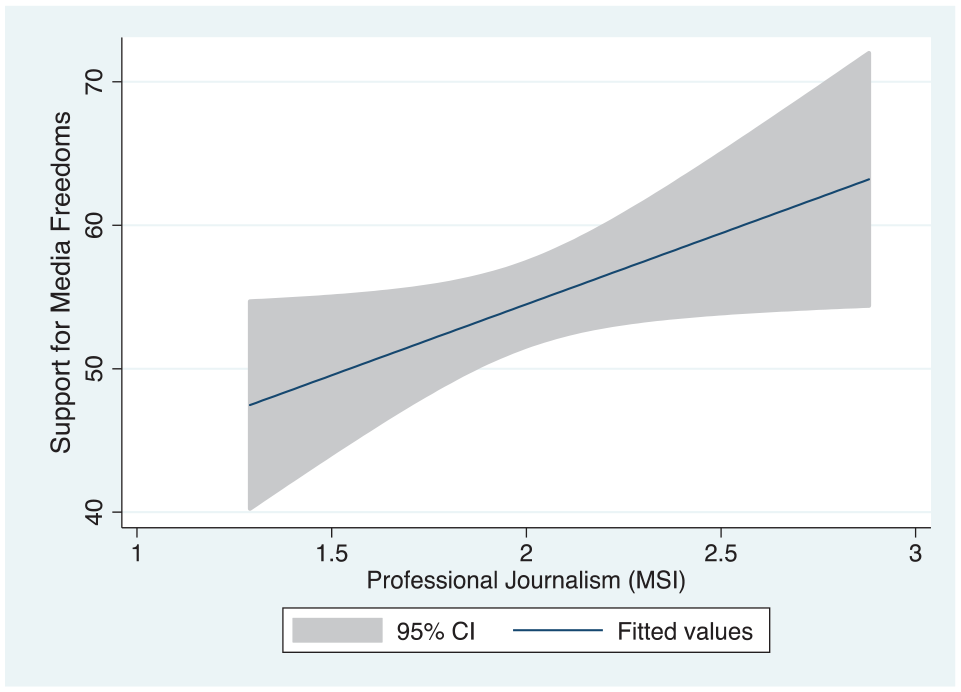
The Effect of Professional Journalism on Support for Media Freedoms.
Concluding Remarks
Our analysis suggests that three factors deserve special consideration for their potential to shape support for media freedoms in sub-Saharan Africa: the level of polarization in society, the extent of media professionalism, and the extent of hostility the media encounter from government. While these early results are preliminary, we remain enthusiastic about exploring these factors further. Changes in Afrobarometer question wording (including changes in the most recent round of surveys) preclude our ability to add longitudinally to the analysis presented here. However, we look forward to deeper investigation of our current data, undertaking multilevel analyses that incorporate individual-level factors.
Aside from this, we aim to further explore polarization with the measure we developed. Our measure offers a simple and elegant way to capture the partisan loyalties and intergroup hostilities that are fundamental to “affective” polarization. To our knowledge, no other scholarship has employed this sort of measure or deployed it in cross-national research. Our future research intends to examine not only the causal significance of polarization, as we have here, but also the determinants of it.
Supplemental Material
sj-docx-1-psw-10.1177_14789299221143681 – Supplemental material for Polarization, Media Professionalism, and Support for Press Freedoms in Sub-Saharan Africa: A Report on Early Results
Supplemental material, sj-docx-1-psw-10.1177_14789299221143681 for Polarization, Media Professionalism, and Support for Press Freedoms in Sub-Saharan Africa: A Report on Early Results by Peter VonDoepp and Daniel J Young in Political Studies Review
Footnotes
Declaration of conflicting interests
The author(s) declared no potential conflicts of interest with respect to the research, authorship, and/or publication of this article.
Funding
The author(s) received no financial support for the research, authorship, and/or publication of this article.

Supplementary information
Additional supplementary information may be found with the online version of this article.
Content Appendix Table: Modelling support for media freedoms with additional controls.
Notes
Author Biographies
References
Supplementary Material
Please find the following supplemental material available below.
For Open Access articles published under a Creative Commons License, all supplemental material carries the same license as the article it is associated with.
For non-Open Access articles published, all supplemental material carries a non-exclusive license, and permission requests for re-use of supplemental material or any part of supplemental material shall be sent directly to the copyright owner as specified in the copyright notice associated with the article.
