



Abstract
We explore how associational activity—a key aspect of social capital—affects migration attitudes. It is argued that people’s membership in sports clubs and associations likely leads to more negative views on migration. Exploiting the panel structure of the German Longitudinal Election Data, the empirical analysis provides support for our expectations. We also show that individuals’ political orientation moderates the postulated effect. The findings further our understanding of how public opinion on migration is formed and we add to the literature on social capital by highlighting the potentially negative consequences one of its components can have.
Introduction
Does social capital, which is commonly defined as the ties and relationships binding members of a society (Hanifan, 1916; Keeley, 2007; Putnam et al., 1994), 1 affect people’s views on migration? The determinants of anti-immigrant sentiments are of major interest today (Bello, 2017; Ceobanu and Escandell, 2010; Dinesen et al., 2016; Hainmueller and Hopkins, 2014; Haubert and Fussell, 2006; Mayda, 2006), and shifts in public attitudes toward immigration strongly influence policy discussions and election campaigns and can translate into restrictions to existing immigration policies (see Böhmelt, 2020; Bove et al., 2021). Especially in Europe after the 2015 “refugee and migration crisis,” an intense debate among policymakers, the public, and scholars emerged on how to best address large transnational population movements. Clearly, knowing more about public opinion on migration has always been a crucial issue (for comprehensive overviews, see Ceobanu and Escandell, 2010; Hainmueller and Hopkins, 2014), but the events in 2015 fueled this discussion. Europe is hardly a continent under “siege,” and scholars (Fitzgerald, 2012; Geys, 2017; Herreros and Criado, 2009) and commentators recently argued that hostility to migration is not driven by the numbers of migrants per se, but by perceptions of social cohesion. 2
At the same time, Reuband (2015) suggests in his study of the German nationalist, anti-Islam, far-right group “Patriotic Europeans Against the Islamisation of the Occident” that participants of the movement’s demonstrations comprise a significant number of “ordinary citizens” who are employed and not socially isolated, but frequently well embedded in society. 3 Yet, while previous research provides us with a conceptual understanding of social capital and outlines some of its paths of influence, the role of associational activity as a structural component of social capital (see Kindler et al., 2015), that is, the membership in clubs and associations, in influencing public attitudes toward migration has not been comprehensively studied. To the best of our knowledge, there are only a few existing works, which focus on some aspect of this relationship. Geys and Murdoch (2010) distinguish between memberships in “bridging” and “bonding” organizations 4 and show that the former can be more strongly linked to reductions in feelings of intolerance toward immigrants (see also Geys and Murdoch, 2008). Fitzgerald (2012) suggests that frequent church attendance reduces immigration concerns. And Geys (2017) reports little evidence for any relationship between voluntary association membership and public opinion on migration, except for memberships in “connected” groups.
In the following, we focus on associational activity and argue as well as empirically demonstrate that it may lead to a potentially normatively negative effect: more skeptical views on migration. Social capital as the general, underlying concept is commonly viewed as a potentially powerful element binding members of a society and, especially given the emphasis on “improved efficiency,” comprises a built-in normatively positive impact (see Coffé and Geys, 2007; Grießhaber and Geys, 2012). Not surprisingly, scholars have developed an impressive body of research suggesting that social capital indeed allows individuals, companies, and nations to flourish (see, for example, Algan and Cahuc, 2010; Borgonovi, 2008; Helliwell, 2006; Moore and Kawachi, 2017; Nannicini et al., 2013; Putnam, 2000; Putnam et al., 1994; Ward, 2006). Kwon and Adler (2014: 420) review the literature over the past two decades and conclude that “the term has penetrated so many social science fields, it is difficult to avoid the impression that the basic thesis—that social ties can be efficacious in providing information, influence, and solidarity—is no longer in dispute.” Having said that, the strong focus on the “bright side” of social capital has sometimes led scholars to disregard the possibility of negative externalities—or, as Putnam (2000: 361) calls it, the “dark side” (see also Berman, 1997; Levine et al., 2014; Portes, 2014). Only recently has “a small but persistent stream of research” (Kwon and Adler, 2014: 418) began to recognize the potential pitfalls inherent in social capital.
Importantly for our work, Grießhaber and Geys (2012: 61) emphasize that “voluntary association memberships need not always propagate positive attitudes.” And Geys (2017: 1204) expects that “bridging associations are viewed as particularly likely to induce a positive effect on civic attitudes, whereas bonding associations are acknowledged to represent a potential ‘dark side’ of civic engagement” (see also Coffé and Geys, 2007; Grießhaber and Geys, 2012). In light of this research, we contend, as a key theoretical contribution, that associational activity in sports clubs and associations is unlikely to have a positive impact on public attitudes toward foreign-born populations. Migration attitudes are perhaps the most critical and discernible aspect of the in-group/out-group positioning (see also Allport, 1954; Pettigrew, 1998). In fact, natives and non-natives are two groups that are reciprocally related, as each is defined in terms of “the other” (De Figueiredo and Elkins, 2003). Studying how associational activity shapes views about migrants has then profound consequences for our understanding of social cohesion. We develop and elucidate arguments on the costs of associational activity and test whether memberships in sports clubs and associations do indeed have negative externalities on public opinion toward immigration.
Empirically, we draw on the German Longitudinal Election Data (GLES). 5 An important feature of our analysis of these data is the panel structure of the GLES, which allows us to track changes in public opinion and associational activity for the same individual over time in 2013–2017 (see also Mader and Schoen, 2019). This helps mitigating concerns about the omission of important individual-specific confounding factors. To foreshadow our results, we report evidence in line with our argument that associational activity in sports clubs and associations is strongly and robustly related to anti-immigrant sentiments.
We do not claim that our estimates of the effect of associational activity on migration sentiments hold everywhere, but we note that there is nothing strictly unique to Germany that could explain our results. In fact, although some particularities regarding associational activity do exist in this context, 6 associational activities and voluntary associations are common in European democracies (Maloney and Rossteutscher, 2007). Moreover, Germany mirrors other developed economies in basic economic and political conditions. And like other European countries, Germany has been the destination of a large number of migrants and refugees during the 2014–2016 crisis. At the same time, Germany is a particularly “interesting case” (Mader and Schoen, 2019: 68) in this respect, as more than one million migrants and refugees have settled in the country over the recent past and concerns about tensions between locals and immigrants, religious prejudices, or racist attitudes have increasingly been dominating the political agenda. This makes Germany a most-likely case: if we do not find meaningful results here, it would be unlikely that systematic patterns exist elsewhere. Ultimately, this article contributes to our knowledge of how public opinion toward migration is formed. We also add to the literature on social capital as we show that a social capital factor can have quite negative externalities. We discuss these contributions and associated policy implications in the conclusion.
Hostility to Migration and Associational Activity
Associational activity is a structural component of social capital and it refers to memberships in clubs and associations. These, in turn, characterize the strength and intensity of an individual’s social network. Except for a few studies (Fitzgerald, 2012; Geys, 2017; Geys and Murdoch, 2008, 2010), there is no work that directly focuses on the relationship between associational activity and public opinion on migration. In the following, we contend that memberships in clubs and associations can have a negative impact on migration attitudes. Existing research shows that a pre-existing organizational base with many members facilitated through personal interactions the rise of the Nazi party in Germany (see also Berman, 1997). And Nazi Party members systematically exploited local associations and clubs to spread the party’s ideology (Satyanath et al., 2017). Riley (2005), more generally, claims that the presence of a strong network of associations has made authoritarian regimes more hegemonic. We build on these works when exploring the impact of associational activities on a conflictive in-group versus out-group positioning (see also Allport, 1954; Pettigrew, 1979, 1998).
Theories of social comparison have long argued that comparing with “others” is central to personal identity (see Coffé and Geys, 2007; Pettigrew, 1998). “In-group love” and “out-group hate” are reciprocally related (Brewer, 1979; Pettigrew, 1979). De Figueiredo and Elkins (2003) remind us that the classification alone can elicit a strong feeling of in-group loyalty and favoritism, although this does not necessarily translate into out-group hostility or aggression (see Allport, 1954; Pettigrew, 1998). 7 Identity is a key predictor of public opinion formation, and beliefs about a country’s cultural composition and strong emotional attachment to the nation affect views on migrants and refugees (Sides and Citrin, 2007). This is, in particular, relevant when immigrants are perceived as a threat and when national identity emphasizes cultural homogeneity (De Figueiredo and Elkins, 2003; Sides and Citrin, 2007). 8 We subscribe to these mechanisms and now move from the national to the individual associational-activities or group-membership level to develop our argument.
As indicated above, Putnam (2000) distinguishes between “bonding” and “bridging” groups. Bonding organizations bring together people who are similar in many aspects, while bridging associations comprise individuals who are unlike one another (Geys and Murdoch, 2008: 438). 9 Geys (2017: 1190) emphasizes here that “bridging networks inhibit wide-ranging social integration through association memberships and the attitudinal benefits expected from such integration.” Similarly, Coffé and Geys (2008: 357) argue that “bridging groups are often expected to . . . generate more positive externalities on society than bonding networks.” Strong inward-looking groups such as bonding organizations can then induce “an us-versus-them way of thinking in which a group develops strong social connections . . ., but generally tends to distinguish itself from other groups” (Coffé and Geys, 2007: 124).
Still, both forms of organizations have the capacity to fragment broader collective identities in the name of local, particularistic ideas. By privileging members’ loyalty and by bolstering local identities, we argue that associational activity can create strong out-group antagonism. Varshney (2001) demonstrates that social capital per se does not significantly affect ethnic violence, but networks that are inter-ethnic and social ties cutting across groups do. Civic networks increase the odds of peaceful coexistence between different communities when they promote communication between them. Yet, Varshney (2001) also notes that although some associational forms of engagement are built nationally, most of the time members of these organizations experience the associated activities locally. We claim that this high degree of particularism is a significant hurdle to the successful integration of members of what is seen as out-groups, especially immigrants. Given that membership in sports clubs or associations concerns the social activities of the local community, the functioning of and the identification with the group underline how important belonging to a particular community for a member’s identity is (Prezza et al., 2008).
Positive social identities can be forged and reinforced at the expense of out-group members (see also Pettigrew, 1998), whose cultures may not be seen as fostering a civic responsibility (Miller and Garran, 2017). In the words of Fitzgerald (2012: 944), associational activity can make anti-immigrant sentiments more likely. This prediction rests most directly on findings that social interaction over time creates strong bonds among people, thereby forging powerful in-group identities. These social ties can bind people to each other, and they can also entail exclusionary dimensions that promote hostility.
In light of members’ self-categorization, immigrants are perceived as “outsiders.” Chambers and Kopstein (2001: 841) show that associations often promote particularistic civility that then “contains all the goods that are associated with participation (trust, public spiritedness, self-sacrifice), but only between members of a particular group, and it often encourages the opposite sort of attitude to members outside of the group.” Group allegiance emerges in relation to other people and groups, and communities are often the sites of competition between different groups for jobs, political power, cultural events, or rituals—including locals and immigrants (Miller and Garran, 2017). The type of cohesive social bonds that benefits members of the group can actually obstruct others and be an obstacle to integration (Putnam, 2000). 10 As such, positive attitudes toward immigrants are less likely to emerge out of such associational activities. We claim in particular that, given an innate tendency toward in-group favoritism, social activities in local sports clubs and associations can actually elicit hostility toward out-group members—in our case, migrants (see also Coffé and Geys, 2007). 11 We thus propose
Hypothesis 1: Associational activity is linked to more skeptical migration attitudes.
We also consider a plausible moderating effect of people’s political orientation. Individuals’ left–right identification is one of the most robust predictors of hostility to migration (e.g. Bello, 2017; Böhmelt and Bove, 2020; Böhmelt et al., 2020; Curtis, 2014; Gallego and Pardos-Prado, 2014; Kentmen-Cin and Erisen, 2017; Kessler and Freeman, 2005). The general mechanism for this factor is that, depending on individuals’ political views, they are exposed to diverse cues from politicians, organizations, or peers, and they will select and interpret information differently. As such, respondents with conservative political views are more likely to be opposed to immigration (Hainmueller and Hopkins, 2014). In light of this effect, several studies argue not only for a direct effect of political ideology, but also an indirect one as a moderator. In essence, it is not plausible to expect a “uniform effect across citizens,” as “different people interpret the same events in different ways” depending on their political orientation (van der Brug and Harteveld, 2021: 229). For example, Graf and Sczesny (2019) report that individuals’ ideology can shape how intergroup contact affects attitudes to migration. And van der Brug and Harteveld (2021) find evidence that the 2015 events had a different impact on migration views depending on people’s political orientation. It thus seems unlikely that the impact of memberships in sports clubs and associations is the same across, for example, individuals who become more liberal over time and those who developed more conservative views. Instead, the individual political context in which associational activity is embedded in matters (Geys, 2017). Interacting associational activity with people’s left–right positions examines this possibility:
Hypothesis 2: Individuals’ political orientation moderates the impact of associational activity on migration attitudes.
Research Design
We analyze individual-level variation based on the German Longitudinal Election Study (GLES), 12 which allows us to exploit the longitudinal nature of these data. That is, the same individuals have been interviewed over time. These longitudinal data have clear advantages over purely cross-sectional data. Most importantly, we can directly track how a specific phenomenon develops over time and in what order. The availability of survey items across waves limits our analysis to essentially two waves: 1 (June/July 2013) and 12 (May 2017). 13 These waves are sufficiently distant to exploit relevant changes in our core variables. Hence, we have one observation for each individual (our unit of analysis), capturing changes over time (from wave 1 to 12), and we use these data to analyze the individual evolution of migration attitudes in a longitudinal approach while controlling for individual effects. This approach mirrors Mader and Schoen (2019), who also study intra-individual changes based on the GLES data.
For the outcome variable, we focus on people’s opinion on whether the means of entry for immigrations should be more limited or eased. For this relatively broadly defined survey item, respondents could reply on a scale from 1 (relax immigration restrictions) to 7 (make immigration restrictions tougher). This question was included in both GLES waves 1 and 12. Using the information over time, our final dependent variable is called Hostility to Migration and is operationalized according to the changes in opinion across waves. That is, we calculate the difference in migration attitude values (ranging in 1–7) between GLES waves 12 and 1. Eventually, we obtain a variable that ranges in [–6; 6] with values below 0 standing for individuals who became more open to immigration from waves 1 to 12, values above 0 pertaining to more restrictive immigration attitudes, and 0 standing for no change in people’s attitudes. Higher values thus stand for more hostile attitudes toward migration. We rely on ordinary least squares (OLS) regression for the model estimations and address possible heteroskedasticity concerns by using robust standard errors.
Our main explanatory variable, Associational Activity, is based on two waves (1 and 12) where the GLES asked respondents whether they were members of civic/public organizations. The GLES distinguishes between unions, employers associations, professional associations, religious groups, sports and recreation clubs, and environmental social movements. Given our argument and the focus of the existing literature (in particular, see Paxton, 2002), we focus on sports/recreation clubs and associations. To this end, using the information from the two survey waves, we created a binary variable that receives the value of 1 if a respondent kept their membership in a sports/recreation club or society across waves 1 and 12, or newly joined such a club/association. A value of 0 is assigned if a respondent was not or never a member of a sports/recreation club at the end of the second wave. Memberships in other organizations such as environmental social movements, unions, or employers/professional associations are also coded as 0. One concern in this context could be that joining (and then leaving) a sports club is an age issue. That is, people might be more willing to join a sports/recreation association when they are young and, at some point of their lives, leave it again. However, Rust and Schofield (1978) report that the German sports club model differs significantly from, for example, the US system. In fact, club memberships in Germany are hardly related to age with large parts of the population—parents and children alike—belonging to sport clubs throughout their life (see also Light et al., 2013). As the authors conclude, the clubs in Germany provide “an ideal model for livelong education” (Rust and Schofield, 1978: 543). 14
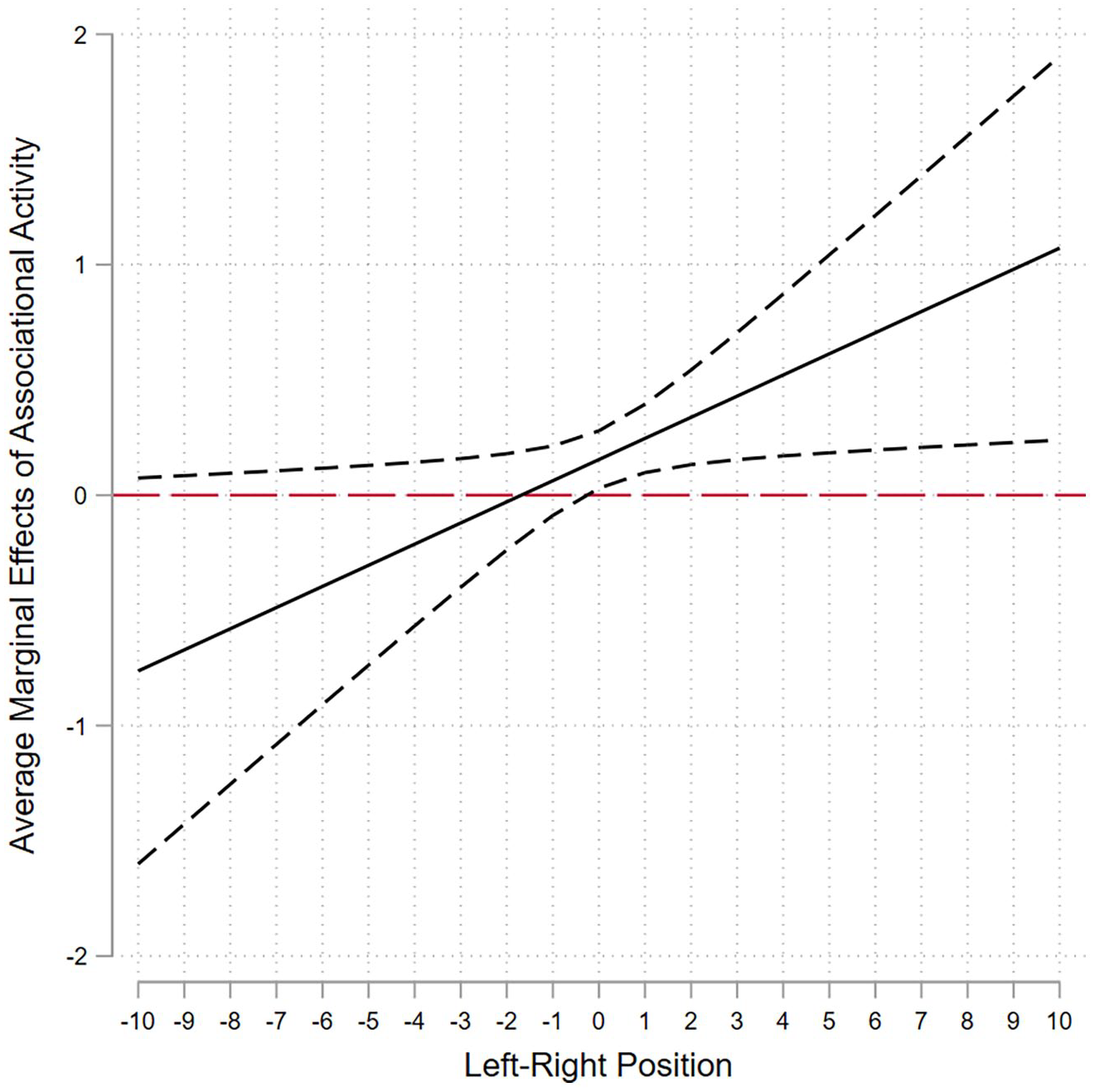
We further include a variable on individuals’ political orientation and ideology. For this, the GLES data comprise an item on people’s left–right self-placement or identification on a scale from 1 (extremely left) to 11 (extremely right). Capitalizing on the longitudinal nature of the data, we concentrate on a respondent’s change in the left–right self-placement over time. This final item’s operationalization is thus based on inter-wave changes and higher values pertain to individuals assuming more conservative (right-wing) views. The more conservative the general public is, the more likely it will be that migration is seen as salient (Böhmelt et al., 2020); in turn, the public can develop more hostile views (Böhmelt and Bove, 2020; Hainmueller and Hopkins, 2014). Given the effect postulated in our second hypothesis, we interact the variable Left–Right Position with Associational Activity. For testing the second hypothesis, all three variables, that is, Left–Right Position, Associational Activity, and the multiplicative term, must be included in the model. We do so in model 4 below and expect the multiplicative term to be positively signed and statistically significant. We also depict the marginal effects of this interactive specification graphically (Figure 2).
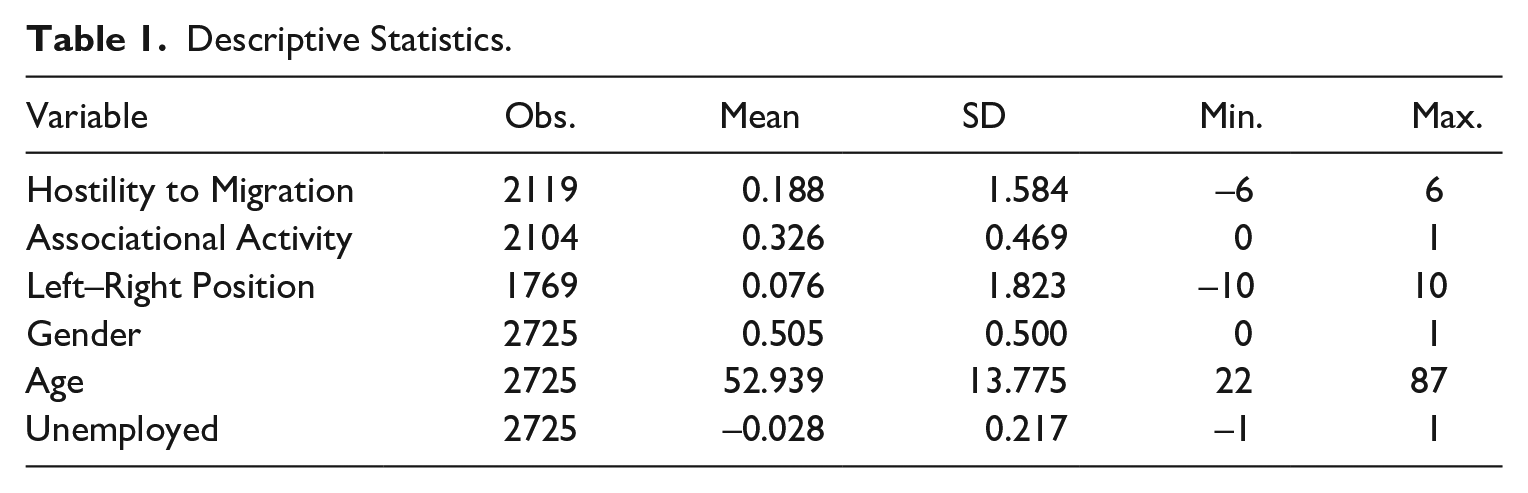
Next to these variables, we control for a set of socio-demographic variables. Their underlying theoretical rationale is based on the existing literature (e.g. Bello, 2017; Curtis, 2014; Kentmen-Cin and Erisen, 2017; Kessler and Freeman, 2005). First, we consider a respondent’s age at the end of wave 12 and their gender. Women might systematically differ from men in attitudes toward migration, while older individuals tend to be more conservative and, hence, are less likely to see migration favorably. 15 The data set is almost evenly divided into males and females, while the sample’s average age is around 53 years.
We also include a variable for the economic status of a respondent: an individual’s (un)employment status. Our unemployment variable receives a value of −1 if a respondent became unemployed between waves 1 and 12, 0 if there was no change in the employment status, or 1 if a previously unemployed individual secured employment by wave 12. Controlling for (un)employment status is important as it could be a confounding variable that affects both associational activities and attitudes toward immigration: people with a secure income likely feel less menaced by immigrants, because their jobs are generally more secure (Curtis, 2014; Fitzgerald, 2012; Scheve and Slaughter, 2001). Table 1 summarizes the variables we use.
Descriptive Statistics.
Findings
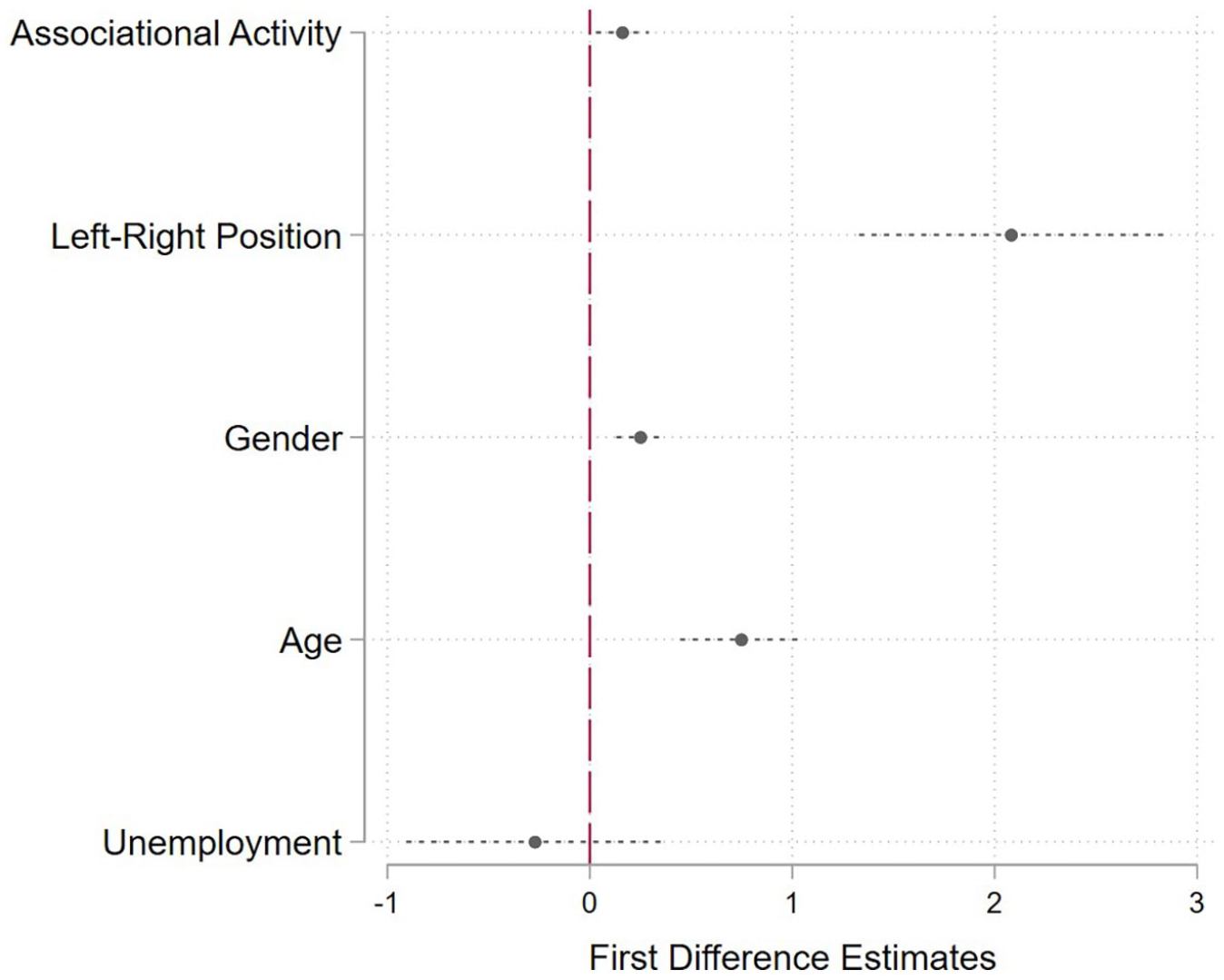
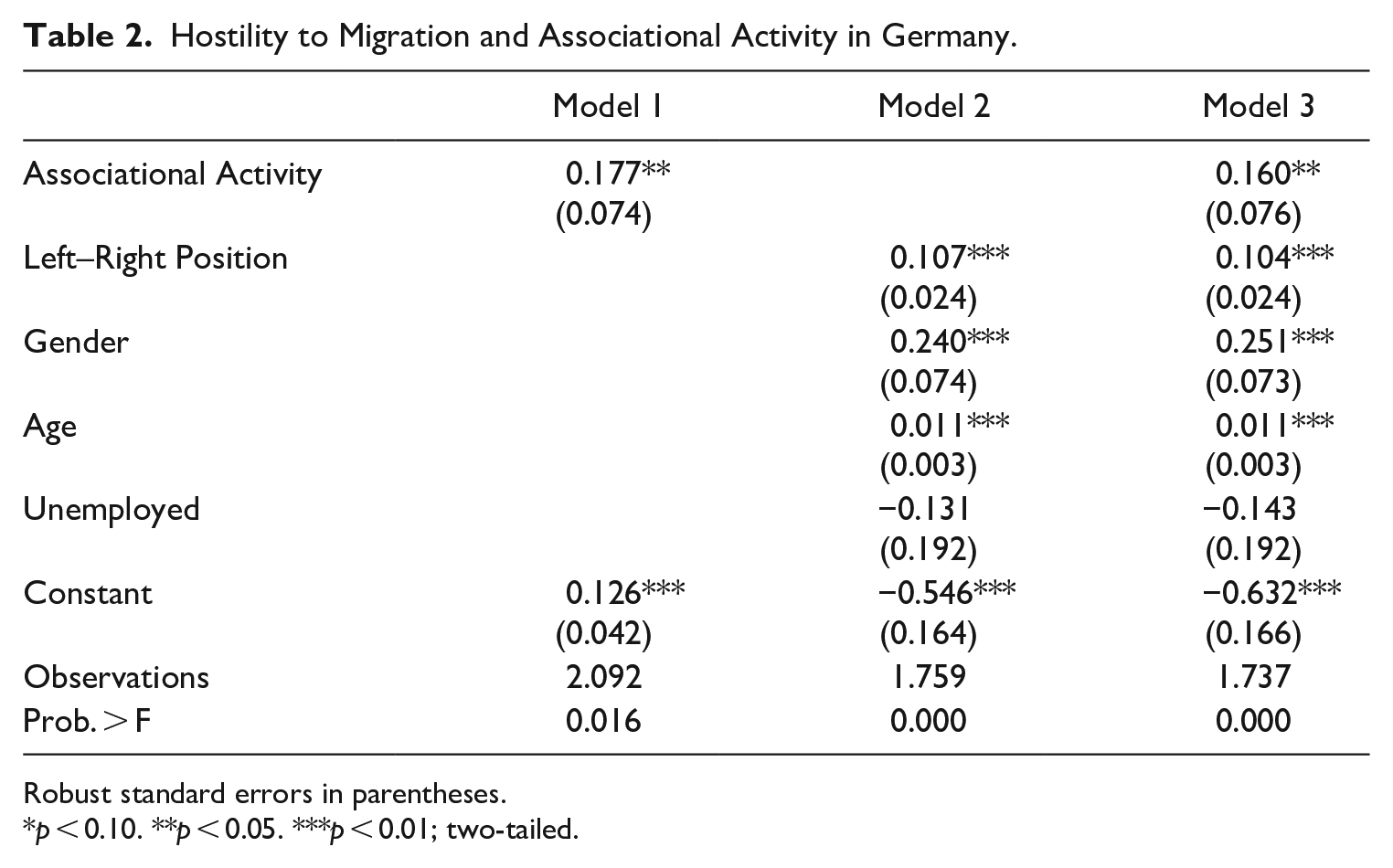
Our empirical analysis rests on four models, which are summarized in Tables 2 and 3. Model 1 only comprises Associational Activity, which we expect to be positively linked to the outcome variable of migration hostility. Model 2 only focuses on the control covariates. Model 3 is based on all explanatory variables introduced above. The estimations in Table 2 follow Model 3, but we now include the multiplicative interaction of Associational Activity and Left–Right Position to test the second hypothesis. Figures 1 and 2 present substantive quantities of interest: the former summarizes first difference estimates for all explanatory variables, and the latter shows average marginal effects of Associational Activity for given values of Left–Right Position.
Hostility to Migration and Associational Activity in Germany.
Interaction of Associational Activity with Left–Right Position.
Hostility to Migration and Associational Activity in Germany.
Robust standard errors in parentheses.
p < 0.10. **p < 0.05. ***p < 0.01; two-tailed.
Interaction of Associational Activity with Left–Right Position.
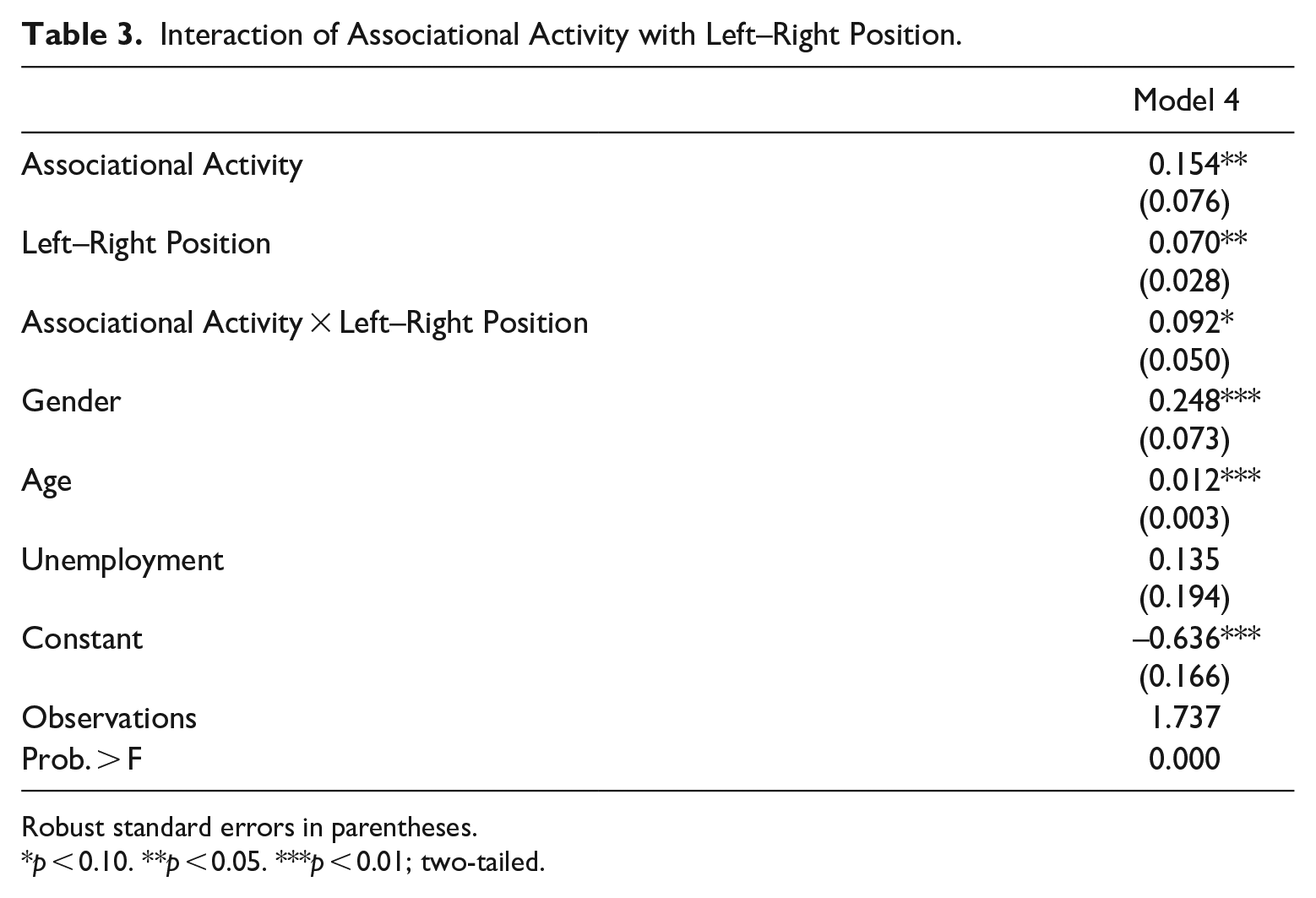
Robust standard errors in parentheses.
p < 0.10. **p < 0.05. ***p < 0.01; two-tailed.
Our theory claims that social activities comprising the membership in sports clubs/associations may be linked to less positive migration public opinion. Indeed, our results emphasize that associational activity leads to more hostile migration views: Associational Activity is positively signed throughout the models in Table 2. Hence, if a respondent became a member of a sports club/society or remained to be a member across the two waves, migration skepticism was higher by about 0.18 (model 1) to 0.16 (model 3) units, which is a sizable effect. 16 Figure 1 underlines this as we depict the simulated change in the expected value of Hostility to Migration when altering Associational Activity from 0 to 1. The coefficient is statistically significantly different from 0 at conventional levels, and of the same magnitude as other important drivers of migration attitudes in Table 2.
The results for Left–Right Position in Table 2 suggest that people on the right of the political orientation spectrum are less supportive of migration and more in favor of restricting migration flows. Having said that, there is also evidence that Left–Right Position moderates the influence of Associational Activity in significant and substantive ways. That is, in Table 3, the interaction effect of Left–Right Position and Associational Activity is positively signed and significant. This suggests that the effect we have identified with Table 2 is more strongly given for those respondents who developed more conservative views between 2013 and 2017. Figure 2 displays the corresponding marginal effects of this interaction. Indeed, changes toward more right-wing ideologies are linked to a positive effect of Associational Activity on hostility to migration. Comparing the effect size of Figure 2 with the coefficient estimates in Table 2 also highlights that the impact of Associational Activity is increased more than 6 times when focusing on those individuals who had the largest shift on the left–right scale toward more conservative attitudes. At the same time, the influence of Associational Activity is insignificant when concentrating on the group of people who had the opposite ideological shift over time, that is, those who assumed more leftist positions between 2013 and 2017.
In sum, we find strong and robust support for our theoretical expectations: associational activities are positively related to hostility toward migration. Memberships in local sports clubs, at least in this context, seem to be associated with the “dark side” of social capital: social identities are reinforced at the expense of out-group members, thus leading to more strongly pronounced negative attitudes toward non-native groups. The impact of Associational Activity is also likely moderated by individuals’ political orientation: more conservative shifts enforce the impact of Associational Activity on anti-migration views.
Coming to our control variables, there is a systematic difference between males and females in our sample. The former have less positive views toward migration: males score higher on our migration hostility outcome variable than females as we obtain a first difference of about 0.25 points (see also Davidov and Meuleman, 2012). Older respondents are also less supportive of migration. Unemployment is statistically insignificant in most of our models.
The appendix (in the Supplementary Information) presents additional analyses and robustness checks. We replicate the baseline models using alternative specifications of the main variable of interest, Associational Activity, by exploiting information on whether and when individuals have joined or left sports clubs and associations. We also omit respondents who have not changed their migration attitudes and estimate a model using three-stage least-squares regressions to determine whether our estimates might be biased due to simultaneity. Overall, our results hold up well to this series of robustness checks.
Conclusion
This article explores the relation between associational activities—a structural component of social capital—on attitudes toward migration, using a panel data set on German public opinion. Germany is one of the countries where immigration has brought forth a strong public response and created a profound division in public opinion (see also Mader and Schoen, 2019). Our results show that more skeptical migration attitudes emerge as a response to associational activities in sports clubs. We believe that this finding furthers our understanding of how public opinion toward migration is formed and we contribute to the literature on social capital. Most importantly, we show that not all types of social capital have “normatively positive” influences. Social capital has been considered for analyzing migration attitudes before (see Fitzgerald, 2012; Geys, 2017; Herreros and Criado, 2009) and there are several works that point to the “dark side” of especially bonding groups (Coffé and Geys, 2007, 2008; Fitzgerald, 2012; Geys, 2017; Geys and Murdoch, 2008). We contribute to these studies by developing a systematic theoretical argument on the impact of associational activities on hostility toward migration and by levering a German panel data set to test our expectations.
Several interesting avenues emerge from this research. First, future studies may want to disaggregate the types of clubs and associations more thoroughly than we have done. Our focus, theoretically and empirically, is on sports clubs and associations, but it may be an effort worth making to explore other organizations with a different scope (see also Coffé and Geys, 2008). While professional clubs can break down barriers and improve interactions between members and non-members, “cultural” clubbing at an informal level can undermine trust toward those who do not belong to the same culture. At the same time, as gender studies demonstrate, the bonding among men of a community within particular men-only organizations can create social exclusion for women. If anything, then, to deal with the problem of “bad” social capital (Chambers and Kopstein, 2001), we need to look more deeply into typologies of associations, chart the variety of activities, and ask which particular features encourage negative attitudes toward out-groups. One way of addressing this in the future could be to make use of the data collection by Geys and Murdoch (2008) and Geys and Murdoch (2010) on the bridging nature of organizations. Having said that, more fine-grained data and information on a larger number of countries and years are necessary to address this challenge. Along the same line, it is interesting to study possible interaction effects between, for example, religiosity or church membership on the one hand in light of Fitzgerald (2012) and, on the other hand, associational membership. The analysis we offer above for Left–Right Position shows that it can be fruitful to understand the underlying mechanisms more accurately. In fact, we believe that future research should more specifically look into various facets of political identity to contextualize more precisely the interplay between associational activities, social capital, and attitudes toward migration. Third, future work could examine the validity of our research in an experimental environment or from a comparative perspective. Especially the former may shed light on whether the causal direction we argue for does apply. We examine possible simultaneity effects for Associational Activity in the appendix (in the Supplementary Information), albeit with little empirical evidence for such a recursive relationship.
Three key policy implications emerge from our work. First, an important question facing us is what different types of impact associational activities, clubs, or associations can have. Not all forms of civic engagement and associations may serve a normatively desirable scope. Despite an extensive debate on the virtues of social capital, not many discuss the types of participation that really matter in fostering social welfare and individual well-being. Second, public opinion is a key driver of policy outputs and implementation (e.g. Böhmelt, 2020; Boswell et al., 2019). In our context, public support is necessary for efficiently implementing policies that address transnational population movements. Our work highlights the importance of associational activity, although hostility to migration may actually increase. It is our hope that more ambitious and effective policies can be designed that not only help integrating large population inflows successfully, but also take into account individuals’ concerns. Third, immigrants should be more integrated into social activities in order to reduce their “outgroup” status. By doing this, the native population would increase contacts to immigrants and reduce their xenophobic attitudes (see Allport, 1954; Pettigrew, 1998), which would benefit society in a long term as increased tolerance foster integration processes (Della Posta, 2013; Schlueter and Scheepers, 2010).
Supplemental Material
sj-docx-1-psw-10.1177_14789299221139805 – Supplemental material for Attitudes Toward Migration and Associational Activity: Evidence From Germany
Supplemental material, sj-docx-1-psw-10.1177_14789299221139805 for Attitudes Toward Migration and Associational Activity: Evidence From Germany by Zorzeta Bakaki, Tobias Böhmelt and Vincenzo Bove in Political Studies Review
Footnotes
Declaration of conflicting interests
The author(s) declared no potential conflicts of interest with respect to the research, authorship, and/or publication of this article.
Funding
The author(s) received no financial support for the research, authorship, and/or publication of this article.

Supplemental information
Additional supplementary information may be found with the online version of this article.
Contents
Table A1. Focusing on Changes in Associational Activity
Table A2. Long-Term Effects of Associational Activity in Germany
Table A3. Focusing on Changes in Hostility to Migration and Associational Activity in Germany
Table A4. Three-Stage Least-Squares Regression on Hostility to Migration and Associational Activity in Germany
Notes
Author biographies
References
Supplementary Material
Please find the following supplemental material available below.
For Open Access articles published under a Creative Commons License, all supplemental material carries the same license as the article it is associated with.
For non-Open Access articles published, all supplemental material carries a non-exclusive license, and permission requests for re-use of supplemental material or any part of supplemental material shall be sent directly to the copyright owner as specified in the copyright notice associated with the article.
