




Abstract
In recent decades, an important field of research has emerged concerning the careers of Members of the European Parliament. Due to the specific nature of the European Parliament, the European Union, the multilevel politics and the peculiarity of the supranational political class, it is of particular interest to map and control the regularity of, and changes in, the composition of the European Parliament and the impact over systemic features or policy-making aspects. For this reason, the article presents a new dataset comprising a collection of detailed information about all of the Members of the European Parliament who held office from the first election in 1979 until the latest in 2019. This dataset represents a useful novelty because it is a dynamic tool that allows reconnecting the Members of the European Parliament’s position and responsibilities within the European Parliament to their political background before entering the supranational assembly. Finally, the article suggests possible fields of research in which this type of data could be useful in deepening and consolidating our knowledge about the European Parliament and its members.
Keywords
Introduction
Studies of political elites represent a fundamental subfield of political science, characterized by a large variety of methodologies and approaches, and by a vast array of objects of study (Best and Higley, 2018). Such enduring fortune is connected to the fact that elites are those who – by virtue of an electoral result or otherwise, or by means of democratic or non-democratic procedures – have the power to establish political outcomes regularly and substantially (Higley and Burton, 2006). The study of political elites contributes towards our understanding of the ways power acts and is distributed, and the way in which individuals and groups determine key policy decisions and exercise influence over the workings of institutions.
Numerous studies and various research approaches have given considerable attention to all these aspects in relation to the Members of Parliaments (MPs). In representative democracies, MPs carry out a variety of different functions, ranging from their primary task of representing citizens-electors, to that of being active actors of the policy-making process. Representative elites play a fundamental role in connecting society with political institutions, thus contributing to the stability and effectiveness of a political system. The complexity and relevance of this function requires us to understand who the representative elites are, what their backgrounds are, how they act within political institutions and how their profile influences the way they perform in parliament.
This is even more important if we think to the representative elites in the European Union (EU), to the peculiarity of their representative function across political levels and how they act within their main institutional arena, the European Parliament (EP). For this reason, it is essential to have tools that allow us to study in depth and with as much information as possible the careers of the Members of the European Parliament (MEPs). These data need to cover different aspects and a long period in order to put in perspective the impact that the circulation of political elites at the supranational level has on the functioning of EU institutions, on the relationship between different levels of government, on the EU political production, on supranational representation and the quality of EU-level democracy. The article will present a new dataset with the precise aim to support the deepening of our knowledge about all these aspects starting from a particular point of view, that is, the structuration of the MEPs’ careers.
Mapping and studying political careers within the EP is worthwhile since it can produce key insights into at least four different but interconnected research themes:
(a) What variables have an influence on the turnover level, which role is played by MEPs’ individual background and the consequent organizational and systemic implications (in terms of system legitimacy, quality of political production, etc.);
(b) Issues concerning gender-balanced representation, the role of the individual background of female MEPs in the allocation of top positions within the EP and the gender impact on policy-making;
(c) The role of seniority and professionalization in the process of EP’s institutionalization and the implications in terms of policy-making effectiveness and throughput legitimacy;
(d) The functioning of an integrated and multilevel political space that determines a peculiar structure of ties and opportunities for political careers and differentiated patterns of circulation of professional politicians. How European societies and the EU political system are interconnected through the different actions, roles and representative styles of MEPs.
The article is organized as follows. The first section will illustrate the dataset by putting it in the context of the main literature dedicated to the study of EU-level political careers, after the dataset variables will be presented. In the third section, some possible research avenues in which use this data will be suggested, offering examples of analysis based on the dataset. In the last part, some concluding remarks will be presented.
Career Patterns at the EU Level: Why It Is Still Worth Studying Them
The studies concerning the definition and strengthening of a truly European parliamentary class are extremely relevant because they are intertwined with the literature on the institutionalization of the EP (Daniel, 2015). The institutional setting represents a key factor in the process of elite selection and circulation. This relationship is more vital and peculiar for the supranational parliamentary class than it is for any other because those elected to the EP, unlike their peers in national parliaments, do not have any possibility of moving directly from parliament to either of the two branches of the executive as the outcome of the way in which the electoral results connect the executive and the legislative arenas.
Another distinctive feature of the EP is the extremely diversified backgrounds of its members, with MEPs coming as they do from 27 different member states, each having different connections with their electoral constituencies, diversified party systems and a consequently differentiated link with the national political arena from which they derive the legitimation to operate at the EU level. This results in a very fragmented, highly differentiated picture, which in turn has the potential to cause a high degree of instability (Beauvallet-Haddad et al., 2016). Despite this, in recent years, a growing stabilization of MEPs’ profiles has been noted, accompanied by a lengthening of the careers of MEPs (Salvati, 2016; Verzichelli and Edinger, 2005; Whitaker, 2014), as well as the apparent stabilization and formalization of parties’ recruitment rules (Kelbel, 2020) and paths to political promotion (Yoshinaka et al., 2010). This means that the multilevel and polycentric system is integrated in both institutional and political terms because the natural differentiation and pluralism of 27 different subnational and national levels do not imply the instability, fragmentation and ineffectiveness of the European system.
The diversity and pluralism proper of this system have led to various attempts being made to establish classifications and typologies; from the seminal work by Scarrow (1997), these have focused on different features of the EP’s members. The rationale of these researches is that if we aim to put in context also the systemic implications of MEPs’ career trajectories, it is essential to identify which are the known characteristics of these patterns. First of all, we have to distinguish between two principal logics underlying MEPs’ ambitions, namely, whether they perform their roles as MEPs while envisaging a political career at the national level or at the European level. The first logic applies to those MEPs who take advantage of their supranational position to attempt a political comeback or as a stepping stone towards the national political arena (Verzichelli and Edinger, 2005), considering the EP as a useful first political experience or as a necessary step towards obtaining future political gains in the national arena.
The second logic, on the other hand, applies to those MEPs who aim to build a political career oriented towards the European level (Salvati, 2016; Scarrow, 1997). This type includes those MEPs who decide to build their career (or a large part thereof) within the supranational arena, by using their political capital to stabilize their presence in the EP (Verzichelli and Edinger, 2005; Whitaker, 2014). This highlights the ever-growing connection between different levels of government and the subsequent intertwining of career opportunities and the structure of incentives defining them (Daniel and Metzger, 2018; Salvati, 2016). The dataset provides a systematized set of information that allow to consider MEPs’ profile as the dependent or independent variable and put it in relationship with both the EU institutional environment and the multilevel and integrated political system in which the EP arena is just one of the rings of this new political space (Borchert and Stolz, 2011).
This approach calls into question the necessity to embrace a dynamic perspective in the study of political careers in the context of the intertwining of local, national and supranational dimensions (Beauvallet-Haddad et al., 2016; Borchert and Stolz, 2011) and on the growing interdependence among these levels. The careers unfolding across various levels can tell us something relevant about how different interests and demands move in a broader political space, which are the characteristics of those who are in charge of these representative claims, how the (potential) conflicts between those claims can be managed and why an institutional venue seems to be more suitable for specific interests compared to others and so on.
To follow this path of research and fruitfully use the dataset, it is important to consider the role of two interconnected dimensions and keep them in the background of our analysis. The first one, which can be labelled as static or institutional, pertains to the transformation in the distribution of power and competencies across different political levels. The first transformation is the tendency towards an increasing decentralization of power and authority towards lower levels of government (Hooghe et al., 2016; Keating, 2008). The strengthening process of the meso level of government has created useful conditions to define the contours of a regional political class that is distinct and autonomous from the national one (Vanlangenakker et al., 2013) and that consequently is representative of specific interests that do not necessarily coincide with those which characterize the nation-state level.
The second transformation refers to the role of the EU as a political system and supranational level of governance. If it is true that at the European level professional politicians frequently act as national politicians in the European arena (the European Council and the Council of the EU), we are nevertheless facing the definition of a truly European political elite within the EP. Nevertheless, when the composition of these institutions is not of technocratic nature – like for the European Central Bank – we are facing the deploying of political mechanisms that are determining the definition of a core group of a truly European political class (Scarrow, 1997; Verzichelli and Edinger, 2005), that is connected to the national arena as a source of legitimation but at the same time is committed to strengthening this supranational institutional level (Van Geffen, 2016).
The second dimension, which can be labelled as dynamic or pertaining to the trajectory of careers, concerns the analysis of the elements that influence the dynamics whereby political careers begin, unravel and develop along different levels of government, providing new combinations and opportunities for professional politicians, stimulating new ambitions (Stolz, 2003).
This means that political career patterns have substantially changed, the weight of the one-way model has been relativized, while now different opportunities in terms of mobility, combinations and trajectories have been opened (Borchert, 2011; Vanlangenakker et al., 2013). Such differentiated arrangement influences patterns of career for what concern both the models of movement across the levels – inter-level trajectory – and the career unfolding within the single levels – intra-level trajectory.
All these elements outline some of the reasons why it is relevant to study an integrated model of political careers and why it is worthy to use individual-level information such as that collected in this new dataset.
The Dataset on MEPs’ Political Careers
The new Dataset on Members of the European Parliament (DMEP) (1979–2019), which is available at https://dataverse.harvard.edu/dataset.xhtml?persistentId=doi:10.7910/DVN/V2FJEF, contains information about 6461 MEPs and covers all nine EP parliamentary terms and all member states. The information about the MEPs has been collected from several different sources, namely, the EP website, the EP legislative observatory, the Official Journal, European and national parties’ websites, Wikipedia, individual MEPs’ websites (where available), national legislatures’ websites and newspaper articles about MEPs’ individual biographies. Where possible, the said sources have been combined in order to double-check different information about individual MEPs.
Despite the difficulties in collecting precise data, especially for the earlier EP terms, the level of accuracy has been quite satisfying due to the opportunity to rely on different sources that provided the opportunity to cross-reference the data. For the collection of data from online websites and repositories, an online translation tool (Machine translation for public administrations) has been used, a resource that is widely recognized in the literature as extremely reliable for the translation of text for case studies analysis or comparative purposes (De Vries et al., 2018). 1
The DMEP (1979–2019) is substantially different from other datasets both for the type of collected data and the quantity of gathered information. Previous datasets have a limited type of information in terms of selected variables or time span covered, and were characterized by (a) looking only at the main individual-level variables (demographic data and role in the EP) in a static way (Michon and Wiest, 2021) or by giving the opportunity to update these limited data in a regular manner via an automated instrument (Høyland et al., 2009); (b) collecting information concerning MEPs’ individual political background but without specifying the details about the assumed offices, that means to systematically distinguish between national and regional/local level (and subsequently providing details about the specific role according to the political level) and do not linking them with legislative variables (Corbett et al., 2007); or (c) focusing on topics other than the political background like the type of parliamentary activities prioritized by MEPs in their working activity within the EP in a singular parliamentary term (2009–2014) (Sorace, 2018).
Obviously, the dataset can be integrated with all these specific resources and several others, according to the proposed research goals. For example, if the aim is to mix and match the MEPs data with the candidate-level information, the COMEPELDA dataset (Däubler et al., 2022) is an extremely valuable resource to be associated with. In particular, because COMEPELDA gathers sensitive data like country-level information (electoral rules), party lists results, data on individual candidates and information on elected MEPs (like mandate type and district affiliation).
The novelty of the DMEPs is the larger and more detailed amount of variables that embrace all the EP parliamentary terms, aiming to reconstruct the political career of all the individual MEPs in a temporal frame that moves from the period immediately prior to the EP election – by codifing the last office held before the arrival in Brussels (providing a detailed reconstruction of the individual political career of every MEP) – till the election to the EP and the consequent assignment of specific offices and leadership positions. This means that the logic at the base of this dataset is completely different from the others, because the aim is to provide researchers with a dynamic tool that does not simply produce a static snapshot of what roles MEPs have within the EP or which responsibilities they assume.
The variables (see Appendix for the Codebook) that reconstruct the MEPs’ individual career paths can be gathered in three categories: party membership, political background before the election to the EP and offices hold within the EP. The first variables identify the country of origin, the European Political Group (EPG) and the national party to which the MEP belong. In the case of MEPs who have switched to another national party and/or another EPG, the last membership and not the one of the election has been codified.
Moving to the variables addressing MEPs’ previous experience, the dataset specifically focuses on the thorough reconstruction of the individual political backgrounds. The main difference in individual political backgrounds concerns the distinction between elected representatives with solid professional political experience and those classifiable as political amateurs. A career politician is defined as an MEP with previous experience in top offices both at the party and institutional level, in positions that are remunerated and/or require a relevant degree of political professionalization due to the power and authority resources connected to the role.
As regards data about the prior political experience, the dataset is based on an in-depth differentiation of the type of positions held, starting from the distinction about the level to which the office held refer to, namely national and subnational. For both levels, the positions are codified if the individual MEPs have been in office for at least 1 month. With regard to national political experience, the MEP’s professionalization is detected if she or he has held the position of: member of the national parliament or the EP, senior or junior minister, Prime Minister, President/Head of State or member of the national party leadership (for this category have been considered the positions of general secretary/president and member of the bureau). According to which position the MEPs have held, the specific office is written out in full.
The interest in tracing the political background of individual MEPs involves also the consideration of the importance to trace the turnover level within the EP, considering this as a relevant proxy in order to measure the institutionalization of the legislature. For this reason, the dataset makes it easier to access the data about the comeback to the EP and for every MEP it detects if she or he is a newcomer – with no previous experience within the EP – or re-elected. For this second option, there is also the indication if for the MEPs it is a comeback directly from the previous parliamentary term or after an interval (meaning that the MEP spent one or more parliamentary terms outside the EP before his or her re-election to such). Finally, are indicated the number of times she or he has been an MEP.
With regard to regional/local expertise, on the other hand, this means having been a council member (at district and/or city level), mayor, a member of the regional parliament, regional minister, regional president or a member of the regional party leadership (for this category have been considered the positions of regional secretary/president and member of the bureau). According to which position the MEPs have held, the specific office is written out in full. For what concerns the office at the local level have been considered only the municipalities with 20,000 or more inhabitants, in order to get a balance between the relevance of the role and the magnitude of the population in order to avoid the risk to exclude the role of ‘mayor’ or ‘council member’ from the definition of professionalization. The dataset only considers the latest office(s) held prior to the election in the parliamentary term in question. In the case of a person holding two different offices at the same level (e.g. minister and MP), the most important position is considered.
If an MEP has held office at both national and regional levels prior to his or her election to the EP, then they are both counted in the dataset (this condition only holds in those countries where there are no limitations on the number of offices that can be held), leaving it up to researchers to decide which of the two to consider.
Instead, for what concern the lack of political professionalism, an MEP is considered a political amateur if she or he has never held an institutional or party office at the national or regional/local level 2 and that arrive in Strasbourg from society, the professions, associations (his or her lack of experience at the political-institutional or party leadership level is considered sufficient grounds for including the MEP in the amateur category).
The last series of variables indicate the role assumed within the EP by the individual MEP and refers to both parliamentary and EPG offices. On one hand, the parliamentary role variables gather the positions that are considered most rewarding for an MEP and to which are attached the most relevant legislative power resources. These positions are paramount because for those who aim to build a political career at the EU level, these are the only available offices due to the lack of direct access to executive positions. Here are considered the steering position of the assembly which are President, Vice President, member of the bureau and member of the EP’s conference of presidents. Alongside these positions, there are the roles connected to the policy-making activity: Presidents and Vice Presidents of parliamentary committees, rapporteur. In a highly specialized and committee-based legislature like the EP, these roles assume a pivotal position due to their impact on reports and legislative dossiers. The rapporteur lies at the core of the legislative process and of the co-decision procedure, so for both an individual MEP and the EPGs, it is extremely important to be in charge of legislation, controlling a report from the beginning to the approbation. The dataset has a specific variable which is the number of times that an MEP has been in charge of legislative and initiative reports 3 as rapporteur – a variable that is available from the 1999 EP term onward.
On the other hand, for the variable role in the party group, the dataset detects all the MEPs that have had the position of group Chair, Vice Chair or member of the bureau (within which is included also the treasurer). Obviously, for those MEPs who have held at the same time parliamentary and EPGs’ offices, both positions are counted. Finally, for all the MEPs, the gender is indicated.
All of these variables provide researchers with a unique source of information that allows them to match and mix different variables in order to further our knowledge of the causal mechanisms underlying the various different aspects of MEPs and the EP’s lives.
The Political Profile of MEPs: What can be Investigated Using the Dataset
The opportunity to analyse the evolution of MEPs’ profiles longitudinally in 30 years of direct elections allows us to define patterns of regularity and change across different dimensions. In particular, there are four streams of research that can largely benefit from using this dataset by considering political careers as the main interpretative lens. Following these themes are presented specific suggestions on what research path can be selected and which dataset’s variables can be more useful. Finally, for each of the four themes, some data and analyses are presented.
Turnover Rate: Organizational and Systemic Implications
One of the possible pieces of evidence that can be produced by the dataset is the study of the EP’s institutionalization process through the analysis of the turnover level, evaluating its influence over the EU polity and the functioning of the multilevel system. Turnover is a key indicator since it reveals the effectiveness of a parliament within a political system, and its ability to perform all its essential functions (Matland and Studlar, 2004). In a nutshell, a parliament with a balanced turnover rate is an institution that is able to ensure continuity and seniority, while guaranteeing a physiological injection of new forces and demands – through newcomers – into the institution. This can be interpreted as the change in the membership of the EP both from one parliamentary term to another, and within a single parliamentary term, with voluntary and involuntary exits being distinguished, thus further refining the analysis (François and Grossman, 2015). These data can be calculated using the variables concerning the numbers of newcomers and the re-elected to the EP.
The turnover rate for the last eight EP elections (see Figure 1) was quite high, and was characterized by substantial peaks that do not allow us to identify any specific trend in the rate of MEPs substitution. This data item opens up different avenues of research concerning both individual level reasons for turnover – the decision of an individual MEP not to run for another term due to personal or professional reasons (Borchert, 2011) – and the party-level dimension. This second dimension comprises intra-party dynamics, the role that national parties play as gatekeepers in the selection process and the principal–agent relationship between organizations and individual MEPs (Gouglas and Maddens, 2019). For example, literature shows that fringe parties seem more likely to consider European elections as of prime importance, thus they support the selection of incumbent MEPs and promote their re-election (Daniel, 2016) and that parties tend to select the profile of their candidates (inexperienced, nationally experienced or European experienced) according to their electoral goals (Aldrich, 2018). Moreover, the individual level of professionalization is a variable that can influence parties’ performances at EP elections, having pieces of evidence that the presence of experienced politicians as leading candidates is a valuable predictor of party electoral success (Hobolt and Høyland, 2011). A structured dataset with full information on MEPs’ political backgrounds allows to enquire in details the connections between the EP legislative and electoral dimension by overcoming the limitation in data availability. The existence of other datasets like the COMEPELDA one (Däubler et al., 2022), permits to link the data of the MEPs’ political background and the offices held within the EP to data on national electoral laws, position on party lists and preference votes (where applicable), district affiliation and so on. This provides the unique opportunity for tracing the interplay between the party, the electoral and the institutional arenas at both national and supranational levels for every MEP.
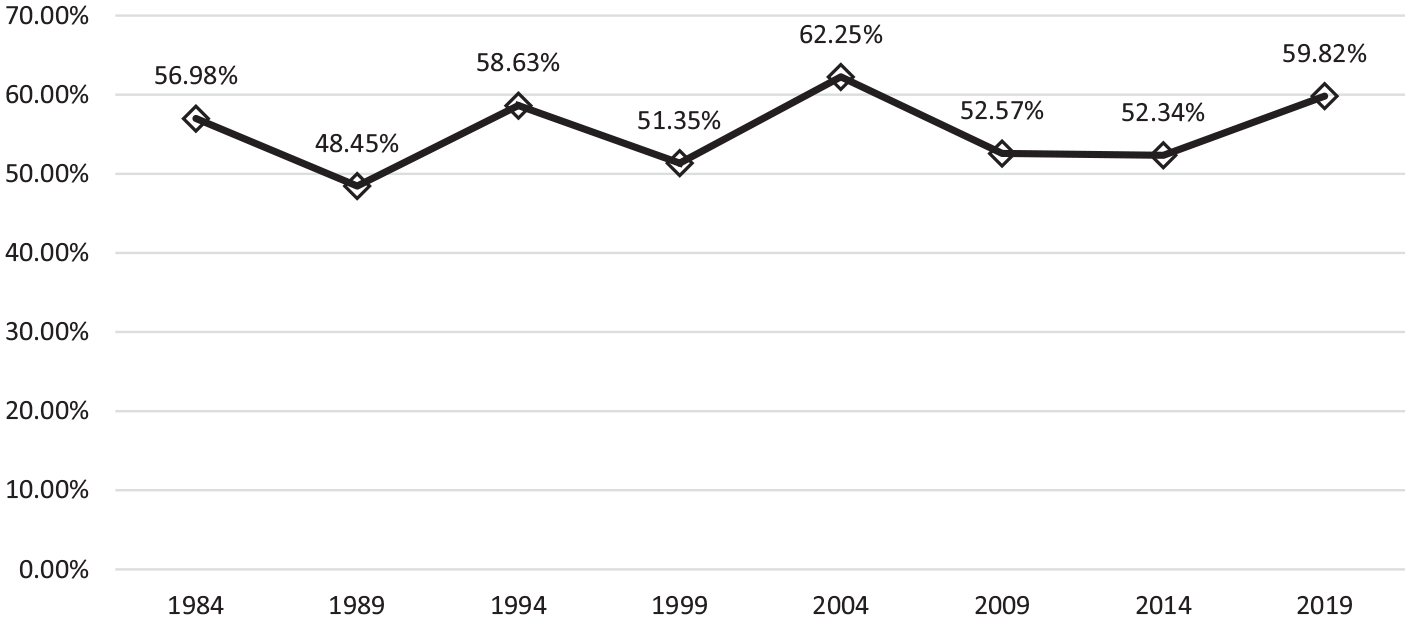
Average Turnover in the EP (1984–2019).
These research lines can be brought back to a more general question pertaining to how the choices made at the individual and party level and the characteristics of MEPs can influence both the institutionalization and the performance effectiveness of the EP.
Finally, considering the EP’s role in co-decision and its constant struggle with other institutions (especially the Council) for gaining more power – even if with limited success – as testified during sensitive crises like the Eurozone and the reform of the economic governance (Bressanelli and Chelotti, 2018) or the migratory crisis (Ripoll Servent, 2019), and the difficulty in strengthening the representative-accountability circuit (Salvati, 2022) assumes particular relevance the opportunity to study how the role of parties as selectors and gatekeepers of political personnel – the meso level – can influence the capacity of the institution in its power struggle within the EU political system – the macro level. The main issue at stake is to determine whether and how specific patterns of elite selection and circulation, the stabilization of a core group of European politicians and the individual background of this political elite have any influence, and of which type, over the interinstitutional dynamics and the EP capacity to improve its constituent power.
Gender Representation
Looking more directly at the composition of the EP’s nine parliamentary terms, an interesting item of data concerns the gender dimension, and connects this broader topic to important parliamentary issues such as the quality of political representation or the EP’s legislative function. The first case pertains to the rough data for the distribution of male and female MEPs (see Figure 2) and the composition of the assembly.
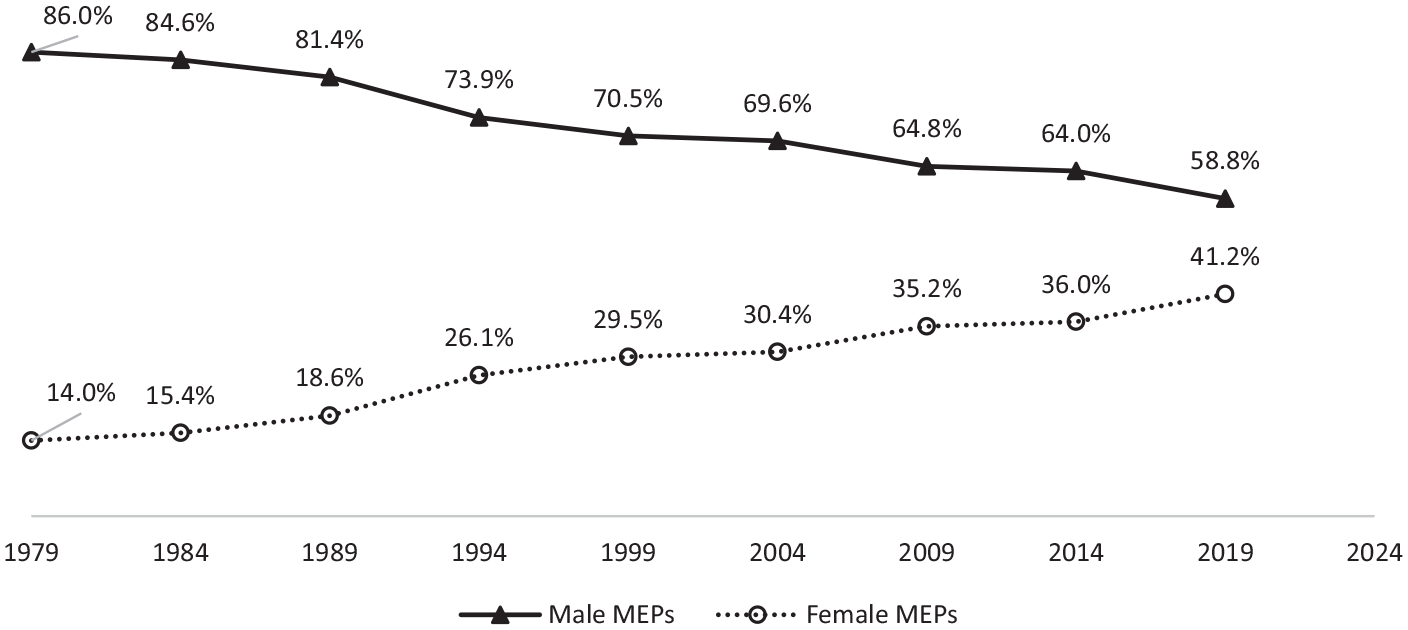
Male and Female MEPs in the Nine EP Parliamentary Terms.
Observing Figure 2 we can appreciate the existence of a trend of convergence between the numbers of male and female elected representatives. If 30 years ago the gap between them was remarkable, the last European elections established a more balanced picture, with the ninth EP parliamentary term having the highest percentage of female representatives.
The literature has devoted great attention to the phase of selection of female candidatures, highlighting the different variables that influence this process like the role played by party-level patterns of selection, with a more centralized model that is conducive to a higher selection rate of female candidacy (Aldrich and Daniel, 2020), or the position of parties on European integration with pro-EU parties in new member states keener to recruit more women as candidates (Chiva, 2014). Other studies have analysed the determinants of differences in female MEPs’ election according to nationality, and also, for example, their membership of EPGs and the individual political background of female MEPs (Lühiste and Kenny, 2016).
Instead, a field of research in which more studies are needed concerns the analysis of what happens when women are elected in the EP. Thanks to the work of Ahrens and Kantola (2022) we know that gender plays a role in the delicate process of group formation, involving different dimensions like formal group constitution and the assignment of leadership and policy positions. Even if differentiated according to different EPGs, the gender variable plays a role in the process and trajectory of group institutionalization. What can be examined in depth is the interplay between gender and political background and the relative influence that this relationship can exert over, for example, the whip of EPGs or the steering of policy dossiers (both in committee and plenary).
Finally, the growing presence of female MEPs has led to a corresponding growth in the assignment of top positions within the EP. What is particularly interesting when we examine the descriptive statistics in Table 1 is the marginality of female amateur newcomers to office; for female MEPs, relevant political professionalism – either in the EP or the national/subnational arena – seems to be of strategic importance when pursuing a career in the supranational parliament. This evidence is in line with the findings of Aldrich and Daniel (2020) according to which gender quotas have a positive impact on the selection to the EP of female candidates with solid previous political experience.
MEPs Women Holding Senior Offices in the EP.
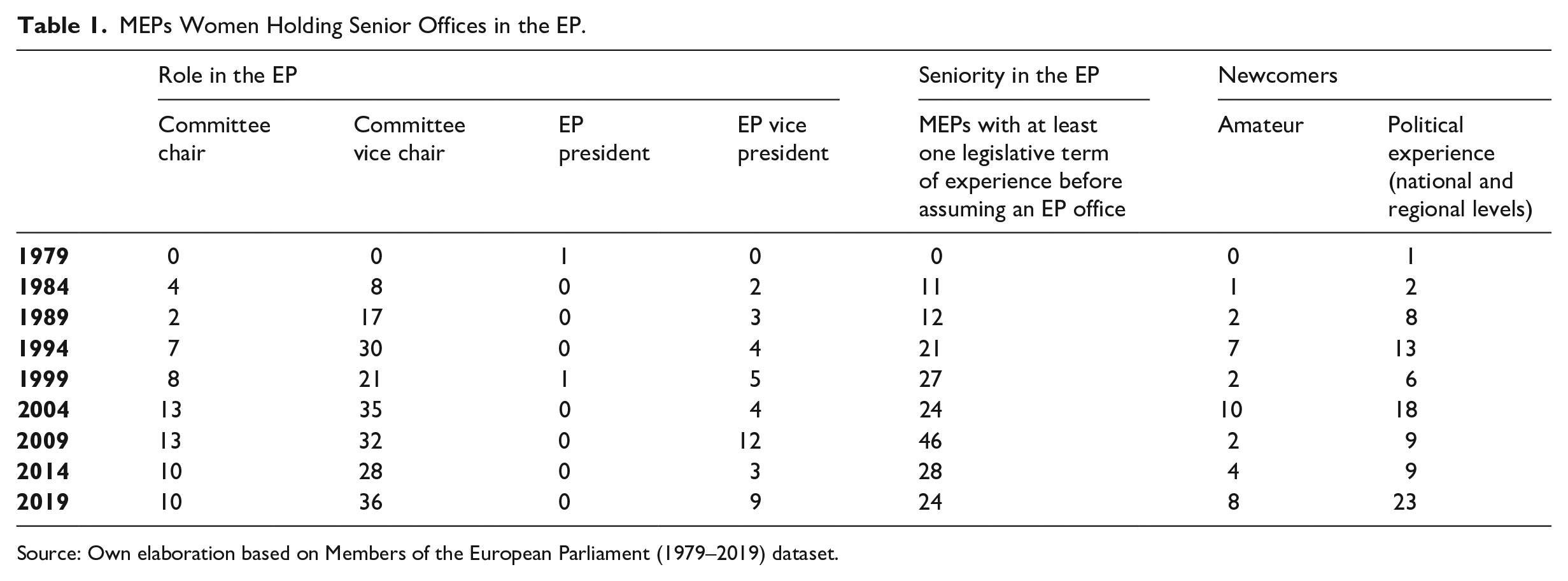
Source: Own elaboration based on Members of the European Parliament (1979–2019) dataset.
Starting from this empirical result it is paramount to further analyse which elements influence the assignment to female MEPs of leadership positions within the EP and also identify which patterns of career and elite circulation in a multilevel-integrated political system characterize the political professionalization of female elected. Related to this topic we find the issue of gender leadership positions’ effectiveness in the policy-making process, which urges to enquire about eventual gender differences in leading to successful legislative dossiers and for which reasons.
Seniority and Professionalization as Strategic Political Resources
To provide valuable insights about the role played by seniority and professionalization (and specialization) within the EP, it is necessary to adopt a clear perspective through which to analyse the characteristics of this political class in the making and its changing features. For this reason, it is useful to adopt one of the various MEP classifications in order to guide the analysis.
Despite different approaches and typologies, it is probably more useful to adopt a parsimonious classification by which to distinguish the different MEPs, thus avoiding the risk of including, for example, variables that are difficult to empirically verify, such as MEPs’ individual ambitions and their professional and individual goals (Salvati, 2016). The main criterion underlying this classification is the analysis of the professional political background of each individual MEP.
Such an approach allows us first of all to distinguish between re-elected and newcomer MEPs. The first coding determines, de facto, the pure European political class and the core of specialized MEPs who presumably lead the parliamentary arena. The second is divided into two subcategories: professional politicians and political amateurs.
Despite the existence of several variables influencing the possibility of a member of parliament being confirmed in office, the degree of stability is, nevertheless, important since it allows us to measure the entity of a core group of MEPs representing that political class focused on the European dimension. This dynamic is of paramount importance since it determines the degree of knowledge of, and the individual specialization in, European issues of a set of career politicians (Salvati, 2016; Whitaker, 2014). This process of European professionalization is directly intertwined with the growing complexity of the EP: a powerful legislature with a high level of internal specialization requires a political leadership with great expertise and knowledge of the perilous waters that characterize the European policy-making process (Ripoll Servent, 2017).
One interesting measure that can be gathered from these data is the connection between considerable seniority within the EP and the assignment of key positions in the party group and senior parliamentary offices. Table 2 identifies that the distribution of top offices within the EP is mainly reserved to MEPs that have spent at least two parliamentary terms in Strasbourg. This summarizes that for MEPs seniority is a precondition for accessing positions of power within the EP. This information, considered in relation to the MEP’s capacity to gain further reconfirmation in office after an initial return to Strasbourg (Beauvallet-Haddad et al., 2016), confirms the existence of a core group of career politicians committed to pursuing a supranational political career (Daniel, 2015; Salvati, 2016; Whitaker, 2014); these politicians thus constitute the hub of professional specialization within the EP (Verzichelli and Edinger, 2005).
Distribution of Top Offices among MEPs With At Least Two EP Parliamentary Terms of Seniority.
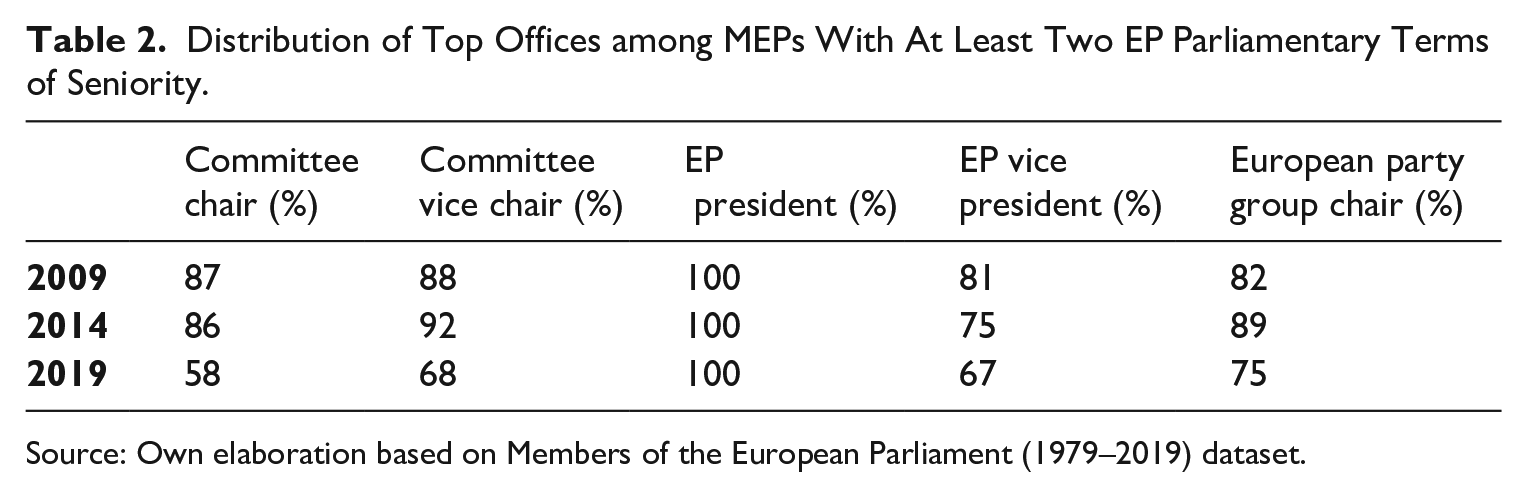
Source: Own elaboration based on Members of the European Parliament (1979–2019) dataset.
The issue of specialization should also be considered under the lens of its relationship with the legislative process. The analysis of the determinants of the assignment of committee and rapporteur positions directly involves the role played by MEPs’ individual experience both at EP and national level (Hermansen, 2018; Salvati and Vercesi, 2021; Yoshinaka et al., 2010). It has been demonstrated that substantial experience within the EP together with intra-institutional ambitions are key factors in gaining committee leadership positions (Treib and Schlipphak, 2019). On the other hand, the assignment of rapporteur positions is affected both by MEPs’ individual interest in a specific policy sector, and by their political expertise matured within the EP (Kaeding, 2004). In addition to these findings, Salvati and Vercesi (2021) have shown that parliamentary policy-making effectiveness is not necessarily negatively affected by a high turnover level when the newcomers assuming leadership positions have solid political experience (at both national and subnational levels). These results are in keeping with the finding that the senior roles in the EP, especially that of the rapporteur, are crucially occupied by those MEPs capable of generating a broader consensus on legislative bills (Yoshinaka et al., 2010). In a consensual institutional environment like the EP, the consensus-building capacity represents a powerful and strategic resource for a policy maker. Under this point of view, we can expect to find this capacity accentuated in MEPs with a stronger professional political background (at every level, from local to supranational), making these profiles more interesting for parties to be selected for the EP and promoted in sensible positions. For this reason, it can be relevant to enquire to what extent the MEPs’ individual backgrounds influence both the policy-making process and the effectiveness of the EU political production.
The dataset information can be a valid support also for studying more in depth the relationship that may occur between individual political background and the representative style and/or the legislative activities of MEPs (Sorace, 2018). Does the type of MEPs’ background exert any influence on the role and behaviour of MEPs? Does the type of activities privileged by single parliamentarians (written or oral questions, speeches, motions for resolutions, participation in plenary debates, etc.) have any connection with the MEPs’ type and degree of professionalization? Considering the different sets of constraints and bonds that characterize the various parliamentary activities (Sorace, 2018), we could expect, for example, that more experienced MEPs are those that can be more easily engaged in the more costly and rewarding parliamentary activities.
Moreover, both candidate selection and policy effectiveness should be considered important issues when pursuing also a new line of research into the role and profile of Eurosceptic MEPs, regarding both the degrees to which they are involved in the EP’s day-to-day operations, and their impact on the policy-making and the legislative activities (Brack, 2015; Ripoll Servent and Panning, 2019).
Moving our attention to ‘the other side of the moon’, the fresh arrivals at the EP, the dataset divides the newcomers into three types: politicians with a national political background, politicians with an exclusively local/regional background and amateurs lacking any political professionalism.
The picture that emerges from Figure 3 is quite clear. It reveals a stable pattern regarding the EP’s new arrivals, with the great majority of MEPs that have a solid political experience. Thus, we can infer the following element: political professionalism (national plus local level) is the predominant feature of all EP newcomers since the first direct election to the EP. The clear prevalence of career politicians among EP newcomers means that parties and electors have always been inclined to rely on professional politicians when establishing membership in the Strasbourg delegation, and that the option of a supranational career represents an appealing opportunity for career politicians. A piece of evidence that contributes to downsizing the interpretation according to which the EP, in its first years after the first direct election, was considered by professional politicians no more than a talking forum.
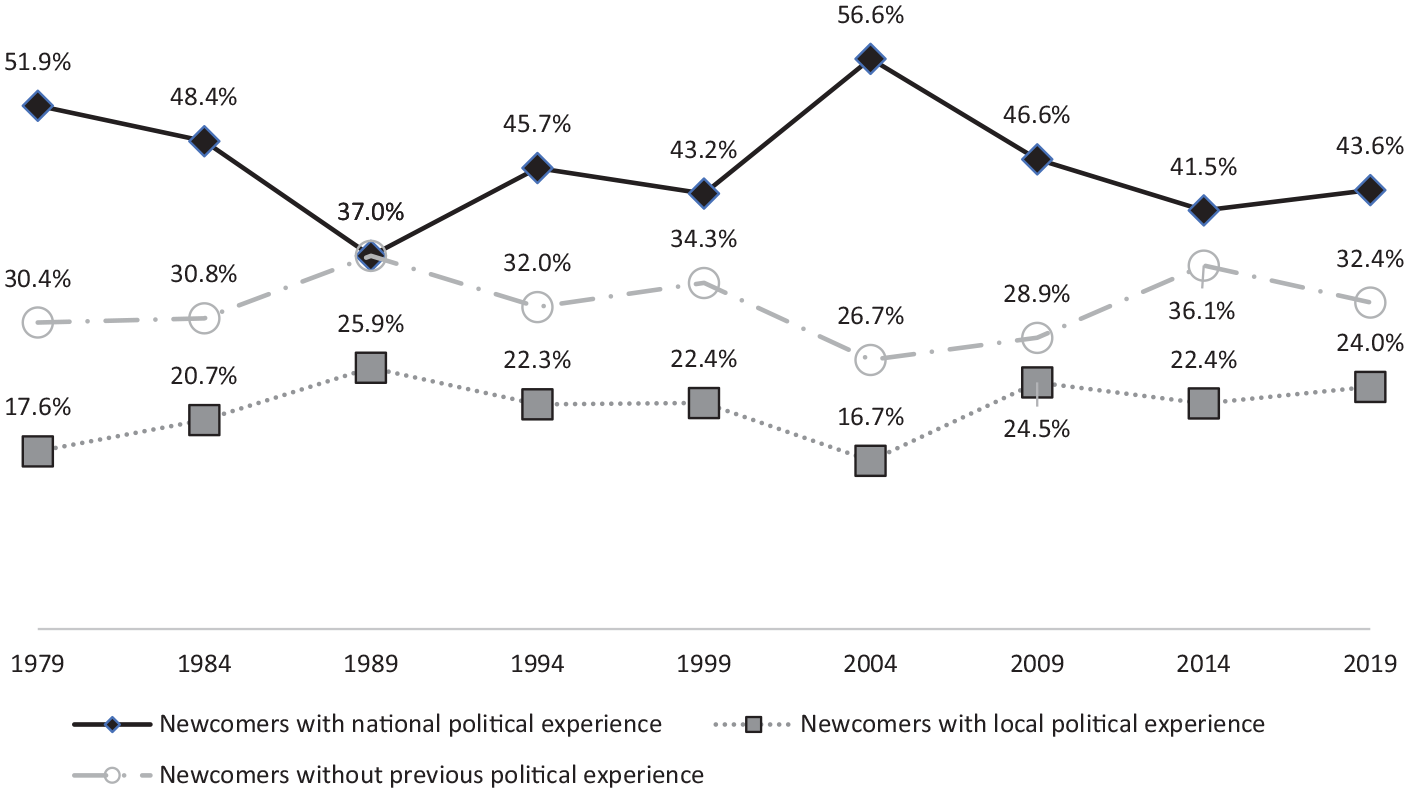
Newcomers Distribution According to Their Background Prior to the Entry to the EP.
Patterns of Circulation in a Multilevel and Integrated Political Arena
In order to better grasp the patterns of elite circulation and their influence over the EP and its functioning can be worth looking more in detail at the stratification of EP newcomers. A possible approach can be to consider the member states’ level as a unit of analysis and detect differences in the patterns of circulation produced by differentiated sets in the structure of opportunities in a multilevel perspective (Borchert and Stolz, 2011). A promising research avenue can be to study how the relationship between subnational levels of government and the EU has influenced the patterns of MEPs circulation across different political levels. Are there any visible trends? Is there a connection between the model of territorial authority distribution and models of political circulation?
The key role of the EU in the life of local and regional communities, together with the growing interconnection between regional and EU institutions, opens the way for an investigation of whether the governance intersection that bypasses the national level is also having an impact on the political experience of those elected to the EP in Strasbourg. Are we now seeing an increase in the number of career politicians who move directly from the local/regional level to the EP? Is there any country-specific pattern in this regard?
If we look at the general data shown in Figure 3, it is difficult to see any balancing between national and local backgrounds at the aggregate level. 4 After the sharp rise following the first two direct elections, and the negative downwards in 2004, the level has been constantly below 25% of newcomers, but is it this trend the same for all member states?
If we consider, for example, the same variables and the same time span for the ECC15 only (i.e. prior to the 2004 and 2007 rounds of EU enlargement), the picture is quite different (see Figure 4).
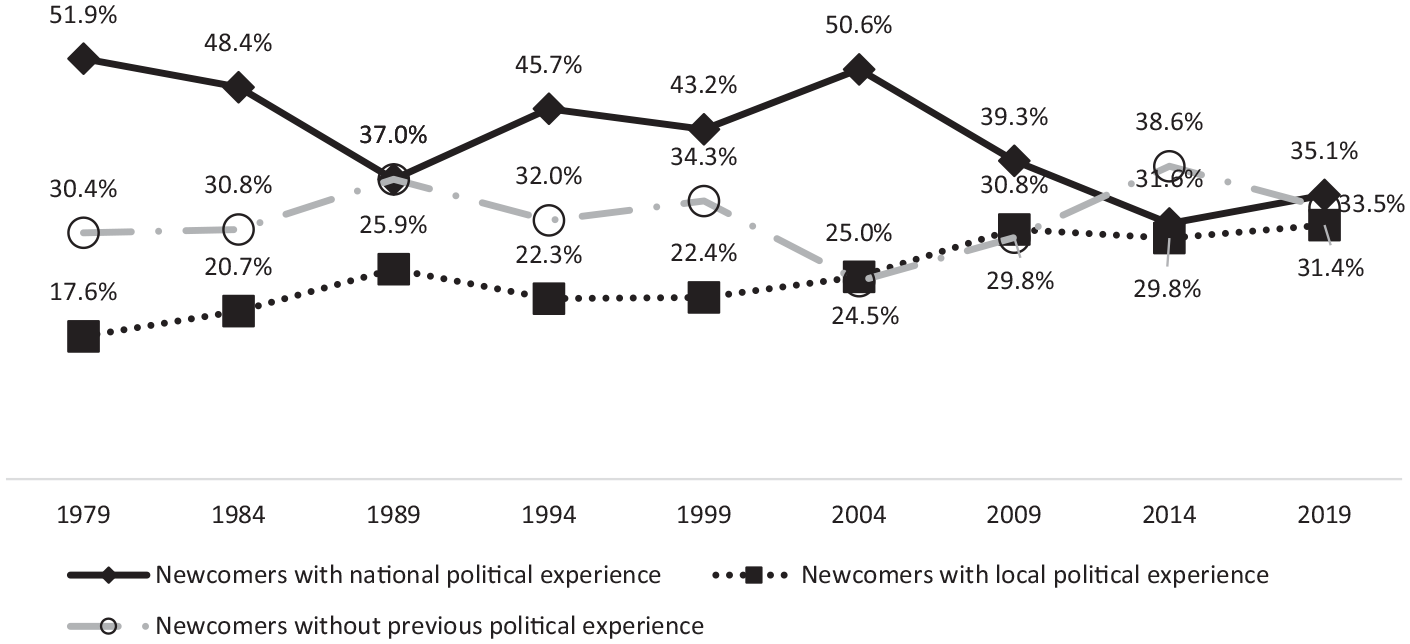
Distribution of Newcomers MEPs (EU at 15).
In this case, the weight of local-level professionals increases considerably, representing almost a third of all newcomers during the 2009–2019 period. This suggests that it can be more interesting to consider the data in a disaggregated way, thus providing a more nuanced and reliable picture. For this reason, it is necessary to imply another variable with which better grasp the different trajectories of EU member states, in terms of the diversified nature of authority distribution. Our subsequent question is: can we detect a differentiation in the backgrounds of EP newcomers as a result of the different governance structures and diverse power and authority distribution within individual member states?
In order to evaluate this, a possible approach consists in combining our dataset with the Regional Autonomy Index (RAI). The RAI measures the authority exercised by regional governments within their countries, by assessing the dispersion of power and authority and detecting their change over time (Hooghe et al., 2016). The RAI is built on the two domains of self-rule and shared rule, both of which are measured at regional and national levels. The final scores gained for the two domains are then summed up, giving the total score of the RAI. The higher the final RAI score, the greater the degree of regional autonomy in that country’s system of authority and in the distribution of power across levels of government. The resulting expectation is that the member states with the higher RAI are those with the higher number of newcomer MEPs elected to the EP with only previous local/regional political experience.
Figure 5 shows the values for the 28 member states contained in the most recent RAI dataset (2018). If we divide the old 15 member states – shown in black – from the new member states – shown in dots – it is clear that the peak values of the RAI are concentrated in the old EU member states, with the new EU members characterized by a higher degree of power concentration at central level, and low or negligible levels of decentralization. Taking this picture as our starting point, our data on MEPs’ political backgrounds can be read in terms of the authority structure within their respective countries.
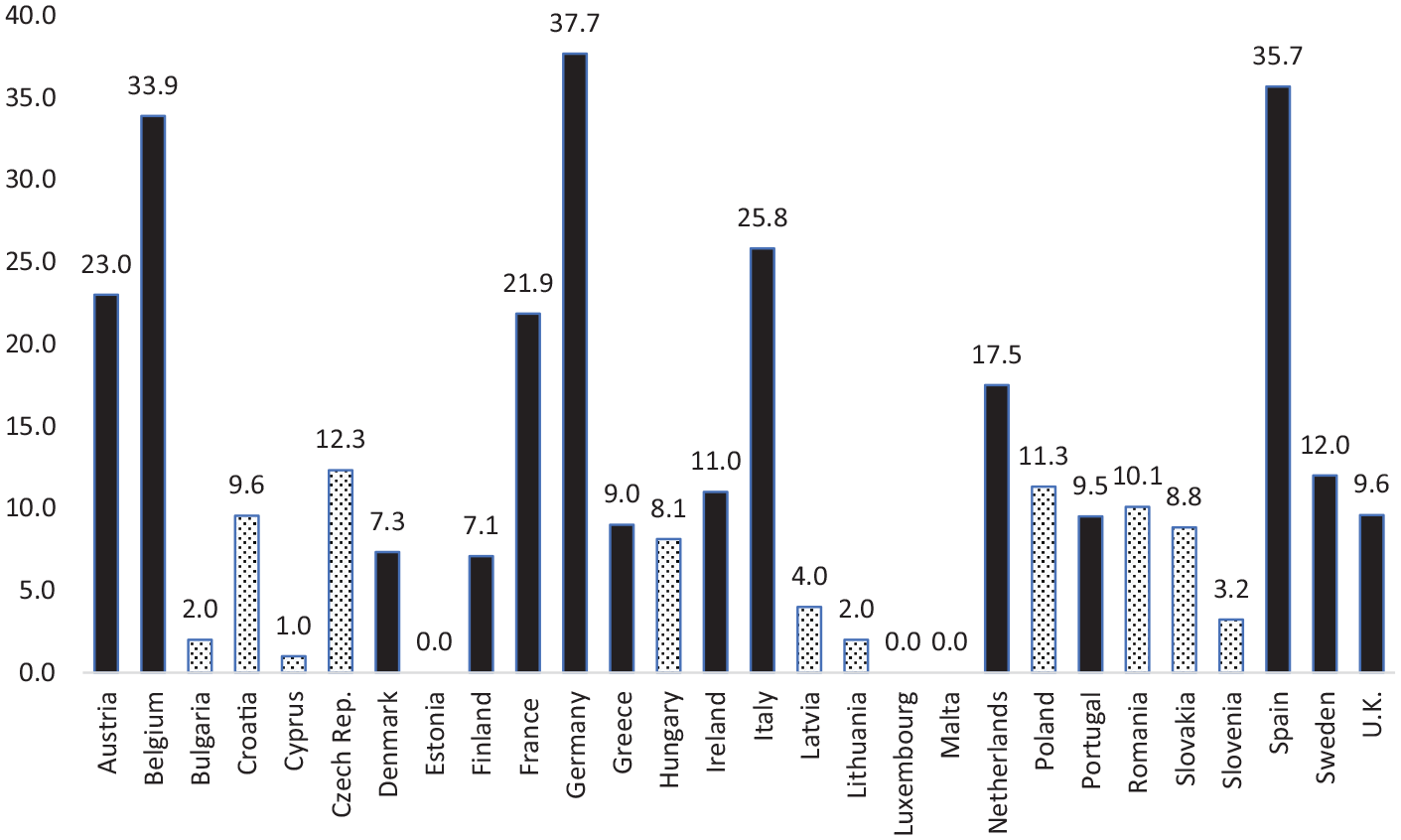
RAI 2018 EU28 (ECC15 + New Member Countries).
To build the variables, the median value for both the RAI and the number of newcomers with a local/regional background has been considered. If we analyse the elections held in 2009, 2014 and 2019 (see Figure 6) in order to evaluate only those elections with all the 28 member states (now 27 due to Brexit), what we effectively see is a strong positive relationship between the two dimensions (r = 0.874). The main outlier is represented by the UK, which had quite a low RAI but a high number of newcomers with local-level experience.
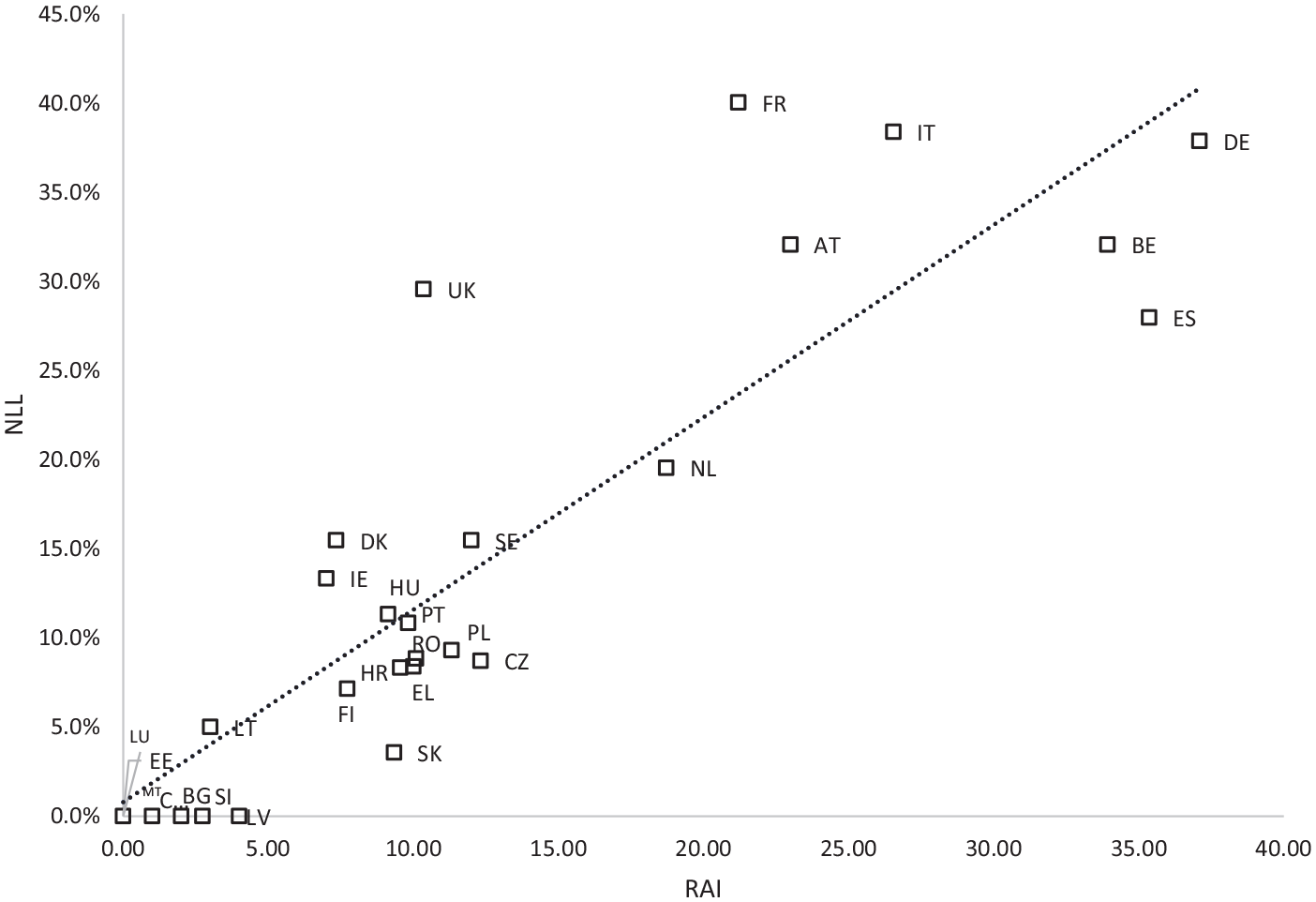
MEPs’ Backgrounds and Member States’ Authority Structures (2009, 2014, 2019 Elections).
In view of the connection between the framework of authority and the degree of local/regional political careerism (see Figure 6), we can conclude that those countries with a federal system of government, a high degree of decentralization and/or a powerful system of local/regional autonomy are also the ones that have elected the greater number of newcomers with a subnational political background. This positive link corroborates the argument that political professionals at the local level have seen their opportunities, and the feasibility, of moving directly to the supranational level, bypassing the national level, increase over time.
Moreover, these findings are positively associated with the data for the MEPs’ seniority and their political background, which reveal that the majority of MEPs having served for two or more EP legislatures have a purely regional/local political background (65% in 2009, 58% in 2014 and 55% in 2019). Greater seniority is mainly associated with a purely local/regional background prior to the initial election to the EP. This evidence copes with Daniel’s (2015) findings on MEPs’ career behaviour, according to which those elected from the more federal or decentralized countries display less dynamic ambitions, preferring, as they do, to remain longer in the EP and to try and get re-elected. Our data further these insights by showing that such MEPs not only come from federal/decentralized countries, but also have mainly held local/regional-level offices only.
These findings obviously cannot fully explain the connections between individual background and (re)election since, as previously mentioned, other variables are at work here. These variables include, for example, the electoral laws, the role of parties, electoral volatility, all of which are rooted in a national political landscape that heavily influences political life in Strasbourg (Daniel and Metzeger, 2018).
What is important here is that the use of the data for MEPs’ political background can significantly contribute towards explaining how MEPs and their individual characteristics operate to link the supranational parliament and its legislative power resources, but also as a connection between the supranational political space and national political arenas characterized by different institutional features, ties and opportunities.
Conclusion
The development of a truly European political class is a salient field of research for political science and EU studies. Thus, it is important to have (a series of) updated and complete tools with which to conduct empirical research into this field. The dataset presented in this article allows researchers to work on data both from a comparative perspective and regarding individual case studies, and guarantees the opportunity to carry out longitudinal research.
A limited series of data have been extracted to show, from a longitudinal perspective, how the EP’s membership has changed over the years. Moreover, I have attempted to underline a series of trends and structural features that are extremely important as they can enhance our knowledge of EU politics and its politicization trends. In a nutshell, these elements include the following:
The stabilization of MEPs’ profiles and the consolidation of a core group of European politicians;
The relevance of the gender dimension on several aspects of EP functioning;
The strong connection between the level of political professionalization and the distribution of senior positions within the EP;
The stabilization, among newcomers, of the number of political amateurs and of politicians with political experience at the local/regional level only;
A demonstration of how the establishment of a direct connection between the subnational and European arenas can be explained by the structure of the national political system and the existence of a federal/decentralized framework of power and authority;
The close link between the different governance levels that determine the existence of a nested political space, and the continuous flow and replacement of career politicians.
This dataset, used in conjunction with other sources of data, represents a useful instrument with which to conduct research on several aspects of the EU political system, ranging from the effectiveness of the supranational policy making to the dynamic of a new multilevel and interconnected political arena.
Footnotes
Appendix 1
Acknowledgements
I thank Pamela Pansardi for the valuable observations to an early version of this work. I am also very grateful to the Editors and the three anonymous reviewers for the useful comments.
Declaration of conflicting interests
The author(s) declared no potential conflicts of interest with respect to the research, authorship and/or publication of this article.
Funding
The author(s) received no financial support for the research, authorship and/or publication of this article.
