



Abstract
Generations are the engine of political change. This is especially relevant in the countries of the Asia-Pacific region, which have had a variety of postwar democratic experiences while also encompassing over 60 percent of the world's youth. This article applies the four-fold democratic classification developed by Yun-han Chu and his colleagues to wave 5 of the Asian Barometer Survey to investigate how generational change is shaping democratic orientations in 14 Asia-Pacific countries. Our results show that generations are less important in shaping views of democracy than is the case in other parts of the world. While generations matter for the transition to democracy, they are less important in Asia than democratic experiences, socioeconomic status, or the country in which the person lives.
The famous third wave of democratization, broadly covering the period between 1975 and 2005, brought with it a surge in democracy unparalleled in human history (Huntington, 1996; Plattner, 2015). Following the collapse of communism in 1989–1990, at least nominally democratic institutions spread to countries across Asia and the Pacific, as well as to Africa, Europe, and parts of the Americas. Many of these countries, however, lacked the basic pre-requisites for democracy, such as a sufficiently well-developed civil society. More recently, many societies have regressed to autocracy or transitioned to a hybrid regime, combining authoritarianism with popular elections (Croissant and Haynes, 2021; Diamond, 2015). As many scholars have commented, the classic conception of liberal democracy, based on the protection of individual rights and the rule of law, is now under serious threat in many parts of the world (for reviews, see Diamond, 2021; Galston, 2020).
Democracy in the Asia-Pacific region 1 is no exception to this trend. While there has been only a modest decrease in public satisfaction with democracy (Chu et al., 2020), there has also been a marked trend towards what Ding and Slater (2021) call ‘democratic decoupling’. This has resulted in free and fair elections remaining largely unchanged but civil and political rights declining, leading to a diminished quality of democracy (Dressel and Wesley, 2014). This change is particularly marked in India, the world's largest democracy and one of the region's oldest, as well as in Thailand and the Philippines, to name but three countries. The lack of a clear trend is attributable to the economic and political complexity of the region, with many strongly performing economies also attracting public support for weak democratic institutions (as in Singapore) or institutions that are democratic in name only (as in China) (Chu et al., 2020).
How do generations fit into this complex picture of democratic change? How will generational change shape views of democracy within the Asia-Pacific region? In principle, generational change holds the key to the future of democracy since it is “the engine of political change” (van der Brug and Franklin, 2018: 436). As each new generation enters the electorate, with different political views, economic expectations, and socializing experiences, it replaces an older generation which moves out of it. Such potential for political change has had profound effects in many of the advanced democracies (see Ford and Jennings, 2020). It is particularly important for the Asia-Pacific region, with a younger population relative to many of the established democracies and with more than 60 percent of the world's youth living in the Asia-Pacific region alone (Ford and Hass, 2021).
Younger generations hold very different political views and expectations of government when compared to their older counterparts (Bennett et al., 2011; Dalton, 2015). This is a common finding across the advanced democracies, but it is also very relevant in Asia which has a vibrant youth culture, high levels of social media use, and higher levels of education relative to many other regions (Chu and Welsh, 2015). Generational change in the Asia-Pacific—by virtue of the size of the younger generations, their distinctive political outlooks, and the changing fortunes of democracy within the region—has the potential to fundamentally shape democratic futures in the region in the remainder of the 21st century. In this article, we ask the question: how and in what ways will generational change shape the future of democracy in the Asia-Pacific?
To answer this question, we apply the democratic typology developed by Yun-Han Chu and his colleagues in a series of influential papers (Chang et al., 2007; Chu and Huang, 2010; Chu and Welsh, 2015) to wave 5 of the Asian Barometer Survey (ABS) conducted between 2018 and 2022. The typology is designed to address ‘Asian exceptionalism’ in attitudes towards democracy and to incorporate feelings of ‘authoritarian nostalgia’ and the desire for economic prosperity into the model. As such, this is an important advance on generic models of democracy which fail to take into account the distinctive political context of the Asia-Pacific. The findings show that there are distinct generational patterns in the four-category typology of democratic types, but that country differences are the most important influence on attitudes towards democracy. These results suggest that generational change may not exert the same influence on politics that it is having in the advanced democracies.
The article proceeds as follows. The next section examines theories of generational replacement in politics and highlights the debates in the area surrounding the importance of economic performance and the political role of the young. The second section reviews the literature on democracy and generations in the Asia-Pacific. The measures covering liberal democratic values and support for democracy are outlined in the third section. The results are presented in the fourth section, while the conclusion discusses the implications for the future of democracy in the Asia-Pacific.
Generational replacement
Theories of political socialization predict that voters will bear the imprint of the generation into which they were born. The classic Civic Culture study by Almond and Verba (1963) stressed the importance of family and early school experiences in shaping lifelong political views. Each generation has, because of its formative experiences in youth and adolescence, a different view of the political world (at least on average). This is particularly noticeable in how different generations interpret political concepts such as the left-right dimension, with older generations viewing it in terms of economic competition, and younger generations in the context of values and cultural priorities (Rekker, 2016, 2022). Various studies also show that more recent generations have very different views of citizenship, elections, and political participation generally compared to their older counterparts (Dalton, 2015; Grasso, 2019). This has been compounded by how poor economic performance has adversely affected younger people following the 2007–2008 global financial crisis (France, 2016) and the 2021–2023 COVID-19 pandemic (Biddle et al., 2023).
Generational replacement can influence political behavior and attitudes through two main pathways. First, if one party or political regime is dominant during the period when the person entered the active electorate, their values and beliefs will imprint themselves on the new generation. More importantly, those growing up in authoritarian regimes should hold very different political views to those coming of age in democratic systems. A second pathway is through the social cleavage structures of the period in question; these are imprinted on the emerging cohort and then reflected in lifelong voting behavior. Older generations in the advanced democracies tend to be most influenced by class politics and class appeals because that was the dominant cleavage when they entered the electorate (van der Brug and Franklin, 2018). Younger generations will be influenced by different cleavages reflecting the party competition at the time they came of age.
Empirical studies have found widespread support for these predictions. There are major differences in the proportions of voters from the various generations who turn out to vote (Blais, 2004), as well as in vote choice, with younger voters being much more likely to support minor and protest parties compared to older voters (Goerres, 2008; Tilley and Evans, 2014). In turn, much is known about what drives these changes, with increasing proportions of younger voters experiencing tertiary education which has come to form a new political cleavage in its own right (Ford and Jennings, 2020; Gethin et al., 2021, 2022; Stubager, 2010, 2013). Tertiary education imparts a different view of the world, which has implications for political outlooks (Scott, 2022; van der Brug and Rekker, 2021; Weakliem, 2002). As younger people possess higher levels of tertiary qualifications compared to their older peers, this affects their political outlook.
What are the implications of generational turnover for either authoritarian regimes or formerly authoritarian regimes that are transitioning to democracy? Traditional modernization theory suggests that as societies become more prosperous and educational levels increase, there is a greater demand for democratic institutions that will protect property rights and ensure economic growth (Inglehart and Welzel, 2005). However, when the transition to democracy occurs there will be some generations who must ‘unlearn’ the authoritarian values that they grew up with. This has been a particular challenge in the post-communist societies of Eastern Europe where democracy arrived suddenly in 1990 and where few, if any, citizens had any prior experience of a political system other than communism (Mishler and Rose, 2007). In many of these countries, civil society was insufficiently developed to cope with the political changes that took place, resulting in regimes that were at best nominally democratic and at worst overtly authoritarian (Cianetti et al., 2018).
One theme in this research which has attracted considerable attention is the argument that declining economic growth and employment opportunities in the advanced democracies has led to weakening support for democracy among many younger voters. This view has been advanced by Foa and Mounk (2016), who argue that many younger people believe that democracy has proved ineffective in meeting their economic expectations and as a result they have withdrawn their support for it. This trend has been particularly marked following the 2007–2008 global financial crisis and the effects on young people of reduced economic security and fewer opportunities to accumulate economic assets, such as a home. Foa and Mounk see this as a longer-term and perhaps irreversible trend, which will eventually lead to democratic deconsolidation. This view has been criticized by several authors who argue that the trends that Foa and Mounk observe are a consequence of lifecycle effects rather than generational change. 2 In this contrary view, these trends represent a short-term change with few long-term implications for democracy.
Generational change, bringing with it the distinctive views and behaviors of younger generations who are replacing older ones, has the potential to fundamentally change politics across many countries. Nowhere is this potential more acute than in regime support and on views about democracy as the preferred form of government that can deliver economic prosperity. It is also highly salient in the Asia-Pacific due to the large proportions of younger citizens, very different political experiences, and widely varying levels of public support for democracy across the countries of the region. In the next section, we examine how and through what mechanisms generations and generational change may impact on democratic futures in Asia.
Democracy and generations in Asia
Despite its potential importance for the future of democracy in Asia, the role of generational change has received relatively little attention in the literature. The main comparative work is by Dalton and Shin (2014), who examine the impact of socialization under different regime types on views of democracy in five East Asian countries: Japan, Korean, Taiwan, Mongolia, and Indonesia. By identifying four generations based on whether they were socialized under ‘older’ authoritarianism, ‘recent’ authoritarianism, or a transitional or democratic regime, they conclude that generational change and social modernization are underpinning a cultural shift to democratic norms but that the process is incomplete. Other studies, examining generational change in individual countries within the region, have come to broadly similar conclusions (Chang, 2017; Chang and Chu, 2017; Cho et al., 2019; Sanborn, 2015; Shin, 2021).
Evaluating the impact of generations on democracy in the region is complex for two main reasons. First, economic performance has varied widely across the countries, and it is often unclear how much that performance can be credited to the operation of political institutions—whether democratic or authoritarian—rather than to opportunity or circumstance. Unlike many other parts of the world, the Asia-Pacific region has demonstrated that strong economic integration between states is not dependent solely on regime type. Not least, many countries in the region show that authoritarian institutions are no barrier to economic prosperity and to the development of extensive international trading links. Authoritarianism in the Asia-Pacific is therefore different from authoritarianism in post-communist Europe where institutions have inhibited economic development (Hamm et al., 2012). This finding is a recurring theme in the ‘Asian exceptionalism’ literature which argues that many Asian countries are charting a different path to democracy in comparison to other parts of the world (Shin, 2017).
The second reason why evaluating the impact of generations on democracy is problematic is the difficulty in defining what democracy in the region means to its citizens. There are two aspects to this, both of which are linked: the ‘Asian values’ debate; and the debate over how to measure what democracy means to citizens.
The ‘Asian values’ debate revolves around the belief that the values of equal participation on which democracy is based are incompatible with Confucianism. In contrast to the egalitarian values that democracy prioritizes, Confucianism emphasizes merit-based paternalism over personal freedoms (Shin, 2021: 154). In an overview of the debate, Shin (2017: 446) concludes that while the evidence on this question is mixed, on balance Confucian values “facilitate the hybridization of authoritarian and democratic political orientations to a greater extent than they hinder the embrace of liberal democratic virtues.” So while Confucianism is one element in the democratic transitions in the region, it is only one part of the story.
The other aspect of the debate concerns the meaning of democracy and how to measure it. This question has been addressed by Chu and his colleagues in a series of influential articles. In a 2007 article, Chang et al. argue that a stable democracy—what they term ‘robust legitimacy’—which has the capacity to resist threats from anti-democratic forces, requires more than just support for democracy; it necessitates “authoritarian detachment” (Chang et al., 2007: 68). In other words, an aversion to authoritarianism is as important as support for democracy and its omission means that traditional approaches to studying democracy in Asia lack conceptual breadth and depth. A similar approach to democratization in the post-communist states of Central and Eastern Europe is used by Mishler and Rose (2007). These various studies emphasize the necessity of developing sophisticated, multiple-item measures to tilt mass public opinion towards democracy.
In developing their model of democratic support, Chang et al. use three survey questions—support for a strong leader, dislike of an opposition party, and a preference for military rule—to measure support for authoritarianism and three questions to measure liberal democratic values—support for free discussion, an independent judiciary, and the rule of law. They conclude that there are a range of opinions in East Asia which are not directly related to support for democracy, which suggests that the younger democracies in the region are “vulnerable to any well-orchestrated hostile intervention by a strategically positioned anti-democratic elite” (Chang et al., 2007: 77). 3 In other words, the roots of democracy are fragile and the institutions could easily be challenged in the right circumstances.
In a later 2010 article, Chu and Min-hua Huang refine the methodology underlining this approach. They argue that in an opinion survey, “any item carrying the ‘D-word’ runs the danger of eliciting socially desirable answers, because in our time it has been embraced by politicians virtually everywhere” (Chu and Huang, 2010: 115). Since democracy has multiple meanings in Asia, so that even authoritarian regimes can claim to be democratic, measurement must cover several dimensions. They adopt a twin approach, first using the original ‘support for democracy’ items noted earlier, and second measuring “the depth of popular commitment to democracy” (Chu and Huang, 2010: 116) but avoiding the use of ‘the D-word’. The latter battery of items is designed to tap into fundamental liberal democratic values such as equality, accountability, and the rule of law.
Applying these two dimensions—support for democracy and liberal values—to public opinion creates a two-by-two table which identifies four types of citizens by their democratic orientations (see Figure 1). In the Chu and Huang (2010) model, consistent democrats display high support for democracy as well as strong liberal values. These are the citizens who we would expect to predominate in a mature, advanced democracy. At the other end of the spectrum, non-democrats have both low values and low support for democracy; these citizens should be most numerous in authoritarian states or states emerging from authoritarianism. In between these two ideal types are critical democrats, who hold strong liberal values but have reservations about democracy's utility and effectiveness, and superficial democrats, who favor democracy as a form of government but do not express the values that underpin it.
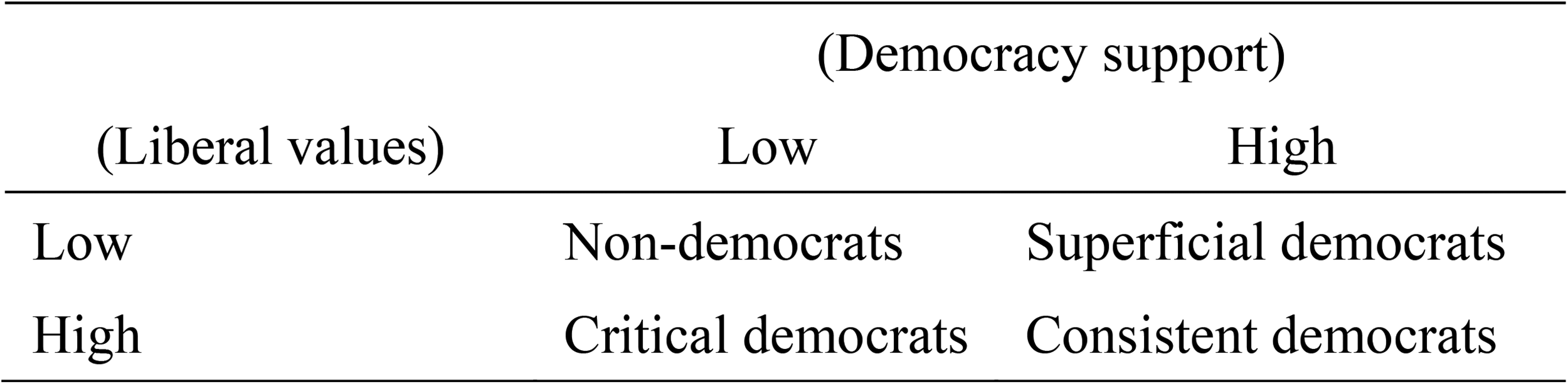
Typology of democratic orientation. Source: Chu and Huang (2010).
How would we expect generations to fit into this typology? In making this determination we must take into account two considerations. First, it is necessary to factor in when the country became democratic, since this will shape the amount of democratic experience the person has been exposed to (Dalton and Shin, 2014; Rose, 2007). We do this by measuring the quality of electoral democracy for five generations in each of the 14 countries under examination when the generation was in its formative years. Second, the distinct political outlooks and expectations of each generation must be considered. This leads to an examination of the youngest generations, who differ markedly from older generations in their experiences, outlooks, and behavior. In the remainder of the article, we track how generations fit into these four democratic orientations.
Data and measurement
Data
The data comes from wave 5 of the ABS, which collected nationally representative samples of the voting age population from 16 countries 4 plus Hong Kong using a common questionnaire. 5 The results are weighted to represent the characteristics of the national population. Since our interest is only in countries that have experienced some form of democracy in the postwar years, we exclude three countries—China, Vietnam, and Myanmar—which are classified as not free using the Freedom House criteria. The remaining 13 countries plus Hong Kong are all classified by Freedom House as either free or partly free. With these restrictions, the total number of cases is 24,197. We further exclude a small number of respondents who were born before 1927, who form the generation that came of age before the Second World War and now represent a very small proportion of the population. This further reduces the number of respondents to 24,007.
Measurement
To measure liberal values, seven questions are used, all of which are coded on Likert scales scored from ‘strongly agree’ to ‘strongly disagree’. If a respondent agreed with a statement, it is coded as a liberal democratic orientation; disagreement is coded as an authoritarian orientation. The seven items are shown in Table 1, together with the percentage who agreed or disagreed with the question or said they did not know. The results show a range of opinions, but the respondents were particularly likely to disagree with the statement that politicians should overrule judges on important cases, and to agree with the two statements about the harmony and diversity of society. The seven items were combined into a single scale and then recoded from zero (low liberal values) to 10 (high liberal values); the mean of the scale is 5.21. 6
Liberal values.
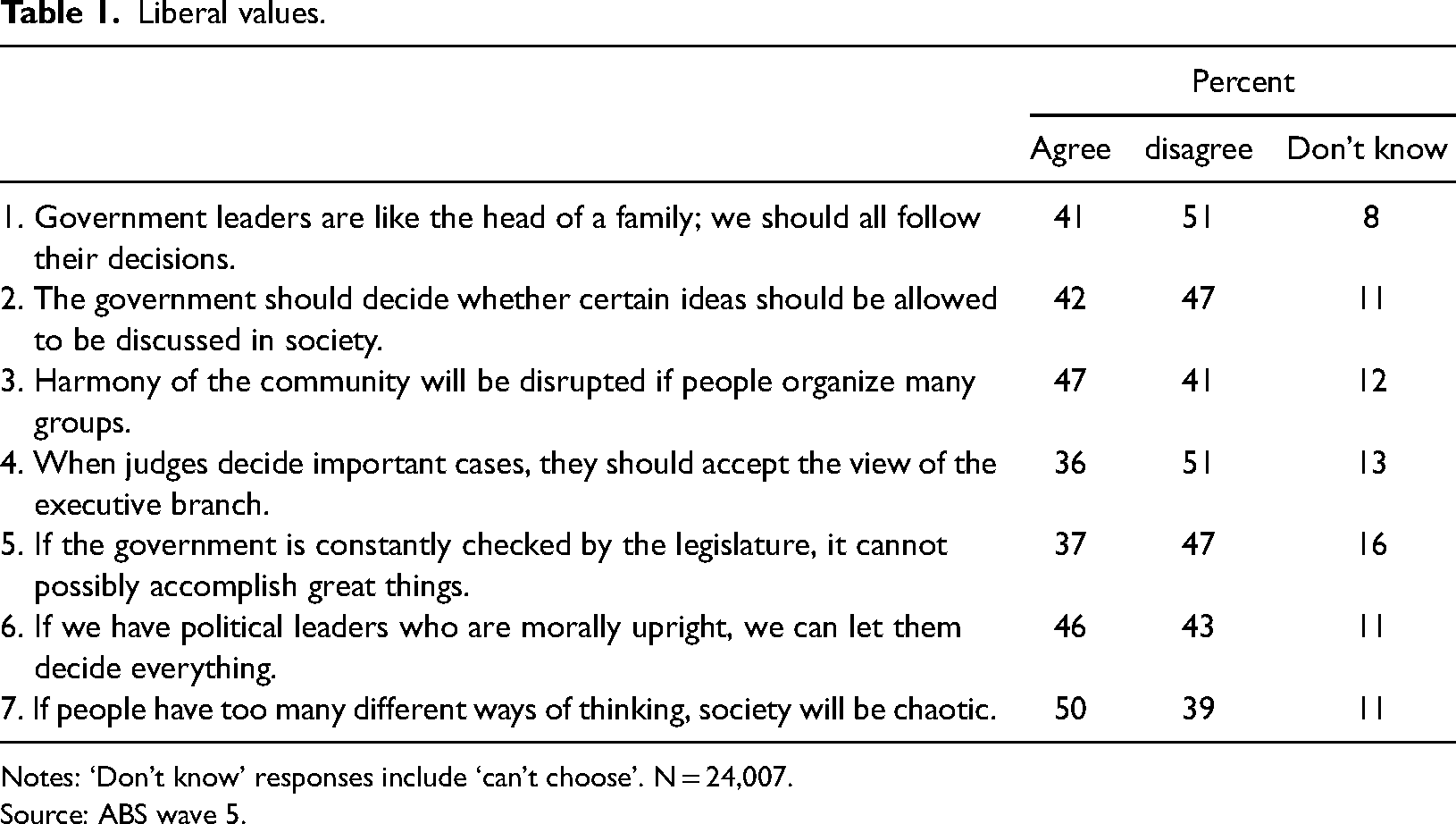
Notes: ‘Don’t know’ responses include ‘can’t choose’. N = 24,007.
Source: ABS wave 5.
The original scale for support for democracy developed by Chu and Huang (2010) was based on five items, however in the ABS wave 5 one of the items (the desirability of democracy) was not included. In addition, one further item—whether democracy or economic development should have priority—did not correlate significantly with the other three items, and to ensure a robust scale it was excluded. We therefore rely on the three items in Table 2 to form the support for democracy scale. Overall, support for democracy is generally high across the 14 countries. A total of 54 percent believe that democracy is preferable to any other kind of government and 64 percent see democracy as capable of solving the problems of society. Combining these three items into a single scale from zero (low support for democracy) to 10 (high support for democracy) produces a scale mean of 6.88. 7
Support for democracy.
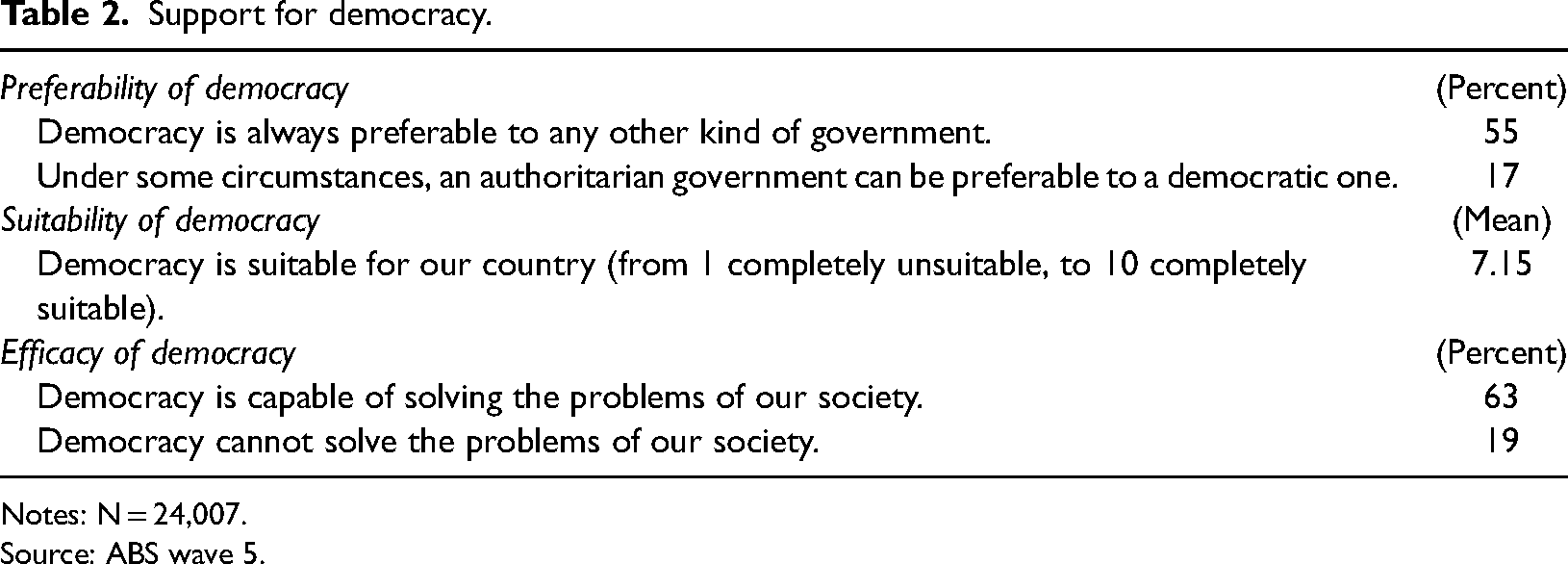
Notes: N = 24,007.
Source: ABS wave 5.
The creation of continuous multiple-item scales measuring liberal values and support for democracy enables us to identify which of the country respondents fall into the four categories of democratic orientation defined by Chu and his colleagues. The respondents were allocated to each of the four groups depending on whether they fell below or above the median on each of the two scales. 8 This produces four discrete groups, with non-democrats (28 percent) and consistent democrats (26 percent) being the two largest groups. Critical democrats represent 24 percent of the sample, and superficial democrats 22 percent.
Defining what constitutes a generation is controversial since the boundaries between generations are not always clearly defined, and the events and formative experiences that shape a generation differ between countries and regions. These definitional problems become more acute in cross-national analyses. In a previous study of generations and democracy in Asia, Dalton and Shin (2014) identify four historical periods—older authoritarian, authoritarian, transitional, and democratic—applied to when citizens became 18 years old. However, their study covers only four countries, not the 14 countries included here. Other studies covering the region, such as Chu and Welsh (2015), use the more familiar international categorization of Baby Boomers, Gen X, Millennials, and Gen Z.
The approach used here is to identify the most prominent formative experiences relevant to the countries of the region when the respondent was aged 18. There is, of course, considerable debate about when a person becomes politically aware. This will vary between social groups, based on their experiences and socioeconomic resources, as well as on the country's experience with politics generally and democracy specifically. As noted above, Dalton and Shin (2014) use age 18 as the most reliable age for their Asian study. Other research on the European democracies has come to broadly similar conclusions. For example, Rekker et al. (2019: 48) find that “the most formative period is around age 18” (see also Bartels and Jackman, 2014; Dassonneville, 2016). For most countries, 18 is also the voting age; among the 13 countries analyzed here, all but Indonesia (age 17), Singapore (age 21), and Taiwan (age 20) have 18 as their legal voting age.
Using age 18 as the point at which most individuals will have their formative political experiences results in the five generations listed in Table 3. The Korean War generation came of age in the years immediately after the Second World War and during the 1951–1953 Korean War and its aftermath; they constitute 4 percent of the sample and are the smallest group. The Vietnam War generation grew up between 1964 and 1975 and make up 11 percent of the sample. The period following the end of the Vietnam War in 1975 and leading up to the collapse of communism were some of the most important years of the Cold War. This generation constitutes one in four of the sample. The largest group—37 percent—are those who grew up in the immediate post-Cold War period, a period of relative economic prosperity. This was brought to an end by the global financial crisis of 2007–2008, and those who came of age in this period and afterwards form the remaining 23 percent of the sample.
Asian generations.
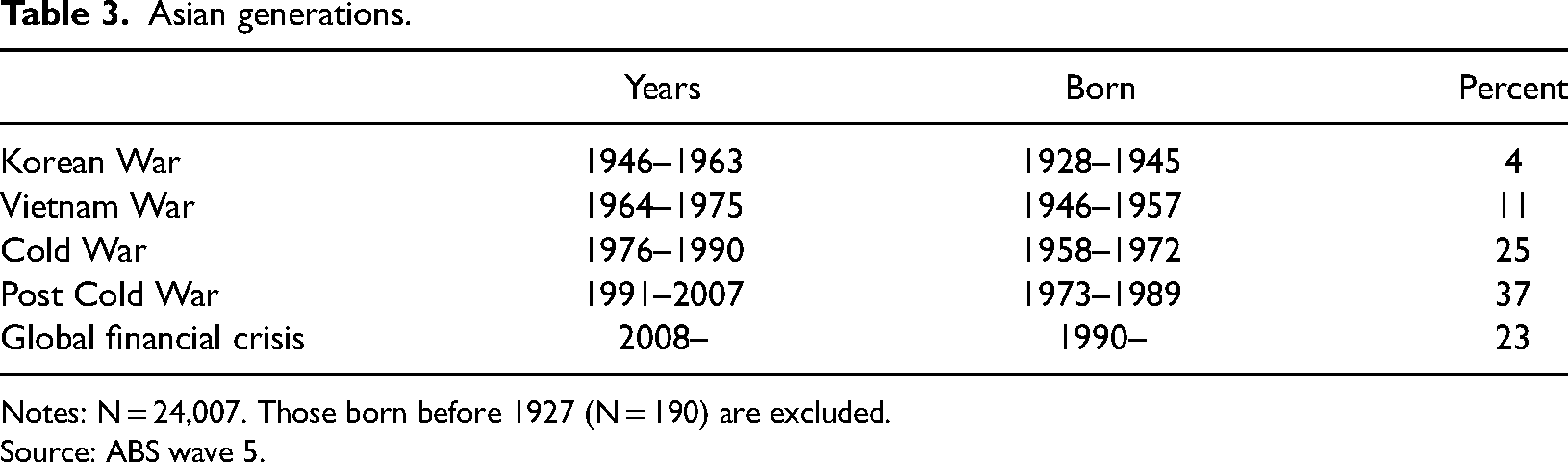
Notes: N = 24,007. Those born before 1927 (N = 190) are excluded.
Source: ABS wave 5.
As we would expect, there are considerable country variations in the size of the generations. Japan, with its aging population, has most respondents (14 percent) in the Korean War generation; Bangladesh, with its young population, has the fewest (1 percent). At the other end of the generational continuum, Mongolia and Malaysia have most respondents (34 percent each) in the youngest global financial crisis generation, while Japan has the fewest (12 percent). 9
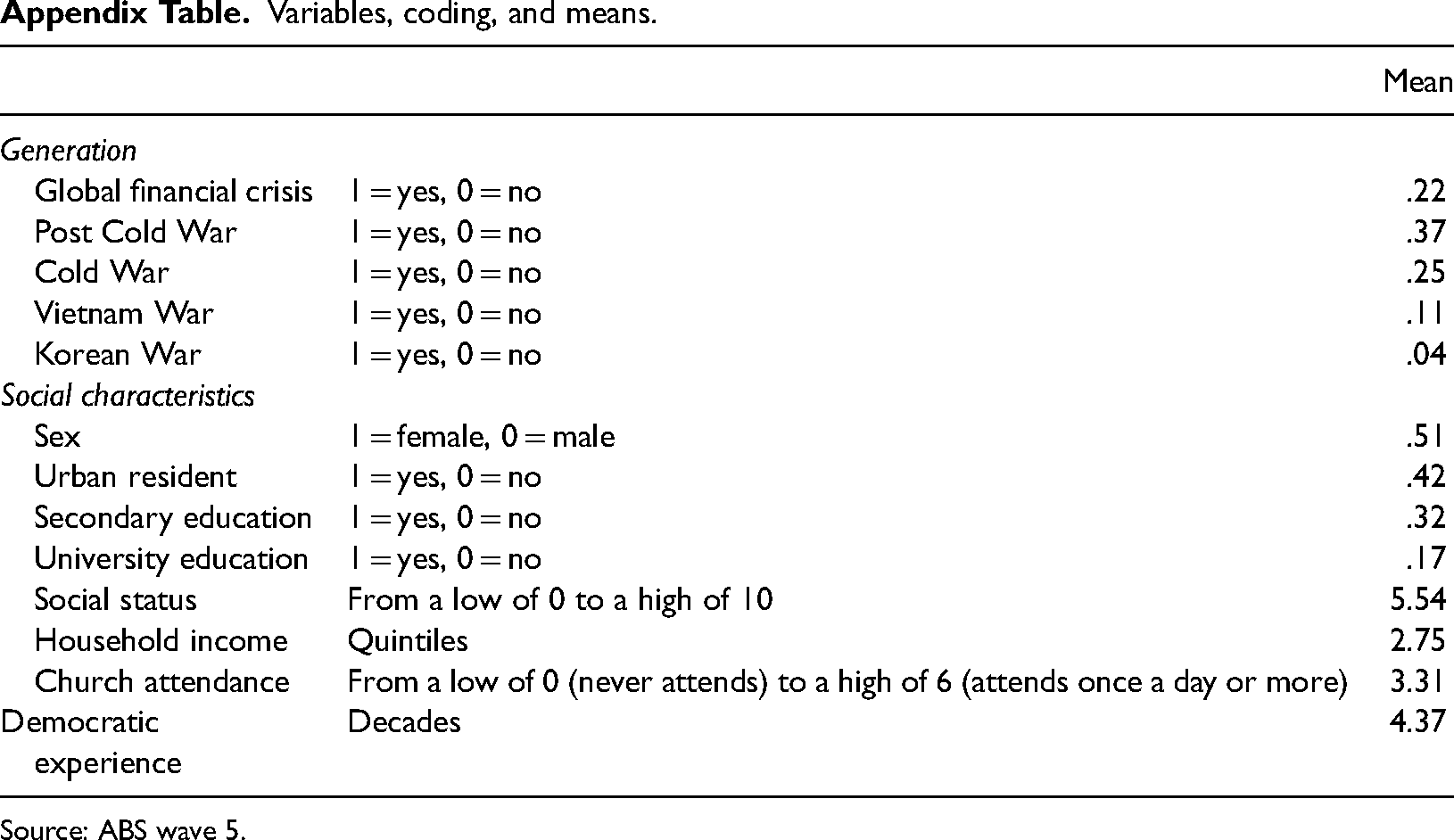
In the multivariate analyses, the models control for the democratic experience of each generation and social background. To measure the former, we use the electoral democracy index from the Varieties of Democracy (V-Dem 10 ) project, which is coded from a low of zero to a high of 10. 11 For each generation in each country, we measure their mean exposure to democracy at the time they were growing up. 12 To measure social background we include sex, living in an urban area, and education (distinguishing between secondary and tertiary education, making those with less than secondary education the reference group). Social status is self-assigned and based on the question “Where would you place your family on the following scale?” It is scored from one (lowest status) to 10 (highest status). Household income is based on the question “What group corresponds to your average household income?” and is scored in quintiles. Finally, church attendance measures attendance at religious ceremonies and is coded from one (never attends) to six (attends once a day or more). Full details of the variables, scoring, and means are shown in the Appendix Table.
Method
The multivariate analyses use multinomial logistic regression and estimate robust standard errors to account for clustering by country. The dependent variable is coded into four categories corresponding to the four types of voters: non-democrats, critical democrats, superficial democrats, and consistent democrats. Respondents classified as non-democrats form the base category.
Results
We begin by estimating the distribution of liberal values and support for democracy across the 14 countries. Figure 2 shows the mean score for the respondents in each country, ranked from the highest to the lowest score. Views about democracy have the largest range of values, from a high of 6.67 in Australia to a low of 4.18 in the Philippines, a distribution of 2.49 on the zero to 10 scale. Support for democracy runs from 5.94 in Taiwan to 7.66 in Indonesia, a range of 1.72. The results show a modest association between values and support. 13 For example, while Australia and Japan rank first and second, respectively, on liberal values, they rank fourth and seventh, respectively, in support for democracy. Similarly, while Taiwan ranks at the bottom in terms of democracy support, the country ranks above the mean on liberal values.
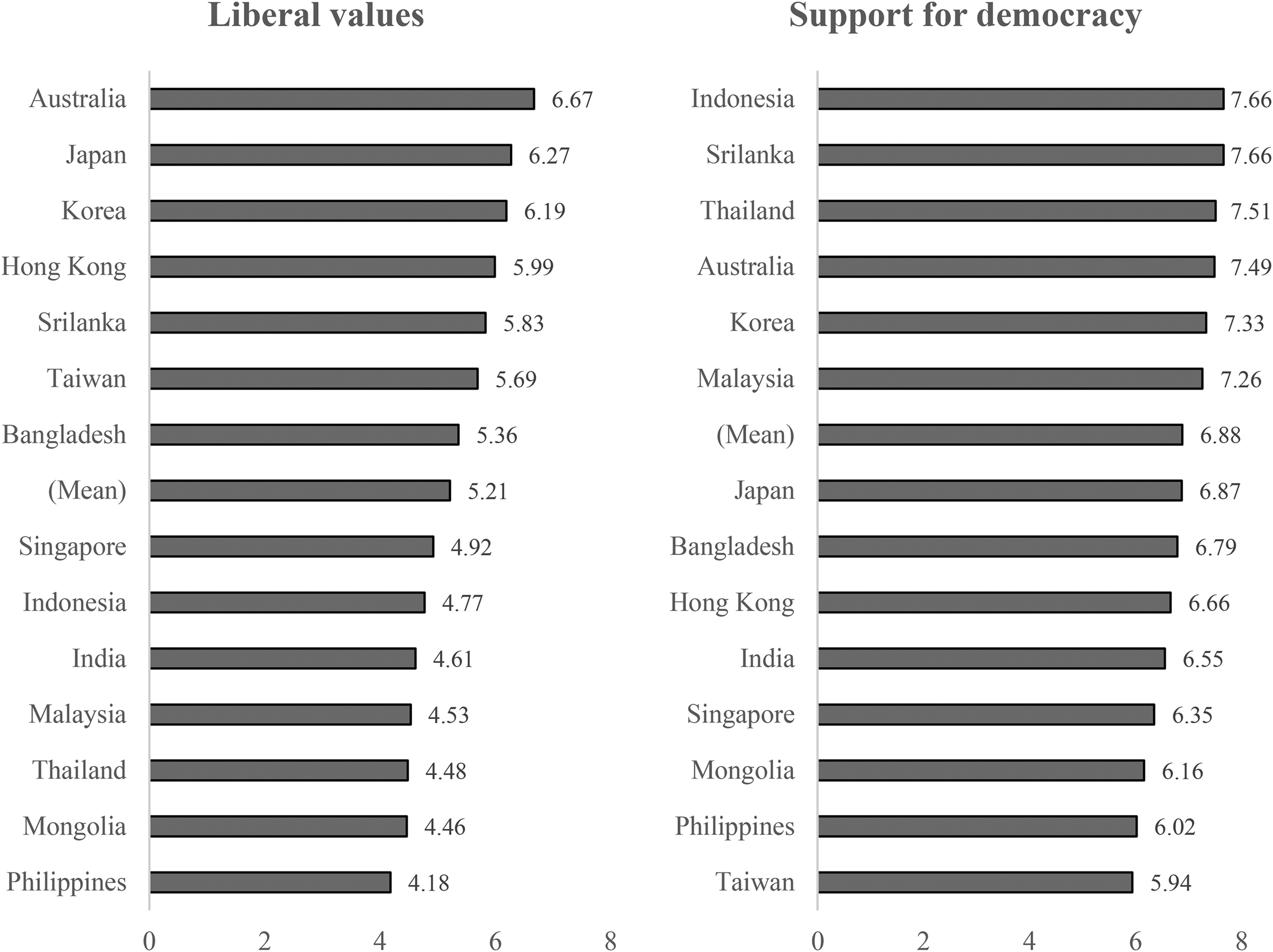
Liberal values and support for democracy by country.
At least part of the explanation for the absence of any direct correlation between liberal values and support for democracy stems from each country's experience of democracy. Liberal values take longer to embed themselves in the political culture than support for democracy since they require a better understanding of how democracy works. At the same time, countries that have a longer experience of democracy may show some skepticism about the performance of democracy while at the same time supporting liberal values. This is reflected in the correlation between the years of democratic experience in a country and liberal values (r = 0.136, p < 0.01), which is higher than the similar figure for democratic support (r = 0.045, p < 0.01).
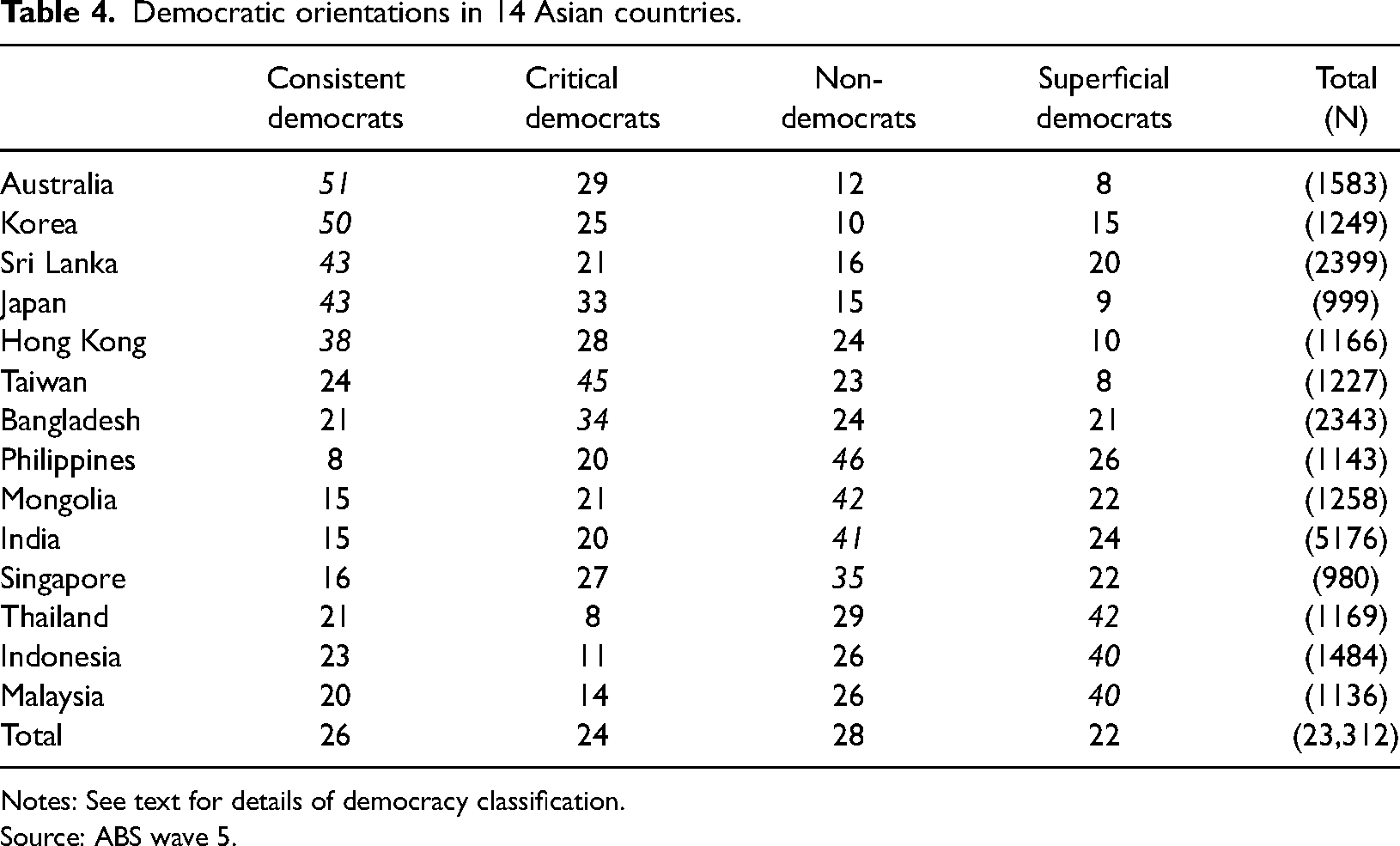
The liberal values and democratic support scales are used to allocate each of the 14 country's respondents to one of the four groups, identified by their democratic orientation. 14 These results are shown in Table 4. The largest group is non-democrats, who account for 28 percent of the total population, while consistent democrats account for 26 percent and critical democrats and non-democrats account for 24 and 22 percent, respectively. There is, then, a broadly equal distribution of the four groups across the 14 countries.
Democratic orientations in 14 Asian countries.
Notes: See text for details of democracy classification.
Source: ABS wave 5.
The detailed results for the 14 countries in Table 4 show considerable variation. Five countries—Australia, Korea, Sri Lanka, Japan, and Hong Kong—are included in the consistent democrat group. Two countries—Taiwan and Bangladesh—are classified as having the largest groups of critical democrats, while four—the Philippines, Mongolia, India, and Singapore—have mostly non-democrats. The superficial democrat group of countries includes Thailand, Indonesia, and Malaysia. The countries that are the most homogenous in terms of their democratic preferences—based on the proportions of consistent democrats and non-democrats—are Australia and Korea at one end of the spectrum, and the Philippines at the other end.
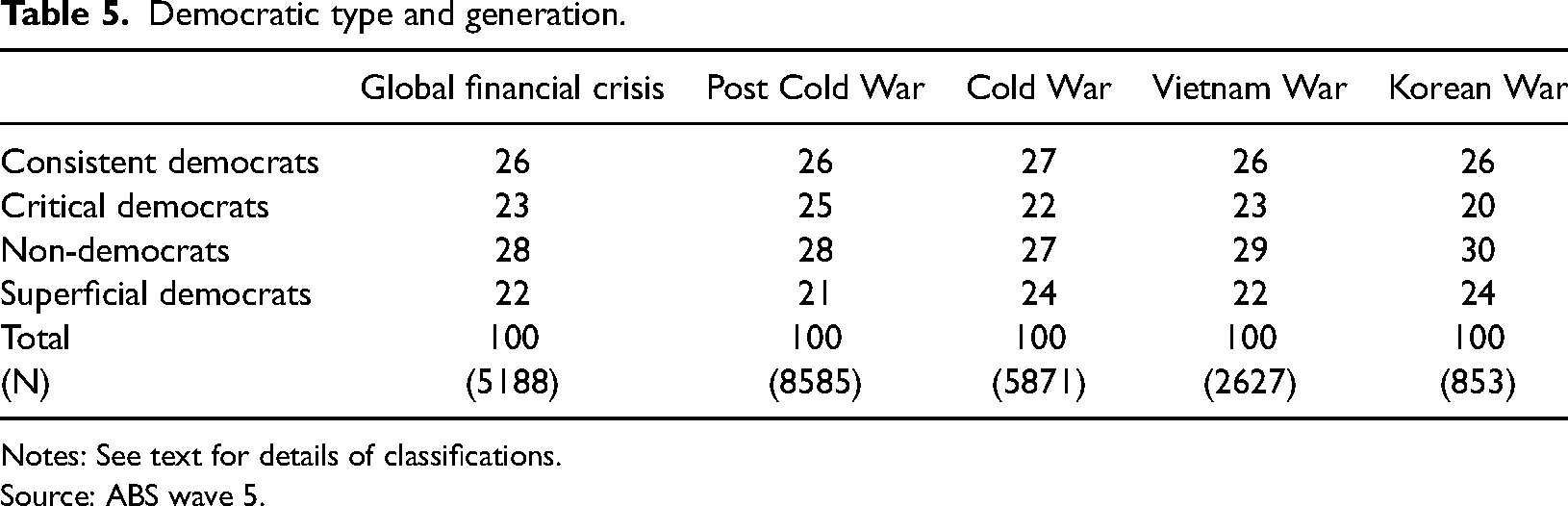
To identify how membership of a generation may relate to each country's experience of democracy, Table 5 shows the distribution of each democratic type across the five generations. These results show relatively little variation between the four democratic types in each of the five generations. The proportion of consistent democrats varies little across the generations. There are some variations for non-democrats, who are most numerous in the Korean War generation, reflecting the relative lack of democracy in many of the 14 countries at that time. However, non-democrats are also the most numerous groups among the two youngest generations: those who grew up after the global financial crisis and in the post-Cold War period.
Democratic type and generation.
Notes: See text for details of classifications.
Source: ABS wave 5.
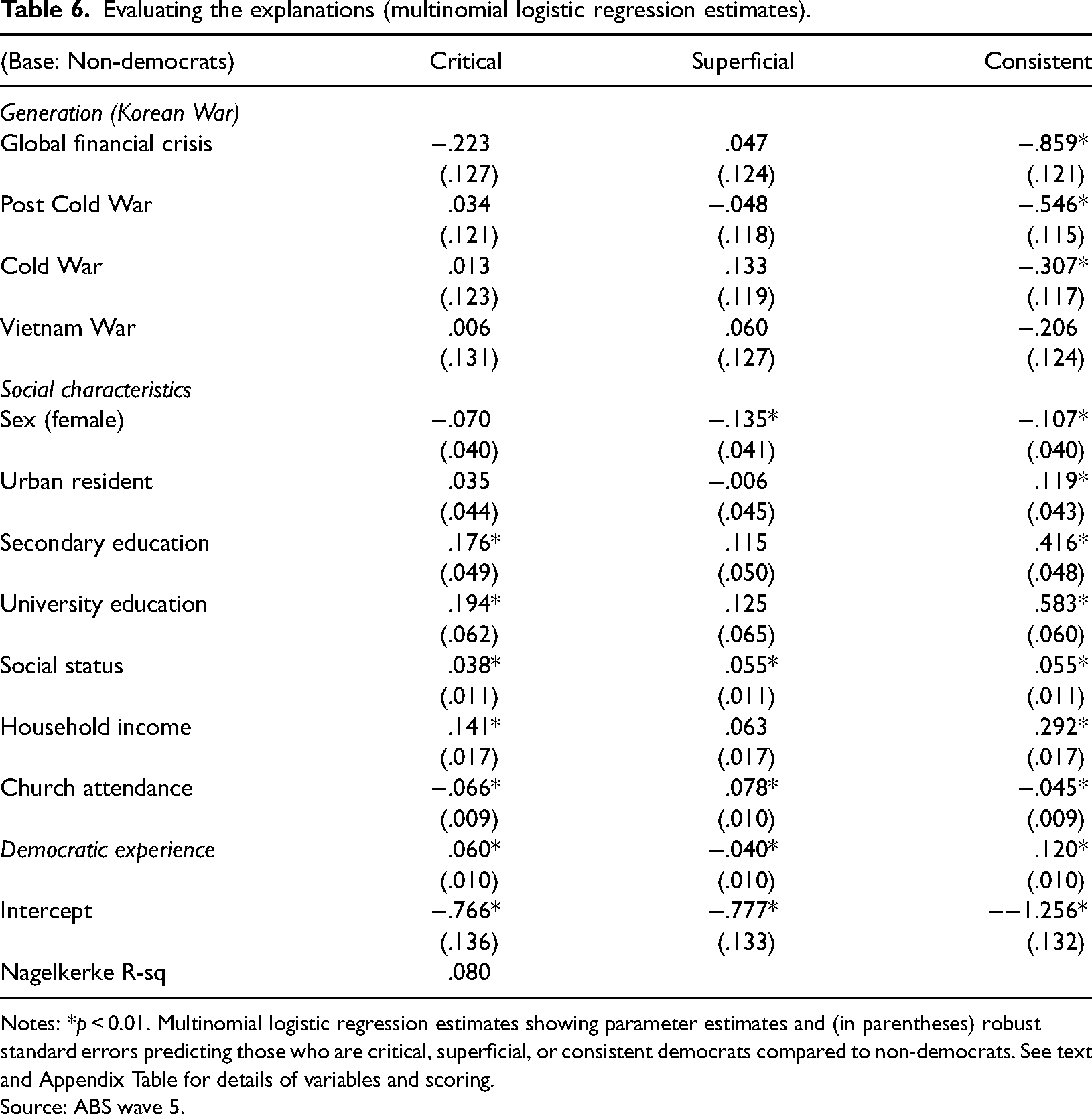
The results in Table 5 suggest, then, that generational factors are, at best, weak predictors of how people in the Asia-Pacific feel about democracy. The question arises, then, as to what other factors may be important in shaping liberal values. To test other possible explanations, we estimate a multinomial logistic regression equation, which predicts membership of each of the democratic groups from generation, democratic experience, and a range of social background variables. Generation and democratic experience are country-specific variables, while the social background variables are measured at the individual level. These estimates are shown in Table 6.
Evaluating the explanations (multinomial logistic regression estimates).
Notes: *p < 0.01. Multinomial logistic regression estimates showing parameter estimates and (in parentheses) robust standard errors predicting those who are critical, superficial, or consistent democrats compared to non-democrats. See text and Appendix Table for details of variables and scoring.
Source: ABS wave 5.
The results in Table 6 show that generations matter in predicting what type of democratic orientation a person has, but that the main difference is between consistent democrats and non-democrats—the two most distinctive groups in the four-fold typology. There are no statistically significant effects involving how critical or superficial democrats differ from non-democrats. To the extent that generation matters, then, it is in distinguishing the two groups at opposite ends of the democratic continuum. This large effect for generation is net of democratic experience, which itself matters in distinguishing consistent democrats from non-democrats. Indeed, democratic experience is about four times more important than being a member of the global financial crisis generation in determining whether someone is a consistent democrat or a non-democrat.
Among the social background variables that could influence membership of a democratic group, the main association comes through household income, with higher income predicting membership of all three groups compared to non-democrats. There is a particularly large predictive effect for household income distinguishing consistent democrats from non-democrats. Education also matters, in the form of tertiary education, and again this is most important for consistent democrats. Sex, social status, and church attendance are relatively unimportant. Overall, about half of what shapes membership of a democratic group comes from generation and democratic experience, and the other half comes from the social background variables. 15
Conclusion
Writing in 2007 at a time when democracy was under pressure in the region, Chang et al. (2007: 66) asked the question: “can democracy still endure and flourish in East Asia?” The answer to this question largely rests on generational change, and on what democratic orientations are adopted by the new generations that are emerging to replace the old. There is a wealth of research, mainly from the established democracies, which demonstrates that the younger generations—millennials and gen Z—are very different from their older counterparts in how they view politics, in the form and extent of their political participation, in their expectations of what politics can deliver for them, and in their sources of political information (Bennett et al., 2011; Grasso, 2014, 2019). In Asia, this is further complicated by the widely varying democratic experiences across the countries of the region, and in the resulting diversity in political socialization (Dalton and Shin, 2014).
To answer the question of how generations will influence the transition to democracy in many of the countries of the Asia-Pacific, this article has applied the four-fold categorization developed by Chu and his colleagues to the five generations, distinguished by the formative political experiences in their region when they became politically aware. We reach two main conclusions. First, the five generations display different democratic orientations, but this is substantially mediated by the democratic experiences of the country in question. Moreover, the effects are most marked for consistent democrats and non-democrats, who sit at opposite ends of the continuum; there are few generational differences for critical or superficial democrats. Second, what matters most in shaping views of democracy is the country in question, not the generation the person comes from. In other words, a country's experiences with different forms of governance are stronger predictors of how a person views democracy than their experiences as a member of a specific generation and the external influences on that generation.
Generations may be the engine of political change, as in the advanced democracies, but why is this not the case in the Asia-Pacific as it is in many of the advanced democracies? The explanation may be Asian exceptionalism, and the wide varieties of governance that the mass publics of the region have experienced in the postwar years (Morlino et al., 2011). This explanation is supported by Dalton and Shin (2014), who find mixed evidence about the role of generations in driving support for democracy, albeit from a more limited range of countries than is examined here. 16 Similarly, Galais and Blais (2017) find considerable variations in election turnout in the Asia-Pacific related to democratic experience, political community, and ethnic diversity. In short, country matters and, as Welzel (2021) argues, the cultural foundations of a country are crucial in shaping the choice between authoritarianism and democracy. This is especially important where there is a heterogeneity of cultures, as is the case in the Asia-Pacific.
Footnotes
Acknowledgements
An earlier version of this article was delivered at the Asian Barometer meetings, Taipei, June 13–16, 2023, and at the World Association for Public Opinion Asian conference, Canberra, December 4–6, 2023. Our thanks to conference participants and to two anonymous referees from this journal for their constructive comments and suggestions.
Declaration of conflicting interests
The authors declared no potential conflicts of interest with respect to the research, authorship, and/or publication of this article.
Funding
The authors received no financial support for the research, authorship, and/or publication of this article.

Notes
Variables, coding, and means.
| Mean | ||
|---|---|---|
| Generation | ||
| Global financial crisis | 1 = yes, 0 = no | .22 |
| Post Cold War | 1 = yes, 0 = no | .37 |
| Cold War | 1 = yes, 0 = no | .25 |
| Vietnam War | 1 = yes, 0 = no | .11 |
| Korean War | 1 = yes, 0 = no | .04 |
| Social characteristics | ||
| Sex | 1 = female, 0 = male | .51 |
| Urban resident | 1 = yes, 0 = no | .42 |
| Secondary education | 1 = yes, 0 = no | .32 |
| University education | 1 = yes, 0 = no | .17 |
| Social status | From a low of 0 to a high of 10 | 5.54 |
| Household income | Quintiles | 2.75 |
| Church attendance | From a low of 0 (never attends) to a high of 6 (attends once a day or more) | 3.31 |
| Democratic experience | Decades | 4.37 |
Source: ABS wave 5.