




Abstract
This article assesses progress in the economics-centred literature on populism along three key themes and develops a conceptual framework to better understand the phenomenon. On the demand side (t − 1), economics research identifies the effect of an exogenous economic shock on a marginalised segment of society and works with the economic voting hypothesis. On the supply side of populists in power (t), in the literature, populist rule is typically associated with unsustainable expansionary fiscal and monetary policies and with trade protectionism. At t + 1, by using rational and biased belief assumptions, economists provide implicit inputs for a seemingly paradoxical question: why is a populist re-elected even if most populist policies assumably end up in Pareto inferior outcomes? This article summarises and criticises the relevant economic literature and shows that not only political science, but economics scholarship is instrumental for studying populism at all three stages.
Introduction
Research in both economics and political science has devoted considerable efforts to understand the recent waves of populist backlash and its consequences. Prominent articles summarise the main findings, identify weaknesses and offer conceptual frameworks to better understand the chain of events that stimulate populism (Berman, 2021; Guriev and Papaioannou, 2020; Mudde and Rovira Kaltwasser, 2018; Rodrik, 2021). Current reviews typically focus on the key debates about the causes of populism among political scientists, economists and sociologists; there is, however, much less overview on what populists do once in power and on the re-election of populist incumbents. At the same time, Mudde and Rovira Kaltwasser (2018: 1668) warn us that ‘scholars should not start from scratch, but rather build upon the lessons that the existing academic literature offers’, and thus, there is a need to better understand what the economics profession offers for studying populism (and for the thickening of a thin-centred ideology (Kotwas and Kubik, 2019)).
To complement and add to the existing literature, we revolve around articles written in the economics tradition to highlight the merit economists bring to studying populism, and to discuss the potential the field has to further enrich our understating of populism. This article is also one of the few to make an explicit distinction between the demand and supply of populism (along with Guiso et al., 2017; Rodrik, 2018a, 2021), while it also identifies the key sequence of events: the demand for populism (t − 1); the economic policies of populists in power (t); the re-election of a populist party (t + 1). 1 We also fill the gap articulated by Guriev and Papaioannou (2020: 5) that is ‘most recent research is empirical; theoretical research on the recent rise of populism is limited’, and we chart a path that moves forward in time with the introduction of a conceptual framework on the economics of populism. The framework complements and extends the causal framework suggested by Rodrik (2021) by including three critical sequence of events and by linking economic theories to these events.
On the demand side (t − 1), economists typically argue that economic hardship – in particular trade shocks, immigration and financial crises – led to rising economic inequality, to changes in labour-market opportunities that in turn produced greater economic anxiety and economic distress in certain segments of society. Scholars loosely follow the economic voting hypothesis, and work with the assumption that following an exogenous shock, a marginalised segment of the population punishes the incumbent government and casts votes for a party that is (at least seemingly) in line with their best economic interest. The profession typically considers non-economic factors as a by-product of experiencing adverse economic change, and thus fails to understand an additional layer of ideas that populist politicians are expressing. Political scientists, however, demonstrate that the demand for populism does not necessarily come from economic hardship per se, but from perceived unfairness and from the activation of populist attitudes that are best understood through the ideational approach of populism (Margalit, 2019; Zanotti and Rama, 2020).
Considerably less scholarly work exists on the supply side of populism and on the economic policies of populist incumbents (t) in economics (Guriev and Papaioannou, 2020). Scholars, by and large, equate populist rule with expansionary fiscal and monetary policies and with trade protectionist measures which are often complemented by the alteration of the institutional landscape – the incentive structure – of the economy. Once in power, populists tend to reject constraints on the conduct of economic policy and often evoke irresponsible policies that result in Pareto inferior outcomes.
If populist policies end up on an unsustainable path of development and have a Pareto inferior outcome that ultimately hurts the most vulnerable segment of the society they purportedly aim to help, it is puzzling to understand why populists are re-elected (t + 1). While there is almost no study on voter’s rationality concerning the re-election of a populist party, there are some important principles and assumptions in the field of economics (and in public choice) that are instrumental for understanding mechanisms at t + 1. In the field of economics, voters’ irrational demand for bad economics is traditionally explained on a rational basis: (1) voters have present biased preferences, thus bad economics with short-term gains can be popular, if only temporarily; or (2) voters are rationally ignorant and do not collect enough information on the economic consequences of populist policies. Bad economics, however, is not always unwanted. We argue that the re-election of a populist party with assumably bad economics can be explained by Caplan’s (2006) rational irrationality theory, that is, voters do consume substantial amounts of irrational beliefs when it pays off in terms of feeling better – even at the price of material welfare.
Parsing the effect of economic hardship on policy preference (in time periods t − 1 and t + 1 alike) is of course plagued by endogeneity concerns. Attitudes, identities and cultural sensitivities may well be endogenous determined by economic conditions. In addition, political preferences of voters may be formed by political messages and narratives that are strategically chosen by political leaders in response to economic conditions (Rodrik, 2021). Indeed, prominent articles stress the need to think carefully about the interaction of political cleavages, policies and social identities and to think about party preferences as endogenously formed as a key part of identity politics (Akerlof and Kranton, 2000;Collier, 2020; Stankov, 2021) – a position we agree with and found it important to highlight. 2
Time Period t – 1: Economic Hardship and Changes in Vote Share
Populism is an essentially contested concept (Mudde, 2017). Despite ongoing disagreement about its content, origins and consequences, almost all studies build on – or re-cycle – the minimalist definition of populism: a thin-centred ideology according to which society is divided into two homogeneous and antagonistic groups: the ‘pure’ people and the ‘corrupt’ elites. Ordinary people are always morally superior than the elite, who illegitimately capture and maintain power betraying people’s interests.
Economists are concerned with identifying (potentially exogenous) economic shocks that hit one segment of society and that exacerbate the antagonism between the people and the elites through changes in economic opportunities. These arguments typically understand voters’ responsiveness to populism as a consequence of the local labour-market effects of specific economic shocks such as rising import competition, changes in technology, rise of winner-take-all markets and the erosion of labour-market protections.
When studying the election of a populist party, economists evoke the rationality of voters in line with the economic voting research tradition (mechanism A in Figure 1) and argue that voters punish mainstream parties for a weak and failing economy that disfavours the losers of economic shocks. Economic voting revolves around the question of how the economy influences voters’ decisions, yet, scholars disagree over whether individuals react to national economic performance (sociotropic voting), or to their own economic situation and individual concerns (pocketbook voting or egocentric voting). In addition, there is a debate on whether citizens evaluate previous economic trends (retrospective voting) or expected future economic trends (prospective voting). 3
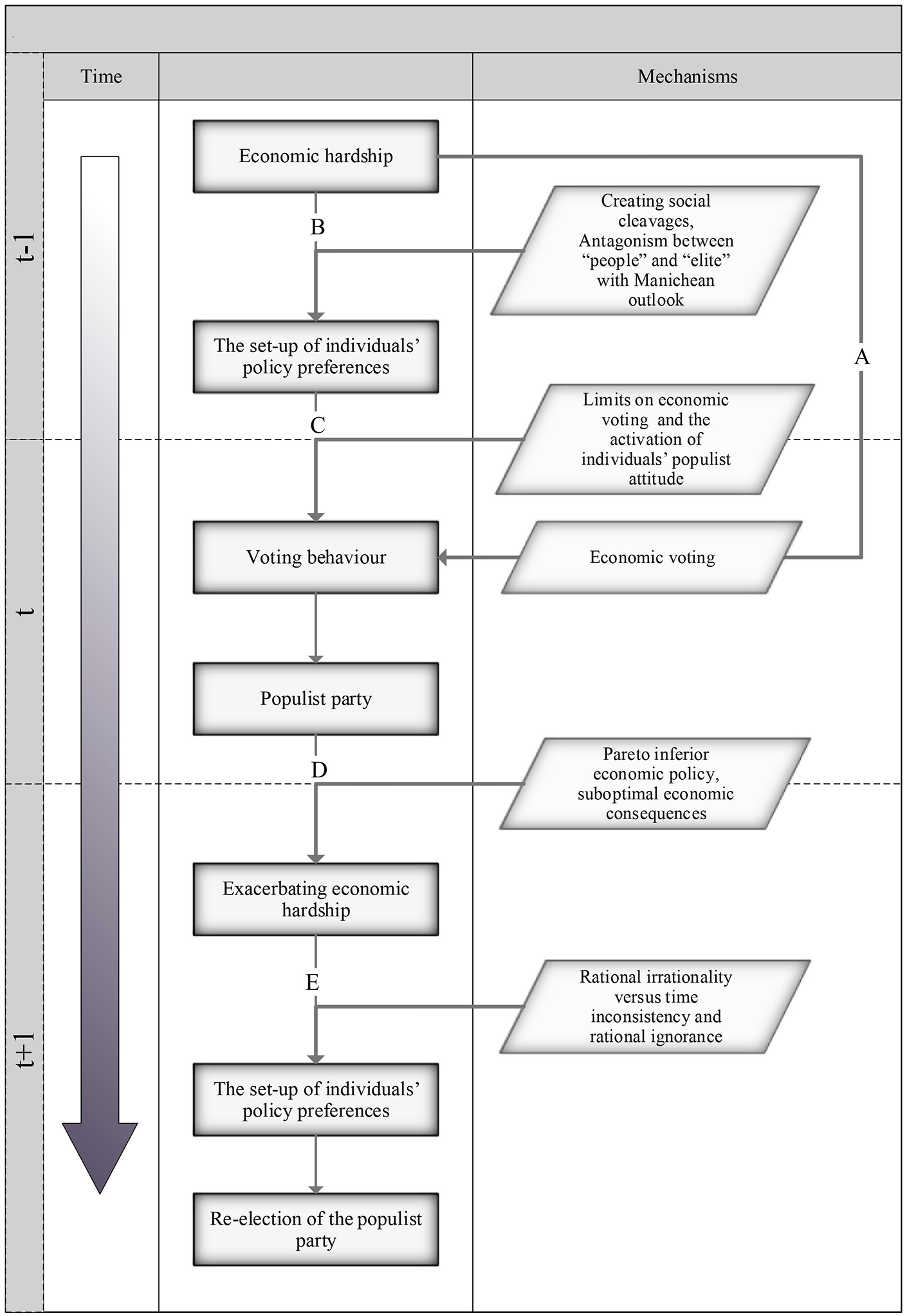
A Conceptual Framework on the Supply and Demand Side of Populism.
The explanatory significance of economic factors is hard to decline. Margalit (2019) and Guriev and Papaioannou (2020), however, point out that revisiting the economic voting hypothesis after carefully identifying a single exogenous shock is, alone, not able to explain why mainstream politics fails to provide appropriate political responses to such challenges and to compensate losers, and why support for populism becomes widespread. Exogenous shocks are likely to interact with each other, often working through culture and identity, that together drive up support for populism, particularly of the right-wing kind. Some economists argue that voters appear to make (economically) substantial, consistent and correlated errors, often holding some entity (‘others’ or the ‘elite’) accountable for actions beyond their control (Cerrato et al., 2018). Typically, the field gives at least implicitly some explanatory power to individual’s perceptions by relying on the term of economic insecurity (Mols and Jetten, 2017; Zagórski et al., 2021). Economic insecurity – a loose and broad term – is sometimes deprived of any subjective substance and measured by unemployment rate (Algan et al., 2017), or by changes in income (Bossert et al., 2019) and by gross domestic product (GDP) growth (De Bromhead et al., 2013). The phenomenon is also often proxied by a ‘vulnerability measure’ based on the degree of exposure to automation; on risk of automation at occupational level (Im, 2021); on exposure to welfare cuts (Fetzer, 2019); or on a composite index of unemployment, individuals’ perception on their own financial situation and employment in low-tech manufacturing (Guiso et al., 2017).
Economic malaises push voters away from mainstream parties, while the activation of certain attitudes pulls them closer to populist parties (instead of to any other opposition party). While some use attitudinal measures (e.g. attitudes of racial inequality, social class, migrations and economic insecurity (financial worries)) in studying the demand for populism (Guiso et al., 2017), the economics profession should perhaps elaborate more on mechanisms B and C (of Figure 1). Most studies of populist attitudes (e.g. Schulz et al., 2018) use the ideational definition that claims that populism is not a consistent, full-bodied ideology such as conservatism or liberalism (not ‘a thick ideology’), but ‘a thin-centred ideology’ as it does not necessarily articulate comprehensive political programmes. Therefore, populism must be combined with political ideologies that provide needed programmatic content and that moderate the effect of populist attitudes (Hawkins et al., 2018). 4 Populists share citizens’ issue positions and activate populist attitudes (mechanism C), that are seen as multidimensional constructs consisting of two or more components or subdimensions (such as anti-elitism, support for popular sovereignty or Manichean worldview) (Wuttke et al., 2020).
As a corollary, to understand the circumstances in which economic shocks work their way into increases in populists vote share, one is advised to look beyond the simplistic mechanisms of economic voting and elucidate the concrete ways in which populists can be successful in mobilising potential voters by reflecting on economic misfortune and activating populist attitudes, and on the institutional and sociological factors associated with the electoral success of populists (Bértoa and Rama, 2020).
The majority of the studies in the field of economics draw at least implicitly from the politically contentious nature of
Instead of globalisation in general, economists engage in testing the local labour-market effects of
The Chinese shock is high on the agenda too. Autor et al. (2020) find that the exposure of local labour markets to increased foreign competition has contributed to rising political polarisation in the policy preferences and media viewing habits of the American public. In contrast, focusing on the United States, Feigenbaum and Hall (2015) find no effect of economic shocks from Chinese import competition on the re-election rates of incumbents; however, they demonstrate that localised economic shocks from trade cause a pronounced and consistent shift towards protectionism on trade bills. Colantone and Stanig (2018) analyse the effect of Chinese imports on elections in 15 Western European countries and find that import shocks revoke sociotropic voting and lead to an increase in support for radical-right, nationalist and isolationist parties.
To infer causality, most of these studies use Chinese import penetration as the main form of trade shock (Ballard-Rosa et al., 2022; Cerrato et al., 2018), while some rely on North American Free Trade Agreement (NAFTA) vulnerability, or import versus export trade exposure (Jensen et al., 2017). The dependent variable, however, is notably diverse: the consumption of polarised media (Autor et al., 2020), the demand for authoritarian values (Ballard-Rosa et al., 2022), vote shares for populist parties and an individual’s appreciation for political candidates (Cerrato et al., 2018) are all designed to show different aspects of the demand for populism.
Another branch of economics literature tests the effect of the
In support for the context hypothesis, Barone et al. (2016) find that immigration generates a causal increase in votes for the centre-right coalition with anti-immigrant sentiment in Italy, while Halla et al. (2017) provide evidence that immigration increases demand for far right-wing parties in Austria. They both argue that cultural diversity, competition in the labour market and for public services and concerns for the quality of their neighbourhood are the most relevant channels at work. Studying Spain, Mendez and Cutillas (2014) prove that Latin American immigration increased natives’ participation rate and their support for the major leftist party and explain their findings mainly through non-economic factors like language, religion and race. Focusing on 11 European countries, Cordero et al. (2021) show that immigration drives up support for right-wing populist parties among low-educated voters, while in regions with higher share of educated immigrants, more educated voters are likely to turn to populist parties. Relatively fewer studies find support for the contact hypothesis. Accordingly, the inflow of immigrants might increase the level of empathy and understanding and decrease discriminatory behaviour (Finseraas and Kotsadam, 2017), particularly when ingroups and outgroups (1) share equal status and common goals, (2) find themselves in a cooperative rather than competitive environment and (3) operate under a well-defined set of norms or regulations.
In empirical studies, some use immigration share (Edo et al., 2019), migration from accession countries (Becker et al., 2017), change in immigrant stock (Caselli et al., 2021); others use refugee influxes (Dinas et al., 2019), change in refuge allocation, share of population of non-Western origin (Harmon, 2018) and asylum seekers (Tomberg et al., 2021) as independent variables. Similarly, the dependent variables vary from vote share for Republicans in House, Senate and presidential elections (Mayda et al., 2022); changes in vote share for major leftists over major conservative parties (Mendez and Cutillas, 2014); vote share for far-right parties (Otto and Steinhardt, 2014) and for far-left parties (Edo et al., 2019). 5
While globalisation with its different types of shocks (such as a sudden influx of immigrants) has a rather long-term effect on society that systematically alters social and economic dynamics, another branch of the literature looks at a very particular crisis: the
Central and Eastern European countries have also become part of the interest of economists. These studies argue that the unequal distribution of the burden of adjustment to adverse economic shocks across creditors and debtors challenges voters’ party preferences. For a populist party, advocating debtor-friendly policies resonates with their claim to stand for ‘the people’ against the establishment in general and against the financial sector in particular. By exploiting variations in exposure to foreign currency household loans during a currency crisis in Hungary, Gyöngyösi and Verner (2022) find that foreign currency debt exposure leads to a large and persistent increase in the far-right vote share. Similarly, focusing on Poland, Ahlquist et al. (2020) show that foreign currency borrowers who are more exposed to the shock of Swiss franc appreciation were more likely to demand government action that would make banks pay a larger share of the cost.
Compared to the previous ones, the empirical literature on the relationship between financial crises and populism is rather thin. It is no surprise that Guriev and Papaioannou (2020) call for a greater attention to the effect of financial openness and outsourcing on the rise of populism. The main dependent variables are changes in vote share (Bergh and Kärnä 2021); demand for government bailouts (Ahlquist et al., 2020); size of the governing coalition (Mian et al., 2014); political fragmentation, fractionalisation and polarisation (Mian et al., 2014). The main independent variables vary from repayment of mortgages denominated in Swiss francs (Ahlquist et al., 2020); foreign currency debt exposure (Gyöngyösi and Verner, 2022); to banking, currency and debt crisis (Mian et al., 2014).
Time Period t: Populists in Power and Their Economic Policies
Whereas the study of the demand side of populism attracts a relatively large degree of attention from the economics profession, no similar tendency arises on the supply side; a point well noted by Guriev and Papaioannou (2020: 5) ‘dozens of empirical works explore the role of trade and . . . the crisis, but few so far focus on austerity or welfare-state policies’. The relatively scarce research work in economics can be rationalised along several lines.
First, it was not that long ago that economists developed their own approach, the ‘economic populism’ paradigm, which was once conceived as the concept of embracing populist economic policies in post-World War II Latin America (Dornbusch and Edwards, 1991). 6 The concept was, however, attacked on several grounds, such as its heavy regional bias, its strong normative content and its sheer focus on policy consequences (Rovira Kaltwasser, 2019). In turn, the concept has not received much credit for studying the most recent waves of populism. Second, demand side analysis is based on an abundance of data (Rooduijn et al., 2019). Populists in power, however, are scarcer phenomena, and availability of data is more limited. Third, the actual decisions and actions taken by populist governments have recently shown remarkable variety across countries.
The concept of economic populism is no longer in use, but the view that populist rule comes with negative economic consequences is still alive (Rovira Kaltwasser, 2019). It is generally assumed that even if populist leaders in power engineered their economies full of good intentions, they ultimately would fail and leave behind a bankrupt and dysfunctional economy where those most in need would be especially hurt (Acemoglu et al., 2013). Populism is, thus, an economically costly endeavour, culminating in a Pareto inferior situation, often expressed in terms of an actual drop in GDP or a relative loss as compared to a constructed counterfactual. In a large sample, Funke et al. (2020: 4) show that ‘[d]eclining economic fortunes under populists are a robust result that we find to hold regardless of region, era, or ideology’.
The literature on Pareto inferior populist policies can be divided into two (mechanisms D in Figure 1). One group identifies populist rule with expansionary fiscal and monetary policies that (too) often end up in an unsustainable path of development; the other emphasises the many forms of trade protectionism, including import tariffs, the limitation of foreign direct investment and the direct attack on multilateralism or regional integration. These two main lines are, however, often complemented by other deliberate political actions, by altering the rules of the game or the constitutional system of checks and balances, which have an undeniable impact on the institutional landscape of the overall economy.
Excessive Redistribution and Policy Cycles
Historically, overly expansive redistributive populist policies were designed to overcome underdevelopment in general, and to fix extreme income inequality in Latin American economies in particular (Dornbusch and Edwards, 1991). Sachs (1989) demonstrates that countries with fixed exchange rates and constrained capital movements willingly engaged in monetary expansion with the hope of boosting aggregate demand and real wages. In his ‘populist policy cycle’, the initial expansion was inevitably followed by an increased current account deficit or even a severe balance of payments crisis. Similarly, looking at 13 Latin American countries from 1976 to 2012, Ball et al. (2019) find that a temporary fiscal and monetary expansion created a short-term boom, which in turn culminated in decelerated long-term economic growth due to a constrained future fiscal space and in increasing debt burden, along with higher inflation. The idea of a policy cycle is further formalised by Dovis et al. (2016), who discover that a government which is short on credible commitments often generates populist cycles. By placing credible commitment at the heart of their analysis, Dovis et al. (2016) acknowledge the importance of strong institutions in preventing the economy from falling into the trap of populist cycles. Similarly, according to Acemoglu et al. (2013), besides drastically high levels of inequality, weak (political) institutions accommodated highly redistributive (and corrupt) policies. Rode and Revuelta (2015), on the other hand, reverse the casual relationship, and find that it was the populists and their policies, which, by cracking down on institutions, substantially narrowed economic freedom in Latin America. 7
Interestingly, the thesis of bad economics has become a prevalent one in modern-day populist policy packages in other parts of the world too. Funke et al. (2020) study debt dynamics under populist rule (compared to doppelgangers) in a panel of 50 countries from 1990 to 2018 and show that debt levels of populist regimes were above the synthetic control by up to 10% points. Nevertheless, with the proliferation of “left- and right-wing populsim” fiscal performances have started to vary to a large degree. Episodes could be found for both unsustainable public finances and fiscal conservativism. 8 Guriev and Papaioannou (2020) are more critical on the assumption that populist economic policies necessarily take the form of unsustainable redistributive policies and argue that Western economies have shown much less interest in large populist redistribution programmes than their Latin American counterparts. Even the Greek Syriza, which won elections with an anti-elitist and anti-austerity programme was forced to abide by the strict fiscal rules of the European Union (EU) eventually (Andreadis and Stavrakakis, 2017).
Nevertheless, by referring to the deep imprinting of the legacy of Dornbusch and Edwards (1990), Mudde and Rovira Kaltwasser (2017: 4) argue that although the concept of economic populism might have lost academic interest, ‘populist economics refers to a political program that is considered irresponsible because it involves (too) much redistribution of wealth and government spending’.
Trade Protectionism, Anti-multilateralism
Economists tend to support free trade and argue that if each country specialises in the production and exchange of what it is relatively good at, every nation will mutually benefit from trade in terms of higher output and income (Ricardo, 1817). While comparative advantage is, by nature, a static concept, it may nevertheless change due to alterations in technology or productivity forcing the domestic economy to adjust to new challenges. For endogenous growth theorists, such dynamic changes are pushed forward by free trade itself.
The global financial and economic crisis of 2008, however, proved to be a game-changer. Import tariffs, the initiation of trade wars and the attacks on multilateralism have become typical responses to the frustration of people who either lost or feared losing their jobs and their standard of living. Analysing policy-changes in relation to cross-border trade, investment and labour migration between 2017 and 2019, Evenett and Fritz (2019) find that trade protectionism has become more pronounced than ever in the last few decades. The positive correlation between the spike of votes on populists and the intense adoption of trade restrictions invited economists to a more rigorous analysis of the phenomenon.
Economic insecurity, triggered and amplified by globalisation, pushed successful populists to provide shelter for their domestic employees in the form of increased tariffs or by urging domestic employers to abstain from outsourcing their activities to foreign locations (Feigenbaum and Hall, 2015). Under the presidency of Donald Trump, the multilateral trade system was put under direct challenge, including the withdrawal from the Trans-Pacific Partnership, cracking down on NAFTA and the World Trade Organization (WTO) and embarking on a trade war with China (Higgott, 2018). The Trump Administration initiated tariff increases on imported Chinese goods which significantly hurt US consumers’ interests (Amiti et al., 2019). Retaliation from China by tripling tariffs in certain sectors worked against US producers, especially against workers in Republican counties (Fajgelbaum et al., 2020).
Besides the widely cited examples of Latin American protectionists (see Edwards, 2019), right-wing populists such as Thaksin Shinawatra (Thailand), Narendra Modi (India), Rodrigo Duterte (The Philippines) or Recep Tayyip Erdogan (Turkey) also serve as prime examples for trade protectionism. Indeed, Funke et al. (2020) provide evidence that import tariffs are significantly higher under populist rule. These findings evidently go against the so-called compensation hypothesis postulating that import exposure in developed economies let left-wing parties benefit from the dissatisfaction from the losers of globalisation (Cameron, 1978). In advanced economies, however, it has not been the left-wing, but rather the right-wing populism, that managed to capitalise on anti-globalisation sentiments (Mudde and Rovira Kaltwasser, 2018). These populists offered no income compensation, but job security in the form of a limited import competition in the United States (Cerrato et al., 2018). In Europe, on the contrary, where no member state of the EU can introduce trade barriers, populists forged Euroscepticism and anti-migration programmes instead (Dustmann et al., 2017).
Rodrik (2018a) rightly points out that economists still struggle to explain why populists turned against international trade, especially because trade itself might not be the most important source of economic hardship. Automation has, in fact, a much larger role in job displacement (Loewen and Stevens, 2019), yet populists show no interest in attacking technological change. Rodrik (2018a) claims that equating exposure to imports with the ‘others’, especially with foreigners, is only part of the answer. International exchange often favours countries which compete on grounds of unfair practices such as the violation of environmental regulations.
Populist policies can and do, in fact, vary from country to country. A recent World Economic Survey reveals that experts pointed to trade as the main factor driving support for populism in the United States, whereas European respondents voted for anti-migration policies. Redistributive policies along with short-term spending were named by Southern and Eastern European experts in the highest number (over 74%), although redistribution was number one in the worldwide ranking (Boumans, 2017). According to Guiso et al. (2017), income redistribution was very much understood as an organic element of an all-encompassing, short-term protectionist strategy. Most importantly, short-termism was supposed to describe the situation where populist politicians concentrate on short-term benefits and hide the consequent long-term costs of their actions. This idea resonates well not only with the macroeconomic concept of time inconsistency (Kydland and Prescott, 1977) but also with the insight of Mudde and Rovira Kaltwasser (2018) who claimed that populism is about respecting popular will irrespective of the implied costs.
Time Period t + 1: The Re-election of the Populists Parties
Public choice theory has devoted a considerable effort to demonstrate that bad politics and bad economics are not rare phenomena in advanced democracies (Mueller, 2012). Politicians, interest groups, and bureaucrats are identified on the supply side as the direct sources of socially harmful outcomes (Krueger, 1974). Much less attention has been paid, however, to the question of why voters on the demand side are willing to support policies that tend to reduce aggregate welfare (or even harm individuals’ own economic interest). Within the discipline of rational choice theory, economists work with the homo economicus assumptions that (1) voters have well-defined preferences and unbiased beliefs and expectations; (2) voters (with infinite cognitive ability) make optimal choices; and (3) the primary motivation is economic self-interest. But then, why might voters re-elect populist politicians engaging in bad economics?
While there might be a flaw in the rationality argument, these anomalies are traditionally explained on a rational basis in economics. Voters are subject to intertemporal choices (to present biased preferences) and thus their discount rate between ‘now’ and ‘later’ is much higher than between ‘later’ and ‘even later’ (Thaler, 2016). If voters choose what is momentarily tempting and not what is best, they will appreciate populist economic policies that typically offer immediate pay-offs to voters, and thus bad economics can be popular, if only temporarily. This time-lag can be long enough for the relationship to be exploited by populists at least for the re-election for another term. Votes, however, cannot be pursued on a regular basis; no systematic fooling is possible under forward-looking expectations (Lucas, 1976).
Whereas ‘fooling’ might be an occasional phenomenon, the rational ignorance of Downs (1957) is a more general and subtle one. Rational ignorance assumes that the chance for an individual to deliberately influence the final outcome of any election is close to zero, and that investing in better information has too high a cost. The more incumbent politicians can hide the long-term costs of their activities in the present, the more costly acquiring information will be for voters at times of elections and, in turn, the higher the chance of re-election will be. Accounting for poorly informed voters, studies find that voters selectively expose themselves to particular sources of information (Dal Bó et al., 2018), they make intertemporal decisions in inconsistent ways (Lizzeri and Yariv, 2017) and fail to extract the right information from other voters’ actions (Esponda and Pouzo, 2017).
Both time inconsistency and ignorance explain the demand for bad economics on a rationality basis. Bad economics (even if later realised) is disfavoured by voters in both instances. Yet, bad economics is not always ‘unwanted’; it can bring about some sort of utility under certain circumstances. The ‘value function’ which translates perceived changes in wealth or income into utility is often subject to some biased beliefs that violates rational expectations. Overconfidence and excessive extrapolation (without any self-awareness of individuals’ lack of predictive skills) are just two examples of biased beliefs (Thaler, 2016).
A prominent account on biased beliefs by Caplan (2003, 2006) assumes that voters entertain systematically biased beliefs and such biased beliefs set incentives for politicians to engage in bad yet popular policies. His concept of rational irrationality grasps irrationality as a utility-generating consumer good. 9 Voters are willing to consume substantial amounts of irrational beliefs when it pays off in terms of feeling better, which compensates for material losses due to poor policies. While some beliefs have low opportunity costs (import tariffs are typically such), others have a substantial, even harmful effect on society (e.g. unsustainable debt accumulation). But even in the latter case, people might feel better by voting on ‘bad’ policies due to the deep divide between the rich and the poor (Sachs, 1989).
Applying the novel concept of rational irrationality to populism at t + 1, one can argue that it is emotion and ideology that together can divert human judgement from a rational standpoint and that, in turn, provides fertile ground for the re-election of a populist. By reflecting on the current (t) malaise of society, populist incumbents successfully exaggerate existing socio-economic issues and (re)-activate populist’s attitudes. The systematically biased beliefs articulated by Caplan resonate well with the components and sub-dimension of populist attitudes, in particular with anti-elitism and the orientations about the role of the people. As Caplan argues: People do not grasp the ‘invisible hand’ of the market, with its ability to harmonize private greed and the public interest. I call this anti-market bias. They underestimate the benefits of interaction with foreigners. I call this anti-foreign bias. They equate prosperity not with production, but with employment. I call this make-work bias. Finally, they are overly prone to think that economic conditions are bad and getting worse. I call this pessimistic bias (Caplan, 2006: 10).
Existing literature on the possible re-election of a populist with bad economics is provocative but incomplete, omitting advances in public choice and behavioural economics. Jennings (2011) provides evidence that voters may prefer policies that are not in their economic interests and demand populism. A notable piece by Acemoglu et al. (2013) makes an implicit assumption that populist voters hold certain beliefs that are more cherished than their economic best interests. Fear from bribes or corruption drive people to cast a vote for the populist incumbent, even if their policies are to the left of the voter’s bliss point. Cerrato et al. (2018) also show that Republican candidates’ ‘cues on out-groups may bear more relevance to voting behaviour than cues pointing to the actual cause of economic hardship’ (Cerrato et al., 2018: 16).
It is the task of a successful populist incumbent to emphasise the positive (short-term) effect of economic policies within his term and build up valence to attract more votes. 10 Populist voters might have rational expectations about the price of irrationality (might perceive some of the Pareto inferior outcomes); however, voters might be willing to forego some wealth in order to retain cherished – though irrational – beliefs. Specifically, public disaffection about those issues appears to overwrite any concerns related to the economic loss produced by a populist regime.
Conclusion
Populism is moving into the research mainstream in economics. This article has attempted to survey the flourishing economics field, describe its robust findings and point the way forward with the introduction of a conceptual framework by combining demand and supply side analyses. Some of the core insights are worth restating here.
Focusing on
For
The main question
We conclude that the study of populism is one of the major arenas in which the principles of economics should be used, and that there is a repeat encounter, with many intersections, between the fields of political science and economics, that should be better utilised in populist research.
Footnotes
Declaration of conflicting interests
The author(s) declared no potential conflicts of interest with respect to the research, authorship, and/or publication of this article.
Funding
The author(s) disclosed receipt of the following financial support for the research, authorship, and/or publication of this article: This project has received funding from the European Union’s Horizon 2020 research and innovation program under grant agreement No 822682.
