




Abstract
Candidate characteristics have an important impact on voter choice, and scandals are found to negatively impact a political campaign. Yet the literature, with its focus on scandals such as financial and (consensual) affairs, has failed to look into how allegations of sexual assault and harassment may impact electability. This study analyzes the effect that allegations of sexual assault or harassment have on the electoral success of American politicians. Using an original survey experiment, we find that, on average, American citizens are less likely to support a candidate accused of sexual assault or sexual harassment. However, not all voters do so to the same magnitude. We find that Democrats are significantly less likely to support a candidate that faces such allegations. Republicans do not strongly penalize candidates facing allegations of sexual assault or harassment, especially if the candidate is identified as a Republican. We analyze open-ended survey responses to offer an explanation for such variation: a propensity to disbelieve women who speak out about sexual assault and harassment explains variations in why some voters may not change their opinion of a candidate based on an allegation.
Introduction
In the last few years, many women in the United States have been coming out with stories about sexual assault and sexual harassment (SASH) within powerful institutions (Maas et al., 2018). While these allegations have been serious, the fate of the careers of those who are politically affiliated and accused have varied, depending on party politics, political prospects, and ultimately on the electorate.
The 2016 reveal of the Access Hollywood tape wherein Donald Trump acknowledged having sexually predatory behavior inspired a stream of women to come out with stories corroborating his sexually aggressive tendencies (Kurtzleben, 2016). This series of events inflamed national discourse about women’s bodily autonomy and perceptions of allegations of SASH in American culture. In response to the burgeoning accusations, Trump accused all the women of making up the stories to bolster the opposition (Sampathkumar, 2017) and labeled the conversation on the tape as “locker room talk” (Maas et al., 2018). Trump’s political ambitions were not squandered by the negative news, as he was elected president, yet the allegations continue to prompt regular discourse in the media regarding his moral character (Dickinson, 2018).
The 2017 contest between Republican Roy Moore and Democrat Doug Jones in the conservative state of Alabama brought the subject of SASH into prominent public discussion again (Jacobs and Smith, 2017). The media coverage of the election brought to light accusations from dozens of women claiming Moore had sexually preyed on them as teenagers (Bloch et al., 2017) and framed the election as a retest for the American electorate on the issue of sexual predators in public office. Jones won the election by 1.6 percentage points, which can also be attributed to Moore’s history of racist comments and actions and a particularly high voter turnout among African Americans (Bloch et al., 2017). In light of this narrow win, it is difficult to neatly conclude that the allegations of SASH had a significant impact on voters’ decisions.
Public conversation on the fitness of public officials accused of SASH grew more salient during the 2018 nomination of Supreme Court Justice Brett Kavanaugh. Dramatic nomination hearings came to signify the divisive and particularly personal nature of conversation in American politics (NYTimes.com, 2018). Despite intense media attention and public outrage over the nomination of a man accused of sexual assault, Kavanaugh was confirmed.
Thus, while many of the federal politicians accused of SASH in the United States in recent years have been forced by party leadership to resign or not to seek re-election, such as Representatives Patrick Meehan (D-PA), John Conyers (D-Mich), Blake Farenthold (R-TX), Joe Barton (R-TX), Ruben Kihuen (D-NV), and Al Franken (D-Minn), others have been able to proceed with their political ambitions without repercussion. These include Representatives Alcee Hastings (D-AL) and Bobby Scott (D-VA), President Donald Trump (R), and Justice Brett Kavanaugh (Drew et al., 2018; Garofoli, 2018). Variations in the effect that allegations of SASH have on the career of politicians suggest variations in the degree and magnitude in which voters hold politicians accountable for such actions. This research aims to measure which members of the electorate take allegations of SASH into consideration, if and how allegations impact their choice in an election, and why the demographic groups may have differing reactions.
The charges against the politicians accused in recent high-profile cases vary greatly in severity (Catanese, 2017). For the purposes of this article, we will consider accusations of SASH as classified in recent high-profile reports in the political arena, such as the cases mentioned previously involving Representatives Meehan, Conyers, Farenthold, Barton, Kihuen, Franken, Hastings, Scott, President Trump, and Justice Kavanaugh. The typical allegation features unwanted touching, groping, and harassment within a relationship of unequal power.
The subject of an allegation of SASH is unique in the context of a political election because some people are inherently skeptical of allegations of SASH (Donat and D’Emilio, 1992; Frese et al., 2004; Harrell and Castaneda, 2009) and public opinion is consequential (Buttice and Stone, 2012; Campbell, 1960; Savigny, 2004). Because some people have an inherent skeptical reaction to the validity of allegations of SASH, they will incite a different reaction than other political scandals such as financial scandal or consensual infidelity, because their truth is not necessarily instinctively questioned. In a contest of public opinion, it matters how voters consider SASH allegations: whether or not they take allegations at face value, treat them with skepticism, or consider them to be a tool of the opposing party. In this article, we argue that variations on the degree in which voters penalize candidates for allegations of SASH depend on their inclination to believe or not the victims and this is contingent to their party affiliation. We test this argument using an original randomized experiment applied to a population of 751 American citizens over 18 years old, and shed further light on the causal mechanism by looking into the respondents’ open-ended answers.
Scholars have long agreed that though voters primarily choose candidates based on shared party affiliation, considerations of candidates’ personal characteristics are becoming increasingly relevant, and candidate scandals tend to hurt their electoral chances (Buttice and Stone, 2012; Campbell et al., 1980; Carlson et al., 2008; Funk, 1996). However, the subject of accusations of SASH—as opposed to a scandal involving consensual infidelity—in the political arena is only recently being explored and to the best of our knowledge, there is limited research conducted to survey the population explicitly about their reactions to candidates accused of SASH and their reasons to do so (Stark, 2018). This article contributes to the literature by showing that when partisans are expected to make a choice between supporting their party and penalizing a candidate accused of SASH, they can “argue their way out” by separating the validity of accusations and the desired electoral trajectory of their party’s candidate.
This article proceeds as follows: first, we present a review of the literature to show that the understanding of SASH has grown dramatically in recent decades. Second, we illustrate that the literature finds that candidate characteristics are important to voters, and that descriptive representation finds that personal characteristics have influence elected leadership once in office. Third, we present that there is a gap in the literature on voter judgment of allegations of SASH against candidates, and propose why it is important to distinguish between allegations of SASH from consensual sex scandals. We then hypothesize why voters of certain demographics and party affiliations are more inclined to penalize candidates facing allegations of SASH than others. The section on methodology presents the experiment and it is followed by the “Results” and “Discussion” sections.
SASH in the Public Sphere
The understanding and perception of SASH in American public conversation has evolved throughout the last 70 years, which is a factor that could impact how demographic groups treat allegations of SASH. While SASH is not a new phenomenon, the conversation about sexual violence in the United States was influenced by a definition set by white men and the legal systems they designed. For much of American history, women’s bodies were white men’s legal property, and sexual violence was legally actionable only for men when their property (wives, sisters, and daughters) was damaged. It was not until the 1960s and 1970s that American women began to assert their own perspectives on the subject of sexual violence (Donat and D’Emilio, 1992: 13, 14). Contrary to the main narrative that sexual violence was a random event committed by strangers, leaders in the feminist movement found that it was usually “a violent crime committed against millions of women by men they knew and trusted” (Campbell and Wasco, 2005: 128). The increased awareness of SASH incited increased research on perceptions of SASH in the field of interpersonal behavior, or the study of communications and actions present in human relationships.
Scholars relate the prevalence of sexual violence to a culture of masculinity and rape (rape culture; Anderson and Swainson, 2001; Rozee and Koss, 2001) where sexual violence is condoned by the constructs of the society which are set up so that women have less power than men (Siegel, 2003). The evidence of rape culture in the United States is structurally integrated in all levels of society (Rozee and Koss, 2001: 295, 296) through the institutions which fail to protect women from equal justice and wherein men predominantly hold the most powerful positions. Whether it is perceived or real, the distance between power held by men and by women has directly resulted in cycles of harassment, misconduct, and abuse (Barreto et al., 2009; Drew et al., 2018). That SASH is an expression of dominance and symptom of rape culture rather than an unleashed, unreciprocated sexual impulse is the commonly accepted perspective in the literature today (Anderson and Swainson, 2001; Brenner, 2013; Drew et al., 2018; Rozee and Koss, 2001; Siegel, 2003).
However, the public’s understanding of sexual violence and women’s empowerment led to claims of sexual violence being regarded with increased skepticism in the 1970s (it had always had an air of mistrust because of the private nature of most encounters). The logic was that, because women were choosing to violate the norms of subordination to men, they also sacrificed their right to protection. Therefore, an empowered woman who claimed to be a victim of sexual violence generally was regarded as if she brought it upon herself because she had rejected men’s protection (Donat and D’Emilio, 1992: 14).
Due to the historical mistrust on the subject of sexual violence, there has been much research on attitudes toward allegations of sexual violence and rape myth acceptance. Rape myth acceptance is confirmed in the literature as the level of willingness a person may have to disbelieve a victim’s story, or “the amount of stereotypic ideas people have about rape, such as that women falsely accuse men of rape, rape is not harmful, women want or enjoy rape, or women cause or deserve rape by inappropriate or risky behavior” (Frese et al., 2004).
The prevalence of sexual violence is evident nowadays with victims reporting in increasing numbers new and historical accounts of SASH (Campbell and Wasco, 2005; Harrell and Castaneda, 2009; Krook, 2017; Rozee and Koss, 2001). It is common for women to reveal stories of SASH with the encouragement or corroboration of other victims (Gardner, 2009). For example, in the 1990s, there was a surge in reporting called the “Anita Hill effect” after former staffer for Justice Clarence Thomas, Anita Hill, testified in the Justice’s confirmation hearings about his sexual harassment (Brenner, 2013). The present-day surge in reporting can be tracked to the “#MeToo movement” that motivated women around the world to share their own experiences of harassment and intimidation in the workplace (Krook, 2017).
Today, SASH is widely recognized as acts borne out of a situation of unequal power and the outpouring of allegations through the #MeToo movement indicates that many people have been victims of, or know someone who has been a victim of SASH. Since abuse of power is found to be an important factor for voter consideration (Doherty et al., 2011), it could be that allegations of SASH in the context of a political election will incite a strong judgment from many voters.
Since the 1770s—the inception of the US government—candidates’ personal characteristics as an electoral tool has been a point of discussion and consequently, a source of research (Summers, 2000), as we will now describe in more detail. Since the 1960s and 1970s, there has been increasing public awareness of SASH and consequently, increasing studies in the field of interpersonal behavior that analyzes perceptions of SASH (Donat and D’Emilio, 1992). However, to the best of our knowledge, the insights about perception of SASH derived from the field of interpersonal behavior has not been connected to research on candidates’ personal characteristics as an electoral tool in the field of political science.
Candidates’ Personal Characteristics and Experiences Impact Voter Perception and Leadership
Scholarly literature has long agreed that party identification is a key driver in determining voter choice, but advances in technological communications have allowed for greater public investment in personal characteristics of candidates and, therefore, they are also a determinant of a candidate’s success (Campbell, 1960; Denver et al., 2012; Fiorina, 2002; Savigny, 2004; Summers, 2000). Positive personal characteristics raise the candidate’s electability, and negative personal characteristics will have a negative impact (Buttice and Stone, 2012; Campbell et al., 1980), but what constitutes a positive or negative personal characteristic is largely dependent on the voter’s perspective (Collignon and Sajuria, 2018) as they are more inclined to vote for someone who looks like them and with whom they share personality features and demographic characteristics than to vote for someone who does not (Campbell and Cowley, 2014; Campbell et al., 1980; Caprara et al., 2007; Collignon and Sajuria, 2018; Savigny, 2004).
Characteristics of a candidate are not only a key to define vote choice. As literature on descriptive representation suggests, personal characteristics of a candidate have an effect on their performance once in office (Campbell, 1960; Fridkin and Kenney, 2011; Ramey et al., 2016). Elected officials in democracies represent not only the expressed preferences of their constituencies, but also those of their descriptive characteristics that are politically relevant, such as gender (Sanbonmatsu, 2003), race (Hardy-Fanta, 2017), and locality (Collignon and Sajuria, 2018). For example, descriptive representation suggests that female representatives are more capable of representing female voters because of shared experiences and identities (Campbell et al., 2010). The body of research on descriptive representation suggests that while it is undeniable that should be an aim for representative democracies, it is not because of the similarity in demographics but because there is value in ensuring shared experiences of representatives and the electorate. In other words, voters choose candidates based on personal similarities, and the personal lives of politicians matter because their personal experiences factor in their representation.
Taking into consideration the fact that political contests are increasingly evaluated by the candidate’s personal characteristics (Campbell, 1960), that certain personal characteristics appeal to certain people (Collignon and Sajuria, 2018), and that negative personal information bodes negatively for the candidate (Buttice and Stone, 2012; Campbell et al., 1980), it could be argued that a candidate’s alleged propensity to sexually abuse could damage their electoral chances. In addition, when factoring in that personal experiences factor in representation (Campbell et al., 2010), it could also be argued that it also impacts their elected leadership.
Research on how voters respond to negative personal information about candidates agrees that scandals have a markedly negative impact on voters’ judgment of the candidate (Carlson et al., 2008; Funk, 1996). Research on the impact of scandals analyzes primarily financial and consensual sex scandals (Carlson et al., 2008; Funk, 1996), and within those subjects, voters’ predispositions and media sources (Peterson and Vonnahme, 2014), and contextual considerations, such as a good economy (Zaller, 1998). Findings suggest that competence-related scandals, such as tax evasion, have a greater impact on voters’ judgment than emotional scandals such as marital infidelity, with voters relating financial fraud to concern for the potential abuse of public funds (Funk, 1996). But while the negative impact of scandals and consensual sex scandals such as marital infidelity is well documented, the literature largely fails to distinguish between consensual sex scandals and SASH (Craig and Cossette, 2020; Stark, 2018).
Previous research suggest that an abuse of power is a prominent factor that prompts voters to take scandals into consideration (Doherty et al., 2011), suggesting that distinguishing between SASH and consensual sex scandals is important (Donat and D’Emilio, 1992). For example, stories that a candidate has cheated on a spouse may impact voters differently than a candidate who has allegedly sexually harassed his or her intern, because cheating may be considered immoral but not necessarily an act that takes advantage of an unequal relationship. With newfound awareness of SASH, following the #MeToo movement in which many published allegations of SASH about prominent people, the consideration that SASH is an abuse of power in an unequal relationship is a key to the conversation about voter perception of allegations of SASH in an election for public office. The need to break down the analysis of the impact of “sex scandals,” by looking specifically at the impact of allegations of SASH, has been suggested for future research since the subject has become prominent in American political conversation (Craig and Cossette, 2020).
Separately, much research within the field of interpersonal behavior analyzes perceptions and attitudes about allegations of SASH, and how and why certain populations react to claims (Anderson et al., 1997; Anderson and Swainson, 2001; Barnett and Hilz, 2017; Frese et al., 2004). However, there is no literature specifically connecting the research from the field of political science on voter judgment of candidates, and research from the field of interpersonal behavior on perceptions of allegations of SASH. This could be largely due to the fact that accusations of SASH in the political arena, as we have encountered them in the last 5 years have only recently been taken into consideration as a tool of public discourse.
In summary, we understand that voters consider the characteristics of the candidate to cast their ballot and that negative personal information about a candidate impacts voters’ judgment. We also know that wrongdoings such as marital infidelity and financial fraud negatively impact the electability of the candidate. But, to the best of our knowledge, there is limited literature on how allegations of SASH impact voters’ judgment (Craig and Cossette, 2020) and there is even less work on why it does so. In the following section, we theorize that, while voters are likely to be impacted by candidates’ negative personal characteristics, the way in which voters perceive allegations about SASH offers complexity. The variation we will observe is in relation to “rape myth acceptance,” the likelihood that a voter may question the validity of a story of sexual violence outright, and the mitigating effect of partisanship.
Not All Sections of the Population Respond to Allegations of SASH Equally
Research largely concludes that some demographic groups, including men, conservatives, and “older” people are more likely to have attitudes classified as rape myth acceptance than women, liberals, and younger generations (Anderson et al., 1997; Anderson and Swainson, 2001; Campbell and Wasco, 2005). Studies on sexual violence find that women are victims of SASH more prevalently than men and that they are less prone to rape myth acceptance; that is, less likely to question the validity of stories of sexual violence and, therefore, they are more likely to relate to the issue more personally and have more empathy for victims than men (Anderson et al., 1997; Anderson and Swainson, 2001; Barnett and Hilz, 2017; Campbell and Wasco, 2005; Harrell and Castaneda, 2009; Rozee and Koss, 2001). In their study of perceptions of allegations of rape, Anderson, Cooper and Okamura found “the strongest demographic predictor of attitudes toward rape was the sex of the respondent: men expressed more accepting attitudes toward rape than did women” (Anderson et al., 1997: 311). Victims of SASH, who are most commonly women, are more likely than those who have not experienced SASH, to have unfavorable views of perpetrators.
This shared perspective has power in the American electorate. Loosely defined, single-issue-based groups that share a common belief or perspective, such as women victims of SASH, are strong influences on electoral decision-making (Campbell and Wasco, 2005). Because women are most often victims of SASH, and voters’ attitudes are oftentimes based on perceived personal similarities and connections with a candidate, we hypothesize that women are more likely than men to be impacted by an allegation of a candidate committing SASH.
On the subject of age, we argue that younger people will consider the issue of sexual assault allegations as a factor in their voting decision more than older people because younger adults have lived the entirety of their lives with the social and legal acknowledgment of SASH. Because the first studies on the prevalence of sexual violence were released in 1985 (Harrell and Castaneda, 2009), we are categorizing “younger” Americans as those younger than 35 years, and assume they will have gone through childhood in an environment informed by the legal recognition and definition of SASH. We categorize “older” Americans as aged 35 years and above because we assume that Americans older than age 35 (at the time of this research) experienced childhood without the social understanding of SASH as we know it to be today. As history progressed, women’s involvement in the conversation about SASH helped reshape how it is understood. Yet, cultural norms do not change immediately. Older people may be less receptive to adjusting their understanding of social life (Anderson et al., 1997: 311). Subsequently, we hypothesize that older people will be less inclined than younger people to revoke their support for a candidate based on an allegation of SASH.
Party ID and Partisanship Matters
Pertaining to political ideology, research finds that social conservatives are more prone to rape myth acceptance than liberals (Anderson et al., 1997; Barnett and Hilz, 2017). Barnett and Hilz analyze differences in the moral foundations of college students and their interpretation of stories about sexual violence, and found that their subjects with conservative values were more likely to contest allegations of SASH than liberals (Barnett and Hilz, 2017). They find that liberals have a higher tendency to place value on minimization of harm to individuals, making them likely to defend a vulnerable person at the expense of group cohesion. In contrast, conservatives are more likely to want to preserve norms, and therefore, will reason with maneuvers to protect group cohesion. When faced with an allegation, conservatives tend to prefer to keep the existing social narrative rather than question it and risk destabilizing social order (Barnett and Hilz, 2017: 3).
In US politics, socially conservative and liberal identities are frequently channeled through the party system with conservatives more frequently identifying with the Republican party and liberals with the Democratic party (Grossmann and Hopkins, 2015; Levendusky, 2009). Thus, the issue of sexual assault may impact Democratic voters more than Republican voters because Democrats have defined their party as one with concern for social issues in a way that Republicans have not (Petrocik, 1996). Because Democrats are considered liberals and Republicans as conservatives, we hypothesize that Democratic voters are more likely than Republican voters to be impacted by an allegation.
However, shared party identification can be a stronger factor in voter choice than an allegation of SASH and will also reduce the impact of such allegation. Research has shown that, above any other factor, a shared party identification is the strongest factor in voter choice (Campbell, 1960; Denver et al., 2012; Fiorina, 2002; Savigny, 2004; Summers, 2000). Partisanship biases electoral considerations significantly and especially at low levels of information, voters are influenced primarily by their party identification, with policy views having little impact on their choice (Groenendyk, 2013; Jessee, 2010). When voters receive information, they most commonly fit the information with their current values and beliefs rather than changing them (Campbell, 1960) and this effect is consistent in partisan and non-partisan elections (Bonneau and Can, 2015). A propensity for rape myth acceptance will explain a variation in willingness to vote for an accused candidate, but when confronted with partisanship, voters are faced with a more complex decision to make.
Because partisanship provides an identity justification to vote for a particular candidate, we hypothesize that voters with strong partisanship will be less likely to remove support of their own party’s candidate due to allegations of SASH. Recent research shows that both Republicans and Democrats are becoming increasingly partisan (Bartels, 2000) and that partisan bias in political perceptions plays a crucial role in perpetuating and reinforcing sharp differences in opinion between Democrats and Republicans alike (Bartels, 2002). We do not have, at this stage, different expectations for the strength that partisanship (for each of the two main parties) will play in candidate evaluation after allegations of SASH.
Based on the previous, we can present the following hypotheses:
H1: Allegations of sexual assault or harassment will decrease the likelihood of voting for a candidate.
H2: The effect of allegations of sexual assault or harassment on the likelihood of voting for a candidate will be smaller among groups prone to rape myth acceptance (men, older and Republican individuals).
H2a: Men will penalize candidates accused of SASH to a lower degree than women.
H2b: Individuals older than 35 years (born before the legal definitions of sexual assault and harassment became commonly understood and, therefore, socialized to be prone to rape myth acceptance) are less likely to penalize candidates accused of SASH than younger individuals.
H2c: Republicans are less likely to penalize candidates accused of SASH than Democrats.
H3: Sharing party identity reduces the effect of SASH on the likelihood of voting for a candidate.
The summation of these hypotheses is largely based on works outlining what demographics have a propensity for rape myth acceptance and the strength of party affiliation. The idea is that demographics who are not prone to rape myth acceptance will be impacted more strongly by an allegation of SASH in a political contest than those who are prone to rape myth acceptance, and that shared party affiliation will reduce that impact. We test these claims with a survey-based experiment and the qualitative analysis of its open-ended questions.
Methodology
To test our hypotheses, we first used an original survey-based experiment and complemented it with the qualitative analysis of open-ended questions (the complete questionnaire can be consulted in Appendix 1). A survey experiment is well suited to the research question as it allows us to control the information about a candidate to which individuals are exposed to. By exposing individuals to the same candidate profile, we can control for policy preferences and isolate the effects of partisanship and allegations of SASH, allowing robust causal inferences.
The experiment was conducted using Qualtrics, a specialized software for surveys, and the distribution system Amazon Mechanical Turk (MTurk) to gather responses. MTurk is recognized as a valid platform for these type of experiments, with participants being significantly more socio-economically and ethnically diverse than participants recruited through posts on social media or that of a standard sample of students on a college campus and are at the same time, equally effective (Casler et al., 2013). Experiments are often criticized for their low external validity. We addressed this concern by ensuring that our sample presents variations in terms of age, gender, party identification, and place of residence.
We addressed ethical considerations about fairness in payment and working conditions of MTurk participants our experiment by explicitly narrowing the sample to American citizens over the age of 18 and by providing a financial compensation of US$0.50 for 3 minutes of work. This would equate to US$9.60 per hour; a wage higher than the federal minimum wage, at US$7.25 per hour.
Our sample consisted of 751 observations, which compare favorably to other similar work (Funk, 1996). Our analysis is based on 625 complete observations, which are well balanced across experimental groups, as shown in Table 1. The experiment was conducted during July 2018. The treatment consisted of a statement about allegations of SASH made against a candidate. The same candidate was presented without party affiliation or as a Republican or Democrat. The statement was written as a gender-neutral person in order to avoid any inherent or overt bias toward or against a certain gender. Policy information about the candidate was limited to valence issues such as education, job development, crime, and drug abuse prevention. To minimize the influence of partisanship, the phrasing around these issues was intentionally vague. Figure 1 presents the design of the experiment graphically.
Demographic Distribution across Groups.

DCSASH: democrat candidate and allegations of sexual abuse and sexual harassment; RCSASH: republican candidate and allegations of sexual abuse and sexual harassment; *SASH: sexual abuse and sexual harassment.
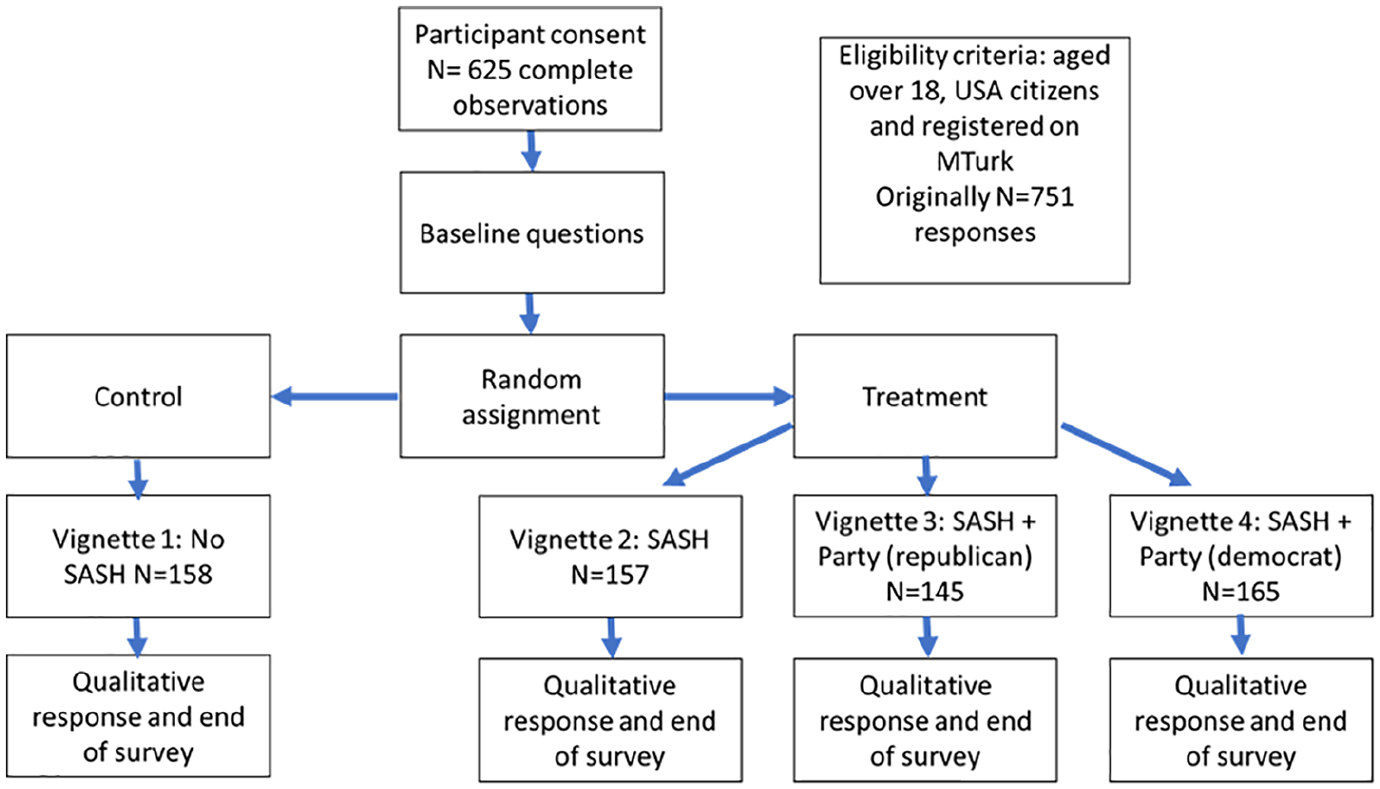
Experiment Flowchart.
The exact wording of each vignette is as below:
Vignette 1 (control group): Jamie Easton is a candidate for Governor. Easton previously served as a U.S. Representative for ten years, and has a strong record on job creation and on work to minimize the country’s deficit. Easton is in support of strong crime prevention programs, housing and urban development, improving the educational system and drug abuse prevention. As U.S. Representative, Easton developed a scheme called the “Common Sense Initiative” which eliminated 10,000 job-killing regulations at the federal level. Easton’s campaign slogan is “Working Hard for America,” as Easton is well-respected amongst peers for a great work ethic. Easton and spouse moved to the state 20 years ago; the couple raised two children together, both of whom now attend universities in the state.
Treatment group 1 was presented with Vignette 2 (testing H1) where we added to the same profile a sentence about sexual assault allegations at the end of the profile. The sentence read, During the election, two former staffers went public with an accusation that Easton had groped and sexually harassed them while they worked together three years ago; it was revealed the parties settled a lawsuit about the matter.
The sentence about the accusation was written to include the corroboration of multiple women and a legal settlement. The main goal was to ensure that the hypothetical accusation was illustrative of the kinds of accusations featured in prominent recent cases mentioned previously (i.e. not extremely violent in nature) and that resulted in a relatively minor legal issue. A final group of participants was presented with a combination of candidate’s party affiliation which was either Republican (Vignette 3) or Democrat (Vignette 4) and the same allegation of sexual assault (testing H3).
Our other independent variables allow us to test for heterogeneity of effects (H2). They include the sex of the respondent (1 = female, 0 = male), their party affiliation (1 = Democrat, 0 = Republican), and their age (0 = younger than 35 and 1 = older than 35).
Each respondent was then presented with a question to measure the dependent variable intention to vote for the candidate. We asked participants “Would you be likely to vote for Jamie Easton in this election?” (Definitely not, probably not, probably yes and definitely yes).
Results
Table 1 shows the demographic composition of each group. Each demographic is well balanced between the control and treatment groups. In all cases, we are confident that categories are distributed at random between groups and we do not find any significant association between demographics and the group assigned to (χ2 tests with p values larger than the conventional threshold of 0.05 in all cases).
Table 2 presents a series of ordinary least squares (OLS) regressions using the ordinal variable likelihood of voting for a candidate (values range from 1 to 4). The coefficients presented in Model 1 indicate that on average and regardless of the candidate’s party of affiliation, the respondents were less supportive of candidates with allegations of SASH as the three coefficients are negative and significant, supporting H1. We can say that, on average, voters are about half a point less supportive of a candidate accused of SASH. This effect is stronger when the candidate is identified as Republican (–0.61) than Democrat (–0.49). The difference in the coefficients between treatments is graphically presented in Figure 2.
Intention of Voting for the Candidate (All Treatments).

DCSASH: democrat candidate and allegations of sexual abuse and sexual harassment; RCSASH: republican candidate and allegations of sexual abuse and sexual harassment; SASH: sexual abuse and sexual harassment.
Standard errors in parentheses.
p < 0.1; **p < 0.05; ***p < 0.01.
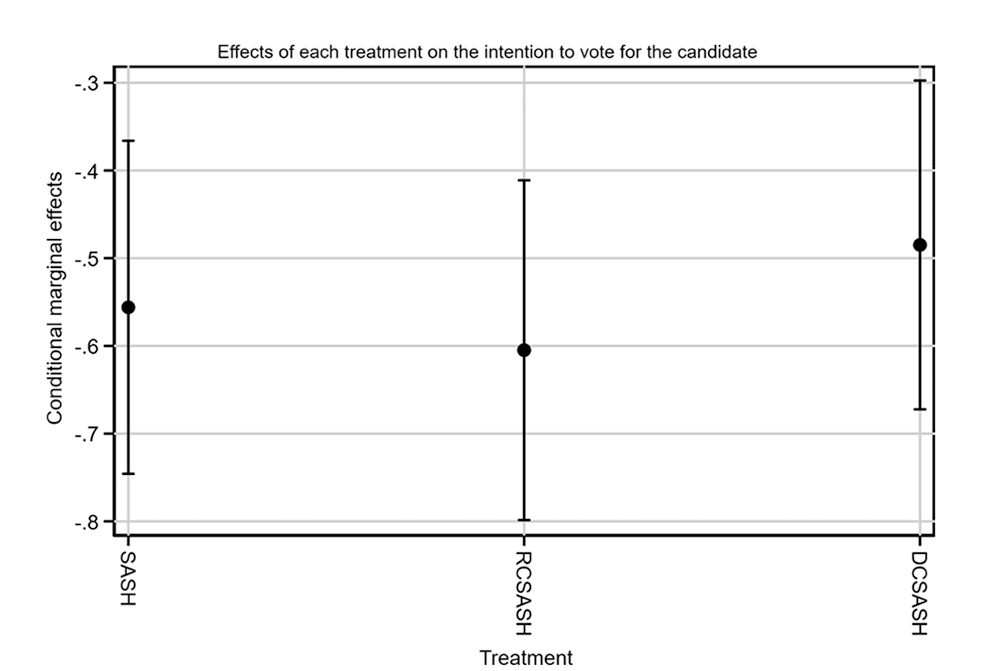
Effect of Allegations of Sexual Assault on Reported Likelihood of Voting for the Candidate.
In Models 2 and 3, we interact all the treatments with the sex, age, and party affiliation of the respondents. We observe that, contrary to what H2a and H2b suggests, the effects of sex and age in the intention to vote for the candidate are not significant. Together, these results indicate that demographics prone to rape myth acceptance (men and old voters), are not particularly forgiving of candidates accused of SASH and are as willing to penalize them in the ballot box as women and younger people do. One possible reason for the lack of significant effects with regarding to age can be that SASH has been an issue that has affected individuals for generations, regardless of advances on its legal conceptualization and framework and therefore, older and younger voters can acknowledge the validity of accusations of SASH.
But looking in detail at Model 4 we observe that, in support of H2c and in full support of H3, the coefficient identifying the respondent by their party affiliation (Democrat = 1) is significant, as are significant the coefficients of the interactions of party identification with the other two treatments identifying the candidate with a party and offering information of SASH at the same time. An interesting story emerges here, which suggests that the party affiliation of the respondent will play a stronger role in the way individuals evaluate candidates than their age or sex do.
We observe that respondents who support the same party of the candidate accused of SASH express, in any case, a higher intention to vote for the candidate than they would if the candidate is standing for the opposition. On average, Democrat respondents will be 0.07 points more inclined to vote for a Democrat who has been accused of SASH than a Republican. Meanwhile, a Republican respondent will be 0.73 points more inclined to support a Republican candidate accused of SASH than a Democrat will.
Figure 3 graphically represents these differences. As we can observe in the graph, the confidence intervals for Republicans and Democrats overlap in the control group indicating that they are equally likely to support the candidate. Then we observe that the support decreases once the candidate has been accused of SASH. It decreases for Democrats and Republicans, even if the slope is more pronounced for Democrats. But once we include partisanship, the effect of SASH is mitigated in both cases. The mitigation effect is stronger for Republicans who will always be more likely to vote for a Republican candidate, despite allegations of SASH, than a Democrat. In the case of Democrats, the effect of SASH is very strong and it does not get totally mitigated by partisanship. To put this in perspective, Democrat respondents have approximately the same intention to support a Democrat candidate accused of SASH (predicted value of 2.25) than a Republican will (predicted value of 2.18). But a Republican will always be supportive of a Republican candidate, despite allegations of SASH (predicted value of 2.52).
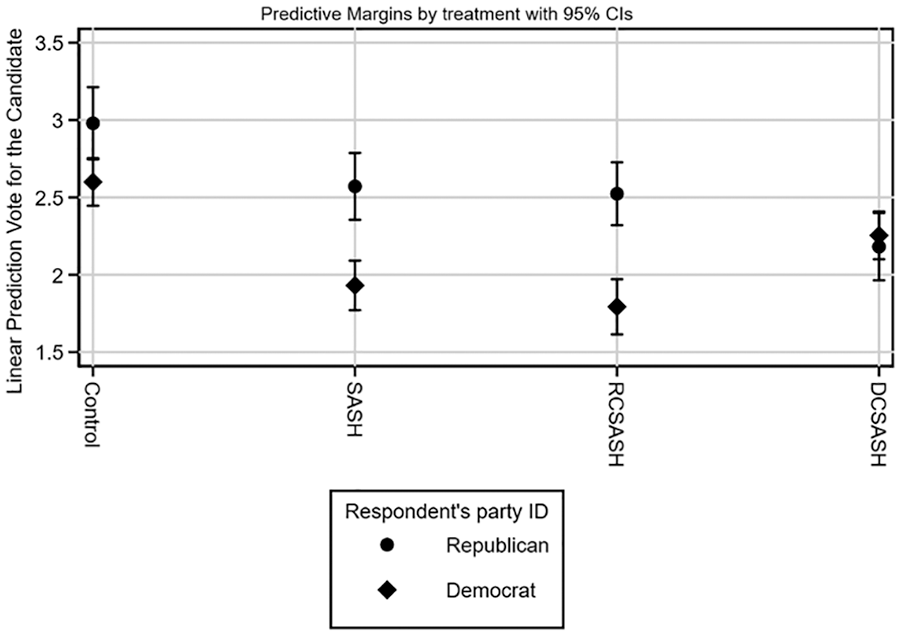
Predicted Intention to Vote by Party of Affiliation.
Together, these findings indicate that partisanship does indeed mitigate the effect of allegations of SASH on the support for the candidate, as suggested by H3. But in the case of Republicans, the negative effect of allegations of SASH is almost completely re-calibrated by partisanship while it is not the case for Democrats. This variation suggests that partisanship acts as a cue for values, socialization, and experiences which in turn, affect the way in which individuals take allegations of SASH and the weight they assign to such allegations in their voting considerations. Since H2 hypothesizes that conservatives (Republicans) will be more prone to rape myth acceptance than liberals, we take this as partial support for H2.
Discussion
This article presented hypotheses about the reasons respondents either do or do not support a candidate that is accused of SASH. To summarize, we hypothesized that allegations of SASH will decrease support for a candidate (H1) and that young people, women, and liberals (Democrats) are more likely to believe victims of SASH and, therefore, the effect of SASH on vote choice will be less in individuals whose characteristics make them prone to rape myth acceptance (men, older, and Republican individuals; H2a, H2b, and H2c). Our final hypothesis (H3) suggested that partisanship may decrease the likelihood of voters penalizing a candidate accused of SASH. Experimental results provide support for H1 and H3 and only partial support for H2 (support for H2c but no support for H2a and H2b). We showed that voters are overall less likely to vote for a candidate that faces allegations of sexual assault and harassment and that there are variations on this effect by party. We did not find support for the notion that women and young individuals penalize candidates more strongly for allegations of SASH than men and older individuals.
In order to go deeper into the role that rape myth acceptance play in determine attitudes toward candidates accused of SASH, we looked into an open-ended question included in the survey where we ask respondents to describe the candidate. We present a systematic summary of our findings in Table 3, where we observe a tension between party identification and the propensity to believe victims.
Systematic Presentation of the Relationship between Open-Ended Questions and Hypotheses.

SASH: sexual abuse and sexual harassment.
With respect to H1, we find further corroboration that voters will be unsupportive of a candidate who is accused of SASH. The majority of the comments about the accused candidate reflected on the allegation as an example of disrespect to women and sexist behaviors, which allude to the respondent’s belief in the truthfulness of the allegations. The most frequently used words to describe all three variations of the candidate that was accused of committing SASH include positive character-based descriptions, including “hard working,” but are followed in frequency by language related to character judgments such as “untrustworthy,” “sexist,” “predator,” “dishonest,” “immoral,” “questionable,” and “typical.”
Regarding the partial support found for H2, we can connect the fact that respondents are less supportive of a candidate who faces allegations of SASH, even if they are from the same party, with their interpretation that the allegations are truthful and committing SASH is a signifier of disrespect to women, and tendency for unethical practices. The word “typical” was prominent in descriptions of the accused candidate, which suggests people are prone to mistrusting politicians or refers to the context that, at this time, many politicians are being exposed for sexual predation. Women were especially likely to describe the candidate using words that confirm trust in the allegation and as such, embody mistrust and disgust, such as “shady,” “offensive,” “creep,” “predator,” “untrustworthy,” “pervert,” and “crooked.” Because of the volume of comments that express trust in the allegation in the responses that signified they would not vote for the candidate; we can see a correlation between the choice to not vote for the candidate and the recognition of the truth of the allegation. Responses reflected that the accused candidate “seems to be very qualified at his job, but the harassment charges against him hinder his ability to be taken seriously in a political way”; that the candidate is “not good moral choice”; and that “He has good policies but he does not support my view of a viable candidate. A viable candidate would not have sexual harassment allegations claimed against them.” This indicates a dislike and mistrust of candidates that are accused of SASH because they consider them untrustworthy, immoral, and lacking earnestness. A few related the accused hypothetical candidate to President Trump by describing the candidate as “Typical Trump jerk,” and “He sounds too much like that national embarrassment named Trump.”
In regard to age, we hypothesized that the common understanding of the social and legal definitions of SASH would lend itself to its perception of validity, and therefore, younger people (as defined in this article as those born after 1985) would be more likely to perceive allegations of SASH as true at face value. What we found, however, is no difference in how allegations of SASH are perceived according to age. This finding points to the fact that SASH has been an issue experienced throughout American history, regardless of its legal definition. Therefore, people of all ages can acknowledge the potential validity of accusations of SASH.
However, tension merges between the negative attitudes motivated by SASH, the propensity to believe or not victims and party identification. Republicans are less likely than Democrats to dislike a candidate based on an allegation of SASH, supporting H2c but we find that in both cases, partisanship obscures this effect, as suggested by H3. This finding aligns with other research that finds the strongest indicator of vote choice is shared party identification, and that conservatives are prone to rape myth acceptance (Anderson et al., 1997; Barnett and Hilz, 2017). When faced with an allegation, conservatives tend to prefer to keep the existing social narrative rather than question it and destabilize social order. These responses from Republican respondents give insights into the thought processes, indicating a propensity for rape myth acceptance and an interest in overlooking the allegation in order to vote for her party: He is a good candidate but I would worry that the allegations are true or not. He has done really good things for his community. (Republican, Female, above 36 years in response to RCSA) While I believe that his personal tendencies are immoral, sadly, I believe this is a common trait in many men—especially those in power or those who are uneducated/living in poverty. Having said that, I would likely vote for him due to the greater good he could do. We need a man with his professional track record. Unless there was a viable candidate that had his track record AND was morally superior, only in that case would I change my opinion. (Republican, Female, above 35 years in response to CSA)
Furthermore, in looking at the respondents’ descriptions of the accused candidate, we find that Democratic respondents are more likely not only to acknowledge the accusation, but to relate the accusation to abuse of power more generally. The responses below demonstrate the contrast with how Democrat respondents perceive the candidate: Qualified but misused their authoritative position to commit a crime and possibly for some sort of biased gain. (Democrat, Female, below 35 years in response to DCSA) Someone who takes advantage of his position in power. (Democrat, Male, below 35 years in response to CSA) [A] man in power who uses that to intimidate women. (Democrat, Male, above 36 years in response to CSA)
These data suggest that, because Democrats believe in the validity of accusations of SASH at face value, they are equipped to interpret the abuse of a relationship of unequal power such as SASH as a signifier of a propensity to abuse power more generally. This is in comparison to Republicans, who, because they do not believe in the validity of the accusations, do not see it as a factor that relates at all to the earnestness of the intentions of the candidate for office. Republicans are more likely to question the validity of the claim, in turn changing the conversation about the candidate’s qualifications to a conversation about the accuser’s intentions. One Republican woman’s response to the question asking for the respondent to describe the candidate illustrates this pivot: “Why are the former staffers bringing it up, especially now? Usually there is a gag order. Why was it not brought up earlier in his career?” (Republican, Female, below 35 years). This propensity to change the conversation from the candidate’s qualifications to that of the accuser’s intentions explains the suspicion that many have that claims are made particularly for the opponent’s political gain.
In all, consistent with our theory, we found those who are more likely to believe in the validity of an allegation of SASH are more likely to change their electoral preference based on such allegations. Those who have a tendency for rape myth acceptance, or a propensity to disbelieve the allegation, are more likely to overlook the accusation. In addition, we find that many people indicated they would vote for the candidate who is accused of SASH if the candidate shares their political party. Interestingly, respondents of shared partisanship with the candidate recognize the negative moral implications of SASH, but separate the candidate from the person. Many express an aversion to the allegation and indicate that shared party affiliation is a stronger factor in their choice than the allegation.
Conclusion
This article presents original evidence to support the claim that allegations of SASH indeed have a significant impact on the American electorate. However, we also observed that these allegations do not weigh equally in the electoral considerations of voters. We find that mainly, the variation comes from their partisanship, since voters that share a candidate’s party affiliation are still willing to support the candidate accused of SASH.
Results show that Democrats and Republicans penalize candidates accused of SASH. But the effect is larger for Democrats. In addition, the mitigating effect of shared Democrat partisanship is not large enough to compensate for the effect of SASH. In the case of Republicans, the effect of SASH is smaller and it can be easily outweighed by shared partisanship. In all, this indicates that partisanship plays a key role in mitigating the effect of SASH but the different effects by party indicate that party affiliation acts as a cue for shared values and experiences that make Republicans more likely to dismiss the accusations.
While we hypothesized that shared partisanship will mitigate the effect of allegations of SASH in the likelihood of vote, we did not have any a priori expectation regarding heterogeneous effects of shared partisanship between Democrats and Republicans. One possible explanation of this variation can be found in the party literature suggesting that Republicans and Democrats have different sets of values they choose to emphasize when evaluating candidates (Barnea and Schwartz, 1998; Caprara and Schwartz, 2006; Feinberg and Willer, 2015; Feldman, 2003; Schwartz, 1992; Williams et al., 2009). Research has shown that values matter the most for vote choice and explain with great accuracy preferences for left or right (Caprara and Schwartz, 2006). Personal values enable people to organize their preferences in a consistent manner and provide a structure to political attitudes (Feldman, 2003), depending on context and time (Davidov et al., 2008). Our findings suggest that voters use their party affiliation as a proxy for other considerations and, therefore, only if they cherish values that conflict with allegations of SASH might they penalize the candidate in the ballot box.
Our investigation shows, with the analysis of the open-ended questions, that rape myth acceptance plays a key role in dismissing the accusations, with important nuances induced by party affiliation, and that a candidate’s moral traits play a direct role in evaluations of politicians. It shows as well that when voters are faced with the choice of penalizing their candidate for allegations of SASH, they find internal ways to justifying not doing it by separating the morality of such accusations with the professional profile of the candidate. It contributes to the literature on personalization of politics by showing that the moral characteristics of a candidate matter for electoral choice. However, as morality is a very personal issue, its weight in voters’ considerations depends on their internalization of values. Our findings add to those of Funk (1996) and may help explain why some politicians are able to retain and obtain high offices after being accused of SASH.
We also contributed to the study of harassment and intimidation of women by showing that some sectors of the population are more likely to believe in allegations at face value than others. It requires courage to speak out about such incidents, particularly when they are oftentimes not believed and/or the perpetrator is allowed to continue to progress in their career. When this happens, it adds to a cycle of victimization and injustice.
There are a number of issues to be addressed by future research. First, our results suggest that voters are, in general, affected by allegations of sexual assault as they describe the candidate as a sexual predator, untrustworthy, and someone who is disrespectful to women. This suggests that voters, in general and regardless of their gender, party, and age, do not normalize sexual violence and harassment. We recognize that our distinction of Democrats versus Republicans as a proxy for values, experiences, and tendency to dismiss accusations of SASH is blunt. There is a richness in the qualitative data we used that allowed us to look into more detail at the elements that played a role in respondents considerations, but we suggest that future research should use more fine-grained measures of social liberalism and conservatism as well as more detailed measurements of the respondents’ value system to get a stronger test of the causal mechanism. In addition, future research should look at the strength of partisanship as it may well be that variations in the mitigating effect of partisanship are related to the strength in which individuals feel their identity as opposed to the values they channel through it. Third, we chose to present the hypothetical candidate as gender-neutral in the interest of avoiding the impact of gender bias, but additional research could be performed to investigate how SASH allegations are interpreted when the candidate and accuser are different combinations of male, female, or another gender identity, particularly because women are running for office in increasing numbers in the United States. Fourth, our hypothetical candidate’s vignette read that the candidate settled a lawsuit about the alleged SASH; additional research could investigate if a candidate’s legal settlement for an SASH case would change voter responses. Fifth, our research finds that some voters are concerned that candidates who are alleged to have committed SASH may have a propensity to abuse the power of public office, and our theory of descriptive representation finds that elected officials’ personal characteristics are factors in their representation once in office. While our research contributes to the literature by making the connection between allegations of SASH, voters’ concern for the abuse of power in public office and the literature which confirms elected leaders’ personal characteristics guide their leadership, further research is needed to understand if a candidate who has committed SASH is in fact more likely to abuse the power of public office. These are avenues that future research should explore to provide a more nuanced answer to the causal mechanisms behind this issue.
Footnotes
Appendix 1
Profile read by Group 1: Jamie Easton is a candidate for Governor. Easton previously served as a U.S. Representative for ten years, and has a strong record on job creation and on work to minimize the country’s deficit. Easton is in support of strong crime prevention schemes, housing and urban development, improving the educational system and drug abuse prevention. As U.S. Representative, Easton developed a scheme called the “Common Sense Initiative” which eliminated 10,000 job-killing regulations at the federal level. Easton’s campaign slogan is “Working Hard for America,” as Easton is well-respected amongst peers for a great work ethic. Easton and spouse moved to the state 20 years ago; the couple raised two children together, both of whom now attend universities in the state.
Profile read by Group 2: Jamie Easton is a candidate for Governor. Easton previously served as a U.S. Representative for ten years, and has a strong record on job creation and on work to minimize the country’s deficit. Easton is in support of strong crime prevention schemes, housing and urban development, improving the educational system and drug abuse prevention. As U.S. Representative, Easton developed a scheme called the “Common Sense Initiative” which eliminated 10,000 job-killing regulations at the federal level. Easton’s campaign slogan is “Working Hard for America,” as Easton is well-respected amongst peers for a great work ethic. Easton and spouse moved to the state 20 years ago; the couple raised two children together, both of whom now attend universities in the state.
Profile read by Group 3: Jamie Easton is a
Profile read by Group 4: Jamie Easton is a
Declaration of conflicting interests
The author(s) declared no potential conflicts of interest with respect to the research, authorship, and/or publication of this article.
Funding
The author(s) received no financial support for the research, authorship, and/or publication of this article.
