



Abstract
Is there a gender gap barrier against the career advancement of women researchers in Mexico? To explore possible answers to this question, we review the specialized literature, based on the “sticky floor” and “glass ceiling” conceptual framework, and then offer an empirical approach to test whether such a gap exists as well as some theoretical reasons that could explain it. We analyzed a massive dataset of 41,000 members of the National System of Researchers (SNI) under the National Council of Science and Technology (CONACyT) in Mexico from 1991 to 2017. To test determinants of advancement, we consider gender, areas of knowledge, states in which researchers reside, years in which initial applications and promotions took place, and universities to which researchers belong to. We found that there is a similar chance to advance from the lower levels of the system, following the sticky floor analogy, but women make a little progress after these initial levels when compared to men, in line with the glass ceiling idea. We also offer additional research avenues in this topic, due to another important finding, which reveals that 62% of researchers never make progress at the level in which they initially join.
Introduction
In 1984, Mexico established the SNI (Sistema Nacional de Investigadores, or National System of Researchers) considered the first public policy with the aim of providing a mechanism for researchers to obtain academic recognition, and an economic stimulus in the context of the economic crisis the country faced. This policy also tried to minimize the drop in research activities and the brain drain (Bensusán et al., 2018). Although it was considered a temporary measure, in full operation during the economic crisis, the system was later institutionalized as an evaluation mechanism of Mexican researchers affiliated to higher education institutions and research centers. The goal of the system is to assess, on an individual basis, the quality of scientific production through the classification of researchers in levels.
The SNI system comprises five levels and each application is assessed by a committee. To become a member, among other requirements, a researcher must hold a doctoral degree; ongoing scientific or technological research activities; mentorship and knowledge dissemination. Those who apply should exhibit peer reviewed articles, chapters, or books published by recognized publishing houses. Technological research comprises intellectual property granted or transferred in Mexico or abroad and projects that produce new knowledge and technological developments oriented to solve real life problems. Academic mentorship includes chairing undergraduate or graduate committees to approve senior and postgraduate degree theses; training of researchers and research groups, and teaching at the undergraduate and graduate levels. Finally, knowledge dissemination activities can be for society at large and promotion of early scientific vocations.
To become a candidate, applicants must demonstrate capacity to carry out research through the evaluation of scientific or technological research products; comply with the specific criteria for the area of knowledge of their choice and the level to which they aspire. To become level I, in addition to candidate’s requirements, researchers must have chaired undergraduate or graduate thesis in Mexico, teaching and training activities of undergraduate and graduate courses. To achieve level II, applicants must have a consolidated research area and chair or co chair doctoral dissertations in Mexico. To achieve level III, researchers must have carried out research that represents a significant scientific or technological contribution, play a leadership role in the national scientific or technological community, receive national and international recognition, and have carried out outstanding work in the formation of a high-level scientific community. To reach emeritus, a researcher must be at least 65 years old and hold level III at the time of application.
In the context of the SNI, which serves as a catalyst for researchers’ careers in general, and women researchers in particular, the object of this study is twofold: to verify whether a gender gap exists and to what extent this gap is associated with female researchers’ advancement, based on quantitative analyses of Mexico’s SNI from 1990 to 2017. Our research question revolves around whether visible and invisible barriers in a gendered world, such as academia, are related to researchers’ gaps. It would be ideal to verify this association using individual level data in which these barriers were captured by survey responses among female and male researchers, including demographics, family situations, and home and work specific responsibilities, among others, to better understand all these potential relationships. The available data, however, are limited to other equally relevant variables, such as public or private home affiliation, state in which they work, years in the system, and in which level of the system’s hierarchy they are placed on an annual basis.
Our aim is to take advantage of the public information with the aforementioned variables to verify whether a gender gap exists, and whether being a female researcher, once admitted in the system, is less likely to make progress in the hierarchy. Although there has been a significant increase in the participation of women in the SNI system, in 2017, the proportion of female researchers in Mexico’s SNI was 37%, comprising approximately 10,000 women as opposed to 17,500 men. Historical data reveal a significant increase in the participation of women in the SNI, from 18.1% (253) in 1984 to 36.2% (9080) in 2016 (Bensusán et al., 2018). Several authors have noted the gender disparity that prevails in the SNI (de Garay and del Valle Díaz-Muñoz, 2012; Didou and Gérard, 2011; Evangelista-García et al., 2012), analyzing women under representation, which roughly reach one third, arguably due to the lack of affirmative action policies and the lack of introduction of a gender perspective in the Science and Technology Law (Evangelista-García et al., 2012).
In this way, the system was designed following a career path of men and ignoring women’s reproductive cycle, which usually coincides with early career development and causes a delay in their career trajectories. For women, work-life balance is a barrier for advancing in an academic career. This same phenomenon can also be seen in Spain, Argentina, and France (Evangelista-García et al., 2012). De Garay and del Valle Díaz-Muñoz (2012) and Evangelista-García et al. (2012) point out that although half of the graduate students in Mexico are women, female professors only represent 33% of SNI members. Finally, the distribution of women within the system has been unequal across levels (Cárdenas, 2015). We also found this disparity based on the 41,144 unique trajectories of SNI members during the period of 1991–2017.
The article starts with the background of the gender gap in research and science. Then, we succinctly describe the SNI based on an analysis of which elements are related to the development of the career of women researchers into the system. Although we discuss some benefits of being admitted, such as economic rewards for members, we will center our focus on the SNI functions as a catalyst for scientific production in Mexico through a mechanism of hierarchization of researchers, in which SNI members teaching and management responsibilities also play a relevant role in promotion or retention of the SNI membership, because a higher education institute with more SNI members is better ranked by the CONACyT in the National Program of Graduate Schools Quality (PNPC in Spanish), an important distinction which allow universities to compete for federal grants and have access to scholarships, among other benefits. Then, we present our data, hypotheses, and methods. Finally, we report results from the models and offer some conclusions and future research avenues.
Theoretical Framework
One of the main explanations for the effects of visible and invisible barriers on women’s career advancements centers on the expressions “sticky floor” and “glass ceiling.” These terms, coined by the US Secretary of Labour in 1991, refer to conditions that act as barriers to women’s career advancement and make it virtually impossible for them to reach the highest levels within an organization (United States Labor Department, 1991). In addition, Williams and Segal (2003) coined the concept “maternal wall” to document how a woman’s professional progress is affected by becoming a mother.
Scholars have identified the following three groups of barriers women face in their professional development: private, public, and labor. In the private sphere, previous labor trajectory and the role played within the family. The former speaks to the payment gap, whereas the latter derives from care responsibilities which affect the number of hours women can devote to paid work. The barriers of a public nature refer to gender stereotypes and prejudices that socially assign different roles to men and women, which in turn influences opportunities and access to higher levels of study or social mobility. In addition to the prevalence of a traditional gender model in public and private spaces, in some institutions, there is a lack of incentives to promote equality in the assignment of roles between men and women (Lovenduski, 1998). Finally, there are labor barriers, such as the exclusion of minorities in recruitment processes, and an organizational climate in which different dynamics complicate the interaction with others by reserving schedules and topics that favor men. These barriers impede women’s efforts in the area of professional development.
Examples of how these general barriers operate are also observed in academia. In terms of salaries, all else being equal, female professors are generally underpaid (Mason et al., 2013; Monroe et al., 2008, 2014). This gender gap, in the case of the United Kingdom, seems to decrease when women earn doctorates at elite universities, publish various articles in prestigious academic journals, or when they are already at the top of the professional hierarchy. However, the gap widens as a result of contractual negotiations, which increase the salaries of male professors but not those of female professors (Claypool et al., 2017).
Once female researchers enter into academia, they face both the visible and invisible barriers that seek to prevent them from reaching higher levels. These barriers are related to low probabilities of being cited, including as co-authors, or receiving few invitations to contribute to published books (Beaulieu et al., 2017). In fact, having published more books has a positive impact on male professors’ salaries but has no effect on female professors (Claypool et al., 2017). In addition, the literature shows that female academics tend to have a greater administrative burden, which is generally unrecognized because research is the relevant product to advance in academia (Mason et al., 2013; Monroe et al., 2008). Other implicit barriers have also been observed in academia, such as common practices that fail to consider female researchers as experts. Examples of this are segregation in agendas, conferences, discussion panels, and bibliographies of articles and chapters, which often stand out for their lack of gender balance (Atchinson, 2016; Beaulieu et al., 2017; Cassese and Bos, 2013).
In addition, career advancement may be linked to marital status and family conditions, such as moving from single to married and from married to a family with children, which may also decrease the likelihood of advancing to upper levels. Mason et al. (2013) find that in the United States, female professors with children within the first 5 years of earning their doctorate are less likely to obtain tenure. Williams and Segal (2003) refer to the “maternal wall” that women in academia face when they become mothers which is interpreted as a lack of commitment to their academic career due to gender stereotypes. De Garay and del Valle Díaz-Muñoz (2012) identify that this phenomenon also happens to female academics in higher education institutions, which ends up affecting their possible access to the SNI. Although membership to the SNI and academic careers in the United States or Spain differ, one of the criteria for advancement in both systems measures contributions in terms of research products (publications, citations), rather than procedures (administrative paperwork and services to the discipline). Thus, the phenomena observed in the process of academic career advancement in other countries may have some similarities with what happens in other places, such as Mexico, since the professional advancement of women is not equivalent to that of men.
Despite the increase of women within the system, they still are a minority in all disciplinary areas of the SNI (de Garay and del Valle Díaz-Muñoz, 2012; Didou and Gérard, 2011; Evangelista-García et al., 2012). In 2003, women in the SNI represented 30% of its members, 14 years later women represented 37%, an increase of 7%. Authors conclude that this is the result of a male centered career path which does not take into account the life situations women normally face: becoming a mom and a heavier family burden (de Garay and del Valle Díaz-Muñoz, 2012; Didou and Gérard, 2011). This happens especially in the early years of an academic career. The lack of policies to promote the participation of women and a system dominated by men poses career barriers for women to advance in the academic career. Didou and Gérard (2011) analyzed the database of SNI members of 2009 and found out that women face a delay in their career path; men can reach level II in the system at 34 years old, while women do so at 36 years. At level III, the youngest man is 38 years old, while the youngest woman is 44 years.
In Mexico and in most of Latin American countries, there has been a feminization of graduate education, but this did not translate into more female researchers in the SNI. Some of the reasons that have been identified are related to family burden, male composition of the evaluation commissions, administrative burden women face in addition to research activities, scarce positions of power, and exclusion of professional networks. All these barriers also complicate the access to a system that is male-dominated.
We do not aim to empirically respond to the reasons for why there is a difference in the women access to the upper levels of the Mexico’s SNI, based on variables such as motherhood, civil status, or administrative workload. The literature however allows us to identify some assumptions that would be worth exploring in further research with additional empirical evidence at the individual level, using variables related to work-life balance. Our aim is more restricted in its scope; based on another set of characteristics, such as gender, area of knowledge, type of home institution (whether public or private), state of residence, and the specific university or research center to which academics belong, we explore the impact of these characteristics on duration and advancement in the system. In this context, and given the system requirements for accessing to the higher levels, such as conferences, chapters in books or coauthorships in highly visible journals, and corresponding citations, are difficult to achieve by female academics in a male-dominated world, thus, it is plausible to expect that, as a result, female researchers will not have the same probability of access to the higher levels of the SNI, such as levels II and III as their male colleagues.
It is also important to explain the implications of a scientific and academic world with a dynamic that has been constructed and dominated by men. As expected, with a reduced number of women, the shared gender understandings that prevail will be those of men. Only by increasing the number of women in academia could this dynamic be transformed (Lovenduski, 1998). However, before reaching that critical mass in academia (Rocha Capiruc, 2016), one of the consequences of the reduced presence of female university professors is the absence of female role models. This could negatively impact the perceptions of female students’ success, perhaps diminishing the potential number of female professors and researchers in the future (Allen and Savigny, 2016; Monroe et al., 2008; Shames and Wise 2017).
In the case of Mexican female university students, this phenomenon has already been observed, based on the 2006–2007 cycle. Data revealed that female university students were concentrated in areas such as education, humanities, health, and the social sciences, and underrepresented in engineering, agricultural sciences, and the exact sciences (Matarazzo, 2014). This phenomenon was also replicated in the SNI data for 2005, where female researchers were underrepresented in engineering, mathematical physics, biotechnology, and agricultural science (Matarazzo, 2014). When considering data from 1991 to 2017, it is also observed that female researchers are underrepresented in engineering and overrepresented in humanities and behavioral sciences.
The literature also shows that a greater number of women in positions of power is a necessary condition, but it is not sufficient to promote gender parity. Monroe et al. (2008) find that when female academics reach positions of power, they sometimes “devalue” this role, interpreting it as one of service rather than one of power. Gender devaluation occurs when administrative positions lose their status of power and authority when occupied by women. These positions become administrative or service positions until they are filled again by men (Monroe et al. 2008). In addition, difficulties in reconciling an academic career, work and family may cause many young female academics who achieve a doctorate to decide not to continue with their original plan (Mason et al., 2013).
A major limitation in our gender analysis derives from using sex as a single indicator. While this allows us to distinguish the probabilities of advancement at each level of the system, it does not represent a general understanding of the gender gap. To deal with this constraint, one option would be to include additional variables that comprehensively define what it means to be a female researcher. This implies exploring other arenas in which female researchers can exercise an influence as researchers, that is, considering their identities, capacities, and interests that derive from a broader understanding of gender, rather than reducing it to the woman/man dichotomy (Lovenduski, 1998). An approach of this type would allow us to perform a more comprehensive analysis of the gender aspect in the Mexican scientific world, which undoubtedly opens doors for new avenues in future research.
A preliminary conclusion derived from the review of the specialized literature is that in order to provide possible answers to the initial research question, a new formulation is required. If gender bias is observed, it could be explained by the visible and invisible barriers that the literature reports in diverse academic contexts. However, it is important to acknowledge that gender is not always significant when analyzing the productivity and impact of researchers in Mexico. Gonzalez-Brambila and Veloso (2007) did not find a significant difference in the production and impact of academic publishing between men and women. However, the focus of their study is different from our aim, in which we analyze whether being a woman has a negative effect on advancement within the SNI.
Gonzalez-Brambila and Veloso’s (2007) sample selection included various filters that indirectly select those women who have managed to overcome gender barriers. They included researchers who had at least one publication indexed in the Institute for Scientific Information (ISI) Web of Science, a situation that requires context; this usually happens in the career of a female researcher from a country in which English is not the primary language, and at which level they typically already have previous publications in refereed journals. Given that the bulk of our analysis is concentrated in level I (53% of the analyzed researchers), in which there are fewer differences among male and female researchers, the results could well reaffirm what the literature on women in academia already argues. In other words, once women pass the barrier of 5 years old kids care work, the gender effect tends to disappear. Another explanation is that some proportion of women who remain in the system do not have children, as observed in the United States (Mason et al., 2013; Monroe et al., 2008).
Descriptive Statistics
Analysis of the evolution of the SNI from 1991 to 2017 provides a picture of how its members evolve. Assuming that the system has 100 members, Table 1 in the Online Supplemental Appendix shows the rank of any given member in the system. There are two parts: the first one is identified as “never advance,” which include all cases in which researchers join the SNI, but are stuck at the same level, and the second is identified as “advancement,” in which a researcher reaches a higher level. This second part includes seven unique trajectories identified by the authors after exploring all the observed combinations. To define these trajectories, the authors assigned a unique ID for each member.
Of the 100 SNI members, 62 were admitted at some level, but did not advance in the ranks, while 38 made some progress. Among those who never advanced, 28 were admitted to candidate level, 31 to level I, and three were accepted to levels II and III. Regarding the seven trajectories, 20 were from candidate to level I, but only six reached level II or more from level 0. Among those who directly entered level I, eight reached level II and only three reached level II when coming from level I. Overall, 28 out of 100 members never reached level I, 79 out of 100 never reached level II, and 94 out of 100 never reached level III. Among those who enter level I directly, three-quarters never progress, and one-fifth move up a step. Finally, of those who enter level II, two-thirds remain at that level. Although gender differences may seem minor (overall, women represent 37% of the total), when analyzing the ratio between men and women, as shown in Table 1 in the Online Supplemental Appendix, no matter the level at which any member is located, there are at least 1.6 men for every woman, a number that increases to 5.8 men for every woman at level III among those who never advance. The sex ratio among those who reach the next level is even wider, from 1.8 at level I to 6.2 at level III.
Descriptive statistics of full data and divisions between men and women are shown in Table 2 in the Online Supplemental Appendix, in which most of the total membership is concentrated in candidacies, and at level I. At some point in their careers, 54% pass candidate selection and 68% pass level I. From level II, only 20% have belonged to this level at some point, in which women represent 17% of the total number of women who have belonged to the SNI during the entire period. Regarding the areas of the SNI, a greater disparity between men and women is observed in Area 1, which corresponds to Physics, Mathematics, and Earth Sciences, as well as in Area 7, which corresponds to Engineering, showing differences of 9 and 8 points, respectively.
From 1991 to 2017, only 38% of the total members managed to advance in the system’s ranks, and in the case of women, the percentage is 36%. In the cases in which there is an advance, traffic is concentrated from candidate to level I in 20% of cases, and from candidate to level I to level II in 5% of cases. In relation to those who directly enter level I and then advance to level II, they represent only 8%. The evolution above level I is approximately 5% of all movements within the system, as pictured in Figure 1. This opens a future line of research to determine some possible reasons why mobility within the SNI is so limited. This was also found by Reyes Ruiz and Suriñach (2015), when analyzing a shorter period, from 1999 to 2003, in which three out of 10 left the system, four candidates received a promotion to level I, three remained as candidates, and no one was promoted to any other level.
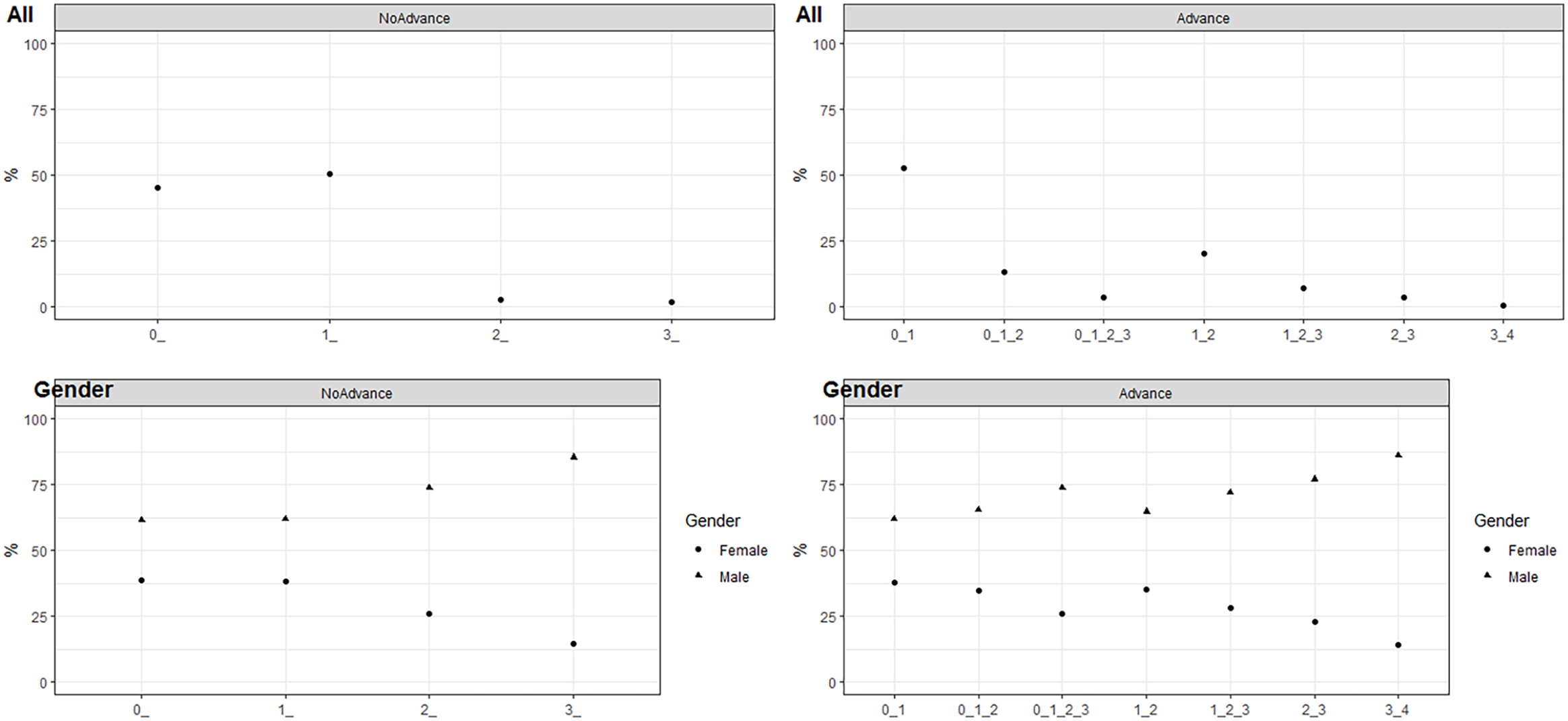
Levels and Advancement by Gender in Mexico’s SNI.
The descriptive statistics also reveal that the bulk of researchers in the SNI are concentrated in the first two levels. Figure 2 shows a significant decrease in candidacies from the beginning of the 1990s, so it is assumed that a higher percentage of researchers manage to move from candidate to level I, regardless of gender. The differences begin at level II, where there is also a significant growth in the number of researchers from 1990 onwards, which stabilizes in 2000 and then decreases toward the end of the decade. This also suggests that the transition from level I to level II is even more complicated; this is the point when a significant difference between men and women begins to emerge. Finally, the number of researchers in level II has remained relatively constant, around 20% of the total. Although the last two levels, III and IV, have been very stable over two decades, they represent less than 20% of all SNI members.
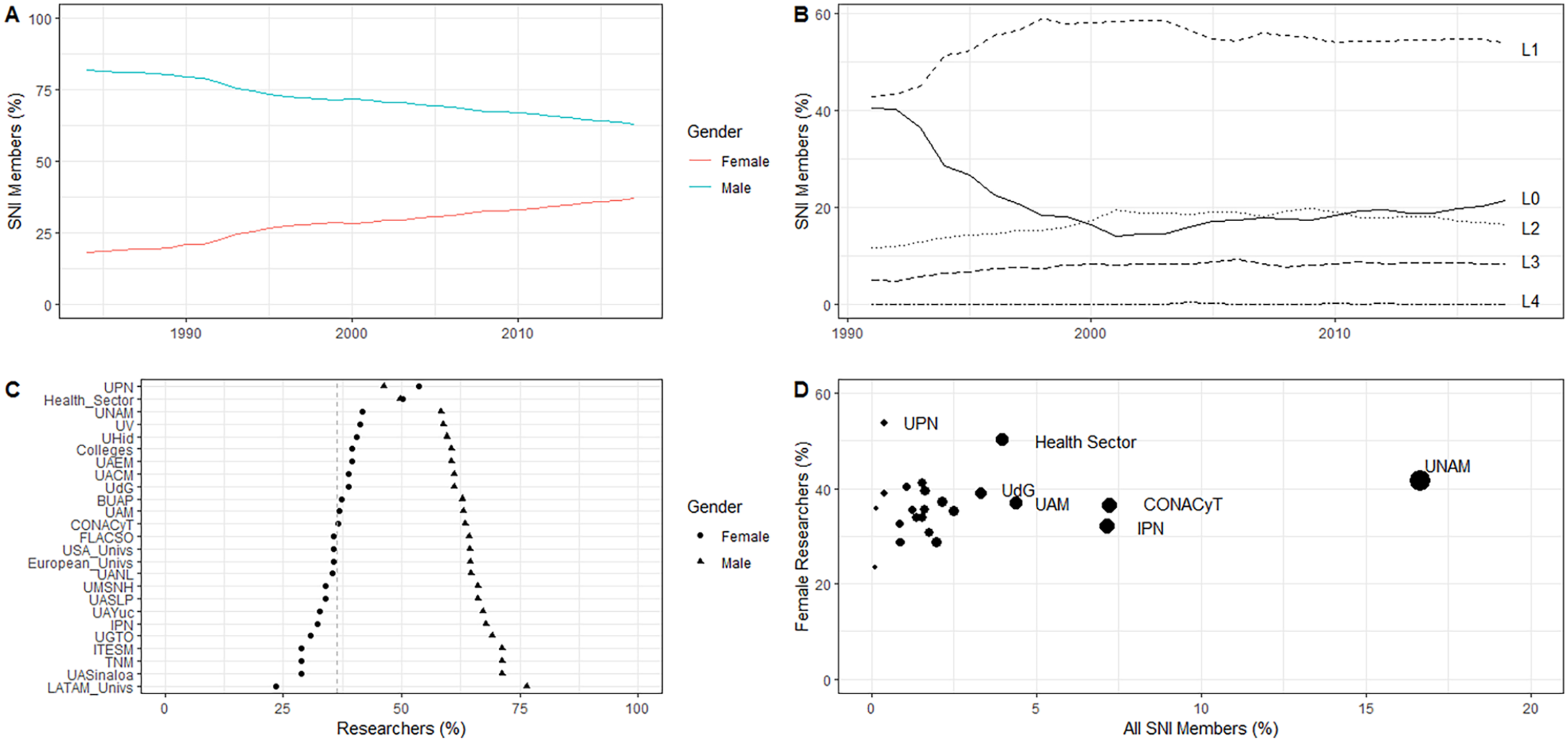
Duration, Levels, and Universities by Gender in Mexico’s SNI.
An accelerated growth started in 2000 for both men and women; notably, this growth is more rapid for men than women. This suggests that the gender gap persists despite the number of students enrolled by gender in doctoral programs has been very evenly distributed since 2010 (ANUIES, 2010). This shows that although women are obtaining doctoral degrees but for some reason, they do not enter the system (Cárdenas, 2015; Zubieta-García, Marrero- Narváez, 2005). The data also show that SNI members are concentrated in the following institutions: National Autonomous University of Mexico (UNAM), CONACyT research centers, the National Polytechnic Institute (IPN), Metropolitan Autonomous University (UAM), the Health Sector, the University of Guadalajara (UdG), and the Autonomous University of Nuevo León (UANL), as shown in Figure 2. The presence of women by institution highlights that there is an important concentration in the National Pedagogical University (UPN) and in the health sector, reaffirming the notion of “traditional” women’s careers, such as education, nursing, and social work (Nevil and Schlecker, 1988). Female researchers represent a little more than 50% of the SNI members of these institutions. The remaining universities have between 25% and 37% female SNI members, as shown in Figure 2.
Duration in the system is also illustrated in Figure 2. Data also reveal that the percentage of women who remain in the SNI on an ongoing basis is limited. The higher point is reached in a cumulative 4-year period, close to 40%. A similar case takes place in trajectories of progress, in which 40% of the women manage to transition from candidate to level I. From there, the advancement from level I to level II and all the other trajectories shows that this percentage decreases as any female advances in the system. This is in line with what the literature indicates; women who can access the system tend to remain in the lower levels, facing impediments to advancing in the same way as men. This may be due to the personal stage of each woman.
Gender Classification
To obtain the described data, the authors made a request through the National Transparency Platform (PNT) and received the information from the CONACyT transparency unit (see the Online Supplemental Appendix for details). The request specifically asked for the historical record of current researchers in the SNI by year, since the creation of the system in a spreadsheet format, if possible, with a gender column. The unit replied that as gender information was defined as confidential, it was impossible to provide it.
CONACyT delivered the information to the authors on a CD with four spreadsheets. The first one identified SNI members from 1991 to 2015, while the second to the fourth sheets included members for 2016, 2017, and 2018. We classified gender based on promotions from 1991 to 2017, using the following nine columns: name, level, area, discipline, institution, agency, state, country, and year of promotion. The main difficulty was that unlike the other three, the first spreadsheet did not include a nobilis column, which made it easy to identify the gender of the researchers, given that they declared themselves as Dr or Dra. For this reason, the final classification employed the name or names of each member. Once the database was received in a spreadsheet format, classification by gender was carried out. This was done manually using the following four steps.
First, since the database contained the full names of each member, each name was divided by cell. Next, those names that were clearly identified as male or female received a value of zero for men and one for women. Second, for names that could be either male or female, for example, Guadalupe, María José, or José María, middle names were checked to see whether they corresponded to a male or female name. In cases of doubt, we employed two criteria: an available photograph on the Internet and/or a male or female reference, such as Dr or Dra.
Third, when foreign names were identified and it was not possible to distinguish whether they belonged to men or women, Internet searches were carried out, based again on photographs or references to their academic degree or title. Fourth, once the base was fully classified, the information was filtered to check for mistakes, including members who were the same person but who were registered under different columns; whether an omitted name, derived from moving the columns, changed the information on gender; or whether the first record was based on the maiden name of a single woman who got married later, in the case of the female researchers.
These corrections allowed us to finally assign a unique ID to the same researcher under a single full name. In this way, errors were identified and corrected, ratifying the information with other columns, such as area number, discipline, institution, dependency, state, and year of promotion. The database is composed of 337,200 lines that represent data for a total of 41,144 unique members. The manual classification was compared to historical databases of the gender library (Mullen et al., 2020) in the statistical package R, using this algorithm for a random subset of 20% of the rows, showing similarities with the manual classification in 70%, leaving room for 30% of improvements, thus this suggest that the accuracy of the manual coding was preferred, given multiple limitation and errors in the dataset. A further research avenue would be how to improve an automatized classification, based on names from Latin American countries, in which there is a combination of English, Spanish, and names which come from Indigenous languages (e.g. Cuauhtémoc or Xóchitl).
Hypotheses, Variables, and Methods
We study whether there is a gender gap in academia through the example of the Mexico’s SNI. If someone who holds a doctoral degree and belongs to a higher education institution wants to become part of academia and actively do research in Mexico, a highly recommended place to start is applying for admission to the SNI. Thus, we center our focus in the notion of staying several years and gradually advance in the SNI levels. We argue that different visible and invisible barriers make much more difficult for female researchers to stay longer and advance further in the system. Nevertheless, we also verify under what conditions female researchers are better off. In particular, we assume the notion of critical mass in a twofold way, that is, in areas in which there are more female researchers, they could face better conditions, and at the same time, changing the environment in which they are evaluated (the respective area of knowledge) they could sort out some barriers. We analyze the gender gap idea in duration and advancement. In particular, regarding advancement, we studied the whole dataset trying to find useful patterns, and we found seven trajectories, from one level to another or even more than two, in which we can classify researchers, as shown in Table 1 in the Online Supplemental Appendix.
Regarding hypotheses, we develop one for duration:
H1: Female researchers are less likely to stay longer in the SNI.
Regarding advancement, we develop three hypotheses:
H2: In general, female researchers are less likely to advance in the SNI.
H3: In areas in which there are more female researchers, they are more likely to advance.
H4: When female researchers change their area of knowledge, they are more likely to advance.
Regarding trajectories, we develop two hypotheses:
H5: In general, female researchers are less likely to have longer trajectories.
H6: Female researchers are more likely to have trajectories at the lower levels of the SNI and less likely to have trajectories at the upper levels.
To verify these hypotheses, we ran different regression models using a variety of specifications and sub samples to gain confidence in our results. We use three datasets: a full dataset with 337,200 observations; a matched data, in which the only difference is being female or male with 222,218 observations; and a dataset with 41,144 unique observations, in which we follow every single researcher in the dataset from 1990 to 2017.
The database of SNI members in regard to their promotions from 1991 to 2017 was coded to obtain a binary dependent variable: whether there was a progress in members’ careers (1) or whether members did not make any progress (0). In addition, we estimated the number of years each member has in the SNI, as a measure of duration. Explanatory variables were coded as binary. The main variable of interest was gender: female (1) and male (0). In addition, we coded binary variables to obtain levels in the system, and specific universities and groups of universities or research centers were identified (State Colleges, CONACyT Centers, National Technological of Mexico, and universities from United States, Europe, and Latin America), as well as the area in which each member was classified, leaving the area of physics and mathematics as a reference category, along with the year of promotion and the associated state. The descriptive statistics are shown in Table 2 in the Online Supplemental Appendix.
Regarding methods, we estimate multilevel regressions with states and years as second and third level variables to account for a mixed structure, and one level regressions. In both cases, multilevel and one level, we employed linear models for duration (in years) and binary logistic models for advancement. Binary logistic models at the individual level have a stochastic component described by a Bernoulli distribution, and a systematic component defined as the inverse of the explanatory variables (Pindyck and Rubinfeld, 1998). Multilevel (also known as hierarchical) binary logistic models also comprised a stochastic component described by a Bernoulli distribution, a multi-dimensional vector of random effects normally distributed (not estimated in this case); a systematic component defined as the inverse of fixed effects (explanatory variables and their coefficients); and the multi-dimensional vector of random effects. Multilevel models consider different levels to not mix their covariances due to the nested nature of data, such as individuals within states and within years (Bates et al., 2020; Spierings, 2016).
Taking advantage of the full data, we also calculated a propensity score for a matched sample employing the nearest neighbor method, based on all individuals equally divided by gender (see further details, such as distributions of raw and matched data, balance and their improvement in Table 8 of the Online Supplemental Appendix). In addition, we used a series of subsamples based on unique IDs of 41,144 members, which allow us to extract members’ trajectories and changes on disciplinary areas.
Results
Available evidence from the empirical models suggests that, in general, being a woman is significantly and negatively related to duration in the system, as shown in Table 3 in the Online Supplemental Appendix, and pictured in Figure 3 in a wide variety of sub samples. Considering all unique IDs, male stay 8.4 years in the system and female researchers 7.8 years, similar predictions for those who live in Mexico, work in public universities and belong to areas 5, 6, and 7. In contrast, disciplinary areas 1, 2, and 4 reveal a different threshold, just right below 10 years, and area 3, in which there is the higher proportion of female researchers (47%), women can stay longer, but in all these cases, they have a lower duration when compared to men.
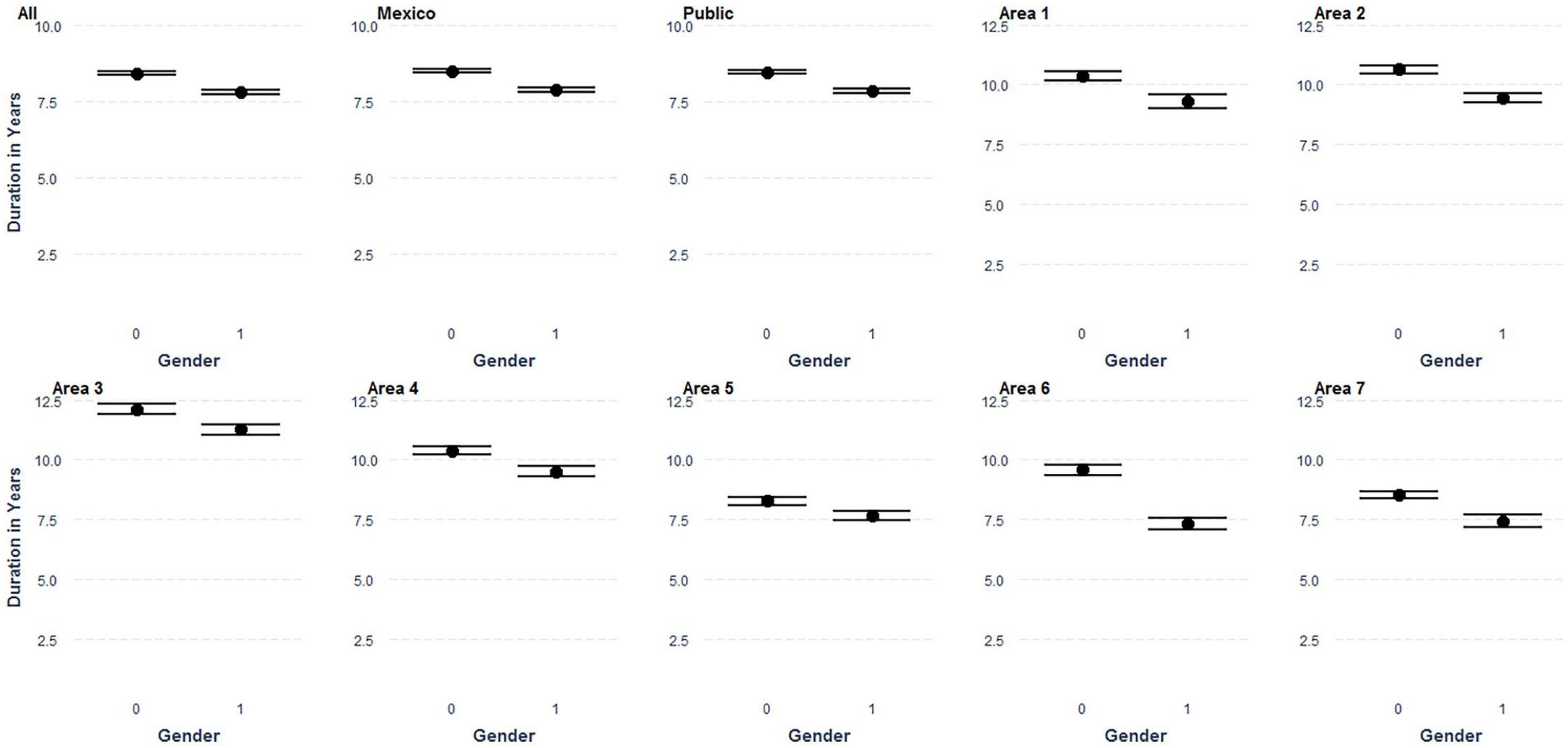
Predicted Duration in the SNI by Gender.
Regarding advance in the SNI, models from Table 4 in the Online Supplemental Appendix show that, in general, women have fewer chances to advance than men, as pictured in Figure 4. Nevertheless, when female researchers change their environment, it is more likely to advance, that is, when women change they disciplinary area one time, but this strategy does not work twice. Interestingly, in areas in which there are more female researchers, such as area 3 (medical and health sciences), women are more likely to advance than men, as shown in Table 5 in the Online Supplemental Appendix. Although there are no statistical differences in areas 2 (biology and chemistry), 5 (social sciences), and 7 (engineering), in other areas, such as areas 1 (physics, mathematics, and earth sciences), 4 (humanities and behavioral sciences), and 6 (biotechnology and agricultural sciences) men have more chances to advance than women. The only case in which women have more probabilities than men is in area 3, as pictured in Figure 5.
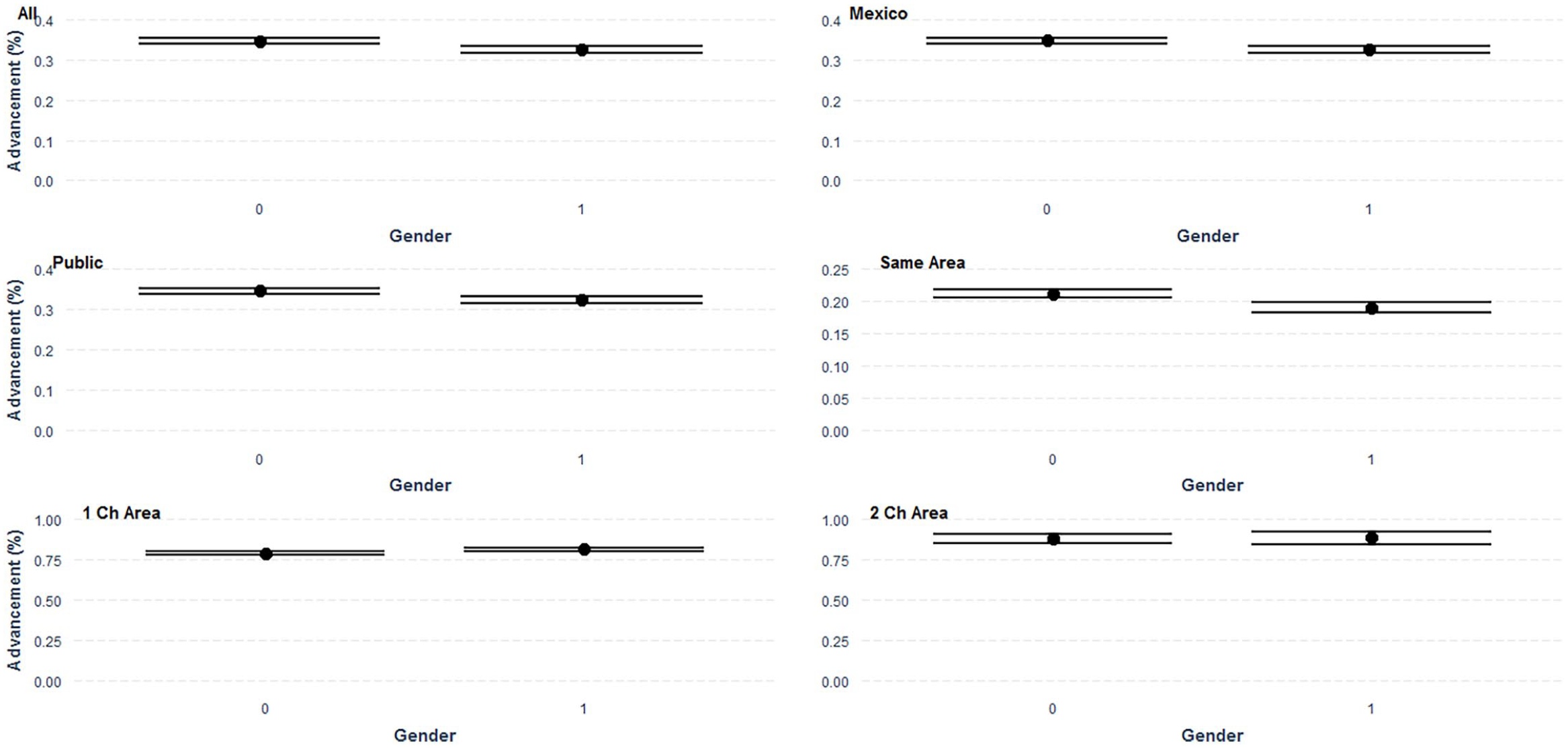
Predicted Probabilities of Advancement in the SNI by Gender, Unique IDs.
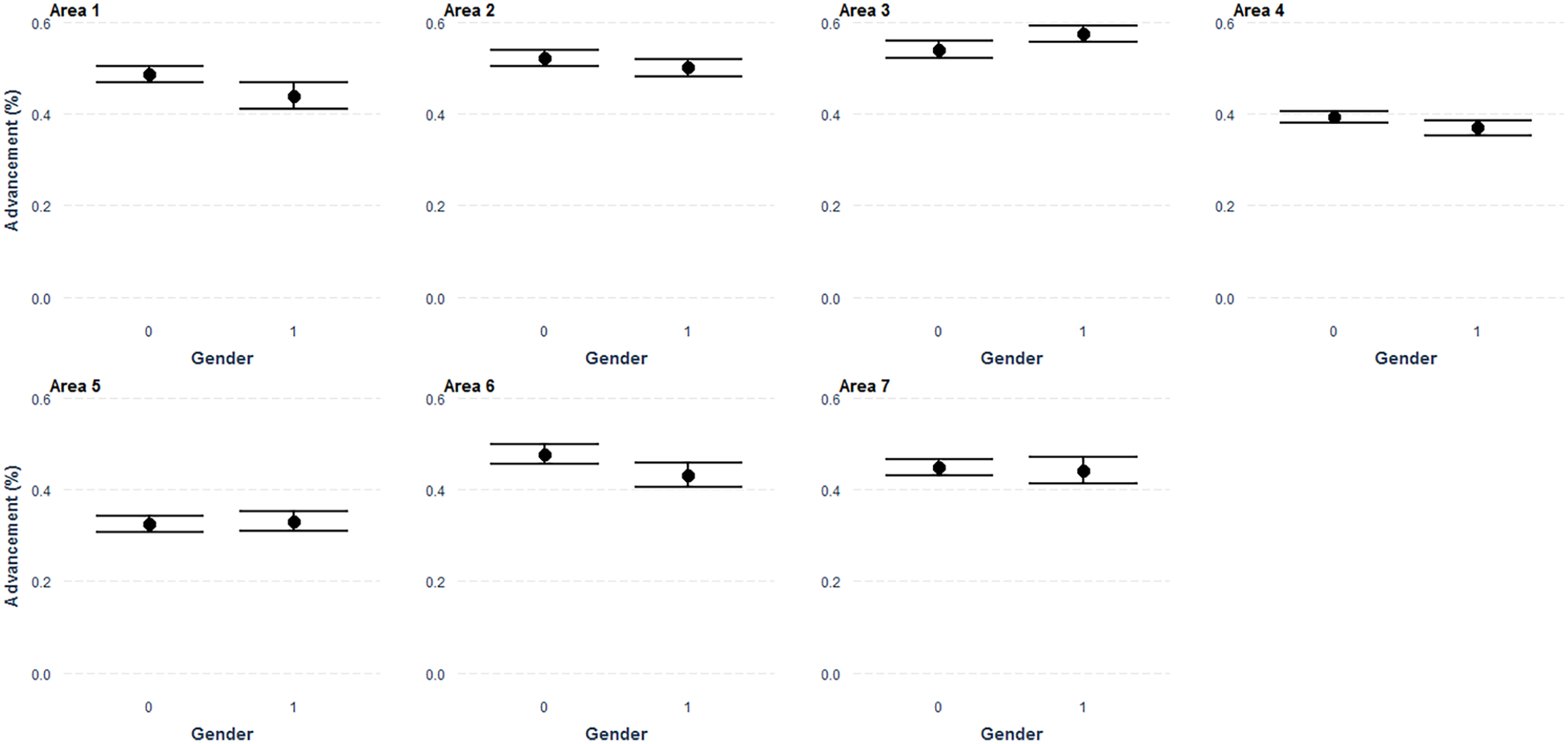
Predicted Probabilities of Advancement in the SNI by Area, Unique IDs.
To take into account multiple differences between male and female researchers, we calculate a propensity score (distance) using a pre-processing technique, a nearest neighbor matching, in which we create two very similar groups except for gender. Using the matched data, to establish better comparisons, we now study advancement in the SNI through interaction terms between gender and areas, and gender and levels. Interactive models are shown in Table 6 in the Online Supplemental Appendix, in which there are statistical differences in constitutive and interaction terms. As pictured in Figure 6, advancement in level II is more likely for men than for women, whose are below 20% of chances. Similar story for candidates (labeled as level 0), in which women hardly reach 5% of chances to advance. There are no significant differences in level I or levels III–IV (when going from level III to emeritus), in line with previous research. Regarding areas, just in area 3, women are more likely to advance than men and no further differences were detected when using matched data. In summary, unique IDs and matched data reveal that advancement in SNI is more difficult for women than for men with two exceptions: (a) disciplinary areas in which presence of women is important and (b) when female researchers are able to change their area.
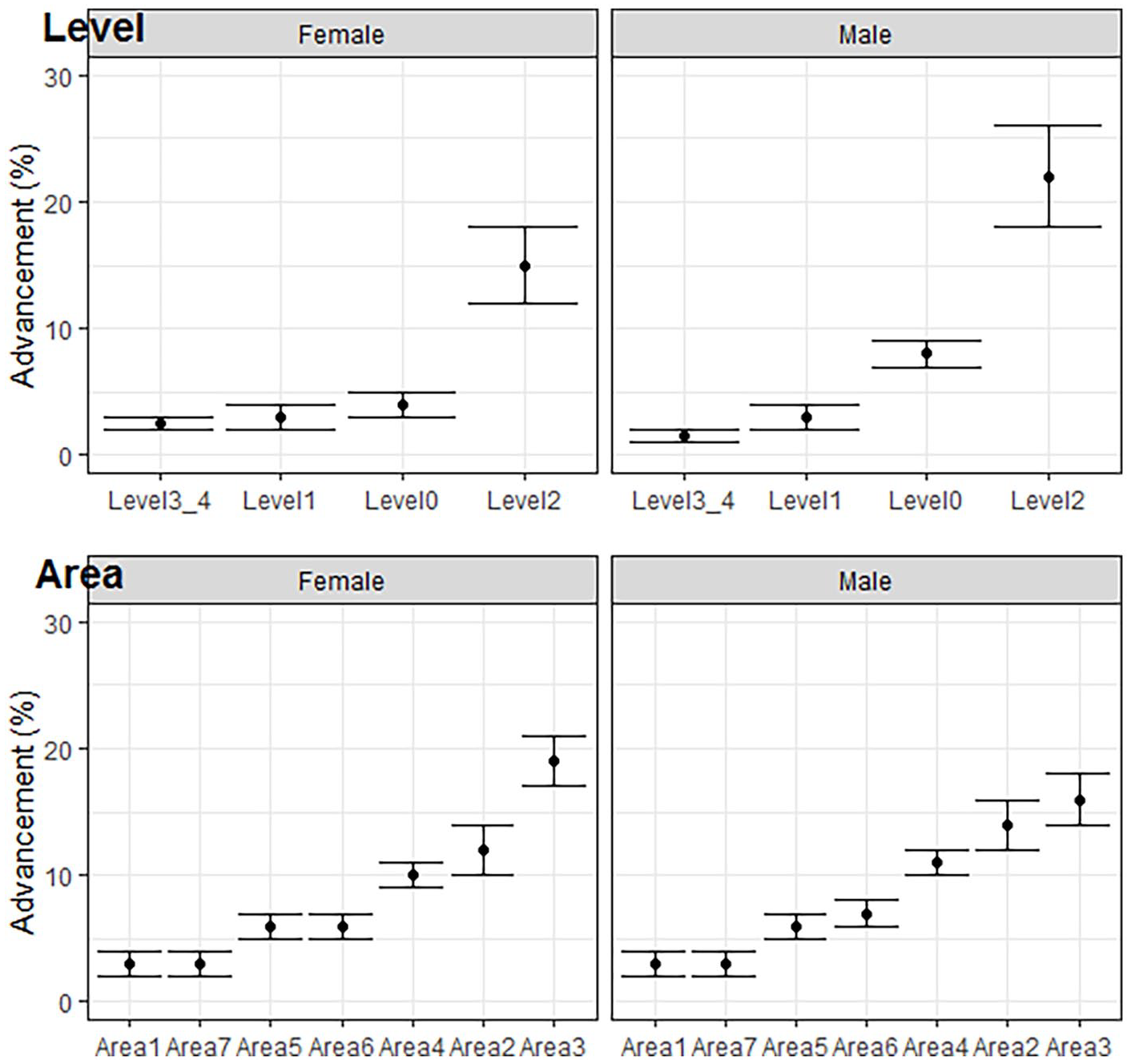
Predicted Probabilities of Advancement in the SNI by Levels and Areas, Matched Data.
Women, arguably for reasons related to breaking male-dominated spaces, when changing their disciplinary area once in the system, are more likely to advance in the ranks, but it is a matter that deserves further research. In contrast, as Table 5 in the Online Supplemental Appendix shows, if a female researcher remains in the same disciplinary area, then the effect is statistically significant but negative, that is, a female researcher who remains in the same area reduces her chances to make any progress, which is in line with other estimations.
Finally, the SNI trajectories for researchers in the system are shown in Table 7 in the Online Supplemental Appendix. If we consider all the unique IDs, our results would reveal that being a woman in trajectories from candidate to level I, and from candidate to level I to level II had no effect. In all the remaining trajectories, being a woman had a negative and statistically significant impact on her SNI career. A more nuanced and appropriate specification would only employ the unique IDs of those who made any advance in the SNI ranks. Results are pictured in Figure 7, in which women are more likely to advance from candidate to level I but there no positive impact of being a female researcher in all the six remaining trajectories within the SNI. In summary, advancement is more likely for women at the lower levels and more difficult at the upper ranks than for men.
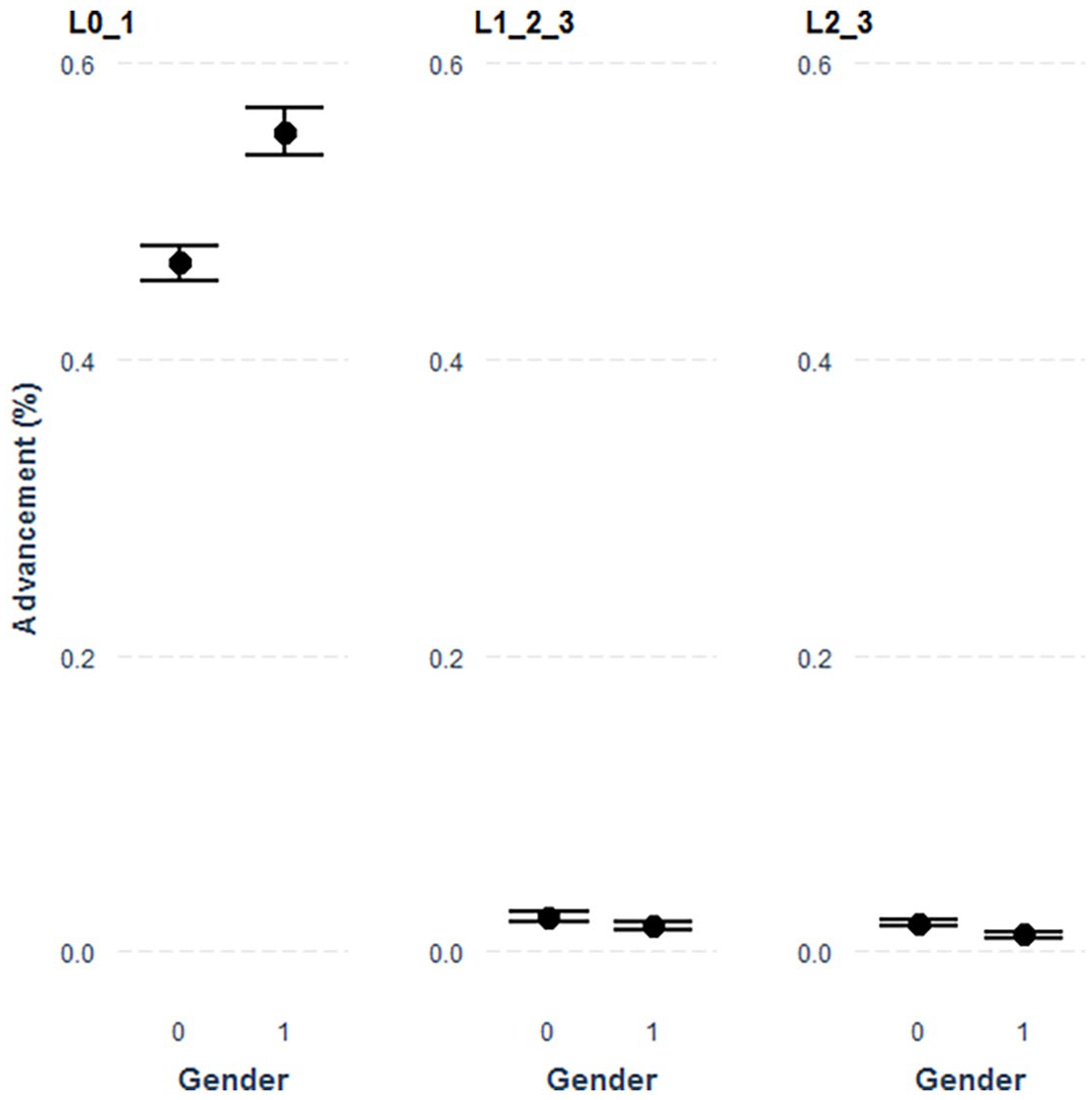
Predicted Probabilities of Advancement in the SNI by Trajectories, Unique IDs.
Other variables, such as areas of knowledge, except for area 6, they are significant and negatively related to advancement. Regarding state fixed effects, there is a significant and positive effect on progress in the SNI when universities are located in the states of Baja California, Colima, Mexico City, Durango, Guanajuato, Jalisco, Michoacán, Morelos, Nuevo León, Puebla, Querétaro, and Yucatán. The remaining states are significant but have a negative impact or no effect. Finally, fixed effects by home institutions are mixed: in some models, such as duration, those statistically significant but with a negative impact on advance in the SNI are the Tecnológico de Monterrey, the UPN, Universities in Latin America, and the Autonomous University of Mexico City. We also included binary variables to identify home institutions from other regions of the world, such as European and Latin American universities, and those which are placed abroad in a generic sense, to control for potential differences between researchers in Mexico and abroad. It is important to remark that those researchers who belong to institutions outside of Mexico do not receive any economic stimulus from the SNI (see Table 3 in the Online Supplemental Appendix).
Although gender probabilities vary from model to model, overall, the predicted probabilities pictured in the figures suggest that female academics are less likely to make progress in the SNI when compared to their male peers. One can argue that the differences in predicted probabilities between women and men are small, which is true, but across very different specifications and sub samples, our findings consistently show a gender gap, regardless of the type of models, control variables, or pre-processing techniques. Thus, despite these differences being small, they are consistent with expectations extracted from the literature review regarding not only the gender gap, but also conditions under which the gap could be closed or at least mitigated.
Conclusion
Available evidence suggests that advancing in the levels of the National Research System in Mexico is harder for women. While there is a slightly better chance to advance from candidate to level I, the women make a little progress after this level when compared to men, and worse, are likely to drop out altogether. Although, based on the empirical evidence, we are not able to reach a strong conclusion about why this happens, the literature does provide some hints. Mexican female academics face very similar struggles when compared to their peers in other countries: a male-dominated system with limited access to disciplinary spaces in which women can publish in prestigious journals, get citations, and receive grants.
In addition, the lack of family-friendly policies, especially during the first years of childcare, notoriously complicates any chances to deliver academic products (publications, citations, grants), reducing much of the work function to academic procedures (administrative tasks). Women academics usually struggle the most during the first 5 years of child rearing as well as other times when care is needed, such as for senior family members. With these visible or invisible barriers in place, female scholars are less likely to advance in the system (not to mention the complicacies around becoming an SNI candidate).
In some disciplinary areas, the number of women pursuing a PhD is roughly similar to that of men; thus, a relevant question is why the percentage of women in the system has remained stable rather than increasing at a faster rate. The literature suggests that young scholars gave up their academic careers when they realized how demanding academia was for them. In addition, given the lack of role models that demonstrate it is possible for young scholars to balance work and family life, and a male-dominated system, visible and invisible barriers are more likely to pose as significant deterrents to young women seeking to stay at the SNI.
Descriptive statistics and regression models provide evidence that regardless of gender effects, only a limited percentage of researchers can advance in the system and the majority remain stuck in the lower ranks. It is noteworthy to address the main determinants of these patterns in future research. In addition, although the main goal of this article revolves around barriers that operate against women’s advancement, there is another research avenue regarding the barriers non-binary researchers face.
Finally, different authors have identified different policy measures that could increase women’s presence in academia, such as opportunities for women to temporarily pause their careers with adjustments to the tenure clock, access to day care services when attending disciplinary conferences and during regular office hours, and a more balanced distribution of administrative tasks and services to male and female academics. In Mexico, Pérez and Armendáriz (2010) states the importance of introducing a gender perspective in the Science and Technology Law, including a disciplinary area of “science and gender” in CONACyT, and in the SNI, along with having access to additional grants and funding, promoting science programs for girls, and access of women to positions in power and paid maternity leave for SNI members, among many other so needed policies. In summary, we show preliminary results that support the notion that there is a gender gap problem in Mexico’s SNI. Thus, future research could investigate why this happens, taking advantage of additional research techniques, such as bibliometrics, surveys, and semi-structured interviews, to find potential customized solutions to the Mexican case to increase the presence of women, and promote women’s progress in the SNI ranks, based on the existing visible and invisible barriers that women face in Mexico’s academia.
Footnotes
Declaration of conflicting interests
The author(s) declared no potential conflicts of interest with respect to the research, authorship, and/or publication of this article.
Funding
The author(s) received no financial support for the research, authorship, and/or publication of this article.

Supplementary information
Additional supplementary information may be found with the online version of this article.
Content
Table 1. Advancement, Trajectories, and Sex Ratio at the SNI. Table 2. Descriptive Statistics, Unique IDs. Table 3. Duration in the SNI, Unique IDs, 1990–2017. Table 4. Advancement in the SNI, Full Data and Unique IDs, 1990–2017. Table 5. Advancement in the SNI by Areas, Unique IDs, 1990–2017. Table 6. Advancement in the SNI, Interactions with Areas and Levels, Matched Data, 1990–2017. Table 7. Advancement in the SNI, Trajectories, Unique IDs, 1990–2017. Table 8. Matching Results Based on Full Data.