



Abstract
There is growing interest in personal representation and policy responsiveness in the European literature. The current scholarship mainly focuses on strong legislatures. This article aims to contribute to the discussion about policy responsiveness by investigating the least likely case, France. It asks whether French MPs engage in policy responsiveness, and if they do, how responsiveness interacts with party agenda and electoral vulnerability. Drawing on written parliamentary questions asked by French MPs from 1997 to 2007 (N = 1172), the article shows that MPs’ behaviour is strongly affected by their district features. Moreover, the article shows that party agenda conditions the impact of district features. MPs are more likely to engage in policy responsiveness when the issue is also essential for the party. In other words, policy responsiveness is not independent of the party agenda. The article thus contributes to a better understanding of the personalisation of political representation and its relationship with political parties.
Introduction
In Europe, personal or dyadic linkages between MPs and constituents are traditionally considered a reaction to growing electoral volatility and the decreasing role of parties as primary agents of preference aggregation (Mair, 2013). These changes have received extensive attention, and the exploration of the behaviour of MPs has a rich literature. The literature acknowledges that MPs are primarily driven by their wish to remain in office (Mayhew, 1974) and will act to achieve this goal. Although policy responsiveness is only one strategy MPs apply to pursue this goal, it is also one of the most important (Papp, 2020). Eulau and Karps (1977) define policy responsiveness as the representatives’ willingness to respond to the public’s policy preferences to enhance the electoral connection. The importance of policy responsiveness is particularly true when the electoral system offers voters the opportunity to select specific candidates. When voters can only choose between lists, MPs behave in a more party-centred way. Moreover, scholars also show that the magnitude of the electoral competition affects the propensity to engage in policy responsiveness. The most vulnerable MPs are more likely to engage in activities that may improve their vote-share, and policy responsiveness is no exception (Ashworth and Bueno de Mesquita, 2008; Dropp and Peskowitz, 2012). While most of the literature investigating policy responsiveness focuses on the references to local entities in MPs’ behaviour (Martin, 2011; Zittel et al., 2019), this article aims to measure the policy focus of MPs (Soroka et al., 2009). This approach has received significant interest in the literature (Baumann, 2016; Borghetto et al., 2020; Däubler, 2020; Papp, 2020), with authors highlighting the impact of local socio-economic contexts on the issues MPs raised in parliament.
There is nevertheless an inherent gap in the burgeoning literature. Most research on the topic focuses on countries with moderately strong to powerful parliaments according to the Weighted Legislative Powers Score (Chernykh et al., 2017). Here, we focus on policy responsiveness in France, where the lower house of the parliament is one of the weakest among Western democracies (Chernykh et al., 2017). The executive dominates political life since the powers of the parliament in the law-making process remain relatively weak. This subordinate position is coupled with extreme party discipline (Sauger, 2009). In addition, the Constitution stipulates that MPs must represent the general interest (Costa and Kerrouche, 2009b). The context ought to provide MPs with little incentive to engage in policy responsiveness. However, at the same time, the electoral system provides French MPs with strong incentives to cultivate personal votes (Brouard et al., 2013; Brouard and Kerrouche, 2014). Previous literature has shown that the association between the weakness of the parliament and the electoral system explains why French MPs spend a significant share of their time in their district (Costa and Poyet, 2016; Gabriel et al., 2018). Nevertheless, recent literature has shown that despite the lack of incentives from the political institutions and party-dominated legislatures, MPs may engage in policy responsiveness (Borghetto et al., 2020; Carroll and Nalepa, 2020; Louwerse and Otjes, 2016). Similar trends towards decentralised personalisation have been recently observed in France (Costa and Poyet, 2016; François and Navarro, 2020), and unlike the seminal works (Converse and Pierce, 1986; Cayrol et al., 1973), the literature displays some evidence of an inclusion of district demands into the legislative work (Poyet and Siefken, 2018). These developments thus justify a study about district-oriented policy responsiveness – aspect that has been neglected by the literature. The questions addressed in this article are therefore the following: Do MPs in a weak and party-centred legislature engage in policy responsiveness? How do party agenda and electoral vulnerability affect the scale of attention to local issues?
To answer these questions, we measured the share of attention MPs dedicated to issues salient to their district. To do so, we used the number of written parliamentary questions on agriculture. We focused on parliamentary questions because they are one of the single forms of parliamentary activity that offer MPs the opportunity to formally and freely advance their agenda and to obtain a reaction from the government (Wiberg and Koura, 1994). Besides, there is no limitation on the number of written questions an MP can submit, and the use of this method is rather hassle-free. Finally, the literature widely uses them to study MPs’ attention to the demands of constituents (Borghetto et al., 2020; Martin, 2011; Papp, 2020). We decided to focus on agriculture for three reasons. First, it is related to specific district features that are salient in the political landscape. Agriculture is related to the rural-urban divide, with each subgroup having specific interests and needs that must be represented. Second, reliable and continuous indicator is available for measuring local needs. Third, agriculture is not only related to French politics. Similar measurement may be used in other countries, thus enhancing the possibility of comparison with previous and upcoming research on the topic.
Concretely, in this article, we explore the link between district features and the amount of attention MPs dedicate to agriculture. The interest of the article goes beyond the addition of a new case. We use a new measurement of policy responsiveness based on works about attention to issues and agenda-setting (Vliegenthart et al., 2013). Instead of measuring the absolute policy responsiveness (i.e. the number of questions), we consider the relative importance (i.e. the percentage) given to district-linked issues within the whole set of issues (Vliegenthart et al., 2013). This was done to control the potential bias introduced by particularly active MPs. In addition, we introduce party agenda to the models. In party-centred legislature, the party cannot completely vanish. Its agenda also matters in activities where party discipline does not apply (Green-Pedersen and Mortensen, 2010; Vliegenthart and Walgrave, 2011). To have a more accurate view of policy responsiveness, it is thus important to also control for party agenda. The article contributes to the literature by proposing an exploration of policy responsiveness in weak and party-centred legislatures and by adopting a new methodological approach.
The article is organised as follows. The next section discusses the literature on policy responsiveness. The third section is dedicated to the theoretical framework and hypotheses. We also introduce the French case. This is followed by a section presenting the data and methods. The results are in the fifth section. Finally, we propose our conclusions and suggestions for further studies.
State of the Art
The question of decentralised or constituency representation in parliamentary work is not a new one (Balmas et al., 2014). However, the first studies do not directly operationalise policy responsiveness as defined earlier. They measure constituency representation by considering implicit references to local entities such as places, persons, or companies (Martin, 2011; Zittel et al., 2019).
More recently, inspired by the seminal work of Eulau and Karps (1977) on policy responsiveness and popularised outside the United States by Soroka et al. (2009), the literature has started to consider another way to measure constituency representation. Researchers are interested in the link between district features and interests and the policy domains MPs focus on (Borghetto et al., 2020: 4–5). The literature highlights various factors explaining why MPs dedicate a significant amount of attention to the interests of their district. Electoral pressure is a common explanation highlighted in the literature (Blidook and Kerby, 2011; Däubler, 2020; Dropp and Peskowitz, 2012). However, the role of electoral incentives has been challenged in the recent literature (Borghetto et al., 2020; Papp, 2020). Intra-party politics also matter; backbenchers are more prone to focus on topics that are important to their district (Bevan and John, 2016). Papp (2020) has shown that in Hungary, policy responsiveness is more frequent among single-member district MPs than among list MPs. Moreover, the literature also shows that district features matter in other aspects of legislative work. In Belgium, high local unemployment rates and large numbers of pensioners are positively correlated with the number of private member’s bills associated with these social risks (Däubler, 2020). Interestingly, in legislative speechmaking, speeches delivered on labour, immigration, and employment are chiefly delivered by MPs from economically untroubled districts (Bäck and Debus, 2018). As access to the floor in these chambers is party-controlled, it shows that policy responsiveness may be constrained by the party, as shown by Öhberg and Naurin (2016) using an experimental research design.
The very high variation in the results may be explained by the diversity of the cases and the heterogeneity of the indicators. Papp (2020) and Däubler (2020) have used standardised indicators with fixed measures (e.g. the number of farmers in a given place at a given time). Borghetto et al. (2020) added a measure of the variation between 2 years (e.g. the increase/decrease in the unemployment rate). This last measurement is associated with the more significant effect of the constituency pressures variables, meaning that MPs are more sensitive to the changes than to the absolute numbers. It is, however, important not to overestimate the importance of constituency features, since other factors also come into play. Scholars explain that policy responsiveness does not trump experience and expertise (Borghetto et al., 2020; Papp, 2020). Similarly, not all policy domains are affected in the same way (Däubler, 2020).
The burgeoning literature thus provides encouraging results. Although most of the European legislatures are party-centred (Thomassen and Andeweg, 2004), district-oriented policy responsiveness is a reality (Borghetto et al., 2020; Däubler, 2020; Papp, 2020). However, the literature also suffers from three significant gaps that our article aims to contribute to filling. First, the current literature focuses on rather strong legislatures. In these cases, since parliaments play a significant role in policymaking and oversight, policy responsiveness may be particularly efficient. However, not all polities have strong legislatures (Chernykh et al., 2017). This does not mean that policy responsiveness is not a feature in such cases. However, the factors influencing the behaviour of MPs may be different. For a rounded understanding of policy responsiveness, it is also essential to explore weak legislatures.
Second, the current literature focuses on the absolute number of objects dealing with one or another policy domain. However, a high number of written questions on one topic may also indicate that an MP is very active and not only on issues that are of importance for his or her constituents. This limitation is particularly important when there is no restriction on the use of a parliamentary tool, as is the case with written questions. Using the absolute number of questions related to district features therefore only offers a partial overview. In order to see the complete picture, it is necessary to consider the importance of local matters or, as stated above, the share of attention that is dedicated to them.
Third, with one exception (Däubler, 2020), the literature exploring European legislatures ignores the party. Even in venues that are considered free from pressure, the party may have an influence. The impact of the party agenda on written questions is attested in the literature (Vliegenthart and Walgrave, 2011). The significant coefficients for the variables of party affiliation in the Portuguese case (Borghetto et al., 2020) show that even though attention may be driven by local considerations, parties also play a role. Hence, it is necessary to include the party agenda in the models. This is particularly true in party-centred legislatures.
Theoretical Framework
Eulau and Karps (1977) define policy responsiveness as the connection between the interests of constituents and the work of legislators. The literature acknowledges that the concept of interests is elusive and difficult to grasp (Borghetto et al., 2020; Papp, 2020). According to Papp (2020: 3), this is not only a matter of debate among scholars, but also an issue for MPs themselves. Information about the interests of constituents is scarce, and direct measures of citizens’ perceptions are unavailable. As explained by Norris (1997) and Papp (2020), MPs use alternative methods to learn about constituents’ preferences, and these include socio-economic indicators. The literature acknowledges these as good indicators of the preferences of a designated area, and they are widely used in the literature (Borghetto et al., 2020; Däubler, 2020; McAdams and Johannes, 1988; Papp, 2020). The rationale is that when a significant amount of people share a common feature, MPs may focus on policy domains that are related to this feature in order to be responsive (Papp, 2020: 4). In other words, these indicators designate the number of persons that may be concerned with a specific policy (Adler and Lapinski, 1997).
Parties act as unitary actors in most European legislatures, and decision-making is characterised by strong party discipline, mainly in roll-call voting (Thomassen and Andeweg, 2004). However, MPs may enjoy more freedom in other parliamentary activities. The literature highlights the opportunities offered by the work in standing committees (Bowler and Farrell, 1995), private member’s bills (Baumann, 2016), parliamentary oversight (Martin, 2011) and, in some instances, legislative speeches (Bäck and Debus, 2018). In this article, we focus on written parliamentary questions for two reasons: unlike other tools, their use is hassle-free, and MPs can submit as many questions as they want. Comparative literature thus explains that written questions are a perfect tool for raising district-related issues (Martin, 2011). Questions are part of these instruments that are increasingly popular among French MPs as a way to indirectly influence the policymaking (Kerrouche, 2006). Moreover, parliamentary questions have a symbolic influence since it is ministers’ duty to reply and they are published in public records (Kellermann, 2016). Hence, so, even though their concrete impact on policymaking may be limited, questions may still influence the government and public agendas (Navarro and Brouard, 2014).
Moreover, parties themselves may incite MPs to use these tools, especially written questions. Kam (2009) explains that parties may also benefit from servicing constituencies, since it allows individual MPs to cultivate a personal vote. In addition, it may limit the impact of potentially unpopular decisions. This is particularly true in systems where voters can choose a particular candidate (Borghetto et al., 2020). The first hypothesis is thus:
H1. The stronger the constituency pressures are, the higher the share of attention is paid to the related policy domain.
As stated above, the party cannot be ignored. MPs also use parliamentary questions to advance issues that are on their party’s agenda. Weissberg (1978) notes that dyadic and collective representation cohabit. There is therefore no theoretical reason for arguing about an opposition per se between the two agendas; they may be complementary. This aspect is crucial in party-centred legislatures where party discipline is a key feature. Even in activities where the party does not exercise strict control as it is the case with written questions, speaking with a common voice is essential. Party agenda has a strong influence on the content of parliamentary questions even though it does not directly exercise a control over MPs (Green-Pedersen and Mortensen, 2010; Vliegenthart and Walgrave, 2011). Hence, we expect that when district interests match the party agenda, policy responsiveness will be enhanced. When there is such a match, MPs can voice district interests without jeopardising party unity. However, some parties enjoy more flexibility (Green and Jennings, 2012; Nanou and Dorussen, 2013). The cohesion appears to be more important for government parties and MPs to facilitate the implementation of the government programme (Depauw and Martin, 2009; Frears, 1990). Also, government MPs have the opportunity to raise controversial issues behind the closed doors of the ministries to avoid publicly challenging the government (Lazardeux, 2005: 269). Opposition groups enjoy more flexibility (Klüver and Spoon, 2016; Nanou and Dorussen, 2013). They are less bound by their manifesto and will not jeopardise their credibility by adjusting their priorities to voters’ ones (Klüver and Spoon, 2016: 638). Hence, the opposition is more free to choose the issues to emphasise (Green-Pedersen and Mortensen, 2010: 258), which may include issues that are salient for an MP’s district. Thus, we expect that the members of a government party will be more influenced by their party’s agenda without necessarily being constrained since parties do not exercise a formal control over MPs’ use of parliamentary questions. As a result, the second hypothesis is as follows:
H2. Among government MPs, the more important the issue related to district pressures is for the party, the greater is the positive effect of district pressures (reinforcement effect). No difference is expected to be found for opposition MPs.
As stated above, one reason for MPs to engage in policy responsiveness is the expected electoral rewards. However, not all MPs are in the same boat. The literature shows that the likelihood of delivering constituency service increases as electoral vulnerability grows (André et al., 2015). The literature on policy responsiveness provides few clear-cut results. Whereas it is a crucial factor in certain publications (Ashworth and Bueno de Mesquita, 2008; Dropp and Peskowitz, 2012), it has no effect elsewhere (Papp, 2020). In weak legislatures, and in France in particular, it is argued that the work in parliament has only a limited impact on an MP’s name recognition (Brouard et al., 2013; Costa and Kerrouche, 2009a). However, the literature does not provide any specific results about policy responsiveness. The research on district work shows that MPs advertise their parliamentary activities mainly when they are related to a local issue (Costa and Poyet, 2016; Poyet and Siefken, 2018). In addition, some of the single activities having a significantly positive impact on MPs’ name recognition are the ones identified by the comparative literature as having the highest likelihood of being used for the purpose of policy responsiveness, namely written questions and private member’s bills (François and Navarro, 2020). There are thus good reasons to argue about an electoral connection or, at least, the use of parliamentary tools for cultivating a personal vote. Considering the importance of MPs’ own features in French elections (Brouard and Kerrouche, 2014), the third hypothesis is as follows:
H3. The more vulnerable an MP is, the greater the attention to district pressures will be.
A Weak and Party-Centred Legislature: The Case of France
In this section, we outline the main features of the French political system and explain why, despite an unfavourable context for policy responsiveness, incentives still exist.
France has a bicameral legislature. The lower chamber – Assemblée Nationale – holds 577 MPs elected in single-member districts for a 5-year term. The electoral formula is a two-round majority system. Although this formula is widely used for presidential elections, France is one of the few countries to use it for parliamentary elections (Blais and Loewen, 2009). Its impact on the party system and MPs’ behaviour has a rich literature (Blais and Loewen, 2009; Dolez and Laurent, 2010; Dolez et al., 2017). One important feature is the stability of the party system, at least until 2017 (Gougou and Persico, 2017). It is characterised by two opposing blocks, each being composed of one main party and its allies (Duverger, 1996). Before 2017, these two blocks were alternately in office. Furthermore, their candidates qualified for the second round of all presidential elections except in 2002 (Gougou and Persico, 2017). In parliament, the blocks also occupy most of the seats, but the smaller parties also reached the minimum threshold to constitute a parliamentary group.
The main feature of the French political system is its centralisation and the strength of the executive (Dupoirier and Sauger, 2010). The French parliament is thus considered a weak legislature (Costa and Kerrouche, 2009a). We can observe the weakness of the parliament mainly in the policymaking. The executive initiated most of the bills and set the agenda of the legislative body (Frears, 1990). A recent institutional reform attempted to strengthen the parliament, but its effect was limited (Costa et al., 2013). Finally, party discipline is the rule in roll-call votes (Converse and Pierce, 1986; Sauger, 2009). Hence, MPs have only a limited ability to advance local issues, at least without the support from their party, and individual actions have a limited probability of being successful. In addition, French MPs are known for being the ‘representatives of the nation’ and not of a particular district (Costa and Kerrouche, 2009b; Rosanvallon, 2006). However, this does not tell us anything about attention to issues or the likelihood of selecting a topic that is important for an MP’s district. MPs remain free to select the issues they focus on. The main reason for going beyond the contextual limitation is the electoral formula and the eventual incentives. A significant share of voters crystallise their decision based on candidates’ features and achievements (Brouard and Kerrouche, 2014) and several MPs can be elected thanks to strong local support (Costa and Kerrouche, 2007). Comparative literature has shown that the incentives emanating from the electoral system can even be greater than in many proportional systems (Pilet et al., 2012). The recent literature on the electoral incentives thus challenges the conception of the Assemblé Nationale as a least likely case for district-oriented responsiveness and decentralised personalisation (François and Navarro, 2020). This leads to a paradoxical situation. On the one hand, MPs are expected to fulfil their parliamentary duties by representing the general interest (Rosanvallon, 2006) in a legislature, offering little room for individual actions. On the other hand, they have to cultivate a personal vote, which implies acting on behalf of constituents (Cain et al., 1987; Carey and Shugart, 1995). Costa and Kerrouche (2009b) have shown that MPs solve the paradox by investing time and financial resources in their district. District work and parliamentary activities are two sides of the same coin, each being dedicated to fulfilling one aspect of the parliamentary mandate. However, recent literature shows interactions between the district and parliamentary activities (Poyet and Siefken, 2018), and the electoral incentives may also have consequences for the parliamentary activities. France offers thus a good case for exploring how the electoral incentives affect MPs work when the institutional framework – a weak and party-centred legislature – offers little room for individual actions.
Data and Method
We focus here on written questions about agriculture submitted between 1997 and 2007. This period covers a time of significant changes, including the 2002 constitutional reforms that transformed the French political landscape by strengthening the link between the executive and the legislative bodies (Dupoirier and Sauger, 2010). This is also the period the literature identifies as the beginning of the trend towards the personalisation of politics (Thomassen and Andeweg, 2004). The questions have been web-scrapped by Sylvain Brouard (2013; see also Navarro and Brouard, 2014), who also attributed a topic to each question using the Comparative Agenda Project (CAP) coding scheme (Baumgartner et al., 2019). This widely used scheme in research on agenda-setting may be used to identify the topic of various objects beyond parliamentary activities.
The dependent variable is the proportion of questions on agriculture. This issue is related to specific district features that are salient in the political landscape. Agriculture is related to the rural–urban divide, each subgroup having specific interests and needs that must be represented. Although agriculture is not the most prominent issue in elections, it remains salient in the period under study following the increasing importance of environmental questions and the eventual partisan divisions on this matter (Persico, 2014). As a result, agriculture is the sixth most important topic in parliamentary questions between 1997 and 2017. Second, reliable and continuous indicators – such as the number/share of people working in agriculture – are available for measuring the local needs and thus identifying which districts have greater interests in the policy domain. Third, the indicator is not specific to the French case. It may be measured in other countries, enhancing the replication of the research design and therefore facilitating further comparison. Incidentally, the literature has already highlighted the pertinence of agriculture – as a typical redistributive issue (Brouard et al., 2018) – for exploring district-oriented policy responsiveness and, more generally, the impact of district pressures on legislative behaviour (Bowler and Farrell, 1995; Papp, 2020).
Previous literature uses measurements of the absolute number of questions on a specific topic. This approach may give a biased estimation of an MP’s priorities, since a significant amount of questions may also indicate an MP who is very active not only on topics of importance to his or her district. This aspect is particularly vital in parliamentary questions, which can be used without limitation by MPs. Consequently, the absolute number of questions does not tell us anything about the importance an MP gives to his or her district’s interests. In this article, we focus on the share of questions that are about agriculture. This gives a better estimation of the priorities of MPs and the relative importance of district needs on their agenda. Such a measure is standard in the literature, dealing with issue priorities and agenda-setting (Vliegenthart et al., 2013), and used in a few research on constituency service (Kellermann, 2016; Marangoni and Tronconi, 2011). It allows better control of the whole set of issues, and thus gives a better overview of the issues that dominate an MP’s attention. The operationalization has, nevertheless, one limitation: it does not consider the frequency of asking questions (Vliegenthart et al., 2013). However, although of great interest, it is not the topic of this study. Including a control for the total number of questions would induce a serious endogeneity issue. The share of questions that is on a topic is, by definition, dependent on the total of questions.
The first independent variable is the district features, which are used as a proxy for district pressures (Borghetto et al., 2020; Papp, 2020). In order to measure the importance of an issue at the district level, we used the share of people that may be concerned with a possible decision or new policy. All the data are issued by the French institute for statistics and economic studies (INSEE). The indicator is the share of persons working in agriculture. Each value was calculated at the district level using the data from the 1999 general census as a reference point. The distribution of the variable is strongly positively skewed with a lot of districts having very few farmers and some outliers where farmers compose more than 20% of the population. The outliers may have a disproportionate effect, limiting the robustness of the models. To address this issue, the models include a log-transformed variable (Abbott, 2014).
The importance of the issue for the party was measured using data from the Comparative Manifesto Project (CMP) (Klingemann et al., 2006). The literature strongly values these data for identifying parties’ policy priorities (Bäck et al., 2011; Klüver and Spoon, 2016). Hence, we measured the share of semi-sentences referring to agriculture in party manifestos. Questions and manifestos are not coded using the same scheme. However, the CMP coding scheme provides one specific code (per703) for all contents related to agriculture. The score for this indicator is thus used to measure the importance of agriculture to a party’s agenda.
Electoral vulnerability corresponds to 1 minus the ratio between the number of votes separating the MP and his or her (first) challenger and the total number of votes (André et al., 2015). The index ranges between 0 (MP received all votes) and 1 (MP and his or her (first) challenger received the same number of votes). The higher the MP’s score on the index, the most vulnerable the MP is judged to be. The vulnerability of MPs is based on the results of the second round of the election, and substitute (suppléant) MPs receive the same score as the incumbent. The vulnerability for MPs elected in the first round was measured in the same way. However, we deducted from this score the share of votes separating the MPs from the threshold required for election after the first round. Finally, a significant number of MPs were elected during special elections organised during the term. These elections are slightly different and generally less competitive. We nevertheless adopted the same measurement.
The last independent variable is the government-opposition dummy. All MPs from a party participating in the governing coalition were coded ‘1’ and all others ‘0’. Between 1997 and 2002, MPs from the PS, PCF, PRG, Greens, and MDC were coded ‘1’. Between 2002 and 2007, MPs from the RPR, DL (both merged into UMP in June 2002), and UDF received this code. The article thus covers a period where the two main blocks were in office.
Three control variables were added to the models. The first is gender. Male MPs received the code ‘1’. Second, we measured seniority by considering the number of terms an MP had spent in the lower chamber of parliament. Third, holding multiple offices was operationalised through a dummy where ‘1’ was attributed to MPs with a local mandate.
The descriptive statistics of all variables are displayed in Table 1.
Descriptive Statistics.

Considering the distribution of the dependent variable and the substantial number of MPs (239) who did not ask any questions about agriculture, we used Poisson regression models with robust (sandwich) variance estimators, which can better handle a positively skewed dispersion with a high number of zeros (Cummings, 2019; Wooldridge, 2010). In addition, this method – also called the Poisson pseudo-maximum likelihood (PPML) in the econometric literature (Cameron and Trivedi, 2009: 560–561; Gourieroux et al., 1984; Wooldridge, 2010: 727–728) – should be preferred to ordinary least squares (OLS) and log linear models regardless of a count or continuous dependent variable (Gourieroux et al., 1984: 686; Silva and Tenreyro, 2006: 645). All analyses also include term-fixed effects to control for time effects, and the robust standard errors are clustered by individual MP.
Results
This section displays the results for the variables and interactions of interest. The specifications of the full models are in the Online Appendix (Table S1). Model 1 tests the effect of constituency pressures on the share of questions about the related topic. Model 2 introduces the interaction of constituency pressures and electoral manifestos to explore the link between policy responsiveness and party representation. Finally, Model 3 includes the interaction between electoral vulnerability and district pressures.
Figure 1 tests the first hypothesis. The coefficients support the first hypothesis since the constituency pressures are the single variable significant at the 95% level. The stronger the district pressures, the higher the share of questions about a related topic. More precisely, the data show that when the share of farmers in a given district increases, the share of attention given to agriculture topics is the higher. Government and opposition MPs both adopt similar behaviour (see Supplementary Files). It thus shows that the opposition is not using policy responsiveness to target government actions, or, at least, not to a greater extent than government MPs.
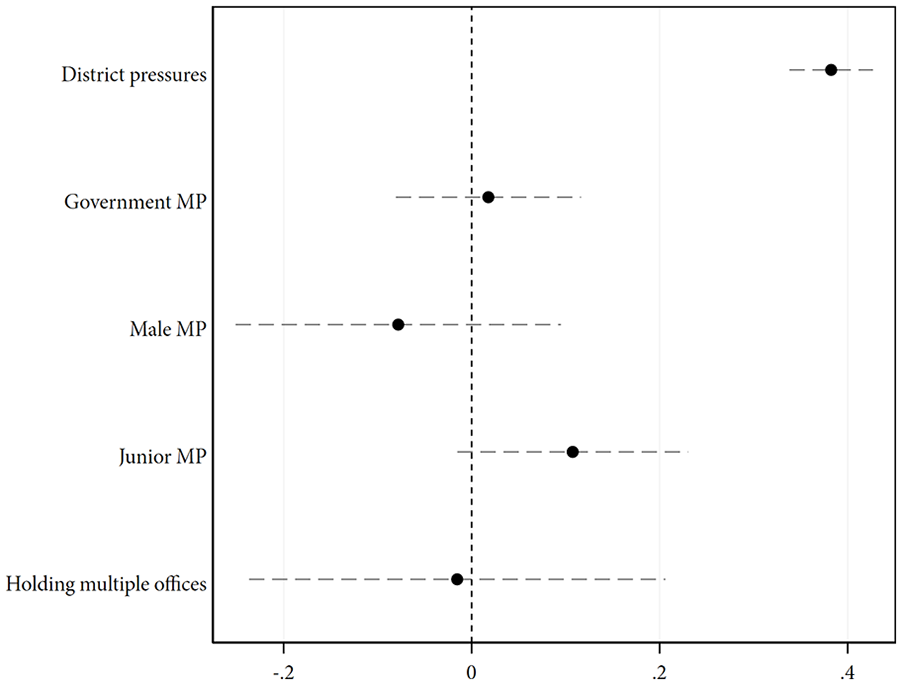
Regression Results Based on Model 1, in Supplementary Table S1 (with 95% Confidence Intervals).
Although the government–opposition divide does not affect MPs in the way they react to constituency pressures, it has an impact on how district pressures interact with the party agenda. Model 2 shows that the interaction term between district pressures and party agenda is not significant at usual levels (p = 0.055) when all MPs are included. However, when dividing the data into two sub-samples following the government–opposition division, the picture is different. For members of the opposition, the agenda of the party does not affect the way MPs react to district pressures. Supplementary files even show that the share of the electoral manifesto dedicated to agriculture does not affect the share of questions about this topic. The opposite pattern applies to MPs of a party in government. In order to better appreciate the effect, we plotted the average marginal effects of district features on the share of questions about agriculture conditional upon the party agenda (Figure 2). As stated in H2, the more important for the party the issue is, the greater the effect of district features. More precisely, the effect (i.e. how much one-unit change in district features affect the share of question about agriculture) increases from 0.015 to 0.023, going from the lowest to the highest value of the share of party manifesto dedicated to agriculture.
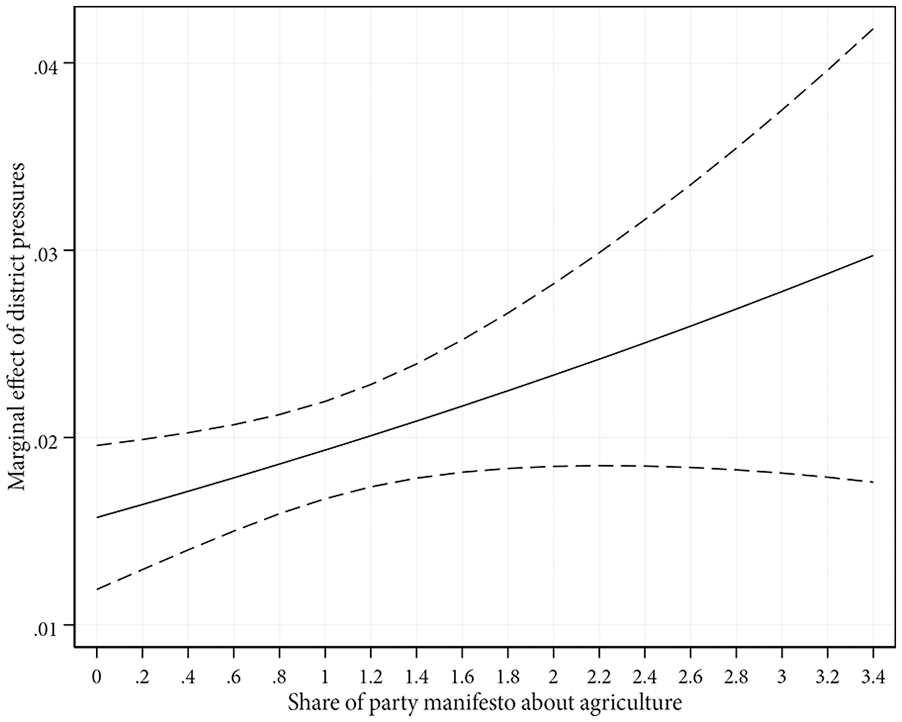
Average Marginal Effects of District Pressures on the Share of Question About Agriculture by Share of Party Manifesto About Agriculture (Government MPs, with 90% Confidence Intervals).
The reinforcement effect is more evident from the predictive margins plot (Figure 3). The value for the district pressures is set to their minimum and maximum. The gap in the share of questions about agriculture between weak and strong district pressures when the party manifesto does not include agriculture is about 0.077. The same gap when the party pays strong attention to agriculture is 0.140. This result thus indicates that the party agenda may be a resource for MPs, inciting them to dedicate more attention to their districts. However, it is not a necessary condition, since district features have a positive impact irrespective of the content of electoral manifestos. The difference between opposition and government MPs may be explained by the institutional structure and the various opportunities and restrictions. In the French parliament, the members of government party groups are expected to support the government and respect the quite strict party discipline (Sauger, 2009). In that sense, a written question destined to comply with district pressures may enter into conflict with the party’s (and government’s) own goals. Incidentally, it may place MPs’ electoral goals at stake. The match between district features and party agenda allows the government to express a statement on a matter of importance to it and the MP to be responsive to his or her district. This situation does not exist in these terms among opposition MPs since opposition groups can hardly implement their policy proposals due to the limited influence they exercise in parliament. Hence, the topics that are important in the manifestos are not necessarily those that will be on the political agenda. Overall, the findings support H2.
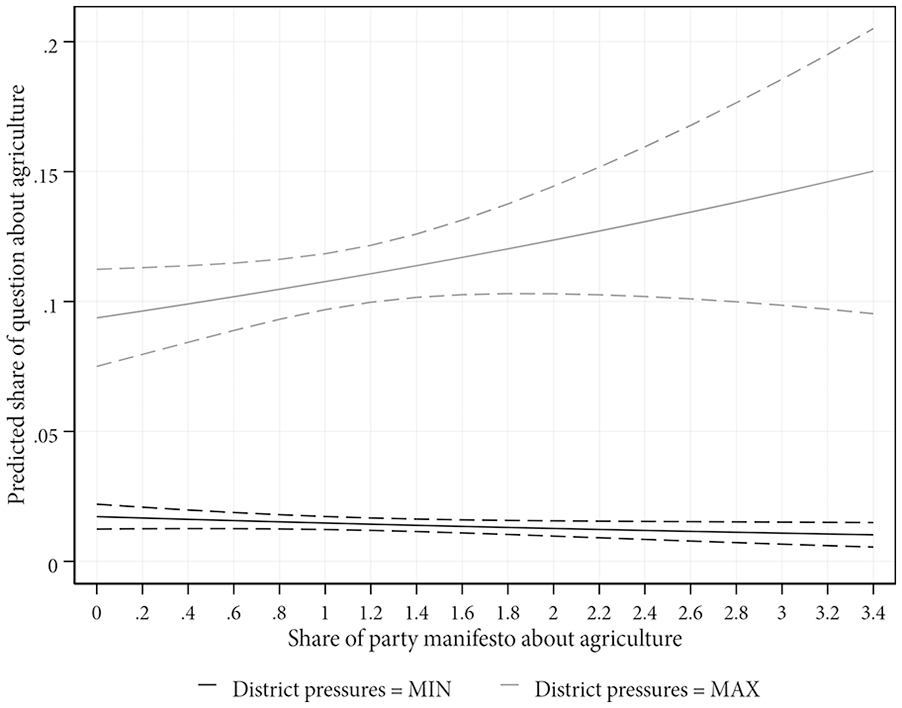
Predicted Share of Questions About Agriculture by the Share of Party Manifesto About Agriculture When District Pressures Are Set at Their Minimum (Black) and Maximum (Grey) (Government MPs, with 90% Confidence Intervals).
Finally, Model 3 introduces the question of electoral vulnerability. The interaction term in Model 3 is not significant. It shows that electoral vulnerability does not provide MPs with more incentives to engage in policy responsiveness. At a similar level of district pressures, vulnerable MPs do not ask more questions on a related topic than their less vulnerable counterparts. This null effect does not vanish in the sub-samples, indicating that government and opposition MPs are similar in this respect. H3 is thus rejected. This result gives credit to a large body of literature about French politics explaining that MPs’ activities in parliament are of little importance to their electoral prospects (Brouard et al., 2013; Lazardeux, 2005). Another explanation may come from the demographics with farmers representing 24% of the population at most, which can be too little to influence the outcome of an election. Recent literature also explains that constituency service has become common among French MPs, most of them investing resource in district responsiveness, regardless of their electoral vulnerability (Brouard et al., 2013; Costa and Poyet, 2016; Siefken and Costa, 2018)
Among the control variables, only a few have a significant effect. Gender and seniority do not directly affect the share of questions about agriculture. Similarly, holding multiple offices has only a limited impact. Even though these factors have a strong effect on other aspects of MPs’ behaviour (Bach, 2012; Brouard et al., 2013; Costa and Poyet, 2016), they do not affect attention to issues. It must be noted that seniority appears to factor into how MPs react to district pressures (not displayed here). The effect of district profile is stronger among junior MPs than among the more experienced legislators.
Concluding Discussion
The goal of the article was to explore policy responsiveness in the least likely case, namely, France. This country is characterised by a weak legislature, the predominance of the executive branch, and strong party discipline. Furthermore, MPs are expected to represent the national interest and to refrain from advancing particularistic agendas. The literature thus depicts a picture of French MPs having a limited opportunity to influence policymaking (Frears, 1990). Hence, the work in parliament ought to have only a limited impact on an MP’s notoriety, inciting him or her to invest time and resources in his or her district in order to cultivate the personal vote required for his or her re-election (Brouard et al., 2013; Brouard and Kerrouche, 2014). This picture has been, however, recently challenged (François and Navarro, 2020), showing that work in parliament does influence an MP’s name recognition. France is thus a good case for assessing how MPs take into consideration the demands of their constituents in weak and party-centred legislatures.
The main argument of this article is that, despite the institutional limitations, MPs are responsive to district demands. Moreover, we argued that in the context of a party-centred legislature, the party agenda does not vanish; it impacts the way MPs react to district pressures. In addition, we expected that electoral vulnerability incites MPs to be more responsive to their constituents. Drawing on parliamentary questions about agriculture, the empirical results offer support to the first two hypotheses. The district features are the main factor explaining an MP’s focus on agriculture. Moreover, the party agenda does matter to MPs from a governing party. They are more responsive to district pressures when the topic occupies a central place on the party agenda. The behaviour of opposition MPs is not affected by their party’s agenda. Finally, contrary to expectations, electoral vulnerability does not encourage MPs to be more responsive.
These results have two major implications. First, the personalisation of politics may be a factor also in weak and party-centred legislatures. Despite the institutional and constitutional limitations, policy responsiveness is a common practice among most MPs. Beyond the French case, it shows that the personalisation of representative linkages also concerns a country where a priori parties are the most important provider of preference aggregation.
Second, the article shows that, in party-centred legislatures, we cannot explore policy responsiveness without considering the party agenda. The recent literature tends to oppose party (or collective) representation and policy responsiveness, the latter developing at the cost of the former. Nevertheless, Weissberg (1978) has argued that these dyadic linkages cohabit with more collective forms of political representation. Our article not only gives credit to this argument but also shows that the link goes beyond ‘simple’ cohabitation. There is an interaction between both types of representation. Admittedly, a match between constituency demands and party agenda is not necessary to produce policy responsiveness. However, this match enhances policy responsiveness. More precisely, our study shows that this factor matters for parties in control of the national political agenda. While party agenda is absent from virtually all studies on policy responsiveness in European legislatures, our article shows it is an important predictor, as shown by Öhberg and Naurin (2016). This research thus helps to apprehend better the personalisation of politics that is not developing in total opposition to the party. All in all, the article provides new insights into the transformation of representative democracies.
Beyond its contributions, the article has two limitations that should be addressed by further studies. First, we focused here on only one case. However, we proposed a research design and data that may be mobilised in virtually all European countries. We thus encourage researchers to replicate this study in other countries to better appreciate how party agenda impacts policy responsiveness. Second, our study focuses on a limited time span. Although this period was selected in order to fit the changes, one may argue that the role of the party is important because we are studying an ongoing process. The scholarship should thus explore how party agenda affects policy responsiveness in more recent times.
Nevertheless, the article provides robust evidence about policy responsiveness in a weak and party-centred legislature. Future studies, when investigating legislative behaviour and policy responsiveness, need to do so by considering the interactive relationship between party agenda and district pressures.
Supplemental Material
sj-pdf-1-psw-10.1177_14789299211007987 – Supplemental material for Personalised Representation in a Weak and Party-Controlled Legislature: Policy Responsiveness in the French Parliament
Supplemental material, sj-pdf-1-psw-10.1177_14789299211007987 for Personalised Representation in a Weak and Party-Controlled Legislature: Policy Responsiveness in the French Parliament by Corentin Poyet in Political Studies Review
Footnotes
Acknowledgements
An earlier version of the article has been presented at the 2018 MPSA annual conference. I thank David Arter, Mihail Chiru, Tapio Raunio, Isabelle Guinaudeau, Olivier Costa and Eric Kerrouche for their insightful comments on earlier versions of the article. Many thanks also to Matthew James for the language editing. Finally, I am grateful to Sylvain Brouard for sharing his data.
Declaration of conflicting interests
The author(s) declared no potential conflicts of interest with respect to the research, authorship and/or publication of this article.
Funding
The author(s) received no financial support for the research, authorship and/or publication of this article.

Supplemental Material
Additional supplementary information may be found with the online version of this article.
Table S1: Specifications of the full model.
Table S2: Government MPs.
Table S3: Opposition MPs.
Author Biography
References
Supplementary Material
Please find the following supplemental material available below.
For Open Access articles published under a Creative Commons License, all supplemental material carries the same license as the article it is associated with.
For non-Open Access articles published, all supplemental material carries a non-exclusive license, and permission requests for re-use of supplemental material or any part of supplemental material shall be sent directly to the copyright owner as specified in the copyright notice associated with the article.
