




Abstract
Drawing on an original sample of 351 elections held in new and consolidated democracies from 1960 to 2013, this article examines the likelihood that new parties gain parliamentary representation as a function of electoral system permissiveness and contextual factors that shape political entrepreneurs’ perception of political opportunity. We distinguish between the success of genuinely new parties and that achieved by splinters or parties formed through mergers. We find that the district magnitude matters for the success of all three types of newcomers, while the electoral formula and proportionality matter only for the parliamentary entry of splinter parties. Another novel finding is that government instability facilitates the success of genuinely new and splinter parties. The analysis also shows that, irrespective of the type of transition, the more elections have taken place since then, the less likely it becomes that genuinely new parties and merger new parties enter parliament.
Introduction
Oftentimes, successful new parties disrupt established patterns of party competition and provide disillusioned citizens with new options, thereby increasing the responsiveness and accountability of policy-making. But they can also hinder accountability by introducing new brands and confusion about who is responsible for what. Hence, the relevance of studying new party success in a systematic manner as a key to how political innovators and the citizens who support them change the ability of party systems to meaningfully aggregate popular preferences (Riker, 1986).
This article studies new party success by focusing on a measure of success that is comparable across political systems: new party parliamentary entry. Most existing studies on new parties (Emanuele and Chiaramonte, 2016; Harmel and Robertson, 1985; Mainwaring et al., 2017; Powell and Tucker, 2014; Willey, 1998) concentrate on their electoral success as measured through vote share. 1 Bolin’s (2014) study is probably the only exception. Similar to Bolin, we argue not only that winning parliamentary representation is a less arbitrary measure of electoral success than vote share, but also that it allows for a more accurate cross-country comparison.
Of the many factors that impact the likelihood of new party success we focus on facilitating conditions rather than direct motivations. Demand side factors, such as the dissatisfaction of voters or political entrepreneurs with the performance of the existing political parties or the appearance of a new societal divide (Rydgren, 2003), may be more influential than the opportunity structure (Kitschelt, 1986: 58), which comprises those institutional and contextual factors that shape the response of relevant political actors to changes on the demand side. However, manipulating the opportunity structure seems to be the most promising route for institutional design to influence the emergence of new parties, and hence the public good that they are expected to bring about.
In this article, we address both key aspects of the opportunity structure. On one hand, scholars have emphasized the role played by the institutional context in shaping the chances of new parties (Rohrschneider, 1993; Willey, 1998). This refers mainly to electoral system features, such as its degree of proportionality or the size of the electoral threshold, but also to constitutional arrangements such as parliamentarism versus presidentialism (Harmel and Robertson, 1985; Hino, 2012). On the other hand, certain contextual factors shape how political entrepreneurs perceive the political opportunity structure and their cost–benefit calculus regarding the viability of a new party project (Cox, 1997): the cost of entry, benefits of office, the chances to attract voters, and to enter parliament and government given existing patterns of party competition (Tavits, 2008; Zons, 2015). These factors range from short-term economic conditions such as the level of unemployment or inflation (Tavits, 2006) to government instability, the fragmentation of the party system (Bolleyer and Bytzek, 2013), or the limited programmatic diversity of established parties (Zons, 2015). We address our central research question – ‘How do institutional barriers and contextual factors related to the political opportunity structure influence new party entry to parliament?’ – by analysing an original dataset that includes 351 elections in 35 democracies, from 1960 to 2013.
The present article revisits the explanatory power of the factors mentioned above while making four original contributions. First, we distinguish more subtypes of new parties then the extant literature did and show that the influence of various factors on new party success depends on which type is examined: genuinely new parties, splinter new parties, and parties that emerge as a result of mergers.
Second, the effect of electoral system permissiveness is tested more comprehensively, moving beyond the role of electoral thresholds to take into account electoral formulas, district magnitude, and the proportionality of the translation of votes into seats.
Third, we test whether the number of previous elections and the type of transition to democracy make a difference for new party entry. Existing studies have either concentrated on the entry and success of new parties in advanced industrial democracies (Bolin, 2014; Bolleyer and Bytzek, 2013; Emanuele and Chiaramonte, 2016; Krouwel, 2012; Van De Wardt et al., 2017; Willey, 1998) or looked only at the electoral participation of new parties in new democracies (Tavits, 2008). This article makes an additional step by also analysing new parliamentary party entries in young democracies, mainly from the post-communist space. In doing so, we also account whether the different features of party competition in post-communist and older democracies affect new party success.
Fourth, we analyse for the first time whether executive politics matter for new parliamentary entry. We argue that governmental instability can be perceived by political entrepreneurs as a window of opportunity to launch new parties capable to provide an alternative to failures of the governing parties.
Theoretical framework
Most studies do not distinguish at all between types of new parties (Bolin, 2014), while some distinguish between genuinely new parties and splinters. Moreover, mergers are not included in any study about new party entry. The likelihood of success of these different newcomer types is most probably shaped by the kind of citizen or party elite need they respond to, and by the existing voter-party linkages and fundamentals of party alignments. It is reasonable to argue that genuinely new parties seek to respond to different needs than the other types, and they are most likely to bring programmatic innovation to the system. Genuinely new parties would compete on salient dimensions by picking positions that were not advocated previously or would promote whole new issues, neglected by the existing parties (Zons, 2015). Thus, their emergence should be rooted in different factors than the splits and mergers of previously existing parties, which are related often to a reshuffling of allegiances within the political elite.
Our first hypothesis relates to the extent to which electoral system features and mechanisms facilitate the entry of new parties. Three different independent variables were examined in the extant literature. First, there is a widespread belief that proportional representation encourages a multiparty system and facilitates the entry of new parties. For instance, it has been argued that ‘proportional representation systems are more hospitable for [new] parties that cater to (neglected) national interests or ideologies’ (Lucardie, 2000: 182). However, very few studies directly tested the relationship between the electoral formula and the success of new parties, and even fewer were able to find positive evidence. In the latter category one can probably include only Harmel and Robertson (1985: 517–518). On the contrary, Powell and Tucker (2014) found that the usage of a proportional representation electoral formula does not affect the type of electoral volatility associated with new party entry.
Second, scholars have emphasized the key role of district magnitude in the formation and survival of political parties (Ordeshook and Shvetsova, 1994; Rae, 1967). However, despite an obvious mechanical effect, namely that a larger district magnitude increases the chances of small parties to win seats, previous research has found mixed evidence of the effect of district magnitude on the success of new parties. Thus, while Willey (1998) reports a positive effect on the vote and seat shares of new parties, Mainwaring et al. (2017), who examined a much larger sample, covering a longer period and a broader geographical space, found no effect of district magnitude on extra-system volatility – which is driven by new party entry. A more robust finding refers to the participation of new parties in elections. Thus, the higher the mean district magnitude, the larger the number of new parties that compete in elections, both in young (Tavits, 2008) and in consolidated democracies (Tavits, 2006).
Third, electoral thresholds are also likely to make a significant difference to the chances that new parties gain entry into parliament. Thresholds are usually expressed as a fixed vote percentage (Taagepera and Shugart, 1989) applied nationally, which once reached guarantees access to the distribution of parliamentary seats. High national electoral thresholds can be a huge obstacle for new party entry, and the evidence gathered by Bolin (2014) seems to suggest that they indeed matter. Summing up, the opportunity for new parliamentary entry should be significantly increased by a permissive electoral system (Bolleyer and Bytzek, 2013), characterized by high proportionality, high district magnitudes, and low electoral thresholds, and it is essential to include all of them in the analysis to properly test our hypothesis:
H1. The more permissive the electoral system, the higher the likelihood of new party entry.
As an exception to H1 we expect that a high threshold might create a strong incentive for new parties to merge, thus facilitating the parliamentary success of merger new parties. This scenario applied to several Central and Eastern European cases, an illustrative example being that of the 1998 elections in Slovakia:
H1a. The higher the electoral threshold, the higher the likelihood of merger new party entry.
Moving to the entrepreneurs’ perceptions of the plausibility of new party entry, we start by emphasizing the importance of party system fragmentation. In fragmented party systems, it is easier for new parties to gain votes (Bartolini and Mair, 2007; Mainwaring et al., 2017: 624) because voters are more used to numerous choices and to switching to the parties that best represent the issue combinations that are most salient for them at a given time. Moreover, the politicians themselves have more alternatives to initiate mergers or to switch to with entire party factions. Conversely, in less fragmented party systems cleavages between existing parties are harder to surpass, which would affect both the success of start-up organizations and of splinters and mergers. Indeed, recent empirical work (Mainwaring et al., 2017) has shown that the effective number of parties is associated with higher extra-system volatility, that is, volatility determined by vote shifts to new parties, while Ibenskas (2020: 19) found that party system fragmentation increases the electoral performance of splinter parties in the first election after the split:
H2. The more fragmented the party system, the higher the likelihood of new party entry.
The entrepreneurs’ calculations of the viability of new party entry and success likelihood would also be heavily influenced by how party competition looks like in the respective country and how voters perceive it. As Lago and Martínez (2011) argue, electoral market failures occur when a substantial share of citizens are dissatisfied with the offer of existing parties. This might happen because existing parties have a low programmatic diversity (Zons, 2015): their policies and ideological stances are not different enough or they fail to address salient issues for the voters, or both. In turn, political entrepreneurs would see this as a sign of electoral demand for a new party that would engage in programmatic innovation. Zons (2015) showed for a Western European sample that lower programmatic diversity increases the likelihood that genuinely new parties emerge, but has no impact on splinter parties. Similarly, we would expect genuinely new parties to be in a better position than merger or splinter new parties to convince voters that they are pursuing different policies than the existing parties:
H3. The lower the programmatic diversity of existing parties, the higher the likelihood of genuinely new party entry.
Government instability implies an openness of the political scene. From the perspective of political entrepreneurs, it suggests less hardened patterns of government and opposition. From that of the voters, it may mean that the existing alternatives are ineffective. Thus, frequent governmental crises send voters the message that established parties are incapable of performing a fundamental function – that of governing. This can lead to calls for renewal of the political class and giving a chance to genuinely new parties. Indeed, analyses of survey and experimental data from Eastern Europe showed that in the eyes of voters, the appeal of new parties is fuelled by coalition infighting and frequent changes in government, which act as a strong motivation for protest voting (Pop-Eleches, 2010: 253–254). The relationship should be also present for splinter new parties: some of these splinter parties emerged precisely because of governmental crises. Moreover, it is reasonable to believe that splinter parties that governed recently have access to organizational resources that would facilitate their success at the next elections:
H4a. The more unstable the government, the higher the likelihood of genuinely new party entry.
H4b. The more unstable the government, the higher the likelihood of splinter new party entry.
In younger democracies, political entrepreneurs, and all actors involved in elections might be more likely to have the impression that the configuration of political forces is not immovable, compared to older democracies. The empirical evidence linking the age of democracy to the parliamentary entry of new parties is, nevertheless, somewhat mixed.
Although one would expect voters to be more attached to parties and less likely to vote for new competitors in more consolidated democracies, neither Powell and Tucker (2014) nor Mainwaring et al. (2017: 630) found any evidence supporting the relationship between the age of a democracy and the type of volatility associated with new party entry. However, the latter did find evidence supporting cohort effects. More precisely, they report that democracies established since 1978 experience more volatility, including extra-system volatility, than older, first- and second-wave democracies.
Another argument is that countries transitioning from communism to democracy are also more likely to see an abundance of new party parliamentary entry because the mainstream parties have weaker party organizations and are more prone to splits (Ibenskas, 2014; Marinova, 2015). These features are partly a direct legacy of the complete prohibition of parties during the Communist rule and of the fact that most of the political entrepreneurs looking to found parties had to start from scratch in 1989–1990. Moreover, their fuzzy ideological profiles (Millard, 2004) would impede the development of voter identification on ideological grounds, facilitating the switch to new parties.
Uncertainty regarding electoral viability – for both entrepreneurs and voters should also help the success of new parties in the first few elections after democratization. Thus, unlike in consolidated democracies, where the support of established parties is relatively easy to predict, given the information accumulated from repeated elections, uncertainty about electoral viability is much higher in the first election cycles (Tavits, 2008). Because of this, voters are more likely to vote sincerely for a new party and help it win seats than to vote strategically for a mainstream one. Genuinely new parties should be more affected by this problem than splinter or merger parties as election cycles pass and voters accumulate knowledge. Thus, the latter two types might be considered more viable by voters who have seen genuinely new parties fail in the past. On the contrary, the presence in splinter or merger new parties of politicians with high name-recognition or their previous affiliation to well-drilled party organizations would signal electoral viability:
H5. New party entry is more likely to happen in post-communist democracies.
H6. The more elections have taken place since the (re)foundation of democracy the lower the probability of new party entry.
H6a. The more elections have taken place since the (re)foundation of democracy the lower the probability of genuinely new party entry.
A few arguments and prior findings contradict H6 and H6a. Emanuele and Chiaramonte (2016) have shown that much of the success of new parties in Western Europe is concentrated in recent decades and this type of party system change has become prominent in several countries after the 2008–2009 financial crisis. Krouwel’s (2012) sequential model of party change, predicts higher success of genuinely new parties in recent times as a response to the cartelization of mainstream parties. These findings and arguments point to the need of controlling for period effects in any model positing a relationship between age of democracy and new party emergence, because some factors that create similar trends in multiple countries are either not yet well understood in terms of underlying causal mechanisms, or are difficult to capture with appropriate variables.
In addition to our measures of programmatic diversity we also control for lagged turnout. Lago and Martínez (2011) argued that low turnout in the previous elections is an indicator of electoral market failure, which would be perceived by political entrepreneurs as an opportunity for entry and success of a new political project.
We also control for poor economic performance. While theoretically high unemployment, inflation, and slow economic growth are considered as major causes for the decline of established political parties and the success of new ones, the empirical findings are rather mixed. Bolin (2014) found no effect of these three economic indicators on the likelihood that new parties win legislative seats. In contrast, Powell and Tucker (2014: 138) and Mainwaring et al. (2017: 630) showed that gross domestic product (GDP) growth decreases the volatility associated with new party entry, while inflation seems to make no difference (Mainwaring et al., 2017).
Research design: Data, variables, and models
The dependent variable
Our binary dependent variable (DV) is coded 1 if at least one new party entered parliament at a particular election and 0 if no new parties gain representation (even if newly emerged organizations contested the election). That is, our analysis is about the emergence of new parties in parliament, not of new parties in general.
We constructed a comprehensive dataset of new parties drawing on studies about new party success or electoral volatility (Bolin, 2014; Hug, 2001; Ibenskas, 2016; Marinova, 2015; Sikk, 2005), databases about elections and political parties (Carr’s (n.d.) Election Archive, the PARLINE database; Döring and Manow, 2015), and websites of national election offices.
Our objective was to include all new parties that obtained seats in (the lower house of) national parliament at a particular election, regardless of whether they ran on their own or as members of electoral alliances. We did not employ any threshold regarding the vote or seat share obtained by the parties. 2
For newly democratizing countries, founding elections have been excluded (new parties being logically meaningful no sooner than the second election). For established democracies, the choice of the first included election depended primarily on the availability of data for the explanatory variables.
We distinguish between three types of new parties: genuinely new parties, splinters from existing parties, and parties that came about through the merger of multiple previously existing organizations. The need to distinguish genuinely new parties from those resulting from splits and mergers has been emphasized by the extant scholarship (Hug, 2001; Sikk, 2005). From a theoretical perspective, a definition of new parties that is too inclusive and treats party splinters or mergers as genuinely new organizations would lack construct validity, since ignoring the continuity element means assigning to the same category extremely dissimilar animals, whose structural ‘newness’ varies greatly. From an empirical perspective, we know that genuinely new parties tend to form differently from the rest, that is, only for their appearance is the programmatic diversity of existing parties influential (Zons, 2015). Moreover, they are usually less likely to participate in government than splinters and mergers (Grotz and Weber, 2016). While the distinction between genuinely new parties and splinters is increasingly widespread in the literature about new parties, the inclusion of the third type – mergers – is less commonplace (but see Marinova, 2015) and needs further justification, which we provide below when discussing the criteria used for the inclusion and classification of the parties.
By genuinely new parties we mean organizations formed outside parliament that obtained their first seats at the respective election. In most cases, these are extra-parliamentary ‘start-up organizations’ (Emanuele and Chiaramonte, 2016: 3) created in the previous electoral cycle. However, what makes a party genuinely new is not age, but the fact that the organization had not been represented in parliament before. Consequently, we consider any extra-parliamentary party genuinely new, as long as it had not entered parliament before, regardless of the number of years it had existed before the respective election. Also classified as genuinely new are parties that resulted from pre-election mergers of multiple parties that never held seats before, 3 parties that were disbanded at some point in time but were re-established after more than one electoral cycle, 4 and parties that used to hold seats at some distant time in the past, but have been out of parliament for more than three electoral cycles. 5 Unlike Sikk (2005), we also treat new parties created by former independent MPs or unaffiliated cabinet members as genuinely new. 6
The latter decision also implies that we defined splinter new parties as organizations created by former members of parties that had been in parliament during the previous electoral cycle. These splinter new parties could not, therefore, have an electoral record of their own. Usually, such splinter groups originate from a single source party, but we also coded the merger of getaway groups from multiple parliamentary parties as a new splinter party, provided that none of these factions had previously competed in a general election under their own label (i.e. all the involved factions left their former parties in the previous parliamentary cycle). 7 The usage of probit regressions fortunately renders irrelevant the decision of whether to treat all parties in a post-split situation as new or only those that do not carry over the label of the splitting party. 8
Finally, our third category includes organizations that came about as the merger of previously existing parties. Treating such parties as new is sometimes challenged on the grounds that fusions only lead to the reorganization of established parties. The argument is that they should be studied separately from genuine newcomers and splinters, as mergers have an easier way into parliament (Bolin, 2014: 8). Similar to other scholars (Bolleyer, 2013; Wren and McElwain, 2007), we argue that parties emerging as a result of party fusions are an interesting subtype of new parties. According to Ibenskas (2014, 2016), party mergers usually occur because the resulting party is expected to be more likely to cross the electoral threshold and enter parliament, or because it is expected to become sufficiently large to govern on its own. We believe that the first scenario renders the argument about the easier path towards representation self-defeating, while mergers involving large parties bring about a qualitatively different party, and sometimes also a qualitatively different party system.
Accordingly, we code as new parties three kinds of party mergers. First, all mergers involving at least two parliamentary parties that contested the previous general election. 9 Second, we also include cases that involve the fusion of only one such party with a party that was established in the previous cycle through a splinter, but did not contest parliamentary elections, yet obtained seats on its own in other (second-order) elections. 10 Third, there are borderline cases, which could obviously not be coded as genuinely new parties or splinters, and where the decision was whether to record a merger new party entry or to treat the party as the continuation of one of the component parties. 11
We do not equate electoral alliances with party mergers, primarily because the former are intended to be temporary, and they do not involve the integration of party organizations (Ibenskas, 2016: 344). Consequently, we did not code them as new parties through merger, unless the member parties of the alliance indeed merged. Instead, we tried to reconstruct the composition of electoral alliances, and to identify each (genuinely or splinter) new party that gained seats as a member of the alliance. However, many mergers start as electoral alliances that last for one or more elections, and the line may become blurred even in election records or accounts in the secondary literature. In such cases, where we were unable to reconstruct how the seats were distributed among the member parties of an alliance which at some subsequent election transformed into a unitary party, we chose to treat the electoral alliance as a merged unitary party already at the elections for which we are lacking precise data about the new parties which gained seats as part of the alliance. 12
Overall, our sample includes 351 elections in 35 young and established democracies on four continents, from 1960 to 2013. On average, a genuinely new party entered parliament in every third election, in 113 of the elections analysed (32%), a rate similar to the success of new splinter parties (34%), but much higher than the entry rate of mergers (14%). This contradicts Lucardie’s (2000: 182) hypothesis regarding long- and short-term differences between the likelihood of winning seats for ‘purifier’ parties (splinters) versus ‘prophets’ (genuinely new parties promoting a new ideology).
Nevertheless, as Figure 1 shows, there is a lot of cross-country variation with respect to the success of these three types of newcomers. The complete list of new parties, countries, and elections included in the sample is presented in Supplemental Appendix 2.
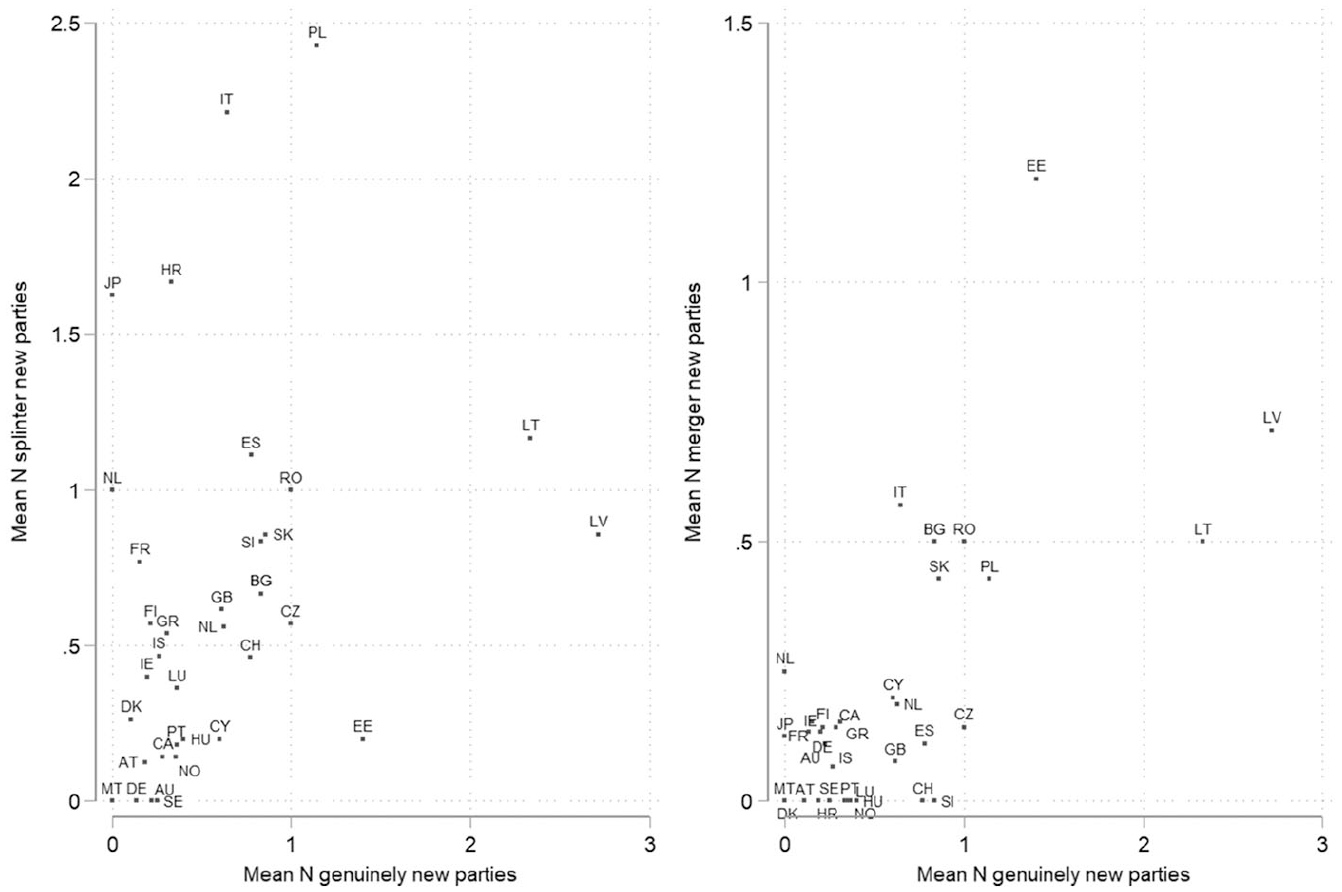
How often do genuinely new parties and parties formed by splinters and mergers win representation?
Explanatory variables
Majoritarian electoral system is a dummy coded 1 for first-past-the-post (FPTP), majority run-off or Alternative Vote and 0 for all other systems. Similarly, Mixed electoral system is a dummy coded 1 for combinations of majoritarian and proportional electoral rules. The lagged disproportionality index (Gallagher, 1991) evaluates the actual proportionality of the translation of votes into seats at the previous election. 13
Programmatic heterogeneity is measured using the formula developed by Franzmann (2008), to reveal how different parties are with respect to the number of Comparative Manifesto Project (CMP) categories (Volkens et al., 2019) they addressed, that is, how the issue emphasis differed across parties at the previous election. The number of 0 categories indicates how many of the CMP categories none of the parties in that country addressed at the previous election. Government instability records the number of government changes (including voluntary and technical terminations) in the past 3 years, excluding the current (electoral) year. Mean district magnitude indicates the average district magnitude, weighed by the number of seats in mixed systems.
The ‘typical’ case in the dataset comes from a country that uses a proportional electoral system, has a relatively small electoral threshold, and a history of rather stable governments. For full descriptive statistics, see Table A1.2 in the Supplemental Appendix.
Figure 2 indicates that over time there seems to be an increase in the incidence of the entry into parliament of genuinely new parties, although this trend is not at all linear. The share of elections with successful splinter parties is rather constant, whereas there seems to be an increase also in the occurrence of merger party entry.
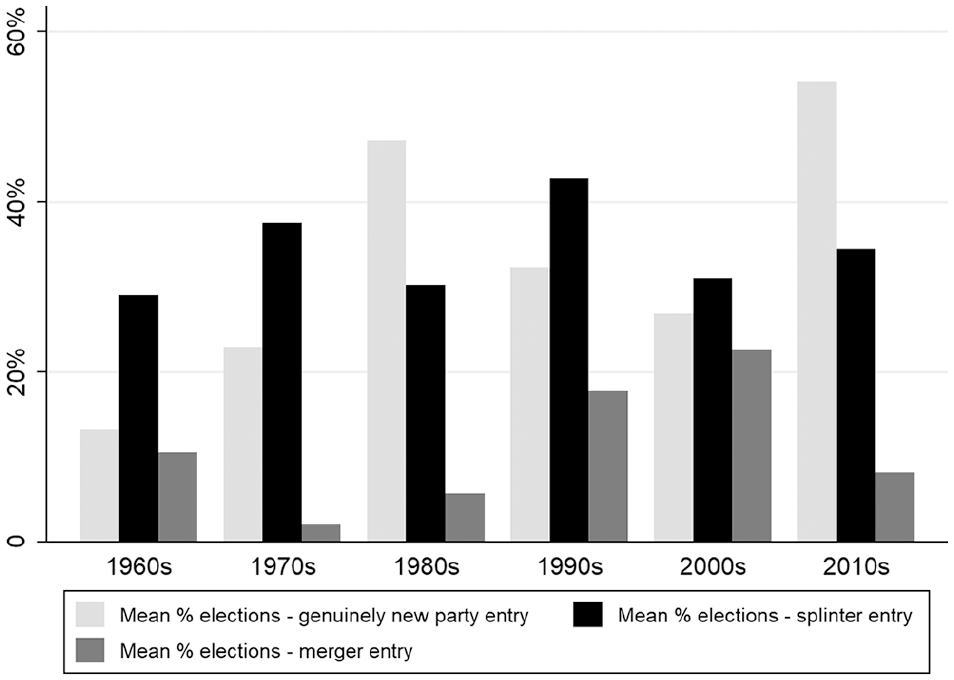
The evolution of new party entry by type of party and decade.
Methods
Since the DV is dichotomous, we use probit regressions, with robust standard errors clustered by country. To make the interpretation of the main findings more straightforward, we present predicted probabilities plots created with Clarify (King et al., 2000).
Multivariate analyses
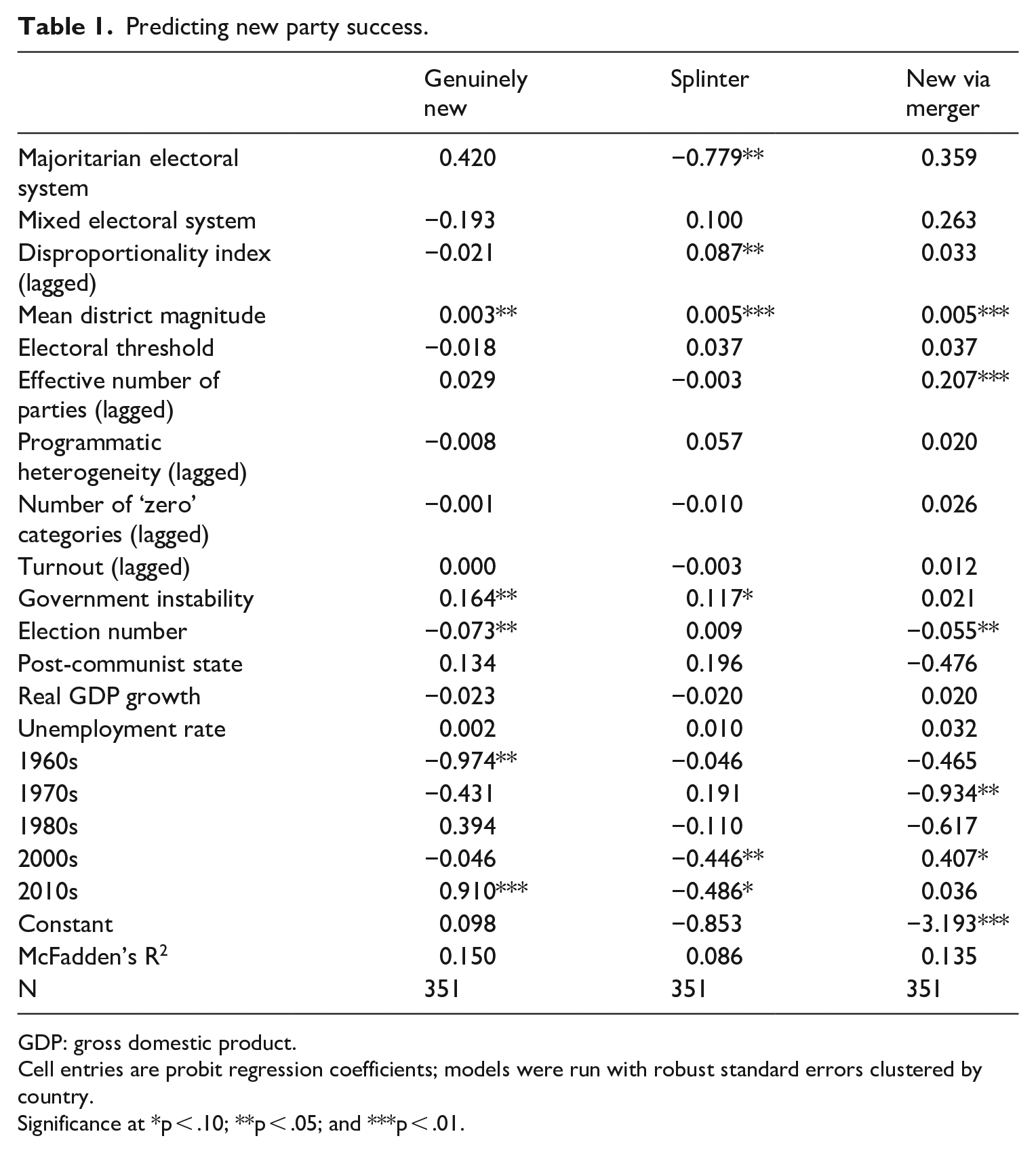
The results reported in Table 1 were obtained by running the same probit regression model, for each DV separately. As expected, given our arguments about their different nature, there are remarkable differences regarding which factors matter the most for the three types of new parties. Before analysing these differences, it is worth noting that a common pattern observed across all regressions is that programmatic diversity (H3) does not make a difference for new party success.
Predicting new party success.
GDP: gross domestic product.
Cell entries are probit regression coefficients; models were run with robust standard errors clustered by country.
Significance at *p < .10; **p < .05; and ***p < .01.
The first regression in Table 1 models the likelihood of parliamentary entry of a genuinely new party. We find evidence only for the effects associated with district magnitude, government instability, election number, and the decade dummies.
In line with H1, higher district magnitude increases the likelihood of new party entry. The left panel of Figure 3, created with Clarify, shows that a full switch from the smallest to the largest mean district magnitude in the sample (150) increases the probability of genuinely new parties entering parliament by 17% (from 0.28 to 0.45).
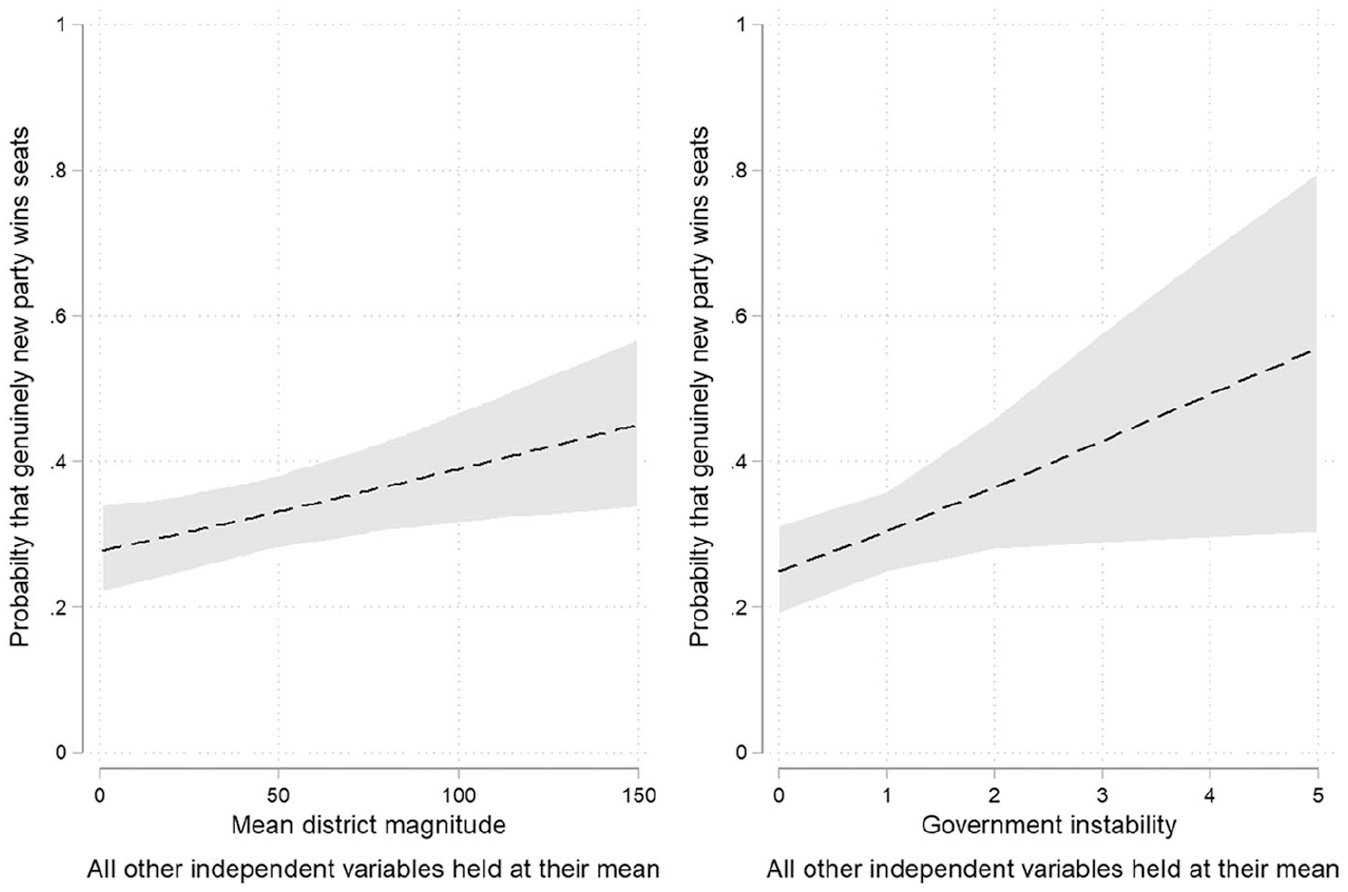
Mean district magnitude, number of elections, and genuinely new party entry.
Genuinely new parties are more likely to win seats in countries facing government instability (H4a corroborated). The right panel of Figure 3 illustrates that the likelihood of success increases by 30% (from 0.25 to 0.55) when comparing countries having a single government for the entire cycle with those that had five different cabinets.
The likelihood of genuinely new party success decreases the more elections have been held since the (re)foundation of democracy (H6a corroborated). While at the first election the probability of parliamentary entry of genuinely new parties is 0.56, by the 27th election it drops to 0.06.
In line with previous studies, the temporal dimension is also salient. Thus, genuinely new parties were less likely to enter parliament in the 1960s compared to the 1990s, while in the current decade the probability is two times higher compared to the same baseline.
Moving to the second regression, mean district magnitude matters for splinter new parties too, the effect being larger than for genuinely new parties. The left panel of Figure 4 shows a 31% increase in this probability when comparing Single Member District (SMD)-based systems with the system having the largest District Magnitude (DM) in the sample.
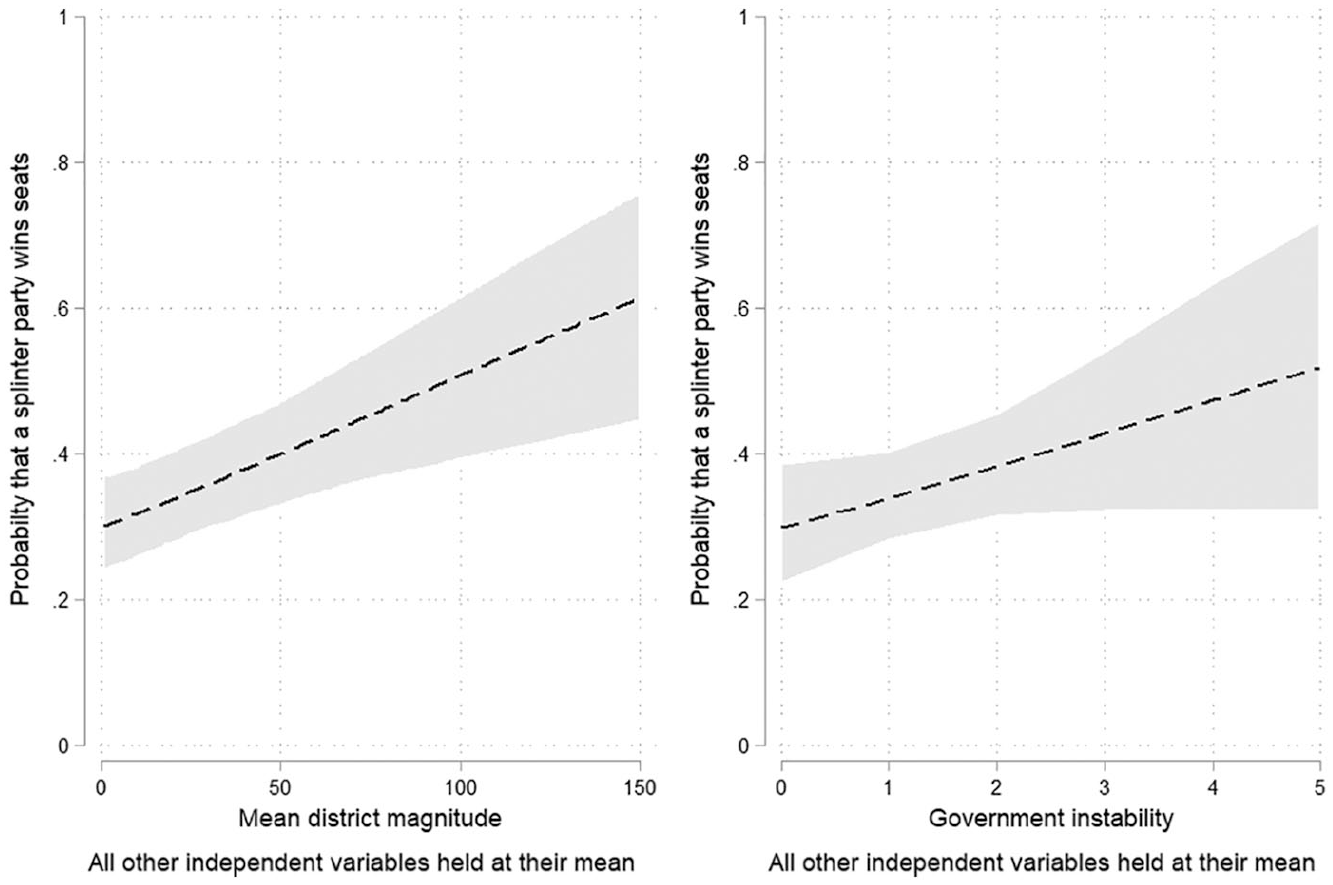
Mean district magnitude, government instability, and new splinter party entry.
Two other electoral system variables exert an important influence on the parliamentary entry of splinter parties. Such parties are significantly less likely to win representation in elections held under majoritarian rules than in contests organized under public relations (PR) formulas. Furthermore, somewhat surprisingly, the more disproportional the translation of votes into seats at the previous election, the higher the chances of splinter parties to win seats. It might be that splinter parties become more attractive in the eyes of voters in the aftermath of electoral shocks: when established parliamentary parties or their coalitions fail to clear the national electoral threshold, resulting in a significant number of wasted votes.
Instead, government instability does matter for the likelihood of splinter entry (H4b corroborated). Thus, the right panel of Figure 4 illustrates that a switch from one to five cabinets in the past legislative cycle increases the chances that a new splinter party wins parliamentary representation by 22%. This effect might be related to the splits that occur as a result of factional disagreements over participation in governments.
The last regression in Table 1 shows the factors influencing the parliamentary entry of new parties formed through mergers. Mean district magnitude once again has a significant impact: the left panel of Figure 5 shows that, with single member districts, the probability of a merged new party entering parliament is 0.1, while with maximal district magnitude it is 0.29.
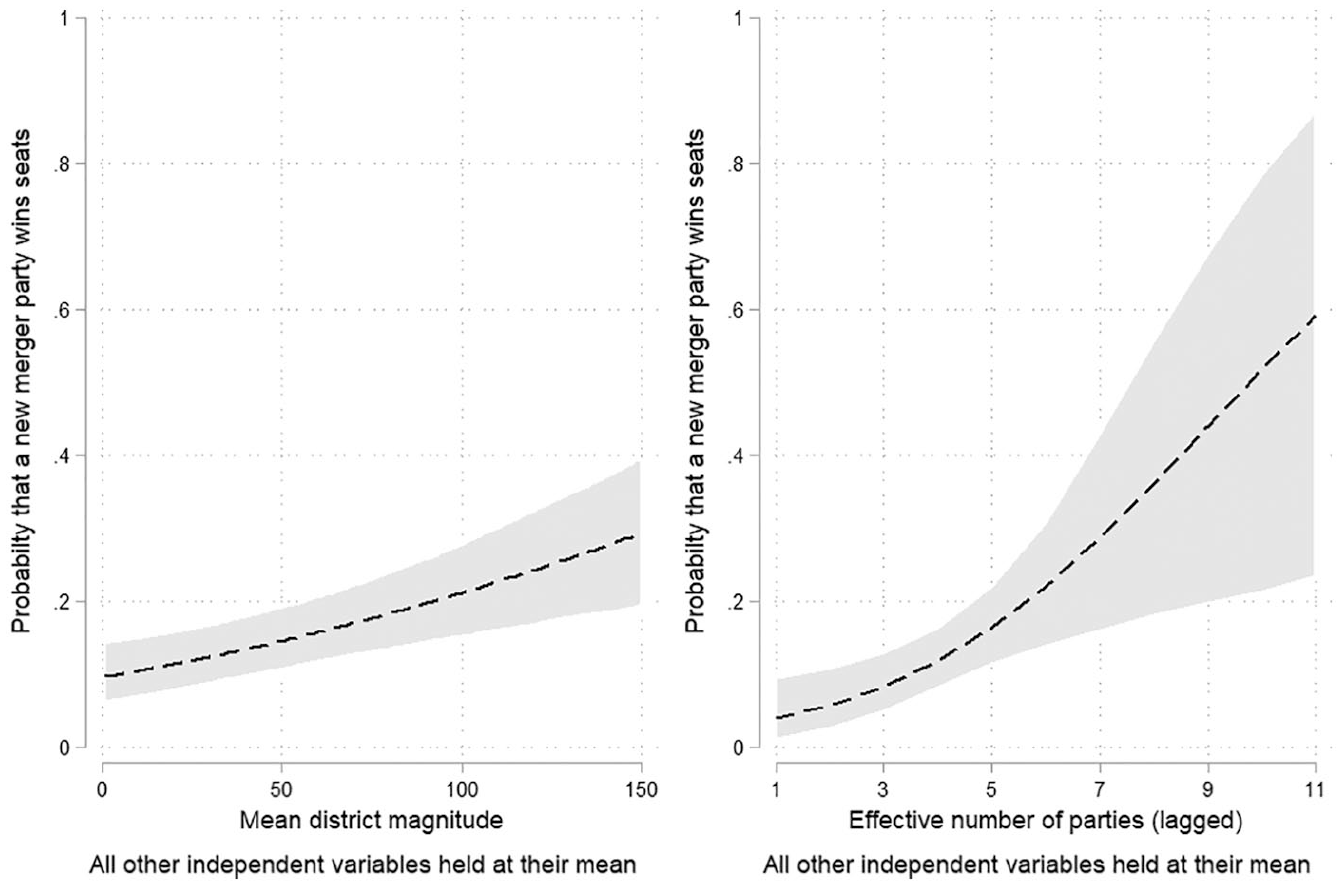
Mean district magnitude, party system fragmentation, and new merger party entry.
Another important finding is that, unlike the other two types, the parties created through mergers have more success in fragmented party systems, evidence in favour of H2. In such settings, there are more parties that can merge to form a new party, and in turn, the merged organization might be perceived as more viable by voters. The right panel of Figure 5 shows that a full switch increases the probability of merger new party entry by approximately 55%: from 0.04 with the effective number of parties at its minimum (1.74) to 0.59 at the maximum number of parties (10.9). An example of a successful merger new party in a very fragmented party system is that of the Reformist Movement (MR) which was founded in 2002, won seats in 2003, and was part of every Belgian government since then.
Finally, and in line with H6, the more elections have been organized since the (re)foundation of democracy the lower the probability of new merger party entry: by the 27th election this likelihood decreases by 21% compared to the first elections (from 0.24 to 0.03).
Robustness checks
The first robustness check was to run the models including the other DVs as independent variables in order to test for co-occurrence effects of the three subtypes (Table A4.1 in the Supplemental Appendix). The findings are very similar to those reported in Table 1 (except for the disappearance of the effect of government instability on splinter party entry) and no effect emerges that would suggest an interdependency between the prospects of success of the three subtypes.
Including the lagged DV also brings about only limited changes to the models (Table A4.2 in the Supplemental Appendix). Its effect is only significant for genuinely new parties: it increases the prospects of success, which seems to indicate that there are systems in which genuinely new parties emerge routinely. Another slight change is that the effect of district magnitude remains only marginally significant for genuinely new parties. In the case of merger new parties, the lagged variable has no effect on the outcome, but it changes the effect of two variables. Thus, the number of issues not tackled by the parties at the previous election acquires a marginally significant positive effect: the more such issues, the better the prospects of success. Moreover, parties created through mergers appear less likely to be successful in post-communist countries.
Running the models separately for the post-communist sample and the consolidated democracies uncovered additional interesting findings (Table A4.3 in the Supplemental Appendix). First, low programmatic diversity, as indicated by the number of ‘zero’ categories, has a positive impact on the success of genuinely new and merger new parties in Eastern Europe. Second, we find a negative effect of GDP growth for both genuinely new and splinter parties in the post-communist sample. Third, while the positive impact of party system fragmentation on merger new parties is present in both samples, we also find a similar positive effect for genuinely new parties in post-communist democracies. Finally, the relationship between government instability and genuinely new party success is present only in the old democracies sample while that between government instability and genuinely new party success is driven by the post-communist countries.
In order to control for the relationship between the emergence and electoral success of new parties (Hug, 2001), we added to our models the number of genuinely new and splinter parties emerging before each election, relying on Zons’ (2015) data. Unfortunately, this restricted the analyses to a subsample comprising elections from Western consolidated democracies (Table A4.4 in the Supplemental Appendix). We found a significant, though not very strong relationship in the case of splinter parties, but none for genuinely new parties. We were unable to test the emergence–success relationship for merger new parties, as they were not covered. Furthermore, in the case of genuinely new parties the effect of election number disappears, but this may be due to the more restricted sample, while in the case of splinters, of the various elements of electoral systems only district magnitude retains its effect, while government instability also turns insignificant.
Finally, we also ran ordinary least square (OLS) and Poisson regressions replacing the dummy DV with the count of the new parties that were successful at each election (Table A4.5 in the Supplemental Appendix). The differences that emerge are mostly related to the effects of various elements of the electoral system. For genuinely new parties, the impact of district magnitude disappears, while for splinters the majoritarian electoral system dummy loses its significance. This could indicate that the electoral system is more important for the mere occurrence of new party success, but less so for how many newcomers will be able to take advantage. While the OLS and Poisson models are in line with some of the most important findings concerning the entry of at least one new party into parliament, they also point towards the need for additional research into the broader phenomenon, for the need to disentangle the mere occurrence of new party entry and focus on qualitative features of the successful new parties.
Conclusion
Our analyses illustrate how the parliamentary entry of new parties is shaped by institutional and contextual factors related to the perceptions of political entrepreneurs regarding the openness of the political system. This article adds a new layer to the literature, emphasizing the need to distinguish genuinely new parties from both splinters and mergers and showing that distinct factors drive the parliamentary entry of the three types, except for district magnitude, which increases the chances of representation for all types of newcomers.
Apart from district magnitude, the other features of the electoral system, the electoral formula and the proportionality of the translation of votes into seats, matter greatly for the likelihood that new parties created as a result of splinters win parliamentary representation but do not make any difference for genuinely new parties or for parties resulting from mergers.
Another salient result refers to the fact that cabinet instability increases the success of genuinely new and splinter new parties. This area was not researched at all previously, and both qualitative and quantitative work is needed to explore the mechanisms through which these relationships occur. Furthermore, the fragmentation of the party system matters a great deal for the emergence of new parties created through mergers.
Taken together, these findings indicate that institutions, and broadly, political opportunity structures matter considerably for splinters but less for the other two types. These differences seem to be related to the different nature of the three types of parties, and the different needs they seek to address.
While the only evidence in favour of the hypothesis regarding the role of programmatic diversity for the success of new parties is limited to the analyses ran on the post-communist sample, how party competition influences new party entry remains a highly relevant aspect for future studies to explore. This could be further refined by focusing on voters’ perceptions concerning the (lack of) responsiveness or accountability of mainstream parties and the extent and quality of how they represent various issues, interests, or ideological positions.
Our analysis also revealed that the more elections have taken place since the (re)foundation of a democracy, the less likely is the parliamentary entry of genuinely new and merger new parties. Moreover, our results also corroborate previous findings indicating that the success of new parties is concentrated in recent decades, with peaks in the 1980s and 2010s – but we show that this applies mostly to genuinely new parties. However, the impact of variables related to the temporal dimension cannot be fully settled based on our dataset. Future research will have to aim for increased coverage, both spatial and temporal, in order to disentangle the potential effects of time spent under democracy, communist legacies, and the particular timing of the elections.
Finally, it was beyond the scope of this study to assess the characteristics of the new parties that succeeded in entering parliament. That would require a different research design and a dataset covering the characteristics of all parties participating in an election – both those that won seats and those that did not. Only then could one analyse whether successful new parties have much better resources than those that are unsuccessful (Ibenskas, 2020; Lucardie, 2000), whether they owe their success to the decision to represent an issue previously ignored (Hug, 2001; Lucardie, 2000), or whether their ideological positions are mainstream and their ‘newness’ is the key factor (Sikk, 2012).
Supplemental Material
POL_943432_Appendix_PDF – Supplemental material for Political opportunity structures and the parliamentary entry of splinter, merger, and genuinely new parties
Supplemental material, POL_943432_Appendix_PDF for Political opportunity structures and the parliamentary entry of splinter, merger, and genuinely new parties by Mihail Chiru, Marina Popescu and István Gergő Székely in Politics
Footnotes
Funding
The author(s) received no financial support for the research, authorship, and/or publication of this article.

Supplementary Information
Additional supplementary information may be found with the online version of this article.
Contents Table A1.1. Variable Codebook. Table A1.2. Descriptive Statistics of Dependent Variables and Covariates. Appendix 2. Countries, Period, Elections and Types of New Parties Appendix 3. Multicollinearity Tests (With and Without Dummies) Appendix 4. Robustness Checks Table A4.1. Models Including the DV for the Other Outcomes as an IV. Table A4.2. Models Including the Lagged Dependent Variable. Table A4.3. Separate Models for Post Communist and Old Democracies Samples. Table A4.4. Models Testing the Relation Between Emergence and Success of New Parties. Table A4.5. OLS and Poisson Models With Number of New Parties as DV.
Notes
Author biographies
References
Supplementary Material
Please find the following supplemental material available below.
For Open Access articles published under a Creative Commons License, all supplemental material carries the same license as the article it is associated with.
For non-Open Access articles published, all supplemental material carries a non-exclusive license, and permission requests for re-use of supplemental material or any part of supplemental material shall be sent directly to the copyright owner as specified in the copyright notice associated with the article.
