



Abstract
This article seeks an insight into the nature of intraparty competition in an open-list single preference voting system, and it does so by analysing the distribution of votes for Centre Party candidates in the 40 or so municipalities making up the northern Finnish constituency of Oulu in each of the five general elections between 2003 and 2019. It builds on Grofman’s distinction between a geographical constituency and a candidate’s electoral constituency to map the ecology of candidate support in a constituency with (1) a larger than average district magnitude (M); (2) a significantly larger than average territorial magnitude (T); and (3) a substantially larger than average Centre party magnitude (P). Setting M, T and P within a party organisational framework, the article identifies (1) a significant disparity between levels of intraparty competition at district and sub-district levels; (2) several contextual factors that act more as disincentives than incentives to engage in personal vote seeking across the electoral district.
Introduction
The focus of this article is on the ecology of the personal vote (Cain, 1987; Carey and Shugart, 1995; Shugart, 2008; Swindle, 2002; Zittel, 2017) in a ‘personalised electoral system’ (Pilet and Renwick, 2018) – Finnish open-list PR – that obliges voters to express a single preference among individual candidates and determine who is elected. The central question runs: what, if anything, can be inferred about personal vote seeking and patterns of intraparty competition from the distribution of the personal vote in an electoral system that appears to create strong incentives for candidates to compete with their co-partisans? The analysis seeks to complement and supplement the personal vote literature in at least two ways. First, it sets the personal vote and personal vote seeking in a party organisational framework following Bergman et al. (2013: 332) who, in their analysis of the distribution of the candidate vote in two non-transferable voting systems, single non-transferable vote (SNTV) and open-list proportional representation (OLPR), expressly argue for the inclusion of ‘party-level factors’. Second, in contrast to the main thrust of the personal vote literature (Carey and Shugart, 1995; Crisp et al., 2007; Shugart, 2008), which derives personal voting seeking incentives exclusively from district-level variables – district magnitude or party magnitude – this article adopts a within-district perspective using the municipality as the basic unit of analysis (cf. André and Depauw, 2019).
André and Depauw (2018: 269) have noted that ‘the growing personal vote literature has rarely examined whether legislators spread their efforts to cultivate personal votes around the district or specialise locally’ and they stress the role of district magnitude – the seat allocation per district – in shaping geographical sub-constituencies. Relatedly, this article builds on Grofman’s (2005) distinction between a geographical constituency – the territorial unit from which voters choose representatives to a legislative body – and a candidate’s electoral constituency – the territorial boundaries of his or her individual vote – to map the contours of the personal vote in Oulu, a constituency in northern Finland with a larger-than-average district magnitude (M), a significantly larger-than-average territorial magnitude (T) and a substantially larger-than-average Centre party magnitude (P). When M, T and P are set within a party organisational framework and the distribution of the personal vote analysed by municipality, (1) a significant disparity is observed in the extent of intraparty competition between district and sub-district levels when measured in terms of the ‘effective number of municipal co-partisans’ (Laakso and Taagepera, 1979); (2) several contextual factors emerge that serve more as disincentives than incentives to cultivate a personal vote across the electoral district (constituency and electoral district are used interchangeably in this article).
The structure of the article is as follows. The opening section reviews some main themes from the personal vote literature and the incentive to engage in personal vote seeking in particular. There are then brief notes on ways of measuring intraparty competition, the basis for the case selection and the Centre’s organisation in the Oulu constituency. Building on Grofman’s notion of candidates’ electoral constituencies, hypotheses relating to the structure and content of these constituencies are presented. After data and results sections, the concluding discussion revisits the central question of what the geography of the personal vote indicates about personal vote seeking and the nature of intraparty competition.
The Determinants of Personal Vote Seeking
Simplifying somewhat, the personal vote literature has focused on two main themes – a candidate’s personal vote-earning attributes (Campbell and Cowley, 2014; Coffé and von Schoultz, 2020; Sällberg and Hansen, 2020; Tavits, 2010) and the incentives for candidates to engage in personal vote seeking by elevating these attributes above their partisan credentials (André and Depauw, 2014; Carey and Shugart, 1995; Crisp et al., 2007). The calculus in the ‘incentives literature’ has been anchored solely in district-level variables, whether the ratio of C:M, that is candidates (C) to available district seats M (district magnitude) or candidates (C) to district seats likely to be won on the basis of past electoral performance P (party magnitude). Based on gross district characteristics, this electoral incentives literature has tended towards an ‘all things being equal approach’, treating candidates as interchangeable players in a simple district-level contest. It has lacked regard for the contextual party-level factors that incentivize or de-incentivize personal vote seeking and by extension define the character of intraparty competition. Even within its own terms of reference, the ‘incentives literature’ has been divided over whether personal vote seeking is driven by (1) the number of candidates relative to seats available or (2) the number of seats a party has routinely won in the district.
For Carey and Shugart (1995), Shugart (2008) and André and Depauw (2014), it is the number of co-partisans on the party slate that matters.
When preference votes determine candidates’ order of election, the higher the [district] magnitude, the more co-partisans they are in competition with and thus the higher the premium on emphasising connections with groups of constituents. In such a context, a candidate’s emphasis on his or her personal attributes or record of service may attract preference votes away from co-partisans. (Shugart, 2008: 47)
Aside from the valid objection that M is not always a reliable proxy for C, the implicit assumption in the C:M calculus is that candidates will have an increased and broadly equal incentive to gain a personal vote as numbers rise. Plainly, however, different candidate types (Arter, 2013; Cheibub and Sin, 2020; Dodeigne and Pilet, 2019; Selb and Lutz, 2015) will have differing incentives to engage in personal vote-seeking activity, a point explicitly recognised by Selb and Lutz (2015) in the Swiss context. In their words, ‘personal vote seeking is important for candidates “at the edge”, which means candidates that are unsure about their chances of getting elected and that are hardly able to tell whether they are about to face doom or victory’ (Selb and Lutz 2015: 336).
For Crisp et al. (2007), it is not so much the ‘party-in-a-district denominator’ (the C: M ratio) as the ‘party-in-a-district numerator’ (the C:P ratio) that will determine the incentive to undertake personal vote seeking. They argue that ‘as the number of co-partisans a candidate faces increases relative to the number of seats her party is likely to win, the more the candidates must cultivate a personal reputation in order to get one of those predicted seats’ (Crisp et al., 2007: 731). They conclude on the basis of the 2003 Finnish general election that the C: P ratio was greatest where parties won the fewest seats and they suggest that ‘in open-list systems, personal vote seeking incentives will be greatest where a candidate’s party is traditionally weakest’ (Crisp et al., 2007: 732; see also Bräuninger et al., 2012: 632). Crisp et al., however, do not factor in the crucial role of political party organisations as electoral actors deploying a variety of nomination strategies to maximise or minimise the extent of intraparty competition. Indeed, the utility of the incentives literature is limited precisely because of the exclusion of the range of party-level factors that influence candidate incentives to engage in personal vote seeking. Parties structure candidate incentives at least as much as does the electoral system.
Thus, parties will configure a party list with a view to gaining the maximum number of elected representatives and they will seek to ‘manage’ intraparty competition to that end. Even when selection procedures are decentralised and inclusive (Shomer, 2014) in preferential voting systems, and conducted on the basis of a membership ballot, as in Finland, the district party will invariably retain the right directly to place candidates on the list so as to ensure the most advantageous mix of candidate types. In other words, the loss of party control over ballot access in preferential voting systems can easily be exaggerated.
In Finland, a membership ballot (jäsenäänestys) or ‘closed primary’ (Kenig et al., 2017) is required by law when the number of candidates proposed by local party executives, or a minimum number of local party members, 1 exceeds the number a party has the right to nominate in a district. 2 Membership ballots have been quite common, especially in the parties on the centre-left (Centre, Social Democrats and Left Alliance) in their stronghold districts where candidate demand has been greatest. However, while the law guarantees that at least half the places on a party list are filled by the best-supported candidates in the membership ballot – and by extension grants the membership an influential say in the selection process – the district party (albeit it with the permission of the central party) retains the right to nominate up to one-quarter of names ‘out of order’ (muutosoikeus). It may, for example, nominate a candidate who came last in the membership ballot (but has ‘niche’ vote-earning attributes) or a person who did not stand in the membership ballot (but has high name-recognition, as with a ‘celebrity’ or possibly a former MP). In other words, the membership has an influential but not an exclusive say in determining the composition of the party list. There have been cases, moreover, when, faced with a surplus of candidates, the district party has prevailed upon incumbent parliamentarians to stand down – so eliminating the surplus and the need for a membership ballot – only then to reinstate the MPs at a dedicated selection meeting of the district party. 3 Two general points are in order: (1) Finnish parties invariably get the lists they want, if not necessarily the electoral outcomes they desire; (2) membership ballots tend to intensify intraparty competition at the selection stage since in practice candidates will strive to fill one of the limited number of automatic places on the ballot.
Optimally, the lists parties want will consist of an eclectic mix of candidates, reflecting the socio-demographic characteristics of the district, all of whom will have an incentive to campaign and the capacity to attract votes. True, not all candidates campaign with a serious view to entering parliament – deferred gratification may, for example, involve mobilising a body of personal support for a forthcoming local election. But in Finland, there are relatively few ‘irrelevant candidates’ – simply making up the numbers – in the manner of open-list elections in Brazil (Cheibub and Sin, 2020). Over and above contributing to a balanced list in which there is in principle a candidate type for every prospective supporter, party nomination strategies will have an eye on the party’s relative strength in a district. In stronghold constituencies in particular, parties will typically seek to maximise support by running a male and female candidate from the same town against each other and, in this way, discreetly encouraging co-partisan rivalry. In weak areas, running a celebrity candidate from the world of sport or entertainment (Arter, 2014; Crisp et al., 2013; De Winter and Baudewyns, 2015; Krouwel and Lucardie, 2008) could serve to paper over the cracks, while minor parties might run as part of a multiparty electoral alliance (vaaliliitto), urging supporters to concentrate their votes on a ‘lead candidate’ (cf. the ‘list puller’ in The Netherlands – Andeweg, 2008). In this case, the party strategy is to minimise rather than maximise intraparty competition.
Crucially, the incentives literature has excluded the role of the district party organisation as an electoral actor. Candidates do not compete in a candidates-only universe; rather co-partisan competition takes place within a party organisational framework. Typically, the electoral district will comprise one or more party districts and within them a network of local party branches which will ‘sponsor’ a candidate and press his or her claims. The local branch party’s ‘investment’ in a candidate brings out the wider point that intraparty competition should not be construed narrowly to connote only candidate rivalry. While in OLPR systems candidates will have an incentive to cultivate a personal vote, parties will have an incentive to ‘cultivate’ a candidate in the competition for geographical representation. Indeed, co-partisan rivalry may be underpinned by and/or spill over into forms of intraparty organisational rivalry – between local party branches and the party’s district executive or between branch parties in the same town backing different candidates. In short, intraparty candidate competition and intraparty organisational competition may well be mutually reinforcing. The wider point is simply that the incentive to garner a personal vote should be analysed within a party organisational framework rather than derived exclusively from the electoral rules.
Estimating the Extent of Intraparty Competition
While gauging the intensity of intraparty competition is problematic – even in systematic interviews candidates will rarely divulge how, and how much their campaigns target fellow-party candidates – it seems feasible to make reasonable inferences about the extent of intraparty competition from three measures – the Gini index of inequality applied to the distribution of the candidate vote (Dodeigne and Pilet, 2019; Villodres, 2003; Wildgen, 1985); the incidence of intraparty incumbency defeats (Gallagher, 2008; Katz and Bardi, 1980; Passarelli, 2020); and a calculation of the ‘effective number of co-partisans’ ENCP (Laakso and Taagepera, 1979).
The Gini index, which was first used in electoral politics by Wildgen (1985), measures the dispersal of preference votes and ranges from 0 to 1, the latter indicating a vote concentration on a single candidate and the former that voters have spread their support equally across a party’s slate of candidates. When there is a high N the Gini index is a valuable relative measure although, unlike the ENCP, the relationship between the Gini coefficient and the number of seats competed for is non-linear. Intraparty incumbency defeats may be a useful indicator of the extent of co-partisan competition across the district as a whole and may reveal something of the scale of personal-vote-volatility when measured in terms of the relative fall in an incumbent’s list rank between elections. But they may indicate relatively little about the spatial distribution of electoral contestation – that is, where it occurs. Put another way, an incumbent may be dominant on ‘home turf’ but lose out to a fellow-party challenger able to mobilise a larger personal vote in an entirely different part of the district.
The ‘effective number of co-partisans’ (ENCP), the approach in this article, is calculated by adapting the Laakso-Taagepera index Nc = 1/∑(Cv)² where Nc is the effective number of co-partisans and Cv the individual candidate vote as a proportion of the district/sub-district party poll. The higher the ENCP, the more dispersed the distribution of the candidate vote and the greater the inferred co-partisan competition. A measure of the ENCP was used by Arter (2013) in explaining the internal dynamics of the unprecedented advances made by the True Finns (perussuomalaiset – now simply Finns Party) – at the 2011 general election and recently by Dodeigne and Pilet (2019) in connection with the debate about the personalisation of politics and ‘decentralised personalisation’ (Balmas et al., 2014) in particular. While there is, of course, no such thing as say three and a half ‘effective’, equal-size candidates, the ENCP is a valuable absolute measure of the fragmentation of the candidate vote on a party list.
Case Selection
In earlier times, Finnish voters were permitted to rank-order candidates and even undertake Swiss-style panachage by writing in candidate names on the lists of electoral associations (valitsijayhdistykset) – political parties were not mentioned in electoral law until 1969. Incremental electoral system change, however, meant that by 1959 Finland had shifted to the present open-list single vote (OLSV) arrangements. In contrast to flexible list systems – the Belgian for example – where voters have a choice of the party list en bloc and/or a preference vote for one or more candidates on the list, the Finnish OLSV system obliges voters to back a single candidate on a party list and this would appear to create notably strong incentives for candidates to cultivate a personal vote (Arter, 2019; Törnudd, 1968; Tarkiainen, 1971).
As to the focus on the Oulu district, three constituency characteristics form the basis for the case selection – territorial magnitude, party magnitude and district magnitude. Territorial magnitude (T) is a readily neglected dimension in work on personal vote seeking and patterns of intraparty competition since T may influence (1) the organisational configuration of the party within the constituency; (2) the ‘reach’ of candidate campaigns (André and Depauw, 2019) and the extent of the candidate-voter distance effect (Arzheimer and Evans, 2012; Gimpel et al., 2008); (3) the representational focus of candidates – who they claim or perceive themselves to represent (Chiru, 2018; Heithusen et al., 2005; Valen et al., 2000); (4) their scope for credit-claiming (André and Depauw, 2018; Lancaster, 1986); (5) the identity of voters and their candidate preferences (Gimpel et al., 2008; Herron and Lynch, 2019; Johnston et al., 2016; Key, 1949). Especially in large-T electoral districts, there are likely to be particularistic loyalties which will create effective barriers – that is, disincentives for candidates – in their campaigning. They will know where to campaign and where not to campaign.
Territorially, the Centre stronghold of Oulu in northern Finland is the largest of the 12 mainland electoral districts, flanking the Baltic Sea to the west and Russia to the east (see Figure 1). As the basic administrative unit, municipalities (kunnat) generally cover a large area but have a low population density. Kuhmo, for example, had a population in August 2018 of 8377 inhabitants spread over an area of 2,106.87 square kilometres and it had a population density of a mere 1.74 persons per square kilometre. An idea of the salience of the ‘politics of scale’ can be gained from the distance between Kuusamo and Kuhmo (see Figure 2), which is over 200 kilometres as the crow flies and much further by road (hence the title of the article).
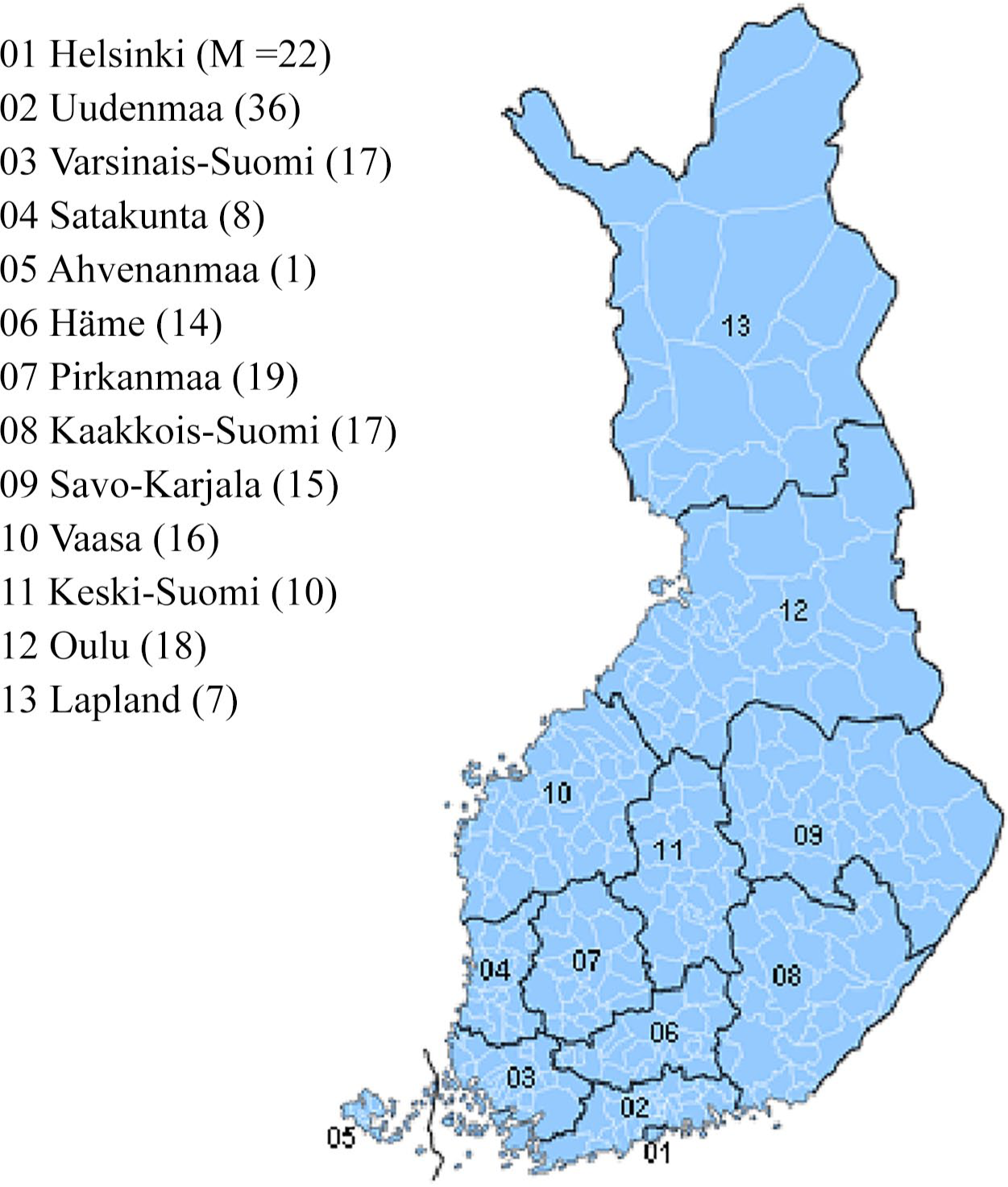
Map of Finnish Constituencies in 2019.
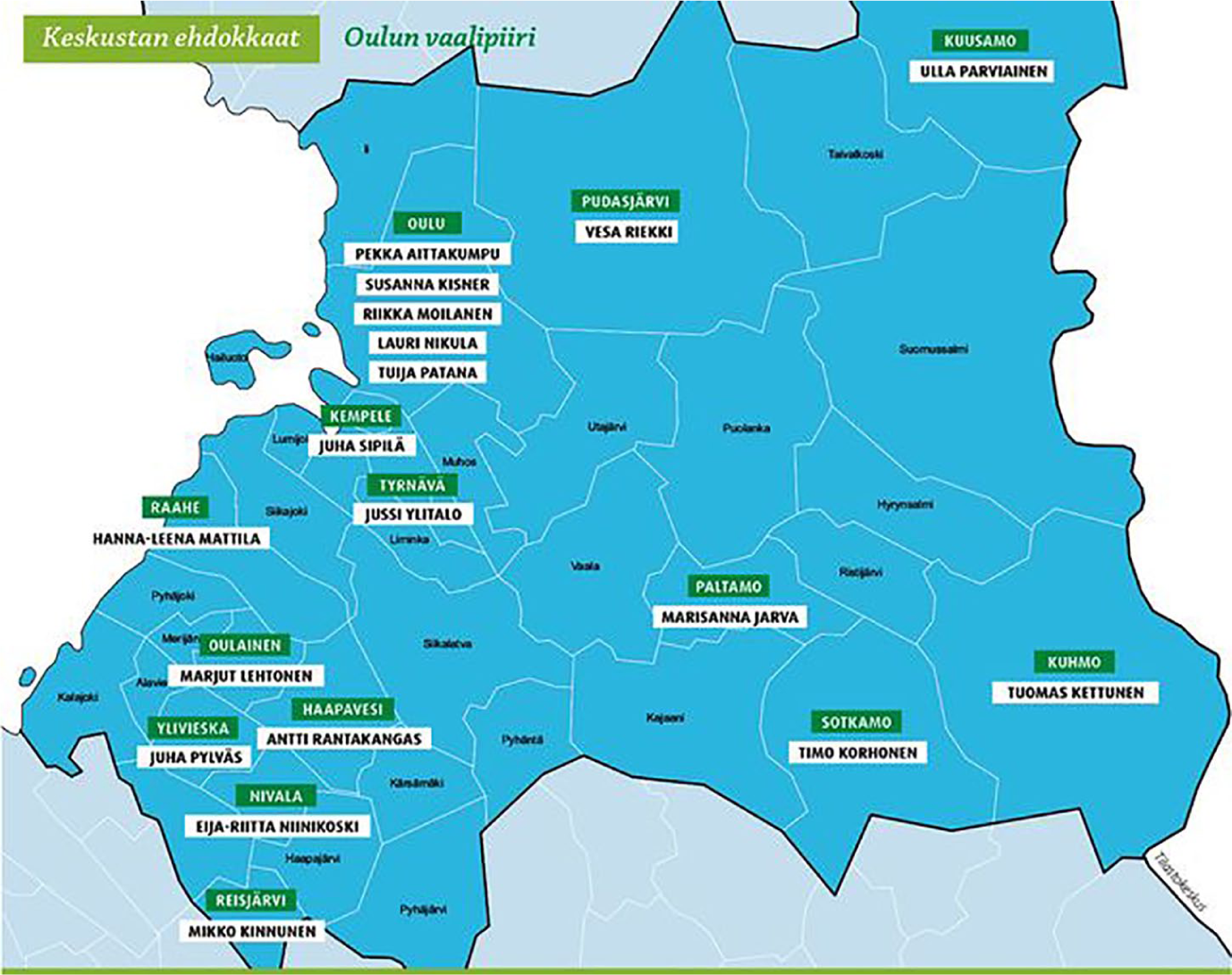
The Territorial Distribution of Centre Candidates in the Oulu District at the 2019 General Election.
As to party magnitude, the assumption is that a high P will (1) facilitate candidate recruitment (Schmidt and Saunders, 2004); (2) increase co-partisan rivalry at the selection stage; (3) incentivize personal vote seeking at the campaign stage; (4) contribute to defining the sub-district arenas of candidate competition. On the specifics of P, Oulu constituency has been a Centre stronghold. In five of the seven general elections between 1995 and 2019, the Centre (Keskusta – KESK) has won half the available seats and in the other two general elections it has secured one-third of the seats. The candidate (C) to seats won (P) ratio at 2:1 or in 2011 and 2019 3:1 has meant that KESK has gained a greater share of available seats in the Oulu district than any other party in any other constituency (district). KESK has consistently been the largest single party in the Oulu district, its support ranging from a low point of under one-third of the active electorate at the most recent general election in April 2019 to well over two-fifths in 1999 and 2007 and approaching half in 2003 (Table 1). However, electoral volatility levels have risen sharply subsequent to the breakthrough of the Finns Party (PS), which advanced by an unprecedented 16.6 percentage points in the Oulu constituency in 2011.
Election Results in the Oulu Constituency, 1995–2019 (%).
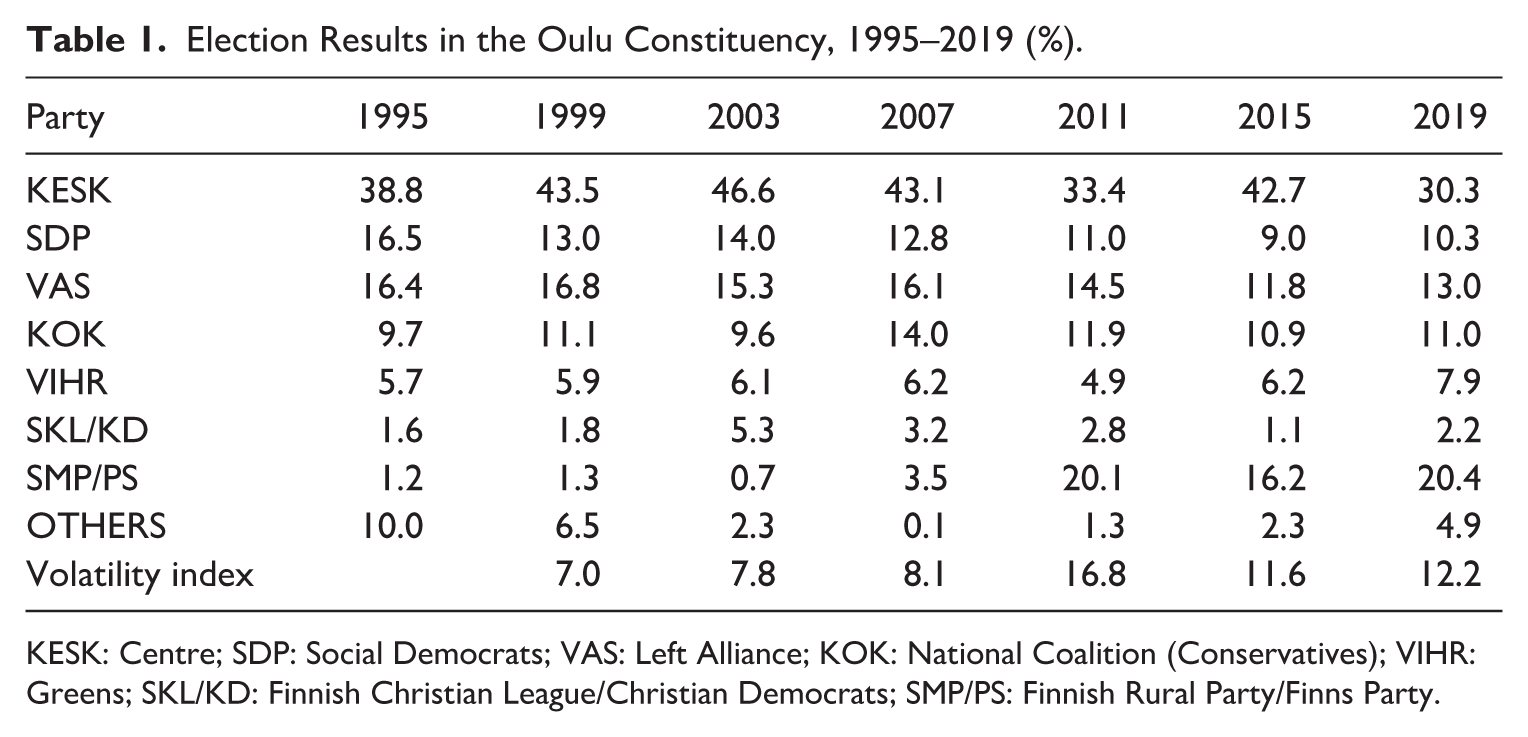
KESK: Centre; SDP: Social Democrats; VAS: Left Alliance; KOK: National Coalition (Conservatives); VIHR: Greens; SKL/KD: Finnish Christian League/Christian Democrats; SMP/PS: Finnish Rural Party/Finns Party.
The Centre’s consistently high relative party magnitude in the Oulu constituency has spawned a high effective number of co-partisans and made a persuasive prima facie case for lively intraparty competition at the district level. As Table 2 reveals, the Centre’s ENCP in the Oulu constituency (C = 18 throughout) in the six general elections between 1999 and 2019 averaged 13.48, the drop of 5 percentage points in 2015 due to the huge popularity of the party leader Juha Sipilä which skewed the distribution of the candidate vote (Dodeigne and Pilet, 2019). An average ENCP for the Centre of nearly 14 would indicate a wide dispersal of the party’s district vote and few ‘irrelevant candidates’ à la Cheibub and Sin (2020).
The Effective Number of Centre Co-Partisans in the Oulu Constituency, 1995–2019.
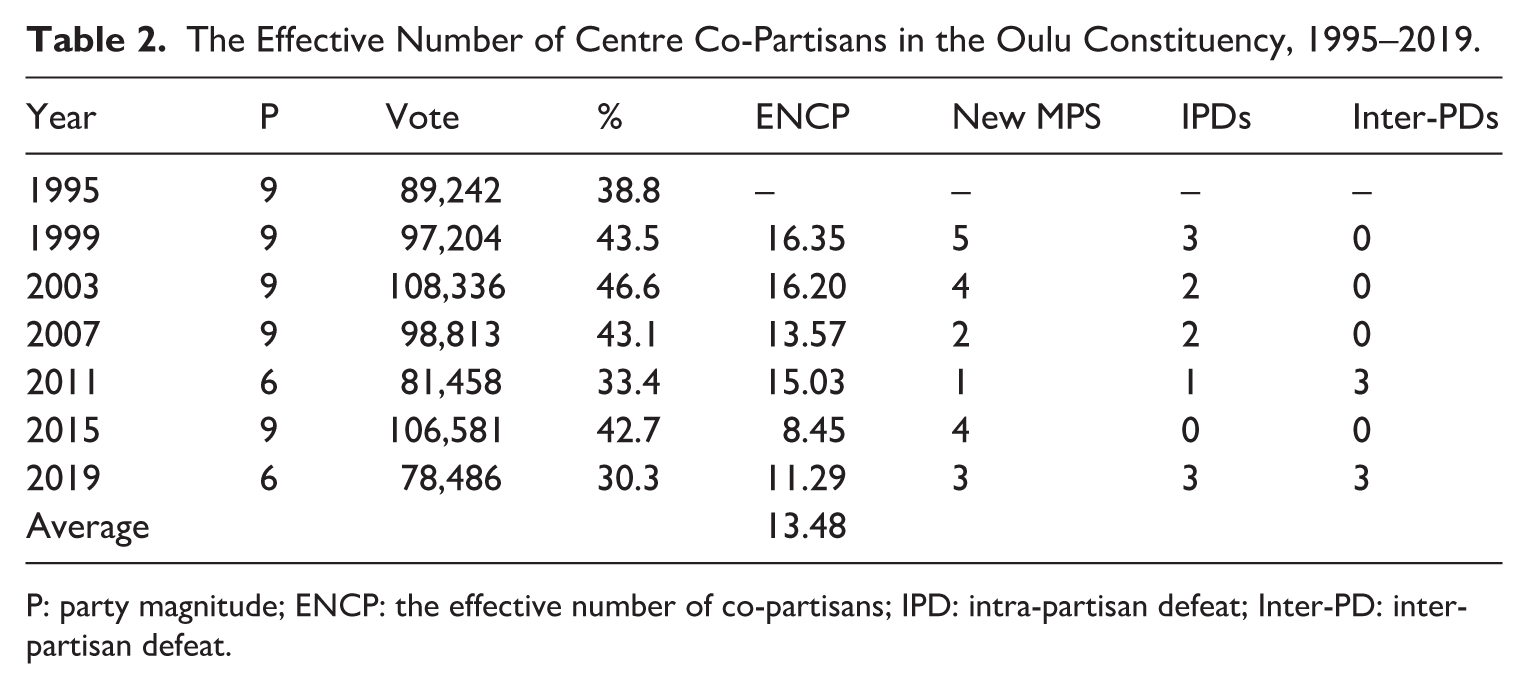
P: party magnitude; ENCP: the effective number of co-partisans; IPD: intra-partisan defeat; Inter-PD: inter-partisan defeat.
In terms of district magnitude, the assumption is that (1) larger parties will generally run a slate of candidates equivalent to M (Shugart, 2008); (2) M will affect the tactics of party competition; (3) a high M will reduce the effective electoral threshold and potentially reduce the incumbency advantage (Katz, 2003: 101). In the Oulu district, M = 18 has been constant for more than half a century and, as Figure 1 shows, it has been exceeded only by Helsinki and the hinterland constituency of Uusimaa. The average M in Finland over the 15 general elections since 1962 has been 14, making the Oulu district the third largest (with Vaasa) over that period.
The Centre’s Organisation in the Oulu Constituency
Table 3 sketches the Centre’s organisation in the Oulu electoral district before the 2019 general election. The electoral district (M = 18) is sub-divided into two party districts – Pohjois-Pohjanmaa (recruiting 15 list candidates) and Kainuu (three candidates). More precisely, two candidates are nominated by membership ballot from each of the four selection districts in Pohjois-Pohjanmaa and three by a membership ballot from Kainuu, which functions as a single district for candidate selection purposes. Of the remaining slots on the constituency party list, at least five are chosen directly by the Pohjois-Pohjanmaa district executive and at most two reserved to be filled by the central party. At the 2015 general election, the 29 municipalities in Pohjois-Pohjanmaa accounted for 83.3% of the Centre vote in the electoral district and the nine municipalities in the sparsely-populated Kainuu district 16.7%. All the selection districts registered a broadly comparable Centre vote in 2015 except Oulujoki, which encompasses the administrative centre of the region, the university city of Oulu, which accounted for just over two-fifths. The basic organisational unit in the Centre is the local branch party (paikallisyhdistys) and these operate at election times under the coordinating umbrella of the municipal party association (kunnallisyhdistys). The Centre has traditionally boasted the strongest grassroots organisation of any of the Finnish parties and, as a random example, the Sotkamo municipal party association (population = 10,371 on January 31 2019) embraced 20 local branch parties, including a Young Persons’ association.
The Centre in the Oulu Electoral District before the 2019 General Election.
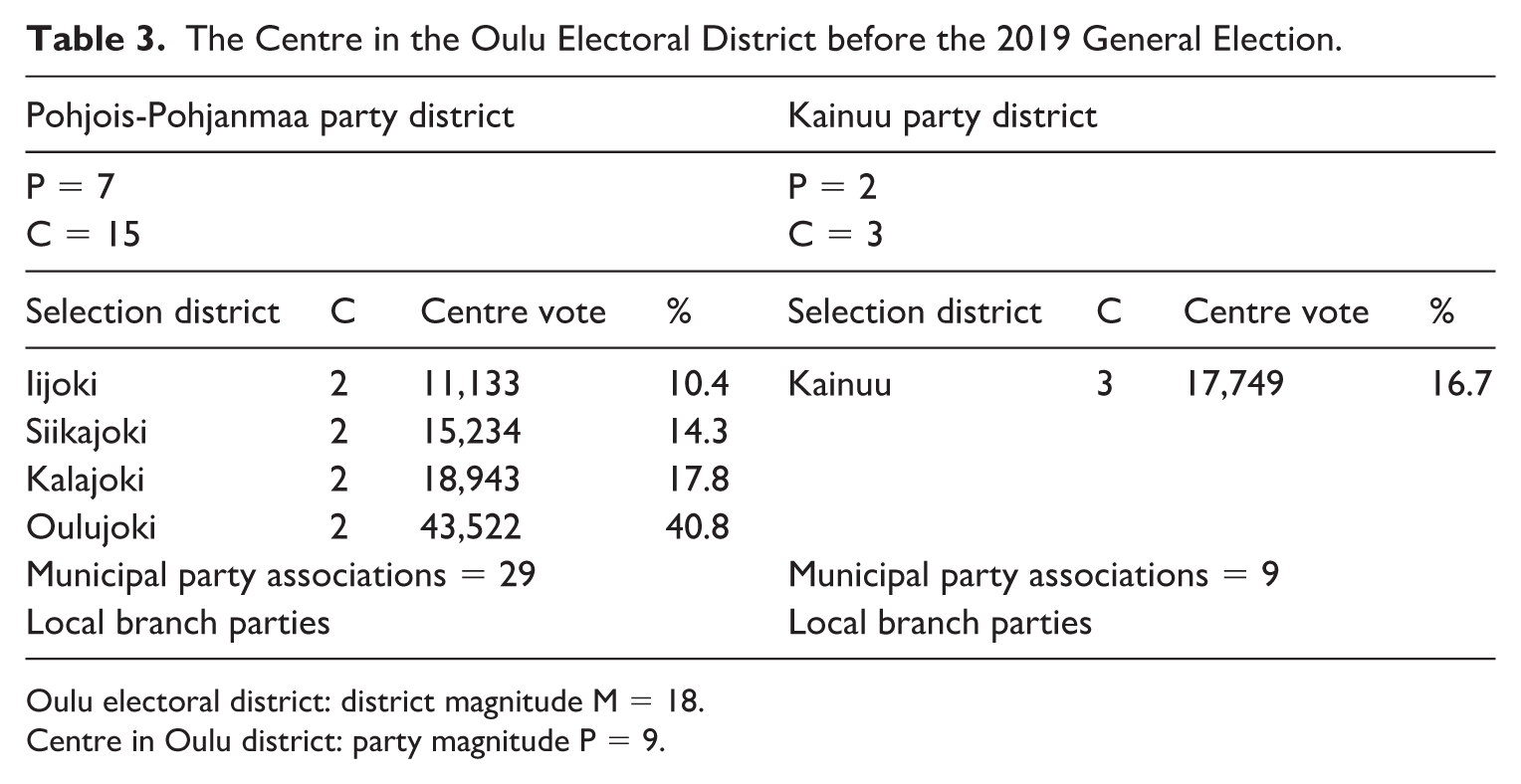
Oulu electoral district: district magnitude M = 18.
Centre in Oulu district: party magnitude P = 9.
At least two fundamental presumptions follow from the above. (1) The effective M and P are best viewed as within-district variables defined in large measure by the organisational structure of the party within the constituency. (2) The effective number of candidates (C) will reflect the allocation of list seats to each of the two party districts while the effective P will be the number of fellow-party candidates selected from each of the five dedicated nomination districts. In short, within a party district framework M, C, and P will interact to mould ‘geographical sub-constituencies’ (André and Depauw, 2018) or in Grofman’s (2005) terms candidates’ electoral constituencies.
Candidates’ Electoral Constituencies
To analyse the topography of intraparty competition in the Oulu district, Grofman’s (2005) distinction between the geographical constituency and a candidate’s electoral constituency is deployed. The geographical constituency refers to the territorial unit from which voters choose parliamentary representatives and it will vary in population size and seat allocation. A candidate’s ‘electoral constituency’ is defined simply as the territorial boundaries of his or her personal vote within the geographical constituency. Theoretically, a candidate’s electoral constituency could coincide with the geographical constituency although in practice in stronghold districts covering a large area this is unlikely to be the case, except perhaps for candidates with notably high name-recognition. Rather, the electoral constituency may be envisaged as comprising a number of sub-constituencies based on the distribution/concentration of the candidate vote by municipality (cf. Fenno, 1978).
A candidate’s primary electoral constituency will comprise the main catchment area of his or her personal vote. It will be recognised de facto as the candidate’s own ‘patch’ and, optimally, this will be reflected in a high party vote-share and a high personal vote-share. In other words, the candidate will be pre-eminent in the intraparty competition for votes and derive the lion’s share of his or her total personal vote from the primary constituency. In view of the salience attached in the literature to localism in intraparty contests (Arzheimer and Evans, 2012; Johnston et al., 2016; Key, 1949), and the force of ‘friends-and-neighbours’ voting, especially in rural communities (Gorecki and Marsh, 2014) – these dominate the Oulu constituency – the expectation might be that candidates would perform best on ‘home turf’. This is not necessarily the case. The primary electoral constituency is defined by the level of the candidate vote and, in theory at least, this may not be concentrated on home soil.
A candidate’s secondary electoral constituency will comprise the main supplementary catchment area of his or her personal vote. It will supply (where needed) the principal top-up vote outside the primary constituency and it may or may not be territorially contiguous with the latter. The secondary constituency will of necessity be less exclusive – the effective number of co-partisans will be higher – but the candidate will gain a greater proportion of his or her total personal vote there than elsewhere in the district outside of the primary core. Put another way, while there may be a degree of ‘distance decay’ (Gimpel et al., 2008) away from the primary electoral constituency, the candidate’s performance will be better than average in the secondary electoral constituency.
Finally, the candidate’s tertiary electoral constituency will comprise the peripheries of his or her personal vote-share. In contrast to the primary core, support in the municipalities will be mixed and mostly relatively marginal. The structure of the tertiary constituency will reflect inter alia the organisational structure of the party in the district, the type of candidate (incumbent/challenger), local voting patterns and a range of ad hoc factors including birth, schooling, prior residence and earlier periods of employment (typically as head of the municipal administration, kunnanjohtaja). Importantly, the tertiary electoral constituency is not necessarily geographically remote, although this may well be the case.
Hypothesising on Patterns of Intraparty Competition
Unlike other preferential systems, Finns vote at one and the same time for a party and a person and the two cannot be distinguished, still less counted separately. Bearing this in mind it seems reasonable to suggest that three mutually reinforcing vote-procuring attributes will combine to shape a candidate’s primary electoral constituency – partyness, localness and presence. Partyness refers to the candidate’s partisan credentials, and surveys over the last half century have consistently shown that about half the active Finnish electorate places the party element (partyness) before the personal element in its voting decision, although the precedence given to partyness has declined somewhat over the years. In 1958, 80% of voters prioritised party over candidate in their voting decision (Pesonen et al., 1993: 74); on the basis of the 2015 general election study, Coffé and von Schoultz (2020: 15) conclude ‘a candidate’s party affiliation matters most when they decide whom to support’, while according to the 2019 general election study (n = 1307), 56% of voters opted first and foremost for the party (Borg, 2020). The findings of the 2017 local government study (n = 1726) capture the enduring importance of partyness as a vote-earning attribute. There were in the order of 14 times more local candidates in 2017 than at the general election 2 years earlier and, especially in the smaller municipalities, many voters would have known one or more candidates personally. None the less, the partisan credentials of candidates emerged as the most decisive factor in the voting decision of respondents (Borg, 2018: 127). Partyness in sum, and being known as a ‘party person’, represents a staple ingredient in the personal vote.
Partyness and a second candidate attribute, ‘localness’, will be intertwined when, as is generally the case, candidates are elected members of the municipal council, a status that will also bestow profile and presence (Tavits, 2010: 227; Put and Maddens, 2015). Multiple office-holding is permitted in Finland and over the years in the order of 90% of MPs have been members of the municipal council (Arter, 2011; Arter, 2018; Raunio and Ruotsalainen, 2018) which meets on Mondays when the Eduskunta is not in session. Candidate localness will involve presence either in the form of local residency (Campbell and Cowley, 2014; Heron and Lynch, 2019) and/or the provision of regular arrangements for meeting with citizens in various parts of the locality. Unlike their British (Norton and Wood, 1990; Sällberg and Hansen 2020) and Irish (Martin, 2010) counterparts, Finnish MPs do not engage in ‘constituency service’ – the notion of constituency as a representational focus is notably weak compared with single-member voting systems. They do, however, undertake forms of ‘municipal service’ associated with their responsibilities as a local councillor.
The representational focus of candidates on a particular locality will resonate with a culture of local candidate voting. For Centre voters, significantly more than the average for the other parliamentary parties, it seems important for a candidate to be a known and locally based figure. In a telephone survey (n = 2000) undertaken a week before the April 2019 general election, 40% of Centre supporters (compared with 18% across the other parliamentary parties) held that it was important to know the candidate personally while 62% believed it was important that the candidate lived close to the voter’s home (the average was 43% for the other parties). 4 When localness as a party nomination strategy complements localness as a candidate resource and is underpinned by a culture of local candidate voting, it may be hypothesised that, irrespective of candidate type and municipal characteristics,
The localness factor in itself, however, may not suffice to secure election. The electoral value of localness – the home turf advantage – may be diminished by the presence of proximate co-partisan rivals with competing claims to localness. Moreover, the vote increment accruing from localness, based on a candidate’s exclusive and/or hegemonic position in the primary electoral constituency à la H1 – or what Put et al. (2020) refer to as candidate ‘localness and remoteness’ – may be undermined by the pull of a high-profile outsider who will skew the distribution of the candidate vote across the district. Put another way, localness and remoteness will be trumped by the appeal of a nationally known ‘offcomer’ who may not even need to canvass to attract votes in the locality. In any event, while survey research has pointed to the salience of territorial contiguity and the value of localness for a personal vote in areas neighbouring home soil (Evans et al., 2017), it may be surmised that the value of localness as a candidate resource and vote-driver will decline – there will be a measure of ‘distance decay’ (Gimpel et al., 2008) – away from home soil. The search will be for supplementary arenas of electoral support, especially if the home municipality boasts only a small electorate.
To understand the ecology of a candidate’s supplementary support, the structure and dynamics of the Centre’s recruitment process warrants the briefest note. In a party stronghold, as in the Oulu constituency, where candidate demand exceeds the supply of available list places, there is likely to be a ‘choice before the choice’ – to adapt from Rahat (2007) – at the pre-election stage. Put another way, where local branch parties within a municipality propose several candidates, there will be a municipality-based membership ballot to determine which of these local candidates advances to the district party’s membership ballot. Municipal membership ballots have been quite common in both the Centre’s Pohjois-Pohjanmaa and Kainuu districts. 5 Having gained the backing of the municipal party, the candidate will then hope to be chosen as a nominee of one of the geographically structured selection districts to stand in the party district’s membership ballot. This is by no means automatic and internal horse-trading may well mean strong candidates falling by the wayside. 6 In any event, to win one of the automatic places on the party list, the candidate will then need to mobilise support outside the home patch and the cluster of municipalities making up the ‘home’ selection district is an obvious point of departure. As a former chair of the Pohjois-Pohjanmaa district remarked, ‘it is more difficult to negotiate the selection stage than the election itself’ 7 and in the intraparty competition for members’ votes, attracting support in the home selection district would appear a sine qua non.
Aside from the vote-attracting value of the ‘partyness, localness, presence’ triad, candidates may well be able to mobilise functional networks – as teachers, nurses, clerics 8 and so on – and gain more or less discreet ‘sponsorship’ from professional bodies, so extending the ‘reach’ of their campaign (André and Depauw, 2019). Moreover, a friend or relative of a candidate, having relocated from the home municipality to a larger town for work-related reasons, could well spread the word on behalf of the candidate. The city of Oulu in particular has become a magnet for migrants from other parts of the constituency. Clearly too, it makes sense for a candidate to trawl the party vote where there are most votes to be competed for, even in the teeth of lively co-partisan competition. At times, to be sure, purely random factors appear at work in the geography of the personal vote. At the 2019 general election, a young architect and KESK candidate in Oulu city gained 13% of her personal vote from a single voting area in the Kainuu municipality of Sotkamo, 196 kilometres away by road. She had not campaigned in the Kainuu district, had no friends or relatives in Sotkamo and, in her words, ‘even thought it could be a mistake’. 9
None the less, there is evidence both from the experience of other parties and from the Centre’s other constituencies of the strength of parochial voting patterns and the way the vote traffic across historic county boundaries and between historic market towns is conspicuously light. According to one Left Alliance candidate at the 2015 general election, leftist voters in Kainuu will not vote for Left Alliance candidates in Pohjois-Pohjanmaa – the border, she claimed, runs through the municipality of Vaala (see map). 10 Campaigning in the same general election, a Social Democrat in the central-southern Häme constituency commented that the distance between the towns of Hämeenlinna and Lahti is less than 100 kilometres but ‘somewhere between the two there is an invisible barbed-wire fence over which votes do not travel’. 11 Significantly, when the two small-M constituencies of Pohjois-Savo and Pohjois-Karjala were conjoined in 2015, only 16% of Pohjois-Savo voters backed the 10 parliamentarians based in Pohjois-Karjala while under 10% of Pohjois-Karjala voters backed the 5 MPs elected from Pohjois-Savo. As the Centre’s party district manager in Pohjois-Karjala put it, ‘people from Vieremä (a Pohjois-Savo municipality) and Kesälahti (Pohjois-Karjala) will not meet each other much in life and the threshold for voting across county boundaries rises accordingly’. 12 A veteran Pohjois-Pohjanmaa parliamentarian related how as a campaign strategy when he canvassed in the Kainuu district he always did so in the company of Kainuu-based candidates. He would say jokingly that if those present did not fancy one of the Kainuu candidates they could always vote for him – and some did. 13 All in all, given the bifurcation of the Oulu constituency into two regionally based Centre party districts, each with its own management structure, candidate selection procedures and so on; given the cost of travel between the two districts; and given the force of local/regional voting loyalties and the likely low return on campaign effort – especially for Pohjois-Pohjanmaa candidates in the sparsely-populated Kainuu – it seems likely that:
Data and Operationalisation
This article employs a multi-method approach. First and foremost, in seeking to test these three hypotheses it draws on the official electoral statistics (tilastokeskus – https://www.stat.fi) which, in the five general elections between 2003 and 2019, break down the individual candidate vote in the Oulu constituency both by municipality (kunta) and the voting areas (äänestysalueet) within the municipality. These data were not available before 2003 and have not been used in this way before. However, the article also benefits from a range of complementary sources, inter alia articles in little-known municipal newspapers in the Oulu region; correspondence with Centre personnel, including the district managers of the Pohjois-Pohjanmaa and Kainuu party districts; and interviews with constituency politicians, among them serving and former parliamentarians and candidates in the membership ballots. Along with candidate websites and blogs, this supplementary evidence sets the statistical data on a firm contextual foundation.
In relation to the statistical data, then, the municipality is the basic unit of electoral analysis. Accordingly, the distribution of the personal (candidate) vote is then broken down by (1) home municipality; (2) the selection districts in the Oulu constituency (four in Pohjois-Pohjanmaa and one in Kainuu) for all the Centre’s parliamentary candidates (n = 90) in the five aforementioned general elections (see the online Appendix).
Superiority in a candidate’s primary electoral constituency – hypothesised H1 as the ‘home municipality’ – is measured in two analytically distinct ways: (1) the candidate’s personal share of the municipal party vote. This permits an assessment of performance relative to that of co-partisan competitors. Relevant questions here would run – did the candidate gain the largest share of the municipal party vote and what was the effective number of co-partisans? Clearly, the higher the candidate’s party vote-share, the lower the ENCP. The closer to 1, the greater the candidate’s pre-eminence on home turf. (2) The candidate’s personal vote-share in the home municipality as a proportion of his or her personal vote in the electoral district as a whole. This permits an insight into the candidate’s performance on home turf relative to that in other areas of the constituency.
The candidate’s secondary electoral constituency – hypothesised H2 as the home selection district – is assessed by reference to personal vote-share as a proportion of the total personal vote in each of the five selection districts across the country excluding the personal vote-share in the primary constituency (home municipality). To validate H2, the candidate should receive a substantial share of his or her supplementary personal vote from the home selection district.
The tertiary electoral constituency – hypothesised H3 as defined by the boundaries of the party district – is analysed by establishing the proportion of a candidate’s personal vote obtained on the ‘other side’ – that is, Kainuu for Pohjois–Pohjanmaa-based candidates and Pohjois-Pohjanmaa for candidates selected in the Kainuu party district.
Results
In line with H1, in an average of 80% of cases over the five general elections in the Oulu constituency between 2003 and 2019, the local Centre (KESK) candidate obtained a plurality of the party vote in his or her home municipality. Outside the city of Oulu, only in the Kainuu district municipality of Sotkamo, which in 2007 ran two local candidates, did a candidate not command a majority poll on home soil. Evidence that the local candidate gained the largest share of the local party vote is perhaps less surprising than the generally low effective number of co-partisan rivals. In those municipalities where a local KESK candidate ran in general elections between 2003 and 2019, the average ENCP was 3.47 and in a quarter of cases under 2.0. Several municipalities were in practice the bailiwick of a single party figure. In this respect, the city of Oulu and its hinterland – with more party votes available and more competition for them – represented an outlier. The best-performing local candidate in 2003–2019 gained only a little over one-fifth of the city vote and the average ENCP stood at 7.4.
Turning from party vote-share to personal vote-share, almost half (48.9%) of all KESK candidates in the five general elections between 2003 and 2019 received the highest share of their personal vote across the constituency in the home municipality and this accounted on average for well over half (55.7%) of their personal vote. In nearly 16% of cases, over three-quarters of the personal vote was drawn from the home municipality. Equally, given the variable size of municipalities, in only just under 15% of cases where the candidate gained the greatest share of his or her personal vote on home turf did this contribute to election. Indeed, only in the cities of Oulu and Kajaani, and for a time the Kainuu municipality of Kuusamo, has the KESK vote exceeded the threshold for election in the Oulu constituency when operationalised as the average poll of the last-place ‘winner’ on the party list. To make it to parliament a top-up vote has invariably been needed from outside the candidate’s primary electoral constituency.
In so far as selection districts have comprised clusters of proximate municipalities – their number ranged in 2019 from four municipalities in the Iijoki river valley selection district to nine in both Siika-Pyhäjoki and Kainuu – and in so far as selection districts serve as recruitment agencies and a gateway to ballot access for aspiring politicians, it was expected in line with H2 that the home selection district would account for a sizable share of a candidate’s personal vote across the district. It would represent a significant supplementary personal-vote channel and define a candidate’s secondary electoral constituency. In fact, in 42% of cases the home selection district accounted for a majority of the candidate’s personal vote across the constituency. The personal vote-share ranged from an average of over one-third (36.7%) in Siikajoki to approaching two-thirds (61.5%) in Kainuu. While H2 thus gains support, and the source of supplementary votes in the home selection district makes prima facie a persuasive case for territorial contiguity in the ‘localness effect’, caution is needed. Between 2003 and 2019 the Iijoki valley in particular was characterised by highly parochial voting patterns with little by way of spill-over into the neighbouring municipality, even if a fellow-party candidate was not standing there. With the Kainuu incumbent Ulla Parviainen fighting for her parliamentary life in 2019 – she gained 87.7% of her personal vote in her home municipality of Kuusamo 4 years earlier – she managed only 8% of her total personal vote from neighbouring Taivalkoski where there was no local KESK candidate (cf. Put et al. 2020). She was not re-elected. 14
In respect of H3 and the tertiary candidate constituency, an average of 95.6% of the personal vote of all KESK candidates between 2003 and 2019 was cast within the confines of the home party district. Equally, while the average vote-share from outside the party district amounted to a modest 2.5% for Pohjois-Pohjanmaa candidates, it was nearly five times greater for Kainuu district candidates. Kainuu candidates with high national/regional name-recognition – ministers or senior party politicians – have been able to attract a personal vote across the party district divide without necessarily campaigning hard for it. For marginal incumbents and strong challenger candidates in the sparsely populated Kainuu district, the imperative of seeking a ‘supplementary’ personal vote within the Pohjois-Pohjanmaa district has yielded a variable cross-border dividend. All in all, there is only limited support for H3 since the tertiary electoral constituency of Kainuu district candidates is more dispersed and significantly less party district-based than their Pohjois-Pohjanmaa counterparts. Candidates seriously aspiring to election in party districts with a low party magnitude will have an incentive to cultivate a personal vote on a wider front although in the Kainuu case the point should not be exaggerated. Six of the nine KESK Kainuu candidates between 2003 and 2019 gained under 8% of their personal vote from Pohjois-Pohjanmaa.
Concluding Remarks
The point of departure for this study was a basic question: what, if anything, can be inferred about (the incentive to engage in) personal vote seeking and patterns of intraparty competition from the distribution of the candidate vote in an electoral system appearing to encourage co-partisan rivalry? The utility of much of the personal vote seeking (incentives’) literature was queried in so far as it draws solely on district-level variables; fails fully to acknowledge that candidates will not have an equal incentive to compete for a personal vote; and more or less explicitly excludes a range of salient contextual factors, particularly the role of the district party organisation as an electoral actor, the range of nomination strategies at its disposal and its significance in shaping the electoral constituencies of candidates. The ‘incentives literature’ in short appears formulaic, mechanistic, and divorced from political reality on the ground.
In order then to place party-level factors à la Bergman et al. (2013) at the forefront of the analysis, the empirical work focused on the Centre stronghold of Oulu constituency in northern Finland. Based on the ‘effective number of co-partisans’, personal vote seeking and intraparty competition appeared extensive at the district level. For a party routinely winning half the seats, there appeared (unsurprisingly) to be lively intraparty competition for a share of the spoils and few ‘irrelevant candidates’ (Cheibub and Sin, 2020). However, the picture appeared very different when the same measure was used to map the distribution of the candidate vote at the municipal (sub-district) level. In line with two of the three hypotheses presented, it appears that (1) the personal vote of Centre candidates displayed a strong home turf bias – their primary electoral constituency (H1) was the home municipality, where their party vote-share was high, the effective number of co-partisans relatively low and almost half of all candidates gained the highest share of their personal vote in the district. (2) The secondary electoral constituency of Centre candidates comprised the relevant selection district (H2), operationalised as the four river valleys in Pohjois-Pohjanmaa on the one hand and the Kainuu party district on the other. In over two-fifths of cases, the home selection district (excluding the home municipality) accounted for a majority of candidates’ personal vote-share across the constituency. As to H3, while overall the personal vote-share of Centre candidates, and by extension intraparty candidate competition, was predominantly party district-based rather than electoral district-wide in character, it was less so for Kainuu candidates than those in Pohjois-Pohjanmaa. The tertiary electoral constituency of Kainuu candidates was overlapping, mirroring to an extent the smaller pool of votes available in a district experiencing significant rural de-population.
All in all, when the distribution of the candidate vote in a party stronghold is analysed below the level of the electoral district, the relatively low effective number of co-partisans in municipalities where a candidate has run – under two in a quarter of cases in the period 2003-2019 – together with the concentrations of personal vote-share in the home municipality and/or ‘near abroad’ would suggest that the intraparty competition is substantially less extensive than the district-level measure would indicate.
At this point, a crucial caveat must be entered regarding the central question of what may reasonably be inferred about personal vote seeking from the distribution of the candidate vote. A personal vote may or may not be the result of personal vote-seeking activity. High name-recognition, for instance (Lehtomäki in 2007 and Sipilä in 2015), may well negate localness as a personal vote-earning attribute and a high-profile figure may receive votes without actively seeking them. Moreover, as we saw in the case of the pocket of support for the Pohjois-Pohjanmaa candidate Patana, in a single voting area in far-away Sotkamo in 2019, at times purely random factors appear at work in the geography of the personal vote. Yet while the personal vote is not necessarily the product of personal vote seeking, the concentration of personal vote-shares in primary and/or secondary candidate constituencies would appear to demarcate the effective parameters of personal vote seeking.
In any event, a principal purpose of this case-study of the Centre in its Oulu district stronghold has been to inject a significant element of ‘nitty-gritty’ into work on the intraparty dimension in open-list preference voting systems. The ratios of candidates to district/party magnitude tell us very little about electoral politics ‘on the ground’: the variety of candidate types, constituency types, party nomination strategies, the extent of intraparty organisational competition, the role of territorial magnitude and the strength of regional/area sentiments among both candidates and voters. Indeed, the present analysis of the distribution of the candidate vote by municipality, selection district and party district has pointed to several contextual factors that serve more as disincentives than incentives to cultivate a personal vote across the entire electoral district. When, as we have seen, a candidate ‘sponsored’ by a local party branch and backed by a municipal party association, receives the lion’s share of his or her personal vote from the home patch and its hinterland, and there is a strongly entrenched culture of local candidate voting, the incentive to expend finite time and resources campaigning in a far corner of a vast electoral district is likely to be extremely limited.
When viewed in a comparative perspective (cf. André and Depauw, 2019) there is a wider point here, namely, the paramount importance attached to area representation (paikallisuus) in Finnish electoral politics. The representational focus of candidates, and the local/municipal parties backing them in the selection/election process, is on the representation of a particular area (town/region) within a constituency and intraparty competition (the candidate and organisational dimensions) involves first and foremost campaigning to give that area a voice in parliament. Some MPs even refer to themselves as MPs for a particular town/municipality, while media reporting in the event of a poor result will declare that ‘town X no longer has its own MP’. In many ways, in short Finns elect ‘local MPs’ if not British-style ‘constituency MPs’. Intraparty competition is bounded by the norm of area representation, and this contributes more than a little to the geographical configuration of candidate support. In this respect, the ‘friends and neighbours’ debate would benefit from being set in the wider context of the representative culture in different countries and the different parties within them.
Of course, to a greater or lesser extent, and irrespective of electoral arrangements, there will be a personal element in candidate campaigning. Put another way, in varying degrees, and more or less discreetly, candidates with elevate ‘personal representation’ over ‘party representation’ (Colomer, 2011) in their campaigning. As a generalisation, the logic of personal vote seeking would appear greatest when the ‘party element’ is a strongly negative asset, namely when the candidate’s party is battling into a headwind in the opinion polls and faces likely electoral defeat. In personalised electoral systems (Pilet and Renwick, 2018), to be sure, the personal element would appear more likely to be pronounced. However, there is the need now, both in Finland and elsewhere, for a greater focus on the logistics and dynamics of candidate campaigns – the ‘electoral connection’ in action. We know from the recent literature (Zittel, 2015) what a personalised district-level campaign looks like ‘on paper’ but we know very little about how it operates in practice in a competitive electoral market-place. Does the incentive to garner a personal vote associated with preferential voting systems necessarily involve a personalised candidate campaign or, more exactly, how personalised are candidate campaigns from an organisational perspective? How independent of the candidate’s party are they in terms of their active personnel? If the point made in this article is correct, that local/municipal parties cultivate a candidate as much as a candidate cultivates a personal vote, it follows that campaign activists will be drawn from the party more than drawn to the personal attributes of the candidate. In short, the candidate-party-activist relationship in the course of so-called personalised campaigning warrants further research.
Supplemental Material
sj-pdf-1-psw-10.1177_1478929920982509 – Supplemental material for ‘It’s a Long Way from Kuusamo to Kuhmo’: Mapping Candidates’ Electoral Constituencies in the Finnish Open-List Single Preference Voting System
Supplemental material, sj-pdf-1-psw-10.1177_1478929920982509 for ‘It’s a Long Way from Kuusamo to Kuhmo’: Mapping Candidates’ Electoral Constituencies in the Finnish Open-List Single Preference Voting System by David Arter in Political Studies Review
Footnotes
Declaration of conflicting interests
The author(s) declared no potential conflicts of interest with respect to the research, authorship, and/or publication of this article.
Funding
The author(s) received no financial support for the research, authorship, and/or publication of this article.

Supplementary information
Additional supplementary information may be found with the online version of this article.
Notes
Author Biography
References
Supplementary Material
Please find the following supplemental material available below.
For Open Access articles published under a Creative Commons License, all supplemental material carries the same license as the article it is associated with.
For non-Open Access articles published, all supplemental material carries a non-exclusive license, and permission requests for re-use of supplemental material or any part of supplemental material shall be sent directly to the copyright owner as specified in the copyright notice associated with the article.
