




Abstract
Ministerial advisors have become an essential aspect of executive branches worldwide, thus making the ministerial advisor office a potential route for young politicians aspiring to an expanding political class. The article studies which professions ministerial advisors migrate to following their ministerial careers, how ministerial advisors’ post-ministerial careers compare to their pre-ministerial careers, and if the variance in careers can be explained by the resources that ministerial advisors obtain while in government. Empirically, the article draws on a cohort of 139 ministerial advisors in Norwegian governments between 2001 and 2009; it covers positions in the political sphere and the public, private and voluntary occupational sectors over a period from each ministerial advisor’s youth to the end of 2017. The bibliographic data are combined with surveys and elite interviews. The results show that more than expanding the political class as a recruitment ground for future Members of the Parliament and ministers, ministerial advisor appointments serve as stepping-stones to careers outside of politics. Most ministerial advisors experience shifts between occupational sectors and upwards to higher positions. However, ministerial advisors’ attractiveness in the labour market is surprisingly unaffected by what they actually did in office; rather, it rests on resources such as insider knowledge and networks.
Introduction
According to some scholars and critical observers, a political class has emerged in established democracies. Consisting of people with lifelong political careers, this class is detached from the people they are elected to represent (Allen and Cairney, 2017: 19; Borchert, 2003). Politicians increasingly surround themselves with advisors, be it at party headquarters (Webb and Kolodny, 2006), in parliament (Karlsen, 2010; Karlsen and Saglie, 2017) or in government ministries (Diamond, 2011; Eymeri-Douzans et al., 2015; Shaw and Eichbaum, 2018; Yong and Hazell, 2014). The growth in the number of advisors suggests that these are positions for an expanding political class or stepping-stones for aspiring top politicians.
Such advisors and ministerial advisors (MAs) in particular, used to ‘live in the dark’ (Blick, 2004), but after 10–15 years of considerable scholarly attention, we now know that MAs are a growing group of powerful actors at the core of executive government. They advise ministers, liaise across ministries and with parliament and oversee the bureaucracy’s policy implementation (Askim et al., 2017; Craft, 2015; Eichbaum and Shaw, 2010; Eymeri-Douzans et al., 2015; Hustedt et al., 2017). However, it remains unclear the extent to which MAs remain in politics or migrate to other arenas and whether service in high public office pays off career-wise. Scholarship utilizing a career rewards perspective has shown that monetary and visible rewards for high public office ‘do not extinguish with [the] end of tenure but rather provide new credentials which expand [politicians’] ability to fulfil their career ambitions’ (Claveria and Verge, 2015: 819; see also Brans and Peters, 2014). The potential revolving-door problem refers to former politicians migrating to jobs where their insights entail a competitive advantage for employers (Boucher and Cooper, 2019; Parker et al., 2012; Selling and Svallfors, 2019).). However, little is known about what aspects of their work in the core of executive government make MAs attractive to outside employers (Hustedt et al., 2017; Wilson, 2016).
This article thus addresses a gap in political science scholarship by analysing MAs’ careers before and after politics and the effect that political service has on their careers. We ask three interrelated questions. First, which professions do MAs migrate to following their ministerial careers? For example, is the predominant pattern to remain in or transition out of politics? Second, how do MAs’ post-ministerial careers compare to their pre-ministerial careers? For example, is the predominant pattern that MAs obtain higher professional positions afterwards or that they stall or regress? Third, can the variance in careers be explained by the resources that MAs obtain while in government? For example, do MAs with independent executive power advance to higher professional positions than those who only counsel ministers or perform menial duties do? And does it help an MA’s career if they have worked in a prestigious ministry?
Empirically, this article is based on the coding of biographical data from 139 individuals who were MAs in Norwegian governments between 2001 and 2009. It covers, in detail, positions in the political sphere and the public, private and voluntary occupational sectors over a period from each of the individuals’ youth to the end of 2017. Thus, the article responds to calls for career research to cover the positions held in various occupational sectors (Blach-Ørsten et al., 2020) and the multiple positions held before and after a period in office, not just those held immediately before and after (Claveria and Verge, 2015). We study career development based on individual-level calculations of occupations before and after serving as MAs. We combine this innovative use of biographical data with a comprehensive survey and elite interviews. High response rates in surveys and access to elite sources such as MAs enable such methodological triangulation.
The results show that the predominant pattern is for MAs to transition out of politics. MAs’ attractiveness in the job marked is less a result of what they actually do while in office and more a question of the insider knowledge and networks they acquire. As such, a main contribution of the article is the demonstration that there is professional advantage to becoming a MA, even if they do not remain in politics. In this sense, we expand on the existing body of knowledge from studies of members of parliament (MPs) and cabinet ministers. We also show that such professional advantage does not necessarily expand the political class in a permanent sense.
Career Perspectives on Ministerial Advisors
MAs are appointed to serve an individual minister; their position is temporary, and they are recruited on the basis of political criteria (Hustedt et al., 2017). Although employed in the core executive, conventions vary across political systems regarding whether MAs are seen as politicians (Shaw and Eichbaum, 2018). Nevertheless, the growth in the number of MAs in most established democracies (Dahlström, 2009) and evidence that MAs have considerable political influence (Hustedt et al., 2017) raise questions about whether they should be considered as members of the political class (Allen and Cairney, 2017; Borchert, 2003). For decades, scholars have argued that being a politician has become a profession in its own right (Wilson, 1962), and MAs can be seen as yet another position for members of an expanding political class. MAs do not necessarily remain in politics – their careers are boundaryless (Blach-Ørsten et al., 2020: 1). For MPs and government ministers, transitioning out of politics is relatively rare (Claveria and Verge, 2015), and it can be traumatic; some struggle to find work (Blondel, 1991; Docherty, 2001; González-Bailon et al., 2013; Nicholls, 1991; Theakston and de Vries, 2012). MAs have a better opportunity structure. They tend to be younger than MPs and ministers when they leave office and have a longer working life ahead of them (Askim et al., 2014; Goplerud, 2015). Moreover, to a relatively lesser extent, they have also nailed their political colour to the mast (Goetz, 1997: 769), thus avoiding potential professional disadvantage outside of politics (Meyer- Sahling, 2008). MAs also have a comparably higher number of yet-to-be-claimed positions that represent advancement on a political career path and a larger pool of positions outside of politics that represent upwards career development.
Studies of MAs in the UK (Goplerud, 2015; Sellers, 2014; Yong, 2014), Sweden (Selling and Svallfors, 2019) and Denmark (Blach-Ørsten et al., 2020) show that only a minority of them continue in politics; higher proportions go into the public or private sector; the general picture is one of promising career prospects, not least outside of politics.
To some, therefore, the issue arising from the careers of MAs is not that they are part of a detached political class but, rather, that they can use insights and skills – ‘specialized human capital’ (Parker et al., 2012) – acquired while serving in public office to obtain high positions outside of politics. This so-called revolving-door problem captures the practice of former politicians migrating to jobs where the insights, networks and other resources they have obtained in high-octane politics can give their new employers a competitive advantage (Boucher and Cooper, 2019; Parker et al., 2012; Selling and Svallfors, 2019). For example, politicians are cognisant that external actors can effectively influence government decisions about subsidies, procurement and regulation (Cohen, 1986).
Resources and Careers
So far, no study of MAs has systematically studied the variation in MA careers outside of politics or attempted to make this variation the object of explanation. We do so and build on existing insights positing that variance in politicians’ careers can be explained by a combination of ambitions, opportunities and resources (Borchert, 2011; Nicholls, 1991; Parker, 2008; Parker et al., 2012; Schlesinger, 1966; Selling and Svallfors, 2019; Stolz, 2003). We focus on resources obtained while in office – a continuation of the argument made by Sellers (2014: 235–246) in her study of British special advisors: Outside employers are interested in the skills MAs attain during their ‘apprenticeships’ in the core of executive government.
One resource factor is hierarchical rank within a polity (Claveria and Verge, 2015: 821). Formal rank varies among parliamentarians (some lead committees, for example, while others do not), ministers and, in some systems, MAs. Higher-ranking MAs are expected to be better positioned than lower ranking counterparts to be recruited to high post-ministerial positions.
A second resource factor is the length of one’s political service – one’s tenure. Claveria and Verge (2015: 827) found that tenure matters regarding whether departing ministers can secure a new position in politics. Diermeier et al. (2005: 364) found that long congressional experience was associated with attractive post-congressional occupations. They also found that experience had a reduced marginal effect after a first re-election, possibly reflecting that prolonging one’s stay in politics could limit a politician’s career options outside of politics (Byrne and Theakston, 2016). Some MAs serve for only a few months, others for several election periods (Wilson, 2016).
Centrality is a third potential resource factor. The type of portfolio held by departing ministers has been shown to matter for career development (Claveria and Verge, 2015: 829; González-Bailon et al., 2013: 869). Some policy portfolios, such as business regulation and defence, are likely of particular relevance for securing work in private lobbying firms and big corporations that pursue close access to the government. Other portfolios, such as the Ministry of Finance and the Prime Minister’s Office (PMO), are probably a resource for any future career path, since they give unique insights, experience and credibility. Portfolios should be of importance to the post-ministerial careers of MAs, as in the case of ministers.
Rank, tenure and centrality are proxies for the skills/resources that MAs can obtain while in office. A more direct measure is the tasks that MAs perform in the ministry. This is a fourth potential resource factor for future employment. Across and within countries, some MAs are primarily media officers or mere bag carriers for ministers, while others work closely with policymaking and/or have executive responsibility in the ministry (Askim et al., 2017, 2018; Goplerud, 2015). Those who have experienced considerable executive responsibility in a ministry attain more knowledge and skills than those without such experience. This should make them more attractive targets for outside employment, particularly for advanced positions. Goplerud (2015: 337) found that special advisors with a media background were less likely to run for parliament. The tasks performed in the executive have so far not been used as a variable in large-N studies of careers, probably because the data are not easily accessible. Thus, we expect that the variance in MAs’ post-ministerial careers can be explained by individual-level variance in in-office rank, tenure, ministry centrality and executive responsibility.
Research Setting
Norway has two MA positions. Political advisors (established in the 1990s as a continuation of the personal secretary position introduced in 1946) are appointed by the PMO. The political advisor shall be at the personal disposal of the minister and shall perform tasks assigned by the minister. Political advisors cannot have independent decision-making authority (Kolltveit and Thorsen, 2018). The state secretary position was introduced in 1947 to reduce ministers’ workload (Askim et al., 2014). They are mentioned in the constitution and are appointed in the Council of State. State secretaries can act on behalf of their minister in all capacities, except in the cabinet. They assist the minister in leading the ministry, but the extent of their decision-making authority varies considerably (Askim et al., 2017). As in many other countries (Dahlström, 2009), the number of MAs has grown steadily since the 1960s. In 2019, Norway had 22 cabinet ministers and 71 MAs.
The observations cover MAs from two governments, the Bondevik II (2001–2005) three-party centre-right coalition government and the Stoltenberg II (2005–2009) three-party centre-left coalition government. Parliamentary elections in Norway have been held every 4 years since 2001, and all 6 political parties in government between 2001 and 2009 have been in government again between 2009 and 2017. Therefore, all the MAs covered by this study have had a chance to obtain new high positions in national politics.
Data and Methods
The data collection began with a survey in 2015 of all state secretaries and political advisors from the Bondevik II and Stoltenberg II governments. The survey had a response rate of 73%. We used survey items on tasks performed (executive responsibility), age at entry and careers before and after serving as MAs in the governments under study. We then constructed a detailed data set on the careers of the 139 MAs for whom relevant survey data were complete. We reconstructed their detailed CV, starting from their very first professional position up to the position held at the end of 2017. The sources were parliamentary and ministerial web pages, press releases from employers and online biographies. Cross-checks were conducted against the career data from the survey. To fill any gaps in the career data, correspondence was undertaken with political party offices and the respondents themselves. Jobs held for less than 6 months were not recorded. There were no gaps after several rounds of quality checks, with the only possible missing data being whether a person had a break from one position to temporarily take up another. Given the level of transparency in the empirical context and the thoroughness of the data collection, it is unlikely that we missed positions of significance.
In the explanatory analysis, we focused on two dependent variables that were constructed on the basis of the career measures described in Table 2. An MA’s score on the dependent variable ‘Peak position outside politics’ (used in Model 1 in Table 4, see later) was the value of the highest position reached in the private sector, central government or voluntary sector in the post-MA phase. A score on ‘Career development outside politics’ (used in Figure 1 (shown later) and Model 2 in Table 4, see later) was the value of the peak post-MA position minus the value of the peak pre-MA position in the private sector, central government or voluntary sector. Measures of careers in national politics, as described in Table 2, are used in Figure 2 (shown later).
Independent and Control Variables.
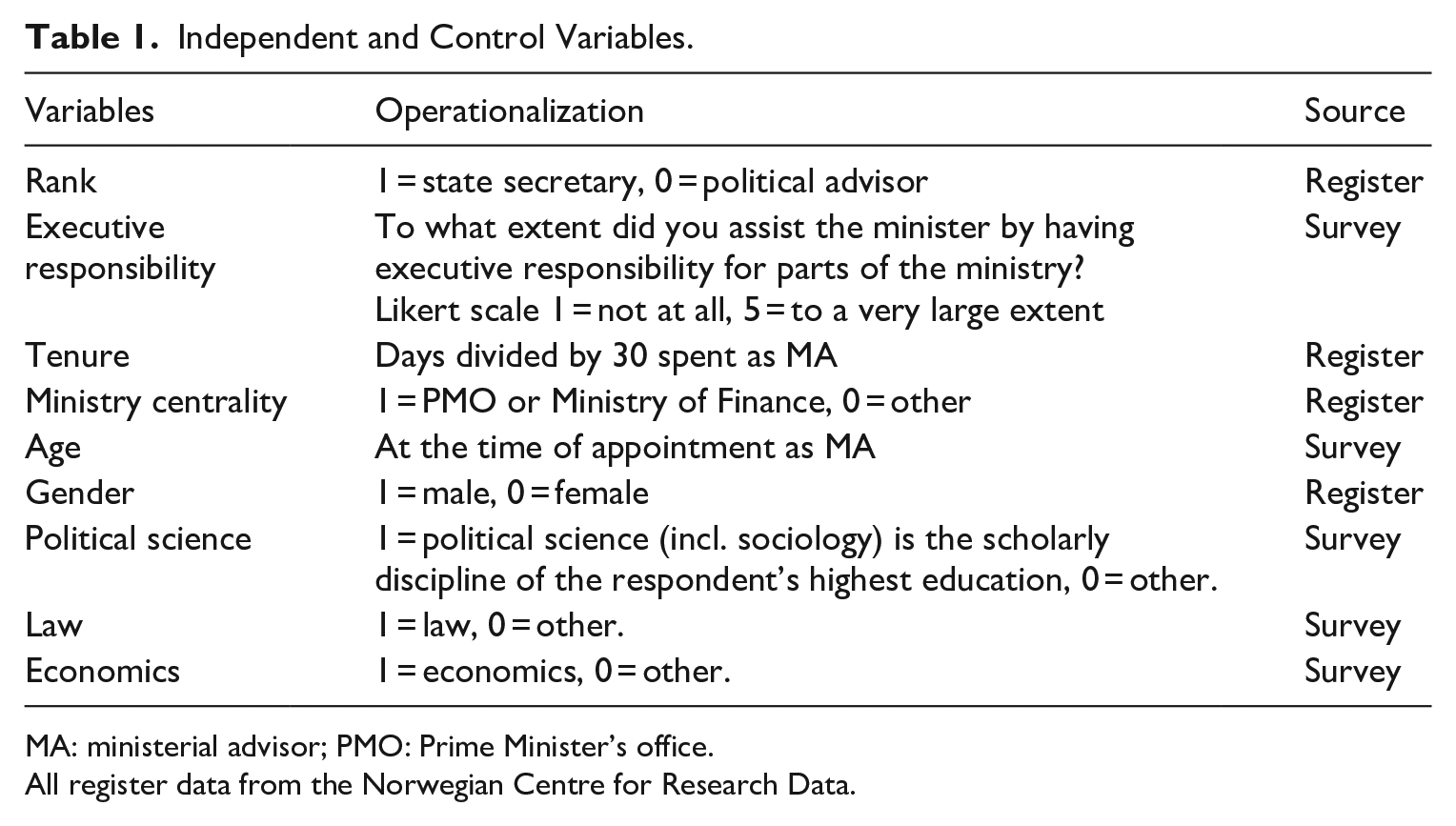
MA: ministerial advisor; PMO: Prime Minister’s office.
All register data from the Norwegian Centre for Research Data.
Career Measures.
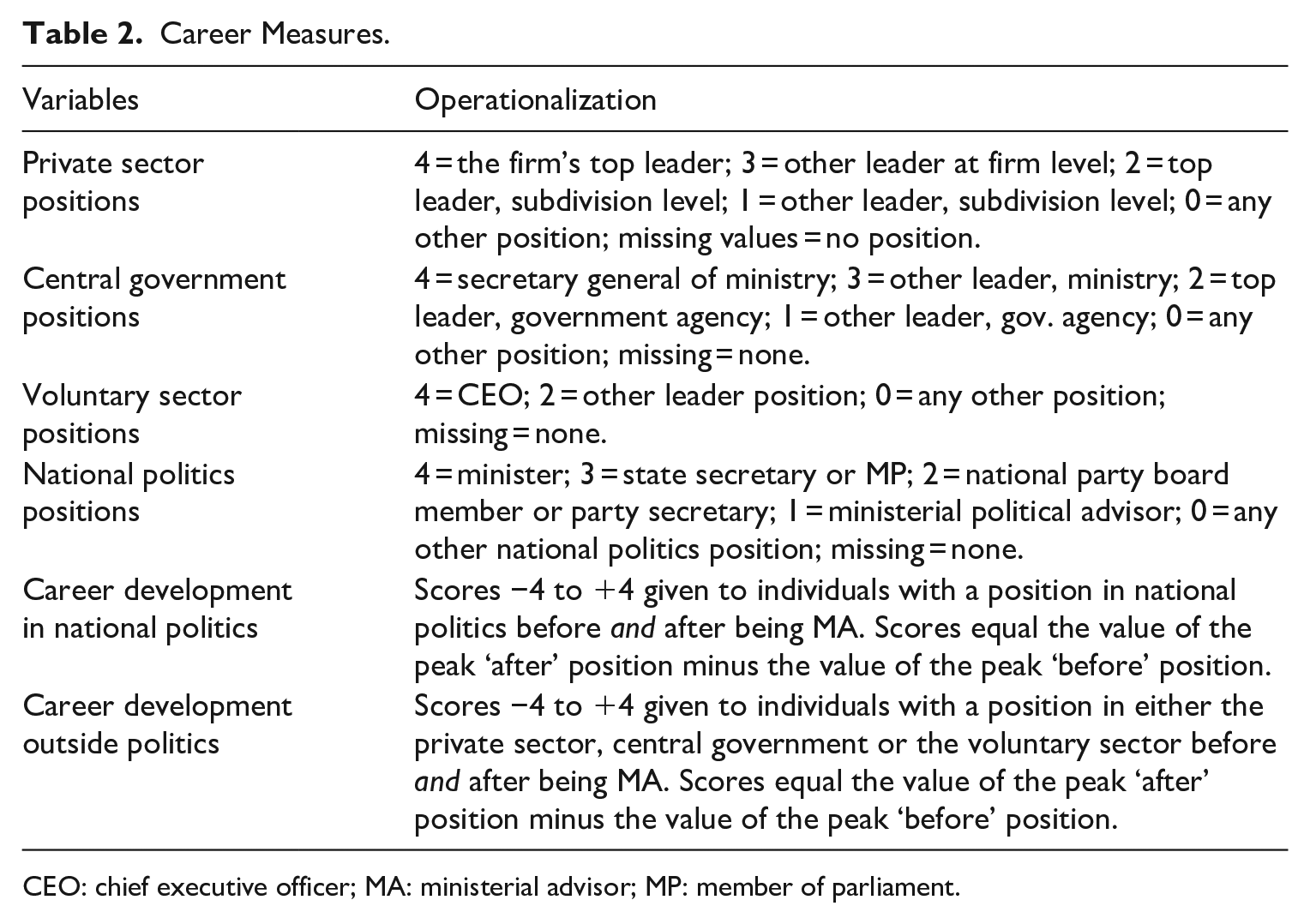
CEO: chief executive officer; MA: ministerial advisor; MP: member of parliament.
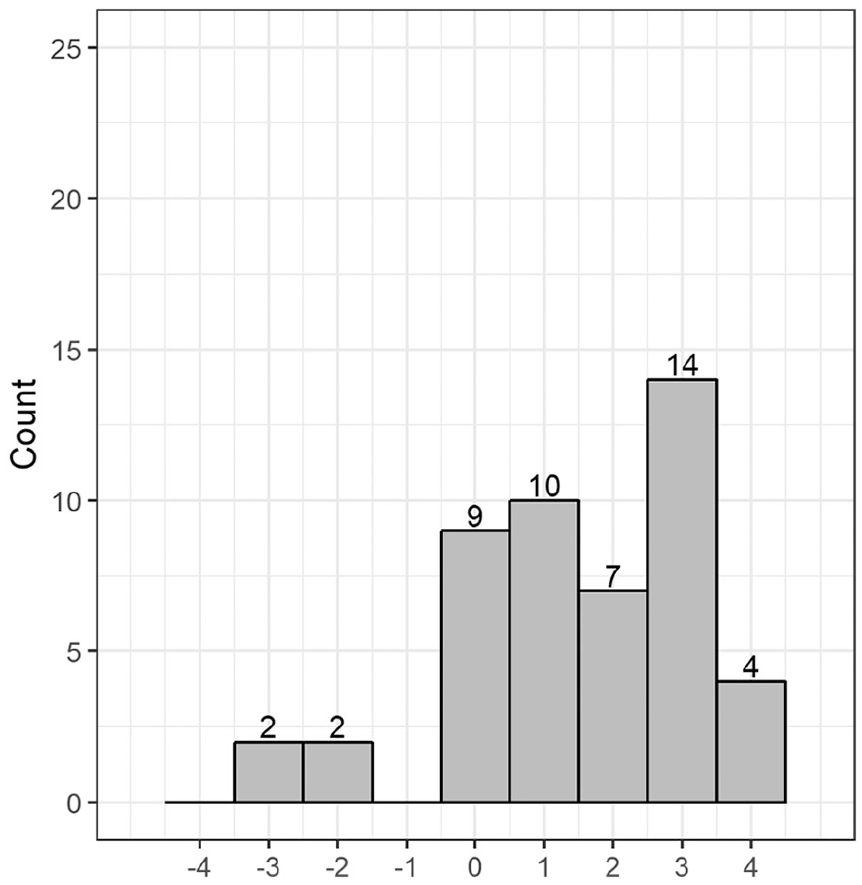
Career Development in National Politics (n = 48).
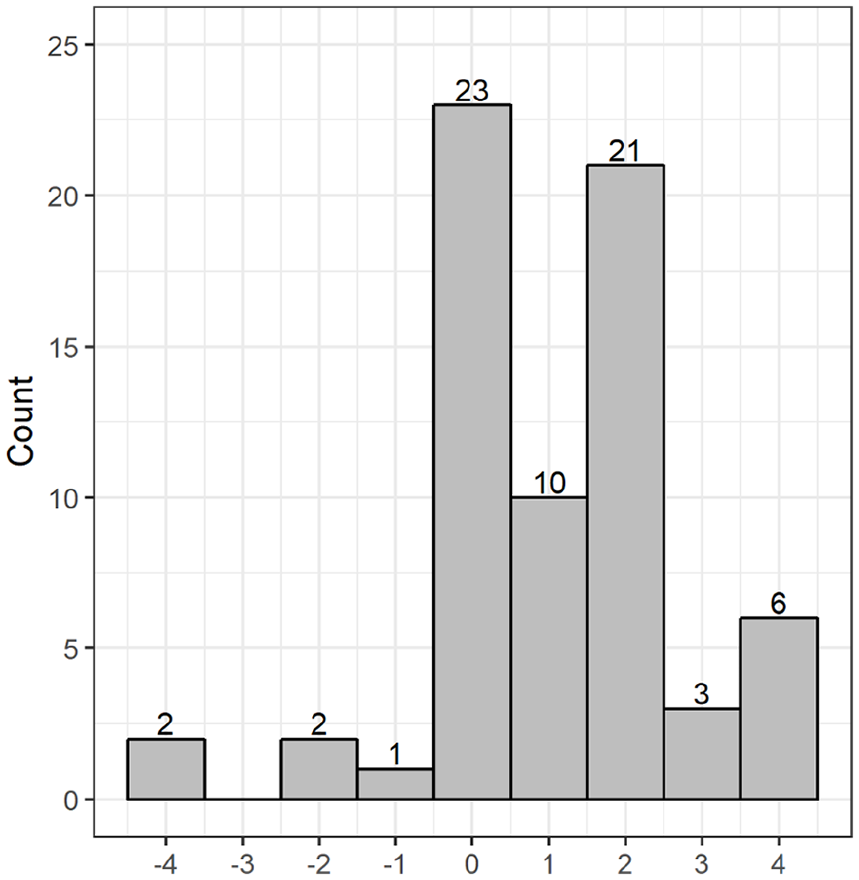
Career Development Outside Politics (n = 68).
The explanatory analysis is limited to careers outside politics because of attributes of a key independent variable: executive responsibility. The Stoltenberg II government was re-elected in 2009, with a second term in 2009–2013. Some MAs from the Stoltenberg II government’s first term were reappointed as MAs in the second term, while others changed ministry and/or rank. The survey used to measure executive responsibility was conducted in 2015. For re-appointees, it is not sufficiently clear whether the data on executive responsibility were related to a first- or second-term MA position. The latter would be a design problem because we recorded all positions after 2009 as post-MA positions.
In the explanatory analysis, we included controls for variables, which, according to existing research, can affect post-MA careers: age, gender and education (Blach et al., 2020; Goplerud, 2015; Sellers, 2014; Selling and Svallfors, 2019; Taflaga and Kerby, 2019; for MPs and ministers, see for example, Allen, 2013; Byrne and Theakston, 2016; Claveria and Verge, 2015; Parker et al., 2012). The education variable measured an MA’s educational discipline (political science/sociology, law, economics or other). 1 We did not include a control for political party affiliation, as the number of observations was insufficient to allow for a meaningful analysis of differences between the six political parties involved in the two governments.
In early 2018, 11 former state secretaries were interviewed about their post-ministerial careers by a researcher affiliated with this project (Rashid, 2018, 2019). Interviewees were selected from the 2001 to 2005 Bondevik II government so as to strike a balance between the passing of sufficient and not too much time since they were state secretaries (sufficient for having had a chance to harvest (any) career rewards; not so much time such that experiences had been forgotten). Furthermore, the pool of candidates was limited to individuals representing either the Conservatives or Liberals, the two political parties that had been out of government and returned in 2005 (so that the interviewees had had a chance to return to executive politics). Also, the pool was limited to individuals who were in office throughout the government’s 2001–2005 tenure (to avoid MAs joining the government late, possibly opportunistically for harvesting career rewards later on, and to avoid those leaving the government ‘prematurely’ for career reasons). Finally, both genders were represented. The interviews, each lasting between 45 minutes and 60 minutes, were semi-structured, recorded and transcribed. The transcripts were released for use in this article, and selected quotes were included to flesh out the results from the survey (the interviewees are referred to as MA1 to MA11 in the text).
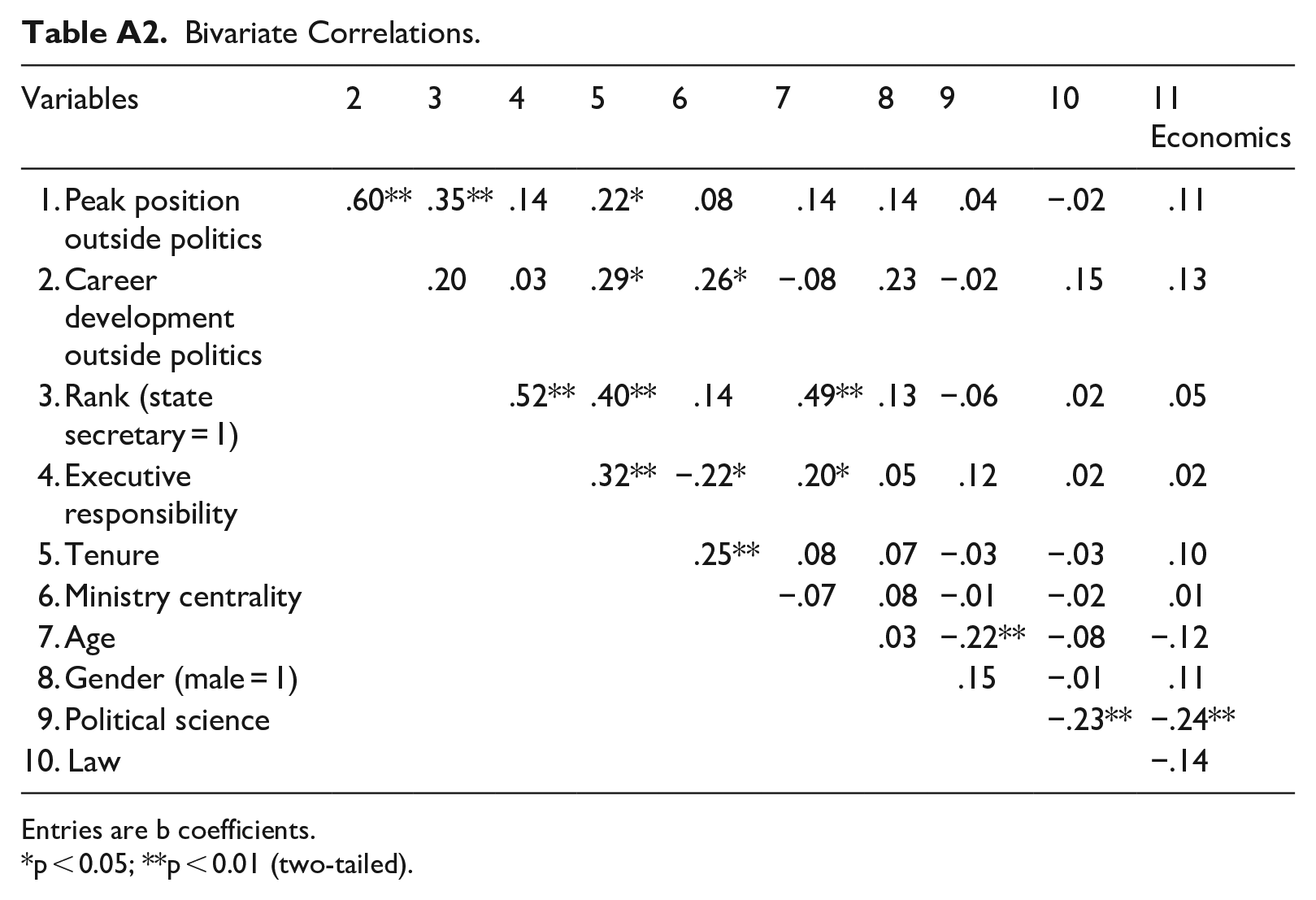
Appendix Table A1 shows the descriptive statistics for the variables used in the explanatory analysis, and Appendix Table A2 shows the bivariate correlations.
Results
Where Do MAs Go After Serving in Public Office?
We start at the group level. Table 3 shows that 73% had a position in national politics before becoming an MA. 2 Following ministerial service, the share was 50% – a high share relative to the occupational sectors discussed below, but a 23-percentage-point exodus from national politics compared to the situation prior to service as an MA (6% later became cabinet ministers and 7% MPs).
Occupation by Sector Before and After Being MA (%).
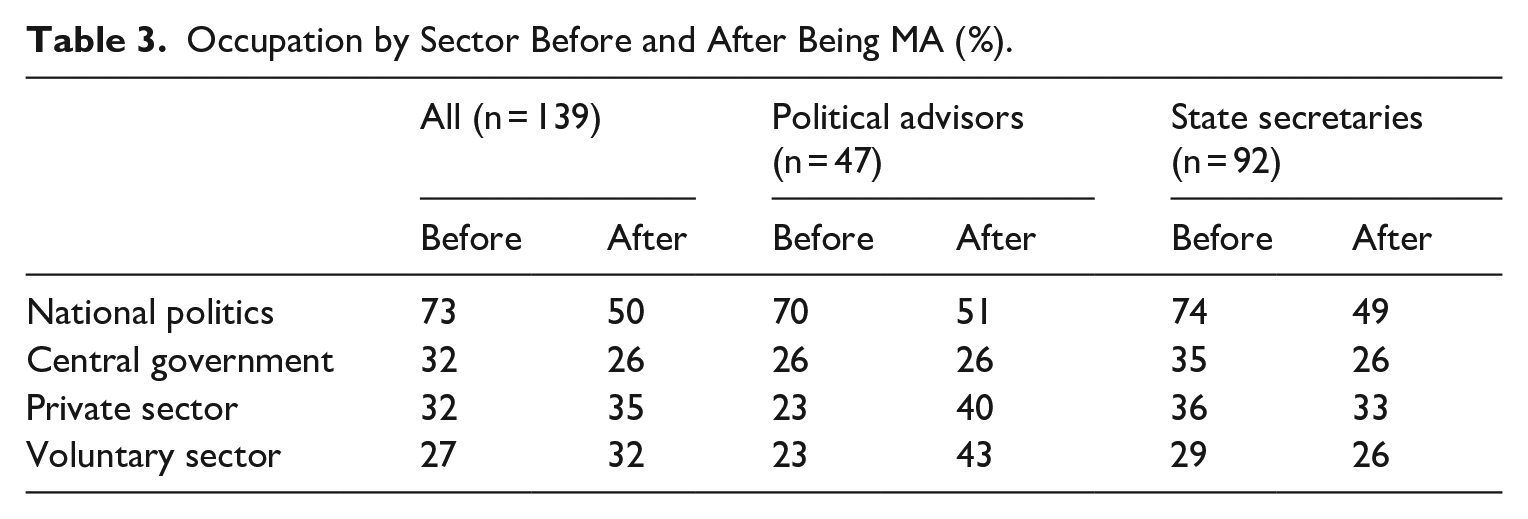
The interviewees said that cabinet minister was a very attractive position. However, most said that low availability made the prospect unrealistic and that having limited parliamentary experience was a disadvantage vis-à-vis other candidates. MA1 said, ‘I knew I did not have . . . enough political experience to be a hot candidate for a minister post’; MA10 admitted, ‘My profile fits far better with that of a state secretary than with [being] minister . . . I have never thought of myself as a career politician’. The interviews suggest that serving in public office is not a stepping-stone for young politicians aspiring to an expanding political class because they lack the experience to take the next steps.
Moving on to occupations in sectors outside of politics, Table 3 shows that 32% worked in central government before becoming MAs, and slightly fewer, 26%, worked there afterwards. 3 Norwegian MAs rarely make it to leadership positions in the central government bureaucracy. None of the 139 individuals studied made it to the very top, that is, to a ministerial secretary general position, and only two became head of a national executive agency (a directorate) or regulatory agency.
A total of 32% worked in the private sector before becoming MAs, and 36% worked there afterwards. The growth was driven by the lowest-ranking MAs – political advisors. For this group, there was a strong migration to the private sector (up 17 percentage points to 40%). For state secretaries, there was a small decline. MAs achieving leading positions was a more common phenomenon in the private sector than in the central government bureaucracy. A total of 5% of the 139 MAs became CEOs of a private company, and 17% became leaders of a company’s subdivision.
A total of 27% worked in the voluntary sector before becoming MAs, and that share grew to 32% afterwards. As in the private sector, political advisors drove the growth. For this group, there was a strong migration to the voluntary sector (up 20 percentage points to 43%). A total of 10% of the 139 participants became CEOs in a voluntary organization; 17% achieved other leadership positions in this sector.
Do MAs Reach Higher Professional Positions in the Post-Ministerial Phase?
This section shows individual career development up, down, within and across occupational sectors. The basis are individual-level calculations based on all the occupations held by the participants before and after being MA. A total of 35% (n = 48) had a position in national politics both before and after being MAs. Considerably fewer, only 13% to 14%, returned to their ‘old’ career paths in either central government or the private or voluntary sector.
So how do sector returnees fare in terms of career development? Figure 1 shows MAs’ career development in national politics. Recall that a score of zero means that a person peaked at identically ranked positions before and after being an MA. A person peaking at, for example, the level of a parliamentary advisor position both before and after their MA position scores zero. 4
Figure 1 shows a left-skewed distribution of career development scores for those who returned to national politics, meaning that most returning MAs later advanced to a higher position than they had held before becoming MAs. The average career development in national politics was 1.5 steps up. Those who obtained a score of four achieved a cabinet minister post after being MAs and held only very modest positions in national politics prior to becoming MAs (n = 4).
Hardly surprising is that the average career development of returnees, regardless of the occupational sector, was positive. Many professionals experience career advancement when they are between 30 years old and 50 years old, which is the age range of almost all MAs in Norway. Noteworthy, however, is that it seems comparatively easy for this group to advance in national politics and the voluntary sector and comparatively difficult for them to advance in central government and the private sector.
The analysis has thus far excluded people who do not return to the occupational sectors in which they worked before becoming MAs. This is unfortunate because changing sectors is a natural occurrence in professional careers. Figure 2 includes sector changers alongside sector returnees; it shows career development within and across central government and the private and voluntary sectors. In other words, we pooled these three occupational sectors and calculated scores for outside-of-politics career development. Within this sub-population (n = 68), only 7% experienced a negative outside-of-politics career development. A total of 34% experienced a neutral development, peaking at the same level as before; 59% experienced an upwards career development.
Five of the 11 interviewees said that being a state secretary influenced a change in what they wanted to achieve career-wise. On the topic of changing occupational sectors after ministerial service, MA5 described making a horizontal career change. Being a state secretary provided insights and networks that enabled MA5 to start a career in a different sector from that of their prior employment. MA10 said, ‘I would not have thought about [their current job] if I had not been state secretary’.
Six of the 11 interviewees thought that being a state secretary had boosted their careers. Three were disappointed not to have been more sought after. As MA5 revealed, ‘There was not a long queue of opportunities’. MA4 noted, ‘There were not that many offers’. MA8 said, ‘I was in several processes where I did not get the job . . . Generally, state secretaries and ministers are not offered as many positions as you would think’.
Some interviewees had experienced that ministerial service had closed some career doors. They offered different explanations. MA8 said that central government organizations ‘think they need a certain political balance among their staff. I experienced in a job interview [being told that] they could not hire any more conservatives because [their workforce] would become [politically] unbalanced’. MA11 said, ‘It is not appropriate to apply for a [bureaucratic] position in a ministry or in a state agency’ for which one has had political responsibility as state secretary. MA10 said, I worked in a field that was relatively immature and where development was fast-paced. I felt I was in the game [when leaving a job to take up the MA position] but that I was quite far behind [when leaving the MA position]; so I do blame the state secretary position for [my] not continuing my career afterwards.
Explaining Variance in Post-Ministerial Careers
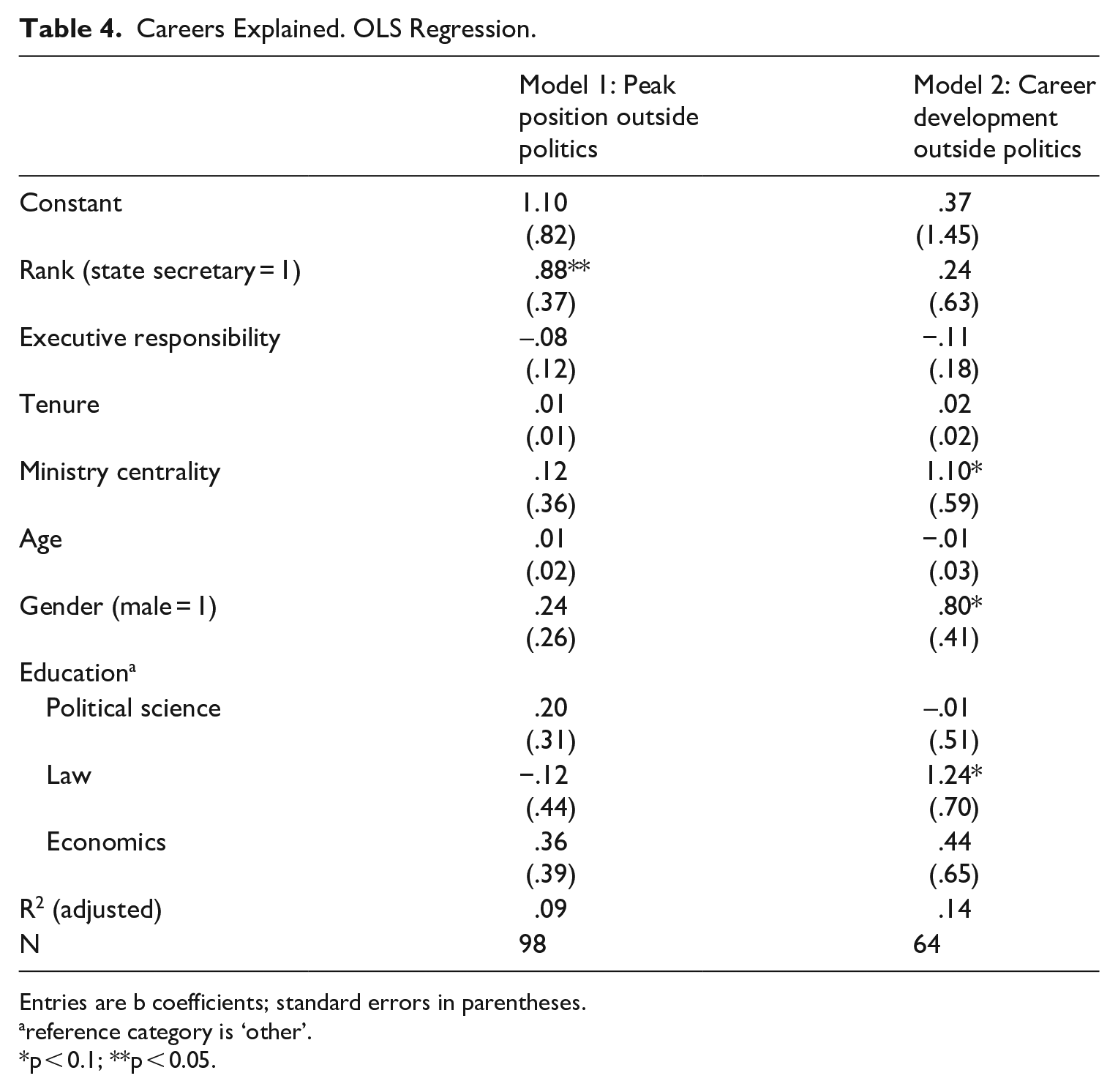
In this section, we investigate the relationship between what MAs did in office and the variance in their later careers outside of politics. The multivariate analysis is reported in Table 4. Model 1 shows the relationship between the explanatory variables and the dependent variable ‘peak position outside politics’ (the value of an MA’s highest post-ministerial position in the private sector, central government or voluntary sector). Model 2 shows the relationship between the explanatory variables and career development outside of politics (the value of the MA’s peak post-ministerial position minus the value of the peak pre-ministerial position).
Careers Explained. OLS Regression.
Entries are b coefficients; standard errors in parentheses.
reference category is ‘other’.
p < 0.1; **p < 0.05.
Rank was positively associated with peak position (Model 1). Being a state secretary rather than a political advisor was positively associated with holding high positions in the post-ministerial phase. Note, however, that this could reflect that some were employed as state secretaries and not as political advisors for a reason (e.g. had more resources) and that the same reason might have equipped them to reach relatively more advanced professional positions afterwards. Executive responsibility, tenure and ministry centrality had no effect in Model 1. That tenure had no effect might have disguised effects cancelling each other out: A longer tenure means that one obtains more of the resources that are valued in the labour market. A counter effect, which was illustrated in the interview data, is the same as that experienced by MPs (Theakston et al., 2007: 20), as being out of the loop for some years can make it difficult to return to one’s former occupation. None of the control variables in Model 1 were significant.
Regarding Model 2, ministry centrality was positively associated with career development. Being MA was a better stepping-stone for those who had served in the PMO or the Ministry of Finance compared to those who had served in line ministries: They made larger career jumps. That ministry centrality affected careers partly resonates with Claveria and Verge’s (2015) finding regarding ex-ministers, they found that only a few policy portfolios matter for later careers.
Of the control variables, gender and education were statistically significant in Model 2. Being male had a positive effect on career development. Taflaga and Kerby (2019) found a similar pattern in Australia for MA careers in politics. Having a law degree also had a positive effect on career development compared to any other disciplinary background.
Surprisingly, executive responsibility had no effect on either of the two dependent variables. This null result also held true for other measures of executive responsibility. 5 Thus, the multivariate analysis gave little support to our expectation that having executive responsibility would provide MAs with resources that made them particularly attractive targets for outside employers. The interviews suggest, however, that the internal knowledge of the core executive and the networks formed while in office have been valuable.
When asked to elaborate on the MA-related competencies valued by the outside work market, MA9 noted in relation to networks that ‘getting to know people and decision-makers’ was one such competence, and ‘understanding decision procedures, who and where key decision-makers are and how to influence them’ was another. According to MA10, ‘understanding political decision processes, how the civil service works and the relationship between politics and administration’ constitutes ‘a generic competence’ of value for careers in most occupational sectors. MA10 said that this generic competency had been very useful as a director of a large public organization, ‘not least since [employees in that organization] understand surprisingly little about how a ministry and the civil service actually work’. Other general competencies mentioned included training in ‘forming opinions, weighing alternatives, making decisions . . . and relating to the media’ (MA5) and the confidence ‘to make decisions, heavy decisions, with very short deadlines’ (MA9).
The interviewees described both the immediate and lasting professional benefits of having been an MA. MA8, for example, said that ‘the professional value of having been an MA declines after the first job’. MA2 said that the job they got afterwards ‘was a direct result of networks I had [from being state secretary]’ and that, in the new job, they ‘benefitted a lot from knowing . . . politicians personally’. MA4 said, ‘I had a network money cannot buy [and] open doors to the cabinet and to government organizations’ immediately after leaving office. Conversely, MA5 said that knowledge of the core executive was a commodity for employers irrespective of whether the party one represents is in power – ‘the central thing is that you understand politics, not really your [party] colour’. MA6 described ‘very useful’ long-term benefits, such that they still benefit professionally from ‘easy access’ to government ministries due to a state secretary position held more than 15 years ago. They also described how having been MA ‘is given so, so much weight’ in their line of business and that ‘knowing politics’ is a competency valued alongside legal and technical expertise.
Discussion
Regarding our first research question on which professions MAs migrate to following their ministerial careers, the results show a clear migration out of national politics, a smaller decrease in the share working in central government and increases in the shares working in the private and voluntary sectors. The general picture of MAs migrating out of politics may be a surprise, given what we know about former cabinet ministers (Claveria and Verge, 2015: 830), but it corresponds with Goplerud’s study of British special advisors. There, too, relatively few continue their careers along a political path: ‘many are content to use their experience to enter professional careers in public affairs, business or the non-profit sector’ (Goplerud, 2015: 348). The interview data showed that lack of opportunity, combined with a perceived lack of political and legislative experience, reduced advisors’ belief in the chance of advancing to, for example, cabinet minister positions. Instead, serving in public office is a stepping-stone to careers in other occupational sectors. It is relatively common in Norway for MAs to change occupational sectors completely after ministerial service. The interview data show that such moves can be driven by experience and networking while serving as an MA.
Generally, the robustness of the results is strengthened by the study’s analysis not just of the career steps taken immediately before and after, but also careers during multiple years before and after holding an MA post (Blondel, 1991; Claveria and Verge, 2015). The first position after being in government might be a transient one. For example, in some contexts, many MAs can relatively easily move into fellowships in policy schools for a year or two while planning their next career moves.
Since the predominant pattern is that MAs transition out of politics, we conclude that the notion of a political class is a poor guide for interpreting the case under study. From the backgrounds of cabinet ministers, one might deduce, as Lord Turnbull did, that accommodating MAs in the core of executive government is to have ‘an intern programme for aspiring politicians’ (quoted in Shaw and Eichbaum, 2018: 151). However, one should study MAs themselves, as we do, to explore whether they often become senior politicians. In the Norwegian case, they do not. Our findings echo those of Goplerud (2015: 333) from the UK: ‘[t]o claim that special advisors invariably enter [elite] politics [. . .] is simply not supported by the evidence’. The same holds for the Danish case. Although a majority of Danish MAs arrive from communication functions in political parties, only a minority return to party work, perhaps because this would be a career setback with lower salaries compared to alternative jobs in private PR firms (Blach-Ørsten et al., 2020: 11). For the majority in Norway, being MA is a stepping-stone to a career in other occupational sectors rather than a route further into, and upwards in, the political sphere (see also Karlsen and Saglie, 2017). Our second research question concerned how post-ministerial careers compared to pre-ministerial careers. The majority experienced not only a, presumably desirable, horizontal shift between occupational sectors but also a vertical shift upwards to higher positions. Serving in public office is thus a stepping-stone in the sense that it helps former MAs to reach higher professional positions afterwards. It is easier for MAs to advance in national politics and in the voluntary sector than in central government and the private sector. Distinguishing between senior and junior MAs reveals that junior MAs experience relatively more vertical advancement.
In the present context, individuals generally need not worry that being an MA harms their professional careers. Across all major occupational sectors, this group has little difficulty establishing or returning to a professional life outside of politics. Our study is thus consistent with the rewards perspective. However, directly addressing the notion of rewards would require a research design with a control group; 6 we cannot say whether those who serve in political positions have post-ministerial careers that are better than what they would have had had they not served. However, like Goplerud (2015), we found that MAs are a class of politicians who differ in important ways from more senior politicians. Working in executive politics brings more career opportunities, and probably more opportunities for higher-ranking positions, for MAs than for cabinet ministers.
Finally, our third research question concerned the association between MAs’ careers and the resources they obtained while in government. Focusing on careers outside of politics, we found that having a higher MA rank was associated with advancing to higher professional positions afterwards. We also found that being an MA in a high-prestige ministry was associated with a particularly lucrative post-ministerial career development. Note, however, that we are cautious about claiming causality; we cannot say with certainty whether former MAs advancing to high post-ministerial positions is caused by the resources obtained from their MA experience or by resources obtained from other professional experiences.
That executive responsibility and tenure had no effect in the statistical analysis does not mean that work experience from the political executive was irrelevant for outside employment. The interview data revealed that employers value MAs’ having accumulated ‘political craft’ as a general competency (Goetz, 1997) from working in the core of executive government. That the specifics of what one does as an MA matter little for one’s career outside of politics contrasts with the finding of Parker et al. (2012: 442), that for US legislators, the specifics of their experiences in office, ‘including specialized training’, affected their future occupation (see also Parker, 2008: 92). Note, however, that our measure of career development focused on hierarchical rank. Future research could measure careers differently, for example, in terms of salary, function or subjective career satisfaction.
That insider knowledge and professional networks matter for post-ministerial careers makes our study relevant from the revolving-door perspective – at least in systems where MAs work closely with policy development and have extensive executive powers (Askim et al., 2017; Selling and Svallfors, 2019). Although the specifics of what MAs do while in office may be less relevant for their future career, the networks they form and the craft they learn while in office make them attractive to outside employers.
Quarantine rules for shifting from jobs in executive government to those outside of politics might affect post-ministerial careers (Maley, 2017). For purposes of generalization, it is therefore noteworthy that Norway has a comparatively comprehensive and strict quarantine regime for MAs (Demmke et al., 2008; NOU, 2012). MAs, as well as ministers, get up to 6 months quarantine following their departure from public office. For certain jobs, MAs are, presumably, most attractive as recruits immediately after leaving executive government. The value of advisors’ networks and policy insights decreases with time (MA1 and MA2 called it ‘fresh produce’) and presumably, dramatically, after a change of government. According to Svallfors (2017: 66), a key resource of MAs and other so-called partisan policy professionals is their ‘context-dependent politically useful knowledge’. For some companies, therefore, the prospect of a 1-year quarantine, for example, might be a sufficient reason not to hire an outgoing MA. That Norwegian MAs are attractive targets for outside employers is, therefore, a pattern that occurs despite regulations; in settings with looser regulation regarding post-ministerial employment, revolving-door issues can be assumed to be more acute.
Conclusion
The article examined the career development of MAs and the effect of political service on their careers through a unique combination of bibliographic data, surveys and elite interviews. More than expanding the political class as a recruitment ground for future MPs and ministers, the results indicate that MA appointments serve as a stepping-stone to a career outside of politics. Focusing on the association between the resources MAs gain while in office and their later careers, as we do here, advances the understanding of ex-politicians’ careers. We have also illustrated the roles played by ambitions (e.g. that career ambitions can change while in government) and opportunities (e.g. that the number of attractive political positions is very small for MAs, and that quarantine rules matter). Still, an important future research task is to build a better understanding of how resources, ambitions and opportunities interact to shape the careers of MAs and other actors in and around the core of politics (see for example, Borchert, 2011).
One implication of this study is that the growth in the number of MAs, observed in most established democracies, need not fuel the fear of a growing political class. However, these actors gain insider knowledge and professional networks, raising revolving-door issues and making it important to follow their careers after they leave public office. Future research could combine such data triangulation with policy decisions to enhance understanding of the professional attractiveness of former MAs.
A further implication for political careers scholarship concerns observers’ worry that political parties struggle to recruit talent from outside their immediate ranks. For Roberts (2018: 13–14), the ‘increasing professionalization of politics [. . .] diminishes fluidity into and out of political office’. She argued that widespread concern among politicians about their outside job prospects has a negative impact on representative democracy, as some politicians cling to office out of fear of a downfall outside of the political arena, while others never enter out of fear of the difficulty of returning to professional life. Political institutions, such as cabinets and parliaments, benefit from being staffed by a mixture of professional politicians motivated by rank and votes and amateur politicians motivated by policy (Keane, 2009; Schlesinger, 1966; Wilson, 1962). We can assume that the expectations that individuals have for their subsequent careers outside of politics affect the size and depth of the candidate pool that a political party has access to (Roberts, 2018). This study’s demonstration that there is professional advantage to becoming an MA, even for those who do not remain in politics, empirically strengthens the rationale as to why individuals take these positions.
Footnotes
Appendix 1
Bivariate Correlations.
| Variables | 2 | 3 | 4 | 5 | 6 | 7 | 8 | 9 | 10 | 11 |
|---|---|---|---|---|---|---|---|---|---|---|
| 1. Peak position outside politics | .60** | .35** | .14 | .22* | .08 | .14 | .14 | .04 | −.02 | .11 |
| 2. Career development outside politics | .20 | .03 | .29* | .26* | −.08 | .23 | −.02 | .15 | .13 | |
| 3. Rank (state secretary = 1) | .52** | .40** | .14 | .49** | .13 | −.06 | .02 | .05 | ||
| 4. Executive responsibility | .32** | −.22* | .20* | .05 | .12 | .02 | .02 | |||
| 5. Tenure | .25** | .08 | .07 | −.03 | −.03 | .10 | ||||
| 6. Ministry centrality | −.07 | .08 | −.01 | −.02 | .01 | |||||
| 7. Age | .03 | −.22** | −.08 | −.12 | ||||||
| 8. Gender (male = 1) | .15 | −.01 | .11 | |||||||
| 9. Political science | −.23** | −.24** | ||||||||
| 10. Law | −.14 |
Entries are b coefficients.
p < 0.05; **p < 0.01 (two-tailed).
Acknowledgements
The authors are grateful for the constructive comments from the journal’s two anonymous reviewers. Thanks also for comments on earlier versions from Tobias Bach and from participants at the panel on Politics and Public Administration within Core Executives at the International Conference on Public Policy (ICPP4) in Montreal, 26–28 June 2019.
Declaration of conflicting interests
The author(s) declared no potential conflicts of interest with respect to the research, authorship, and/or publication of this article.
Funding
The author(s) disclosed receipt of the following financial support for the research, authorship, and/or publication of this article: The study received funding from the Research Council of Norway, grant number 258956.
