




Abstract
The article examines the post-government career moves of 521 former British special advisers who served from 1997 to 2017. Analysis of an original dataset mapping the first job each special adviser ‘landed-in’ after leaving government shows the vast majority land in corporate lobbying and policy advocacy roles. A minority become politicians, although many continue to work in political organisations. The least popular choice is public service. The findings challenge the ‘lure of power’ hypothesis and lend weight to increasing concerns about former political staff revolving to shadow lobbying. The findings point to potential lobbying regulation loopholes first raised by the UK Committee of Standards in Public Life. A multi-nominal logistic regression shows how party affiliation and occupational path dependency constrain career moves. Labour special advisers are less likely to become corporate lobbyists than Conservative and Liberal Democrat ones. Special advisers also tend to revolve back to similar professional roles held before an appointment.
Keywords
Introduction
British special advisers (hereafter SpAds) are influential actors at the apex of political life in Whitehall. As senior political staff to executive politicians, they are the ‘third actor’ in the ‘Executive Triangle’ (Shaw and Eichbaum, 2018: 149), next to their bosses and senior civil servants. Despite increased research related to their genesis and history (Blick, 2004), as well as their influence on policymaking and day-to-day affairs while in government (Gains and Stoker, 2011; Yong and Hazell, 2014), our understanding with respect to their career trajectory outside of government is scarce. With few exceptions (Goplerud, 2015; Sellers, 2014), we know little about their professional lives after leaving their minister’s office: where do they go? what do they do? and why? These questions are salient because, while small in numbers compared to other Westminster countries (Craft and Halligan, 2020) – 113 SpAds in the 2021 Johnson government (Cabinet Office, 2021) – we argue their capacity to influence British politics and policymaking endures even in their post-SpAd afterlife as many become politicians, lobbyists, policy advocates, and senior public officials.
The first primary research question we pose is: where do British special advisers land and what roles do they perform immediately after they leave government? To answer this question, we assembled a unique dataset that details the post-government employment experience of 521 British SpAds starting from 1997 to 2017. Building upon previous bodies of literature examining the post-government careers of advisers (Askim et al., 2021; Blach-Ørsten et al., 2020; Sellers, 2014; Selling and Svallfors, 2019), how partisan policy professionals (PPPs) offer ‘politics for hire’ (Svallfors, 2020), and the revolving door of politics (see, for example, LaPira and Thomas, 2017; McCrain, 2018), we categorise SpAds as landing either in or outside the policy professions field, and classify the policy professions by four categories: (1) politics; (2) corporate lobbying; (3) policy advocacy; and (4) public service. Contrary to theoretical expectations that former advisers are lured by power (Svallfors, 2017) and thus will be more likely to join roles in the politics sector, as well as in contrast to past empirical findings showing that the business sector is the most popular destination for former advisers in the UK, we hypothesise that British SpAds are career-driven individuals that are more likely to land in corporate lobbying and policy advocacy roles.
The second fundamental research question is: what explains variability in the roles? We answer this question by testing two main factors that might constrain SpAds post-government career moves, using a multi-nominal logistic regression. First, we hypothesise that SpAds’ post-government career moves will be conditioned by their ideological commitments, mainly party ideology. Second, we hypothesise that they will land in the same sector as their prior-SpAd tenure (occupational path dependency). We also control for length of tenure, ministerial centrality, department policy sector, and gender.
Analysis reveals the vast majority land in corporate lobbying and policy advocacy roles, confirming an emerging trend raised by Sellers (2014). A minority become politicians, although many continue to work in political organisations. The least popular choice is public service. The findings challenge the ‘lure of power’ hypothesis and lend weight to increasing concerns about former political staff revolving into shadow lobbying. The findings point to potential lobbying regulation loopholes first raised by the UK Committee of Standards in Public Life. The multi-nominal logistic regression shows how party affiliation and occupational path dependency constraint career moves. Labour SpAds are less likely to become corporate lobbyists than Conservative and Liberal Democrat ones. SpAds also tend to revolve back to similar professional roles held before an appointment.
The article proceeds as follows. First, we set the scene with a brief overview of the afterlife of special advisers. Then, we present our main theory and hypotheses. Next, we outline the empirical approach, detailing the data and analytical method. Following this, we present the results. Finally, we offer some concluding remarks and public policy implications of our research.
Research setting: The afterlife of special advisers
The influence of SpAds on British politics and policymaking is not just confined to their work while in government. We know former SpAds can become tomorrow’s political leaders. That is, working in a political advisory role to a cabinet minister is often viewed as a professional ‘tradecraft’ for a long and successful career in politics (Barber, 2014; Goplerud, 2015). An iconic case is former Prime Minister (PM) David Cameron who earlier worked as an adviser to Chancellor of the Exchequer, Norman Lamont. There have been other high-profile elected representatives too, for example, William Hague, Ed Miliband, Andrew Adonis, Jack Straw, and Michael Portillo, to name a few. Some former SpAds do not need to be elected to remain influential outside of politics. A notable case is Dominic Cummings who became a Campaign Director for the Vote Leave Brexit campaign after resigning as adviser to Michael Gove. In these high-profile cases, we should not forget the roles that former SpAds also play as PPPs in their parties and party think tanks.
Former SpAds are also influential when revolving out of politics into corporate lobbying. These movements in and out of the government are linked to important ethical issues, in particular when lobbying is associated with ‘money, undue influence and secrecy’ that undermine public trust in government (Committee on the Standards in Public Life, 2021: 82). Take, for example, a lobbying row that involved former adviser to PM David Cameron, Kate Marley, who attended the Conservative Party Conference as the Head of Government Affairs at Philip Morris International to lobby for a tobacco product (Downard, 2017).
Former SpAds who enter policy advocacy roles in the non-profit sector also influence the government. They are thought to play ‘an active role’ in the ‘in-and-outer system’ (Heclo, 1988) that has emerged in Whitehall (Sellers, 2014: 246). Occasionally, we hear about them in the media like, for example, the row over Gordon Brown’s former SpAds who landed in charities that were lobbying the Cameron-Clegg Coalition (Hope, 2014). However, SpAds turned policy advocates are usually not involved in public controversies and generally fly under the radar of British media. Similarly, inconspicuous but highly influential are former SpAds who land in senior public service roles, for example, in executive agencies, non-departmental public bodies, and also the civil service.
The focus on British SpAds is also temporally salient given recent policy debates surrounding lobbying regulation in the UK. In November 2021, the Committee on Standards in Public Life (2021) published its 23rd report Upholding Standards in Public Life. There it castigates the system of business appointments for SpAds, which was established back in 2010 and was most recently revised in 2016. Moreover, it points to important weaknesses and loopholes with respect to the overall functioning of the British regulatory framework on lobbying and shows how the vast majority of SpAds’ activities fall through the cracks of the system - both in government and after they leave. However, how many former SpAds do these problems concern?
Surprisingly, despite the fact that former SpAds can be potentially influential via multiple avenues in their post-government professional afterlives, and in certain cases even ethically problematic, little attention has been given to researching their career trajectories. By contrast, a study by Byrne and Theakston (2016) explored the afterlives of British Members of Parliament. In the best example (and where we draw inspiration from), Sellers (2014) – in Yong and Hazell’s (2014) seminal book – provided a teaser chapter on the post-employment career paths of British SpAds. The chapter was buried deep in ‘Appendix 3’. And while empirically rich, provided limited critical analysis and linkage to salient theoretical debates. Moreover, the dataset stopped in 2010 and since then has not been updated. Thus, we cannot know whether certain trends more than 10 years ago have eventuated. For example, Sellers (2014: 236) found only 12% of the 1979–2010 SpAd cohort joined public affairs/lobbying roles, but this was increasing over time. This was less than the share of SpAds joining businesses (the most popular sector), the non-profit sector (the second most popular), but also political organisations and even public bodies, and was just above the share entering politics as elected representatives.
Outside of the UK, studies on advisers’ career trajectories have also been limited although advisers are known to remain influential in these other settings too after they leave the government. 1 The US is one big exception (Blanes i Vidal et al., 2012; McCrain, 2018; Strickland, 2020), and other cases have recently emerged, including from Denmark (Blach-Ørsten et al., 2020), Norway (Askim et al., 2021), and France (Alam et al., 2015). In addition, recent literature has explored the motivations and post-government career trajectories of ‘PPPs’, including political advisers, mainly in Sweden (Selling and Svallfors, 2019; Svallfors, 2017, 2020), but with broader theoretical insights for advisers in other administrative settings. The most important theoretical proposition arising from this emerging literature is the ‘lure of power’ hypothesis brought forward by Selling and Svallfors (2019). They suggest that the appeal of political power, in a variety of forms, is the most fundamental and important motivation to explain the jobs and roles sought by PPPs, such as former political advisers. Paradoxically, though, there seems to be a mismatch between theory and empirical reality in previously tested and other untested administrative settings.
Theory and hypotheses
Where do special advisers land?
Post-government professional afterlife refers to the first job each adviser ‘landed in’ immediately after leaving the minister’s office. We focus only on the immediate post-government position and not the entire post-government career trajectory because the professional value of having been an adviser decreases as time passes (see, for example, Strickland, 2020). Some past studies have even estimated this decrease in monetary terms (Blanes i Vidal, 2012; McCrain, 2018; Strickland, 2020). The reason why this happens is not because former advisers lose their skills/expertise and process knowledge of the system, but because their most valuable resource, which is connections and networks, starts to fade when former colleagues (staffers) and politicians turn-over, or exit and civil servants rotate departments (Askim et al., 2021; Blanes i Vidal, 2012; McCrain, 2018; Strickland, 2020). Thus, from a point of view of democracy and standards in public life, it is more essential to focus on this first career position because it allows us to observe the extent to which former advisers, when at the peak of their contacts and networks, use the attained resources to remain directly influential in government and state affairs.
So where do they land? We know from previous research that although advisers can land anywhere in the job market, some career moves are far less and some far more common than others (Blach-Ørsten et al., 2020; Sellers, 2014; Selling and Svallfors, 2019: 998). Previous research on the post-government careers of British SpAds has focused on occupational sectors (Sellers, 2014). Despite its merits for descriptive mapping, we depart from this approach as it is largely atheoretical and does not allow for developing a richer theoretical understanding of advisers as professionals. One perspective is to view advisers as ‘PPPs’ (Svallfors, 2017) who inhabit the policy professions field, a professional meso-level social order that is not confined to one specific occupational sector, but spans organisation types and which is characterised by specific purposes, actions, actors and rules of legitimate behaviour (Selling and Svallfors, 2019: 988). The specific skills and motivations, which are associated with workers in this field, define the way they navigate future career choices. Overall, PPPs, including former SpAds, will most likely land into jobs that span different organisations, but inside the policy professions field (Selling and Svallfors, 2019). The main purpose of these jobs is to craft or directly influence public policy. This should be contrasted to jobs in other occupational fields whose primary objective is not public policy, even though some are considered adjacent to the policy professions, for example, academia and media (Selling and Svallfors, 2019). Thus, for the present study, we make the distinction between landing in jobs in the policy professions and landing in other non-policy profession jobs. Furthermore, we identified four clusters of job roles in the policy professions field (Table 1).
Life after Whitehall. Categories of SpAd post-government career moves.
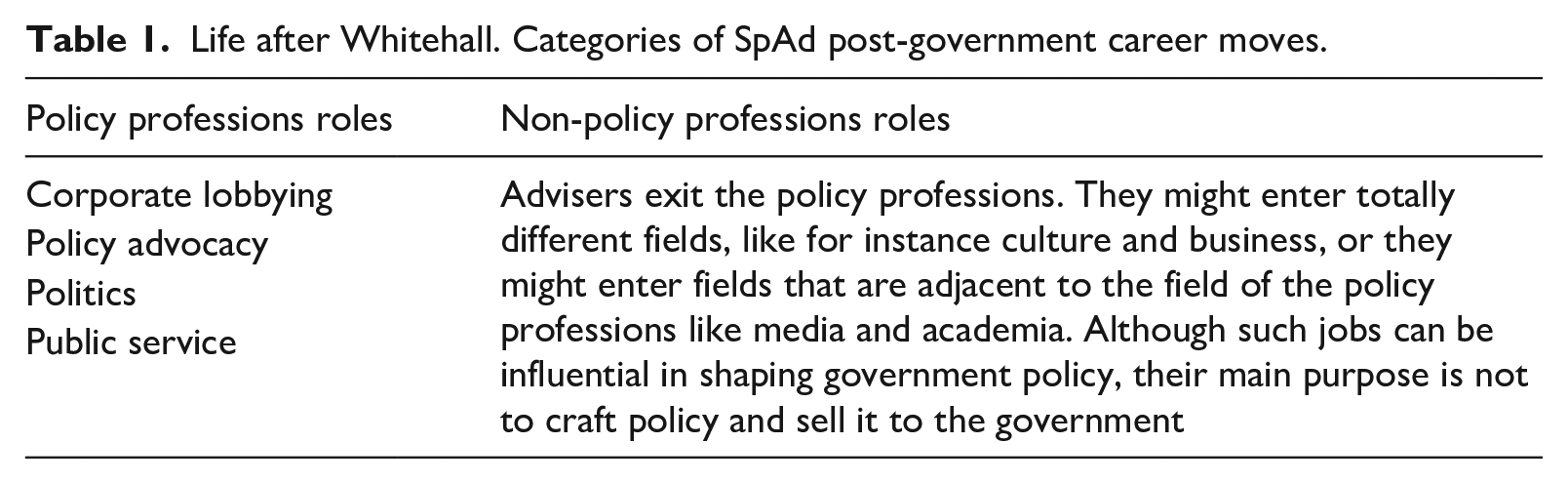
Corporate lobbying. Advisers officially register as lobbyists or work as unregistered ‘shadow lobbyists’ (LaPira, 2015). They work for lobby firms or are paid by corporate clients to conduct government relations and public affairs. Similar to policy advocates, corporate lobbyists spend a significant part of their time advocating policies to the government, monitoring developments, distributing information, and networking with government officials on behalf of their clients (LaPira and Thomas, 2017).
Policy advocacy. Advisers work as policy professionals in civil society, third sector, think tanks or societal interest representation organisations, for example, a trade union, an employers’ umbrella organisation, or a charity. They are essentially ‘lobbyists’ for all kinds of societal causes (LaPira, 2015; LaPira and Thomas, 2017). They spend a significant proportion of their time advocating policies to the government, subsidising policymakers with information, or closely monitoring intricate policy and political developments that are not readily available to the public and their clients (LaPira, 2015: 229).
Politics. Advisers work as PPPs in political parties or party-associated organisations such as party research institutes and political campaigns. Alternatively, advisers might decide to jump into representative politics by running for office and being elected (Goplerud, 2015).
Public service. Advisers work as policy professionals for the state. They become state officials, often landing in senior public service roles in government departments, agencies, and on government boards.
The question here is simple. Which of the above career moves are more and which are less common? Past theoretical arguments posit that advisers, as PPPs (Blach-Ørsten et al., 2020; Selling and Svallfors, 2019; Svallfors, 2017), are primarily lured by power, and not strictly by public service nor money. According to the ‘lure of power’ hypothesis, ‘the prime motivating force’ among PPPs is ‘the desire to affect politics and society at large’ (Selling and Svallfors, 2019: 995). PPPs consider power as much more important than money and many of them are even willing to leave better-paid positions in private companies to be able to wield influence (Selling and Svallfors, 2019: 997). In addition, PPPs are also quite different from public administrators, their loyalties being to specific causes, persons, and organisations than to a public system (Selling and Svallfors, 2019: 1001). Being PPPs, advisers are motivated by all aspects of power, be it agency (the ability to affect decisions and outcomes), proximity (being close to power and circles where decisions are made), and/or self-determination (being able to define one’s own standpoints; Selling and Svallfors, 2019: 995–996). This appeal of power, together with the specific skills advisers develop during their tenure such as problem framing, knowing the game, accessing information (Selling and Svallfors, 2019: 988–989), also known as ‘know-why, know-how, and know-whom competences’ (Blach-Ørsten et al., 2020: 304) drives their career decisions.
According to the lure of power hypothesis, we should expect advisers who exit government to primarily land in roles within the partisan policy profession field, which is constituted by the purpose of changing society by political means. In order of preference, these would have to be politics and then policy advocacy. The least popular options would be corporate lobbying jobs, which are dominated by private profit maximisation, as well as public service jobs, which are dominated by stronger ‘commitment to public interests and loyalty to duty and the government as a system’ (Selling and Svallfors, 2019: 989). Evidently, the probability is also low that individuals lured by power land in other occupational fields whose primary institutional objective is not to craft or influence government policy and which require a certain critical distance from the business of government such as academia, media, and business.
Empirical observations from past research show a disconnect between theory and empirical reality. In Sweden, for example, the lure of power hypothesis seems to be much more relevant to other types of PPPs like political party researchers or policy analysts in think tanks but not so much to advisers who worked for the government (Selling and Svallfors, 2019: 991–993). Research on the future careers of special advisers in Denmark also points to a disconnect with the lure of power hypothesis. Blach-Ørsten et al. (2020: 301) found that ‘the position of Danish special adviser serves as a stepping-stone to a new labour market that typically culminates with a position in private public relations’. Revolving from Congress or government positions to lobbying is also what American political staffers do (Blanes i Vidal et al., 2012; McCrain, 2018; Strickland, 2020). In the UK, Sellers (2014) observed that the majority of SpAds revolve around the business sector and then the non-profit sector. Although joining public affairs/lobbying jobs was less popular than other choices, Sellers (2014) did point to an emerging trend starting in the 1990s. How can this trend be explained?
Advisers are not typical PPPs who are only lured by power. They are particular types of individuals in that they are ‘adept at the creation and maintenance of good relations with employers that can be later converted into revenue’ (Blanes i Vidal et al., 2012: 27). Thus, increasing revenue in the future by capitalising on established political connections might be an equally, if not more important, explanation of advisers’ motivation for entering this line of industry in the first place, as is a commitment to the ideal of changing society and public service (Blanes i Vidal et al., 2012: 27). If this is the case, then in countries with a pre-existing, or expanding lobbying sector, corporate lobbying is the place to be after advisers leave government. The reason is that corporate clients value and are consequently willing to pay a premium for advisers’ connections with their former employers, politicians (Blanes i Vidal et al., 2012), as well as their former colleagues, be they staffers or public servants (McCrain, 2018). Firms value these ‘know-whom competences’ more than advisers’ ‘know-why’ and ‘know-how’ competences (Blach-Ørsten et al., 2020: 304). According to a former chief of staff of Congressman John Boehner, ‘the most effective lobbyists are the people who have been in the position of the people they are lobbying’ (McCrain, 2018: 1372). Past research in the US shows that small increases in lobbyist connections can result in increases in revenue by as much as 18% (McCrain, 2018). But advisers’ connections are concentrated and perishable (Blanes i Vidal et al., 2012). Their value is ‘contingent on the continued presence of former colleagues within government’ (Strickland, 2020: 67). When these networks expire (Selling and Svallfors, 2019: 987) advisers’ value in the lobbying market drops significantly (Blanes i Vidal et al., 2012; McCrain, 2018; Selling and Svallfors, 2019; Strickland, 2020). Thus, advisers need to move into corporate lobbying immediately after they exit politics; otherwise, they suffer a severe drop in attractiveness and thus employability and profitability. In the US, it has been observed that this might even be distorting advisers’ career incentives by encouraging them to leave government early to profit from their connections (Blanes i Vidal et al., 2012: 3746).
We would like to insert a couple of important caveats to our theoretical approach. First, as already highlighted above, our theory makes sense when there is a pre-existing or expanding lobbying sector producing jobs on which former advisers can land to cash in their knowledge and connection premium. We expect this assumption to hold for the UK where a new substantial market has emerged where political and policy skills and especially political connections are bought and sold (Craft and Halligan, 2020). Second, for our theory to hold there needs to be few regulatory measures limiting advisers from revolving into lobbying. While British SpAds face private sector post-employment restrictions, including either a one or two year ‘cooling-off’ period, these measures have enforceability issues and struggle to fully capture all lobbying activity (McKay and Wozniak, 2020; Ng, 2018). Third, the public sector needs to be considered a relatively unattractive and/or unwelcoming workplace for former advisers to enter vis-à-vis the private sector. Britain and other Westminster countries generally fit this narrative as the administrative tradition has historically idealised a wide separation between politics and the bureaucracy, where civil servants are expected to be apolitical and recruited on merit (Ng, 2018). This may not be the case in other countries that have more porous political-administrative borders, like in France where the public sector is a popular and privileged outlet for advisers when leaving a minister’s office (Rouban, 2012).
To conclude, SpAds can land in a plethora of roles after they leave government, stretching across all kinds of positions and organisations. However, we expect to observe specific patterns with some career moves being far more and some far less common. SpAds are expected to land primarily in jobs within the policy professions field – politics; policy advocacy; corporate lobbying; public service – whose aim is to craft policy, rather than in other non-policy focussed occupational fields – media, academia, business, etc. Within the policy professions, the order by which the most to least popular roles that SpAds land in are (1) corporate lobbying, (2) policy advocacy, (3) politics, and (4) public service.
What explains the different professional roles former SpAds perform in their afterlife?
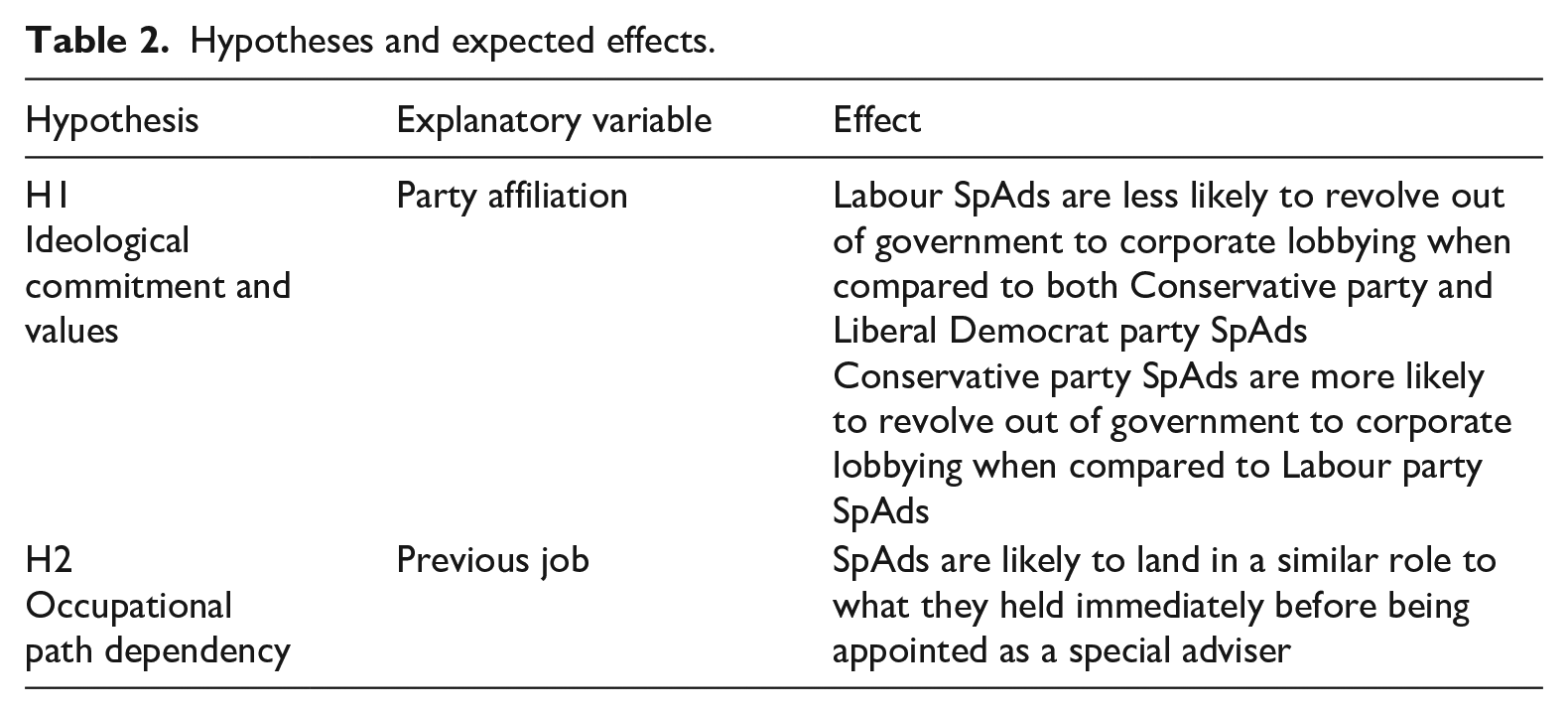
We also expect variation in their post-government roles. To begin with, individual motivation naturally varies. Second, revolving from the government to corporate lobbying, as a ‘hired gun’ who cashes in on connections, is a highly controversial career move with respect to political ideology and moral values, democracy and transparency, and even the minimal revolving door regulation. We argue two factors might constrain their post-government career decisions: (1) ideological and value commitments and (2) occupational career path dependency (Table 2). We put these to the test along with a series of other control factors.
Hypotheses and expected effects.
According to Selling and Svallfors (2019: 999), ideological commitments and loyalties are ‘the basis for value hierarchies regarding jobs and positions’. Put simply, advisers would be expected to leave office and enter particular job sectors consistent with the ideological leanings and values of the political party to which they are affiliated. Leftist advisers might be much more reluctant to revolve out of government to corporate lobbying as for them this might be a highly stigmatised area of work, given that leftist parties champion transparency and accountability and are much more critical of unfettered corporate activities and revolving door practices. By contrast, advisers in economically liberal, right, and conservative parties are more ideologically aligned with business and large corporations and their parties tend to promote policies that attempt to reduce taxes and regulations that benefit corporations (and by association also employees). The party ideology factor dovetails with the ‘logic of appropriateness’ put forward by normative institutionalists (March and Olsen, 1996). For liberal, right and conservative party advisers, cashing in on their connections might be considered more normatively appropriate, when compared to leftist party advisers. Exceptions of course might exist. Not all advisers have strong affiliations to a specific political ideology, or to their minister’s party. Some may be employed due to their personal connection to an executive politician, whereas others may be relatively neutral professionals employed predominantly for their communication and policy acumen. Notwithstanding, we assume the vast majority of political advisers have affiliations to the party in government (e.g. party membership, prior work experience), or are at least sympathetic to the party’s values. If accurate, we would expect the following.
Hypothesis 1. Party affiliation. Labour special advisers will be less likely than Conservative and Liberal Democrat SpAds to land into corporate lobbying positions immediately after they leave government.
Previous work experience can also work as a barrier to post-government professional decisions. The mechanism here is occupational path dependency whereby the progression of occupational careers is a path-dependent process in which decisions and accomplishments of the past influence the range of occupational alternatives in the future (Dlouhy and Biemann, 2018; Garud et al., 2010). Although, theoretically at least, individuals have many professional options, these are narrowed following their initial career choices. Studies have shown that dominant paths emerge and initial choices become difficult to reverse (Sydow et al., 2009). One of the key processes here is psychological. Working in a particular occupation means acquiring occupation-specific human capital, especially skills and knowledge. Conservation of Resources (COR) theory (see Halbesleben et al., 2014) claims that workers are motivated to protect their acquired resources and that even when they expect to gain higher pay or higher satisfaction by changing occupation they will abstain from doing so if change entails losing resources in the form of human capital. Fundamental to this reaction is stress. When resources are threatened humans experience stress and even more stress when resources are lost (Hobfoll 1989). This makes careers particularly prone to being locked in (Dlouhy and Biemann, 2018). For example, it is not very difficult to imagine a journalist becoming a media adviser to a minister, and then later returning to the media sector, or performing a media or other professional communications role, instead of taking up a managerial position in business or a senior civil servant role in a government department. The same logic is true for corporate lobbyists, business managers, political party researchers, and other occupational categories. Thus, we expect:
Hypothesis 2. Occupational path dependency. Most individuals will land in a similar role to what they held immediately before being appointed as a special adviser.
Empirical approach
To test our theoretical expectations we assembled a novel dataset recording SpAds that worked in government from 1997 to 2017. The period covers individuals employed during the following British governments: Blair/Brown Labour (1997–2010), Cameron/Clegg coalition (2010–2015), Cameron (2015–2016), and May (2016–2017). The dataset records the name of each individual SpAd, their gender, the department for which this individual worked, the party of their minister and prime minister, the period when they were employed, the name of the organisation, job title, and professional role held both immediately before becoming a SpAd and after leaving the politician’s office, the length of tenure as a SpAd, the centrality of the department, the policy sector of each ministry, and whether they have been officially registered as lobbyists or not in any of the two existing UK registers. These data were collected in intervals between February 2021 and March 2022. In all, our cohort list is 576 former advisers. Figure 1 below illustrates how this larger cohort of 576 was filtered down to a useable and accurate final cohort of 521 individuals, including 356 men and 165 women, and 273 from Labour, 208 from the Conservatives, and 40 from the Liberal Democrats (for details of how the dataset was constructed please, see Supporting Information 1).
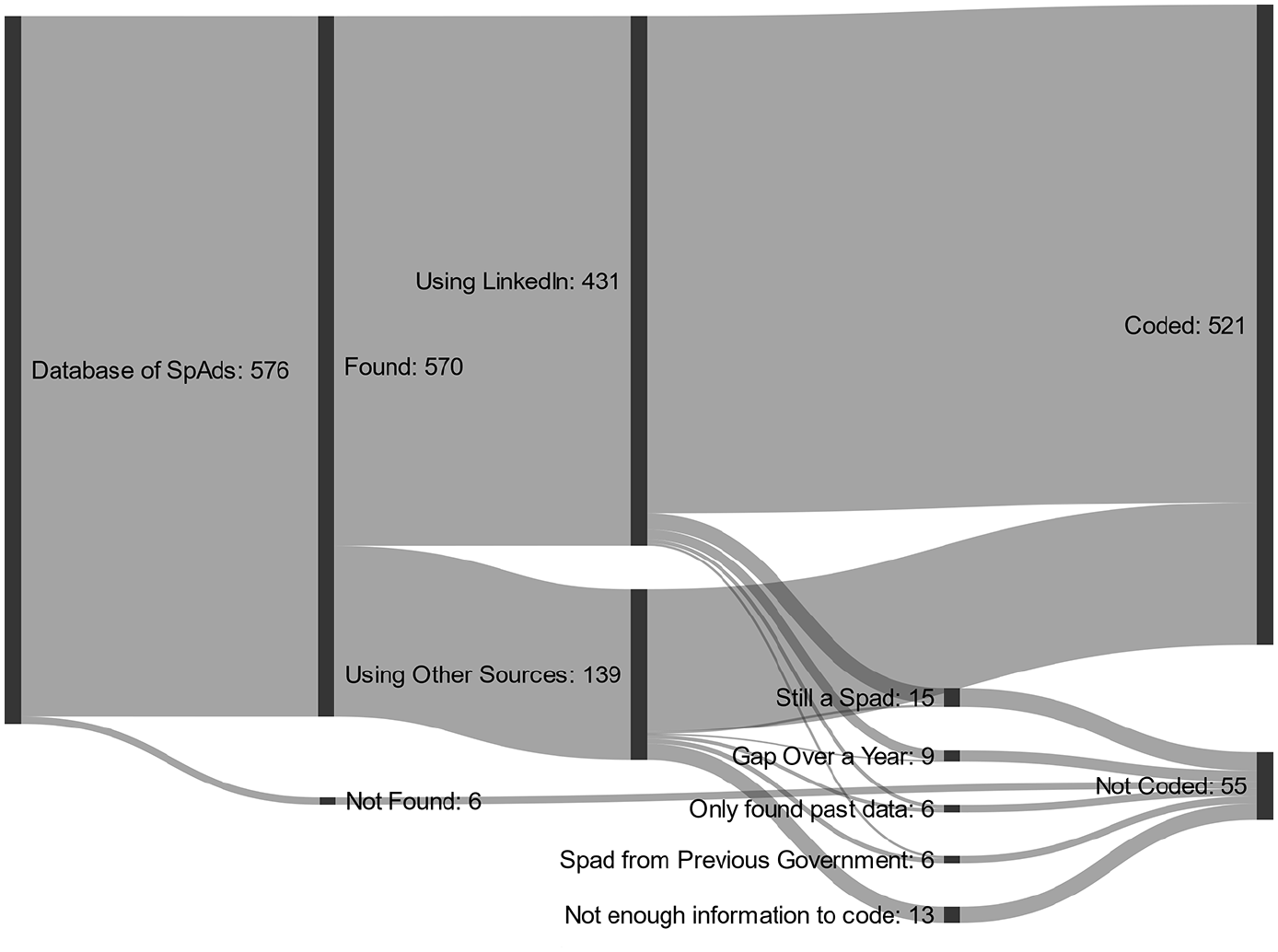
Sankey diagram showing data collection flow.
Our dependent variable is the first post-government job role of former British SpAds. It is a categorical variable with five categories: corporate lobbying; policy advocacy; politics; public service; and non-policy professions. To retrieve and record first post-government employment, we primarily used LinkedIn, a publicly available professional social networking website, and also a mix of online material, including, but not limited to, government websites, such as the ACoBA which is meant to regulate post-government work, company websites, industry newsletters (e.g. PR week), government reports and press releases, and news articles. Over 75% of the SpAds in our sample were found through the LinkedIn platform alone. Much of these data is self-reported information provided by the user (the former SpAd). Thus, the approach is limited in so far as some profiles lacked sufficient employment information or some individuals did not have a LinkedIn account, but information could be cross-checked or retrieved from other sources. The method is also consistent with other similar studies (Blach-Ørsten et al., 2020; Krajňák et al., 2020; Sellers, 2014). LinkedIn was also a main source for Sellers’ (2014) earlier exploration, and was also supplemented using information from Debrett’s People of Today and the UK Parliament website. In sum, we retrieved information for 90.5% of the cohort, similar to Sellers’ (2014) earlier research (89%).
Given that in the UK there exist two lobbying registers, one voluntary (UK Lobbying Register (UKLR) and one mandatory since 2014 (Office of the Registrar of Consultant Lobbyists (ORCL), we also collected data on three additional variables of interest: (1) whether the former SpAd ever registered individually as a lobbyist; (2) whether the SpAd’s first post-government job was with a company registered on the lobbying registry; and (3) whether the person’s first post-government job was with a company registered as a client of a lobbying firm on the lobbying registry. If landing into corporate lobbying and policy advocacy positions is as big of a phenomenon as we assume, it would be interesting to know how overt, or covert these roles are in the UK.
The first independent variable of interest is party affiliation (H1). We assumed an adviser’s party affiliation mirrors that of the minister, or prime minister to whom the adviser worked for. The second independent variable of interest is the previous professional role (H2). This was measured as a categorical variable with five categories: politics; corporate lobbying; policy advocacy; public service; and non-policy professions. Data on previous work experience were also collected via the method outlined above.
For robustness, we also controlled for variables, which, according to existing research, can affect the post-government careers of advisers. First, we controlled for length of tenure. This was measured as the number of years the SpAd spent in government before their first exit. Second, we controlled the effects of ministry centrality. Centrality was measured using a binary variable. An adviser was considered central if, during their term, they worked in either the Prime Minister’s Office or the Cabinet Office (see operationalisation by Yong and Hazell, 2014). Third, we controlled for effects of the policy sector in which the adviser served. We measured this by grouping the last ministry the adviser worked in before leaving government into four policy clusters: government and administration; market and economy; social; and security and foreign affairs. The final control was gender.
Finally, we imported the dataset into RStudio (R Studio Team 2021 version R.4.1.1), for data transformation, presentation, and analysis. To test our hypotheses, we used multinomial logistic regression. This method is appropriate as we are dealing with a dependent variable with multiple nominal options and was computed using the nnet package in R (Venable and Ripley 2002).
Results
Where do they land?
Table 3 reports the number and percentage of former SpAds according to five categories of post-government professional roles.
The post-government professional afterlife of British special advisers 1997–2017 (N = 521).
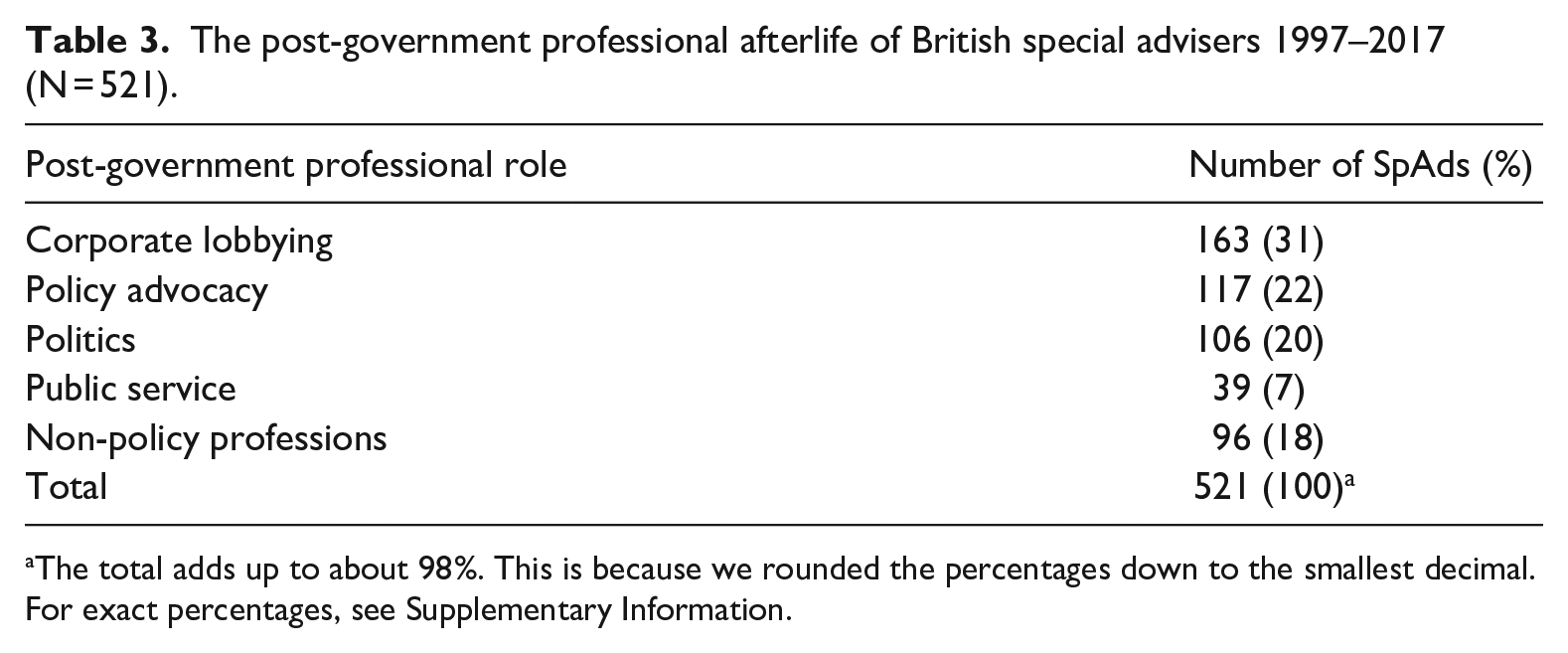
The total adds up to about 98%. This is because we rounded the percentages down to the smallest decimal. For exact percentages, see Supplementary Information.
The vast majority of advisers stay in the policy professions field (about 81%) and only a small percentage (about 18%) exit to other occupations – for example, business, media, academia, etc. (see Supplementary Information 2 for a breakdown of specific non-policy profession roles). As expected, by far the most common post-government career move is to revolve into corporate lobbying (about 31%). After corporate lobbying, policy advocacy is the second most common career move (about 22%). According to LaPira and Thomas (2017), these ‘unregistered policy advocates’ should also qualify as lobbyists, even though many of them might feel ‘contaminated by being lumped together’ with corporate lobbyists under one common label (Selling and Svallfors, 2019: 1000). If we follow the definition by LaPira and Thomas (2017), we observe that 54% of SpAds in our sample revolve into some kind of broadly defined ‘lobbying’ role after they leave government.
The third most common career move is to enter politics (about 20%). However, from the 105 former SpAds who landed in politics, only 12 immediately became MPs in the House of Commons and 5 in the devolved assemblies. Twenty-five became peers in the House of Lords and the remaining 63 landed in party roles (for a detailed breakdown and discussion see Supporting Information 3).
As expected for the UK context, the far less common career move is to enter public service as state officials (about 7%). Becoming a civil servant in a Whitehall department has always been a minority choice (Sellers, 2014: 236). However, when compared to the findings of Sellers (2014), our data here show that the percentage of former SpAds who land in public service roles has decreased by more than half. Our interpretation of this decrease is that public service has become less attractive in the course of the last decade given austerity measures and the growth of the lobbying sector.
We also searched the UK official lobbying register (ORCL), which was established in 2014, and the self-declared lobbying registry (UKLR), to examine how many advisers and how many of the professional organisations for which they worked were registered as consultant lobbyists. Table 4 summarises the results (see Supplementary Information 4 for more details).
A comparison of special adviser post-government professional roles and level of registration in (1) The Office of the Registrar of Consultant Lobbyists (ORCL) and (1) the UK Lobbying Register (UKLR).
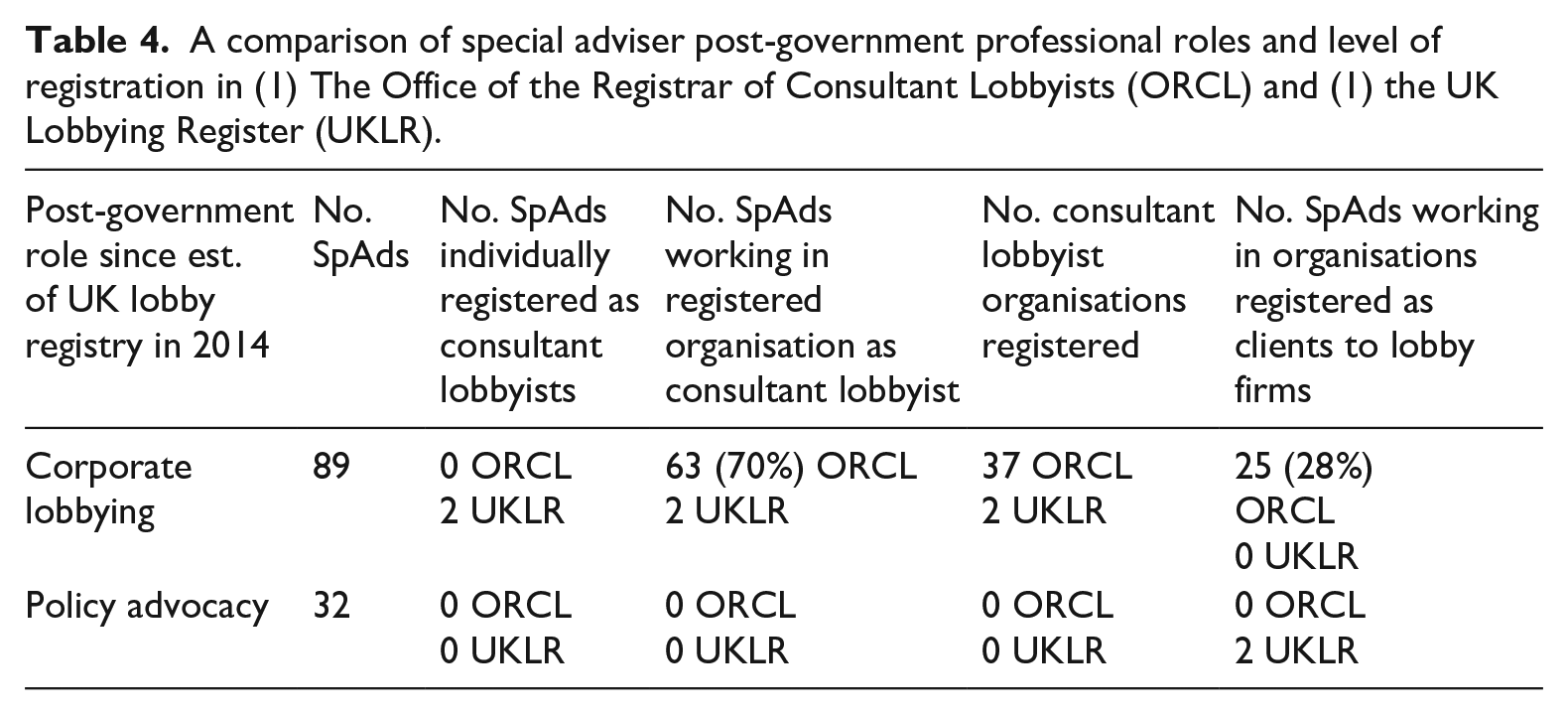
In a post-2014 subset of the dataset, we found no former SpAds registered with the ORCL and only two with the UKLR although we coded 89 as landing to corporate lobbying and 32 in policy advocacy roles (out of 201 total in the period 2014–2017). Notwithstanding potential problems with our coding approach, clearly, there seems to be a huge mismatch between self-reported individual adviser job roles and the lobbying registers. The mismatch between the number of individual registrations and the ORCL, which was set up by an Act of Parliament and is mandatory, begs for an explanation. One reason for this mismatch might be the difference between how lobbying is defined in academia and in the British statutory framework. The main problem, though, which we are going to discuss in the concluding remarks of this article, concerns the various loopholes in the UK lobbying legislation that allows former SpAds to fly under the radar (Committee on Standards in Public Life, 2021).
Searching the ORCL for consultant lobbying organisations instead of individuals is more telling. Sixty-three SpAds landed in 37 different organisations that were registered as consultant lobbyists post-2014. Evidently, some organisations employed more than one SpAd (e.g. Bell Pottinger, Lexington, etc.). Thus, since ORCL came into effect in 2014, about 31% of the 201 SpAds during that period, revolved out of government into an organisation that was registered as a consultant lobbyist. Interestingly, all 37 registered organisations are for-profit companies. This in turn means that 70% of SpAds, whom we classified as having revolved to corporate lobbying since 2014 (n = 89) and were not individually registered as consultant lobbyists, landed in a firm that was listed on the lobbying registry (for a detailed breakdown of both registers, see Supplementary Information 4, table SM4b).
This is not to say that organisation registration in ORCL is high. On the contrary, it is very low and very limited to for-profit companies, with many companies being unregistered and the majority of advocacy groups, such as, for example, the British Bankers Association, staying in the shadows. Our findings validate previous research (e.g. McKay and Wozniak, 2020) according to which there is a mismatch between formal consultant lobbying organisation registration and the actual reality on the ground.
Finally, we also searched both the UKLR and ORCL for organisations that registered themselves as clients of lobbying firms (see Supplementary Information 4, table SM4c). Our search of ORCL, revealed that 25 SpAds worked for companies registered as clients of lobbying firms, such as, for example, Teneo, Hanover, Policy Connect, Cicero, Jericho, and others. This amounts to about 28% of the post-2014 sample of SpAds who landed in corporate lobbying positions. From the policy advocacy sector, only Greenpeace was found to be the client of a lobbying firm (see Supplementary Information 3 for the list of registered clients in each register).
Explanations
The bar chart below (Figure 2) groups the post-government professional role of SpAds by party affiliation, which is our first main predictor of interest. We find Conservative and Liberal Democrat party SpAds are more prone to enter corporate lobbying than Labour SpAds. Labour SpAds are more prone to enter policy advocacy roles, or exit the policy professions when compared to Conservative and Liberal Democrat party SpAds. Liberal Democrat SpAds, by contrast, appear to be marginally more prone to enter political roles. The multinomial logistic regression will later show whether what we see here is statistically significant.
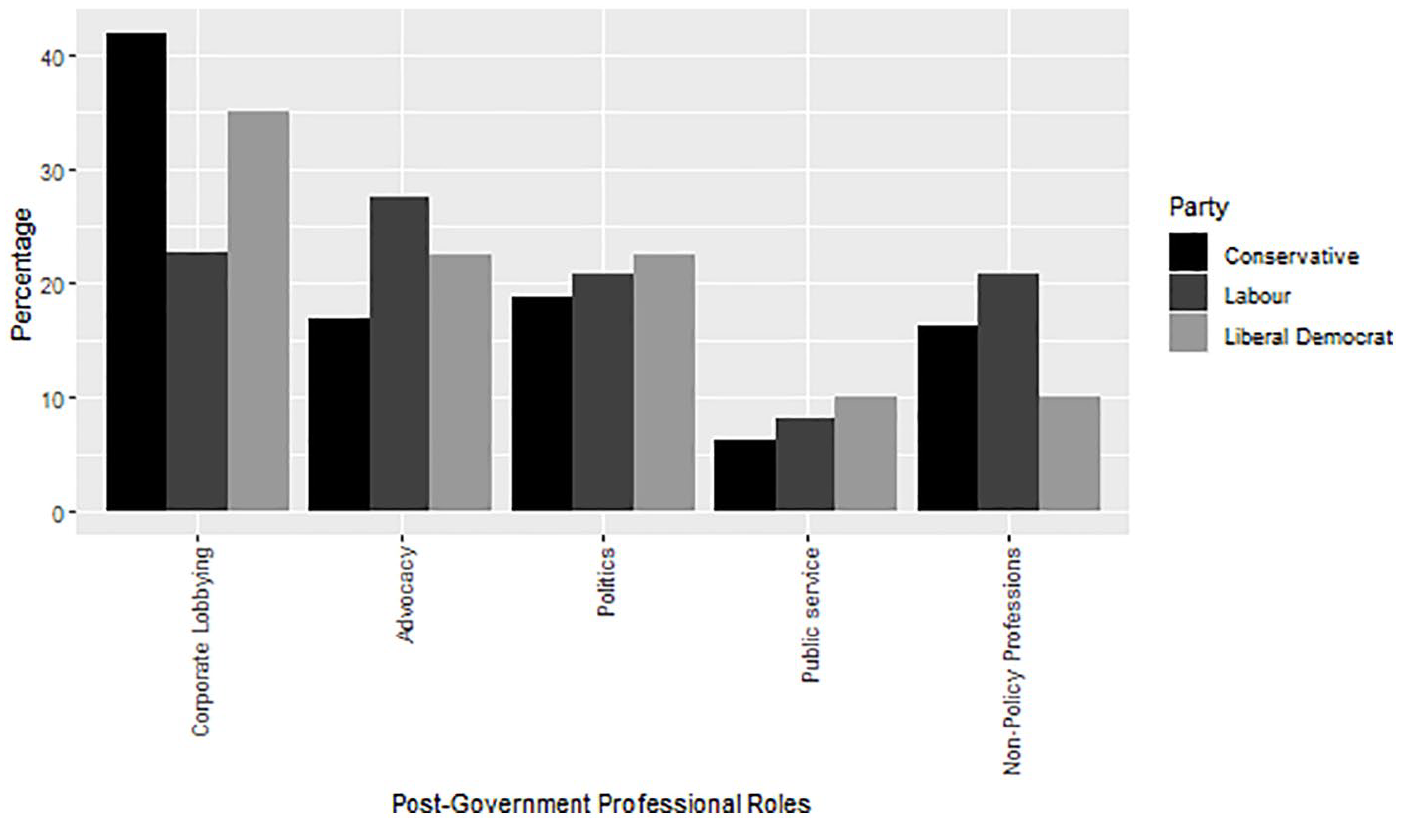
Post-government professional roles – Split by party (percentages).
Figure 3 shows the flow of adviser occupational careers. On the left-hand side, we observe the professional roles advisers held immediately before joining a minister’s office. This is our second predictor of interest. The majority of advisers come from politics (n = 222), followed by non-policy professions (n = 100), such as, for example, business, media, and academia, then comes corporate lobbying (n = 90), followed by policy advocacy (n = 74) and public service (n = 26).
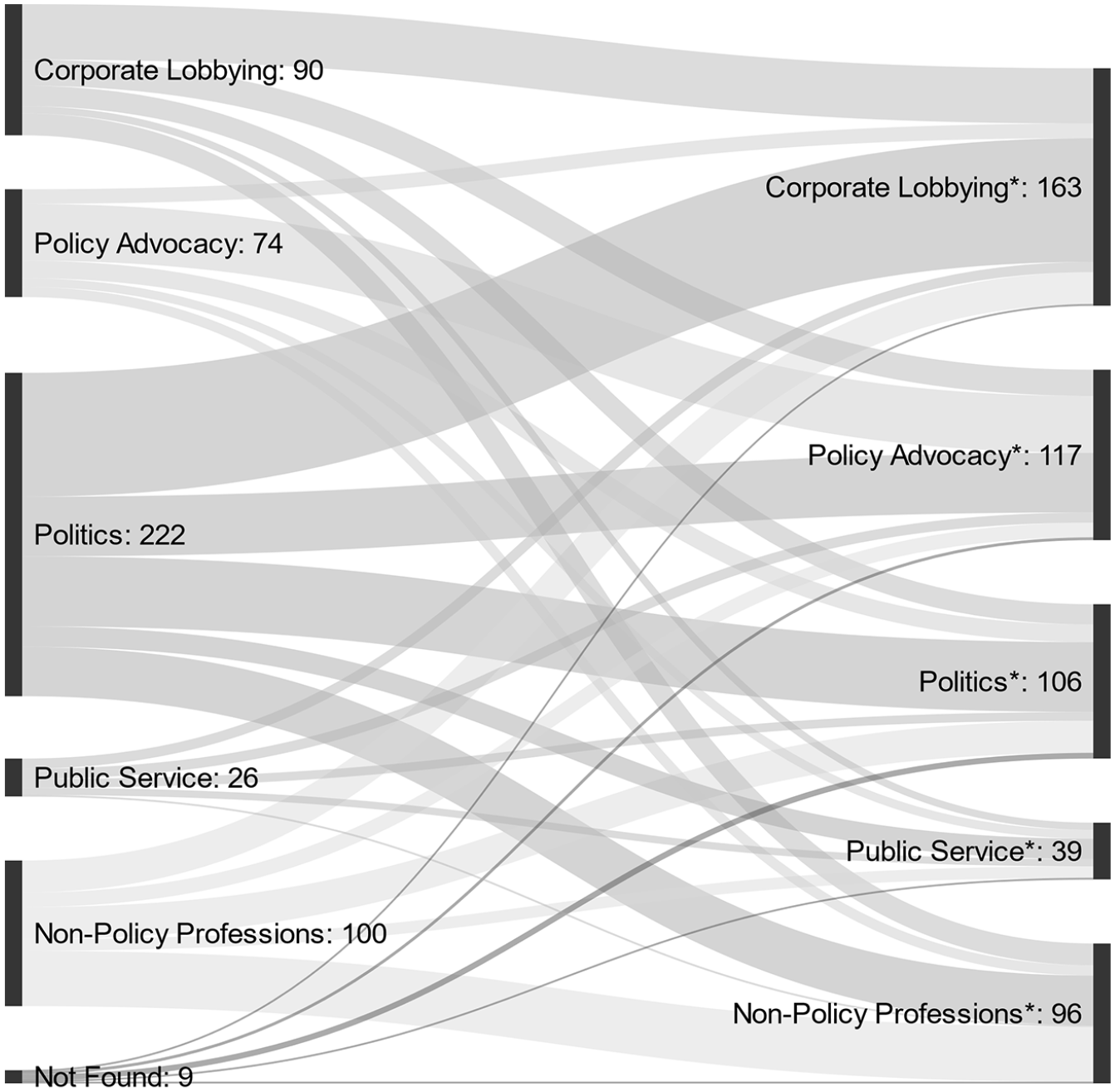
Pre-government to post-government flows (n = 521).
The right-hand side of Figure 3 shows where the advisers landed immediately after leaving their minister’s office. Corporate lobbying now becomes the biggest category by almost doubling in size (n = 163), followed by policy advocacy (n = 117), which also sees a big increase. Politics, by contrast, is almost reduced to half (n = 106) and thus relegated to third place as a career option. The non-policy professions (other n = 96) remain fairly stable in terms of numbers. Public service sees an increase but remains low as a post-government career option (n = 35).
The width of the arrows tells an interesting story too. SpAds with a background in politics, by far the largest pre-appointment job role category, by and large enter corporate lobbying and policy advocacy. SpAds with non-politics backgrounds tend to stay in similar roles to the ones they held before the appointment, despite some movement to other roles.
Is what we see descriptively also statistically significant? Table 5 presents the results of the multinomial logistic regression model.
Multinomial regression analysis of post-government roles.
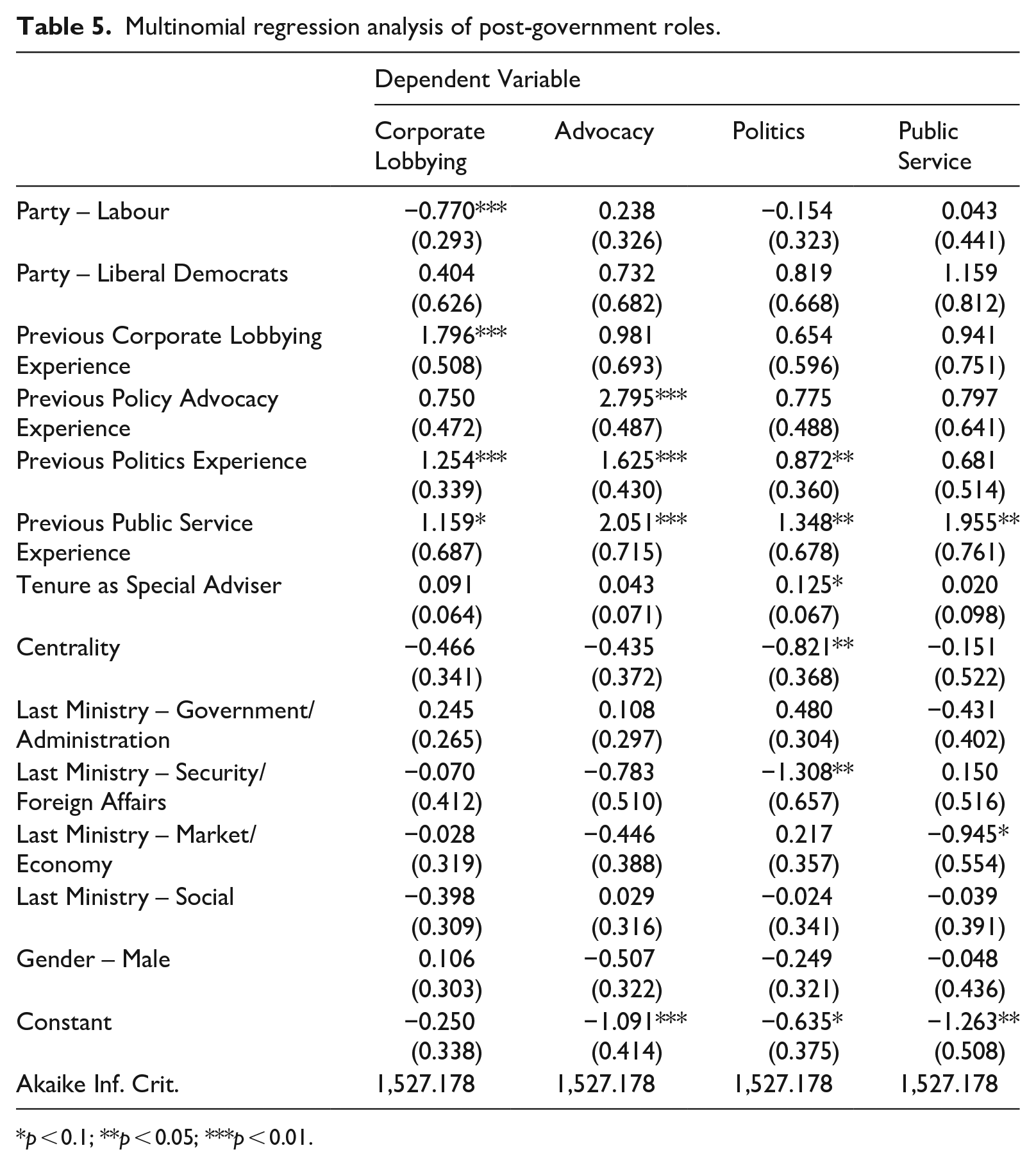
p < 0.1; **p < 0.05; ***p < 0.01.
Our first hypothesis was that ideological commitments influence post-government career moves. This refers to loyalties and value hierarchies captured by SpAds’ party affiliation. The hypothesis is confirmed. We found that Labour-affiliated advisers are significantly less likely to land in corporate lobbying roles, when compared to advisers who are affiliated to the Conservatives. The comparison between Conservative and Liberal Democrat party SpAds yielded no significant effects with respect to their professional lives after Whitehall. We then changed the reference category in our analytical model to test whether the opposite hypothesis holds for Conservative and Liberal Democrat party-affiliated advisers (see Supplementary Information 5 and 6). With Labour as the reference category, we observed that both Conservative and Liberal Democrat former advisers are significantly more likely to land in corporate lobbying jobs than their Labour colleagues. Finally, we made Liberal Democrat SpAds as the reference category in our model. We found that Conservative Party SpAds show no significant differences from their Liberal Democrat counterparts with respect to where they land after government. However, Labour SpAds are significantly less likely to land in corporate lobbying jobs. The findings are robust.
Our second hypothesis posited that the previous career of advisers would influence their post-government professional afterlife because of occupational path dependency. This hypothesis is also confirmed. When compared to advisers with a non-policy profession background, advisers who worked in corporate lobbying before becoming a SpAd are more likely to revolve back to corporate lobbying. Similarly, advisers who worked in policy advocacy are significantly more likely to land back into an advocacy role. What is especially interesting is the analysis for advisers with a politics and public service background. SpAds with a previous job in politics are not only more likely to land back to politics when compared to SpAds with a non-policy background, but they are also more likely to land in corporate lobbying and advocacy. Moreover, SpAds with a previous job in public service, when compared to those with no policy profession background are more likely to land in any of the four policy profession categories. This in turn confirms the occupational path dependency hypothesis, but also provides evidence on how most routes lead to post-government jobs in corporate lobbying and policy advocacy.
With respect to the four control variables, we observed the following. There are no significant differences among male and female former SpAds. What was significant, however, is the longer a SpAd’s tenure the more likely this individual is to land in the political sector. This can be explained by the fact that the longer a SpAd works in government acquiring new political skills and political process knowledge, the higher the chances of breaking the occupational path and depleting their old skills (Dlouhy and Biemann, 2018). By contrast, SpAds who served in the PM’s Office and the Cabinet Office are less likely to land in politics. This is somewhat surprising, and many reasons could explain this observation. For instance, we speculate some of the political roles may be perceived as a ‘step-back’ in one’s career (such as working in a party central headquarters’ role), and others may take more time to secure (e.g. being pre-selected and then running for a House of Commons seat, or being appointed to the House of Lords). Finally, some policy sectors seem to matter, though we should be careful with the interpretation of these results as the exact theoretical logic of the correlations cannot be determined by our data. SpAds who served in an economy and market department are less likely to land in a public service job. This is somewhat intuitive as the networks associated with the two sectors and the skills one should possess are fundamentally different. In addition, we know from past research on US staffers that the value of government contacts in the economy sector is associated with significant revenue premiums when these actors turn revolvers (Blanes I Vidal et al., 2012: 3743). Going into public service after having served in an economy department would therefore be the most sub-optimal option and one that is clearly avoided. We also found that SpAds who served in a security department are less likely to land in politics. This observation is also hard to disentangle. We speculate that the kinds of contacts and networks associated with ‘high politics’ in defence, the foreign ministry, and the home office, as well as the very nature of these portfolios (e.g. the types of issues addressed) inhibit the landing (or relapse) of advisers to party think tanks and constituency politics, which by and large prioritise low politics.
Concluding remarks and practical implications
This article has filled an important gap in our understanding of the post-government career moves of British special advisers. We make the following novel contributions. First, we assembled an original empirically rich longitudinal dataset spanning 20 years. Our work is not a mere update of previous SpAd career data (Sellers, 2014; Yong and Hazell, 2014). Second, we offer a novel, theory-derived categorisation of SpAds’ post-government careers. Instead of relying on atheoretical occupational sectors, we applied the concepts of the policy professions field and ‘PPPs’ (Selling and Svallfors, 2019), as well as that of shadow lobbying and ‘unregistered policy advocates’ (LaPira, 2015; LaPira and Thomas, 2017) to create more meaningful and parsimonious categories of career roles from the point of view of democracy and public policy. Third, our study offers the first systematic analysis of British SpAd career data, the only exception to our knowledge being the study of Goplerud (2015) on advisers as parliamentary candidates. Fourth, our analysis challenges the lure of power hypothesis for SpAds, which has emerged as a dominant theory to explain the career moves for PPPs in other politico-administrative systems. Our analysis corroborates the role of ideological commitments and occupational path dependency as major constraints in career choices Finally, not only does this research converse with multiple strands of literature, including research on political advisers/staffers, political elite careers, revolving door lobbyists, and occupational choice, but it also engages with contemporary policy debates surrounding lobbying regulation in the UK and elsewhere. Thus, our study has concrete public policy implications.
By analysing the employment profiles of 521 former SpAds in the period 1997–2017, we found that they land primarily in corporate lobbying roles and second in policy advocacy roles, although the latter should also be seen as lobbying on behalf of special interest organisations that influence government (LaPira and Thomas, 2017; Sellers, 2014). A smaller yet sizable proportion lands in politics, out of whom only a small fraction become political representatives (e.g. in the House of Commons or House of Lords). Thus, what was an increasing trend in the 1990s (Sellers, 2014), namely the small but increasing number of former SpAds who landed in public affairs jobs, is now a dominant reality. A very small percentage ends up in public service roles (e.g. in public bodies, in the civil service). By contrast, the popularity of businesses as the first choice for SpAds has by and large evaporated. This is also partly due to differences in coding between Sellers (2014) and ourselves. The business category in the work of Sellers (2014) codes individuals by the job sector, rather than the specific job they held, and it also includes positions in associations that represent business interests. This has the effect of inflating the number of people working in private sector ‘business’ firms in the Sellers (2014) dataset while under-reporting the number of in-house shadow lobbyists.
Our findings are not just specific to the British case. The findings also corroborate trends that we observe in other country settings and lend weight to increasing concerns about revolving door lobbyists (Blanes i Vidal et al., 2012; LaPira and Thomas, 2017) and how PPPs offer ‘politics for hire’ (Svallfors, 2020). Moreover, we would expect to see an increase in ministerial advisers (or equivalent) revolving in lobbying and policy advocacy roles in other country settings experiencing new market demands for political and policy skills. Another finding of importance is that former SpAds-turned-lobbyists face minimal public scrutiny. Irrespective of whether they are corporate lobbyists or policy advocates, former SpAds do not register as individual consultant lobbyists in either the self-declared UKLR or most importantly the mandatory ORCL, which was established in 2014. In addition, 30% of those former SpAds who land in corporate lobbying, work for non-registered for-profit companies. Not a single policy advocacy organisation, of the ones in which our sample of former SpAds landed, has registered since 2014. This shadow lobbying trend, which is also observed in other countries (LaPira and Thomas, 2017) is a result of certain key institutional loopholes, evidence that the UK lobbying regulatory framework is ‘opaque’ and falling in the ‘low robustness category’ (McKay and Wozniak, 2020).
A report published by the independent Committee on Standards in Public Life (2021) highlighted three key issues. First of all, the Business Appointment Rules are merely a set of principles and guidelines and the Advisory Committee on Business Appointments (ACOBA) can only advise, it can neither ban lobbying, nor sanction the breach of rules. A second loophole is that consultant lobbyists − for example, a former SpAd − who contact senior civil servants (below permanent secretary level, e.g. director generals and directors) and SpAds in government service are not required to formally register in ORCL. Yet, we know from past research in other systems that the key persons that former staffers lobby are former officials and former staffer colleagues (McCrain, 2018). It is this type of lobbying that produces the biggest value premium. Third, this loophole is further increased by the fact that ‘transparency releases for special advisers only include details of meetings with senior media figures’ (Committee on Standards in Public Life, 2021: 12). Thus, not only is a former SpAd not obliged to register, but also SpAds in government service are not obliged to report meetings with their former colleagues turned lobbyists. The same applies to civil servants. Thus, to summarise, a former SpAd turned corporate lobbyist − for example, for a lobbying firm − or policy advocate − for example, for a charity, or professional organisation − can have as many meetings as they want with current SpAds in ministries and senior civil servants without registering on the ORCL and without registering the meetings.
Trying to close the revolving door, as well as enhance transparency and disclosure about who qualifies as a lobbyist may also face partisan objections. The statistical analysis of party ideological preferences on post-government career moves showed that being a Labour SpAd significantly diminishes the likelihood of landing into corporate lobbying roles and the reverse holds for Tory and Liberal Democrat SpAds. In face of this evidence, we expect suggestions to give ACOBA more teeth, as the Committee on Standards in Public Life (2021) has recommended, to be cheered by partisans of one side, but met with scepticism or even outright hostility from those on the other side.
In addition, it is debatable whether making adherence to the Business Appointment Rules an enforceable legal requirement will be effective. As the US case shows, enforceable cooling-off periods can drive more lobbyists into the shadows (LaPira Thomas, 2017). Moreover, it might also not be desirable. The statistically significant effect of occupational path dependency on SpAds’ post-government career landings, which we report in this study, means that individuals would not be able to return to their previous job sectors if the system was more stringent. This would abuse their right to have a career and earn a living. As a side effect, individuals who would desire to enter government as advisers could be deterred from doing so (Sellers, 2014: 245). It has been argued in the past that one way to avoid this would be to take ‘a proportionate approach’ that strikes a balance between the right to have a career and public interest (Sir Christopher Kelly quoted in Sellers, 2014: 245).
What should be non-negotiable, though, is enhancing lobbying transparency. Definitions of lobbying and of who (whether an individual and/or organisation) can be considered a consultant lobbyist could become more inclusive to account for a variety of activities that currently fall under the radar. The fundamental principle should be that all meetings of government outsiders with serving SpAds and civil servants (irrespective of rank), in which public policy is being discussed, should be registered. Moreover, anyone who wants to register for a policy-relevant meeting should automatically be registered in the ORCL. This in turn could be renamed as a lobbying and advocacy register to temper stigma and facilitate transparency of contacts and networking with the government.
Supplemental Material
sj-docx-1-bpi-10.1177_13691481221144228 – Supplemental material for Life after Whitehall: The career moves of British special advisers
Supplemental material, sj-docx-1-bpi-10.1177_13691481221144228 for Life after Whitehall: The career moves of British special advisers by Daniel Orchard, Athanassios Gouglas and Heath Pickering in The British Journal of Politics and International Relations
Footnotes
Acknowledgements
The article has evolved from a research essay submitted by the lead author, Mr Daniel Orchard, for the assessment of the third-year undergraduate module POL3228 ‘From the Shadows into the Light. Political Advisers and Policy Making’, University of Exeter. A previous version of this article was presented to the ‘Politics of Bureaucracy’ panel at the 2021 European Consortium for Political Research conference. The authors thank the panel participants for their comments and suggestions, and in particular discussant Professor Richard Shaw. The authors would also like to thank Ben Yong, Robert Hazell, and Max Goplerud for providing access to their British Special Adviser dataset.
Funding
The author(s) disclosed receipt of the following financial support for the research, authorship, and/or publication of this article: Thanks to the Flanders Research Foundation (FWO) grant number G079619N and KU Leuven, Belgium, for supporting the participation of Heath Pickering in this work.

Supplementary information
Additional supplementary information may be found with the online version of this article.
Supplementary Material 1: Dataset Construction. Table SM1: Stages of Data Collection and Dataset Construction. Supplementary Material 2: Breakdown of the Non-Policy Professions Category. Table SM2: Breakdown of the Non-Policy Professions Roles. Frequency (n and %) by Occupational Sector. Supplementary Material 3: Breakdown of the Politics Cluster. Table SM3a: Frequency of Post-Government Job Roles per Type of Politics Roles. Table SM3b: Frequency of Post-Government Job Roles per Type of Politics Roles per Party. Supplementary Material 4: UKLR and OCLR Registry. Table SM4a: Individual Consultant Lobbyists. Table SM4b: Organisation Consultant Lobbyists on the UKLR and ORCL. Table SM4c: Clients Table. Supplementary Material 5: Analysis With Labour as Reference Category for the Party Variable. Supplementary Material 6: Analysis With the Liberal Democrats as Reference Category for the Party Variable.
Notes
References
Supplementary Material
Please find the following supplemental material available below.
For Open Access articles published under a Creative Commons License, all supplemental material carries the same license as the article it is associated with.
For non-Open Access articles published, all supplemental material carries a non-exclusive license, and permission requests for re-use of supplemental material or any part of supplemental material shall be sent directly to the copyright owner as specified in the copyright notice associated with the article.
