




Abstract
The article examines how Israeli state-secular education integrates the principle of continuity and change through human agency into its history curriculum, in order to cultivate democratic consciousness. Drawing on theorists such as John Dewey, Marc Bloch, and Peter Seixas, it evaluates the curriculum's potential, or its lack thereof, to promote the understanding that democracy is constantly shaped by human actions. The article argues that, while the curriculum emphasises democratic values across various chapters from ancient times to the late twentieth century, it faces challenges in fostering historical consciousness that encourages students to act as agents of democratic change. Particularly, critical issues like relations between Jews and Arabs, or the tension between the country's Jewish and democratic identities are often neglected or not historicised, undermining a comprehensive view of modern Israeli society as a product of its history.
Keywords
Contemporary Israeli democracy needs a historically conscious Israeli society. The heated debates about an array of issues concerning the foundation of civic life in Israel – the balance of power between the branches of its regime, the tensions between the democratic and Jewish identity of the county, relations between Jews and Arabs, the Israeli-Palestinian conflict, and more – indicate that Israeli democracy is undergoing a profound, and rapid, change. The fact that the diverse society in Israel is divided on the future character of its democracy is natural, and in itself an expression of the democratic culture in Israel. Yet, to lead this transition without tearing apart the delicate fabric of society, and without undermining the foundations of the democratic culture that allows for this change, Israeli society needs to understand the democratic idea, its particular manifestation and development in Israeli history, and the human agency that has brought about this development. It needs also to acknowledge that contemporary Israeli democracy is the product of its latest development, and that the future of democracy will be determined by the present generation of Israelis. Thus, Israeli society requires an active and reflective historical consciousness.
Education in general, and history education in particular, is key to nourishing this historical consciousness (Bentrovato end Schulze, 2016). When John Dewey (2008 [1916]) argued that “democracy has to be born anew every generation, and education is its midwife” (139), he captured the idea that not only is democracy based on education that supports democracy, but also that democracy evolves over time through human agency. A primary goal of a democracy-supportive education is to convey this concept.
The idea of change in time through human agency lies at the heart of history education and its disciplinary and educational objectives. As the great historian Marc Bloch beautifully articulated, “Behind the features of landscape, behind tools or machinery, behind what appear to be the most formalized written documents, and behind institutions, which seem almost entirely detached from their founders, there are men, and it is men that history seeks to grasp” (Bloch, 1964 [1949]: 26). The historian has to follow mankind, because people make history, and anything that is created by humans has a history, including democracy. Theorists of history education, foremost amongst them Peter Seixas (2017), developed models that show the centrality of continuity and change and of human agency in effective history education (see also: Rosenlund, 2021; Thorp and Persson, 2020). Moreover, as Seixas wrote: “generating large historical questions extends from continuities and changes across periods in the past, to continuities and changes between past and present” (Ibid), suggesting the principle of continuity and change through human agency allows pupils to see themselves as active historical subjects.
Additionally, history education in and for a democratic society should be about democracy. As Ochoa-Becker (2006) argued, for education to develop pupils’ democratic tendencies and capacity, curricular content “need[s] to emphasize persistent democratic values such as freedom and equality”, and “incorporate the idea of diversity and pluralism wherever possible including ideas about history […]” (75; see also: Nordgren and Johansson, 2015). Noddings (2013), drawing attention to the importance of including democracy and democratic ideas as a subject in the curriculum, stresses also the need for the curriculum itself to reflect the principle of continuity and change. The curriculum, she argues, should be “varied, rich and relevant body of material, continuously open to creative and responsible change” (145). Furthermore, history education in and for democratic society is not only about democracy, but also, in itself democratic (Kurz et al., 2022; Matusov, 2023; Nishiyama, 2021; Zembylas, 2023). Building on academic literature on democratic education in and through conflict (Davies, 2004), history education, in and for democracy, problematises life in a constantly evolving democracy. This, particularly by discussing the tensions between democratic values as these have been realised in human societies in the past, and by examining troubled chapters in history through the lens of democratic worldview (Alvén, 2024; Berg and Persson, 2023; Goldberg, 2017; Goladberg et al., 2019; Naveh, 2017; Klein, 2017; Larsson and Lindström, 2020).
Thus, the present article takes the principle of continuity and change through human agency as the prism through which to examine if, how, and to what extent the history curriculum in Israel supports the advancement of pupils’ democratic consciousness. It draws on Wodak's (2004) concept of Critical Discourse Analysis (CDA), which allows to explore how ideas of citizenship in general, and democratic citizenship in particular, are expressed through language in specific historical contexts. CDA examines how language constructs meaning to reinforce norms and in this study, it is applied to analyze language within broader educational and social contexts, with a focus on history curricula and history didactics (Martin and Wodak, 2003). Thus, applying Wodak's (2011) CDA, the article investigates how historical consciousness intersects with the multifaceted aspects of democracy and offers a detailed roadmap of democratic concepts within Israel's history curricula.
It begins with establishing that the curriculum sets the understanding of democracy as a main learning goal. This enables answering the first set of questions developed by Wodak, pertaining to how democracy is described, what topics related to democracy are discussed, and what features are attributed to people and events. Then the article analyses the curriculum in three categories: human agency, continuity and change, and pedagogy, while allow it to address Wodak's second set of analytical question, particularly whose vioce is heard in content relating democracy. Based on this analysis, it assesses the potential of the curriculum to convey that democracy in general, and the Israeli democracy in particular, have evolved over time through human agency, and that it is a primary civic mission of the pupils’ generation to reshape it in the future.
The Israeli state education system is divided into separate streams – state-secular (and within it the Arab education sector), state-religious, and state-Haredi – each with its own inspectorate, curriculum, and textbooks (Reichel, 2008). To keep within the allocated space, this work focuses on the state secular education system, where most Israeli pupils study (Central Bureau of Statistics, 2024). While focusing on the state secular system alone, the paper analyses together both the latest curriculum for middle school (2010, grades 7 to 9) and for high school (2003, grades 10 and 11). Beyond presenting and exploring the overall teaching plan for history, this will allow the analysis of two approaches to history education when addressing the idea of democracy in history. The middle school curriculum is organised chronologically from the ancient period to the Second World War, whereas the high school curriculum is organised thematically around key chapters, from ancient history to the late twentieth century, including chapters in the history of the State of Israel since 1948. For each grade, a set of core values is attached to the curriculum by the Ministry of Education (MoE) and the subject inspectorate. To deepen the analysis of whether and how democratic values are weaved into history education, these texts will also be examined.
History of the history curriculum in Israel: A brief overview
Before Israel gained independence in 1948, Zionist intellectuals, politicians, educators, and cultural agents had already begun constructing a collective Jewish national past. As Yael Zerubavel's (1995) seminal work shows, this early narrative-building laid the groundwork for the historical canon that emerged in the 1950s, when the Israeli Zionist elite solidified this vision to give the young country its official national history, primarily through the education system. The resulting canon was overwhelmingly Zionist, Jewish and Eurocentric, a reflection of its creators’ perspectives (Avineri, 2017). Unsurprisingly, it faced almost immediate resistance from various Israeli groups that were not represented in it, including Jews from Middle Eastern and North African (MENA) countries, religious Zionists, Ultra-Orthodox Jews and Palestinian Arab citizens of Israel. Throughout the 1960s and into the 1970s, these challenges to the canon grew in intensity, revealing cracks in the supposedly unified historical narrative (Naveh, 2017).
In 1975, the MoE introduced a new history curriculum – the first significant update since 1954. This curriculum, which remained in place until its full revision in 1995, aimed to promote students’ historical literacy and academic skills, placing a greater emphasis on critical thinking. Ben-Amos (1994) noted that this shift focused on the cognitive aspects of studying history, rather than on contributing to a nationalist consciousness (see also: Tal and Hofman, 2020). This marked a significant departure from the more ideologically driven history education of the 1950s and 1960s. However, despite the shift towards a more academic approach to teaching history, the curriculum retained a conservative focus on political history, largely ignoring the “New Social History” that was gaining traction in American universities.
In subsequent decades, additional challenges to the Zionist master narrative emerged from new immigrant groups, such as Jews of Ethiopian descent in the mid-1980s and early 1990s, and immigrants from the former Soviet Union in the early 1990s (Anteby, 1998; Tal, 2023). These, along with the emergence of diverse old and new competing narratives, raised the pressure to revise the established canon, particularly regarding questions of equal representation and pluralism. Accordingly, although not without its flaws, the 1995 curriculum for the state education system signalled a turning point in Israeli history education, promoting a more inclusive approach to multiculturalism (Weintraub and Tal, 2021). Today, history education in the state secular system, with the high school curriculum of 2003 and the middle school curriculum of 2010, is more attuned to cultural diversity, a shift which points to a broader trend toward acknowledging and valuing various cultural heritages, suggesting a departure from an Ashkenazi-centric viewpoint toward a more inclusive perspective on Israeli history and society.
Analysis overview
Before embarking on an in-depth exploration of the curricula through the lens of CDA, the table below allows with a bird's-eye view of the analysis, which aligns with the methodological framework outlined in the special issue (Ammert, et. al., in print). In essense, this framework categorizes democratic traditions into three orientations: Protective, Developmental, and Interruptive, each associated with democratic sub-traditions, educational purposes, and concepts of historical consciousness (here particulary focusing on how the relation between past, present, and future is presented and advanced. See also: Ahonen, 2006; Doquette, 2015; Seixas, 2004). Protective democracy emphasizes continuity in history through master narratives that strengthen nationalism; Developmental democracy, encompassing liberal, deliberative, and participant democracy, seeks to balance continuity and change by exploring interdependence between past, present, and future while embracing a plurality of perspectives; and Interruptive democracy, linked to multicultural, critical, and participant democracy, fosters critical engagement with history, highlighting complexity, plural perspectives, and non-linear interconnections between past, present, and future.
In addition to facilitating comparative analysis, the table also sheds light on the complexity of Israel's curriculum. Particularly, it reveals a nuanced blend of elements from protective and developmental democracy, while notably lacking components of disruptive democracy.
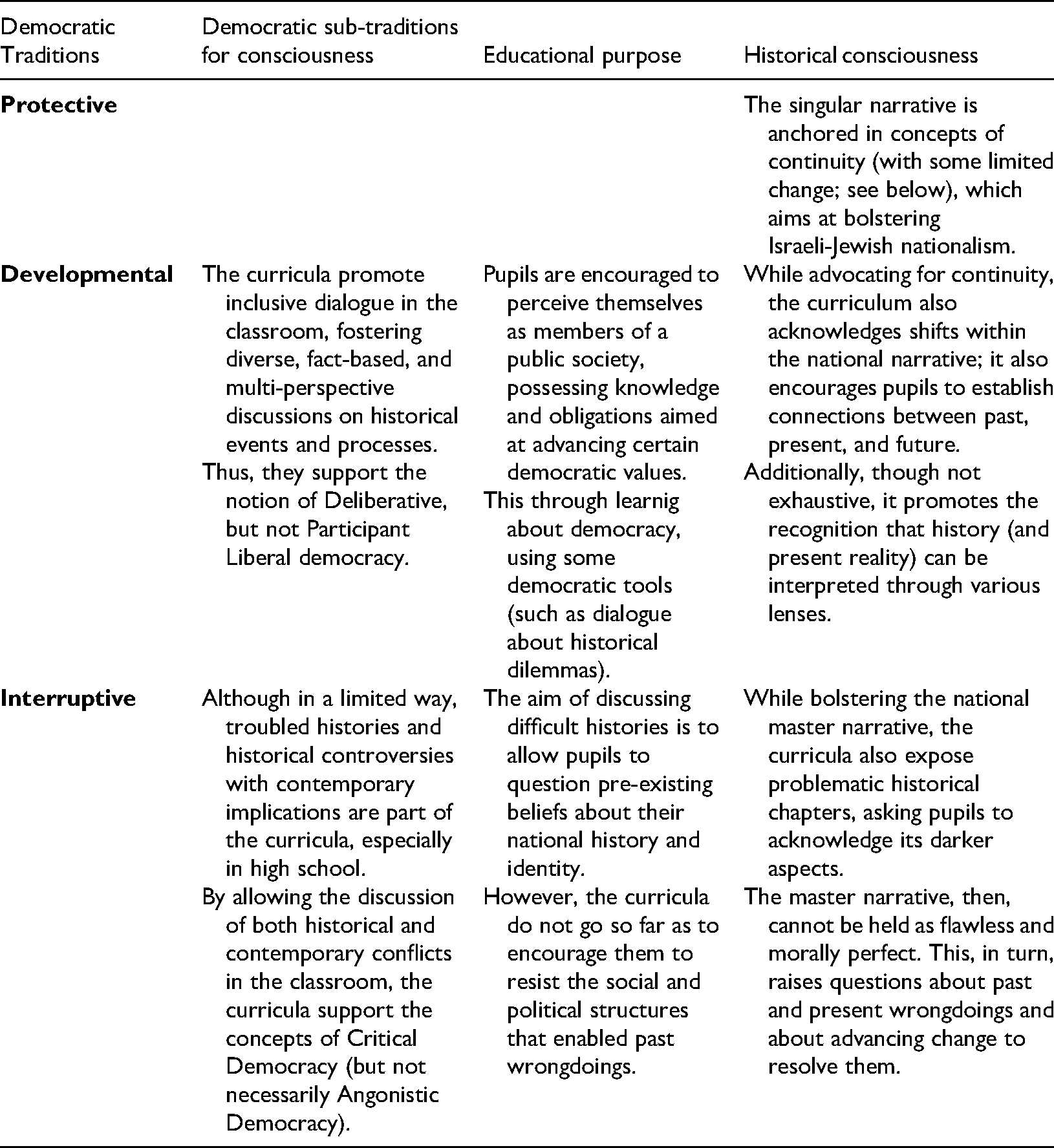
Democracy in the history curriculum
The connection between historical consciousness and democratic values is explored both theoretically and through the lens of specific historical events within the curricula. Thus, the middle school curriculum touches upon democracy and democratic values from the start, with the word itself appearing in it 15 times. The first subject that the pupils encounter in 7th grade, “Classical Greece – the World of the City-State”, focuses on the “characteristics of the democratic regime and its institutions in Athens” (MoE, 2010: 14). There, pupils learn about the roots of the democratic idea in the west and about its main characteristics, such as majority rule and people's power to determine their regime. The next time pupils engage with the history of democracy is in the 9th grade, primarily in the chapters about the consolidation of the modern nation state in the nineteenth century (Ibid.: 37). Yet, the broadest and most focused discussion on democracy is in the chapter on the interwar period, when “democratic states faced social, economic, and cultural crises”, and some withheld while others collapsed (Ibid.: 46). Lastly, the question of democracy is raised in the chapter about the political institutions in the Jewish society of Mandatory Palestine, when pupils learn that the “The Zionist Congress, the Jewish Agency, the Assembly of Representatives, and the National Council” were democratic (Ibid.: 49).
The sets of core values attached to the curriculum also underline democratic values that teachers are encouraged to highlight in their classrooms. Individual freedom, religious tolerance, and human dignity, for example, are to be discussed in the chapters about feudalism, Christian culture in Europe in the Middle Ages, and the Renaissance and humanism, respectively (Weinberger and Nagar, undated c). The broadest discussion about democracy and democratic values appears in the cluster of chapters about the Enlightenment, the French Revolution, and the Industrial Revolution. There, history educators are advised to address “the value of liberty: the right to education”, “the value of human dignity [and] the right to liberty”, “personal and civil freedom within the state”, “majority rule”, “the value of equality”, “the right to self-determination”, “upholding human rights”, “equality before the law”, “freedom of conscience and religion”, “the value of life, [and the right to] protection and bodily integrity”, “upholding children's rights”, and “”upholding women's rights” (Weinberger and Nagar, undated b).
Democracy is also pivotal in the high school curriculum, where it already appears as a core idea in the main goals of the curriculum. These are divided into five clusters, and democracy and democratic values receive a central place in four of them. Thus, in the cluster dedicated to “nurturing universal, humanistic moral values, developing the ability to judge historical events based on these values”, the goal of “instilling democratic values” is mentioned unambiguously (MoE, 2003: 4). Furthermore, while instilling democratic values and while the word “democracy” appears only as the third objective in the cluster (itself the fifth and last cluster), the first two goals also touch upon fundamental democratic ideas: “Cultivating the understanding that, alongside the differences between people in various societies, there is also a fundamental similarity between them”, which underlines the principle of a common human identity together with the right for self-determination, and “cultivating an understanding of, and a commitment to treating all human beings as equal, regardless of gender”, which stresses the idea of equality in general, and gender equality in particular (Ibid.).
Furthermore, the fourth cluster, which also addresses moral and civic development, puts the principle of tolerance and plurality at its centre. Although the word democracy, or any of its declensions, is not mentioned as a goal, the cluster of “cultivating understanding and tolerance toward the emotions, traditions, cultures, and lifestyles of others”, is dedicated in its entirety to this democratic value. This, inter alia, by stressing the “importance of evaluating people based on their actions, not their group affiliation (race, origin, gender, nationality, religion or social class)” (Ibid). Of the democratic values, tolerance receives special attention, with emphasis on its positive outcomes, while the dangers of intolerance and living in intolerant societies are also highlighted.
Democratic ideas appear also in two additional clusters of the main goals of the curriculum, which do not directly refer to the moral development of pupils. The cluster titled “Developing Historical Thinking” (the second of the five clusters) underlines “developing the ability to reconstruct the inner world, motivations, values, beliefs, and lifestyles of people from different eras and cultures compared to our own” as a main objective (MoE, 2003: 3). It thus creates a link between a key skill of historical thinking (aspiring to understand the past in its own terms and in context), with a key democratic idea (acknowledging human diversity and individual identity), which is mentioned as such in the abovementioned clusters that deal with values. Likewise, the cluster on “fostering national identity and nurturing recognition of and connected to Jewish heritage” (the third of the five clusters), encourages pupils to acknowledge that societies – including their own – are diverse. Thus, “understanding the sources of the pluralistic nature of Israeli society and recognising the importance of a common foundation for all groups within the State of Israel” (Ibid: 4), is presented as the sixth (and last) goal, implying that even when history education aspires to cultivate Jewish identity, the State of Israel is comprised of other identities with equal standing.
In the light of these disciplinary, educational, and moral goals, the MoE and the State Secular Inspectorate for history point to the historical chapters that particularly invite teachers to discuss them. For example, in learning about the “patterns of activity of the Zionist movement in the Diaspora and the Land of Israel”, and specifically when exploring kibbutz life, teachers are encouraged to emphasise the value of equality (Sheler and Nagar, online). Likewise, the curriculum designers refer teachers to the chapter on the “city in Christian Europe”, to examine with their class, ideas related to social justice. This, by showing them how “in a class-based world, where a person is born into and dies in their social class, with limited opportunities for mobility, medieval city dwellers fought for the freedom of their Christian citizens” (Ibid.). Jewish life in the Muslim world is another opportunity to advance principles of tolerance in a multicultural world. In the chapter on Jewish life in Baghdad, for example, the educator is guided to discuss “openness and appreciation toward other cultures, different from your own” (Ibid.). “Students”, the guidelines underline, “tend to view Muslim culture from an anachronistic and narrow perspective, seeing it as underdeveloped. The goal of teaching is to break down such prejudices.”
When focusing on specific chapters, we find that democracy as such is most central in the chapters relating to the rise of the Nazis and the Holocaust, when Jews tragically experienced the dangers of living in a non-democratic reality. Thus, in the chapter concerning the character of the totalitarian regime, “the uniqueness of democratic life – human and civil rights” should be discussed; in the chapter about the reaction of the world to the suffering of the Jews, “universalism – moral sensitivity to human suffering, regardless of who they are, and a willingness to take action to help people in distress”; and in the chapter about the Nazi prosecution of non-Jewish populations, “empathy and sensitivity to the suffering of other nations under Nazi rule” (Maniv and Nagar, online).
Although less so, democracy is also part of the chapters regarding the establishment and the development of the State of Israel from the 1920s to the 1980s. In the chapter about the building of the institutional infrastructure of the state during the British mandate between the 1920s and 1948, “democracy” is mentioned directly as a topic. In later chapters, “maintaining the State of Israel as a Jewish and democratic state”, “solidarity”, and “pluralism and tolerance to the other” are weaved into the story of the state as presented in the curriculum, from the 1950s to the early 1980s (Maniv and Nagar, online).
However, in both the middle school and high school curricula, in the context of tensions between Jews and Arabs before 1948, and later in the context of the Israeli-Palestinian conflict, chapters that summon significant questions about the place and image of democracy in Israeli history, democracy and democratic values are scarcely mentioned. In the chapter on the struggle for independence, it clearly states that the War of Independence in 1948, “among other things, created the Palestinian refugee problem” (MoE, 2003: 21). Furthermore, in the supplementary guidelines to the curriculum, educators are encouraged to discuss the 1948 Deir Yassin massacre (“Deir Yassin affair” in the curriculum) (Maniv and Nagar, online). However, the Palestinian refugee problem, with the enormous challenges it has posed since 1948 to the present, is not further discussed. Likewise, in the chapters about Jewish life in Mandatory Palestine, which raise an array of questions pertaining to democratic values, the values highlighted are: “fulfilling the Zionist vision […] fulfilling Zionism (settlement, culture, work and livelihood, protection of settlements, agriculture, and more), the right to uphold the value of life and security, the right to self-determination, the right to life and protection, [and] prohibition of harming innocents” (Weinberger and Nagar, undated c).
More perplexing is the absence of the mention of democracy and democratic values in relation to the chapters about the Six Day War in 1967, the occupation of the West Bank and the Gaza Strip, and the annexation of the Sinai Peninsula, the Golan Heights, and East Jerusalem. While the war is a subject discussed, the values linked with it are “courage, perseverance in fulfilling a mission and facing an existential war with a consensus about its justification and goals” (Maniv and Nagar, online). The chapters about the establishment of Israel in general, and the ones about relations between Jews and Arabs in particular, underline values of nationalism, Zionism, and the right for security, while less is said about human rights, national identity of others, and occupation.
At the same time, the complex and tension-ridden history of Jews-Arabs relations in Israel is absent from the curriculum. There is no mention in the text of the military rule imposed by the state on Arab Israeli citizens between 1948 and 1966, to the Kfar Qassim Massacre in 1956, to the issue of land expropriation, nor to other chapters in this troubled history.
Through the lens of the methodological framework of this special issue (Ammert, et. al., in print), the analysis of the place of the democratic idea in the curricula reveals an endeavour to advance Developmental Democracy. The curriculum aims to instill democratic values in pupils by teaching them about democracy and using democratic tools, such as engaging in dialogue about historical dilemmas. It also highlights that history and contemporary reality can be interpreted from multiple perspectives. However, at the same time, the curricula refrain from using the same themes and historical chapters to promote Interruptive Democracy. In particular, the discussion of democracy and democratic ideas is absent from controversial historical chapters – especially those concerning Jewish-Arab relations – which have the potential to drive pupils to question their pre-existing narratives and beliefs and to inquire about the social and political order that allowed for past wrongdoings and that may still need to be addressed in the present.
Human agency
The middle school curriculum assigns evident significance to understanding the role of human agency in shaping history. Three of the ten main goals of the curriculum are: Understanding that present-day reality is influenced by past events and processes shaped by human action, and that human actions in the present will affect the shaping of the future; understanding that human actions are driven by various and diverse factors; [and] understanding the impact and contributions of key figures throughout history on society and historical processes (MoE, 2010: 7).
Likewise, the high school curriculum in history, takes the centrality of human agency throughout history as a key premise. For example, it encourages teachers to focus “on the challenges faced by people involved in shaping historical processes […].” (MoE, 2003: 5). What is more, the curriculum sets the understanding of human agency in history as paramount to the development of the pupils as active citizens, today and in the future. There, too, at the very beginning, “understanding the premise that the future is also subject to human design, and that present actions will influence the shaping of the future” (Ibid: 3) is highlighted as a main goal in history education.
In the context of democracy, the principle of human agency is especially central in the chapters on the rise of Nazism in Germany and on the Holocaust. Particularly evident is the emphasis on the individual layperson as an active subject. “Personal responsibility for the protection of democracy”, “personal responsibility for upholding norms and values”, “personal responsibility for maintaining moral values, humanity, and helping others”, and “the individual's personal responsibility for their actions, avoiding blind obedience to orders”, all appear as key values to highlight in the chapters from the fall of democracy in Germany to the Nuremberg Trials (Maniv and Nagar, online). In the middle school curriculum, too, the role of people in the advancement of democratic processes is evident. In the chapter dealing with the processes of democratisation, for example, educators are instructed to “conduct a contextualised debate for and against granting voting rights to one of the following groups: women, workers, Jews. Present the arguments from the perspective of those who support expanding voting rights and those who oppose it” (MoE, 2010: 37).
However, the chapters into which both curricula are divided imply that historical agency is not evenly distributed. In the curriculum for the 11th grade, for example, 17 of the 26 chapters revolve around political events and processes – such as the characteristics of the totalitarian regime and the building of the Jewish national home – and around military affairs – such as the War of Independence, the creation of the IDF, and the Six Day War (MoE, 2003). Less space is given to economic and social processes, and even less to cultural ones. This leaves most of the attention to politicians, military figures, and leaders of the economy, while little space remains for those who were active in other spheres, such as culture and education. Given that politics, military affairs, and economic processes have been historically dominated by men there is some doubt as to whether women receive equal place as historical agents. The middle school curriculum pays more attention to cultural history – for example in the chapters about sports in Ancient Greece, the everyday life in feudal Europe, or the culture of the Renaissance. Yet, it is unclear to what extent this broadens the range of human agency in history. The place of women in the bourgeois society of the nineteenth century, for example, is a non-obligatory subject, as is socialism and the struggle for social justice (MoE, 2010: 36–37).
Moreover, in the high school curriculum in particular, the focus is mainly on Jewish societies throughout history. This suggests that Jewish people are presented as active in history whereas non-Jewish individuals and communities are allocated with a more marginal place, as the background against which the actions of the protagonists and their impact on history become evident. Accordingly, in the curriculum, Jews of European descent, the founding fathers (women are not mentioned) of the Zionist movement, play a more prominent role than other historical agents, and the only figure mentioned by its name is Binyamin Ze’ev Herzl, in the context of “building and organising the Zionist movement” (MoE, 2003: 17). Even less space is given to other Jewish communities, such as Jews from Middle Eastern or North African (MENA) countries, or Ultra-Orthodox Jews, and even less so for non-Jewish collectives, such as Palestinians and, later in history, for Arab citizens of Israel.
Finally, within the focus on nation states and on high politics, substantial space is given to Arab countries in the Middle East, indicating their pivotal impact on the history of the region. However, in the chapter dedicated to “The State of Israel in the Middle East”, the topics of “factors of unity and division in the Arab world in the Middle East”, “domestic and foreign policy of Egypt during the Nasser era”, and “domestic and foreign policy of one of the following countries: Jordan, Lebanon, Syria or Iraq in the 1950s and 1960s”, are all non-compulsory (MoE, 2003: 21). At the same time, “the impact of the War of Independence and the establishment of the State of Israel, as well as the process of the establishment of sovereign independent states in the Mediterranean countries on the fate of Jews in those countries” is mandatory. Ultimately, therefore, the impact of the Arab world on the history of the region, and the role of the Egyptian, Jordanian, Lebanese, Iraqi and Palestinian people as historical agents remain marginal.
Continuity and change
The manifestation of the principle of continuity and change through human agency differs significantly in the two curricula. In the middle school curriculum, and particularly in the 8th grade, 29 out the 60 h of history education are dedicated directly to processes pertaining to democracy. The overarching aim of these units is to “understand democratisation and parliamentarism processes in various countries in the nineteenth century, with a focus on expanding voting rights, increasing the power of parliaments, and social legislation” (37).
In contrast, in the high school thematic curriculum it is more difficult to fathom how democracy and life in a democratic society have been created throughout history, and by whom. Examining democracy in the curriculum from the perspective of continuity and change, two main patterns emerge. First, that democracy is seen as an unchanging idea and way of life. For example, the principle of “pluralism” is highlighted both in the chapter about the Hellenistic influence on Jewish society, and in the chapter about the diversifying Israeli society in the last decades of the twentieth century, about a millennium and a half later (Sheler and Nagar, online; Maniv and Nagar, online). Generally, the issue of values in the high school curriculum seem to lie outside history. In the guidelines for educators, pivotal values are listed in a separate column from the main topics and focuses of the study. The latter are where continuity and change take place, or, in other words, where history happened. The second pattern regarding the principle of continuity and change in reference to democracy, is that while, within itself, democracy is relatively static, transitions can, and have occurred from a democratic historical reality to a non-democratic one, or vice versa. The chapter on “The transition of Germany from democracy to Nazism”, is a lucid example of the first instance (MoE, 2003: 18), while the chapter on the building of the Israeli state is an example of the second: “The State of Israel was not created out of nothing in 1948. For over twenty years, under British mandate, the groundwork for the state's existence was laid in areas such as politics, democracy, economy, military, culture, settlement, and more” (Maniv and Nagar, online).
Furthermore, the curriculum suggests that, once democracy had been established during the mandate period, it has served as the unchanging foundation of historical processes in Israeli society. Thus, it is argued that “in this transition [from the pre-state condition to national independence after 1948], the Jewish and democratic foundations of the young state were emphasised” (Ibid.). After the transition to national existence in 1948, the story of Israeli society is one of constant progress towards the fulfilment of the democratic idea. The foremost example in the curriculum is the story of Jews from MENA countries who came to Israel since the 1950s. Although ethnic relations in general, and the discrimination of MENA Jews in particular, have been a source of heated debates, protests and controversy in Israel since the 1950s, the curriculum gives the impression that, with some difficulties and mistakes notwithstanding (in themselves understandable when examined in their historical context), from the vantage point of the early twenty-first century, this troubled chapter can be seen as another step, indeed a heroic one, towards the realisation of Israeli democratic ideals: In its first twenty years, the State of Israel and Israeli society undertook the enormous task of absorbing a large wave of immigration from across the Jewish world. This endeavour is one of the young state's most significant achievements, although it was marked by quite a few mistakes and missteps that had long-lasting impacts. In the last third of the twentieth century, Israeli society began to transition from a melting pot society that aimed to mould all its members into the image of the ‘New Jew’, to a multicultural society which recognises the cultural uniqueness of different segments of the population (Maniv and Nagar, online).
Finally, it remains unclear from the curriculum who the driving force was behind the process of continuous progress towards fuller realisation of Israel's democratic identity. In the chapter on “The immigration of the 1950s and 1960s: countries of origin of the immigrants, reasons for immigration, the scale of immigration and its characteristics”, and “the absorption process: challenges and factors influencing the absorption process”, only the controversial events of Wadi Salib, “their meaning and impact” are mentioned (MoE, 2003: 22). Thus, if high school pupils are to participate in the historical, generation-long process of democratic continuity and change, they are, in fact, not presented with the full process that they should be part of.
Within the framework of Ammert et al. (in print), continuity and change in the curricula reveal the idea of protective democracy as a foundation, alongside an openness to developmental democracy to improve society. On the one hand, democracy is depicted as an unchanging pre-condition of the state and Israeli society. In the curricula, Israel is and has always been a democracy. If changes did take place, the curricula make it hard to understand who stood behind the historical process. On the other hand, the curricula suggest that the unchanging democratic foundation of Israel has enabled the development and improvement of Israeli society. In different times and places, continuity and change can also occur in the transition from non-democratic life to democratic life, and vice versa.
Didactics
Both history curricula straightforwardly encourage educators to engage with historical dilemmas as a particularly appropriate and useful method to learning history in a meaningful way. Thus, for example, the first cluster of goals in the high school curriculum, “Knowing and understanding key historical events”, specifies “Understanding that every topic, event, or process has different perspectives and approaches, and recognising this diversity” (MoE, 2003: 3) as a pivotal didactic principle. Likewise, the accompanying guidelines to both curricula include a special section about “an ethical question or dilemma that can be highlighted in the learning process”, to accompany each chapter (Maniv and Nagar, online; Sheler and Nagar, online, Weinberger and Nagar, undated a). These are presented as open questions for discussion in lessons, organised around: a central problem focused on the challenges faced by people who participated in shaping historical processes […] During the discussion, students are exposed to the uncertainties, dilemmas, opportunities, and risks taken by individuals prior to decision making, as well as the complex and contributing factors that influenced them. During the discussion, a dialogue should take place between the teachers and the students, and among the students themselves (MoE, 2003: 5).
Beyond encouraging such democratic historical pedagogy, the questions that the supplementary guideline offers to educators often highlight the inherent tensions between democratic values, and thus enables experiencing of the complexity of democratic life. For example, while exploring the chapter on the Zionist activity in mandatory Palestine and abroad, teachers are invited to raise “the dilemma [created in the clash] between the values of equality and the values of individual freedom that occupied the early groups [of settlers], and later the kibbutzim” (Sheler and Nagar, online). In the same vein, while learning about the policy of the Jewish organisations in Mandatory Palestine with regard to the Holocaust and the persecution of the Jews in Europe, educators can discuss the dilemma between “maintaining Jewish solidarity versus protecting the interests of the Jewish community” (Maniv and Nagar, online).
Moreover, the curriculum and the guidelines for its implementation also encourage discussions on the tensions between democratic and other non-democratic ideals. For example, when discussing the birth of democracy in Ancient Greece, teachers are guided to ask the pupils to “present and explain the advantages and disadvantages of life in the democratic city-state of Athens compared to life in the militaristic city-state of Sparta” (MoE, 2010: 14). Similarly, in the chapter about the French Revolution (9th grade), the curriculum suggests that pupils be asked to “present a well-reasoned argument regarding the claim: Terrorism is a legitimate means to achieving revolutionary ideals” (Ibid.: 34).
Furthermore, in the chapters dealing with the period post 1948, attention is drawn to the tension between democratic ideals and national identity, which characterise life in a democratic nation state in general, and in Israel in particular. Thus, for example, in relation to the relevant chapters, educators are advised to discuss “multiculturalism as an expression of pluralism and mutual respect on one hand, but as a potential threat to social cohesion on the other. Is Israeli society ready for such a process?” (Maniv and Nagar, online). Likewise, in the context of the Great War, educators are advised to raise the dilemma of “the value of human life versus loyalty to the homeland”; and in learning about the interwar period in Europe to discuss “the common good of the state versus the risk of infringement on individual rights” (Weinberger and Nagar, undated c).
At the same time, however, such dilemmas are given more space in chapters that are farther the past, or more removed from life in Israel, than in chapters immediately related to present-day Israel. Particularly, relations between Jews and Arabs, and the Jewish identity of Israel, arguably the most conflictual issues in the Israeli society – certainly since the foundation of the country and to this day – receive little attention in general, and almost no attention as pivotal dilemmas in democratic life in Israel. For example, while “understanding the sources of the pluralistic nature of Israeli society and recognising the importance of a common foundation for all groups within the State of Israel” (Ibid: 4), is highlighted as a primary aim, the tension between the pluralistic nature of the Israeli society, and specifically, the place of Jewish and Arab citizens in the country and its Jewish identity, is not mentioned. Similarly, the objective of “fostering a sense of belonging to the State of Israel, to the Jewish people, and to the cultural heritage of the Jewish people, in accordance with the values of the State of Israel as a Jewish and democratic state”, fails to take one step further and bring to the surface the tension between the country's Jewish identity and the democratic principles which appear in the different clusters and chapters of the curriculum. The Jewish identity of the country, the occupation of the Palestinian territories, and the inequality between Jewish and non-Jewish (and particularly Arab) citizens in Israel generally do not serve as platforms for discussion about democracy in Israel.
Through the lens of Ammert et al.'s (in print) methodological framework, the didactical aspects of the curricula advance deliberative democracy by encouraging teachers to make the classroom a place where different voices can be heard in discussions about contentious historical issues that bear contemporary societal relevance. Furthermore, the curricula do not guide the teacher to reach an agreement in class nor to offer pupils a consensus. In this way, the curricula also promote history education that potentially supports interruptive and even agonistic democratic tendencies.
Conclusion
Democracy and democratic values receive a central place in the state secular history curricula in Israel. They are part and parcel of the main goals of history education, and they are weaved into many different chapters covered in the curricula, from ancient times to the late twentieth century. Moreover, the curricula highlight the discipline of history as uniquely focused on continuity and change through human agency. It thus conveys the democratic idea that individuals and societies are the autonomous creators of their own reality. Finally, by putting moral dilemmas at the forefront of history didactics, the curricula promote an approach that supports the honing of skills required to living in a democratic society, such as engagement in dialogue, acknowledgement of others’ identities and worldviews, the ability to live in conflict and to argue without turning to violence. In many ways, then, the history curricula promote the ideals outlined in the introduction to this special issue: “about democracy” in that they ask to teach about democracy and its history; “in democracy” in that they encourage dialogue in class; and “for democracy”, in that they mention participation in democratic processes as a goal of history education.
However, several caveats raise doubts about the curricula's ability to foster in pupils a historical consciousness to enable them to fulfil their potential as active contributors to processes of democratic change in Israel today. First, while democracy and democratic values are present in the context of many historical chapters, they are marginal or absent in many others. Particularly evident is the limited space that democracy is given in chapters touching upon the identity of the country as concomitantly both Jewish and democratic, and in the chapters about Israeli-Palestinian relations. A plethora of research has shown the dramatic impact of the heated debates about the Jewish and democratic character of the state throughout history (Kedar, 2017). This polemic history has been mainly cultural and social, and it is thus difficult to consider its place in the high school curriculum, which deals with the relevant period, but accentuates political history. The Israeli-Palestinian conflict is included in both curricula, but the questions it raises revolve around national politics or military strategy, more than around questions pertaining to democracy.
Second, particularly in high school, the focus on the political history of Jewish and Israeli people narrows down the spectrum of potential agents who have shaped the history of Israeli society. Cultural figures, lay people, workers, and women, to mention but a few examples, have lesser room in the narrative presented in the curriculum, as do non-Jewish historical subjects. Pluralism of identities, of views, of ideologies, and of spheres of activities remains confined within somewhat narrow limits. Thus, while the wide array of individual and collective identities is immensely influential in the heated debate about the character of Israeli democracy today, as it was in the past, this linkage is hard to discern in the curriculum.
Third, especially in the thematic high school curriculum, modern democracy and democratic values are seldom presented through the perspective of continuity and change and appear to lie outside history. To the extent that historical processes touch upon democracy, they deal with a binary movement between a non-democratic situation to a democratic one, or vice versa. In Israeli history, once democracy was established during the mandate period, and instilled in national institutions after independence, it has served as a solid platform of the ever-progressing process of realisation of the democratic values. Thus, while Israeli curricula abstain from depicting a utopian “Golden Age” in the past, they consistently advocate for an optimistic vision of an ever-improving future.
Lastly, although the curriculum encourages a didactical approach that supports skills of living in a constantly changing democratic society, notably by focusing on historical dilemmas and conflict of values in a pluralistic democratic society, burning historical questions and dilemmas which still shape Israeli reality today are avoided. Foremost are questions regarding relations between Jews and Arabs in Israel and the Israeli-Palestinian conflict, but also dilemmas created by the identity of the country as concomitantly both Jewish and democratic, by the ethnic diversity of a country that was founded based on the ideas of European nationalism, by the relations of various religious societies to the state, and more.
In sum, the history curricula in Israel today primarily advance a perception that combines protective and developmental democracy. Especially in Israeli history, democracy is depicted as an almost unchanging condition. At the same time, democracy serves as the stage on which a host of historical agents have driven historical processes to further develop Israeli democracy towards its ideal. Furthermore, the curricula feature dark and controversial chapters in Israeli history and encourage teachers to use didactical approaches that foster dialogue, arguments, and conflicts in the classroom about history and its present-day relevance. However, the curricula stop short of fully advancing interruptive or agonistic democratic ideas. In particular, the most urgent conflicts that shape the political and social reality in Israel continue to be marginalised. Primarily, the troubled and violent history of Jews and Arabs in the region is glossed over and they are not presented as a basis for conflictual dialogue. Additionally, many historical agents who have shaped the story of the area are still absent from the narrative.
Yet, like every human creation, the Israeli history curricula have a history. From a historical perspective, putting the curricula and the human agency behind it in the stream of continuity and change over time, significant progress has been made in relation to previous curricula. The present curricula are more pluralistic, revolve around moral dilemmas, and centre around liberal and democratic ideas more than ever before. Unfortunately, in a parallel process, the resources allocated to history education in Israel are dwindling (Weintraub et al., 2022). As Weintraub (2024) recently suggested, it is questionable what can be achieved with so little. It is questionable, for example, what impact only two hours per week has on pupils’ historical consciousness, or whether teachers are able to connect the historical processes at the centre of the middle school curriculum with the main themes of the curriculum in high school.
Footnotes
Statements and declarations
Not applicable.
Ethical considerations
Ethical approval was not required.
Declaration of conflicting interests
The author declared no potential conflicts of interest with respect to the research, authorship, and/or publication of this article.
Funding
The author received no financial support for the research, authorship, and/or publication of this article.
