




Abstract
As democracies have deteriorated worldwide, understanding preservice teachers’ perceptions regarding teaching about the 2020 US presidential election helps teacher educators better guide them to make informed and intentional pedagogical decisions for democratic education. Through a survey study, we found that early childhood and elementary preservice social studies teachers did not express a strong degree of comfort teaching about the presidential election and were most comfortable teaching about matters of literacy and of political agreement.
Keywords
Introduction
Democracies around the world have deteriorated by the rise of far-right populism in the last decades (Serhan, 2020). As Donald Trump became the 45th president of the United States in 2017, white supremacist, racist nativist, sexist, and xenophobic discourses resurged (Giroux, 2017). P-12 teachers reported that students, those who were historically marginalized, experienced political trauma, including fear, anxiety, and sadness on the days following the election (Sondel et al., 2018; Southern Poverty Law Center, 2016). According to a survey conducted by the Pew Research Center in 2019, 52% of U.S. adults had concerns about how the U.S. political system operates while 50% believed that make-up news is a critical problem that needs to be fixed (Dimock and Gramlich, 2021). The public seemed to distrust democracy and was perplexed by the dearth of shared facts and information among misinformation, disinformation, and conspiracies. Leading up to the 2020 presidential election, the global pandemic and protests against police killings of Black people brought social, economic, and political upheaval (Arora, 2020), which made this election unprecedented. As participants in this historic moment, future teachers were at a critical vantage point to reflect on what and how to teach about this event as it unfolded. In this survey study, from a feminist perspective, we attempt to understand preservice teachers’ comfort levels and concerns regarding teaching the 2020 U.S. presidential election in their future P-6 classrooms. Understanding preservice teachers’ perceptions about teaching this topic helps teacher educators acknowledge and address preservice teachers’ concerns to better guide them to be politically and socially aware and make informed and intentional pedagogical decisions for democratic education. In this paper, first, we explain the established literature and our theoretical perspectives. Then, we describe our research contexts and methods. Last, we share our findings and implications for citizenship, social and economic researchers and practitioners.
Literature review
In the United States, presidential elections are often considered social studies topics although they could impact students’ everyday lives, especially during election years. Therefore, all educators should consider the importance of their teaching as it relates to development of a critically thinking democratic citizenry. Due to testing obligations and the curricular emphasis on mathematics and literacy in P-6 classrooms, social studies is often put on the back burner (Hass and Laughlin, 2002; Hauver, 2017; Rock et al., 2006). Thus, as part of civics and government strand of social studies, teaching and learning about presidential elections is rare. Moreover, educators often lack knowledge of current events, including presidential elections. Journell (2013) argues that many preservice teachers don’t have the habit of acquiring knowledge of political and social issues. In his study with secondary social studies preservice teachers, over half (52%) of the participants reported spending less than 2 h per week following politics and current events.
As a social act and a political act the manner by which a teacher interprets social studies knowledge bears on how his or her students view the content. Elementary and early childhood educators are particularly weak in their knowledge of content and this knowledge deficiency bears on the time spent on social studies teaching (e.g., Anthony et al., 2015; McKinney et al., 1990; Russell III, 2009). Yet, as Catling and Morley (2013) observe, the suitability of content knowledge relates to the contextual expectations and requirements. In early childhood and elementary classrooms teachers must exercise prudence in how they navigate the influences on social truths that stakeholders affect on classrooms.
Some educators avoid teaching about presidential elections for fear of controversies and conflicts. As the political landscape became increasingly divisive and polarized, many teachers disclosed that they felt unprepared to address students’ concerns and other intense emotions (Dunn et al., 2018; May et al., 2014; Sondel et al., 2018). Some teachers believed they needed to stay neutral and withhold their own views (Bartolomé, 2008; Kelly and Brandes, 2001). Last, some teachers assume the role of protectors, who shield “innocent” children from real-world politics and complex social issues. Despite evidence to the contrary, protectivist stances prompt some preservice and early childhood and elementary school teachers to doubt the appropriateness of teaching political issues to young learners (Beck, 2003; James, 2008; Payne and Journell, 2019). In fact, children are capable political agents. They are both aware of and interested in politics. For instance, through critical caring relationships and responsive teaching strategies, a fifth-grade teacher successfully taught about the 2016 presidential election through discussions on controversial identity issues (Payne and Journell, 2019).
In addition to teachers’ content knowledge and teaching beliefs, teachers’ pedagogical decisions regarding presidential elections are oftentimes impacted by sociopolitical factors in the school/district and state/nation, such as national mood, explicit district and school policies, and parental feelings (Dunn et al., 2018; Sullivan, 2018). We believe that practicing teachers are more likely to integrate presidential elections and other current events into their curricula if they, in their teaching preparation program, are guided to reflect on navigating sociopolitical contexts and reconciling their personal and teaching beliefs to make sound, thoughtful pedagogical judgments. To better equip preservice teachers with the necessary skills and dispositions, teacher educators, first, need to understand their perceptions about teaching this topic in their future P-6 classrooms. As a dearth of literature exists to describe early childhood and elementary preservice teachers’ views of teaching about the presidential elections, this study fills the research gap through a survey study. Such information provides an indication of the need to engage preservice teachers in these reflections and provide the teacher education community with a benchmark against which to interpret future projects. In this study, we answer the following research questions: R1. What degree of comfort do early childhood and elementary preservice social studies teachers express teaching about the 2020 presidential election and major campaign issues? R2. What concerns early childhood and elementary preservice social studies teachers with regard to teaching about the 2020 presidential election? R3. Are there significant differences in attitudes that concern teaching about the election between students enrolled in early childhood social studies methods and elementary social studies methods?
Theoretical perspectives
Teaching is always political as it perpetuates certain power relations and has real consequences on all stakeholders, including teachers, students and families, school/district, local communities, and the larger democratic society. In a patriarchal society, politics often is construed as masculine, while education, especially P-6 schooling is often considered as private/natural, which is at the periphery of the political sphere and positioned as less important than politics. As Lather (1987) argues, as transmitters of cultural norms, educators “are simultaneously in position of power and powerlessness” (p. 32) because they prepare children for the public world and perpetuate their own oppression. Although teachers have some autonomy in their own classrooms, many of their pedagogical decisions are dictated by the school, district, and state/ national policies (Dunn et al., 2018; Sullivan, 2018). For instance, educational administration has been historically perceived as “a masculinist enterprise” while teaching as feminine (Blackmore, 2017). Under this gender regime, regardless of the gender identity of the individual classroom teachers, they often find themselves, by default, following directions imposed by the dominant group, which represents the male power in a patriarchal regime. Early childhood and elementary school educators, predominantly white cis-gender heterosexual females, must wrestle with narratives such as being protectors of “innocent” children, staying “neutral” and “apolitical,” being “nice,” conformable, and docile, as well as serving as rule-followers and peacemakers. Even now, the early childhood teaching profession is deskilled as “babysitting” (Schachter et al., 2021). These problematic narratives prevent P-6 educators from integrating politics into the curricula and resisting their subordination.
Teaching and learning about presidential elections is political. In Giroux's (2011,) words, Politics is central to any notion of pedagogy that takes as its primary project the necessity to provide conditions that expand the capacities of students to think critically and teach them how to take risks, act in a socially responsible way, and connect private issues with larger public considerations. (p. 6)
Teachers can invite students to directly explore political ideals, procedures, issues, and injustice. As active, responsible citizens, teachers and their students, fellow citizens in-the-making, problematize the status quo and (re)imagine changes for equity and justice. Regarding gendered power relations, we believe teaching about presidential elections and other current events empowers female and male teachers to be “cultural transformers” (Lather, 1987) or “transformative intellectuals” (Giroux, 2018). When choosing specific topics from the presidential elections and making other pedagogical decisions, teachers infuse their personal experiences and voices into their curriculum and instruction, enacting their political agency. Even when educators strive for political neutrality, they are not neutral in practice (Journell, 2011). Therefore, teaching about presidential elections disrupts the public/private split and invites all teachers to enact their agency, making this pedagogical move political.
Considering a feminist perspective, we embrace preservice teachers’ mind and body for “engaged pedagogy” (hooks, 1994). bell hooks's critique on the mind and body separation serves to remind us that how comfortable preservice teachers feel as well as what they think is worth teaching and learning are equally important. Therefore, we value teachers’ emotions and concerns regarding teaching about presidential elections as well as their thinking on how to teach this topic. Besides, faced with uncertainty, preservice teachers may have excessive apprehension, anxiety, concerns, and doubts regarding their pedagogy and its consequences. To help preservice teachers become deeply caring for their diverse students and work for equity and social justice, teacher educators should model respect, care, and critical compassion for them (Conklin, 2008; Parsons and Brown, 2001). Teacher educators must work to genuinely understand the knowledge and experience the preservice teachers bring to the classroom, which should start with being open to their concerns, fears, and other emotions. Last, not psychiatrists or therapists, teacher educators can serve as “a healer” (hooks, 1994) or “a container” (Henry et al., 2003) for preservice teachers’ assumed subordination, anxiety, and other emotions related to teaching about presidential elections in their unique socio-political contexts. Being a “healer” or “container” means that teacher educators bear witness and feel with preservice teachers to help them hold, sort out, and give meaning to their emotions related to teaching this topic in their future classrooms. In addition to modeling behaviors such as enduring and living with emotions of anger, fear, and uncertainty, teacher educators can have a dialogue with preservice teachers to address their individual burdens and offer practical tactics to help them envision and plan intentional, equitable pedagogies in schools and communities where are charged with conflicting political discourses. Therefore, in this study, we examine preservice teachers’ comfort levels and concerns and suggest ways to acknowledge and address their emotions to help them make reflective justice-oriented pedagogical decisions. In the next section, we explain the methods to answer our research questions.
Methods
We conducted a survey study to have a snapshot of preservice teachers’ thinking and feelings related to teaching about the 2020 presidential election at the start of the 2020 semester. “A survey is a systematic method for gathering information from (a sample of) entities for the purpose of constructing quantitative descriptors of the attributes of the large population of which the entities are members” (Groves et al., 2004: 2). Because respondents’ responses to mostly close-ended questions about their beliefs/ emotions are easily comparable and quantifiable, it is an efficient way to collect information and generate knowledge (Salkind, 2010).
We applied the convenience sampling method as the sample is taken from preservice social studies teachers, whom we work with in our teacher preparation programs. We selected these participants not only because they were the most accessible but also because we believe their demographics aligned with the racial and gender makeup of the preservice teacher population nationwide. Our respondents consisted of elementary and early childhood preservice teachers enrolled in social studies methods courses in a large public teacher education institution in the midwestern US. We administered the survey in Spring and Fall 2020 semesters (Table 1 describes the number of respondents for each semester). The participants were predominantly middle-class, white, female students. A little more than one half (62 or 56.88%) of respondents indicated their hometown as being suburban. Slightly more than one fifth (20.18%) disclosed their hometowns as small towns, with a little more than one tenth (14 or 12.84%) noting that they were from rural communities. Smaller numbers of responses were associated with mid-sized (7) and inner-city (4) origins.
Sample characteristics.

Concerning political preferences, our survey contained an item that asked respondents “Do you identify with a political party? If so, what is it? Of 97 respondents to the item, 37 (38.14%) selected the choice of Democrat and 22 (22.68%) selected Republican. Other respondents selected “None” (14 or 14.43%), “Other” (11 or 11.34%), “Undecided” (5 or 5.15%)), “Liberal (3 or 3.09%), Moderate (2 or 2.06%), Independent (2 or 2.06%), and Conversative (1 or 1.03%).
Finally, the survey contained an item that asked about the numbers of civic and government courses the students took in high school and college. Less than two-thirds (68 or 62.38%) indicated that they had taken 2–3 courses. Less than one quarter (23 or 21.10%) took 4–5 courses, while 17 (15.60%) took 0–1 course. One respondent indicated taking 6–7 courses.
Additionally, as the 2020 presidential election was a societal event that all pre-service teachers experienced, our participants could represent some emotional responses and pedagogical reflections all preservice teachers had in this historic moment. Though the responses we collected couldn’t accurately represent the whole in a statistical sense, they contributed to our understanding of pre-service teachers’ attitudes toward teaching about presidential elections in the existing literature.
were aware of the limitations of the survey as a research method. For instance, respondents could misinterpret the survey questions, were unmotivated to answer truthfully, or had certain biases related to our research questions. We maximized the validity and reliability of the survey by creating short and specific questions that were easy to understand, asking one question in each item, visually separating questions from answers, ordering questions so that related items were presented together as a group and that topics were logically ordered throughout the survey, and beginning the survey with easy to understand, non-controversial questions (Salkind, 2010). To ensure the respondents answer questions honestly, students were recruited on a voluntary basis and the data were collected anonymously. We explained to students that they would not be penalized if they choose not to respond. Also, we didn’t know who responded to the survey until we submitted the final grades at the end of each semester.
Instrument
The survey consisted of seven groups of items, beginning with an open-response item that asked respondents to describe the rewards and obstacles that they perceived concerning teaching about the election in grades K-6.
The first block of items that concerned respondents’ level of comfort teaching specific topics or issues that related to the election followed the open response item during the spring survey and served as the initial items for the fall administration. Each item contained five possible responses that ranged from “Not at All” to “Totally.” These topics, in part, were derived from Hass and Laughlin's (2002) survey. The next set of items consisted of a series of multiple-choice items that interpreted reasons for concerns about teaching the election. These items derive from Dunn et al.'s (2018) results, which described reasons for teacher resistance to teaching after the 2016 election. Each item contained five possible responses that ranged from “Not at All” to “Totally.”
Six items that concerned the respondents’ agreement with statements related to teaching about the election ensued. Each item contained five possible responses. The first author created these items to interpret patterns of respondents’ interest in politics and perspectives of related teaching responsibilities. The following section contained a series of items that interpreted the degree of comfort expressed by respondents discussing the teaching of campaign topics with their students. Each item contained five possible responses that ranged from “Not at All” to “Totally.” In the next section, nine items that measured respondents’ knowledge and perspectives of election topics and processes. Example items related to respondents’ voting records and plans, knowledge of the electoral college, and plans to teach about the election. Finally, we provide a set of items that interpreted the demographic characteristics of participants.
Initially, the lead author developed the survey and administered it to elementary preservice teachers in Spring 2020. In the fall, both authors made minor changes to the survey. Specifically, to ease the respondents into the survey, we relocated the open-response item to after the initial section. In addition, to elicit respondents’ explicit attitudes towards the political nature of teaching, we asked respondents to indicate their agreement with two distinct prompts – one stating that teaching was a social act and the other stating that teaching was a political act. Last, we included “COVID” and “Police Brutality” in the list of campaign issues and added an item for respondents to indicate the course in which they enrolled.
Survey administration
After we received approval from IRB, we recruited participants and administered the survey in the first meetings of the spring and fall semesters. The classes completing this survey did so before the outset (spring) and during the height (Fall) of the COVID pandemic. The administration of the spring semester survey was conducted by a graduate assistant on the first day of class. During the final semester, the survey was facilitated at online classrooms using Zoom.
During the spring semester, a graduate assistant administered a paper version of the survey during the first day of class. We left the classroom while students responded to the survey. Also, those who chose not to participate were directed to an online reading so that they were occupied as the rest of their peers were completing the survey.
Data analysis
For the quantitative data collected through the multiple-choice items, we conducted frequency analysis to interpret the patterns of preservice teachers’ comfort, concerns, and agreement with different topics/statements. We condensed responses of “Not at All” comfortable and “Somewhat” comfortable into one category. We condensed responses of “Very” comfortable and “Totally” comfortable into one category. We employed analysis of variance (ANOVA) to interpret patterns of differences in responses between elementary education and early childhood participants. We perceived five-point scale as being symmetric around the Moderate midpoint, thus allowing for this manner of data interpretation.
For the qualitative data collected through the open-response item, using the open-coding method (Miles et al., 2019), we developed initial codes and then identified themes in preservice teachers’ perceived rewards and obstacles when teaching about the presidential election in grades K-6. For the benefits, we coded under “knowledge,” “skill,” “disposition,” and “other”; for the challenges, we created codes such as “parental concerns,” “age appropriateness,” and “school/district politics.” We validated the analysis of the spring semester data by inviting a colleague to code them independently. We then compared our results to verify the commonality of our observations.
Findings
Comfort teaching
Our analysis collapsed very and totally comfortable responses into one category. For each of the 14 items less than one half of respondents stated they were very comfortable or totally comfortable teaching elements of election processes. Concerning comfort in teaching various election topics, most respondents expressed being very comfortable or totally comfortable teaching about (1) media bias (44.0%), (2) the role of the media (38.15%), and (3) the voting process (34.80%) and (4) political parties. Few respondents were very confident or totally confident in teaching about any of the presented aspects of the election.
We collapsed somewhat and not at all responses into one category. More than 50% of respondents indicated being “somewhat” or “not at all” comfortable teaching about nine of the 14 listed items. The respondents felt least comfortable teaching about special teaching about (1) special interest groups (68.80%), (2) examining campaign statements (65.10%, and (3) election night coverage (56.90%). These areas concerned potentially contentious items that may present challenges teaching in a neutral political manner (Table 2).
Comfort teaching about the election elements (N = 109).
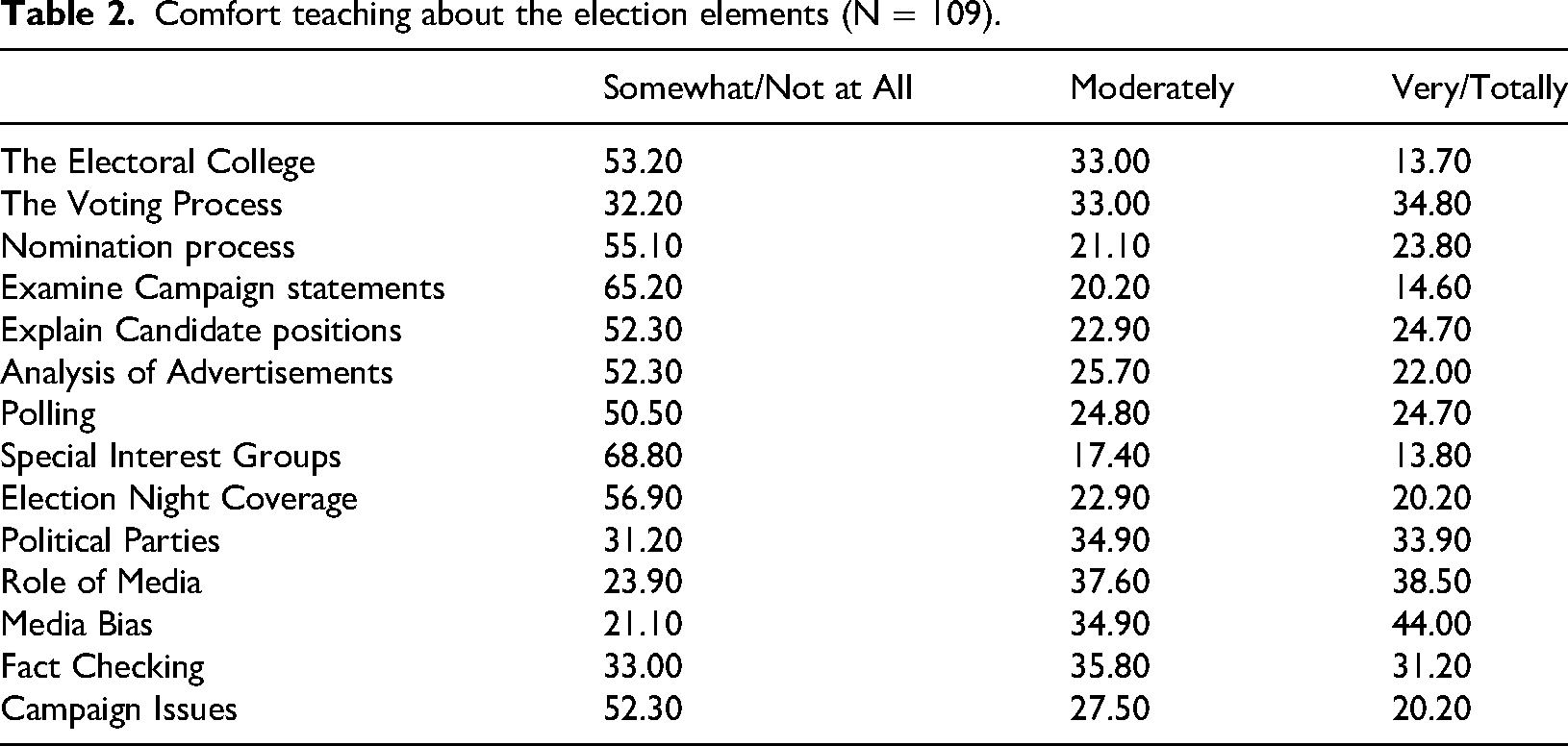
We used Analysis of Variance to interpret whether significant differences existed between early childhood and elementary preservice teachers in the items for which they had comfort teaching. Significant differences were found to be associated with one item, Fact Checking (p = .024). The Levene's Test for Homogeneity was not significant (Levene = .682, p = .411). Elementary preservice teachers (µ = 3.15) expressed greater comfort than early childhood preservice teachers (µ = 2.61). The estimated value of Cohen's effect size (d = 0.48) indicates this difference to be moderate.
Concerns about integrating the election into the curricula
We again collapsed “very” and “totally” concerned responses into one category. Of the nine items presented, more than one half (50%) of the respondents expressed concerns with having to engage with parent concerns. The highest percentage of very or totally concerns were associated with (2) school/district policies (45.40%), and age appropriateness of the content (42.0%).
Less than one half (50%) indicated that they were somewhat or not at all concerned with each of the items provided. The items receiving the highest percentage of indicators of being somewhat or not at all concerned were revealing their political position (45.40%), having support from colleagues (40.4%), and student attitudes (38.50%) (Table 3).
Concerns with teaching about the election (N = 109).
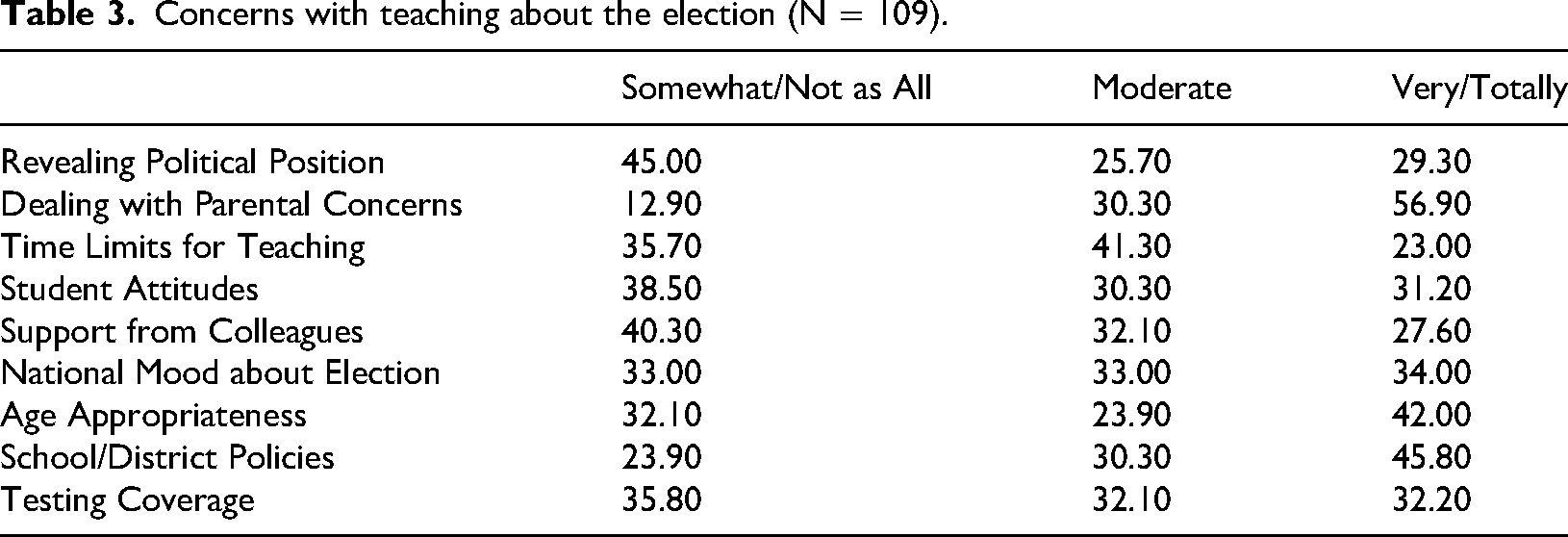
We used ANOVA to interpret whether significant differences existed between early childhood and elementary preservice teachers in their concerns. We found significant differences with the item Revealing Political Position. Elementary preservice teachers (µ = 2.96) expressed greater comfort than Early Childhood Preservice teachers (µ = 2.25). The estimated value of Cohen's effect size (d = 0.55) indicates this difference to be moderate.
Dispositions and engagement
We measured respondents’ levels of agreement associated with dispositions and engagement with the election. The most respondents very much or totally agreed that they were motivated to be involved and comfortable finding information sources. The motivation to be involved was the only item for which more than 50% of respondents very much or totally agreed.
Most respondents agreed somewhat or not at all that (1) they enjoyed conversations about politics (2) that they were familiar with the issues, and (3) that neutrality is a political stance. The enjoyment of conversations was the only item for which more than 50% of respondents somewhat agreed or did not agree.
We used ANOVA to interpret whether significant differences existed between early childhood and elementary preservice teachers in responses to the items concerning dispositions and engagement. We found no significant differences between early childhood and elementary majors.
Respondents’ knowledge of the electoral college
We asked three questions to interpret respondents’ understanding of the votes associated with the electoral college. Table 4 presents the patterns of correct responses. We only include findings from the fall semester because the spring semester students were focused on the election primaries and their initial survey occurred nearly a year before the general election. The fall students began the project three months before the election during a time when the election processes and coverage were becoming more intense.
Answers to questions about the electoral college.
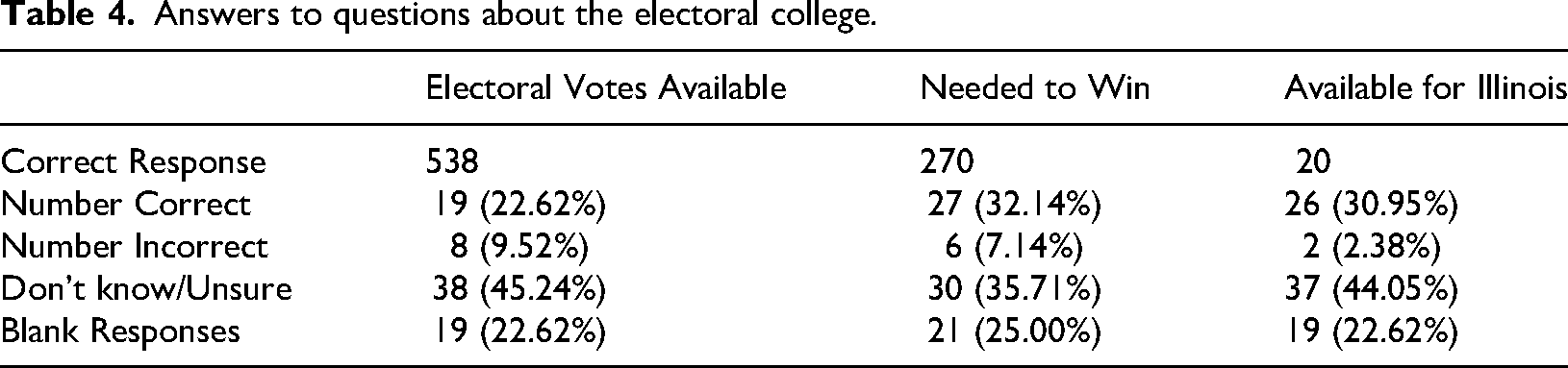
Low percentages of respondents correctly answered these items, with no more than one third of respondents providing correct answers. Even more disturbing, a majority of respondents openly acknowledged that they didn’t know the answer, that they were uncertain, or left the items blank.
Rewards and obstacles in preservice teachers’ words
Rewards
Analysis of responses found that preservice teachers believed that students can benefit a lot from learning about the election: (1) students would gain knowledge about politics, the candidates, and democratic process; (2) students could strengthen skills such as forming and supporting their opinions, distinguishing facts from misinformation, inquiry, and communication; and (3) students may develop and strengthen dispositions such as caring about the worlds, staying informed, open minded, and active in the democracy. Some thought that learning about this topic would prepare students for future political engagement.
Some respondents believed in children's readiness in learning this content and the harm of not teaching it early on: “Not keeping them in the dark. The more we shelter kids the worse it’ll be.” “I think incorporating this into our curriculum will stop keeping children in the dark about what others considers ‘adult business’ or something that comes with age. Everyone is a capable learner if they are given the right tools. I think the greatest reward is that we’re truly setting children up for success. I say this because it is being introduced at a young age, and then there is a follow through as they move up the grade levels. Rather than they’re being crammed with the information in the first 2 years or last 2 years of their High School education.”
Obstacles
For obstacles and challenges to teaching about this topic, preservice teachers wrote about students’ political stances, age appropriateness and complexity of the topic, parental pushback, and school/district restrictions, which is consistent with the findings of the quantitative data. Some preservice teachers were unsure about children's readiness for political discussions, their prior knowledge, and perspectives as biased, due to the influence of their family, and their capabilities of handling conflicting opinions and emotions. One response was: “The students may only know the information they see on TV and or from their parents. So it is a challenge to get through that for them to see the full picture of it all.” A few participants wrote about the possibility of students judging or bullying others based on their differing political views.
The majority of the responses were about potential conflicts with families and how one-sided some families were. The preservice teachers seem to be aware of the political power families have and position themselves as less powerful in relation to families. One participant reported, “I think the biggest obstacle for me is the parental concerns that may come up, especially when I am in an area that is largely conservative.” Another wrote, “I do think that the greatest obstacle to teaching about the 2020 presidential election would be that it is controversial and to not upset parents. However, I hope to someday teach in a district that aligns with my teaching philosophy and would back me and my teaching decisions up when considering controversies such as this.”
A few participants mentioned potential restrictions from the school/district. For instance, one early childhood participant reported, “The greatest obstacle for me would be making it age-appropriate since we only teach up to 2nd grade and making sure my school is okay with me openly talking about the election.”
In addition, some participants acknowledged their lack of knowledge and understanding of the topic and were unsure about teaching the topic in a bias-free way. One person candidly wrote, “I do not know very much about the elections or who is running.” Interestingly, the desire for neutrality could derive from the fear of conflicts with other stakeholders or the disengagement from or affiliation to any political parties, as the following statements explained: “I perceive the greatest obstacles to be teaching unbiased, factual information without upsetting any students, parents, staff, or schools.” “I think the biggest obstacle is teaching from a non-bias standpoint. To be truthful, I’m not very political and it appears others in my generation are the same because it's a learning process. I think it will be a great learning process for the students and I, and I would execute it well because I don’t have a party to identify with. However, other teachers who are very involved will have to work on not teaching from a place of bias and emotions.”
No participants reported concerns regarding time limits for teaching, support from colleagues, the national mood, or standardized test coverage, which were on the survey.
Discussion
This research study found that early childhood and elementary preservice social studies teachers at a large public midwestern teacher education institution did not express a strong degree of comfort teaching about the 2020 presidential election and were most comfortable teaching about matters of literacy and of political agreement. These attitudes were not significantly different between preservice teachers focused on teaching in elementary and early childhood settings. We also found that, regardless of their intended teaching environments, when given choices of possible concerns, preservice teachers expressed most concern regarding parents, school/district policies, and age appropriateness of the content when teaching about the 2020 presidential election. These concerns bore out in their concerns about volunteering as well.
We noted that the preservice teachers had conflicted views on children's readiness and the appropriateness/significance of the topic in P-6 settings: some believed the critical value of creating spaces for current events for the sake of democracy while the rest doubted children's emotional and intellectual maturity. The majority shared concerns about the restrictions from school/district as well as backlash from the families, suggesting their subjugated positioning as “the powerless.” They assumed that school/district would prohibit teachers from teaching about presidential elections and that teaching this topic would offend “conservative” families. In this case, preservice teachers were likely to perpetuate their own oppression in their relations with the school administrations and the public. And they were less likely to become “cultural transformers” (Lather, 1987), who can teach about presidential elections from a justice-oriented perspective and enlighten the young citizens about related political and civic engagement for democracy.
Social studies represents a topic marginalized in elementary and early childhood classrooms. Teachers driven by expectations to improve student teacher performance emphasize instruction concerning literacy and mathematics, neglecting attention to the preparation of students in their rights and responsibilities for civic engagement. The results of this survey indicate that while a sample of ECE and elementary preservice teachers at one teacher preparation institution are comfortable teaching the processes of presidential elections and their students’ participation in the process, they experience discomfort dealing with the differences of opinion that come with the discussion of contentious political issues. Many of the participants seemed to consider “neutrality” as their goal. They might think they should balance out different ideas and shun divisive discussions. Scholars like Journell (2011) have already negated the possibility of achieving political neutrality. Teacher educators can help them deconstruct this concept before encouraging them to take their political stances and own their political impacts on children, family, and themselves.
Young children are capable of difficult political conversations when provided the opportunity (Payne and Journell, 2019; Payne et al., 2020; Zakai, 2019). Future studies may consider strategies for engaging early childhood and elementary preservice teachers in these conversations. While modeling care and compassion represent important strategies for developing students to experience appreciation for themselves and others, preservice teachers need the capacity to value and practice the contextual relevance of their emotions and develop a practice of affective adaptability. Such practice is essential in an intensely contentious environment where participants experience difficulties resisting or controlling their anger. Strategies for developing these skills in preservice teachers may include, but not be limited to, simulations and role-plays that offer opportunities to practice responses within safe environments. Still another strategy may involve the study and practice of civic virtues as dimensioned rather than absolute concepts. Extending Murray-Everett and Demoiny's (2022) work by cultivating visions of citizenship engagement as a process towards openness that necessarily involves conflict represents a path to accomplishing this vision.
Survey respondents expressed comfort teaching about elections through an emphasis on voting and the electoral college, an exercise in affirming the cultural election norms as described by Lather (1987). Teaching about elections in manners that prepare students to be part of a critically thinking compassionate citizenry necessitates dispositions that welcome conversations about the candidates and issues. Preparation of ECE/ELED teacher candidates requires their engagement in discussions about the issues and the social values represented by each candidate. Preparations that engage preservice teachers in exploration of campaign issues while instilling senses of self-compassion may address the preservice teachers’ affective and cognitive needs. Developing a depth of knowledge about these issues that provides a confidence to engage in intense discussions. Cultivating a sense of both the feminine and the masculine within the children and the preservice teachers is essential to preparing a well informed and engaged citizenry.
Except for two items, Fact Checking and Revealing Political Position, our findings realized no significant differences between the concerns of preservice early childhood and elementary teachers. Given the large degree of child development that occurs in early childhood and elementary school settings, we perceive the absence of significant difference in respondent perceptions as relating to professional inexperience of the sample and the imprecision of their professional assignments. Further research that pursues more robust and diverse samples to interpret attitudes of veteran teachers may provide for richer findings.
Conclusion
Teaching about the presidential elections represents an essential process in the preparation of a critically thinking democratic citizenry. Ensuring that this teaching engages students in the development of skills, knowledge, and dispositions for responsible engagement in the election process contributes to this learning, yet ECE/ELED teacher candidates should also possess the emotional dispositions to engage in conversations about these issues with the various education stakeholders. Such dispositions and emotional maturity are paramount to cultivating a sense of both the feminine and masculine within children and youth.
The early childhood and elementary educators surveyed for this research lack comfort engaging in discussions about complex issues about elections that may open children's minds to alternative manner of thinking and feeling about elections and related political issues. The preparation of ECE/ELED teachers for citizenship, social, and economics education may consider that teaching about the election involves both cognitive and affective elements. Such processes may ease the senses of fear and ignorance that discourage teachers from engaging administration, parents, and students in these important political conversations.
Footnotes
Acknowledgement
The authors acknowledge and are grateful for Anthony Lorsbach's contributions to the project.
Declaration of Conflicting Interests
The author(s) declared no potential conflicts of interest with respect to the research, authorship, and/or publication of this article.
Funding
The author(s) received no financial support for the research, authorship, and/or publication of this article.

Correction (June 2024):
Acknowledgement added in the article.