




Abstract
In order to strengthen civic education in elementary schools, research is needed to understand preservice teachers’ ideas about civic teaching. The current study examined the degree to which elementary preservice teachers’ civic competencies (i.e., civic awareness, dispositions, and interpersonal skills) and the grades they plan to teach are associated with expected future civic teaching. Survey data were collected from 235 undergraduate students majoring in early childhood or elementary education. Results from hierarchical multiple regression showed that greater civic awareness and lower levels of trust in the American promise were associated with expected future teaching about politics, while greater civic awareness, stronger commitment to social issues, and better interpersonal skills were associated with expected future teaching about community engagement. Additionally, those who plan to teach the upper elementary grades (third–fifth) were more likely to report that they will teach about politics and community engagement in their future classrooms when compared to those who plan to teach younger grades (PreK–second). Practical implications for preservice teacher preparation are discussed.
Keywords
Introduction
Understanding political processes and community engagement is essential in a democratic society, and the elementary grades represent an important time to build a foundation for current and future civic engagement. According to the National Council for the Social Studies (n.d.), the primary goal of social studies education is “civic competence” meaning “the knowledge, intellectual processes, and democratic dispositions required of students to be active and engaged participants in public life” (para. 1). Unfortunately, research has shown that time spent teaching social studies in elementary classrooms has declined in recent years (Heafner & Fitchett, 2012). Further, elementary preservice teachers may have negative views of social studies and do not connect it to civic topics (Bousalis, 2021). Despite these trends, the elementary grades remain a relevant developmental period to engage in civic teaching. Research has shown that an understanding of democracy and individual rights begins to develop in childhood (Helwig, 2006), and elementary-aged students understand basic tenets of democracy including the voting process, choosing between candidates, and the representation of political parties (Berti, 2005). Elementary students also understand concepts related to community engagement such as volunteering (Metzger et al., 2016), and research shows they benefit from community-based volunteer experiences organized through school (Fair & Delaplane, 2015). Mitra and Serriere (2015) argue that discussions about political and community issues should occur in early childhood, as they found that even kindergarten-aged children can engage in critical conversations about citizenship and social issues. Thus, in order to strengthen and increase civic teaching across the elementary grades, research is needed to understand preservice teachers’ ideas about their own future civic teaching practices. The purpose of the current study was to examine the degree to which preservice elementary teachers’ civic competencies (i.e., civic awareness, dispositions, and interpersonal skills) are associated with expected future civic teaching. In addition, this study also examined whether or not the grade range preservice teachers plan to teach, meaning early elementary (PreK–second) versus upper elementary grades (third–fifth), is associated with expected future civic teaching. Study findings have implications for teacher preparation programs.
Theoretical Framework
This study is guided by Torney-Purta and Lopez’s (2006) framework for civic education, as they maintain that civic competency includes three strands: civic knowledge, cognitive and participatory skills, and motivations/dispositions. Including multiple and varied competencies is important, as Torney-Purta and Lopez (2006) state that in order to take part in a democratic society, students “need civic competencies that extend beyond knowledge of the history of the ratification of the Constitution” (p. 7). These three strands of civic learning (i.e., knowledge, dispositions, and skills) are highlighted as critical to fulfilling one’s role related to citizenship in a democratic society (Gould, 2011). Torney-Purta and Lopez (2006) focus on K-12 students, though it is likely that these competencies are relevant for college-aged youth, particularly those who are planning to be teachers and who will be responsible for supporting these same competencies in their future students.
Torney-Purta and Lopez (2006) divide each of these strands into categories related to Patrick’s (2003) core concepts of education for democracy which include “democracy/law,” “citizenship/human rights,” and “civil society.” Although there is overlap across these categories, knowledge, dispositions, and skills related to civil society are particularly relevant to the current study. Torney-Purta and Lopez (2006) describe the three strands of civic competency in relation to civil society as follows: civic knowledge includes knowledge of national and community issues and awareness of current events; dispositions include a commitment to social justice and community members; and skills include the ability to interact cooperatively with others to resolve conflict. In line with this framework, in the current study, preservice teachers’ civic competencies related to civil society were examined in relation to future civic teaching. Specifically, preservice teachers’ awareness of civic issues, dispositions including a commitment to social justice and trust (or lack thereof) in the American promise of equal opportunity for all, and interpersonal skills were all included as possible predictors for expected future civic teaching. Torney-Purta and Lopez (2006) maintain that “schools have a vital role to play in contributing to civic engagement” (p. 7) so examining the civic competencies of future teachers and how they relate to expected future civic teaching is especially important.
Literature Review
Civic Teaching Definitions
Civic teaching is defined in a myriad of ways in the extant literature, and usually includes various types of social and political learning experiences. In “Guardian of Democracy: The Civic Mission of Schools,” six “proven practices” in civic education are described which include: classroom instruction in government, law, history, and democracy; discussion of current events and controversial issues; service-learning opportunities; extracurricular activities; participation in school governance; and simulations of political processes (Gould, 2011). Kahne and Sporte (2008) define civic learning opportunities as learning about problems in society, studying current events and issues, experiencing an open climate for classroom discussion of social/political topics, hearing from civic role models, and learning about ways to improve the community. Flanagan, Cumsille, et al. (2007) also include teachers’ use of democratic principles in the classroom meaning the degree to which they model respect, fairness, and tolerance in their daily interactions with students. Research has also shown variability in teachers’ conceptions of civic teaching. For example, when asked to describe how they “teach civic skills and promote civic engagement,” teachers in the upper elementary grades reported a variety of activities including formal lessons in social studies (e.g., lessons about government) and science (e.g., lessons about environmental conservation), service-learning experiences, current events monitoring, political simulations, and classroom community building activities (White & Mistry, 2019). Thus, civic teaching is a broad and multifaceted construct that includes learning about and experiencing both political processes and community engagement.
In the current study, civic teaching is conceptualized as teaching about politics and democratic processes, and teaching about community issues and engagement. Examples of civic teaching related to politics includes teaching about the U.S. election process, having political discussions, and organizing political role-play such as voting experiences and debates in class. Civic teaching related to community engagement includes organizing service-learning or volunteer projects, teaching about environmental conservation, and discussing ways to improve the community. This distinction between political and community-based civic teaching aligns with Barrett and Pachi’s (2019) conception of civic engagement, as they distinguish between political engagement which includes “engagement of an individual with political institutions, processes and decision-making” and community engagement which includes “the concerns, interests, and common good of a community” including local, national, and global communities (p. 3). Other theorists also maintain that community and political participation are markedly different as political involvement is confrontational in nature while community participation requires cooperation and communalism (Uslaner & Brown, 2005). Therefore, in the current study, civic teaching includes teaching about political and democratic processes and teaching about community engagement as two separate constructs.
Civic Teaching: Preparing Children to Live in a Democracy
Civic learning experiences in schools and classrooms are essential in a democratic society, and Dewey (1916) believed that teachers play a critical role in preparing future citizens to participate in political processes, contribute to society, and engage with others to support the community. Research supports an association between civic learning in school and both current and future civic engagement. For example, both required and voluntary community service during adolescence are associated with increases in social concern, a greater likelihood to plan to vote and volunteer in the future, and civic participation in adulthood (Billig et al., 2005; Hart et al., 2007; Reinders & Youniss, 2006; Yates & Youniss, 1996). Political role-play in the classroom, hearing from civic role models, and learning about ways to improve the community are also related to adolescents’ commitment to civic participation and civic skills (Kahne & Sporte, 2008; Kahne et al., 2005). Classroom-based discussion, meaning open discussion and debates about politics, social issues, and current events is also associated with civic participation, political efficacy and interest, and civic skills during adolescence (Kahne et al., 2005; Syvertsen et al., 2007; Torney-Purta et al., 2001), as well as political and community engagement in adulthood (Keeter et al., 2002).
Research with elementary-aged students is more limited, but research has shown benefits of civic learning experiences to children’s emergent civic skills and dispositions. For example, research examining civic learning in the upper elementary grades found that teachers who reported more classroom-based civic activities (i.e., learning about social issues, keeping up with current events, meeting people who work to make society better, and working on a service-learning or volunteer project) had students who expressed greater social responsibility and more strongly endorsed civic values, even after controlling for individual and family-based factors (White & Mistry, 2019). Qualitative work conducted by Mitra and Serriere (2012, 2015), Serriere (2014), and Serriere et al. (2010) has also shown that service learning and civic experiences benefit elementary-aged students. In their examination of “Dewey Elementary,” a school which included a variety of civic experiences ranging from informal class discussions to children advocating for school change, researchers found that students showed increases in perspective taking, self-efficacy, and civic agency over time. Additionally, Mitra and Serriere (2015) found that even kindergarten-aged children were able to engage in critical conversations regarding citizenship and civic issues.
Clearly, civic teaching is important in terms of preparing the next generation of community members to participate in political processes, tackle social issues, and work to improve communities. Unfortunately, community service experiences and service-learning are much less common in elementary schools compared to middle or high schools (Skinner & Chapman, 1999). The amount of time elementary school teachers spend teaching social studies continues to decline, as subjects such as math and reading that are connected to high-stakes, standardized achievement tests are often prioritized (Center on Education Policy, 2006; Heafner & Fitchett, 2012). Further, districts reported that social studies was the most frequently cut back subject by elementary teachers trying to create more time for math and reading instruction (Center on Education Policy, 2006). Elementary preservice teachers also report that they rarely see social studies taught in their school-based clinical placements (Mathis & Boyd, 2009). Given these trends and structural barriers, efforts to strengthen civic education may benefit by targeting preservice teachers and examining their ideas about specific civic teaching practices.
Preservice Teachers and Civic Education
Although Torney-Purta and Lopez’s (2006) civic competencies have not been examined among preservice teachers, research has shown that preservice teachers’ perceptions of social studies, ideas about citizenship, and awareness of current events and politics may have implications for civic teaching. For example, Bousalis (2021) examined elementary preservice teachers and found that while the majority of participants felt that social studies was extremely or very important to teach, most also reported that they did not like or feel comfortable teaching it, and they did not see it relating to their own lives or to civic education. Research examining preservice teachers’ perceptions of citizenship has found that preservice teachers are more likely to endorse Westheimer and Kahn’s notions of personally responsible citizenship (i.e., personally responsible behaviors), rather than participatory (i.e., active civic participation) or justice-oriented (i.e., social justice) citizenship (Fry & O’Brien, 2015; Marri et al., 2014). This is problematic because Westheimer and Kahne (2004) argue that participatory and justice-oriented orientations will lead to more meaningful and influential civic education. Research has also shown a dearth of civic knowledge and awareness among preservice teachers, as Sharp and Nettleton (2018) examined social studies knowledge among preservice elementary teachers and found they had limited knowledge of the government and civics. Similarly, Bousalis (2021) found that most preservice elementary teachers reported having “fairly to very little knowledge about social studies content” (p. 5). Overall, the extant literature shows that preservice teachers’ ideas about social studies, citizenship and civic awareness may be related to civic teaching, yet it is unclear how preservice teachers’ ideas and knowledge connect to specific teaching practices.
The Current Study
In summary, the current study adds to the literature on civic teaching and preservice teacher preparation by examining the degree to which preservice teachers’ civic competencies are associated with expectations to engage in specific types of civic teaching in their future classrooms. Civic competencies include civic awareness, civic dispositions (i.e., commitment to social issues and trust in the American promise), and interpersonal skills. Based on Torney-Purta and Lopez’s (2006) theoretical framework highlighting the role of civic knowledge, dispositions, and skills in civic education, it was expected that preservice teachers with greater awareness of current events and political issues, a stronger commitment to civic issues, and those with better interpersonal skills would be more likely to report that they will teach about politics and community engagement in their future classrooms. This study also examined the degree to which the grade level preservice teachers plan to teach in the future is associated with expected future teaching about politics and community engagement. Although prior research has shown that time spent teaching social studies has decreased in elementary classrooms (Heafner & Fitchett, 2012; Skinner & Chapman, 1999), it is unclear if there are differences between the upper- and lower-elementary grades. The following questions guided this study:
Are preservice teachers’ civic awareness, civic dispositions (i.e., commitment to social issues and trust in the American promise) and interpersonal skills associated with expected future civic teaching?
Is the classroom grade level preservice teachers plan to teach (PreK–second vs. third–fifth) associated with expected future civic teaching?
Methods
Participants
Data were collected at a large public university in the Midwestern United States (IRB Protocol Number: 2020-447). Participants (N = 235) included a convenience sample of undergraduate preservice teachers majoring in early childhood (n = 50, 21.3%) or elementary education (n = 185, 78.7%). The participant sample was predominantly female (n = 231, 98%) and white (n = 196, 83.4%) though other groups were also represented (Hispanic/Latinx, n = 17, 7.2%; African American, n = 10, 4.3%; Asian, n = 4, 1.7%; Multiethnic, n = 8, 3.4%). Participant age ranged from 18 to 49 years (M = 20.16, SD = 3.10) though the majority (n = 224, 96%) were traditional college-age students between the ages of 18 and 23 years. See Table 1 for a description of the study sample.
Descriptive Data (N = 235).
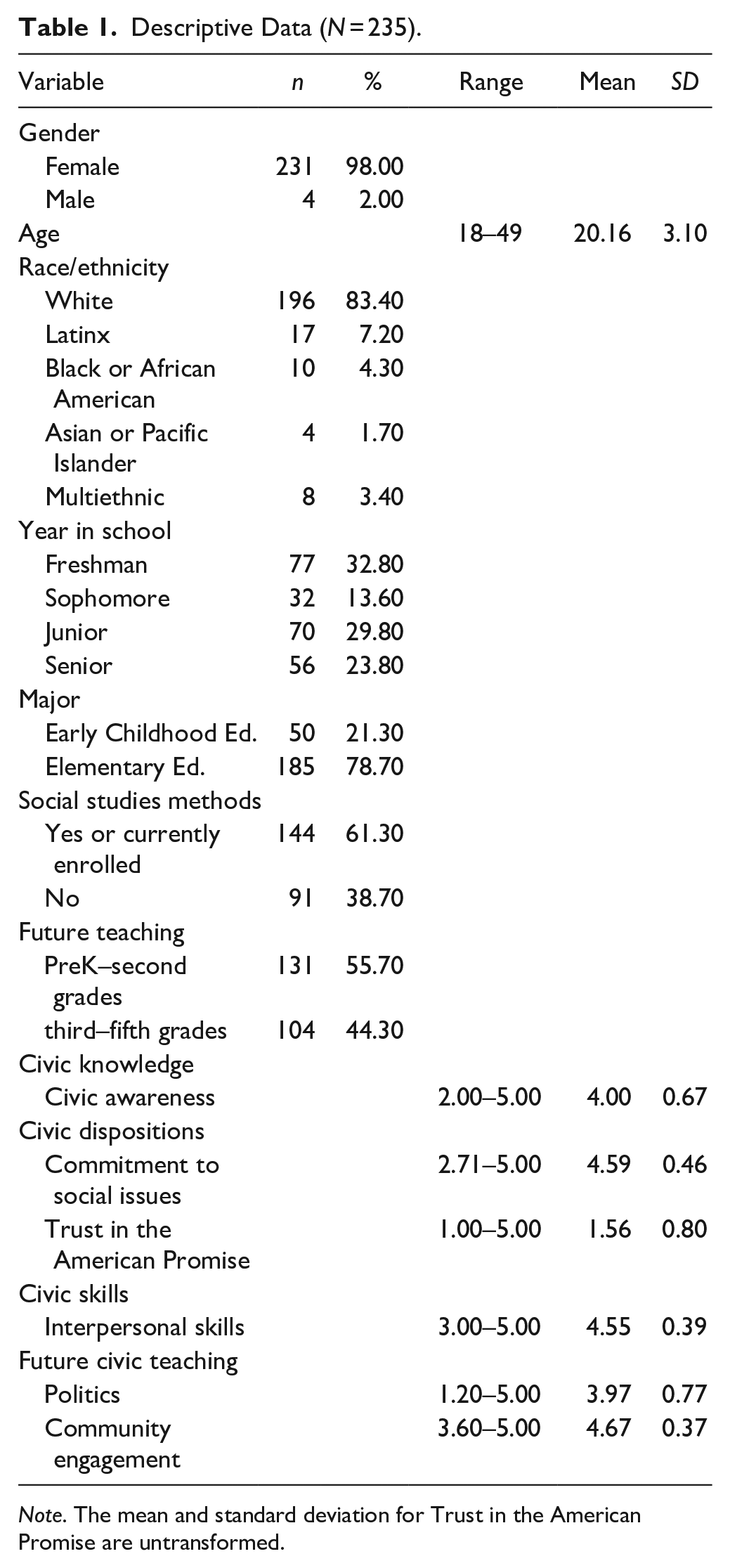
Note. The mean and standard deviation for Trust in the American Promise are untransformed.
Procedures
Data were collected from mid-October to mid-November in fall 2020. All undergraduate early childhood and elementary education majors were contacted via email and invited to participate in the study. Participants provided consent electronically and completed the survey online through Qualtrics. Participants were offered entry into a drawing for a $50 Amazon gift card for completing the survey.
Measures
Civic Awareness
Participants responded to four items measuring their awareness of civic and political issues. Preservice teachers indicated their level of agreement on two items from Moely et al.’s (2002) Civic Attitudes and Skills Questionnaire (CASQ; i.e., I am aware of current events, and I understand the issues facing this nation). They also responded to one item from Flanagan, Syvertsen, and Stout (2007) (i.e., I enjoy talking about politics and political issues) and one item from Westheimer and Kahne (2004; i.e., I think it’s important to think critically about laws and government). Participants responded on a scale from 1 (strongly disagree) to 5 (strongly agree). Items were averaged with higher scores reflecting greater civic awareness. The composite measure demonstrated adequate reliability (α = .75).
Commitment to Social Issues
Preservice teachers responded to seven items measuring their commitment to various social issues (Flanagan, Syvertsen, & Stout, 2007). Participants were asked to rate the importance they place on helping others in their community, preserving the earth for future generations, working to stop prejudice, stopping pollution, helping those who are less fortunate, helping society, and improving race relations. Participants responded on a scale from 1 (not at all important) to 5 (very important). Items were averaged with higher scores reflecting greater commitment to social issues. The composite measure demonstrated adequate reliability (α = .88).
Trust in the American Promise
Preservice teachers responded to three items from Flanagan, Syvertsen, and Stout (2007) assessing trust in the American promise, meaning “beliefs about (in)justice in America.” Participants reported their agreement with the following statements: Basically, people get fair treatment in America, no matter who they are; In America you have an equal chance no matter where you come from or what race you are; and America is a fair society where everyone has an equal chance to get ahead. Participants responded on a scale from 1 (strongly disagree) to 5 (strongly agree). The three items showed adequate reliability (α = .85) and were averaged to create a composite measure. Higher scores indicated greater trust in the American promise and the belief in America as a meritocracy. However, this composite measure violated assumptions of normality, as kurtosis values exceeded the acceptable range of −2 to +2 (George & Mallery, 2010). Further, visual inspection of the distribution indicated a strong positive skew. To address this issue, as recommended by Tabachnick and Fidell (2007), a square root transformation was performed on the composite variable. After transformation, measures of skewness and kurtosis were within the acceptable range. Although the untransformed mean and standard deviation are reported for descriptive purposes, the transformed composite was used in all analyses (i.e., correlations and regressions).
Interpersonal Skills
Preservice teachers responded to five items assessing interpersonal skills from Moely et al.’s (2002) Civic Attitudes and Skills Questionnaire (CASQ). Participants rated their agreement with the following items: I can listen to other people’s opinions; I can work cooperatively with a group of people; I can communicate well with others; I can successfully resolve conflicts with others; and I can easily get along with people. The response scale was 1 (strongly disagree) to 5 (strongly agree). Items were averaged so that higher scores reflected stronger interpersonal skills. The composite score demonstrated adequate reliability (α = .72).
Major
Participants indicated major by choosing “early childhood,” “elementary education,” or “elementary education bilingual/bicultural.” Because of the low number of elementary bilingual/bicultural majors (n = 12), this category was combined with the general elementary education majors.
Prior Coursework
Participants indicated if they had taken a social studies methods course by choosing “yes in a previous semester,” “currently taking,” or “no, I have not taken one yet.” Because data were collected after two-thirds of the semester was complete, this item was recoded into a dichotomous variable noting if participants had completed or were currently taking a social studies methods course (n = 104) or if they had not yet taken one (n = 131).
Future Civic Teaching
Questions assessing expected future civic teaching were developed based on civic and political teaching practices identified on The California Survey of Civic Education (Kahne, 2005) and research from Flanagan, Syvertsen, and Stout (2007) and White and Mistry (2019). First, participants were given the following prompt: “Think about yourself when you have completed your degree and have your own classroom. Choose the grade range that you would most like to teach in the future.” Participants were asked to choose between PreK, K to second, and third to fifth grades. Because only a small number chose PreK (n = 12), this category was combined with K to second. Overall, 55.7% (n = 131) planned to teach PreK to second grades while 44.3% (n = 104) planned to teach third to fifth grades.
Next, preservice teachers responded to ten items assessing future civic teaching practices, with their chosen grade range in mind. Participants indicated their agreement with various civic and political teaching practices and classroom activities on a scale from 1 (strongly disagree) to 5 (strongly agree). Exploratory factor analysis was used to check dimensionality of the scale. The 10 items were factor analyzed using principal component analysis with Varimax rotation. The analysis yielded two distinct factors explaining 55.80% of the variance for the 10 items (see Table 2). The practices or activities loading strongly onto Factor 1 included teaching about the U.S. election process, requiring students to keep up with current events, encouraging students to make up their minds about political and social topics, having discussions about politics, and engaging students in political role-play (such as a mock elections). This factor explained 30.37% of the variance. Because items loading strongly onto this factor reflected learning about political processes, the factor was labeled future teaching–politics. Factor 2 included teaching about environmental conservation, including a service learning or volunteer project, teaching about the role of citizens, teaching about ways to improve the community, and having students meet or learn about people who work to make society better. This factor explained an additional 25.43% of the variance. Items loading strongly onto this factor reflected volunteerism and community involvement, so this factor was labeled future teaching– community engagement. For each composite, items were averaged so that higher scores reflected stronger agreement for engaging in civic teaching practices in the future. Cronbach’s alpha indicated adequate reliability for both measures: future teaching about politics (α = .81) and future teaching about community engagement (α = .76).
Exploratory Factor Analysis for Future Civic Teaching.
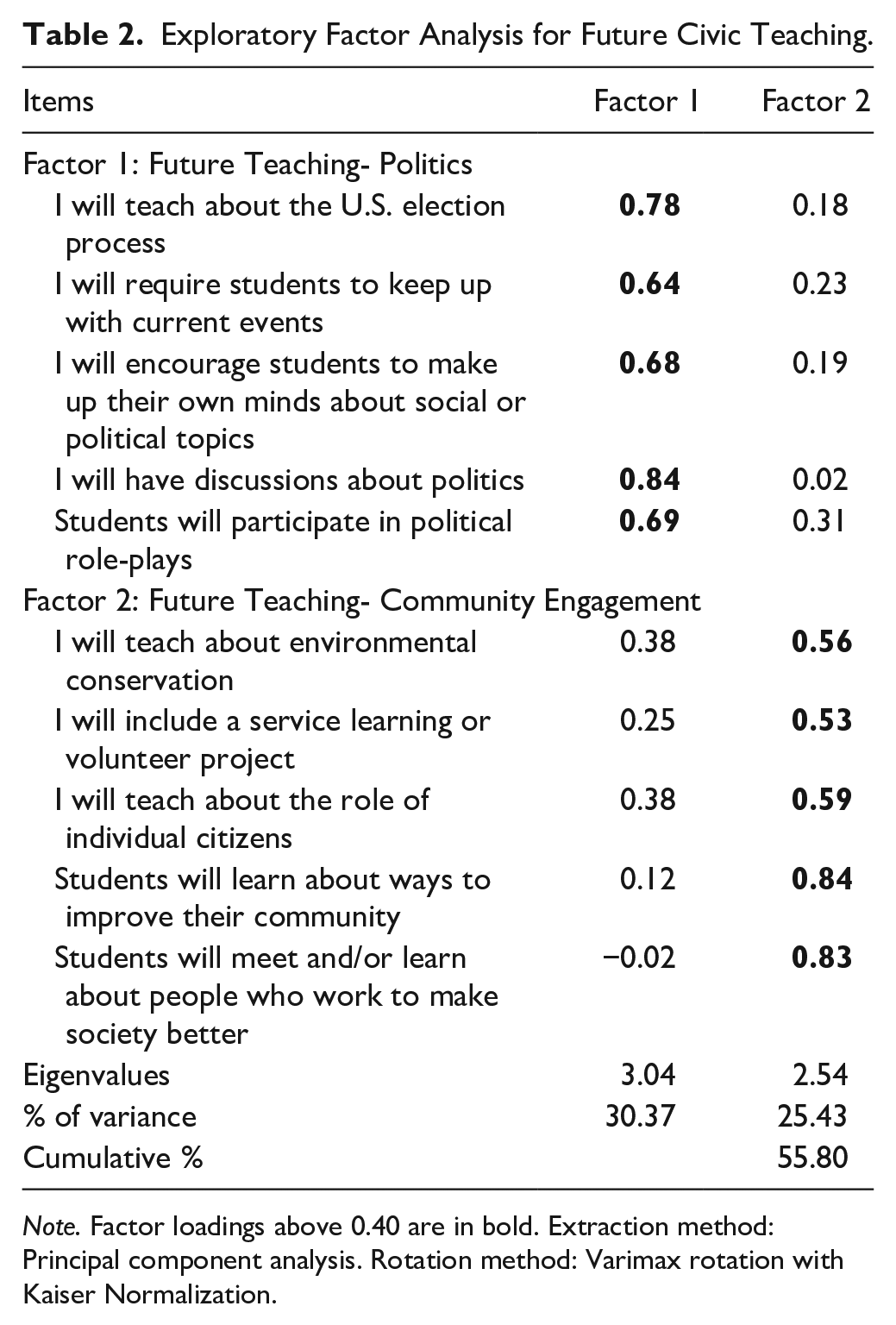
Note. Factor loadings above 0.40 are in bold. Extraction method: Principal component analysis. Rotation method: Varimax rotation with Kaiser Normalization.
Demographics
Preservice teachers also responded to several demographic questions. Participants self-reported age in years and indicated year in school by choosing “freshman,” “sophomore,” “junior,” or “senior.” Participants reported gender by choosing “female,” “male,” “non-binary,” or “prefer not to say.” Participants were asked to indicate their race or ethnicity by choosing from six categories (Asian/Pacific Islander, African American or Black, Hispanic or Latinx, Native American, White, or Other). All preservice teachers who chose “other” wrote in two or more pan-ethnic categories (e.g., Latino and White) and were labeled as “multiracial.” See Table 1 for demographic data.
Results
Preliminary Analysis
All survey data were entered into SPSS v. 27. Descriptive and frequency reports were run for each item to check for typographical errors. Next, composite scores were calculated, as described in the Measures section, and preliminary checks were performed to ensure that assumptions were met for regression analyses. First, data were checked for normality by examining skewness and kurtosis of each composite variable. Skewness and kurtosis values for most composites were within the acceptable range of −2 to +2 to meet this assumption (George & Mallery, 2010). The only exception was the composite variable for Trust in the American Promise which was positively skewed. As described in the measures section, a square root transformation (Tabachnick & Fidell, 2007) was performed on the composite variable so that measures of skewness and kurtosis were within the acceptable range. Assumptions of a linear relationship between the continuous independent variables and the dependent variables were examined with a visual check of scatterplots, and it was determined that the assumption of linearity was met. Composite measures were also checked for multicollinearity to ensure that predictors were not too highly correlated (Field, 2005). Variance inflation Factor (VIF) values greater than 10 (Myers, 1990) and tolerance values lower than .2 (Menard, 1995) indicate issues with multicollinearity. Preliminary analyses indicated no issues with multicollinearity among predictors, as VIF values were all less than 1.64 and tolerance values were greater than .60. Homogeneity of variance was checked by examining scatterplots of standardized residuals plotted against standardized predicted values. For both dependent variables, the scatterplot showed no clear shape and points were randomly and evenly dispersed, indicating that assumptions of homoscedasticity were met (Field, 2005). Finally, the assumption of independence was also met, meaning that data from each participant was independent and unrelated to other participants’ data.
Descriptive Findings
Preservice teachers showed high levels of civic awareness (M = 4.00, SD = 0.67) and commitment to social issues (M = 4.59, SD = 0.46) and lower levels of trust in the American promise (M = 1.56, SD = 0.80, untransformed). Preservice teachers also perceived themselves as having strong interpersonal skills (M = 4.55, SD = 0.39). Civic awareness and commitment to social issues were positively correlated (r = .36, p < .001). Trust in the American promise was negatively correlated with both civic awareness (r = −.13, p = .048) and commitment to social issues (r = −.24, p < .001). Interpersonal skills were correlated with civic awareness (r = .20, p = .003) and commitment to social issues (r = .30, p < .001), but not trust in the American promise. Preservice teachers showed moderate-to-high levels of expected future civic teaching including future teaching about politics (M = 3.97, SD = 0.77) and future teaching about community engagement (M = 4.67, SD = 0.37). Correlations among indicators of expected future civic teaching were significant and positive (r = .53, p < .001). Correlations among all study variables can be found in Table 3.
Correlations Among Study Variables (N = 235).
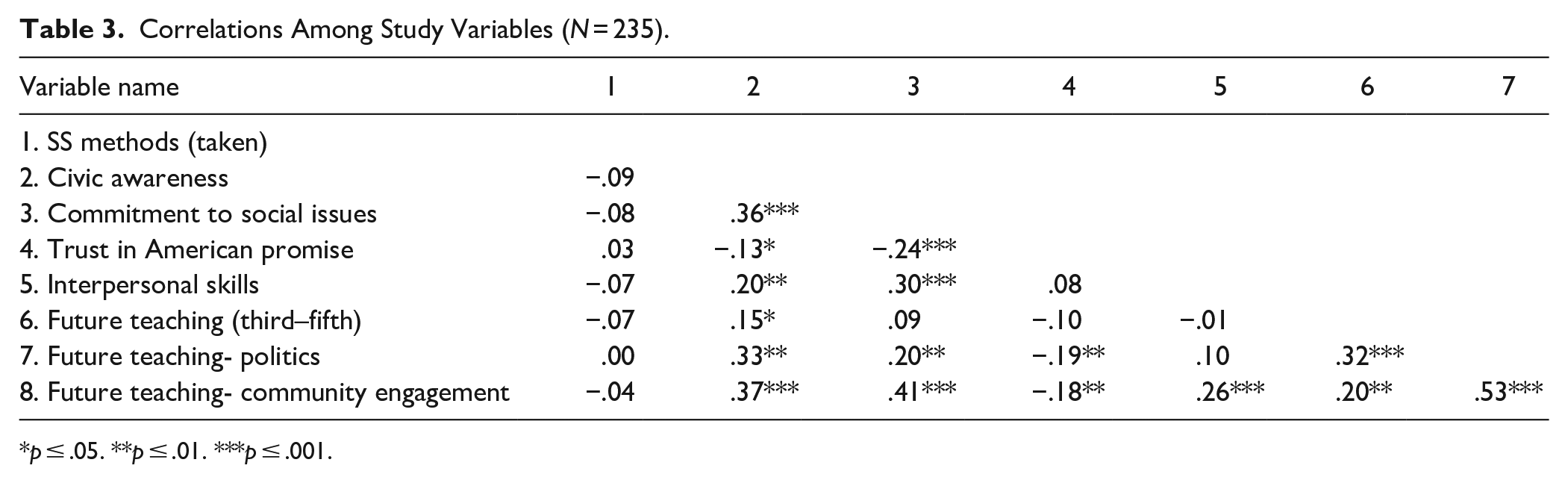
p ≤ .05. **p ≤ .01. ***p ≤ .001.
Future Civic Teaching about Politics
Hierarchical multiple regression analysis was used to determine if preservice teachers’ civic awareness, civic dispositions (i.e., commitment to social issues and trust in the American promise), and interpersonal skills predicted expected future teaching about politics (Step 1). Whether or not participants had taken a social studies methods course (i.e., prior coursework) was included as a covariate in all analyses (Baseline Model, not shown). Multiple regression results are presented in Table 4. In Step 1, preservice teachers’ future civic teaching about politics was regressed on civic awareness, commitment to social issues, trust in the American promise, and interpersonal skills. Results showed that after accounting for prior coursework, preservice teachers’ civic awareness and trust in the American promise (or lack thereof) predicted expected future teaching about politics (R² = .12, F (5, 227) = 7.18, p < .001). Preservice teachers who had greater awareness of civic issues (β = .29, p < .001) and those who had lower levels of trust in the American promise (β = −.15, p = .023) were more likely to report that they will teach about politics in their future classrooms (see Table 4). Commitment to social issues and interpersonal skills did not predict expected future teaching about politics.
Summary of Hierarchical Linear Regression Predicting Future Civic Teaching- Politics.
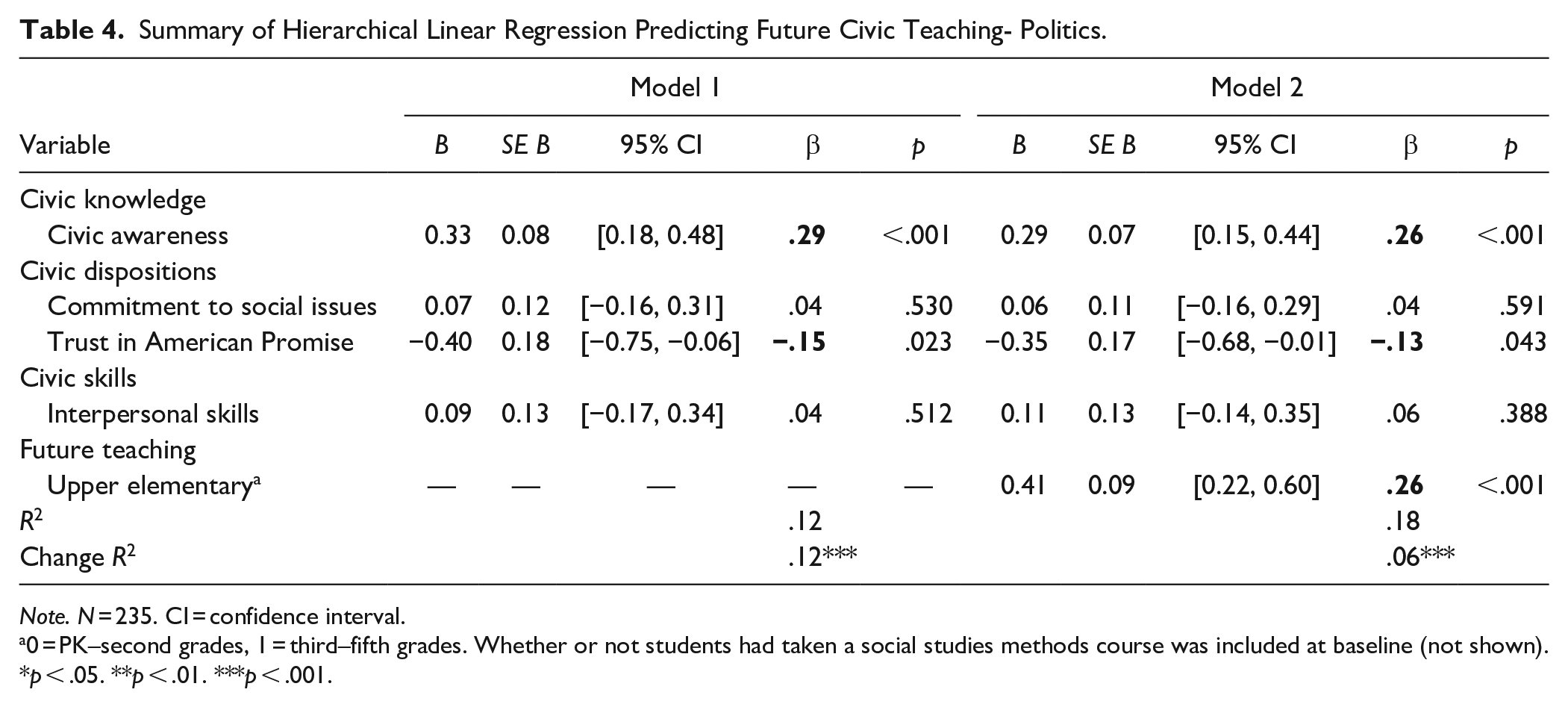
Note. N = 235. CI = confidence interval.
0 = PK–second grades, 1 = third–fifth grades. Whether or not students had taken a social studies methods course was included at baseline (not shown).
p < .05. **p < .01. ***p < .001.
Step 2 of the model was used to determine if future teaching grade level predicted expected future civic teaching about politics. Future teaching about politics was regressed on the grade range participants planned to teach in the future (PreK–second grade or third–fifth grade). Results showed that after accounting for prior coursework, civic awareness, civic dispositions, and interpersonal skills, the grade range preservice teachers planned to teach significantly predicted expected future teaching about politics (R² = .18, F (6, 226) = 9.61, p < .001; see Table 4). Preservice teachers who planned to teach in the upper elementary grades (third–fifth) were more likely to report that they will teach about politics (β = .26, p < .001) in their future classrooms.
Future Civic Teaching about Community Engagement
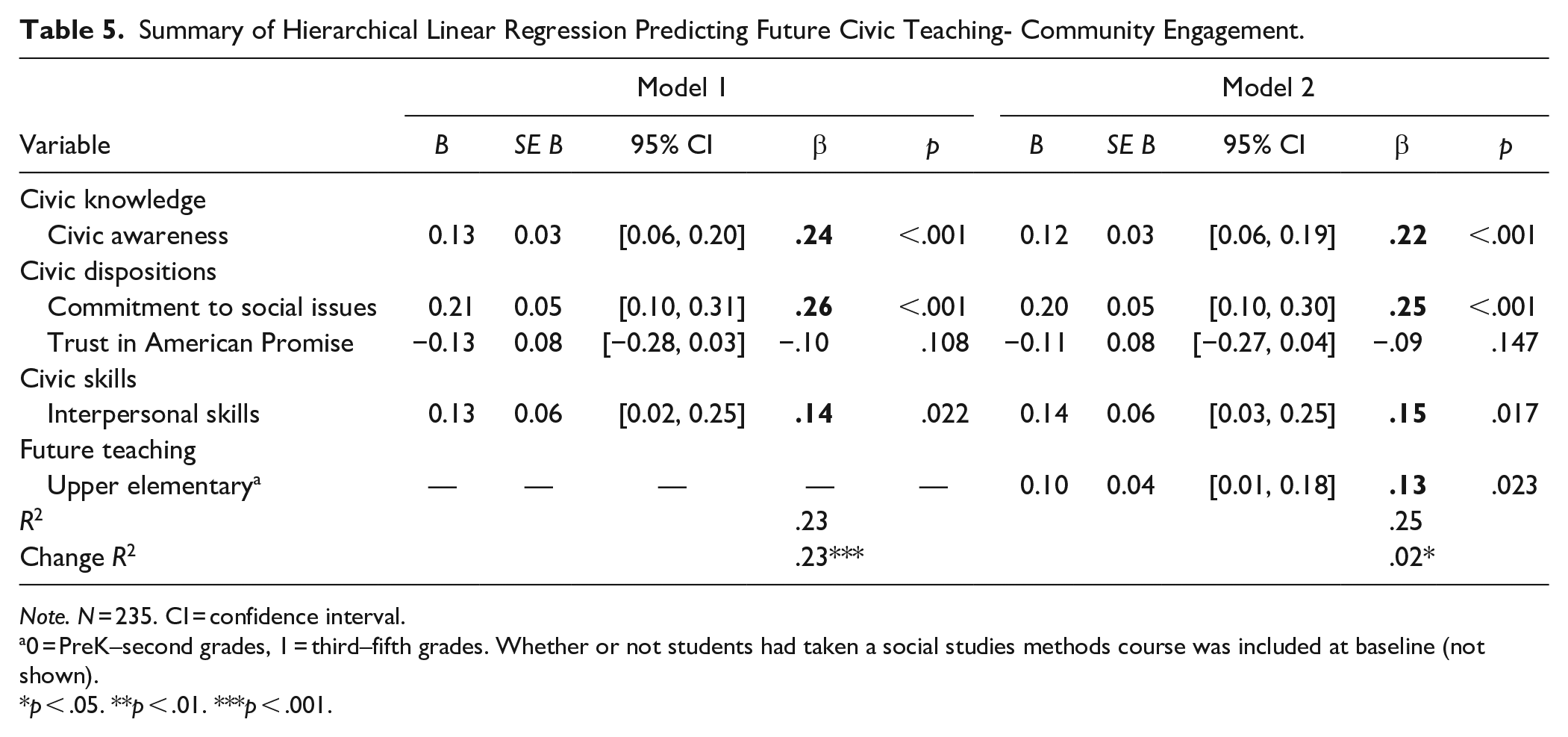
Hierarchical multiple regression analysis was also used to determine if preservice teachers’ civic awareness, civic dispositions (i.e., commitment to social issues and trust in the American promise), and interpersonal skills predicted expected future civic teaching about community engagement (Step 1). Whether or not participants had taken a social studies methods course (i.e., prior coursework) was again included as a covariate (Baseline Model, not shown). Results for future teaching about community engagement are presented in Table 5. In Step 1, preservice teachers’ expected future civic teaching about community engagement was regressed on civic awareness, commitment to social issues, trust in the American promise, and interpersonal skills. Results showed that after accounting for prior coursework, preservice teachers’ civic awareness, commitment to social issues, and interpersonal skills predicted expected future teaching about community engagement (R² = .23, F (5, 227) = 14.91, p < .001). Preservice teachers with greater civic awareness (β = .24, p < .001), a stronger commitment to social issues (β = .26, p < .001), and better interpersonal skills (β = .14, p = .022) were more likely to report that they will teach about community engagement in their future classrooms (see Table 5). Trust, or lack thereof, in the American promise did not predict expected future teaching about community engagement.
Summary of Hierarchical Linear Regression Predicting Future Civic Teaching- Community Engagement.
Note. N = 235. CI = confidence interval.
0 = PreK–second grades, 1 = third–fifth grades. Whether or not students had taken a social studies methods course was included at baseline (not shown).
p < .05. **p < .01. ***p < .001.
Step 2 of the model was used to determine if future grade level predicted expected future teaching about community engagement. Future teaching about community engagement was regressed on the grade range participants planned to teach in the future (PreK–third grade vs. third–fifth grade). Results showed that after accounting for prior coursework, civic awareness, civic dispositions, and interpersonal skills, the grade range preservice teachers planned to teach significantly predicted expected future teaching about community engagement (R² = .25, F (6, 226) = 13.53, p < .001; see Table 5). Preservice teachers who planned to teach in the upper elementary grades (third–fifth) were more likely to report that they will teach about community engagement (β = .13, p = .023) in their future classrooms.
Discussion
The purpose of this study was to examine preservice teachers’ ideas about civic teaching in their future classrooms. First, it was found that greater civic awareness was a consistent predictor of multiple types of expected future civic teaching. Furthermore, lower levels of trust in the American promise were associated with expected future teaching about politics while a greater commitment to social issues and better interpersonal skills were associated with expected future teaching about community engagement. Finally, those who planned to teach third to fifth grades were significantly more likely to report that they will teach about politics and community engagement in their future classrooms when compared with those who plan to teach PreK to second grades. Study findings and implications for teacher preparation programs are discussed.
Preservice Teachers’ Civic Awareness, Dispositions, and Skills
At the broadest level, results showed that preservice teachers’ civic knowledge, dispositions, and skills were associated with ideas about their future civic teaching. This finding lends credence to the use of Torney-Purta and Lopez’s (2006) framework for civic education with future teachers. While Torney-Purta and Lopez’s (2006) model of civic competencies was developed as a framework for understanding K-12 civic education, findings from the current study indicate that this is also a relevant framework to understand some of the individual beliefs and characteristics associated with civic teaching.
Additionally, the current study showed that preservice teachers’ expected future teaching about politics was predicted by their own civic awareness and mistrust in the American promise. Thus, teacher preparation programs should consider how to increase awareness of national and community issues and how to share the importance of critical conversations about laws and government among preservice teachers. This should be considered in both general education and major courses. For example, general education courses that examine civics and politics should be considered essential for preservice teachers. Early childhood and elementary education majors at the institution where data were collected are required to complete a course in politics and government as a prerequisite to starting major coursework. However, it’s unclear if preservice teachers connect their learning about politics and government to their future classrooms and whether or not they are encouraged to engage in critical conversations about laws and government themselves. Perhaps general education courses in politics and government could be developed specifically for education majors. Preservice teachers, in particular, may benefit from coursework that helps them relate their learning about politics and government to their future classrooms. Current events (related to education and beyond) could also be incorporated into preservice teacher education courses, and these efforts should be embedded throughout their coursework, not just social studies methods.
In addition to awareness of civic issues, those who expressed more skepticism regarding America as a fair society were more likely to report that they will teach about politics in their future classrooms. Prior research has shown that mistrust in the government and political systems can motivate political participation (Levi & Stoker, 2000), and the current study extends this association to teaching about politics as well. If skepticism regarding America as a fair society predicts plans to teach about politics in the future, efforts to increase teaching about politics in the elementary grades should include a critical examination of American meritocratic ideals among preservice teachers. While many preservice teachers hold meritocratic views of U.S. society (Castro, 2010), notions of meritocracy can also be deconstructed through activities and discussions that highlight how privilege and power affect learning opportunities and social mobility (White et al., 2017). In other words, when preservice teachers engage in critical conversations and learning experiences about the myth of meritocracy and issues of privilege in the U.S., they may embrace social justice perspectives and be better positioned to have critical conversations about political issues with their students in the future.
However, it should also be noted that current trends in the United States related to civic education pose an additional challenge to civic teaching in elementary classrooms. To date, eighteen states (e.g., Georgia, Florida, and Texas) have passed laws restricting discussions of “divisive concepts” in K-12 classrooms (National Education Association, 2024), and this legislation has implications for civic teaching, as it limits discussions about current events and civic activism among students (Healy, 2022). There is also considerable variability in what each state’s board of education believes should be included in civic education or related topics like history. When teachers are prohibited from discussing the ugly and regrettable parts of U.S. history, or when they are barred from discussing current events and social issues with children, this greatly limits the civic teaching that can occur within a classroom. Preparing preservice teachers to navigate civic teaching should also include an understanding of the differing laws across the United States that directly affect civic education and an understanding of the ways in which political activism and advocacy can challenge legislation that restricts civic discussions and teaching in classrooms.
Similar to teaching about politics, expected future teaching about community engagement was also predicted by civic awareness, further demonstrating the importance of this construct for preservice teachers. However, expected future teaching about community engagement was also predicted by a commitment to social issues and interpersonal skills. The measure for commitment to social issues asked participants to rate the importance they placed on behaviors such as preserving the earth, working to stop prejudice, and helping others in the community, all of which reflect concern for others and a desire to help the community. Prior research has shown that individuals who feel a sense of responsibility to their community are more likely to work to solve community problems, and that a desire to help others motivates volunteerism (Keeter et al., 2002). Results from this study show that social concern and commitment to social issues may also motivate teaching about community engagement.
Interpersonal skills, which includes working cooperatively with others, communicating well, resolving conflicts, and getting along easily with others, were also associated with expected future teaching about community engagement. Although the relationship between interpersonal skills and civic teaching has not been established in prior studies, research has shown that social skills are related to civic participation among adolescents and adults. For example, research has shown that adolescents who demonstrate social competence are more likely to engage in community service (see Hart et al., 2007, for review; Metz & Youniss, 2005), and individuals who are socially skilled (high emotional regulation, positive emotionality) in early childhood are more likely to volunteer in adolescence as compared to youth who are shy or have difficulty with social interaction (Atkins et al., 2005). Furthermore, extraversion, agreeableness, and outgoingness are associated with volunteering among adult populations (Matsuba et al., 2007). Researchers maintain that civic participation skills are essential for future civic involvement (e.g., Flanagan & Faison, 2001; Youniss et al., 1997), and findings from the current study show that social and interpersonal skills also matter for civic teaching related to community engagement. However, interpersonal skills did not predict plans for civic teaching related to politics. Uslaner and Brown (2005) argue that community and political participation are different because political involvement is confrontational in nature while community participation requires cooperation. Perhaps interpersonal skills are more relevant for teaching about community engagement and less so for teaching about politics. Further, other skills not captured in the current study such as critical thinking or leadership skills could be explored in future studies as possible predictors of future teaching about politics.
Future Civic Teaching and Grade Level
Findings from the current study also showed that the grade level preservice teachers plan to teach is associated with expected future civic teaching, even after accounting for prior coursework, and civic awareness, dispositions, and skills. Specifically, preservice teachers who planned to teach third to fifth grades were significantly more likely to report that they will teach about politics and community engagement in their future classrooms when compared with those planning to teach PreK to second grades. This finding may indicate that preservice teachers need better preparation for civic teaching in the early elementary grades. Astuto and Ruck (2010) argue that early childhood provides the foundation for future civic engagement and that early childhood classrooms are an important setting to “introduce young children to democratic processes and values” (p. 253). Preservice teachers may benefit from guidance regarding the types of civic activities that can be used with young children, how to structure those experiences, and how to have conversations with young children about political and community issues. Civic activities for early elementary students could include opportunities for political role-play (i.e., opportunities to vote), activism and political voice activities (i.e., identifying a school or community issue and writing a persuasive letter to address it), or discussions about ways to become involved in the community through volunteering. Mitra and Serriere (2015) maintain that civic dialogue is critical in elementary classrooms and recommend using children’s literature to illustrate social issues and to scaffold discussions among younger students. Giving preservice teachers practical ideas about how to implement and guide civic activities and discussions in the early elementary grades is essential in their preparation for civic teaching. Additionally, service-learning experiences in teacher preparation programs may be another way to increase civic teaching among future teachers. Research in service-oriented fields (e.g., education, social work, and health sciences) has shown positive effects of service-learning in higher education including awareness of inequality and a greater sense of social responsibility and social justice after participating in service (Curl & Benner, 2017; Lund & Lee, 2015; McMenamin et al., 2014; Stewart & Wubbena, 2014; Tinkler & Tinkler, 2013). Thus, service learning in teacher preparation programs can foster civic dispositions and demonstrate how to build community connections for future teachers.
Limitations and Future Directions
Study findings should be considered in light of limitations. First, the participant sample for the current study was predominantly white. While this does mirror the racial demographics of the current teaching force in the United States (de Brey et al., 2019), the lack of diversity among participants limits generalizability to all groups of preservice teachers. Future studies should include a more ethnically and racially diverse participant sample to understand civic processes and future civic teaching among diverse groups. In the current study, preservice teachers were the sole respondents to survey measures, so there may have been a degree of response bias. Although participants were informed that their answers were anonymous, self-reported characteristics such as interpersonal skills may have been exaggerated. Future studies should consider including multiple respondents to address this issue. Additionally, the outcomes for the current study were expected future teaching practices though longitudinal work is needed to determine if future intended practices translate into actual civic teaching in the future. In regard to teaching about politics in the future, the current study focused on explicit teaching practices such as political role-play, class discussions, and learning about U.S. elections. However, it is worth noting that pedagogical decisions such as how students are grouped, the curriculum covered, or which books are included in classroom libraries are also inherently political in nature (Apple, 1993). Thus, future studies should examine the degree to which preservice teachers understand how politics inform both school policy and their own pedagogical decisions to better account for more implicit political teaching. Finally, findings for the current study revealed differences in expected future teaching practices based on future classroom grade level, but more research, particularly qualitative work, is needed to better understand the factors contributing to decisions about civic teaching across the elementary grades. Additional factors such as state curriculum and laws, school policies and norms, local resources, and perceptions of children’s interests should be examined and included in future studies to provide a more comprehensive examination of the complex factors related to civic teaching.
Conclusion
Teachers and schools play an essential part in sharing knowledge and creating experiences that prepare children to live in a democratic society (Dewey, 1916; Torney-Purta & Lopez, 2006). Civic education, including learning about politics, democratic processes, and community engagement, are all critical. Unfortunately, social studies and civic education are often deprioritized in elementary classrooms (Heafner & Fitchett, 2012; Skinner & Chapman, 1999), so efforts to increase civic teaching should also address preservice teachers. The current study examined the degree to which early childhood and elementary preservice teachers’ civic competencies were associated with their ideas about future civic teaching. Findings showed that those who reported greater civic awareness and less trust in America as a fair, equitable society were more likely to report that they will teach about politics in their future classrooms. Preservice teachers who expressed greater civic awareness, a stronger commitment to social issues, and better interpersonal skills were more likely to report that they plan to teach about community engagement. These findings demonstrate the importance of fostering civic competencies among preservice teachers, as they likely have implications for civic teaching in the future. The current study also showed that preservice teachers planning to teach third to fifth grades were more likely to report that they will engage in civic teaching in their future classrooms when compared to those who plan to teach PreK to second grades. While all preservice teachers would likely benefit from better preparation to teach about politics and community engagement, this may be especially important for those planning to teach the early elementary grades as they may be less sure of how to structure civic learning experiences and navigate political conversations with young children. Both longitudinal and qualitative work will be important in the future to better understand these processes.
Footnotes
Data Availability Statement
Data are available upon request
Declaration of Conflicting Interests
The author declared no potential conflicts of interest with respect to the research, authorship, and/or publication of this article.
Funding
The author received no financial support for the research, authorship, and/or publication of this article.
