



Abstract
In Spain social education professionals have been incorporated progressively into the educational system in certain Autonomous Communities. The necessity to integrate these professionals is the object of analysis in this work. For this purpose, a systematic literature review (SLR) of fifty-six articles published in open access from January 2000 to August 2020 has been conducted in the databases Scopus, Dialnet, Web of Science, Redalyc and Scielo. The extended criteria of the University of York were used as a validation tool. The findings reflect that the role of social education professionals is essential from the approach of an inclusive and comprehensive education in the educational system. It is clear that in a changing society the interaction of the school with its social environment is increasingly decisive in the development and training of students. Thus, the conclusions and discussion show that the social educator's role and tasks are fundamental and that it would be necessary to integrate them in all schools. As the law enacted in 2021 -Organic Law for the comprehensive protection of children and adolescents against violence- proposes, it is key to incorporate the figure of a welfare and protection coordinator in all schools.
Introduction
Although the Royal Decree 1420/91 of 30 August 1991, which establishes the official university degree of Graduate in Social Education and the general guidelines for the curricula leading to it, initially limited its action to the fields of Adult Education, Sociocultural Animation, Leisure and Specialised Education, different areas associated with current socio-cultural changes have now been incorporated, and among these areas are educational centres (Dapía and Fernández, 2018a).
Today we live in a more complex society which has changed its social and relational structure (Rodorigo and Aguirre-Martín, 2020), moreover considering the situation produced by the COVID19 pandemic (Khachfe et al., 2020) which has led to the confinement and digitalisation of education. Weaker sectors have experienced the digital gap (Fernandez, 2020) which amplifies other economic, social, and cultural gaps (Corrotuelo et al., 2012), and in turn leads to a further widening of educational inequality (Martin and Rogero, 2020). Vulnerable families whose “cultural capital” and “academic language” are very distant from the traditional academic school culture (Alonso, 2019; Martín, 2019, 2020; Martín and Gómez, 2017) still have no access to the basic necessities of life, sometimes living in overcrowded substandard housing with a situation of stress that is difficult to imagine (Makarov and Lacort, 2020). These families are witnessing how the compensatory function of the school is reduced even further.
In this context of change and globalisation (Díez-Gutiérrez, 2007), educational centres and teachers themselves are increasingly affected by a greater burden of tasks and demands to respond to all aspects related to education, which go far beyond the strictly academic sphere. In schools, there is an increasing need for educational work related to learning participation, coexistence, mediation and conflict resolution, social inclusion, and equity as a way to guarantee educational success and promotion. In this sense, also the development of a critical and democratically committed citizenship with a fairer, more sustainable, and supportive society in a complex, multicultural, diverse, and changing context is essential (Segovia, 2000).
These tasks are especially necessary for students with greater social integration difficulties (López, 2012). In fact, many teachers at schools are demanding professionals who are able to support and deal with this type of situation which sometimes makes teachers feel overwhelmed (Serrate and González, 2019). There is a need for complementing and supporting schoolwork focused on the curriculum (González and Martínez, 2018; Sierra et al., 2017) with social, community and coexistence integration, combining educational action with life in the community and their environment (Sáez, 2019). Also needed is the comprehensive addressing of aspects such as the development of empathy, mutual respect, the prevention of abuse and bullying, the fight for equality or against injustice and racism (Rodorigo and Aguirre-Martín, 2020).
This review study attempts to analyse if social educators are the appropriate professional
Nowadays, the number of social educators working in schools is scarce (Sierra et al., 2017) and the response of the Education Administrations to the incorporation of this type of professionals in schools has been rather insufficient and limited to some of them.
Method
A systematic literature review (SLR) was conducted on research and publications related to the object of study: the role and function of social educators in compulsory education in Spain. The SLR is a detailed, selective, and critical study that compiles and reviews multiple studies or research papers through a systematic process, using a well-defined methodology to identify, analyse and interpret all the evidence related to a specific research question (García-Peñalvo, 2019; Grant and Booth, 2009; Marcos-Pablos and García-Peñalvo, 2018; Petticrew and Roberts, 2005; Ramírez-Montoya and García-Peñalvo, 2018). To conduct this review, we considered the PRISMA (Preferred Reporting Items for Systematic Reviews) statement for a systematic review (Moher et al., 2009; Urrútia and Bonfill, 2010) which has helped us to avoid, or at least minimise, possible biases (Moraga and Cartes-Velásquez, 2015).
This review has considered peer-reviewed scientific articles based on quantitative and/or qualitative methodologies, as well as literature review articles or essays. The method used to compile the sources was a search in databases based on the most suitable, relevant, and used search terms (see Table 1) to refer to the topic.
Database search procedure
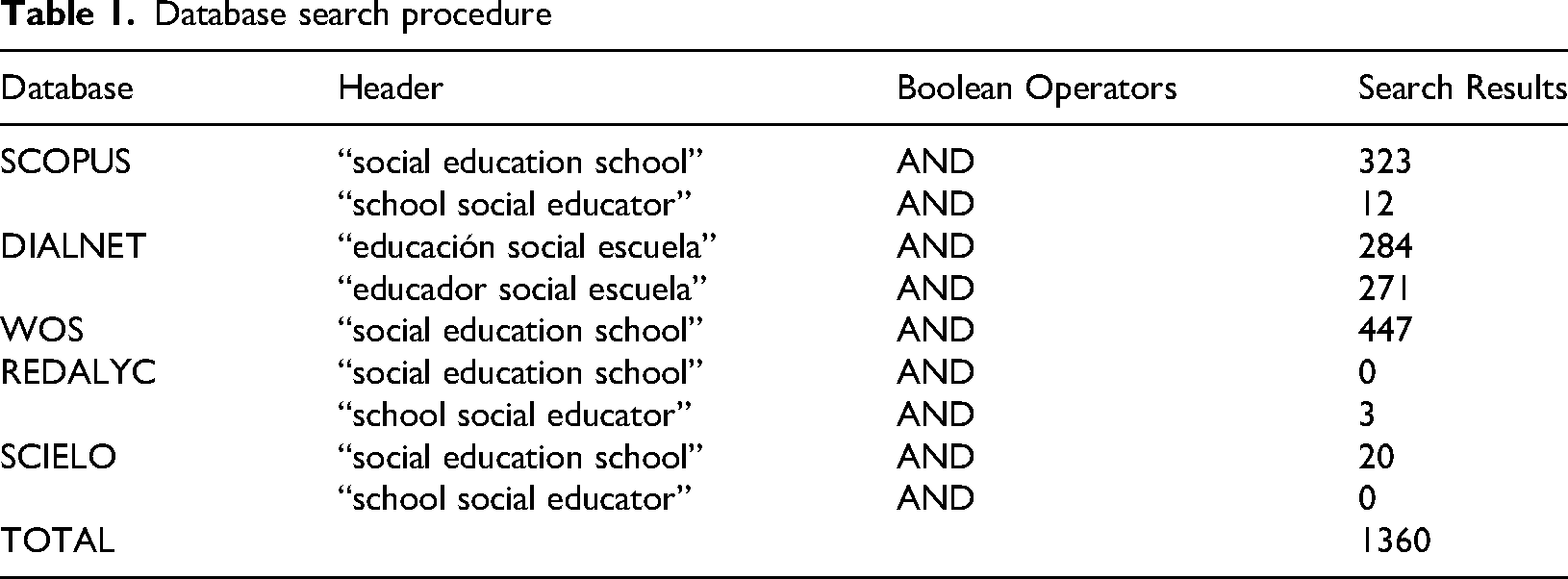
A systematic search was completed in the reference databases (Scopus, Dialnet, Web of Science: WOS, Redalyc and Scielo) of all publications between 2000 and 2020, using Boolean operators, reviewing especially emerging research and publications, reading, and analysing the contents of the articles and finally mapping the state of the art.
In addition to what is shown in Table 1, it is worth mentioning that common criteria have been considered in each of the databases where the following filters have been applied:
- The articles must be Spanish, in order to obtain experiences or studies based on schools in Spain. - The area of knowledge is focused on Social Sciences, Pedagogy, and Education. - The results provide open access documents.
To these 1360 articles that resulted from the total search other documents (17) not obtained from databases, but from google, were added. Therefore, the total number of documents was 1377, of which 48 were screened out as duplicates and 1329 remained in the selection process.
The first screening was carried out considering the titles and abstracts of the articles, discarding those in which there was no information about (a) the role of school educators, (b) the functions of social educators or (c) their role and function in school. Thus, the number of excluded records was 1231. The 98 articles screened were read and those that met the following characteristics were excluded: these were either book reviews or were intervention proposals or experiences in which social educators were involved, but they did not analyse the functions of social educators in schools. As a result, 56 articles were finally included in this systematic literature review. This process is summarised in Figure 1.
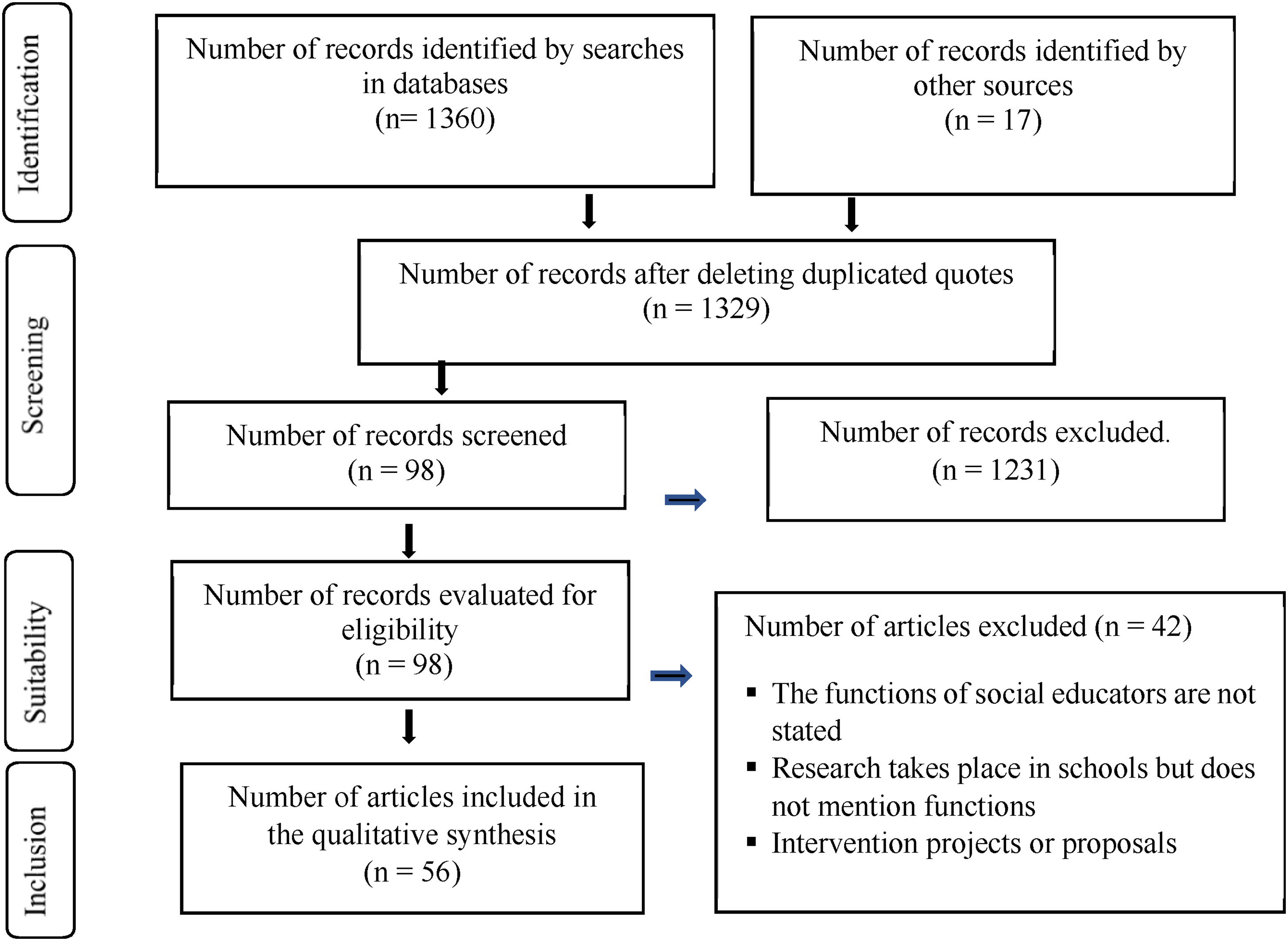
Prisma flow diagram adapted from Moher et al. (2009).
This mapping of the state of the art allowed us to learn about the various epistemological positions and debates that have taken place around the figure, role, and function of social education professionals, as well as current trends and the most significant advances. In this sense, we believe that the review work carried out represents an effective scientific contribution that provides new elements to understand and interpret the current situation of the social education profession in the school environment.
The validation was carried out using the complemented criteria of the University of York (Centre for Reviews and Dissemination, 2009): inclusion and exclusion, relevance and appropriateness, quality assessment of the studies, description of data, timeliness, referentiality and sufficiency. The inclusion and exclusion criteria have already been described in the screening process of the database review. The criterion of relevance and appropriateness focuses on discriminating those studies that are most relevant to the research topic. The criterion of quality assessment and data description refers to the validity and soundness of the research process carried out and the robustness of the data provided. The topicality criterion has considered the fact that this is a recent and consolidating profession, so the study corpus has covered the period from 2000 to 2020, including both the most significant historical references and the most current advances in the field. Figure 1 shows the number of articles selected according to the year of publication. With regard to the criterion of referentiality, it should be noted that the entire corpus of references analysed are articles published in peer-reviewed journals of recognised prestige and impact. Finally, the criterion of sufficiency has been very solid, covering 56 final references, which is sufficient breadth in the review of the literature on the subject.
Results
Both the research and the scientific literature reviewed show that social educators can perform different functions within schools thanks to their ability to adapt to the diverse and specific situations of each educational centre (González et al., 2016). They are socialising agents and exert a great influence on the comprehensive development of pupils, creating bonds of trust that favour environments where socio-educational action can be developed. Furthermore, they are agents that educate in the promotion of autonomy, conflict resolution, cooperation, as well as in the acquisition of values (Corrotuelo et al., 2012; Vega, 2013).
All these functions are mainly framed in three areas: prevention, mediation, and education (Akinaberri et al., 2012). Laorden et al. (2006), as well as López (2012) or Serrate and González (2019), include functions that have now been incorporated in educational laws at a state level:
- To integrate the centres into the community by studying the socio-cultural context and working in coordination with the different educational agents in the area.
- To carry out mediation actions aimed at bringing teachers, families, and pupils closer together to create a close environment that allows for the prevention of truancy, through mechanisms to encourage participation, as well as the assumption of commitment by the family to the school.
- To design, implement and evaluate mediation programmes in school conflicts between pupils and between pupils and teachers, and programmes to bring families closer together and encourage their participation.
- To encourage the inclusive participation of the educational community and the environment (pupils, teachers, and families) by designing extracurricular and complementary activities that promote associationism in the school or by collaborating in activities that the school requests.
- To collaborate with the school's governing bodies, searching coordination with the centre's departments, with the school council and with the AMPAS (Parents’ Associations) to develop activities of a socio-educational, social integration and insertion nature.
- To set up programmes to promote health, the environment, and the development of tolerance and equality that foster the school-family and school-community relationship.
- To conduct follow-ups when there are situations of absenteeism and/or school failure, situations of violence, or problematic behaviour.
These functions are linked to three strategies to be developed in schools: 1) Prevention of different problems through the development of plans and programmes framed in the different areas of intervention; 2) Mediation as a means to bring together all the agents that make up the educational community; 3) Intervention with students in those aspects that hinder their full inclusion (Sáez, 2019).
This allows us to affirm that currently the functions of social education professionals are not only related to the specific intervention with disadvantaged students (Castro et al., 2017; Mollà, 2006) as traditionally considered. Also, other areas of intervention are considered, such as the promotion of the participation of families and community agents, training in social and communication skills or the dynamization of the social and community environment (Akinaberri et al., 2012; Jiménez, 2017; Sáez, 2019; Sierra et al., 2017). In addition, other tasks are performed related to socio-educational animation, intercultural activities, leisure and free time, democratisation, healthy habits, prevention in sexual education (Alonso and Rodríguez, 2018; Ruiz, 2018), association promotion, etc. (Fernández and Ceinos, 2018; González et al., 2016).
Among the essential areas of intervention are those related to absenteeism and dropping out of school (Martínez and González, 2018), for which the school is a space for educational compensation (Álvarez, 2012) in order to gain access to a more socially and community integrated life (Longás, 2000). Also, the promotion of coexistence and the awareness and prevention of racist behaviour and attitudes, the inclusion of the migrant population and their families, and support and advice for teachers in an intercultural intervention and mediation (Hernández and Chamseddine, 2013). Besides, educators may also be able to detect indicators of abuse or lack of protection in students, as well as family situations where there is a risk of social exclusion (Vega, 2013).
Another of the most outstanding areas of work is intervention in coexistence (Santibáñez, 2005), in the face of bullying, conflicts between students or disruption in interaction with teachers (Galán and Castillo, 2008; González et al., 2016). The social educator's role as a conflict mediator (Akinaberri et al., 2012) and as an expert in training in social and communication skills, is very useful for the positive management of groups and the design of school mediation strategies. Thus, supporting a model of democratic coexistence in schools (García, 2013) and acting jointly with different institutions in the development of value training (Conde and Tirado, 2013).
The social educator's role in the coordination with social intervention institutions in the environment (Borges and Ci, 2019) contributes to building bridges and links of collaboration and active participation of families in schools (López, 2012; Sáez, 2017, 2019). This can facilitate a climate of collaboration, solidarity, and therefore, of school transformation and social improvement (Sáez, 2017).
It is not only a matter of integrating the community into the school, but also of favouring coordination between community resources, educational institutions, public administration, the third sector, social services and any institution related to child and adolescent protection (Akinaberri et al., 2012; Jiménez, 2017). This work of the social educator with the community also enables the creation of community networks between social agents, resources, or institutions (Sáez, 2019) and the development of policies, programmes and projects linked to organisations, making schools more inclusive (Jiménez, 2017; Sáez, 2019).
It is true that their intervention in the school environment was initially developed through socio-educational activities outside school hours, based on the demand of parents’ associations (AMPAS) or the schools themselves (Dapía and Fernández, 2018a). Although social educators have not always worked outside the school, they have increasingly intervened when required, although generally at specific times or in specific situations (Rodorigo and Aguirre-Martín, 2020). Those interventions were oriented to detection and intervention in cases of social exclusion or to prevent and intervene in cases of truancy, and also to coordinate intervention with children's centres (Laorden et al., 2006).
In the last two decades some autonomous communities have started to include social educators in schools: Extremadura, Castilla La Mancha, Balearic Islands, Canary Islands and Andalusia (Dapía and Fernández, 2018a; Galán, 2019; Menacho, 2012).
In 2002, Extremadura (Galán, 2019) integrated 140 Guidance Departments in secondary schools. Those departments are in charge of promoting coexistence, detecting risk factors that may affect the academic evolution and social development of students, as well as providing training and advice to families and developing awareness, prevention, and skills programmes with students (Puig and Fernández, 2018; Ruiz, 2012).
Also in 2002, in Castilla La Mancha 62 social educators joined schools (CGCEES, 2020; Dapía and Fernández, 2018b). In the 2003/2004 academic year, they were incorporated as civil servants into the Technical Corps (A2), with the functions of developing management, coexistence, and advisory actions for the educational community as a whole (Puig and Fernández, 2018).
In the Balearic Islands 18 social educators are developing coexistence plans in educational centres and working with community resources in the area (CGCEES, 2020). They are called TISOC (technicians of socio-educational intervention). The result was positive, but the programme was ended (Galán, 2019; Muñoz and Gelabert, 2013; Puig and Fernández, 2018; Ruiz, 2012). It has incorporated 25 TISOC in the 2020–21 academic year, also in semi-private state-subsidised schools, to prevent, reduce and eliminate the social difficulties that cause problems of coexistence, absenteeism, failure, and early dropout in both primary and secondary education.
In the 2017/2018 school year, the Canary Islands incorporated 36 social educators in centres of different modalities (Galán, 2019) with functions of analysis, assessment, counselling, networking, design and intervention, group dynamisation and coordination (CGCEES, 2020; Galán, 2019).
Finally, in Andalusia between 2007 and 2008, 68 social educators were incorporated (CGCEES, 2020; Dapía and Fernández, 2018b; Vila et al., 2020), mainly in secondary schools (Terrón-Caro et al., 2017). They mainly develop coexistence, multicultural and absenteeism programmes (Terrón-Caro et al., 2015, 2017) and specific prevention programmes, student monitoring, intervention with students and families, coordination, and collaboration with the educational community, as well as with the educational administration, and mediation with students, families and school (CGCEES, 2020). Today (Vila et al., 2020) they are no longer perceived as an emergency resource and are being incorporated into the educational community.
In other Autonomous Communities, although social educators are not formally integrated into schools, they do develop specific actions. For example, in Aragon, within the Integration Projects of school spaces in 6 nursery and primary schools, 32 sary schools and 4 special education schools (Galán, 2019; Ruiz, 2012); in Galicia, in secondary schools, but starting from organisations outside the schools (Galán, 2019; Puig and Fernández, 2018); in Catalonia, after school hours, from external organisations such as social services and under public administration contracts, focusing on areas such as absenteeism or mediation (Aznar et al., 2005; Puig and Fernández, 2018), although it announced the incorporation of 75 professionals in the 2020–21 academic year in centres of maximum complexity. In the other Autonomous Communities, work is also carried out by external entities and mainly through prevention activities (Puig and Fernández, 2018).
In general, the incorporation of social educators in educational centres has been a positive experience. As the CGCEES (2020) points out, these Autonomous Communities have improved their relationship with social services, reduced school dropout rates and improved educational success. Bullying has decreased through the promotion of a culture of peace; there is a better relationship between the school and community resources; and the functions of teachers in terms of social aspects have also improved. Even so, as the study by Bretones et al. (2019) concludes, the spaces occupied by social educators are still in many cases of support in specific situations for teachers, pigeonholed in interventions with disadvantaged students and. In addition, the other tasks they carry out in schools have not yet been recognised or are not given sufficient importance in all schools and public administrations.
Discussion and Conclusions
It is clear that schooling does not simply involve transmitting and learning academic knowledge but is also a space and a time for personal and social development, integration, and promotion in a community context. It goes beyond the educational centre but constantly interacts with it as a place where different agents converge (Jiménez, 2017).
We have seen how social education has been incorporated into the school environment, in some cases through educational regulations or legislation or linked to socio-educational programmes and projects of different administrations in collaboration with the centres. It has also been the effort and dedication of the social educators themselves who, with their projects, proposals, and actions, have given value and a significant dimension to this profession in the field of formal education (Castillo et al., 2016).
The conclusions in this regard seem clear. The presence of social educators in the school environment can favour the work of teachers, as they can take on these new tasks and functions that arise from new social problems and needs, avoiding the overload that this entails for today's teachers (Jiménez, 2017; López, 2017).
On the other hand, they can work together with the educational community, providing a broader vision and knowledge about the circumstances of students and their needs, making their work more oriented towards guaranteeing equal opportunities (Bretones et al., 2019).
In addition, they can also publicise, make visible and denounce the situations of exclusion and inequality experienced by students (Vega, 2013) in order to mobilise the necessary resources and the involvement of the community and the different institutions and administrations (Bretones et al., 2019; Galán and Castillo, 2008) with the aim of making progress towards achieving the Sustainable Development Goals on Education (SDG4) and the end of poverty (SDG1), as well as encouraging social education professionals to be an active part of the design of public policies in this field (Hong and Hamot, 2020).
However, their work cannot be that of a sporadic professional who only acts in conflict situations, as a “fire extinguisher” (Galán and Castillo, 2008). It cannot be considered and demanded as an emergency resource in situations of social exclusion, or where there is a presence of migrant pupils who suffer difficulties of school and social integration, or where there are situations of conflict in coexistence. Their integration in the Autonomous Communities was initially focused on the assumption of tasks that could sometimes be labelled as “firefighting” in centres of preferential action or of “difficult performance” (Cid, 2017). That is the case of Catalonia in centres of maximum complexity as a shock plan for tackling inequalities, their function being increasingly oriented from an integral perspective. Their work then is focused on social and educational inclusion, social transformation, and socio-community integration (Galán and Castillo, 2008; Merino, 2012; Quintanal, 2017; Rodorigo and Aguirre-Martín, 2020), developing their work in coordination with the rest of the school's professionals (Galán and Castillo, 2008).
The task of the social educator is complementary to teaching work (Castillo, 2013). They do not replace the work of other professionals, but together with them they can achieve great results with students at risk and/or in exclusion (Quintanal, 2017). Also, with the entire educational community in general as has already been proven during their experiences within schools (Arpal, 2019; Vega, 2013). Therefore, they should be incorporated as another professional in the educational community. Guidance Teams and Departments through a School Social Plan should develop their three main functions: socio-educational, relational and community (Akinaberri et al., 2012; CGCEES, 2020; Quintanal, 2018).
One of the most important aspects highlighted in this review is also the social educator's role in articulating relationships and collaboration between educational centres and the local communities in which they carry out their educational work (Caballo and Gradaílle, 2008; Pulido and Ríos, 2006). This is key to promoting not only the much-demanded family-school collaboration, but also the participation and involvement of and with the community and the social environment. Thus, the focus should be on joint transformation and improvement, and the construction of “educating cities”, where the traditional saying that it takes a whole tribe to educate just one of its members becomes a reality (Imbernón, 2008).
This requires solid initial training (Candedo et al., 2007), which includes subjects in the training plans of social education degrees in Spanish universities that are oriented towards socio-educational action within the school environment (Castillo and Bretones, 2018). Of the 36 Spanish universities with a degree in Social Education, only 17 have a subject explicitly dedicated to social education and school, and only in 11 of them it is a compulsory subject (Fernández and Ceinos, 2018; Serrate and González, 2019). The implementation of specific subjects can provide training in sufficient transversal competences for the future educator to be able to adapt to the school context (Santos, 2021).
Finally, it should be noted that the Organic Law for the Comprehensive Protection of Children and Adolescents against Violence enacted in June 2021 (the so-called Rhodes Law), opens the door to the incorporation of educators into schools. It is proposed in its Chapter IV -Article 33- to create the figure of a coordinator in all educational centre, and each and every one of the functions performed by these coordinators correspond to the work that social educators have been carrying out since 1991, when Social Education became an official qualification (Figure 2).
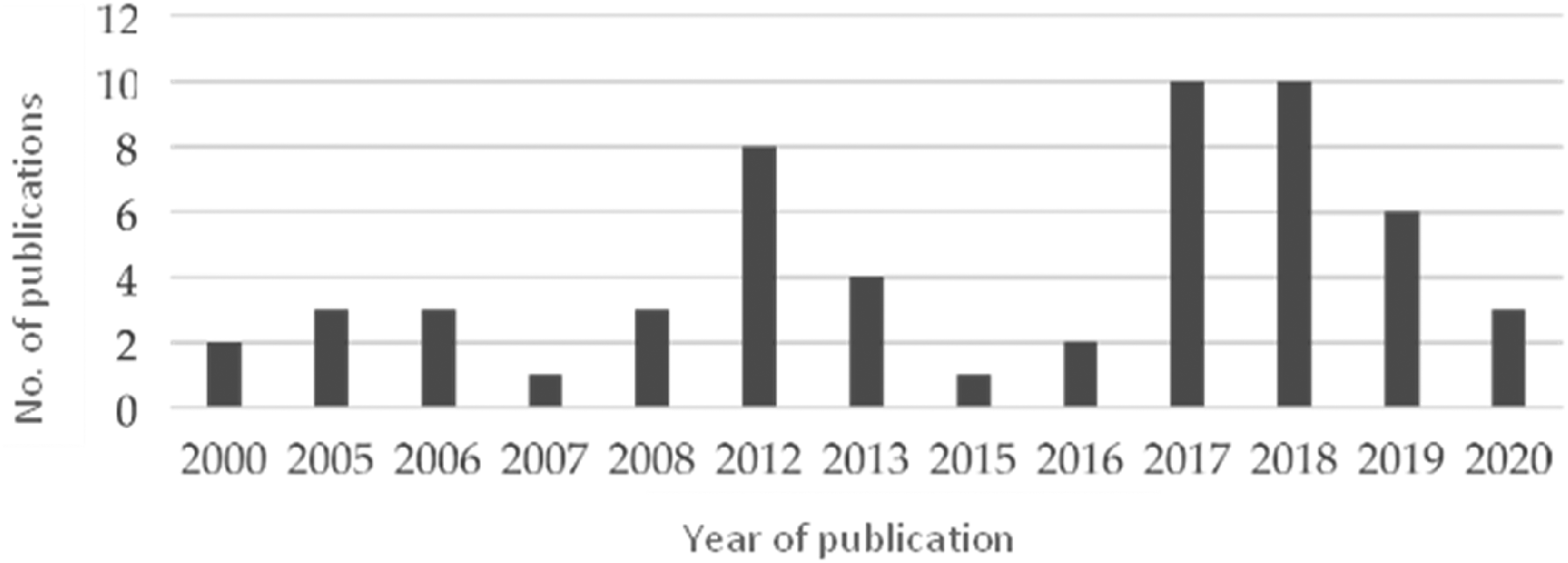
Year of publication of the articles included in the qualitative synthesis.
The decalogue of functions of the coordinator established in Article 33 of the Law coincides with those already performed by social education professionals in schools. Those functions have been reviewed throughout this text, related to prevention, mediation and intervention in situations that prevent the full development of children and adolescents. In addition, the work of the coordinator is carried out in areas of action specific to social education, such as community resources (Laorden et al., 2006), social services (González and Martínez, 2018) and public administrations (Sáez, 2019). In short, this Law offers the opportunity to incorporate this much-needed professional figure in all educational centres by regulating their presence and functions of support and integrated intervention in educational centres in coordination with the resources of the environment and the social community.
The school of the twenty-first century is inserted in a changing society with a greater awareness of the social problems that are inevitably also reflected in educational centres (Torres de Bustos, 2017). Schools must have social educators for the development of socio-educational programmes that help and collaborate to make the right to education a reality and a fully enriching experience, thus advancing towards a fairer and more cohesive society (Guitart, 2021).
Footnotes
Author Contribution
Both author(s) have discussed the theoretical framework of the study as well as the methodology applied, the literature review and the final conclusions.
Declaration of Conflicting Interests
The author(s) declared no potential conflicts of interest with respect to the research, authorship, and/or publication of this article.
Funding
This work has been developed and financed in the framework of the European Erasmus+ Project, Jean Monnet Module financed by the European Union (Application N° 620320-EPP-1-2020-1-ES-EPPJMO-MODULE), titled “Building up an Inclusive and Democratic Europe through a Dialogical Co-Creation of intercultural Solutions to the Rise of Neo-Fascism and Xenofobia· (INCLUE).
