




Abstract
School psychologists play important roles in working alongside Indigenous Peoples within Canada; however, a large gap exists between the discipline’s actions and the recommendations set forth by Indigenous Nations and governmental working groups. In this conceptual article, we seek to highlight the need for further Indigenous representation and engagement in the field of school psychology, as well as present key areas of relevance. We first briefly contextualize the relationship between Indigenous Peoples and school psychology, followed by the results of a brief survey concerning Indigenous representation and engagement across five school psychology doctoral programs in Canada. Next, we discuss nine key areas of consideration for school psychologists based on the Calls to Action of the Truth and Reconciliation Commission of Canada and the Calls for Justice of the National Inquiry into Missing and Murdered Indigenous Women and Girls. Each area of consideration provides school psychologists with a starting point for concrete actions when working with Indigenous students, families, and communities.
Keywords
Indigenous communities across Turtle Island (an Indigenous name for North America; Bowra et al., 2021) have demonstrated remarkable resistance in the face of oppression, advocacy for cultural and community-centered wellness, and a commitment to protecting and maintaining traditional languages and ways of knowing (Hartmann et al., 2019). At the same time, they have endured ongoing systemic violence and dispossession, leading to inequities in school completion, child welfare cases, incarceration, and mental health problems (Bombay et al., 2014a; Carr-Stewart, 2019; Gone et al., 2019). Within this context, school psychologists have important roles in advocating for Indigenous sovereignty, being aware of potential harm from certain forms of well-intended support, and promoting culturally relevant practices including those rooted in Indigenous epistemologies.
In this conceptual article, we seek to assist Canadian school psychologists in taking an accountable and responsive role in addressing Indigenous considerations, by describing the historical and ongoing inadequacy of school psychology’s attention to the context of Indigenous communities who seek equity in the educational sphere. We then present a brief survey of current Indigenous-specific training and engagement practices across Canadian school psychology doctoral programs. Finally, we discuss nine key areas for school psychologists in Canada to consider regarding Indigenous Peoples and the profession.
Indigenous Education and Mental Health Inequities
This article focuses on Indigenous Peoples within what is now called Canada, which includes First Nations, Métis, and Inuit peoples. The 2021 Canadian census indicates that 5% of the population identifies as Indigenous, including 1,048,405 (3%) First Nations, 624,220 (1.8%) Métis, and 70,545 (0.2%) Inuit (Statistics Canada, 2022). The Indigenous population is projected to increase from 1.8 million to 2.8 million from 2016 to 2041 under a “medium-growth scenario” (Statistics Canada, 2021). Among First Nations, Métis, and Inuit peoples, there are vastly diverse community and cultural practices, as well as languages and spiritualities (Brazil, 2013; Voyageur & Calliou, 2000). Indigenous Peoples refer not just to a population of self-identified individuals, but to sovereign Nations with dynamic forms of governance that reference inter-tribal or inter-community relations that are inscribed in traditional, oral-based community customs (Gone, 2019).
In order to address school psychology’s responsibility to Indigenous Peoples, it is pertinent to be oriented toward the history and current context of education and mental health among Indigenous Peoples in Canada. Since initial colonial contact, European settlers have attempted to control Indigenous Peoples’ education, health, families, and religion, despite communities already having rich, effective, and diverse practices concerning these domains (Carr-Stewart, 2019). Notable historical and ongoing examples of such violence include land dispossession, the Indian Act, and the Indian Residential School system, which were created to forcefully assimilate Indigenous children into Western society and Christian religions at the expense of their own identities and community connections, resulting in profound intergenerational trauma that continues to affect many individuals’ health and wellness (Bombay et al., 2014b; Gone et al., 2019; Wilk et al., 2017). Additionally, systemic acts of oppression such as mass incarceration and over-involvement of Canadian youth protection agencies have resulted in the overrepresentation of Indigenous individuals in prison and foster care (Chartrand, 2019; Government of Canada, 2022; Trocme et al., 2019). Presently, there are also thousands of cases of Indigenous women and girls that are missing and/or murdered across Canada (Heidinger, 2022; National Inquiry, 2019; Razack, 2016).
For decades, Indigenous educators have sought to rectify the ongoing consequences of forced assimilation attempts that manifest through education and mental health inequities among some Indigenous individuals and communities (Carr-Stewart, 2019; Chandler & Proulx, 2006; Gone & Trimble, 2012; Pidgeon et al., 2013). These inequities are worsened by continued oppressive governmental policy and systemic discrimination (Brave Heart et al., 2016). Many Indigenous children and adults face the continued effects of historical trauma, both directly and through intergenerational transmission (Gone et al., 2019). A number of mental health epidemics have been identified among Indigenous Peoples as a result of colonial violence, including problematic substance use, depression, and suicide (Nelson & Wilson, 2017). Indigenous communities and individuals vary in terms of these inequities (Chandler & Proulx, 2006; Gone & Trimble, 2012), and these inequities are narrowed when controlling for socioeconomic factors (Brave Heart et al., 2016). It is vital for school psychologists to be educated and informed of the unique strengths and stressors prevalent in Indigenous communities across Turtle Island in order to provide appropriately contextualized support and avoid replicating colonial harms to Indigenous children and families.
School Psychology’s Responsibility in the Context of Indigenous Educational Self-Sovereignty
A focus on school psychology’s role in Indigenous reconciliation is crucial, given that the profession is situated at the intersection of education, child and family welfare, and health, differentiating it from related fields of social work, education, and clinical, and counseling psychology (American Psychological Association, 2022). Two federal commissions pertaining to Indigenous reconciliation have clear relevance for these domains, even if they do not address school psychology explicitly. In 2015, the Truth and Reconciliation Commission of Canada (TRC) issued 94 Calls to Action in response to the legacy of the Indian Residential School system and related historical and ongoing forms of colonial violence. In 2019, the National Inquiry into Murdered and Missing Indigenous Women and Girls (NI) issued 231 Calls for Justice specific to this ongoing genocide. These landmark reports are in addition to initiatives within Canadian psychology. In 2018, the Canadian Psychological Association (CPA) and the Psychology Foundation of Canada published a report with recommendations for psychologists to engage with the TRC’s Calls to Action and to take accountability for their destructive part in the marginalization of Indigenous Peoples. This report outlined recommendations—grounded in principles of cultural allyship, humility, collaboration, critical reflection, respect, and social justice—pertaining to assessment, treatment, research, education, program development and evaluation, and advocacy. The report is surely inclusive of school psychologists; however, it did not specify school psychologists or provide recommendations that are particular to school psychologists. In addition, Indigenous psychologists within Canada have written at least three foundational articles pertaining to implications for professional psychology in response to the TRC (Ansloos et al., 2019, 2022; Fellner et al., 2020); however, these articles are framed primarily in terms of clinical and counseling psychology, with no explicit focus on school psychology.
Thus, there is a clear need for articulating recommendations for school psychologists in working with Indigenous Peoples. The seeds of this article were planted in conversations between the senior author (an Assistant Professor of Counseling Psychology with European settler ancestry) and three Indigenous school psychology graduate students (two First Nations and one Métis) he taught or co-supervised. These students expressed an interest in collaborating to advance dialogues for reconciliation with Indigenous Peoples within school psychology. Over the course of multiple meetings, the authorship team (consisting of these students, the senior author, and two non-Indigenous graduate students in counseling psychology) decided to focus on the tasks reported in this article: compiling a brief literature review, conducting a basic survey with program directors of school psychology programs, and generating key areas of consideration for school psychologists working with Indigenous Peoples in relationship to the TRC and the National Inquiry into Missing and Murdered Indigenous Girls.
Current State of Research and Training: Indigenous Peoples and School Psychology
School psychology is increasingly poised to responsibly engage with Indigenous Nations, communities, families, and children, as evident from its increased attention to social justice and awareness of problems with the discipline’s historical Eurocentrism (Bender et al., 2020; Graybill et al., 2018). An increasing number of school psychology programs are firmly committing to training clinicians in social justice competencies (Bender et al., 2020; Jenkins et al., 2018), though there is not consensus on what this means in the context of school psychology (Graybill et al., 2018; Johnson et al., 2019). However, despite these advances, the current state of research and training with Indigenous peoples within school psychology in Canada is quite meagre. In terms of the academic literature, scholarly outputs within the Canadian context are limited—even as Indigenous-focused research has accelerated in related fields—such as clinical/counseling psychology (Ansloos et al., 2019, 2022), social work (McCauley & Matheson, 2018), and education (Carr-Stewart, 2019)—since the TRC final report was published in 2015. Limited school-based research within Canada has been situated within Indigenous context, such as research on behavior management with Indigenous students (Baydala et al., 2009; Greflund et al., 2014; McIntosh et al., 2014) and the quality of relationships between Indigenous students and their peers and teachers (Burack et al., 2013; Fryberg et al., 2013). However, little if any Indigenous-focused research of which we are aware (prior to the special issue in which the current article is published) has focused squarely on school psychology as a profession within the Canadian context.
Outside of Canada, a small number of Indigenous-focused articles that are squarely rooted in school psychology have been published within U.S. context. Perhaps most notably, the U.S. National Association of School Psychologists (NASP, 2012) and Diné (Navajo) school psychologist Elvina Charley have published a guiding framework for working with Indigenous children and youth (Charley et al., 2015). This visual framework presents a model of integrating Indigenous worldviews within culturally relevant services, placing culture and identity at the center of the framework. The framework also includes interconnecting areas to consider: four aspects of the human being (physical, spiritual, cognitive and academic, and social-behavioral); four central considerations for building relationships (reciprocity, sovereignty, intentionality, and language); and eight key school psychology domains (resiliency; educational historic foundation; law and ethics; research; assessment; intervention; home, school, and community collaboration; school culture and policy advocacy). Dauphinais et al. (2018a, 2018b) use the NASP (2012) framework in presenting a case study outlining the assessment and intervention process of working with a Native American child and his mother. The authors provide key questions for those involved in the assessment process in order to “examine [the] cross-cultural experience” without having to be an expert on Indigenous Peoples’ diverse cultures (Dauphinais et al., 2018a, 2018b).
Additional articles within the U.S. have addressed Indigenous-specific multicultural competence, training needs, and representation. Robinson-Zañartu et al. (2011) conducted a national survey of school psychologists’ training experiences and current competence relevant to working with Native Americans. Participants reported inadequate preparation and competencies for what they perceived as necessary to work with Native American students, with People of Color rating these perceptions higher than European-Americans. Specific to Indigenous student representation, Goforth et al. (2016) note an underrepresentation of Native American graduate students in U.S. school psychology programs, using the NASP (2012) Indigenous framework to consider why this may be the case. The authors recommend several supportive changes that universities can make to promote Native American student enrolment and retention, such as financial opportunities and efforts to diversify faculty (Goforth et al., 2016). With the limited research highlighting a lack of Indigenous-specific training and representation, we suspect it is likely that most school psychologists in Canada are not being adequately trained to working with Indigenous children and families.
Brief Survey of Canadian School Psychology Doctoral Programs
In addition to consulting the literature, we administered a brief survey in order to capture emerging Indigenous initiatives within school psychology doctoral programs in Canada. Through consultation with the Research Ethics Board of McGill University, the survey was determined to be exempt from institutional review. The senior author contacted the program directors of each of six Canadian PhD-level school psychology programs (between June 2021 and March 2022): McGill University, University of Alberta, University of British Columbia, University of Calgary, University of Toronto, and Western University. Four of these programs are accredited by the Canadian Psychological Association (CPA) and were identified through the CPA website; the remaining two programs were identified after consulting with several school psychology faculty members in Canada. Five of the program directors participated in the survey, with one declining participation.
The survey consisted of eight questions in order to provide a snapshot of Indigenous engagement with school psychology programs, including Indigenous faculty, Indigenous-centered training/curricula, and other initiatives (see Table 1). Program directors were invited to answer “yes,” “no,” or “I don’t know” to each item as it pertained to the school psychology program as well as its respective department; directors were encouraged to consult with their colleagues as needed.
Survey Results of Five Doctoral School Psychology Programs
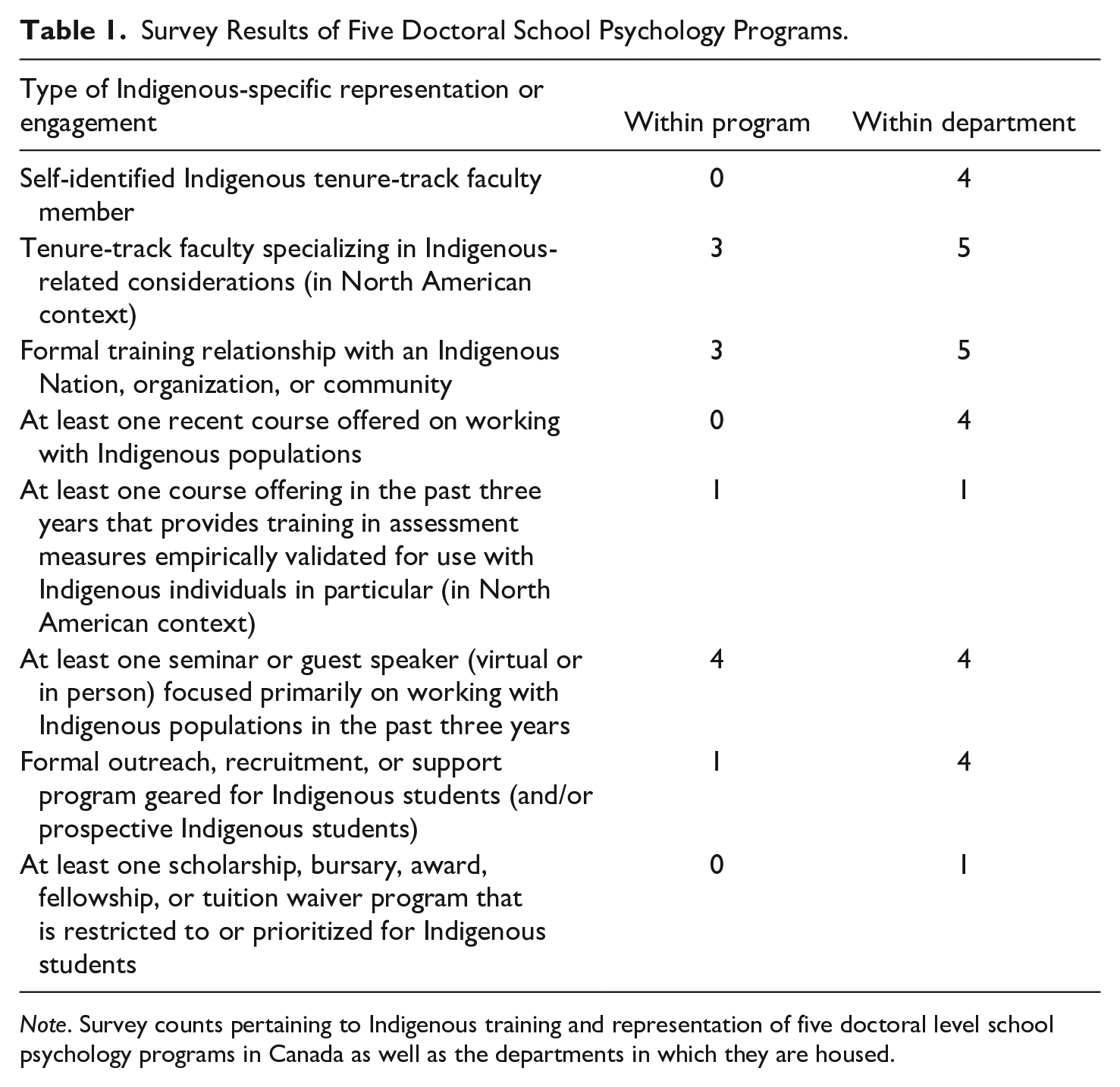
Note. Survey counts pertaining to Indigenous training and representation of five doctoral level school psychology programs in Canada as well as the departments in which they are housed.
Results are shown in Table 1. At the department level, Indigenous engagement and representation ranged in frequency depending on the survey item. At the program level, Indigenous representation and initiatives were less apparent. Although some programs indicated having tenure-track professors specializing in Indigenous research as well as formal relationships with Indigenous Nations or organizations, no programs reported one or more publicly self-identified Indigenous tenure-track professors. Though most program directors reported hosting lectures on Indigenous topics, only one program appears to have provided Indigenous-focused assessment training, and no programs have offered courses specifically focused on working with Indigenous populations. Finally, only one program has offered Indigenous-specific student support.
Although this survey surely does not adequately contextualize ongoing Indigenization efforts within school psychology programs, it portrays a general snapshot highlighting certain efforts but also key shortcomings. Most notably is the absence of Indigenous faculty among core school psychology faculty (among the five responding programs); although Indigenous faculty are severely underrepresented in higher education across Canada, there are growing numbers of Indigenous faculty in related fields such as counseling psychology (Ansloos et al., 2019, 2022). We urge school psychology programs to prioritize the training of Indigenous students and the hiring of Indigenous tenure-track faculty. Likewise, we recommend for school psychology programs to examine the adequacy of supports for Indigenous students (e.g., scholarships) as well as the cultural appropriateness of its assessment coursework and training.
Key Areas of Considerations for School Psychologists
Given the limited Indigenous-centered research and other products focused on school psychology within Canada, the authorship team decided to summarize key themes as starting considerations for school psychologists. We decided to honor the TRC of Canada and the National Inquiry (NI) on Missing and Murdered Indigenous Women and Girls by first reviewing their Calls to Action and Calls to Justice, respectively. These items were then organized into thematic areas that we determined to be most important for school psychologists. Table 2 includes a brief description of each theme (in alphabetical order) as well as the relevant calls within the TRC and NI reports. In this section, we describe key considerations for school psychologists for each of these themes in turn.
Summarized Themes and Relevant Calls in TRC and NI-MMIWG Reports.
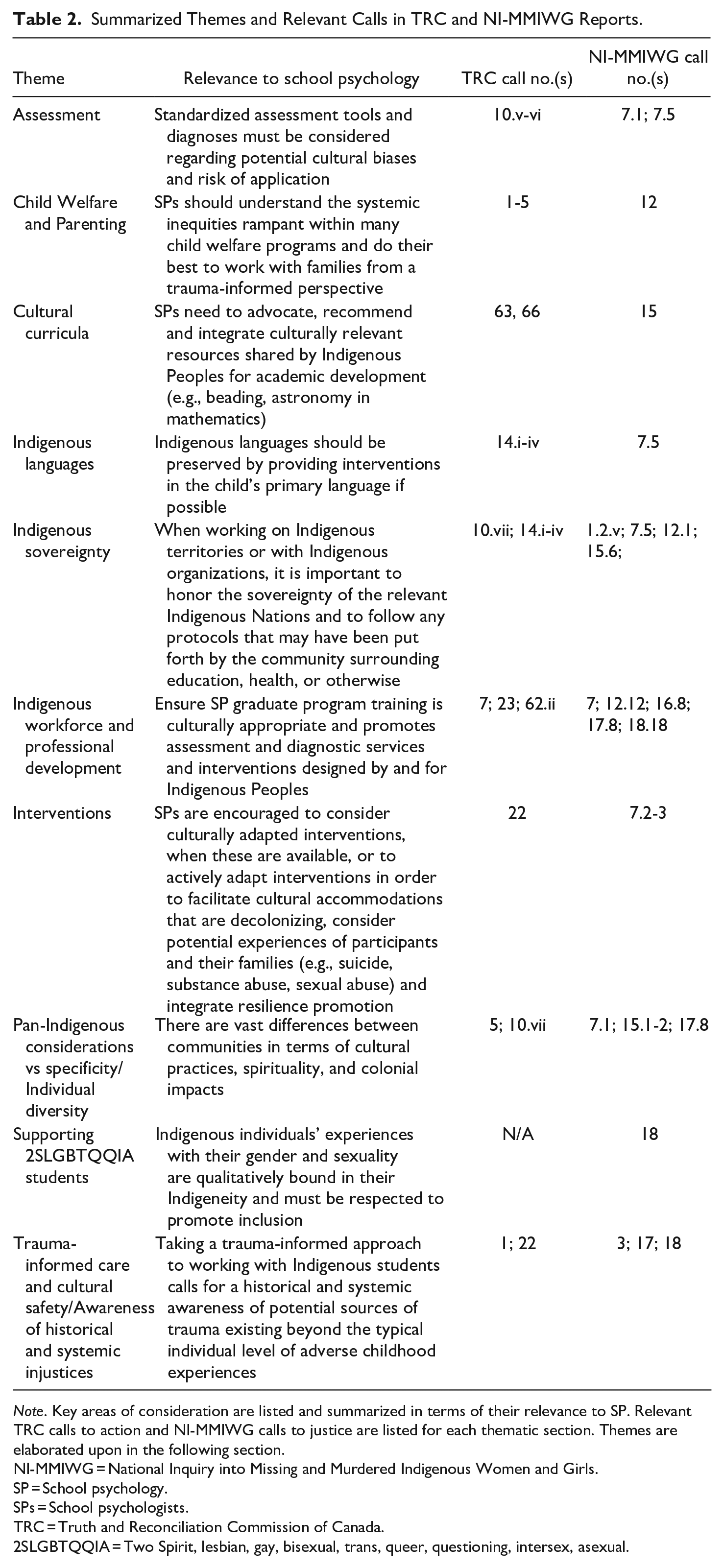
Note. Key areas of consideration are listed and summarized in terms of their relevance to SP. Relevant TRC calls to action and NI-MMIWG calls to justice are listed for each thematic section. Themes are elaborated upon in the following section.
NI-MMIWG = National Inquiry into Missing and Murdered Indigenous Women and Girls.
SP = School psychology.
SPs = School psychologists.
TRC = Truth and Reconciliation Commission of Canada.
2SLGBTQQIA = Two Spirit, lesbian, gay, bisexual, trans, queer, questioning, intersex, asexual.
Child Welfare and Parenting
The first theme pertains to child welfare and parenting considerations. Across provinces and territories, Indigenous youth and children make up 53.8% of children in foster care (Government of Canada, 2022; Trocme et al., 2019). The TRC dedicates its first five Calls to Action on this systemic issue by ensuring those involved in child welfare cases are properly educated on Indigenous history and intergenerational trauma (1–5). Similarly, the NI calls for those implicated in child welfare to prioritize Indigenous governance and community control regarding child welfare issues (12). School psychologists should advocate for the child’s relational needs should a child welfare case arise, involving the child’s familial and community relationships as much as possible. Ensuring agency (e.g., involving children in the evaluative process or intervention planning) within a culturally safe space and taking an intergenerationally trauma-informed approach is also key to supporting child welfare. This approach includes understanding how certain stigmatizing behaviors (e.g., substance use, sexual exploitation, and gang activity) exist within the context of historical loss and need for belonging (Brendtro, Brokenleg et al., 2019). School psychologists need to take on the responsibility in identifying their own worldview and seek Indigenous resources that can aid in their perspective-taking to best support Indigenous children. For school psychologists in Canada, relevant legislation embedded in Indigenous sovereignty is Bill C-92: An Act Respecting First Nations, Inuit and Metis Children, Youth And Families. The TRC also supports parental involvement and community responsibility, and culturally appropriate parenting programs (involving Knowledge Keepers or Elders). School psychologists might also incorporate use of the Sweetgrass method (Baez, 2011), which includes school psychologists sharing their own story and helps to build relationships of trust with children and families (Charley et al., 2015).
Consideration and Revitalization of Indigenous Languages
The preservation of Indigenous languages is of high importance given the historical and ongoing attempts of colonial governments in eradicating language and culture among many Indigenous Nations. The TRC (14.i-iv) and NI (7.5) both note the importance of providing services in Indigenous languages whenever possible in order to promote their preservation. To participate in the preservation, revitalization, and strengthening of Indigenous languages, school psychologists should acknowledge and respect each Nation’s right to language as well as its use in education and wellness practices to the extent that it is relevant and feasible. It is useful to familiarize oneself with the provincial and territorial laws around Indigenous language rights, particularly regarding Treaty territories relevant to one’s context, to ensure that services are being provided in line with local expectations and needs surrounding language. School psychologists may support this endeavor by developing an awareness that Indigenous languages (and cultures) are best managed by Indigenous Peoples and communities themselves. Maternal language can impact assessment results, particularly given the cultural differences that may be apparent between Indigenous languages and Western languages (e.g., French and English; Gorter & Cenoz, 2017). Students whose Indigenous language is their first language may show phonemic differences and syntax. School psychologists can increase clarity about ambiguous language and use qualitative descriptors when appropriate to ensure mutual understanding. Finally, if possible, school psychologists should seek intervention options that may be provided in the child’s language (or via a translator) to support children’s Indigenous cultural connection and increase accuracy of assessment, effectiveness of mental health interventions, and acceptability of educational interventions (Ball, 2009).
Cultural Curricula
Cultural curricula include both curricula for Indigenous students as well as surrounding Indigenous topics presented to the general public. The TRC calls for Indigenous-specific curricula across all grades for both Indigenous and non-Indigenous children (63; 66). The NI calls for Canadians to learn accurate information about the relationship between Indigenous Peoples and Canada (15). School psychologists need to advocate for, recommend, and integrate culturally relevant resources shared by Indigenous Peoples for academic development (e.g., beading, astronomy in mathematics; McKinley & Smith, 2019; Morcom, 2017) and holistic wellness (e.g., traditional healing practices, community connectedness; Kirmayer et al., 2003) for all students to promote intercultural awareness and empathy. Additionally, school psychologists might work collaboratively with educators to develop and implement curriculum and learning resources focused on Indigenous Peoples, and the history and legacy of residential schools throughout the curricula (e.g., http://www.fnesc.ca/irsr/). School psychologists can support with gathering and promoting resources to deliver programs on reconciliation and establish a national network to share information and best practices.
Indigenous Sovereignty
Indigenous sovereignty pertains to restoring power to Indigenous communities regarding decision making concerning governance, land, education, and other areas of life. In the words of a First Nation co-author of this article, “For anything to be effective it must be rooted in Indigenous epistemology (e.g., for the people by the people). We are capable of empowering ourselves in discovering who we are, who we always have been.” The TRC calls on governments to obtain informed consent and full participation of Indigenous Peoples in “respecting and honouring Treaty relationships” (10.vii; 14.i-iv). The NI calls on governments to respect Indigenous self-governance and self-determination rights, particularly surrounding the development of solutions to social problems (1.2.v; 7.5; 12.1; 15.6). There are many freely available resources in which school psychologists can become aware of the Nations and Treaties pertaining to the geographical areas that they work, such as the interactive website from Native Land International (native-land.ca). When working on Indigenous territories or with Indigenous organizations, it is important to honor the sovereignty of Indigenous Nations and to follow any protocols that may have been put forth by the community surrounding education, health, or other relevant domains. Whenever possible, school psychologists should consult with local communities, leaders, Knowledge Keepers, and Elders in order to provide locally relevant support rather than pan-Indigenous cultural assumptions.
Indigenous Workforce and Professional Development
Ansloos et al. (2022) estimated that there are only 15 “Indigenous practicing and/or teaching doctoral-level psychologists” throughout Canada. As discussed above, our survey did not report any self-identified Indigenous faculty among the five school psychology doctoral programs that responded. The TRC (7; 23; 62.ii) and NI (7; 12.12; 16.8; 17.8; 18.18) include a number of calls urging for improved pathways to professional development and representation of Indigenous professionals and topics within health service education and training. School psychologists should publicly encourage training programs to update courses to include Indigenous-specific training as well as promote avenues to support Indigenous students, given the lack of relevant courses and training currently available for school psychology trainees as indicated in the prior survey section of this manuscript. Mental health services for Indigenous children are best delivered by clinicians who are representative of, or meaningfully connected to, the community from which the individual derives, in order to ensure culturally relevant and empowering services (Canadian Psychological Association and Psychology Foundation of Canada, 2018). Ideally, a school psychology graduate training program that seeks to attract, retain, and invest in Indigenous students should look toward building a relationship with Indigenous communities first, in order to better gauge community needs.
Indigenous students are surely more likely to thrive and feel less alienated in professional training programs that provide culturally centered, contextuality informed, and community oriented training (Ansloos et al., 2019, 2022). Through incorporating training that includes holistic approaches to traditional medicine (healing methodologies), community wellness, and spirituality, school psychology programs will be more oriented to strong values among Indigenous communities (Champagne, 2015). Community definitions of wellness and well-being can inform curricular and culturally informed recruitment and decision-making processes throughout school psychologists’ careers. The community-oriented approach honors Indigenous knowledges, connections, and experiences that historic Western curricula alienates or elides (Ansloos et al., 2019; Carr-Stewart, 2019).
Cultural Interventions and Holistic Wellness
Given that school psychologists develop and implement interventions directly with students, culturally relevant considerations are encouraged during intervention development to support the child’s wellness on both the individual and cultural level simultaneously (Blacklock et al., 2020). The TRC (22) and NI (7) both underscore the importance of using Indigenous-centered healing practices, as well as working directly in collaboration with Indigenous healers and Elders, if clients request. We encourage school psychologists to begin to incorporate interventions designed by Indigenous Peoples, to use culturally adapted interventions, or to do their best to adapt interventions to facilitate culturally-relevant accommodations—recognizing that there are limited evidence-based interventions for Indigenous populations (see Wendt et al., 2022). Interventions should consider a critically (and contextually) informed lens to Indigenous communities’ needs, which is informed by active engagement and collaborative partnerships with community stakeholders and leaders. Without such a lens, children’s behaviors may be misunderstood from an individualistic and biomedical model that pathologizes normal behavior. By tapping into existing community strengths and expertise, training programs can move away from a pathologizing, damage-centered paradigm (Persad, 2017). Moreover, an over-reliance on Eurocentric forms of assessment, diagnosis, and intervention has the potential to be harmful for Indigenous students (CPA, 2018; Wendt et al., 2015). School psychologists may choose enriched measures and interpretations that are inclusive of family, community, and cultural indicators of health and cognitive development to ensure a holistic sense of the child’s mental health (Charley et al., 2015).
Pan-Indigenous Considerations versus Specificity
There are diverse communities and individuals within what is referred to as the Indigenous population in Canada. This theme describes how to respect diversity when working with Indigenous Peoples rather than assuming homogeneity across the population. The TRC calls for the government to ensure that programming and legislation respects Indigenous communities specific to the region of consideration (5; 10.vii). The NI calls for health providers and governments to recognize that Indigenous people are experts in caring and healing themselves; thus, health and wellness services are recommended by the NI to be designed and delivered based on diverse cultures and values relevant to the community being served (7.1,6; 15.1-2; 17.8). School psychologists demonstrate respect and communicate with greater precision when using terminology that is specific to the local and/or relevant Indigenous Nations. For example, unless ethical reasons prohibit such, it is generally preferable to refer to an “Ojibway girl” rather than an “Indigenous girl” or “First Nations girl.” We also discourage reference to “Indigenous culture,” as such an ethnic gloss is no more useful or accurate than reference to “European culture.” Moreover, discussions surrounding culturally appropriate interventions often assume that what is appropriate for one Indigenous community may be for any Indigenous community. This is certainly not the case; not only do traditional practices and spiritual beliefs differ across geographical regions and communities, but so does colonial contact history as well as social and health disparities. School psychologists should practice modelling specificity in notes, assessment feedback, verbal interactions, etc., with both clients and colleagues to promote respect for diversity and more accurately speak to their client’s identity and context.
Supporting 2SLGBTQQIA Children
Two-Spirit, lesbian, gay, bisexual, transgender, queer, questioning, intersex, and asexual (2SLGBTQQIA) Indigenous children require adequate support that respects both their Indigenous and sexual/gender/sex identification and expression. The NI report includes an entire section dedicated to supporting 2SLGBTQQIA Indigenous people regarding their human rights, prevention of violence, and inclusion of perspectives and identities from a culturally specific understanding (18). It is important for school psychologists to take time to learn about the child’s sexuality and gender identity within a cultural context before making assumptions about what a sexuality or gender-related label may mean to the child, as gender and sexuality are inherently culturally bound concepts (Sheppard & Mayo, 2013). Two-Spirit individuals—a recently coined post-colonial pan-Indigenous term—may conceive of their gender or sexual orientation in a qualitatively different way than Western individuals, in part due to kinship patterns and language that do not reflect Western assumptions of gender and sexuality norms (Vowel, 2016). For this reason, it is most accurate and most likely to lead to a respectful and useful relationship to understand the descriptions of children and their families rather than making assumptions based on labels alone. The NI additionally centers Two-Spirit individuals as a particularly vulnerable group in terms of potential for abuse and mistreatment (Kia et al., 2020; Lyons et al., 2016; Ristock et al., 2019). That said, it is important to not pathologize children based on their Two-Spirit identity, as struggles may be related to bullying, discrimination, or abuse, rather than inherent to their identity (Hall, 2018). By pathologizing a child’s sexual or gender identity, it communicates that the identity itself is a problem, furthering homophobic or transphobic stigma. School psychologists should ensure that children are aware of the limits of confidentiality (including in relationship to parents or guardians) to avoid outing identities to those that they prefer not to know for the sake of the child’s safety (Sims & Nolen, 2021).
Trauma-Informed Care
Taking a trauma-informed approach to working with Indigenous students calls for a historical and systemic awareness of potential sources of trauma existing beyond the typical individual level of adverse childhood experiences (Boullier & Blair, 2018; Pride et al., 2021). The TRC calls for service providers to support healing across individual, familial, and community levels that center Indigenous healing practices (1; 22). The NI report’s Calls for Justice are written from the guiding principle of trauma-informed approaches that include Elders, Grandmothers, and other Knowledge Keepers in supporting survivors of trauma and violence (3; 17; 18). School psychologists should take a trauma-informed approach to the presenting problems of Indigenous students, noting the potentially intergenerational and systemic nature of their trauma. As mentioned earlier, this is especially important as many problematic behaviors (e.g., opposition, concentration issues) may manifest in relation to traumatic origins, both in terms of direct experience and intergenerational trauma. School psychologists should take time to understand the established susceptibility of the descendants of Indian Residential School survivors to a variety of mental and physical health disorders through intergenerational transmission to utilize appropriate interventions that are trauma- and culturally-informed (Bombay et al., 2014a). Many behavioural and cognitive traumatic responses may present as or relate to neurocognitive or developmental issues, such as ADHD, autism, or intellectual disability (Kildahl et al., 2019; Szymanski et al., 2011). Should a child present with signs of trauma, school psychologists are encouraged to connect with relevant community members to support desired culturally relevant healing practices beyond talk therapy. Holistic assessment includes examining any impacts of ongoing and historical trauma including Indigenous Nations’ histories (e.g., in relation to the land) and physiological impacts on learning (Robinson-Zañartu et al., 2011).
Conclusion
In this article, we have summarized the state of affairs regarding Indigenous considerations for school psychologists in Canada. First, we discussed the current research in this area. Next, we presented the results of short survey pertaining to Indigenous representation in several Canadian school psychology doctoral programs. Finally, we discussed nine key areas of consideration for school psychologists based on the TRC and NI reports. Through doing so, it is evident that there is further need for research and training within school psychology in a post-TRC context. Although there is clearly much work to be done, this brings many opportunities for innovation within the discipline. We hope that this article can be a helpful step for school psychologists to engage in reconciliation and support Indigenous children as well as their families and communities.
Footnotes
Acknowledgements
We also wish to acknowledge Alison Read, Steven Shaw, Meadow Schroeder, and Erica Makarenko for their assistance with certain conceptual and logistical decisions in conducting this project.
Declaration of Conflicting Interests
The author(s) declared no potential conflicts of interest with respect to the research, authorship, and/or publication of this article.
Funding
The author(s) disclosed receipt of the following financial support for the research, authorship, and/or publication of this article: This project was supported by the Award for Research Initiative funded by the Faculty of Education at McGill University.
