




Abstract
Previous studies suggest that secondary school students in vocational tracks receive fewer opportunities to practice with critical-democratic citizenship than students in academic tracks. Less is known about the role of critical-democratic citizenship education in tertiary vocational education and training (VET). Utilizing questionnaire data collected in 2021 amongst 350 Dutch VET students, a structural equation model was constructed in which we conjointly studied to what extent differences in students’ attitudes towards societal awareness and sound opinion forming are associated with 1) students’ experiences regarding the curriculum content, 2) openness of the classroom climate for discussion, 3) autonomy and structure provided by the teacher and 4) intrinsic value of the experienced citizenship education. This latter element was found to be especially relevant, as it was associated with both societal awareness and sound opinion forming, whereas classroom climate played only a minor role. Students’ societal awareness was also associated with both the experienced curriculum content and the autonomy and structure offered by the teacher. These results offer important practical implications to further improve opportunities for critical-democratic citizenship in VET.
Keywords
Introduction
Democratic societies are continuously changing and debating fundamental problems. Societal issues concerning social cohesion, tolerance, discrimination and radicalization underline the importance of attention to young people's development of citizenship competences to enable them to actively take part in democratic processes (Barrett, 2016; Council of Europe, 2017). In line with this observation, citizenship education has received increasing attention over the years, from policymakers as well as researchers (Campbell, 2019; Eurydice, 2017). There is no shortage of debating the moral assumptions underlining democracy, ‘good’ citizenship and the consequent goals to be set out for citizenship education, both between and within countries (Lozano Parra et al., 2021; Merry, 2020; Veugelers, 2020, 2023; Wheeler-Bell, 2014).
Many conceptualizations of citizenship now include not only the political domain but also the social and cultural (Veugelers, 2021). As a result, one of the goals of citizenship education in most contemporary democratic societies is to help students develop a broad set of so-called citizenship competences, often referred to as knowledge, skills and attitudes related to democratic conduct, socially responsible behavior and the ability to deal with differences and conflicts (e.g., Barrett, 2016; Ten Dam and Volman, 2007; Ten Dam et al., 2011). Examples of competences that receive attention in democratic-citizenship education are the ability to think critically, uphold or promote (social) justice and participate in (societal) dialogues and debates.
One of the characteristics distinct to citizenship competences as compared to other competences such as reading, writing of mathematics, is the relevance of attitudes besides knowledge and skills. According to Veugelers (2017: 57): “In citizenship education, knowledge and skills are important, but attitudes are most relevant. They determine, to a large extent, the opinions and behaviors of citizens”. In this study, we therefore focus specifically on citizenship attitudes. More precisely, we are interested in attitudes towards critical-democratic citizenship, which focuses on autonomy and societal awareness (Veugelers, 2021). Previous studies of citizenship education in different educational tracks suggest critical-democratic citizenship receives more attention in academic than in vocational tracks (Leenders et al., 2008; Ten Dam and Volman, 2003). Students in vocational tracks also less frequently feel like they are encouraged to be socially and politically engaged, and report fewer possibilities for discussions in class (Nieuwelink et al., 2019), thereby limiting vocational students’ opportunities for equal participation in democracy. These findings align with a more general pattern of unequal access to democratic activities at school (Deimel et al., 2020; Hoskins et al., 2017; Mennes et al., 2023).
Whereas most research on citizenship education focuses on secondary and – to a lesser extent – primary education, relatively little is known about the effectiveness of the citizenship curriculum offered in tertiary vocational education and training, or VET. In the Netherlands, citizenship education in VET has been criticized for focusing on the individual (personal development, individual knowledge of societal issues), more so than on the relationships between the individual and the collective (De Groot et al., 2022). Moreover, similar to previous studies in secondary vocational education, citizenship education in Dutch VET appears to be mainly aimed at the internalization of societal norms and values, and less so at stimulating autonomous and critical thinking (Zuurmond et al., 2023).
The present study aims to investigate opportunities for critical-democratic citizenship in VET by building upon the rapidly increasing knowledge base on effective approaches to stimulate the development of citizenship competences in secondary education (Coopmans et al., 2020; Isac et al., 2014; Reichert and Print, 2018). We conjointly study students’ critical-democratic citizenship attitudes, the relationship with their experienced citizenship education curriculum and relevant pre-conditions for effective citizenship education. We aim to answer the question: to what extent are students’ critical-democratic citizenship attitudes related to their experiences with citizenship education in VET? In doing so, the current research not only contributes to the existing literature but also offers important practical implications that may help further improve opportunities for critical-democratic citizenship education in VET.
Citizenship education and VET in The Netherlands
In the Netherlands, tertiary education is split into (four levels of) vocational and (two levels of) university education. Young people aged 16 and older with a pre-vocational secondary education diploma can choose from a wide range of training programs in tertiary vocational education and training (VET). The duration of the program depends on the chosen level and varies between one and four years.
All VET programs, regardless of duration or vocation, are legally obliged to teach citizenship education. Like all schools in the Netherlands, however, VET institutions enjoy a relatively large degree of freedom in the way they offer citizenship education (De Groot et al., 2022). How, when, and to what extent contents of citizenship are covered, is decided by the school – even whether citizenship is offered as a distinct subject and how student achievement is assessed. Consequently, the type and intensity of citizenship education that is offered in VET can vary between schools with regard to contents as well as form (Zuurmond et al., 2023).
In Dutch legislation on VET, four dimensions are described on which citizenship education should focus: political/legal (the willingness and ability to take part in political decision making processes, democracy in general, and human rights), economic (the willingness and ability to take part in labor processes and working community, i.e., as an employee), social-societal (the willingness and ability to take part in and contribute to the society, including dealing with social and cultural differences), and vital citizenship (the willingness and ability to reflect upon one's lifestyle and take care of one's vitality as citizen and employee). These dimensions are currently undergoing revision, but it is unclear how and when they will change.
Critical-democratic citizenship education
Previous literature has identified multiple perspectives on citizenship (Knight Abowitz and Harnish, 2006; Westheimer and Kahne, 2004). In the literature on citizenship education, three types of citizenship have been distinguished, each expressing different orientations: adaptive citizenship, with a strong focus on discipline and social involvement; individualized citizenship, emphasizing autonomy and discipline; and critical-democratic citizenship, focusing on social involvement and autonomy (Leenders et al., 2008; Veugelers, 2017; 2021). The latter dimension, critical-democratic citizenship, thus combines social and societal involvement aims such as solidarity with others and awareness of and engagement in current issues, with critical thinking and autonomy aims such as forming and voicing a critical opinion. In the Netherlands, students, teachers, researchers and policymakers appear to support a focus in citizenship education on promoting critical-democratic citizenship, at least in theory (De Groot et al., 2022; Leenders et al., 2008; Veugelers, 2017, 2021). In practice, a focus on a more adaptive form of citizenship is more frequently found (Veugelers, 2021). Critical-democratic citizenship can be seen reflected in students’ societal awareness concerning (global) societal issues (Veugelers, 2023). This can be comprised of moral aspects of citizenship, including human rights and a concern for the planet and its inhabitants, as well as social-political elements, including social justice, (in)equality and corresponding political change (Veugelers, 2021, 2023). For instance, in 2019 many students, in the Netherlands as well as in other countries, participated in climate strikes, creating a global movement (Richardson, 2020). Their awareness of and engagement with these issues can arguably be regarded as showing a sense of solidarity and awareness as described in the previous paragraph. With regards to critical-democratic attitudes, this means students both show a willingness to be aware of current issues, as well as a willingness to form and voice their opinions.
To form an opinion on current issues, awareness of societal issues is ideally accompanied by a willingness and motivation to form this opinion based on reliable sources. Critical thinking has therefore long been considered another important aspect of critical democratic citizenship education (Abrami et al., 2015; Volman and Ten Dam, 2015), also in vocational education (López et al., 2023; Zuurmond et al., 2023). The rise of attention to mis- and disinformation has also increased attention to fostering students’ ability to think critically about the information they read (Fair and Fasko, 2021). With regards to students’ critical-democratic attitudes, this means students develop and show a willingness to follow the news and check the information they are receiving, comparing and critically reviewing information from different kinds of (media) sources – also referred to as ‘sound opinion forming’ (Holman et al., 2021).
In an exploratory study in which Dutch VET teachers were asked on which type of skills they focused most in their citizenship education, social-cultural skills appeared more embedded in the curriculum than critical thinking skills (Petit and Verheijen, 2015). The lack of attention to critical thinking skills in initial legislation on citizenship education in VET, and their perceived relevance to citizenship education, led to policy intervention. Since 2017, the VET legal qualification requirements describe the relevance of critical thinking skills (e.g., critically reflecting upon information sources; distinguishing between arguments, assertions, facts and assumptions; and being able to switch between different perspectives).
The emphasis on critical thinking could have very well translated into extra attention for this particular learning goal in the current citizenship curriculum. However, the current curriculum has also been criticized for focusing more on individualistic and adapting citizenship than on (bringing about change in) social issues and relationships with the collective (De Groot et al., 2022), and more on social norms than on autonomy and critical thinking (Zuurmond et al., 2023). One of the aims of the present study is therefore to further explore how the content or focus of critical-democratic citizenship education – and more specifically, societal awareness and sound opinion forming – is related to students’ attitudes on these topics.
The relevance of the experienced curriculum
Reviews of the effects of citizenship education have pointed to the effects of embedding citizenship education in the curriculum on students’ development (Campbell, 2019; Geboers et al., 2013; Teegelbeckers et al., 2023). Longitudinal research on the effects of citizenship education in England has shown that the extent to which students experience having been taught citizenship education is a robust predictor of their citizenship competences (Keating et al., 2010). The effect of ‘received citizenship education’ on students’ development of citizenship attitudes proved far greater than whether schools indicated that citizenship education was part of the curriculum. The different effects of the curriculum as experienced by students and as designed by schools can be explained from the literature on curricula. Van den Akker (2006) describes three levels of curriculum: intended, implemented and attained. Intended curriculum refers to the vision and intentions as specified in curriculum documents, implemented curriculum to the curriculum as taught by teachers, and attained curriculum to the learning experiences as perceived by learners and the resulting outcomes of learners.
To understand critical-democratic citizenship education and the promotion of critical-democratic attitudes as experienced by students, we need insight into the extent to which they consider their education has covered the promotion of these attitudes. In the present study, we therefore focus on the effectiveness of critical-democratic citizenship education as perceived by Dutch VET students, in other words, the extent to which they believe to have been taught about societal awareness and to think critically about the information they receive.
Conditions promoting effective citizenship education
Previous studies on citizenship education have shown that for citizenship education to be effective in fostering students’ critical-democratic citizenship competences, they must be given opportunities to practice in the classroom, to reflect on what they learn and to be able to make sense of what they learn through active, experience-based ways of learning (Donbavand and Hoskins, 2021; Knowles et al., 2018; Reichert and Print, 2018; Teegelbeckers et al., 2023; Willeck and Mendelberg, 2022). This includes a key element of Self-Determination Theory (SDT), namely the need for autonomy, which concerns experiencing free choice and free will, rather than feeling constrained and forced to participate in an activity (Deci and Ryan, 2012). SDT states that effective learning supports intrinsic motivation and internalization (i.e., discovering the value and personal utility of the learning process). To be effective, three basic psychological needs have to be met: competence (i.e., the need to experience mastery), social relatedness (i.e., feelings of belongingness with others) and autonomy (Niemiec and Ryan, 2009; Reeve and Cheon, 2021).
The relevance of the latter two needs is also underlined in the emphasis in citizenship education literature on a democratic and participative classroom climate. An open and democratic climate in which discussion and dialogue take place seems to effectively promote various critical-democratic citizenship competences (Campbell, 2019; Daas et al., 2023; Geboers et al., 2013; Knowles et al., 2018), including critical thinking (Abrami et al., 2015). Letting students decide on topics and lesson strategies, for instance, was found to stimulate students’ citizenship competences – both in terms of knowledge, skills and attitudes (Coopmans et al., 2020; Torney-Purta et al., 2008). Furthermore, experiencing a participatory democratic climate is positively related to students’ commitment to democratic goals (Flanagan et al., 2007) and various components of critical consciousness (Godfrey and Grayman, 2014; Rapa et al., 2020).
Effective teaching combines autonomy support with structure (Hornstra et al., 2016). Teachers can provide autonomy by connecting to students’ perceptions, offering meaningful choices and avoiding coercive language (such as issuing commands or using words like ‘must’). Examples of providing structure include formulating clear goals and using a step-by-step approach (Cheon et al., 2020). By providing structure in learning, teachers support students’ basic needs to feel competent. For teachers, it can be difficult to offer both autonomy and structure at the same time, for example when they confuse autonomy support for chaos and structure for controlling strategies (Reeve, 2009). This has consequences for students’ learning process. Cents-Boonstra et al. (2021) for instance found that VET students were least motivated in lessons in which teachers displayed chaotic teaching behavior. In practice, however, teachers are often inclined to use a more controlling teaching style (Hornstra et al., 2015; Pelletier et al., 2002). This is partially explained by external pressure, like having to comply with performance standards (Pelletier et al., 2002). Another reason is that teachers feel that such strategies are more suitable for students with a low ability or low socio-economic background than autonomy-supportive strategies (Hornstra et al., 2015). This is however not the case: providing the right amount of structure, adapted to students’ levels of independence and competence, ensures the effectiveness of autonomy support (Hornstra et al., 2016; Jang et al., 2010).
As stated above, effective learning supports internalization (Reeve and Cheon, 2021). Students should therefore be stimulated to discover the value of citizenship education, as well as its personal utility. This includes making connections to the future profession, which students in vocational education claim is often missing in citizenship education lessons, as they often fail to experience the usefulness of these lessons for their future profession (Van der Veen et al., 2022).
The above points to three pre-conditions for citizenship education to be effective in promoting students’ citizenship competences: (1) the degree of experienced openness of the classroom climate for discussion; (2) the degree to which students experience both autonomy support and structure offered by their teacher; and (3) the intrinsic value of citizenship education as perceived by students.
Methods
Data
In total, 358 VET students from four schools filled out an online questionnaire in 2021, during regular class time, that was used to determine their citizenship knowledge and attitudes, as well as their motivation for and evaluation of the citizenship education offered at their school. Data from 353 of them were included in this study, as they filled out the questions on critical-democratic citizenship attitudes this study focuses on. Table 1 displays the background characteristics of the participating students. The majority of students were male and in their first year. Most students pursued courses at the higher levels 3 or 4. Of the three sectors participating in the current study, the number of participating students in the Business services sector was highest. The majority of students exclusively spoke Dutch at home. Most students indicated that one or both parents attended higher education. Furthermore, students were on average 18.1 years old (std. 2.2). At one of the four schools, citizenship was given in the form of several project days throughout the year, in the other schools students attended regular weekly lessons.
Background characteristics of the students in the study.
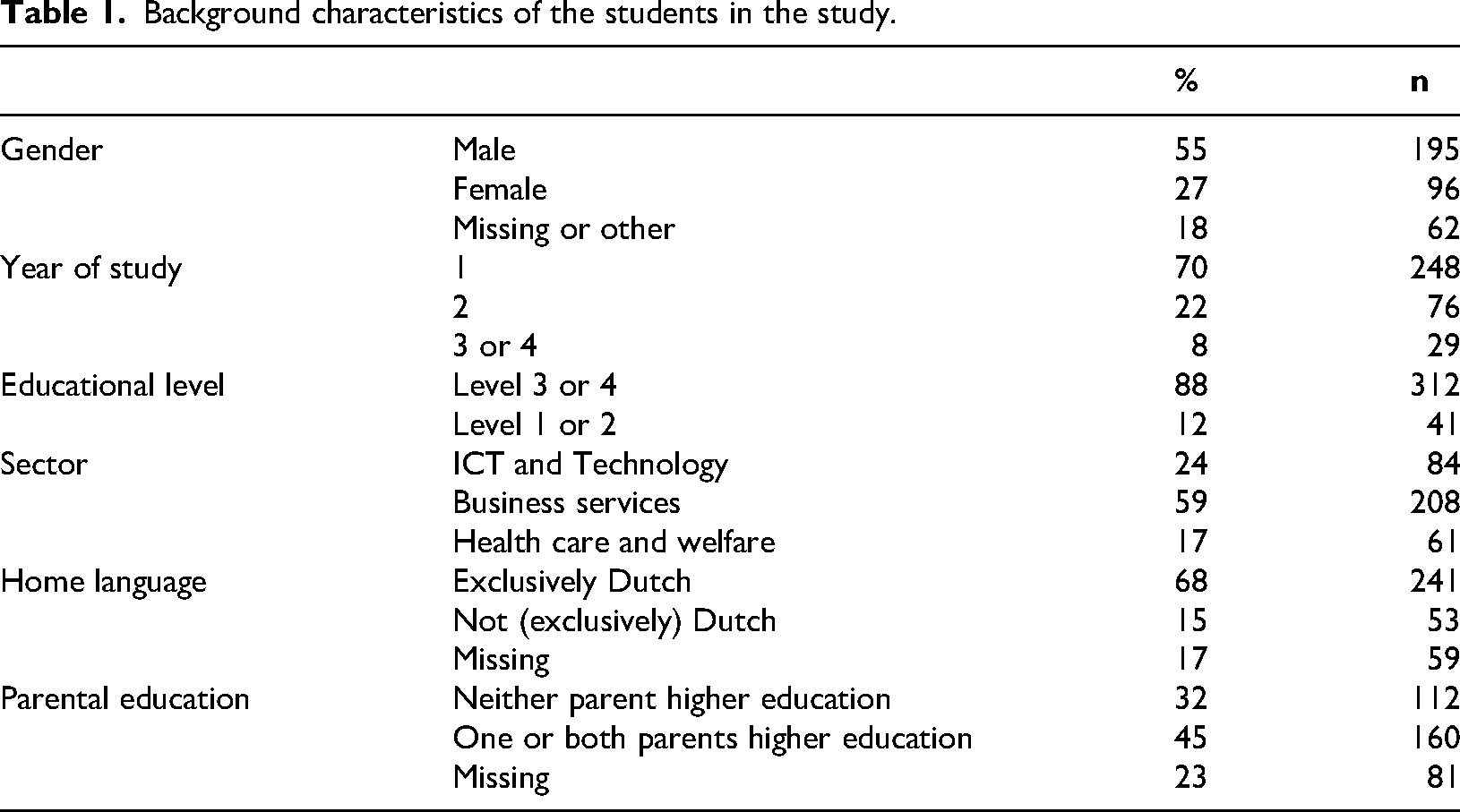
The distribution of students’ background characteristics appears to be in line with the general population. In comparison, in the schoolyear 2019–2020 a little over 500,000 students participated in VET in the Netherlands (CBS, 2023), of which around 70 per cent were in level 3 and 4 tracks. Health care and welfare students made up approximately 30 per cent of the total student population in that school year, and ICT and business services both around 10 per cent (DUO, 2023). In total, there are 42 regional training centres offering education in engineering and technology, economics, and health and social care, 10 agricultural training centres educating in agriculture, natural environment and food technology, and 11 specialized training centres in the Netherlands.
Instruments
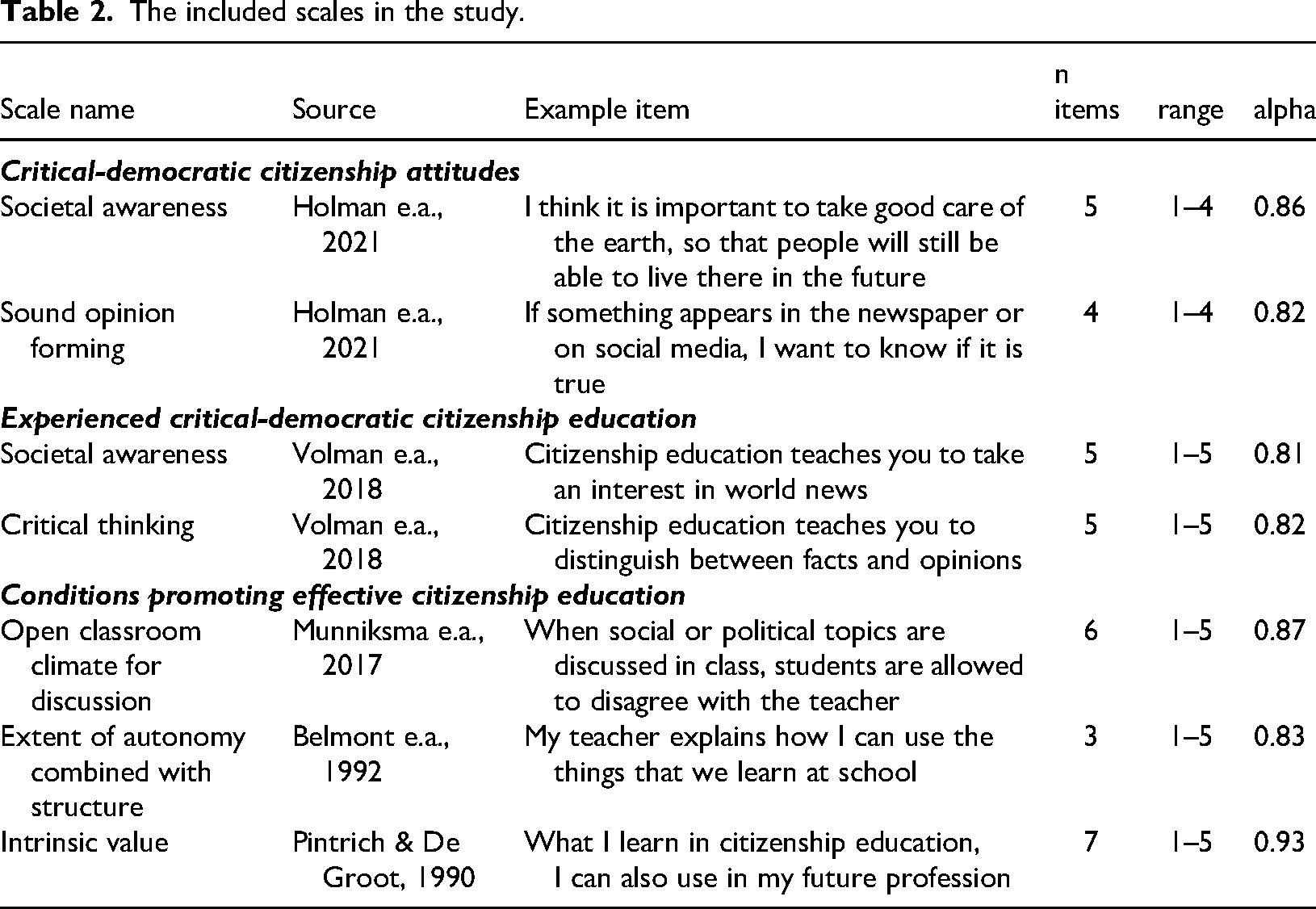
The online student questionnaire contained Likert type scales on various citizenship attitudes, the experienced citizenship curriculum, classroom climate, and background characteristics (see Table 2 for an overview of the instruments including example items and reliability scores).
The included scales in the study.
Critical-democratic citizenship attitudes
The measurement of critical-democratic citizenship attitudes was based on an existing questionnaire by Holman and colleagues (2021) who adapted a measurement instrument by Ten Dam and colleagues (2011) for secondary education to VET. A first selection of existing questions was presented to experts and teachers, based on which the selection was modified. Two scales were formed to measure critical-democratic citizenship: (critical) societal awareness and sound opinion forming.
Societal awareness. Students were asked five questions, two of which were taken from the scale ‘dealing with societal issues: sustainability and moral conduct’ by Holman and colleagues (2021), supplemented by three items on this subject, as this topic was not yet sufficiently represented in this instrument.
Sound opinion forming. Students were presented with four items from Holman et al. (2021) about their attitudes towards sound opinion forming (the higher the score, the more important they consider this to be), which was a subscale of the broader theme ‘democratic conduct’.
Experienced critical-democratic citizenship education
Students were asked what they learned in the citizenship lessons when it comes to societal awareness and sound opinion forming. These two subjects were chosen, as they connect directly to the aforementioned citizenship attitudes. The two scales were taken from a study by Volman et al. (2018) on future-oriented education. Shortened versions of the scales ‘critical thinking’ (five questions), and ‘societal awareness’ (five questions) were created for this study.
Concerning critical thinking, students were asked for example, to what extent they think that during the citizenship lessons, they learn to judge whether something is a good argument. Concerning societal awareness, students were asked for example, to what extent they learn to understand what is happening in society during the citizenship lessons.
Open classroom climate for discussion
To measure the openness of the classroom climate, a scale from the International Civic and Citizenship Education Study (ICCS) was used (Daas et al., 2023; Munniksma et al., 2017). The higher the score on this scale, the more students experience that they can express their opinion in class (even if others think differently), disagree with the teacher, and propose topics themselves.
Extent of autonomy combined with structure offered by teacher
To measure the experienced degree of autonomy and structure offered by teachers, an adapted version of the Teacher as Social Context Questionnaire (TASC-Q) by Belmont et al. (1992) was used. This concerned the abbreviated subscales ‘autonomy support’ and ‘provision of structure’ by Domen and colleagues (2020). A factor analysis with the items of these two subscales showed that the items of the scales (after rotation) loaded on one instead of two factors. This was also found in a study by Ahn et al. (2019) that examined the factor structure of the various subscales of the TASC-Q. In addition, the item ‘My teacher does not explain why what I do at school is important to me’ was unexpectedly positively correlated with the other items. It appeared that many students did not read the word ‘not’. This item was left out of the scale. Consequently, one scale of three items was formed about the extent to which students considered their citizenship teacher to provide both autonomy and structure during the lessons.
Intrinsic value of citizenship education
For the assessment of intrinsic value students attribute to citizenship education, the subscale intrinsic value of the Motivated Strategies for Learning Questionnaire (MSLQ; Pintrich and De Groot, 1990) was used. It measures intrinsic interest in and perceived instrumentality of citizenship education. The wording of the scale by Pintrich and De Groot was adapted to refer to citizenship education. In addition, the number of items on instrumentality was expanded so that the scale paid sufficient attention to the perceived instrumentality of citizenship education for other subjects, internships and later professions.
Background characteristics
Previous studies have shown that citizenship attitudes can differ according to students’ gender, age, the field of their future profession, and social and ethnic background (e.g., Daas et al., 2023; Munniksma et al., 2017; Slijkhuis et al., 2021). Students were therefore first asked which year of study they were in. One dummy variable was created: for year 1 (reference category year 2, 3 or 4). Second, students were asked about their gender, and answers were coded to (1) female and (0) male. Third, as an indicator of migration background, students were asked about the language they spoke at home. Answers were coded to (1) home language not (exclusively) Dutch, and (0) home language exclusively Dutch. Fourth, the students were asked about their parents’ level of education. Answers were coded 1 when at least one parent had attended higher professional education or university and 0 when neither parent had attended these school levels. Fifth, the field of future profession was coded to ICT and Technology; Professional services; and Care and Welfare, the latter being the reference category.
Design of analysis
First, mean scores and correlations between the variables were calculated to facilitate the interpretation of the results. Next, interrelations between the measured variables were examined further by employing structural equation modelling using Mplus 8.0 (Muthén and Muthén, 2017). This method of analysis has several advantages over regular regression analysis, in this case, the ability to test a theoretical model and simultaneous testing of relationships, allowing for the estimation of both indirect and direct effects (e.g., Kline, 2016). In the model, we investigate to what extent differences in societal awareness and sound opinion forming, as indicators for critical-democratic attitudes, are associated with differences in experienced curriculum contents, and (both indirectly and directly) with the pre-conditions for effective citizenship education, namely classroom climate, autonomy and structure, and intrinsic value of citizenship education. Figure 1 shows the estimated model.
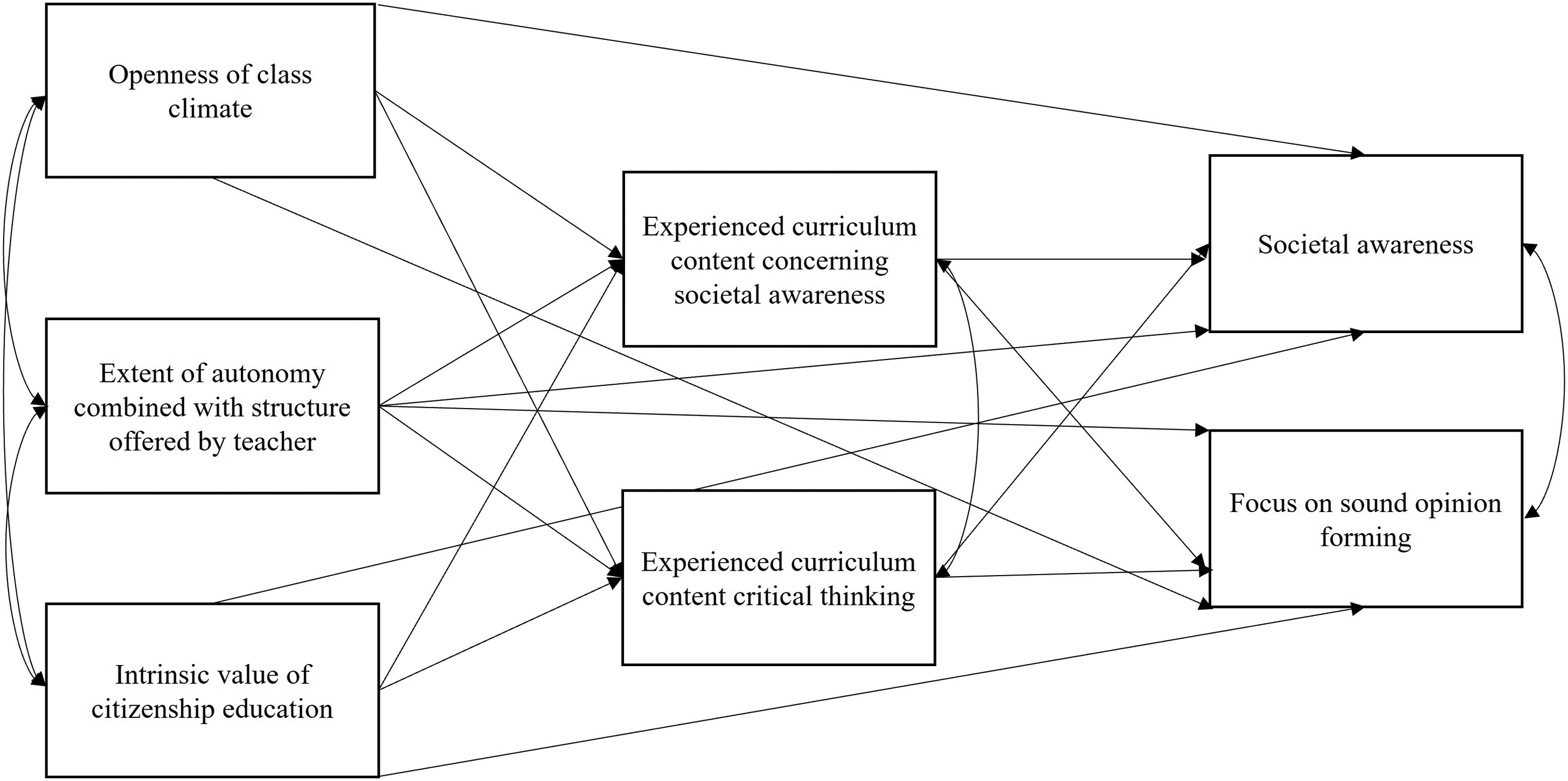
Structural model.
In the analyses, the nesting of the data of students within classes (corresponding to the study programme) was taken into account by correcting for this in the estimation of the standard errors. All background characteristics mentioned in the instruments section were included in the model. Missing values were estimated with Full Information Maximum Likelihood estimation. The model we estimated was essentially a regression model (a fully saturated model) and therefore had a perfect model fit. The model was based on data from all 353 students. We calculated standardised direct, indirect and, on that basis, total effects. The level of significance used in this paper is p < .05.
As indicated, at one school citizenship was given in the form of project days. A series of regression analyses were performed to explore whether the students in this school showed differences in dependent variables compared to the other schools. Separate analyses were performed for each dependent variable with the background characteristics and attendance of this specific school as independent variables. In none of the analyses was the attendance of the specific school significant, which means we can reliably maintain this school in the sample.
Results
Descriptive results
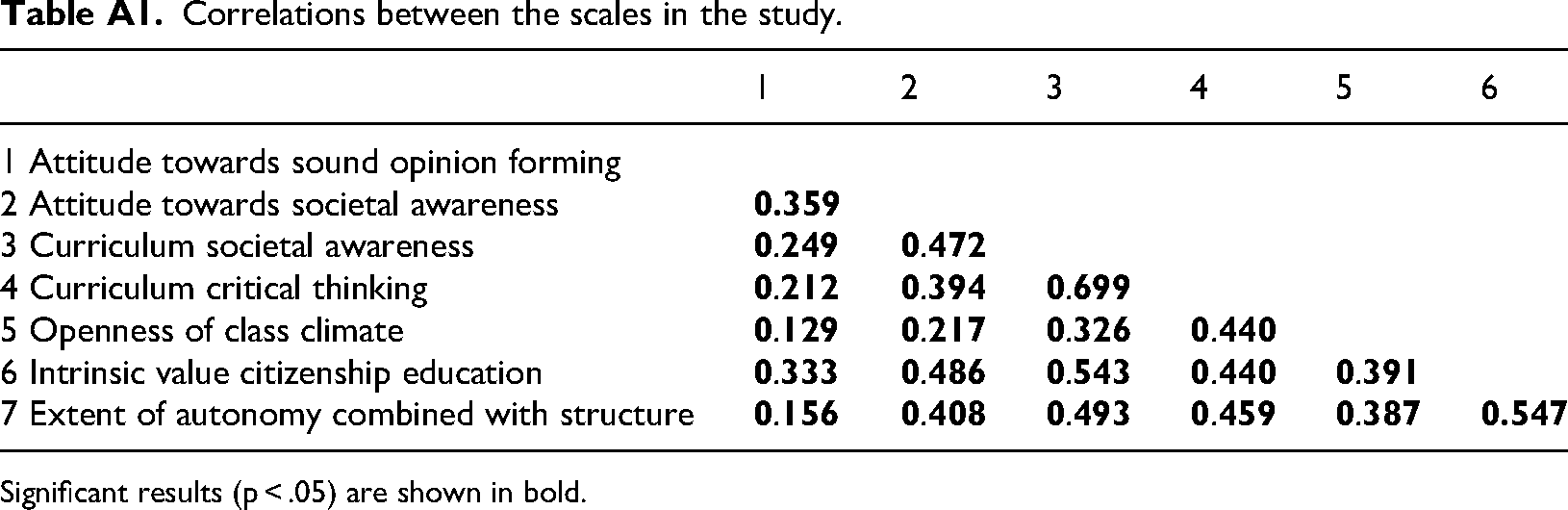
The mean scores on the variables are displayed in Table 3. The correlations between the different scales can be found in Appendix A. Average scores of both critical-democratic citizenship attitudes centred around the median of the scale: students typically indicated to be somewhat focused on sound opinion forming and to also have some societal awareness.
Mean scores, standard deviations and n for the scales in the study.
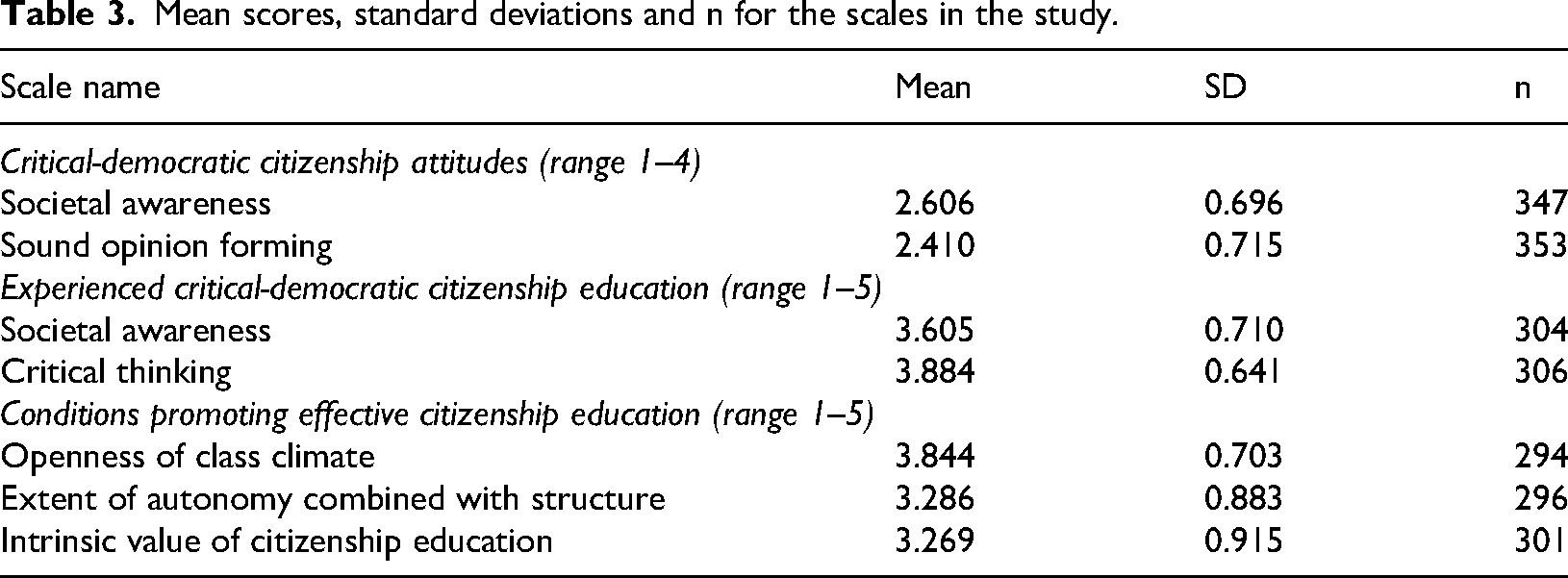
Regarding the experienced curriculum during citizenship classes, students indicated that they did indeed learn about critical thinking and societal awareness; that is, learned to understand what is happening in society, about concerns for the environment and to be interested in world news.
Finally, students were positive about the classroom climate, which they experienced as fairly open. Students felt that their teacher to some extent provided both structure and autonomy during citizenship lessons. They reported finding citizenship lessons somewhat interesting, challenging and useful for their future profession; contributing to its intrinsic value.
Results of the structural model
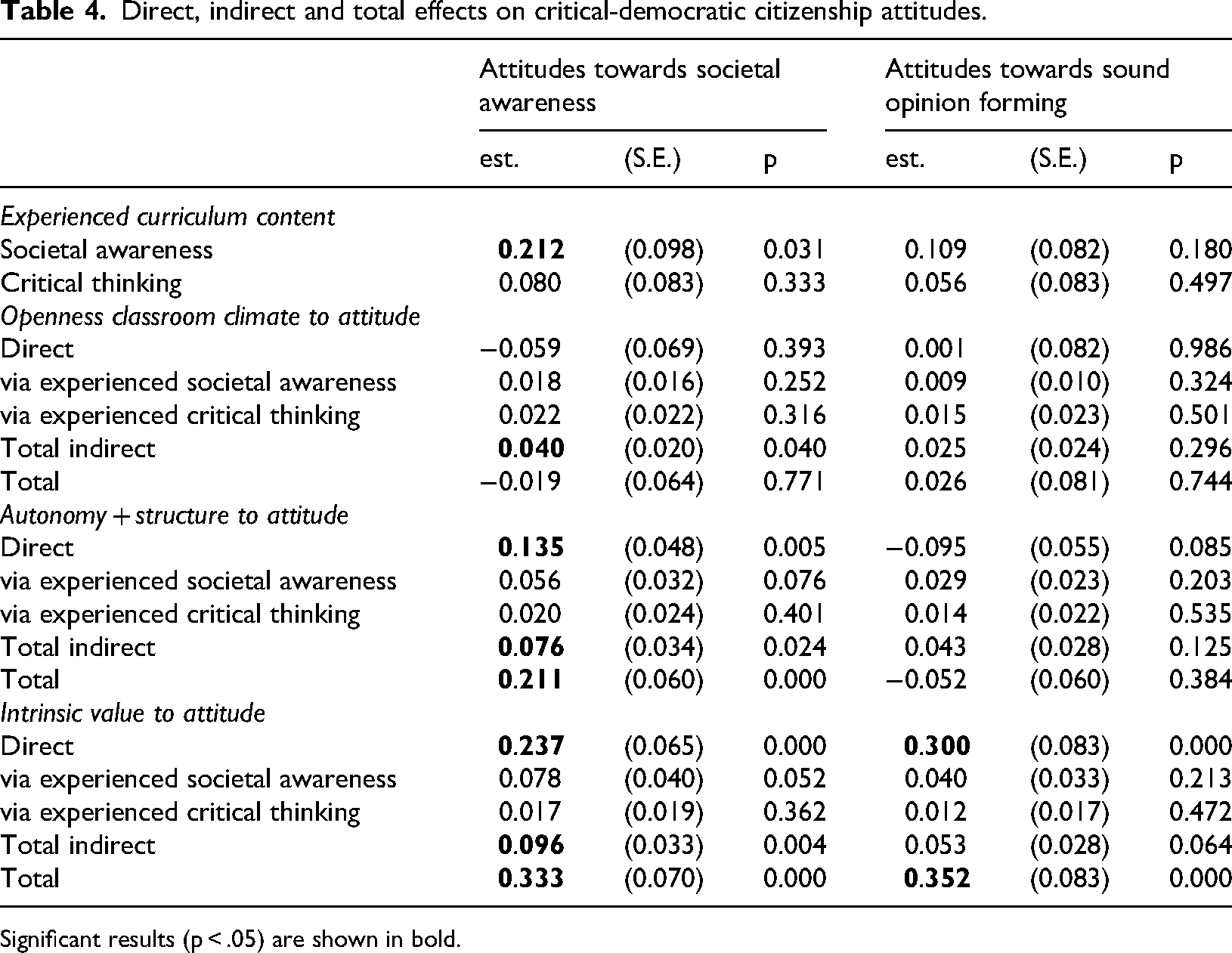
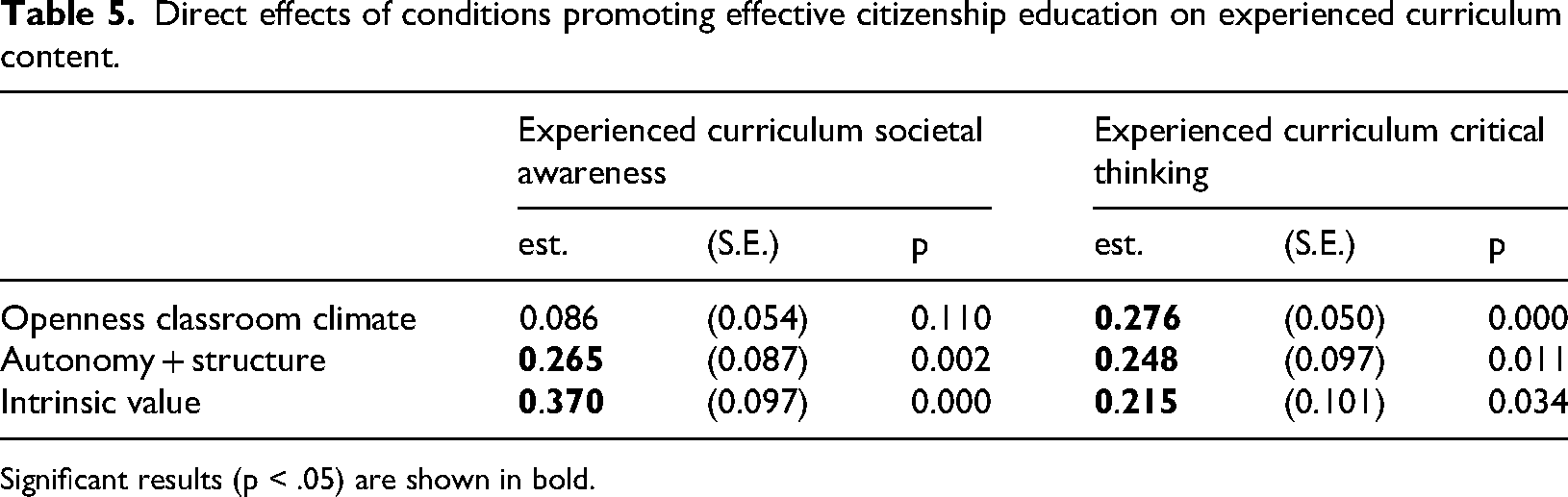
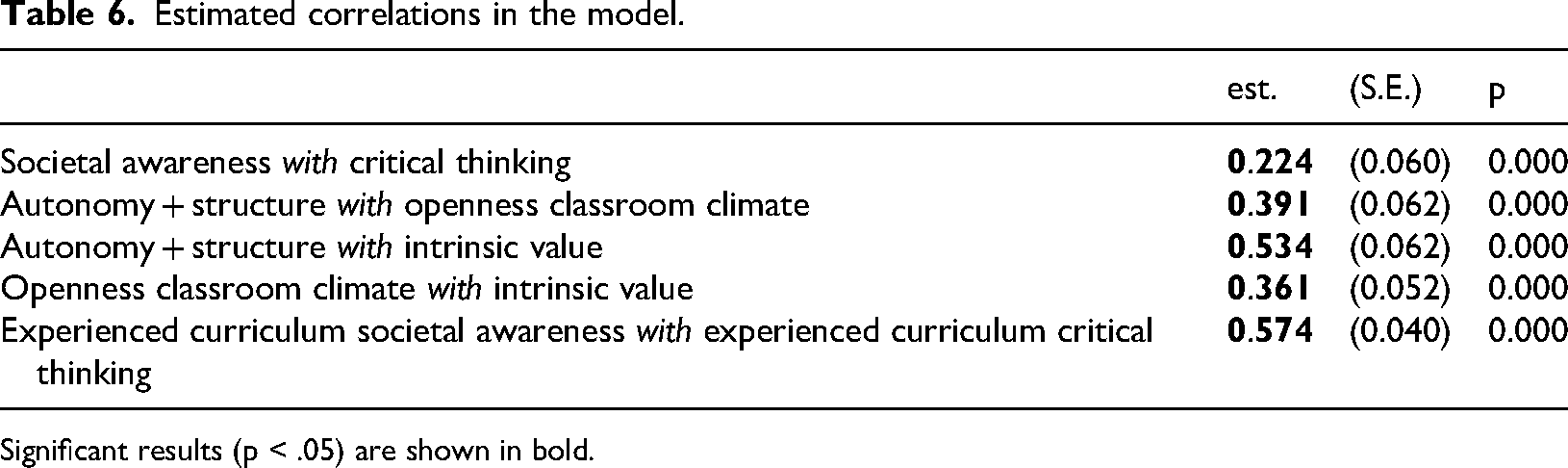
The results for the model are displayed in Tables 4, 5 and 6. Table 4 contains information on the various direct, indirect and total effects on the two scales measuring students’ critical-democratic citizenship attitudes. Table 5 contains information on the direct effects on the two scales measuring students’ experiences of societal awareness and critical thinking in the curriculum. Finally, Table 6 contains information on the correlations between the independent scales modelled as covarying.
Direct, indirect and total effects on critical-democratic citizenship attitudes.
Significant results (p < .05) are shown in bold.
Direct effects of conditions promoting effective citizenship education on experienced curriculum content.
Significant results (p < .05) are shown in bold.
Estimated correlations in the model.
Significant results (p < .05) are shown in bold.
Students’ attitudes towards societal awareness
The first column in Table 4 displays the main results for the paths predicting students’ attitudes towards societal awareness. Zooming in first on the direct effects of the experienced curriculum content, students who indicated to have learned more about societal awareness in their citizenship education reported on average more positive attitudes regarding societal awareness. Whether students indicated having experienced more curriculum content relating to critical thinking did not affect their attitudes towards societal awareness.
Both the intrinsic value of citizenship education and the combination of autonomy and structure offered by the teacher were directly and indirectly related to students’ societal awareness, resulting in positive total effects. Both pre-conditions for effective citizenship education also have indirect effects through experienced curriculum regarding societal awareness and critical thinking. However, the indirect effects are only found for the combination of curriculum contents, and the indirect effects are considerably smaller than the direct effects. Of the two, the direct and total effects of the intrinsic value of citizenship education had the largest effect on students’ attitudes regarding societal awareness.
As for the openness of the classroom climate, only a positive indirect total effect was found. The two indirect pathways in themselves – either via the experienced curriculum content on societal awareness or via the curriculum content on critical thinking – were not significant. As for direct relationships between the openness of the classroom climate and the experienced curriculum content (Table 5), a positive effect was only found for the curriculum content regarding critical thinking.
Students’ attitudes towards sound opinion forming
The second column in Table 4 displays the main results for the paths predicting students’ attitudes towards sound opinion forming. Zooming in again on the experienced curriculum content, we found no direct effects of either of the critical-democratic curriculum content experiences on students’ attitudes towards sound opinion forming.
Even though all three of the citizenship education elements that were expected to contribute to the effectiveness of the citizenship education curriculum were positively associated with the experienced curriculum content regarding sound opinion forming (Table 5), only the intrinsic value of citizenship education as experienced by the students was (positively) associated with their attitudes towards sound opinion forming (Table 4). This concerned a direct effect.
Neither the openness of the classroom climate for discussion nor the experienced extent of autonomy combined with structure offered by the teacher was significantly associated with students’ attitudes towards sound opinion forming. As was the case for students’ attitudes towards societal awareness, their attitudes towards sound opinion forming were most strongly related to their intrinsic value of citizenship education. The difference is, that for sound opinion forming, most other effects were non-significant.
Correlations
Table 6 shows that all of the estimated correlations are significantly positive: between .22 and .57. The correlation among both experienced curriculum contents is the highest. The correlation between experienced autonomy and structure and intrinsic value is only slightly lower (.53). The correlation between the two assessed attitudes is the lowest. Correlations with the openness of the classroom climate are in the .30 range.
Background characteristics
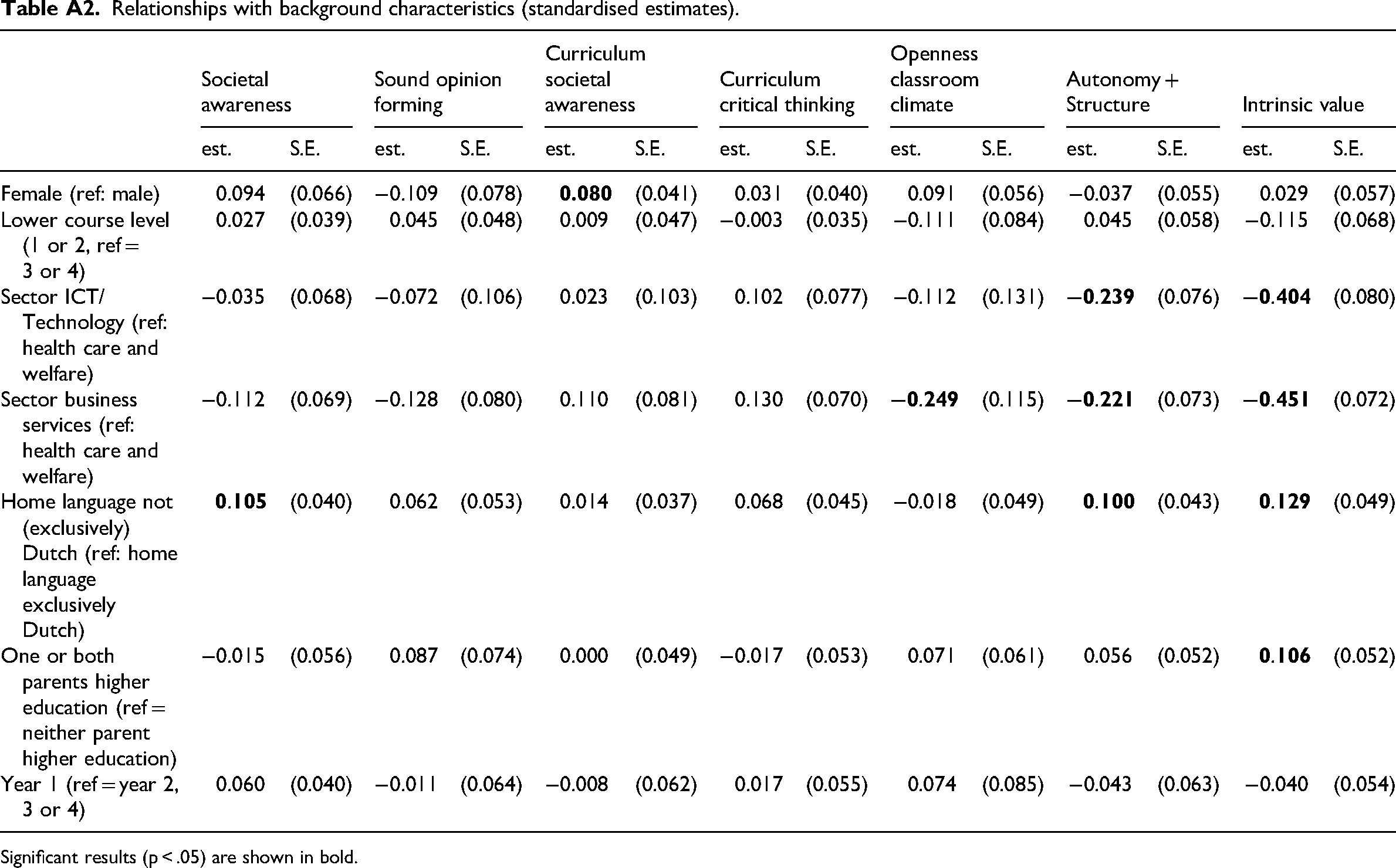
Although not the main focus of this article, the analyses also showed results for associations with background characteristics (see Appendix B). Only a minority of the relationships studied were significant. Students studying in the care and welfare sector on average reported more intrinsic value for citizenship education and more provided structure and autonomy by the teacher than students in the ICT/Technology and Business Services sector. Furthermore, they reported a more open classroom climate for discussion than students in the ICT/Technology sector. Students who do not speak exclusively Dutch at home reported more positive attitudes towards societal awareness, more structure and autonomy by the teacher, and more intrinsic value for citizenship education than students who speak exclusively Dutch at home. Female students had a more positive attitude towards societal awareness than male students. Students of whom at least one parent had attended higher professional education reported more intrinsic value for citizenship education than students of whom neither parent had attended these school levels. There were no significant associations with the course level, nor with year of study (for more information, see Van der Veen et al., 2022).
Discussion
Building on previous research studying the role of citizenship education in the development of citizenship competences in secondary education (Coopmans et al., 2020; Isac et al., 2014; Reichert and Print, 2018), the present study examines the extent to which two important critical-democratic citizenship attitudes – more specifically, societal awareness and sound opinion forming – are related to VET students’ experiences with their current citizenship education. In doing so, this study contributes to the existing literature by providing further insight into the efficacy of educational methods known for fostering critical-democratic attitudes in other educational contexts and by examining whether these methods are similarly effective within the VET context. Additionally, the study identifies potential areas for improvement and opportunities for growth. What follows is a discussion of the results, based on structural equation models using questionnaire data from 354 Dutch VET students.
Pre-conditions for critical-democratic citizenship education
By analyzing a structural model to predict students’ critical-democratic citizenship attitudes – including direct and indirect effects of the experienced curriculum, as well as several pre-conditions known for effective citizenship education (thus hypothetically influencing students’ experiences with the offered curriculum as well as their learning outcomes) – we were able to more closely examine the interrelationships between these various aspects of critical-democratic citizenship education in the Dutch VET context.
First of all, the intrinsic interest in and perceived instrumentality of the offered citizenship education curriculum as perceived by students – such as the usefulness for their future profession – seems most important in explaining VET students’ critical-democratic citizenship attitudes. Intrinsic value seemed to be the only element in our model associated with students’ attitudes towards sound opinion forming, in addition to being an important predictor of students’ societal awareness. This is particularly relevant considering that: (1) Dutch VET students reported that they often miss this element in their current citizenship education, in particular, the usefulness for their future profession (Van der Veen et al., 2022); and (2) the role of the experienced intrinsic value of the offered curriculum is rarely included in studies on citizenship education. Examining the role of this element in citizenship learning in other educational contexts is therefore a promising avenue for future research.
Of the other two pre-conditions, the extent of autonomy and structure offered by the teacher was also found to be positively associated with students’ attitudes towards societal awareness, albeit to a smaller extent than intrinsic value. This finding supports previous studies emphasizing the relevance of balancing autonomy with support (Hornstra et al., 2016), also in the VET context (Cents-Boonstra et al., 2021). Interestingly, this was not the case for students’ attitudes towards sound opinion forming. A closer look at the items used to measure the extent of autonomy and structure offered by the teacher shows that the items tend to focus on support (e.g., checking in), more so than on autonomy. It could thus be the case that this type of support is more useful when teaching students about societal awareness than it is for teaching sound opinion forming.
The openness of the classroom climate, our third pre-condition, played a smaller role than was expected based on previous literature (Abrami et al., 2015; Campbell, 2019; Geboers et al., 2013; Godfrey and Grayman, 2014; Knowles et al., 2018; Rapa et al., 2020). Whereas the openness of the classroom climate was positively associated with students’ societal awareness when analyzed in a one-on-one relationship, in our structural model – in which also the other pre-conditions were included – only a very small indirect effect was found. A comparable result was found in an earlier study by Coopmans and colleagues (2020), in which a comprehensive school effectiveness model of citizenship education was analyzed to predict citizenship competences amongst secondary school students. These findings suggest that an open classroom climate might be considered a relevant precondition for other elements of the school environment (in this case, the experienced intrinsic value of the offered curriculum and the extent of teacher guidance) that more directly influence students’ learning outcomes. This aligns with SDT, which states that for learning to be effective, the need for social relatedness and autonomy both need to be met (Niemiec and Ryan, 2009; Reeve and Cheon, 2021). A democratic and participative classroom climate seems to facilitate these conditions.
The experienced curriculum on societal awareness and critical thinking
What can be concluded about the role of the experienced curriculum? Even though almost all of the hypothesized pre-conditions had a positive impact on the experienced curriculum content (except for open classroom climate, which was not associated with the curriculum content on societal awareness), the indirect effects on students’ critical-democratic citizenship attitudes were small, if at all present. Thus, even though these pre-conditions seem to contribute to students’ experiences regarding the curriculum content, they do not ensure that the curriculum content results in an actual change in students’ critical-democratic citizenship attitudes. Instead, they appear to influence students’ attitudes on this matter in other ways, as argued above.
Our findings furthermore show that VET students who indicated to have learned more about societal awareness in their citizenship education also have more positive attitudes on this topic, in line with Keating and colleagues (2010). This relationship was not found for the experienced curriculum content on critical thinking, suggesting that the current content offered on critical thinking is not directly related to students’ willingness to adopt a critical approach towards sound opinion forming themselves. These findings seem to support previous studies suggesting that an effective way of teaching the critical-democratic aspect of citizenship education, including a critical awareness of societal issues, is still largely absent in the Dutch VET context (Petit and Verheijen, 2015; Zuurmond et al., 2023).
At the same time, it has to be noted that the items used to measure students’ attitudes towards critical thinking – which are based on a previous VET study (Holman et al., 2021) – focus very specifically on how critically students tend to follow the news, whilst the items measuring the experienced curriculum content focus on more general aspects of critical thinking (e.g., distinguishing between facts and opinions; evaluating a topic from various perspectives). Thus, although the curriculum content on critical thinking does not seem to be associated with a more critical attitude regarding the news, the learned content might still play a role in other contexts where sound opinion forming applies, and in which young people might be more motivated to apply these skills, such as when reading social media content.
General conclusions and suggestions for future research
The above argument proves a very important point regarding the specific content that is addressed in citizenship education. Whilst previous studies on the role of citizenship curricula seem to predominantly focus on experiences relating to the ‘general’ curriculum on citizenship education, the topics addressed in citizenship curricula are highly diverse (Veugelers, 2021; 2020; Zuurmond et al., 2023). Interesting in this regard is the distinction made by Veugelers (2021) between open, moral and social-political citizenship. Several of the items used in the present study to measure students’ societal awareness can be considered quite activistic (e.g., ‘If there are actions organized against poverty in the world, I find it important to help’), primarily measuring social-political citizenship. Considering the variety in visions on citizenship education, however, contributing to activistic citizenship learning (see also Wheeler-Bell, 2014; Wood et al., 2018) might not be the (only) goal of a school's citizenship education, and as such, the curriculum could also be oriented towards, for instance, the development of an open attitude on or moral consideration of topics related to critical-democratic citizenship (e.g., finding it important that people are aware of poverty in the world).
Hence, when studying the potential outcomes of citizenship education, it is essential to make a similar distinction, examining not just one general outcome, but a range of domains in which we expect the effects of a particular approach. By focusing on two specific elements of critical-democratic citizenship education, the current study not only sheds new light on the role of the citizenship curriculum in the VET context but also provides relevant insights for future studies on citizenship education in general.
Of course, considering the small sample size and the fact that data were collected at four schools for VET, we have to be careful with generalizations of the found results. Moreover, since the analyses are based on cross-sectional data, we are unable to make conclusive judgements about the causality of the found relationships. Future studies could for example investigate to what extent preconditions for citizenship education and experienced curriculum content may be reciprocal, as well as whether students’ citizenship attitudes affect their experiences with the curriculum. Further research is therefore advised, based on more representative datasets in which both the development of students’ critical-democratic citizenship competences and their experiences with the offered citizenship education are followed over a longer period. Furthermore, although using an online questionnaire allowed us to investigate interrelationships between various aspects of critical-democratic citizenship education, qualitative measures could have added more in-depth information.
All in all, however, the current study offers an important starting point to improve opportunities for critical-democratic citizenship in VET. In particular, the limited associations found between students’ experienced curriculum content regarding societal awareness and critical thinking and their attitudes on the topics in question are important to consider further, especially regarding students’ attitudes towards sound opinion forming. In addition, the study contributes to the existing literature on citizenship education by highlighting the role played by the intrinsic interest in and perceived instrumentality of citizenship education, as this element is often neglected in studies on citizenship education.
Footnotes
Acknowledgements
We would like to thank Marieke Buisman, Marianne Boogaard, Anne Bert Dijkstra, Dorothé Elshof, Arwen van Stigt, Judith ‘t Gilde, Régina Petit and Annabel Vaessen for their assistance in conducting this study. We would also like to express our gratitude towards the participating schools for their hard work and dedication during this project.
Declaration of conflicting interests
The authors declared no potential conflicts of interest with respect to the research, authorship, and/or publication of this article.
Funding
The author(s) disclosed receipt of the following financial support for the research, authorship, and/or publication of this article: This work was supported by the Netherlands Initiative for Education Research (NRO), which is a division of the Netherlands Organisation for Scientific Research (NWO) [grant number 40.5.18540.066].

Appendix A
Correlations between the scales in the study.
| 1 | 2 | 3 | 4 | 5 | 6 | |
|---|---|---|---|---|---|---|
| 1 Attitude towards sound opinion forming | ||||||
| 2 Attitude towards societal awareness |
|
|||||
| 3 Curriculum societal awareness | ||||||
| 4 Curriculum critical thinking | ||||||
| 5 Openness of class climate | ||||||
| 6 Intrinsic value citizenship education | ||||||
| 7 Extent of autonomy combined with structure |
|
Significant results (p < .05) are shown in bold.
Appendix B
Relationships with background characteristics (standardised estimates).
| Societal awareness | Sound opinion forming | Curriculum societal awareness | Curriculum critical thinking | Openness classroom climate | Autonomy + Structure | Intrinsic value | ||||||||
|---|---|---|---|---|---|---|---|---|---|---|---|---|---|---|
| est. | S.E. | est. | S.E. | est. | S.E. | est. | S.E. | est. | S.E. | est. | S.E. | est. | S.E. | |
| Female (ref: male) | 0.094 | (0.066) | −0.109 | (0.078) |
|
(0.041) | 0.031 | (0.040) | 0.091 | (0.056) | −0.037 | (0.055) | 0.029 | (0.057) |
| Lower course level (1 or 2, ref = 3 or 4) | 0.027 | (0.039) | 0.045 | (0.048) | 0.009 | (0.047) | −0.003 | (0.035) | −0.111 | (0.084) | 0.045 | (0.058) | −0.115 | (0.068) |
| Sector ICT/Technology (ref: health care and welfare) | −0.035 | (0.068) | −0.072 | (0.106) | 0.023 | (0.103) | 0.102 | (0.077) | −0.112 | (0.131) | (0.076) | (0.080) | ||
| Sector business services (ref: health care and welfare) | −0.112 | (0.069) | −0.128 | (0.080) | 0.110 | (0.081) | 0.130 | (0.070) | (0.115) | (0.073) | (0.072) | |||
| Home language not (exclusively) Dutch (ref: home language exclusively Dutch) | (0.040) | 0.062 | (0.053) | 0.014 | (0.037) | 0.068 | (0.045) | −0.018 | (0.049) | (0.043) | (0.049) | |||
| One or both parents higher education (ref = neither parent higher education) | −0.015 | (0.056) | 0.087 | (0.074) | 0.000 | (0.049) | −0.017 | (0.053) | 0.071 | (0.061) | 0.056 | (0.052) | (0.052) | |
| Year 1 (ref = year 2, 3 or 4) | 0.060 | (0.040) | −0.011 | (0.064) | −0.008 | (0.062) | 0.017 | (0.055) | 0.074 | (0.085) | −0.043 | (0.063) | −0.040 | (0.054) |
Significant results (p < .05) are shown in bold.