




Abstract
This study describes the integration of citizenship education into the K to 12 Junior High School Economics curriculum in the Philippines. Content analysis of the 2016 Curriculum Guide Learning Competencies (CGLCs) and 2020 Most Essential Learning Competencies (MELCs) for Social Studies was conducted to determine the alignment of the Economics curriculum with liberal individualist and civic republican conceptions of citizenship. Gaps that need to be addressed in the alignment of Economics learning competencies with citizenship education were explicated. Results of the study show that the Junior High School Economics curriculum integrates liberal individualist and civic republican conceptions of citizenship. However, civic-oriented outcomes like wastong pagbabayad ng buwis (correct payment of taxes) and bayanihan spirit (communal unity) need to be explicitly stated to ensure that these essential outcomes will not be missed out in the unpacking of the learning competencies.
Keywords
Introduction
The content of high school Economics had been the prevailing concern of curriculum developers (Hahn and Kim, 2010; cf. Jackstadt and Brennan, 1983; Sunal et al., 1987; Colander, 2004). Several studies contend that citizenship education should be emphasized in the economics curriculum (Chan, 1996; cf. Tse, 2000; Hyslop-Margison et al., 2006). Here, economics education should be designed in a way that encourages students to become reflective and active citizens (Barr, 1998). This is because the main goal of Social Studies is to hone students to become citizens who reflect on ways to solve social problems and be active in doing their duties and responsibilities to the nation (National Council for the Social Studies, as cited in Adams, 2019a; cf. Wentworth and Schug, 1993; Bickmore, 1993; Houser, 2005, 2009). Recent research on the K to 12 Social Studies curriculum in the Philippines emphasized that aside from Geography, all content areas of Social Studies including Economics should help develop reflective and active citizens (Dizon, 2021). However, there are doubts on the ability of the K to 12 economics curriculum to integrate citizenship education (Adams, 2019a) and teachers seemed to be unaware that citizenship education is a major goal of Social Studies (Ho and Barton, 2020; cf. Clay and Rubin, 2020). Moreover, there is a dearth of empirical work on K to 12 economics education, particularly on its citizenship education component. Earlier studies found that goal statements in the Economics curriculum are not directly linked to citizenship in spite of citizenship education’s role in honing students to become reflective and active citizens (VanFossen, 2000). This is because citizenship education is not the focus of the Economics competencies, which are mostly based on Economic knowledge and skills (McNeil, as cited in Houser and Kuzmic, 2001; cf. Sears, 1994). In addition, earlier studies found that teachers fail to integrate citizenship education in Social Studies as curriculum guides were insufficient in terms of civic-oriented aims, content, instruction, and assessment (Dilworth, 2004). This is supported by Fernekes (2004) who found that Social Studies teachers have problems when selecting content and instructional strategies to integrate citizenship education in their lessons. Hence, a study on the alignment of Economics learning competencies with citizenship education is imperative to ensure that the curriculum is designed in a way that will hone learners to become reflective and active citizens.
K to 12 economics and citizenship education
Recent studies contend that the teaching of Economics can contribute to the creation of reflective and active citizens (Adams, 2019a; cf. Ingels and O’brien, 1988). Economics has four (4) outcomes that are geared towards citizenship education. These include decision making, ideological skepticism to become wise consumers, affective socialization, and workforce preparations (Joshi and Marri, 2006; cf. Leming, 1987). Then, the economics curriculum should emphasize analytical, critical, and decision-making skills to help students understand and solve economic problems, which are essential for reflective and active citizenship (Ayers, 2016; cf. Yamane, 1996b). This integrative approach to economics and citizenship education is essential in honing citizens who know how to manage and allocate their resources wisely (Remmele and Seeber, 2012). Then, citizenship education and economics should go together in order to build a strong nation (Adams, 2019b). This integration of economics and citizenship education is possible as economics has values component (Brant, 2011) and citizenship education promotes values-based participation (Holden and Clough, as cited in Holden, 1998). Thus, students will understand the needs of their community through economics and consequently create ways to help improve the community through citizenship education (Brant, 2011; cf. VanFossen, 2000; Davies et al., 2002).
Economics education in the Philippines
Economics was first instituted in the Philippine high school curriculum in 1906 by the Americans (Abueg, 2007). Schools used the textbook written by Hugo Herman Miller, who was then the head of the Department of Industrial Information of the Bureau of Education, entitled Economic Conditions in the Philippines in 1913. It was noted that this textbook had advocated agriculture as it was then the advocacy of the Bureau of Education. Miller had updated this textbook and titled it as Principles of Economics Applied to the Philippines in 1932. This textbook employed foundational concepts in economics as well as current economic issues and conditions in the Philippines.
Postwar economics involved topics regarding economic growth and development in the Philippines (Abueg, 2007). Economics was re-institutionalized in the high school curriculum in 1949. Textbooks written by Filipinos like the Philippine Economics by Andres V. Castillo and Economics for Philippine High Schools by Jose L. Celeste, Diosdado G. Capino, and Zosimo C. Ella were used by schools. These textbooks advocated the Bell Trade Act and the Parity Rights Law, which were enacted during the administrations of then President Manuel A. Roxas and President Elpidio S. Quirino. However, these policies were said to be unfair to Filipinos as these had provided Americans the equal rights to exploit the natural resources in the Philippines.
Economics became an elective course titled Philippine Development and Progress in the high school curriculum after the social sciences domain became known as Social Studies in 1973. Here, they used the slogan Bagong Araling Panlipunan sa Bagong Lipunan (New Social Studies in the New Society) (Abueg, 2007). It was possible that the Bureau of Education in the Philippines adopted the name from the New Social Studies Movement that started in the United States in the 1960s as it resonated with the New Society program of then President Ferdinand E. Marcos during the Martial Law regime. New Society economics involved the importance of land reform and infrastructure (Abueg, 2007). Economics is included in the Social Studies curriculum in the Philippines like in the United States (Yamane, 1996a). Social Studies is the term for the learning area in Philippine basic education that draws its content from Social Science disciplines like History, Sociology, Economics, Political Science, and Geography.
Philippine textbooks became the mouthpiece of the government in its socio-economic agenda and programs (Abueg, 2007). This was crucial as a lot of teachers rely on textbooks in preparing their lessons (Leet and Lopus, 2007; cf. Romanish, 1983; Walstad and Watts, 1984). Economics started to be taught using the Filipino language in public schools in 1989 with the implementation of the National Secondary Education Curriculum (NSEC) of the Secondary Education Development Program (SEDP) (Abueg, 2007). This move was based on the advocacy to use the national language for academic instruction, especially in the social sciences. However, private schools were given the option to choose between English and Filipino as medium of instruction.
Twenty-first century Economics involved more topics regarding contemporary issues in the Philippine setting after the revision of the Philippine Secondary Schools Learning Competencies (PSSLC) in 2004 (Abueg, 2007). The PSSLC’s were introduced in 1998 to provide essential knowledge, skills, and values that should be taught to students. The inclusion of more contemporary issues in the Economics curriculum was due to the implementation of the Basic Education Curriculum (BEC) in 2002, which featured curriculum integration. Here, teaching approaches like multidisciplinary and interdisciplinary approaches were introduced in basic education. Multidisciplinary approach uses concepts from different disciplines to discuss an event or concept (Peterson, as cited in Dizon, 2020). On the other hand, an interdisciplinary approach combines various concepts from different disciplines to form a central theme that can be used to explain an event or concept (Peterson, as cited in Dizon, 2020). Earlier studies contend that Social Studies should use an interdisciplinary approach to foster civic competence among learners (Wraga, 1993).
In 2016, Economics started to be taught as the content area of Social Studies in Grade 9 (Department of Education, 2014). Contemporary issues replaced Economics as the content area of Social Studies in Grade 10. This change was because of the implementation of the K to 12 program in the Philippines, which started in 2012. Here, Kindergarten became mandatory and a two-year Senior High School Program was added to the previous ten-year basic education system in the Philippines. Then, the elementary level consists of Kindergarten and Grades 1 to 6 while the secondary level is composed of Junior High School (Grades 7 to 10) and Senior High School (Grades 11 to 12). The content of different subjects in the elementary and secondary levels started to be decongested as part of the ongoing review of the K to 12 curriculum in the Philippines. It was noted that other countries have also placed the teaching of basic economic concepts at Grade 9 and economic issues at Grade 10 (Hahn and Kim, 2010). But an issues-based approach was criticized in economics education as it would bring about little treatment of economics in Grade 10 (Hahn and Kim, 2010). Thus, K to 12 curriculum writers of the Department of Education in the Philippines still pushed for a stand-alone Economics subject in Grade 9 despite having economic issues as one of the components of Grade 10 Social Studies.
The latest curriculum guide that contains learning competencies for Social Studies was released by the Department of Education in the Philippines in 2016. Curriculum guides are public documents that contain the learning intent for various learning areas (Department of Education, 2016; cf. Pak, 2000; Dilworth, 2004; Chong et al., 2020). Learning competencies include essential knowledge, skills, and values that students are expected to develop (Department of Education, 2015). Teachers are expected to unpack these learning competencies to make instructional objectives for their lessons (Department of Education, 2015; cf. Ellington and Uozumi, 1988). The Department of Education released a list of Most Essential Learning Competencies (MELCs) in 2020 based on the original competencies found in the 2016 curriculum guides. These MELCs were used nationwide for School Year 2020 to 2021 to focus on the most essential topics in order to ease the academic load of students and teachers in the time of Covid-19 pandemic wherein public schools in the Philippines shifted from face-to-face to modular instruction (Department of Education, 2020a). Here, learning competencies from the 2016 curriculum guides were analyzed and then categorized as most essential if these were enduring or considered as helpful for students in the future (Department of Education, 2020b). Then, learning competencies that were classified as enduring were retained and considered as most essential learning competencies (Department of Education, 2020b; cf. Shanks, 2019). But it was noted that a significant number of competencies from the 2016 curriculum guides were removed as they were said to be not enduring while some competencies were rephrased to be more concise (Department of Education, 2020b). Hence, there is a need to content analyze the Junior High School Economics curriculum in the Philippines to determine whether learning competencies explicitly contribute to citizenship education.
Theoretical framework
Westheimer and Kahne (2004) concluded that personally responsible citizenship, participatory citizenship, and justice-oriented citizenship are the three conceptions of citizenship based on practices for democratic citizenship and educational theories. Here, Khalil (2021) distinguished these three conceptions of citizenship by offering core assumptions. Personally responsible citizens should be honest, law-abiding, and have good character in order to improve society and solve social problems. Participatory citizens should take leadership roles and be active in order to improve society and solve social problems. Justice-oriented citizens should be critical about political, social, and economic structures in order to improve society and solve social problems (Khalil, 2021). Recent studies, on the other hand, have suggested pluralistic or multicultural citizenship, which are interwoven with critical democratic citizenship (Mathews and Dilworth, 2008; Knowles, 2018; Rodriguez, 2018; Shanks, 2019; Falkner and Payne, 2021). Critical democratic citizenship discourages memorization of facts and develops students to become problem solvers and active citizens who are committed to help improve society (Mathews and Dilworth, 2008; Saada, 2013; Gibson, 2020).
However, Holden (1998) contends that there are two main conceptions of citizenship that have influenced curricular approaches to citizenship education since the Second World War. These are the liberal individualist and civic republican conceptions of citizenship. Liberal individualist conception of citizenship shows that a citizen should fight for his/her own economic, civil, political, and social rights (Marshall, as cited in Holden, 1998). In a liberal framework, individuals’ social, civil, economic, and political rights are the essential elements of citizenship (Choi, 2016). The application of the liberal individualist approach to citizenship education leads to the enhancement of individual competence for reflective thought that is essential in analyzing social problems (Knowles, 2018). On the other hand, civic republican conception of citizenship shows that citizens are not fully autonomous as they have duties to their fellow citizens. This means that the civic republican approach to citizenship education advocates a communally based conception of citizenship wherein citizens are viewed as members of the community and they are thereby required to maintain unity and peace (Oldfield, 1990; cf. Kim, 2021). This civic republican approach is linked with honor, commitment to a common good, and loyalty (Holden, 1998). An earlier study contends that the civic republican approach seems to focus on citizens’ contribution to society (Hillgate Group, as cited in Holden, 1998). Recent research argues that from these two dominant conceptions of citizenship, the civic republican approach to citizenship education is the one that can develop active citizens as students are taught to do their obligations and responsibilities to the nation (Castles and Davidson, as cited in Choi, 2016).
More recent research indicates that K to 12 curricula in the United States has been framed within liberal individualist and civic republican conceptions of citizenship (Kim, 2021). This is supported by Choi (2016), Sabzalian (2019), and Hahn (2020) who claimed that liberal individualist and civic republican views are the two dominant conceptions of citizenship in the curriculum standards of the United States. Historically, the high school Economics curriculum of the Philippines is patterned from the United States. Thus, this study aligned learning competencies with liberal individualist and civic republican conceptions of citizenship to determine whether the K to 12 Junior High School Economics curriculum in the Philippines has integrated citizenship education the way it should be.
Purposes of the research
This study sought to conduct a content analysis of the K to 12 Junior High School Economics Curriculum developed by the Department of Education in the Philippines based on conceptions of citizenship education. Specifically, this study aimed to answer the following research questions:
What is the alignment of Economics learning competencies with dominant conceptions of citizenship? What are the gaps that need to be addressed in the alignment of the Economics learning competencies with citizenship education?
Research design
Content analysis was employed in this study to determine the alignment of the Junior High School Economics curriculum with conceptions of citizenship education. Here, the stated learning competencies in the Social Studies 2016 Curriculum Guide and 2020 MELCs of the Department of Education in the Philippines were subjected to content analysis to determine evidence of conceptions of citizenship education in Junior High School Economics. Only the manifest content of the curriculum documents or those that are explicitly stated were analyzed (Krippendorf, 2013). Curriculum alignment of the Economics learning competencies with conceptions of citizenship was done to ensure that the Economics curriculum contain civic-oriented outcomes (cf. Wijngaards-de Mij and Merx, 2018). As aforementioned, Social Studies teachers derive their instructional objectives from the stated learning competencies in the 2016 Curriculum Guide. However, for School Year 2020-2021, teachers derive their instructional objectives from the list of 2020 Most Essential Learning Competencies (MELCs) that were prescribed by the Department of Education in the Philippines. Thus, this study purposively chosen civic-oriented 2016 Curriculum Guide Learning Competencies (CGLCs) and the 2020 MELCs for Economics to determine gaps that need to be addressed in the alignment of learning competencies with citizenship education. In addition, this study focused on the Junior High School Economics competencies as it is only in Grade 9 that a stand-alone subject for Economics is offered as a content area in Social Studies. Elementary level Social Studies is focused on History, Geography, Civics, and Culture. On the other hand, Senior High School (SHS) subjects are categorized based on tracks like Academic, Technical Vocational Livelihood, Sports, and Arts and Design. The Academic track of the SHS has a Humanities and Social Sciences strand, but subjects under the Social Sciences domain are focused on Sociology and Political Science.
Content analysis procedure
In this study, civic-oriented 2016 Curriculum Guide Learning Competencies (CGLCs) and 2020 Most Essential Learning Competencies (MELCs) for Junior High School Economics were analyzed based on two dominant conceptions of citizenship. The qualitative content analytic study started with a thorough reading of the Quarterly Performance Standards and their corresponding learning competencies in the curriculum documents. The Economics curriculum for Grade 9 is composed of four (4) quarters. Here, each quarter or unit is composed of performance standards with corresponding learning competencies. The curriculum documents are written in Filipino but translations in English for the Quarterly Performance Standards and learning competencies are provided in the results of the study.
After reading the curriculum documents, learning competencies were coded according to liberal individualist and civic republican conceptions of citizenship to which they belong. Here, ATLAS.ti (2019, v. 8.4.25.0), a qualitative data analysis software, was used to code learning competencies with conceptions of citizenship. Reports generated by the qualitative data analysis software contain coded quotations from the learning competencies. The coded quotations reflect attributes of conceptions of citizenship that are present in the stated learning competencies. Table 1 shows the attributes of liberal individualist and civic republican conceptions of citizenship, which were used as bases in coding the learning competencies.
Attributes of liberal individualist and civic republican conceptions of citizenship (Holden, 1998; Choi, 2016; Knowles, 2018).
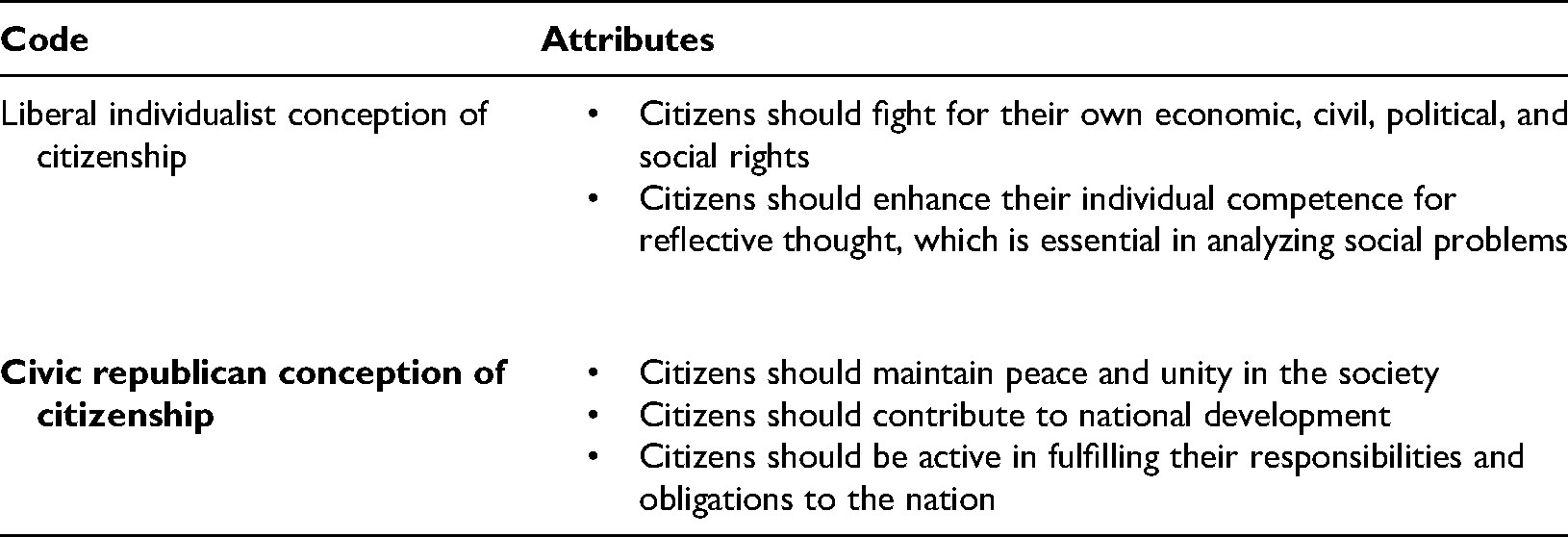
Here, a learning competency is aligned to a particular conception of citizenship if it reflects attributes of that conception of citizenship. Attributes of a conception of citizenship should be evident in a word, phrase, or in the whole competency (Dizon, 2020, 2021). After aligning the learning competencies with conceptions of citizenship, gaps that need to be addressed in the alignment of Economics learning competencies with conceptions of citizenship were explicated. Figure 1 shows the research framework, which includes the content analysis procedure of the study.
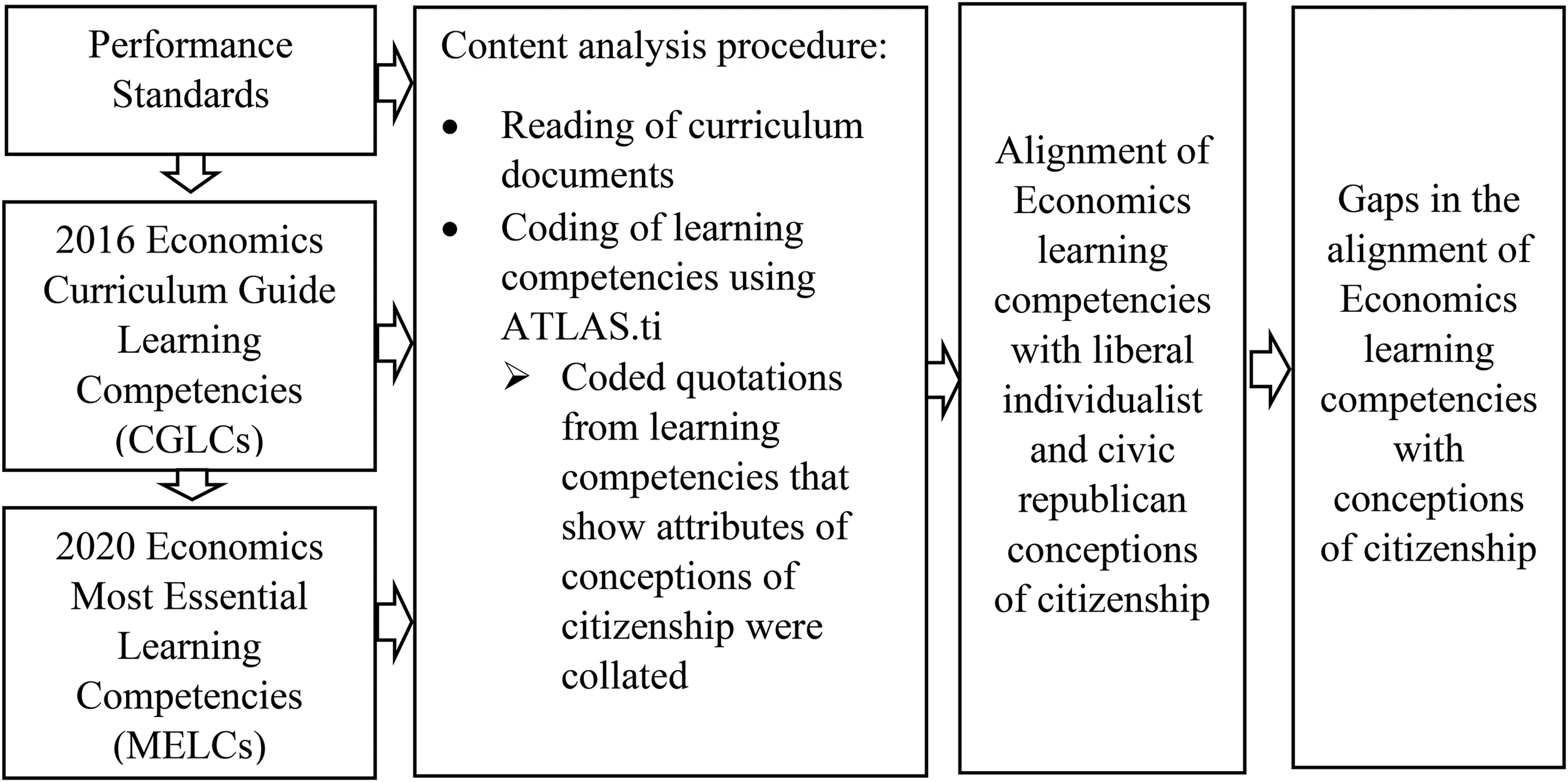
Framework of the study.
This study did not employ multiple coders to establish inter-coder reliability. ATLAS.ti (2019, v. 8.4.25.0), a qualitative data analysis software, was used instead to have valid and replicable inferences from texts (Krippendorff, 2013). In addition, this study only analyzed the intended curriculum, particularly the curriculum standards of the Junior High School Economics in the Philippines. Moreover, the curriculum documents employed in this study are in the public domain and the Department of Education in the Philippines welcomes the conduct of studies that can aid in assessing the gaps in the existing intended curriculum (Dizon, 2020, 2021).
Results and discussion
This section presents and discusses the salient findings of the study, as to:
alignment of Economics learning competencies with liberal individualist and civic republican conceptions of citizenship; and gaps that need to be addressed in the alignment of the Economics learning competencies with citizenship education
First quarter
The performance standard for the First quarter is “Ang mga mag-aaral ay naisasabuhay ang pag-unawa sa mga pangunahing konsepto ng Ekonomiks bilang batayan ng matalino at maunlad na pang-araw-araw na pamumuhay” (Students apply their understanding of basic Economic concepts to have smart and comfortable life) (Department of Education, 2016: 185). Civic-oriented 2016 CGLCs and 2020 MELCs that will be presented in this section are expected to be based on the said performance standard. But the standard is vague and only focuses on the application of basic Economic concepts. It does not cover essential civic-oriented outcomes that are evident in the learning competencies for the First Quarter like defending one’s rights and performing responsibilities as citizens.
For instance, the learning competency “Naipagtatanggol ang mga karapatan at nagagampanan ang mga tungkulin bilang isang mamimili” (Defend one’s rights and perform responsibilities as a consumer) (Department of Education, 2016: 192) makes students aware of their rights and responsibilities as a consumer. This competency highlights both liberal individualist and civic republican conceptions of citizenship as it motivates students to fight for their rights and at the same time do their responsibilities as consumers. This competency was retained in the 2020 MELCs. In addition, the learning competency “Naipamamalas ang talino sa pagkonsumo sa pamamagitan ng paggamit ng pamantayan sa pamimili” (Demonstrate wise consumption of goods and services by following market standards) (Department of Education, 2016: 191) reflects a liberal individualist conception of citizenship as it asks students to have wise consumption of products, thereby enhancing their individual competence for reflective thought. Here, Philippine textbooks, which are based on Economics competencies, teach students the need to understand the return and exchange policies of business establishments to be secured when buying goods and services. This means that students are honed to become reflective in choosing the right goods and services that can address their needs. However, this competency was not retained in the 2020 MELCs.
Second quarter
The performance standard for the Second quarter is “Ang mga mag-aaral ay kritikal na nakapagsusuri sa mga pangunahing kaalaman sa ugnayan ng pwersa ng demand at suplay, at sistema ng pamilihan bilang batayan ng matalinong pagdedesisyon ng sambahayan at bahay-kalakal tungo sa pambansang kaunlaran” (Students conduct a critical analysis of their basic understanding of demand and supply, and market systems as basis of wise decision-making for national development) (Department of Education, 2016: 194). Civic-oriented 2016 CGLCs and 2020 MELCs that will be presented in this section are expected to be based on the said performance standard. However, the standard is vague and only emphasizes critical analysis of microeconomic concepts to render wise decisions. It fails to include other essential civic-oriented outcomes that are evident in the learning competencies in the Second Quarter like defending the need for government regulation to ensure the safety and quality of goods and services in the market.
For example, the learning competency “Napangangatwiranan ang kinakailangang pakikialam at regulasyon ng pamahalaan sa mga gawaing pangkabuhayan sa iba’t ibang istraktura ng pamilihan upang matugunan ang pangangailangan ng mga mamamayan” (Defend the needed intervention and regulatory functions of the government to activities of different market structures to address the needs of citizens) (Department of Education, 2016: 199) reflects a liberal individualist conception of citizenship as it asks students to fight for their rights by defending the need for government intervention and regulation. Here, Philippine textbooks, which are based on Economics competencies, teach students that government intervention and regulation are essential to ensure that products and services have appropriate prices and of good quality. However, this competency was revised in the 2020 MELCs as “Napahahalagahan ang bahaging ginagampanan ng pamahalaan sa regulasyon ng mga gawaing pangkabuhayan” (Value the role of the government in regulating economic activities) (Department of Education, 2020c: 55). Civic-oriented outcomes in the original competency like defending the need for government intervention were removed in the 2020 MELCs. The original competency in the 2016 Curriculum Guide is better as it enables students to recognize the essential role of the government in maintaining quality goods and services with affordable prices and at the same time make the government accountable for violations like overpricing and substandard products in the market. Thus, civic-oriented outcomes in the original competency should be retained. On the other hand, the learning competency “Matalinong nakapagpapasya sa pagtugon sa mga pagbabago ng salik na nakaaapekto sa demand” (Render wise decisions in response to changes to factors that affect demand) (Department of Education, 2016: 195) reflects a liberal individualist conception of citizenship as it requires students to render wise decisions, thereby enhancing one’s competence for reflective thought. However, this civic-oriented outcome was not retained in the 2020 MELCs.
Third quarter
The performance standard for the Third quarter is “Ang mag-aaral ay nakapagmumungkahi ng mga pamamaraan kung paanong ang pangunahing kaalaman tungkol sa pambansang ekonomiya ay nakapagpapabuti sa pamumuhay ng kapwa mamamayan tungo sa pambansang kaunlaran” (Students recommend ways on how their basic understanding of the national economy can make life better for everyone towards national development) (Department of Education, 2016: 200). National development is being emphasized as an end goal of understanding the economy. Civic-oriented 2016 CGLCs and 2020 MELCs that will be presented in this section are expected to be based on the said performance standard. But the standard is vague and only focuses on basic understanding of the national economy. The standard does not clearly relate to civic-oriented outcomes that are evident in the learning competencies in the Third Quarter like correct payment of taxes.
For instance, the learning competency “Nakababalikat ng pananagutan bilang mamamayan sa wastong pagbabayad ng buwis” (Perform one’s responsibilities as a citizen in relation to correct payment of taxes) (Department of Education, 2016: 205) reflects a civic republican conception of citizenship as it had explicitly stated that citizens of the Philippines should pay their taxes correctly, which is considered a moral obligation. But this civic-oriented outcome was not retained in the 2020 MELCs. In addition, the learning competency “Aktibong nakikilahok sa paglutas ng mga suliraning kaugnay ng implasyon” (Actively participate in addressing problems in relation to inflation) (Department of Education, 2016: 204) reflects both liberal individualist and civic republican conceptions of citizenship. This is because the competency requires students to be active in solving problems regarding inflation, which is both beneficial to them as individuals and the nation. This competency was revised in the 2020 MELCs as “Natatalakay ang konsepto, dahilan, epekto at pagtugon sa implasyon” (Discuss the concept, causes, and effects of inflation as well as the ways of mitigating inflation) (Department of Education, 2020c: 55). However, the revised competency did not explicitly indicate active involvement in addressing problems related to inflation. The original learning competency is better as it encourages students to actively involve themselves as citizens of the Philippines in mitigating problems that come with the increase of prices in basic commodities.
Fourth quarter
The performance standard for the Fourth quarter is “Ang mga mag-aaral ay aktibong nakikibahagi sa maayos na pagpapatupad at pagpapabuti ng mga sektor ng ekonomiya at mga patakarang pang-ekonomiya nito tungo sa pambansang pagsulong at pag-unlad” (Students actively participate in different sectors of the economy and support economic policies for national growth and development) (Department of Education, 2016: 207). Civic-oriented 2016 CGLCs and 2020 MELCs that will be presented in this section are expected to be based on the said performance standard. However, the standard is vague and only involves active participation in economic sectors and support to economic policies of the state. It does not incorporate other essential civic-oriented outcomes like collective action, which can be gleaned from the 2016 learning competencies in the Fourth Quarter.
For example, learning competencies like “Napahahalagahan ang sama-samang pagkilos ng mamamayang Pilipino para sa pambansang kaunlaran” (Value collective action of Filipino citizens for national development) (Department of Education, 2016: 208); and “Nakapagsasagawa ng isang pagpaplano kung paano makapag-ambag bilang mamamayan sa pag-unlad ng bansa” (Plan ways on how to contribute for national development as a citizen of the Philippines) (Department of Education, 2016: 208) reflect a civic republican conception of citizenship as they motivate students to unite and contribute to national development. Here, Philippine textbooks, which are based on Economics competencies, teach students the bayanihan spirit wherein people need to work together in order to achieve a goal. The word bayanihan came from the word bayan which means nation, community, or town. The bayanihan spirit (communal unity) is usually illustrated in Philippine textbooks as a group of people carrying a hut made of light materials like nipa or coconut leaves. Back in the earlier days, Filipinos in rural areas usually move their houses from one place to another in search of livelihood. Today, bayanihan is linked with cooperation and volunteerism. Then, these competencies of the Fourth quarter in the 2016 Curriculum Guide that feature civic-oriented outcomes like collective action and contributing to national development reproduce the bayanihan spirit as a unique Filipino custom. However, these competencies were not included in the 2020 MELCs. A competency that explicitly describes bayanihan spirit is needed in order for students to develop values of unity and eagerness to contribute to nation-building. In addition, the learning competency “Natutukoy ang iba’t ibang gampanin ng mamamayang Pilipino upang makatulong sa pambansang kaunlaran” (Determine the duties and responsibilities of Filipino citizens to contribute to national development) (Department of Education, 2016: 207) reflects a civic republican conception of citizenship as it highlights the duties and responsibilities of Filipino citizens. This competency was retained in the 2020 MELCs. This competency that asks students to determine the duties and responsibilities of Filipinos is significant as it explores the kind of citizens that is expected in the Philippines. Here, Philippine textbooks, which are based on Economics competencies, show that Filipino citizens should be madiskarte (resourceful) and have sipag at tiyaga (hard work and perseverance) to have a prosperous life for everyone. Moreover, the learning competency “Nasusuri ang bahaging ginagampanan ng sektor ng industriya, tulad ng pagmimina, tungo sa isang masiglang ekonomiya” (Examine the role of industrial sectors, such as mining, towards a vibrant economy) (Department of Education, 2016: 209) reflects a liberal individualist conception of citizenship as it requires students to examine the role of mining in the economy, which can enhance one’s competence for reflective thought. Here, Philippine textbooks, which are based on Economics competencies, ask students to weigh the contributions of mining in the economy and the problems that come with mining activities. But this competency was revised in the 2020 MELCs as “Nabibigyang-halaga ang mga gampanin ng sektor ng industriya at mga patakarang pang- ekonomiyang nakatutulong dito” (Value the roles of the industrial sector and economic policies that help the industrial sector) (Department of Education, 2020c: 56). The revised competency removed the analysis of the role of mining in the economy and focused on the role of economic policies in improving the industrial sector instead.
Conclusion
Findings of this study revealed that the K to 12 Junior High School Economics curriculum in the Philippines integrates both liberal individualist and civic republican conceptions of citizenship. However, curriculum standards of Junior High School Economics in the Philippines are not properly formulated as the standards are vague and fail to explicitly state essential civic-oriented outcomes. It is important that these standards are clear and specific as curriculum standards define the content that will be taught to students. But essential civic-oriented outcomes like “wastong pagbabayad ng buwis” (correct payment of taxes) and bayanihan spirit (communal unity) among Filipinos in the 2016 CGLCs were not included in the 2020 MELCs. These civic-oriented outcomes should have been retained in the 2020 MELCs as these can help to foster responsibility and unity among future citizens of the Philippines. Only those competencies that were considered most essential based on Economic knowledge and skills were retained. This “overemphasis on the technical aspects of [Economics] education at the expense of quality citizenship education will produce a generation of ‘skilled barbarians’” (Senate Standing Committee, as cited in Sears, 1994: 37). Hence, there is a need to retain and explicitly state essential civic-oriented outcomes in the Junior High School Economics curriculum so that teachers will make a deliberate attempt to attain these outcomes.
Footnotes
Notes on contributor
Arnie G. Dizon is an instructor in the College of Education at the Don Mariano Marcos Memorial State University, South La Union Campus, Agoo, La Union, 2504, Philippines. E-mail: adizon@dmmmsu.edu.ph. His research interests include the content analyses of Social Studies curriculum, learning modules, and teaching guides in basic education.
Declaration of conflicting interests
The author(s) declared no potential conflicts of interest with respect to the research, authorship, and/or publication of this article.
Funding
The author(s) disclosed receipt of the following financial support for the research, authorship, and/or publication of this article: This work was supported by the Don Mariano Marcos Memorial State University, La Union, Philippines.
