




Abstract
This paper investigates the existence of GCED principles in Omani Basic Education schools’ visions and missions. A qualitative exploratory collective case study research design was used by analysing 50 schools’ vision and mission statements for the existence of five GCED principles: peace and conflict, human rights, identity and diversity, environment concerns, commitment to social justice, democracy and equity. The results revealed the varying existence of GCED principles, with commitment to social justice, democracy and equity principle being the most evident principles and the environment concerns principle the least evident in the dataset. For enabling schools to produce global citizens, schools need a revision of their visions and missions for better inclusion of GCED principles.
Keywords
Introduction
With the setting of the Sustainable Development Goals (SDGs) by the United Nations and with education being one of these goals, global citizenship education (GCED) has become a central topic for debate among academic institutions and governments around the world (Bourn, 2005; Pigozzi, 2006; Torres, 2008; UNESCO, 2016). UNESCO's vision of education for sustainable development (ESD) and its implementation plan have urged the reformulation of national education plans, programmes and policies to develop the knowledge, skills, understandings and values required to rationalise people's individual and collective decisions at the local and global level to improve life quality for all people (Bourn, 2005; Pigozzi, 2006). Goal 4 ‘Quality Education’ of the SDGs aims to ‘ensure inclusive and equitable quality education and promote lifelong learning opportunities for all’ (UNESCO, 2016; United Nations, 2015). It directs educational providers to developing learners’ dispositions in order to foster peace, collaboration, equity and mutual understandings (UNESCO, 2016). Also, Goal 4 strives to ensure global partnership though the involvement of citizens in economic, social and environmental concerns (Torres, 2008; UNESCO, 2016; United Nations, 2015; Webb et al., 2017). It is important for education to contribute to the development of human rights, peace and responsible local and global citizenship, gender equality, sustainable development, environment and health (UNESCO, 2016).
To ensure inclusive and equal quality education and provide lifelong learning opportunities for all, SDG4 includes seven outcome targets (UNESCO, 2016). Target 4.7 of goal 4 calls for strengthening education's goal to contribute to human rights, peace, gender equality, global citizenship, sustainable development and health. It states that education should aim to equip learners with the knowledge, skills and values required to endorse sustainable development through “education for sustainable development and sustainable lifestyles, human rights, gender equality, promotion of a culture of peace and non- violence, global citizenship and appreciation of cultural diversity and of culture's contribution to sustainable development” (UNESCO, 2016: 13).
One way to achieve target 4.7 of the fourth goal of 2030 Agenda for Sustainable Development (producing productive citizens who can contribute to productive life, make informed decisions and involve locally and globally in facing and resolving global difficulties) is by reinforcing ESD and GCED in schools (UNESCO, 2014, 2016; United Nations, 2015). Both includes “peace and human rights education, intercultural education and education for international understandings” (UNESCO, 2016: 14). In addition, both call for transformative and holistic view of education that can equip learners with the required skills to operate in a globalised world (UNESCO, 2015). Although both deal with global issues and action, GCED is associated with issues related peace and conflict while ESD is associated with issues related to environmental warnings and natural resources (UNESCO, 2015). In short, it has been argued that GCED is a requirement to achieve outcome target 4.7 of goal 4 of the 2030 Agenda of Sustainable Development (UNESCO, 2016).
GCED aims at equipping learners with the required skills of belonging to a global community with shared responsibilities in achieving sustainability of resources (Bourn, 2005). It plays a key role in addressing injustice and making our world a sustainable place (Blackmore, 2016; Torres, 2008; Torres and Dorio, 2015; Webb et al., 2017). Nowadays, being a global citizen is crucial in enabling learners to function in a volatile, uncertain, complex and ambiguous world (Bennett and Lemoine, 2014). Additionally, GCED does not only help developing students’ thoughtful and clarified interactions with their cultures and their countries, it also helps learners in developing global identifications and adequate knowledge of their roles in the world and the global community (Akkari and Maleq, 2019; Banks, 2004; Jorgenson et al., 2012). It empowers learners with the required skills and attitudes to actively be involved in a globalised world (Oxfam, 2015; Pike, 2008; Torres, 2008).
In Oman, the focus of this paper, to ensure access to education for all Omanis and equip them with lifelong learning skills (Al-ani, 2015; Issan and Gomaa, 2010), the Omani education system reforms highlighted preparing students to be active members of society and preparing them for employment after school (Al Najar, 2016). These reforms were initiated as a consequence of the impact of globalisation on education (Al’Abri, 2011; Issan and Gomaa, 2010). The Post-Basic Education introduced in 2008 for grades 11 and 12 was developed according to international standards to develop communication, problem-solving, interpersonal interaction, mathematics and information technology skills (Al-ani, 2015). The National Strategy for Education 2040 (see The National Strategy for Education 2040, 2018) calls for the development of policies for reforming the educational sector in Oman to meet the demands of new technologies and a globalised world. The strategy stresses the importance of providing educational opportunities for attaining self-growth, interacting with the world and building social and economic transformations (Education Council, 2018).
Despite the attempts and educational practises in Oman to implement GCED, there is a serious concern for defining the approaches and strategies used by Omani schools in the implementation of GCED (Al-Maamari, 2014). The National Strategy for Education 2040 raised a serious call for 21st century skills development to meet the requirements of dynamic and unpredicted national and international demands, along with the need for reinforcing quality, performance efficiency and transparency (Education Council, 2018). Previous research has indicated a strong demand for employability and life skills needed for Omanis to interact in a globalised world (Al-Ani, 2017).
Considering all the efforts being exerted and the plans to develop globalised citizens, this paper focuses on GCED because it has a “transformative” perspective on education (Oxfam, 2015) that seeks to transform and enhance students’ knowledge, skills, values and attitudes required to function effectively in a globalised world. Also, GCED encompasses learning, thinking and actions as crucial components of achieving just, secure and sustainable global future (Oxfam, 2015). This comprehensiveness of GCED leads to the significance of this investigation. Also, the Omani education system plans to implement GCED in order to meet the demands of globalised world (Al-Ani, 2017; Education Council, 2018) rationalises the need for this investigation.
Although there has been great focus on GCED in schooling in international literature, we could say that GCED generally has been neglected in Oman as an area of research. Overall, there were some Omani studies focussed on GCED in higher education and universities (Al-maamari, 2020a, 2020b), with few counted studies focussed on schooling (Al-maamari, 2014; Ibrahim & Almarzouqi, 2020). This study comes as a response to this neglect and contribute to the Omani literature on GCED as well as adding to the international literature.
In this context, the aim of this paper is to trace the existence of five GCED principles (peace and conflict, human rights, identity and diversity, environment concerns, commitment to social justice, democracy and equity) in the visions and missions of Omani Basic and Post-Basic Education schools. This paper follows the rationale that the successful implementation of GCED in school depends on the existence of principles of GCED in schools’ visions and missions. As vision and mission statements provide directions towards achieving desired goals and contribute to the success of schools (Cho, 2017; Hall and Hord, 2019), the analysis of the vision and mission statements carried out in this paper will help us understand the directions of schools in addressing global citizenship and the implementation of GCED in Omani schools. Eventually, the results of this analysis will inform policy makers, curriculum developers, school principals and teachers how to best implement GCED in Omani schools. Additionally, the results of the study will guide schools regarding how to revise their vision and mission statements for a better inclusion of GCED principles.
It is important to mention here that this paper is not intended to investigate how schools are implementing GCED. In other words, we are not targeting implementation of GCED but planning of it. Indeed, we believe that having the appropriate mission and vision statements does not ensure implementation. We argue that having the vision and mission statement is necessary but not sufficient basis for achieving/implementing GCED. In our view, analysing vision and mission statements doesn't tell you about implementation but planning to achieve it. Another study is required to investigation the implementation of such planning.
This paper will first define and highlight the importance of GCED, followed by an outline of strategies for developing global citizens. Then, it will briefly describe the study context and review some initiatives concerning developing global citizens in Omani schools. The third section will present the research methodology and the fourth section will present the results. The discussion section will discuss the results in light of previous research on GCED. It will critically address GCED implementation issues based on the existence of GCED principles in schools’ vision and mission statements. It will also provide practical implications for schools and it will set directions for future research endeavours.
Literature review
Global citizenship education
While GCED is not relatively new, it has become more evident and a controversial topic in academia since the United Nations Global Education First Initiative (United Nations, 2012) and its inclusion in the 2030 Sustainable Development Agenda (United Nations, 2015). ‘Quality education’ is the 4th goal of the 2030 Agenda for Sustainable Development, which is defined as the need to “ensure inclusive and equitable quality education and promote lifelong learning opportunities for all” (UNESCO, 2016; United Nations, 2015). Additionally, education is recognised as an essential part of achieving many other goals in the agenda (United Nations, 2015; Webb et al., 2017). Based on the underlying principles of Goal 4 of SDGs, education should develop human dispositions, leading to peace, friendship and mutual understandings (UNESCO, 2016). In addition to ensuring prosperity, friendship and peace, the goal aims to ensure global partnerships, by the active involvement of citizens in economic, social and environmental concerns (UNESCO, 2016).
UNESCO (2016) articulated 4 means to help in the implementation of ESD as means to achieve goal 4 of the agenda. First, to provide safe and inclusive learning environments for all despite background, cultural and disability conditions. Second, to increase support to education by expanding scholarship opportunities for young people and adults in developed and developing countries. Third, to pay urgent attention to supply of qualified teachers through well-resourced and efficient professional development systems.
One way to achieve Goal 4 of SDGs is through the implementation of GCED in schools. It is deemed essential nowadays for its contributions to global peace and sustainable development (Torres, 2008), and improving life quality for all people around the world (Bourn, 2005). This is also to say that GCED has been in the agenda of international organisations because of its potential benefits in making the world more sustainable, equal and peaceful (Webb et al., 2017). The successful implementation of GCED can contribute to developing peace through “empowering students to be responsible global citizens and providing them opportunities to realise their rights and obligations to promote a better world and future for all” (Torres and Dorio, 2015: 4).
GCED is about equipping learners with rights, responsibilities and active participation beyond the borders of their nation to include the whole globalised world (Oxfam, 2015; Pike, 2008; Torres, 2008). According to UNESCO (2014), GCED aims to “empower learners to engage and assume active roles both locally and globally to face and resolve global challenges and ultimately to become proactive contributors to a more just, peaceful, tolerant, inclusive, secure and sustainable world” (p. 15). GCED is a learner-focussed education because the empowerment focuses on the learner's active social role as a global citizen (Gaudelli and Schmidt, 2018). Additionally, GCED addresses learning as a way of thinking and a set of abilities that students can perform as a consequence of learning experiences (Gaudelli and Schmidt, 2018; Oxfam, 2015). GCED also assists students in developing a set of dispositions and skills to enable them to work across varied cultures and societies (Torres, 2008). GCED is not simply teaching students about the world, it is teaching students empathy and reflection on current global issues to enable them to view and analyse world issues from various perspectives (Goren and Yemini, 2017).
Developing global citizenship in schools
A plethora of research studies has discussed ways of nurturing global citizens and implementing GCED in schools. The United Nations and UNESCO identified three essential factors that can contribute to the success of implementing GCED: 1) inclusion of GCED in policies, 2) inclusion of GCED in long-term sustainable action plans; and 3) providing pre-service and in-service training for teachers (UNESCO, 2014; United Nations, 2012). In addition to these factors, Davy (2011) reported a set of pedagogical approaches that can contribute to the development of global citizenship among students: constructivist approaches, transdisciplinary approaches, collaborative approaches, critical thinking, active learning and creative integration of technology. He also called for a change in assessment in a way that assessment should explicitly assess international-mindedness and global citizenship. This indicates that developing global citizenship in schools is a multi-faceted process in which different areas of the educational context (polices, action plans, teacher professional development, pedagogy) interrelate to achieve the purpose.
Competence-based learning that is built around self-discovery where students interact with their environment, reflect and apply skills in everyday contexts is a suitable approach for nurturing global citizens (Pastor-garcía et al., 2019). Oxfam –an international non-profit organisation- encouraged providing resources to assist teachers’ in developing global citizens who can learn, reflect, participate in the world, as an essential part of their social justice and human rights approach to solve world issues and address local and global challenges (Bourn, 2016; Oxfam, 2015). For a rigorous development of global citizenship, Oxfam (2015) identified three main principles for schooling as a guide: learning, thinking and actions. First, students are provided various opportunities to learn about the issues from different perspectives; second, they think and critically consider solutions with relation to world views; and finally they act and take action individually and collectively based on the given different views and their personal understandings and experiences (Oxfam, 2015). Based on these studies, providing students with knowledge is not sufficient to produce global citizens. It is essential that students get opportunities to think and reflect on different situations and make them accountable for their decisions.
For developing global citizens, teachers should encourage students to develop arguments, write research questions, analyse and synthesise arguments and examine different views and perspectives (Reynolds et al., 2019; Torres, 2008). To equip students with skills required for social justice, Martin et al. (2012) supported exposing students to global literature. They argued that reflecting on global literature can help students develop open-mindedness and critical reflection skills that would eventually help them consider similar local/global issues from different perspectives. Hence, students should be given opportunities to use technological tools for communication with various communities verbally and non-verbally (Reynolds et al., 2019). This requires schools to develop their infrastructure and prepare their teachers to ensure a conducive learning environment for the effective development of global citizens.
To help teachers and schools to develop global citizenship, Fricke and Gathercole (2015) argued that teachers and schools should adopt popular education or education for liberation. They defined this approach as an educational approach that “enables groups of people to develop a critical awareness of the situation in which they find themselves and of the causes of that situation, as the basis from which to transform their (communal) lives” (Fricke and Gathercole, 2015: 17).
Zahabioun et al. (2013 p. 202) argued for the use of a dynamic process in curriculum design in which schools revise curriculum goals continuously. The curriculum goals should emphasise the following for better implementation of GCED:
Developing citizens of the world concerning culture, language and learning to live together. Fostering students’ recognition and development of universal human values. Equipping students with the skills to learn and acquire knowledge, individually or collaboratively, and to apply these skills and knowledge accordingly across a broad range of areas.
While there are many ways to implement GCED in schools, the implementation can face various structural and pedagogical challenges. Clark and Savage (2017) pinpointed that schools may fail to translate practically global citizenship into classrooms although schools’ policies have focussed on global citizenship. Lim (2008) claimed that schools were not able to create a good environment for developing global citizenship because the learning experiences were not contextualised and meaningful for students. Since global citizenship dispositions, abilities and skills should be infused in the curriculum across the schooling levels (Oxfam, 2015), the learning experiences should be contextualised and tailored to suite students’ levels (Lim, 2008).
Insufficient professional development provisions can negatively affect GCED. Lim (2008) raised a call for professional development of teachers and school leaders to enable schools in implementing GCED. Professional development is required for teachers and school leaders to help them “investigate links between local and global citizenship issues, develop skills of participation and reflection and examine their own values and attitudes” (Ibrahim, 2005: 191). Teacher preparation for teaching GCED can be integrated in teacher development programmes with other related issues or it can be an independent professional training programme (UNESCO, 2015). Additionally, Ekanayake et al. (2020) argued that teachers should be exposed to various cultural issues and international experiences to help them nurture global citizenship values in their students.
Schools’ vision and mission statements
Vision and mission statements are essential for effective school leadership and school success. Gurley et al. (2015) defined a mission statement as “a statement of why an organisation exists, a statement of its fundamental purpose” (p.7), whereas a vision statement is defined as “an articulation not of purpose, but of a preferred future for the organisation” (p.8). In other words, the mission statement describes the purpose of the existence of the school and their desired plans, while the vision statement provides a picture of the school when the vision is achieved through the collaboration of different school stakeholders.
Vision and mission statements are essential for the success of schools. First, they can help schools make desired progress and direct them towards higher levels of planned activities (Cho, 2017; Hall and Hord, 2019). They provide teachers with an understanding of school directions and what and how to solve educational problems that they may encounter on everyday practises (Cho, 2017; Lowenhaupt, 2014). Having clear vision and mission statements with these being accessible to all school stakeholders can contribute to better school management (Tariq et al., 2012). In addition to progression and better management, they can effectively predict schools’ performance (Al-Ani and Ismail, 2015).
The review presented thus far provides evidence that the analysis of schools’ vision and mission statements, which is the aim of this study, can provide an indication of schools’ planning and some directions towards the strategic implementations of their plans regarding GCED. In addition, they can also pinpoint issues of addressing GCED in the schools, and this paper can contribute to the success implementation of GCED in schools.
An overview of education and GCED in Oman
The Omani educational system has witnessed rapid developments in the last forty years. The development of the education system in Oman can be divided into two main phases: the pre-1970 phase when there were only three formal schools in Oman, and the educational renaissance after 1970 (Al’Abri, 2011; Al Najar, 2016). Al Nabhani (2007) divided the later stage into two different stages based on the goals of education: the quantitative stage with a focus on rapid quantitative development of education (Al Nabhani, 2007) and a focus on providing educational access to all citizens in Oman (Al Najar, 2016). The qualitative stage, the second stage, aimed at enhancing the quality of education and diversifying education (Al Nabhani, 2007). One of the major developments of the education system was evident in the introduction of Basic Education in 1998 which is a ten-year system consisting of two cycles that is cycle one (grade 1 to grade 4) and cycle two (grade 5 to grade 10) (Issan and Gomaa, 2010). Once students complete the Basic Education, they progress to either Post-Basic Education (grades 11 and 12) or vocational training (Issan and Gomaa, 2010).
Several reasons rationalised these fundamental developments in the education system: to increase Omanisation, to diversify the economy by developing workforce skills and exploiting natural resources, to prepare citizens for challenges of globalisation and to prepare a democratic nation (Rassekh, 2004). Apart from enriching students with basic needs of information, skills and knowledge, Basic Education aimed to develop students’ attitudes to enable them to continue their education based on their personal preferences and skillset (Al Najar, 2016), whereas Post-Basic Education aimed to enhance students’ skills in mathematics, Information Technology, communication, problem solving and interpersonal skills (Al-ani, 2015). In general, both Basic Education and Post-Basic Education aimed at preparing citizens for the workplace, equipping them with the required 21st century skills to demanded by globalisation (Al-harthi, 2000). The new curriculum is based on “effective evaluation criteria; pupil centred learning; pupils’ skills development; the development of individual talents and abilities and the development of vocational skills” (Al Najar, 2016: 140). Although the textbooks were written by qualified Omani curriculum designers, the process of textbook production was supervised and reviewed by international agencies and contributors to ensure high quality and to align them with international standards (Al-ani, 2015).
Due to the impact of globalisation on education (Al-harthi, 2000; Al’Abri, 2011; Issan and Gomaa, 2010), the education system strived to develop global citizenship by preparing students to involve actively and productively in society (Al Najar, 2016). To achieve and sustain economic stability, educational reforms in Oman endeavoured to enrich students with practical, vocational and technical skills and expertise to meet the standards of a globalised world (Al-Ani, 2017). Overall, teachers in Oman are chosen carefully to play a huge role in creating global citizens and preparing them for the suture. It is important to point here that Oman has been facing a challenge recently to attract Omanis to teaching profession due to various factors such as the lack of incentives, low status compared to other profession and low payment (Al’Abri, et al., 2021).
The Philosophy of Education in Oman included sixteen principles with various objectives that aim to provide guidelines for developing, reforming and evaluating all aspects of education. GCED principles are very evident in the majority of the principles in the philosophy (evident in 13 principles). To illustrate, the first principle calls for an integrated growth of learners in order to help students deal with current global developments and challenges (Education Council, 2017). With regard to peace and conflict, the fifteenth principle of the philosophy provided guidelines for developing education for peace and mutual understandings. Three of its objectives strive to “promote understanding and solidarity among different groups in society,” “promote positive patterns of behaviour to reinforce the values of peace and co-existence”, and “promote awareness on issues of international mutual understanding, respect and cooperation” (p.27). The second principle discussed identity and globalisation. It aims to develop citizenship and identity by reinforcing “a sense of belongingness to Islamic and Arab nations” and reinforcing “citizenship values” (p.20). An environment concerns principle is also evident in the philosophy in the eighth principle ‘Education for Sustainable Development’ through objective 4, “contribute to the protection and conservation of the environment” and objective 5, “develop knowledge and skills related to water and food security and confronting of natural disasters” (p.23). Additionally, the philosophy stressed the importance of a social justice principle in the seventh principle that aims at developing social justice and equity by helping learners to “develop the ability to contribute to public issues through expressing opinions and accepting constructive criticism” and “encourage diversity of expression in accordance with ethical and legal regulations and controls” (p.23).
The National Strategy for Education 2040 aims to contribute to reforming education in Oman and aligning education to international standards and global demands. Along with the development of 21st century skills, the National Strategy for Education 2040 proposed that the education system should provide training opportunities for students to enable them to work and interact in a globalised world (Education Council, 2018). This is planned to be achieved through “introducing technical and vocational pathways in post-basic education that allow students to continue their education or join the labour market” (p.31) and through “providing practicum for students at all educational levels and establishing a programme which ensures the provision of training opportunities for all students” (p.32). The strategy stressed the importance of education for global citizenship through “Reinforcing the role of educational institutions in instilling values, citizenship and positive attitudes; and, encouraging voluntary work among students” (p.34). In addition, the strategy stated that the educational vision in Oman is to “maintain national identity and intrinsic values” (p.22). In order to build a quality education and responsive education to global demands, the strategy set some guidelines for teacher enhancements, such as “establishing the Specialised Centre for Professional Training of Teachers to provide in-service training courses to enhance professional practsce and develop teachers’ capabilities and potentials” and “introducing a teacher licenzing system for all schools in Oman” (pp. 33–34).
The review presented in this section has highlighted that the education system in Oman has developed a roadmap towards GCED, despite the implicit existence of GCED principles already. The plan to equip learners with global citizenship values is rationalised by the need to meet the demands of the globalised world. Hence, it is essential to investigate how schools’ in Oman have planned to achieve and implement GCED through examining their vision and mission statements.
Method
The study adopted a qualitative exploratory collective case study research design which allows an in-depth exploration of a system (Creswell, 2018). Also, a collective case study design allows the examination of multiple cases (Berg, 2001), which provides a justification for the selection of this design to understand the case of each school in order to form a wider picture of schools’ plans and directions. Moreover, a collective case study enabled the description and comparisons of multiple cases to provide an insight into the research problem (Creswell, 2018). This design helped in ensuring adequate representations of the population because the cases were spread across a large geographical context (Berg, 2001).
Research sample
Using a random sampling technique, the visions and missions of 50 (4.6% of the total number of public schools in Oman, N = 1100) public schools were selected based on their availability. The random sampling was carried out through desktop web-search on schools’ vision and mission statements available in online resources. These schools were public schools and were fully funded and supervised by the Ministry of Education. To ensure obtaining a representative sample, the research sample included primary and high schools (cycle 1 and cycle 2 schools = 25 schools (50%), post-basic education schools = 12 schools (24%), and cycles 1, 2 and post-basic education schools = 13 schools (26%). The schools in Oman are divided into two main stages: Basic education schools and Post-basic education schools. Basic education is divided into two cycles. Students in Cycle 1 (grades 1 to 4) are co-educated in the same classes in which the staff in these schools are exclusively females. Cycle 2 (Grades 5–10): Male and female students at this level are taught in separate schools. Post-basic education schools include grades 11 and 12. Schools in remote areas with very small population can have the two stages together. Additionally, the schools represented all the geographical regions of Oman and both urban and rural areas. Since schools included in the research sample were spread across Oman, schools from the southern parts of Oman had minor sociocultural differences than the northern parts of Oman. These differences only related to dialectical variations and some cultural rituals and ceremonies. However, students in all areas practised the same language and religion and they shared the same cultural norms. Despite the vast geographical areas of schools in the sample, the socioeconomic status of the communities served by these schools were similar. Since the Ministry of Education supervised all these schools, the same administration, curriculum, teaching and learning methods and assessments are administered in all of these schools. Private and international schools were beyond the scope of this research. The schools’ visions and missions were collected from the schools’ websites and the schools’ accounts on Twitter®. The inclusion of visions and mission of these schools depends fully on their availability and the ability of authors to access them. Each school's vision and mission statement is considered as an independent case study.
Data analysis
A directed content analysis was adopted to analyse the research data. This method was deemed relevant to the study to identify the existence of predetermined categories based on prior research (Elo and Kyng, 2008; Hsieh et al., 2005). The directed content analysis used followed Assarroudi et al.’s (2018) three phases: preparation, organisation and reporting (see Figure 1). In the preparation phase, the authors identified the units of analysis (schools’ visions and mission statements). Once the units of analysis were identified, the researchers read and immersed themselves in the data. Next, in the organisation phase, the authors developed a categorisation matrix based on a theoretical definition of categories from prior research. Based on previous research on GCED, five themes were identified to be used in data analysis: Peace and conflict, human rights, identity and diversity, environment concerns, commitment to social justice, democracy and equity (Oxfam, 2015). The comprehensiveness of Oxfam's themes and its’ guidelines for schools and teachers were the rationale for their section as the pre-existing themes. The matrix included the names of the schools, the vision/mission statements and the codes. The team read the statements, coded them into the matrix and put a tick against the themes that were traced in the vision and mission statements. To ensure rigour, reflexivity and inter-coder reliability, the authors met and reviewed the matrix and identified categories (Creswell and Miller, 2000; Tracy, 2010). During the meeting, the authors pre-tested the categorisation matrix and they selected anchoring samples for each category. Then, they conducted the main analysis independently to all the research sample using the developed categorisation matrix. To facilitate the analysis, MS Excel® was used. A meeting was held to discuss the results of the analysis. The first author consolidated the results and wrote the findings. The co-authors provided subsequent revisions and feedback.
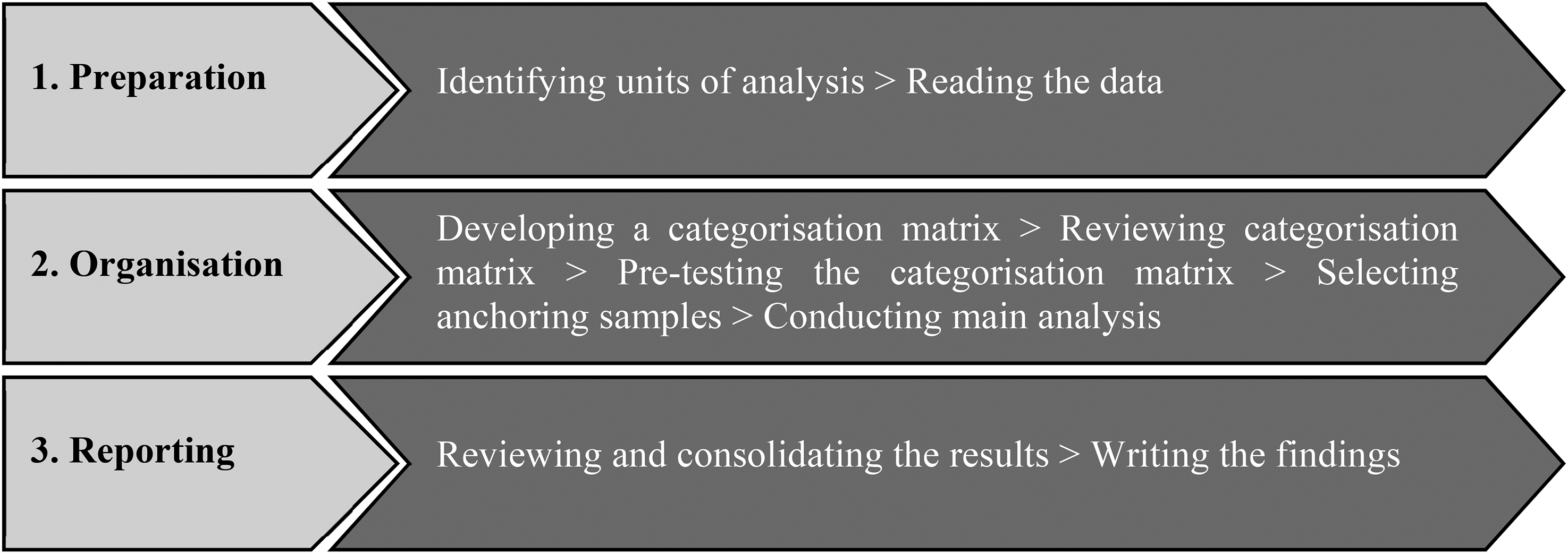
Data analysis steps.
Results
The analysis revealed varying evidence of the existence of GCED principles in schools’ vision and mission statements (see Table 1). The peace and conflict principle was evident in most statements with different indications. Some statements stressed the importance of the school's collaboration with society. For instance, school 2 stated, “The school strives to create a mutual collaboration and communication with various parts of the society to achieve its educational goals”. Additionally, schools aimed to set up and prepare skilful administrative and teaching staff to establish strong and effective ties with society. This was evident in school 4 mission, “… utilising prior experience through training, reinforcement and communication and working in a team spirit to reach better school performance”. Likewise, school 13 mission was to establish ways of involving the society in its educational process, “… aiming to activate the role of the society in the educational process”. Overall, teamwork, collaboration and involvement of society characterised the existence of peace and conflict principle in schools’ visions and missions.
Number and percentage of the existence of GCED principles in schools’ visions and missions.
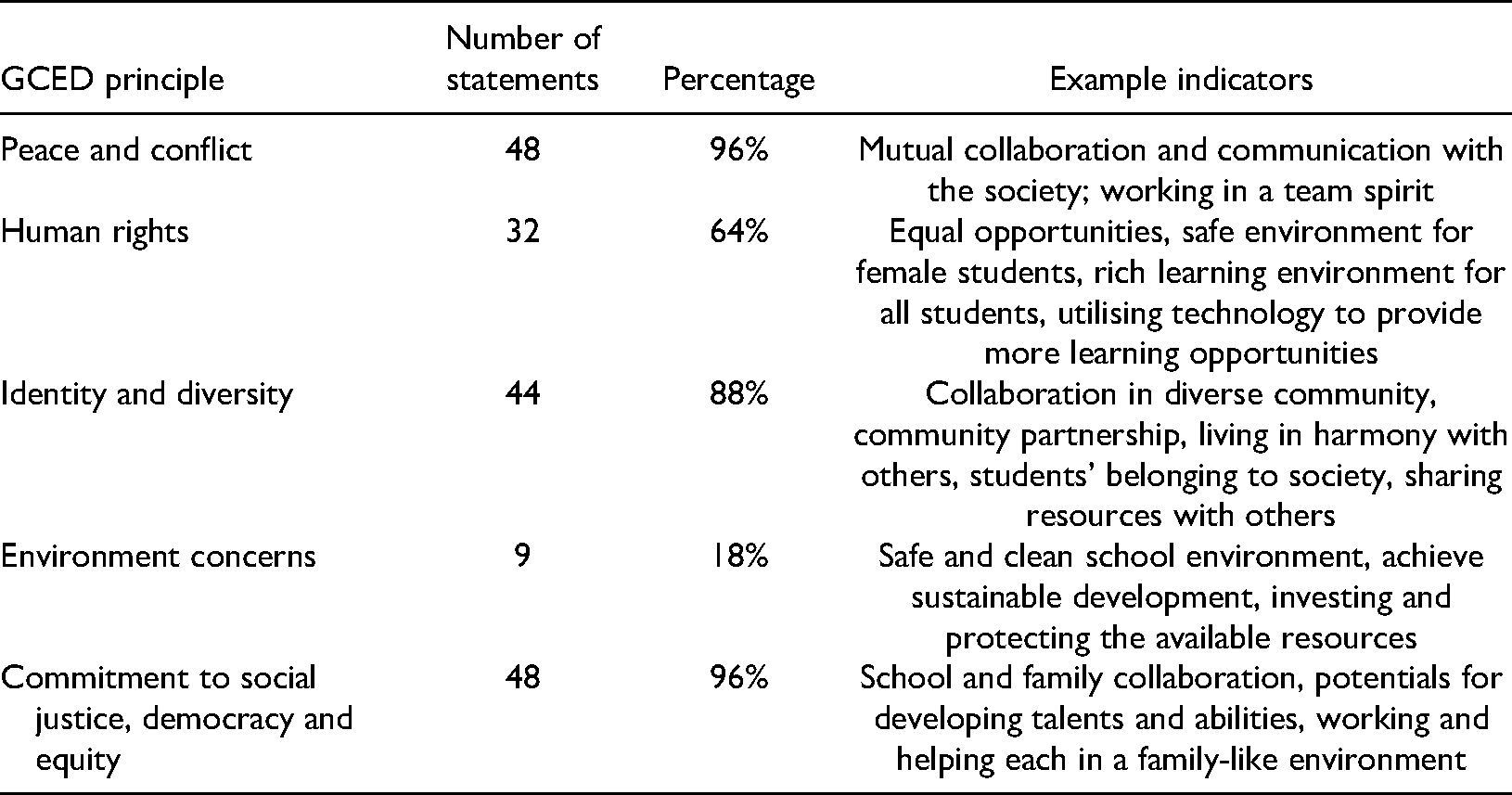
Similarly, the human rights principle was explicitly and implicitly evident in some schools’ visions and missions (N = 32, 64%). Schools strived to provide equal opportunities of educational services to its students through the provision of a safe educational environment for all students. For example, school 1 aimed at, “providing a learning educational environment to improve students’ educational levels”. Apart from the educational environment, schools aimed at providing students with various chances to enhance their skills and talents. One school stressed the importance of providing equal learning opportunities for female students. It aimed to provide “an appropriate and safe environment for female students” to help them develop their knowledge, skills and attitudes. Different phrases indicated schools’ attempts to develop human rights principle, such as “an appropriate environment for high quality education,” “ideal educational environment,” a rich learning environment that is suitable for students’ educational purposes and preferences,” “educational environment that utilise new instructional technologies and communication technologies,” and “an environment that provides students with various opportunities for skills and knowledge development and enhancement”.
Although the results revealed the existence of the environment concerns principle in some statements, its existence was implicit and minimal. Environmental concerns appeared only in nine statements (18%). Some phrases that indicated this principle were “safe school environment”, “a clean and rich environment to achieve sustainable development”, and “students’ being responsible for their environment”. One school aimed at improving staff and students’ performance to meet the globalisation demands though “achieving sustainable development of effective community partnership and investing in the available capabilities”.
Identity and diversity appeared implicitly in 44 statements (88%). However, schools’ visions and missions focussed on one aspect of this principle, which was community partnership. Some schools tried to build support mechanisms and collaboration with different sectors in the society. One school aimed at producing an educated and creative student who “can utilise the modern technologies to effectively collaborate in diverse community”. Another school mentioned that school's management attempts to “enable learning and community partnership with high considerations of globalisation and industrial revolutions”. Moreover, the attempt to raise students’ belonging to their society was evident. “Living in harmony with other people in the society” and “sharing resources with others” were among the phrases that indicated the existence of this principle.
Commitment to social justice, democracy and equity existed in 48 visions and missions (96%). Schools stressed the importance of training, reinforcements and collaboration in their visions and missions. In addition, some schools called for solidarity of views and fostering of team spirit to achieve better performance. Other schools stressed school and family collaboration to ensure quality education. For example, one school stated the provision of qualified school management and teaching staff that “can collaborate with students’ families and community institutions to provide each student the opportunity to develop his/her talents and abilities to the fullest potentials”. Many phrases indicated the existence of this principle, such as “to create an effective family-like environment”, “to be prepared to live with modern life requirements”, “to create an environment that encourages collaboration between the school and the society” and “to work as one team”.
In summary, the results revealed that the five principles of GCED existed in the majority of sample with social justice, democracy and equity being the most evident principle, while environment concerns principle is the least evident.
Discussion
Global citizenship principles in Omani schools: Satisfactory intentions
Five principles of GCED- peace and conflict, human rights, identity and diversity, environment concerns, commitment to social justice, democracy and equity- existed implicitly and explicitly in Omani schools’ vision and mission statements to varying degrees. The most articulated principle in schools’ visions and missions was commitment to social justice, democracy and equity, while environment concerns was the least articulated principle. Other principles were evident in the data with slight variations. Although the existence of these principles varied across the dataset, it indicates that schools have realised the importance of educating for global citizenship and they are moving in a good direction to develop global citizens.
The existence of these principles predicts schools’ realisation of the importance and need for educating global citizens. Additionally, this demonstrates that schools in Oman have satisfactory intentions to produce global citizens, at the planning level. Based on the existence of these principles, schools must have prepared action plans, procedures and guidelines to help them achieve their goals with regard to developing global citizens. These elements should not only influence students’ learning, but it should also influence teachers’ teaching strategies, continuous professional development and schools’ environment and infrastructure. Moreover, the existence of these principles indicate that schools have taken transformative learning, constructivism and active learning (Fricke and Gathercole, 2015; Oxfam, 2015; Torres, 2008; UNESCO, 2015) into deep consideration in the process of developing the vision and mission statements, which can positively impact the implementation of GCED. The existence of GCED principles signpost that schools are exerting efforts to develop 21st century skills and vocational skills deemed as a consequence of globalisation impacts on education (Al-harthi, 2000; Al’Abri, 2011), and to develop students’ talents and vocational skills (Al Najar, 2016).
The existence of global citizenship principles indicates that schools have implemented and followed the guidelines of the Philosophy of Education regarding peace education and mutual understandings, environment protection and preservation, social justice and equity. This is represented in statements that call for safe educational environment for students to develop skills of expressing their opinions and reflecting on social, national and international issues. In addition, some statements showed schools’ plans for creating collaborative environment to encourage collaboration between the schools and the society.
In addition, schools have also relied on Islamic principles and values related to human rights, peace and conflict and environment concerns. Theses realisation can explain the low existence of human rights and environment concerns in schools’ visions and missions because these values are also developed in the societies and families through different mediums, such as family gatherings, masjid's gatherings and speeches and social clubs. It is also the parents’ responsibilities to raise their children's awareness of environmental concerns, sustainable environment and protection of public resources. Since these values are addressed by society and family, their existence was minimal. However, schools do play a crucial role in the development of these values through their inclusion in the curriculum and extracurricular activities.
As the results revealed that schools have articulated the five principles of GCED in their vision and mission statements, this indicates that schools have followed the guidelines of The National Strategy for Education 2040. One way that indicates this realisation is through schools’ plans to provide students with skillset to enable them work in a globalised world. In addition, the results also showed that schools are working on utilising technology to help students learn and collaborate in diverse community, taking into consideration globalisation and industrial revolutions.
The efforts made by schools in promoting GCED, which is evident in their vision and mission statements, have positive impact on many areas. First, as a part of the unstable Middle East, Oman has been ranked high in the Global Peace Index (Oman: Global peace index, n.d.). Enhanced quality life and better living standards (Al-ani, 2015; Al’Abri, 2011) can be part of the consequences of GCED implementations in schools. It is also evident in the Omanisation and the increase number of Omanis working in different sectors (Al-Nahdi, 2016). Also, the increase number of Omani women working along males in different work places can be associated with the success implementation of GCED in schools (Goveas and Aslam, 2011).
A need for a revision of schools’ visions and missions
While schools’ vision and mission statements included some GCED principles, there is a need for a revision of schools’ vision and mission statements for better inclusion of GCED which can eventually enable schools to produce global citizens. Although the wording of vision and mission statements might not be as powerful as the process that underwent their development (Mark, 2007), school should reword their statements to include the GCED principles. To begin with, schools should carefully phrase their vision and mission statements to include all the five principles because some schools tried to include some principles at a superficial level, which has led to skipping some elements of these principles. This might influence the implementation of GCED in those schools. As environment concerns principles was not clear in many statements, its inclusion is important to ensure that students are prepared to address local and global environmental issues. Although the democracy and equity principle was evident in all schools’ visions and missions, schools should consider rephrasing these statements in a way that includes more sub-categories of the theme such as coexistence with others (Oxfam, 2015). Another term suitable for inclusion in the same dimension would be social responsibility and solidarity for all humanity (Fricke and Gathercole, 2015). Clearly including GCED principles in school's visions and missions can help the schools in providing an individual focus and support on achievement of every student in the school (Taylor, 2009).
Schools need to review and revise their vision and mission statements periodically. Pike’s (2008) argument that global citizenship is “immensely adaptable over time, changing to meet various geographical, political, and cultural pressures, moving from an exclusionary force towards ever greater inclusion” (p.15) can rationalise the continuous need for revision of school's visions and missions regarding inclusion of GCED. A better inclusion of terms related to human rights and environmental concerns will better deploy human rights values and environmental concerns values in the schools. A superficial and subconscious inclusion can hinder schools for fully implementing these values, and can hinder schools from establishing proper practises in these aspects of GCED.
Schools should communicate and explain their vision and missions to their teaching and administrative staff. Rather than a superficial awareness of the statements, teachers should also be aware of the rationale and the process that were carried out to phrase the statements so that they can be able to work out strategies for implementation to achieve their desired goals (Mark, 2007). This shared understanding can help schools build stronger ties and partnerships with community and stakeholders (Potts, 2009; Schweisfurth, 2006). In addition, schools’ management should hold meetings with parents to explain and discuss their vision and mission statements.
Education for global citizenship: Practical implications
Although the results revealed that schools attempt to produce global citizens, schools’ management should provide and organise training opportunities to enhance their teachers in implementing GCED in their classroom. As Clark and Savage (2017) argued, although school policies focus on global citizenship, the practical realisation of global citizenship in classroom remains challenging. The training programmes can be twofold: raising teachers’ awareness of the importance of global citizenship and enhancing teachers’ skills in adopting a transformative pedagogy that is essential for GCED (UNESCO, 2015). Training the teaching staff is central to the implementation of GCED (Ibrahim, 2005; Lim, 2008). As Ekanayake et al. (2020) argued that apart from possessing pedagogical and subject knowledge, teachers should adopt technologies and stay ahead of the diverse needs of their students to enable them to foster GCED. Once teachers are trained on these aspects, they will be able to contextualise their learning experiences (Lim, 2008) and to integrate global literature to develop open-mindedness (Martin et al., 2012).
Despite the fact that GCED principles are realised in schools’ vision and mission statements, for the successful implementation of GCED schools should consider evaluating and enhancing curriculum to help to nurture global citizens (Reynolds et al., 2019). Dynamic process of curriculum design and continuous revision of curriculum goals should be part of schools’ missions and action plans (Zahabioun et al., 2013), which can have a positive impact on global citizenship development. School should infuse global citizenship values, dispositions and skills across the curriculum at different levels (Oxfam, 2015; Torres, 2008), and in extra-curricular activities (Schweisfurth, 2006).
Although schools’ visions and missions demonstrated some evidence of GCED principles, schools’ missions should state some goals concerning assessing global citizenship development. Since GCED consists of knowledge and understanding, skills and attitudes (Oxfam, 2015), schools should assess students in the three domains following practical, reliable and authentic assessment measures (Davy, 2011). For example, Davy (2011) and Oxfam (2015) pointed out that schools should assess critical thinking, problem solving, communication, reasoned persuasion, sustainability and environmental issues, open-mindedness, diversity and intercultural issues.
Based on the analysis of schools’ visions and missions, Figure 2 summaries the practical implications for schools to better implement GCED. Schools should follow five crucial steps to ensure a quality education for nurturing global citizens. First, they should revise their visions and missions in order to include as many GCED principles as possible. Second, they should communicate and explain their missions to the community, teachers and parents so that each part exerts efforts to attain the GCED goals. Third, schools should provide training and professional development provisions for their teachers. Fourth, schools should evaluate and enhance their curriculum. The curriculum should state clear outcome-based objectives to develop global citizens. It should be based on transformative learning and constructive learning paradigms that can help in developing global citizens. Finally, schools should adopt practical and authentic assessment measures to assess students’ development of global citizenship. These elements are interconnected and related. Having clear visions and missions with some GCED principles would not ensure a good and comprehensive education for global citizenship. Therefore, schools should aim to address the five elements simultaneously.
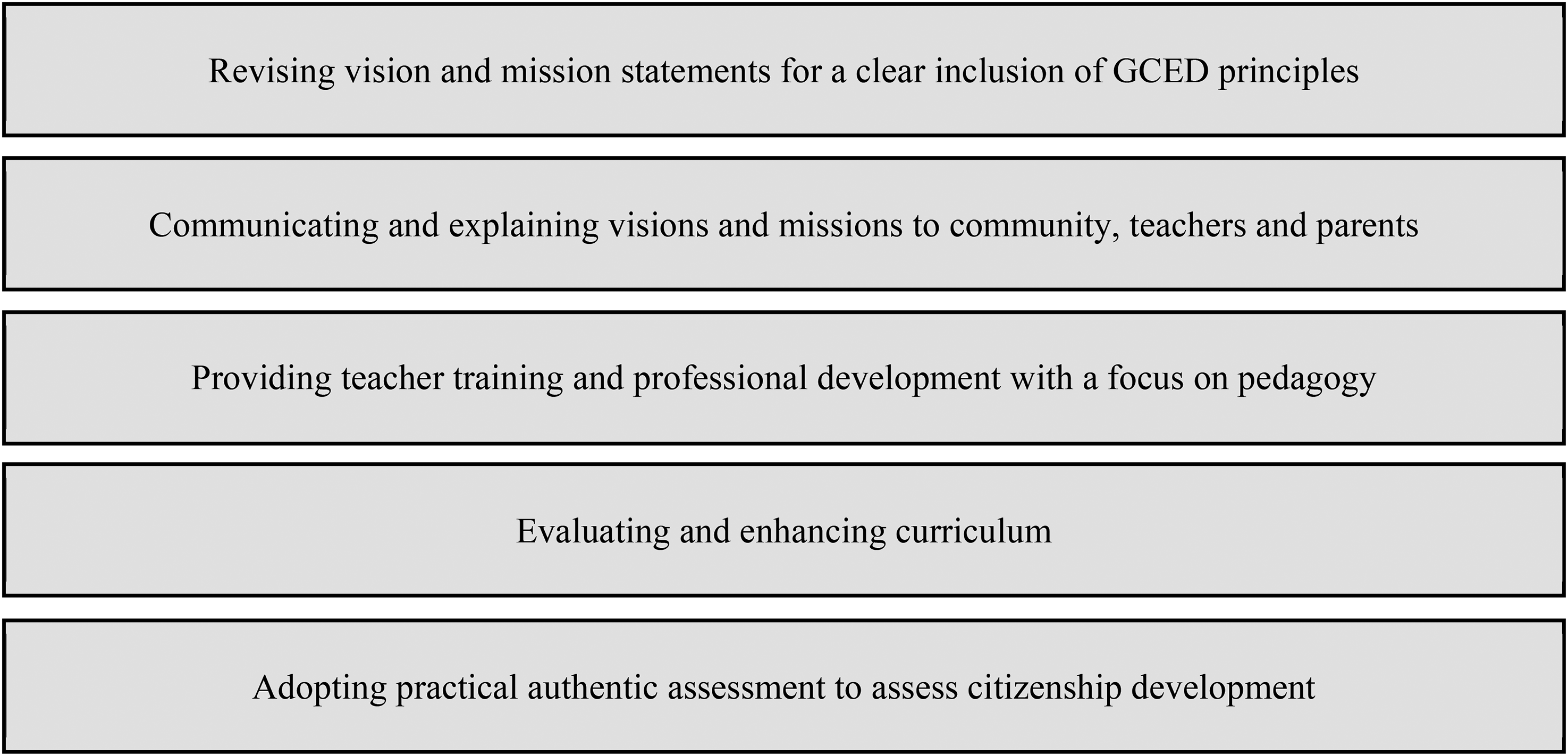
Practical implications for schools to develop global citizenship.
Future research directions
As schools have realised the need to develop global citizens, there is a scholarly need to investigate schools’ practical ways in achieving their plans in developing global citizens. Future research may consider how school management and school staff and teachers view the GCED education initiatives in their schools. Analysis of curriculum activities and teachers’ strategies in developing global citizenship is another focus for future research. Also, future research may explore differences between the implementation of GCED between public and private schools in Oman. These areas for future research can inform policymakers and responsible people of education to establish and/or enhance policies regarding GCED.
Limitations
This study analysed schools’ vision and mission statements to trace the existence of global citizenship principles. Schools’ ways of achieving their plans concerning global citizenship are beyond the scope of the paper. This study adopted purposeful sampling for data collection and directed content analysis for data analysis which are subject to limitations of coverage and subjectivity. Although the authors endeavoured to include a representative sample, there is a possibility of missing some schools’ visions and missions because of their unavailability in either schools’ websites or in the Twitter® accounts which may have influenced the results. To ensure objectivity, we held several meetings to discuss preparing and organising the data for analysis. Yet, the results of this study should be interpreted cautiously.
Conclusion
Using an exploratory collective case-study research design, this study explored the existence of five GCED principles in Omani schools’ vision and mission statements in order to predict schools’ plans and intentions to produce global citizens. The content analysis of 48 statements revealed that the five GCED principles -peace and conflict, human rights, identity and diversity, environment concerns, commitment to social justice, democracy and equity- existed at varying levels, which indicated satisfactory intentions of schools’ attempts in providing opportunities for developing global citizenship. Based on the results of the study, the study recommended schools to revise their vision and mission statements for better inclusion of GCED principles, which would eventually enhance education for global citizens.
Footnotes
Declaration of conflicting interests
The author(s) declared no potential conflicts of interest with respect to the research, authorship, and/or publication of this article.
Funding
The author(s) disclosed receipt of the following financial support for the research, authorship, and/or publication of this article: This work was supported by the Ministry of Higher Education, Research and Innovation, Oman, (grant number RC/GR-EDUC/DEFA/19/02).
