




Abstract
The GENE Global Education Innovation Award aims to reward and support organizations whose goal is to provide innovative Global Education, valuing youth participation in democratic processes. Toward that end, funders are sensitive to whether and how organizations support youth participation and civic engagement. Funding applications, thus, become a way for organizations to enact their own values and strategies for promoting youth participation. This paper reports on a secondary analysis of applications to GENE, revealing an emphasis on participatory practices. The data includes 82 excerpts across eight applications awarded funding and 13 applications honoured as runners-up. Using values analysis, we explored how organizations described engaging participants and the importance of participants’ activities as forwarding the organization's purpose. Analysis uncovered three major values: Perspective on Participation; Rhetoric of Participation; and Agents of Participation. While all applicants shared similar values of youth participation in their organizations, how they expressed the importance of their participants differed. Ultimately, Awardees emphasized what their organization could do for participants, whereas the Runners Up focused on what their participants were doing through their engagement. The findings exhibit how participation and practice in Global Education initiatives are enacted in discourse.
As global education initiatives attempt to engage youth as diverse citizens of the world, the ways in which organizations frame the practices they perform becomes critical for understanding these education initiatives. One part of this process is enacted through the numerous applications non-governmental organizations must submit for funding to extend their important activities. The application is, thus, an expressive genre that involves social goals, commitments, and persuasive argumentation. Although the funding application may be dismissed as pure persuasion, this expressive genre must be taken seriously as a relational activity (Daiute, 2014; Daiute et al., 2018). How do organizations handle that balancing act between using applications to forward their commitments and communicate with the funders who provide resources? Prior analyses have documented the influence of funders’ priorities (Poretti et al., 2014), but how do applicant organizations make their own case? How do youth-devoted organizations balance passion, commitment, goals, and communication? This article offers theory and analysis of the youth-devoted global education application as an activity of purposeful integration of global commitment priorities.
What Is Global (Citizenship) Education?
Situated within the world of supporting global education, the Global Education Network of Europe (GENE) Global Education Innovation Award process is a project that aims to reward and support organizations whose goal is to provide innovative Global Education. GENE is a network of agencies and European ministries that work together to support global education at international levels. Through the GENE Innovation Award, initiatives across Europe can receive funding with a particular emphasis on new and untested projects whose goal is to bring transformative change at the national and local levels. The applicant organizations also engaged with what global education means and how their work will expand and create quality education programmes.
Global education (GE) was emphasized and developed in Europe through UNESCO, the Council of Europe, and the European Commission. This led to current questions of what global education means and who global education is for. Global citizenship education (GCE) is defined by GENE through the definition expressed in the Maastricht Declaration on Global Education in Europe (2002): “Global Education is education that opens people's eyes and minds to the realities of the world, and awakens them to bring about a world of greater justice, equity and human rights for all. GE is understood to encompass Development Education, Human Rights Education, Education for Sustainability, Education for Peace and Conflict Prevention and Intercultural Education; being the global dimensions of Education for Citizenship.”
Throughout this paper, we use both global education and GCE synonymously. The shared goal, as implied in the Maastricht Declaration is, moreover, a collection of projects that occur, for the most part, beyond regular funding by the nation-state. A review by Goren and Yemini (2017) identifies two approaches to global education. “The global competencies approach, which aims to provide students with the necessary skills to compete in global society; and the global consciousness approach, which aims to provide students with a global orientation, empathy, and cultural sensitivity, stemming from humanistic values and assumptions” (Goren and Yemini, 2017: 171).
At its core, GCE considers “whether and how to address the economic and cultural roots of the inequalities in power and wealth/labour distribution in a global complex and uncertain system” (Andreotti, 2014: 22). Varying GCE models are used by educational organizations as ways to frame how the organizations will approach their content and their learners. One framing conceptualizes GCE as consisting of ‘soft’ and ‘critical’ approaches (Andreotti, 2014). Scholars and activists have argued that the foundation of global education has to take power and inequity into account (i.e. Andreotti, 2014; Spivak, 1998). GCE from a ‘soft’ approach often holds Western values and assumptions of progress and builds activists who are trained for ‘saving the world’ and furthering their personal development. A ‘critical’ approach, on the other hand, needs to centre notions of power and have learners reflect on their positioning and understand the historical production of knowledge in order to make informed choices (Andreotti, 2014).
There is an intentional piece in GE to link advocacy and participation within the programmes that are created. Distinctions are made between ‘active’ and ‘passive’ GE programmes, where active participation is more frequently seen in European educational programmes (Bourn, 2016). Active approaches engage participants in the doing – through social movements, action for change, and actions based on individual motivations (Bourn, 2016). Critics of current GCE models question the connection between what is learned and what can actually be put to practice (Eis and Moulis-Doos, 2017). These GCE models can leave youth participants feeling fully informed but powerless in their ability to actually impart change and influence on local and global issues (Eis and Moulis-Doos, 2017). Many models of GCE are found to be homogenous, operating with a ‘one size fits all’ approach that does not take cultural and international differences into account (Goren and Yemini, 2017).
In their 2017 call for applications, GENE invited organizations to present innovative practices for global education (Daiute et al., 2018). For example, the call asked applicants “to highlight and support innovative Global Education initiatives in Europe that are either ongoing or that have been recently finalised with a clear follow up” (GENE, 2017). Among the GENE applications, organizations attempted to convey what they can do for participants. They attempted to speak to what participants can do to actively mobilize in ways that they can take outside of the classroom or learning environment. With GENE's emphasis on innovation, we explore the ways in which these organizations may attempt to change how GCE is normally taught. Organizations can bring in a more critical perspective of what GCE can (and should) be. GENE applicants present citizenship participation beyond country boundaries, as citizens of the world.
How To Engage Participation Through Applications
In this inquiry, we consider the applications that the organizations submit as relational activity. When organizations apply for the GENE award, they engage in purposeful ways – as actors involved in social, personal, and political activity (Daiute, 2010, 2014; Daiute et al., 2015, 2018). From that perspective, organizations interact with prospective funders via their calls for proposals, which state or suggest their priorities, requirements, processes, and other details. Such interaction is potentially developmental as organizations expand their own work, in terms of funding criteria and, thus, use the application process for more than technical persuasion. In addition, similar to Bourn's (2016) distinction between passive and active programmes, here, we consider participants as active agents in the organizations. Given the novelty of considering the application process as meaningfully interactive process and the importance of that connection to the organization's emphasis on active participation, we now offer further background about our theoretical approach.
Activity meaning systems design (Daiute, 2008), stemming from cultural-historical activity theory (Vygotsky, 1978), ground the theoretical foundation through which we examine the applicants’ presentations. In this sense, individuals use language in purposeful ways to interact with, engage, and transform themselves and society. We consider language as action, where people do things in the world through language. “Symbolic genres – including narrative, essays, news reports, friendly conversations, and presidential speeches – are culturally developed routines connected with the environments where they occur” (Daiute, 2017: 451). Narratives occur within the social contexts they are created in and are therefore embedded with the values, dynamics, and social constructs within which they exist (Souto-Manning, 2014; Fairclough, 1995/2010). Applications, in this case, are a genre used with quite specific purposes and to specific audiences (Daiute, 2010; Bamberg, 2004). Similar to college application essays, where students are required to present themselves as college-ready to their audiences of admissions counsellors (Todorova, 2018a), the GENE applications ask organizations to respond in ways that would deem them award-worthy. Like other narratives, the applications that are submitted are grounded in cultural and social scripts that the organization responds to and transforms to their own ongoing goals and/or challenges. As such, the narratives told in the applications can be used to engage critically and creatively with environments and their social structures (Fairclough, 1995/2010; Nelson, 1998; Zittoun, 2006). The applications are tailored and structured to speak to what the applicants know and understand in addition to how they position themselves in relation to innovative global education. Genres help us understand that language use is interactive and embedded in cultural norms, with varying genres eliciting different responses and meaning (Todorova, 2018b; Daiute, 2014).
Previous GENE Study
An initial analysis conducted during the 2017 GENE Global Education Innovation Awards application cycle (Daiute et al., 2018) included a large dataset of 32 applications and five institutional documents related to the Award. We also considered whether organizations received the GENE award or not. Our analysis looked at all the applications together and also compared values expressed by those who received the award (12 organizations) and those that did not receive an award (20 organizations) (Daiute et al., 2018). This is another element of the relational system, where organizations receive an implicit response from GENE when they are considered for the award. In this case, the applicants were orienting toward an explicit audience as they knew who the application would be scored by and what the GENE application requirements were. Applicants were responding to the call of innovative GE and GENE was responding, through their selections, in determining which organizations captured the call most Implicit audiences were, of course, also present in the relational environment, but the application was one example of an explicit audience. Similarly, the genres are not only there to express meaning but can illustrate mechanisms of change and action (Daiute, 2017). Organizations enact their goals and activities as activism, in part in their attempts to receive funding but also as they narrate their existence to participants within and around the organization.
The initial study revealed 14 values, which were organized in terms of their three rhetorical processes: values that emphasized goals; values that emphasized practices; and values that conveyed the project justifications (Figure 1) (Daiute et al., 2018). The results showed that applicants most emphasized goal values, followed by practice values, then by project justification values. Interestingly, applicants’ expressions of practices showed precise and lively descriptions and examples of how their organizations will enact their goals (Daiute et al., 2018).
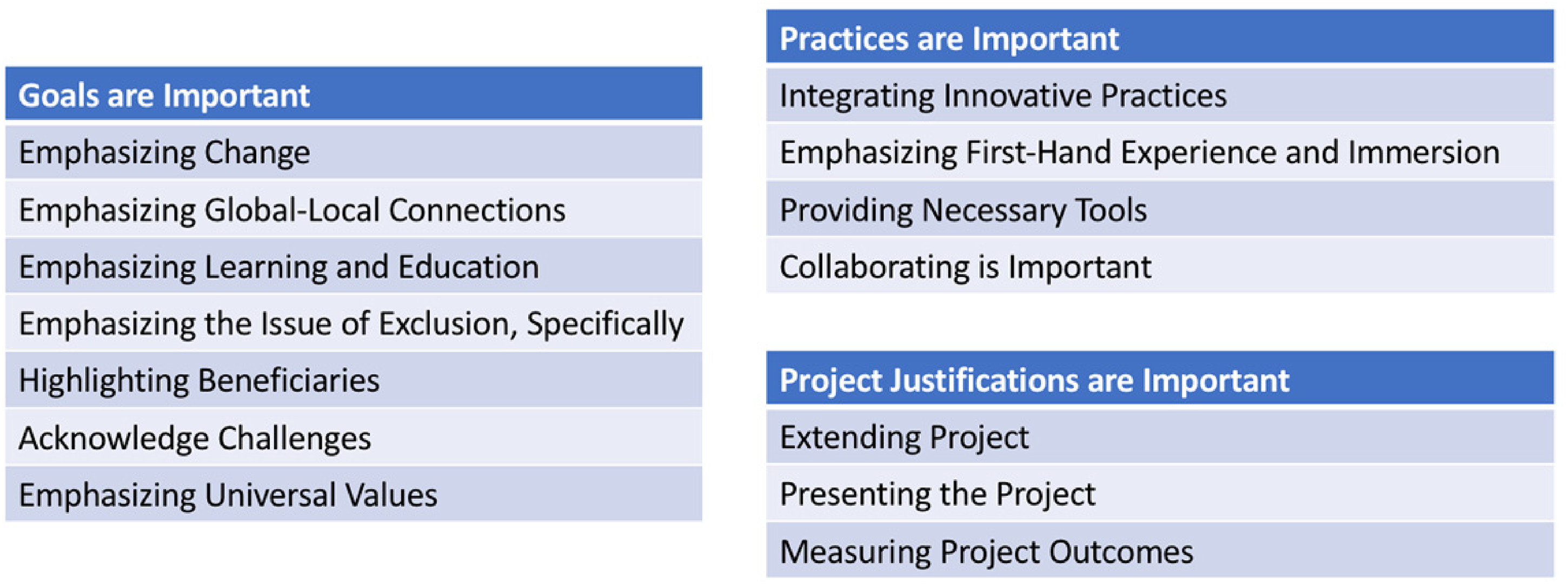
Values analysis in global education initiatives. Innovation, Values and Policy in Global Education. (2018).
The practice values were used to engage with, challenge, and embolden the goal values that were also expressed. In the applications, organizations were able to use the genre to convey concepts of justice, equity, and belonging in ways that illustrated their creativity and mission. Because of the uniqueness of the practices that were expressed, we decided to focus more deeply on the value expression of practices in our current study.
Why Do Organizations Focus on Their Practices?
Presently, we are interested in how the GENE innovation award process elicits innovative approaches from the applicants, which then impacts how applicants describe participation in their organizations. The policy systems that are presented have the potential for new developmental goals. This paper explores how applicants approach the value of innovation in the context of democracy, civic education, and participation. In our current analysis, we consider the practices that organizations convey and partake in. These organizations have elaborate systems and rationale that govern the way they address GE. This innovative approach views participants as citizens of the world, beyond boundaries of country.
The current study focuses specifically on the values of practice that GENE applicants expressed. Practice values emerged as applicants used concrete examples and practices to justify their projects and goals. Within the practice value, applicants emphasized innovations, first-hand experience and immersion practices, which provided the necessary tools and support to achieve programme goals and collaboration. For this analysis, excerpts were considered only if they featured multiple practice values consecutively, in order to analyze excerpts that were consistent in the delivery of the practices presented. As a result, the analysis considered here consists of 21 organization applications. Eight of the applications analyzed were from Awardees and 13 from Runners Up.
Practices were considered the means (methods, approaches, and materials) of achieving specifically focused social justice goals as well as global-local interconnection goals as important to emphasize. As such, there were a number of approaches the applicant organizations took to enact their social justice goals. One main thread considers the importance of participation by the beneficiaries of the programme and the importance of buy-in from the bottom-up. “The program's initiative is about inquiring, evaluating, reflecting and potentially changing one's practice as an educator to think and practice innovative ways of teaching and learning to meet the needs of today's learner.”
This statement showcases the organization's overarching goal to affect change through education that the organization provides. Other applicants take a different approach. “Innovative solutions in workshops’ programmes, methodology with elements of informal education and the construction of the place in the shape of a world map surrounded by houses from different continents can expand the imagination of visitors.”
Here, the organization lays out specific practices that lead to change in participants’ thoughts and perceptions.
Thus, this study focuses on the practices that organizations applying for the GENE award conveyed to examine how these organizations present innovation. Practices, or the ways in which projects and strategies are enacted (the how), reflect on what organizations do to promote Global Education and what they believe makes that work innovative.
How Do the Applicant Organizations Highlight Participation?
We dismantle how applicants portray participation as a form of engagement to understand how participation is valued. Practice values expressed by the GENE applicants convey innovative ways of bringing in the participants who engage with the organizations as active agents. Practices are about how participation occurs, whereas participation is more about who initiates the act. Thus, what kind of participation do the applicants present? How do organizations use their applications to emphasize what they do for participants and what they do to engage activity by the participants? In each of the GENE submissions, the applicants present how their organization creates curriculum and activity that engages their local citizenry. We found that there are two main forms through which participation is enacted – where organizations work for their participants and where participants are active agents doing their own participation.
We reflect on the relationality between the GE organizations, the participants they work with, and the funder they appeal to (GENE). We test the hypothesis that the GENE system is one that can create innovation and not only be about innovation. In asking organizations to focus on how their global education approach is innovative, we expect to see the development of new approaches, ones where the participants of the organizations are active agents. With this in mind, we also expect that these new approaches will lean more toward a global consciousness approach (Goren and Yemini, 2017) as a way to understand innovation in GE.
GCE falls under a few different frameworks: charity-based education, which focuses on development; an intercultural perspective focused on diversity; and a critical perspective that challenges contemporary ways of thinking about global development (Tallon, 2012). Many NGOs tried to challenge the conventional ways of thinking about development and tried to move away from the charity-based model (Tallon, 2012). That said, the marketing and funding pull that charity and relief models have, NGOs can have a difficult time if they pursue more critical models of global education when pressed for funding. Charity based models also appeal to funders because they speak to ethical desires to be helpful and to do good (Tallon, 2012). When organizations present their work as the promotion of others, there is an inherent desire to provide help that is being fulfilled. Critics of these models argue that this enacts a white-savior approach, where the better and wiser (typically Western) organization sees a deficit that needs to be resolved in the less developed world.
When social action is framed as charity toward a group in need, this often appears through practices in the organization that engage with participants’ emotions (Tallon, 2012). The GE model works to elicit empathy from participants which could lead them to take actions that can help others. Critics also argue that this makes social justice into an othering exercise, where there is a distance between the NGO participants and those in need of help (Tallon, 2012).
With this in mind, we are interested in how the GENE applicants enact participation and describe engagement when they apply for funding. We examine differences in how successful applicants (Awardees) describe participation compared to applicants that did not receive an award (Runners Up). The Runners Up, as distinguished by GENE, are all applicants that did not receive an award. If organizations take more risks, they would discuss the practices and participation in their organization through a more critical lens. Because the GENE award is specifically seeking innovation in GE programming, we expect that the applicants who do not receive the GENE award will be the ones to describe participation through less critical approaches.
Methodology
Our current analysis is theoretically grounded in the activity meaning systems model (Daiute, 2008) and within cultural-historical activity theory (Vygotsky, 1978). For this study, a values analysis approach was used (Daiute, 2014). This approach is based in dynamic narrating, where narrators are aware of and immersed in the norms and expectations of their culture (Daiute, 2017; Todorova, 2018a). Value expressions are the ways in which narrators organize and express their beliefs and views of cultural and social norms. Values, and narrative expression broadly, are dynamically and socially expressed based on the purpose and audience of the speaker. Through the GENE application, organizations purposefully express their own personal values in relation to and in conversation with the values of GENE. Thus, we aim to uncover the following inquiries: How do these organizations describe engaging participants?
How do these organizations describe participants’ actions in forwarding the organizations’ purpose?
Ultimately, we intended that these inquiries would uncover our overarching question of “How is participation valued in global education practices?”
Data collection
After careful review of what applicants discussed and how, we noticed the concept of practices within the educational organizations was centred around participation. This led us to consider how society conceptualizes participation within education, and why participation matters. Thus, we wanted to know how these organizations talked about participation, and if it made a difference in who received funding and who did not.
We extracted 215 statements in the practice excerpts that expressed participation. As a result, three patterns of value expressions emerged with a total of six values, two values per major value expression, when they discussed participation as part of organizational practices (Figure 2). The first value expression we uncovered was Perspective on Participation, which included values Big Picture or Instrumental; the second value expression we noticed was Rhetoric of Participation, which included values Persuasive or Informative; and the third value expression we determined to be Agents of Participation, which included values What Participants Are Doing (By Participants) or What Is Being Done For Participants (For Participants). The first major value expression, Perspective on Participation, was about how the view of participation played a role in the organization. Participation was a general concept that contributed to the overall organization, also known as Big Picture. The alternative was a step-by-step breakdown of how participation played out within the organization, otherwise known as Instrumental. The second major value expression, Rhetoric of Participation, involved a look at the language used to describe participation. For some organizations, positive adjectives were used to explain what participation was to demonstrate importance; in these instances, the rhetoric was Persuasive. In other organizations, verbs were used to demonstrate the daily responsibilities and other actions conducted by participants; in these instances, the rhetoric was Informative. The third major value expression, Agents of Participation, entailed the different stakeholders’ role(s) in the organization, or agency. Organizations either mentioned what the participants’ role was (ie. By Participants), or the organization's role (ie. For Participants).

List of value expressions assigned to T-units.
With an analysis of participation into these three major value expressions, we hoped to understand what participation means in society, how participation plays out in global education, and which educational organizations are funded based on how participation is valued. More specifically, the process began with a breakdown of practice excerpts into t-units; individual statements with an independent and dependent clause that formed a complete thought. We then assigned three related values, one from each value expression, to every t-unit. Thus, one t-unit would be assigned related values “Big Picture” or “Instrumental”; “Persuasive” or “Informative”; and “By Participants” or “For Participants.”
Analysis
The applications were uploaded to Atlas.ti – a software programme used to code and analyze qualitative data (Figure 3) (Scientific Software Develop, 2018). With Atlas.ti, the six values were assigned to each statement with an independent and a dependent clause. We separated the organization applications into those by Awardees and Runners Up, and isolated the portions where practices were addressed. Next, we delved deeper into what the practices were about and how they were presented, as well as if that impacted those who received an award and those who did not. Once every statement was assigned a value, the software determined the frequency of the values, as well as the frequency of the patterns of values.
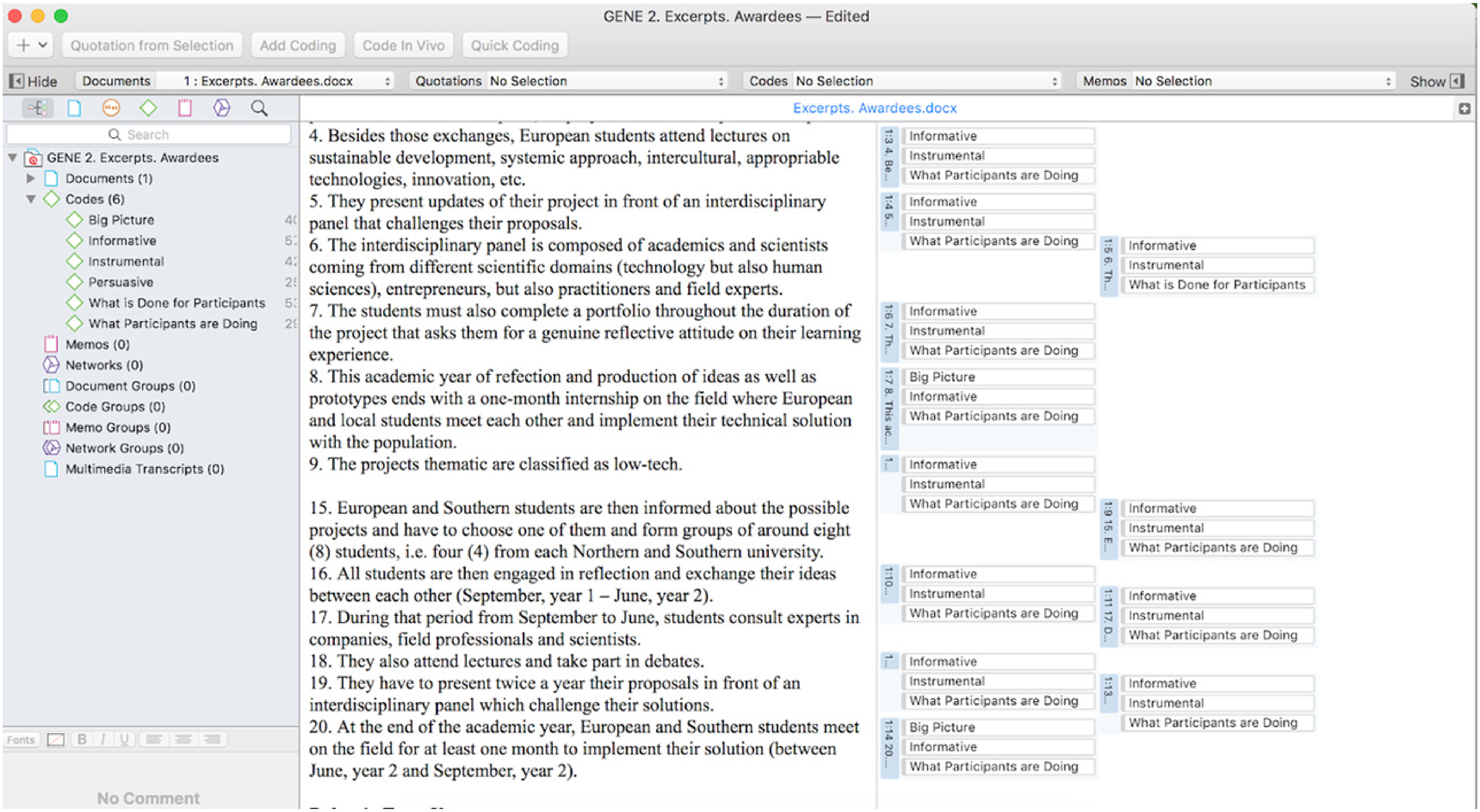
Screenshot of analyzing practice excerpts of awardees in atlas.ti.
After we analyzed the data separately, we conducted reliability on the data together, or member checking. Two researchers first coded 20% of the narratives with our value categories and came together to discuss any discrepancies. We obtained 92% reliability on single values across all six value expressions. Once reliability was obtained, we compared individual values from each value expression, as well as combinations of values within and across Awardees and Runners Up to see how they compared.
Results
Values analysis was conducted to uncover not only how values of participation through practice were expressed, but ultimately, how participation is valued and how that affected which organizations received funding or not. Broad results included an analysis of Awardees and Runners Up separately (Within Groups) to look at the frequency of eight combinations of value expressions. Next, we narrowed in on the differences between Awardees and Runners Up (Across Groups), which our analysis demonstrated that the quality of each major value expression and their value expressions.
Within group: Awardees
Out of 12 Awardees, eight organizations discussed their practices, which contained a total of 82 excerpts, or roughly 10.25 t-units per organization that were analyzed. A look at the combinations of all three major value expressions revealed that Awardees portrayed participation as either Instrumental, Informative, and By Participants, or Big Picture, Persuasive, and For Participants.
As shown in Figure 4, Awardees used their applications most to balance emphasis of the Instrumental, Informative, and By Participants values and Big Picture, Persuasive, and For Participants values. For example, one organization framing its practices through Instrumental, Informative, and By Participants value expressed: “During this training, migrants (as trainees) discuss the movie, underlying important aspects - of the movie and of their lives - to point out during the second phase of the project carried out in the school with students.”
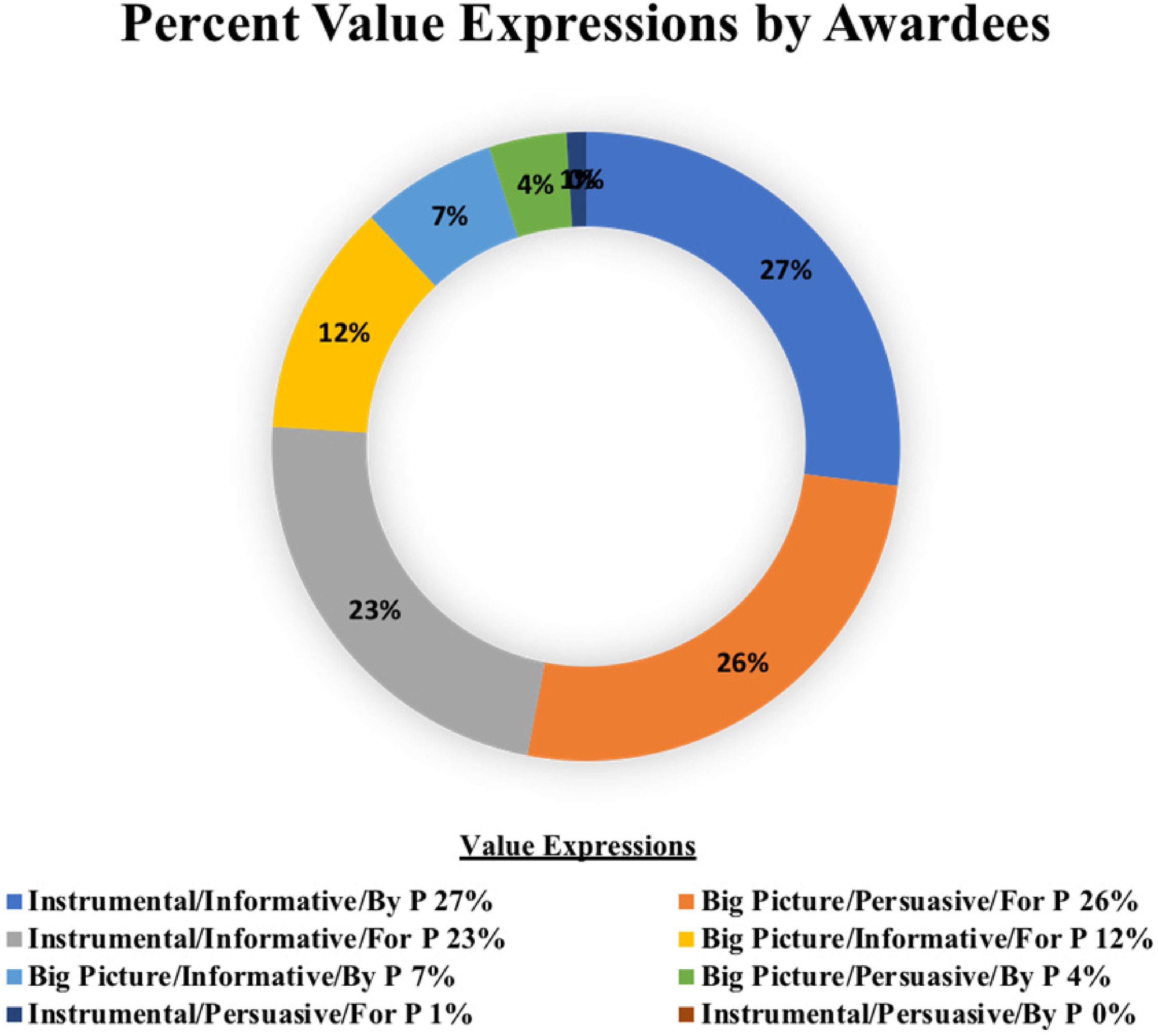
Percentages of combinations across value expressions for awardees.
The statement was analyzed as Instrumental because the organization addressed a specific practice of discussing the movie; Informative because the organization described what was happening by discussing the movie; and By Participants because the organization explained that the participants are the ones contributing to the conversation about the movie.
Another organization utilized Big Picture, Persuasive, and For Participants: “[The] educational programmes take a holistic approach and aim for the development of each participant on a personal, professional, and academic level, with the importance of having “a healthy mind in a healthy body.’ ”
The statement was identified as Big Picture because the organization addressed the purpose and strategy used to educate participants; Persuasive because the organization used adjectives like “personal,” “professional,” “academic,” as well as “healthy”; and For Participants because the organization explained how they were working to help the participants.
Hence, Awardees were more likely to take one of two clear approaches to demonstrate how they value participation. In the first approach - Instrumental, Informative, and By Participants - participation focused not only on the growth of participants, but their own contributions to a global society. In the second approach - Big Picture, Persuasive, and For Participants - participation is centred on the organization itself, how beneficial participation is, and how participation helps others.
Another noticeable pattern of value expressions was the integration of only Big Picture or Instrumental, and Persuasive or Informative. In 50% of instances, Awardees would group step-by-step tasks (Instrumental) with action words (Informative) to show what participation is in their organization. One Awardee wrote: “Lastly, (June 2017) we met for a common evaluation of the whole project with all partners and beneficiaries.”
The discussion of participation's role in the overall organization (Big Picture) and the use of descriptive language (Persuasive) was only used in 29% of instances. An example of this enactment demonstrates that the act of participation was not valued as much as the concept of participation: “Movies have, in fact, a rich potential to let us discover the deep diversity that is a blueprint of our society.”
So, the approach to participation was emphasized more than the act of participation itself for the Awardees. To compare, we looked at the patterns of value expressions by Runners Up as well.
Within group: Runners Up
For the 20 Runners Up organizations, 13 mentioned practices with a total of 133 excerpts, or 10.23 t-units per organization. A closer look at the combinations of all three major value expressions showed that Runners Up were similar to Awardees, in that, they portrayed participation as either Instrumental, Informative, and By Participants, or Big Picture, Persuasive, and For Participants. That said, the Runners Up emphasized Instrumental/Informative/By Participants more than the Awardees. Moreover, there was a bigger gap between Instrumental/Informative/By Participants and Big Picture/Persuasive/For Participants than there was for the Awardees.
As shown in Figure 5, Runners Up used their applications most to emphasize the Instrumental, Informative, and By Participants values more with a 15% lead over other combinations. For example, a Runner Up organization presented the Instrumental, Informative, and By Participants values: “During the whole year they prepare special chocolate packages and sell them at the school events such as Christmas market, open days, school community meetings, etc.”
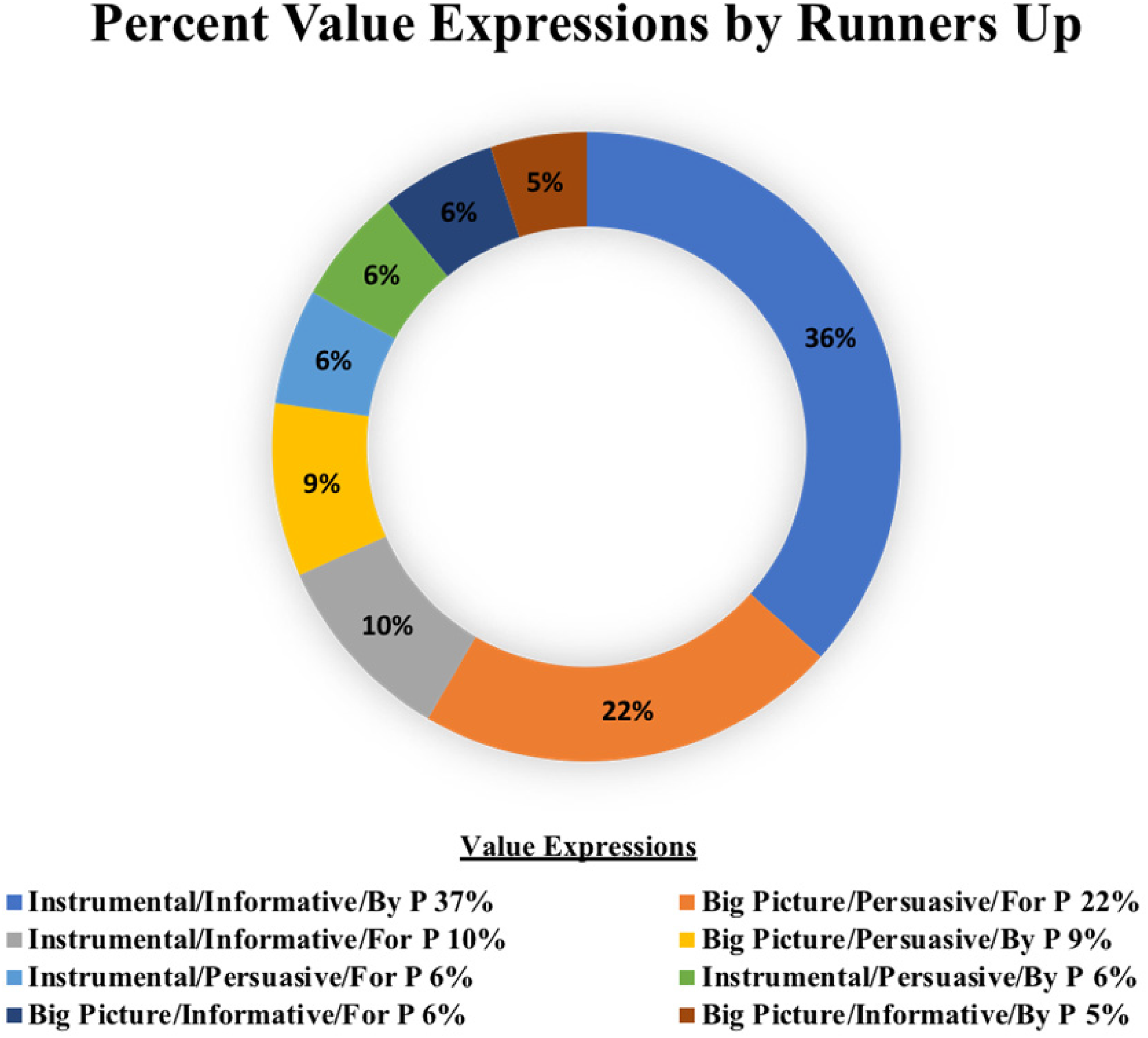
Percentages of combinations across value expressions for runners Up.
The statement was identified as Instrumental because the organization showcased a specific practice the youth participate in; Informative because the organization listed several events in which the youth participate, such as “Christmas market, open days, school community meetings”; and By Participants because the organization explained how the participants are the ones preparing and selling the chocolate packages.
The other frequently seen combination of Big Picture, Persuasive, and For Participants was also expressed by Runner Up organizations: “Based on more than 20 years of experience, we have ascertained that international peer-to-peer exchanges prove an important catalyst for global learning, because they produce permanent, profound changes in people's hearts and minds.”
The statement was identified as Big Picture because the organization shared their philosophy to help people based on their experience; Persuasive because the organization used words/phrases, such as “prove,” “important,” “permanent,” and “profound”; and For Participants because the organization stated how they change the hearts and minds of people, rather than the people creating change in themselves or for others.
That said, the combination Instrumental, Informative, By Participants occurred 15% more than the combination Big Picture, Persuasive, For Participants. For the Awardees, there was only a 1% gap between the same combinations.
Other significant results consisted of two-value combinations. When it came to Big Picture or Instrumental and By Participants or For Participants, 43% of instances mentioned participation as it relates to tasks and participants’ role in those tasks (ie. Instrumental and By Participants). For example, “Teaching methods used in programme are brainstorming, group work, presentation, with text, discussion etc.”
For Persuasive or Informative and By Participants or For Participants, 41% of instances described participation as participant action(s) within the organization (ie. Informative and By Participants). An example was, “The portal is accompanied by additional activities coherent with the portal (e-learning courses, stories and photo reportages covering GE classes, various ways of promotion).
Lastly, a look at Big Picture or Instrumental and Persuasive or Informative showed that 47% of instances explained the role of participation in terms of day-to-day actions within the organization (ie. Instrumental and Informative). Another example was, “When we run e-learning courses, we assign teachers ‘homework’ that requires them to conduct classes based on our class scenarios.”
Hence, the act of participation was valued more than the concept of participation for the Runners Up, which was the opposite for the Awardees. Overall, Awardees and Runners Up most expressed the same two combinations of Instrumental/Informative/By Participants and Big Picture/Persuasive/For Participants to present their organization as deserving of funding. Thus, a look at individual values and examples of values across groups was also necessary to investigate.
Across groups: Perspective on participation
The way the organizations were presented to the funder, or the Perspective on Participation, were defined by Big Picture or Instrumental. T-units identified as Big Picture presented participation within the organization as the purpose or end goal of the organization. T-units labelled as Instrumental presented participation as the day-to-day tasks of the organization. As shown in Figure 6, Awardees mentioned perspective on participation about the same among Big Picture and Instrumental values, at 49% and 51% of the time respectively. Runners Up talked about the day-to-day duties of participation in the organization, or Instrumental, 59% of the time, whereas they talked about participation in terms of the overall organization, Big Picture, 41% of the time, leaving an 18% gap.
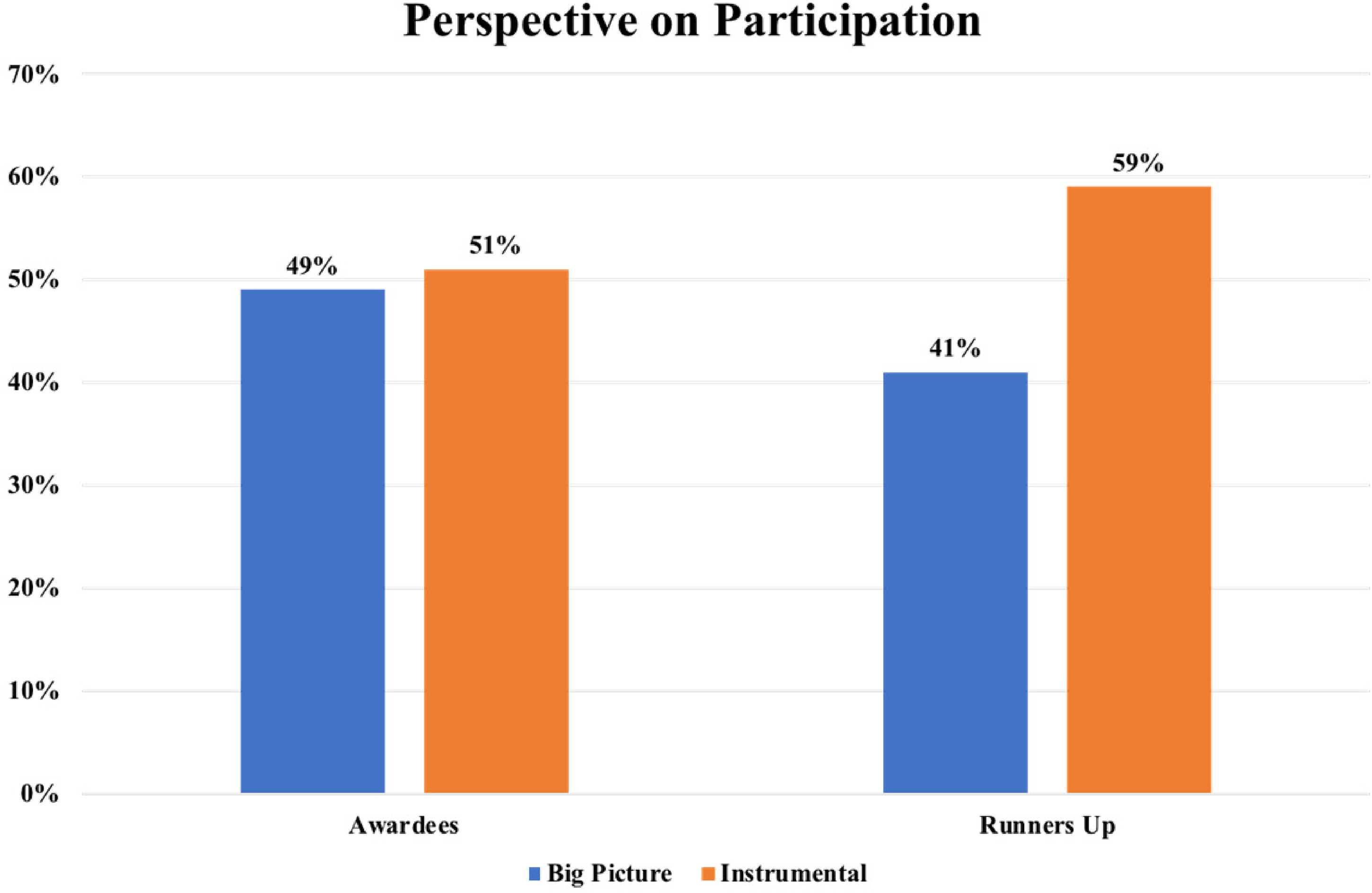
Percentages of Big picture and instrumental values within groups.
Big picture values
For both Awardees and Runners Up, Big Picture values expressed recognizing the problem or need in society, their intent or purpose, their philosophy or pedagogy, what they learned through experience, their mottos, and their long-term aspirations or goals. Thus, Big Picture values signified an organizations’ overall outlook on what participation in education should be. An example for Awardees was, “Within the project we are trying to connect global food systems topics with global social inequalities and bring these topics into environmental education in a creative and holistic way.”
Here, the Awardee talked about the importance of connecting the problem with global food systems to potential solutions while using an approach that they believe in (ie. creative and holistic). On the other hand, an example for Runners Up was, “The idea is to achieve routes that are able to connect with each person's experience and give examples people can relate to when discussing these challenges.”
Here, the Runner Up stated what their intentions were with the project and how they hoped to make a change through participants’ experiences in the organization.
Instrumental values
Instrumental values expressed individual tasks, who was involved, duration of tasks, and detailed exchanges between the participants and their organizations. An example for Awardees was, “The students communicate via emails, text messages, phone calls, video meetings, etc. with each other from September to June.”
Here, the Awardee listed the multiple ways in which their participants connect and communicate with one another in a certain amount of time to get the job done. On the other hand, an example for Runners Up was, “They draft new scenarios for us, write methodical comments to the existing ones, participate in website surveys, giving us feedback on how to develop our initiative.”
Here, the Runner Up provided several tasks of the participants to help the organization enhance their purpose and effect on society.
Both Big Picture and Instrumental values were slightly different in frequency, but there was no difference in how they were stated across groups. Thus, whether participation was presented as a means to an end (Big Picture) or a daily task (Instrumental), the values were similarly expressed between the Awardees and the Runners Up.
Across groups: Rhetoric of participation
The rhetoric used in the applications were categorized as either persuasive or informative. Persuasive rhetoric involved descriptive words and phrases that would elicit a positive response from the funder. Informative rhetoric simply stated how participation played out in the organization. In Figure 7, for Awardees, the widest gap in values involved the descriptive words used to talk about participation, as Persuasive rhetoric was used 30% of the time and Informative rhetoric was used 70% of the time. Thus, while the Awardees did not emphasize either overall participation or day-to-day participation within their organization, other values were more important. Moreover, Awardees made a conscious effort to use descriptive words in hopes to receive funding than to tell them what participation actually looked like within their organization. For Runners Up, however, there was a 14% gap where participation was described with Informative rhetoric 57% of the time compared to participation being described with Persuasive rhetoric 43% of the time.
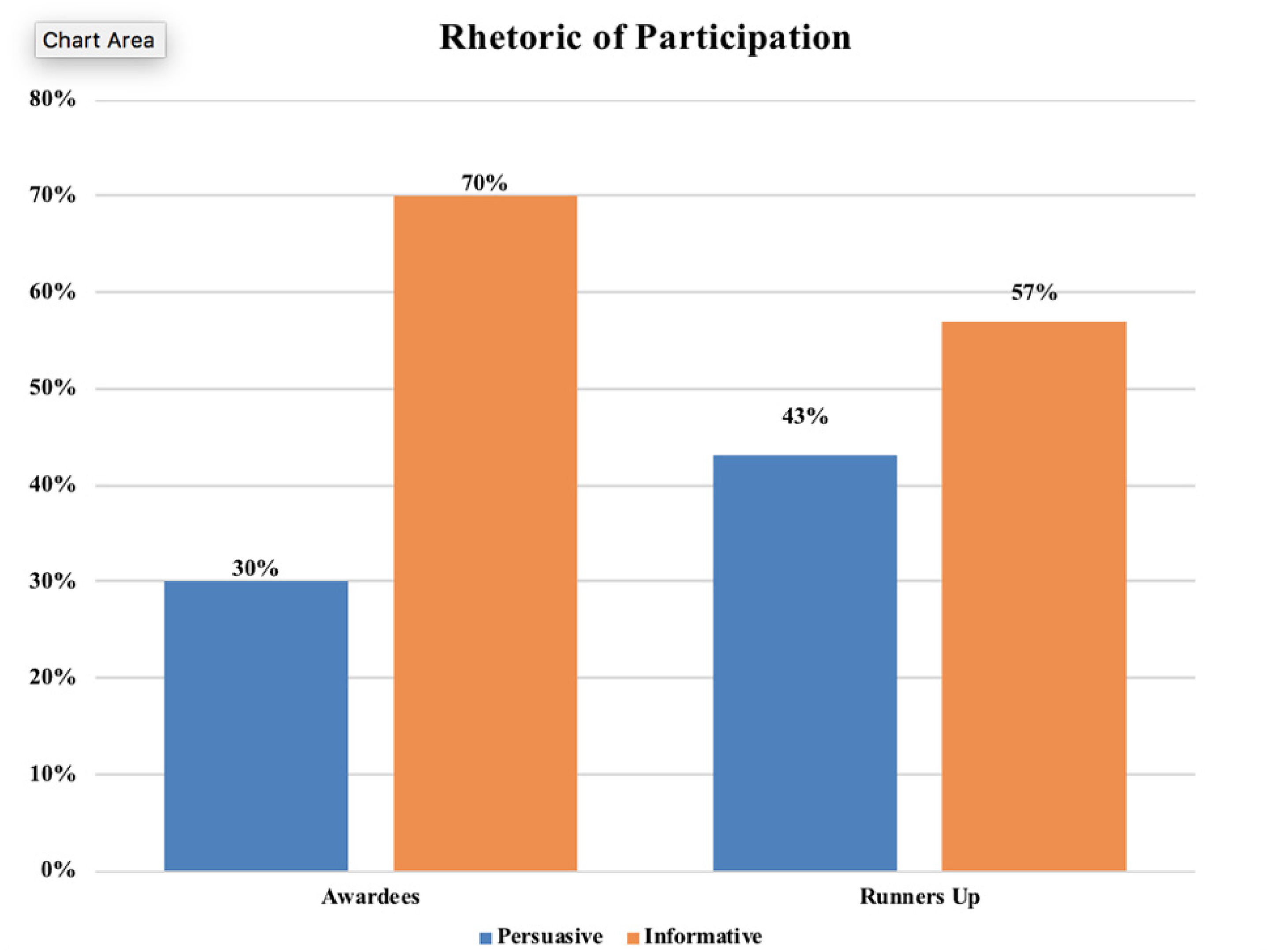
Percentages of persuasive and informative values within groups.
Persuasive values
Persuasive values for Awardees emphasized community, stakeholders, what was still needed in global education, as well as action and change. For example, “Concrete actions towards conscious and responsible food choices are based on local contexts and thus creative and needs based in their essence.”
Here, the Awardee was direct and confident in how they used participation in their organization. When they discussed their methodology, they used persuasive rhetoric to show they took action and could produce tangible change, while using words/phrases like “concrete actions,” “responsible,” “creative,” and “needs based.”
Persuasive values for Runners Up focused on experience, helping others, and awareness, however, they would always build up to something greater. For example, “The project participants, if genuinely enthusiastic about the work they are doing, will convince family and peers of the project's positive impact, multiplying the number of people involved and boosting general awareness.”
Here, the Runner Up was not confident that the participants were passionate about the project, and they were unsure about the project's outcome, rather than what the organization was already doing. The Persuasive value for Runners Up was more about possibilities, rather than the present effect they had on participants and global society.
Informative values
Informative values for Awardees centred on communication, interaction, challenges, and implementation. For example, “As students come from different academic and professional backgrounds, they ask relevant question, they uncover new insights for new aspects of the problems during the discussions.”
Here, the Awardee spoke about interaction in terms of engagement and exploration because participants are encouraged to use their critical thinking skills. They use informative rhetoric in a way that exemplifies not only action, but creativity through discussion and other forms of collaboration.
Informative values for Runners Up, while about interaction, were more about preparation, set-up, and an approach to something bigger. For example, “First animation in class in the form of a philosophical discussion (learning the rules of the philosophical speech, work of argumentation, listening …).”
Here, the Runner Up discussed one step in a step-by-step process, where they first address the animation stage in the form of a discussion. The informative language is about tools or materials used, topics discussed, and the methods used in their organization.
Across groups: Agents of participation
For Awardees, the stakeholder's role in participation showed a noticeable difference, through discussion of By Participants 38% of the time compared to For Participants 62% of the time (Figure 8). Awardees emphasized the organization's role in participants’ educational growth, rather than participants’ role in the organization itself. For Runners Up, the difference between values involved the role of participants in the organization, with 56% of instances where they mentioned By Participants and 44% of instances where they explained For Participants.
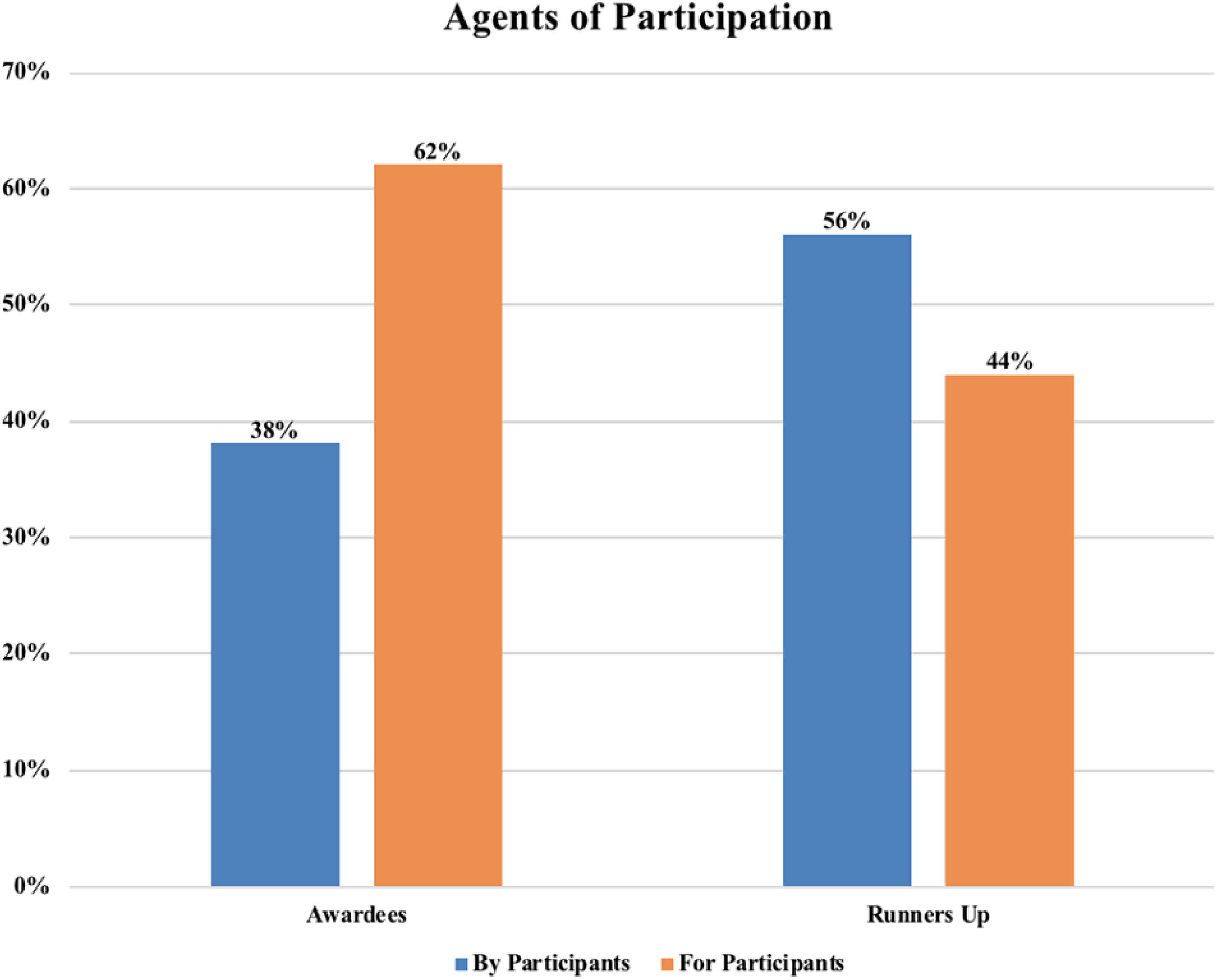
Percentages of By participants and for participants values within groups.
What is being done [For participants]
The For Participants value for Awardees was about positive transformations in the organization's participants. For example, “This holistic approach helps to address the gap in global competence, which includes enhancing students’ knowledge, skills, values, and behaviours for responsible global citizenship.”
Here, not only does the Awardee mention what the individual participant gains from being part of the organization, they emphasize that the participant can then change global society with what they learned in the organization itself.
The For Participants value for Runners Up was also about changing the participants, but they did not talk about specific change to the participant or society. For example, “We give a central place to the learns who constantly look after/treat/exchange information.”
Here, the Runner Up mentioned the opportunity for change through cooperation with other stakeholders as they shared information with others. While the For Participant value demonstrates participation, there are no specifics to what that change is or will look like.
What participants are doing [by participants]
The By Participants value for Awardees was about participants’ critical thinking, reflection, and innovation. For example, “This academic year of reflection and production of ideas as well as prototypes ends with a one-month internship on the field where European and local students meet each other and implement their technical solutions with the population.”
Here, the Awardee expressed participation in what participants are doing by coming up with solutions and implementing those solutions in a global society.
The By Participants values for Runners Up were expressed in indirect terms of interaction and exchange. For example, “The class prepares a collective portrait which was recorded to the attention of the corresponding class.”
Here, the Runner Up described the By Participant value as collaboration and working together for the greater good, however, the organization never stated this explicitly.
All values across the three major value expressions were used in the organizations, however, the values were expressed differently across the Awardees and Runners Up. Thus, the amount of instances in which a value was expressed was not as significant as how each value was expressed. For Awardees, active participation (by participants) was not emphasized as much as what the organizations were doing for participants, but they were clear and direct in laying out the positive outcomes of their organizations’ participation, as well as other long-term goals. On the other hand, the Runners Up expressed more choice for participants when they discussed participation, but they were not direct, not confident in their assertions, nor did they emphasize innovation and explicitly state how their organization was different from the rest
Discussion
The current analysis of GENE applicants focused on how GE practices are framed and emphasized within innovative projects. We wanted to explore how the application projects are innovative and expected to see the development of new approaches, ones where the participants of the organizations are active agents. Focusing on participation, we were interested in how these organizations enacted participation and described engagement when applying for funding. We expected the more innovative organizations to be the ones who take more risks and who discuss the practices and participation in their organization through a more critical lens.
The results demonstrated, however, a more traditional perspective of participation in global education. The results were broken down by values Within Groups and Across Groups. For Within Groups, both Awardees and Runners Up expressed participation as a combination of Instrumental, Informative, and By Participants codes or a combination of Big Picture, Persuasive, and For Participants codes. For Across Groups, Awardees’ “Perspective on Participation” were expressed as either Big Picture or Instrumental, whereas the Runners Up leaned more toward Instrumental. For “Rhetoric of Participation,” both Awardees and Runners Up used more informative language than persuasive. For “Agents of Participation,” Awardees were coded as using For Participants more and Runners Up were coded as using By Participants more. Thus, the values of Awardees and Runners Up were similar, however, the ways in which those values were expressed were different, which impacted whether they received funding from GENE.
Applications are a major component of how organizations, agencies, funders, and individuals live much of their lives. Applications are used as a tool for participation and entrance into activities, like applying for grants, such as the GENE award. In this case, applicants use the GENE award in hopes of being able to fund and endorse their innovative educational approaches.
Applications are also implicated in dynamic power relations. They are often used as a barrier to entry or as an access point to funds or groups one wants to be a part of. Power relations can reinforce access and inequality or can be used to push barriers and challenge the status quo, depending on the ways in which awards are given. There is an inherent power that comes with being the award-granters that is first and foremost associated with funding and money. In being the ones with the money, and not the ones asking for the money, these organizations then dictate who gets access to funds. Through this genre, applicants use their applications purposefully as well, with creative and masterful approaches to speaking to funders. Particularly for organizations that want to promote diversity and equity, there can be great benefits to understanding how the gatekeepers operate and perceive their applications. Thus, the analysis of the GENE awards does not remove the power relations and gatekeeping that exist but it can be useful in understanding the dynamics, processes, and strategies at play.
The applicants are active agents and respond to the requirements put forward by GENE with their own purposes and goals in mind. Additionally, in the applications themselves, the citizen-participants – those that partake in the organizations – are essential to the organization that applies for the GENE award. On the one hand, applicants present the work as for the participants, through engagement to create a better world for the migrants and refugees that entered their country. On the other hand, applicants present the work that is done by participants themselves, a narrative stance that essentially makes the citizen-participants the driving agents of the organization (and not the organization itself).
Given that one of the criticisms of GE models question whether what is learned can actually be put into practice (Eis and Moulis-Doos, 2017), one approach to innovation could be applicants conveying how they enact these practices. Because the GENE award is specifically seeking innovation in GE programming, we expected that the applicants who received the GENE award would be the ones to describe more critical approaches to participation as a way of showing practices in action. Further, considering the distinction between ‘active’ and ‘passive’ GE programmes (Bourn, 2016), we imagined the more innovative approaches would be the ones that are active and that engage participants in ‘the doing’.
Therefore, we expected that participation done by participants would be described by the Awardees, since they were the ones to win funding from GENE. We expected this because of the push for activity-based GE among organizations and funders in Europe, where the emphasis is for the participants to be actively involved in learning (Bourn, 2016). However, our findings do not support this active participation-based model as we found that winners of the GENE award more frequently expressed what the organizations are doing for the participants. The applicants who did not receive an award were more likely to convey what the participants were doing.
Perhaps what these findings show is a reflection on who is the active agent. We anticipated seeing active pedagogy expressed as participants engaged in the doing of the work – through social movements and individual actions (Bourn, 2016). In finding that the Awardees expressed participation as what they would be doing for the participants, it appears that this approach is more passive on the part of the participants. But in the Awardees’ descriptions of the practices they run, the informative approach that is emphasized describes how participants were actively engaged. Additionally, the Awardees were more forceful in their expressions of practices. They directly describe their organization's role and goals. In a sense, the Awardees may be showing their own engagement as active agents in the process of how the organizations engage the participants. The by participants and for participants is not just binary in its nature but shows that applicants are being strategic in the application process. They are conveying innovative approaches to GE, while not necessarily in explicit ways that only centre on the participant, through an approach that highlights what the organization will do for others. Considering Andreotti's (2014) analysis, critical GE models would factor in more structural and systemic approaches to engaging learners. Perhaps through the focus on the organization as a whole, rather than on what individuals can do, GENE applicants are conveying their critical approach to GE.
There are limitations to this study that we were not able to address. This project is an analysis of the applications that were produced and the award status given to them by GENE. As researchers, we do not have insight as to how award decisions were made or what specifically funders were looking for. Our analysis is rooted in the material presented in the application process and the applicants’ responses. This project also does not examine any outcomes for the organizations upon receiving the GENE award. It would be interesting to explore whether and how these organizations implement the grant funding. Further research could also consider whether the enactment of the practices the winning organizations described bring about more critical approaches and build critical activists and learners.
Implications of this research offer insight for how organizational discourse should be understood as activity and how that is relevant to finding processes and activities of presentation of goals, practices, and connections within and across the GE world. The findings show that it is important for those who offer funding to include their criteria but to also consider new criteria. Thus, the application is a socio-political communicative interaction that gives both sides (applicant and funder) opportunity for goal enactment. There is space for ‘innovation’ in the context of GE to be further explored and space for on-the-ground organizations to have a claim in what that innovation can be.
Footnotes
Author Note
We have no known conflict of interest to disclose. The paper has not been previously published and is not currently under consideration by another journal.
Declaration of conflicting interests
The author(s) declared no potential conflicts of interest with respect to the research, authorship, and/or publication of this article.
Funding
The author(s) received no financial support for the research, authorship, and/or publication of this article.
