




Abstract
In the past two decades global citizenship education (GCE) has become established in national and international education policy. This article focuses on the emergence of GCE in the educational discourse of the Province of Trento in northern Italy and outlines how policymakers and teachers construct GCE as a pedagogical framework for schooling in the 21st century. Combining the perspectives that emerge from the scholarly literature with the findings of a qualitative study based on Constructivist and Informed Grounded Theory, the article proposes a typology of GCE ideal-types. The typology illustrates two ‘mainstream ideal-types’ of GCE (neo-liberal human capitalism and cosmopolitan humanism) and two ‘critical ideal-types’ (social-justice activism and critical counter practice). In the province studied, the dominant perspective is cosmopolitan humanism. GCE is essentially conceptualised as a ‘new moral pedagogy’ that reflects adherence and commitment to a universal moral structure based on humanistic cosmopolitan values. The author believes that critical GCE perspectives in line with social-justice activism and critical counter practice should find expression in both policies, curricula and practices. However, this is recognised as a challenge which could be partially addressed through teacher education and an alliance between academia and practice.
Keywords
Introduction
Rising nationalism and populism, increasing xenophobia and racism, the growth of violent extremism pose significant challenges to human rights and the democratic values that have been the cornerstone of European democracies since the end of the Second World War. These phenomena are manifestations of a globalised system characterised by high levels of interconnectedness and challenging global problems. Despite some favourable trends with regard to the implementation of the sustainable development goals (SDGs), the shift in development pathways to generate the transformation required to address the issues identified in the SDGs is not advancing at the speed or scale required. Hence global challenges like the persistence of extreme poverty and hunger, the loss of biodiversity, the increase of greenhouse gas emissions, the exclusion of population groups with documented disadvantages, gender inequalities, conflict and instability persist and/or have increased (United Nations, 2019). In this context, the last two decades have witnessed a resurgence of interest in a global notion of citizenship (Dower, 2003). The concept of ‘global citizenship’ has become popular in academia but also in a variety of sectors, including private companies, educational institutions, international organisations, governments and non-governmental organisations (NGOs). But like all popular terms, it is used ambiguously and is understood differently both within and across a variety of contexts (Oxley and Morris, 2013).
Education is one of the fields where the concept of global citizenship is most seriously used, particularly in the literature that theorises the need for a new citizenship education with a global orientation (Pashby, 2011). In the past two decades, global citizenship and particularly its ‘associated construct’, global citizenship education (GCE), have ‘taken on the status of a “global” or “travelling” educational policy’ (Oxley and Morris, 2013: 301–302). From its emergence in the 1990s, GCE has rapidly become the object of substantial academic discussions, and in recent years the narrative about GCE has become established in international policies. Tarozzi and Torres (2016) underline that this important and new development happened in ways that GCE scholars had never imagined and expected. They identify the Global Education First Initiative (GEFI), launched in 2012 by the UN Secretary General, as the ‘start of a new global sensitivity’ (Tarozzi and Torres, 2016: 6). The GEFI includes fostering global citizenship as one of its three priorities; the other two are to expand access to education and to improve the quality of learning. In the GEFI, education is considered much more than a provider of competences to enter the job market and be efficient workers and consumers in the global economy: through an emphasis on global citizenship, education has the power to shape a sustainable future and a better world (United Nations, 2012). GCE is also firmly established within the SDGs for the period 2015–2030, in particular SDG 4.7 (United Nations, 2015a) and its indicator 4.7.1 which requires countries to measure the extent to which (a) GCE and (b) education for sustainable development, including gender equality and human rights, are mainstreamed at all levels in (a) national education policies; (b) curricula; (c) teacher education; and (d) student assessment (United Nations, 2015b). Internationally two key actors have provided pedagogical frameworks for the integration of global citizenship competences in formal education. UNESCO (2015) has developed a pedagogical framework on GCE which largely pursues a socialisation function, while OECD (2018) has integrated global competences in its Programme for International Student Assessment (PISA) and pursues primarily a qualification function (Franch, 2019).
GCE, or its ‘antecedents’ Development Education and Global Education (Tarozzi and Torres, 2016: 6), are becoming increasingly prominent in Europe in government policies (McAuley, 2018) and in educational discourses and practices (Bourn, 2015). Mannion et al. (2011) talk about a ‘curricular turn towards the global’ and enhanced profile of GCE in the national policy discourses of many European countries. Yet GCE is a complex and ambiguous concept that ‘emerges from a nexus of interrelated discursive fields, each of them contested as well as marked by particular histories, challenges, and possibilities’ (Pashby, 2016: 69). The words global, citizenship and education represent narratives that, although apparently neutral, natural and unquestionable, are in reality contested discursive fields. Seeing GCE as a ‘nexus of interrelated discursive fields’ (Pashby, 2016: 69), therefore, means recognising how language, and in this case the words global, citizenship and education, do not just describe reality, but rather ‘construct (different) realities’ (Andreotti, 2010: 240). The global/globalisation, citizenship and education are therefore interpreted differently in a variety of contexts according to shared worldviews and cultural assumptions of what counts as real or ideal (Pashby, 2016). Therefore, when understood discursively, GCE ‘becomes a complicated idea that is infused with various meanings’ (Pashby, 2016: 71). It operates as a ‘nodal point in policy discourse – a floating signifier that different discourses attempt to cover with meaning’ (Mannion et al., 2011: 443).
This article is based on a qualitative research that explored how GCE is conceptualised in the Province of Trento in northern Italy. Due to historical reasons and the presence of linguistic minorities, this Province enjoys a special autonomy within the Italian regional system. This means that the provincial government has legislative and administrative powers in many areas, one of which is education, that in Italy are normally under the competence and responsibility of the state. The decision to study this particular province relates to a number of factors, which make this province an interesting case study. Firstly, the Province of Trento distinguished itself nationally for its commitment to international development co-operation. In the late 1980s it paved the way for the involvement of local and regional authorities (LRAs) in international development and since the early 1990s, allocated a significant and growing share of financial resources to international development projects and GCE activities. Secondly, since 2015, the Province of Trento significantly scaled up its support to GCE. It became the lead partner of a European project which provided an impetus for increased engagement at the national level. This province managed to mobilise other Italian regions in support of GCE and promoted the drafting and approval by the Italian regions of a policy document on GCE. In the latter part of 2017, the Province of Trento co-ordinated a national multi-stakeholder process which resulted in the development of the first Italian national strategy on GCE. Thirdly, through a European project the Province of Trento initiated a process to integrate GCE in the curriculum of the primary schools under its jurisdiction. GCE was brought to the attention of local policymakers and some timid changes in the provincial education policies were initiated. At the practice level training was provided to school managers, teachers and local civil society organisations. Although the Province of Trento may be just a small player on the international scene, focusing the research on this province provided an opportunity to see how the dynamics that characterise the provincial education discourse, and that reflect global education trends, were reconciled with attempts to initiate policy and practice changes related to GCE. It also showed how teachers interpreted GCE while at the same time reproducing, ignoring or challenging the provincial policy discourses.
In summary, this article shows the multiple meanings and perspectives that different provincial actors convey through GCE. It addresses two interests underrepresented in the scholarly literature. Firstly, it responds to calls from different scholars for empirical research in schools to explore perspectives, experiences and approaches on GCE (Marshall, 2011, Peterson, 2016). Second, as the bulk of the writings on GCE, both theoretical and empirical, is mainly from Anglo-Saxon countries, it adds the case of Italy, where GCE is practised in both formal and non-formal education, but is still marginal within scholarly pedagogical discourses. The article offers a number of theoretical insights which are relevant for policymakers and educators in the province studied, but are also pertinent for scholars and practitioners in other European contexts. In particular, it proposes a typology of GCE’s conceptions that could be used as an analytical tool to carry out studies in other contexts. The typology illustrates two ‘mainstream ideal-types’ of GCE (neo-liberal human capitalism and cosmopolitan humanism) and two ‘critical ideal types’ (social-justice activism and critical counter practice). The author believes that it is important that the two critical ideal types of GCE move beyond experimentation by individual educators and teachers and find a more systematic translation in policies, curricula and practices. However, this is recognized as a challenge which could be partially addressed through teacher education and an alliance between academia and practice.
GCE: diverse conceptualisations and pedagogical frameworks
In many Western countries, the language and practice of GCE is undoubtedly entering formal education and scholars have begun to study how GCE is understood and practised in schools (Blackmore, 2014; Bryan and Bracken, 2011; Cozzolino DiCicco, 2016; Rapoport, 2015). Yet, this heightened interest in integrating a global dimension in the curriculum responds to particular political interests. Mannion et al. (2011) underline that the recent ‘curricular turn towards the global’ and enhanced profile of GCE in national policy discourses are not arriving by chance in Europe and more broadly in the west, but rather respond to particular cultural and economic threats perceived by politicians and policymakers. These threats are linked to the challenges of increasingly culturally diverse societies and work environments, and to a desire of European countries to continue to be significant global players both economically and culturally (Mannion et al., 2011). The ‘official curricular global turn’ is essentially a reaction to the presumed fact and value of one dominant model of globalisation, and of a certain global world economy and society, assumed to be desirable and desired by us in Europe and by others in the rest of the world (Mannion et al., 2011). In this perspective, the ‘official curricular global turn’ and GCE are instruments to pursue the onward economic development of European countries and prepare young people to face the threats and reap the benefits of globalisation (Mannion et al., 2011).
This vision of GCE is certainly dominant in European education-policy discourses, but it is not the only perspective that influences educational policies and practices. In the context of todays globalised and unequal world, a number of scholars call for an ethical, political and critical GCE. Mannion et al. (2011), for example, react to the fact that GCE might conflate environmental and development agendas within a new-found citizenship agenda based on a ‘socialisation conception’ of civic learning (Biesta, 2014). In this socialisation vision, the focus is on producing the global ‘responsible citizen’ defined in cultural/social and economic terms, that is a citizen who is contributing to the community and working in the economy. In this perspective, the political and justice-oriented citizen can be easily obfuscated (Mannion et al., 2011). Hence, Mannion et al. (2011) call for a GCE that draws from its ‘lineages’, in particular environmental education, development education and citizenship education, and ‘the rich tapestry of eco-socially critical approaches’ that can be found in these ‘lineages’ (2011: 454). In this perspective the focus of a critical and political GCE is no longer about acquiring the competences to be responsible global citizens who are ‘obedient, deferential, and compliant as they take their place within hierarchical and authoritative social structures and power relationships’ (Jickling and Wals, 2007: 8). In line with a ‘subjectification conception’ of civic learning (Biesta, 2014), a critical and political GCE focuses on the process of citizenship, and hence on asking what kind of global citizenship practices are possible within schools and society more generally and what and how students might learn from such practices (Mannion et al., 2011).
Drawing from Biesta’s (2009) work on the functions and purposes of education – qualification, socialisation, subjectification – Sant et al. (2018) identify three discourses within GCE: GCE as qualification, GCE as socialisation and GCE as subjectification. These three discourses within GCE should not be seen as entirely separate. On the contrary, in both pedagogical frameworks and in practice they are deeply intertwined and overlapping. While synergy is certainly possible and indeed has the potential to facilitate a comprehensive approach to GCE, one should note that there is also contradiction and potential for conflict between the three discourses, particularly between the qualification and socialisation dimension on the one hand, and the subjectification on the other.
In GCE as qualification, the purpose is to facilitate the acquisition of a certain set of knowledge, skills and dispositions, what have been referred to as global and intercultural competences (Sant et al., 2018). The dominant perspective is not about fostering a global citizen committed to social justice, but rather a global entrepreneur. An apt example of GCE as qualification is the new OECD PISA 2018 Global Competence Framework (Franch, 2019), which sees GCE in terms of ‘global competences’ (Dill, 2013). The framework provides a definition of global competences on the basis of a prescriptive set of knowledge, skills, attitudes and values, and proposes a set of tools and criteria to assess and certify adolescents’ global competences.
In GCE as socialisation, the focus is on promoting certain values and identities to become ‘good citizens of the world’. The main emphasis here is on fostering citizens who are committed to a world culture based on human rights, pacifist values and cohesiveness, care for the environment and sustainability (Sant et al., 2018). GCE as socialisation has points in common with the ‘global consciousness’ view of GCE identified by Dill (2013). The OECD PISA Global Competence framework includes this perspective and therefore merges GCE as qualification with GCE as socialisation, but a more fitting example of GCE as socialisation is the UNESCO’s (2015) GCE pedagogical framework (Franch, 2019). The ‘good global citizen’ is defined by UNESCO in relation to three domains of learning (cognitive, socio-emotional and behavioural). The global citizen is ‘informed and critically literate, socially connected and respectful of diversity, ethically responsible and engaged’ (UNESCO, 2015: 23–24).
In GCE as subjectification, the emphasis is on promoting ‘a global citizenship from below’ (Sant et al., 2018) and in line with a critical tradition, GCE is a ‘counter-practice’, that is an ‘education on non-dominant knowledges and values’ (Sant et al., 2018). Andreotti (2010)’s post-colonial and post-critical GCE, or ‘global citizenship education otherwise’ (Andreotti, 2015: 221) is an apt example of GCE as subjectification (Franch, 2019). The post traditions have the potential to provide educators with conceptual tools that will help them ‘pluralize epistemologies and possibilities for thinking and practice’ (Andreotti 2010: 245). Andreotti’s post-colonial and post-critical GCE does not provide learners with normative ideals of democracy, freedom, rights and justice that are presented as universal, but rather is meant to facilitate ‘the emergence of ethical, responsible and responsive ways of seeing, knowing and relating to others “in context”’ (Andreotti, 2010: 239).
Methodology: constructivist and informed grounded theory
Considering the ambiguities and diverse conceptualisations and pedagogical frameworks that characterise GCE, this article explores how GCE is conceptualised in the Province of Trento in northern Italy. It draws from the findings of a qualitative study based on grounded theory (GT; Glaser and Strauss, 1967; Strauss and Corbin, 1990; 1998; Corbin and Strauss, 2008), in particular the constructivist interpretation promoted by Charmaz (2014) and the informed version suggested by Thornberg (2012). Constructivist and informed GT enabled learning about the participants’ meanings, and ensured that both the process and the product of research remained ‘thoroughly grounded in data by GT methods while being informed by existing research literature and theoretical frameworks’ (Thornberg, 2012: 249 ).
The main data gathering method used in the study was intensive interviews with provincial decision makers, key informants and particularly teachers. Intensive interviewing in fact is particularly suitable for constructivist GT as it foregrounds the participants’ words and meanings while at the same time allowing researchers to explore areas of emerging theoretical interest when participants bring them up (Charmaz, 2014). In line with GT, a flexible attitude characterised the data gathering process as ‘in the midst of the research, questions may arise that impel researchers to construct new data-gathering methods and to revise earlier ones’ (Charmaz, 2014: 28). Intensive interviewing was hence complemented by a thematic analysis of relevant provincial policy documents on international development cooperation and education.
Intensive interviews were conducted between February and November 2017 with five decision-makers and key informants representing the provincial Office for International Development Co-operation, the provincial Education Office, and two provincial centres involved in research and training on education and international development. An additional decision maker decided to provide a written response to the interview questions. The section ‘GCE as a new “moral pedagogy”’ below includes extracts from the interviews with some of these key informants: provincial representative ‘c’ worked in the Education Office, provincial representative ‘b’ in the Office for International Development Co-operation, representative training centre ‘a’ in the provincial centre on education and representative training centre ‘b’ in the provincial centre on international co-operation.
In the same period, 21 teachers from nine lower secondary schools were interviewed. The schools included in the sample were located in both the main urban centres and rural valleys, had both a low and a high percentage of students with migration background, and were both included and not included in a provincial European project aimed at integrating GCE in the curriculum (see Table 1).
Sample of schools included in the research.
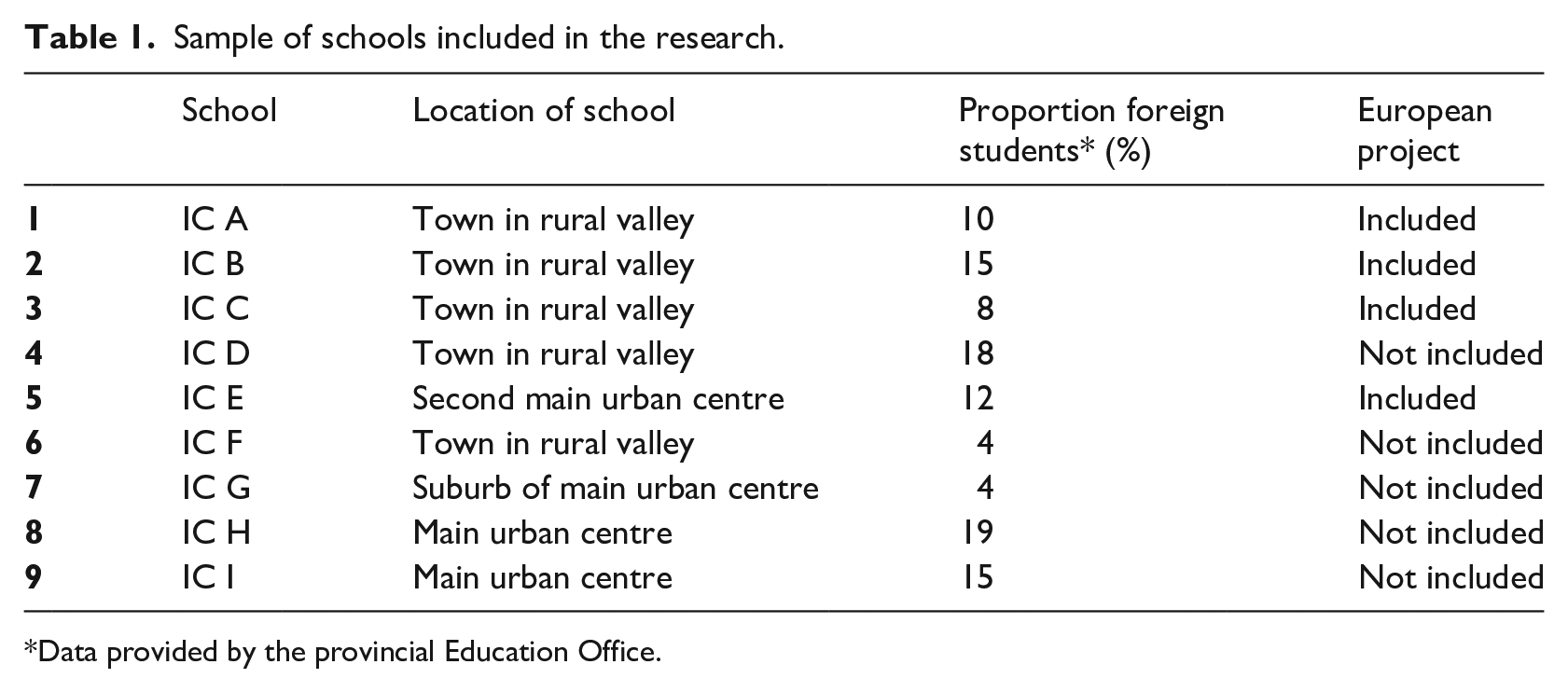
Data provided by the provincial Education Office.
The teachers were identified through personal contact, indication by the provincial Education Office and snowballing. As GCE is not a subject ‘demanded’ by the curriculum, teachers are not required to integrate it in their teaching. A decision therefore was taken to include in the research only those teachers that had experience of teaching GCE or were passionate about it. The sample of teachers, therefore, is not representative of the population of teachers in the province: all the teachers interviewed had been exposed to GCE through in-service education, or their interest in GCE was known within and beyond their school. The majority of the teachers interviewed were female (85%), taught humanities (62%), and had between 11 and 20 years of teaching experience (47%).
Different interview guides were developed for policymakers, key informants and teachers with some common questions related to the meaning of GCE and others tailored to the particular position of the interviewee. Prior to the interview, policymakers received only the informed consent form, while the teachers also received the interview guide. This was done because the term GCE is not widely used in schools and hence sharing the interview guide with the teachers was a way to reassure them and give them some time to use the concept of GCE as a lens to read their practice. During the interviews, particular attention was paid to deconstructing the idea of the researcher being the ‘expert working with established theoretical and pedagogical frameworks’. This made uncertainty and openness possible. The interviewees, in particular the teachers, shared their doubts about the concept, and about whether their work could even be seen as GCE. They were forthcoming with the challenges and difficulties they experience. The interview became ‘a space, time – and human connection’ (Charmaz, 2014: 80), for reflection and clarification.
All the interviews were recorded and then transcribed verbatim. Overall, the five interviews with provincial decision makers and key informants amounted to 352 minutes of recorded data, and the 21 interviews with teachers amounted to 1468 minutes. The average length of the interview was 70 minutes. All the transcripts of the interviews were then coded. Following GT, initial line by line coding was used to ‘open up’ the data and explore fragments of text to reveal all the possible meanings that the text could generate (Tarozzi, 2008). Initial coding led to the construction of more than 300 codes. A series of organisational topics under which the codes could be subsumed were then constructed to organise the codes. These topics were not the analytic conceptual categories that eventually formed the skeleton of the theory, but, similarly to how they are used by Maxwell (2013: 107), they operated ‘primarily as bins for sorting the data for further analysis’. Focused coding was then used to identify and develop the most salient codes and then put them to the test with large batches of data. It advanced the theoretical direction of the research.
Iterative strategies of simultaneously going back and forth between data collection and analysis were used to continually focus the data collection on the ideas that were emerging from the analysis. Once tentative interpretative categories were constructed, theoretical sampling was used to seek pertinent data to ‘elaborate and refine the categories’ constituting the emerging theory (Charmaz, 2014: 193). It meant going back into the empirical world to collect additional data about the properties of these categories. The methods used for theoretical sampling included: (a) a ‘theoretical thematic analysis’ (Braun and Clarke, 2006) of the provincial curricular guidelines and in particular of the area called ‘History with citizenship education, geography’; (b) intensive interviews with new research participants, namely two additional key informants working in the provincial Education Office; (c) a meeting with the teachers already interviewed where the provisional analytical categories were shared and new focused questions were asked (9 teachers from 4 schools participated in the meeting).
GCE ideal types
In consideration of the multiple interpretations of GCE, this study has constructed a typology of four ideal types to explain how GCE may be conceptualised and practised. The four ideal types are: neo-liberal human capitalism, cosmopolitan humanism, social-justice activism, and critical counter practice (see Table 2). The typology illustrates six key dimensions of each ideal-type: (a) main theory and key theorists; (b) type of global citizenship; (c) functions of GCE; (d) citizenship education; (e) GCE; (f) learning domains of GCE.
The four global citizenship education (GCE) ideal types.
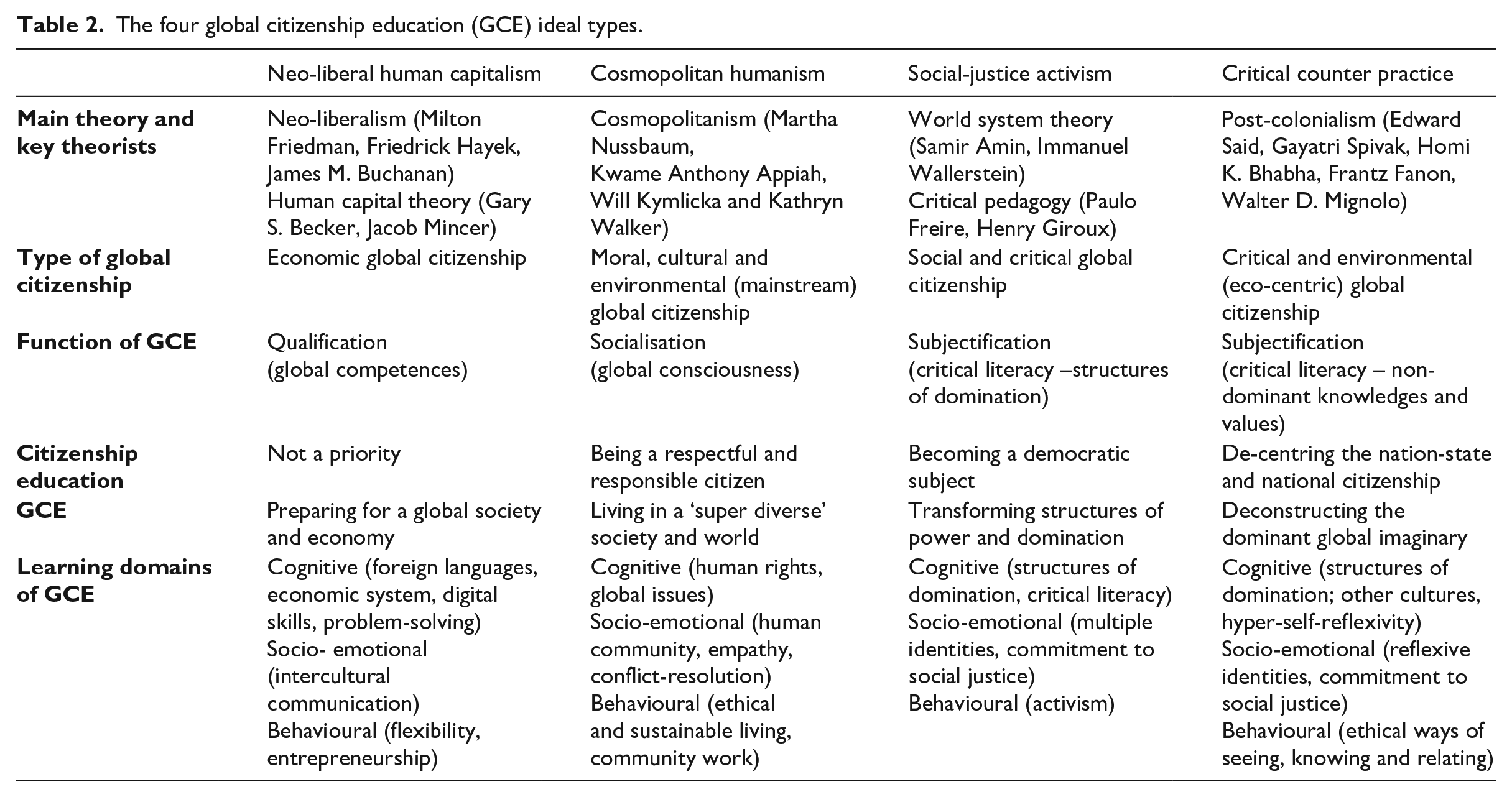
The first three dimensions of the typology are informed by the literature. In particular, dimension 1 illustrates the key theories and theorists that inform each ideal type. Dimension 2, ‘Types of global citizenship’, draws from the cosmopolitan types of global citizenship (political, moral, cultural, economic) and the advocacy types (social, critical environmental and spiritual) outlined by Oxley and Morris (2013). Dimension 3, ‘Functions of GCE’, is based on the categorisation of the purposes of education (qualification, socialisation and subjectification) developed by Biesta (2009) and applied to GCE by Sant et al. (2018).
The last three dimensions – 4, ‘Citizenship education’, 5, ‘GCE’ and 6, ‘Learning domains of GCE’ – are grounded in the empirical data of this research. The key characteristics of each dimension are based on the conceptual categories that emerged from the analysis of the data. However, as social-justice activism and critical counter practice are marginal in the discourses of both policymakers and teachers of the province studied, the scholarly literature was used to describe the characteristics of these three dimensions.
In terms of Dimensions 4 and 5 – Citizenship education and GCE – it is worth underlining that policymakers clearly distinguished between these two concepts and showed different perspectives. On the one hand, the international development sector embraced the concept of GCE and saw it as the new conceptual framework for all its co-operation and education work. The education sector, on the other hand, demonstrated a clear preference for the term citizenship education, considering GCE as a provisional and fickle academic label. The perspectives of teachers showed a certain level of conceptual overlap between citizenship education and GCE and the two terms were often used interchangeably. However, certain elements of differentiation emerged. In particular, citizenship education had a more local connotation centred on the school, the local area and the nation state and focused on four categories which captured how teachers conceptualised it and translated into teaching practice: (a) democracy, rights and legality; (b) moral and social development of students; (c) digital citizenship; (d) care for the environment. The concept of GCE, on the other hand, allowed the interviewees to bring to the fore the interplay between the local and the global and the ‘super-diversity’ of societies (Vertovec, 2007). Three categories were constructed to explain how teachers conceptualised and practised GCE: (a) learning to live in a super diverse society; (b) decoding what is happening in the world; (c) preparing for a global society and economy. In the typology, maintaining citizenship education and GCE as separate dimensions conveys the conceptual differences between the two concepts and allows for an explanation of the different position that these two concepts have in the interviewees’ discourses.
Lastly, Dimension 6, ‘Learning domains of GCE’, was constructed combining the three GCE domains (cognitive, socio-emotional, behavioural) described in the GCE pedagogical framework developed by UNESCO (2015) with the conceptual categories constructed through the empirical research to explain the knowledge, skills and values that policymakers and teachers associate with GCE and aim to foster through their policies and practices.
In summary, in the typology, the conceptual categories constructed during the analysis of the empirical data were combined and put in dialogue with theoretical concepts. A certain level of resonance was found and led to the construction of the four ideal types. Hence, in line with informed GT, the typology is thoroughly grounded in empirical data while being also informed by the scholarly literature.
Neo-liberal human capitalism
Neo-liberal human capitalism is driven by neo-liberalism and human capital theory. Neo-liberalism maintains that competition is and should continue to be the driving force of the economy. From a global citizenship perspective, a neo-liberal discourse focuses on building the knowledge and skills of individuals to make them competitive in the global economy, while human capital theory takes a country perspective and considers people as human resources needed to facilitate the economic productivity and competitiveness of their own countries (Sant et al., 2018). In neo-liberal human capitalism, GCE is related to economic global citizenship (Oxley and Morris, 2013) and has a defined qualification function which focuses on the acquisition of a certain set of knowledge and skills to ‘function’ in society (Biesta, 2009). Through GCE, students acquire the global and intercultural competences to compete for jobs in the global economy, and a country builds a pool of human resources that will help it to gain or maintain a position in the global economy. In this discourse, citizenship education is not a priority, while GCE is clearly about preparing young people for the global society and economy. The learning domains that characterise neo-liberal human capitalism relate to cognitive knowledge (foreign languages, knowledge of the economic system and the job market, understanding of the ‘rules of workplaces’), cognitive skills (digital skills and problem-solving), socio-emotional skills (intercultural communication) and behavioural (being entrepreneurial and flexible).
Cosmopolitan humanism
Cosmopolitan humanism in underpinned by moral cosmopolitanism and in particular its focus on our common humanity and the moral duties and obligations owed to all human beings. The emphasis is on a global ethic centred on common human values and norms, which are exemplified by universal human rights. In cosmopolitan humanism, GCE is related mainly to moral and cultural global citizenship and the mainstream perspective that characterises environmental global citizenship (Oxley and Morris, 2013). Cosmopolitan humanism has a distinctive socialisation function, articulated in terms of the promotion and acquisition of certain norms, values and identities (Biesta, 2009). These relate to becoming ‘better’ citizens of the global world. Through GCE students become aware of and committed to universal values such as human rights, peaceful coexistence, solidarity and sustainability (Sant et al., 2018). In cosmopolitan humanism, citizenship education is about fostering the ‘respectful and responsible citizen’ that engages in pro-social behaviour to ensure social cohesion and integration. There is a strong emphasis on awareness of the rule of law, legality, the rights and duties of the ‘good citizen’, as well as the political actors and processes at local, national and international level that govern our life. The moral and social development of students is a core concern and work is centred on fostering respect for the rules of civil behaviour, promoting tolerance of diversity, as well as coexistence and inclusion. Care for the environment is also a key concern, and the main emphasis is on fostering ecological citizens that in their private spheres ‘do the right things’ like recycling, reducing their carbon footprint, etc. In cosmopolitan humanism, GCE is essentially about preparing students for life in a society characterised by ‘superdiversity’ (Vertovec, 2007). The learning domains focus on cognitive knowledge (human rights and global issues), socio-emotional attitudes and skills (sense of belonging to a human community, empathy and conflict-resolution) and behavioural (ethical consumerism, sustainable living, community work and volunteering, charity).
Social-justice activism
Social-justice activism draws from a radical discourse based on Marxist world system theory, and a critique of the socio-economic structures of global inequality (Sant et al., 2018). In social-justice activism, GCE is related to social and environmental global citizenship (Oxley and Morris, 2013). It has a subjectification function associated with a radical and transformationist view of global citizenship and is based on a critical and empowering pedagogy (Sant et al., 2018). The main focus of citizenship education is on opening spaces for students to learn to engage in the ‘experiment of democracy’ and become ‘democratic subjects’ (Biesta, 2014: 5–6). Priority is given to experiencing democratic processes in school, in the community and in national and international settings. Care for the environment does not prioritise individual sustainable behaviours, but rather focuses on the larger structures and processes that are at the core of environmental problems. In terms of GCE, social-justice activism emphasises the transformation of political and economic structures of power and domination. It is related to Banks’ (2008) idea of a cosmopolitan and transformative citizenship education. Through GCE students become critically literate and committed to act to achieve democracy, equality and social justice within the local community and at global level. The learning domains focus on cognitive knowledge and skills (political and economic structures of domination, critical literacy), socio-emotional attitudes (multiple identities, commitment to social justice) and behavioural (political activism).
Critical counter practice
Critical counter practice draws from the post-traditions, in particular post-colonialism which is concerned with the epistemic violence of colonialism, uses poststructuralist ‘deconstruction’ to destabilise Western/European/White cultural supremacy and focuses on protecting and reviving ‘voices that have historically been subjugated by colonial violence’ (Andreotti, 2010: 238). In critical counter practice, GCE is associated with critical global citizenship (Oxley and Morris, 2013) and an eco-centric version of environmental global citizenship (Burdon, 2012; Mylius, 2013). Similarly to Social-justice activism, it has a subjectification function but a stronger focus on pluralising epistemologies and exposing students to non-dominant knowledges and values (Sant et al., 2018). In terms of citizenship education, critical counter practice challenges the presumed inevitability of the continued existence of the nation state, and suggests a curriculum that de-centres the bounded nation state and complicates the notion of citizenship (Stein and de Oliveira Andreotti, 2017; Pashby, 2011). In terms of GCE, critical counter practice fosters the deconstruction of the dominant modern/colonial global imaginary, and the overcoming of hegemonic, ethnocentric, ahistorical, depoliticised, self-serving, uncomplicated and paternalistic patterns of international engagement (Andreotti, 2015). The learning domains focus on cognitive knowledge and skills (political, economic and cultural structures of domination; other cultures and minorities to diversify perspective; cognitive decentralisation; hyper-self-reflexivity), socio-emotional attitudes (reflexive identifications, commitment to social justice), behavioural (ethical, responsible and responsive ways of seeing, knowing and relating to others ‘in context’).
GCE as a new ‘moral pedagogy’
The four ideal types of GCE are grounded in the theoretical categories constructed from the empirical research and are informed by the scholarly literature. They provide a framework to categorise how GCE is conceptualised in the Province of Trento. The perspectives that emerged from the different provincial actors (local government representatives, key informants, teachers) did not neatly fit into one of the four ideal types. Rather the position of the actors often conflated elements of the different ideal types. Merging and conflating characterised the perspectives of the three main sectors included in the study, that is the provincial education sector, the international development sector and school teachers. Yet, it was also possible to locate the narrative of each of these three sectors within a dominant ideal type of GCE. In particular, while the discourse dominant in the education sector is located in neo-liberal human capitalism, the narratives of the international development sector and the teachers are consistent with cosmopolitan humanism. Elements of social-justice activism and critical counter practice were also noted.
GCE in the provincial education discourse
Neo-liberal human capitalism is the dominant discourse in the provincial educational policies. In this perspective, schooling responds predominantly to the qualification function of education. Global competences, related to knowledge of foreign languages (English), as well as entrepreneurial and digital skills, are valued because they respond to the provincial objectives of equipping students with the skills needed to succeed in the global economy, while at the same time enhancing the internationalisation and economic development of the province: Educate and train a population with adequate skills and knowledge, able to face the processes of innovation and internationalisation, able to support the exercise of the rights/duties of active and responsible citizenship, as well as to reach and maintain an adequate level of economic development of the provincial territory (Autonomous Province of Trento, 2015).
In the provincial education discourse, the emphasis on global competences is reconciled with a socialisation conception of citizenship education, understood as civic education: the concept of active citizenship. . . of knowledge and awareness of living in a world made of rules, but also rights, made of rights and duties, I understand it in this way. . . all the projects that the schools are doing. . . related to the area of civic education and therefore reflecting on rules, rights and duties. . . that govern the community in which you live. . .what’s in Brussels, what’s in Rome, what is the parliament, what is the mayor and what does he do. . . why there must be a mayor, why you pay taxes [provincial representative c].
In this discourse, the main focus is not global citizenship, but rather a ‘traditional idea of citizenship’, interpreted as civic and civil virtues. Citizenship is also linked to a sense of belonging to a clearly defined local and cultural identity: this concept of citizenship has developed mainly in the sense. . . of having an awareness of where you are, the community you belong to. . . the history you belong to. . . We are Trentini, Trentino has these characteristics because it has a history, because in this history a number of things happened, that have moulded characters, traditions and cultures. Therefore, creation of a stronger bond. . . in the sense of greater awareness of one’s own historical roots and this is citizenship [provincial representative c].
In this perspective, the function of citizenship education is to foster the ‘respectful and responsible local citizen’. Promoting rootedness in the local community, respect for the rule of law and legality as well as social cohesion in the context of culturally diverse local communities are the key areas of attention in the provincial citizenship education discourse. Yet this institutional perspective was challenged by some members of the provincial education system that embraced a more fluid and multiple conception of citizenship and identity: if it is intended as a mere strengthening of the identity of Trentino. . . without remembering that the identity of Trentino comes. . . from many exchanges and different origins, it is not very compatible with GCE. If you insert it in a discourse of multiple identities, that each of us has and of which one should be increasingly aware. . .of awareness. . . of the movements of peoples, past, present, future, then. . . In the way identity is often understood and conceived here, there is a risk that is very restrictive and I do not share it. If you link it to a perspective. . . of multiple identities, not only declared, but also experienced in the daily life of the classes, then. . . We are all part of very multiple and varied identities [representative training centre a].
These people were also working within the provincial education system to promote a shift in the curriculum from citizenship education interpreted as civic education to a citizenship education with a global dimension in line with the GCE perspective embraced by the provincial international development sector.
GCE in the provincial international development discourse
The dominant discourse permeating the provincial international development policies is cosmopolitan humanism. GCE is framed within a humanistic perspective that recognises the unfairness and unsustainability of the current global system. The approach, however, is about making the current system more humane and sustainable, rather than fundamentally questioning and transforming the system. In the discourse, GCE is located within a commitment to universal human rights and a vision that merges economic growth with a rights-based understanding of development, which is broadly in line with the 2030 Agenda and the SDGs. In the discourse citizenship education has an explicit global dimension aimed at fostering the ‘respectful and responsible global citizen’, conceptualised primarily as a consumer in the global economy: if you think in this way [with a global citizenship perspective], you are a different consumer, you are concerned about the products you buy, you are a citizen who. . . uses public transport. . . who is aware of what is in one’s smart phone, who is aware of the use of natural resources and who. . . knows that one’s choices have an influence. And therefore. . . GCE is about having competences that allow you to know and understand these issues, and that then they make you also act in a certain way. Therefore there is also a dimension of action. . . in one’s daily life [provincial representative b].
The narrative is clearly located in cosmopolitan humanism, but in the provincial discourse there are also elements of criticality. These critical perspectives stress the need to decolonise our thinking, question our taken for granted conceptual and interpretative frames and refuse what is considered natural, thus unveiling the conventional nature of realities: I myself am so immersed in mechanisms of thought, in thinking habits, that. . . I can't even see and recognise them for what they are. . . What is hidden behind the language we use in terms of the worldview we are communicating?. . . For example, one idea that I found extraordinary and that still makes me reflect is to think about how purely conventional it is to look at a political map. It’s pure convention!. . . And how much we use it as an education tool, that is, one of the very first things that children, young people see is a political map! It means that you’re fixing that stuff firmly in your head and you are not going to give it up. That is, that stuff is considered irremovable. . . There are so many things that are taken up and absorbed and you don't even question them anymore. . . What I find powerful in this type of work [GCE work] is something that disrupts a little the most automatic mechanisms of thought [representative training centre b].
Strong emphasis was also placed by some representatives of the international development sector on the need to learn from visions, worldviews and approaches from the Global South.
The international development discourse is mainly located in cosmopolitan humanism, has elements of criticality but also aspects of neo-liberal human capitalism. These relate in particular to the role of international development cooperation and GCE in the promotion of a policy of ‘responsible internationalisation’ of the provincial economic system: it is an internationalisation. . . that is guided by this paradigm of global citizenship education. It is an internationalisation that respects. . . rights, diversities, the environment, cultures. And therefore we need. . . coherence of the policies, of the international economic development policies, so the promotion of our territory from the economic point of view. . . needs to be in harmony with the thinking of international development co-operation. . . the approach must not be that of colonialism, but an approach of relations, of exchange, also from the economic point of view, but respectful of a particular frame [provincial representative b].
GCE in teachers’ discourse
Despite a strong focus in the provincial education discourse on neo-liberal human capitalism and the qualification function of education, the perspectives of the teachers interviewed are predominantly located within cosmopolitan humanism. It is important to underline that their perspectives cannot be generalised as the sample of teachers involved in the study, as indicated in the section ‘Methodology’ above, is not representative of the teachers’ population in the province. In the discourse of the teachers interviewed, GCE has a distinctive socialisation function, which the teachers articulate in terms of fostering in young people a cosmopolitan identity in line with moral global citizenship. Strong emphasis is given by teachers to universal human rights, a sense of belonging to a common humanity, the commonalities between humans that transcend differences and moral obligations towards distant others. A key concept that teachers associate with being a global citizen is being aware of the interdependence that characterizes the world and that creates links and connections between the ‘here’ and the ‘far away’: global citizenship in today’s complex world, is to try to. . . understand and know different situations as they relate to your place. . . You can no longer study only your context. There is such a great interconnection that global education is precisely this, it is this interconnection, this. . . interdependence between the different places of the world. . . an attention. . . both to the local and the global, because. . . everything is interconnected, right?. . . we are tied to the other. . . who lives somewhere else. So, always trying to [consider] ‘here it is like this, but how is it elsewhere?’ [teacher 16, school F, humanities]
In the teachers’ discourse, citizenship education is primarily about fostering the ‘respectful and responsible student’. The main focus of teachers’ conceptualisations and practices is consistent with the provincial education discourse centred on democracy, rights and legality. It is about fostering awareness of the rights and duties of citizens, and respect for legality and the rule of law. The teachers interviewed related citizenship education to the moral and social development of students. They placed a lot of emphasis on fostering respect for the rules of civil behaviour, starting from the rules that should be respected in the classroom and more broadly the school. The assumption is that if young people learn to be ‘respectful, well-behaved and co-operative students’ in the school environment, in terms of their relations to the teachers, to the classmates and to the facilities and equipment of the school, they will then become ‘good citizens’ in society: and then the main thing, citizenship is experienced daily, in the classroom, all the dynamics that take place in the classroom, more or less consciously, are part of a citizenship education journey. Relationship dynamics, mutual respect. Here it’s a training ground for your whole life, for the workplace, for any context [teacher 3, school I, humanities].
Teachers’ accounts of their GCE work focuses primarily on cultural global citizenship and in particular on preparing students for life in a culturally ‘super-diverse’ society. The teachers conflate GCE with intercultural education. They see school as a training ground for life in today’s multicultural society, as it provides a space for relating to the ethnically and culturally diverse, and for addressing prejudices, stereotypes and racism: Citizenship is not only a topic of the subject citizenship education. . . but it is a daily occurrence, because we have multicultural schools, we have students who come from all over the world. . . so in my opinion beyond the topic, beyond the subject, you do it daily. For example, I found myself a year with a class where I had 13 students who came from distant countries, Brazil, Bangladesh, Pakistan, India. . . so often you start from their experience, from their difficulty, eliminate certain stereotypes. . . or prejudices. . . ensure respect for the foreign classmate. . . for their culture [teacher 8, school I, humanities].
Some of the teachers were aware of the complexity of working in multicultural classes, and displayed a high level of reflexivity in relation to their own perceptions of students with a migration background, or the attitudes of these students towards being identified as culturally diverse or foreign: it was an enlightening moment: at school this year there is a first grade pupil called X [Muslim name]. . . and I asked him: ‘where are you from?’ And he answered: ‘From X [name of the local town]’. And I thought, darn. . . I too saw him as a foreigner, that is, I wanted to know if he was Moroccan or Tunisian, but instead he feels from X [name of the local town]. . . on this I don’t feel prepared, in the sense that I have always worked with groups of foreign students, but who had just arrived in Italy, but with the second generation. So, either I treat them too as foreigners but they are not, or I treat them as Italians but even that is not completely true. In short, we should find a way to reflect on their identity [teacher 7, school A, humanities].
In many cases, however, teachers’ accounts revealed that an intercultural perspective within their citizenship education work was more an aspiration than a reality of their practice. The approach of some teachers stopped at the level of experiencing the folkloristic aspects of the other cultures, like multicultural food, music, clothing. The perspectives conveyed by some teachers essentialised ethnicity and culture, seeing the foreign student, or his/her parents, as the ‘bearer’ of a monolithic foreign culture, that we need to tolerate. There was also a sense among teachers that what is done in school cannot really change deep rooted stereotypes and prejudices towards the culturally diverse. Moreover, accepting and respecting the ‘other’ presupposes a deep engagement with the concept of identity, however teachers did not clearly outline a multiple, fluid, dynamic concept of identity. They also did not seem confident in accompanying students to critically reflect on their identities, nor explore with them their values in an open, transparent and critical manner.
The GCE literature highlights that GCE tends to be characterised by the behavioural dimension of GCE, that is to provide opportunities for students to be active and do something about the issues they are addressing in school. The emphasis on encouraging students to be active and do something to ‘help’ or ‘solve’ global issues did not emerge as a prominent feature of the way the interviewed teachers conceptualise and practice GCE. The teachers’ perspectives reveal a strong focus on the concept of personal responsibility, with importance given to encouraging students to engage in ethical and sustainable behaviours at the individual level, like discussing the issues with their families, or being responsible and ethical consumers, or changing particular behaviours like environmentally unsustainable practices. Fundraising and charitable work, although mentioned in a few cases, did not feature prominently in teachers’ accounts of their GCE work.
The marginality of the ‘action agenda’ in the schools studied seemed to open spaces for teachers and students to engage critically with GCE issues without the ‘anxiety’ of finding solutions to global issues or crafting opportunities for students to ‘make a difference’ in the life of distant others. Indeed, elements of criticality emerged from teachers’ narratives of their work. A few teachers talked about creating spaces where ‘single stories’ can be challenged and different perspectives can find expression. They stressed the importance of questioning the assumed objectivity and truth of our knowledge, and of discussing with students the fact that history is not objective but is told from different points of view: sometimes they are also linguistic comparisons,. . . in history. . . we speak of invasioni barbariche [the Migration Period during the decline of the Roman Empire between the 4th and 6th centuries AD] and then we discover that the Germans do not call them invasions but call them Völkerwanderungen, so migrations of peoples, so there is also an ideological aspect that we begin to perceive. . . and so we understand how history is interpreted by each people according to its own perspective. . . Sometimes I discover these things and then I communicate them to my pupils or we think about them together [teacher 15, school D, humanities].
A teacher explicitly referred to the importance of cognitive decentralization to move beyond an ethnocentric interpretation of the world, and provided some examples of how she ‘displaces’ students’ Eurocentric views: work on cognitive decentralization. . . to simply make it clear that the way we have studied the world, and history, is a Eurocentric view, even simply projecting planispheres, as they are depicted in other countries. . . this above, this below, the fact that you can’t find Europe anymore because it is in a little corner because maybe at the centre there is. . . this displaces them [pupils]. . . You can also make them reflect on how the European, even historically, has always assessed with its own metre, without valuing what was there, what he was finding. There are some nice readings, maybe you know Papalagi, that is a book written by. . . a king. . . of a tribe of the Samoa Islands that in the 19th century took a trip to Europe, and you see how he lived these European oddities, and therefore here, you work on points of view [teacher 13, school D, humanities].
While opening spaces for a critical engagement with issues, the marginality of the ‘action agenda’ also revealed the hesitancy of teachers about fostering opportunities for the students to experiment (global) citizenship practices. The collective social and political dimensions of being citizens did not feature prominently in the way GCE is conceptualised and practised by the teachers interviewed. While a few teachers acknowledged that it is an important aspect to develop, for most teachers it was somehow ‘postponed to the future’. The students are not considered citizens yet but are rather seen as ‘citizens in the making’. Being active ‘democratic subjects’ in society is hence seen as something they will do when they get older.
Concluding remarks
GCE as subjectification in its expressions of social-justice activism or critical counter practice is marginal in the provincial policies and in teachers’ GCE conceptions. While the radical perspective of social-justice activism to transform structures of power and domination was virtually absent from the discourses, elements of criticality in line with critical counter practice were found in the way GCE was conceptualised by some representatives of the international development sector and by a few teachers.
In the province studied, the dominant perspective in the education sector is neo-liberal human capitalism, that is shaping a schooling system aimed at preparing young people for the global economy while also supporting the economic development and internationalisation of the territory. The dominant perspective in the international development discourse and in teachers’ conceptualisations, on the other hand, is cosmopolitan humanism. GCE is essentially conceptualised as a ‘new moral pedagogy’ that merges socialisation with qualification, but overall reflects what is perceived to be a universal moral structure based on humanistic cosmopolitan values. GCE is about fostering in young people a cosmopolitan identity in line with moral and cultural global citizenship and centred on a sense of belonging to a common humanity, respect for cultural diversity, moral obligations towards distant others and a commitment to human rights and sustainability.
The author believes that it is important that GCE as subjectification in its critical expressions moves beyond experimentation by individual educators and teachers and finds a more systematic translation in policies, curricula and practices. This does not mean that these critical versions of GCE should necessarily replace the cosmopolitan perspective dominant in schools, but they can rather complement it. A political perspective grounded in social justice is in fact necessary if GCE is to take political agency seriously. Moreover, a critical conception of GCE is required to facilitate the deconstruction of the dominant discourses that shape our understanding and actions. In this context, teacher education and an alliance between academia and practice could play a significant role.
The role of teacher education
Teacher education is very important as it can provide spaces where the different theoretical frameworks, agendas and curricula that characterise GCE can be discussed. Such spaces should not be ‘about “unveiling” the “truth” for the learners’ (Andreotti, 2006: 49). They should not be about telling teachers what GCE should be like, what are ‘best practices’ in GCE, or providing them with a ready-made GCE toolkit. But rather should be an opportunity for teachers to critically reflect on mainstream GCE discourses (neo-liberal human capitalism and cosmopolitan humanism) and be exposed to more political and critical pedagogical frameworks based on GCE as subjectification (social-justice activism and critical counter practice). In this way teachers can identify and reflexively analyse the discourses and theoretical frames that give meaning to their practice. They can then experiment with different frameworks and consciously decide where to locate their GCE practice. In a context where teachers often look at teacher education as an opportunity to receive methodological tools and materials that they can apply in class with their students, it is important that these pedagogical spaces are opportunities where teachers can come together to address practical aspects relating to the place of GCE within the curriculum and its enactment within schools and classrooms. So, these spaces should facilitate exchanges of knowledge and learning from one another about experiences of ‘doing’ GCE in schools.
Alliance between academia and practice
GCE as subjectification in its declination as social-justice activism and critical counter practice are marginal in policies and practices. It is quite challenging for these critical versions of GCE to move beyond experimentation by individual educators and teachers. They are to a certain extent more easily integrated in non-formal education settings. In schools, however, according to Marshall, a more systematic translation in curricula may currently be unrealistic and unworkable given the strengths and pervasiveness of ‘corporate cosmopolitan ideals entrenched in a set of neo-liberal and knowledge-economy norms’ (Marshall, 2011: 424). In this context, an alliance between academia and practice could ensure that critical approaches to GCE do not remain confined to theory and abstraction, or propose ‘an alternative educational ideal, without fully taking into account the economic contexts, and pedagogic and curricular realities and traditions within schools’ (Marshall, 2011: 424). Empirical research in schools across Europe jointly designed and carried out by scholars and teachers could highlight the tensions between the different perspectives but also show the potential for synergies. It can focus on modalities through which political and critical GCE approaches can complement the mainstream GCE approaches and be systematically embedded in curricula.
Footnotes
Declaration of conflicting interests
The author(s) declared no potential conflicts of interest with respect to the research, authorship, and/or publication of this article.
Funding
The author(s) received no financial support for the research, authorship, and/or publication of this article.
