




Abstract
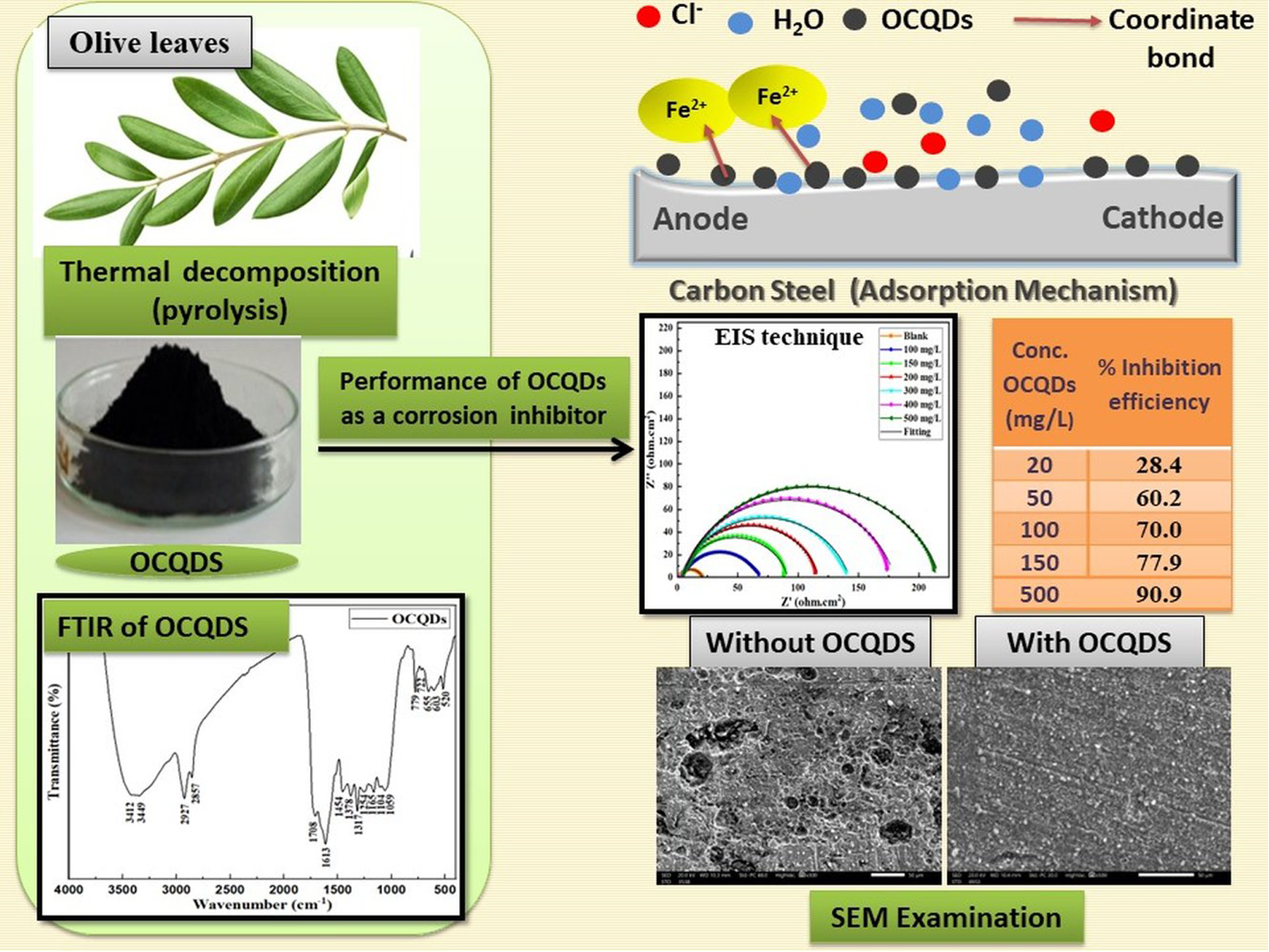
Olive leaf-derived carbon quantum dots (OCQDs) were prepared via thermal pyrolysis decomposition reaction and characterised using Fourier transform infrared spectroscopy, energy dispersive X-ray spectrometry, transmission electron microscopy, UV-Vis, X-ray photoelectron spectroscopy (XPS) and X-ray diffraction techniques to verify different functional groups, chemical composition, morphology/particle size, transition type, bonds and chemical structure and amorphous nature, respectively. Steel corrosion inhibition effect by OCQDs in HCl 1.0 M was assessed at 30 °C through mass loss, electrochemical impedance spectroscopy (EIS) and potentiodynamic polarisation techniques. Mass loss indicates that after adding OCQDs, the corrosion rates significantly decreased compared to the blank solution to demonstrate that OCQDs potent protective activity. The EIS results indicate Rp increase and Cdl decrease as OCQDs concentration increases, revealing 90.9% optimal inhibition effectiveness at 500 mg L−1 OCQDs. The potentiodynamic outcomes declared that OCQDs is a mixed-type inhibitor. Effectiveness and mechanism of steel corrosion inhibition by OCQDs in HCl 1.0 M solution were examined using SEM, EDX, contact angle, XPS and XRD techniques. Furthermore, adsorption mechanism of OCQDs on the steel surface was explored. Assessment of isotherms of adsorption indicated that Flory–Huggins, Langmuir as well Kinetic thermodynamic model offer the most appropriate interpretations of the adsorption mechanism. A calculated ΔGoads −25.86 kJ mol−1 suggests a physical/chemical adsorption mechanism.
Get full access to this article
View all access options for this article.
References
Supplementary Material
Please find the following supplemental material available below.
For Open Access articles published under a Creative Commons License, all supplemental material carries the same license as the article it is associated with.
For non-Open Access articles published, all supplemental material carries a non-exclusive license, and permission requests for re-use of supplemental material or any part of supplemental material shall be sent directly to the copyright owner as specified in the copyright notice associated with the article.
