



Abstract
This paper investigates the effects of aging at 175 °C on microstructure and corrosion behavior of the Mg-6.5Gd-0.9Y-0.5Zr (wt.%) alloy. After aging treatment, β′ precipitates are formed within grains and at grain boundaries in the alloy except for the original Zr nucleus, Mg5(Gd,Y), and Mg3Y3Gd2 second phase particles. Both immersion weight loss testing and electrochemical measurement in 3.5 wt.% NaCl shows that the corrosion resistance of the alloy increases at first and then decrease with the prolonged aging time. The alloy in the peak aging state demonstrates the highest corrosion resistance, with Pw of 0.443 mm/y and Icorr of 6.79 μA/cm². The aging treatment consumes the high density of dislocations in the as-extruded alloy, resulting in the enhanced localized corrosion resistance. The high corrosion resistance of alloys in the peakaging state can be primarily attributed to the protective effect of the β′ precipitates, which are distributed in a reticulated manner within grains and continuously at the grain boundaries. Additionally, the formation of a dense film of corrosion products contributes to this resistance.
This is a visual representation of the abstract.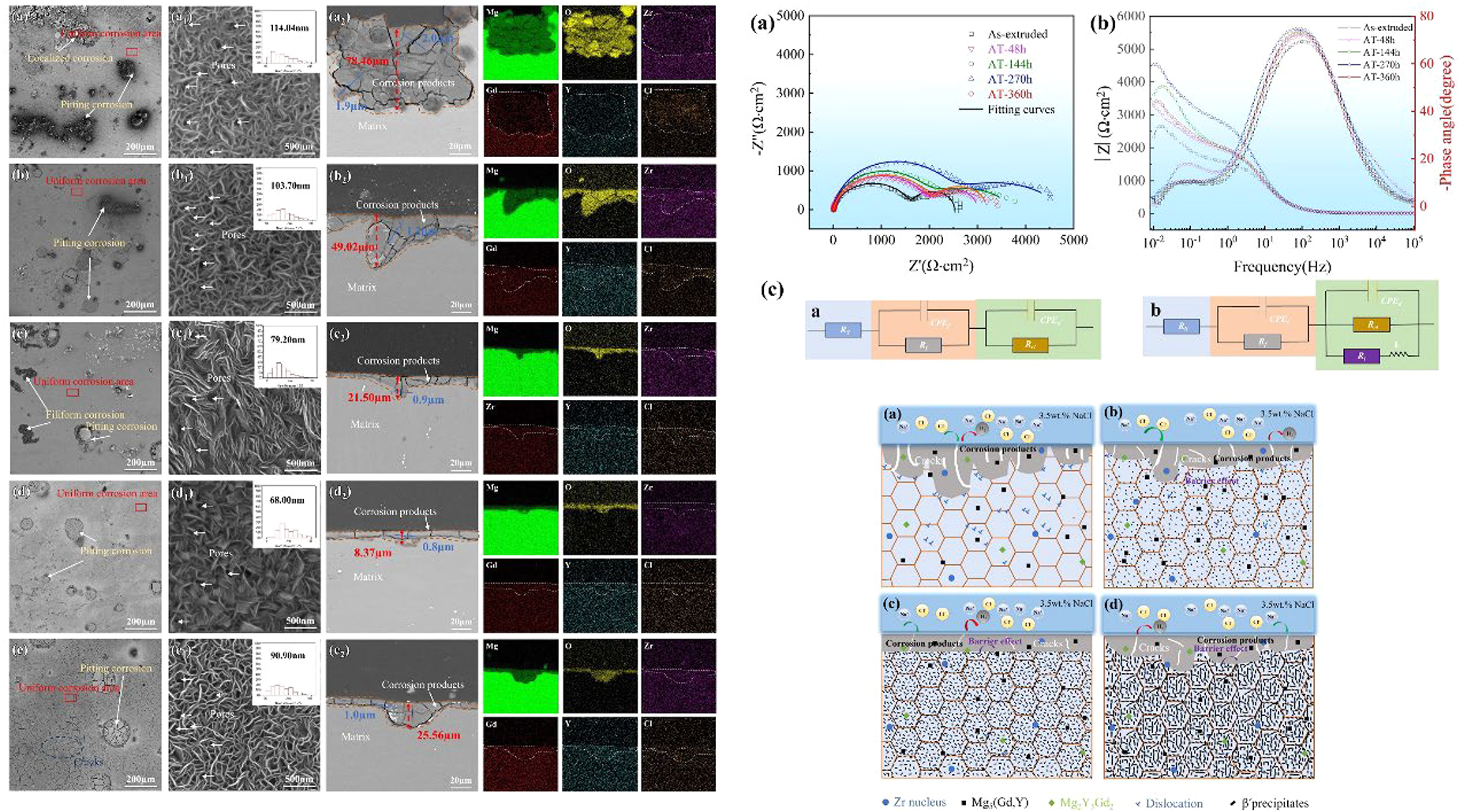
Keywords
Get full access to this article
View all access options for this article.