



Abstract
This study provides an in-depth examination of how university English language teaching (ELT) teachers conceptualize research as part of their professional job and discusses the issues of balancing these two roles. The results show ELT teachers, despite having different conceptualization of research and varying levels of research engagement, considered it an integral part of their job that could better inform their teaching performance. Revealing this group’s pressure of being evaluated by both roles on their professional performance, the study charts their research engagement constraints resulting from a lack of academic resources and research community, a mono-research culture in the institution, poor financial reward, and heavy workload. These constraints hold implications for teachers’ identity and autonomy and institutional policy and management. Importantly, the paper suggests a typology demonstrating teachers’ behaviour and attitudes towards the research engagement policy of the institution, and the alignment of their careers with the future direction of the institution.
Introduction
Engagement in research is seen as a vital component of a university teacher’s job, especially those working in research-led institutions. The tension of balancing teaching and research tasks among academic staff in higher education institutions (HEIs) has been explored in prior studies (Fraser and Ling, 2014; Gong et al., 2024; Kensington-Miller et al., 2015). To many, teaching and research are inextricably intertwined, while to others, teaching takes priority and the research duty is overlooked. Expectations for teachers’ research productivity have risen significantly because research publication is a way to enhance an institution’s position in international academic ranking and global competitiveness (Tie, 2012).
Research outputs have been quantified to be the measurement for annual professional performance of university teachers. In some cases, research products are the dominant and even the sole criterion for academic hiring, tenure, and promotion in HEIs (Khan, 2017). It is generally recognized that research is a beneficial form for professional development leading to deeper practical knowledge of teaching and higher level of efficacy of research (Gao and Cui, 2024; Jamoom and Al-Omrani, 2021). At the same time, research-oriented teachers demonstrate their confidence, self-reliance, and interest in teaching in order to share their research outputs and knowledge creation with a wider audience (Brown, 1998). However, university teachers’ research engagement is shaped by a multitude of factors (Borg and Liu, 2013). There are a number of barriers that impede research development and productivity of university teachers, most notably the lack of available resources and heavy teaching workload (Borg, 2013; Lu and Zhang, 2024; Vu, 2020).
Like elsewhere, there has been a strong increase in research productivity of universities and institutions in Vietnam. Vietnam has an average citation index of 9.2, which is comparable to that of other Asian HEIs (Thanh Chung et al., 2019). However, the research productivity of Vietnamese universities is still limited, especially in areas like Humanities and Social Sciences (Le et al., 2024; Nguyen et al., 2021; Pham and Hayden, 2019). The research performance of Vietnam in these fields has been pronouncedly poor with only 740 (12.2%) of the 6031 cited documents from Vietnam in 2017, according to Scimago (2018). To contribute to a wider discussion of research performance in Vietnamese higher education and university teacher’s tensions in balancing roles, this paper explores the way English language teaching (ELT) teachers in a public university in Vietnam perceived their teacher/researcher identity and responded to their institutional policy of research output, and their strategies for their professional career trajectories in connection with the institution development.
Literature review
The research-teaching nexus in higher education
The integration of research and teaching in higher education has emerged as a critical component in the sector, especially in the Global South and post-socialist contexts where the strive for better ranking metrics to compete with systems in the Global North has been widely recognized. The research-teaching nexus is largely understood as a mutually enriching relationship wherein teaching informs research practices and vice versa to foster more effective, up-to-date and engaging education experiences for students. The debate surrounding the research-teaching nexus, however, encompasses the perceived tension between research and teaching responsibilities faced by academic staff, such as feelings of strain caused by competing demands for their time and resources in research and teaching. This phenomenon is substantiated by studies that reveal the extensive workload expectations placed on new staff members, particularly in research-intensive institutions.
In the field of English language teaching (ELT) and Teaching English as a second language (TESOL), the area in which participants of this study worked, the conversation also centres around a teaching and research divide and gaps. One such gap is that studies conducted by researchers who are not deeply engaged with teaching are deemed more significant by the TESOL research community than those carried out by researcher-practitioners who have practical classroom-based work (McKinley, 2019; Rose and McKinley, 2017). McKinley (2019) insists that the research-teaching nexus in TESOL is important for ‘the research to be more grounded in classroom contexts, and for methods to be more transparent about the messiness of doing real-world classroom research’ (p. 876). Nonetheless, language teachers in higher education often face pressure to balance the dual responsibilities (Bao and Feng, 2023) and the identity conflicts (Phan et al., 2025; Rose, 2019). At the same time, researchers have noticed that ELT teachers and TESOL practitioners tend to rely more on increasing teaching experiences to enhance their practice, rather than using applied research to inform teaching. The reasons are limited access to resources, lack of awareness of instructionally oriented research, or insufficient time and research expertise to meet institutional expectations (Chen and Li, 2025; Gao and Yuan, 2021; Le et al., 2024; Paran, 2017; Sato and Loewen, 2019).
University teachers’ research engagement in Vietnamese higher education
The neoliberalisation of higher education in Vietnam has significantly reshaped the sector. For the past decades, Vietnamese universities have been eager to join the race of world-ranking universities, which extensively requires substantial quantity and quality research outputs (Dao, 2014; Gao et al., 2023; Le and Pham, 2025). Rooted in global neoliberal trends that prioritize competitiveness, accountability, and efficiency (Tesar et al., 2022), Vietnamese universities have increasingly adopted metrics-based assessment regimes with a view to enhancing international visibility in ranking leagues and alignment with global standards (Tran and Marginson, 2018). Key performance indicators such as publication outputs in indexed journals have become a major discourse in university governance. University teachers, thus, see themselves being involved in ‘a research-based economy’ (Gao et al., 2023: 4). The Vietnamese higher education system, nonetheless, is characterized by centralized governance, and a dual emphasis on teaching and research responsibilities operates within resource constraints (Le and Pham, 2025). While the emphasis on enhancing academic research productivity and quality of research in Vietnam has been mandated since the 2005 Higher Education Reform Agenda, research productivity reports indicate that the Vietnamese indexes of quantity and citation of publications lag behind its other East Asian and Southeast Asia neighbours such as Korea, Singapore, Thailand, and Malaysia (Nguyen et al., 2020), presenting a substandard performance (An, 2022). Academic staff in universities in Vietnam are found to have less research engagement, performance, and output in research productivity (Gao et al., 2023), even though ‘publication quotas’ have been imposed by a combination of governmental policies and institutional mandates in Vietnam, specifying formalized requirements for academic staff to achieve a minimum number of research publications as part of their performance evaluations over a period of time (Le and Pham, 2025).
The Vietnamese Ministry of Education and Training (MoET) has encouraged university teachers to dedicate substantial working hours to research to promote research performance (An, 2022). There have been a number of projects in place, for instance, Project 911 (2010–2020): Vietnamese government PhD scholarship programme; Project 599 (2013–2020): Training officers abroad by state budget (under the Decision 599/TTg of the Prime Minister); and Support for Autonomous Higher Education Project (SAHEP) (2017–2022): Leveraging research, teaching, and institutional capacity. There is also a trend towards using internationally indexed databases at both the macro and meso level. For instance, the international publishing requirement was highlighted in the regulation on doctoral education (Circular 08/2017/TT-BGDĐT, issued in 2017 by MoET), which requires PhD supervisors, PhD candidates, and newly appointed professors to have ISI Web of Science/Scopus-indexed publications. In 2020, according to Article No. 20/2020/TT-BGDĐT, Vietnamese institutions started to adapt the guidelines issued by MoET into specific quotas for academic staff, depending on their academic rank and linked these quotas to performance evaluations, promotions, and salary increments (MoET, 2020). At the institutional level, research productivity is measured by the number of publications and research hours points. The main policy framework that specifies ELT teachers’ work responsibilities at tertiary level in Vietnam is Circular 36 on professional standards for university lecturers (Circular No. 36/2014/TTLT-BGDĐT-BNV). Circular 36 formally outlines that in order to be qualified as an academic member in a university, teachers are required to hold a PhD degree and be able to demonstrate their research competence via the number of publications. Thus, research is part of the professional tasks against which teachers’ annual performance is evaluated. Financial reward for staff who succeed in international publications has also been applied, acting as an incentive for teachers to be more research-engaged.
The low or moderate level of research engagement, in this paper understood as engagement both in and with research, has been reported in ELT teachers in different countries including China (Borg and Liu, 2013), Iran (Mehrani, 2015), and Vietnam (Gao et al., 2023). As noted by Chen and Li (2025), the research-teaching gap remains unresolved for language teachers, and how teachers manage to connect their research with their teaching practice is still underexplored. Several barriers of research engagement are reported by ELT teachers, such as lack of time, knowledge, and access to material, and lack of encouragement and motivation (Borg, 2009; Jamoom and Al-Omrani, 2021; Phan et al., 2024; Phan and Pham, 2023). In addition, the gap between the expectations of institutions and teachers’ research capabilities causes significant challenges to ELT teachers, both in their research self-efficacy, outputs, academic freedom, and well-being (Le et al., 2024; Le and Pham, 2025). Despite the described shift and increasing focus on research activities and productivity of Vietnamese higher education system, literature on how ELT university teachers perceive and respond to these changes has been scarce. Some exceptions include Vu (2020) who attempts to address this issue by using teacher cognition semi-structured interviewing with ELT faculty members at a university in Vietnam. Her study shows how teachers construct different versions of research to rationalize their attitudes, self-awareness, and practices. Le et al. (2024) investigate how the research productivity policies pose a significant impact on academic freedom, with ELT lecturers at different career stages perceiving and adapting to the policy’s constraints in varied ways. Le and Pham (2025) provide a comprehensive analysis of the significant publication pressures on teachers’ work–life balance, as well as job stress and anxiety. Despite these recent progress in this line of inquiry, little attention has been paid to how teachers take on and balance these two roles within the current ill-resourced conditions for research activities. This paper goes beyond ELT teachers’ conceptualization of research to explore their perceived identities, and their strategies to overcome the ‘dilemmas between two worlds – practitioners and academics, external pressures and internal values, visions and realities’ (Vu, 2020: 1) in order to understand their research engagement and career development in alignment with institutional policy.
Theoretical framework
In this paper, we employ the Dynamic Systems Model of Role Identity (DSMRI) to understand ELT teachers’ teacher/researcher role identity and its development within socio-cultural contexts. In DSMRI, role identity is conceptualized ‘as a Complex Dynamic System anchored in action that comprises the actor’s ontological and epistemological beliefs, purpose and goals, self-perceptions and self-definitions, and perceived action possibilities in the role’ (Kaplan and Garner, 2017: 2036). Attached to each role is a set of meanings defined as the response to a stimulus (either verbal or physical) that may be either an observable behaviour or an internal cognitive behaviour (Burke and Stets, 2009). Meanings are understood as the cognitions or actions attributed to a particular role. They are formed through ‘others’ expectations that become internalized and shared by the person in a given role’ (Pope et al., 2014: 137). These expectations, to follow Burke and Stets (2009) and Pope et al. (2014), are known to individuals either through an individual’s responses or reactions in an opposing role in the corresponding environment (meaning a teacher observing the behaviour of learners) or through imitation (meaning observing another individual in the same role such as a teacher/researcher). The framework thus provides insights into the processes through which individuals may experience identity learning, including identity conflicts and resolutions, facilitated by engagement in role-related activities.
The role identity as teachers and researchers of ELT teachers in this study are viewed as a complex dynamic system, rather than a stable and static one, which expects to go through different trajectories and form though teachers’ contextualized and negotiated situations. The identities of university teachers as teachers and researchers are explored through constructive personal experiences and professional practices, and through the implications to who they are and who they want to become (Vedder-Weiss et al., 2018). DSMRI provides a suitable framework to study the role identity perception of Vietnamese ELT teachers and the tensions and balance of their teacher/researcher roles in a research-led university, as well as their according strategies to perform the roles.
Methodology
Nine participants were recruited by purposive sampling through both authors’ existing professional networks. We attempted to diversify the group of participants in terms of gender and years of teaching experience ranging from six to over 10 years. This stratification was purposefully designed to capture a broader spectrum of experiences and perceptions of the teachers on the research policies on their professional practice and identity. All participants were working in a public university in Vietnam and were expect to accumulate at least 600 research hours annually. There are a wide range of activities that can be converted into research hours, including research products (articles, book chapters, books, conference presentations), or other activities (student research supervision and curriculum and materials design).
Among nine participants, one had a doctoral degree and others had Master’s degrees in either English language teaching, English linguistics, or Education. We used semi-structured interviews in order to go deeper when answers from informants seem to be superficial (Hatch, 2002). The duration of the interviews ranged from 40 minutes to over an hour. Ethical considerations in conducting this study were meticulously observed. Before the interview started, the participants were reminded of the purpose of the study and that they were being recorded and the information obtained from the interview would remain confidential. The interview only started after informed consent was given and were conducted in Vietnamese, recorded, transcribed and translated into English. Pseudonyms were given to each participant to protect their anonymity and confidentiality. Any possible identification information was removed.
The authors conducted thematic analysis (Clarke et al., 2015) to uncover the key themes in the data. The transcribing process enabled an initial cycle of analysis during which prominent themes emerged from the material. The transcribed data was read and re-read multiple times by both authors. We first independently coded a small sample of data where specific ideas, concepts, or patterns were evident, then discussed together to establish preliminary codes before analyzing the remaining data and adjusting codes and categories to make sure both authors have the same interpretation. In so doing, we aimed to ensure the reliability of our coding process. We then refined the wording of themes, and then we again returned to the data to confirm our mutual interpretation. The excerpts quoted in the paper were translated by the authors. Triangulation was employed through the use of multiple data sources including interviews and institutional documents accessed on the institution’s and education ministry’s websites to strengthen analytical validity.
Findings
ELT teachers’ conceptualization of research in their work
The participants had various conceptualizations of research as a component of their professional duties. To some, research and teaching were interlaced and mutually informed. Ha, for instance, explained that she needed theoretical orientations to help her teaching activities to be more student-centred and were helpful in her course design. Tuan, An, and Lan hold a similar view and attitude towards the relationship between these two main roles. They highly regarded a combination of research-led and research-informed practices, explaining that this ideal combination would yield teachers’ professional development and students’ better learning. They likened the complementary roles of these two activities as a ‘reflective practice’ which can induce deep-surface learning and constructive alignment in teaching.
On the contrary, to Mai, the idea that teachers carrying out research is an extra activity added on to their heavy teaching load rather than as an enabler of transformation in teaching practices. Research activities, in Mai’s conceptualization, is broader than ‘carrying out a study following specific steps, or publishing’ but refers to a process that teachers are engaged with every day in preparation for their lessons. In that sense, lesson planning to Mai is a research activity itself. She raised her concern over whether she could actually put what she read from published studies into practice, presenting her doubt: ‘I’m not sure what research means or what it involves. But when I read an article, I just have a feeling it will not work in my class, in my specific context. I feel as if the researchers don’t really know what happens in class in reality’. Mai’s concern resonates with the comment that ELT professionals do not know where they fit in academia (Bao and Feng, 2023; Lu and Zhang, 2024). ELT teachers in this study were sceptical about the implications of published results of academic research in the real classroom. In their conceptualization, there existed a gap between research as impractical and teaching as reality.
The participants also noticed that research outputs were instrumental for their further study. An, Lan, and Mai agreed that only those who wanted to apply for a doctoral scholarship overseas would try to conduct high-quality research and attempt to publish in order to ‘polish their academic profile’, to borrow Lan’s words. This comment means that ‘real’ research activities are only relevant to teachers who aspire for a PhD study while they make little sense to others who identify themselves as ‘just a teacher’, ‘a teaching machine’, or ‘a robot teacher’. Trang, who holds a PhD degree from a university in Vietnam, also agreed that publications were necessary for her doctoral graduation, but ‘there are still ways for PhD students to have their work published, without being too much pressurized about the rigour or significance’. This positioning exercise of the ELT teachers remind us of Huang and Guo’s (2019) identified three distinct patterns of Chinese university English teachers: becoming a researcher, questioning oneself as a legitimate English teacher, and strengthening one’s personal approach to teaching English.
Comments made about the interactions of teaching and research among the participants highlight the ideas of research as pedagogy in their professional development (Kinchin et al., 2018a, 2018b). In contrast to Vu’s (2020) study in which she found that there was largely an absence of research in the work–life of the faculty members, in our study, research played a large and important part of the ELT teachers’ professional work. Regardless of their conceptualization of research, they all agreed that teaching and research were reciprocally supportive and they recognized the need to incorporate research into their teaching practice. Their views confirm what Macalister (2018) claims in his survey research on development activities of ELT teachers at multiple levels across five Asia-Pacific countries, including Vietnam, that reading published materials (books or journal articles) is more popular than publishing. However, the teachers in this study differentiated between formal and informal research (Borg, 2013). The former refers to academic inquiries as projects with reported results and the latter involves informal research practices (for instance observing, reflecting, and trying ideas in the classrooms) without a tangible research product. In other words, most ELT teachers in this study engaged with research more as a consumer of research (Sachs, 2015). In that sense, they viewed research as practitioner inquiry, a long-term orientation toward teaching, learning, and educational change (Cochran-Smith and Lytle, 2009). They, henceforth, saw themselves more associated with teaching than research and referred to teachers as their primary professional identity and researchers as an under-developed identity.
Constraints hindering ELT teachers’ research engagement
Despite the emphasis on the importance of research engagement in their job, the participants were faced with major barriers, including low self-efficacy, lack of time, resources, and financial conditions. The most highly cited constraint is low self-efficacy. Thanh, for instance, was interested in doing research; however, she believed her lack of knowledge in research methodology might lead to the low quality of a project. Another participant, Hoa, stated that a teacher-researcher should know a wide range of theories and methods to perform efficiently as a researcher and a supervisor, and her limited knowledge of quantitative methodologies was a weakness barring her from research activities. Other obstacles included lack of time and access to scholarly materials. According to the teachers, besides the contractual teaching hours in the institution, they had to take on other tasks such as curriculum design, digitalization of educational materials against the circumstances of the COVID-19, and other administrative assignments, indicating potential conflicts between research commitment and teaching effectiveness. The teaching workload therefore consumed most of their time and research was regarded as ‘mission impossible’ (Phan et al., 2024; Phan and Pham, 2023; Vu, 2020). Additionally, in many Vietnam HEIs, there remains an issue of limited access to scholarly resources such as academic journals, books, and research softwares and tools. Trang was particularly upset about the under-resourced condition for research development in her institution which made her ‘completely stuck in conducting research’.
Another constraint of ELT teachers’ research engagement was their low income which did not allow them to be financially worry-free to focus on research capability development. The teaching profession, although highly valued in Vietnamese society as part of the Confucious legacy, hardly provides ELT teachers with sufficient financial security (Phan et al., 2025). Mai et al. (2020) further indicate that Vietnamese universities often operate under severe financial pressures, with constrained budgets for research support. The participants all stated that they had to resort to other sources of earnings to make ends meet. Lan, Tung, and Nhung described moonlighting as their primary income-generating job which consumed lots of their time and energy. Research also consumed time and energy but otherwise earned them little money, if any at all. ‘To consider which to put our mind and heart, of course we would choose moonlighting because everyone needs money to survive, feed our children and provide them with good education’, Lan explained. Even An, who identified herself more as a researcher than a teacher, also admitted that in order to focus on research, she had to reduce extra tutoring hours and earn less. Tung, though acknowledged that there were now more financial incentives to encourage teachers to be more engaged with research and more active in international publishing activities, commented that the monetary rewards were not enough to ‘compensate’ for their time and efforts. By taking extra tutor classes in the evening or at weekends, they could easily in a short time earn the same amount of money as rewarded by the institution for international publication. Meanwhile, it can take up to two years to carry out a research project, write a manuscript, and publish in a high-ranking journal. ‘It’s not worth it’, Tung concluded.
ELT teachers’ critiques on institutional policy and research culture
The participants’ critiques of the research culture in their institution included the facial value of the research practices and a mono-research culture that lacks a community of practice. The teachers realized that their research engagement and the current research practices in their institution had only facial values. In their views, there was a gap between the quantity and quality of their research activities. It reflects a common predicament among ELT teachers who were grappling with the policy’s implications on their research activities. Despite the constraints, they managed to meet the minimum research requirements, which leads to the ‘research on the surface’ problem as commented by several participants. Thanh said she usually presented in conferences that had the ‘national’ or ‘international’ word in the name to satisfy the research engagement requirement. Some other teachers admitted that because they could not afford time and energy to properly conduct a study, they came up with ‘something’, in Ha’s words, to participate in these conferences. As many ELT teachers applied this strategy, Tung likened the current research performance as a ‘race’ where teachers cared more about meeting the requirements than research quality and significance. In a similar vein, Lan raised her concerns over ‘academic rigour’ in these activities. The teachers themselves said they were ‘dissatisfied’ with their research outputs which did little to promote their learning and professional development.
The teachers further described the mono-research culture. The ‘mono’ was manifested in the fact that language teaching methodologies were the dominating research strand, leaving other areas of interests marginalized. An evocatively articulated her feeling of ‘loneliness’ caused by a lack of research community. She found it hard to develop interdisciplinary or transdisciplinary research projects within her institution and hence was unhappy with the lack of change in research practices. Tung and Nhung had similar observations, and Nhung stated her interests were the minority in her department. Furthermore, as commented by Lan, while teaching-related issues went into everyday conversations among her colleagues, research was ‘off-topic’ and ‘largely ignored’ by the teachers. The outstanding interest in the conversational topics of teaching rather than research indicated what most of the participants agreed on: they identified themselves more as teachers and less as researchers. Moreover, the dominance of teaching-related topics in teachers’ conversations led to a bias against research engagement.
When asked if the teachers would convene themselves according to special interest groups to enhance their research capacity and possibilities for research collaboration, the participants stated that if there was, it was not systematically designed or consistently carried out. The inconsistency and spontaneity of research training workshops was what Tung saw as a drawback in enhancing teachers’ research capacity. The training provided so far resembled an experience-sharing model more than a programme designed to meet specific needs of the teachers. Nhung and Ha further commented that the outcomes of these workshops were not clear to the teachers and hence their attendance was only to gain knowledge, not to take actions. Even when they tried to find partners to do research, like in Thanh’s case, the process was not easy and again, it was just an individual effort rather than a collective attempt. While it has been emphasized in prior studies that research capacity is developed through interaction with various collaborative networks (Gao and Cui, 2024; Rienties and Hosein, 2015), the mono-research culture and lack of community in their institution obscured chances for collaboration and extension of research strands among ELT teachers.
ELT teachers’ autonomy and strategies
Due to the lack of community and systematic professional development agenda that could enhance ELT teachers’ research capability, they demonstrated their autonomy to find either resources or a community of practice of their own. An was one participant who was most active in ‘finding my herds’. She reached out to other Vietnamese doctoral students and academics who were studying and working overseas. She also participated in various research groups and was an active member in these communities where she found herself empowered and her researcher identity evidently strengthened.
Other participants who showed interest in research capacity enhancement, though in varying degrees, were also autonomous in seeking necessary resources. If they needed materials such as books or journal articles for their ongoing research or for knowledge enhancement, they would come to available platforms such as Google Scholar, or seek help from their colleagues and friends who were studying overseas. Lan proposed another strategy: I follow the Facebook pages of researchers in the field I am interested in or follow some research groups. If anyone has a new article published, I will send them messages to ask for a copy, if they are willing to.
For most of the participants, the research engagement policy was regarded at first as a mandatory duty. However, they understood that the research component is an integral part of their job, and there was a need to improve research capability and productivity. The reluctance of doing research gradually turned into willingness and enthusiasm to be research-involved and active. Tung, for instance, showcased his changes in attitudes and behaviours overtime: ‘After some time, by doing research, I can learn from other teachers, the methods they use. I love it and want to do more research’. For others, they accepted the new rules without resentment. Some participants found ways to integrate teaching and research meaningfully into their work. As Trang and Tung explained, the variety in different forms of research products specified in the policy could be considered a strategy to give the teachers time to adapt and satisfy the demands. Although they are not ‘real research’, in Lan’s words, the inclusion of various activities in the research hour policy could reduce the dissatisfaction with the demanding requirements.
ELT teachers’ projected future careers
The institution where the participants were working was described by them as striving to become a research-oriented university. According to Tung, one of the priorities was to boost institutional research profile such as increasing the number of PhD holders and enforcing academic staff’s research productivity. This, we argue, may lead to the reconstruction of identity among the ELT teachers.
In response to the discourse of global university rankings as well as international education competition, a positive self-image of HEIs as leading in both teaching and training and knowledge producing may incite reidentification of academic staff (Elsbach and Kramer, 1996). Their identity reconfiguration or reconfirmation can be seen as ‘part of the stories they construct in order to retain a meaningful relation to their organization’ (Degn, 2018: 308). Those like Tung and An seemed to find their career trajectories more aligned with the institutional research-led orientation and henceforth saw their identity as researchers reinforced. They felt happy and empowered in the institution, which strengthened their commitment to the teaching profession in higher education and to their own institution. Meanwhile, other participants stated that when they found themselves under too much pressure of increasing research outputs, they would think of departing from the institution.
When new ideas emerge about what a university is and should be, or when HEIs are gravitating towards changing environments and impulses, HEIs’ staff are forced to address questions of identity, not only their personal and professional identity, but also their perception of the institutions they work for. Ha, for instance, articulated her concern: ‘It took me a long time to think about it [future career development]. I thought about it a lot, about whether I should continue to work in higher education’. Another teacher, Lan, explained that ‘not every university teacher can be a researcher, and vice versa’ and when the requirements in the institution were too much to handle, leaving would be a good choice, especially when she believed that there were ample teaching job opportunities for ELT teachers. Tung, Lan, and Nhung took further examples of some of their senior colleagues who declined to follow the new changes, and some even decided to leave when research productivity requirements became insurmountable pressure. These experiences echo Henkel’s (2005) note that although HEIs can significantly affect academic working lives, they can be ‘a weaker source of identification’ (p. 164) if the institutional development no longer matches with teachers’ professional desires.
Discussion and conclusion
The paper seeks to explore the way ELT teachers in a public university in Vietnam engaged with research in their profession, and reconfigured their teacher/researcher identity and their strategies in response to the institutional policy, as well as their projected future careers and connection with the institution. The findings show disparity in how ELT teachers conceptualized research as part of their professional duties that could cause conflicting identities, leading to varying levels of research engagement among them (Bao and Feng, 2023; Lu and Zhang, 2024). The paper outlines the constraints that lowered ELT teachers’ involvement in research activities, including heavy teaching workload, limited resources, unfavourable financial conditions, and lack of a community of practice. In response to the current research-related policies, they developed strategies to satisfactorily meet the institutional demands, leading to reconstruction in their identity and professional career trajectories. We echo with Mills et al.’s (2010) observation that: Change within organizations may cause individuals to ask questions such as ‘who are we?’ or ‘how do we do things?’ The way in which individuals make sense of these questions impacts their understandings of their own identities and that of the organization. (p. 188)
In a study by Tran et al. (2017), four types of identities and emotional responses among ELT teachers facing new research policies are enthusiastic accommodators, pressured supporters, disheartened followers, and discontented performers. In this paper, we develop a potential, more complicated typology (Figure 1), summarizing ELT teachers’ strategies, behaviours and attitudes in relation to institutional research policy changes. This proposed typology can be used with university teachers in general, offering a nuanced framework to deepen our understanding of how university teachers, in a Global South context like Vietnam, respond to institutional policy pressures regarding research outputs and teaching workload, with their behaviours and attitudes ranging from strengthened to weakened connections with the institution. ELT teachers’ strategies towards institutional research engagement policy (framework designed by the first author).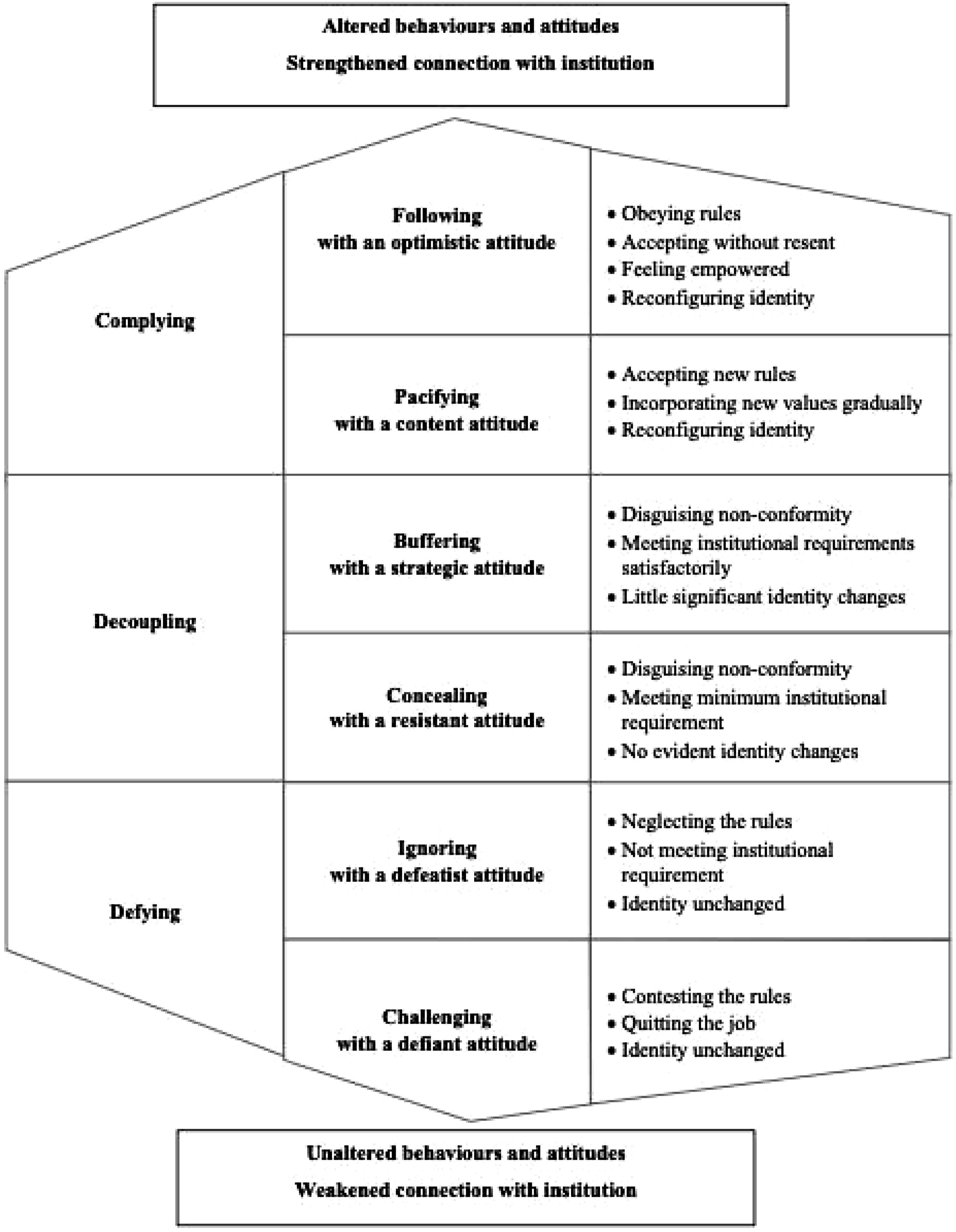
We argue that in response to the changing policy of the institution regarding research engagement and productivity, the ELT teachers’ strategies can be categorized into three types: Complying, Decoupling, and Defying. Complying strategy is manifested in two ways. First, teachers followed the rules with an optimistic attitude, meaning that they were happy to comply with the initiatives from top-level management and felt empowered by the new changes. Their identity was accordingly reconstructed, and they found themselves more committed to the new missions of the institution. In a lower level of compliance, pacifying with a content attitude means teachers were also obliged to the new policy, though it took them time to incorporate new values into their professional job and their identity gradually shifted. Decoupling strategy is a common response to changed initiatives described in organizational literature which ‘lies somewhere between continuation of practice and altered behaviour’ (Degn, 2018: 316). Our findings suggest that there are differences between two types of decoupling responses. While buffering with a strategic attitude means that teachers tried to meet new institutional requirements, they did so with a view to enhancing their research capacity within the unfavourable conditions (cramped workload, poor resources, and lack of systematic capacity development agenda). Meanwhile, concealing with a resistant attitude refers to the performance that met the minimum requirement of the institution but yielded little changes in behaviours and attitudes of ELT teachers towards their research duties. Lastly, the defying strategy, though not utilized by the group of participants in this study, was mentioned to be used by their colleagues. We put defying strategy in this frame as a reference for future research of the same inquiry or other research areas like organizational learning and management. Defying strategy is used when the teachers find the new policy to be impossible for them to comply with. They may ignore with a defeatist attitude, meaning that they contend with a failure to meet the institutional requirements and accept subsequent penalization. Teachers might also choose to challenge the new policy with a defiant attitude, which means they contest the rules and even leave their job as they see themselves unfit with the institution’s changing direction.
This typological framework can also offer policy implications for institutions seeking to support staff in more inclusive ways. Rather than viewing resistance as dysfunction or failure, this framework suggests it may serve as a diagnostic tool that signals areas of cultural disconnect and misalignment between institutional vision and personal development. In this regard, this understanding encourages institutions and policymakers to recognize resistance attitudes more as a meaningful form of engagement to institutional constraints in resources and time, which prompts for actions from institutions to create a better, more inclusive research environment, supportive communities of practice and professional development programmes, and adaptive responses to the evolving demands of global knowledge landscape. By understanding the range of attitudes exhibited by teachers as in the framework, HEIs may consider designing continuing professional development and research training programmes that could accommodate diverse capacities and time commitment, thereby fostering deeper alignment between individual and institutional goals and moving beyond narrow metrics and compliance-driven accountability in an intensified research agenda of a developing context like Vietnam (Tesar et al., 2022; Tran et al., 2017).
It should be noted that these three strategies are not fixed and may change over time, depending on other factors. Recently, researchers have discussed how generational traits influence ELT teachers’ perception of their career sustainability, their loyalty to an institution, and consideration of the alignment between their trajectory growth and institutional future vision of development (Phan et al., 2023, 2025). In future research, generational traits can also be incorporated into the proposed typology to develop a more comprehensive framework that illustrates ELT teachers’ strategies towards institutional research engagement policy. In addition, teachers may move fluidly between these strategies over time, shaped by shifting institutional contexts, personal experiences, and evolving professional identities at different points of their career spectrum. Scott et al. (2006) and Le et al. (2024) have pointed out early-career researchers are often under pressure to establish their academic profiles, thus, policies of research outputs could inadvertently result in a reduction in their scholarly productivity. A teacher may begin by ‘following’ with optimism and openness to change at the beginning of their career, only to later transition into a ‘buffering’ strategy later in the career. The change can also stem from the teachers’ navigation of rapid transformation in the landscape of neoliberal higher education that is not necessarily on par with local resources.
This paper further broadens discussions on knowledge production in a Global South context like Vietnam. The findings and the proposed typology highlight how the EFL teachers negotiated institutional logics shaped by global models of research productivity while operating within institutional and national constraints and incentives. This underscores the importance of attending to the situatedness of academic labour, teacher identity, research engagement, and challenging dominant models of university governance that focuses on research outputs and indexes (Tran et al., 2017; Tran and Marginson, 2018). We suggest that this typology can be used in future research to analyze teachers’ response to different initiatives from top-down management levels. We also believe that this typology can be used in various contexts to interpret employees’ response to organizational policies and implementation.
Footnotes
Acknowledgements
The authors would like to dedicate this paper to our dear colleague, friend and student, Linh Thi Thuy Pham, who lived a wonderful and heroic life. Ms Linh Thi Thuy Pham contributed to this study in the first stage in 2020, including participant recruitment, interview, and initial analysis. The authors would also like to thank the participants for sharing their experiences with us. We were grateful to the editor and two anonymous reviewers for their valuable comments on the earlier version of the manuscript.

Funding
The authors received no financial support for the research, authorship, and/or publication of this article.
Declaration of conflicting interests
The authors declared no potential conflicts of interest with respect to the research, authorship, and/or publication of this article.