




Abstract
Higher music education (HME) institutions, globally, have increasingly been expected to incorporate research into teaching in music performance programs (MPPs). This feature of “musical academization” arguably conflicts with a longstanding focus on the development of practical playing skills as part of a music performance education. Whilst academic literature has outlined how to conduct research supervision in performance programs at universities, the question of how students and educators understand research-led teaching and implementation strategies is lacking. This article highlights challenges to implementing research-led teaching in HME, exploring how research and research-led teaching is understood and implemented in MPPs at a medium sized Swedish university. Drawing on 13 semi-structured interviews with students and educators across different MPPs, it asks: (1) how are research and research-led teaching conceptualized and understood amongst music performance students and educators? and (2) what do students and educators see as the potential of research-led teaching for MPPs specifically? The article divides research in music performance programs into three themes: research as a noun, research-competent educators, and student-centered artistic research. Through this, the article informs discussions relating to implementing research in HME and to demonstrate students and educators’ perspectives on the value of research-led teaching in music performance programs.
Keywords
Introduction
Demands to incorporate research into music performance education programs have placed pressure on higher music education (HME) institutions across the world, blurring the line between what have been seen as strictly “musical academy” traditions, as selective institutions where musicians are trained full-time to play or compose, and the notion of universities as places of research (see Johansson & Georgii-Hemming, 2021). A number of authors have indicated that HME in multiple countries increasingly faces challenges to balance research alongside artistic education (e.g. Bennett et al., 2010; Moberg, 2019), emerging as a result of what Johansson and Georgii-Hemming (2021) call “musical academization.” The idea of needing to integrate research into music performance teaching is, however, a relatively recent phenomenon.
This article focuses on the challenges and possibilities of research-led teaching in HME from the perspective of MPP students and educators. It asks:
(1) how are research and research-led teaching conceptualized and understood amongst music performance students and educators?
(2) what do students and educators see as the potential of research and research-led teaching for music performance programs specifically?
The issue of how far performing arts departments engage in “real” research has already been debated elsewhere (e.g. Borgdorff, 2012; Croft, 2015). Yet, despite this, what research is and what research is good for has not been studied from the point of view of those who are affected by these demands. The article starts with a summary of how research has been conceptualized in MPPs, the problems with this and what it means in the Swedish context specifically before moving on to discuss the implications of these definitions for the artistic practice-research-teaching-nexus or “ART” (Bennett et al., 2010). The methods are outlined before presenting under three key themes: (1) the idea of research as a noun whereby written material, based largely on empirical data, is analyzed and discussed; (2) teacher-centered definitions which focus on the research competencies of educators; and (3) the idea of research as a verb which focus on student-centered activities aimed at gathering information on and analyzing their own musical practices with a view to producing new knowledge about them. In doing so, the article hopes to disentangle what is meant by research-led teaching in music performance programs, as well as to identify opportunities and areas of potential confusion.
The problem of “research” in music performance programs
The assumption that research, rather than purely teaching, is what distinguishes “academic” from “non-academic” music institutions has been a key feature of “musical academization” (Johansson & Georgii-Hemming, 2021). Academization refers to the increasing demands placed on educational institutions “to link teaching to research; requirements for teachers to hold research qualifications; and [to develop] a quality assurance system that focused on students’ scientific work (rather than practical training periods)” (Ek et al., 2013, p. 1309). Extending the concept to HME institutions, Johansson and Georgii-Hemming (2021) observe, through interviews with HME heads of department in Sweden, that there is now much more stress on training music performance students to become “artist-researchers.” This includes a shift from focus on purely instrumental tuition, composition and music theory to a 3-year degree program which includes a mix of lectures, group seminars, one-to-one and ensemble tuition, and a final-year independent project (more on this below) mirroring final year projects in the natural sciences, humanities, and social sciences.
The literature on how research itself is understood in MPPs, as a result of musical academization, is sparse. There are guides on how to supervise performance students’ independent research projects (Frisk et al., 2015; VanAlstine & Holmes, 2018; Young & Shanahan, 2018), literature arguing for the value of research in artistic education more generally (Borgdorff, 2012; Wilson & van Ruiten, 2013) as well as debate articles around what research should look like for the performing arts (Lilja, 2015; Stenström, 2014). Yet how teachers and students understand research within their education is not well understood; as Johansson and Georgii-Hemming’s (2021) work highlights, heads of HME music departments appear more inclined to talk in terms of what research is not rather than what it is within the programs they offer.
With respect to performing arts programs generally, debates have centered around the extent to which research in artistic programs: (a) should employ principles of systematic data-gathering and analysis in established scientific disciplines to inform artistic practice (see Borgdorff, 2012; Stenström, 2014, p. 87); (b) whether these principles, when applied to musical practice, are equivalent to research in other disciplines (Croft, 2015; O’Riley, 2011); and (c) how best to implement research-focused educational competencies (information retrieval, posing research questions, gathering data) in order to complement the practice-based requirements of performance programs (Frisk et al., 2015; Wilson & van Ruiten, 2013). Debates have similarly concerned the extent to which artistic knowledge needs to be communicated in written form or whether using extra-linguistic rather than written, visual, or verbal means to communicate research “findings” is more appropriate in arts-based education (Candlin, 2000; Moberg, 2019; Phelan & Nunan, 2018).
The problem is further complicated by debates around what constitutes “artistic research” 1 (Borgdorff, 2012). For instance Lilja (2015, p. 16) defines it, according to the “Swedish model,” simply as “research which has artistic research practice as its object of knowledge and which is carried out with artistic practices as its research basis” (my translation). In this case, documentation of the process of practicing and performing separates it from artistic practice. However, Lilja subsequently notes that there is no consensus as to whether “art” [konsten] is “the goal or just an account of the knowledge obtained/an insight in relation to the project’s theme” (p. 18 my translation). This approach differs from other proponents of artistic-research who see gathering data on others’ artistic practices as artistic research (Hultberg, 2017). Nevertheless, despite a general resistance to defining artistic research in concrete terms within the academy (Wilson & van Ruiten, 2013, p. 26), Borgdorff’s (2012, p. 23) definition of research in the arts as “not only experimentation in practice, but also reflection on practice and interpretation of practice” has been highly influential.
Finally, there is skepticism around the extent to which artistic-research should even be called research. Croft (2015: 8), for instance, argues that “by reducing compositional quality and originality to forms of innovation amenable to the language of research, we completely lose sight of the former” (p. 10). With regards to the accuracy of the term, he observes that, whilst “research describes the world; composition [and by extension musicianship] adds something to the world” (p. 8). It could, of course, be argued that research also adds something to the world, whether in terms of providing a new perspective or generating new knowledge by uncovering new phenomena. However, given that the purpose of artistic practice concern essentially aesthetic judgments surrounding one’s own musical practice and producing something new, as distinct from previous artistic expressions, this poses different problems to those which can be answered with recourse to principles of generalizability and systematic data-gathering. As a result, Croft argues that research should not be conflated with composition, which is an end in itself.
What complicates the process for MPP students and educators, specifically, is that it is rare for trained and career musicians who teach to also be “research-active” or have a research doctorate. Secondly, whilst the practice of gathering data in a systematic and rigorous fashion, and importantly reading about how to do this, is seen as integral to other subjects, MPP students do not have to gather and analyze data in the traditional sense to become more competent music practitioners.
The Swedish context
The notion that research-led teaching is important in HME has been influential in Sweden for some time. From a policy perspective, educational reforms within the Nordic countries as well as the UK during the 1990s made a legal case for recognizing “art practice-as-research” (Borgdorff, 2012, p. 34). Lilja (2015, p. 19) argues that The Swedish Higher Education Act of 1992 argued specifically for a closer relationship between research and artistic practice at Swedish HE institutions. Nevertheless, the Swedish Higher Education Act, in its current form, states that Swedish universities must provide “courses and programs which rest on either scientific or artistic competence . . . and research and artistic research as well as development work” (Swedish Higher Education Act Chapter 1 Section 2, my translation). “Or” and “and” leave a relatively large degree of interpretation here. Nevertheless, despite a high degree of ambiguity, the phrasing suggests that there is no legal requirement for artistic programs and courses to be linked to research even if universities’ wider activities should be based on either artistic research or research understood in the sense of gathering data about phenomena external to the researcher and communicating findings in written form. Similarly the Association of European Conservatoires’ guidelines emphasize that HME institutions at first cycle education should include the systematic use of methods and written materials to evidence musical practice as well as data-gathering and analysis as a means of informing practice but the term “research” is not used until second cycle education (AEC, 2017, p. 11). This highlights that, despite some ambiguity, there is no direct, formal requirement to include research as part of the MPP curricula, even if the importance of research is emphasized.
Despite this, internal pressures from broader university cultures which prioritize research, as well as external pressures from the culture around research as part of musical academization (Johansson & Georgii-Hemming, 2021) play a significant role (Moberg, 2019). One criteria by which “academic” programs are judged by state regulators in Sweden is through demonstrating forskningsanknytning, which, roughly translated, means that something is “linked to research.” The term itself has equivalences in the term “research-led teaching” in the UK, the US and Australia, though the idea of tying research to artistic practice in Europe has been decidedly influenced by the “Swedish model” (Lilja, 2015, p. 19) which emphasizes research doctorates in artistic education and basing artistic development on research (more on the complexities of how this is implemented below).
Whilst there are special dispensations for artistic education programs in Sweden, there is simultaneously no firm consensus as to what constitutes “forskningsanknytning,” nor whether, to what degree or in what way teaching in artistic programs should be linked to research. This leads to a certain ambivalence and a lack of clarity concerning whether teaching should be informed by research or whether students should be taught to undertake data gathering for the purposes of their own study. Most commonly in Sweden, MPPs include a final-year independent research project (självständigt arbete), though the form differs by institution. At the HME institution in this study, for instance, to accommodate different music traditions, the design of the course was structured around students conducting artistic research on a topic of their own choosing, often using structured autoethnographic methods (logbooks and self-observations) to document their own development around a chosen research question (see Borgdorff, 2012, p. 43). The examination however consisted of a written and sounding part. The former is orally presented and examined, using peer-reviewed literature to make an argument for the choice of topic and using quotes from the logbooks to support an analysis of the developmental work. The sounding part, which could be a performed or recorded song, a composition or a series of recordings, similarly, details the development of a sounding piece and is considered in tandem with the written work. As such, the project involves both a performance or compositional aspect as well as a written explanation of the theory and process behind them. The Swedish case, in this respect, is similar to other countries which also implement research projects amongst their performance programs (Lilja, 2015, p. 37).
Research-led teaching and the artistic practice-research-teaching-nexus
The debate around what constitutes the relationship or value of research to teaching is not, even in other subjects, uncontested. In discussions on the “teaching-research nexus” it is generally agreed that “there is no simple and consistent linkage between research and teaching” (Tight, 2016, p. 301). There have been key conceptual distinctions between the extent to which research-led teaching is understood as something inherent in the process of teaching or in the substantive content of what gets taught, as well as whether it is the student or the teacher who is the focus of the integration of research into teaching (Healey, 2005).
With regards to MPPs in HME, Bennett et al. (2010) expand on the concept of the “teaching-research nexus” to propose the “artistic practice-research-teaching nexus (ART).” In reviewing the literature on the area, they note that there has been a tendency to separate different research-focused activities from each other in artistic education. Rubidge (cited in Bennett et al., 2010, p. 6), for instance draws divisions between practice-based research, practice-led research, and practice as research. The first emphasizes the formulation of pre-defined research questions on practice which can be undertaken by non-musicians, the second is about using practice to answer questions about musical practice with no formal question and the third concerns using musical practice as a form of process.
Despite its appeal, this neat distinction does not hold given that there is considerable overlap between the three: practice-based research can also be practice-led and involve musical practice, for instance. Nevertheless, whilst Bennett et al. (2010) argue against the taxonomical division of research in artistic education into discrete categories, they instead propose a model that distinguishes between situations in which research is included in teaching as part of the substantive content (what they call “teacher-centered”) and those “student-centered” approaches which they regard as more actively empowering the student to take ownership of the process of researching (see also Healey, 2005). Extending Bennett et al.’s (2010) framework, in addition to the ends to which research is put, it is important to note that the term “research,” itself, should also be understood as both a noun and a verb; there is a distinction between the type of activity (reading, writing, experimenting) and the object to which it is directed, even if both activities might be seen as “student-centered.” In the former case, reading and writing are directed “at” developing epistemic competencies based on research. In the second, it concerns equipping students with the skills to specify questions and gather and analyze data. The key conceptual distinction between the idea of research as important in terms of what students do and what teachers do, as well as the level and type of activity involved, has consequences for understanding the value and role of research in HME more broadly.
Methodology
Interviews with students and educators responsible for different performance programs 2 were carried out from 2019 to 2020 at a medium sized university in Sweden. To ensure that views were not overrepresented from one particular performance tradition, a purposive sampling strategy (see Bryman, 2018) was used to ensure representation of students and educators from the different performance programs in the department (classical, popular, classical composition, and music production with songwriting). Students were further subdivided by year to ensure a broad range of interpretations from those who were undertaking or had finished their final year independent projects as this was likely to shape their view of what constituted research-led teaching. Educators were chosen because they had not only the ability to shape the form of research-led teaching but also had an overarching view of how research-led teaching was implemented in their respective courses (see Table 1).
Sample.
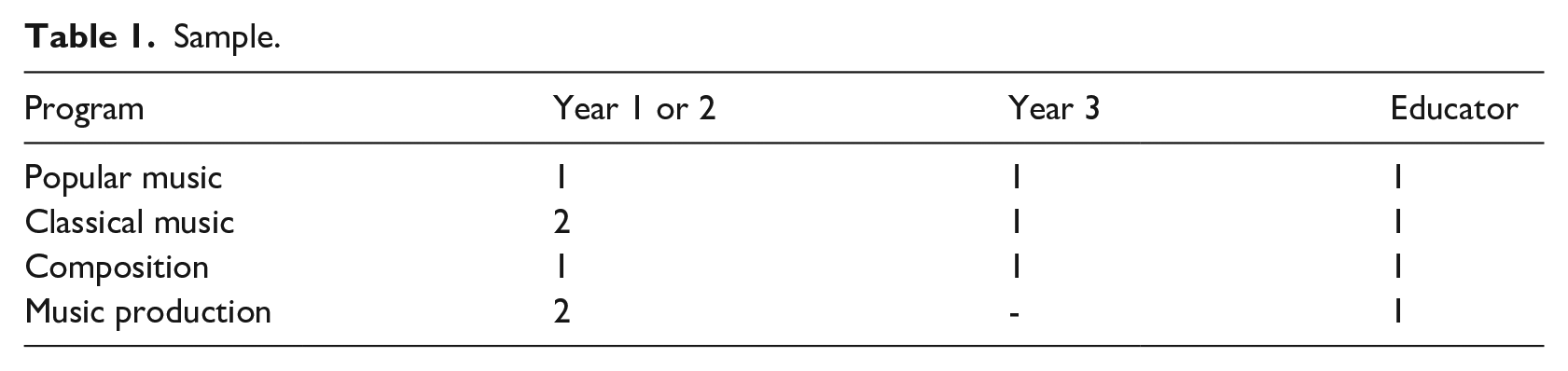
Interviews were carried out in Swedish using a discussion guide focusing on five areas: (1) background information; (2) what the concept of research generally meant to respondents; (3) what respondents saw as research’s role in HME; (4) how respondents had encountered research in their studies/worked with in their teaching; (5) what support respondents felt was available for research activities from the institution. Through this, the interviews aimed to get at what they saw as the advantages and disadvantages of research-led teaching, their perceptions of what research meant specifically in relation to HME and concrete examples of how they encountered or integrated research into their teaching and learning, depending on whether they were students or educators. Interviews lasted between 45 and 90 min and were first transcribed fully into Swedish before being translated into English. Analysis was also conducted in Swedish first before being translated to English.
The study was primarily inductive and no theoretical framework was adopted from the start. Analysis was conducted using a thematic analysis approach, coding semantically first, before exploring the “latent” content (see Braun & Clarke, 2008). The process was iterative and during the first stage, this involved simply reading the transcripts and using the research questions to note areas of interest based on the use of specific words (for instance: development, researcher, support, artistic-research, relevance). To ensure a greater degree of systematicity, interviews were first transcribed in full and then analyzed using Nvivo’s word frequency function before engaging in manual coding. This allowed for gauging the relative weight of certain concerns and issues relative to others, avoiding perceptions of a certain arbitrariness in thematic analysis and allowing the researcher to see the words in context to determine their suitability and salience (Feng & Behar-Horenstein, 2019). During the second stage, transcripts were compared with each other, and the data were grouped into 21 different codes based on thematic similarities concerning definitions of research, problems/difficulties with research and what they saw as they potential advantages. These ranged from the quantitatively most significant category of “reflection” to the least common “tradition-critical.” Finally, these categories were refined through engaging with Bennett et al.’s (2010) approach to viewing ART as a continuum, and grouped into three themes reflecting distinctions between: (1) treating research as a noun focused on reading, writing and talking about research; (2) teacher-centered definitions focused on the research competencies of educators; and (3) developing student-centered research competencies, particularly through the concept of artistic research.
All participants signed written consent forms and have been anonymized enabling them to speak openly and freely. Before each interview began, participants were informed of their right to withdraw from the process at any time without pressure to continue. The project adhered to national guidelines on good research practice (Vetenskapsrådet, 2017) though formal research ethical approval was not necessary as the project did not deal with sensitive or personal information as defined under Swedish law. Guidelines pertaining to the handling and management of correspondence under the GDPR have also been followed.
Research as a noun: Reading, writing, talking about research
Both students and educators had trouble defining what was meant by research and students in the first and second years generally did not feel that they had “encountered” research in any substantial or meaningful way. This is significant in that it indicates that whilst research-led teaching is expected of teachers, a clear notion as to what constitutes research was frequently absent. Nevertheless, when pushed, the most common definition of what research was about for students particularly, concerned reading written texts about others’ musical practice or compositional techniques. These texts were, themselves, largely (though not exclusively) based on the systematic gathering of information about other musicians.
It’s been like, “read this”, that’s some kind of research (popular music student, 3rd year) All I can think of is what we have done in the music history course when we had a written assignment. (Classical music student, 2nd year) Perhaps in a theoretical course. . . music history and ensemble psychology, perhaps? (popular music student, 3rd year)
Two things are apparent here: first that written knowledge about music was automatically equated with being research-based. In this respect, there was a broad definition of research regarded as a noun whereby the activity of reading and talking about peer-reviewed publications or theoretical texts on music was key. The second is that students did not discriminate between different academic traditions or foci. The discussion seminars could include music history, aesthetic or empirical texts about music’s importance, biographical information about composers or music psychology. Students, however, were likely to conflate philosophical texts on the aesthetics or interpretation of music with music psychology literature in which authors had used experimental or other empirical methods to gather data systematically.
Despite the fact that music psychology is an empirical science the term “theoretical” is particularly important as it denotes the common separation between epistemic knowledge about music, through the gathering of research data on others’ practices (research as a noun), as something separate from what students saw as the core focus of their education. As Georgii-Hemming (2013, p. 22) notes, epistemic knowledge concerns “certain knowledge of how nature, mankind and the world are constituted and function.” This does not necessarily have to concern collecting data given that it can help students to evaluate, analyze, and explain their own musical practice (p. 24). However performance students clearly saw it as separate. To this end, there was a particularly marked difference in terms of how students regarded the value and relevance of these seminars depending on their degree stage. Those in the first and second years were generally more skeptical of the relevance of reading and writing for their artistic development. However questions of artistic relevance did not exclude more philosophical questions about the role of music and students’ reflections on their role as musicians in society more broadly. This was particularly the case amongst third-year students:
It’s important to think a little . . . [you should] have thought through a little what it means and reflect a little on what led you there, and also, historically, what kind of music do I use, or what tradition does this come from? (popular music student, 3rd year)
Those in the third year were also generally more supportive of the role of discussion seminars and reading academic work about musicians’ composition practices or music reception. However all students stressed that there was a need to indicate how these “theoretical” seminars related to their artistic work; something characteristic of the emphasis on musical education as about the development of practical skills or “techne” (see also Georgii-Hemming, 2013).
The biggest challenge is still being creative when you’re creating artistically and that it should be based on research without it becoming too . . . What can I say, academic maybe? . . . I feel that the more tangible the research is, the easier it is to absorb in order to apply it to my own musicianship (composition student, 3rd year emphasis added).
However, among the educators too, opinion was a little divided on the relevance of these courses for the students’ educational development, and particularly the emphasis on musical practice, with one commenting:
I think it would be disastrous for practical teaching if everything becomes more intellectualized and more formalized. It would really affect the results and the quality, as well as the appeal of our program (classical music educator).
Importantly, most educators tried to emphasize not only the theoretical application of knowledge to students’ artistic work but also the importance of developing students’ critical abilities as part of “higher order,” problem-solving skills through activities directed at research as the indirect object designed to stimulate thought:
In the seminars we talk [about ideas] and try to find out how things are. Not coming up with . . . ready-made solutions, but . . . One might have more of an idea [of asking students] ‘Do you think it works like this’? (music production educator) In the [name of course] . . . they read about central concepts . . . it’s about getting a bigger perspective [pause] . . . about one’s own music-making (composition educator)
Here, the focus was on developing students’ abilities to critically read texts, to familiarize them with the format and structure of academic texts, to introduce them to possible methods that they can use and to reason from different arguments. This was seen as a base from which to build critical analytical skills which would be relevant for students’ artistic and educational development. As with the notion of epistemic knowledge, in the tradition of bildung, the purpose was not necessarily goal-oriented in terms of having a direct effect on either students’ musical abilities or in terms of obtaining a grade. Whilst students saw these as research, they are primarily about familiarizing students with the structure of academic texts as well as stimulating thought based on written sources, many of which are not necessarily based on empirical data.
Teacher-centered definitions: Research-competent educators
A popular perception of what research was, in conversations with both students and educators, centered around the figure of “the researcher,” emphasizing research as an activity but one which was primarily centered on the competencies of educators. For students, there was an idea that those who had conducted research themselves were generally something distinct from “normal” music teachers and it was often these people that were responsible for running literature seminars and for recommending literature. However, the definition of who was “research-competent” was broad, including musicology and music education lecturers with a doctoral degree, doctoral students, or music teachers who had undertaken some form of study or had a master’s degree in either musicology or music education. Here, as with the literature seminars, students placed emphasis on an understanding of research as being about the work of others; constituting sessions taught by those with previous experience of doing research, with some noting that teachers who emphasized their own research experience instilled greater confidence in students:
I wonder about how I’ll get in touch with a researcher when the time comes to write [my] research project . . . It feels good if you come into contact early with someone who’s used to [carrying out] research (classical music student, 2nd year)
Educators too, particularly those working as music teachers, often highlighted their own research credentials as central to artistic education, having undertaken research activities themselves in the form of collecting data and writing an independent thesis or staying abreast of literature in the field:
I’ve gotten stuck into a lot of research. I’ve updated myself on the artistic research that has been produced in the last ten years or so (popular music educator)
From students’ perspectives, those teachers who were perceived as lacking a background in having conducted empirical research, or who had not undertaken a research doctorate, were seen as uncertain and therefore less authoritative:
I think that the teachers who work with this course [preparing the students for their independent research projects], are themselves quite uncertain (popular music student, 2nd year).
Research-competent teachers were generally seen positively by students though, again, the extent to which educators’ ideas were well-received concerned whether they could communicate the relevance of their research activities or peer-reviewed literature for students’ artistic music practice. This included an emphasis on teachers explicitly stating the relevance of their research interests for the topic of artistic practice.
In interviews with the first- and second-year students (prior to undertaking their third-year independent project), the definition of what research was more often touched on the figure of the (natural and physical) scientific researcher and references to “Einstein,” “mixing-chemicals,” and “lab coats” featured frequently. This focus on epistemic, primarily theoretical, knowledge as the defining characteristic was far less prominent amongst the third-year students who, having undertaken their independent research projects, often emphasized how much their view of what research was had changed particularly through coming into contact with the concept of artistic-research and artistic researchers.
Research as a verb: Developing student-centered research competencies
The main way that students across all years felt that teaching was research-led was through conducting final-year artistic-research projects. Here, research operates as a verb in the sense that it is concerned with students collecting data through logbooks and reflective journaling as the central activity, based on the artistic-research tradition of focusing on their music practice as the object of study (see Lilja, 2015). Nevertheless, the question of what separated research in this context as distinct from artistic practice is one that the students, even those who had undertaken independent research projects, struggled to define:
This particular “objectivity factor” feels difficult and strange . . . It’s hard to say what [artistic research] is (popular music student, 3rd year). It’s become much clearer, but also more unclear . . . because it feels like it’s [laughs] kind of pretty loose and that it can be so many different things (popular music student, 3rd year)
The fact that most of the students, as well as the educators could not offer a concise definition of research is significant in that it indicates a clear unease about notions of research based on introspection and autoethnographic methods. Most pointed to the fact that the methods chosen for self-reflection differed from their usual way of performing or practicing, which enabled a more systematic approach to rendering their own thoughts and reflections visible. Here, the focus on methods as a means of informing practice was key to their understanding:
the concept of research has probably become much broader since I started writing on my work . . . [and with the idea of] artistic research . . . the concept of research has become a little looser (popular music student, 3rd year) I think that the artistic research that I have encountered is very much about the researcher’s own experiences and it is often a question of interpretation . . . Maybe that’s what I mean by subjectivity (composition student, 3rd year)
The issue of reflexivity and developing a means of thinking consciously about the choices made in relation to their artistic practice, particularly, was a vital element in both how the students and educators defined artistic research as well as what they considered to be the biggest strength of the final-year independent research project. The methods thus enabled students to reflect more systematically than they otherwise felt they did in their everyday practice:
[it raises] awareness of things that get in your way, or that have gotten in my way emotionally and psychologically. It may have helped to . . . just to see them . . . it motivates me to . . . [laughter] what can I say? Confront [those things], maybe? (popular music student, 3rd year)
This was a deliberate intention amongst educators:
I can get tools to make those deepest recesses visible. And maybe get ideas and insights too that I don’t usually think of if I don’t think about them without “research glasses” on (classical music educator)
Students and educators saw clear value in having the logbook as a reflective aid to make visible what students did. The relationship of artistic to research practice here is however contradictory: first there is the application of theory to technical artistic practice; rendering performance practices visible in order to find new ways of doing them. This invokes Stenström’s definition of developmental work (2014, p. 84) as distinct from research whereby “research seeks new knowledge, while development work uses knowledge to develop new or improved products, systems, processes or methods.”
Secondly, however, there is the application of epistemic knowledge to the development of artistic practice. This was seen as enhancing less definable qualities such as creativity and new forms of thinking in a way that was systematic but less direct goal-oriented, in the sense of bildung or knowledge for its own sake. This second aspect chimes more with Borgdorff’s (2012, p. 43) assertion that: “art practice qualifies as research when its purpose is to broaden our knowledge and understanding through an original investigation.” In fact notions of “development” and novel perspectives, which were not directly related to improving technical proficiency, came through very strongly in the interviews:
It’s been extremely important for my development, and maybe I didn’t know from the beginning that it would be. (popular music student, 3rd year) You have to have a connection to research in order to develop artistically . . . Yes, to develop . . . (classical music student, 3rd year) [it helps to] produce new knowledge . . . New perspectives on things. See things in a new light (composition educator).
Here, whilst the focus of the independent artistic-research project is clearly on developing students compositional and technical abilities, it also has a less instrumental aim in the sense that it is also concerned with encouraging student’s reflective development as artists. However, when pressed, clear examples of how the independent research projects contributed exactly to either of these were lacking.
Discussion
This study set out to address: (1) how research and research-led teaching was conceptualized and understood by students and educators; and (2) what students and educators see as the potential of research and research-led teaching in music performance programs. With respect to the first, students adopted a broad view of research and research-led teaching in MPP. They were most likely to highlight research as a noun, with the central activity based around reading, discussing, or writing about what other people (academics or composers) have done. This literature was often though not always based on empirical data itself. Whilst this is a student-centered approach in that students actively engage with literature which is itself based on research, students and educators both framed it in terms of talking, reading, or writing “about” research as an indirect object.
The second most common idea about what constituted research-led teaching, was often “teacher-centered” (Healey, 2005) with students looking more favorably upon teachers with research experience to educate them about epistemic questions and process-related activities. This involved learning to critique arguments, learning about data collection methods (primarily logbooks), finding relevant literature, devising research questions, and making theoretical arguments about their practice in writing. These teachers were seen to be important sources of knowledge, over and above what students saw as “regular” music teachers. This focus on the figure of the “researcher,” as distinct from the “teacher,” further emphasizes a dominant idea of research as primarily based on epistemic knowledge and as something external to the everyday practices of music students (see also Croft, 2015).
As Georgii-Hemming (2013, p. 22) notes, such a view is also common within music-teacher programs where students separate pedagogical theories about teaching music from their actual practice of teaching music. Her study observed particularly that music teachers tended to see scientific research as primarily involving measurable and documentable phenomena whereas musical development was seen to be somewhat contrary to this way of thinking. Students during the earlier years often did not feel that they had experience with a vague concept of research, again understood largely as a noun, referencing methods relating to the natural, physical, and medical sciences. This indicates that, even if research-led teaching strategies were in place, students were not usually aware of them, though MPP students’ perceptions of what constituted research, as well as its value, shifted over time.
With respect to the second question, students and educators who participated in this study were largely enthusiastic about the potential of “research,” broadly defined as the acquisition of empirical and theoretical knowledge or the systematic documentation of their own experiences, even if it was often difficult to define why. This might be seen as the way in which the broader processes of “musical academization” (Johansson & Georgii-Hemming, 2021) and the emphasis in the Swedish context, as well as in other countries, on integrating peer-reviewed literature (AEC, 2017, p. 11), in addition to employing research-competent teachers in HME have influenced the way students and educators see “research” as something of value despite not being able to explain why.
Third-year students, however, were particularly more likely to articulate what they saw as the value and validity of artistic-research, through the systematic written documentation of their own artistic practice, as a valid source of knowledge in its own right and as important for their artistic development. Both students in the third year and educators drew attention here to the importance of student-centered artistic-research projects for their theoretical and technical development. Whilst Croft (2015) argues strongly against equating artistic development with research in the traditional sense, educators emphasized a model more indebted to Borgdorff’s (2012) more subjectivist conception of artistic-research as based on embodied knowledge and autoethnographic methods. Educators actively worked to instill a view of artistic-research as something distinct from students’ normal musicianship but this was focused on placing students at the center; a process which involved the systematic collection, documentation and analysis of their own experiences. It was clear that this approach resonated most with students in terms of the relevance of research and clear institutional frameworks played a significant role in how MPP students come to view “forskningsanknytning” as a primarily student-centered, process-oriented activity.
Nevertheless, the value of these activities was primarily judged as beneficial insofar as they were a means to enhance students’ musical and artistic practices. In this respect, students could more easily see the benefits of student-centered approaches for their musical development than either teacher-centered approaches or where they discussed research as a noun. Students stressed the importance of not only teaching which included literature based on musicological research, delivered by “research active” educators, but emphasizing and demonstrating the relevance of teacher-oriented research for artistic development and practice. Furthermore, despite generally positive perceptions of the value of research-led teaching in HME, there were educators and students who were implicitly or explicitly critical of academization, with both students and one educator warning strongly against “diluting” the artistic aspects of MPP with too much academic knowledge.
As noted, whilst the concept of the “research-teaching nexus” is also contested in other fields (Tight, 2016), a key distinction remains between conceptions of research which focus on what competencies teachers are expected to have and what students are expected to do. This study supports previous theoretical approaches in that it confirms that the forms that the research-teaching nexus may take in HME are broadly understood. Despite understandable concerns to the contrary (Croft, 2015), there is room for a wide range of different approaches to both defining and implementing research within MPPs. It also supports Bennett et al.’s (2010) assertion that whilst it is fruitless to try to separate different types of artistic or practice-led research, it is important to think about ways of integrating research into teaching as both a process-oriented (verb) and as an indirect activity (noun) with both seen as valuable to artistic development. A student-centered approach to research in HME, in which students learn by conducting artistic research, as well as by reading, writing, and discussing theoretical texts, by contrast, is beneficial. This is because whilst the focus on musicianship and artistry is central to music-performance education, artistic development is enhanced by theoretical and metaphysical ideas about the nature of music and its place in world, through an emphasis on epistemic knowledge. Such ideas are relevant to their artistic education because they provide students with a greater sense of meaning around why they do what they do, beyond a purely practice-oriented outcome, but does so in a way which motivates and shapes practice.
