




Abstract
The aim of this article is to introduce and provide an overview of fiction as a research method with examples from education. Although there are similarities with narrative research, particularly narrative construction, fiction allows for more speculation and imagination. Two types of fiction are discussed: informed fiction and speculative fiction. Informed fiction uses data to inform and inspire fictional works, while speculative fiction encourages researchers and research participants to craft more imaginative and creative fictional narratives. To illustrate different ways fiction can be informed, examples are provided of how fiction can draw from empirical data, workshops, and literature. Then, examples of how speculative fiction can connect with research and researchers are discussed. These include speculative fiction created as part of research, research participants creating speculative fiction, and researchers themselves creating speculative fiction. The article also critically examines what quality might mean when creating research fiction. While some traditional indicators of qualitative research quality may apply to informed fiction, they often do not apply to speculative fiction. Fiction, as a research method, encourages researchers to embrace their imagination and creativity rather than suppress it.
Introduction
Why is fiction relevant in research? Research fiction can help make research more accessible, engaging, and promote debate (Cox et al., 2023). Such fiction is more open to interpretation, encouraging the reader to become actively involved in a dialogue with the text. One might ask whether research is supposed to be rigorous rather than fictional? Fiction and non-fiction are not binaries. Research texts are, in fact, fictional “since they have been ‘fashioned’ and ‘moulded’ by their writers and their quality depends at least in part on the skill and imagination with which they have been crafted” (Spindler, 2008: 20). Empirical “data is partial, incomplete, and is always in a process of a retelling and remembering” (Jackson and Mazzei, 2013: 262). Research fiction can be a way to respond to Jackson and Mazzi’s call to open up and proliferate knowledge rather than foreclosing and simplifying it. Research fiction allows us to explore and gain access to different social worlds, and reexamining them (Leavy, 2018). For example, in the edited book Childhood, Science Fiction, and Pedagogy, examples of science fiction are used as an entry point to explore alternative education possibilities (Kupferman and Gibbons, 2019).
Research fiction needs to be careful not to place too much emphasis on academic formality, as this risks stripping away the lived experiences of research participants and researchers (Gibson, 2021). By reducing complex and conflicting voices to generalities free of context, these experiences may be lost (Jackson and Mazzei, 2013). Adapting the idea of “plugging in” from Jackson and Mazzei (2013), who in turn drew on Deleuze and Guattari (1987), we can connect three fields: the field of reality (the world represented through experiences, data, and theories), the field of subjectivity (the author’s personal and professional knowledge and experience), and the field of representation (the product, such as a story, paper, or book). Because the author is subjective, no story will be alike. This gives us the opportunity to imagine different possible worlds and frees us from predetermined agendas dictating what “should” be.
Research fiction allows us to “sensitively portray human experience” because participants are not reduced to numbers or excerpts from transcripts (Leavy, 2023). Creating fiction based on research can help open up multiple meanings and different views into social experience (Barnes, 2014). Leavy (2023) defines the broader term social fiction as follows: By social fiction I mean fiction that is written by researchers in a field and reflects their social research concerns or expertise. A work of social fiction may be based on a particular study in the traditional sense, or it may be influenced by the author’s cumulative insights and perspective (p. 3).
As will be described in the article, not only researchers but also research participants can create fiction (Kaukko, 2023). Although the majority of research fiction, including most of the work discussed in this article, has been text-based, there are exceptions, such as photographs (Pfohl et al., 2021), images (Costello et al., 2023), audio, comics (Davis et al., 2024), designs (Bleecker, 2009), and objects (Ross, 2023). For the purpose of this article, the following definition is suggested: Research fiction is created by researchers or research participants reflecting their concerns and experiences. Such fiction may be informed by a study or other sources, the author’s insights, perspectives and speculative ideas, or a combination of these.
Research fiction can take many different forms. It can imagine and connect to past, present, and future events. Realistic, near-future fiction may be useful in helping us understand actions to take in the present. Even when considering potential futures, authors will implicitly or explicitly draw on the past and present, as our knowledge shapes how we imagine futures. Radical fiction can be created to challenge dominant agendas. However, thinking otherwise is difficult. When creating fiction, we tend to repeat these dominant agendas (Gidiotis and Hrastinski, 2024). Here, we can learn from authors such as Freire (1978) and Hooks (2014), who have led the way in challenging dominant narratives and oppression, using storytelling as a vehicle for transformation. Fiction can actively shape how we feel, think, and act. However, research fiction is never neutral and, like any other fictional work, should be approached with a critical eye.
The aim of this article is to introduce and provide an overview of fiction as a research method. In the next section, the related field of narrative research is discussed, with a particular focus on constructed narratives and their relationship to research fiction. This is followed by an examination of two types of research fiction: informed fiction and speculative fiction. Examples of education fiction are presented to illustrate these approaches. The article also critically examines what quality might mean when creating research fiction. Finally, the article is concluded.
Constructed narratives and research fiction
While conventional research attempts to discover knowledge about the “real” world, narrative research “causes us to question our values, prompts new imaginings of the ideal and the possible. It can even stir action against the conventional, the seemingly unquestionable, the tried and true” (Barone, 2001: 736). Narratives emphasize emotions and lived experience, and are aesthetically presented through different story forms. Narrative research “uses literary devices to allow readers to make sense of the study in their own ways. Multiple interpretations by multiple readers are expected and promoted” (Coulter and Smith, 2009: 578). Narrative researchers describe events retrospectively (Freeman, 2007). Evidence is gathered in similar ways as in qualitative research by conducting, for example, interviews, observations, and searches of archives.
Polkinghorn (1995) distinguishes between two basic categories of narrative research: analysis of narrative and narrative analysis. In the former, themes and categories are identified through analysis of narratives. In the latter, “researchers collect descriptions of events and happenings and synthesize or configure them by means of a plot into a story or stories” (p. 12). By organizing data as a story, it can become interesting beyond merely recounting such data, which can make research more accessible and emotionally engaging (Winter, 1986). Stories are built on data that is collected, framed, and rendered in an analytical process that is both artistic and rigorous (Coulter and Smith, 2009). Barone (2007) prefers the term narrative construction because “this recasting of data into a storied form is more accurately described as an act of textual arrangement than of analysis” (p. 456). Since the late 1990s there has been great interest in narrative construction and researchers have experimented with different literary genres to present their data (Barone, 2007).
In the process of narrative construction, researchers develop one or several stories based on the research data. The story is continuously written and tested against the data. When conflicts arise, the researcher revises the story. Over time, the researcher determines which data elements should be included in the narrative. The storytelling process involves balancing the details identified in the research to decide what should be incorporated into the story. For example, multiple research participants might be represented as a single character, or several settings could be combined into one scene (Coulter and Smith, 2009).
While some narrative researchers prefer not using the term fictionalizing (Coulter and Smith, 2009), imagination and speculation is at the core of research fiction. Narrative researchers often study lived experiences and events retrospectively (Coulter and Smith, 2009; Freeman, 2007), while a key theme of research fiction is futures. We can distinguish between two types of fiction in research: informed and speculative fiction.
When creating informed fiction, researchers can, for example, conduct literature reviews or collect empirical data and draw on the results when creating stories (Cox, 2021). However, a difference compared to narrative construction is that the story is not directly based on the research data but is instead informed by it. In speculative fiction, researchers have even greater imaginative and creative freedom. Speculative fiction is not bound by the “rules” of traditional research: “From this privileged position of ‘author’, we can draw into our narratives those crucial but subtle textures of thought and feeling which are not readily accessible to more standard forms of ‘research’” (Rowland et al., 1990: 291).
Research fiction is both informed and speculative to varying degrees, which is what makes this approach unique. It is always informed to some extent because our experiences and knowledge influence what we create. At the same time, it is inherently speculative; otherwise, it would not be fiction: “‘Fact’ and ‘fiction’ within text are problematic and interdependent; fiction must have some basis in fact, and within text fact is always mediated by the writer’s craft” (Spindler, 2008: 20).
Building on the discussion above, fiction in research can be viewed as existing on a continuum—from constructed narratives closely based on data to speculative fiction, which prioritizes imagination. Positioned between these approaches is informed fiction, which is partly based on data or other sources and partly speculative (see Figure 1). The next section focuses on informed and speculative fiction, which can be seen as complementary to constructed narratives. Constructed narratives and research fiction.
Informed fiction: turning data into stories
Early approaches to research fiction have been to draw on research, most often empirical data, to inform fiction. Researchers are telling their stories based on their interpretations and intuitions (Clough, 2002). “No two imaginations are alike, and how we take what we see in our mind’s eye and translate that into pen on paper, is entirely original” (Leavy, 2023: 16). Thus, different researchers would create different stories even if they have access to the same dataset.
Fiction can be informed by any type of empirical data (Clough, 2002), although there has been a preference for using qualitative data (Leavy, 2012). For example, interviews can be coded to identify themes, which are then used as the basis for writing a story (Leavy, 2018). When crafting fiction, researchers may also incorporate fragments of empirical data, such as “real” dialogue captured during observations (Clough, 2002). To illustrate different ways to inform fiction, examples of how fiction can be informed by empirical data, workshops, and literature are described below.
Fiction informed by empirical data
Fiction can be informed by empirical data. Veletsianos and colleagues (2024) developed three hypothetical scenarios for the near future of teaching and learning, based on interviews with 34 Canadian faculty members: a hybrid work model, a high-tech and flexible learning model, and a pre-pandemic status quo model. These scenarios are closely based on the interviews and sometimes include direct quotes. Each scenario draws from 12 to 13 interviews, with some interviews contributing to two scenarios. The interviews were guided by the following open-ended question: I am going to ask you to take out your fictional crystal ball and imagine that you’re teaching a course at your institution in 2026. Describe to me what a typical day at work might be like. What happens during that day? What is life like from your perspective? (Follow-up prompts: Tell me more about [topic/concept/practice]. What makes you say [X]?) (p. 1857).
Each scenario revolves around a hypothetical main character. In the following excerpt from one of the scenarios, we meet Hassan, a tenured faculty member at a Canadian university: Walking through a courtyard on his way to teach a lab, Hassan pauses momentarily, and staring at the tall building in front of him reflects on how “even with a greater reliance on technology and having a mix of online and in-person students,5” many things remain the same. Although Hassan’s institution returned to so-called “normal operations” as early as 2022, there are still noticeably fewer people on campus than before the pandemic. As the COVID-19 pandemic has abated but persists—something, he hopes, that shall eventually pass—people’s sense of belonging to a collective and desire to participate in various forms of in-person activities appear to have fractured somehow. Although some students and faculty had been eager to return to campus, others wanted to retain alternative options and support for remote work and online learning (p. 1859).
This is an example of highly informed fiction, or what could even be considered a constructed narrative. The scenarios include numerous references to and quotes from the interviews (see number 5 in the excerpt above). Overall, these scenarios provide insights into faculty expectations regarding future teaching and learning modalities and highlight the potential impacts of hybrid and distance learning on the future of higher education.
Another example is Costello et al. (2023), who analyzed job advertisements for learning designers. The authors discussed their findings and grouped them into themes. Based on these themes, three learning designer personas were developed and presented as fictional interviews together with images of them. In the following excerpt, one of the persona describes his view on teaching and research: So yeah, teaching was great, but research is where it’s at. Some colleagues spend a lot of time telling me about their teaching. But you can’t get impact with teaching. So you did your job – big deal. Do you want a medal? We’re not a school. That sounds harsh, but we need research to drive teaching because if we are not evidence-based, we are a basically a bunch of wizards traipsing about in funny costumes (p. 465).
The article concludes by “contributing elements of a speculative job advertisement for a learning designer, who will help shape educational spaces of the near future by entangled care and unencumbered attentiveness” (p. 460).
Fiction informed by workshops
Fiction can be informed by conducting workshops. Empirical data, such as notes, recordings, and artifacts created by the participants, can be collected through workshops. The Near Future Teaching project, for instance, used various types of workshops, such as brainstorming and discussion sessions, to co-design a “values-based future for digital education” at the University of Edinburg (Bayne and Gallagher, 2021). Informed by this work, speculative scenarios about the future of higher education teaching were developed, alongside a set of “tarot” cards, posters, and short stories (Bayne et al., 2022). The following is an excerpt from the scenario AI Academy, which envisions one of eight potential future universities: Surveillance is pervasive from the movement of staff around campus to students’ attendance, engagement and behaviours. Acceptance of this is high because the gains are significant and very few care about eroded privacy rights. Information is continually sifted, sorted and pushed to students, academics and administrators on a just-in-time basis and with infinite granularity. Conventional student assignments are no longer required, as Al-enabled analysis of historic, behavioural and neuro data provides an instant categorisation of their capacities (Bayne et al., 2022).
Other examples of speculative future scenarios from the project include Extinction-era universities, Justice-driven innovation, and Return to the ivory tower. These scenarios can be used to provoke discussions on future universities.
Another example is Davis and colleagues (2024), who conducted storytelling sessions to explore themes of social injustice by critiquing and analyzing “their routes into and through academia as people of working-class origins” (p. 2). The project provided a group of eight academics the opportunity to interrogate and (re)imagine their experiences. They analyzed transcripts from the storytelling sessions and developed themes and data categories. Then, sub-groups worked with the themes, categories, and data to create composite stories, which were presented in text, audio,
1
and comic
2
formats in collaboration with an illustrator. In the following segment, the fictional characters Ed and Dan discuss a promotional video produced by the university based on their journey from part-time students to academic roles: Dan: “I was a bit annoyed to be honest about how the videos came across.” Ed: “Annoyed? How come? I thought the videos projected a positive message.” Dan: “Well, I said quite a bit about the ups and downs involved in studying and working but also how those from different backgrounds and experiences bring their knowledge into universities which is really valuable. There seemed to be more ups than downs in the video. I didn’t get to see a final version until tonight and it was a bit of a shock.” Ed: “We’re trying to promote the courses. And you can’t get into much detail in those short videos. Who wants to hear about the not so good stuff?”1
Overall, the project contributes to representing the experiences of diverse individuals who are culturally and socially marginalized in academia.
Fiction informed by literature
Fiction can be informed by the literature. Cox (2021) wrote fiction that drew on a systematic literature review to examine the “potential use of AI and robots in learning, administration and research” (p. 1). Findings from the review were organized into eight themes, with a vignette written for each theme. The article includes selected passages from these vignettes, while the full versions were published in a public repository (Cox, 2020). Three of the vignettes were adapted from existing literature and rewritten for this study by applying them to higher education, making them more concise, or incorporating new elements. One of the themes, “social robots in learning,” inspired the vignette Footbotball: Maybe it’s a bit weird to say, but it’s about developing mutual understanding and… respect. Like the bots can sense your feelings too and chip in with a word just to pick you up if you make a mistake. And you have to develop an awareness of their needs too. Know when is the right time to say something to them to influence them in the right direction. When you watch the best teams they are always like talking to each other. But also just moving together, keeping eyes on and moving as a unit (Cox, 2021: 8).
Collectively, the eight vignettes ask questions about human agency in relation to AI and robots. They were written not to advocate for a specific perspective but rather to be inspirational and controversial, and highlight tensions between different potential futures in education. This makes such fictions valuable for reflection and discussion (Cox, 2021).
Speculative fiction: exploring ideas through stories
Through speculative fiction, we can make full use of our experience, imagination, and creativity. Creating such fiction allows us to test and explore new ideas, and sometimes “the story seems to express something of which [the author] was not previously aware” (Rowland et al., 1990: 291). While fiction can be highly speculative, it can never be entirely so, as it is always grounded in the author’s experience and knowledge: A piece of fiction devoid of any connections with known reality would be incomprehensible. Consequently, if we are to attempt a description of what is fiction, there is little point in clinging to the old distinction between fiction and reality as a frame of reference. The literary text is a mixture of reality and fictions, and as such it brings about an interaction between the given and the imagined (Iser, 1993: 1).
To illustrate different ways that speculative fiction can connect with research or researchers, three types are discussed: speculative fiction in research, speculative fiction created by research participants, and speculative fiction created by researchers.
Speculative fiction in research
Speculative fiction in research describes fiction that is connected to scientific work, such as utilizing research methodology when creating fiction or analyzing speculative fiction as a basis for scientific discussion or conclusions. Two examples are provided below. The first is an article that develops fiction as part of the scientific process. The second demonstrates how collections of short stories can be compiled and analyzed to explore themes or issues.
Selwyn et al. (2020) wrote five vignettes imagining a future school named Lakeside as part of a research article. Workshops were conducted to brainstorm vignettes that were considered meaningful and relevant. The researchers followed guidelines for social science fiction (Lackey, 1994) and ethnographic writing (Atkinson, 2015). Drafts of the vignettes were shared with other members of the research group at a public event and subsequently rewritten based on the feedback received. The following is an excerpt from one of the vignettes, describing the potential future role of a fictitious school management platform named Oracle: When Laura had taken her first job, she had imagined herself planning classes and marking papers late into the night, but actually this was completely not how it was. Oracle took care of most of Laura’s planning and assessment. She had become bored with her own classes, and her students could sense it (p. 97).
Following the vignettes, the authors argue that “the main benefit of developing these fictional narratives about ‘Lakeside of 2030’ has been to push ourselves to consider the social realities of the digital conditions that we have chosen to focus on” (p. 101). Examples of these social realities, discussed in the final part of the article in relation to previous research, include schooling as a never-ending “pursuit” and the concept of the platformized school.
Collections of fiction can also be compiled and analyzed to explore themes or issues evident in the stories. Bozkurt et al. (2023) invited academics to write speculative vignettes that imagine opportunities and challenges of ChatGPT and generative AI in education. The collective article aimed to provoke critical thinking about the educational applications and limitations of generative AI. A total of 64 positive and negative vignetters were included. To illustrate, excerpts from the positive and negative vignettes written by Bali (in Bozkurt et al., 2023) are provided below: Teacher Chat shows her a picture of Salma, her teacher for now. She starts asking questions about the lesson that has been confusing her all week, and Salma responds with videos for her to watch, some problems for her to solve on her own, and gives her helpful feedback. Sarah starts to feel frustrated, and the affective AI element of Teacher Chat, Salma, starts playing soothing music and starts giving her supportive words of encouragement: “Let’s step back and try an easier problem for now” (p. 68). Little did he know that the platforms he used for writing, the ones made available free especially for Egyptians, were also making connections between his writing assignments, his location data, and his social media interactions. Somehow, the AI the government uses found him guilty of inciting riots near the mosque where he prays on Friday (p. 98).
A related approach was used by Gidiotis and Hrastinski (2024) in a review of 100 short stories about AI in education published in journals and edited books. Thematic analysis was employed to identify themes and sub-themes across the stories. It was argued that education fiction can provide insights into the complex and uncertain landscape of AI in education, while also stimulating reflection and dialogue among educators, researchers, and policymakers. However, dominant agendas were often repeated rather than challenged, illustrating the persistence of established so-called “truths.”
Research participants creating fiction
Research participants can be asked to create fiction as part of the data collection process. This approach can shift the focus from viewing stakeholders as mere subjects to encouraging them to express their hopes and concerns through storytelling. Stories about desirable and undesirable digital futures for education were collected from 74 participants in a Finnish professional teacher education program (Teräs et al., 2024). The stories varied in length and depth, yet even the shorter ones provided valuable insights. The stories were analyzed by the researchers, who identified recurring themes and grouped them into categories that were then used to construct fictive scenarios. The following segment is from one of the scenarios, which includes direct quotations from the empirical material, presenting a desirable future where technology adds value: “Technology works well, and the teacher doesn’t even notice it when teaching. Teachers can manage their own work, and their agency and subjectivity overrule the restrictive and imposing practices and structures of ICT systems.” Digital tools are used for well-defined purposes, and only when there is clear added value. “Digital tools are used only when there is a clear benefit. Digital tools are a means to an end, there’s no digital for the sake of the digital.” Because technology takes care of many burdensome tasks, teachers are less busy, and can concentrate on activities that support the learning and growth of their students. Teachers have agency and control over technology. “We have gone back to a time when digital tools were just tools, and they exist for humanity to advance wellbeing and sustainable living” (p. 129).
Students can also be encouraged to create speculative fiction. For instance, as part of the initiative Enhanced digital teaching and learning in Ireland, students shared their perspectives and challenged some preconceptions (Flynn et al., 2023). Participants were tasked with crafting 500-word vignettes envisioning a day in the life of a student in 2042. This process was facilitated through online workshops and discussions, emphasizing the importance of envisioning a “good” future for higher education. Writing sessions, discussions, and idea-sharing activities supported the writing process. Students envisioned a future with an increased emphasis on online education and the integration of advanced technologies, as exemplified in the following quotation: Any in-person classes, tutorials and labs are organised on the same days (1–3 days a week). This offers greater flexibility to students and endeavours to make education more accessible for all, while still maintaining that level of face-to-face interaction that students value so highly (p. 347).
Students’ imaginings of the future were grouped thematically for discussion and analysis. Based on the vignettes, the researchers identified recurring themes, including supportive learning environments and future active campuses.
Researchers creating speculative fiction
Researchers are well-positioned to create fiction, though there should be reasonable expectations on the aesthetic quality of such work: This is not fictional writing of any particular merit – luckily for us, this is not the point of social science fiction. Instead, these are stories to help us think critically about the future … (Selwyn et al., 2020: 94).
Researchers are knowledgeable in their field but are often constrained by the “rules” of academic publishing, leaving few opportunities to explore ideas, hopes, and concerns in more free and creative ways. Most speculative fiction created by academics has been published as part of collections, such as special sections in journals (Hrastinski and Jandrić, 2023), collective articles (Bozkurt et al., 2023), or edited books (Conrad and Wiebe, 2022). For instance, a special section of a journal featured 21 short stories about the futures of education (Hrastinski and Jandrić, 2023). Researchers were “invited to abandon the chains of academic formality,” and the stories were intended to “complement scholarly research by presenting the fruit of unrestricted imagination about the many possibilities for the future of education” (Hrastinski and Jandrić, 2023: 509). Although the editors identified overarching themes, such as the online as norm and post-dystopian education, each short story could stand on its own. In fact, each “story presents an implicit, ambiguous or even playful set of ideas, some of which will not be entirely clear to the writer” (Rowland et al., 1990: 291). Finally, here is an excerpt from a dystopian-turned-utopian radical future featured in the special section: These were the songs of the world in ruins, of legacies of greed and destruction. They were songs of rage and grief. But underneath those songs were other songs, more ancient songs of gratitude, of worlds in emergence, and of connection. But we were not so good at hearing those songs just yet; our ears and heads and hearts were still stuffed too full of old noise, old tech, and defunct ways of being. Yet, there were a few of us who still remembered the ancient ways of listening; bits of it were salvaged and held together in spiraling webs of generosity and care (Houlden, 2023).
On quality of research fiction
How should we think about the quality of research fiction? What characterizes good research fiction? The latter is a question that should not have a definitive answer, since establishing strict quality indicators would conflict with the essence of creative work. However, this does not mean that we cannot engage in discussions about quality. Traditional criteria for assessing research quality could suppress the transformative potential of research fiction because such fiction aims to expand our thinking rather than attempting to produce general “truths” as responses to complex challenges, an approach common in conventional scientific research. Research criteria can also be problematic in that researchers might hide behind such criteria rather than take “real” responsibility for the research they do. Good researchers seek the good (Ellis, 2007). That said, if we aim to encourage such fiction to be published in research outlets, it is at least valuable to discuss what could constitute quality.
Relevant quality indicators for research fiction depend on whether the piece is more informed or speculative. When adopting a more informed approach, traditional criteria for assessing qualitative research quality may be more applicable. As illustrated in this article, informed research fiction can draw upon conventional research methods, such as conducting interviews (Veletsianos et al., 2024) or systematic literature reviews (Cox et al., 2023). Conversely, emphasizes imaginative and creative thinking, which can make some traditional research quality indicators counterproductive.
Striving for “truth-in-fiction” (Clough, 2002) would conflict with the fundamental nature of fiction—the researcher creates fiction. For example, Detarala (2024) wrote a story about a meeting that never occurred due to constraints on participants’ availability: “I hope that my narrative, in its untruths, can hold out truths about the participants being time-poor, overworked, and highly anxious during their stay in the UK as international students” (p. 4). In doing so, she addressed ethical limitations of qualitative research: “Instead of passively accepting the unfortunate limitations on our interactions and interpretations, I allowed a fictional version of a utopian meeting to ‘occur’ among us” (p. 1).
Comparison of criteria for quality in research fiction (adapted from Leavy (2016) and Cox et al. (2023)).
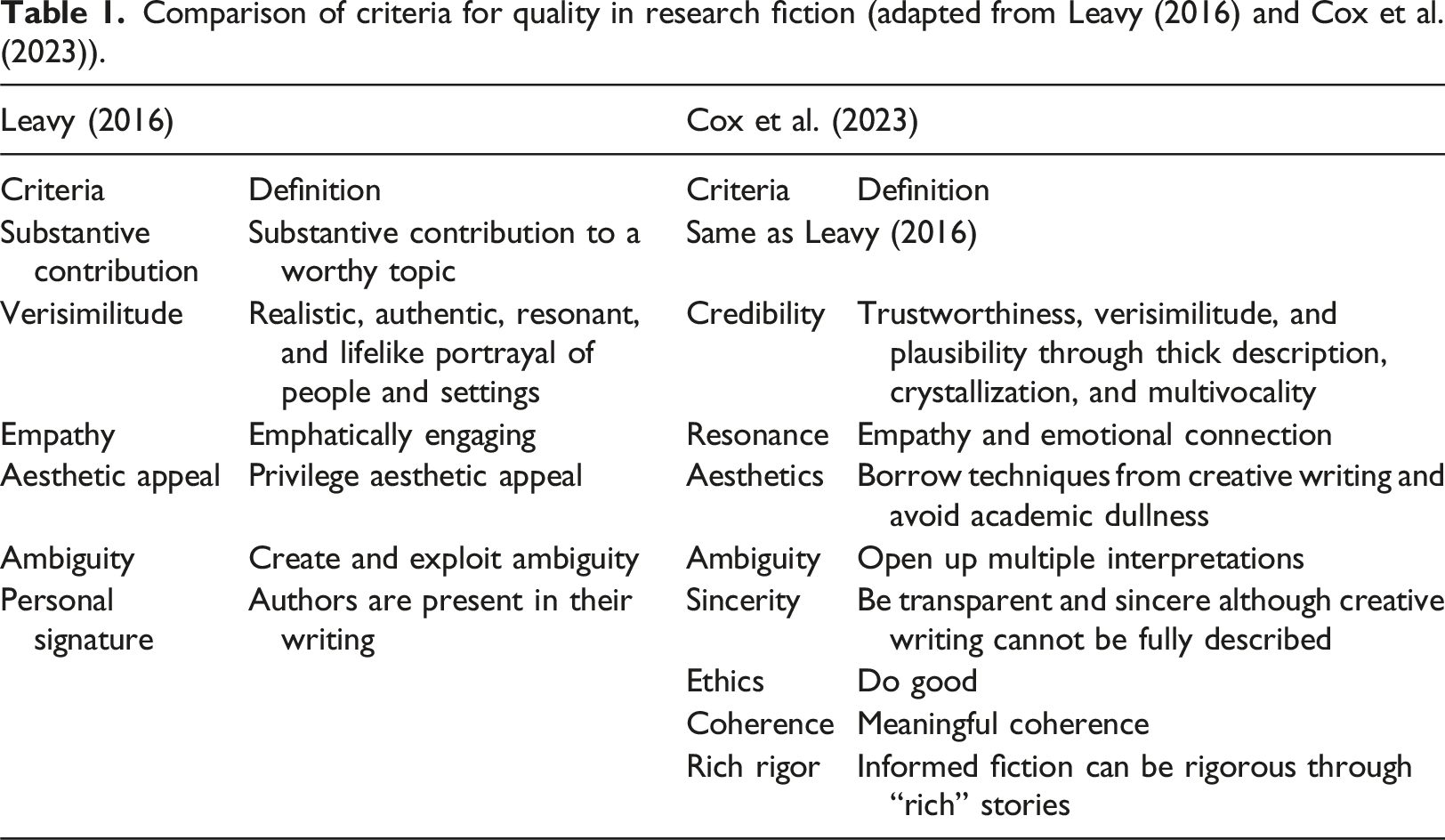
Fiction should make a substantive contribution to a worthy topic (Cox et al., 2023; Leavy, 2016). This overarching goal is shared by both research and fiction (Cox et al., 2023). However, whereas traditional research typically seeks to identify “research gaps,” more speculative research fiction may explore topics intended to expand thinking, challenge so-called “truths,” or suggest radically new possibilities.
Leavy (2016) identifies verisimilitude as the primary standard for evaluating research fiction. Verisimilitude, a goal of both social science research methods and research fiction, involves describing existing or possible worlds and authentically portraying human experiences (Leavy, 2018): Verisimilitude refers to the creation of a realistic, authentic, resonant, and lifelike portrayal of people and settings. In other words, verisimilitude centers on truthfully portraying human experience. It rings true. Achieving verisimilitude is a standard goal in qualitative research and one of the benchmarks against which ethnographies, for instance, are evaluated. Fiction is uniquely suited for capturing verisimilitude (Leavy, 2023: 9).
Cox et al. (2023) favor the term credibility, which encompasses trustworthiness, verisimilitude, and plausibility in qualitative research. Credibility can be achieved through methods such as thick description, crystallization, and multivocality (Tracy, 2010). While verisimilitude and credibility are useful measures of quality, they are not always necessary in speculative research fiction. In some cases, speculative fiction deliberately avoids being realistic, lifelike, truthful, or credible—for example, when envisioning distant futures that encourage the imagination to “run wild” (Kupferman, 2021).
Research fiction should encourage empathy and aesthetic appeal. It is not enough for such fiction to be merely informative; it also needs to be emphatically engaging (Leavy, 2016) or even provoking emotional responses. While research fiction places a strong emphasis on emotion, traditional academic work often lacks this dimension (Gibson, 2021). For example, research fiction might include characters, with the goal of encouraging readers to form personal connections with them (De Freitas, 2003; Leavy, 2023). Cox et al. (2023) prefer the term resonance, which encompasses empathy and emotional connection as integral components (Tracy, 2010).
Research fiction may embrace ambiguity (Cox et al., 2023; Leavy, 2016). Research fiction can be intentionally ambiguous and might have different meanings to different people. It might even attempt to unsettle assumptions. For instance, Cox (2021) wrote vignettes that suggest tensions when using AI and robots in education, which can be interpreted in different ways. Embracing ambiguity means allowing for multiple entries and exists, avoiding the trap of settling with the so called “truths” (Jackson and Mazzei, 2013).
Research fiction should carry a personal signature and authors should be present in their writing (Cox et al., 2023; Leavy, 2016), meaning that the author should be encouraged to build on their personal and professional knowledge and experience. Personal sincerity may involve describing the writing process, although creative work cannot be fully captured in such descriptions (Cox et al., 2023). Sometimes, describing the writing process may not even be meaningful, as stories are often created through freer, more creative approaches that do not follow explicit procedures.
Inspired by Tracy (2010), Cox et al. (2023) describe three additional quality criteria for research fiction. The first is ethical, which concerns the “the rightness or wrongness of our actions as qualitative researchers in relation to the people whose lives we are studying, to our colleagues, and to those who sponsor our work” (Miles and Huberman, 1994: 288). This is an essential characteristic of research fiction as it directly stems from an ambition to do good. Rich rigor involves using sufficient, abundant, appropriate, and complex theoretical constructs and data (Tracy, 2010). Constructed narratives, and to some extent informed research fiction, can employ rich rigor, whereas more speculative approaches ease rigor to allow for imagination and more creativity.
As noted above, traditional criteria for assessing qualitative research quality may be more applicable to fiction that adopts a highly informed approach, but less so to speculative fiction. Although potential quality indicators for speculative education fiction were discussed above, such as questioning assumptions, provoking emotional responses, or suggesting radical new possibilities, such lists cannot be exhaustive or widely applicable. Speculative fiction might even adopt post-qualitative perspectives, breaking free from methodologies that reduce complex and conflicting issues to generalities (Jackson and Mazzei, 2013) allowing a focus on the not yet rather than the what is (St Pierre, 2019).
Conclusions
This article discussed research fiction, particularly education fiction, emphasizing that all fiction is inherently both informed and speculative to varying degrees. While various examples of informed and speculative fiction were provided, there are undoubtedly many other ways fiction can be integrated into research, including approaches yet to be developed. The article also critically examined what quality might mean when creating research fiction. While some traditional indicators of qualitative research quality may apply to informed fiction, they often do not apply to speculative fiction, which might need to be guided by other indicators, such as questioning commonly held assumptions or imagining radically different worlds.
There are numerous opportunities for future work. This article has primarily focused on fiction in textual form, but as noted earlier research fiction can take many different forms. While most research fiction tends to be dystopian, with the occasional examples of utopian fiction, a potentially useful approach lies somewhere in between by “staying with the trouble,” being truly present, rather than succumbing to despair or hope (Haraway, 2016). Such an approach highlights the tensions we encounter when exploring potential futures and helps us avoid the faith in technofixes where technology will come to the rescue, but also avoid the position that there is no sense trying to make anything better. In conclusion, research fiction as a method deserves greater attention for its ability to encourage researchers to embrace, rather than suppress, their creativity. Let us imagine what could be.
Footnotes
Declaration of conflicting interests
The author(s) declared no potential conflicts of interest with respect to the research, authorship, and/or publication of this article.
Funding
The author(s) disclosed receipt of the following financial support for the research, authorship, and/or publication of this article: Open Access funding is provided by KTH Royal Institute of Technology.
