




Abstract
This paper explores the role of counterfactual thought in educational theory by proposing a heuristic that distinguishes between two modes: ‘As if’ and ‘What if’. We begin by grounding the discussion in philosophical debates on language, imagination, and fictionality, before introducing the heuristic, which situates these modes within a broader typology of relations to reality. We then elaborate two exemplary figurations – axioms for ‘As if’ and Science Fiction for ‘What if’ – to demonstrate how counterfactual thinking operates in educational theory and as educational theory. A final discussion assesses the heuristic’s analytical, clarificatory, and generative value. We conclude that educational theory is inherently imaginative and that counterfactual modes of thought are essential to its capacity to critique the present and envision alternative futures.
Introduction: In between arguments and fantasy
‘Excursus on Levelling the Genre Distinction between Philosophy and Literature’ – this is the title of one of the central chapters in Habermas’ eminent The Philosophical Discourse of Modernity (1987). Habermas’ accusation in this chapter is delicate: He declares some of his colleagues, namely Derrida and Rorty, guilty of mixing genres and thus holds them representative for no less than the decline of philosophy. Because philosophy, according to Habermas, must stand on the side of reasonable arguments and must not slip into fantastic writing, the difference between argumentative-philosophical and fantastic-literary writing needs to be held on to if the impending decline of philosophy shall be halted.
To those accused, Derrida and Rorty, to distinguish argumentative from fantastic writing was indeed not particularly concerning. On the contrary: Rorty provocatively remarked that the distinction between philosophy and literature is nothing more than an aid for librarians to sort books (Rorty, 2001) and Derrida systematically drew on literature to anchor his philosophical thoughts and crosses them back into literary thinking (Derrida, 1994). Whereas Habermas argues for understanding the world through rigorous reasoning, Rorty merges philosophical with other kinds of writing into what he calls “cultural politics” (Rorty, 2007), and Derrida approaches the ontologically uncertain world by throwing theoretical ropes into the unknown.
This contrast between Habermas on the one hand and Derrida and Rorty on the other hand stages questions about the importance of and possibilities for counterfactual thought in educational theorizing. What is at stake here is the role, quality, and degree of imagination and fiction in educational theory and to what extend it is necessary to hold on to what we think of as being true and fact. 1 Implicitly, the debate also negotiates to what extend reasoning should adhere to or go beyond the principles of representation and correlation (Habdankaité, 2020; Rorty, 1979). One can understand language as a representation of reality, a means by which we can philosophically inquire about and understand objects, phenomena, structures, meanings, and relationships; but language can also open this reality up and lead into the fantastic, with which one can invent new worlds and create new words.
We propose moving into the in-between of these two possibilities. Thinking and writing in the conflicted relationship between the world we live in and the thoughts we articulate around it, we would like to explore how counterfactual thought shapes how we theorize education. By focusing on the counterfactual, not as the realm of what is false or fake, but as a realm of imagination, speculation and fabulation, and birthing into being, we hope to find in this in-between that which is neither factual nor simply fantastic; as that, what is not real, not because it cannot be, but because it is not yet.
One of our main premises is that we move in this counterfactual in-between, tied to words, thoughts, and language, but also to the world, our material dependencies, and cultural-historical origins. Depending on collective habits situated in and following out of reality, language is tethering us to the world even when we attempt to be ‘thinking without a banister’ (Arendt). But language is also a (re-)iterating, (re-)signifying practice, a game with and exchange of symbols that will never fully encompass reality. Rather than encompassing reality, we shape it, cutting out bits and pieces that seem to be relevant in particular situations and present them to our fellow human beings. In this way, we can see educational thought as situated in a figuration of language and reality that we play with when engaging in educational theory: We enact a language game of deliberative arguing, aiming at the best possible or most reasonable understanding of the factual world. In educational theory, we refer to and anchor in the world and worldly experiences. But thereby we simultaneously take part in a constantly changing reality that we are always already speculatively and actively counterfactually entangled with. We enact, shape, and write educational worlds and words into being.
Redescribed in this way, the Habermasian conflict between different genres of writing might evolve into an argument over contesting figurations of relating to reality that we as educational theorists enact when grappling with concepts, questions, and problems. From this perspective, in question is not what and how the world is, but rather how we can and should relate to, grasp, shape, and change it.
To further explore this endeavour, we take up a trace left by Dahlbeck in his recent paper on The Pedagogy of ‘As If’ (2024). Dahlbeck addresses a specific problem in educational theory, namely the paradox of autonomy, by proposing to conceptualize the educational relationship in a mode of ‘As if’. Whereas Dahlbeck employs this proposition to progress in educational theory, we aim at further developing the notion of ‘As if’ as educational theory. 2 To further explore how counterfactual thought is shaping and changing how we theorize about education and inspired by Science Fiction as a genre that is grounded in speculative world-building, we will contrast this mode with a second mode of counterfactual thought, a mode we call ‘What if’.
To contextualize and frame this pursue, we will in the following section (2) give reasons for why counterfactual thought is important in educational theory and further elaborate theoretical assumptions on imagination and language games. Following these, we will present a heuristic for analysing counterfactual thought in educational theory (3). Without assuming them to be comprehensive, we will further elaborate on two modes of counterfactual thought – ‘As If’ and ‘What If’ – and give examples from recent debates in educational theory (3.1. and 3.2.). Afterwards, we will discuss the heuristic’s potential contributions to educational theory (3.3). Finally, we will draw a conclusion emphasizing the importance of researching the counterfactual in educational theory and pose some questions for further research (4).
Educational theory, imagination, and language games
Why should we as educational theorists care about counterfactual thought? We argue that counterfactual thought is especially important in educational theory for two reasons: The first reason is that education is always in process, never a stable reality or fact. Therefore, an educational theory that focuses exclusively on what is risks missing the very point of its object as what could be. In this line of argument, Dahlbeck argues that “most of our starting points in education are in fact fictional in the sense that they reflect assumptions about the world that are heuristically and temporarily helpful in terms of getting us started, but not necessarily true in the sense that they provide a completely rational and non-contradictory understanding of the world” (2024: 18, emphasis added). Because of the “practical necessity of accounting for innate limitations in the epistemological scope of human cognition” (Dahlbeck, 2024: 18), i.e., the fact that we organize education around the ideal of autonomous, reasonable individuals, whereas in reality the autonomous, reasonable individual will always remain illusive, to integrate the fictional nature of the educational relationship is not to deceit, but to help understanding what is actually happening in education. In this sense, educational theory can be seen as always already counterfactual and, conversely, counterfactual thought as necessary for educational theory.
The second argument why counterfactual thought is especially important in educational theory concerns the practical (and to some extend political) relation between educational theory and educational reality. Since educational theory is involved in and has practical effects on educational reality (as one can see, e.g., in the idea of the autonomous and reasonable individual), counterfactual thought enables educational theory to recognize and strategically use its reality-changing power. If educational theory limits itself to what is, it restricts its own potential to contribute to what else could be. Rorty’s proposition to understand philosophy as “cultural politics” is an example for this line of argument: Philosophy should affirm its potential to actively destroy the “crust of convention” (Dewey, 1985) 3 and suggest new ways of language use (Rorty, 2007). 4 To contribute to linguistic and social progress, the most efficient way is not to criticise old ways of using concepts but to counterfactually suggest concrete new alternatives (Rorty, 1990). It can thus be posited that counterfactual thought is an essential component of educational theory, insofar as it provides a means for educational theory to effect change in the domain of education. Moreover, it is submitted that this capacity is an inherent feature of educational theory, irrespective of whether it is explicitly acknowledged. 5
Many argued for the importance of imagination when it comes to obtaining knowledge and problem solving more broadly. 6 Whereas imagination is often held in contrast to reasoning or believed to be a mode of escaping reason, it can also be seen as its basic means (Kinberg and Levy, 2022: 320). This is claimed even in analytic philosophy, which mostly strongly emphasizes rationality, such as the metaphilosophical position by Williamson, who argues that “imagining has the basic function of providing a means to knowledge – and not primarily to knowledge of the deep, elusive sort that we may hope to gain from great works of fiction, but knowledge far more mundane, widespread matters of immediate practical relevance” (Williamson, 2016: 113). Put simply, we cannot solve problems, think, or obtain knowledge without the imaginative. The conceptual issue here is that imagination as a term is metonymical. In a weak sense, imagination can be understood as the capacity to work with mental representations of objects, to imagine them even if they are not enacted and experienced in a specific situation. In this sense, imagination is no different to reasoning: Being able to imagine possible consequences, deciding which route to take, and change perspectives on context or meaning are key when it comes to pondering problems in our everyday, social, educational, political, and philosophical life (Dewey, 1938) and might be encountered in questions like: What should we do next? How can I handle a conflict? What can I do differently this time?
In contrast, in a strong sense, imagination can also be understood as the ability to imagine a reality that we not (yet) have any representation of – a world that was not yet being experienced. In this sense, imagination is not only understood as a capacity to change perspective or relate to the world in terms of mental representations, but also as the ability to think about the world beyond its representation. In this strong sense, imagination is key to the ability to ponder questions that go beyond our experienced reality such as: How do we get to a world that we would like to enliven? What would equality look like? What is the good life? Such questions are dependent on us being able to think counterfactually in a more radical sense by going beyond the facticity of the world how we know it.
A philosophical take on the emphasis of this strong sense of imaginary thinking can be found in the work of Rorty. 7 To Rorty, imagination not only precedes but also fosters philosophical reasoning as it (1) paves the way for what can be considered reasonable at all and (2) nurtures and opens up ways to think differently about the world: “No imagination, no language. No linguistic change, no moral or intellectual progress. Rationality is a matter of making allowed moves within language games. Imagination creates the games that reason proceeds to play” (Rorty, 2016: 36). Put simply, as reason is dependent on language and language on imagination, the ability to theorize is strictly dependent upon the ability to play with imaginaries. 8 Imaginaries lie at the heart of language games in which we, as educational theorists, play by and with reason. 9
Drawing a difference between the weak and strong sense of imagination enables us to differentiate between two ways of connecting imagination and language. Understood in a weak sense, imagination and language are tied together strongly in terms of correlation and representation. In contrast, imagination understood in a strong sense, imagination and language are connected more loosely and open up how we might go beyond and see the world differently.
The two cases imply a divergent take on the imaginary power of language. In the first case it is a means by which we can philosophically (or mentally) represent and inquire about the world to understand objects, processes, phenomena, experiences, and relationships, while in the second case it is a practice that is opening up new worlds, images, fabulations, and speculations about what is not (yet) existent, but might become somehow. Both can be seen as language games, but they play the game differently. Just as we can take play as the practice of creating and enacting an “unreal reality” (Schäfer and Thompson, 2014: 11) 10 , we refer to and anchor in the world and worldly experiences while simultaneously taking part in a constantly changing reality that we are always already speculatively and prefiguratively entangled with (possibly called counterfactual). Although play and games are dependent on the existence of norms and rules (tethered to reality), engaging in plays and games means to go beyond and break the known, enact and create something that could not be foreseen, planned, and controlled by those immersed in it. Instead of determinately signifying and iterating what is known to be true, play allows for a transcendence of what is yet believed or considered real, true, or natural. Similarly, we enact, shape, and write educational worlds and words into existence. It is this productive, contingent and, psychoanalytically speaking, excessive realm between reality and symbolisation, that, in our view, comes into focus in counterfactual thought.
Figurations of counterfactual thought in educational theory: Towards a heuristic
To analyse the role of counterfactual thought in educational theory, we will present a heuristic of its modes and figurations. The proposed heuristic does not claim to be exhaustive but might serve as a preliminary taxonomy. It can make us aware of the differences and communalities within diverse ways of counterfactual thought in educational theory. Following a concise exposition of the heuristic, the subsequent sections will delve into the modes of ‘As if’ (3.1.) and ‘What if’ (3.2.), followed by the proposition of three analytical values that the heuristic may offer (3.3.).
The heuristic for researching counterfactual thought in educational theory distinguishes between four levels. On the first level, it differentiates between three relations to reality: factual, counterfactual, and fantastic. The factual relation to reality claims to capture reality how it really is, thereby allowing for imagination only in the weak sense described above. The fantastic relation to reality, on the contrary, has no commitment to capturing reality, but commits itself purely to the strong sense of imagination – although imagination of course here, too, is embedded in reality, it can be as “free” as it wants in making up whatever could be. The third, counterfactual relation to reality is situated between the two. Although the counterfactual does not claim to represent reality, it still holds a commitment to and investment in reality. Insofar as counterfactual thought both recognizes its embeddedness in and transformative commitment to reality, it is genuinely educational – in both a foundational and necessary sense. The modes of imagination within factual and fantastic thought therefore are ‘It is’ and ‘It is not’ respectively. Within counterfactual thought, we can yet again distinguish between two different modes: ‘As if’ and ‘What if’. Whereas the first treats the imagined as if it was real, the second deliberately plays with its non-real status by asking what if it was real. These modes of imagination can be at play in several figurations. Due to the aim of this paper, we only focus on figurations of counterfactual thought and, although there are surely more, only name three exemplary figurations for each mode. The mode of ‘As if’ can be presented in the figurations of fabulation, fiction, and axioms and the mode of ‘What if’ in speculation, Science Fiction, and experiments (Figure 1). Heuristic for researching counterfactual thought in educational theory.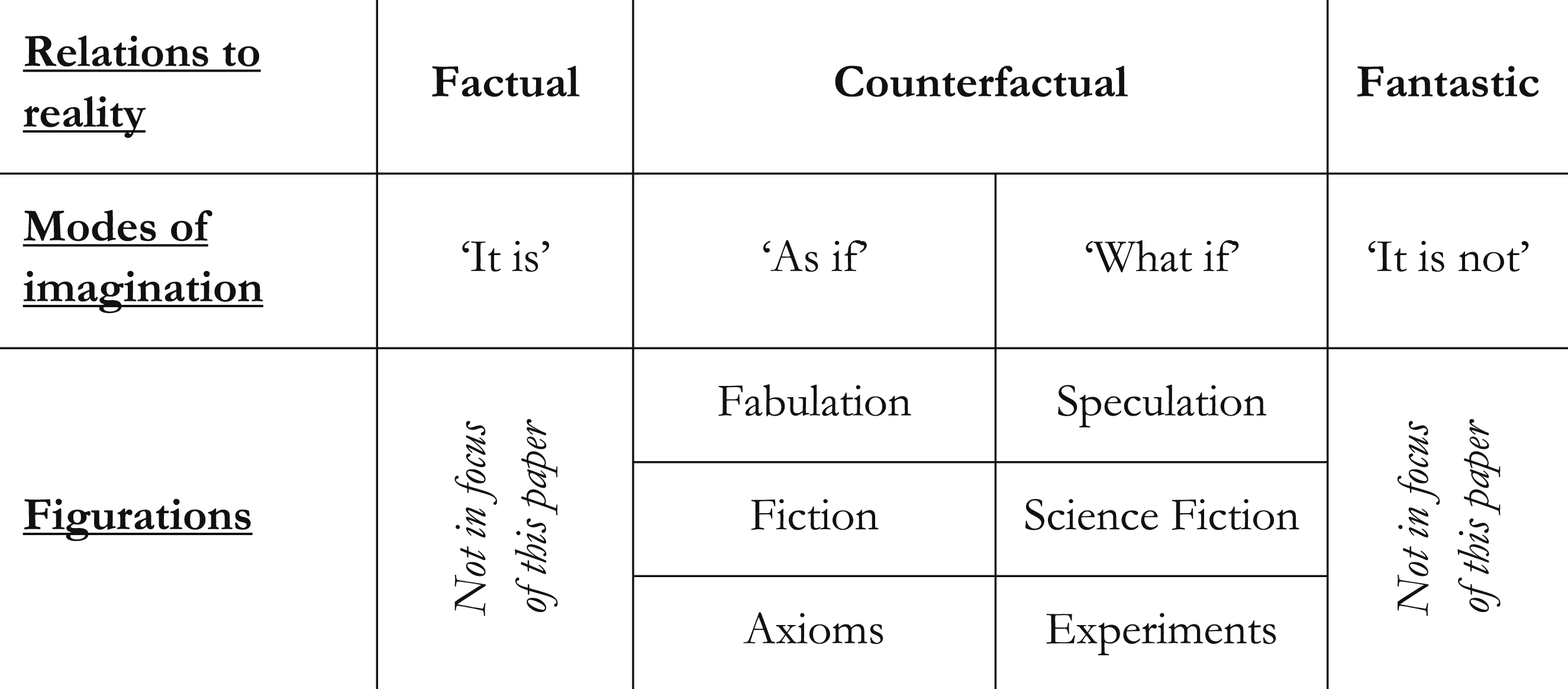
We will in turn elaborate more deeply on exemplary figurations for each mode of imagination – axioms for ‘As if’ and Science Fiction and speculation for ‘What if’ – and draw on their relevance in educational theory.
A figuration of ‘As if’: Axioms and the foundation of the educational
In recent debates in educational theory, perhaps one of the most discussed concepts was equality as put forward by Rancière (Bingham and Biesta, 2010; Mayer et al., 2019). It was often noted that equality was not just a theoretical notion but an axiom. It seems to us that this somewhat uncommon status of Rancière’s equality played an important role in its success in irritating common thought habits in educational theory. To put forward equality not as an aim of education, not as a goal to reach in the future but as an axiom from which to start perceiving and theorizing education as if equality was already there in the present was as provoking as it was productive. Rancière’s axiom broke with sociological and psychological views of (in)equality in the factual mode of ‘It is’ (not) – as exemplified in Bourdieu’s critical social analysis or psychological research on intelligence, which both are unable to ever achieve actual equality – and instead shifted towards the strong assumption that counterfactual acting as if equality was already present is the only way to make equality real.
Generally, axioms are statements that are taken to be true, serving as premises for further reasoning and arguments. Rancière drastically reduces the possibilities for different premises to one – and only one! – alternative: either inequality or equality. This is the fundamental axiomatic decision from which the “distribution of the sensible” (Rancière, 2004a) follows: “Equality is not a goal that governments and societies could succeed in reaching. To pose equality as a goal is to hand it over to the pedagogues of progress, who widen endlessly the distance they promise that they will abolish. Equality is a presupposition, an initial axiom – or it is nothing.” (Rancière, 2004b: 223, emphasis added)
Rancière often highlights the intentional aspect in this axiomatic decision. He specifies that the method of equality is not a “counter-model” of the future. Neither is it a strategy that prescribes a singular path from the current state to an anticipated destination. It is therefore drastically different from utopian thinking.
11
Rather, the axiomatic nature of equality “insists on the division that is at work at every point of every process. […] Every situation can be cracked open on the inside, reconfigured in a different regime of perception and signification, altering the landscape of what can be seen and what can be thought, along with the field of the possible and the distribution of capacities and incapacities. The method of equality is at work everywhere at any time. It is true that it promises no definite future. But new horizons are not defined by the planning of the future. On the contrary, it is from the division at work in the present, from the inventions of the method of equality, that unpredictable futures can emerge. (Rancière, 2016: 155)
There is clearly an idea of ‘As if’ at play in Rancière’s use of ‘axiom’. Although it is in a sense – in the sociological or psychological factual relation to reality – not true that all people are equal, the axiomatic assumption as if that was the case, has a real effect on the world and how it is perceived. In his Method of Equality, Rancière explicitly draws on a “mode of […] as if” (2016: 137) to explain how subjection under a specific ‘As if’ mode is at work to realise inequality and domination. Reading Plato’s Republic, Rancière emphasises the counterfactual nature of this mode of ‘As if’: “We have to accept a story or a lie: the story has it that God mixed iron in the makeup of the artisans while he mixed gold in the makeup of the legislators who are destined to deal with the common good. The story has to be believed. Now the key point is what ‘belief’ means. Obviously Plato does not demand that the workers get the inner conviction that a deity truly mixed iron in their soul and gold in the soul of the rulers. It is enough that they sense it, that is, that they use their arms, their eyes, and their minds as if it were true. […] The ordering of social ‘occupations’ works in the mode of this as if. Inequality works to the extent that one ‘believes’ it, that one goes on using one’s arms, eyes, and brains according to the distribution of the positions. This is […] the way domination works.” (Rancière, 2016: 136–137, original emphases deleted and new emphases added)
The counterfactual notion of axioms certainly stimulated discussions foundational or founding concepts in educational theory. One example for this is the debate in post-critical pedagogy 12 about the status of its principles. In their Manifesto for a Post-critical Pedagogy, Hodgson, Vlieghe, and Zamojski state that “there are principles to defend” (2017: 15, emphases added). This choice of words might be irritating from a post-structuralist perspective since the endeavour to formulate principles in the sense of identifying an educational common ground that could be invoked has been abandoned (for this line of criticism of post-critical pedagogy see Wittig, 2022). From this perspective, a foundation of the educational in principles must fail (Schäfer, 2009; 2012a; 2012b). However, aiming at defending principles might point towards their counterfactual nature: The authors do not claim to state principles in the factual mode of ‘It is’ but argue for them, make them come to matter in our imagination of the educational.
A figuration of ‘what if’: Science fiction and worlding the educational
The mode of ‘As if’ can be distinguished from that of ‘What if’: Whereas the former treats the imagined as if it were real, perhaps to prefiguratively make it real as in Rancière’s axiom of equality, the latter plays with its non-real status by speculating what if it were different. This speculative aspect of counterfactual thought is particularly salient in the genre of Science Fiction.
As a genre deeply concerned with world-building, Science Fiction particularly highlights the mode of ‘What if’ and thus may serve as a figuration to theorize about further implications for educational thought. We see Science Fiction as a genre characterized by systematically drawing on the consequences of specific (scientific, technological, etc.) assumptions. The key question evolves around these assumptions and effectively grounds in a ‘What if…?’. As famously framed by James Gunn and Michael R. Page in their 1951 essay Some of Us Are Looking at the Stars (2018), Science Fiction sets out on a single question that precedes and steers the story, it anchors in a world that at the very core is founded by a “if such-and-such happened or such-and-such was invented, what would be the result?” (2018: 39, emphases added). Science Fiction speculatively imagines: What consequences would follow if we assumed, e.g., the possibility of space and time travel, artificial intelligences, the encounter with extraterrestrial life, substantial social transformations, or advancements of climate engineering?
Current technological developments have been shown to be indicative of the uncanny realism that is characteristic of works of Science Fiction, also within the context of educational imaginaries (Bayne and Ross, 2024; Eynon and Young, 2021). Indeed, the Science Fiction author Robert Heinlein has characterised the genre as “realistic speculation” and emphasised its basis “on adequate knowledge of the real world” (Heinlein, 1964: 143). 13 In a similar manner, feminist Science Fiction writer Ursula K. Le Guin has reflected on the intricate relationship between Science Fiction and material realities. In her essays, she underscores the capacity of Science Fiction to provoke critical inquiries, such as: “Why are things as they are? Must they be as they are? What might they be like if they were otherwise?” (Le Guin, 2017: 83). Le Guin points out that in this mode, Science Fiction is to “admit the contingency of reality, or at least to allow that our perception of reality may be incomplete, our interpretation of it arbitrary or mistaken” (2017: 83). Questions like these enable to think about the world in a counterfactual way. It is imagining the world radically different, while staying anchored in and committed to real world problems. This is how Science Fiction explores not only technological but also political questions, such as: ‘what if the world was not structured by a gendered binary?’ (as in Le Guin, 1969/2012: The Left Hands of Darkness), ‘what if we organized collectively in the midst of far-right extremism and climate apocalypse?’ (Butler, 1993: Parable series), or ‘what if similarity was held more central in living and working together than difference?’ (Chambers, 2014: Wayfarer series) – often long before each proposition and principle can be found in educational theory or practice.
Shifting towards another figuration of this mode, we want to propose that the nature of the question of ‘What if’ is speculative. It is in thinking and writing in the liminal boundaries of reality, in an imaginative realm of the not-yet-known or an ‘it doesn’t have to be this way’ that Science Fiction is counterfactually projecting different perspectives on reality. In this speculative counterfactual quality, Science Fiction mirrors “speculative theories” which can be distinguished as a “form of theory” (Grossberg, 2024: 20, emphasis added). In contrast to “explanatory theories” (Grossberg 2024: 20), which in our heuristic would operate in the mode of ‘It is’, speculative theories help us to understand and interpret the world in a different way and lean towards the universal rather than the particular or empirical. Thus, they rather serve as shifts of perspective and as starting points than as concepts that seek to explain certain real-world outcomes.
In this quality, Science Fiction and speculation form specific figurations of the counterfactual mode of ‘What if?’. Both can be seen as figurations that explore the beyond of a yet known reality. Thus, they share a quality of imaginative beginnings, and most of the time an intention of change. As for Science Fiction, we find this description quite explicitly in the work of John W. Campbell, who writes: “Inherently, the science fictioneer believes that any method, any system, which we have today is the rudimentary, crude beginning of the real thing – that any technique known now is a make-shift stop-gap arrangement for the right answer yet to be found. He is deeply, genuinely, and emotionally – not just surface-intellectually – convinced that change is inevitable, necessary, and desirable (Campbell, quoted in Gunn and Page, 2018: 37).
A speculative ‘What if’ as a counterfactual figuration can be found both in educational theory and as educational theory. In educational theories, this mode can be found in theoretical reflections of educational practices where the world-building of Science Fiction as a genre parallels practices of “worlding” (Goodman, 1978), or practices of “speculative design” and “social dreaming” (Dunne and Raby, 2013). It is in these practices that ‘What if’-questions are posed to open discussion and dreaming about the futures that people seek to inhabit, make, and want (or not) – based in the premise that the practice of speculation will also make the imagined realities more malleable (Dunne and Raby, 2013). In this way, the mode of ‘What if’ is used as an imaginative opening to foster the concrete possibility of change and progress in educational settings.
As educational theory, the mode of ‘What If’ can be found in thought experiments, abductive reasoning, and, even more poignantly, in the emerging paradigm of speculative methods (Boyd, 2022; Ross, 2023; St Pierre, 2018). It appears in de Feitas and Truman’s approach to foreground “speculative fiction as a way to open up scientific imaginaries […] to think through the many pasts, presents and futures of science” (2021: 522–523) or can be connected to (anti-)utopian accounts that explore narratives and imaginaries of alternative futures (Abensour, 2008; Cooper, 2014; Suvin, 2021).
A concrete example on how educational theory operates in the mode of ‘What if’ can be found in the research project “Higher Education Futures” at the University of Edinburgh, led by Siân Bayne, Jen Ross, and Michael Gallagher.
14
Situated within the emerging field of speculative methods, the project has developed eight speculative scenarios for the future of higher education (Bayne and Ross, 2024). In the scenarios with titles such as “Extinction-Era Universities”, “Justice-Driven Innovation”, or “The Universal University”, there is a speculative ‘What if’ posed which aims at opening up debates, storytelling, or learning how to desire otherwise (Bayne, 2023; Bayne and Ross, 2024). In a reflection of their account, Bayne and Ross write: “As an antidote to predictive, closed forms of future-making, speculative scenario-building and storytelling […] can function as a ‘medium to aid imaginative thought […] [they can] loosen, even just a bit, reality’s grip on our imagination’ (Dunne and Raby, 2013: p. 3). However, these methods themselves require critical caution. As imaginaries work to shape higher education policy, practice, investment and theory in a range of ways, they can come to seem inevitable, thus producing and reifying particular realities. We need to remain sensitive to the fact that speculative storytelling is not guaranteed to generate creative, free-flowing futures – as Markhan (2021) points out, in creating these we encounter ‘discursive closures’ and the limits of our own experience and realities.” (Bayne and Ross, 2024: 3)
It is in this way that the mode of ‘What If’ shows to being neither fantastic nor factual, but characteristically counterfactual. It fosters an imaginative opening, aiming at going beyond current premises and principles of societal constraints, while encountering discursive closures that, sometimes violently, tether speculative scenarios to reality.
Discussion: The Heuristic’s analytical value
In these two counterfactual figurations, the accounts of a more speculative mode of ‘What if’ and a more fabulative mode of ‘As if’ differ, and we have begun to explore how. While both aim at moving beyond current reality, they do so in different ways: Whereas the mode of ‘As if’ is prefigurative and axiomatic, the mode of ‘What if’ is speculative and experimental. And whereas ‘What if’ grounds in a realistic ‘It is’ and seeks to foster change in the future, the mode of ‘As if’ seeks to suspense the realistic ‘It is’ and foster change in the present. Both modes rely on the contingency, productiveness, and excess of sociality, but whereas ‘As if’ aims at enacting and embodying the future in a prefigurative strategy, the mode of ‘What if’ aims at envisioning the future to create a common imaginary that people could strive towards. 15 In turn, three options are put forward for the heuristic’s potential contributions to educational theory, with the aim of furthering the exploration of the counterfactual.
(1) Understanding the counterfactual in educational thought: In a strictly analytic way, the proposed heuristic makes it possible to focus on counterfactual modes and figurations in classical works of educational theory and facilitate the synthesis and classification of theories and debates. For example, the heuristic could be employed to analyse or generate interpretations of seminal works in education, such as Rousseau’s Émile or Pestalozzi’s Gertrude. These interpretations could be categorised into various figurations and modes, for example, reading them as recipes (‘It is’), experiments (‘What if’), or collections of axioms (‘As if’). 16
(2) Clarifying misunderstandings between different relations to reality and modes of the counterfactual: In a comparative perspective, the cultivation of an awareness of modes of counterfactual thought makes it possible to avoid misunderstandings of or debates between incommensurable theoretical stances. For example, the heuristic may elucidate the reasons why certain debates remain unresolved, for example between Bourdieu’s and Rancière’s approach to (in)equality. The crux of the issue lies in the fact that the two operate within different relations to reality: a factual (‘It is’) in Bourdieu and a counterfactual (‘As if’) in Rancière. 17
(3) Inspiring further educational thought: In a productive sense, a consideration of the modes of factual, counterfactual, and fantastic thought has the potential to reveal the strengths and weaknesses of extant educational theories and to explore the possibilities for alternative modes of thought. For example, the “Higher Education Futures” project previously outlined may be advanced through deliberation regarding its counterfactual status of ‘What if’ and by establishing deliberate connections to other modes.
To conclude, our heuristic should neither be seen as comprehensive nor should it be used for judging “right” ways of reading or producing educational theory. Nonetheless, the heuristic may facilitate awareness of significant commonalities and discrepancies in diverse approaches of educational theory and their counterfactual components.
Conclusion
This paper proposed a heuristic for understanding counterfactual thought in educational theory. We mainly focussed on two key modes of counterfactual thought: ‘As if’ and ‘What if’. Positioned between the factual and the fantastic, these modes reveal how educational theory engages with the world not merely by describing it, but by imagining and shaping it otherwise. The mode of ‘As if’, exemplified through axioms like Rancière’s principle of equality, enables theory to act as if a future condition were already present, prefiguring transformation in the here and now. In contrast, the ‘What if’ mode, found in Science Fiction and speculative methodologies, treats the imagined as hypothetical, fostering experimental inquiry into what could be.
The heuristic contributes to educational theory in three primary ways: analytically, by identifying and analysing counterfactual dynamics in educational thought; comparatively, by clarifying theoretical tensions that stem from differing relations to reality; and generatively, by inspiring new modes of theorizing through imaginative and speculative engagement. Rather than treating imagination as external to reason or theory, we argue that it is central to educational theory’s critical and creative potential. In this sense, counterfactual thought is not a departure from reality but a necessary mode of engaging with it.
Ultimately, we contend that educational theory cannot remain confined within factual descriptions or representational logics. To engage seriously with the complexities, contradictions, and contingencies of educational thought and practice, educational theory should not shy away from entering the realm of the counterfactual. It must imagine otherwise – not as a retreat into fantasy, but as an ethical and political gesture toward what education could become. In this sense, theory is not only interpretive but world-making: a practice of shaping reality through conceptual invention, critical re-description, and imaginative projection. Counterfactual thought, then, is not a supplement to educational theorizing – it is its condition of possibility. To theorize education is always to ask: What if things were otherwise? And to act, perhaps, as if they already were.
We want to conclude by pointing to avenues for further exploration. How do factual and counterfactual modes interact in educational theory, and how might this interplay shape both conceptual frameworks and practical outcomes? What effects, intended or unintended, emerge when educational theories rely on counterfactual assumptions or speculative propositions? Moreover, which other modes and figurations of counterfactual thought remain underexplored or unnamed within the field in general and our heuristic in particular? These questions, we suggest, call for a deeper and more systematic engagement with imagination, fictionality, and the speculative as constitutive elements of educational theorizing. A more structured approach to counterfactual thought may help clarify its diverse functions and expand the repertoire of theoretical practices available to educational researchers. In doing so, we hope to foster educational theory development that is both analytically rigorous as well as imaginative, visionary, and responsive to a world in (counter)factual transformation.
Footnotes

Funding
The authors received no financial support for the research, authorship, and/or publication of this article.
Declaration of conflicting interests
The authors declared no potential conflicts of interest with respect to the research, authorship, and/or publication of this article.