



Abstract
This study examines teachers understanding of inclusive education in the English education subsystem in Cameroon and the challenges they experience in its implementation. Based on interviews with some selected teachers, the findings reveal a strong focus on students with disabilities as well as the view of inclusive education as the removal of cultural barriers that pervade access and participation in education. The results also indicate policy inadequacies, school organisational insufficiencies, teacher incompetence and societal barriers to be some of the challenges these teachers encounter when implementing inclusive education.
Introduction
Inclusive education despite having gained traction within education policy across the globe is a complex and contested concept amongst researchers, policy makers and practitioners (Kefallinou et al., 2020). Questions, uncertainties and contradictions still abound as to what it means, how it can be successfully implemented and to what outcomes (Finkelstein et al., 2021; Göransson and Nilholm, 2014; Haug, 2017; Jia et al., 2022; Florian, 2014; Slee, 2011; Magnússon, 2019). Perrin et al. (2024) note the society, policy makers and individuals have different understandings of inclusive education. These different understandings could not only influence teachers’ attitudes (Krischler et al., 2019) but also teaching practices.
Teachers are considered to be the single most important factor in the effective implementation of inclusive education (Forlin and Chambers, 2011; Loreman, 2014; Rouse, 2017). Perrin et al. (2024) articulate the urgency to understand how teachers as a key player understand inclusive education. Their understanding, beliefs and attitudes are crucial in the implementation of inclusive education and should be carefully examined (Yang and Deng, 2019). How teachers understand inclusive education is crucial in how it is enacted in practice in a national context like Cameroon where there is no clearly formulated policy on inclusive education and implementation guidelines. Though teachers understanding of inclusive education has been studied in several contexts (see Jia et al., 2022; Demo et al., 2021; Su et al., 2020; Gidlund and Boström, 2017; Anastasiou et al., 2015; Moberg et al., 2020), not much attention has been given to it in the context of the education system in Cameroon.
Moreover, the literature shows that the implementation of inclusive education is confronted by a plethora of challenges (see Adewumi et al., 2019; Amor et al., 2019; Schuleka, 2018; Donohue and Bornman, 2014; Kim, 2013; Alves et al., 2020). Challenges in some African contexts include lack of resources, teacher incompetence and over-crowding (Mpu and Adu, 2021; Akinyi et al., 2015). Particularly relating to challenges experienced by teachers, Adewumi et al. (2019) in a study in South Africa identify challenges such as lack of parental participation, lack of adequate teacher training and lack of resources. While some of the challenges are common across the different educational contexts, the manifestations and depths of the challenges may vary. Identifying and addressing such challenges is a necessary pathway to the effective implementation of inclusive education.
This study therefore explores how teachers understand inclusive education, to discuss and problematise their understandings in relation to different categories of understanding of inclusion. Secondly, to identify challenges the teachers experience in the day-to-day implementation of inclusive education, in a bid to drive forward the discussion on how the challenges may be addressed to foster the development of an inclusive education system. These issues are examined within the context of the English education subsystem in Cameroon.
To examine these afore-mentioned issues, the following two questions are posed: - How do teachers in the English education subsystem in Cameroon understand inclusive education to mean? - How do they describe the challenges in implementing inclusive education?
English education subsystem in Cameroon
The education system in Cameroon comprises a parallel French and English subsystem education system as an outcome of colonial occupation. Each subsystem has a separate organisation, structure, curricula and national examinations (Cockburn et al., 2017). The English education subsystem composes of a 6 years primary school, 5 years secondary school and 2 years high school. At the transition from one level to the next is a national examination. After high school, students can pursue education at the tertiary level. Though the English school subsystem is predominantly organised in the English-speaking regions of Cameroon, the system is national. Schools following the English educational system are available across the country. There is a legislative provision for free public education, which unfortunately is hardly enforceable (Tchombe et al., 2014) and most public schools still charge a small cost for parents such as the Parents Teachers Association (PTA) fees. A significant majority of the teachers in the public schools are trained in government-operated teacher training institutions. Apart from a public education, there is also a striving private education system in Cameroon. Students in the private schools pay varying tuition fees, set by the schools. The government also provides some subsidies to the private schools.
Regarding special education in Cameroon, children with special educational needs may attend the regular school system, as well as special schools which are mainly run by religious and charity organisations (Cockburn et al., 2017). Very limited data is available on the education of students with disabilities in Cameroon, however studies show significantly low participation in education. Cockburn et al. (2017) report 36.2% of children between the ages of two and four positively screened for a disability participated in early education activities and even lower levels of learners diagnosed with disabilities participate in early learning activities. Moreover, people with disabilities reported no or little secondary and tertiary education, with over 70% of disabled adults reporting that they did not go past primary school (Cockburn et al., 2011).
Inclusive education policy in Cameroon
Cameroon lacks a clearly articulated policy on inclusive education. The intentions and goals of inclusive education are nonetheless expressed in different legislative and policy texts. The government of Cameroon is signatory to different international agreements that promote the implementation of inclusive education such as the Salamanca declaration (Mngo and Mngo, 2018), the UN Convention on the rights of the Child and the UN Convention of the rights of persons with disabilities. Moreover, the Constitution of the Republic of Cameroon of 1996 and the National Action Plan for the Promotion and Protection of Human rights 2015-2019 clearly stipulate the right to basic education for all including students with disabilities and other special educational needs. Special educational needs in the legal framework in Cameroon involve a broad array of things. It is defined as children with significant learning difficulties due to some form of disability and or disadvantage, including children from areas that are remote and faraway from schools, displaced, disadvantaged and poor populations and children from marginalised populations such as children from nomadic groups (Acts No. 2010/003 and 2005/006, cited in UNESCO, 2021). This broad view on special educational needs articulates not only disability but also socio-cultural diversities and geographic characteristics that may lead to difficulties in education for children from certain groups and communities. Furthermore, the education policy in Cameroon specifies equal access and non-discrimination in education for all. The Education Framework Act No. 98/004 of 14 April 1998, article 7 clearly stipulates ‘the State shall ensure that everyone has equal opportunities for access to education without discrimination on grounds of sex, political, philosophical and religious views, or social, cultural, linguistic or geographical origin’ (Ministry of Education, 1998).
The commitment to inclusive solutions for students with disabilities is also highlighted in different legislative acts and the Education Sector Plan 2013-2020. Perhaps the clearest intention to establish an inclusive system of education is pronounced in both articles 1 and 2 of the decree number No. 90/1516 of 26 November 1990 and decree No. 2018/6233. The former stipulates that ‘the education of handicapped children and adolescents is assured in the regular schools, and in centres for special education’ and that ‘children with hearing or visual impairment and mental disabilities will benefit from special education that will permit them to register in regular school’ (cited in Tchome and Shey, 2017). Meanwhile article 4 of the 2018 decree on the promotion of inclusive education and vocational training articulates 10 different measures. These include provision of different specialised materials, special teachers and teachers’ competence development as well as resource redistribution in all levels and education segments.
The Education Sector Plan 2013
1
-2020 reiterates relating to the development of an inclusive system that The Government will deepen reflection (in concert with all stakeholders involved) on the identification, accompaniment and treatment of the handicap (health, social affairs, associations, NGOs, etc.) in order to study any possible response and adaptation of the school milieu (schools, facilities, teaching tools, pedagogic aids, specific training programmes, teaching practice) for an inclusive approach and/or development of specialized education if better suited to certain handicaps (MINEPAT, 2013, s. 59).
Similarly, the legislative framework underscores the role of families in ensuring their children access mainstream schools with support from the state, defines learner’s well-being in schools and how schools should support that as well as punitive actions in case of discrimination (see Act No. 83/13, Act No. 2010/002 and Act No. 90/1516). These acts also emphasise educational support and teachers’ competence development in implementing inclusive education (UNESCO, 2021).
As seen above, despite the lack of a clear-cut comprehensive policy on inclusive education, the vision and goals of an inclusive education system are implicit in several policy texts. While there is no clear definition of what inclusive education is, the policy infrastructure alludes to the inclusion of students with disabilities in mainstream schools where special educational support will be provided to them while also suggesting special educational solutions outside of the regular schools. Noteworthy in the policy and legislative formulations is the accentuation of the special education ideology in the promotion of inclusive education. This particularly relates to the referral of students with disabilities as the focus for inclusion, ignoring other groups of learners, despite a broad-based definition of special educational needs beyond the confines of disabilities.
In spite of an apparent effort by the government of Cameroon to establish laws towards an inclusive education system, the practical implementation of inclusive education leaves much to be desired. Cockburn et al. (2017:15) identify a number of factors that decelerate and limit the implementation of the laws. These include delays between the development of the laws to their enactment, the lack of teachers with inclusive education competence, resources, strategies and finances to implement changes. Moreover, students with disabilities still experience discrimination in education and denial of educational opportunities (Tchombe and Shey, 2017). To facilitate the enrolment of students with disabilities in public secondary schools within the general education, the government has put in place a measure exempting them from the payment of registration fees (UNPRPD, 2021). Most students with disabilities are still left outside of education system as a whole (Cockburn et al., 2017). When they gain access to education, it is mostly in separate special educational settings (UNESCO, 2021). Religious organisations, NGOs and private stakeholders operate most of these special schools (Cockburn et al., 2017). Some good initiatives towards improving inclusive education have been made in the last years, for example, the piloting of 68 inclusive schools and seven other experimental inclusive schools with support from an NGO, the sharing of good practices, the provision of teaching materials and improvement of school learning environments (UNESCO, 2021).
In the sphere of teacher competency for inclusive education, inadequacies remain regarding formal competence development. There is no national training framework for teaching specialising in disabilities such as visual and hearing impairments and training centres of inclusive education for teachers (UNESCO, 2021). Some efforts are been made by different NGOs, the government and academic institutions towards teachers’ professional development in inclusive education. An example is the partnership between Sightsavers and the Ministry of Secondary Education to support the training of teachers in inclusive education and the provision of resources to teacher training institutions in 2018 (UNESCO, 2021).
Understanding inclusive education
Despite the different ways in which the concept of inclusive education has been defined and understood, there are some common elements which seem to generally characterise the concept of inclusive education (Hardy and Woodcook, 2015). Haug (2017) argues that inclusive education imbues values such as participation, equal access, equity and justice. Participation as a key concept underpinning inclusive education is operationalised in terms of participation in school culture and school curricula for all students (Booth, 1999), while Ainscow (2020) notes it is a process whereby barriers to participation for all students are removed. Similarly, Thomas and Loxley (2001) propose the idea of community in the understanding of inclusive education, where schools are seen as communities in which diversity is recognised and respected and all students are treated equally and with respect. These examples of how inclusive education is understood primarily attend to all students and not just some students. Others have taken a more restrictive view of inclusion focussing on students with disabilities and special educational needs and their placement in mainstream schools (Lindsey, 2007) where their needs are met. These different understandings of inclusive education thus bear some tensions. Tensions relating to inclusion for whom; who are the group of students to be included? Is it for all students or some; especially students with disabilities? Where and how should they be included? Florian (2014) argues for the usefulness in the synthesising and discussing of these different understandings for the necessary development of inclusive education.
The work of Göransson and Nilholm (2014) does this by categorising the understandings of inclusive education in high-impact articles. They construct a hierarchal category system to conceptualise the different understandings of inclusive education.
Four categories of definitions of inclusion
Based on an analysis of the different understandings of inclusive education, Göransson and Nilholm (2014) present a system consisting of four distinctive categories of understandings of inclusive education (see Figure 1). Different categories of definitions of inclusion and their hierarchal relations (Göransson and Nilholm, 2014: 268).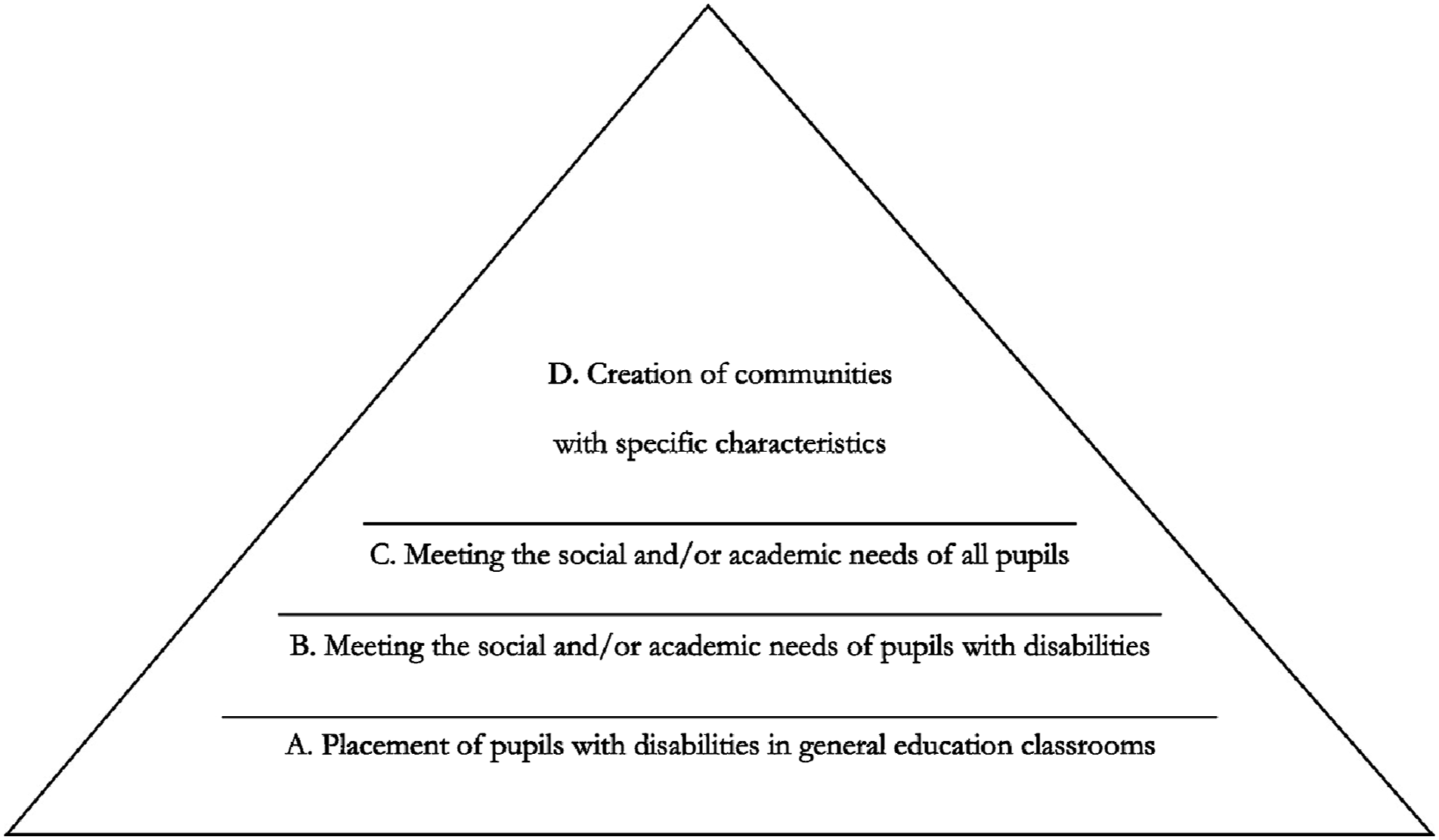
The practice of inclusive education – The coherence approach
The concept of coherence is proposed by Haug (2017) to understand the practice of inclusive education. Coherence refers to the interconnectedness and consistency between the different parts in the education system. The different educational systems and parts of the system are connected and consistent in relation to inclusion (Ferguson, 2008; in Haug, 2017, s. 210). This highlights the necessity for interconnectedness and consistency in the educational ecosystem at all levels. All the different parts and systems in the educational environment should support and promote the intentions and practices of inclusive education, from the top to bottom, that is, policy to practices, where practices involve teachers teaching and students experiences and learning (Haug, 2017, s. 210). Relating to coherence, there is mutual support between the parts to achieve the goals of inclusion. This means there need to be clear and consistent policies on inclusive education while at the same time, school organisation and teachings mirror inclusive practices. Therefore, inclusive policies and practices go hand-in-hand. This symbiotic mutualism in the education ecosystem at all levels, and between all the different actors and practices would lend to the successful implementation of inclusive education.
Method
Data collection
This study examines teachers understanding of inclusive education and their experiences of challenges in implementing inclusive education in the English education subsystem in Cameroon. Semi-structured interviews were conducted with eight teachers working in the English educational system. The teachers have experiences of working with diverse groups of students in what can be described as inclusive educational settings. Seven of them teach at secondary and high school levels, while one is a primary school teacher. Seven of the teachers work for public government-run schools and all have completed higher teacher training programs. One teaches at a private school, has bachelor’s degree and has received some short-term in-service teaching training, through cascade training and workshops. Interviews were conducted digitally on Zoom and lasted about an hour. Consent to participate and record the interviews was obtained.
Data analysis
Thematic analysis is used in the analysis of the data. The choice of thematic analysis is motivated by its flexibility in application as well the fitness of purpose in understanding how participants think and feel as well as their experiences of a certain phenomenon (Braun and Clark, 2016; 2006). In the case of this study, how teachers as school actors responsible for the day-to-day implementation of inclusive education in schools understand the concept and their experiences of the challenges in its implementation. The interviews were transcribed word verbatim for analysis. The analysis followed the six steps of thematic analysis described in Braun and Clark (2006). The analysis started with a thorough reading of the interview transcripts. Since the author conducted the interviews and was already familiar with the content of the interview, this process was useful as it provided a more in-depth knowledge of the interview data and the identification of some important elements of the data. This was followed by the coding of the data. Open coding was used. All text units that provided any insights into the research questions were coded simultaneously. The coding made sure that enough context was assigned to the coded text unit. This was a repeated process until the author was satisfied all insightful texts in the data have been coded. The generation of initial themes was engaged through a process of sorting and group of codes based on patterns of meanings. Here, codes that were related in meaning through semantics but also interpretation of latent meanings were grouped together to generate initial themes. This was done in a sequential process where thematic generation pertaining to teachers understanding of inclusive education was completed first and then initial themes relating to the challenges. A total of 12 initial themes were generated: Two themes pertaining to teachers understanding of inclusive education and 10 relating to the challenges in implementing inclusive education. All 12 themes were very briefly described. The initial themes were then reviewed through a rigorous process to ascertain relevance to the research questions, clarity, overlapping and redundancy. The two themes relating to the teachers understanding of inclusive education confirmed. The 10 themes relating to challenges were collapsed into four more overarching themes. The themes were then named, defined and briefly described. These descriptions included subthemes as the building blocks for the main themes. The results report was completed and is presented in a section below.
Ethical considerations
The study respected key ethical principles regarding good research practice in Sweden (Swedish Research Council, 2002; 2017). All the informants were provided with information relating to the study and their rights as research participants, consent to participate and recording of interviews were received from all participants, protection of confidentiality both in the handling of personal information such as the audio data and pseudonyms have been used in the results report. No sensitive personal information was collected.
Results
From the analysis of the data, six themes were constructed. Two themes relate to the teachers understanding of the concept of inclusion, namely, disability view and cultural barrier removal view. The remaining four themes pertain to the challenges of implementing inclusive education, namely, policy inadequacies, school organisational factors, teacher incompetence and societal barriers.
The disability view
This understanding of inclusive education relates to the placement of students with disabilities in the regular educational settings. A common denominator in the responses from the teachers in this study is the understanding of inclusive education as educational arrangement that places students with disabilities in regular educational settings. These teachers clearly articulate that inclusive education is, The form of educational system in which we have students who have disabilities study together with students who are normal; who do not have disabilities like students who are visually impaired, hearing impairment and students with other disabilities (Teacher 3). Inclusive education to me is about getting everybody on board. The able and the disabled to study in the same environment in their neighbourhood school with all the necessary special education facilities provided them at their neighbourhood school for effective education (Teacher, 2).
These two citations are illustrative of the shared-understanding by the teachers, that the population of students to be included are students with disabilities and that they should be included through placement in the mainstream schools, where effective education is provided to them.
The removal of cultural barrier view
Beyond the dominant view pronouncing students with disabilities as the primary focus of inclusive education, a lesser significant yet important view of inclusive education is the view of inclusive education as the removal of cultural barriers that dispossess or hinder access and participation in education for certain groups of students. This view is expressed by a few of the teachers, and it reposes on the ideation that certain cultural constituencies inhibit access and participation in education for some members of the communities. These cultural constituents are conceived in terms of cultural hierarchy and traditional and customary beliefs.
Cultural hierarchy is based on the understanding that inclusive education seeks to deconstruct and create educational possibilities for all despite cultural belonging. This understanding is concretised in the view by this teacher of the existence of cultural hierarchies where certain tribal groups and linguistic communities are undervalued and neglected such that children and young people from these communities are systematically deprived from participation in education. More so, even when students from these communities or groups accessed education, they are marginalised and their educational needs are left unmet. The teacher explicitly comments that, It means putting of all learners in the same class, that is given opportunities to those learners that traditionally considered as being neglected because of language barriers. So when u give all learners an equal opportunity towards learning. Equally we have minority groups in Cameroon for example, you have groups like the pigmies, bakas, and the bororos, those are people who traditionally due to their ethnicity, they are not considered as part of the educational community but when you look at recently, they are being integrated. This can be considered as part of inclusive education (Teacher 6).
In the same vein, an underlying aspect of cultural barriers refers to the removal of customary beliefs that stigmatise and create obstacle to the education of children with disabilities in some local communities. Traditions and beliefs in certain communities ascribe negative associations to disabilities. In these communities, children with disabilities are regarded as unfit and abnormal members and should be kept at arm’s length. This stigmatisation alienates them from mainstream society and deprives them participation in education.
Policy inadequacies
Regarding challenges to implementing inclusive education, the teachers described policy inadequacies as a core challenge. Policy inadequacies are conceived in three aspects: no clear policy on inclusive education, curricular inflexibility and limited inter-agency collaboration. The teachers mentioned that without a clear policy on education, their efforts at implementing inclusive education are half-hazard. A clear policy infrastructure will define what inclusive education is and how it should be implemented. This is essential in guiding and supporting the teachers in their day-to-day practice implementing inclusive education. Furthermore, policy inadequacy in terms of curricular inflexibility alludes to the inflexible character of the curricula. The curriculum is seen as irresponsive to the needs of students with special educational needs. This is counterproductive in the implementation of inclusive education. This teacher notes, The curriculum may not take care of people with special needs. When schemes of work are designed these kids are left out …. It should begin at the level of policy makers and curriculum developers before it comes down. If it is not well-structured it is bound to be a failure. Policies should be well laid out, a good curriculum that can inclusive education. Government should come out with a special curriculum for inclusive education (Teacher 1).
Lastly, there is no clear-cut policy on inter-agency collaboration. Some teachers mentioned that inclusive education to be effectively implemented requires collaboration between educational services and others such as social care services. They experience very little or none of such collaboration.
School organisational insufficiencies
School organisational factors were also described as a challenge to the effective implementation of inclusive education. These factors refer to aspects in the organisation of schools that create difficulties for teachers in implementing inclusion. These teachers identified a plethora of factors. The school environment was repeatedly discussed, especially the physical and psycho-social school environment. The physical environments such as the school buildings, classrooms and playgrounds were viewed as inaccessible and irresponsive to the needs of many students with disabilities. The psycho-social environment was seen as hostile and unwelcoming for students with disabilities in terms of their acceptance, belonging and general well-being.
Other factors discussed by these teachers include the unavailability of special education teachers to support students with special educational needs and teachers in their day-to-day work in the classrooms. All the teachers in this study mentioned they did not have a special education teacher in their schools.
The teachers also identified the lack of material and other adapted resources for students with disabilities. This was a common denominator in the teachers’ experiences that schools were not necessarily resourced with most of the basic equipment and materials to promote the participation in education for most students with disabilities in the regular schools, such as braille and other assistive devices. When such resources and materials were available, they were largely insufficient. Furthermore, huge class size was expressed by the teachers as being challenging to implementing inclusive education. Teachers articulated that they are confronted with the problem of huge class size which compromises the provision of meaningful support to students with disabilities in the classroom. These students are not part of classroom culture and fail to receive adequate attention as this teacher clearly frames it, We have schools at times were have a class size of about 80 students. In such a situation it more becomes survival for the fittest. So if we could have class sizes that are smaller those who have disabilities can easily fit and you will be able to integrate and work with them. When the class sizes are too big, the tendency for the teacher is to concentrate on those who follow your lesson and if a child with disability that needs special attention, in such a situation, it will be difficult for the teacher to work with. It is a problem when the classes are too big with one teacher to handle (Teacher 4).
Teacher incompetence
Teacher incompetency in meeting the needs of all students especially students with disabilities was underlined by the teachers as a major challenge experienced in implementing inclusive education. Incompetency is construed in two terms: knowledge and attitude. Knowledge incompetence relates to specific pedagogical and didactic skills to support learners with disabilities in the classrooms. All the teachers interviewed mentioned they were not offered any training in inclusive practices during their pre-service teacher education as well as in-service continuous professional development. Our teacher training institutions do not really take into consideration inclusion as of now, the curriculum of the teacher training institutions, be it the basic teacher training education, the higher teacher training school; the ENS (This is the state-run higher teacher training institution), the curriculum does not take into consideration inclusion as of now, so the teachers are trained with little knowledge of inclusion and various disabilities (Teacher 2).
Teacher attitude as another constitutive element of the teacher incompetence framework designates negative attitude vis-à-vis students with disabilities. This pertains to teachers’ negative attitude towards students with disabilities which leads to a problematic divide between these students and the typical students. This may have potential negative outcomes, such as the stigmatisation of these students by their classmates.
Particularly interesting is that while all the teachers in the study identified teacher´s negative attitude as a problem, none of them actually mentioned it was a problem for them as individual teachers. Moreover, they link the problem of negative attitude to the lack of knowledge about disabilities and the negative societal views on disabilities.
Societal barriers
In addition, some of the teachers aired societal barriers as a challenge to the implementation of inclusive education. Societal barriers advert mainly to the perceptions and representations in the conduct of everyday life in the society that is problematic for children with disabilities and their families. This assigns to attitude, cultural beliefs and lack of support from certain societal structures. A certain normative view in the society that disability is something negative and something abnormal. This creates a negative perception of persons with disabilities. Moreover, some traditional beliefs dehumanise individuals with certain disabilities. In these traditional belief systems, people with disabilities are not viewed as part of mainstream society, and are unfit members of that society, which is depreciative of their intrinsic human values. This teacher intimates, ‘It is a matter of culture. They are unfit due to the culture. Our culture regards those persons as unfit’ (Teacher 5).
These societal aspects permeate into services such as education, negatively influencing the inclusion of students with a disability in the school system. Some of the teachers in this study decry the attitudinal problem, which is reflected in some teachers’ unwillingness to include due to a manifested resistance from parents of the typical students towards the inclusion of students with disabilities. Another challenge is the attitude we have towards special needs students. As a population, in terms of our Cameroonian context, because sometimes we do not see those children as normal children. People see them as some abnormal things or sometimes maybe their parents did something, that´s why they came out that way. Which is very negative attitude, because they are normal human beings and they have to be embraced as other persons. So that to me is a challenge. Because the way we see them, we do not think for them to sit in the same classroom with other children is right. We think we are doing them some special privilege. It is not a privilege; it is their right (Teacher 7).
Another teacher links this negative attitude in the society towards children with disability and their inclusion to the lack of knowledge about disability.
Finally, the teacher also identified the lack of support to students with special needs and their families by welfare services. Some of the teachers lamented that social services, especially the educational services, are not supportive to students with special needs and their families. These students without this support are left on their way to navigate through the educational system.
Discussion
Findings are discussed in relation to the tensions in the definition of inclusive education and on how the challenges can be addressed in an effort to effectively implement inclusive education.
Strong focus on disability in the understanding of inclusive education
The results provide some insights into how the teachers understand inclusive education. It is far from in any way resolving the problem of what inclusive education is even within the same national educational context. It thus confirms the complexity of the understanding of inclusive education. The findings show a nuanced but strong focus on disability in the teachers understanding of the concept of inclusive education. The teachers strongly view inclusive education within the prism of the special education paradigm, where students with disabilities and their placement in the regular education settings are underscored. Previous research in other contexts has arrived at a similar conclusion. For example, studies in Malawi show the special education paradigm based on the medical deficit model informs and shapes the development of inclusive education (Hummel et al., 2016) and in China where teachers’ perception of inclusive education stems primarily from the medical model of disability (Jia et al., 2022). This aligns with the single-orientation view or the special education discourse on inclusive education constructed in Categories A and B in Göransson and Nilholm (2014), where inclusive education is premised on students with disabilities. However, another view that was expressed, albeit in a lesser extent, is that inclusive education is about creating access to and participation in education through the removal of pervasive cultural and societal barriers that marginalise, devalue and exclude certain groups of people in the local communities. A similar emphasis is revealed in a study on stakeholders understanding of inclusive education in Guatemala (Perdomo et al., 2016) This view does accentuate the participation in education for people disenfranchised by cultural and societal barriers irrespective of where the education takes place. Booth (1999) emphasises participation as central in the understanding of inclusive education in the context of the developing countries. He argues inclusive education in the developing countries should be about participation for all, since many are refused participation in education for reasons such as poverty, health care and culture (Booth, 1999). Moreover, this view is situated in Göransson and Nilholms Category C focusing on all learners not just a selected few but more so in Category D, where the notion of communities based on core values of diversity, equity and care is underlined. Here it is about transforming or re-creating communities where all forms of barriers to access and participation in education are dismantled. Overall, the teachers understanding of inclusive education demonstrates a strong focus on students with disabilities. Such a view of inclusive education in the context of the Global South has been strongly criticised by some commentators of inclusive education (see Muthukrishna and Engelbrecht, 2018; Singal and Muthukrishna, 2014; Thomas, 2013; Booth, 1999). They argue that it is based on a Western ideology, with little relevance in the context of the Global South since it suffers from deficiency of contextual realities amongst other factors (e.g. Muthukrishna and Engelbrecht, 2018; Booth, 1999). Instead, they propose for a more contextual and situated construction of inclusive education based on the distinct characteristics and features of local communities (Singal and Muthukrishna, 2014; Thomas, 2013; Walton, 2016). This critic is grounded in a decolonisation framework in education (e.g. see Waghid et al., 2020) and has been emphasised and further theorised by Bertolli et al. (2023) arguing for the cruciality of local context, while showing how Western educational projects that do not take into consideration local contexts are instruments for discrimination and colonisation. This, however, is a systematic problem rather than a teacher-based problem. This strong view of inclusion based on the disability view positions the child with a disability in the centre of inclusive education, and academic inquiry on how best to implement inclusive education in this perspective should critically pay attention to the complexity of concept of childhood (see Tesar et al., 2021a; Tesar et al., 2021b), since there is child in a child with disability.
The failure of the educational system to provide a clearly articulated policy definition of inclusive education can be seen as a ‘'responsibilisation’ of teachers in the inclusive education project. They assume the task to define what it is and then implement it. This creates space for a view of inclusive education and possibly a practice of inclusive education that is of less relevance to the realities of the context. It is therefore necessary and crucial that inclusive education is defined by policy and in such a way that is contextual and situated.
A lack of coherence and fundamental societal conditions
The findings of this study reveal a number of challenges relating to the implementation of inclusive education in the context of English education subsystem in Cameroon. Though this is a small-scale study, it nonetheless gives us some indications on the kind of challenges that teachers are experiencing in implementing inclusive education. The challenges include an inadequate policy infrastructure, school-based problems such as the school environment, both the physical and psycho-social environments which are inaccessible and unconducive, the lack of special educational resources and class size. Moreover, teacher incompetency in working with students with special education needs and certain societal barriers linked to negative attitudes and beliefs towards individuals with disabilities. Similar challenges have been found in studies elsewhere in Africa, for example, Engelbrecht (2020) and Adewumi and Mosito (2019). These challenges can be discussed within the framework of the concept of coherence. Haug (2017) uses the concept of coherence to understand the implementation of inclusive education in educational systems. It refers to the interconnectedness and consistency between different parts of the educational ecosystem in relation to inclusive education. These different parts can be policy and practice, where practice involves teachers, school leadership, how schools are organised, etc. The findings here show a lack of coherence towards inclusive education within and between the different parts in the education system. Inconsistency as lack of coherence at the policy level refers to policy inadequacies; mirrored in the lack of a clear-cut policy on inclusive education and dispersal of aspects of policy compatible with inclusive ideologies across several different unconcerted policy texts. Moreover, even when these policy texts are formulated, they take considerable amount of time for rolling out and implementation as observed by Cockburn et al. (2017). In the practice area, inconsistency is demonstrated in school organisation and practices that do not support inclusive practice. Schools lack the necessary resources and conditions to support inclusive education, teachers’ incompetency to meet the needs of students with special educational needs as well as societal challenges that spill over to the schools hindering the implementation of inclusive education. There´s also a tendency of disconnect and inconsistency between policy and practice levels. For example, policy mentions that students with disabilities will be provided with all necessary support in the mainstream schools; however, the teachers mention they have not been provided with the relevant competence development and resources to support these students in the mainstream settings. Policy also mentions the provision of special teachers to support students with disabilities in regular schools; however, there are no national frameworks to train these teachers and none of these teachers are available in the regular schools. The effective implementation of an inclusive education system will therefore necessitate addressing the issue of consistency within the different parts as well as interconnectedness between them. This involves developing a clear national policy on inclusive education and implementation guidelines well at the same time offering schools the necessary preconditions and requirements to effectively implement inclusive education. This can be done by responding to the challenges identified in this study. This involves changing the school organisation and arrangement to provide an accessible physical environment, a supportive and responsive psychosocial school environment and equipping schools with relevant and adequate special educational resources and materials. Furthermore, supporting teachers’ competence development and preparedness for inclusive education is also stressed in Tchombe et al. (2014), addressing negative attitudes and beliefs towards disability and persons with disabilities.
Footnotes
Declaration of conflicting interests
The author(s) declared no potential conflicts of interest with respect to the research, authorship, and/or publication of this article.
Funding
The author(s) received no financial support for the research, authorship, and/or publication of this article.
