



Abstract
This article analyses the Swedish case of the government’s funding for equity, which annually provides over 600 million euros to improve equity. Being one of the largest funding schemes ever for work towards educational equity it also provides full autonomy for local education authorities (LEAs) to use the money at their discretion. By studying local decisions through interviews and analysing applications and plans in nine cases, we deepen our understanding of governance relations between state, LEAs and schools. Our findings show that funding is used mostly for general purposes, rather than for specific measures to improve equity. Dynamics of governance that mitigate improvements in equity are also found. LEAs take advantage of their position as receivers and distributors of the funding to local schools, deciding what equity is and how to invest in improving it, rather than passing funds to their school units and let them decide on its use.
Keywords
Introduction
Increasing resources and autonomy on the local level are often presented as solutions to educational equity and efficiency challenges. While following the same global guidelines for equity in education, many educational systems adopt unique policy measures in seeking to create a school system with equity as its main ideological pillar (Artiles et al., 2011; Hardy and Woodcock, 2015; Paquette, 1998). Measures undertaken to improve equity are mediated by understandings and educational responses to local circumstances, such as sociocultural variations and socioeconomic context (Hopmann and Bauer-Hoffmann, 2015). Inclusive practices and organisations depend on local access to human and material resources (Ainscow et al., 2012; Grützmacher et al., 2023; Huber, 2018).
Earmarking economic governance at the local level through state funding is a strategy in Scandinavia as well as the rest of the world, recurringly embedded in strives of equity and often meshed in complex financing systems within the welfare state. Equity funding policies (EFPs) seem to generate diverse results in terms of efficiency in leading to increased equity (Jahnukainen, 2011; Volckmar, 2019; Volckmar, 2019; Franck and Nicaise, 2022). Whether or not the interventions lead to the desired outcome, examining funding in various configurations enables us to understand the complex relations between levels of the educational system, such as the state, the local education authority (LEA) and individual schools. Discerning how resources are used and the way goals are negotiated on different levels will illuminate the workings of governance in the educational system.
This paper explores what happens when a central government launches one of the largest funding schemes there has been globally with the purpose of improving equity, and on top of that provides full autonomy for LEAs to use the money at their discretion. Being an ongoing case in Sweden since 2018, this is the focal point of the present paper. Our aim is to provide insights into how the dynamics of decision-making and control in governance play out in this context of large-scale funding combined with the high level of local autonomy regarding its use.
Against this background of the Swedish government providing a tremendous amount of money for equity and leaving it up to the LEAs how to spend it, we ask the following research questions: (1) How are LEAs using the resources they receive through the funding scheme? (2) How can governance relations between the state, LEAs, and individual schools that are revealed through decisions regarding the funding scheme be understood?
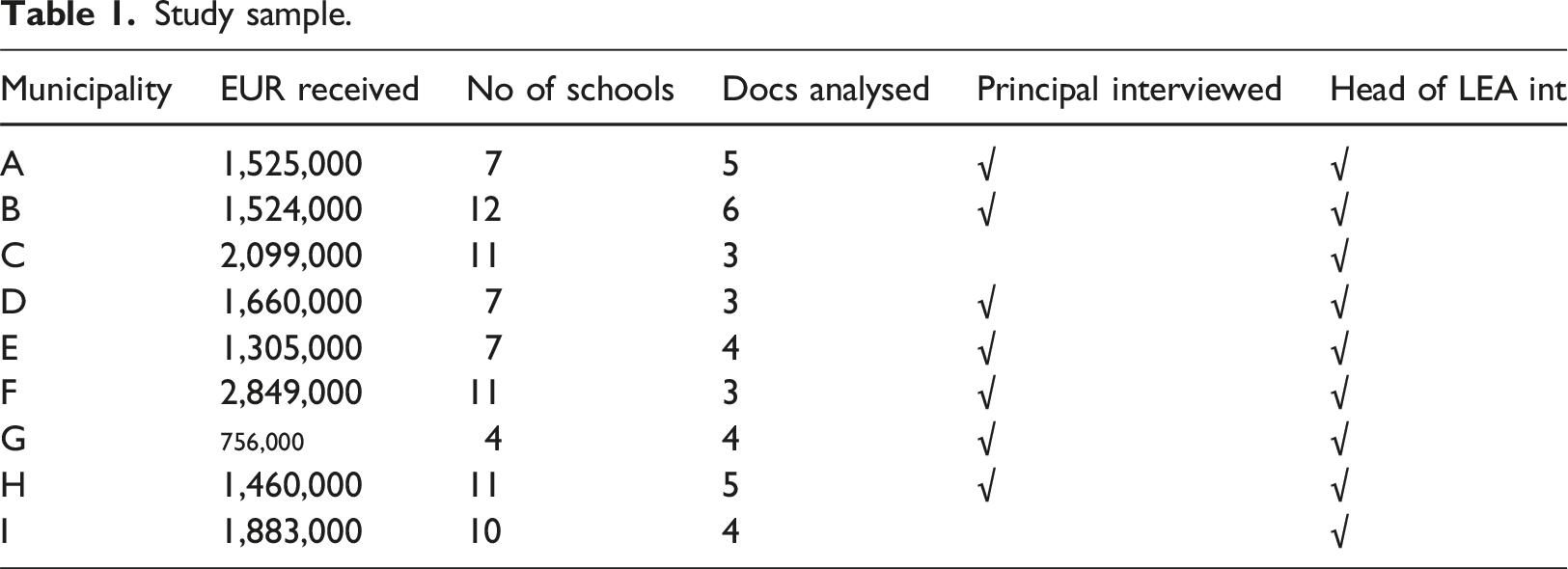
This article builds on a content analysis of nine LEAs plans and reports on using the funding in 2022, and a thematic analysis of 16 interviews with heads of the LEAs and school principals 1 in the nine municipalities the LEAs belong to. These are located in different parts of Sweden holding populations of similar sizes and one or more lower secondary schools in the upper tiers of the socioeconomic index, which will be explained in more detail.
Our aim is to provide insights on the use of this unique governmental funding scheme, especially regarding its impact on governance chains and the dynamics of power and autonomy on different levels. After sketching the context of the Swedish welfare state’s educational system and the present funding scheme for equity, we present our theoretical framework of governance and school development. This is followed by a brief account of our research design. Our findings are then divided into those regarding how the funding was used, and how that use impacts governance relations. We conclude with a discussion of the findings and their implications for the fields of school governance and school development.
Equality and equity as guiding principles in the Swedish welfare state school
In developing the welfare state in twentieth-century Sweden, similar to other Scandinavian countries, the educational system was crucial for national aspirations of equality and, later, equity (Stenersen and Prøitz, 2022).
Since the implementation of the comprehensive school legislated in 1962 (grundskolan), many reforms have been implemented in the Swedish school system, most often in the quest for equity and a more inclusive educational system. After an initial emphasis on both equality (lika/equal) and equity (likvärdig/equitable), the latter became predominant during the 1990s (Berg et al., 1999). Put in an international context after the Salamanca Declaration (UNESCO, 1994), equity and inclusion have come to be understood as necessary priorities in themselves, as well as measures for the success and efficacy of the educational system. This awareness has also been influenced by global actors and processes such as the OECD and PISA (Bergstrand, 2022). Moving from the aspirations for equality, the comprehensive unitary system established in the 1960s was dismantled in the 1990s. Decentralisation, diversified the provision of resources and organisation of schools on the local level. Parallel to this, marketisation reforms enabled parents to choose which schools their children would attend and opened the way for companies, churches, or cooperatives in the private sector to launch school ventures and found schools on all levels of the educational system, except universities (Wermke and Forsberg, 2017).
Financing private schools via a voucher system was intended to enable everyone, regardless of income, to opt for private schools for their children. Still, the system soon exhibited patterns that prevail today, where capital-strong groups are both the ones starting schools and are more often active in choosing schools for their children, as has been the case in similar systems around the world (Ball, 2021: 143f; Trumberg and Urban, 2021). The Swedish system is also one of the few in existence to allow publicly-financed schools to be for-profit. Although scholars have seen positive outcomes in particular schools or settings, quantitative and qualitative research carried out since the marketisation of the system has generated a consensual understanding of it as increasing divergences in school results as well as socioeconomic and racial segregation in the Swedish educational system (Böhlmark et al., 2015; Bunar and Ambrose, 2018; Hultqvist, 2018).
During this same period, what had been a state-governed school system was de-centralised as part of an extensive national reformation of the financing structure of the municipalities’ local authorities in the early 1990s. These gained more autonomy as previously earmarked funding streams were transformed into a single general fund for all municipal services. The local authorities could now freely decide on their finances and organisation, including the governance of primary and secondary schools. The increase in autonomy coincided with an economic crisis in Sweden that decreased tax income for municipalities, which were now responsible for solving their own fiscal problems. The general solution was budget cuts for schools and other areas that were now a municipal burden, with subsequent negative effects on school results and development (Hallsén and Magnússon, 2021; Swedish National Agency for Education, 2009).
In the second half of the 1990s, the liberal-conservative government was replaced by the social democrats that set up governmental funding programs to ease the burden of the municipalities. Entering the 2000s, over 100 different earmarked funding streams were governing Swedish schools. During the century’s first two decades, the system for controlling the quality of schools was enhanced with increased mandatory reporting from the local level of their ‘systematic quality work’, a new concept introduced during this period (Bergh, 2015). Another outcome of the strive for increased control over schools by the central government was legislation that required every municipality to appoint someone responsible for the schools administrated by the LEA (Bergstrand, 2022; Swedish Government, 2017). This enhanced the position of the heads of school at the LEAs and increased their liaison with the central government. At the same time, they were appointed by and worked on behalf of the local political administration. In conclusion, the historical dynamic of the Swedish school system has been described as a centralised system that became de-centralised and re-centralised (Bergstrand, 2022; Wermke and Salokangas, 2021).
A large-scale funding scheme to cope with equity problems
It is in this context that the Swedish Government, 2017 decide on a funding program with the purpose of financing ‘extended efforts to strengthen equity and knowledge improvement’ in Swedish primary and lower secondary schools. Sweden, once known for one of the most equal educational systems, now faces severe problems with inequality both between schools and between social groups, none the least in terms of school results but also regarding pupil well-being and satisfaction (Gustafsson et al., 2016; Henrekson and Wennström, 2022). The funding program was built on a funding scheme with a minimum threshold regarding the formal requirements for getting and using the money requested from the central government by the LEAs as well as private school organisers. Consequently, there were few guidelines for the program, aside from the quoted portal paragraph and a statement that the funding was intended to add resources to schools with pupils in socioeconomically vulnerable situations (Swedish Agency for Public Management, 2020: 26). Equity improvement was initially defined as an increase of pupils at the lower secondary level passing with the grades needed to transition to upper secondary school. In the years to come, the description of equity was taken away. In 2023, the funding scheme was merely described as aimed at ‘strengthening equity and knowledge development’, without defining any of the concepts. Combined with the (intentional) lack of guidelines or requirements from the government, the funding scheme gave practically full autonomy to the LEAs and private school organisers to decide how to use the extra funding. As for the campaign of 2024, the name of the program has changed from ‘State funding for school equity’ (för likvärdig skola) to ‘State funding for improved knowledge development’ (för stärkt kunskapsutveckling). While not being the scope of this article, changes in understanding and the concept of equity are nevertheless relevant and could be understood as reflecting the development of Sweden’s political and societal context during this period (Smith et al., 2023). Besides the name, no changes have been made in the regulation itself, and the budget has increased from a yearly EUR 600 million to almost EUR 700 million 2 . Being on its seventh year, it is probably one of the largest schemes ever undertaken in any country in terms of funding per capita and exceptional in the trust it places in the recipients (Swedish Agency for Public Management, 2021: 62).
In the initial evaluations of the funding campaign made by the Swedish National Agency for Education (SNAE), many LEAs complained about needing to prove that funds were spent on new projects and not employed to finance already ongoing developmental or regular work. LEAs in smaller municipalities had declined to apply for money for fear they would fail the evaluation and be forced to pay back the funding received after it had already been spent. Evaluations of the application and accounting process also implied a heavy administrative burden, especially for smaller LEAs and private school organisers. In addition, the funding scheme coexisted with several other smaller such programs for specific needs that sometimes overlapped with comprehensive equity funding. For this reason, the evaluations were revised and almost all thresholds, both in application and accountability, were removed (SNAE, 2019).
The only thing an LEA or private school organiser has to do to receive funds is to request them from the SNAE. The sum for each school organiser is set by an algorithm based on the socioeconomic index of each school. The index generates a score depending on the background variables of the pupils’ families regarding education, migration, and economic dependency. Less than 100 words need to be written when requisitioning funds: a short list of how the money will be used, and a brief description of how the list has been elaborated. In 2022, the SNAE informed that spot-checks replaced accountability reports, but as of March 2023, information from the SNAE when asked for reports is that no checks have been carried out (Fäldt, 2023; personal communication).
On the governance of school development and equity
This paper has its vantage point in curriculum theory, focussing on a so-called chain of government (Jarl and Rönnberg, 2019; Kridel, 2010). While the state is interested in forming and steering the system as a whole, it is also aware that this is impossible. Curriculum theory aims to understand these tensions by studying them through four lenses: ideological, juridical, economical, and accountability or control (Jarl and Rönnberg, 2019; Lindensjö and Lundgren, 2000). In our case, the ideology of equity is a major force in governing the school system on different levels. The juridical dimension embraces laws and regulations, such as the Educational Act or the Local Government Act that we will refer to below. Economic dimensions are funding and budgeting activities, while the accountability dimension of governing consists of checks, balances, inquiries, etc (Møller, 2009).
In this theoretical perspective, top-down governance is seldom possible due to the sheer size of a school system and the differentiated nature of everyday life in its intricate ramifications (Green, 2022). For reasons of practicability, transformations must take place in the model which assigns planning and implementation responsibilities to actors in the system. Consequently, the state bestows a specific amount of autonomy on various units in its education system. To a certain degree, it must also supervise how discretion is exercised and whether particular goals have been achieved. However, ultimately those units must exercise their own autonomy (Wermke et al., 2023). In such multi layered governing dynamics, earmarked funding from the state is a way to influence school’s priorities and allocating of resources on the local level (Barrenechea et al., 2023; Bergstrand, 2022; Kirsten, 2020). Funding as such is often a requirement for improvement of disadvantaged schools, albeit seldom the most important (Barrenechea et al., 2023; Chapman and Harris, 2004; Muijs et al., 2004). The efficiency of providing more funding has proved to vary depending on the capacity of the school and its leadership to use the resources efficiently (Franck and Nicaise, 2022; Grützmacher et al., 2023; Loeb et al., 2012; Muijs et al., 2004; Westling Allodi, 2013).
Research methodology
The design of our study has been guided by the two research questions about how LEAs use the governmental funding scheme and what we can learn about multi-level governance dynamics by examining decision-making on the use of resources in the absence of any formal expectations. Two methods have been used to explore how educational policy is expressed at different levels in the governance chain: a content analysis for national and local/municipal plans and documents, and a thematic analysis of qualitative interviews carried out with heads of LEAs and principals.
Sample
We strategically sampled nine LEAs on the municipal level with a population ranging between 11,000 and 34,000 and at least one lower secondary school with a score of 150 or more on the Socioeconomic Index (SEI) of the SNAE 3 . Since the mean value is 100, a school with a score of 100 generally has a mean pupil population in terms of the families’ educational and migratory backgrounds. A score of 150 means that a school has roughly an additional 50% of pupils from families with lower educational levels or who have migrated to Sweden. Being an LEA with a high-SEI school was relevant as the central government’s funding scheme for equity is supposed to especially benefit these schools and their pupils. The population range chosen as a variable for our sample was intended to include municipalities with some degree of similarity regarding economic and other structural conditions, while varying regarding municipalities and their LEAs historical, political, cultural and social realities. Furthermore, Sweden is constituted by 290 municipalities and half of these have a population ranging between 11,000 and 34,000. While the research does not claim generalizability, but to reveal multi-level dynamics of governance of an EFP, the choice of sample criteria can make the findings more relatable to more LEAs, schools and their personnel.
The first sample of municipalities/LEAs was followed by a sampling of documents to analyse and a sampling of individuals for the interview study. For the content analysis of documents, we chose plans that specified the intended use of the funding for equity and adopted a problem driven approach, in line with Krippendorff, (2013: 355ff). The plans were descriptive of priorities mostly during the years 2021 and 2022, depending on what was available. Interviewees from the LEAs were chosen based on their having administrative responsibility for the schools. When that responsibility was shared, the manager responsible for the lower secondary schools was included in the sample. The principals in the sample were those heading the high-SEI lower secondary schools administered by the LEA.
Data collection and analysis
Study sample.
The interview data was subsequently analysed using a thematic analysis (TA) in the tradition of Braun and Clarke (2006, 2022), which follows a scheme for analysing taking a reflexive stance and treating the data as more than topical. The aim is to find the meaning or central point, rather than sorting, coding and striving for a reliable approach.
Interpretation of data from municipality A.
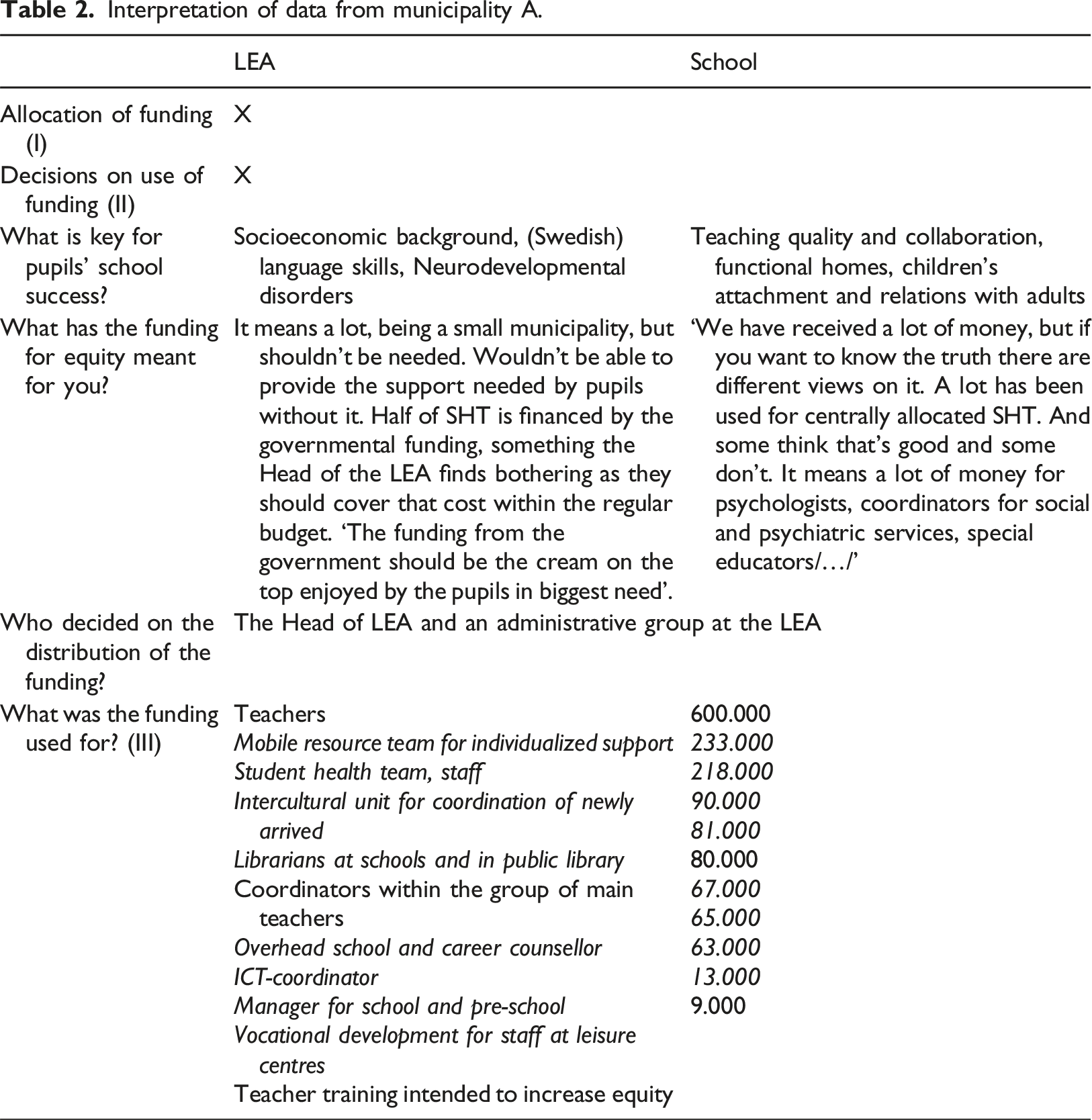
(I) Where the majority of the funded resources are held. Budget posts in italics in (III) are held by the LEA.
(II) Draws from qualitative data from the interviews describing the decision-making processes.
(III) Specified budget posts in the requisition for 2022. In italics budget posts administrated by the LEA. Original sums in SEK changed to approximate in EUR at ratio 11:1
Findings
How LEAs use their funding
Given the autonomy to use the resources granted by the governmental funding scheme for equity, what the LEAs chose to do with those funds depends in part on their interpretation of local needs and of the national policy of improving equity enacted by the government’s funding scheme.
The money provided by the Swedish government is budgeted by the receiving LEAs primarily for staffing, according to evaluations made by the Swedish Agency for Public Management (2021). Teaching staff is the most recurring expenditure specified in the plans projected for the use of the money. Staff for the schools’ health and well-being services are also recurring needs, as well as assistant principals or teaching assistants. Digital devices and licenses for software come next, and training of different kinds follows. The two examples in Table 2 show of this, as do the other seven LEAs. Yes, we do like this: ‘This is what we do. These are the activities we have to increase equity’. And then we send [to the LEA], just like I said: ‘We have created special teaching groups, we have hired people’. I have hired several special educators, and I have a speech therapist too, by the way, that I have hired here. That also goes, like, under school equity. So, we send these [to the LEA], our activities. And then they apply for governmental funding. As I have understood it, that is how the process goes. And then they say, ' You get this money because you have had these activities. But then I say this: from school equity [funding scheme], I have received not even half of what I have invested in this. (Principal, municipality G)
All specifications on the use of funding include areas that the LEAs are bound by Swedish law to provide for as part of school services, such as student health teams (SHT) 4 . In the case of municipality B, another budget item is for financing summer school for those needing to improve failing grades. This is mandatory for every LEA and private provider of school services, regardless of the availability of funding specifically for increasing equity. It is also recurring in the plans to include a rather large and unspecific budget item, like the teachers in municipality A’s budget, that appears to be part of the schools’ general budgets.
In the specification from municipality A, shown in Table 2, a line item that stands out is one about librarians. As it represents staff for the public library and school libraries, it allocates part of the funding received to an entity outside the LEA (the administration of public libraries in the municipality). The written plans state that the cost for staff in the municipality’s public library is supposed to provide a coordinator for the schools in the municipality and thus increase equity. The interviewed head of this LEA talks about the issue as an untimely decision made by his predecessor, as he has held his position for only 1 year: I think one has done wrong when distributing the funding for equity. [...] Do we need a librarian focused on schools with an overarching responsibility? Yes, but this should be employed with municipality money, not on some of this sagging equity funding. (Head of LEA, municipality A)
We can understand the distribution of investments in equity as the LEAs’ best shot at increasing equity in their local context, given what they know at that time. In addition to patterns shown through the examples of municipalities A and B, the other LEAs we examined have cases of hiring security personnel, a building coordinator or a physiotherapist.
How the LEAs decide on what equity is
As illustrated by our examples, improving equity by utilising the governmental funding scheme can include several autonomous decisions by the LEA, the first being the definition of equity. As it is not specified in the guidelines of the governmental funding scheme, it is open to interpretation by the LEA. We find both an explicit definition in the accounts of the heads of the LEAs and an implicit or applied definition in how they de facto invest funding earmarked for improving equity. We have set a goal that we will educate for the future. And then a part of that is how you afford the technology that you have. That is, buying the iPads or computers […] It can differ a great deal. Some have more. And then they have used the equity funding to make this densification and catch up with the political goal. (Head of LEA, municipality I)
One aspect of the LEAs’ understanding of equity that permeates their accounts is how equity is best improved when considering the whole school organisation, not just the particularities of individual schools. The examples of municipalities A and I will help us better understand such negotiation practices. Municipality A organise seven schools, and I organise ten. As with all beneficiaries of the funding, the LEAs receive the money as a lump sum and autonomously decide how to distribute it between the schools they oversee. They can, in theory, invest everything in a single school facing the biggest challenges. They can also choose to distribute it among several schools, or all of them. Our data reveals an understanding of equity as best improved through the distribution of resources that might support all or most schools in the municipality, in line with the following argumentation: We feel that we need to have all our schools. That is, all schools should exist and function. Some are bigger challenges. So, we have a general model for the distribution of resources for this that depends on the number of pupils. But, then we have had this equity funding where we have tried making additional compensatory opportunities. (Head of LEA, municipality I)
There are three cases where previous investments have been made in schools facing more challenges and with higher SEI, justifying the use of state funding for balancing this in the name of equity. Although they spend more per pupil on schools with higher SEI, all LEAs direct a share of their funds to schools that are below or near the mean of 100 (i.e. they are, in theory, better off than the average school in Sweden in terms of the expected success rate of their pupils). One of these schools scores as low as 35 on the SEI and still receives funding for staff working against absenteeism, for a speech therapist, and for training in social pedagogy for a staff member responsible for supporting and coaching pupils. The physiotherapist mentioned earlier is another example of an investment by a school with a lower SEI. That part of the funding for equity go to these types of schools is recurringly explained to be because all schools have challenges of different kinds, regardless of the background of their pupils. But several heads of LEAs disagree on this interpretation of equity, such as the following instance: One has used equity money to ensure that every pupil has a computer. For me, that is not about equity. [...] If we are to talk equity funding, then it should go to pupils out of a socioeconomic, ethnic, some perspective that makes that those pupils who have the greatest need will get part of this. It is not about handing out computers to all pupils. That is wrong, badly focused money. (Head of LEA, municipality A)
How the LEAs decide on how to work towards equity
Overall, we find low levels of participation by principals or other school personnel in the decision-making by the LEAs on the use of money and what resources it is invested in. The heads of the LEAs we spoke with generally told us that their decisions were made after having listened to the principals at the local schools, sometimes directly involving other colleagues at the LEA in the process. The principals, on the other hand, could seldom remember being asked specifically about the use of the funding. Most did not know about the nature of the funding and that they could, in theory, use the money for whatever local challenges they had in their schools in order to attain equity. A few principals did not even know the funding scheme existed. An example is the principal of the lower secondary school of municipality E, quoted below, followed by a statement from the corresponding head of the LEA, explaining how they decide on the use of funding: I don’t think that we… It may be applied, but we don’t get any such funds to our school unit. As far as I know, at least. And we had an economic review last week [laughs] […] I don’t know, how much money, how much. Can you see how much money we have gotten from that, or? (Principal, municipality E)
The LEAs tend to hold an important share of the funds transferred to them by the central government and invest them in resources within the organisation of the LEA, rather than pass the money on to the schools. Some examples are centrally organised SHTs, or assistant principals on the payroll of the LEA. And when money is passed on to the schools, it is for a predetermined use as decided by the LEA. The LEAs absorb all autonomy associated to the funding by the central government. In this way, the LEAs probably mitigate the central government’s goal of funding local needs when they decide on which the local needs are, instead of letting the local schools do it.
Examining not only the accounts given by the principals and the heads of LEAs but also planning documents and specifications concerning the use of equity funding, reveals a few undertakings that can be understood as change efforts or at trialling solutions to problems of equity beyond what can be understood as the general practice. Some of the investments mentioned earlier in staff for security or a physiotherapist may be considered disruptive or innovative, regardless of how they might facilitate school equity. A few more examples outside the box may be found in municipalities C and D. One school in municipality C invested in pedagogical staff to work on relationships and learning opportunities during the breaks between classes. In municipality D, the principal we interviewed employed what she called a ‘super teacher’, targeting truant pupils and mitigating a vicious circle they were in. LEAs and the schools under them have mostly used their money to recruit teachers or special educators to enhance teaching in subjects that a particular school has challenges with or to assess children of immigrants. Most of these teachers are either additional resources in the schools, financed by equity funding, or as a de facto reallocation of money in the budget that pays for existing personnel without adding supplementary human resources. Interpreting the plans and documentation in the light of the accounts from the interviews suggests both of the above, to varying degrees.
Governance relations between the state, LEAs and individual schools
The Swedish government’s funding scheme for equity has created an opportunity for the LEAs to increase their control and governance over the individual schools. In every case we studied, the LEA has seized this opportunity. The themes and dynamics present in our evidence show how the four dimensions of school governance are affected by an intervention involving a significant amount of money, coupled with full autonomy provided by the funder to the receiver (Jarl and Rönnberg, 2019; Lindensjö and Lundgren, 2000). The ideological dimension of equity in education applies to government, LEA, and school levels more or less equally. The design of the funding scheme and its communication clearly indicates that equity should be the main ideological goal of the school, and should be understood in diverse ways based on local circumstances (Swedish Agency for Public Management, 2020; 2021).
The juridical governing dimension is relevant for the impact of the national funding scheme on the local governance dynamics in the sense that two laws with different priorities are competing and pushing the heads of the LEAs and the schools in different directions regarding the use of the funding and the prioritisation of equity investments. The Education Act guarantees every child’s equal right to educational opportunities, while the main purpose of the Local Government Act, apart from organising the local administration, is to judiciously administer common funds and properties. That is, assure a balanced budget. The Education Act thus governs the principal, as well as the head of the LEA in the role of superintendent. At the same time, the head of LEA is governed by the Local Government Act in the role of local administrator. Since all of the LEA heads interviewed have worked as principals before their current position, they held views similar to those of the principals when discussing how they relate to the tension between the Education Act and the Local Government Act. My role in my small municipality is as head of administration, where I am supposed to have a balanced budget. But then, I am also head of the schools [of LEA], where I am to cater to pupils' needs. When I choose between them, the state assignment comes first. That is, the pupils' needs always come first. And I believe that is how principals think, and teachers think. So, if we have an organisation lacking certified teachers, it is more expensive to hire them than the uncertified ones. Or if we work in an organisation where we are too few, we need to become more able to support the pupil's needs here, and then we will prioritise the expense. We will take it on, like, totally, regardless. […] Then the boss might get fired [laughs]. (Head of LEA, municipality G)
Apart from the competing responsibilities conditioned by the two laws, the Education Act also stipulates that the principal of a school is responsible for all matters regarding it, except for the size of the budget it is given. In this context, it is a unique opportunity for the LEA to receive a considerable sum of money that they can exercise complete autonomy over. Our data reveals significant shares of the funding received generally stays within the LEA as centrally organised school resources, rather than being passed on to the schools.
Retaining control of the funds received from the state lets an LEA control some important aspects of its schools, such as health care or special education. At the same time they fulfil the obligations of the Local Government Act of keeping their administrative budgets in balance, although at the expense of prioritising equity. As reported in our findings, all LEAs use some funding to cover regular costs, fill gaps, or restore imbalances in the budget. Those heads of LEA we interviewed tended to speak about allocating funds in either general or equity-specific budgets as something overlapping, fluid, or hard to define. Talk about reporting or evaluating and openness to audit is often part of their statements, even though the minimal accountability that the government demands is well known to them. The following sequence with the LEA head of municipality I is one example of this: As a principal, we have to report what we use the equity funding for. So there are general and specific investments, everything, like student health, for example. A principal who feels they want an expansion, maybe another school welfare officer or school psychologist, can then take part of this funding, or in general, money, as they get a joint sum. But the difference is just that the equity funding must be accounted for. *[…] Previously, you had to tell what you had applied for and what you did with that. So, it is a part of our own, how can I say it? Quality assurance. Have we used the money in the right way? Did it have the desired effect? And such.
The bureaucratic relief inherent in the funding scheme and its elimination of complex applications, audits, and reporting clearly impacts the governance dynamics through the dimension of accountability. The SNAE decided to minimise requirements regarding applications, accounting, and reporting procedures based on the first evaluations of the funding scheme. Not only was there a reduction in the need for written documents, but also the previous requirement of not using the funding for already existing costs was removed.
All heads of LEA interviewed praised the fact that a bureaucratic burden had been lifted from their shoulders and that they were now trusted to use the money as they found most effective for improving equity. At the same time, our data reveals that all LEAs chose to keep business as usual with the principals, and continued to hold them accountable requesting reports of how the money was used. As described previously, there are also differences in how the LEAs decide to invest. There were cases where principals could participate at some level of decision-making. However, most of the principals interviewed had not been made aware or did not know about the autonomy inherent in the governmental funding scheme. That they could, in theory, have been provided with funds to use autonomously themselves was concealed from all of them. On the contrary, several principals expressed a desire for money they could use freely, instead of being obliged to allocate it according to the LEA’s or the central government’s will. Sometimes I wish that, like [I would be asked], ‘What do you need? Out of your…’ And we see that if we would get this, we would have, like, opportunities to employ extra, an extra teacher for every assignment team. [If we] would get this, then we would have this continuity for the pupils. And that every day, like every school day, every week, all year. We see that then we would reach here [further]. But a lot of this [funded investments] becomes like extra interventions, and at some point it feels like one doesn’t persist. It doesn’t get like, ‘How fun, now we get the opportunity to hold holiday school,’ ‘How fun, now we get the opportunity to do this.’ Rather, ‘How are you to cope with working for another day?’ Should one cope, or say like the pupils, ‘But we don’t want to do it. I need a vacation!’ (Principal, municipality B)
Conclusion and discussion
Overall, funding received was primarily used for staffing and materials corresponding to the ordinary needs of the school, and for general school development. Little was devoted to innovations of any kind with the purpose of improving equity. The few exceptions involved small investments in relation to the total funding received. Larger sums were used to fill out gaps in the budget. Based on our data and previous research on the impact of increased funding for education, it is difficult to argue that greater funding is the key to increasing the standards of schools in developed welfare states that already have relatively large school budgets (cmp. Barrenechea et al., 2023; OECD, 2019; SNAE, 2009). To limit the scope, our study has not aimed to analyse the direct results in terms of equity or equality of the funding and we can’t say what would have been a better way of using the money. But we can conclude and discuss, that it seems probable that the dynamics played out mitigate the results of the funding. One prominent example is when LEAs divert equity funding to cover costs they already have. Rather than increasing a school’s resources, this practice depletes the budget of the local administration of which the LEA is a part. This makes the LEA budget and each school’s budget more dependent on governmental funding, whereas they previously depended on their own, mostly consisting of tax revenue from citizens in the municipality.
The current practice can be viewed as the central government showing goodwill ideologically and financially to its citizens and global policy actors, providing a historically large sum for school equity improvement. It places complete confidence in the administrators at the local level to make the best use of those funds. However, paradoxically, although decentralising state control by providing money to use at will, it has strengthened the governance of local schools, increasing power over them, and making them dependent on more funding flows coming from the state. Funding flows that, in theory, could be earmarked for any micro-managerial purpose in the future. The autonomy provided has another centralising effect, however, as the central government can blame the LEA for failing to work towards equity while keeping the governance power of how failure is measured: grades, in this case.
The understanding of governance dynamics between state, LEA, and individual schools that we have outlined points to a concrete theoretical conclusion: multiple bypassing. Saying that Nordic superintendents and the LEA are frequently ‘bypassed’, turning them into ‘agents in a broken chain’, as some have claimed, since principals and teachers are bound directly to the governmental level (Moos et al., 2016), might be too simple. We have seen how multiple bypassings are activated by various actors in the governance dynamic created by the promulgation of a governmental funding scheme involving big money and great autonomy. The central government steers towards equity, bypassing the school principals and the local government that otherwise decides on the funding of the LEA. Through this bypassing, the LEA, and none the least the head of LEA, is strengthened in its position relative to other local actors – the school principals and the local political board of the LEA. The LEA acts upon this, bypassing both local and central government with their own political and educational intentions, using the money received for purposes other than equity. Have in mind the aforementioned jurisdictionally strengthened position of the head of LEA (Bergstrand, 2022). Heads of LEA also chose to keep the funding in locally centralised resources that they control, rather than passing the money on to the principals who could optimise its output. This can be seen as bypassing the principals and disregarding their autonomy to decide on their school’s business, or at least depriving them of the opportunity to claim the funds to which the government has entitled them. It could be argued that there is no guarantee for success if providing additional funds directly to the schools without intermediaries. The effective use of new funding is dependent on the management and leadership at the school. When mismanagement and poor leadership exists, additional funding can result in negative outcomes (Mujis et al., 2004). As the present findings show, similar negative outcomes exist for LEAs.
Yet another conclusion is that the tension created by the overlapping and to some degree competing dimensions addressed by curriculum theory (Jarl and Rönnberg, 2019) in its interplay with the multiple bypassing occurring, seem to corrode a shared understanding of school equity throughout the different levels. Government, LEAs and schools strive for equity by focussing on their context and proximity. The central government distributes funding based on a socioeconomic index encompassing all pupils in Sweden. The LEAs receive this funding and subsequently strive for equity for the pupils in their municipality. Not to contribute to national equity, even though they might contribute as a secondary effect. The principal of each school, in turn, uses the funding to create an equitable situation for the individual school’s population of pupils, rather than striving for equity for all pupils in the municipality or the nation.
A coherent understanding of equity, regardless of the specifics of it, is pivotal for the success of a funding scheme with this aim. And here, unfortunately the state can’t abdicate, as an Official Report of the Swedish Government on decentralization is titled (2014). The state needs to take responsibility for equity. Thus, a policy recommendation springing from our research would be to keep as low bureaucratic burden as possible, but focus on distinct values regarding who is to get part of the funding. Values that need not be numerical, but clear. One key value to address, springing from our research, is whether the funding for equity should be distributed to all schools or to the most disadvantaged schools. Swedish scholars have already proposed that LEAs direct a considerably higher share of their budget to schools facing disadvantaged situations (Bunar et al., 2021) rather than limiting to ‘a little more’ for those, compared to the schools that are better off. And international research has argued that to improve equity in a government lead educational system, specific groups of disadvantaged pupils need to be prioritized (Hopmann and Bauer-Hofmann, 2015). This raises further questions for future research, that are outside the scope of this article: how do we value and measure equity, its soft values and unmeasurable measures?
Within all dynamics of governance that are set in motion by the funding scheme, some of the money provided may have positive impact on equity and the trajectories of disadvantaged pupils. Still, the complexities and deficits revealed in the depletion of the funding scheme and the use of it, may damage the governance structure and threaten the autonomy of principals at the school level. It risks increasing schools’ dependency on resources from both the state and the LEAs in the quest for increased equity, and in the long run making the large funding scheme inappreciable for the pupils it was intended to make a difference for.
Supplemental Material
Supplemental Material - Governance dynamics and local autonomy in large-scale governmental funding: The case of Sweden’s campaign to improve equity
Supplemental Material for Governance dynamics and local autonomy in large-scale governmental funding: The case of Sweden’s campaign to improve equity by Carlos Rojas and Wieland Wermke in Policy Futures in Education
Footnotes
Declaration of Conflicting Interests
The author(s) declared no potential conflicts of interest with respect to the research, authorship, and/or publication of this article.
Funding
The author(s) received no financial support for the research, authorship, and/or publication of this article.

Supplemental Material
Supplemental material for this article is available online.
Notes
References
Supplementary Material
Please find the following supplemental material available below.
For Open Access articles published under a Creative Commons License, all supplemental material carries the same license as the article it is associated with.
For non-Open Access articles published, all supplemental material carries a non-exclusive license, and permission requests for re-use of supplemental material or any part of supplemental material shall be sent directly to the copyright owner as specified in the copyright notice associated with the article.
