




Abstract
The paper features the most probable visions of development of the general education school obtained from the research project Futuristic Scenarios of the Lithuanian General Education School. The study used the Delphi method to develop futuristic scenarios and extrapolate the most probable trajectories of school development. Sixty-one experts in education including academics, school administrators, teachers and students completed an online Delphi survey designed by the project partners. Based on the findings, four futuristic scenarios are proposed: (1) The School of Eco Care; (2) The School of Exclusion; (3) The School for the Market; and (4) The School of Individual Meanings. These findings capture the (un)realistic and (un)preferable tendencies in our rapidly changing world, the implications and possible benefits of the scenarios.
Introduction
The current context of rapid socio-cultural and political changes warrants hasty decisions and the need to predict future events captured by the question: Is there a way to predict optimal future scenarios and, based on them, adjust the policy of change? In this case, our focus lies on education, which is constantly criticised for being insufficiently thought out and neglected by educational policy makers, let alone inadequately implemented by practitioners, even if there is a clear agenda. The current reality of education is a lot about subjective experience, eclecticism, inclusiveness and irony. It is informed by notions such as difference, (dis)equilibrium, repetition, the simulacrum, the hyperreality as well as instability of other concepts such as presence, identity, historical progress, epistemic (un)certainty and the univocity of meaning; it is also evocative, eschatological, existential, expressive, evolving and experimental (Aylesworth, 2015; Slattery, 2006). Importantly, today’s education does not view the curriculum and the study process as something set in stone and it gives the voice and choice to the learner. Discussions on the future of education and the centrality of the human become dominant in education philosophy and practice and require a revision of anthropocentrism as well as the adoption of a new approach known as the new materialism. One of the main questions in this approach is how to diminish the anthropocentric binaries (e.g. culture vs nature, meaning vs matter, etc.) and, consequently, binaries in the educational field such as adult-child, teacher-student, etc. Based on the new materialism stance, concepts such as human agency, child agency, more-than-human, non-human are newly interpreted or invented and introduced into the educational discourse (e.g. Daffara, 2020; Jagodzinski, 2018; Wallin, 2014; Snaza, 2018; Malone, 2018; Kouppanou, 2020). Hence, the educational encounter is everchanging and can be informed and modified by its actors, that is, learners, teachers, school administrators and education policy makers. Yet, there is a clear lack of a common vision between educational strategists and implementers of the educational policy in Lithuania and other countries too.
One way to tackle this problem is to make predictions of the future and develop best suited strategies for the policy. Such initiatives arise from international organisations (OECD, 2006, 2020; UNESCO, 2021) and from researchers in a number of countries (Slaughter, 2003; Sanborn et al., 2005; Facer and Sandford, 2010; Kesson, 2020; White, 2020; Ramos, 2020; Daffara, 2020). As an illustration, a publication on the future of education which appears on the platform of the OECD entitled Back to the Future of Education: Four OECD Scenarios for Schooling (2020) is presented as a tool to support long-term strategic thinking in education. The four scenarios have a time frame of approximately 20 years and were named (1) Schooling Extended, which envisions expansion of formal education, technological support for more individualised learning and overall retention of the structures and processes of schooling; (2) Education Outsourced, which foresees a breakdown of traditional schooling systems and learning through more diverse, privatised and flexible arrangements, with digital technology as a key driver; (3) Schools As Learning Hubs, in which schools are retained but experimentation becomes the new norm favouring ever-changing forms of learning and social innovation; and (4) Learn-as-you-go, which envisions education everywhere and anytime and the blurring of distinctions between formal and informal education as society turns to the power of the machine. Apparently, all the OECD’s scenarios are hardwired with a human-centric utilitarian purpose of education – the well-being of human individuals and that of humanity. Learning practices in one form or another, whether it is in schools without borders or in corporate-owned educational institutions, are also envisioned as organised by adult agents subordinate to the labour market, fulfilling the role of supply chain elements. However, the reconceptualisation of philosophies and principles needed to guide future education takes a more progressive look at what it means to teach and learn for surviving in the damaged planet.
Conversely, agentic human and more-than-human relationships are introduced in the newest UNESCO initiative based on the pluralistic epistemologies of indigenous knowledge systems which question the narratives of almighty humans. UNESCO, a longstanding advocate of child-centred education, published its newest future-oriented report Reimagining Our Futures Together: A New Social Contract for Education (2021) which presents visions, principles and proposals for the role of education in the distant future (the year 2050 and beyond). In line with the posthumanist and the new materialist thought, the UNESCO report urges us to rethink human agency and see it as it is, that is, always intra-connected with complex multiple more-than-human entities. However, the report is inconsistent in its flattening of ontologies. Swinging from anthropocentric declarations of ‘human rights first’ to ‘dangerous AI’ that needs ‘steering’, it throws around what new materialist and posthumanist ethico-onto-epistemological perspectives offer but does not seem to gravitate towards them. All in all, the newest future-oriented report from UNESCO is a step in the right direction as it envisions agency which is relational, yet with the human interest prioritised.
Admittedly, future theorists and scenario builders allow a wide panorama of future possibilities. Even before the pandemic, some studies (e.g. Facer and Sandford, 2010) were projecting very diverse scenarios and a new vision of the human/student, not so much separating them from their environment but looking at the networkedness, the interconnectedness of the human being with nature and technology, similarly to what Bruno Latour (2005) suggests. Indeed, as a counterbalance to the consumerist and economically driven world and education, scenarios have emerged that highlight the possibility of a shift towards an individual and collective contemplative and meditative Indian consciousness as well as a harmonious relationship with nature, the planet and cosmos as a whole (e.g. Kesson, 2020). The COVID-19 pandemic has had an impact on research, scenarios and recommendations. Slavoj Žižek, in his book Panic/Pandemic (2020), analyses the situation in the wake of the pandemic and sees in it a very important message: how we should communicate with each other and with the planet. The crisis caused by capitalism and the need to cooperate rather than split is, of course, seen first and foremost, yet scenario analysts envision a reverse process: the world is fragmenting, dividing, and this could have a devastating effect on education. Some authors put the blame on tribalism, which is becoming a much greater public concern than other problems. This is evident in José Ramos’s (2020) study Four Futures of Reality based on CLA (Causal Layered Analysis). A similar global confrontation is projected in Phillip Daffaro’s (2020) study which used the same method to explore possible post-pandemic scenarios. The study put forth a projection of macro-history and The Futures Wheel of Consequences (FW) suggesting that humanity will flourish through cooperation and a rebalancing of certain fields (economy, ecology, society), or else there will be a complete degradation and some of the most creative people will take control of the entire existence of isolated communities (this option is called creative destruction).
Meanwhile, Marek Tesar (2021) notes in response to the current reality that education is mostly ‘reactive’, while it should be ‘proactive’. This has been demonstrated by the challenges of the pandemic, where short-term measures are used to rescue the situation instead of collectively creating and predicting a future liveable for all. According to Tesar, the particularly pronounced changes in ontology, epistemology and axiology also lead to the need for new research methodologies based on projections of imagination as well as on children’s opinions, experiences and voices. His approach seconds that of Karen Malone, who suggests turning to those who own the future, that is, children, and hearing their voice (Malone, 2018; Malone et al., 2020).
All in all, although there exist plausible projections into a relatively distant future, all of them are subject to unforeseen or only partially foreseen events which befall society. The more predictable those events are, the easier it is to prepare for the future or even to create it. And it is not only global but also local events and contexts that matter. This is what prompted this ‘Lithuanian’ study, an attempt to unravel the specificity of our public imagination, which we discuss at the end of the current paper.
Scenario creation initiatives in Lithuania are often rather meagre and limited in number. One of them was the project back in 2011–2012 entitled Scientific Lithuania 2030, which proposed 10 scenarios for the future (2012). 1 Another example is the Scenarios of Development of Education Competition organised by the Ministry of Education and Science in Lithuania (2012). It proposed 11 scenarios which focused heavily on student and teacher autonomy, choices, communities, creativity, networking, technology, laboratories as well as rating, assessment and monitoring, but those scenarios neglected ecological development, national security and health-related issues, which have come to prominence recently. What is the use of such undertakings is probably hard to say as there are no review articles on them, they obviously lacked broader coverage. Apparently, some of the insights were included in documents on the strategy of education, yet it is difficult to estimate which ideas from which scenarios were used for the creation of those documents.
Today we see a new ambitious project, the State Progress Strategy Lithuania 2050, which envisions creation of scenarios for the future, yet it is a pity that it does not provide an adequate platform for representatives of the educational sciences, although education is seen as one of the main dimensions of the foreseeable future.
This context creates a good platform for the project Futuristic Scenarios of the Lithuanian General Education School carried out by a group of Vilnius University researchers in 2020–2022. What makes it unique is the fact that it focuses not only on the typical global and local features and visions of education, but also on the current realities of the general education school.
The present paper presents the research method developed within the framework of the project for the creation of futuristic scenarios of the general education school and its results, the four scenarios and their benefits and implications.
Method
Our scenario creation was informed by a broad overview of extant relevant literature published in four papers. Of course, the literature was not reviewed in its entirety but based on several selection criteria: the timeframe spanning from 2001 to 2022 and the location ranging from Lithuania to prognostic research findings of international organisations, research groups or individual researchers. Our activities were slightly adjusted by the recent global events: the pandemic, the neighbouring war, the issue of climate change, etc. These issues have informed some of our futuristic predictions, such as the question of how the adjustments and measures dictated by pandemic control will take root in the future and whether they might become dominant, as seen in part in the People’s Republic of China today.
The Delphi research method and procedure
The Delphi research method (Beiderbeck et al., 2021; Markmann et al., 2020; Schulte, 2017) is a structured communication technique and a systematic, interactive future’s research method which relies on a panel of experts. The experts answer questionnaires in 1–4 rounds. After each round, a Delphi manager (facilitator) provides an anonymised summary of the experts’ forecasts from the previous round and experts are encouraged to revise their earlier answers considering the replies of other members of their panel. Finally, the process is stopped after a predefined stop criterion (e.g. number of rounds, achievement of consensus and stability of results) determine the results. The Delphi method allows researchers to adjust the questionnaire for the next round if some items/questions turn out to be irrelevant or invalid (see Figure 1). Graphic depiction of the Delphi method (eDelphi, the Delphi Method Software: https://www.edelphi.org/).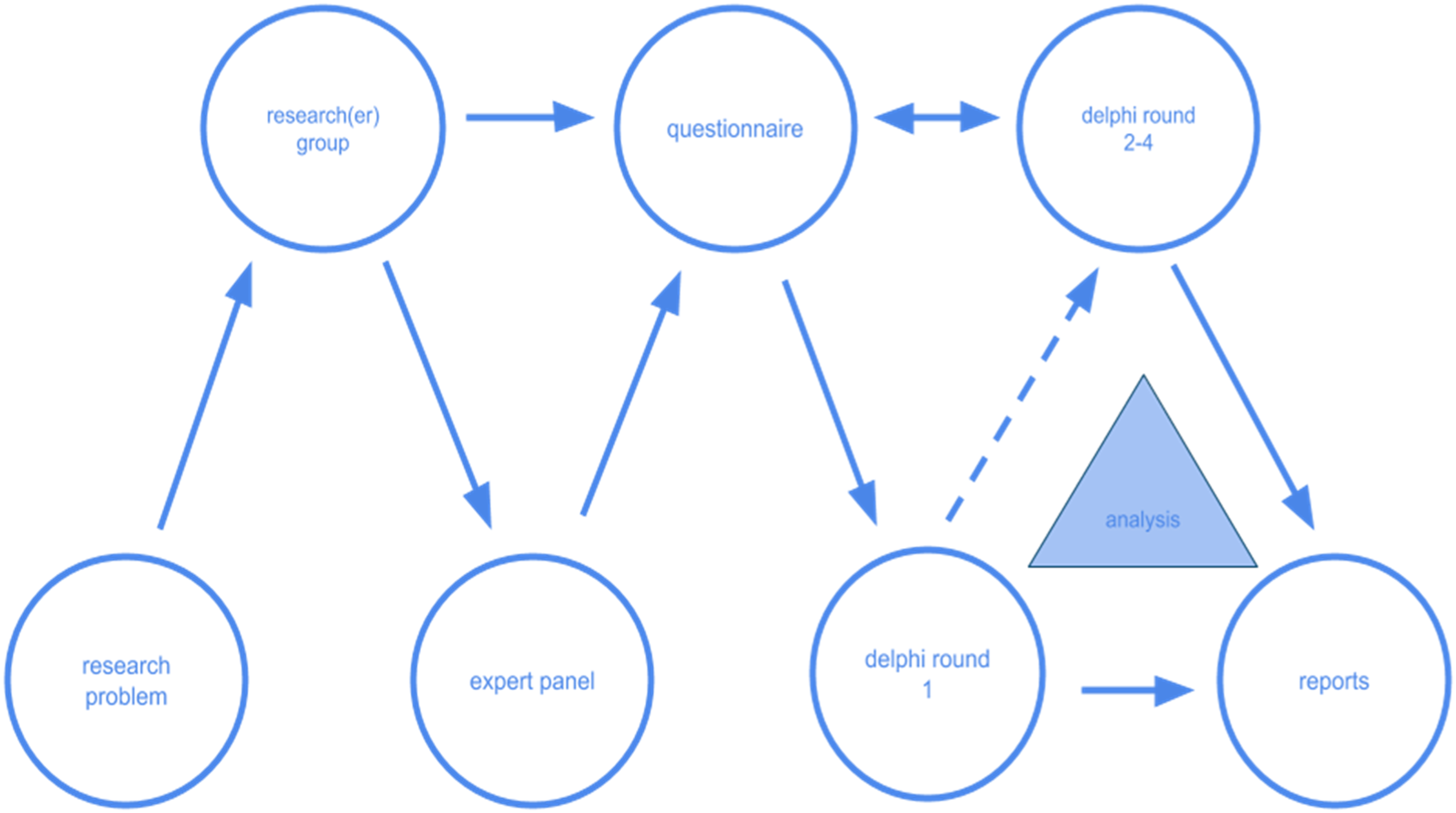
As for the steps in our study, after the initial literature review, we drafted questions for six individual semi-structured interviews with an astrophysicist-palaeontologist, a botanist, a philosopher, an IT expert, a sociologist and a sociolinguist on their visions of the future of the society in general and the foreseeable future of school. The interview data were analysed both deductively and inductively and informed the construction of preliminary questionnaire items that captured the core dimensions of the Lithuanian general education school. To explore the content validity of the items, we asked seven experts (school students, school leaders, school administrators and experts in education) to judge their appropriateness in terms of accuracy in tapping the scenarios of future school. This way, based on futuristic research, visions, scenario reviews and the analysis of the state of education in Lithuania, we identified eight most important focus areas, the first three of which capture mega-problems that extend to education, the other four relate only to schools and the last one to the recent crises in the world. Their list is as follows: the sociocultural context (e.g. ‘An increase in the number of immigrants will radically change the Lithuanian school to a multicultural one’); information technologies and school (e.g. ‘Artificial intelligence will replace teachers’); ecology and school (e.g. ‘Ecological justice will be just as important as social justice’); school culture (space and time, e.g. ‘The school building(s) will have one large space without separated classrooms’; ‘Formal lessons will be shorter in duration’); the curriculum (e.g. ‘The curriculum will be chosen by the students themselves’); the ratio between formal and non-formal education (e.g. ‘The distinction between formal, non-formal and informal learning will be blurred, all the learning ways and actors will become equally important’); relationships and communication between teachers and students (e.g. ‘Technology/artificial intelligence will significantly reduce communication between learners); and the impact of new global crises (the pandemic, the war, etc., for example, ‘Due to pandemics, physical contact at school will become rare and highly valued’).
The methodology and stages of scenario development and data analysis are presented in Figure 2. Scenario development scheme.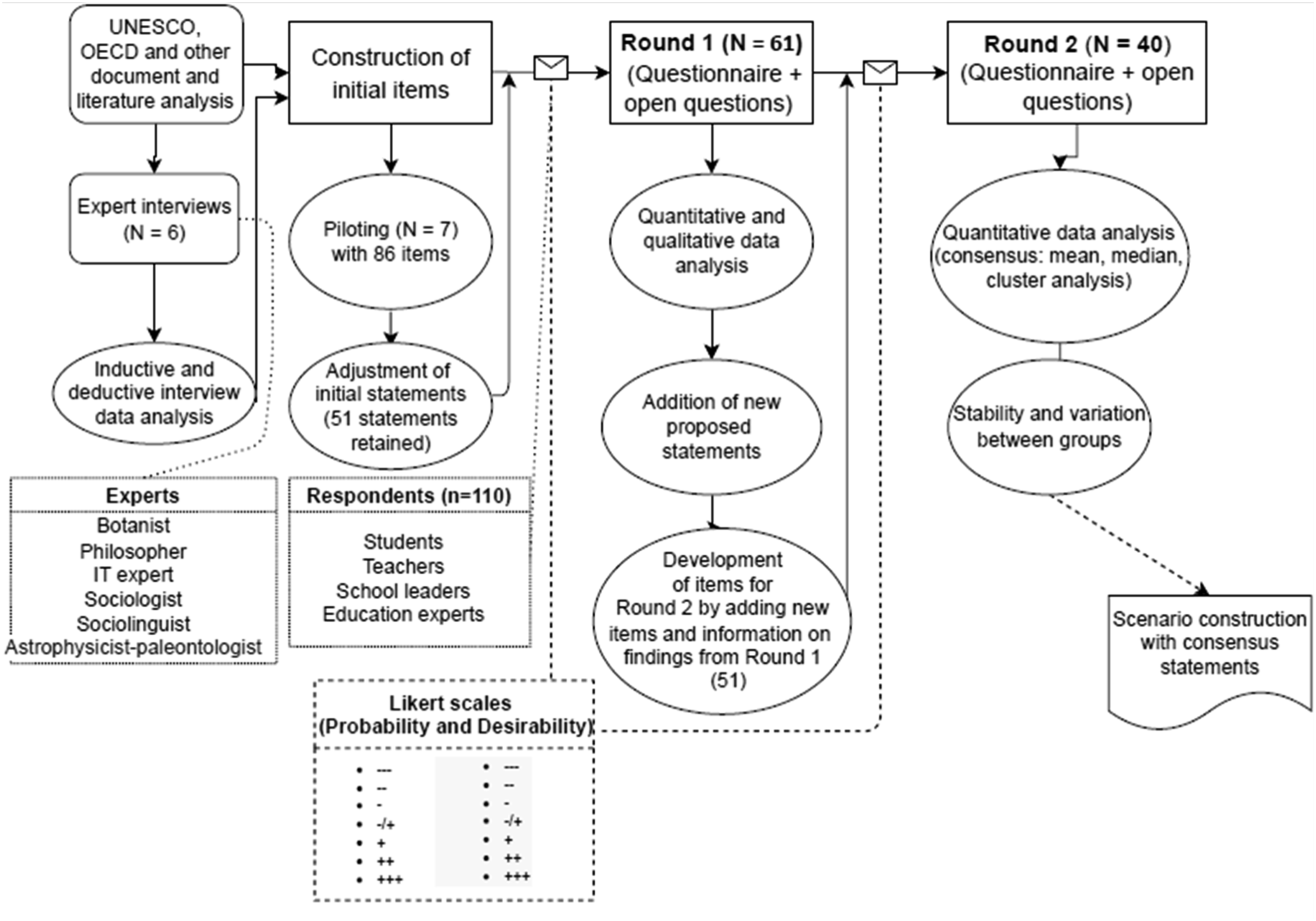
It should be noted that the questionnaire was slightly modified after the first Delphi round as several new items were generated from answers of respondents to open-ended questions. Open-ended questions and closed-ended items in each round of the survey were presented across two dimensions: probability and desirability, and the survey was conducted in Lithuanian in the eDelphi research platform. 2
Participants
The Delphi method envisions that research participants must be experts in their field. Unfortunately, there are few experts in the field of futuristic education research in Lithuania, therefore our study used what we might call arbitrary experts, a relatively small portion of individuals from each specifically targeted group with notable experience in education selected using purposive and convenience sampling methods. First, the Delphi survey was sent to 20 scientists, 20 education experts, 20 school leaders, 20 teachers and 20 students, with 10 more teachers and school leaders added later. It made no sense to continue looking for experts because their experience in the field of education would have been increasingly smaller and departed from the requirements for the Delphi research participants. Sixty-one respondents (N = 61) agreed to take part in the study, among them 19.7% men, 60.7% women and 19.7% not indicated. Eight (13.1%) participants were students, 13 (21.3%) teachers, 15 (24.6%) school administrators, 12 (19.7%) researchers and 13 (21.3%) %) experts from all major Lithuanian cities.
Results
Statistical analyses of data were performed using the software package SPSS 21.0 and the Excel programme. We analysed descriptive statistics, normality of distributions (the Shapiro–Wilk test), differences in means (the Wilcoxon test) and performed cluster analysis on the data. The results were considered statistically significant at p < .05.
The results from both rounds of the Delphi survey indicated several significant differences in participants’ responses to the probability and desirability dimensions, yet those differences were not numerous. In view of this fact and the limited scope of this paper, only the probable, not the desirable, scenarios extracted from the cluster analysis in the second round are presented below, followed by their descriptions and implications.
Futuristic scenarios: School 2050
The cluster analysis of the results of the second round prompted the formation of four scenarios, although the first round of our study earlier yielded six scenarios. But we thought that a large scattering of similar items did not prove informative and logical enough, hence the final decision to narrow our findings down to four scenarios. Can they really be called that? Perhaps only tentatively. It would be more appropriate to view them as reflections of public consciousness but the Delphi research method allows us to design them as scenarios (Beiderbeck et al., 2021; Nowack et al., 2011), although they could also be called visions or projections. It must be noted that the concept of a scenario is as diverse as the different scenario development methods (Bradfield et al., 2005; Martelli, 2001; Millett, 2003; Varum and Mel, 2010).
In the hope of clarifying the emerging scenarios, two rounds of the survey were followed by three focus group interviews with students, teachers, school leaders and educational experts/researchers. These groups had to evaluate the scenarios based on the grouped items and provide their insights and suggestions for additions and corrections. The interviews resulted in a few interesting suggestions and observations, for example, to structure the description of school life by relevant domains, to pay closer attention to personalised learning, to pay due credit to the positive side of technology, not only its threats, to relate scenarios with the problem of social exclusion, etc. To sum up, all the stages and rounds of our research, the most important of which was the Delphi study, brought about refined insights and the creation of the four probable scenarios for the future of Lithuanian general education school presented below.
Scenario 1: The School of Eco Care: With the planet
The formation of this school is greatly decided by crises such as epidemics, neighbouring wars, climate change, etc. These crises urge the school community to join forces, to seek common solutions to critical situations and to look for and experiment with alternatives. In such a school, eco-justice is no less important than social justice: secured herein are the rights of both people and other living beings as well as the entire natural environment. The community of such a school often agrees to limit ‘live’ teaching in favour of distance teaching because it is believed that saving energy resources and reducing transport pollution contributes to a cleaner environment. Not only that but the students are encouraged to regularly monitor the level of harmony and sustainability of their immediate environment. The days when the students meet in person are especially appreciated and their activities include project presentations, individual and group portfolio evaluations, or personal, national and intercultural holidays. Particular attention is paid to the integration of minority groups and team building activities.
One of the pragmatic concerns of the eco care school is to ensure full provision of students with necessary ICT technologies as this adds to independent self-study. This also aims to reduce the gap between students of high and low socio-economic status. Citizen science is flourishing. In cooperation with science and research centres, universities and other institutions of higher education, schools receive tasks they delegate to students, for example, to monitor their natural environment, take water samples, record air quality and photograph and catalogue information about living and non-living nature in their immediate home environment. Such practices provide important data about the ecological situation and allow students to learn from experience and find meaning in the pursuit of ecological well-being.
Although the topic of climate change is an essential axis which integrates all other subjects, national security topics are also included into the curriculum in response to natural disasters and unrests in neighbouring countries as well as the growing number of climate change refugees. School buildings are adapted to protect against cataclysms. Exercises are held regularly to develop skills of hiding from danger or providing humanitarian aid.
Such education blurs the boundaries between formal and non-formal education. The divide between students and teachers is also decreasing because students participate in activist movements under the influence of the unifying idea of eco justice and sustainability, which teachers are also invited to join.
Scenario 2: The School of Exclusion: With the Ingroup
It is assumed that the region will face an increase in the number of war refugees, climate change and inequality, which will reflect on the educational landscape. As a result of the ineffective integration policy, immigrants are isolated in ‘ghettos’. Exclusion and segregation thrive among the local population, which prompts the creation of very diverse schools, such as monocultural educational institutions of national minorities, multicultural schools abundant in low-SES districts and predominantly private elite educational institutions for the middle and upper classes of society.
Segregation thrives not only between but also within schools. All types of educational institutions are marked by competition and hierarchy, and from the very start in primary education the aim is to get into the ‘strongest’ classes with the ‘best’ teachers. This is partly due to the stringent bar for admission to higher education institutions and partly due to the closure of communities in bubbles by socioeconomic and cultural status, not to mention that only the classes showing the highest academic achievements enjoy live teaching, the rest mostly have to comply with distance education from home.
Although a large part of the population learns online, only elite schools use the most modern, individualised ICT solutions that monitor personal progress and select the curriculum, while the rest stream video lectures watched by hundreds of students simultaneously. Repeated viewing of recorded lectures with integrated standardised testing becomes the norm of learning. Communication between teachers and students is formal and limited, practiced only during final assessments and exams.
Ecological issues are taken care of minimally because it is believed that the damage has already been done, and the irreversible processes are halfway through. Environmental protection becomes only a matter of moral superiority and elitist fashion for certain social groups. Scarce ecological projects are seen by schools as ways of securing additional funding, while the content of education is dominated by decontextualised traditional learning of classical subjects. Non-formal paid education is available only to the elite and affluent social groups.
Although the curriculum is shaped centrally, control and quality are ensured only in schools of higher SES neighbourhoods, whilst in closed communities and multicultural schools with many immigrants, unwarranted conspiracy-theory-like curriculum is manifest. There are also actor-like educators who are hired by communities that resist digitised education. Those educators often are teachers dismissed from the formal education system due to non-use of ICT. Last but not least, there emerge underground ‘live’ teaching groups.
Scenario 3: The School for the Market: With the Capital
The essential factor shaping the school is the country’s economy. It is understood that the market responds to emerging needs of the society, therefore school partnerships with private companies are flourishing; also, the latter take active part in shaping the curriculum and offering professional and practical training in their businesses. An extended network of private schools is focused on a specific job market niche. Education is often provided by public schools cooperating with companies and private schools, and often directly by the companies themselves. Most of the time, these are companies which develop and apply the most innovative STEM technologies that include both artificial intelligence and animals in the educational process with abundant visuality and live, experiential education; these companies compete for the most talented students who are encouraged with material rewards for their achievements.
Due to the desire of international companies to attract the future workforce, all social and ethnic groups are included in education. Many companies providing education are international corporations, therefore the language of instruction is mostly English. Eco-problems are included in the curriculum through STEM subjects, whilst environmental protection is primarily ensured through the creation of green, environmentally friendly and well-designed products as well as the education on their consumption.
The most important goal of such schools is development of competences which can be applied in the market and pay off quickly. Subject purity is a rarity, the curriculum is mainly interdisciplinary and transdisciplinary. The educational process is governed by companies, professionals, scientists, economists, etc. The lines between non-formal and formal education, between curricular and extracurricular activities are blurred. Learning and preparation for assessment take place in various spaces and at any time of the day. Most often, education is focused on problem solving skills and project-based learning, but problems are also selected by the human resources departments of companies.
If the company which supports the school is prosperous, live teaching is applied, but this is an exception than a rule. To save money, the education of many students takes place in the virtual space. Companies in the most successful fields allow students to select up to 50% of their learning content, the rest are given less choice. ICT systems strongly control the choice of school subjects and the assignment of students to professional fields. There is an increasing outcry about dehumanised education and the ‘black box’ effect, which means that it is impossible to determine the criteria based on which artificial intelligence assigns subjects, fields and specialties to students.
Scenario 4: The School of Individual Meanings: With the Self
Due to the success of global automation and robotisation, there exists no more need for human labour. Climate change is partially under control and concern about it is pushed to the margins. Education becomes a quest for individual meanings. In this scenario, the current traditional school becomes an exotic rarity as school is no longer a place of centralised teaching of various subjects. The school is a multifunctional centre which provides personalised learning and algorithms for individualised education based on the interests, pace and age of the learners. Various competences acquired independently or non-formally and certificates issued in enthusiast hubs are regarded as valid here.
Learning hubs are small, temporary groups seeking self-realisation and growth and facilitated by artificial intelligence which has replaced teachers. The issue of time is no longer important for education, and concepts like the school year, grade levels and other elements of school life become extinct. Algorithm-driven and optional curriculum is delivered in blocks based on personal preferences and prior levels of achievements. The latter are recorded in certificates or badges whose virtual and physical displays become symbols of personal maturity.
The learning process is associated with a sense of meaning, goodness and pleasure. The central axis of the curriculum is spirituality (religious or non-religious), well-being, health, authenticity and ‘naturalness’. A lot of attention is devoted to meditations, physical wellness programmes and other techniques for soothing down and clearing one’s consciousness. Orientation towards prestigious disciplines or academic results is viewed as a bad tone. Most important in this school is the very process of learning, slow learning. Certain subjects are replaced by their fragments or chips which facilitate ‘uploading’ of the required content of classical sciences. However, due to the increasing competition of teenagers in collecting ‘certificates-badges’, parents intervene in the educational process and demand to recode the algorithms to render them respectful of the family regime (work vs rest). Physical communication beyond the immediate family is extremely rare, except in a very small group of like-minded people or with a personal teacher.
Part of the teacher’s functions is transferred to IT, but the content of spirituality is reserved to the live teacher. The relationship between the teacher and the student is usually individual and depends on the student’s development needs and interests, therefore the entire educational process lacks a broader social and cultural relationship as well as communication within the community. The dominance of personalised learning and individualism hinders the realisation of communal aspirations.
How were the probable and desirable scenarios different?
In comparison with the probable scenarios, the desirable scenarios focus more on the entanglement of multiculturalism with the market economy and the pursuit of achievements (scenario 3). While in the probable scenarios, multiculturalism is segregated by identities (scenario 2) which refer to closing up in social bubbles. Yet openness to the Other, according to the probability dimension, is related to support of the market economy and the training of students for that purpose. This mirrors the current processes in many countries, including Lithuania. And spiritual education, when desired, is associated more readily with communalism than with individualism, which is manifest in the probability scenario 4, thus conveying the message that personalised education closes individuals in their own worlds and even if they are free and feel blissful, they are more asocial than social and communal.
What surprised the researchers the most was minimal attention paid to creativity and artistic education. Even though creativity garnered much attention in the answers to open-ended questions of the Delphi survey and communication competences stood out from all the other competences, this was barely reflected in the cluster analysis results. In addition, there was no emphasis on creativity and artistic education in the focus groups. It is more apparent only in scenario 1.
Another surprising aspect was little attention devoted to imagination. There were only a few innovative and unexpected ideas, for example, chips to transmit information on certain subjects (mathematics, chemistry, physics, history), sliding school walls, interplanetary communications, the fact that artificial intelligence will replace the entire school staff and especially teachers, etc. Obviously, the future is seen in a very practical way, and this bespeaks a lack of creativity and imagination on the part of the experts, teachers, high school students and school administrators who took part in the study; on the other hand, it should gladden educational strategists and politicians, who often view things practically due to their result- rather than process-oriented slant and place emphasis on concreteness and situation management but not innovations which require new administration and control efforts.
Another prominent theme that emerged from our results was new challenges (the pandemic and the neighbouring war). The results suggest concern about health and national security, about bomb shelters in schools and about education for a healthy lifestyle. Yet the issue of climate change and the crisis the world has been facing for quite some time do not rise to prominence. They are deemed important in only one scenario, while the issue of technologies dominate every scenario. It is somewhat associated with creativity (which indicates a tendency to transfer creativity to the domain of technology use and compensate for the general lack of interest in creativity apparent in the study); on the other hand, technology is attributed the role of greater control that frightens educational practitioners, especially if IT ‘grows’ into an active use of artificial intelligence in schools.
Balancing sustainability and segregation: The paradox in Lithuania’s educational policies
The current educational policy in Lithuania, as reflected in key strategic forward-looking documents like Lithuania’s progress strategy Lithuania 2030, 3 closely aligns with the first scenario, The School of Eco Care: With the Planet. This scenario and the strategy share a focus on holistic, community-driven approaches to address key challenges such as climate change, social justice and sustainable development. The strategy’s emphasis on sustainable development and environmental protection finds a parallel in the eco-justice focus of the scenario, which prioritises the rights of people, other living beings and the natural environment. Similarly, the strategy’s commitment to technological advancements and innovation is mirrored in the scenario’s approach to integrating ICT technologies in education, aiming to bridge socio-economic gaps and enhance independent learning.
However, certain steps the Ministry of Education, Science and Sport is taking towards enactment of the strategy, as reflected in the implementation plan, 4 show alignment with The School of Exclusion scenario. This is because the plan is characterised by segregation and elitism, which are reflected in some practices observed in Lithuania’s educational landscape. For instance, while the government emphasises equality and equal opportunities in its strategic documents, practices like the forced streaming of students into vocational education after the 10th grade, as outlined in the latest Law on Education of the Republic of Lithuania, 5 can inadvertently promote segregation and elitism. This approach potentially restricts students’ prospects by channelling them into predetermined paths, rather than nurturing their individual talents and aspirations. Additionally, the concept of the so-called Millennium Schools intended to foster excellence may inadvertently contribute to the creation of elitist institutions. These schools are often perceived as catering to the ‘best’ students, leading to a hierarchical ‘good’ and ‘bad’ school-ridden educational system. Such phenomena align with The School of Exclusion scenario, where educational institutions are marked by competition.
In conclusion, while Lithuania’s educational policy is well intentioned in its pursuit of equity and excellence, it is crucial for policymakers to critically evaluate these strategies and consider their long-term implications for the educational landscape. Balancing the aspirations of the Lithuania’s progress strategy Lithuania 2030 with realities highlighted in the Order of the Minister of the Ministry of Education (ŠMSM, 2022) is essential to avoid unintended consequences that could lead to divisions and inequalities in the educational sector. The School of Exclusion scenario should serve as a cautionary tale for Lithuanian policy makers.
Now what? Foreseeable trajectories and implications
Presentations of the project findings often prompted the question of educational practitioners: Now what?
The answer is not easy. It is not always possible to know how one or another idea will turn out in the future as an outcome of social creation. History shows that scenarios do not necessarily have to be implemented, often they are implemented only partially (see Enders et al., 2005; OECD, 2006; Research on the Future of Lithuanian Science Scientific Lithuania 2030, 2012
6
). This is what researchers will say: The aim of scenarios is to challenge the current way of thinking and create stories that view possible events likely to be overlooked. Scenario planning is designed to broaden and challenge decision-makers’ perspectives, allowing them to reconsider the standard assumption of business-as-usual (Chermack et al., 2020: 81).
Chermack and colleagues (2020) base their contentions on the works of Kees Van der Heijden (2000), who has paid much attention to the idea and critique of scenario creation. The mission of the scenario is to provide new ideas and directions for thinking to our educational strategists. Traditionally, politicians and administrators, despite all the existing agreements, are focused on what the funding is allocated to. And the funds are usually allocated from international funding organisations or from the state budget to those developments in education that are already dominant worldwide. This is understandable but not sufficient if we want to create a more diverse and creative, also more sustainable and environmentally sensitive education. It is important to allow our imagination to escape the existing confines of standard thinking and conveniently established visions which one day may turn out to be inadequate in the given context, even if we are plagued by fears of being different, ridiculed, misunderstood, ‘backward’. Creativity in thinking about the future and in discussing the past, tying it to the current day depends primarily on the creativity of educational experts and strategists themselves. The notion of creativity should be transmitted in schools to teachers, school administration and then to students. Otherwise, we will never free our imagination and get ready for unexpected ideas in today’s world full of uncertainty and surprises. The solutions can be diverse and varied, perhaps that is why scenarios are sometimes criticised for rendering certain directions and leaving out other probable ones. Even worse: scenarios often rely on polarities and dichotomies, they forward to progress or drag back to regress, metaphorically speaking, they split things into ‘black and white’. This obviously leaves little room for intermediate and alternative options for which our consciousness may not be sufficiently prepared, but this is not to say that they are not probable.
All in all, it can be concluded that scenarios: • Offer insights on what the educational community represented by the experts surveyed thinks about education and school. • Convey innovations brewing in the minds of educators. • Check whether the future-oriented activities suggested by politicians or visionaries in other fields take root in the minds of education practitioners. • Show the degree of applicability of suggestions proposed by educational strategists or practitioners for solving intractable issues. • Show what innovations can be introduced to enrich or ‘pamper’ the system of education in the given country. • Propose ways to prepare for or manage current educational crises and envision the upcoming ones. • Equip researchers with solutions for what is outlined in negative scenarios.
To illustrate, the scenarios developed by Facer and Sandford (2010) are particularly interesting, the one that stands out the most is the network-based scenario integrating Latour’s actor-network theory (2005). Other creators of scenarios (see Keeson, 2020) predicted the emergence of ‘blissful’ communities in which ecology intertwines with communality and spirituality, leaving little room for the individualism which is visible in many Western societies; indeed, it was the rise of communality and networks that gave an inspiration to educational theorists and practitioners to talk about a new school in which people (students, teachers, managers, parents), technology and animals are intertwined. In our case, communality is less detectable in the scenarios, which testifies a lot about our society and its fears of communalism. It puts forth individualised education as a salvation and a trajectory of uniqueness and singularity. This highlights the tendency to put forth and isolate the individual without connecting them to others (scenario 4), when the modern post-philosophy of the Gaia project focuses primarily on being with, thinking with, researching with (Malone, 2018; Snaza, 2018; Somerville and Powell, 2018). On the other hand, we see the fear of the great Orwellian control in more than one scenario in scenarios of other countries and organizations but it is not prominent in Lithuania, although it somewhat seeps through on occasion and reaches the school through technology. Does this mean that our society is getting used to being under constant control? Maybe, or maybe the current reality does not foresee more control in the future, which would be a positive message. Although perhaps a more important challenge for educators is how to turn fears, both those related to control and those not related to it, into creativity; how not to turn the school into one ‘correct’ model which would be correct only for a limited time or only for a limited group of people, but to give the school opportunities to experiment and achieve results in its own ways, without stifling its various ‘faces’. Not to order around but to mediate, put more trust in creativity, given that one day it will be displayed naturally.
Should we suggest that strategists change the directions they have set, or at the very least, adjust them? It would probably be better if they read the scripts themselves and rethought them creatively. By doing so, they can better respond to pressing contemporary issues such as ecological crises, democratic deficits, epistemological challenges and the crisis of humanism (Cole, 2022; Jagodzinski, 2018; Kouppanou, 2020; Malone, 2018; Somerville and Powell, 2018). This would constitute one of our primary recommendations.
Discussion and conclusions
Ongoing innovation and the speed of changes in every country’s socio-cultural and political life instigate a marked interest in futurological research, insights, visions and scenarios. The focus is increasingly shifting from the past to the future, with due attention vested in the present. This provides an alternative vision and trajectories of development, domesticates uncertainty, strengthens the sense of security, recruits potentially floating ideas and, most importantly, makes it easier to plan purposeful activities, anticipate crises and properly prepare for them.
Our Delphi study suggests four very different scenarios which do not envision dichotomous divisions into ‘black and white’, autocracy and democracy. They are neither utopian nor dystopian, rather, quite realistic with elements of utopia and dystopia. Indeed, they outline several possible paths for the development of the general education school.
For one thing, our expert participants envision strengthening of IT in the future school, though they appear apprehensive rather than happy about the dominance of IT. A by far lesser interest lies in the idea of the ‘green’ school, communality, climate issues and creativity, even if the future is associated with creativity and communication competences.
Also, all the participants agree that the content of the school should be decentralised and given more relevance and choice according to needs. The didactic aspects of subjects are considered in an integrated way rather than separating subjects and foresee the possibility of turning subject information into technically comprehensible material, albeit without much creativity. Creativity is attributed to interdisciplinary undertakings, while physical education appears as an adjunct to health enhancement projects related to the issue of climate change.
All the four scenarios show that the future is seen as bridging together formal and non-formal education without eliminating formal education, except for one scenario. More attention is paid to experiential education, which will probably compete with virtual education. The virtual mode of teaching and learning is perceived not only as a safety measure at the time of pandemics, but also as a convenient refuge which saves time, resources and travel costs. In addition, concern for climate change emerges occasionally and may even constitute a separate scenario.
Diversity of experiences and the influence of the virtual world instigate a new vision of the school’s territoriality and its physical boundaries, although at least partial existence of such territoriality is not questioned. To some degree, it will remain an organisation with its own building and regime, but it will be much more flexible in terms of time and duration of education: education will take place when needed, not according to a predetermined schedule.
The issue of teacher’s authority appears to be eradicated. The teacher is a facilitator, an aid, and often merely an IT manager, controller, or, even worse, they are completely given up at school, replaced with artificial intelligence. One-on-one live learning with a teacher is a rare luxury. Everyone understands that the authentic relationship is very important, it helps to maintain empathy, sensitivity and the sense of community, but it is doubtful whether it will be retained to a necessary degree. To some extent, the teacher can be replaced by other specialists – university professors or experts in their fields. This is one of the ways to change the teacher.
Another prominent finding is longing for spirituality as a substitute for IT, which urges one to pay more attention to intangible things, to what lies beyond our visible world.
Lastly, it is apparent that the current crises faced by the world have greatly frightened education experts, as reflected on the future of the school they see. It needs security, bomb shelters and readiness for distance education. It is necessary to prepare schoolchildren to understand what it means to defend the country or to know the actualities of war. In addition, there appears a need for psychological help as a large part of students become much more anxious than they were before the crises.
In conclusion, it could be argued that current educational developments foster similar ideas across countries which predict that schools will become less rigid in their internal architecture and less monolithic in their treatment of individuals. Underlying this is the idea that education should help learners lead a fulfilling personal life, even if it means that curriculum overload should yield to ‘quality learning time’ centred on personalised and collaborative learning.
Admittedly, there is reason for scepticism about scenario forecasts as they may be plagued by a number of problems such as hurried unconscious approximations to consciousness (which results in the belief that appearance equals reality), an availability heuristic (the tendency to disregard notable influences when making decisions about the future because we tend to use information that comes to mind easily), a confidence heuristic and ‘groupthink’ (which results in conformity even among highly educated, skilled and successful people working in their fields of expertise), intolerance of uncertainty and randomness (which creates anxiety in us and a wish to ‘be on the safe side’ and experiment less), an illusion of control (which gets even stronger when it involves prediction and, hence, might jokingly be renamed the ‘illusion of prediction’), the tendency to predict the future by projecting the present, as well as overconfidence or optimism and social desirability or confirmation biases (the latter explains why we tend to only believe in stories that fit our schemas) and, finally, a mass delusion (when we ignore misses and celebrate hits, even when we have to purposefully hunt for them) (see Gardner, 2010).
And yet, perhaps the biggest benefit of projects like futuristic scenarios lies in providing material for practitioners to improve or reload the future of education and school without direct instructions or prescriptions. The scenarios are descriptive, you are invited to use them creatively, to find something that has not yet been noticed or written up and react in timely manner. The future itself will show whether our scenarios of the general education school apply.
Footnotes
Declaration of Conflicting Interests
The author(s) declared no potential conflicts of interest with respect to the research, authorship, and/or publication of this article.
Funding
The author(s) disclosed receipt of the following financial support for the research, authorship, and/or publication of this article: This work was supported by the Lithuanian Research Council (2020-2023) under Grant No. S-MIP-20-58.
ORCID iDs

Notes