



Abstract
Regional Technical Colleges, later Institutes of Technology, were developed just over fifty years ago in response to a perceived gap in knowledge, skills, and competencies required to promote market growth and success (Thorn, 2018). It was envisaged that this change to Ireland’s higher education landscape would be capable of continuing adaptation to the social, economic, and technological changes (to meet the needs of employers and students (Steering Committee on Technical Education Report to the Minister for Education on Regional Technical Colleges, 1967, 11). Fifty years after this initiative began, the presented paper wishes to reflect and review what is occurring within today’s higher education landscape, posing the question: Did the newly introduced additional higher education institute type evolve from their modest beginnings? Specifically, did they, as suggested by the Steering Committee on Technical Education Report to the Minister for Education on Regional Technical Colleges (1967), avoid the dichotomy and provide students with an opportunity to study in a variety of fields close to their home, or has something else emerged and evolved that is in contradiction to this ambition. This research paper examines these questions using available Higher Education Authority data, considering what this means for student access, equity, and choice within Ireland’s higher education system. The findings of this review suggest that while increased student participation in higher education is evident, the choice for today’s aspiring student is less noticeable or possible within some fields of study because of the socially constructed configuration of Ireland’s higher education system.
Introduction
Like many other countries, the higher education sector in Ireland is considered a two-tier system. The top tier is comprised of the traditional universities, and Institutes of Technology/Technological Universities, 1 occupy the second tier (Houghton, 2020). The second rung of Ireland’s higher education ladder opened in the 1970s. This new tier is acknowledged as key to supporting a successful widening access and student participation in higher education agenda (Clancy, 2001; Department of Education and Skills, 2011).
While this new addition to Ireland’s higher education landscape has facilitated a widening participation agenda, a question fifty years after its inception is what is the impact of Irelands higher education system configuration on student choice on where and what to study? In answering this question, the paper will explore if a socially stratified and polarised version of higher education has emerged, making real student choice 2 a challenge.
Using available and published Higher Education Authority (HEA 3 ) Funded Institutions by Field of Study (ISCED 4 ) data, 5 that is, secondary data as primary source material, this research paper will examine what this data means in the context of the research question above.
The paper will begin by providing some context to Ireland’s higher education sector configuration, moving to explore a data-informed interpretation of what is occurring within this landscape. It will also examine how this configuration can impact student choice and opportunity.
Ireland’s higher education landscape – The past and present
While Ireland has a long history of university education, with some suggesting that its origins are in the religious orders dating back to the 1300s (Todd, 1844), a need for change and re-configuration of the higher education system became apparent post the Second World War. This was a time when it was recognised that Ireland’s elite and traditional university system struggled to cope with the consequences of long-term official neglect of third-level education, combined with the first indications of increasing social demand and a national priority of economic development, where employment skills gaps were emerging (Walsh, 2014: 5). This required an evolution of the higher education landscape, resulting in the idea of a second rung to Ireland’s higher education ladder.
This evolutionary journey started in 1957 with the raising in Dáil Éireann (one of the Houses of the Oireachtas, the national parliament of Ireland) of the need for new types of education that would closely align with industry skills gaps. In 1963, a proposal as made to establish the Regional Technical Colleges to fulfil this vision (Steering Committee on Technical Education Report to the Minister for Education on Regional Technical Colleges, 1967 commonly known and cited as the Mulcahy Report; Thorn, 2018). While responding to industry need, these colleges supported the ideology that higher education should be accessible to students, extending educational opportunities beyond its traditional and elitist higher education structure (Thorn, 2018; White, 2001).
Specifically, the Steering Committee Technical Education Report stated that there was a ‘need for certain kinds of education and training’ (Steering Committee Technical Education Report, 1967: 7), adding that Irish people generally lacked the opportunity to become technically skilled and that academic bias in the education system had not helped (7). Concluding that this combination ‘leaves a serious gap in the stock of knowledge and skills necessary for the development of productive enterprise’ (Steering Committee Technical Education Report, 1967: 7). The report provided additional clarity on what fields of study the new colleges would provide: …. that the main long-term function of the Colleges will be to educate for trade and industry over a broad spectrum of occupations ranging from craft to professional level, notably in engineering and science but also in commercial, linguistic, and other specialities (Steering Committee Technical Education Report, 1967: 11).
The Committee also highlighted the need for a centre for the education and training of those that would have careers in the hotel and catering industry (19), as well as integrated training of students in both regional colleges and agricultural colleges for those who were interested in careers in agriculture (21-22), and a course in ‘art which should be broadly based and should include design and craftwork and appreciation of the fine arts and design of everyday objects’ (Steering Committee Technical Education Report, 1967: 23). However, the report was equally clear that whilst the starting point for the Regional Technical Colleges was the development of industry-led programmes to fill the existing employment gaps, it could not be their endpoint. The report concluded that these new colleges must ‘not be deterred by any artificial limitation 6 of either the scope or the level of their educational achievements’ (Steering Committee on Technical Education Report to the Minister for Education on Regional Technical Colleges, 1967: 11).
Unsurprisingly there was opposition and resistance politically and from a dominant traditional university sector to the development of the Regional Technical Colleges, consequently, progress was slow. Times however had changed, and support for the Regional Technical Colleges was present from external industry and certain critical political players, as evidenced through key documents underpinning the college’s development, for example, the Organisation for Economic Co-operation and Development (OECD) Investment in Education Report (1965) compiled by the Survey Team. 7
The Regional Technical Colleges became a reality in the early 1970s. They were established under the governance of Vocational Education Committees, 8 which, at the time, administered some secondary education, most adult education, and a minimal amount of primary education in the state (Thorn, 2018: n12). This decision to have the Regional Technical Colleges under the remit of Vocational Education Committees, while not favoured by the Steering Committee, was introduced to appease those who were struggling with the idea of a two-tier higher education system, and the Irish Vocational Education Association who lobbied to obtain control of the newly formed colleges (White, 2001: 82–84).
In the following decades, further ambitions, informed by many different political and ideological viewpoints and agendas emerged regarding what Regional Technical Colleges should and could be. For example, the Regional Technical Colleges Act 1992 removed the colleges from the Vocational Educational Committee’s remit, where concerns had existed that the model of Vocational Educational Committee’s governance constrained Regional Technical Colleges autonomy in their day-to-day operations and limited their expansion into research and industry engagement (The House of Oireachtas, 1991).
In 1997, a high-level group charged with advising on the technological sector recommended renaming the Regional Technical Colleges to Institutes of Technology (Oireachtas Library and Research Services, 2014; Thorn, 2018). This stage of Irelands’ higher education sector`s evolution provided for an improved framework for higher education and placed the Institutes of Technology officially under the governance of the HEA. 9 This remains the case today.
Most recently Institutes of Technology have been provided with the opportunity to transition to become a Technological University if they meet specific criteria. 10 While not forgetting the origins and core philosophy of the Regional Technical Colleges, this opportunity has allowed for a change in direction for Ireland’s higher education sector.
Worldwide context-elite, mass, universal higher education
It would be untrue to say that the impetus for change to Ireland’s higher education sector was unique; it was, in fact, reflective of changing patterns in higher education systems worldwide. Ireland was, and is, late to this transition, and in being so, has replicated (in part) the journey of others (Walsh and Loxley, 2014). Specifically, there have been several phases in the transformation of higher education worldwide over the last centuries, understood as an elite to-mass-to-universal-higher education typology or model (Brennan et al., 2004; Castells, 2001; Trow, 1973, 2007).
The first phase of higher education formation can be termed elite higher education, which has been used to refer to education for the offspring of wealthy and influential families but not available to those from families of lower status, less power, wealth, or income (Trow 1976: 355). This elite educational opportunity was believed to shape a ruling class’s minds and character, preparing them for elite roles (Brennan, 2004; Trow, 2007: 20; Feeney et al., 2017). Consequently, this was not an option open to most but the privilege of a few, that is, less than 15% of a country’s population progressed to higher education.
The second phase, the massification of higher education, is the phase of transmission of skills and preparation for a broader range of technical and economic roles (Trow, 2007). During this time, it was believed that educational opportunities had to be expanded in response to industry skills gaps and shortages. Massification of higher education was thought to be achieved when between 15% and 50% of the appropriate age group availed of higher education opportunities (Trow, 1973). The transition to mass higher education systems worldwide tended to result in a two-tier structure of higher education, where additional institute types were introduced to meet an expanding, changing, and evolving higher education need (Marginson, 2016). Ireland did likewise, ‘following the path that found favour in most other European countries’ (Clancy, 2015, 256). Transforming Irish higher education from an ‘elite’ to a ‘mass’ system within a single generation (Walsh, 2014: 29).
The third phase in the evolution of higher education systems is termed universal higher education. It is understood to occur when most adults in society participate in advanced studies at some level and where individuals who have not completed secondary school have the possibility of embarking on some form of postsecondary education (Pike, 1975: 71). In numerical terms, universalism occurs when over 51% of the relevant population has availed of higher education learning opportunities (Brennan, 2004; Harkin and Hazelkorn, 2015; Trow, 2007).
The rationale for rapid national and international expansion of higher education is the rising demand for highly qualified and skilled graduates and the societal value placed on a higher education credential. This value comes from the individual, community, and employment sector, all believing and supporting the ideology that higher education is necessary to produce a thriving, prosperous population, and society (Bowen, 1996; Harkin and Hazelkorn, 2015; OECD, 2017; OECD, 2023a).
The previous mass and current universal phase in higher education`s evolution has significantly supported a widening access and participation agenda (HEA, 2008: 14). The importance of this was reaffirmed in the 2022 National Access Plan: A Strategic Action Plan for Equity of Access, Participation and Success in Higher Education 2022–2028, which concludes: ‘Equity of access to higher education is a fundamental principle of Irish education policy and a priority for the Department of Further and Higher Education, Research, Innovation and Science and the Higher Education Authority. People should have equity of access to education independent of their socioeconomic background, ethnicity, gender, geographical location, disability, or other circumstances’ (HEA, 2022: 20).
As the system moves from elite to mass to universal higher education, an increase in the provision of higher education occurs. This works in tandem with changing patterns of student participation in higher education.
Ireland’s context-elite, mass, universal higher education
At the beginning of the 20th century (elite phase), only 3,200 students were enrolled at the then five universities in Ireland (Coolahan, 1981). These universities were Trinity College Dublin (1592) and four universities loosely federated as the National University of Ireland (1908) (Harkin and Hazelkorn, 2015; White, 2001).
This elite phase co-existed with a lack of student opportunity to apply to enter universities because of Ireland’s fee-paying post-primary education system, where post-primary education was considered ‘the preserve of a minority’ (O’Donoghue et al., 2017: 135), only to be afforded by the wealthy classes (Hayes, 2022: 19–20)’. This fee-paying structure made most of the relevant population ineligible for consideration to enter university as they could not attain the qualifications necessary for university matriculation.
Phase two, the massification of higher education, was supported within the Irish context by several events; in 1967, under the then Minister for Education Donogh O`Malley, the Irish government unexpectedly introduced free upper-second-level education for all. This allowed all students to complete second-level learning, making them eligible to apply for university places. Eliminating what O’Malley referred to as ‘a dark stain on the national conscience’ (Nyhan Grey, 2018: 19). Within a decade, participation rates in second-level education had doubled. While many other countries had already implemented this change, it was considered to have had ‘radical consequences (in Ireland) for economic development, social mobility, and cultural change’ (O’Brien, 2017).
Massification of higher education was further supported within Ireland by the introduction of two new universities, the University of Limerick (1975) and Dublin City University (1989), and the development of the Regional Technical Colleges (1970s). More recently, massification to universalism of higher education in Ireland was assisted by the 1995 Free Third Level Fees 11 initiative (Bhreathnach, 2008; Department of Education and Science 1995). This was introduced on a phased basis, with tuition fees being halved for the 1995/96 academic year and abolished entirely from the 1996/97 academic year. Evidence suggests that this, similar to previously mentioned initiatives, has led to increased access to higher education for more of the second-level school leaving population (Department of Education, 2009).
All Full-time Undergraduate New Entrants in All HEA-Funded Institutions by field of study (ISCED) 2011–2023).
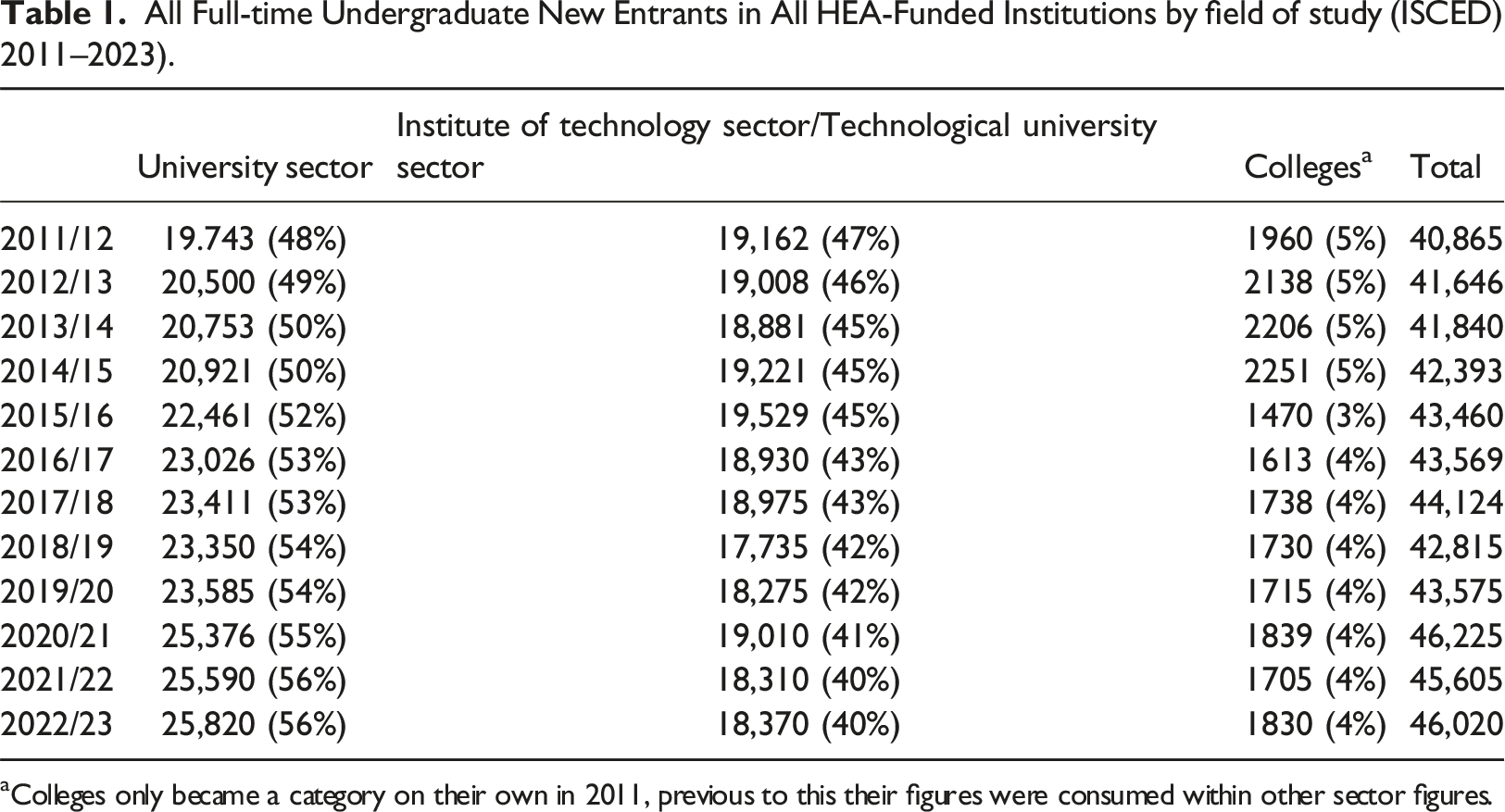
aColleges only became a category on their own in 2011, previous to this their figures were consumed within other sector figures.
Such high participation rates present a positive picture of Ireland’s higher education landscape and its widening access and participation agenda, where the level of tertiary educational attainment among 25–64 year olds is one of the highest among OECD and partner countries (53.7 %, rank 3/44) (OECD, 2022). Regarding school leavers progressing to higher education, the results are equally positive, whereby Ireland has the highest proportion of young people in Europe progressing to higher education, with approximately 74% of all school leavers engaging in higher education learning (Donnelly, 2022).
Notwithstanding the positivity for the population and society that such high participation rates bring, the types and portfolios of programmes provided in both higher education institute types of traditional universities and Institutes of Technology/Technological Universities have remained essentially unchanged since the introduction of the Regional Technical Colleges. This calls into question whether, while universalism in education appears to have been achieved, has equity in access to types of education occured councurrently (Graham, 2007). Specifically, do students within what is considered a universal higher education system have real and meaningful choice when they are at the stage of decision-making around the progression to, and selection of, higher education programmes of study to support their future aspirations?
This will be explored in the following sections.
Research design
This study uses HEA table data sets collected for ‘another purpose’ as its primary data source (Sobal, 1981: 480), allowing researchers to use data collected by others to explore new problems, to address different questions (Wickham, 2019). This secondary analysis of data research design, while an under-used research technique in many fields, has been used in education and social sciences research and is considered valuable to our understanding of both fields (Sales et al., 2006; Smith, 2008).
Specifically, this study’s secondary data used for analysis is published HEA International Standard Classification of Education (ISCED) census data, gathered from the Student Record System data. This administrative data collects the same information from all higher education providers. Data collected includes information on the student profile, their academic progression and completion, what higher education provider they attend, and registered student numbers across all ISCED disciplines. Higher education providers collect this data bi-annually and are required to furnish this to the HEA. As government collected data, it is a complete and comprehensive data set with a total response rate from all higher education providers, with no issues of missing or incomplete data. Where anomalies are identified, education providers are requested to review and re-submit amended data. This makes the data sample a highly representative and valid sample. As this data is derived from administrative and public records rather than for research purposes, it is assumed to be ‘free of the bias of reactivity’ (Sales et al., 2006: 547).
ISCED data sets were reviewed and considered for their inclusion within the study through the lens of whether it could provide ‘appropriate depth’ and ‘pertinent detail’ (Hinds et al., 1997), ‘that is suitable and sufficient’ (Charmaz, 2006: 18) to answer the research question, with the overarching question, does it fit the needs of the study (Smith, 2008). Within this context, specific table data sets considered pertinent and of sufficient detail to meet the requirements of the study included datasets which provided relevant information on full-time undergraduate student discipline and field enrolment numbers across the higher education sector within Ireland, telling us something that we did not ask of it before (Smith, 2008).
Process of secondary data analysis
Reviewed data sets explored what disciplines are provided within the traditional university sector and Institutes of Technology/Technological Universities, the numbers of students who attend specific fields of learning within higher education institutes, with consideration and interpretations of what this means for the education structure and, ultimately, student choice and opportunity.
The presented data sets and their secondary data analysis will be discussed relevant to the tables’ content (Durbin, 2004), generating novel interpretations and conclusions (Hewson, 2006: 274) within the frame of the overall research question.
To avoid subjective interpretation of secondary data, data sets were considered using an explanatory data analysis framework (Knaflic, 2015: 19–20). This analysis sought to highlight specific features of the data that may be of interest or relevant to the reader, including the story built over time (Knaflic, 2015: 27).
Findings and discussion
Following a review of available table data sets, several things emerged. Specifically, while the student progression and participation figures within higher education institutes in Ireland are impressive, a review of the ISCED data indicates that, for the most part, traditional universities focus their undergraduate programme portfolio within traditional to them fields of study, with the Institutes of Technology/Technological Universities equally not having significantly diversified their programme portfolio beyond their initial 1967 scope and remit.
Fields of education provided by the traditional university sector include but are not limited to, Humanities, Arts, Medicine, Law, and Teaching. For example, a Bachelor of Arts was the only award provided at Trinity College Dublin from 1592 to the mid-1800s. Trinity College’s Medical School and the Royal College of Physicians, whose establishment was in an effort to regulate the practice of medicine in Ireland, began professional medical training during the 17th century. Both schools taught only medicine. The Royal College of Surgeons, whose focus was on regulating and the training of surgeons, began its journey in 1765, whilst Law as a discipline developed outside the university sector and remained a ‘Cinderella subject’, that is, left outside the higher education university space, until well into the 20th century (White, 2001: 7–10).
These traditional higher education disciplines and award types are considered elite subject fields, most often associated with social class inherited merit and status awards (HEA, 2019; Lynch, 2015; Lynch and Baker, 2005; Sullivan et al., 2018). Comparatively, the Institutes of Technology/Technological University sector, whilst providing hugely valued and valuable awards of the same academic award level as their traditional university counterparts, do so in many fields that are considered less elite and have less educational, economic, social, cultural, and symbolic capital for the future graduate (Bobek and Wickham, 2015; Richardson, 2008; Whelan et al., 2004). These disciplines, that is, tourism, catering, and general agriculture, were part of the scope of the original education provision suggested in the 1967 Steering Committee Education Report (19–20) and remain core programmes within the Institute of Technology/Technological University sector today.
While higher education programme type and provision segregation exist within Ireland`s two-tier system, so does a socially polarised, stratified higher education system (Gallacher, 2006; James, 2007: 3; Power, 2010; Marginson, 2016; Sullivan et al., 2018; Ryan, 2019; Hayes, 2022), where access to higher education is not distributed equitably across different groups (HEA 2015: 14). This is similar to its past form, where inequalities are reproduced rather than eliminated (Carpentier, 2018: 10; Houses of the Oireachtas, 2019). This will be explored in more detail below.
Traditional elite programmes
Arts and humanities
Examples of full-time arts and humanities undergraduate new entrants in HEA-funded institutions by field of study (ISCED) at 1 March 2023 (Traditional Elitist Programmes) Location of Delivery.
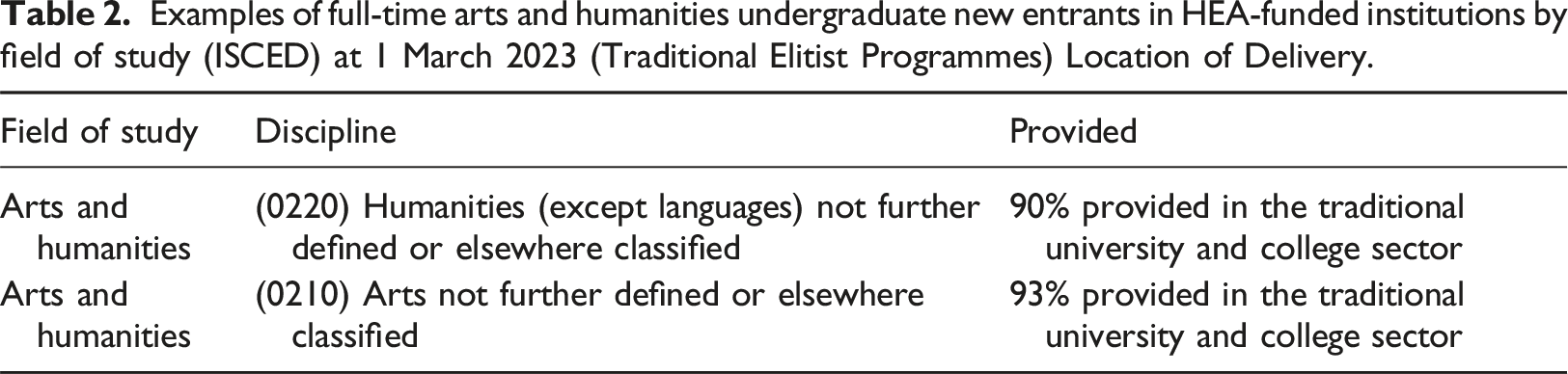
Examining this further within the Quality and Qualifications Ireland (QQI) Qualifax 13 tool, Humanities are not included as a course category. However, Arts 14 awards are identified in an Arts/Social Science/Community category. 15 On review of Qualifax information, there are thirty-eight Arts/Social Science/Community programme offerings in the Institute of Technology/Technological University sector. Comparatively, there are 244 level 8 honours degree programmes delivered in the traditional university sector in the Arts/Social Science/Community category. Within this categorisation, ninety-five are titled Arts awards and are delivered by the traditional university sector; two are titled Arts awards delivered by the Institute of Technology/Technological University sector. These include awards in Dundalk Institute of Technology and South East Technological University (SETU) – Waterford Campus.
Whilst fluctuations in student interest in the arts and humanities fields vary, the Arts subjects remain a popular programme choice for students applying for and progressing to higher education within Ireland and further afield (Donnelly, 2018; HEA, 2024; Mooney, 2018). This attraction is related to the generic nature of the awards, delivered in traditional universities, for student’s undecided on what future path they may wish to follow (Cradden, 2016) and because an Arts award has traditionally been considered an elitist award (Bothwell, 2017; Ferrell, 2019; Starkey, 2013; Telling 2020).
More recently, there has been an increase in available places on traditional university Arts programmes, which has allowed for a reduction in university entry points. For example, in 2023 280 CAO 16 points would allow students to enter an Arts programme of learning in a traditional university. The knock-on effect of a decrease in entry points is that this type of award in a traditional university is now accessible to a more expanded cohort of students. This is considered a positive move forward in terms of supporting student choice.
However, difficulty can and does arise if an individual possessing the required university entry points wishes to undertake an award but cannot or does not wish to relocate to where these programmes are provided. In this instance, that individual’s opportunities are limited and may be unattainable. Therefore, while choice is available to more significant numbers, it is only available to some suitably located aspiring students.
Pressure on the traditional university sector to meet an increasing stakeholder demand and aspiration is not without problems. Issues of space, overcrowding, and higher non-completion rates have all been recorded by those endeavouring to meet the needs of an expanding student cohort (O’Brien, 2016b). This is a complex and multifactorial issue, but noteworthy, nonetheless.
Medicine, teaching, and allied health professions
Examples of full-time undergraduate new entrants in HEA-funded institutions by field of study (ISCED) at 1 March 2023 (Traditional elitist prestigious programmes – location of delivery).
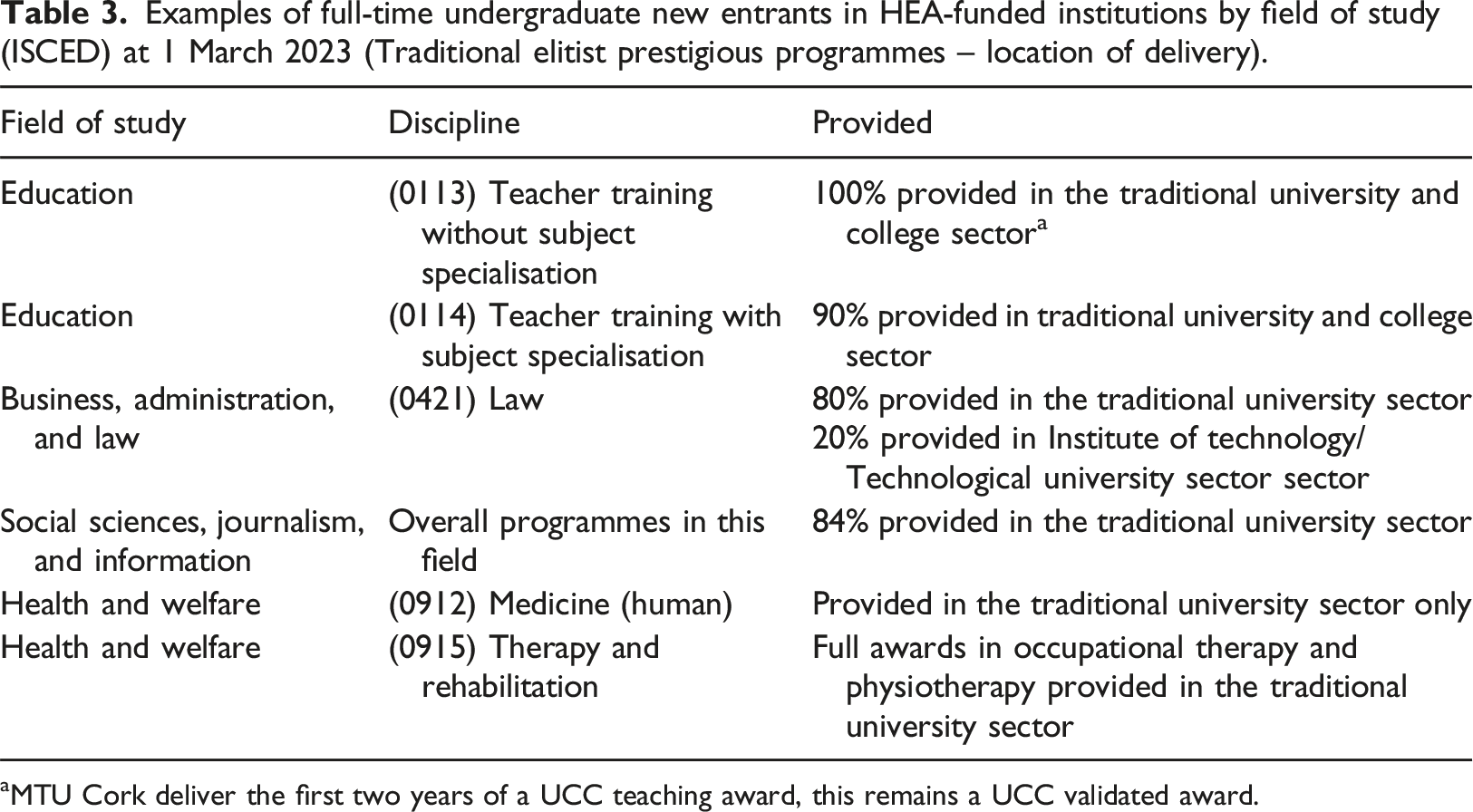
aMTU Cork deliver the first two years of a UCC teaching award, this remains a UCC validated award.
Annually these programmes appear as popular choices for students. However, due to a lack of available programmes across Ireland`s higher education landscape and limitations and caps on places on some programmes, supply and demand issues emerge. This results in entry points increasing/or remaining static at the very top of the entry points system.
There has been much evidence of the impact and influence of a positive social, cultural, and economic capital on a student’s educational journey, inclusive of the acquisition of higher points and decision-making regarding higher education institutes and (elite) programme selection (e.g. Ball, 2016; Bourdieu, 1986; HEA, 2008, 2019; Lynch and Baker, 2005; Reay et al., 2009; Sinclair et al., 2010; O’Brien, 2016a). This has been reaffirmed in the Higher Education Authority a Spatial & Socio-Economic Profile of Higher Education Institutions in Ireland (2019) report, which highlights that students from affluent areas enter higher education institutes with higher points on average, mainly accounting for the socioeconomic profile of high-points courses (HEA, 2013, 2019). Clancy (2015) agrees, concluding that ‘middle-class groups are more strongly represented in the (traditional) universities than the IoTs (Institutes of Technology), and within universities, they are especially strongly represented in the most prestigious professional faculties such as medicine and law’ (Clancy, 2015: 17). The HEA (2019: 46) breaks this down further, concluding that, ‘The ratio in the medical field of study is 1 student from a disadvantaged area for every 10 students from affluent areas, the lowest ratio for any detailed field of study’.
The impact for those who do not have these conditions (Lynch and Moran, 2006) to support higher education point acquisition over their life is explained by McGuire et al. (2017), who concluded that ‘Young people from disadvantaged backgrounds are denied the same opportunities as their wealthier peers, whilst parents with money can afford a better education for their children despite Ireland’s so-called free education system’.
This maintenance of advantage, while similarly supporting higher education structure and system elitism, is problematic. Whether it is one’s ability to afford additional outside-school tuition (shadow education), 17 to the possession of social, cultural, and economic capital to understand the education system and how it works, which can assist in decision-making around school and higher education selection, to having advantageous relationships and networks to support plans and aspirations (e.g. Bourdieu, 1986; Ball and Vincent, 1998; Lynch, 2015; Watson et al., 2016; Watson et al., 2017; Duta and Iannellli, 2018; HEA 2018: 21; Lynch and Crean, 2018; Skerritt, 2019; McCoy and Byrne, 2022) is reproduced within the current higher education system configuration.
Equally, undermatching is a real issue for some students from lower socioeconomic groups who have the required CAO points to progress to higher entry point programmes but undermatch, 18 choosing programmes of study with lower points on average than they achieved (Delaney and Devereux, 2020; HEA, 2021). The reasons for this undermatching are not fully understood, but it is reasonable to assume it may be related to one’s social, cultural, and economic capital, and/or geographical location, making the selection and undertaking of more elitist programmes a less realistic option for students (Cullinan and Duggan, 2016; Royal Irish Academy, 2021a).
The stratification of grades, socioeconomic status, and resulting representation of a profile of students on more elitist higher education programmes of study is well documented nationally and internationally (Bourdieu et al., 1994; Friend, 2018; Karagiannaki, 2017; Martin, 2010; Zhang and Yijie Wang, 2021). The resulting impact in the context of student choice on where and what to study is the reality that the average student who achieves between 400-419 CAO 19 points, of average background, will not be able to access more elite degrees within Irelands two-tier higher education structure (Holmquist, 2003; Lynch and Moran, 2006; Houghton, 2020; CAO, 2022). It would therefore appear that a hierarchy of programmes has emerged within the system, where specific programmes, due to (less) supply and (more) demand and associated high points to accommodate for this, lead to socially restricted programme spaces, most often only accessible to those from a selective group in society, that is, those who have the required capitals and/or reside in the right area, making this unattainable or possible for the average student (Hazelkorn, 2014).
The benefits of studying Medicine, Education, and Allied Health professions continue well beyond graduation, whereby these professions are known to have significant symbolic, social, economic, and cultural capital within the community, in the wider society nationally and internationally (Social Mobility and Child Poverty Commission, 2014), thus adding to, and perpetuating, social class reproduction and elitism.
While this is not new, it is disappointing that this situation remains when student participation in higher education is increasing.
Remaining traditional
Examples of full-time undergraduate new entrants in All HEA-funded institutions by field of study (ISCED) at 1 March 2023 (Institute of Technology/Technological NS university traditional non-elitist programmes) location of delivery.
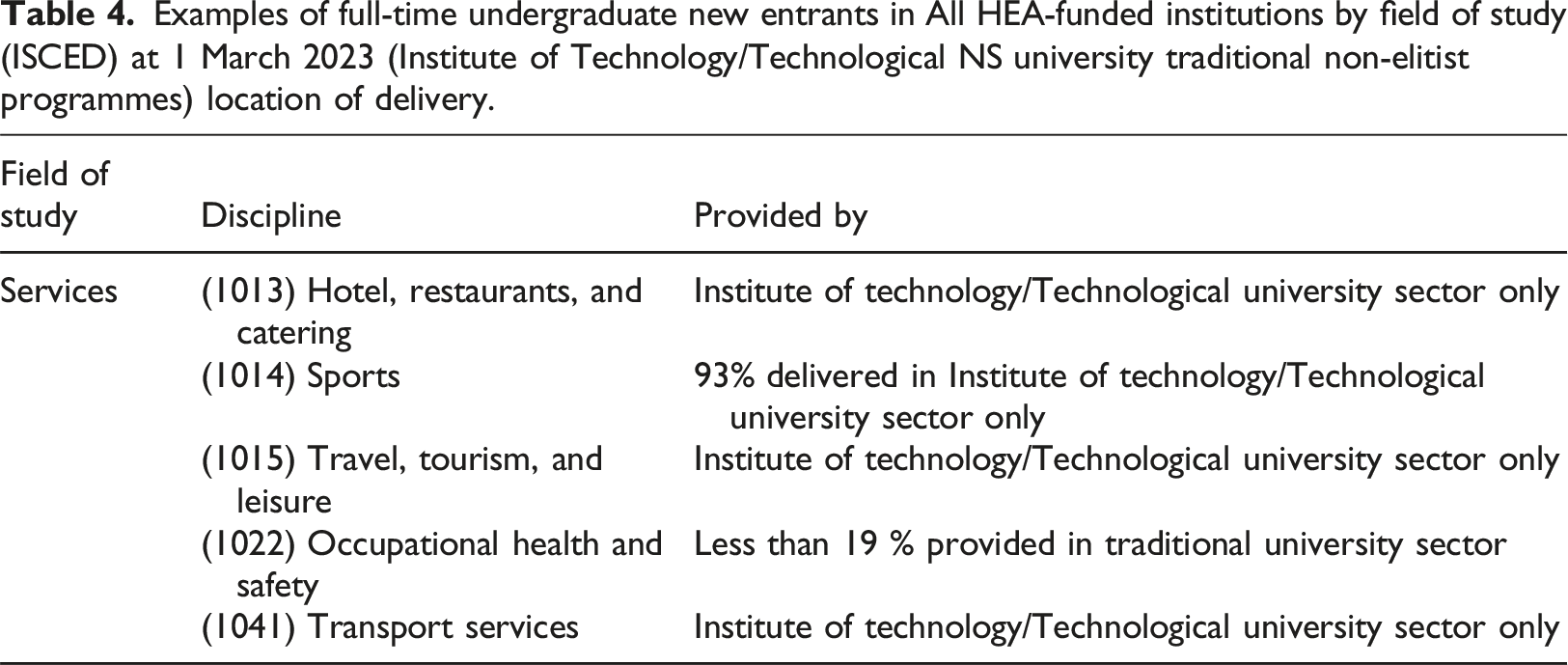
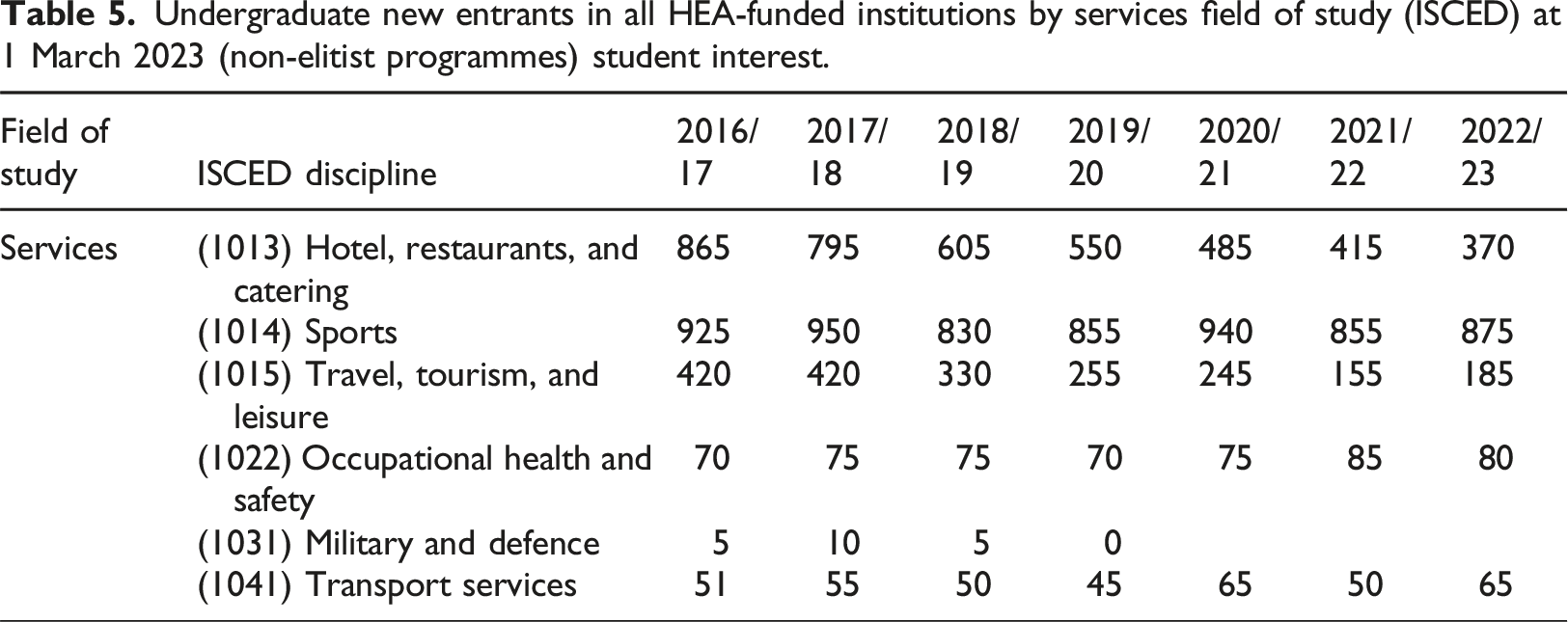
Undergraduate new entrants in all HEA-funded institutions by services field of study (ISCED) at 1 March 2023 (non-elitist programmes) student interest.
The OECD sums up the challenges to the agriculture sector as follows, In Ireland, the agriculture and food sector are facing a major challenge to attract
The same resonates with the narrative that exists within the Tourism, Catering, and Sport sectors, where despite higher education programme capacity and many career opportunities, these are only pathways attractive to some (Bobek and Wickham, 2015; Central Statistics Office (CSO), 2016; Britton, 2017; OECD, 2023b).
There may be a misconception that because these fields of study have less student interest than other programmes, the student entry-level points would be lower; this is different from the reality. A review of points indicates that while there were students with lower CAO points, the median of points for the Level 8 Tourism programmes was, in fact, more than 315 points (HEA, 2018).
Positively, there has been a slight increase in the number of students choosing to study higher education awards in Agriculture. Unfortunately, other, such as catering, have shrunk to almost extinction within higher education.
What does this mean or matter? Past to future
The idea of the need for regionally focused programmes of study, which had no artificial limitations, was alluded to within the Steering Committee on Technical Education Report to the Minister for Education on Regional Technical Colleges (1967, 25) as follows: ‘Though we are conscious of the advantages which could result from the concentration of courses in fewer centres, we feel that a well-distributed regional educational structure is economically and socially desirable’.
This was again revisited in the early 2000s, where it was noted by the Council of Directors of the Institutes of Technology that future government policy on higher education should underpin ‘the objectives of achieving balanced regional development through maintaining and enhancing the potential of Institutes of Technology to be important hubs and gateways of knowledge and, thus, engines of new economic activity within the communities they serve’ (The Council of Directors, 2003: 62).
What has occurred is universal higher education in participation but not in access or equity in opportunity to an institute type or a specific programme (Graham, 2007); this has remained the privilege of a smaller number. In real terms, the impact of this for some students is inequities/geographic inequities to and within higher education institutes and programmes of study, which can, and do, impact life opportunities (Bathmaker and Thomas, 2009; Cullinan et al., 2013; Frenette, 2006; Hayes, 2022; HEA, 2015; Power, 2010).
Where Institutes of Technology/Technological Universities have moved into more elite programmes spaces, providing programmes of learning more often found in the traditional university sector, it has been well received. For example, in 2018, the Institute of Technology Sligo, now Atlantic Technological University Sligo, introduced two subject Degrees, more commonly found in the traditional university sector, and a Master’s award in Social Work, the only Social Work programme outside the traditional university sector; Waterford Institute of Technology/South East Technological University has, for many years, delivered programmes in the field of psychology; Dundalk Institute of Technology delivers a Bachelor of Arts (Honours) in traditional humanities arts education subjects of History, English, Archaeology, Politics, and Society. The path to developing these programmes into traditional university spaces by the Institutes of Technology/Technological Universities is not without its challenges, but it is something well-received by its student cohort and regional employers (McTaggart, 2019).
A universal system with structural restrictions and barriers because of where you live, your economic capital, your life to date, is not something anyone would advocate for. A change in how we conceptualise entry into, and provision off, higher education in Ireland may be of value. Indeed, there may be value in a unitary system.
The introduction of technological universities within Ireland`s higher education and university landscape may help us move towards a unitary system. It is too early to say if their introduction supports a more accessible and equitable higher education system, particularly as rhetoric exists that the new university should ensure an ‘ethos that is aligned and consistent with the current mission and focus of institutes of technology’ (HEA nd). This narrative has the potential to encourage a status quo.
However, the Technological University Act 2018, which is the blueprint for the new universities, encourages ambition in line with and beyond the 1967 Steering Committee Report, stating that ‘The functions of a technological university, having particular regard to the needs of the region in which the campuses of the technological university are located…. (b) provide programmes of education and training that reflect the needs of individuals, business, enterprise, the professions, the community, local interests, and other stakeholders in the region in which the campuses of the technological university are located and facilitate learning by flexible means`.
It is evident that change is essential for achieving present and future ambitions in the higher education system. Without change, the higher education system will continue to support segregation and remain a socially polarised system, which disadvantages students, their families, and the community and region they belong to, preventing the system from living up to its potential as suggested by the legislation. Diversity in the mix of degree and research programmes and in disciplinary specialisms in higher education institutes is to be encouraged (Royal Irish Academy, 2021b: 8), but not where it facilities and perpetuates a socially polarised higher education system.
Positively, and significantly, the HEA are considering Technological Universities on their merit and offering them an opportunity to apply to deliver programmes of study in traditional and elitist fields of education such as pharmacy and veterinary. A region, students, and society can only benefit from such changes. However, these changes are part of national conversations, political lobbying, and extended decison-making. For example, vets lobbying for a second Irish veterinary school have endorsed the University of Limerick (UL) as the venue (Riegel, 2023) despite applications and an evidence-based need for these programmes in South East Technology University (SETU), Munster Technology University (MTU), and the Atlantic Technological University (ATU). This behaviour is reminiscent of what occurred during the writing and publication of the 1967 Steering Committee Report. The outcome of these deliberations, watched with much interest, will suggest a future configuration of the Irelands higher education landscape.
Conclusion
In 1967, the Steering Committee’s ambition that this college type (Regional Technical Colleges) should not be deterred by, or restricted by, the scope of their educational achievements has had challenges. Institutes of Technology/Technological Universities have become more proficient in doing what they do; however, fifty years on, they continue to provide programmes in the same fields of study and disciplines; they have struggled to widen their remit to provide access to certain types of programmes, and because of this, certain opportunities are not available to regionally located students. In tandem, demand and supply issues are evident for certain types of programmes and certain types of institutes, which are more favourable and attainable for those from higher socioeconomic groups and/or those living in certain geographical locations.
Inequity in a universal system is evident, as counteracting tendencies regarding where and what programmes are provided, in tandem with changing student aspirations, lead to a more highly stratified system, thus compounding an already complex structure. This is a structure struggling to ‘fit’ today’s purpose. If the dispersion of programmes were more widely available, and Ireland’s two-tier higher education system did not lend itself towards perceived hierarchies, prestige, and elitism, it would be less of an issue; until that occurs, this problem will likely continue. Choice matters when one does not have it or if it is limited; education inequity runs in tandem with this.
Footnotes
Acknowledgements
The author would like to acknowledge the work of the Statistics Unit, Higher Education Authority, whose exellent work and publications formed the basis of this paper.
Declaration of conflicting interests
The author(s) declared no potential conflicts of interest with respect to the research, authorship, and/or publication of this article.
Funding
The author(s) received no financial support for the research, authorship, and/or publication of this article.
