



Abstract
This piece demonstrates a creative practice that invites educators from diverse backgrounds to consider the memories, stories, and cultural histories alive within them. How we carry and know our own stories influences how we can critically and reflexively enact or challenge policies of cultural responsivity in education. Given that the political landscapes in education get remade over and over, the threads of our personal histories remain vital to remember, so they, too, do not move into the realm of forgetting. To connect, in an ongoing way, to our unique heritages and stories is to challenge current policy proposals that intend to privatise historical and cultural education, risking fragmentation and dissociation. This piece uses a diffractive storytelling approach through critical autoethnography to consider how material artefacts are imbued with histories and stories. This article traces my memories as a Pākehā (immigrant of European origin) educator in Aotearoa, New Zealand, from Scotland, through the artefact of a tartan quilt. I demonstrate how educators may use creative practices to remember and trace the threads of their stories through their material artefacts, elucidating the lenses from which they teach so they may equip students with the tools to navigate political influences within their own stories.
Introduction: Where policies and stories entangle
In the wake of the 2023 general elections in Aotearoa, New Zealand, and the shift in party policies on education, this piece asks educators to consider their own stories and cultural histories to elucidate what they carry within them into classroom settings. This is particularly pertinent as the proposed party policies aim to repeal the new curriculum for schools, which includes matauranga Māori and New Zealand history, in favour of a curriculum created by the private sector (Mathias, 2023). This has natural flow-on effects for education at the tertiary level. The changing political climate in education in Aotearoa, New Zealand, asks us, as responsive and reflective educators, to consider how histories and stories matter to educational settings, which, in turn, asks us to consider how histories as stories matter to us as educators.
Before November 2023, Aotearoa, New Zealand, was led by the left-leaning Labour Party for two terms (6 years) in government under the youngest female prime minister this country has seen. After that point, the right-leaning National Party was voted in. Aotearoa, New Zealand, has an MMP electoral system designed to avoid single-party rule. Thus, the new government is in a three-way coalition (National, ACT, NZ First) between parties that have historically favoured the privileged in this country. Two of the three coalition parties had militant-sounding campaign slogans about ‘taking back’ the country and putting it ‘back on track’, and so there was a predictable sense that this government would desire to return to policies of the past. Amongst other things, the new government has indicated that the use of te reo Māori in government agency names will be reduced; the principles of Te Tiriti o Waitangi (the Treaty of Waitangi) will come under review as well as a possible referendum on the whole Treaty; there are discussions about whether Aotearoa will withdraw from the United Nations Declaration on the Rights of Indigenous People; and questions are being asked about whether a bill should introduce English as an ‘official’ language of this country.
In the educational context, the previous Labour government supported and championed the creation of the new Aotearoa New Zealand Histories curriculum, which was required to be taught in schools from the beginning of 2023. The curriculum was designed to make and guard space for a multiplicity of viewpoints and complex experiences with and through the histories of our land and people. Given the trajectory, I have just outlined above – where the current government’s priorities seem to be on something other than protecting or upholding indigenous voices or experiences – the space within the Aotearoa New Zealand’s Histories curriculum might be filled with other priorities if changed or repealed.
This article sits outside the governmental space I have just introduced and the Aotearoa New Zealand’s Histories curriculum. However, providing you with those contexts will hopefully illustrate what may flow culturally, educationally, and socially into the tertiary sector (through the students who enter tertiary spaces, what they have been taught/not taught, and the political milieu they have been steeped in) if the current government succeeds in their plight. Arndt and Tesar (2019) introduced me to Kristeva’s (2002) idea of ‘tiny revolts’, which I will return to later. However, I intend to leave it here as a punctuation as to why these kinds of conversations are important and what we can do, as educators, to consider the entanglements of our roles and the place of our histories and stories in these wider narratives and political landscapes. I am suggesting that we have a responsibility to foster closer connections to our own stories, memories, and histories so that we can support our students to do the same with theirs. Haraway (2016b) reminds me that it deeply matters ‘what stories tell stories’.
In this work, I demonstrate a creative practice that invites educators from unique backgrounds to consider the stories and cultural histories alive within us. How we carry and know these stories influences how we can critically and reflexively enact or challenge policies of cultural responsivity in education. This piece tracks an assemblage of critical autoethnographic stories woven with theory about time, place, and memory. Critical autoethnography asks that we examine our lives and consider how and why we think, act, and feel as we do. It means starting with lived experience, investigating the ‘culture of self’, and our multiple identities to critique broader cultural beliefs and experiences (Gray, 2011; Leavy, 2009; Ricci, 2003). Autoethnography privileges subjectivity, challenging traditional scholarship norms that silence life’s complexity (Ellis, 2013; Leavy, 2013). The ‘critical’ is also about using theory alongside story to weave a reciprocal, engaged narrative that links abstract and concrete through a ‘living body of thought’ (Holman Jones, 2016). The stories I explore demonstrate how memory supports me, as an educator, in considering my cultural heritage and how I enact this. Considering time and history has become important to me in my practice. It helps me to make sense of, in a non-linear way, how experiences continue to live in our bodies, minds, memories, and words; how they live in the spaces in between you and me; and how past experiences continue to impact educational spaces, politics, pedagogies, power dynamics, and languaging. Stories have agency, and I am curious how we can trace how we came to this moment, this particular place, and how we live with it (Macfarlane and Donwood, 2018).
Situatedness: Education, History, and Artefacts
I am an educator within the School of Creative Arts Therapy at Whitecliffe College, where I contribute to training master-level students. As this is the sole programme for Creative Arts Therapy in Aotearoa, New Zealand, all faculty members have trained through this institution themselves at some point. Almost all faculty members within the School of Creative Arts Therapy are first-generation immigrants to this land from different European, Asian, and African countries. This invites questions about being in place, teaching from place, and being partners of te tiriti o Waitangi (the Treaty of Waitangi). It invites questions about the importance of knowing our histories as Pākehā educators, the descendants of colonial New Zealanders (Fitzpatrick, 2017), a call strongly echoed by Jones (2020). Contemporary Pākehā identity emerges between country/ies of origin and country of birth, always entangled with ideas of the Other (Fitzpatrick, 2017). As Pākehā educators, we embody and enact many cultural and historical stories. History does not refer merely, or even principally, to the past. On the contrary, Cohen (2022: 6) believes that ‘the great force of history comes from the fact that we carry it within us, are unconsciously controlled by it in many ways, and history is present in all that we do’. It is to history that we owe our frames of reference, our identities, and our aspirations. All bodies, both human and otherwise, leave tracks or traces where we live and walk, and history is the record of many trajectories of world-making (Macfarlane, 2012; Tsing, 2015). Ordinary people and their actions matter and shift worlds, and human life is coloured by our intra-relationships with the environments we find ourselves in (Clark, 2004; Van Dooren et al., 2016). How we walk, track, and trace through the world becomes our history, and stories of these histories are often imbued into the artifacts we make or collect along the way.
This writing explores how a material artefact, a tartan quilt, is used as a touchstone piece to explore my personal history, memories, and place/space relations. The process of working with the quilt developed into a method that informs how I invite other educators and therapists to think-with their spaces, memories, and histories too. We each carry threads of multiple identities, and each identity has a lineage, history, and materiality about them, expressed in different but often entangled ways. I am curious about what artefacts exist for other educators or therapists and how they may think-through their artefacts and consider how they enact their cultural histories. Like a quilt, all parts of the self are present, meaningful, and active; there is always something worth finding (Wall Kimmerer, 2003).
The Mattering of My Culture
I am a first-generation Pākehā immigrant from Scotland. I often think about Scotland, particularly when I am stitching. My experience as a human on this earth is connected to the glens (valleys), lochs (lakes), and Munro’s (mountains), and part of them live inside of me, in absentia, while I live on the other side of the world (Macfarlane, 2012). I am curious about how these landscapes, and my knowings of these landscapes, may not be my memories at all, but an ingrained sense of touch, sight, taste, and sound passed through my genes from those who knew those landscapes more intimately than I do. I notice how sensing these knowings sends ripples into my world and informs the subtleties and obviousness of who I was, who I am now, and who I am becoming.
I am drawn to art forms of weaving and stitching, I am drawn to wilderness places, and I am drawn to music that reverberates in my chest cavity. I feel at home when I hear my parents' accents in unexpected others, and I am saddened that I do not possess the same lilt, though I can expertly mimic it. I am drawn to the colours of that landscape and furnish my home and body with them. The adaptation of living with that landscape is reflected in my fair complexion, work ethic, and gravitation to craft. Moreover, I know, too, that I am voyaging into versions of that landscape and culture that do not always exist in the modernised, industrialised, digitalised world.
Entanglements of Theory and Method
In this work, I am informed by post-human, new materialist theorists (Barad, 2017; Bennett, 2010; Haraway, 2016b) and environmental and ecological writers (Macfarlane, 2012; Morton, 2018; Tsing, 2015), who move me to think-with places and the stories that entangle them. Stories are agentic as they meet us in our present, from the past, and can be traced through how we think about the future (Barad, 2014). I am theorising an approach to working with threads of memory and personal historical stories in a material, creative, and ecological way. It is a recognition that ‘matter becomes’ rather than ‘matter is’ (Coole and Frost, 2010), in the sense that these memories have emerged through my engagement with matter, the tartan quilt. The artefact of the quilt has helped me critically consider how assemblages of stories continue to live in my body and inform how I am as an educator and therapist. The emerging stories are entangled with landscapes I have lived in or visited. This invites me to consider how environments shape our identities as much as anything else. I take inspiration from Patrick Kavanagh, who writes that ‘to know fully even one field or one land is a lifetime experience and in the world of poetic experiences it is the depth that counts, not width’ (quoted in Macfarlane, 2015: 63). Perhaps to be a Pākehā educator engaging in cultural identity work means taking the time to remember these places that made us.
In this writing, I take a diffractive approach. I place the artefact of a tartan quilt and the idea of agentic historical stories in the centre of my thinking and trace narratives that map from there through time and space. Diffraction, a concept from physics, points to the behaviour of waves when they encounter and intercept obstacles and each other. At the moment of contact, waves physically recalibrate each other, redirecting the other into a diffractive pattern in which both ‘subject’ and ‘object’ are absorbed and remade (Are, 2018). Drawing on the work of Haraway, Are (2018) notes that diffractive writing is a mode of enquiring where we ask how specific world-makings come to matter and to matter differently for given beings and objects. According to Haraway (1992: 300) Diffraction does not produce ‘the same’ displaced, as reflection and refraction do. Diffraction is a mapping of interference, not of replication, reflection, or reproduction. A diffraction pattern does not map where differences appear, but rather maps where the effects of difference appear (my emphasis).
When I consider the phrase ‘map where the effects of difference appear’, I am considering Barad’s key methodological question for their work: What methodology might there be for putting different insights into conversation with one another that does not contradict a relational ontology? (in Juelskjær et al., 2021: 120). Barad found the answer through Donna Haraway’s 1994 writing, which introduced her interest in diffraction. Diffraction thinks of differences outside the metaphysics of individualism, referring to contrasting pairs as ‘this’ and ‘that’ rather than a hierarchy of implicit comparison (Zhao and Murris, 2022). Methodologically, you can make any contrasting concepts converse with one other, and Barad suggests that you can gain ‘insights into how particular ways of framing things contribute to the very constitution of “this” and “that” as always already in relation to one another’ (in Juelskjær et al., 2021: 120). In Barad’s theory of agential realism, a contrasting pair is always already in relation to ontological givens, ‘all the way down’ at the macro and micro levels (Barad, 2007). My diffractive memories and reading/analysis of them were not through a lens of interpretivism or hierarchy, nor with the intent to codify the text but to map the interference of matter as a new form of memory-making. As a research practice, diffractive writing recognises that ways of knowing and understanding have profound consequences: they shape worlds (Van Dooren et al., 2016). Barad (2014: 181) explains: “There is no ‘I’ that exists outside of the diffraction pattern, observing it, telling its story. In an important sense, this story, in its ongoing (re)patterning, is (re)(con)figuring me. ‘I’ am neither outside nor inside; ‘I’ am of the diffraction pattern. Or rather, this ‘I’ that is not ‘me’ alone and never was, that is always already multiply dispersed.”
Diffraction is also understood here as thinking with Deleuze and Guattari’s (1987) idea about the ontological diversity of agency. This means the capacity to act and possess agency is redistributed from being a purely human-centric capability to one in the material networks of people, things, and narratives (Fullagar and Taylor, 2022). Human action always requires complex material interdependencies with the more-than-human. Woven, all the way through my stories, are narratives of other agential bodies. To ‘think with’ means to consider the more-than-human beings whose histories also meet us in our experiences. My stories are not sequential. They are intentionally written from different times and spaces. This problematises the linearity of time and highlights how memories appear and inform us, seemingly at random, by material stimuli. When we experience the phenomena of memory, we are experiencing our own lived reality and the realities of those who have come before. We are an assemblage of our memories and those inherited through our ecologies (Thomashow, 1995). Indeed, ecologists turn to the concept of assemblages to challenge the sometimes fixed and bounded connotations of ecological relationships (Tsing, 2015). For Deleuze and Guattari (1987), assemblage represents how bodies, political systems, and other material systems intermingle to create particular collections. Assemblages show our histories in the making. Writing towards diffraction can be about noticing where the writer and the artefact’s history intercept each other. It is an acknowledgment that both life forms are shaped and made possible through shared heritage (Are, 2018).
I draw theoretical and methodological inspiration from Arndt and Tesar’s (2019) work, where they conceptualise the idea of ‘dreaming/s narratives’. This is a post-qualitative methodological and philosophical lens through which researchers may engage with ‘voice’ or ‘story’. Their work considers a de- and re-entanglement of the human by blurring the lines between the relationships within which realities are formed, known and unknown. I consider this re-orientation in the context of my work by interrogating how realities and memories are constructed. Adams St Pierre (2014) states that methodological choices arise simultaneously with and from epistemology (our ways of thinking) and ontology (practices enabled by our ways of thinking). I position myself as thinking with place and matter (epistemology) and leaning into creative practices (ontology) to engage a diffractive research approach (methodology). My work’s epistemology and ontology become and grow with each, leaning out of research shapes that are otherwise ‘mechanised, instrumental, and reduced to methods, process, and technique’ (Adams St Pierre, 2014: 3).
Thinking-with a Tartan Quilt
In this section, I introduce you to the artefact of the tartan quilt and begin to consider how this material entity holds worlds and stories that matter for me as a Pākehā educator in Aotearoa, New Zealand (Figure 1). Tartan quilt, 2023.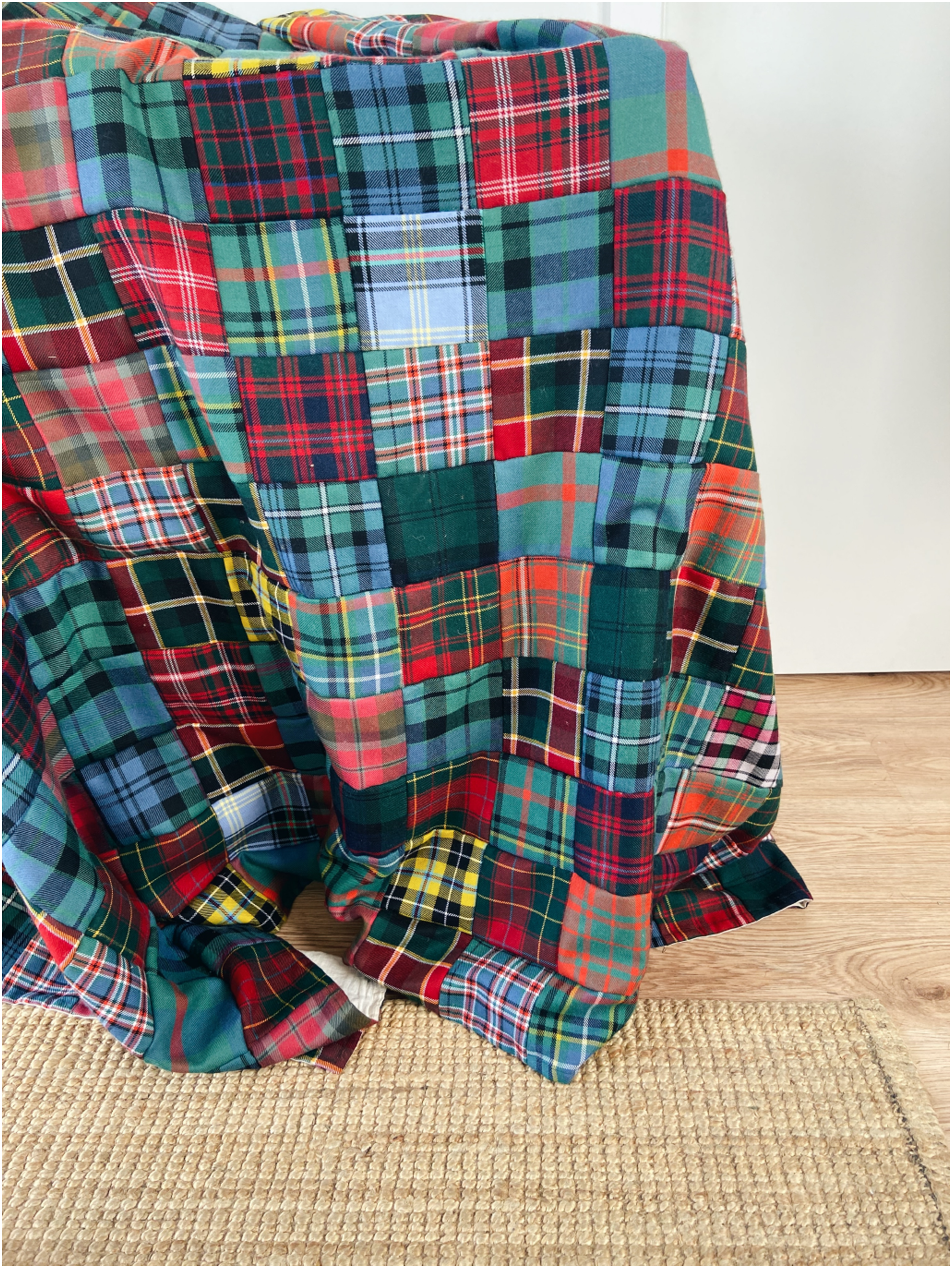
My parents immigrated back to Scotland last Easter. In their packing-up process, they uncovered a bag of tartan pieces they had collected from ‘Lochcarron’s of Scotland’, the world’s leading tartan manufacturer, at the Borders in Selkirk 2 years earlier. While my father was fitted for a new kilt, my mother collected fabric offcuts. She brought them back to Aotearoa, New Zealand, put them away, and forgot about their existence until they were unearthed and presented to me, a sewer, 2 years later. The pieces are woven wool of deep, rich colours representing about 20 clans. While my maiden name, Malone, is Irish, as my paternal grandfather was from a small town outside of Belfast, my mother’s side is Scottish. I inherit a lineage from her paternal Buchanan clan, who lived in the highlands of Scotland on the eastern shore of Loch Lomond, and her maternal MacKay clan, from the far north of the highlands.
Scottish tartans were created to map identities and demonstrate belonging and connection to your people and land through colour and pattern. The meaning of tartans has changed throughout history, and the designs have become more contemporary. However, one explanation is that red tartan was worn in battle, so blood would not show, green resembles the forest, blue symbolises lochs and rivers, and yellow resembles crops (Lindsay, 2023). My MacKay tartan is deep blue and green. This clan’s lands are enlivened in deep blues and greens. I feel the earth and water I have inherited woven into this tartan through my strong connection to the land of Scotland. However, as a Pākehā immigrant to Aotearoa, New Zealand, I also notice how strongly I feel connected to the landscape here, particularly the waters and forests. How do these colours, my inheritance, entangle me as I live 18,000 km away? I consider these questions in the light of new materialism, a philosophy that challenges the notion of linear time, recognising that the world is a knot in constant motion and there are no pre-constituted subjects and objects (Akomolafe, 2017; Haraway, 2016a).
I was curious about the arrival of the tartan at the time of my parent's departure and decided to stitch the wool into a quilt. Through the construction, I noticed how some tartan lines crossed divides and met the lines from other tartans. I considered this regarding ancestral stories and storylines, where they flow from one generation to the next, and where they stop and disappear. Though Barad (2014) reminds me that opposites, or endings, are already diffractively implicated in each other, and there is no absolute boundary between here and now, then and then, you and me. This concept is carried through Haraway (2016b: 97), who notes that ‘we relate, know, think, world, and tell stories through and with other stories, worlds, knowledge, thinkings, yearnings’. Mapping cultural storylines also involves mapping the ghosts that haunt our identity stories (Derrida, 1994). As a Pākehā immigrant, I am entangled with the colonial story (Abu El-Haj, 2005).
Wall Kimmerer (2020) invites us to consider how we may set aside the colonists' ways and become ‘naturalised’ to place, a term used for foreign-born people when they become citizens of a country. As a primarily immigrant nation in Aotearoa, New Zealand, we cannot, by definition, be indigenous. Indigenous is a birthright word. What happens when the very people most intent on building a home for themselves here are newcomers born of another soil (Clark, 2004)? As immigrants, and Pākehā immigrants more specifically, we can learn to live as if we are staying and enter the deep reciprocity that renews the natural world. Throwing off the mindset of the coloniser, being naturalised to a place means living in a way that acknowledges that this land feeds you. It also means acknowledging that our ‘bones and sacred places’ are in different lands, and we may be severed from these stories (Kiddle, 2020: 87). What signatures of our spaces will we leave in the strata? We cannot seal off the future or stop time from leaking out of things (Morton, 2018), though the Anthropocene does ask us, ‘Are we being good ancestors’? (Macfarlane, 2019). My understanding of belonging to a place continues to change along the way with the questions I learn to ask (Akomolafe, 2017) Figure 2. Tartan quilt 2, 2023.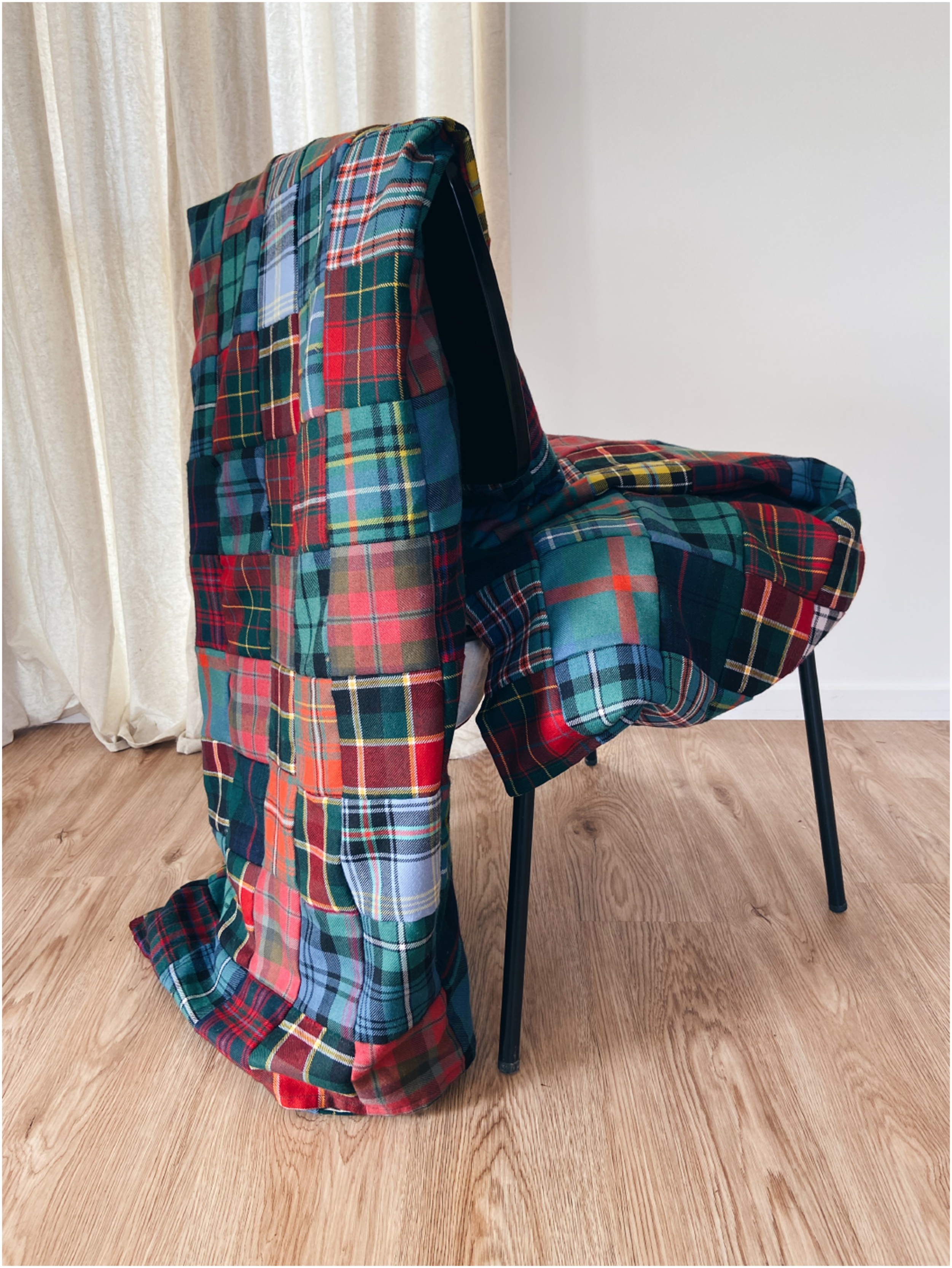
The Warp and Weft of Tartan
The tartan quilt is a material entity I have made and now cohabitate with. It is practical, warm, and beautiful, and like all artefacts, it holds multiple stories. It is, indeed, enchanted (Bennett, 2001). Diffractive memories and stories have emerged from my engagement with the tartan fabric. These memories have helped me consider how making artefacts and critically considering their material composition can be ways of getting to know who we are as Pākehā educators. The stories we carry inform how we are in the world and the lenses through which we see and act. When I tell the story of the tartan, I am telling a story that is a weaving of past and present, human and more-than-human, there and here, land and weather and imagined and lived histories. In the following section, I trace the lineage of the fibres and the process of making them into a quilt. I use the concepts of warp and weft, denoting the two essential weaving components to turn thread or yarn into fabric. Warp is the lengthwise threads that are held stationery and in tension on a loom, which the horizontal weft is drawn through and woven over and under the warp. I am using this imagery metaphorically to demonstrate how memories hold together, like a fabric, when they meet through an artefact. Warp: A shearing shed When we immigrated from Scotland, I spent the first part of my New Zealand childhood in rural Wairarapa. In a small town, the spring agricultural and pastoral shows were a highlight of the community calendar. My family were not farmers, but we went along for the festivities. I remember the sweet, sticky pink candy floss melting in my mouth and the toffee apple I begged for and then discarded quickly as it hurt my teeth. I remember the pungent, earthy smells, the sounds of laughter met with bleating, and people flowing through the paths of animals. I remember the clatter of metal pen gates opening and closing, the click of hooves on concrete pads, and megaphone loud voices announcing activities or winners. I rode a Ferris wheel with fairground music and felt the slick sunblock on my skin and the breeze on my bare legs for the first time in months. I went into a sheep shearing shed to watch the eager competitors speed-shear their flock. There was a high-pitched buzzing of the clippers in motion and a smell of lanolin as wool came free of the milky bodies, wriggling in anticipation of what would happen next - me and them. The hay bale I was sitting on was itchy on my exposed skin, and the high wooden rafters echoed with the sheep’s curious conversations. The farmers were solid, muscular, sure of their movements, embracing and then releasing their flock, one by one, from their winter coats. Small remnants of wool floated throughout the shearing shed, and they were warm and soft and smelled like the earth and soap. In this small rural community, the lives of humans and sheep were entangled in complex ways for reasons of economy, clothing, and food. For reasons of lineage, inheritance, and pride. We live in a symbiotic, or sympoietic as Haraway (2016b) puts it, relationship with all critters, and while humans sometimes tend to think we are autopoietic, self-producing autonomous units with self-defined spatial or temporal boundaries, we are indeed part of sympoiesis. Both biology and philosophy know this to be true: there are no independent organisms in environments.
Weft: The death of creatures
I remember pet day at my rural primary school. Back then, I did not have a pet and took a toy dog, while my school friends had calves, lambs, and chickens. At lunchtime, we paraded around the school field with our animals, cheering each other on, a cacophony of excitable shrieks from progeny with fur, feathers, and smooth skin (Figure 3). Pet day, 1999.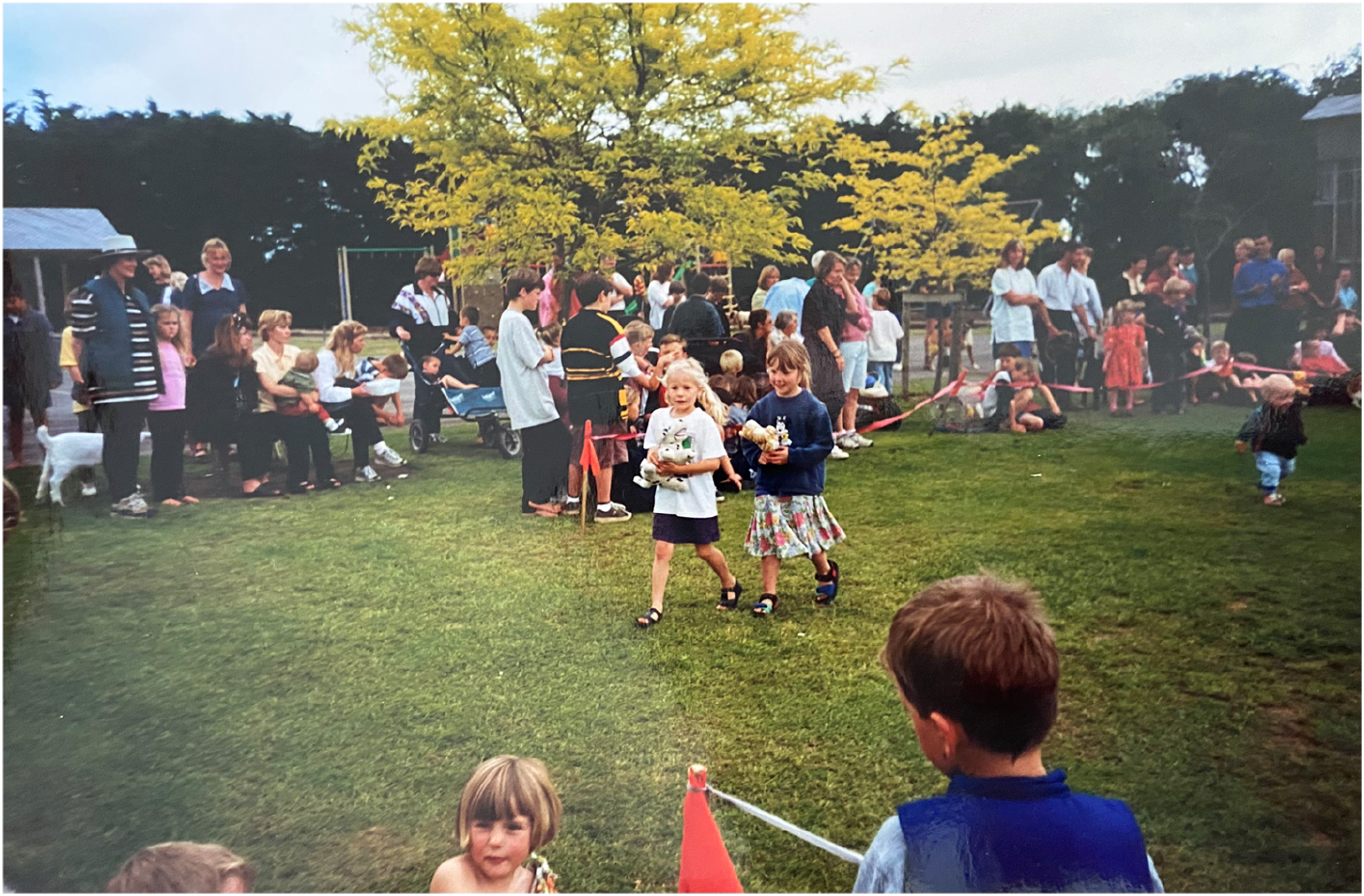
When I arrived home from school in the afternoons, my favourite place to be was with the kunekune pigs. The pigs lived in the apple orchard between my house and the neighbours, roaming a domain rich with juicy, rotting fruit. We fed them our compost, and I was fascinated and repelled by how they crunched eggshells and sloppy leftovers. In the afternoons, I would enter their terrain, climbing a tree when they approached me, watching their lumbering bodies from above. They smelled muddy and sweet, and if I felt brave, I would reach down to caress their thick, wiry coats. The neighbours purchased three piglets each spring to join the kunekune in their orchard territory. The piglets, much faster than the waddling kunekune, would, for a time, get to the compost first, squealing in pleasure at the feast we offered them. And then, just before Christmas, the piglets would disappear and reappear as ham beside the rosemary potatoes. Haraway (2016b) states that grief is a path to understanding entangled shared living and dying, and human beings must grieve-with because we are in and of this fabric of undoing.
The piglets arrived each spring at about the same time as the lambs. I watched the lambs being birthed, slimy, sticky, oozing bodies falling onto soft grass, nuzzled by expectant ewes. After school, I would visit them too. I sat cross-legged on the grass, holding them on my lap while their soft, warm, wriggling bodies suckled out of a rubber-teated milk bottle. Like the piglets, I watched them grow, disappear, and reappear beside the mint jelly on the Christmas dining table. Humans have all kinds of labels for animals: pets, pests, stock, grazers, beefies, meat, and money. Haraway (2016b) reminds us that these labels, paradigms, thoughts, dialogues, and stories matter and have potency. She reminds us that staying with the trouble of living and dying well on this earth requires us to make odd kin. We need each other in unexpected collaborations and combinations to become with each other or not at all (Haraway, 2016b: 4). Warp: A spinning wheel The first time I encountered a spinning wheel was through the movie of Sleeping Beauty as a child. I was enchanted when I saw one in real life, tucked into the corner of my nana’s house in Scotland. As a young child, I enjoyed the pedal’s rhythmic pumping and the pulsing motion moving through my whole body, rocking me. In turn, the rhythm pulled raw wool into long threads. The gentle whirr of the wooden mechanism delighted me, and I watched this machine take a piece of fleece and produce yarn for knitting or weaving. My mother-in-law now owns a spinning wheel, and when I see it, I imagine my childhood self pulsing the pedal in rhythm with the machine, the wool, and the craft.
Weft: Wool tangled on a fence
When I lived in Wellington, there was a track I used to enjoy walking that traced over hills where sheep lived. The fences were tangled with tufts of wool from the animals stretching their necks to reach the grass on the other side. I would feel the tangled wool, remembering the shearing shed, the spinning wheel, and the wriggling bodies suckling on rubber teats. Morton (2018) writes about the past-meeting-us-here aspect of history through the work of a nineteenth-century scholar of architecture, John Ruskin. Ruskin argued that the modern tendency to want to clean old buildings was a sacrilegious erasure of the stains of time. He invites us to consider how removing stains harms the actual thing because the thing is the temporal staining. To allow things to get dirty is to allow things not to be at war with time. I enjoyed seeing the ‘stains’ on the fencepost, the stories of the sheep's existence on the landscape, and a reminder that to cleanse things of the marks of animals is to label them as a malfunction in a world we desire to sanitise (Morton, 2018). Berry (2018: 19) states that ‘the principles of ecology, if we take them to heart, should keep us aware that our lives depend on other lives and upon processes and energies in an interlocking system that, though we can destroy it, we can neither fully understand nor fully control’.
We walk on landscapes shaped by time and footfalls and are moved and changed by them. We are not stationary creatures, and while Heidegger believes that how we humans are on the earth is Buan, dwelling, Ingold (2011) believes being human is embarking on movement, not staying still. Ingold describes how humans and non-humans make their way in the world through movement and how dwelling, contrary to this, carries an aura of snug, well-wrapped localism that seems out of tune with an emphasis on the primacy of movement. When we move, we inhabit and make with landscapes. Landscapes take on meanings and appearances with people, and people develop skills, knowledge, and identities with the landscapes in which they find themselves (Ingold, 2011). Landscapes are domains of entanglement (Figure 4). Warp: Pigments from the earth My mother-in-law dyes her hand-spun wool, experimenting with natural pigments from plants and vegetables. Boiling up a pot of dye, she submerges her skeins (a length of thread or yarn, loosely coiled and knotted) and lets them soak and absorb the colours. I have experimented with natural pigments for painting, enjoying the vibrant colours accessible in the natural world that can move and blend through a paintbrush over canvas. Natural pigments, 2018.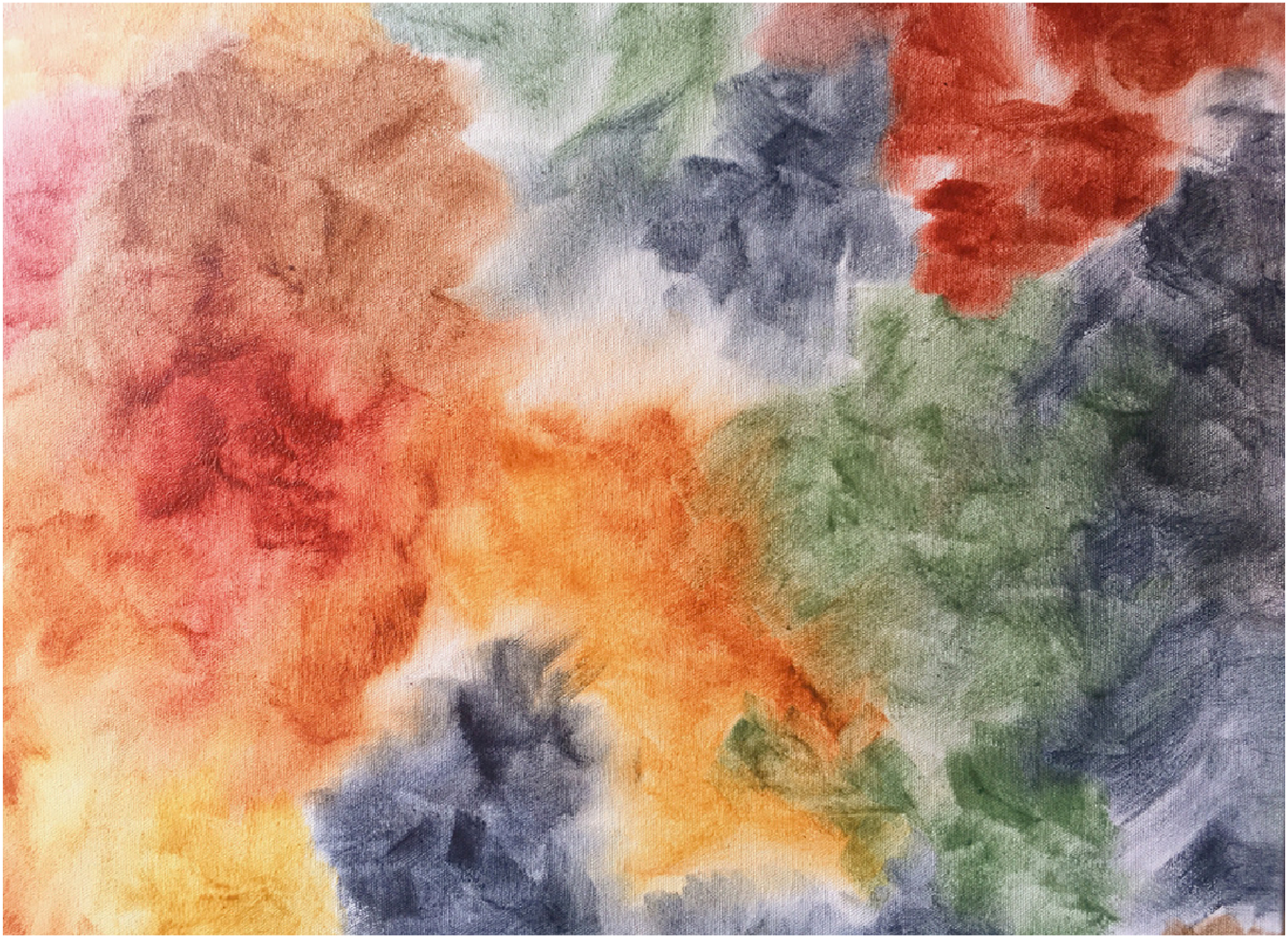
Weft: Landscapes where sheep live, and wool is needed
Four Decembers ago, I journeyed through the landscapes on the Isle of Skye, an inner Hebridean island on the west coast of Scotland. In this landscape, peat smoke still hangs in the air, distinct in its rich, dank, earthiness with tones of ocean, soil, grass, seaweed, pine, and rain. Burnt peat has been used to warm the homes of this landscape for centuries, and some still harvest it, cut from scars in the earth I walked upon. The peatlands, slowly being outlawed and revegetated, are sunken land stories worn down by centuries of toiling for warmth. Nowadays, they are mostly forgotten and unused, though I recognise these places as thin places. They are places where the veil between the physical and other realms is porous, where unexpected things can happen, and binaries of past and present, dead and alive, get slippery, amorphous, and undefined. Sometimes, bodies appear in peat bogs, perfectly preserved and immortalised as mummified ‘bog bodies’. When they are found, we encounter apparitions and a sense that the past is closer than we thought and that places and paths might carry memories of a person, just as a person might of a place (Macfarlane and Richards, 2014).
I smelled the burning peat that week before Christmas and saw the lone fairy lights adorning scatted cottages across the sparse landscape. Dotted on the hillsides of this landscape were the Isle’s sheep, laden in their thick winter coats. They were on the steep slopes of Storr and the Quairing, in the glens and dee-side meadows, at the edge of the Isle where the rock meets the sea, and on a tiny strip of grass that tracked down to a lighthouse that aids passing vessels. These sheep are forever immortalised as white pinpricks in a photograph above my couch (Figure 5). Isle of Skye, 2019.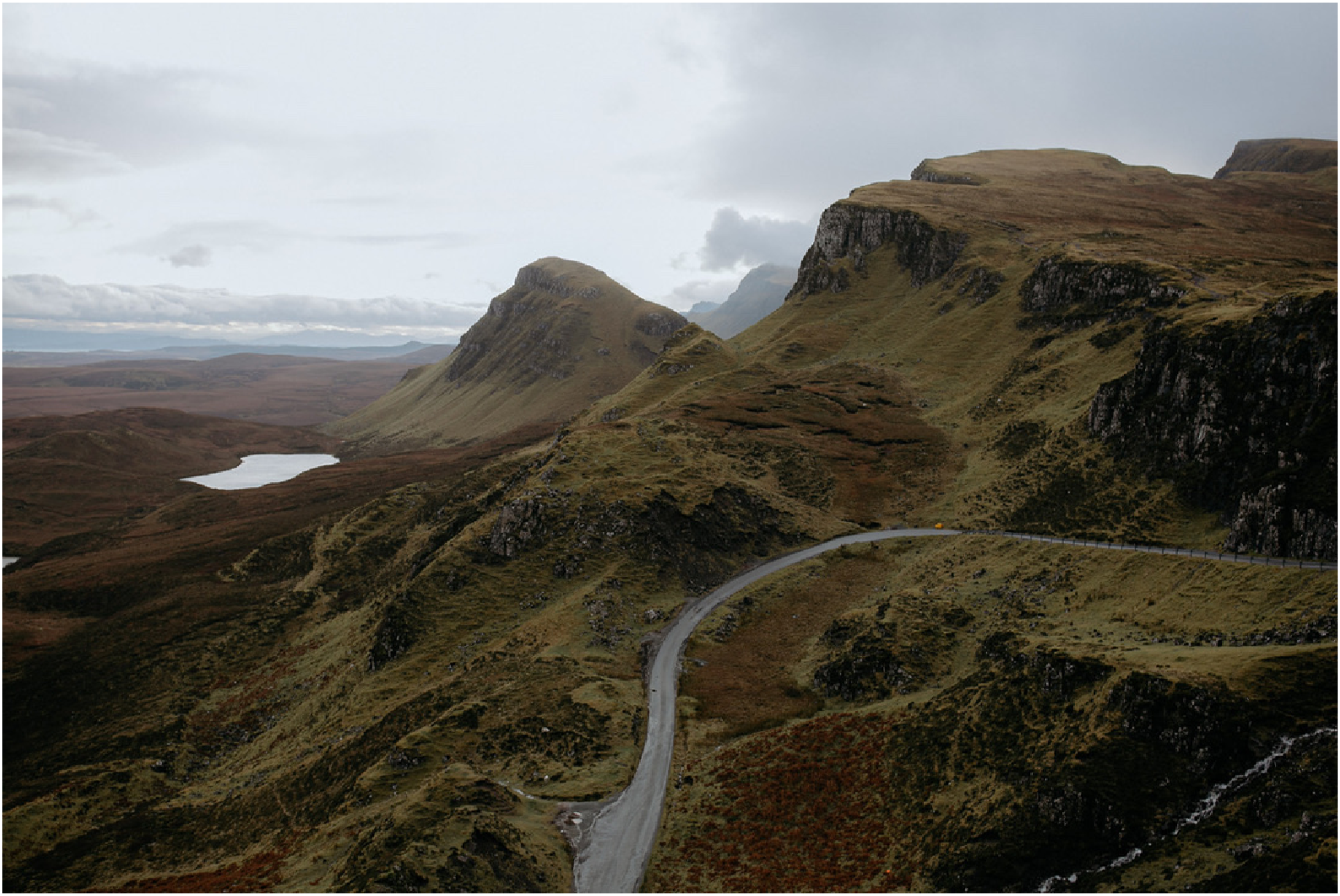
Warp: The weaving mill village
A fragment of a memory. A village on a riverbank… a schoolhouse… stone walls… a large loom in a factory… what is this place? I FaceTime my mother to piece together the fragments. Years before, I visited the old factory village of New Lanark in the biting January winds. The village was built in the 1700s on the riverbank of the Clyde in heavy grey stone. The community straddles a cascading waterfall, with the river powering the weaving mill. In the low-roofed factory room, working looms still stand. These are now electric-powered and click back and forth, weaving cloth. In the 1800s, the mill was managed by Robert Owen, who supported workers’ children in going to school. In other villages, children who were small enough would scramble on the floor, underneath the looms, collecting fallen threads and fibres in their hands and lungs. It was dangerous work as their heads were precariously close to the heavy moving beams overhead. In the New Lanark factory, workers were offered reasonable hours for living wages, given well-kept quarters to live in with their families, and could access healthcare and community activities. The New Lanark factory has always woven cotton cloth, though I imagine the smells, sounds and heavy stone structures are similar to the other mills nationwide that weave woollen tartan.
The tartan I have stitched with came from the hands of the factory workers who discarded offcuts from their bolts. They were then collected by my mother’s hands, who gifted them to me. I have handled the cloth, as the workers did, as my mother did, touching their DNA. They left their traces and tracks in weaving the cloth, and I left mine as I cut and stitched it into something more. This fabric, created to become a kilt, became a quilt through me instead.
Weft: Cultural practices with fabric
There is a video on the internet of women waulking Harris tweed on the Western Isles in 1941. Waulking is a process of felting woollen fibres together through movement and agitation to make the fabric more waterproof, warmer, and robust. The women sing a folk song while they work and stretch the cloth rhythmically with their hands in synchronicity on a wooden table. Traditionally, women waulked collectively to process cloth for kilts, blankets, or clothing. The hands of the women work and warm the fibres, their skin cells working their way into the cloth, DNA infusing the wool and pigments. The women are of the land, as are the sheep whose thick lanolin-infused coats are used for weaving. Trees are harvested from the environment to make the weaving looms, as are the plants used for dyes. Earth is cleared for pastures to nourish the sheep, and the year-round rain raises the grass and makes it lush for grazing. Ancient granite rocks are eroded by the biting cold, ice, and wind, and rivers carry nutrients to form soil for the grass to grow. These landscapes are in constant motion.
Places hold memories, and landscapes are changed over time by intentional and passive human use. Movement forms new shapes and geographies, new topographies. Macfarlane (2014: 20) introduces Edward Thomas, a twentieth-century poet who understood himself in topographical terms and believed that ‘paths run through people as indeed as they run through places’. What is it to be a path or form a path? While this poetic notion is alluring, I am mindful too of the concept of ‘shifting baseline syndrome’, a term from ecologists reminding us that as landscapes are reshaped through human and more-than-human activity, we forget what was there before (Tsing et al., 2017). Our newly shaped or ruined landscapes become the new reality, and forgetting, in itself, remakes landscapes as we privilege some assemblages over others. We tend to imagine that environmental conditions at the edge of our memories represent how the world used to be or has always been (Svenning, 2017).
Given that we forget, it is more of a reason to trace movements and keep them alive in memory. As the education sector once again shifts focus and funding in the wake of the change in the governing party, there are potential losses not only for tangata whenua (people of the land, indigenous Māori) but also for others who are not part of the dominant discourses of privilege that seem to prevail in the current coalition’s policy focus. Therefore, the invitation of this piece is to consider the importance of remembering and telling stories through the material and tangible. Given that our political ‘landscapes’ get remade over and over, the threads of our histories remain critical to remember, so they, too, do not move into the realm of forgetting. To connect, in an ongoing way, to our unique heritages and stories is to challenge agendas that desire to sanitise and erase. Remembering and telling stories needs to be reciprocal and invitational to our students so they do not forget but find places where their stories and heritages hold tangible and material meaning. I also acknowledge that it is a privilege to know and remember, and sometimes, remembering involves finding others who can help remember for us if our memories have already been erased or silenced (Figure 6) Warp: Making my tartan I have a friend who owns a loom. She weaves cloth from New Zealand wool while living in Australia, connecting her to home. I asked if she could teach me how to make cloth, and she shared about the warp and weft, here and there, coming and going, and weave of belonging and living. I purchased a small loom, learned the basics, and stretched this practice to consider how I may make my own tartan. Weaving is a practice of slow time. I gathered wool from other knitting and tapestry projects I had done, along with the hand-died, hand-spun wool from my mother-in-law, my inherited family. The colours reflect the heathers of the highlands in Scotland. Weaving there and here, my birth family, my marriage family, and the lands of Scotland and Aotearoa, New Zealand, I considered how materials carry stories and are infused with time. Weaving tartan became a practice of making time for stories and memories to emerge and meet each other through the material. Through noticing entanglements, we are invited into the ongoing practice of being open and alive to each meeting so that we might use our ability to respond and breathe life into new possibilities for living (Barad, 2007). (Figure 6) Tartan weaving: 2023.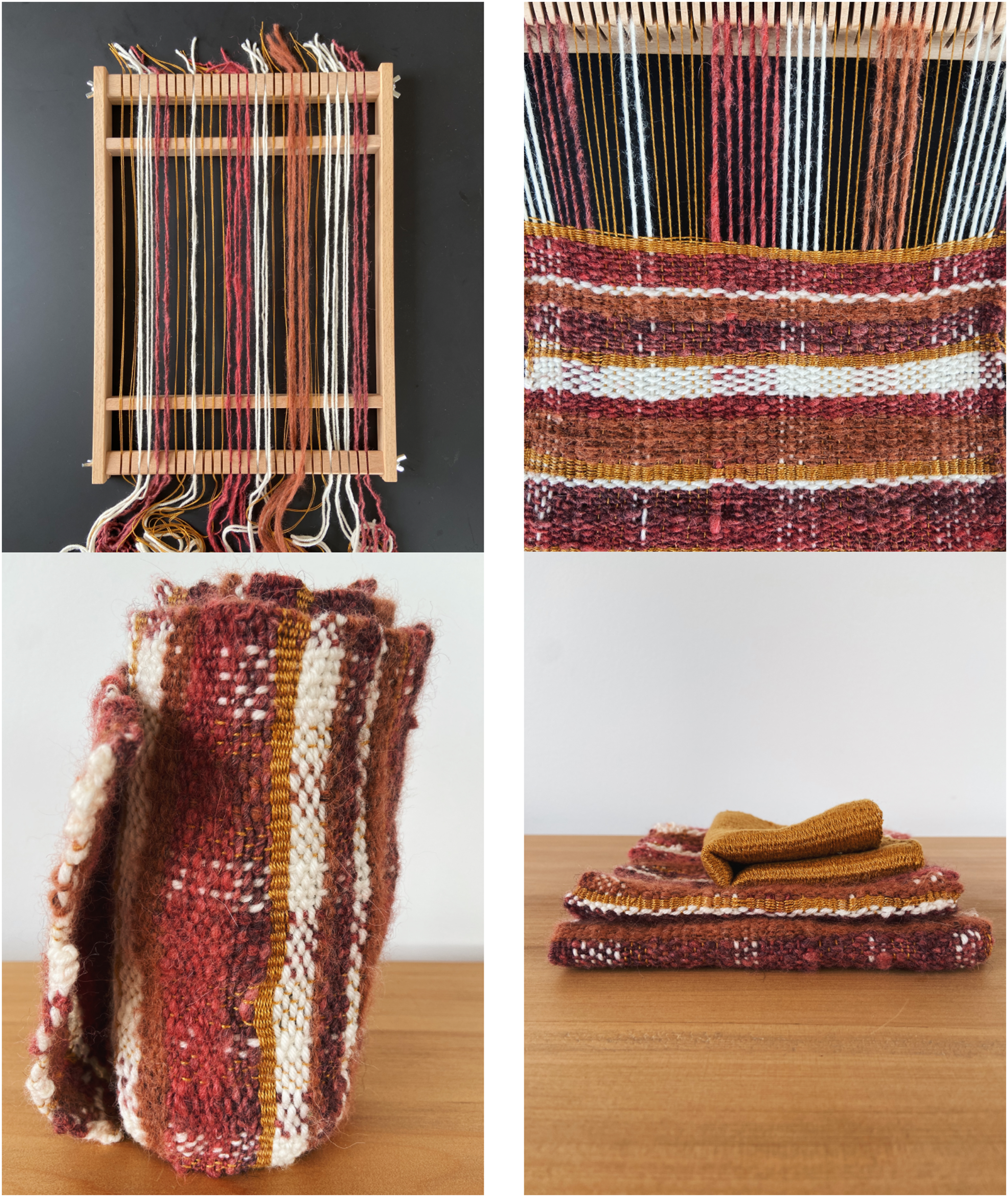
Conclusion: Stitching the assemblage
I write about and engage with the materiality of a tartan quilt through diffractive writing to move into the idea that the artifacts and artworks we make and cohabitate with hold stories and histories. They elicit stories and memories. The tartan quilt I warm myself under on cold August mornings never met the lambs of my childhood in rural Wairarapa. Still, they meet each other through my memories. The waulking women never met my nana’s spinning wheel or my mother-in-law’s natural dyes; still, the stories meet through memory. A tartan quilt, as a material artefact, a thing, is dappled with time, temporality, and spacetime curvature (Morton, 2018). A tartan quilt is an entanglement of inseparable intra-acting agencies of material, thought, history, skill, memory, desire, ancestry, time, and art (Barad, 2017).
I am inspired by the work of Cohen (2022), a history writer who believes that beneath every history, there is another history – there is, at least, the life of the historian and the way they moved through the world. History is both a storytelling practice and a set of reminders from the past that we turn into stories (Tsing, 2015). I extend this to consider how history does not stay in the past but ripples forward to meet us here and now. I have an entangled identity; each stand has a genealogy and particular material expression. We must get to know the expressions of these strands as educators implicated in a history woven with colonisation. We are responsible for practising on the lands of Aotearoa, New Zealand, as treaty partners, tangata Tiriti, and knowing who we are in material relation to this. I would not have told these stories or considered their entanglements had not my ethnic identity met my academic identity, met my arts therapist identity, met my crafter identity. When you tell a history story, consider artefacts, or make something material, you always bring the many threads implicated in your past and present, the warp and weft.
In this writing, I have traced an assemblage of stories related to cloth, land, sheep, memory, tartan, weaving, spinning, sewing, history, and identity. Concluding with the position that memories and stories have agency and deeply matter for educators, I invite other educators to remember and trace the threads of their own stories, through material artefacts. In my story, the raw material of wool has a place alongside folk songs, a riverside stone village, a childhood suckling lamb sent to the slaughterhouse, and a tartan quilt. This knowledge leads me to (Haraway, 2016b), who challenges us to consider that it matters what stories we tell to tell other stories with. Tracing historical and ancestral stories, in the way I am proposing, woven with the ‘thing power’ of story, memory and matter (Bennett, 2010), is not about finiteness or linear time; it is about considering how our histories and memories have been both inherited and are continually made through our complex engagements with the world.
As I bring this writing to an end, I want to address a few final points about why it is important as Pākehā educators to connect with our histories and how this may support a better understanding of the histories of others. As I have demonstrated, histories and our memories of them are entangled with place, land, material, time, culture, language, ancestors, loss, privilege, and other people. Holding this knowledge for ourselves invites us to consider how it is for others. Our role as educators is to engage in an ongoing practice of listening to, acknowledging, and appreciating how the memories and stories of others are entangled with ours in this land of Aotearoa. Our experiences from now colour how we think about and remember the past and there is no objective ‘truth’ to our stories. This is not a discipline-specific approach to creative arts or therapeutic spaces but a practice educators can consider from whatever domain they teach. It can be as simple as introducing yourself through your land, culture, history, and artefacts, inviting students to do the same, paying attention to where stories meet, and exploring these meeting points.
While our memories and stories are important to us individually, they also form an important part of shaping others’ stories, including the story of education in this country. Educators are public servants; in higher education, we are the critics of, conscience of, and champions of cultural and societal practices. I bring a challenge then to enact these responsibilities through our writing, teaching, advocacy, and scholarship practices locally and globally to elucidate to policymakers how memories and stories impact future generations. We have already seen how this can have long-lasting impacts in our country, such as when the Māori language of te reo was banned in schools through the 1800–1900’s. It took a grassroots revitalisation in the 1970s for the language to be recognised, in law, as an official language of New Zealand, following Te Pire Mo Te Reo Maori 1986 (the Maori Language Bill, 1986). However, the ripples of these lost decades are still felt, and the country must not regress to sanitisation again.
Stories and memories are ecological and entangled. Past always meets present. As educators, we have a responsibility to not rush forward in a linear trajectory, letting the past fall into the shadows, but to invite the shadows, ancestors, and memories forward to meet us here, to tell the stories that matter to us and the students we educate. There is always a collective weaving in the classroom because we all carry our own ‘tartan’ stories. Students’ and educators’ experiences, cultures, and perspectives entangle each other and the learning that occurs. While proposed policy changes will see divergences and fragmentation and an attempt to remove parts of the curriculum, as educators, the need to share and elicit history stories remains essential. Indeed, we require complex answers for complex problems.
Arndt and Tesar (2019) note that working in post-qualitative ways offers methodological opportunities for events and questioning to emerge that would otherwise remain invisible and silent in ‘the real world’. These questions and events may result in the appearance of ‘tiny cracks’ in the wall that grow into rhizomes of new discourse, ideas, and, perhaps, policies. Leaning into Havel (1985, 1989), Arndt and Tesar (2019) remind us that it is unimportant how big or small the cracks are, as even the tiniest crack can shed light on the unstable foundations of ‘reality’ and ‘real world’. This also considers Kristeva’s (2002) idea of revolt. My work is a ‘tiny revolt’, but a revolt nonetheless of rethinking methodological expectations, engaging with philosophy as a method, and inviting tiny cracks and tiny revolts into this question of memories, histories, and stories for Pākehā educators. I invite new considerations into how these are kept, taught, spoken, and allowed. We have a responsibility, as educators, to consider our own stories and memories and the artefacts that we make or cohabit with that carry these. We have a responsibility to stay in the messy middle of ever-growing narratives, histories, ideas, and worlds that interweave to give life its co-constitutive layers (Akomolafe, 2017; Macfarlane, 2019). Individual stories have always been political, and part of the responsibility of educators is to equip students with the tools to navigate political influences within their own stories and to do the same with ours.
Footnotes
Declaration of conflicting interests
The author(s) declared no potential conflicts of interest with respect to the research, authorship, and/or publication of this article.
Funding
The author(s) received no financial support for the research, authorship, and/or publication of this article.
