



Abstract
Universal Design for Learning (UDL) has been frequently discussed as a framework that guides the design of inclusive learning environments for all students with and without disabilities. This policy brief reports on findings of a content analysis of how UDL was referenced in three major U.S. federal education laws. Results indicate that UDL was not explicitly defined although it was closely tied to alternative assessment and technology in K-12 education laws. References to UDL in the higher education law suggested using UDL to guide inclusive educational practices for post-secondary students and the need to integrate the framework into educator preparation.
Introduction
Universal Design for Learning (UDL) is defined in the 2008 Higher Education Opportunity Act (HEOA) as a scientifically valid framework for guiding educational practice that “(A) provides flexibility in the ways information is presented, in the ways students respond or demonstrate knowledge and skills, and in the ways students are engaged; and (B) reduces barriers in instruction, provides appropriate accommodations, supports, and challenges, and maintains high achievement expectations for all students, including students with disabilities and students who are limited English proficient.’’ The concept of UDL is considered as an extension of the universal design (UD) movement in architecture and technology development in the 1990s (Edyburn, 2010). In essence, UD provides seven principles, including equitable use, flexibility in use, simple and intuitive use, perceptible information, tolerance for error, low physical effort, and size and space for approach and use, that guide the design of physical products and environments to be usable and accessible to the full range of individuals regardless of their age and abilities (Centre for Excellence in Universal Design, 2021).
Translating the concept of UD into education, researchers developed UDL following the reauthorization of the 1997 Individuals with Disabilities Education Act (IDEA; Edyburn, 2010). The framework consists of three principles (i.e., providing multiple means of engagement, multiple means of action and expression, and multiple means of representation), nine guidelines, and 31 checkpoints that provide guidance on designing accessible curricula and learning opportunities to address learner variability in inclusive learning environments (see a detailed description of UDL principles, guidelines, and checkpoints at udlguidelines.cast.org/). In 2015, UDL was introduced into the reauthorization of the Every Student Succeeds Act (ESSA).
However, some researchers have warned against the widespread adoption of UDL into public policy without further evidence of its impact on student learning (e.g., Boysen, 2021; Murphy, 2020). Murphy (2020) states that “the policy changes called for by UDL advocates lack an evidentiary basis of success in prior applications” (p. 9). Similarly, Boysen (2021) warned about the similarities between UDL and the now widely disproven concept of learning styles given that both concepts were built upon oversimplified neuroscience research. The researcher argues that there is little reason to believe that students will know the best method for learning when given flexibility in instruction, which was regarded as one major claim of UDL.
To examine the evidentiary basis of UDL, King-Sears et al. (2023) conducted a meta-analysis of 20 studies investigating UDL-based versus non-UDL-based interventions. Serving as the first methodologically sound meta-analysis of UDL implementation across K-12, higher education, and industry settings, this study revealed a medium positive effect size of UDL-based interventions (Hedges’ g = 0.43). Although promising, a closer analysis of studies included in the meta-analysis suggested that UDL implementation differed vastly in terms of the constellation of checkpoints or guidelines; thus, a clear understanding of how UDL was operationalized systematically across studies was still lacking. Moreover, this meta-analysis reflected a relatively small number of (quasi-)experimental studies evaluating UDL over more than 30 years of development.
Researchers have rightly argued that ambiguity still exists regarding how UDL is defined and implemented (Hollingshead et al., 2022). The ambiguity and insufficient evidence warrant more research efforts and require clear policy guidance. Particularly, federal policy plays an influential role in implementing programs in teacher preparation and K-12 settings, which, in turn, impacts the education of all students (Cook-Harvey et al., 2016; Hehir, 2005). In this brief, we investigated how UDL and its precursor UD were positioned in U.S. federal education laws at both higher education and K-12 levels.
Data source and analysis
Data used in the present study were collected from U.S. federal education laws, including ESSA (2015), IDEA (2004), and HEOA (2008). ESSA is the federal law for K-12 education. IDEA is the federal special education law for students with disabilities (SWDs) from birth through high school. HEOA is federal legislation designed to ensure rights for post-secondary students. We searched the legislation documents using terms “universal,” “UDL,” and “UD.” After identifying legislative clauses with references to UDL or UD, we calculated the frequencies of their references and analyzed emergent themes.
Findings
Presence of UDL and UD in U.S. federal education laws.
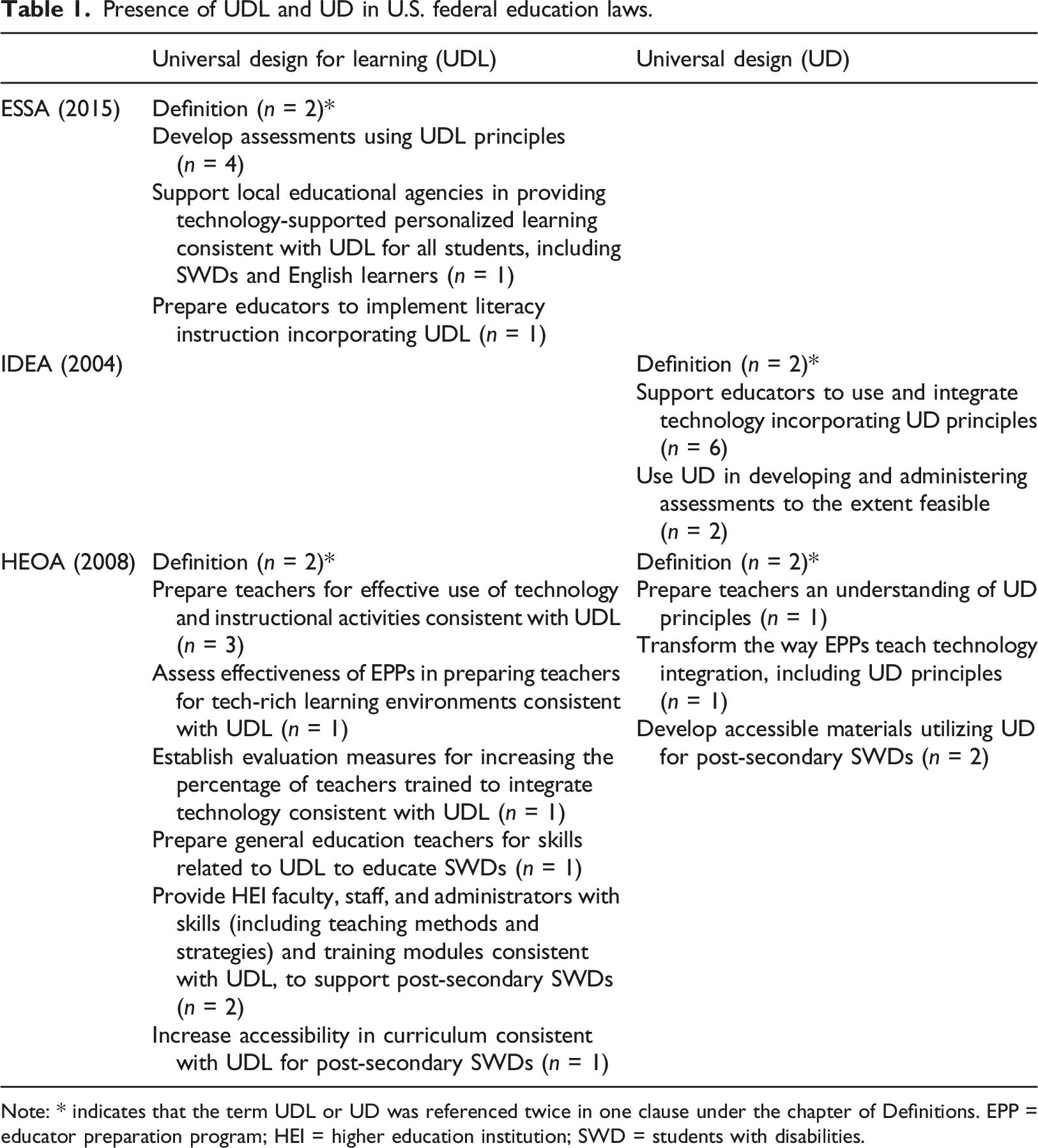
Note: * indicates that the term UDL or UD was referenced twice in one clause under the chapter of Definitions. EPP = educator preparation program; HEI = higher education institution; SWD = students with disabilities.
K-12 education policies
The most salient reference to UDL in ESSA is that it can serve as the foundation for designing alternate assessments (n = 4) for SWDs. For example, ESSA indicated that states desiring to receive funding develop assessments using UDL to the extent practicable and describe in their state plan the steps they have taken to incorporate UDL in alternate assessments to the extent feasible. ESSA specified that states could use an allotment of grants to develop assessments for SWDs, including alternate assessments designed using UDL principles. Additionally, ESSA suggested UDL principles as integral for designing comprehensive literacy instruction (n = 1) or technologies (n = 1) that support personalized learning for all, including SWDs and English learners.
Because of their closer tie with technology, UD principles were referenced for developing and using instructional and assistive technologies (n = 6) to maximize accessibility to the general education curriculum for SWDs in IDEA. For example, IDEA provided funding opportunities for states and local educational agencies (LEAs) to prepare personnel in using universally designed technologies and assistive technology. IDEA suggested activities that promote development, research, demonstration, and use of technology with universal design features accessible to the broadest range of SWDs without further modifications or adaptations. Further, state or LEAs should use received funds to apply UD principles to development and administration of assessments (n = 2) for SWDs to the extent feasible.
Higher education policy
In HEOA, UDL was defined as a framework guiding educational practices that could be incorporated into pre-service teacher preparation and in-service teacher training as well as serve as an approach to improving inclusive education for post-secondary students. Similar to ESSA, HEOA highlighted the importance of supporting educator use of technology consistent with UDL (n = 5). For example, HEOA provided funding opportunities through Teacher Quality Partnership Grants to partners who could demonstrate integration of strategies or technology, including implementing technology-rich learning environments, consistent with UDL in educator preparation programs (EPPs). Grant applicants could incorporate the percentage of teachers trained to integrate technologies aligned to UDL as an indicator for assessing the quality of teacher preparation and training in the evaluation plan. Moreover, states or higher education institutions (HEIs) who received funds should report program outcomes, which might include preparing teachers to integrate technology consistent with UDL.
To support post-secondary SWDs, HEOA provided funds under Graduate and Post-Secondary Improvement Programs to awardees to implement activities, which might incorporate developing and implementing training for post-secondary faculty, staff, and administrators to develop skills including effective teaching methods and strategies consistent with UDL. Funds were also available to award national centers to carry out duties such as developing training modules, including UDL, for HEIs on exemplary practices for accommodating and supporting post-secondary SWDs. Moreover, UD principles were mainly referenced for integrating technology in EPPs (n = 3) and developing accessible materials for post-secondary SWDs (n = 1).
Discussion
First, our findings showed that both HEOA and ESSA endorsed UDL as a framework for guiding educational practices (e.g., instruction, assessments) and provided funding opportunities for integrating UDL into K-12 and higher education settings. It is interesting to note that although HEOA provided a clear definition of UDL, which was referenced in ESSA, there was no explicit mention of multiple means of engagement, multiple means of action and expression, and multiple means of representation as three UDL principles in the federal education legislation. This lack of clear links to UDL principles might be problematic considering the ambiguity that exists in current literature regarding how UDL is defined and insufficient guidance on practices (Hollingshead et al., 2022).
Second, our findings revealed that UDL was not explicitly referenced in IDEA. Instead, the statute highlighted enhanced access to the general education curriculum for SWDs through universally designed technologies. Moreover, IDEA indicated that states and districts should use UD principles in developing and administering any statewide or district assessment to the extent feasible. Regardless, using technologies or assessments aligned to UD principles is not tantamount to UDL. This finding helped clarify the statement claiming that UDL has been referenced in IDEA as indicated in several research reports (e.g., Sherwood and Kattari, 2023; Smith et al., 2019). Although derived from UD, UDL should be distinguished from its precursor to avoid ongoing confusion; thus, researchers and policymakers should clarify which concept is adopted in future research and policy implementation.
Conclusion
The growing diversity of the student population in today’s classrooms requires continued efforts to meet the needs of all learners. The UDL framework was developed to support such efforts through enhanced access to general education for SWDs. Given the relatively small amount of evidence, however, we suggest that further research efforts and policy implementation explicitly define UDL, operationalize its implementation, and continue to strengthen the evidentiary basis.
Footnotes
Declaration of conflicting interests
The author(s) declared no potential conflicts of interest with respect to the research, authorship, and/or publication of this article.
Funding
The author(s) received no financial support for the research, authorship, and/or publication of this article.
