



Abstract
This paper provides a brief overview of the history of Universal Design for Learning (UDL), its prominence in the literature, and its use within the educational community. It then provides a critical analysis of the literature base linked to UDL checkpoint 1.2 by examining the relevance to the current trends in education and technology and alignment with checkpoint 1.2 and/or UDL as a whole. Using these criteria, the paper reports how much of the literature base was out-of-date or disconnected to UDL. Given UDL’s prominent position in educational policy, further research into its effectiveness is necessary. Implications are discussed.
Universal Design for Learning (UDL) is widely touted as a research- or evidence-based framework (Lalor, 2018). Universal design for learning is a framework that aims to design instruction and the learning environment in such a way that it meets the needs of all learners without the need for extensive accommodations and modifications (Nelson, 2014). It has been utilized and promoted by special and general education teachers for well over a decade. Universal Design for Learning’s goal of providing access to all learners is a noble one that attempts to fill a desperate need for accessibility for all students in our schools. Overall, UDL is a well-intentioned framework that aims to benefit all students, even students with the most diverse learning needs.
Universal Design for Learning’s inclusion in the reauthorization of the Higher Education Opportunity Act (2008) as a “scientifically valid framework for guiding educational practice” further cements its status in the educational community among policymakers and practitioners alike. Its foundation in empirical research appears to be robust when one investigates the website of CAST, the organization that created the UDL framework.
The UDL framework is set up with three overarching categories: multiple means of engagement, representation, and action and expression. Under each of those categories are individual checkpoints with more specific details, such as representation 1.1 “offer ways of customizing the display of information.” For each of these individual checkpoints outlined in the UDL framework, CAST lists an abundance of empirical research, scholarly reviews, and expert opinions, and the organization welcomes anyone to “explore research used to develop” their checkpoints (CAST, 2020). Therefore, in this critical analysis, the authors explore the research used to develop one specific UDL checkpoint within the framework.
Given the immense wealth of research presented by CAST, it would be impossible to do a fully exhaustive analysis of all articles offered as the basis for UDL. For example, CAST cited 319 articles as the scholarly foundation for the overarching category of representation alone. Therefore, UDL checkpoint 1.2 was selected to represent a microcosm of UDL research. It represents a robust category that shares some of its research with other checkpoints under the representation category, as well as across other categories.
Universal Design for Learning checkpoint 1.2 falls under the principle of “providing multiple means of representation.” This checkpoint is specific to offering alternatives for auditory information and gives guidelines such as using captions, providing visuals, and providing written transcripts, among others (CAST, 2020). The purpose of this critical analysis is to examine the literature cited by CAST as the basis for checkpoint 1.2 and analyze its relevance to the checkpoint, and UDL as a whole. Implications of the prominence of UDL in educational policy in light of findings and the need to conduct further analyses of the research base will be discussed.
History of UDL and current literature
Universal Design for Learning often credits Universal Design of architecture and accessibility as its inspiration for this framework (Nelson, 2014). The overarching idea of Universal Design in architecture is that if a design is approached with everyone in mind, or even with those that need more accommodations than others, that design then benefits everyone. For example, sidewalk curb cuts were designed for people with mobility issues, but they also benefit parents with strollers, travelers with rolling suitcases, and inline skaters. This foundational idea in architecture gained momentum when the Americans with Disabilities Act was passed in 1990. Granting equal access to individuals with disabilities in public spaces translated into a monumental retrofitting task for existing structures, which could have been avoided if those structures were designed universally for all people from the start.
In applying universal design to education, the learning environment is “designed around the needs of all students” (Nelson, 2014). Instead of traditional teaching, where a teacher plans their instruction based on the majority of students and then modifies or accommodates the needs of unique learners (Black and Moore, 2019), UDL seeks to remove learning barriers at the beginning rather than accommodate, or retrofit, for those outlying students at the end (Harshbarger, 2020). Beginning in 1984, a group of children’s hospital clinicians set out to provide increased educational opportunities and experiences for students with disabilities, and eventually came to understand how to improve these outcomes using flexible materials and teaching methods. This was the foundation for CAST’s Universal Design for Learning (CAST, 2020). Since then, utilizing existing research as well as their own, CAST has developed a framework for UDL complete with definitions, guidelines, and links to the research base.
In much of the current research, UDL is touted both as academically beneficial for students with high-incidence disabilities (King-Sears and Johnson, 2020) and perceived as positive by these students as well (Kortering et al., 2008). Though the research-base is still emerging in this area, there even have been studies on UDL’s benefits for students with more significant disabilities (Coyne et al., 2010; Kok Hwee and Kee, 2014), though some have criticized current research on UDL to be less-than-systematic (Murphy, 2021). Universal Design for Learning has been studied as a support for English language learners (Delaney and Hata, 2020) and for students with cerebral palsy (O’Neill, 2000). It has been the subject of undergraduate courses for pre-service teachers (Metcalf, 2011), and is currently being applied to teaching higher education (Bracken et al., 2019).
It is evident that there is an abundance of literature that serves as the foundation of UDL, as well as literature in support of its implementation. The basis of UDL, designing instruction and curriculum universally to reach all learners, seems like common sense. As mentioned, some go so far as to consider UDL an evidence-based practice (Lalor, 2018) or scientifically valid (Higher Education Opportunity Act, 2008). The following questions are explored within this critical analysis: How relevant to current educational and technological practices is the evidence-base for UDL checkpoint 1.2? How relevant to UDL checkpoint 1.2 are the cited studies?
Critical analysis
Methods
As part of a larger project exploring the research base for Universal Design for Learning presented on the CAST website (CAST, 2020), the first two authors have been investigating the UDL foundational literature specifically in the representation sub-category. Representation was chosen as it is very concrete in its implementation. The representation category intends for teachers to provide different means of representing information in order to reach their entire class (CAST, 2020). Given the straightforward nature of the representation component, ideally the literature base would be straightforward as well. Further, in reviewing the other categories, the representation category seems representative of the type of research found in other categories. For example, the age of the articles is similar, many articles are repeated through multiple checkpoints, and many of the categories share authors between them. The second author then created a codebook to extract relevant information from each article with categories including the following: • purpose or research question(s) • inclusion of students with disabilities • disability categories present • results • relevance to the current time • UDL checkpoint principle(s) addressed • UDL checkpoint principle(s) supported • other relevant study factors such as methodology, study type, sample size, etc.
After coding three checkpoints under representation, the first author elected to focus on checkpoint 1.2: offer alternatives for auditory information as a representative sample of the UDL literature. This checkpoint was selected, in part, because of the number of articles cited as its literature base, as well as the number of articles accessible to the authors. For example, other checkpoints contained 50 or more articles in their literature bases, while the selected checkpoint contained a reasonable 18. Further, other checkpoints reviewed during the overarching project cited articles that were unable to be accessed due to their age or their limited publication release(such as conference proceedings). Finally, upon reviewing other checkpoints, it was evident that the literature base in UDL checkpoint 1.2 was similar to the literature base in other checkpoints, even sharing some of the same articles and authors between them. Therefore, checkpoint 1.2 was selected to serve as an accessible microcosm of UDL’s vast literature base.
CAST’s foundational research-base for UDL checkpoint 1.2 (and all other checkpoints) is comprised of two sections: experimental and quantitative evidence; and scholarly reviews and expert opinions. For the purpose of this critical analysis, only experimental and quantitative articles were considered. Within this sub-category there were 18 articles, 17 of which were located either through search Libraries Worldwide or through the university interlibrary loan application. One cited article (Dalton et al., 2005), listed as a final report and published through the CAST organization itself, was unable to be located. The first author reached out to the author of this article and procured a Word document, but it did not appear to be the requested article. Therefore, this article was not included in the critical analysis.
Literature overview
All 17 studies included in the review were published between 1982 and 2006 with over 40% (n = 7) of the articles published in the 1980s and 1990s. The remaining 10 articles were published in the 2000s. Despite UDL’s roots in helping students with disabilities in hospitals to access educational opportunities (Meyer et al., 2014) and its wide acceptance in the field of special education, few of these articles contained participants with disabilities (n = 6; 29%), and five of these articles were focused only on deaf students or students with hearing loss. The remaining article (Montali and Lewandowski, 1996) had a sub-population of students with learning disabilities within their “less-skilled” readers group. Two of the articles (Linebarger, 2001; Montali and Lewandowski, 1996) specifically excluded particular students with disabilities in their studies. This is particularly interesting given UDL’s widespread use in the special education community.
How relevant is the research base to present day?
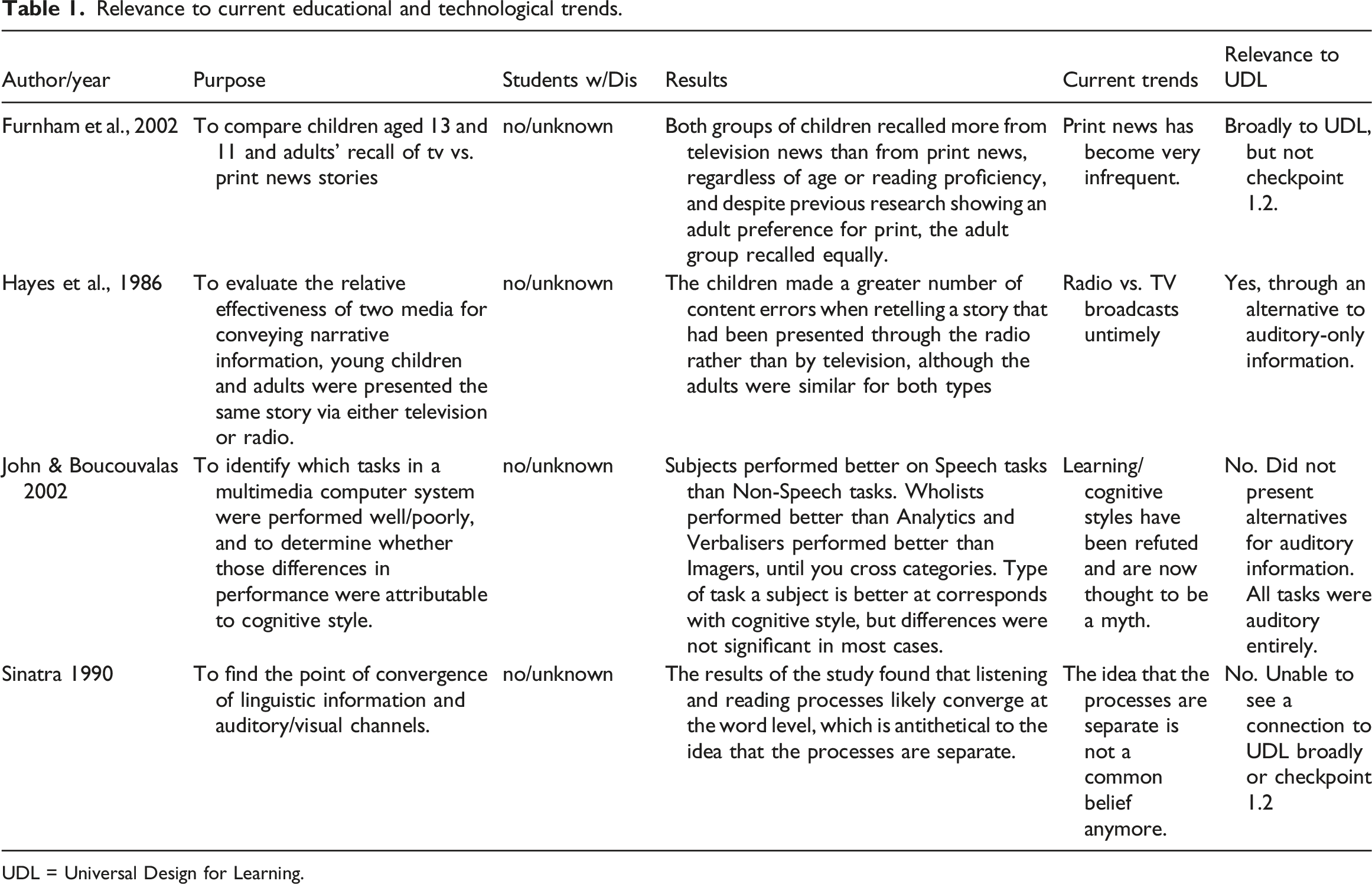
Relevance to current educational and technological trends.
UDL = Universal Design for Learning.
As can be expected with such a literature base, some of the selected studies (n = 4; 24%) have lost some of their relevance in the time since publication. For example, as recorded in Table 1, Hayes and colleagues (1986) sought “to evaluate the relative effectiveness of two media sources for conveying narrative information…” by comparing television and radio. In 2020, however, radio can almost be considered a defunct form of media. For example, music online streaming platforms account for 85% of US music revenue, not radio stations (Mayfield, 2021). In terms of talk radio or informational radio like that studied in the aforementioned article, 2020 has seen a stark drop in publicly funded radio listeners, with nearly 25% of listeners no longer tuning in during the pandemic (Folkenflik, 2020). In terms of television, it is hardly recognizable now compared to 1986. For example, a press release by a major cable network cites a study conducted in 2012 that found a significant portion of the population, and the majority of millennials, get their news from news-related comedy programs rather than traditional news stations (Comedy Central, 2018).
Likewise, Table 1 summarizes Furnham et al. (2002), which studied the differences in recall of news stories in print and television. In a similar vein to the previous study, print news is far less available and less utilized in modern times. Although some would argue that print news is utilized daily through various websites, the multimedia elements embedded in most online news today are hardly comparable to the black-and-white newspapers of the past.
These advances in technology that obviously would be present in a literature base of this age are not the only place where the research base is dated, however. It is also evident in the deep connections that UDL has in cognitive psychology. In one of the included articles, John and Boucouvalas (2002) sought to identify two things: which tasks completed using a multimedia computer system were performed well or poorly; and if those differences could be attributed to the participants’ cognitive styles. Not only was the interest in cognitive styles or brain-based learning and its application to the classroom critiqued even at the time (Jensen, 2000), much of the educational field currently views cognitive and learning styles as a myth, if a prevalent one (Kirschner, 2017). In another article from the research-base, Sinatra (1990) was interested in examining the commonly held belief that auditory and visual channels of linguistic information were completely separate. They found that there was actually a point where the two processes converged, challenging this historical assumption. However, the idea of these channels being separate is no longer the prevailing belief, and the interactions among linguistic, auditory, and visual channels is common knowledge (Echeverría-Palacio et al., 2018; Sekiyama and Burnham, 2008).
How well-aligned is this research to the checkpoint, or to UDL as a whole?
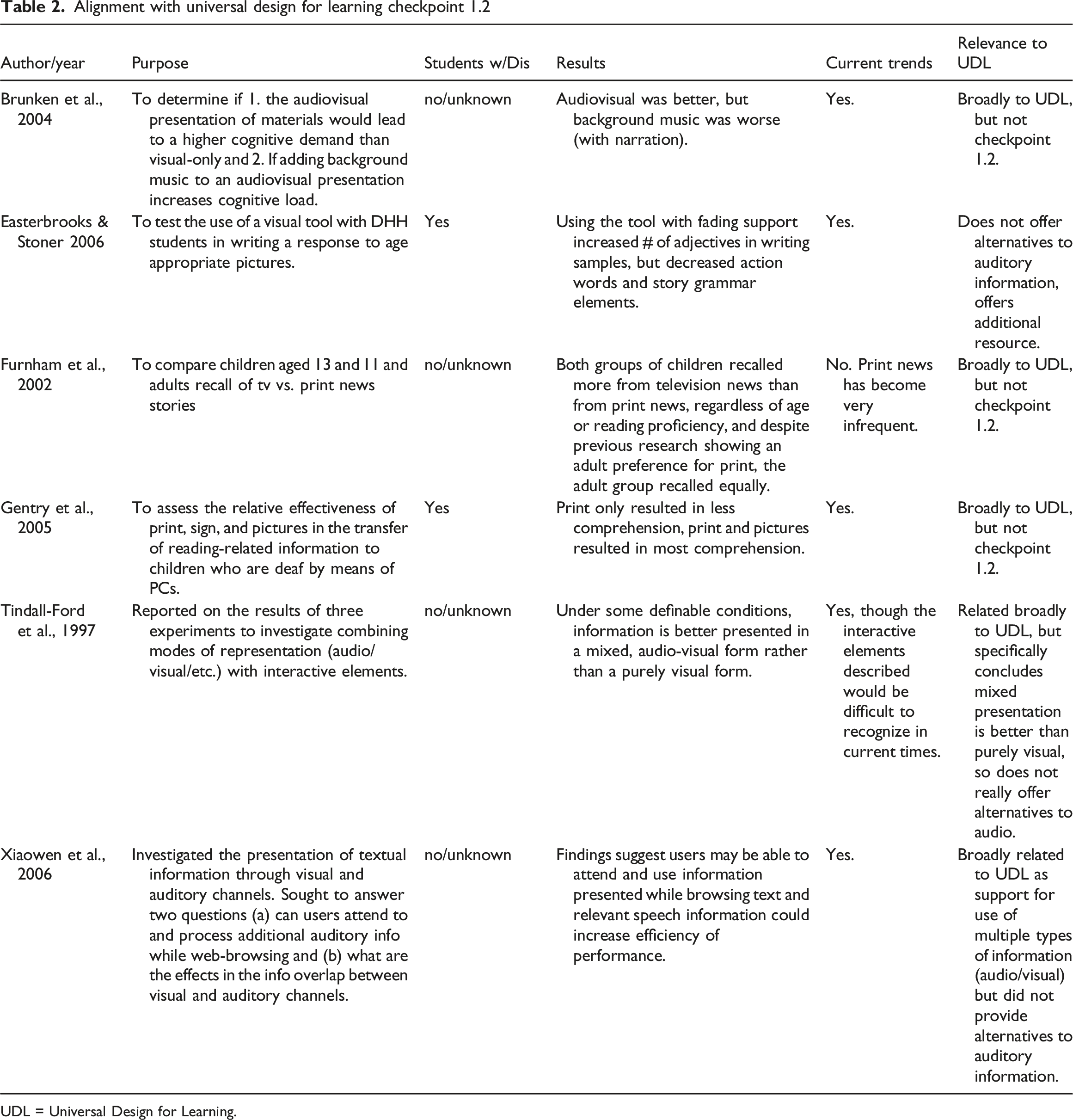
Alignment with universal design for learning checkpoint 1.2
UDL = Universal Design for Learning.
Although some studies arguably aligned to Universal Design for Learning in the broadest sense, they did not seem to fit into the specific category of UDL checkpoint 1.2: offer alternatives for auditory information (n = 6; 35%). For this study, alignment was considered not only with UDL as a whole, but with the specific checkpoint that CAST assigned the article within as part of its literature base. In the case of this checkpoint, if an article that is cited is not specifically aligned with offering alternatives for auditory information, then that article would not be considered aligned to the checkpoint, though it could be considered aligned to the principles of UDL as a whole.
Several instances of this misalignment can be seen within Table 2. For example, Brunken and colleagues (2004) discussed the results of two experiments that attempted to determine if an audiovisual presentation of materials would lead to a higher cognitive demand than a visual-only presentation, and if adding irrelevant background music increases cognitive load. Although a study of this nature seems to align to UDL as a concept, and even provides multiple means of representation, the research was not designed to investigate alternatives to auditory information and therefore citing its findings as justification for the checkpoint is an extrapolation at best. Another example of this sort of misalignment between the UDL checkpoint and the cited literature comes from Easterbrooks and Stoner (2006). The purpose of this study was to test the use of a visual tool (graphic organizer) with Deaf and hard of hearing students who were writing responses to age-appropriate action pictures. Although this article speaks on using a visual as a supplemental resource, it is not actually offering an alternative to auditory information. Instead, it offers an additional visual and instructional resource (concept map) to an already existing visual (picture).
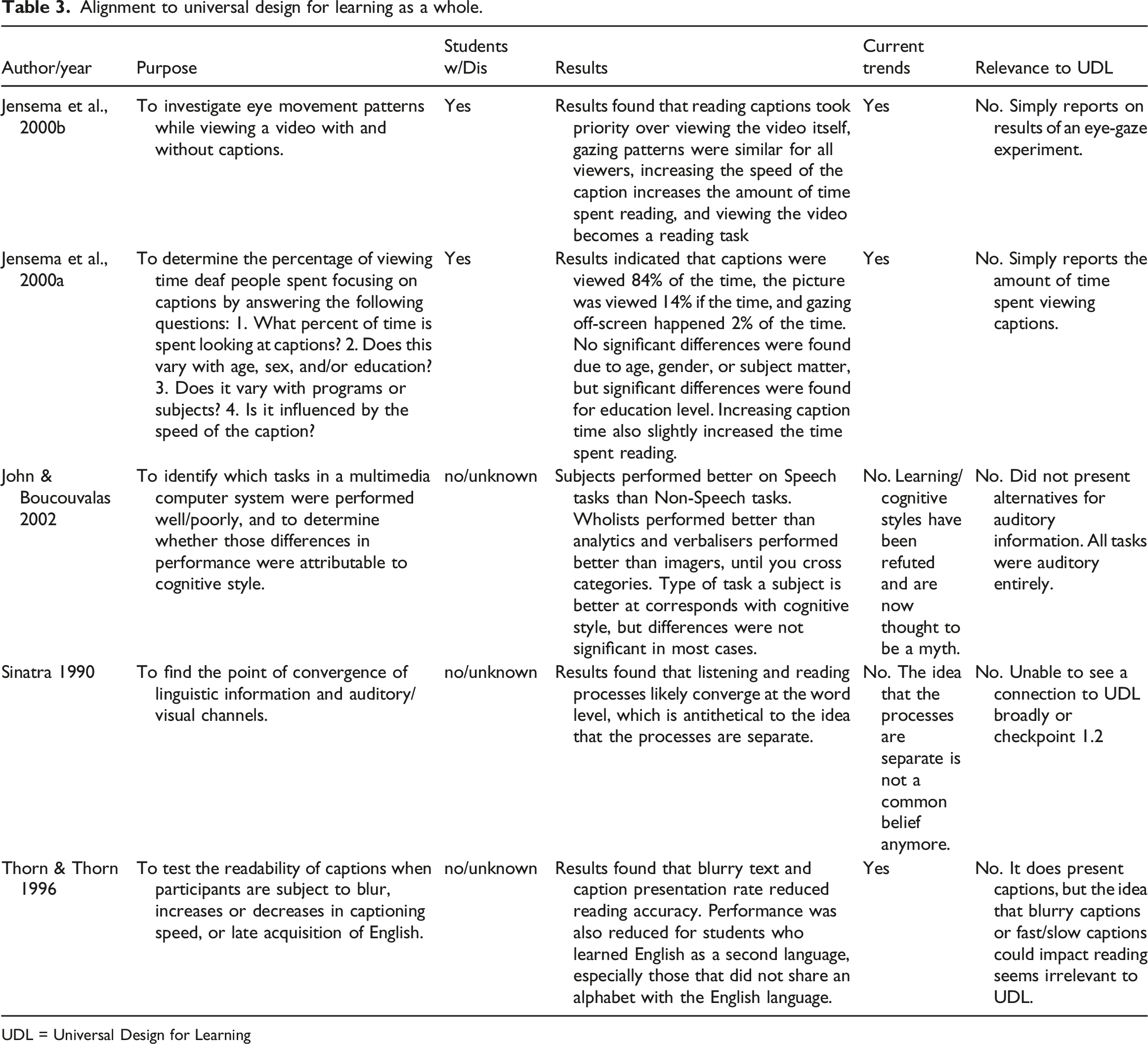
Alignment to universal design for learning as a whole.
UDL = Universal Design for Learning
In one article, Jensema et al., 2000b studied the eye movement patterns in students while viewing videos both with and without captions. Some would argue that the use of captions would align with offering alternatives for auditory information, but this study does not report on any benefit in adding captions or detriment in taking them away. Therefore, it does not support, nor does it refute, this UDL checkpoint. It is simply a report on the results of an eye-gaze experiment investigating where and for how long the participants looked at particular parts of the screen. Similarly, the John and Boucouvalas (2002) study on cognitive styles mentioned in the previous section contained tasks that were only auditory in nature. It did not present alternatives for auditory information, and therefore provides no support to this checkpoint. The Sinatra (1990) study regarding the convergence of linguistic, auditory, and visual systems not only did not connect to 1.2 through providing alternatives to auditory information, but did not connect to UDL as a concept other than in the broadest sense of support for simultaneous multiple means of representation.
Relevant literature
Five of the 17 studies (Jensema et al., 2000a; Linebarger, 2001; Moreno and Mayer, 2002; Nugent, 1982, 1983) were found to be well-aligned with UDL checkpoint 1.2 and did not have any obvious irrelevance to the current time. A 1982 study conducted by Nugent sought to compare learning facts from visuals, audio, print, and all possible combinations when the information presented therein was redundant. They used text equivalents and provided visuals and transcripts, which are all alternatives to auditory information. The study found it was helpful for the participants to have multiple means of representation and supports this checkpoint and the UDL principle of representation as a whole. Similarly, Linebarger (2001) examined what combination of captions and auditory cues contribute to children’s reading skills. They found that captions produced greater word recognition gains even up to 15 days later. In fact, almost all the literature that connected directly to UDL checkpoint 1.2 was specifically related to captions (n=4).
Implications and next steps
The results of this critical analysis indicate that 71% of the articles cited for UDL checkpoint 1.2 raise questions about relevancy either to UDL or current trends in education and technology. Despite this, educational policy has moved toward adopting UDL as a best practice since the Higher Education Opportunity Act (2008). The framework has been included in federal legislation in the Every Student Succeeds Act (ESSA, 2015), the 2016 National Education Technology Plan (Thomas, 2016), and the Strengthening Career and Technical Education for the 21st Century Act (2018). Additionally, UDL is being utilized internationally as well. England’s schools, for instance, have been moving toward utilizing UDL in their primary and postsecondary schools (Martyn et al., 2015). Universal Design for Learning is a stronghold within the international educational community and even government policy without scrutiny of its research base. The potential negative implications of supporting any educational framework without critical analysis cannot be overstated, and steps need to be taken to ensure UDL is able to uphold its position as a scientifically valid framework.
Just as the concept of Universal Design in architecture posits that retrofitting buildings is ineffective when compared with designing them with everyone in mind, going back and retrofitting UDL with a different research base will not solve any problems. Although it may be a worthwhile endeavor to revisit the literature and ensure the alignment with each checkpoint is clear, perhaps the focus should be on what the research has said since those foundational pieces were first identified.
There is still reason to continue engaging in this inquiry about the evidence to support UDL. The good news is there has been a wealth of literature published since 2006 specifically about UDL and its success with different populations of students in multiple grade levels and school contexts. Researchers with specific interests in the implementation of UDL have merged with CAST to create “the global leader for” Universal Design for Learning and will undoubtedly conduct and publish more research that supports UDL (Nicholis, 2019). Conducting a review of the most current and forthcoming literature may result in an even stronger claim in the effectiveness and scientific validity of the UDL framework. Conversely, if the literature is inconclusive or provides evidence of detriment, this is important information that the field of education needs to know considering the incorporation of UDL into public policy in the last decade.
Future research into UDL could be conducted in a number of ways. As mentioned previously, UDL is widely considered to be an educational framework that is useful for even the most diverse populations (Coyne et al., 2010; Delaney and Hata, 2020; Kok Hwee and Kee, 2014; O’Neill, 2000). Continued research in this area could focus on the outcomes for specific populations when utilizing UDL. Do any populations show more increased outcomes than others? If so, how can we utilize UDL to ensure the greatest outcomes for the widest range of learners possible?
Conclusion
It is important to note that the authors do not disagree with UDL as a concept or a framework. Yet new knowledge is generated by engaged critique, and when educational tools or innovations are introduced, it is incumbent on their designers to demonstrate the evidence informing them. Likewise, it is the responsibility of the research community to examine the evidence base for them, which has been done herein. It is hard to argue against the idea of designing instruction so that it is beneficial to all students, regardless of disability (CAST, 2020). Any organization devoted to ensuring “all learners have equitable opportunities to succeed” (Nicholis, 2019) is dedicated to a worthy cause. However, the adoption of UDL into policy as a research-based framework has come with little to no analysis of the research on which UDL is based. At best, this could be perceived as an oversight on the part of policymakers. Given its widespread use in classrooms across the globe, it is time the educational community look into the effectiveness of the UDL framework for various populations, and in various contexts, to ensure this is not another bandwagon approach to educational policy.
Footnotes
Declaration of conflicting interests
The author(s) declared no potential conflicts of interest with respect to the research, authorship, and/or publication of this article.
Funding
The author(s) received no financial support for the research, authorship, and/or publication of this article.
