



Abstract
Free schools were a flagship policy of the Conservative-Liberal Democrat coalition (2010–15), aligned with the broader academisation programme, yet both consolidating and transcending New Labour’s educational narrative between 1997 and 2010. Driven by political ‘modernisers’ such as Prime Minister David Cameron and his Education Secretary Michael Gove, these schools were framed as an innovative and revitalised educational policy approach, aspiring to eclipse previous ‘failed’ policies of both left and right. They proposed greater autonomy and liberation from statist bureaucracy, incorporating non-state bodies as providers, while remaining within the broader state educational structure. Primarily exported from Scandinavia as ‘all-ability’ schools, and with a distinctive autonomous and communitarian element, yet analysis and measurement of the impact of free schools both internationally and domestically has since been mixed. The article seeks (with the benefit of added hindsight and perspective) to focus on the circumstances in which this policy was implemented from 2010, assessing various challenges it faced within a coalition government environment, while ultimately analysing its overall impact on the English educational system in subsequent years.
Introduction: The context and circumstances of coalition government
The ‘free schools’ education agenda was a prominent social policy of the Conservative-Liberal Democrat coalition government (2010–15), originating as a high-profile component of the 2010 Conservative Party manifesto, before coming to practical policy fruition within the 2010 coalition deal. Free schools have been broadly described as being ‘state-independent schools’ whose functions would be delivered by ‘independent providers of different sorts’ (Exley and Ball, 2011:101), with a core objective of decentralising such core educational provision away from the ‘big state’. In contextual terms, the policy emerged amidst various criticisms that the Conservatives had neglected and overlooked aspects of social policy during a previous period of governing hegemony between 1979 and 97 (Williams, 2015), and free schools were ostensibly an indication of how a specific and critical aspect of Conservative Party social policy had evolved since the party was last in national government. The policy also illustrated how the Conservatives sought to utilise the educational sphere to illustrate the scale and extent of its ‘modernisation’ agenda under David Cameron, emphasising the ‘newness’ and ‘originality’ of such educational institutions, while also addressing specific perceptions and conventional interpretations of ‘social injustice’ in the process.
The subsequent evolution of this agenda can now be assessed with some hindsight in analysing how contemporary British Conservatism adapted its specific ideological heritage into a revamped social policy formulation for the 21st century, and how an un-planned coalition government reacted to a political landscape moulded by 13 years of Labour (ostensibly left of centre) government. While free schools appeared to be original and distinctive, an area of subsequent focus and analysis has therefore been to what degree such emerging policy was distinct from the political traditions that preceded it, namely, the ‘New Labour’ period (1997–2010), or indeed the Thatcher and Major eras of Conservative governance over an 18-year duration from 1979 onwards.
Free schools ultimately represented an innovative policy agenda within the Conservative Party’s re-formulated attitude towards social justice and associated social policy-making in the 21st century. The policy’s more individualist ethos can be viewed as a critique of the left’s conventional and collectivist vision of ‘social justice’, which as a concept focused on addressing social hardships and injustices caused by an often-arbitrary free-market capitalist system. Some figures on the political right have dismissed ‘social justice’ as a vacuous and meaningless concept, likened to a ‘mirage’ by Hayek (1976), while some who acknowledge its validity have argued it was not addressed in practical policy terms during previous Labour governments, and indeed for most of the post-war ‘consensus’ era between 1945 and 1979. Within this context, Conservative modernisers argued that many post-war ‘statist’ social and welfare policies designed to improve social justice ended up having the opposite effect.
This educational policy agenda was therefore significantly influenced by the prevailing neo-liberal ethos that had emerged with the advent of the ‘New Right’ and Margaret Thatcher’s Conservative leadership from 1975 (Williams, 2021), namely, the ‘belief in markets and a minimal state’ (Exley and Ball, 2011: 97) as being the key drivers towards an improved and more dynamic social and welfare system. Within the educational sphere, this entailed ‘greater responsibility’ of both individuals and various educational institutions, and a supposedly reduced role for the centralised and enlarged post-war British welfare state. This emphasis on a more ‘marketized’ approach alongside greater institutional devolution and autonomy was broadly accepted to differing degrees by successive governments after 1979, moulded by both domestic think-tanks such as the Institute of Economic Affairs (IEA), as well as external bodies such as the OECD that have claimed that ‘countries that delegate managerial discretion to headteachers and school governing bodies often have higher educational attainment’ (Leeder and Mabbett, 2012; 133).
Party political representation (by MPs- Members of Parliament) at the 2010 UK General Election.
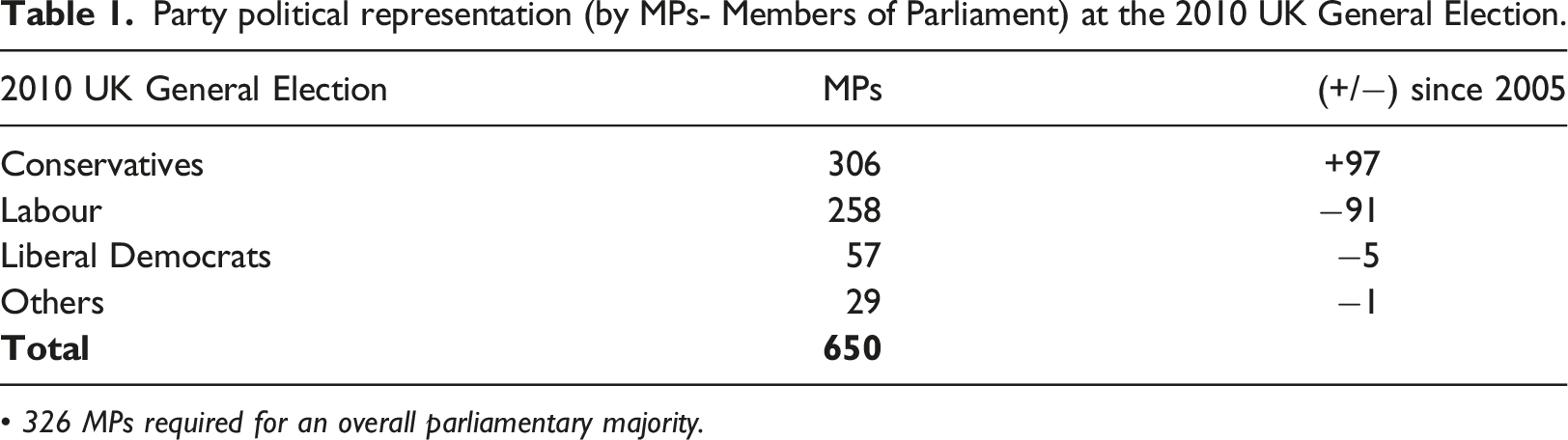
• 326 MPs required for an overall parliamentary majority.
Free schools – policy origins
During the Conservative Party’s sustained spell in opposition after 1997, there was a significant period of introspection regarding its political identity, focus and purpose. Within this context, one such policy area that the Conservatives sought to address in terms of re-formulating a refreshed message and image was in the specific realm of educational provision. Educational policy had the potential to impact on large swathes of the electorate, and was identified as a key social element within the concerted strategy of the Cameron leadership to ostensibly ‘detoxify’ the party’s brand (Rentoul, 2015). By focussing on issues with a more ‘communitarian’ and social emphasis, and addressing previous claims of social policy neglect, Cameron sought a more ‘compassionate’ image for his party (Norman and Ganesh, 2006). In doing so, Cameron sought to cultivate a refreshed perspective and modernised social policy agenda that aspired towards greater social justice, enhanced social mobility and improved educational opportunity, while also aspiring to reduce the role of the centralised, bureaucratic state. This was a challenging target, and during his acceptance speech on winning his party’s leadership in late 2005, he had remarked that while ‘society' was important, ‘it was not the same as the state’. This appeared to deliberately rebuke Thatcher's language of the 1980s, and such sentiments formed the crux of modernised Conservatism’s efforts to devise an alternative and viable counter-narrative to New Labour’s more ‘statist’ social policy legacy.
Within this context, in 2010, the Conservatives inherited a scenario that had been impacted by New Labour’s progressive investment of public spending into core educational provision. Indeed, despite some initial caution, investment in education had steadily grown and averaged 3.9% a year during Labour’s period in office (IFS: 2010), with funds pumped into core buildings and infrastructure from a largely centralised and interventionist ‘command and control’ model of government. This approach had generated broad public support for such investment, building on Tony Blair’s populist ‘education, education, education’ pledge in 1997 (Butler and Kavanagh, 1997), and this educational emphasis was noted by Cameron and his fellow modernisers as they sought to widen electoral support. However, New Labour’s approach to such key social policies had also retained aspects of local autonomy in pragmatic recognition of the significant educational reforms of the Conservative administrations between 1979 and 1997, and one academic perspective claimed a degree of cross-party (post-1979) continuity in that ‘New Labour took the Conservative infrastructure (on education policy) and gave it meat and teeth’ (Exley and Ball, 2011: 110).
Blair and New Labour’s post-1997 educational initiatives therefore entailed major capital expenditure from the centre of government, a prime example being the ‘Building Schools for the Future’ (BSF) policy, which emerged during Labour’s third term in office from 2005 onwards and which boldly sought to eventually rebuild/refurbish all of England’s approximate 3500 state secondary schools. With an estimated initial cost of a generous £55 billion, this was evidently aligned with the party’s 1997 high-profile emphasis on educational investment. Yet in also acknowledging the neo-liberal legacy of the 1980s, while a significant degree of centralised funding was a consequence of this policy, the use of Private Finance Initiatives (PFIs) to deliver aspects of it reflected a pragmatic acceptance of the market-driven influence on the traditional model of state intervention and investment in public services, although not always at the best value for taxpayers’ money (Connolly et al., 2008). Nevertheless, the policy’s main thrust represented a more prominent co-ordinating and investment role for the ‘big state’ in comparison to the Thatcher era in particular.
Consequently, the significant degree of centralised planning and bureaucracy that accompanied the BSF policy initiative generated criticism from the then Conservative opposition, who claimed that a future Conservative administration would tackle such ‘statist’ tendencies arising from Labour’s approach being overtly ‘managerial in its conception of both the private and public sector’ (Glasman and Norman, 2012:11). Consequently, the axing of BSF was one of the first major decisions taken by Michael Gove after becoming Secretary of State for Education in May 2010, with rising financial and bureaucratic costs cited as core factors as to why the programme was no longer justified in an era of economic austerity. Within the context of such austerity and a revived emphasis on fiscal conservatism, there was consequently a Conservative Party re-focus on social policies that would provide enhanced value for money for the taxpayer, create a ‘post-bureaucratic’ smaller state (Williams, 2012), while instilling more individualism alongside a ‘modernized’ conservative variant of compassionate social justice. Educational policy was traditionally a significant area of public spending amidst a more comprehensive welfare state, and this subsequently aroused Conservative interest in a more efficient and cost-effective approach (originating on the European continent), namely, the ‘free schools’ initiative. The 2008 global economic crisis was a particular turning point in this policy’s evolution, when an era of austerity was initiated, re-emphasising the need for a more frugal, enterprising and innovative model of government and associated policy-making.
The free schools policy could said to have been specifically derived from and influenced by the socio-political experiences of Sweden from the early 1990s onwards, which in this period elected a non-socialist government for the first time since the 1930s, and as a result of this radical political swing the country’s long-established and centralised welfare model and bureaucratic educational system came under renewed scrutiny. This development seemed to indicate that the global influences of ‘Neo-liberal politics (had) come to Sweden (Wiborg, 2010: 8), with its ‘Scandinavian model’ of historically generous welfare spending, although rather belatedly in the context of the New Right hegemony that had already notably impacted both Britain and the USA during the 1980s. Yet such free schools or similar variants of them had also been trialled in other countries such as Finland, Canada and the United States, and their principal innovative aspect was the decentralised alternative structure to policy delivery by the bureaucratic state. The localised role and focus of such bodies would supposedly remove the cost and inefficiency of centralised bureaucracy, respond to local needs, while ultimately providing better value for money for taxpayers in the long term.
This model of education had therefore experienced significant growth in Sweden, with numbers of pupils in free schools increasing ‘from 20,247 pupils in 1995/96 to 95,948 pupils in 2009/10’ (Wiborg, 2010: 11), with such a rapid expansion stemming from enhanced autonomy from centralised state control, while potentially increasing educational standards, social mobility and individual choice. Such policy trends consequently emerging in Britain have been described as departing from ‘a more managed Labour response’ regarding educational policy-making after 1997, and instead moving towards ‘a more libertarian Conservative one’, (Exley & Ball, 2011: 112) as such schools were permitted to utilise a more diverse and devolved range of functional mechanisms to raise standards and efficiency. The intention was therefore for private and community sector interests to be given greater opportunity to access and dynamically influence the delivery of state educational services and provision; in turn undermining the traditionally (post-war) hegemonic role for the state in this respect, yet there has been considerable political, practical and institutional resistance to this developing in the specific manner envisaged by its advocates.
Justifications for the free schools policy
From the outset of his party leadership in 2005, David Cameron aspired to develop innovative policies that would generate wider public and electoral support in order to avoid an unprecedented fourth consecutive Conservative general election defeat. Regarding free schools, Cameron’s Shadow Education Secretary Michael Gove emerged as a key figure within the policy’s evolution, justifying his support for this re-modelled concept of public service provision by attacking Labour’s record in this policy area after over a decade in power. He was also enthusiastically supported in such initiatives by notable special advisers such as Dominic Cummings, who has since gone onto prominence as Boris Johnson’s Chief Adviser during a key part of his premiership (2019–20). Apparently damning statistics that ‘almost half of children from deprived backgrounds leave school without a single good GCSE’ (Gove, 2008), provided apparent evidence that broader social and specific educational inequality had been maintained and even exacerbated under New Labour’s ‘statist’ public service agenda during its prolonged period in office. This bolstered Gove’s faith in the need for decentralised and devolved free schools as a part of radical alternative remedy, and indeed as the mechanism for instigating the vital socio-political dynamics of greater ‘social mobility’ and enhanced ‘social justice’ within traditionally disadvantaged parts of society. Such specific terms subsequently formed key elements of the vocabulary of ‘modern’ Conservatism in this social policy sphere. As Gove outlined in 2008: Schools should be engines of social mobility.…..the Swedes decided to challenge declining standards by breaking the bureaucratic stranglehold over educational provision and welcome private providers into the state system (Gove, 2008).
Gove’s confident assertion that greater competition and choice instilled by an influx of enterprising private involvement would raise standards struck at the heart of various fundamental conventions of the post-1945 welfare state, in particular his emphasis on enhanced localism and decentralisation rather than the entrenched ‘state knows best’ ethos. Gove cited evidence from Sweden to support his claims that such schools improved overall standards by instilling enhanced competition (Bohlmark and Lindahl, 2007), and he aspired towards the pre-1945 era when the state was less comprehensive in its remit, and where more diverse public service provision existed to provide enhanced choice for the citizen. Gove’s sentiments appeared to reflect some influence of the 20th century conservative scholar Michael Oakeshott (1975), who was a critic of the left’s state-centred approach to moulding people’s lives in a pre-determined way, and ultimately rejected such an artificial, state-induced ‘enterprise association’ (as he saw it), whereby the state imposed a universal purpose on its citizens. Oakeshottian thought instead envisaged the alternative distinct evolution of a more natural ‘civil association’ that is ‘organised as a communal enterprise or undertaking in its own right’ (Norman and Ganesh, 2006: 97). Yet to what extent such required social outcomes could occur due to natural local enterprise and autonomy regardless of the state’s co-ordinating hand has remained a key area of contention relating to the free schools policy.
Gove visited Sweden in early 2010 to witness how such schools practically functioned, and fuelled by supporting academic research, forcefully advocated a more diverse educational solution with an enhanced role for the private sector to instil greater choice for parents and pupils. This culminated in the policy’s distinctive inclusion in the 2010 Conservative Party manifesto, and its focus on promoting individual choice and wider social responsibility represented a distinct area of ‘clear blue water’ (Page, 2015) between the Conservatives and the outgoing Labour government in this particular policy sphere. This policy agenda subsequently emerged in practical terms from the 2010 Academies Act and the 2011 Education Act, establishing the initial principle that ‘if a local authority decides that a new school is needed, it must seek proposals to establish an academy, in the form of a free school’ (West, 2022: 306). Such developments could be therefore said to have transcended the New Labour academy agenda, with Cameron’s strategy utilising this (and other) social policy initiatives as a means of re-branding the Conservatives as a forward-looking and ‘modern’ political party, equating such policies with the seemingly dynamic if nebulous political value of futuristic ‘modernisation’, rather than Labour’s ‘statism, egalitarianism (and)…… backward looking repressive centralism’ (Page, 2015).
Following a period of planning and preparation that entailed 323 bids for free school status during 2010–11, the first wave of 24 free schools opened in September 2011, with a prominent example being the West London Free School, instigated by the author and journalist Toby Young and other local parents. The policy consequently escalated at a fairly rapid rate, and in November 2011, Cameron’s government announced a further £600 million investment for 100 new free schools in England over the next 3 years, even amidst an apparent landscape of austerity. A further fifty-five free schools were confirmed as opening in the autumn of 2012, (tripling the number in England), and reaching 79 overall (by wave two). This further expansion was part of a rolling process of applications for this status, with wave three established from February 2012 (for opening in autumn 2013). Those opening in subsequent phases of the policy’s roll-out during 2012–13 featured a diverse selection of groups including Christian charities, ex-soldiers, football clubs (an example being Everton FC in Liverpool, Merseyside), and existing private schools among those applying for the status. Within this rolling programme of free schools being established, of the provisional proposals for 102 new free schools approved in the summer of 2012, a third had a religious ethos, and Toby Young applied to open a further primary institution attached to his original West London Free School within the next phase of proposed free schools, primarily due to the ongoing high demand.
Free school challenges and criticisms
The initial wave of free schools that were established after 2010 faced a degree of hostility and opposition from some local authorities and mainly politicians on the left, largely fuelled by fears from this political perspective (supported by teaching unions), that what appeared to be a fragmented approach to educational policy delivery would erode the broadly egalitarian principles of post-1945 educational provision and its protection of minimum and uniform standards. Such educational standards were conventionally administered and regulated by the centralised state and its devolved (often left-wing) local education authorities, bodies whom Margaret Thatcher had previously noted was where ‘the real power lay’ in this policy sphere (Campbell, 2012:55). Free Schools advocate Toby Young has alluded to such hostility from left-wing politicians, commentators and teaching unions, with such opposition to the free schools ‘revolution’ triggered by its de-regulated nature that ostensibly by-passed various bureaucratic structures, established accountable mechanisms, and other prescribed procedures. A potential negative consequence of this policy (as highlighted by this viewpoint) was evident in the chaotic closure of one proposed free school in Yorkshire just days before its scheduled opening in autumn 2012. A further example of such de-regulation and potentially harmful avoidance of state bureaucracy emerged in early 2013 when the LGA raised concerns that free schools were not required to adhere to national food standards when providing school meals (LGA, 2013). Such institutional LGA criticism was often cross-party (indeed the LGA was Conservative-led at this point) and not just from left-wing Labour councils or politicians.
Perhaps the most fundamental criticism of free schools to emerge was that far from raising educational standards, improving quality and enhancing socially just outcomes, the policy had the potential to generate and re-enforce social divisions in its more arbitrary methods of educational provision, with fears raised that such schools were funded with resources removed from other pre-existing schools, with a lack of clarity how they would be joined up with other local schools and services. Indeed, one critical commentator alleged that the narrative driving this sphere of policy-making after 2010 could be compared to attempting to ‘break up and privatise English education’ (Milne, 2012). Other critical observations suggested that by replacing uniform, state-driven provision with local voluntary providers ‘the claim of (social) rights is reduced to an act of charity’ (Hattersley and Hickson, 2012), and such a policy stance potentially undermines the basic rights of citizenship to be provided with acceptable and standardised levels of welfare state support.
While convincing the broader political spectrum of the value of free schools was a considerable challenge in itself, the liberal left’s reaction to them, while largely critical, was not wholly uniform. Indeed, moderate Labour peer Lord Adonis argued that such schools can be aligned with Labour values (Adonis, 2012b), and that his party should pragmatically support their evolution and progression (Adonis, 2012a). However, while there were some tentative proposals for ‘parent-led academies’ under the leadership of Ed Miliband in 2013, the party’s position in 2015 was to oppose new free schools opening in areas where there were surplus school places. By 2019, Labour’s hostility to free schools had hardened under Jeremy Corbyn’s more left-wing leadership, with its position notably seeking to return powers back to local educational authorities. Labour have consequently pledged to ‘end the inefficient free schools programme and allow local authorities to open new schools in their area, backed up by new investment to ensure that every community can open new schools when they need them’ (Labour Party, 2019).
The Swedish experience of free schools also generated potentially negative implications, namely because according to some academic analysis it caused falling educational standards and social division. Such negative social patterns are claimed by some to have emerged in another Scandinavian country, Denmark, since it also embraced such state-subsidised free schools into the early 21st century (Wiborg, 2009). Such critical analysis of the policy has suggested that free schools and their focus on marketized, individual choice actually generate greater social injustice, segregation and ultimately discriminate against poorer members of society. This arises from critical claims that more deprived social groups are less likely to utilise opportunities stemming from such establishments in comparison with the better-educated and more thrusting middle classes and their enhanced ‘social capital’. By 2014, such trends were highlighted as an ostensibly concerning development, with ‘stealth selection’ allegedly taking place in such English schools according to research conducted by London University’s Institute of Education (Garner, 2014). This would appear to be the exact opposite of the desired policy outcomes as espoused by Michael Gove and other free school advocates.
Post-bureaucratic social (educational) policy?
Despite such criticisms, a notable benefit of free schools was said to be their initial popularity in meeting community/parental demand, while remaining under the ultimate control of the state, albeit within an explicitly more arms-length relationship. Such flexible educational provision therefore sought a more autonomous curriculum which in theory was accessible to the whole community, via a ‘post-bureaucratic’ and devolved service model to allow such institutions greater independence and freedom in prioritising core functions and decision-making on a daily operational basis, particularly regarding staffing, facilities management, curricular options and specific local requirements. The policy aimed to provide enhanced parental choice to parents in a consumerist style, which had some parallels with the prevailing Conservative neo-liberal attitudes of the 1980s and the focus on instilling greater competition within mainstream education.
This competitive ethos was originally established between 1979 and 1997 in the form of flagship Conservative educational policies such as grant-maintained schools, school league tables and city technology colleges; infusing a more individualistic and autonomous culture within educational policy that was maintained across various aspects of New Labour policy from 1997 onwards, notably within the academy programme. In many ways, the free schools agenda can be viewed as continuation of such neo-liberal policies which ‘roll back the state’ (to quote Margaret Thatcher in the 1980s). Yet free schools arguably sought to strike a revised balance between uniformity and diversity within the provision of state education in Britain, and in a rebuff to both the political left and right, the policy entailed an underlying inference that there had been insufficient educational diversity, quality and choice in previous years under both major parties in power.
For much of the period between 2010 and 15, the Cameron and Gove axis consolidated the radical and innovative edge to such a policy that aspired to eclipse the educational agenda of previous administrations of all parties, and the ethos of free schools had been integrated within the core narrative of the ‘Big Society’ agenda and associated ‘localist’ principles from circa 2009 onwards (Cameron cited in Sparrow, 2009). The Big Society’s broader focus on decentralised, voluntarist and community-led activity across a range of social policies, promoted greater individual responsibility detached from bureaucratic state control, and sought to generate ‘variety, experimentation and local innovation’ (Norman, 2010: 74). Free school advocates subsequently dismissed fears from those on the political left that the enhanced competition generated by such new schools would cause greater educational segregation, but would instead enhance choice and subsequently raise ‘standards all round….. (with such) new schools (acting) as a spur to their neighbouring maintained schools’ (Gove, 2008). Toby Young and notable right-of centre think-tanks such as Policy Exchange have echoed that free schools have acted as a catalyst to boost the performance of other schools close to their proximity (Young, 2015). Michael Gove was significantly one of Policy Exchange’s founders in 2002, representing a practical link regarding the evolution of free schools.
In offering educational provision that in theory benefits all social classes, and deriving from genuine grassroots demands where no previous institution existed, the free schools policy can therefore be viewed as distinct from what went before, including academisation; being consequently emblematic of the concept of post-bureaucratic politics in action. The policy has adopted the premise of a difference existing between public services and state provision, in the sense that neither is mutually exclusive to the other, and that effectively functioning public services can be delivered away from monopolistic state control. On a negative level however, anecdotal evidence from the application process to establish such free schools claimed that procedures are challenging and complex to such a degree that ‘there is a real danger that free schools become the sole preserve of those with the resources and capacity to take on such a huge undertaking, such as faith groups or independent schools’ (Blume, 2012).
This would suggest that the notion that everyone has equal potential to establish such a school is questionable, and that middle-class communities capable of ‘exploiting (their) social capital’ (Blume, 2012) to establish such educational institutions possess major advantages over poorer socio-economic groups. Yet to counter this, it has also been claimed that the policy is beneficial for lower social classes who are apparently guaranteed a proportion of places in such institutions due to the proposed non-selective nature. While such figures have varied, free schools pioneer Toby Young claimed that 25% of the first cohort at his West London Free School qualified for free school meals, which would suggest a diverse and varied social composition of its initial pupil intake. This compares favourably to the national average of 15.4% for free school meals as of 2019 (Department of Education, 2019).
Furthermore, prominent educational charities such as The Sutton Trust have consistently argued for enhanced opportunities being provided for bright students from disadvantaged backgrounds and free schools were subsequently identified as a vehicle for such provision, with a priority to ‘serve disadvantaged pupils (and) give preference to pupils from low income homes in their admissions criteria’ (Sutton Trust, 2010). The educational charity the New Schools Network (established in 2009 by Rachel Wolf), a former adviser to Michael Gove who went on to co-write the 2019 Conservative manifesto, has been a particularly significant organisation in its enabling and co-ordinating role in establishing free schools (Wilce, 2009). Such advisory and lobbying groups can be viewed positively as prominent and pro-active civic stakeholders, who are ‘authoritative voices….. undertaking further commissions to deliver initiatives’ (Exley and Ball, 2011: 109). Such apparently pluralistic policy formulation is therefore viewed by advocates of this policy as a positive and advantageous asset to be attached to the free schools policy; entailing both a decentralised and post-bureaucratic state structure and a revived civil society. This reflects an attempt to transcend the post-1945 ‘big state’ era, which resulted in autonomous and localised social policy providers being ‘largely pushed to the margins’ (Norman 2010: 27).
Applying educational decentralisation
Conservative Party interest in educational policy has evolved and fluctuated over time, and during the Thatcher administration from 1979 onwards, it was claimed that ‘education was not a priority’ due to initial economic imperatives (Chitty, 2004: 47). However, policy priorities shifted, with internal tensions emerging regarding educational policy during the 1980s, namely, between the radical neo-liberals who favoured more de-regulation, and the distinct brand of neo-conservatives who were ‘interested primarily in upholding 19 th century notions of tradition, hierarchy and social order’, (Chitty, 2004: 47) and who sought to retain some degree of centralised control of social policy. It can be ultimately argued that despite Thatcher’s own neo-liberal instinctive resistance to state intervention, it was Conservative Education Ministers such as Kenneth Baker (1986–89) who favoured maintaining a ‘strong state’ (Gamble, 1988) as a key tenet of the doctrine of Thatcherism, and which sought to retain some aspects of control over such core social policy matters from the centre of government in a more authoritarian manner.
It was this more ‘strong state’ variant of Conservatism thought (as opposed to de-regulated neo-liberalism) that consequently imposed some co-ordinating and moral standards from the centre during this period of Conservative political dominance, despite devolution in other aspects of educational policy. Such neo-conservative tendencies became evident in the emergence of key ‘centralising’ educational policies such as the National Curriculum in 1988 (still in place), and which to the dismay of more libertarian Conservatives represented an avowedly bureaucratic element of educational policy-making, taking up ‘nearly 370 hours of parliamentary time and (giving) the Secretary of State 451 new powers’ (Chitty, 2004: 51), a legislative duration that was noted as being ‘a post-war record’ (Campbell, 2012: 394). Over twenty years later its centralised function came under Michael Gove’s scrutiny, whose decentralising policy instincts it appeared to conflict with. With free schools only adhering to the core elements of this centralised curriculum and with greater flexibility in terms of the range and diversity of their subject provision, Gove launched a formal review into the ongoing functional role of the National Curriculum in early 2011, and subsequently indicated ongoing opportunities for more flexible, transformative and autonomous curriculum options for free schools, potentially enabling ‘a drastic scaling back of the national curriculum….. (amidst) the creation of new schools’ (Norman, 2010: 140).
In more intensely focussing on such specific social policy after 2010, David Cameron appeared to revive aspects of policy debates of the 1980s, yet with a revived philanthropic emphasis, paternalistic compassion and communitarian endeavour. Within such a context, a Conservative minister in charge of the implementation of the free schools policy from 2010 onwards described it in radical terms as ‘a grass-roots revolution’ (Hill, 2012), with the policy’s most enthusiastic supporters claiming it transcended the 1980s policy agenda, with the ‘revolutionary’ nature of its bottom-up approach its key innovative aspect; with anyone in theory able to instigate such a school, conditional on the required localised organisation and facilities and negotiated/secured funding from government. Prominent media commentators from the libertarian right subsequently proclaimed the establishment of free schools as ‘a ‘triumph’, particularly their rapid introduction between 2010 and 15, alongside the fact that many have struggled to keep up with demand fuelled by demographic shifts in some locations. This radical vision of educational provision therefore promoted post-bureaucratic individualism, meeting localised needs, diluting previously dominant centralised state control (Nelson and Norman, 2011), yet still formally part of the public sector. On this basis, key regulatory bodies such as OFSTED have maintained a monitoring role, with the Secretary of State retaining the power to suspend any free school that appears to be in breach of the terms of its ‘Articles of Association’.
Yet from a more critical angle, it has been suggested that far from liberating schools from centralised state control, such regulatory elements of a financial and bureaucratic nature remain an inevitable aspect of the British education system, despite the decentralised mantra diving this educational policy (Jenkins, 2010). It has therefore been argued that pure ‘devolution’ of this social policy is extremely difficult to achieve in practical reality due to the requirement of basic minimum standards and state regulations being adhered to, for example, the continued application of the centralised National Curriculum (since 1988), or the regulatory monitoring of standards by OFSTED (formed in 1992), as obvious examples. This led to criticisms that the free schools policy has adhered to many existing practices and was unrealistic in its de-regulatory aspirations, as a genuine and credible educational policy simply cannot be as radically decentralised as its most enthusiastic advocates have claimed. The policy therefore became something of a paradox in practical terms, with all free schools established being reliant on central government funding, accountable to ministers and civil servants, and monitored through financial agreements from Whitehall.
Such specific criticisms therefore suggest that despite the radical rhetoric associated with the free schools policy, the practical reality has been somewhat different in terms of detaching such localised institutions from centralised state control. One commentator remarked that the extent of such control under Michael Gove was ‘not so much socialist as Soviet’ (Jenkins, 2012), with the central Whitehall machine undemocratically transcending the conventional role previously held by local authorities in the educational funding process, which appears to contradict the localist and accountable aspirations of the policy. The post-2010 government was subsequently criticised by the Labour opposition for prioritising financial investment to the roll-out of free schools, as opposed to more comprehensive and ‘catch-all’ educational funding initiatives such as the abandoned ‘BSF programme. This allegedly resulted in poor value for money and low student numbers in some such bodies, within one commentator describing them as part of an ‘expensive state school movement’ (Jenkins, 2012), which have lacked experimentation and liberation in many cases (ironically given the policy’s core aims), thereby creating a two-tier and segregationist structure where free schools have often failed to integrate with existing local educational institutions.
Free schools and coalition tensions
The internal dynamics of coalition government arguably blunted the policy’s more radical edge and potential implications, with the Liberal Democrats’ scepticism towards it appearing to restrain its more radical potential features. Consequently, this could perhaps explain why significant state bureaucracy and restrictions remained from the centre of government between 2010 and 15 in relation to whether such schools could make profit, limiting the scope and range of educational commercial freedom, although existing fee-paying private schools could apply for free school status while still charging for admission. Such limitations and conditions could be notably linked to the influence of Deputy Prime Minister Nick Clegg, and while such restraints were applied during the period of coalition government at least, the vision of establishing a wave of free schools for profit in the future remained an aspiration for the more radical advocates of this policy. Such radicals aspired for a scenario whereby if free schools were successful over time, then future governments could establish ‘for-profit’ Education Management Organisations to own and operate swathes of free schools, as is the case in Sweden and some American states. Politically right-leaning think-tanks such as the IEA have advocated that the longer-term implications of this policy has clear potential to instil an inherent profit motive within the delivery of state education, which they argue will further raise overall educational standards (Sahlgren, 2010), although this remains to be seen.
The coalition government’s internal divisions in relation to the competitive, commercial and selective values of free schools ultimately exposed a long-standing political tension and debate within British politics. This tension derives from whether delivering core public services on a comprehensive, universal basis is preferable to the alternative of allowing greater diversity within public service provision to meet specialist individualistic and commercial requirements, with supporters of free schools claiming that such commercialism is the decisive dynamic behind educational improvements. This was specifically evident in Michael Gove’s experimental approval of the free school IES Breckland in Suffolk (in autumn 2012), by a Swedish private (‘for profit') company. While in legal terms free schools were not permitted to be run entirely for profit, such private organisations could utilise and maximise their commercial expertise to ‘buy in' more services from private firms. However it was noted by 2018 that this specific school was losing money over a sustained period (Whittaker, 2018), and although this example appeared to be a notable breakthrough for private involvement in the state education system, such explictly commercial initiatives were limited by legal issues and coalition friction. This ultimately stemmed from disagreements as to whether such profit aspects automatically equated to either improved public services, or indeed was wholly aligned with the communitarian emphasis of Cameron’s broader ‘Big Society’ agenda.
Michael Gove’s more vigorous ideological emphasis was often a cause of coalition friction, and which was in turn moderated by the caution of the Liberal Democrats alongside more flexible Conservative political figures (leading to Gove being ousted from his educational Cabinet role in 2014). Personalities aside, the policy was adjoined to the practical necessity of maintaining a degree of state control and accountability while managing the various coalition dynamics and such personal and institutional factors collectively reduced the pace of its reforming zeal. Nevertheless, despite coalition tensions, the educational policy sphere became a key testing ground to implement various socio-political initiatives, stemming from a belief that the establishment of free schools would progressively come to transform the way the wider British public views the provision of public services in the longer term, and particularly beyond the lifetime of the 2010–15 coalition administration.
Impact and legacy of free schools policy
Existing state bureaucracy coming into conflict with private commercial interests is arguably inevitable in the management and reform of public administration in critical public policy like education. This can be linked to the sociological theories of prominent German social scientist Max Weber in the early 20th century (Weber, 1922) who observed that a more ‘bureaucratized society’ steadily develops due to the growth in size and complexity of states and communities, which therefore suggests that the aspiration of a wave of ‘post-bureaucratic’ free schools is not based in practical reality given the varied complexities of 21st century western society. In the sphere of English education, this is a particularly pertinent argument given that between 1979 and 2000 there were ‘over 30 separate Education Acts, together with large numbers of accompanying circulars, regulations and statutory instruments’ (Chitty, 2004: 33). However, advocates of free schools would claim they can overcome such complexities with more ‘radical’ post-bureaucratic tenets such as hiring teachers without formal teaching qualifications, quicker start-ups, the lack of conventional educational buildings, more flexible curriculums, as well as enhanced commercial autonomy.
In focussing on decentralised and more localised policy-making, the free schools policy broadly embraced some traditional Conservative political priorities that yearn for a pre-1945 model of society where mutualism, localism and enhanced local autonomy thrived before the comprehensive, hegemonic and largely universalised welfare state was constructed. From a later era, such New Right principles that desired a smaller centralised state also suggest that such a policy would not have looked out of place if it had been initiated amidst the zenith of Thatcherism in the 1980s. Indeed, there have been various arguments made that the free schools educational flagship policy of 2010–15 consolidated the Thatcherite outlook of the 1980s, yet while also instilling a sharper focus on ‘society’ and ‘incorporated elements of communitarianism’ within a ‘re-imagined state’ (Exley and Ball, 2011: 101), which has revised the conventional structures and relationships both within and between central and local government.
Within this analysis (and despite its enhanced focus on ‘society’), the free schools policy embodies a more radical political strategy from the right of the political spectrum that has undermined the structural basis of the post-1945 ‘social democratic’ model of the British state and its previous tendency to expand. In the process it has challenged a liberal left perspective at the heart of the post-war political consensus that ‘a large state was a guarantor of good public services and social well-being’ (Norman, 2010: 26). Yet a vigilant and critical counter-argument from the social-democratic perspective would rather claim that the ideology behind free schools is potentially ‘dangerous….. in its genuine belief that charities and volunteers, rather than the state, can and should provide numerous, core public services’ (Kisby, 2010: 490). A further distinctive interpretation is that the ‘collectivist’ and ‘mutualist’ influences stemming from ‘The Big Society’ and its aligned policies such as free schools, have in fact diluted the 1980s Conservative ‘free-market’ agenda, with greater social emphasis distinguishing the policy from the individualistic ethos and arbitrary variables of the neo-liberal 1980s. Within this viewpoint, free schools entail some aspects of the more paternalistic ‘One Nation’ Conservative tradition, particularly in response to criticism from the left that they cater for a primarily affluent and middle-class market, with its advocates instead claiming that all such bodies guarantee significant quotas of their intake from poorer sections of society.
This again indicates interventionist, bureaucratic elements directing and moulding this policy framework, suggesting that completely decentralised, de-regulated and devolved decision-making is not practically feasible in terms of meeting wider social and inter-connected community needs. This perhaps exposes the paradoxical element at the heart of the free schools policy initiative, namely, that such a localist policy requires the state to initiate and monitor the decentralisation and devolution of power and to maintain ongoing influence, albeit streamlined, in the effective functioning and funding of the policy. The policy does however correlate with previous post-1979 Conservative governments in at least minimising and diversifying centralised state control, while ostensibly extending meritocratic opportunity to all pupils regardless of social backgrounds, as aligned with past Conservative policies such as the assisted places scheme and the party’s ongoing affinity with selective grammar schools.
Conclusion: Overview and outcomes
Number of free schools in England (approx.).
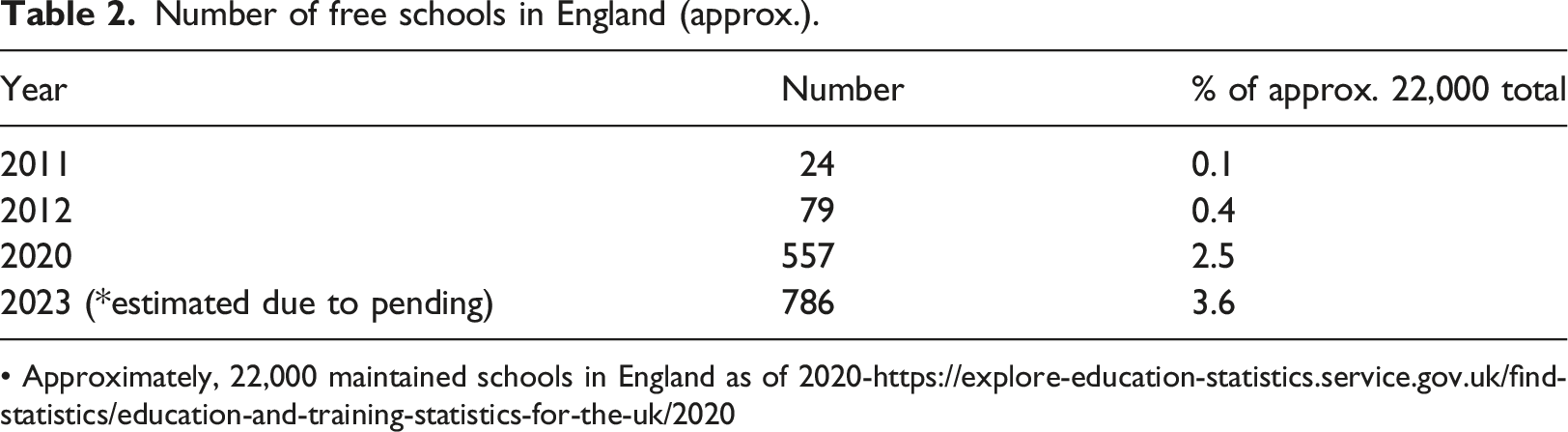
• Approximately, 22,000 maintained schools in England as of 2020-https://explore-education-statistics.service.gov.uk/find-statistics/education-and-training-statistics-for-the-uk/2020
A quixotic fusion of traditions and influences has shaped this social policy’s formulation and distinctive evolution, with tensions evident between pragmatism and ideology. Such variable influences ultimately suggest an ambiguous undertone to the overall image, identity and legacy of free schools, and a compromise position could be that the policy came to represent a degree of ‘common sense and a new perspective (rather than)….. more ideological commitments’ (Norman, 2010: 141). Innovations attached to the free schools policy could be said to have created a more ‘competitive education quasi-market’, (Leeder and Mabbett, 2012: 134) causing further eruptions within educational policy that will be hard to reverse in ensuing years, given the volume of roll-out and considerable public support for such bodies by 2015. Such developments suggest that a distinct and new political consensus will subsequently emerge on this issue, as the Swedes indeed discovered after 1992, and indeed the policy has continued beyond Cameron and the coalition, further consolidated by Cameron’s Conservatives in office alone (2015–16), and then to varying degrees under ensuing Conservative-led premierships of May, Johnson, Truss and Sunak. The policy has created further distinct and variable units within England’s educational structure in the long term, nestled alongside local authority comprehensives, grammar schools, university technical colleges and academies, etc., in providing an increased diversity of schools via a broader range of providers rather than a hegemonic state monopoly. This has accelerated the emergence of a ‘patchwork quilt’ appearance for an increasingly fragmented English model of state educational provision. While demand has been geographically variable, outcomes have been mixed. In terms of outcomes, a positive perspective is that free schools are ‘more likely to be rated Outstanding by Ofsted….. (be popular) with pupils outperforming peers in other schools at Key Stage 4’ (NFER 2021). However, critics respond by stating that there are fewer positive outcomes at younger age groups (primary), with cities benefiting more than non-urban areas. Additionally, some such schools have been unnecessary, some not socially representative, with resources allegedly coming at the expense of more established state schools within the proximity, while investment has slowed down in recent years (Millar, 2021).
Over a decade since the practical inception of free schools across England, there have evidently been practical limits linked to funding, demand and school numbers/places, while value for money and profit motives remain contentious aspects in terms of ethics, for example, should money/finance be a consideration in providing such a critical social and welfare policy, linked to basic citizenship rights. Indeed, it has been variously noted that such policies fuelled by devolved, quasi-private bodies do not always automatically equate to the wider public good or broader social benefit, with ‘parental preferences over education….. not fully aligned with the public interest’ (Leeder and Mabbett, 2012: 134). As a definitive legacy of the 2010–15 free schools policy agenda therefore, ongoing tensions remain regarding the measurement of outcomes, the extent of civic engagement, commercial profit motives, parental self-interest and practical choice for pupils, as well as competition within and between such educational institutions. With free schools now a distinctive and gradually expanding part of the educational landscape in England in the early 21st century, such dynamics are likely to continue to interact as the policy evolves and develops further in the years ahead.
Footnotes
Declaration of conflicting interests
The author(s) declared no potential conflicts of interest with respect to the research, authorship, and/or publication of this article.
Funding
The author(s) received no financial support for the research, authorship, and/or publication of this article.
