



Abstract
Inevitable and constant change is challenging school systems worldwide, and COVID-19 has further intensified the debate on the future. This article examines the possible futures of Finnish comprehensive schools through three scenarios generated by analysing data from a Delphi panel of 30 Finnish experts in the field of education. This study contributes to two major intertwining debates: first, who or what determines the content and goals of the curriculum. The study’s theoretical framework builds on the curriculum as a social practice model, which views curriculum work as interwoven layers and sites of practice. Another topical debate concerns the tension between powerful knowledge and competences in the curricula. This is explored through Young and Muller’s model of three types of knowledge: knowledge of power, tacit knowledge and powerful knowledge. The results show that Finnish comprehensive schools have various substantially divergent trends. In the three scenarios, the role of the teacher as a curriculum maker varies from non-existent to a strong interpreter. International policy flows can be transferred to schools to varying degrees. The three types of knowledge included in Young and Muller’s model can be recognised in the three scenarios. Competences can be identified as learning outcomes in all scenarios, but the intensity varies. Scenarios are not predictions of the future or policy recommendations but an efficient tool for provoking strategic debate, generating new visionary thinking and considering the need for system-wide change in education.
Keywords
Introduction
The rapid change in the world challenges education in many ways, and it also challenges us to imagine possible futures for school. The core question is what the goals of school should be in the future – in an era of wicked problems and an almost unlimited amount of information. How do we educate young people to live in such a complex world, face the complexity and find solutions to problems brought about by trajectories such as climate crisis, digitalisation and globalisation? That leads us to two major questions: what knowledge and skills should be developed in school, and how do we create a curriculum to achieve this? Answers to these core questions of education depend on who is responding and deciding and what their vision of the future society is. Futures studies may help us to anticipate and reorganise the ways we make the curriculum and our pedagogical practices in order to meet the future needs (Tesar, 2021).
Great visions of tomorrow’s education models seem to be based on the work of global political or economic actors, such as the Organisation for Economic Co-operation and Development (OECD) or European Union (EU), and ICT companies and their agendas and values (Lingard, 2021; Mertanen et al., 2021). This causes concern since most educational scholars, practitioners and parents view education as having tasks and functions beyond politics or economics, such as developing students as human beings and cultivating their personalities (Andrews et al., 2014; Miettinen, 2019; Värri, 2019). Curriculum theorists participate in the discussion from varying philosophical and theoretical perspectives. Their views on what school education’s goals should be seem to be polarised, with an emphasis on either competence or knowledge (Deng, 2021; Young, 2016). National school curricula are constructed in the midst of these driving forces, as multi-layered social practice that reflect the political, economic and social conditions at a given moment in history (Priestley, 2019: 8). The immediate, sometimes pressing, concerns of the present may hinder our ability to see possible futures. Therefore, we need future-oriented thinking in designing education, which is especially crucial in school which forms the educational base. A more nuanced understanding of the curriculum as a concept and of the practices associated with constructing the curriculum, that is curriculum making, can help us anticipate, forecast and design future schooling.
According to Young (2016), futures thinking is not widespread in educational research. However, if futures research is carried out, the social changes in society or the role of knowledge in the school context are usually not considered (Young and Muller, 2010). In this article, we aim to contribute to this gap and foresee the possible futures of Finnish comprehensive school (basic education) to understand the possible evolution of the educational system as a part of society. We present the results – three future scenarios of a Delphi study conducted in 2020–2021 in Finland – and analyse the scenarios from the perspective of curriculum development and curriculum making. The scenarios link the future to the present by describing possible pathways that different choices could generate. We consider the National Core Curriculum (NCC) changes that might occur in different scenarios. In particular, we focus on the relationship between competences and (powerful) knowledge in the curriculum. In addition, we examine how the impacts of actors at different levels of curriculum making might take shape, the role of global actors such as the OECD or the European Union, and on the other hand, teachers as curriculum makers.
Curriculum as future scenario
In many countries, the school curriculum is a crucial instrument in steering the direction of the developments of the nation. As such it may be considered as an educational future scenario, showing possible pathways and trajectories from the present towards the desired future. Therefore, it is always regulated by certain political, economic and societal conditions and reflects power relations and struggles in society (Rokka, 2011; Tervasmäki and Tomperi, 2018). In research on curriculum, it has been viewed as a multi-level and nested entity (Deng, 2012; Doyle, 1992) and lately more and more as something that is made in complex social practice across multiple activity sites (Priestley et al., 2021a). National school curriculum making takes various forms, for example, the production of national policy frameworks, the development of programmes of study in schools and other educational institutions, and the transactional curriculum that occurs as teachers and students engage pedagogically in classrooms and other learning spaces. Recently sites of supra curriculum making with actors such as the OECD generate discourses that are global in scale but affect local meso and micro sites of curriculum making, such as educational institutions’ curricular programmes and eventually nano curriculum making in classrooms between teachers and their students (Priestley et al., 2021a). According to Nyyssölä (2022), supra-level influence on local policies is a strengthening trend in the future.
Curriculum is a complex conversation (Pinar et al., 1995) where some voices gain more influence than others. In the new millennium, achievement tests such as The Programme for International Student Assessment (PISA), 21st century learning and the debates about the role of knowledge and competences in the curriculum have dominated the European conversation about the present and future school curriculum. In these debates, concepts such as transversal competences and powerful knowledge have been represented on seemingly opposite sides of the debates. The competence movement expressed its concern about school systems already in the 1990s. Are they adhering to subject-based education, or are they able to provide young people with the skills needed to participate in the knowledge society effectively – namely, how to manage complex issues, collaborate, communicate, problem-solve and adapt to unexpected situations in the future (Author et al., 2003; Biesta and Priestley, 2013; Deng, 2021; Greiff et al., 2014; Kuhn, 2005; Willbergh, 2016; Vainikainen and Nilivaara, 2022)? The desire to update school systems for the new millennium led to similar projects simultaneously worldwide and, consequently, to various frameworks to solve the same problem. Well-known frameworks are the 21st Century Skills and the Key Competencies (e.g., DeSeCo, 2001; European Union, 2006; Griffin et al., 2012; Pellegrino and Hilton, 2012; Rychen and Salganik, 2003). These models share many common features. They are cross-curricular; hence, they are not directly linked to any specific discipline but are relevant across various fields and utilise high-order skills and behaviours to cope with complex problems and unpredictable situations (Vainikainen and Nilivaara, 2022; Voogt and Roblin, 2012). In recent years, the original models from the beginning of the millennium have been updated, especially underlining the impact of technological development and the climate crisis (e.g., European Council, 2018; OECD, 2019).
At the same time, with the global implementation of competences in education and national curricula, criticism and worrying debate have arisen on whether schools have forgotten the knowledge base and the traditional role of schools in ensuring equitable access to the sources of knowledge for all (Biesta, 2010, 2014; Young and Muller, 2016). In particular, educational sociologist Michael Young and his colleagues have defended the importance of organised school knowledge in curricula, pointing out that competences such as critical thinking cannot be learnt in isolation from scientifically researched and structured powerful knowledge (Young, 2016; Young and Muller, 2010). Young and Muller (2010, 2016) have formulated three alternative visions of how knowledge will emerge in future schools. The first vision, which they call knowledge of power, considers that learning is based on power relations and teacher-centredness. Knowledge – taught in a strongly subject-specific way – is not questioned, but the teacher acts as the authority on knowledge. The social construction of knowledge is not reflected in the classroom but is relatively static. In the second vision, knowledge is mainly everyday knowledge constructed with other students, with the teacher acting as a facilitator. The emphasis on everyday knowledge is seen as linked to competence thinking and the modern socio-constructivist and student-led approach to learning (Young and Muller, 2010). According to the scholars, the third form of the curriculum is ideal: it is based on powerful knowledge, which is abstract and specialised in nature (Young and Muller, 2010, 2016).
Young and Muller (2013) define knowledge as powerful when it enables students to go beyond their everyday knowledge and experiences. Subject-specific knowledge provides the basis for learning, but powerful knowledge, being broad, nevertheless helps the learner develop an overall understanding of complex issues by learning the disciplinary concepts. Powerful knowledge is also considered to create opportunities for students to actively build their thinking skills and skills for managing their own lives (Lambert, 2017; Niemelä, 2021a). The concept of powerful knowledge has been questioned and further considered in the curriculum context (e.g., Carlgren, 2020; Deng, 2018; Niemelä, 2021b).
White (2018) criticises the concept of powerful knowledge for its vagueness and asks whether it is possible to identify whether knowledge is powerful in all subjects. He questions whether access to knowledge is the fundamental task of school, pointing out other aims, such as personal growth and practical know-how. Deng (2018) argues that insofar as the cultivation of powers is the underlying aim of school, knowledge should be seen as a resource for cultivation, rather than an object of learning as such. Carlgren (2020) suggests a shift from knowns to knowings, underlining the importance of teachers and teaching. Instead of knowns, knowing, including the tacit aspects, cultivates capabilities. Thus, powerful knowings could integrate knowledge-based and competence-based curriculum principles (Carlgren, 2020).
These ideas and flows from supra sites, transnational conversation and curriculum theory affect curriculum making through interpretation, mediation, negotiation and translation processes across multiple layers or sites of education systems (Petko et al., 2015; Priestley et al., 2021a). For example, school leaders and teachers engage in interpretation of the official curriculum in and for their local contexts in schools, seeking to make further sense of the national specifications and guidance, and in classrooms, as teachers and students negotiate and produce curriculum events via daily pedagogic transactions (Alvunger, 2015; Coburn, 2005; Soini et al., 2017, 2021). In recent years, there has been growing interest in teachers’ role and teacher agency in curriculum making (Biesta et al., 2015; Pyhältö et al., 2015). There is growing evidence that weak teacher agency and involvement in curriculum making result in a lack of ownership, an incoherent curriculum and, consequently, failure in educational development (see, for example, Sullanmaa et al., 2019).
Curriculum in the Finnish education system
The foundation of the Finnish system is equal and high-quality education that respects childhood and diversity throughout the country (Salonen-Hakomäki et al., 2016). The system aims to promote life-long and life-wide learning, holistic development and the well-being of all learners and to support a sustainable way of living at the individual and societal levels (Halinen, 2018; Kumpulainen and Lankinen, 2016). The Finnish curriculum system is based on both German Lehrplan and Anglo-American curriculum traditions (Rantala and Ouakrim-Soivio, 2018). It is a holistic hybrid model, including a general background, for example, values, learning conceptions and guidelines for organising teaching and learning in schools and the goals and content of the school subjects (Pietarinen et al., 2017; Nilivaara and Soini, 2022; Vitikka, 2009). The knowledge taught in schools is based on scientific knowledge (FNBE, 2016; Government Decree, 2012). Common national legislation and curriculum criteria guide action and development at the local level. There is, however, much autonomy enabling schools to make autonomous decisions and highly educated teachers to make pedagogical choices (Soini et al., 2017). The ethos of trust is a guiding principle, and national accountability testing does not exist in the Finnish system (Soini et al., 2017). Instead, assessment in schools aims to support learning and guide students on their learning paths, and the forms of assessment based on the national curriculum’s objectives are decided at the local level (FNBE, 2016). Though the differences in students’ learning outcomes and well-being between schools used to be relatively small (Yang Hansen et al., 2014), there has been a declining trend and according to the latest study results, the differences between schools, classes and individual students are still increasing (Bernelius and Huilla, 2021; Hautamäki et al., 2013; Kupiainen and Hotulainen, 2019; Leino et al., 2019).
Curriculum reforms are considered the central means of promoting continuous school development in Finland (Vitikka et al., 2012). The reform has been carried out approximately every 10 years when the Basic Education Decree and the distribution of lesson hours prepared by the Ministry of Education and Culture are decided by government changes. Drafting the national core curriculum is a task assigned to the National Agency for Education (FNBE) by law. Since the 1990s, curriculum reforms have been carried out in co-operation with national authorities, municipalities and schools. Thus, local stakeholders play a central role in interpreting, integrating and transforming the broad aims of the core curriculum into a local curriculum that emphasises the aims, content and values from a local perspective (Niemi, 2015; Soini et al., 2017). The National Agency for Education (FNBE) is responsible for coordinating the process. Agency officials usually have pedagogical training and long-term experience in education as teachers or principals (Vitikka et al., 2012). The recent core curriculum reform was especially participative and democratic in nature: a network of more than 300 stakeholders, including administrators, researchers, teacher educators, municipal education providers, representatives from associations, principals, teachers and other educational experts, was invited to participate in working groups working on different parts and content of the core curriculum (Airaksinen et al., 2017; Halinen et al., 2013; Vitikka et al., 2012).
The influence of competence discourse and global actors, especially the OECD and EU, from supra site can be seen in the current core curriculum in Finland. Finland integrated transversal competences into the National Core Curriculums revised in the 2010s from pre-primary education to upper-secondary education. Competences do not replace disciplinary knowledge but serve as dispositions beyond individual subjects and are the ultimate objectives of all subjects (FNBE, 2019: 60). In the Finnish National Core Curriculum for comprehensive schools, transversal competences are defined as an entity of knowledge, skills, values, attitudes and volition (FNBE, 2016). The Finnish model recognises students’ volition and engagement in using their knowledge and skills and acting appropriately in everyday situations (FNBE, 2016). Their use is influenced by the values and attitudes they have adopted. The foundation of transversal competences is the curriculum’s value basis and learning conception and the guidelines for school culture development. The fundamental goal of transversal competences is the student’s development as a human being and a citizen (FNBE, 2016; Halinen et al., 2016). Thereby, the goal appears to connect the transversal competences and the school’s educational, social, cultural and future-related tasks.
Curriculum making is challenging; despite participatory curriculum making, there seems to be a gap between supra-level goal setting/policy and micro-level experiences of teachers trying to implement the curriculum. In particular, teachers have found it challenging to integrate transversal competences into subject-specific teaching and learning (Saarinen et al., 2019). Hence, there seems to be a gap between supra discourses and microsite reality and misfit between adopted principles of the school curriculum and conditions regulating pedagogical work in schools, such as challenges faced in families and problems in student as well as teacher well-being observed lately in Finland (Pyhältö et al., 2021; Tikkanen et al., 2020; Välijärvi, 2017). These challenges reflect economic conditions and, hence increasing inequality in Finnish society (Bernelius and Huilla, 2021; Pulkkinen, Rautopuro and Välijärvi, 2018; Välijärvi, 2020). Moreover, in Finland, digitalisation and inclusion are major changes that challenge teachers’ work and competence (Hienonen, 2020; Nyyssölä, 2022). The phenomena can simultaneously complicate and open up opportunities for learning and skills acquisition in schools (Nyyssölä, 2022). There is a need for more discussion and shared sense-making in terms of the future of Finnish schools and how school curriculum as future scenario should take these developments into account.
Aim of the research
In this study, we identify future images and formulate scenarios for comprehensive school based on Finnish education experts’ perceptions of future schools. The scenarios are analysed from the perspective of curriculum development and curriculum making. We consider the changes that the different scenarios might bring to the National Core Curriculum (NCC), focussing on the constellation of the curriculum in terms of competences and knowledge. In addition, we construe how the impact of actors at different levels in curriculum making might take shape. The following research questions are addressed: 1. What are the scenarios for the future of Finnish comprehensive school? 2. What are the levels and layers of actors defining the curriculum making based on scenarios, especially? What is the role of the supra level in the future Finnish school curriculum? What is the teacher’s role in curriculum making? 3. What is the relationship between competences and disciplinary (powerful) knowledge in the future Finnish school curriculum? 4. What level of curriculum making defines the curriculum’s objectives and content?
The study
Delphi as a tool for futures research
In this research, we used Delphi, an expert technique and survey method that generates tacit knowledge and insights about future possibilities and alternatives. In the Delphi process, experts relevant to the topic are brought together to work on a complex problem, and their opinions and communication are refined into knowledge (Linstone and Turoff, 2002). The expert group, called a panel, takes positions about the future theses stated by the researcher. Typically, in Delphi, theses are assessed along two dimensions: desirability and probability. Initially, the Delphi method sought consensus among experts on what the future might look like. It is achieved by iterating rounds of Delphi until consensus is reached. Today, Delphi policy more often seeks polyphony and diverse responses, thus providing multiple perspectives on the future (Needham and De Loë, 1990; Yousuf, 2007). Finding divergent views was also the aim of this study.
Participants and data collection
The panel’s composition represents the purposeful sampling technique, as the participants were selected based on their expertise and experience. Purposeful sampling is a relevant technique when the aim is to gain deep and comprehensive insight into the topic under study (Palinkas et al., 2013; Patton, 2002). Kuusi (2017) states that the panellists’ expertise is a more critical quality factor than the number of participants.
The panellists (n = 30) were Finnish experts in various areas related to education and learning: researchers, policymakers, governance and implementation, and representatives of parents and NGOs. The panel’s composition was in line with the traditional assembly of the bodies involved in the Finnish curriculum process. When constituting the panel, the diversity and equity of background organisations, gender and regional distribution were considered. Of the 35 panellists invited, 30 eventually participated and responded to the theses. In this case, both the number of participants and the diverse expertise of the panellists are considered acceptable. (see Kuusi, 2017).
The future time horizon chosen for the study was 20 years because of the slow pace of school change and the desire to get respondents to think about the future with sufficient openness. For the Delphi panel to argue, 12 theses were formulated by the researcher to describe the possible state of basic education in 2040. The formulation of the theses was preceded by an environment scanning, in which weak signals and drivers of change were recognised. The Finnish Future of Learning 2030 Barometer (Airaksinen et al., 2017) was the basis and megatrends such as digitalisation, demographic changes, strengthening relational power, and ecological reconstruction (Dufva, 2020; Dufva et al., 2020) were also considered. The megatrends are endorsed by the Finnish National Agency for Education (Nyyssölä, 2022) and they can be identified also as trends in the grassroot development in Finnish schools. The perspective of the schools was identified through the media and social media, looking at the topics emerging in the current debates. The primary sources were the social media forums in the field of education, the Finnish Teachers and Educators Forum (19 500 members) and the Alakoulun aarreaitta (42 900 members), which mainly represent teachers.
In this policy Delphi study, the theses were structured in an argumentative way, expressing a statement of the future situation balancing different perspectives and arguments against each other. The aim of this policy Delphi is explicitly to produce the strongest possible opposing views on the possible futures of key policy issues (Linstone and Turoff, 2002). Here are some examples of theses presented to the panel: ‘The curriculum is being reformed frequently to meet the evolving needs of the society and working life’. ‘The eco-social awareness is the basis for all the school activities’.
The panellists numerically assessed the desirability and probability of the theses using a scale of −7 – +7. In addition, the participants were asked to explicate their choices verbally. As the aim was not to seek consensus but to make diverse views visible, the study was conducted as a single-round, real-time Delphi. The panel experts’ responses were anonymously available for all to see throughout the panel. In addition, participants were allowed to comment on each other’s arguments and freely modify their answers while the forum was open. The panel was carefully monitored by the researcher to follow ethical research guidelines (Finnish Advisory Board on Research Integrity, 2012, 2019) and to avoid any harm or insult to the participants. The researcher’s role as panel manager in the Delphi technique is neutral, and she must take particular care to ensure that different, even opposing views, are heard. The panel was organised using a digital eDelphi environment (www.edelphi.org) and it was available for responses for one month from December 2020–January 2021.
Analysis
The data were first examined using morphological analysis to identify images of the future. This is a non-quantified modelling method that identifies category variables relevant to the problem area under consideration and their possible relationships (Ritchey, 2022). The analysis is presented as a matrix or a table that includes relevant variables and alternative values or conditions for the parameters identified in the data. Reasonably combining the values creates futures images that are like snapshots of possible futures of the examined phenomena in the set time frame (Jokinen et al., 2022). The morphological analysis enables the researcher to scan the study field systematically when creating future scenarios (Godet, 2000).
Morphological analysis and formulation of future images.
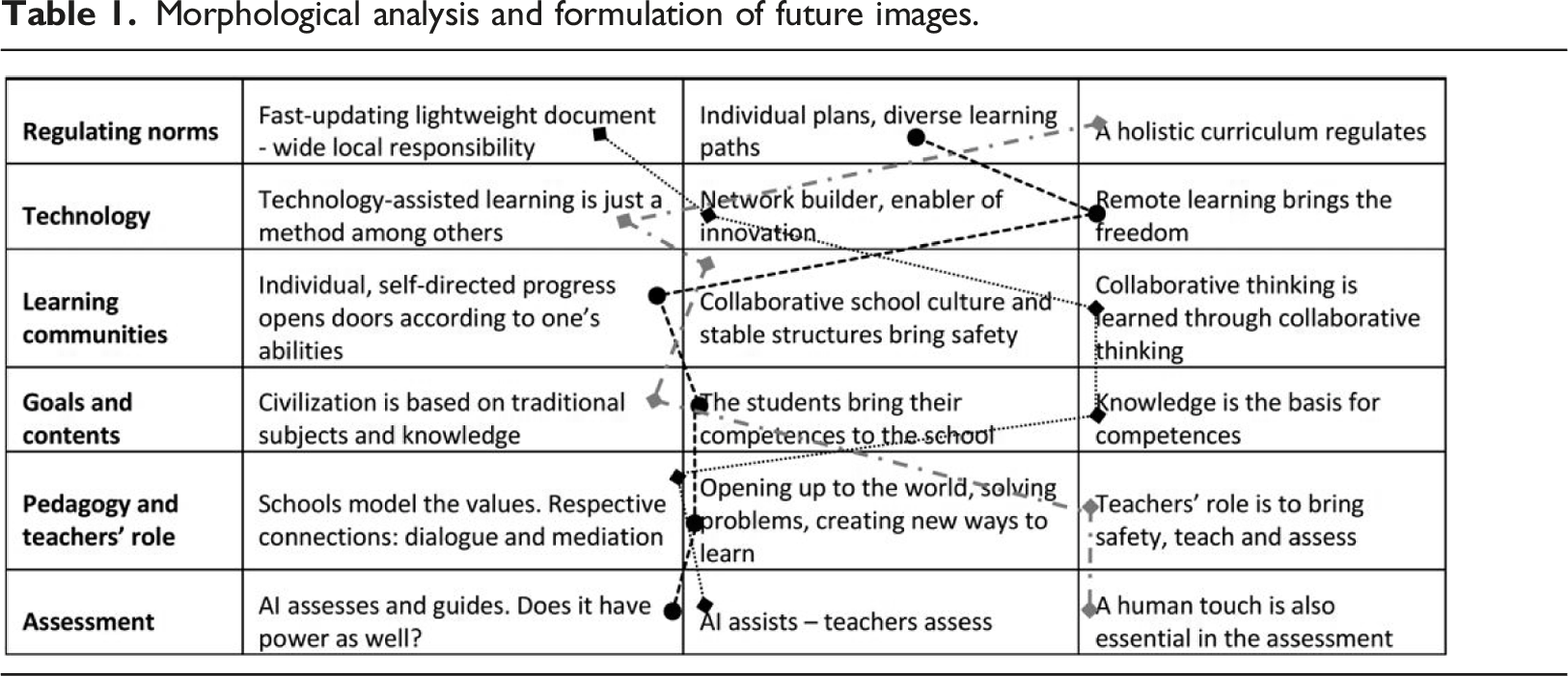
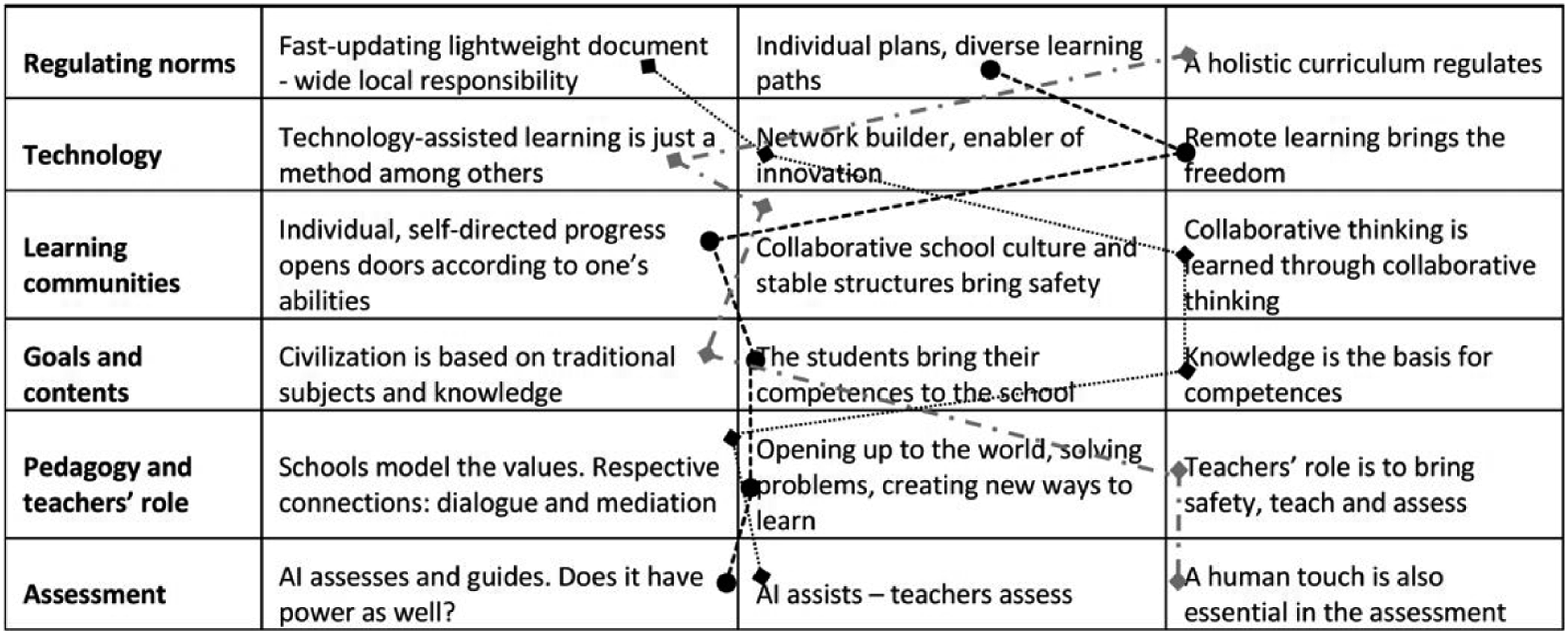
The future images composed in the analysis serve as a foundation for future scenarios in the subsequent analysis phase. In this study, the scenarios were generated using the backcasting method, which aims to build a timeline from the future back to the present and to identify a plausible causal chain of events and decisions that would occur on the way (Bibri, 2018). Backcasting is particularly useful when the phenomenon under study is complex and involves several sectors and levels of society (Dreborg, 1996).
In the next phase, the scenarios were analysed through the lenses of the theoretical framework of this article: curriculum making and the competence–powerful knowledge debate. Relevant elements were identified in the scenario narratives and a summary was composed. Not only were direct references to the theoretical aspects included in the summary, but systemic interpretations, such as changes in societal values leading to specific evolutionary paths, were also included.
Results
The scenarios
A scenario is a tool to summarise futures research outputs. It can be defined as a description of possible future states or conditions within a subject field (Johansen, 2018: 116). Scenarios are not predictions of future events, but they may provide probabilities. Though scenarios are imaginary narratives created by the researcher, they should be plausible, that is, they should be based on current knowledge and the explanations should be understandable. They also have to be logical, that is, possible or expected in the social and cultural context (Kuusi, 2017; Linturi and Rubin, 2011). The primary function of scenarios is to provide decision makers with a range of alternative futures to consider and against which to measure alternative courses of action (Johansen, 2018). The quality of a scenario is determined by how well it serves the decision making. Based on the Delphi panel results, three alternative scenarios for the future of comprehensive school in Finland were formulated. The three scenario narratives are as follows:
Scenario: ‘The smart always survive' The ‘The smart always survive’ scenario is built on society’s grim values. The pursuit of economic growth and the skills it requires are driving the public sector. Competition is increasing in all sectors and society is highly polarised. Education is organised mainly according to parents’ wishes and school paths may be differentiated from the early years of school according to interests, strengths and individual potential. The accelerated digitalisation of learning and good experiences with e-learning during the COVID-19 pandemic have gradually transformed schools into permanent distance learning schools, leading to global hackathons and MOOCs. The traditional comprehensive subject-based curricula were abandoned in Finland, as the implementation of the NCC 2014 failed due to abstract descriptions and a lack of human and financial resources. Instead, based on recommendations from international organisations, descriptions of future competences were created as a basis for personal learning plans. Individual learning plans are designed for every student based on transnational competence models. The whole world serves as learning material and problem-solving skills are practised in real-life situations. Schools as physical buildings are almost nonexistent. There are just shrinking activity centres where those who have fallen off the wagon can get help from a teacher to learn basic skills. Otherwise, the teacher’s role is mainly to monitor and record learning analytics. Instead, the role of parents is essential in making choices and providing guidance for their children.
Scenario: ‘Open to the world’ In the second scenario, the school lives ‘Open to the world’. Society survived the pandemic era and got back on its feet, spiritually and economically. Education as a force for change in society has been restored. Cooperation, responsibility and critical thinking are the values that underpin the school. The school provides a lively and collaborative platform for learning various skills. While transversal competences are emphasised in learning, traditional subjects are not abandoned either. They serve as the ultimate basis for learning and a critical approach to knowledge is valued. The national curriculum framework as a whole was no longer reformed after 2014, but there was a gradual move towards less prescriptive documents—with broad local freedom. The curriculum is a versatile document and is revised frequently, only when necessary and insofar as appropriate. Individual schools and teachers have a significant responsibility to put it into practice. While digital tools connect students to international networks and learning platforms, the COVID-19 pandemic taught us that learning requires significant human interaction and personal support. Empowered by their enhanced role, teachers explore and develop their work as learning communities.
Scenario: ‘Safe nest in a turbulent world.’ The third scenario of the school is ‘Safe nest in a turbulent world’. Society was paralysed after the pandemic and called on schools to help solve the indisposition of children and young people. Society’s values emphasise security, stability and connection. School development took a step backwards, returning to the core of primary education: the goal of ensuring equal rights to learning and education for all. At the same time, centralised management was strengthened, and local powers were reduced. Teachers’ autonomy has decreased while centralised guidance has increased. The national curriculum, updated in 2030, provides structure and predictability for school activities. The curriculum defines goals for subject knowledge, and associated national tests facilitate teachers’ teaching and assessment work. The school has been isolated from external networks, and the world is safely observed behind windows guided by a teacher. Teachers are exempt from development activities to teach—and sometimes, of course, to organise thematic weeks related to transversal skills—for a change. National guidelines on class size limits allow for differentiation and support for pupils, especially in mathematics and languages, when class sizes are small enough. Resources are sufficient and inclusion works well.
Curriculum making, competence and knowledge in scenarios
In the scenario ‘The smart always survive’, the role of the school has changed from traditional education to serving mainly work and business life by producing a skilled workforce and innovative entrepreneurs. National policy frameworks and national control over school activities are minimal, and the international educational policy flows at the supra-level directly impact schools, students and parents. Locally, meso and micro layers of schools and municipalities do not have the possibility of shared sense-making of the curriculum – there is no such thing. However, the role of the teacher is to negotiate the plans and progress of the individual pupil with the parents. Therefore, the nano site of education is not the classroom but the individual student and family. The traditional high autonomy of the teacher in Finland is dissolved, and the responsibility for teaching and pedagogical solutions lies outside the individual teacher and school. The teacher’s position as an interpreter of the curriculum and as an expert in pedagogy has vanished. In addition, the teacher does not have an expert role in assessing learning outcomes according to the curriculum.
The scenario ‘The smart always survive’ bears a resemblance to scenario two presented by Young and Muller (2010) regarding the teacher’s role and especially the nature of knowledge. Traditional school subjects have been superseded by the competences that appear directly in supra-level transnational frameworks. There are no mechanisms to ensure that the knowledge base is achieved by pupils during the school years. The main form of gaining competences is experimental learning, which is mainly based on tacit knowledge without a reasonable basis for research-based (powerful) knowledge. The use of everyday knowledge and the enhancement of competences is a more important goal than building a solid knowledge base in various fields. Learning without a knowledge base does not necessarily guarantee the development of conceptual thinking skills (Demetriou and Spandouis, 2011; Nilivaara et al., 2022; Young and Muller, 2010).
In the ‘Open to the world’ scenario, the structure of the school, or at least the guiding norms, remains relatively unchanged compared to today. The main change from today is a piecemeal reform of the curriculum rather than the current broader reform every 10 years or so. In the scenario, school development and curriculum work would appear to operate top-down and bottom-up. Macro layers of national-level governance set the guidelines for development, but meso and micro sites, such as district and school levels, are ultimately responsible for development. The relationship must be reciprocal. As the curriculum at the national level is partially revised quite frequently, there is a need for a continuous sense-making process at the other layers of curriculum making. The model of the school as a learning organisation described in the scenario also encourages teachers to collaborate on an ongoing basis in a continuous negotiation process and search for common views. It is further emphasised when the national curriculum document is written at a very general level, and its transformation into everyday practice takes place at the micro and nano sites in schools and classrooms. Teacher autonomy is high.
Competences play an essential role in the ‘Open to the world’ scenario, but their weightings and content are negotiated at the national level and, to some extent, in schools. The supra-level educational policy flows are filtered down to the macro-level educational policy, considering national objectives and values. This can be seen, for example, in the emphasis on eco-social education.
However, as a foundation of the competences, there is an emphasis on knowledge and its critical use. Competency thinking in this form can be seen as an element that integrates learning and develops systemic thinking rather than as a set of objectives for the world of work and economy. With some limitations, this scenario could be thought to correspond to what Young and Muller (2010) call powerful knowledge. The development of thinking skills requires conceptual systems learnt through the subject matter. Collaborative learning projects not only generate tacit everyday knowledge but also enable the knowledge and skills acquired at school to be used in authentic situations in interaction with other actors in society. As Niemelä (2021b) and Deng (2021) point out, knowledge boundaries are needed to cross them.
The ‘Safe nest in the turbulent world’ scenario would significantly change the current Finnish curriculum system. Since 1970 when comprehensive school was introduced in Finland, there has been no national curriculum that, as such, guides the activities of schools and teachers without interpretation and an implementation plan at the local level (Vitikka and Rissanen, 2019). In this scenario decisions are made at the national level, and global policy flows do not directly reach the teacher’s activities in a way that requires negotiations and sense-making at the local level. Teacher autonomy as curriculum maker on the micro and nano levels has vanished or ceased entirely. The teacher’s role is only to implement the curriculum, as is the tradition in some cultures. Such a system would hinder the culture of trust considered to be one of the strengths of the Finnish education system. The same effect would apply to the national examinations presented in this scenario, which measure the mastery of school subjects. That is entirely new in Finnish comprehensive schools and would shape assessment practices and reduce the scope for teachers to interpret the curriculum for personalised learning.
As a result of the international curriculum flows, one can see a strong knowledge focus in this scenario. The curriculum mainly contains disciplinary knowledge. As the curriculum is based on relatively static knowledge, the emphasis might be on the natural sciences. It seems that the unquestioned nature of knowledge in this scenario might be what Young and Muller call knowledge of power in their first vision. However, competences or skills are somewhat included in this scenario; they appear on a minimal scale and are not systematically taught if they are mainly based on teacher-organised theme weeks. Collaboration with external parties and other actors in the society is also limited and controlled.
Conclusions and discussion
The aim of this study was to foresee possible futures for Finnish comprehensive school based on educational experts’ images of the future. In this study we formed three scenarios in terms of the National Core Curriculum (NCC) changes that might occur in different scenarios. Our focus was on curriculum making; we asked which layers and sites of social practice are active or seem to have power in different scenarios. We were also interested in the role of competences and disciplinary knowledge in the curriculum, whether one was dominating or if there were tensions in between.
Our results show that Finnish experts have a wide range of, even conflicting, expectations and views on the school of the future. Due to the relevance of the study, the panellists of the Delphi study were selected from those who have traditionally been involved in curriculum making at the national, local and school level. Each of the experts on the panel represents a large number of experts in their field. The views of these experts will be reflected in the possibly forthcoming curriculum process.
A new governmental programme including guidelines for educational transitions is expected to be launched after the general election in 2023. The future direction of basic education is determined by the election results and the values of the powers. The year 2040 is not far away and the guidelines will be built in the forthcoming curriculum reform. The COVID-19 pandemic and the digital leap during school closures have accelerated the futures discourse and pressure on change, especially adducing the potential of digital learning (Tesar, 2021). Time will tell if the post-pandemic period is a turning point in the development of school systems. The results in this study indicate that there are opposite options on what direction should be taken – a return to something safe and well known or a leap into something new? In both cases the core question is how the school can maintain its’ role as a provider of equal opportunities for education and learning of relevant knowledge and skills. How can the school stay as a meaningful experience in the lives of children and young people?
The first scenario, ‘The smart always survive’, sounds dystopic and unfeasible. The role and nature of knowledge in this scenario will become unidentifiable, and the competences dominate the curriculum. This scenario may indicate the ‘fast-policy’ thinking, which reacts quickly to time currents (Hardy et al., 2021). Is the long-term development of Finnish education coming to an end and the power over the direction of schools being handed over to the rapidly changing market forces? What makes this scenario particularly undesirable is that it reinforces the already burgeoning consolidation of parentocracy in Finland. The impact of parents' educational background is already reflected in learning outcomes (Pulkkinen et al., 2018; Seppänen et al., 2015); differences would become even more polarised in this scenario. The success of some individuals comes at too high a price for others.
From the Finnish perspective, the ‘Safe nest in a turbulent world’ scenario also seems to have dystopic features: a national testing system, so far absent in the Finnish education, is introduced, and central steering dominates curriculum making and the teacher dominates the knowledge. Will Finland follow some other countries’ example, such that learning becomes just preparation for national exams instead of sustainable educational values? In this scenario, there is a risk that when schools are called upon to ensure safety for children and young people, they may be forced to take on other functions of society, such as social and health services. The ecosystem of services around the school must be linked to the school in a way and with resources that enable the school to fulfil its basic mission in cultivating personalities and building a solid knowledge base for the students.
Through the lenses of the theoretical framework the, ‘Open to the world’ scenario may have many desirable features, such as strengthening the role of the teacher as a curriculum maker or a rational relationship between competences and powerful knowledge. Looking at the scenario in light of existing policy documents, the building blocks of a school in the scenario can already be found in the current core curriculum. This may indicate that a major system-wide change in the Finnish school system is not a necessity itself, although the discourse around Finnish education and documents created by various stakeholders seem to necessitate it (Säntti et al., 2021). The experts on the Delphi panel criticised the power of supra-level actors such as the OECD to define the Finnish education. At the same time, however, they strongly agreed that the future school should develop competences such as problem-solving skills, critical thinking, creativity and ecological awareness like in the ‘Open to the world’ scenario. Here lies the challenge of designing the future of Finnish schools – how to retain the unique Finnish way and resist the features that are seen as not well suited to the Finnish educational thinking while keeping up with the developments. This requires proactive strategies based on building shared understanding about the desired direction of school. This, in turn, requires strong aspiration to maintain trust between different stakeholders. To succeed we need a solid knowledge base and powerful knowledge, which can be applied in collaborative settings. This is true in terms of both solving the world’s wicked problems as well as in curriculum making.
It seems that there are visions of how to resolve the tension between knowledge and competences and models of how powerful knowledge could be encompassed into modern integrated curricula, enabling multidisciplinary learning and the cultivation of personal powers or capabilities to be presented in the field (e.g., Carlgren, 2020; Deng, 2018, 2021; Niemelä, 2021b). A recent educational psychology-based model also seeks to find common ground between views (Nilivaara et al., 2022; Vainikainen and Koivuhovi, 2022). According to this model’s definition, transversal competences ‘aim at raising active members of society through subject-based teaching who think critically, so that the contents and perspectives of each subject reinforce the learner’s capacities for action’ (Hienonen et al., 2022: 6). This might be the basis for ‘Open to the world’ school. On the other hand, combining strong knowledge base and transversal competences in the core curriculum, like in this scenario, may send a confusing message to the teachers: what to prioritise? (Priestley and Sinnema, 2014). To integrate disciplines and cross boundaries of school subjects, there should be enough guidance in the national curriculum documents for teachers to succeed in their teaching (Deng, 2021; Niemelä, 2021b).
The study results show that Finnish comprehensive schools have various substantially divergent trends in terms of the teacher’s role as a curriculum maker. In ‘Smart always survive’ and ‘Safe nest’ scenarios, teachers’ autonomy and role as pedagogical specialists are limited or non-existent. Instead, the ‘Open to the world’ scenario might leave room for Finnish teachers’ expertise as curriculum makers and strong interpreters. Compared to many other countries, views on how to develop Finnish school among curriculum makers has been rather unanimous, and the curriculum is experienced as coherent (e.g., Salonen-Hakomäki et al., 2016; Tikkanen et al., 2020). These varying scenarios are especially interesting in light of recent lively discussion on teacher agency (e.g., Pietarinen et al., 2016; Priestley et al., 2015a; Priestley et al. 2015b; Priestley et al., 2021b). Teacher agency is either supported or hindered not only by the curriculum but also by social practices of curriculum making. Achieving agency requires a curriculum for teacher agency and teacher agency for the curriculum (Priestley et al., 2022).
The scenarios have been formulated to outline possible and alternative futures, which some see as desirable and others as potentially threatening. It is obvious that none of the scenarios presented in the study will be realised as such. Still, they can provide a mirror through which different trajectories can be viewed, and a tool for critical reflection on today’s practices. In the study no consensus was sought, instead the aim was to point out elements to consider: what needs to change in Finnish comprehensive school and what is worth preserving.
Footnotes
Declaration of conflicting interests
The author(s) declared no potential conflicts of interest with respect to the research, authorship, and/or publication of this article.
Funding
The author(s) disclosed receipt of the following financial support for the research, authorship, and/or publication of this article: This work was supported by the The Academy of Finland (326647).
